Oxidation Number or Oxidation State
 Oxidation number or oxidation state is the number of electrons that
an atom appears to have gained or lost when it is combined with
other atoms.
Rules for Assigning Oxidation Numbers
Rule 1: The oxidation number of all elements in Free State is zero.
This rule is also applied for diatomic or polyatomic elements.
Example: The oxidation number of Na = 0, Cu = 0, Cl in Cl2 = 0, O
in O3 = 0, S in S8 = 0.
 Rule 2: The oxidation number of a monatomic ion is equal to the
charge on the ion.
Example: Na+
= +1, Mg2+
= +2, S2–
= -2.
Rule 3: The oxidation number of oxygen in a compound is usually
-2 except in the following cases:
Belay B.
Cont….
Exceptions
The oxidation number of oxygen in:
i) Peroxides is -1. Example: Na2O2
ii) superoxides is -1/2. Example: KO2
iii) Oxygen diflouride is +2. Example: OF2
 Rule 4: The oxidation number of hydrogen in its entire
compounds is +1 except in metal hydrides, (like NaH, CaH2
and AlH3), where its oxidation number is -1.
 Rule 5: The sum of the oxidation number of all the atoms in a
neutral compound is zero.
 Rule 6: In a polyatomic ion, the sum of the oxidation numbers
of the constituent atoms equals the charge on the ion.
Belay B.
Cont…
 Rule 7: Elements of group IA have +1 and group IIA have +2
oxidation states in all of their compounds.
 Rule 8: In a compound, the more electronegative element is
assigned a negative oxidation number, and the less electronegative
element is assigned a positive oxidation number.
Example: - 1) Find the oxidation number of
a. Cr in K2Cr2O7 b. Mn in MnO4 c. N in NH4
Solution: a) The sum of the oxidation numbers must equal to zero
since it is neutral compound. Assign X for the unknown: -
K: 2 (+1) = +2, K is alkali metal
Cr: 2 (X) = 2x
O: 7 (-2) = -14
Sum =0, this is means, (+2) + 2x + (-14) =0
Belay B.
Cont …
2x - 12 =0
2x = 12
X = +6, Therefore the oxidation number of Cr in
K2Cr2O7 is +6.
b) The sum of the oxidation numbers equals to -1.
Mn: 1 (x) =X
O: 4 (-2) =-8
Sum = -1, Therefore, x + (-8) = -1
X = -1 + 8
X = +7, thus, the oxidation state of Mn in MnO4 is +7.
Belay B.
Cont...
Oxidizing and Reducing Agents
 Oxidizing Agents are substances that are reduced (gains
electrons).
 Decreases in oxidation state.
 Acquires electrons.
 Elements with high electronegativity such as F2, O2, N2 and Cl2
are good oxidizing agents.
 KMnO4 , NaClO4 ,K2 Cr2 O7 ..... are oxidizing agents
 Are also known as Oxidants.
 Reducing Agents are substances that are oxidized (loses
electrons).
 Increases in oxidation state.
 Loses electrons.
Belay B.
Cont….
 Elements with low electronegativity for example, metallic elements
like Na, K, Mg and Al are good reducing agents.
 FeS, CO, Na2SO3 ……. are reducing agents.
 Are also known as Reductant
Analyzing Redox Reactions
 Oxidation and reduction reactions are called Redox reactions.
 Redox reactions involve transfer of electrons.
 Oxidation and reduction reaction take place simultaneously in a
given reaction.
 It means if there is oxidation, there must be reduction.
 Non - redox reactions:- do not involve transfer of electrons.
Examples: - - Double displacement reactions
- Neutralization reactions
Belay B.
RATES OF CHEMICAL REACTIONS AND CHEMICAL
EQUILIBRIUM
Rates of chemical reaction
 Reaction rate is the speed at which the reactants disappear or the
products appear.
 The branch of chemistry that is concerned with the rate of chemical
reaction is known as chemical kinetics.
 The rate of a chemical reaction measures the decrease in
concentration of a reactant or the increase in concentration of a
product per unit time.
 Methods of determining the concentration of reactants or products
are:
 color change
 Increase or decrease in pressure or volume
 Gain or lose of mass
 Formation of insoluble solid called precipitate.
Belay B.
cont…
 This means that the rate of a reaction determines how fast the
concentration of a reactant or product changes with time
Rate of reaction = =
 The rate of a reaction is inversely proportional to the time
taken by the reaction.
Rate
Pre-conditions for a Chemical Reaction
• Chemical reactions are usually explained by the collision
theory.
• Collision theory states that the rate of a reaction is directly
proportional to the number of collisions occurring each second
between the reacting particles.
Belay B.
Cont…
• Rate
 According to collision theory , chemical reactions occur if:
1. Collisions between reactants
• This means direct touch of reacting molecules.
• There are two types of collisions
A) Effective collision
- Results desired products
B) In effective collision
- Results no products or unwanted products.
2. Activation energy
• The minimum amount of energy needed for the reaction.
• Chemical reaction occurs if the energy of the reactants is greater
than or equal to activation energy.
Belay B.
Cont …
3. Proper Orientation
• Unless reactants arranged in proper position, there is no desired products.
Factors Affecting the Rates of Chemical Reaction
1. Nature of the reactants
 Some chemical reactions are naturally fast others are slow depending of
the nature of reacting substances.
Examples - 2Na + 2H2O → 2NaOH + H2 (fast)
- Ca + 2H2O → Ca(OH)2 + H2( slow)
 The first is fast and the second slow due to sodium is more reactive than
calcium.
2. Temperature
 An increase in temperature increases the rate of a reaction.
Belay B.
Cont…
 This is because as the temperature increases, the average kinetic energy of
the particles increases which in turn increases the number of effective
collisions.
 In general, for many chemical reactions, the rate of a reaction doubles for
every 10°C rise in temperature.
3. Concentration of reactants
 The number of collisions is proportional to the concentration of reactants.
 The higher the concentration of the reactants, the more collisions between
the reacting particles and thus the higher the rate of the reaction.
4. Surface area
 As surface area increases the rate of a reaction increases.
Belay B.
Cont ……
Examples:
CaCO3 (powder) + 2HCl → CaCl2 + CO2 + H2O…. ( fast )
CaCO3 (crystal) + 2HCl → CaCl2 + CO2 + H2O….. (slow )
 Powdered CaCO3 has larger surface area than crystal CaCO3.
5. Catalysts
 A catalyst is a substance that speed up the rate of a chemical
reaction without itself being consumed in course of the reaction.
 Catalysts increase the rate of chemical reaction by lowering
activation energy.
6. Pressure
 Pressure affects the rate of gaseous reaction.
 Increasing pressure or lowering, volume increases the rate of
reaction.
Belay B.
Chemical Equilibrium
 Chemical reactions can be divided into two:
1. Irreversible reactions
- One way reaction and proceed to completion.
- Are also known as forward reaction.
- Reactants are quantitatively converted to products .
- Have general formula, A → B
- The amount of limiting reactant that remains is negligible.
2. Reversible reactions
- Are two ways reactions and do not go to completion.
- Are also known as backward reaction
- Have general formula
X + Y W + Z
Belay B.
Cont ….
• Chemical equilibrium is the state of a chemical system in which
the rates of the forward and reverse reactions are equal.
• At the state of chemical equilibrium, there is no net change in the
concentrations of reactants and products because the system is in
dynamic equilibrium.
• Dynamic equilibrium means the reaction does not stop and both
the forward and the backward reactions continue at equal rates.
At equilibrium, Rate of forward reaction = Rate of reverse
reaction
• The law of chemical equilibrium can be expressed
mathematically using the molar concentrations of reactants and
products at equilibrium.
Belay B.
Cont ….
• The concentration of species is denoted by enclosing the
formula in square bracket [ ]. Thus, for the reversible reaction:
aA+bB⇄cC + dD
Rate of forward reaction = where and are rate constants for the
Rate of reverse reaction = forward and reverse reactions
respectively.
Since at equilibrium the rate of the forward reaction equals the
rate of the reverse reaction, it follows:
UNIT 5
PHYSICAL STATES OF MATTER
Introduction
 Everything around our environment is matter.
 Matter is anything that has mass and occupy spaces.
 The changes of the states of matter are our every day experience.
 The physical state of a given sample of matter depends on the
temperature and pressure.
 It can exist in the form of solid, liquid and gas.
 Plasma state exists a fourth-state of matter at very high
temperature (million degrees Celsius).
 At such high temperatures molecules cannot exist.
 Most or all of the atoms are stripped of their electrons.
Belay B.
Cont ….
 Because of the extreme temperatures needed for fusion, no
material can exist in the plasma state.
KINETIC THEORY AND PROPERTIES OF
MATTER
The Kinetic Theory of Matter
 The three states of matter in which substances are chemically
the same but physically different are explained by the kinetic
theory of matter.
 The kinetic theory of matter gives an explanation of the nature
of the motion and the heat energy.
 According to the kinetic theory of matter, every substance
consists of a very large number of very small particles called
ions, atoms and molecules.
Belay B.
Cont….
 The particles are in a state of continuous and random motion with all
possible velocities. The motion of the particles increases with a rise
in temperature.
Generally, the kinetic theory of matter is based on the following
three assumptions:
1.All matter is composed of particles which are in constant motion.
2. The particles possess kinetic energy and potential energy.
3. The difference between the three states of matter is due to their
energy contents and the motion of the particles.
Properties of Matter
 Matter exists as solids, liquids and gases. Their properties are
explained in terms of the kinetic theory as follows:
Belay B.
Properties of Solids
 From the kinetic molecular theory of solids, the following general
properties of gases can be summarized.
1. Solids have a definite shape and a definite volume.
2. Solids generally have higher densities than gases and liquids.
3. Solid are extremely difficult to compress.
4. Solids are not fluids.
5. Solids do not diffuse.
6. Solids have no freedom of motion simply vibrate.
Properties of liquids
1. Liquids have a definite volume but have no definite shape.
2. Liquids have higher densities than gases.
3. Liquids are slightly compressible.
4. Liquids are fluids i.e that can easily flow.
5. Motion of liquids more restricted than gases.
Belay B.
Properties of gases
 From the kinetic molecular theory of gases, the following general
properties of gases can be summarized.
1. Gases have no definite shape and definite volume.
2. Gases can be easily compressed.
3. Gases have low densities compared with liquids and solids.
4. Gases exert pressure in all directions.
5. Gases easily flow and diffuse through one another.
6. Gas particles are in irregular pattern.
The Kinetic Molecular Theory of Gases
1. The particles are in a state of constant, continuous, rapid, random
motion and, therefore, possess kinetic energy.
2. The volume of the particles is negligible compared to the total
volume of the gas. Gases are composed of separate, tiny invisible
particles called molecules.
Belay B.
Cont…
3. The attractive forces between the particles are negligible. There are
no forces of attraction or repulsion between gas particles. When they
collide, they do not stick together but immediately bounce apart.
4. The average kinetic energy of gas particles depends on the
temperature of the gas. At any particular moment, the molecules in a
gas have different velocities. The mathematical formula for kinetic
energy is K.E. = ½ , where m is mass and ν is velocity of gas
molecules.
5. The average kinetic energy of the gas is directly proportional to
the absolute temperature of the gas.
The Gas Laws
 The gas laws express mathematical relationships between the
volume, temperature, pressure, and quantity of a gas.
Pressure: pressure is defined as the force applied per unit area.
Belay B.
Cont…
pressure =
P =
 The SI unit of pressure is Pascal(Pa).
1 Pa = 1
 Other units of pressure are atmosphere, mmHg, torr, cmHg
1 atm = 760 mmHg = 76 cmHg = 760 torr = 101325 Pa = 101.325 kPa
1 mmHg = 1 torr
Example a) Convert 1520 torr into atmosphere.
Solution: atm = × torr = × mmHg
atm = 2atm
Therefore 1520 torr is equals to 2 atm.
Belay B.
Volume
 Volume is the space taken up by a body.
 The SI unit of volume is the cubic meter ().
 Volume is also expressed in cubic centimeter () and cubic
decimeter ().
 Other common units of volume are milliliter (mL) and liter
(L).
1 = 1000L = 1000 = 1000000mL = 1000000
1L = 1
1 mL = 1
1 L = 1000mL = 1000
Example a) How many liters are equivalent to 150 mL?
Solution: a) L = × mL
L = × 150mL
L = 0.15L, Therefore 0.15L is equals to 150mL.
Belay B.
Temperature
 Temperature is the degree of hotness or coldness of a body.
 The SI unit of temperature is Kelvin (K)
 Three temperature scales are commonly used. These are °F
(degree Fahrenheit), °C (degree Celsius) and K (Kelvin). We
use the following formulae for all necessary inter conversions:
0
C = (0
F – 32)
0
F = 0
C + 32
K = 0
C + 273
Example :- 1) Express body temperature, 37 0
C in
a) K b) 0
F
Solution:
A. K = 0
C + 273
K = 37 + 273
= 310 K Belay B.
Molar Volume and Standard Conditions (STP)
 The conditions of a pressure of 1 atmosphere and a temperature
of 0oC (273.14 K) are called standard temperature and pressure
or STP for gases.
 At STP the volume of one mole of any gas is equal to 22.4 liters.
This volume is known as molar gas volume.
 Quantity of gas: The quantity of a gas is expressed in mole (n).
 Mole is the quantity of gas in terms of number of particles.
 It is the number of atoms or molecules in 1 gram-atom or 1
gram-molecule of an element or a compound.
Belay B.
1. Boyles’ Law
 States that volume (V) is inversely proportional to pressure (P) at
constant temperature and number of mole (n).
V ( at constant T and n )
V = K or PV = K
where k is a constant at a specific temperature for a given sample
of gas.
 If and represent the initial conditions; and and represent the new
or final conditions, Boyle’s law can be written as:
= ;
Example 1 An inflated balloon has a volume of 0.55 L at sea level
(1.0 atm) and is allowed to rise to a height of 6.5 km, where the
pressure is about 0.40 atm. Assuming that the temperature remains
constant, what is the final volume of the balloon?
Solution:
Belay
B.
Cont…
Givens:
Use Boyles’ law equation: =
Therefore, =
Belay B.
Finalconditions
=1.0atm =0.40atm
=?
2. Charles’ Law
 States that the volume of a gas is directly proportional to
temperature at constant pressure and number of mole.
Mathematically; V T (at constant p and n)
V = KT or = K
3. The Combined Gas Law
 It is the combination of Boyles’ law and Charles’ law.
Boyles’ law : V
Charles’ law : V T
Combined gas law : V
V = K ( where K is a constant)
4. Avogadro’s law
 States that equal volumes of different gases, under the same
conditions of temperature and pressure, contain the same
number of molecules.
 Thus, according to the law the volume of a gas is proportional
to the number of molecules (moles) of the gas at STP.
Mathematically, V α n(at constant T and P)
=
Example :1)
5. The Ideal Gas Equation
 It is also called the equation of state for ideal gas because
relates pressure, volume, temperature and number of mole of a
gas at any condition.
 The ideal gas law is a combination of Boyle’s law, Charles’
law and Avogadro’s law.
Boyles’ law : V (at constant T and n)
Charles’ law : V T (at constant P and n)
Avogadro's law : V α n (at constant T and P)
 This relationship indicates how the volume of gas depends on
pressure, temperature and number of moles.
V or V = R
where R, is a proportionality constant called the gas constant.
PV= nRT (the ideal gas equation)
Belay B.
Cont…
 At STP, the values of R can be calculated from the ideal gas
equation.
R = =
= 0.082057 = 8.314 = 8.314
Example
Calculate the volume (in L) occupied by 7.4 g of CO2 at STP?
Solution:
The ideal gas equation is given as
PV = nRT
V = (since n = by rearranging V = )
= 0.082 = 3.77L
Belay B.
6. Graham's Law of Diffusion
 Diffusion is the tendency of a gas to mix spontaneously and
spread throughout another gas.
 Graham’s law of diffusion states that at constant temperature
and pressure, the rate of diffusion of a gas, r, is inversely
proportional to the square root of its density, d or molar mass,
M.
Mathematically it can be expressed as:
r or r
where r is the rate of diffusion, d is the density and M is the
molecular mass of the gas.
 For two gases A and B
= =
Belay B.
cont…..
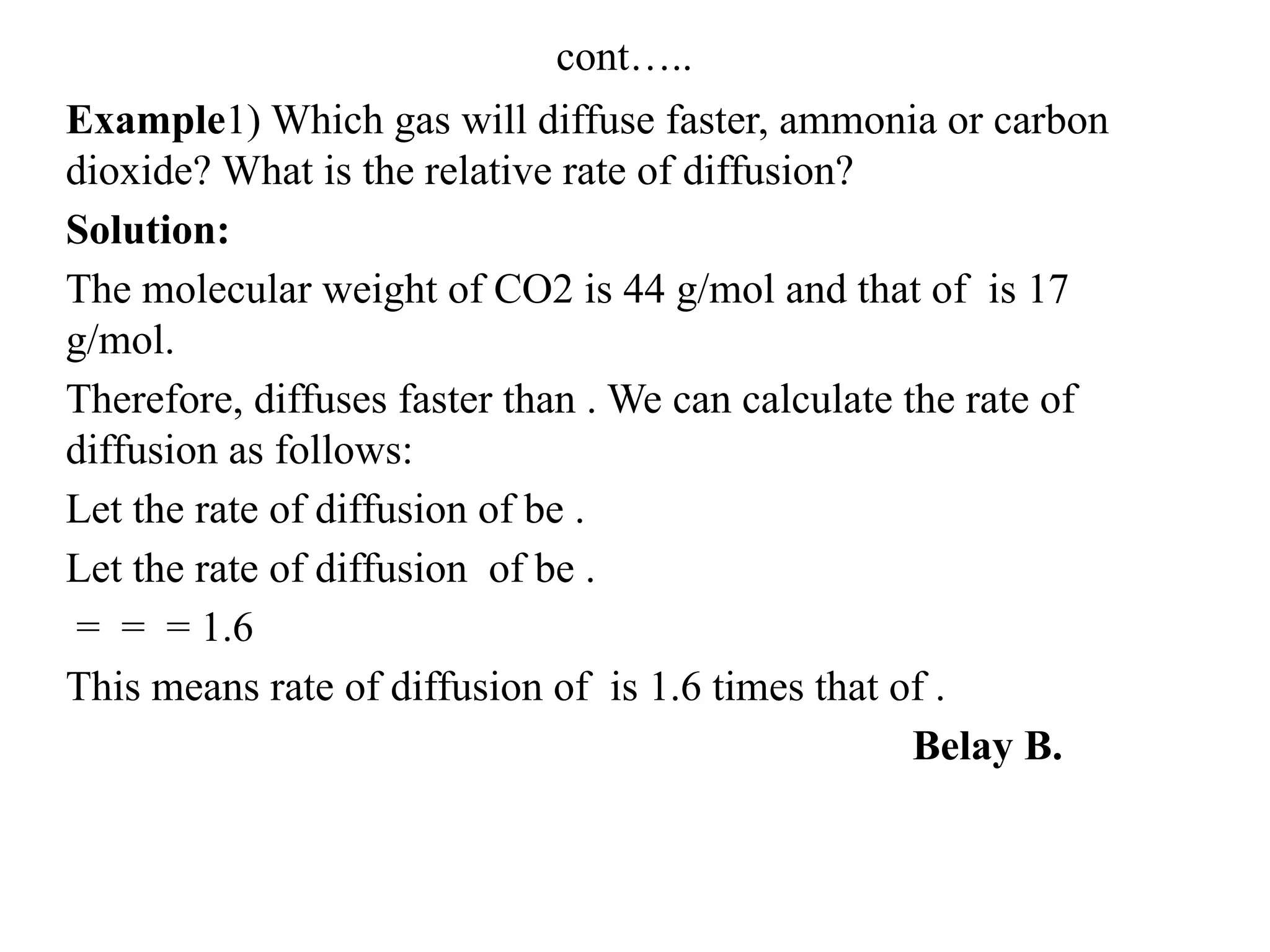
Example1) Which gas will diffuse faster, ammonia or carbon
dioxide? What is the relative rate of diffusion?
Solution:
The molecular weight of CO2 is 44 g/mol and that of is 17
g/mol.
Therefore, diffuses faster than . We can calculate the rate of
diffusion as follows:
Let the rate of diffusion of be .
= = = 1.6
This means rate of diffusion of is 1.6 times that of .
Belay B.
THE LIQUID STATE
Energy Changes in Liquids
 vaporization is a process by which a liquid changes to a gas.
 Evaporation is the process by which liquid molecules break
freely from the liquid surface and enter the vapor phase.
 Evaporation is explained in terms of the energy possessed
by the molecules on the surface of the liquid.
 condensation is a process by which vapor returns to the
liquid state.
 Evaporation and condensation are opposing processes.

@Tmhrt_Minister_Oxidation_&_Physical_state_of_matter_best_ppt.pptx

  • 1.
    Oxidation Number orOxidation State  Oxidation number or oxidation state is the number of electrons that an atom appears to have gained or lost when it is combined with other atoms. Rules for Assigning Oxidation Numbers Rule 1: The oxidation number of all elements in Free State is zero. This rule is also applied for diatomic or polyatomic elements. Example: The oxidation number of Na = 0, Cu = 0, Cl in Cl2 = 0, O in O3 = 0, S in S8 = 0.  Rule 2: The oxidation number of a monatomic ion is equal to the charge on the ion. Example: Na+ = +1, Mg2+ = +2, S2– = -2. Rule 3: The oxidation number of oxygen in a compound is usually -2 except in the following cases: Belay B.
  • 2.
    Cont…. Exceptions The oxidation numberof oxygen in: i) Peroxides is -1. Example: Na2O2 ii) superoxides is -1/2. Example: KO2 iii) Oxygen diflouride is +2. Example: OF2  Rule 4: The oxidation number of hydrogen in its entire compounds is +1 except in metal hydrides, (like NaH, CaH2 and AlH3), where its oxidation number is -1.  Rule 5: The sum of the oxidation number of all the atoms in a neutral compound is zero.  Rule 6: In a polyatomic ion, the sum of the oxidation numbers of the constituent atoms equals the charge on the ion. Belay B.
  • 3.
    Cont…  Rule 7:Elements of group IA have +1 and group IIA have +2 oxidation states in all of their compounds.  Rule 8: In a compound, the more electronegative element is assigned a negative oxidation number, and the less electronegative element is assigned a positive oxidation number. Example: - 1) Find the oxidation number of a. Cr in K2Cr2O7 b. Mn in MnO4 c. N in NH4 Solution: a) The sum of the oxidation numbers must equal to zero since it is neutral compound. Assign X for the unknown: - K: 2 (+1) = +2, K is alkali metal Cr: 2 (X) = 2x O: 7 (-2) = -14 Sum =0, this is means, (+2) + 2x + (-14) =0 Belay B.
  • 4.
    Cont … 2x -12 =0 2x = 12 X = +6, Therefore the oxidation number of Cr in K2Cr2O7 is +6. b) The sum of the oxidation numbers equals to -1. Mn: 1 (x) =X O: 4 (-2) =-8 Sum = -1, Therefore, x + (-8) = -1 X = -1 + 8 X = +7, thus, the oxidation state of Mn in MnO4 is +7. Belay B.
  • 5.
    Cont... Oxidizing and ReducingAgents  Oxidizing Agents are substances that are reduced (gains electrons).  Decreases in oxidation state.  Acquires electrons.  Elements with high electronegativity such as F2, O2, N2 and Cl2 are good oxidizing agents.  KMnO4 , NaClO4 ,K2 Cr2 O7 ..... are oxidizing agents  Are also known as Oxidants.  Reducing Agents are substances that are oxidized (loses electrons).  Increases in oxidation state.  Loses electrons. Belay B.
  • 6.
    Cont….  Elements withlow electronegativity for example, metallic elements like Na, K, Mg and Al are good reducing agents.  FeS, CO, Na2SO3 ……. are reducing agents.  Are also known as Reductant Analyzing Redox Reactions  Oxidation and reduction reactions are called Redox reactions.  Redox reactions involve transfer of electrons.  Oxidation and reduction reaction take place simultaneously in a given reaction.  It means if there is oxidation, there must be reduction.  Non - redox reactions:- do not involve transfer of electrons. Examples: - - Double displacement reactions - Neutralization reactions Belay B.
  • 7.
    RATES OF CHEMICALREACTIONS AND CHEMICAL EQUILIBRIUM Rates of chemical reaction  Reaction rate is the speed at which the reactants disappear or the products appear.  The branch of chemistry that is concerned with the rate of chemical reaction is known as chemical kinetics.  The rate of a chemical reaction measures the decrease in concentration of a reactant or the increase in concentration of a product per unit time.  Methods of determining the concentration of reactants or products are:  color change  Increase or decrease in pressure or volume  Gain or lose of mass  Formation of insoluble solid called precipitate. Belay B.
  • 8.
    cont…  This meansthat the rate of a reaction determines how fast the concentration of a reactant or product changes with time Rate of reaction = =  The rate of a reaction is inversely proportional to the time taken by the reaction. Rate Pre-conditions for a Chemical Reaction • Chemical reactions are usually explained by the collision theory. • Collision theory states that the rate of a reaction is directly proportional to the number of collisions occurring each second between the reacting particles. Belay B.
  • 9.
    Cont… • Rate  Accordingto collision theory , chemical reactions occur if: 1. Collisions between reactants • This means direct touch of reacting molecules. • There are two types of collisions A) Effective collision - Results desired products B) In effective collision - Results no products or unwanted products. 2. Activation energy • The minimum amount of energy needed for the reaction. • Chemical reaction occurs if the energy of the reactants is greater than or equal to activation energy. Belay B.
  • 10.
    Cont … 3. ProperOrientation • Unless reactants arranged in proper position, there is no desired products. Factors Affecting the Rates of Chemical Reaction 1. Nature of the reactants  Some chemical reactions are naturally fast others are slow depending of the nature of reacting substances. Examples - 2Na + 2H2O → 2NaOH + H2 (fast) - Ca + 2H2O → Ca(OH)2 + H2( slow)  The first is fast and the second slow due to sodium is more reactive than calcium. 2. Temperature  An increase in temperature increases the rate of a reaction. Belay B.
  • 11.
    Cont…  This isbecause as the temperature increases, the average kinetic energy of the particles increases which in turn increases the number of effective collisions.  In general, for many chemical reactions, the rate of a reaction doubles for every 10°C rise in temperature. 3. Concentration of reactants  The number of collisions is proportional to the concentration of reactants.  The higher the concentration of the reactants, the more collisions between the reacting particles and thus the higher the rate of the reaction. 4. Surface area  As surface area increases the rate of a reaction increases. Belay B.
  • 12.
    Cont …… Examples: CaCO3 (powder)+ 2HCl → CaCl2 + CO2 + H2O…. ( fast ) CaCO3 (crystal) + 2HCl → CaCl2 + CO2 + H2O….. (slow )  Powdered CaCO3 has larger surface area than crystal CaCO3. 5. Catalysts  A catalyst is a substance that speed up the rate of a chemical reaction without itself being consumed in course of the reaction.  Catalysts increase the rate of chemical reaction by lowering activation energy. 6. Pressure  Pressure affects the rate of gaseous reaction.  Increasing pressure or lowering, volume increases the rate of reaction. Belay B.
  • 13.
    Chemical Equilibrium  Chemicalreactions can be divided into two: 1. Irreversible reactions - One way reaction and proceed to completion. - Are also known as forward reaction. - Reactants are quantitatively converted to products . - Have general formula, A → B - The amount of limiting reactant that remains is negligible. 2. Reversible reactions - Are two ways reactions and do not go to completion. - Are also known as backward reaction - Have general formula X + Y W + Z Belay B.
  • 14.
    Cont …. • Chemicalequilibrium is the state of a chemical system in which the rates of the forward and reverse reactions are equal. • At the state of chemical equilibrium, there is no net change in the concentrations of reactants and products because the system is in dynamic equilibrium. • Dynamic equilibrium means the reaction does not stop and both the forward and the backward reactions continue at equal rates. At equilibrium, Rate of forward reaction = Rate of reverse reaction • The law of chemical equilibrium can be expressed mathematically using the molar concentrations of reactants and products at equilibrium. Belay B.
  • 15.
    Cont …. • Theconcentration of species is denoted by enclosing the formula in square bracket [ ]. Thus, for the reversible reaction: aA+bB⇄cC + dD Rate of forward reaction = where and are rate constants for the Rate of reverse reaction = forward and reverse reactions respectively. Since at equilibrium the rate of the forward reaction equals the rate of the reverse reaction, it follows:
  • 19.
    UNIT 5 PHYSICAL STATESOF MATTER Introduction  Everything around our environment is matter.  Matter is anything that has mass and occupy spaces.  The changes of the states of matter are our every day experience.  The physical state of a given sample of matter depends on the temperature and pressure.  It can exist in the form of solid, liquid and gas.  Plasma state exists a fourth-state of matter at very high temperature (million degrees Celsius).  At such high temperatures molecules cannot exist.  Most or all of the atoms are stripped of their electrons. Belay B.
  • 20.
    Cont ….  Becauseof the extreme temperatures needed for fusion, no material can exist in the plasma state. KINETIC THEORY AND PROPERTIES OF MATTER The Kinetic Theory of Matter  The three states of matter in which substances are chemically the same but physically different are explained by the kinetic theory of matter.  The kinetic theory of matter gives an explanation of the nature of the motion and the heat energy.  According to the kinetic theory of matter, every substance consists of a very large number of very small particles called ions, atoms and molecules. Belay B.
  • 21.
    Cont….  The particlesare in a state of continuous and random motion with all possible velocities. The motion of the particles increases with a rise in temperature. Generally, the kinetic theory of matter is based on the following three assumptions: 1.All matter is composed of particles which are in constant motion. 2. The particles possess kinetic energy and potential energy. 3. The difference between the three states of matter is due to their energy contents and the motion of the particles. Properties of Matter  Matter exists as solids, liquids and gases. Their properties are explained in terms of the kinetic theory as follows: Belay B.
  • 22.
    Properties of Solids From the kinetic molecular theory of solids, the following general properties of gases can be summarized. 1. Solids have a definite shape and a definite volume. 2. Solids generally have higher densities than gases and liquids. 3. Solid are extremely difficult to compress. 4. Solids are not fluids. 5. Solids do not diffuse. 6. Solids have no freedom of motion simply vibrate. Properties of liquids 1. Liquids have a definite volume but have no definite shape. 2. Liquids have higher densities than gases. 3. Liquids are slightly compressible. 4. Liquids are fluids i.e that can easily flow. 5. Motion of liquids more restricted than gases. Belay B.
  • 23.
    Properties of gases From the kinetic molecular theory of gases, the following general properties of gases can be summarized. 1. Gases have no definite shape and definite volume. 2. Gases can be easily compressed. 3. Gases have low densities compared with liquids and solids. 4. Gases exert pressure in all directions. 5. Gases easily flow and diffuse through one another. 6. Gas particles are in irregular pattern. The Kinetic Molecular Theory of Gases 1. The particles are in a state of constant, continuous, rapid, random motion and, therefore, possess kinetic energy. 2. The volume of the particles is negligible compared to the total volume of the gas. Gases are composed of separate, tiny invisible particles called molecules. Belay B.
  • 24.
    Cont… 3. The attractiveforces between the particles are negligible. There are no forces of attraction or repulsion between gas particles. When they collide, they do not stick together but immediately bounce apart. 4. The average kinetic energy of gas particles depends on the temperature of the gas. At any particular moment, the molecules in a gas have different velocities. The mathematical formula for kinetic energy is K.E. = ½ , where m is mass and ν is velocity of gas molecules. 5. The average kinetic energy of the gas is directly proportional to the absolute temperature of the gas. The Gas Laws  The gas laws express mathematical relationships between the volume, temperature, pressure, and quantity of a gas. Pressure: pressure is defined as the force applied per unit area. Belay B.
  • 25.
    Cont… pressure = P = The SI unit of pressure is Pascal(Pa). 1 Pa = 1  Other units of pressure are atmosphere, mmHg, torr, cmHg 1 atm = 760 mmHg = 76 cmHg = 760 torr = 101325 Pa = 101.325 kPa 1 mmHg = 1 torr Example a) Convert 1520 torr into atmosphere. Solution: atm = × torr = × mmHg atm = 2atm Therefore 1520 torr is equals to 2 atm. Belay B.
  • 26.
    Volume  Volume isthe space taken up by a body.  The SI unit of volume is the cubic meter ().  Volume is also expressed in cubic centimeter () and cubic decimeter ().  Other common units of volume are milliliter (mL) and liter (L). 1 = 1000L = 1000 = 1000000mL = 1000000 1L = 1 1 mL = 1 1 L = 1000mL = 1000 Example a) How many liters are equivalent to 150 mL? Solution: a) L = × mL L = × 150mL L = 0.15L, Therefore 0.15L is equals to 150mL. Belay B.
  • 27.
    Temperature  Temperature isthe degree of hotness or coldness of a body.  The SI unit of temperature is Kelvin (K)  Three temperature scales are commonly used. These are °F (degree Fahrenheit), °C (degree Celsius) and K (Kelvin). We use the following formulae for all necessary inter conversions: 0 C = (0 F – 32) 0 F = 0 C + 32 K = 0 C + 273 Example :- 1) Express body temperature, 37 0 C in a) K b) 0 F Solution: A. K = 0 C + 273 K = 37 + 273 = 310 K Belay B.
  • 28.
    Molar Volume andStandard Conditions (STP)  The conditions of a pressure of 1 atmosphere and a temperature of 0oC (273.14 K) are called standard temperature and pressure or STP for gases.  At STP the volume of one mole of any gas is equal to 22.4 liters. This volume is known as molar gas volume.  Quantity of gas: The quantity of a gas is expressed in mole (n).  Mole is the quantity of gas in terms of number of particles.  It is the number of atoms or molecules in 1 gram-atom or 1 gram-molecule of an element or a compound. Belay B.
  • 29.
    1. Boyles’ Law States that volume (V) is inversely proportional to pressure (P) at constant temperature and number of mole (n). V ( at constant T and n ) V = K or PV = K where k is a constant at a specific temperature for a given sample of gas.  If and represent the initial conditions; and and represent the new or final conditions, Boyle’s law can be written as: = ; Example 1 An inflated balloon has a volume of 0.55 L at sea level (1.0 atm) and is allowed to rise to a height of 6.5 km, where the pressure is about 0.40 atm. Assuming that the temperature remains constant, what is the final volume of the balloon? Solution: Belay B.
  • 30.
    Cont… Givens: Use Boyles’ lawequation: = Therefore, = Belay B. Finalconditions =1.0atm =0.40atm =?
  • 31.
    2. Charles’ Law States that the volume of a gas is directly proportional to temperature at constant pressure and number of mole. Mathematically; V T (at constant p and n) V = KT or = K
  • 32.
    3. The CombinedGas Law  It is the combination of Boyles’ law and Charles’ law. Boyles’ law : V Charles’ law : V T Combined gas law : V V = K ( where K is a constant)
  • 33.
    4. Avogadro’s law States that equal volumes of different gases, under the same conditions of temperature and pressure, contain the same number of molecules.  Thus, according to the law the volume of a gas is proportional to the number of molecules (moles) of the gas at STP. Mathematically, V α n(at constant T and P) = Example :1)
  • 34.
    5. The IdealGas Equation  It is also called the equation of state for ideal gas because relates pressure, volume, temperature and number of mole of a gas at any condition.  The ideal gas law is a combination of Boyle’s law, Charles’ law and Avogadro’s law. Boyles’ law : V (at constant T and n) Charles’ law : V T (at constant P and n) Avogadro's law : V α n (at constant T and P)  This relationship indicates how the volume of gas depends on pressure, temperature and number of moles. V or V = R where R, is a proportionality constant called the gas constant. PV= nRT (the ideal gas equation) Belay B.
  • 35.
    Cont…  At STP,the values of R can be calculated from the ideal gas equation. R = = = 0.082057 = 8.314 = 8.314 Example Calculate the volume (in L) occupied by 7.4 g of CO2 at STP? Solution: The ideal gas equation is given as PV = nRT V = (since n = by rearranging V = ) = 0.082 = 3.77L Belay B.
  • 36.
    6. Graham's Lawof Diffusion  Diffusion is the tendency of a gas to mix spontaneously and spread throughout another gas.  Graham’s law of diffusion states that at constant temperature and pressure, the rate of diffusion of a gas, r, is inversely proportional to the square root of its density, d or molar mass, M. Mathematically it can be expressed as: r or r where r is the rate of diffusion, d is the density and M is the molecular mass of the gas.  For two gases A and B = = Belay B.
  • 37.
    cont….. Example1) Which gaswill diffuse faster, ammonia or carbon dioxide? What is the relative rate of diffusion? Solution: The molecular weight of CO2 is 44 g/mol and that of is 17 g/mol. Therefore, diffuses faster than . We can calculate the rate of diffusion as follows: Let the rate of diffusion of be . Let the rate of diffusion of be . = = = 1.6 This means rate of diffusion of is 1.6 times that of . Belay B.
  • 38.
    THE LIQUID STATE EnergyChanges in Liquids  vaporization is a process by which a liquid changes to a gas.  Evaporation is the process by which liquid molecules break freely from the liquid surface and enter the vapor phase.  Evaporation is explained in terms of the energy possessed by the molecules on the surface of the liquid.  condensation is a process by which vapor returns to the liquid state.  Evaporation and condensation are opposing processes.