Metaprogramming, Metaobject Protocols,
Gradual Type Checks
Optimizing the “Unoptimizable”
Using Old Ideas
Stefan Marr
Athens, October 2019
Creative Commons
Attribution-ShareAlike
4.0 License
Got a Question?
Feel free to interrupt me!
2
The “Unoptimizable”
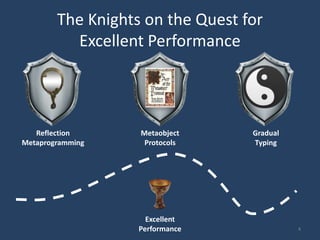
The Knights on the Quest for
Excellent Performance
4
Excellent
Performance
Reflection
Metaprogramming
Gradual
Typing
Metaobject
Protocols
Metaprogramming
Reflection, Introspection, Intercession
obj.invoke("methodName", [arg1])
obj.getField("name")
obj.setField("name", value)
obj.getDefinedFields()
…
5
Reflection
Metaprogramming
Metaprogramming
6
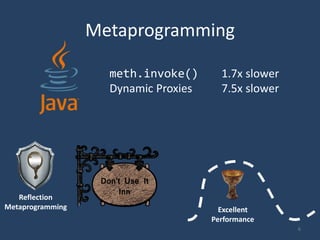
meth.invoke() 1.7x slower
Dynamic Proxies 7.5x slower
Reflection
Metaprogramming Excellent
Performance
Don’t Use It
Inn
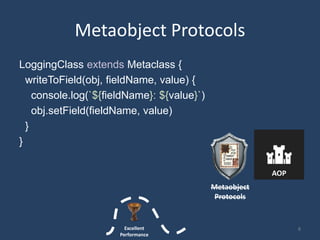
Metaobject Protocols
LoggingClass extends Metaclass {
writeToField(obj, fieldName, value) {
console.log(`${fieldName}: ${value}`)
obj.setField(fieldName, value)
}
}
7
Metaobject
Protocols
Excellent
Performance
Metaobject Protocols
LoggingClass extends Metaclass {
writeToField(obj, fieldName, value) {
console.log(`${fieldName}: ${value}`)
obj.setField(fieldName, value)
}
}
8
Metaobject
Protocols
Excellent
Performance
AOP
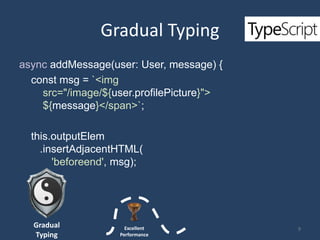
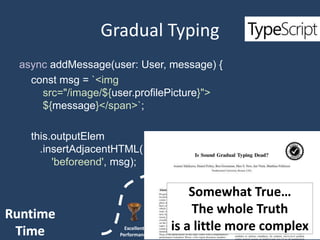
Gradual Typing
async addMessage(user: User, message) {
const msg = `<img
src="/image/${user.profilePicture}">
${message}</span>`;
this.outputElem
.insertAdjacentHTML(
'beforeend', msg);
9Excellent
Performance
Gradual
Typing
Gradual Typing
async addMessage(user: User, message) {
const msg = `<img
src="/image/${user.profilePicture}">
${message}</span>`;
this.outputElem
.insertAdjacentHTML(
'beforeend', msg);
10Excellent
Performance
Gradual
Typing
Somewhat True…
The whole Truth
is a little more complex
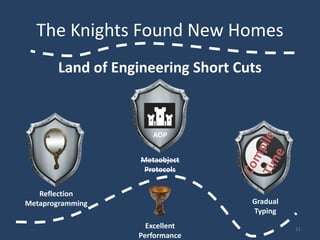
The Knights Found New Homes
11Excellent
Performance
Reflection
Metaprogramming Gradual
Typing
Metaobject
Protocols
AOP
Land of Engineering Short Cuts
The story could have ended here…
12
If it wouldn’t be for the 90’s
13
An “everything has been
done in Lisp” Talk
14
Smalltalk
Self
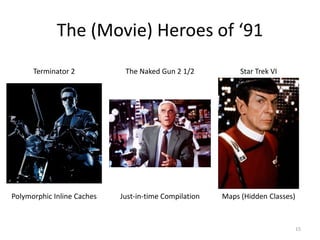
The (Movie) Heroes of ‘91
15
Polymorphic Inline Caches Just-in-time Compilation Maps (Hidden Classes)
Terminator 2 The Naked Gun 2 1/2 Star Trek VI
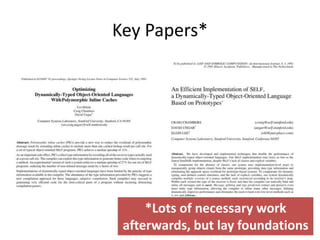
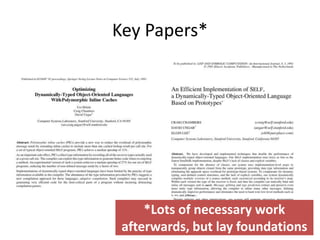
Key Papers*
16
*Lots of necessary work
afterwards, but lay foundations
POLYMORPHIC INLINE CACHES (PICS)
A technique for lookup caching.
17
A Class Hierarchy of Widgets
18
class Widget {
fitsInto(width) {
return this.width <= width;
}
}
class Button extends Widget {}
class RadioButton extends Button {}
fn findAllThatFit(arr, width) {
const result = [];
for (const w of arr)
if (w.fitsInto(width))
result.append(w)
return result;
}
Lookups can be frequent and costly
19
class Widget {
fitsInto(width) {
return this.width <= width;
}
}
class Button extends Widget {}
class RadioButton extends Button {}
fn findAllThatFit(arr, width) {
const result = [];
for (const w of arr)
if (w.fitsInto(width))
result.append(w)
return result;
}
RadioButton
Button
fitsInto
Widget
superclass
superclass
For each fitsInto call
hasMethod: 3x
getSuperclass: 2x
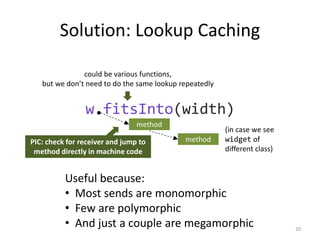
Solution: Lookup Caching
20
w.fitsInto(width)
could be various functions,
but we don’t need to do the same lookup repeatedly
method
method
(in case we see
widget of
different class)
PIC: check for receiver and jump to
method directly in machine code
Useful because:
• Most sends are monomorphic
• Few are polymorphic
• And just a couple are megamorphic
The Terminator PIC Eliminates
Potential Variability
22
JUST IN TIME COMPILATION
Generating Machine Code at Run Time
23
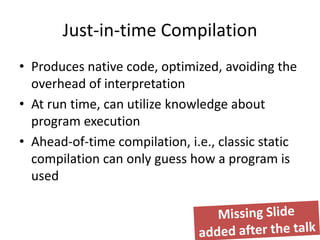
Just-in-time Compilation
• Produces native code, optimized, avoiding the
overhead of interpretation
• At run time, can utilize knowledge about
program execution
• Ahead-of-time compilation, i.e., classic static
compilation can only guess how a program is
used
24
With PICs, we can know
25
class Widget {
fitsInto(width) {
return this.width <= width;
}
}
class Button extends Widget {}
class RadioButton extends Button {}
fn findAllThatFit(arr, width) {
const result = [];
for (const w of arr)
if (w.fitsInto(width))
result.append(w)
return result;
}
1
2
3
4
5
6
7
8
9
10
11
12
13
14
15
RadioButton Widget.fitsInto
Array
RadioButton
Integer
And Generate Efficient Code
26
fn findAllThatFit(arr, width) {
const result = [];
for (const w of arr)
if (w.width(field) <=(int) width)
result.append(w)
return result;
}
1
2
3
4
5
6
7
inlined fitsInto
Specialized to types
Resulting in Efficient
Machine Code
Polymorphic Inline Caches
• Give us type
information
• Enable method
inlining
27
Our Hero has a lot of Luck
and Achieves his Goal
28
Relies on Developers
not utilizing flexibility
And, understanding
90’s humor
MAPS, HIDDEN CLASSES,
OBJECT SHAPES
Structural Information for Objects
29
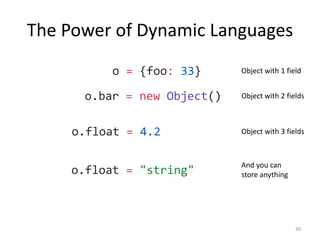
The Power of Dynamic Languages
30
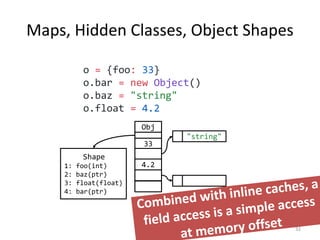
o = {foo: 33} Object with 1 field
o.bar = new Object() Object with 2 fields
o.float = 4.2 Object with 3 fields
o.float = "string"
And you can
store anything
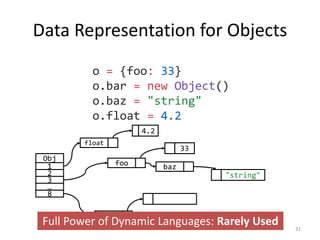
Data Representation for Objects
31
o = {foo: 33}
o.bar = new Object()
o.baz = "string"
o.float = 4.2
Obj
1
2
3
…
8
foo
33
"string"
4.2
bar
baz
float
Full Power of Dynamic Languages: Rarely Used
Maps, Hidden Classes, Object Shapes
32
o = {foo: 33}
o.bar = new Object()
o.baz = "string"
o.float = 4.2
Obj
33
4.2
"string"
Shape
1: foo(int)
2: baz(ptr)
3: float(float)
4: bar(ptr)
Our Hero brings
Structure and Logic to the Chaos
33
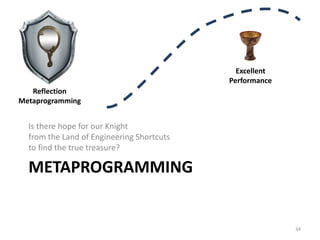
METAPROGRAMMING
Is there hope for our Knight
from the Land of Engineering Shortcuts
to find the true treasure?
34
Reflection
Metaprogramming
Excellent
Performance
Reflective Method Invocation
35
cnt.invoke("+", [1])
Let’s look at the addition first
Reflective Method Invocation
36
cnt.invoke("+", [1])
Int.+ method
cnt.+(1)
Optimizing Reflective Method Invocation
37
cnt.invoke("+", [1])
+ string
Int.+ method
Nesting of Lookup Caches
Eliminates Potential Variability
* string
Int.* method
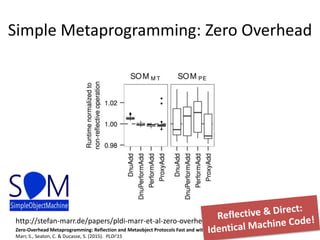
Zero-Overhead Metaprogramming: Reflection and Metaobject Protocols Fast and without Compromises.
Marr, S., Seaton, C. & Ducasse, S. (2015). PLDI’15
Simple Metaprogramming: Zero Overhead
38
http://stefan-marr.de/papers/pldi-marr-et-al-zero-overhead-metaprogramming-artifacts/
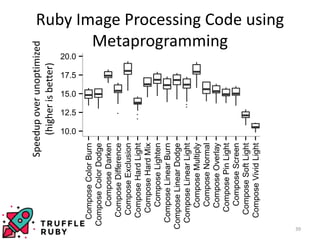
Ruby Image Processing Code using
Metaprogramming
39
●
●
●
●
●
10.0
12.5
15.0
17.5
20.0
ComposeColorBurn
ComposeColorDodge
ComposeDarken
ComposeDifference
ComposeExclusion
ComposeHardLight
ComposeHardMix
ComposeLighten
ComposeLinearBurn
ComposeLinearDodge
ComposeLinearLight
ComposeMultiply
ComposeNormal
ComposeOverlay
ComposePinLight
ComposeScreen
ComposeSoftLight
ComposeVividLight
Speedupoverunoptimized
(higherisbetter)
Speedupoverunoptimized
(higherisbetter)
METAOBJECT PROTOCOLS
Is there hope for our Knight
from the Land of Engineering Shortcuts
to find the true treasure?
40
Excellent
Performance
Metaobject
Protocols
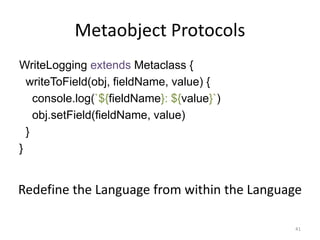
Metaobject Protocols
WriteLogging extends Metaclass {
writeToField(obj, fieldName, value) {
console.log(`${fieldName}: ${value}`)
obj.setField(fieldName, value)
}
}
41
Redefine the Language from within the Language
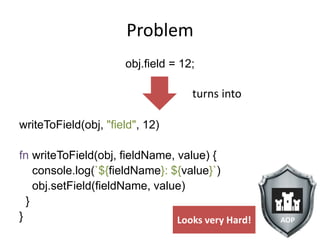
Problem
obj.field = 12;
writeToField(obj, "field", 12)
fn writeToField(obj, fieldName, value) {
console.log(`${fieldName}: ${value}`)
obj.setField(fieldName, value)
}
}
42
turns into
AOPLooks very Hard!
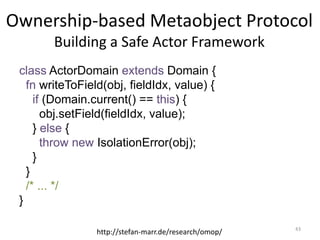
Ownership-based Metaobject Protocol
Building a Safe Actor Framework
class ActorDomain extends Domain {
fn writeToField(obj, fieldIdx, value) {
if (Domain.current() == this) {
obj.setField(fieldIdx, value);
} else {
throw new IsolationError(obj);
}
}
/* ... */
}
43
http://stefan-marr.de/research/omop/
An Actor Example
44
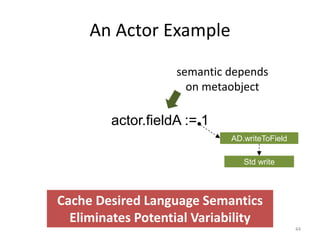
actor.fieldA := 1
semantic depends
on metaobject
AD.writeToField
Cache Desired Language Semantics
Eliminates Potential Variability
Std write
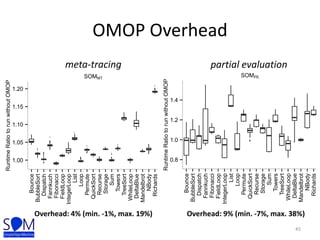
OMOP Overhead
45
meta-tracing partial evaluation
Overhead: 4% (min. -1%, max. 19%) Overhead: 9% (min. -7%, max. 38%)
●
●
●●●●
●
●
●●
●
●●
●
●
●
●●●●●
●
●
●●
●●
●●
●
●●●●●●
●●
●●●●●
●
●●●●●●
●●●●
●●
●
●
●
●
●
●●
●
●
●
●
●
●
●
●
●
●●
●
●
●
●●●
●
●●●
●●
●●●●
●
●●●
●
●●●●
●●●●
●
●
●
●●●●●●
●●●
●●●
●
●●●●●
●●●
●●●
●●●●
●●●●
●
●●●●
●●
●●
●
●
●●
●
●
●●●
1.00
1.05
1.10
1.15
1.20
Bounce
BubbleSort
Dispatch
Fannkuch
Fibonacci
FieldLoop
IntegerLoop
List
Loop
Permute
QuickSort
Recurse
Storage
Sum
Towers
TreeSort
WhileLoop
DeltaBlue
Mandelbrot
NBody
Richards
RuntimeRatiotorunwithoutOMOP
SOMMT
●●●●●●●●●●●●●●●●●●●●●●●●●●
●
●●●●●●●●●●●●●●●●●●●●●●
0.8
1.0
1.2
1.4
Bounce
BubbleSort
Dispatch
Fannkuch
Fibonacci
FieldLoop
IntegerLoop
List
Loop
Permute
QuickSort
Recurse
Storage
Sum
Towers
TreeSort
WhileLoop
DeltaBlue
Mandelbrot
NBody
Richards
RuntimeRatiotorunwithoutOMOP
SOMPE
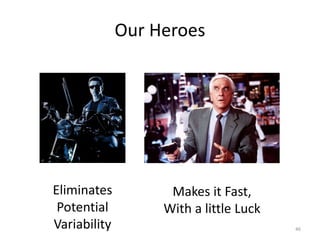
Our Heroes
46
Eliminates
Potential
Variability
Makes it Fast,
With a little Luck
GRADUAL TYPING
Is there hope for our Knight
from the Land of Engineering Shortcuts
to find the true treasure?
47
Excellent
Performance
Gradual
Typing
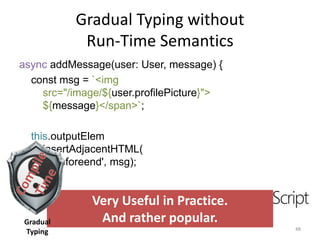
Gradual Typing without
Run-Time Semantics
async addMessage(user: User, message) {
const msg = `<img
src="/image/${user.profilePicture}">
${message}</span>`;
this.outputElem
.insertAdjacentHTML(
'beforeend', msg);
48
Very Useful in Practice.
And rather popular.Gradual
Typing
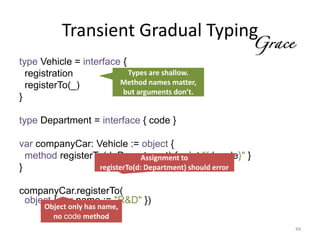
Transient Gradual Typing
type Vehicle = interface {
registration
registerTo(_)
}
type Department = interface { code }
var companyCar: Vehicle := object {
method registerTo(d: Department) { print "{d.code}" }
}
companyCar.registerTo(
object { var name := "R&D" })
49
Types are shallow.
Method names matter,
but arguments don’t.
Object only has name,
no code method
Assignment to
registerTo(d: Department) should error
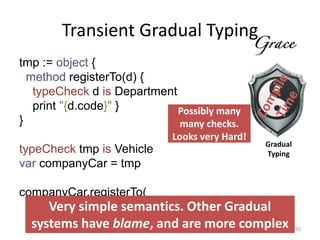
Transient Gradual Typing
tmp := object {
method registerTo(d) {
typeCheck d is Department
print "{d.code}" }
}
typeCheck tmp is Vehicle
var companyCar = tmp
companyCar.registerTo(
object { var name := "R&D" })
50
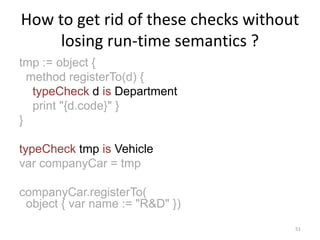
Very simple semantics. Other Gradual
systems have blame, and are more complex
Possibly many
many checks.
Looks very Hard!
Gradual
Typing
How to get rid of these checks without
losing run-time semantics ?
tmp := object {
method registerTo(d) {
typeCheck d is Department
print "{d.code}" }
}
typeCheck tmp is Vehicle
var companyCar = tmp
companyCar.registerTo(
object { var name := "R&D" })
51
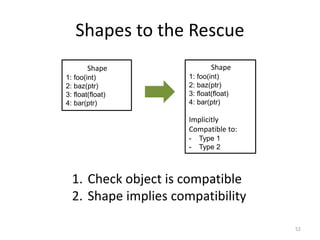
Shapes to the Rescue
52
Shape
1: foo(int)
2: baz(ptr)
3: float(float)
4: bar(ptr)
Shape
1: foo(int)
2: baz(ptr)
3: float(float)
4: bar(ptr)
Implicitly
Compatible to:
- Type 1
- Type 2
1. Check object is compatible
2. Shape implies compatibility
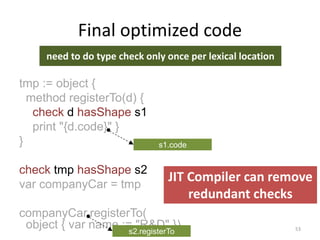
Final optimized code
tmp := object {
method registerTo(d) {
check d hasShape s1
print "{d.code}" }
}
check tmp hasShape s2
var companyCar = tmp
companyCar.registerTo(
object { var name := "R&D" }) 53
need to do type check only once per lexical location
s1.code
s2.registerTo
JIT Compiler can remove
redundant checks
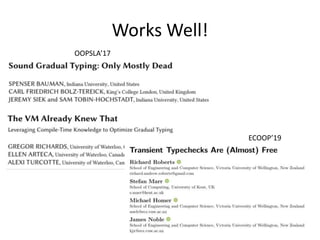
Works Well!
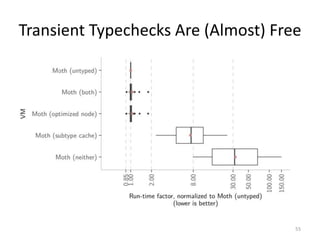
54
OOPSLA’17
ECOOP’19
Transient Typechecks Are (Almost) Free
55
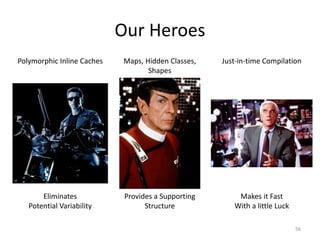
Our Heroes
56
Eliminates
Potential Variability
Provides a Supporting
Structure
Makes it Fast
With a little Luck
Polymorphic Inline Caches Just-in-time CompilationMaps, Hidden Classes,
Shapes
WARP UP
57
Things I didn’t talk about
Failure cases:
Deoptimization
An Efficient
Implementation of SELF a
Dynamically-Typed
Object-Oriented Language
Based on Prototypes.
Chambers, C., Ungar, D. &
Lee, E. (1989). OOPSLA’89
Object shapes are useful
for other things
Efficient and Thread-Safe
Objects for Dynamically-
Typed Languages.
B. Daloze, S. Marr, D.
Bonetta, and H.
Mössenböck. OOPSLA'16
58
And many other
modern optimizations
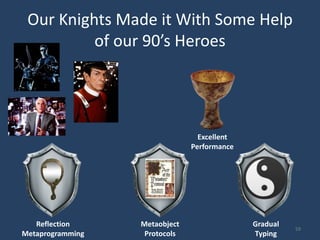
Our Knights Made it With Some Help
of our 90’s Heroes
59
Excellent
Performance
Reflection
Metaprogramming
Gradual
Typing
Metaobject
Protocols
Key Papers*
60
*Lots of necessary work
afterwards, but lay foundations
Research and Literature
• Efficient Implementation of the
Smalltalk-80 System.
Deutsch, L. P. & Schiffman, A. M.
(1984). POPL’84
• Optimizing Dynamically-Typed
Object-Oriented Languages With
Polymorphic Inline Caches.
Hölzle, U., Chambers, C. & Ungar,
D. (1991). ECOOP’91
• Zero-Overhead
Metaprogramming: Reflection
and Metaobject Protocols Fast
and without Compromises.
Marr, S., Seaton, C. & Ducasse, S.
(2015). PLDI’15
• Optimizing prototypes in V8
https://mathiasbynens.be/notes/
prototypes
• https://mathiasbynens.be/notes/
shapes-ics
• https://mrale.ph/blog/2012/06/0
3/explaining-js-vms-in-js-inline-
caches.html
61
Research and Literature
• An Efficient Implementation of
SELF a Dynamically-Typed
Object-Oriented Language Based
on Prototypes.
Chambers, C., Ungar, D. & Lee, E.
(1989). OOPSLA’89
• An Object Storage Model for the
Truffle Language Implementation
Framework.
A. Wöß, C. Wirth, D. Bonetta, C.
Seaton, C. Humer, and H.
Mössenböck. PPPJ’14.
• Storage Strategies for Collections
in Dynamically Typed Languages.
C. F. Bolz, L. Diekmann, and L.
Tratt. OOPSLA’13.
• Memento Mori: Dynamic
Allocation-site-based
Optimizations. Clifford, D., Payer,
H., Stanton, M. & Titzer, B. L.
(2015). ISMM’15
62
Research and Literature
• Virtual Machine Warmup Blows Hot
and Cold. Barrett, E., Bolz-Tereick, C.
F., Killick, R., Mount, S. & Tratt, L.
(2017). OOPSLA’17
• Quantifying Performance Changes
with Effect Size Confidence Intervals.
Kalibera, T. & Jones, R.
(2012). Technical Report, University
of Kent.
• Rigorous Benchmarking in
Reasonable Time. Kalibera, T. &
Jones, R. (2013). ISMM’13
• How Not to Lie With Statistics: The
Correct Way to Summarize
Benchmark Results. Fleming, P. J. &
Wallace, J. J. (1986). Commun. ACM
• SIGPLAN Empirical Evaluation
Guidelines
https://www.sigplan.org/Resources/E
mpiricalEvaluation/
• Systems Benchmarking Crimes,
Gernot Heiser
https://www.cse.unsw.edu.au/~gern
ot/benchmarking-crimes.html
• Benchmarking Crimes: An Emerging
Threat in Systems Security. van der
Kouwe, E., Andriesse, D., Bos, H.,
Giuffrida, C. & Heiser, G. (2018).
arxiv:1801.02381
• http://btorpey.github.io/blog/2014/0
2/18/clock-sources-in-linux/
• Generating an Artefact From a
Benchmarking Setup as Part of CI
https://stefan-
marr.de/2019/05/artifacts-from-ci/
63

Metaprogramming, Metaobject Protocols, Gradual Type Checks: Optimizing the "Unoptimizable" Using Old Ideas

  • 1.
    Metaprogramming, Metaobject Protocols, GradualType Checks Optimizing the “Unoptimizable” Using Old Ideas Stefan Marr Athens, October 2019 Creative Commons Attribution-ShareAlike 4.0 License
  • 2.
    Got a Question? Feelfree to interrupt me! 2
  • 3.
  • 4.
    The Knights onthe Quest for Excellent Performance 4 Excellent Performance Reflection Metaprogramming Gradual Typing Metaobject Protocols
  • 5.
    Metaprogramming Reflection, Introspection, Intercession obj.invoke("methodName",[arg1]) obj.getField("name") obj.setField("name", value) obj.getDefinedFields() … 5 Reflection Metaprogramming
  • 6.
    Metaprogramming 6 meth.invoke() 1.7x slower DynamicProxies 7.5x slower Reflection Metaprogramming Excellent Performance Don’t Use It Inn
  • 7.
    Metaobject Protocols LoggingClass extendsMetaclass { writeToField(obj, fieldName, value) { console.log(`${fieldName}: ${value}`) obj.setField(fieldName, value) } } 7 Metaobject Protocols Excellent Performance
  • 8.
    Metaobject Protocols LoggingClass extendsMetaclass { writeToField(obj, fieldName, value) { console.log(`${fieldName}: ${value}`) obj.setField(fieldName, value) } } 8 Metaobject Protocols Excellent Performance AOP
  • 9.
    Gradual Typing async addMessage(user:User, message) { const msg = `<img src="/image/${user.profilePicture}"> ${message}</span>`; this.outputElem .insertAdjacentHTML( 'beforeend', msg); 9Excellent Performance Gradual Typing
  • 10.
    Gradual Typing async addMessage(user:User, message) { const msg = `<img src="/image/${user.profilePicture}"> ${message}</span>`; this.outputElem .insertAdjacentHTML( 'beforeend', msg); 10Excellent Performance Gradual Typing Somewhat True… The whole Truth is a little more complex
  • 11.
    The Knights FoundNew Homes 11Excellent Performance Reflection Metaprogramming Gradual Typing Metaobject Protocols AOP Land of Engineering Short Cuts
  • 12.
    The story couldhave ended here… 12
  • 13.
    If it wouldn’tbe for the 90’s 13
  • 14.
    An “everything hasbeen done in Lisp” Talk 14 Smalltalk Self
  • 15.
    The (Movie) Heroesof ‘91 15 Polymorphic Inline Caches Just-in-time Compilation Maps (Hidden Classes) Terminator 2 The Naked Gun 2 1/2 Star Trek VI
  • 16.
    Key Papers* 16 *Lots ofnecessary work afterwards, but lay foundations
  • 17.
    POLYMORPHIC INLINE CACHES(PICS) A technique for lookup caching. 17
  • 18.
    A Class Hierarchyof Widgets 18 class Widget { fitsInto(width) { return this.width <= width; } } class Button extends Widget {} class RadioButton extends Button {} fn findAllThatFit(arr, width) { const result = []; for (const w of arr) if (w.fitsInto(width)) result.append(w) return result; }
  • 19.
    Lookups can befrequent and costly 19 class Widget { fitsInto(width) { return this.width <= width; } } class Button extends Widget {} class RadioButton extends Button {} fn findAllThatFit(arr, width) { const result = []; for (const w of arr) if (w.fitsInto(width)) result.append(w) return result; } RadioButton Button fitsInto Widget superclass superclass For each fitsInto call hasMethod: 3x getSuperclass: 2x
  • 20.
    Solution: Lookup Caching 20 w.fitsInto(width) couldbe various functions, but we don’t need to do the same lookup repeatedly method method (in case we see widget of different class) PIC: check for receiver and jump to method directly in machine code Useful because: • Most sends are monomorphic • Few are polymorphic • And just a couple are megamorphic
  • 21.
    The Terminator PICEliminates Potential Variability 22
  • 22.
    JUST IN TIMECOMPILATION Generating Machine Code at Run Time 23
  • 23.
    Just-in-time Compilation • Producesnative code, optimized, avoiding the overhead of interpretation • At run time, can utilize knowledge about program execution • Ahead-of-time compilation, i.e., classic static compilation can only guess how a program is used 24
  • 24.
    With PICs, wecan know 25 class Widget { fitsInto(width) { return this.width <= width; } } class Button extends Widget {} class RadioButton extends Button {} fn findAllThatFit(arr, width) { const result = []; for (const w of arr) if (w.fitsInto(width)) result.append(w) return result; } 1 2 3 4 5 6 7 8 9 10 11 12 13 14 15 RadioButton Widget.fitsInto Array RadioButton Integer
  • 25.
    And Generate EfficientCode 26 fn findAllThatFit(arr, width) { const result = []; for (const w of arr) if (w.width(field) <=(int) width) result.append(w) return result; } 1 2 3 4 5 6 7 inlined fitsInto Specialized to types Resulting in Efficient Machine Code
  • 26.
    Polymorphic Inline Caches •Give us type information • Enable method inlining 27
  • 27.
    Our Hero hasa lot of Luck and Achieves his Goal 28 Relies on Developers not utilizing flexibility And, understanding 90’s humor
  • 28.
    MAPS, HIDDEN CLASSES, OBJECTSHAPES Structural Information for Objects 29
  • 29.
    The Power ofDynamic Languages 30 o = {foo: 33} Object with 1 field o.bar = new Object() Object with 2 fields o.float = 4.2 Object with 3 fields o.float = "string" And you can store anything
  • 30.
    Data Representation forObjects 31 o = {foo: 33} o.bar = new Object() o.baz = "string" o.float = 4.2 Obj 1 2 3 … 8 foo 33 "string" 4.2 bar baz float Full Power of Dynamic Languages: Rarely Used
  • 31.
    Maps, Hidden Classes,Object Shapes 32 o = {foo: 33} o.bar = new Object() o.baz = "string" o.float = 4.2 Obj 33 4.2 "string" Shape 1: foo(int) 2: baz(ptr) 3: float(float) 4: bar(ptr)
  • 32.
    Our Hero brings Structureand Logic to the Chaos 33
  • 33.
    METAPROGRAMMING Is there hopefor our Knight from the Land of Engineering Shortcuts to find the true treasure? 34 Reflection Metaprogramming Excellent Performance
  • 34.
    Reflective Method Invocation 35 cnt.invoke("+",[1]) Let’s look at the addition first
  • 35.
  • 36.
    Optimizing Reflective MethodInvocation 37 cnt.invoke("+", [1]) + string Int.+ method Nesting of Lookup Caches Eliminates Potential Variability * string Int.* method
  • 37.
    Zero-Overhead Metaprogramming: Reflectionand Metaobject Protocols Fast and without Compromises. Marr, S., Seaton, C. & Ducasse, S. (2015). PLDI’15 Simple Metaprogramming: Zero Overhead 38 http://stefan-marr.de/papers/pldi-marr-et-al-zero-overhead-metaprogramming-artifacts/
  • 38.
    Ruby Image ProcessingCode using Metaprogramming 39 ● ● ● ● ● 10.0 12.5 15.0 17.5 20.0 ComposeColorBurn ComposeColorDodge ComposeDarken ComposeDifference ComposeExclusion ComposeHardLight ComposeHardMix ComposeLighten ComposeLinearBurn ComposeLinearDodge ComposeLinearLight ComposeMultiply ComposeNormal ComposeOverlay ComposePinLight ComposeScreen ComposeSoftLight ComposeVividLight Speedupoverunoptimized (higherisbetter) Speedupoverunoptimized (higherisbetter)
  • 39.
    METAOBJECT PROTOCOLS Is therehope for our Knight from the Land of Engineering Shortcuts to find the true treasure? 40 Excellent Performance Metaobject Protocols
  • 40.
    Metaobject Protocols WriteLogging extendsMetaclass { writeToField(obj, fieldName, value) { console.log(`${fieldName}: ${value}`) obj.setField(fieldName, value) } } 41 Redefine the Language from within the Language
  • 41.
    Problem obj.field = 12; writeToField(obj,"field", 12) fn writeToField(obj, fieldName, value) { console.log(`${fieldName}: ${value}`) obj.setField(fieldName, value) } } 42 turns into AOPLooks very Hard!
  • 42.
    Ownership-based Metaobject Protocol Buildinga Safe Actor Framework class ActorDomain extends Domain { fn writeToField(obj, fieldIdx, value) { if (Domain.current() == this) { obj.setField(fieldIdx, value); } else { throw new IsolationError(obj); } } /* ... */ } 43 http://stefan-marr.de/research/omop/
  • 43.
    An Actor Example 44 actor.fieldA:= 1 semantic depends on metaobject AD.writeToField Cache Desired Language Semantics Eliminates Potential Variability Std write
  • 44.
    OMOP Overhead 45 meta-tracing partialevaluation Overhead: 4% (min. -1%, max. 19%) Overhead: 9% (min. -7%, max. 38%) ● ● ●●●● ● ● ●● ● ●● ● ● ● ●●●●● ● ● ●● ●● ●● ● ●●●●●● ●● ●●●●● ● ●●●●●● ●●●● ●● ● ● ● ● ● ●● ● ● ● ● ● ● ● ● ● ●● ● ● ● ●●● ● ●●● ●● ●●●● ● ●●● ● ●●●● ●●●● ● ● ● ●●●●●● ●●● ●●● ● ●●●●● ●●● ●●● ●●●● ●●●● ● ●●●● ●● ●● ● ● ●● ● ● ●●● 1.00 1.05 1.10 1.15 1.20 Bounce BubbleSort Dispatch Fannkuch Fibonacci FieldLoop IntegerLoop List Loop Permute QuickSort Recurse Storage Sum Towers TreeSort WhileLoop DeltaBlue Mandelbrot NBody Richards RuntimeRatiotorunwithoutOMOP SOMMT ●●●●●●●●●●●●●●●●●●●●●●●●●● ● ●●●●●●●●●●●●●●●●●●●●●● 0.8 1.0 1.2 1.4 Bounce BubbleSort Dispatch Fannkuch Fibonacci FieldLoop IntegerLoop List Loop Permute QuickSort Recurse Storage Sum Towers TreeSort WhileLoop DeltaBlue Mandelbrot NBody Richards RuntimeRatiotorunwithoutOMOP SOMPE
  • 45.
  • 46.
    GRADUAL TYPING Is therehope for our Knight from the Land of Engineering Shortcuts to find the true treasure? 47 Excellent Performance Gradual Typing
  • 47.
    Gradual Typing without Run-TimeSemantics async addMessage(user: User, message) { const msg = `<img src="/image/${user.profilePicture}"> ${message}</span>`; this.outputElem .insertAdjacentHTML( 'beforeend', msg); 48 Very Useful in Practice. And rather popular.Gradual Typing
  • 48.
    Transient Gradual Typing typeVehicle = interface { registration registerTo(_) } type Department = interface { code } var companyCar: Vehicle := object { method registerTo(d: Department) { print "{d.code}" } } companyCar.registerTo( object { var name := "R&D" }) 49 Types are shallow. Method names matter, but arguments don’t. Object only has name, no code method Assignment to registerTo(d: Department) should error
  • 49.
    Transient Gradual Typing tmp:= object { method registerTo(d) { typeCheck d is Department print "{d.code}" } } typeCheck tmp is Vehicle var companyCar = tmp companyCar.registerTo( object { var name := "R&D" }) 50 Very simple semantics. Other Gradual systems have blame, and are more complex Possibly many many checks. Looks very Hard! Gradual Typing
  • 50.
    How to getrid of these checks without losing run-time semantics ? tmp := object { method registerTo(d) { typeCheck d is Department print "{d.code}" } } typeCheck tmp is Vehicle var companyCar = tmp companyCar.registerTo( object { var name := "R&D" }) 51
  • 51.
    Shapes to theRescue 52 Shape 1: foo(int) 2: baz(ptr) 3: float(float) 4: bar(ptr) Shape 1: foo(int) 2: baz(ptr) 3: float(float) 4: bar(ptr) Implicitly Compatible to: - Type 1 - Type 2 1. Check object is compatible 2. Shape implies compatibility
  • 52.
    Final optimized code tmp:= object { method registerTo(d) { check d hasShape s1 print "{d.code}" } } check tmp hasShape s2 var companyCar = tmp companyCar.registerTo( object { var name := "R&D" }) 53 need to do type check only once per lexical location s1.code s2.registerTo JIT Compiler can remove redundant checks
  • 53.
  • 54.
    Transient Typechecks Are(Almost) Free 55
  • 55.
    Our Heroes 56 Eliminates Potential Variability Providesa Supporting Structure Makes it Fast With a little Luck Polymorphic Inline Caches Just-in-time CompilationMaps, Hidden Classes, Shapes
  • 56.
  • 57.
    Things I didn’ttalk about Failure cases: Deoptimization An Efficient Implementation of SELF a Dynamically-Typed Object-Oriented Language Based on Prototypes. Chambers, C., Ungar, D. & Lee, E. (1989). OOPSLA’89 Object shapes are useful for other things Efficient and Thread-Safe Objects for Dynamically- Typed Languages. B. Daloze, S. Marr, D. Bonetta, and H. Mössenböck. OOPSLA'16 58 And many other modern optimizations
  • 58.
    Our Knights Madeit With Some Help of our 90’s Heroes 59 Excellent Performance Reflection Metaprogramming Gradual Typing Metaobject Protocols
  • 59.
    Key Papers* 60 *Lots ofnecessary work afterwards, but lay foundations
  • 60.
    Research and Literature •Efficient Implementation of the Smalltalk-80 System. Deutsch, L. P. & Schiffman, A. M. (1984). POPL’84 • Optimizing Dynamically-Typed Object-Oriented Languages With Polymorphic Inline Caches. Hölzle, U., Chambers, C. & Ungar, D. (1991). ECOOP’91 • Zero-Overhead Metaprogramming: Reflection and Metaobject Protocols Fast and without Compromises. Marr, S., Seaton, C. & Ducasse, S. (2015). PLDI’15 • Optimizing prototypes in V8 https://mathiasbynens.be/notes/ prototypes • https://mathiasbynens.be/notes/ shapes-ics • https://mrale.ph/blog/2012/06/0 3/explaining-js-vms-in-js-inline- caches.html 61
  • 61.
    Research and Literature •An Efficient Implementation of SELF a Dynamically-Typed Object-Oriented Language Based on Prototypes. Chambers, C., Ungar, D. & Lee, E. (1989). OOPSLA’89 • An Object Storage Model for the Truffle Language Implementation Framework. A. Wöß, C. Wirth, D. Bonetta, C. Seaton, C. Humer, and H. Mössenböck. PPPJ’14. • Storage Strategies for Collections in Dynamically Typed Languages. C. F. Bolz, L. Diekmann, and L. Tratt. OOPSLA’13. • Memento Mori: Dynamic Allocation-site-based Optimizations. Clifford, D., Payer, H., Stanton, M. & Titzer, B. L. (2015). ISMM’15 62
  • 62.
    Research and Literature •Virtual Machine Warmup Blows Hot and Cold. Barrett, E., Bolz-Tereick, C. F., Killick, R., Mount, S. & Tratt, L. (2017). OOPSLA’17 • Quantifying Performance Changes with Effect Size Confidence Intervals. Kalibera, T. & Jones, R. (2012). Technical Report, University of Kent. • Rigorous Benchmarking in Reasonable Time. Kalibera, T. & Jones, R. (2013). ISMM’13 • How Not to Lie With Statistics: The Correct Way to Summarize Benchmark Results. Fleming, P. J. & Wallace, J. J. (1986). Commun. ACM • SIGPLAN Empirical Evaluation Guidelines https://www.sigplan.org/Resources/E mpiricalEvaluation/ • Systems Benchmarking Crimes, Gernot Heiser https://www.cse.unsw.edu.au/~gern ot/benchmarking-crimes.html • Benchmarking Crimes: An Emerging Threat in Systems Security. van der Kouwe, E., Andriesse, D., Bos, H., Giuffrida, C. & Heiser, G. (2018). arxiv:1801.02381 • http://btorpey.github.io/blog/2014/0 2/18/clock-sources-in-linux/ • Generating an Artefact From a Benchmarking Setup as Part of CI https://stefan- marr.de/2019/05/artifacts-from-ci/ 63

Editor's Notes

  • #3 I know, questions are hard. So, let’s practice together.
  • #16 Lt. Frank Drebin (Leslie Nielsen)
  • #40 Use of runtime programming sneaks into all kind of places, including performance sensitive parts. This here is a ruby library to process photoshop files, we chose a number of kernels that do layer composition to show that optimizing reflective operations gives major benefits. This library is not artificial, it is widely used, and arguably, layer composition can be performance critical. It has more than 500 forks on GitHub…
  • #46 We had 50% overhead without VM support on PyPy
  • #57 Lt. Frank Drebin (Leslie Nielsen)