Ogni riferimento a fatti realmente accaduti e/o a persone realmente
             esistenti è da ritenersi puramente casuale.

     Any resemblance to actual persons is purely coincidental
As a user I want to search the Internet so
    that I find the information I need
•   Software Engineer
                       •   Scrum Master in Funambol
                                – 6 teams
                                – 30 engineers
schepis@funambol.com   •   2,5 years = 50 iterations  3000 user stories


                       •   Links:
                                – http://www.funambol.com
                                – http://www.edschepis.net
                                – http://pragmaticagile.wordpress.com
                                  edschepis
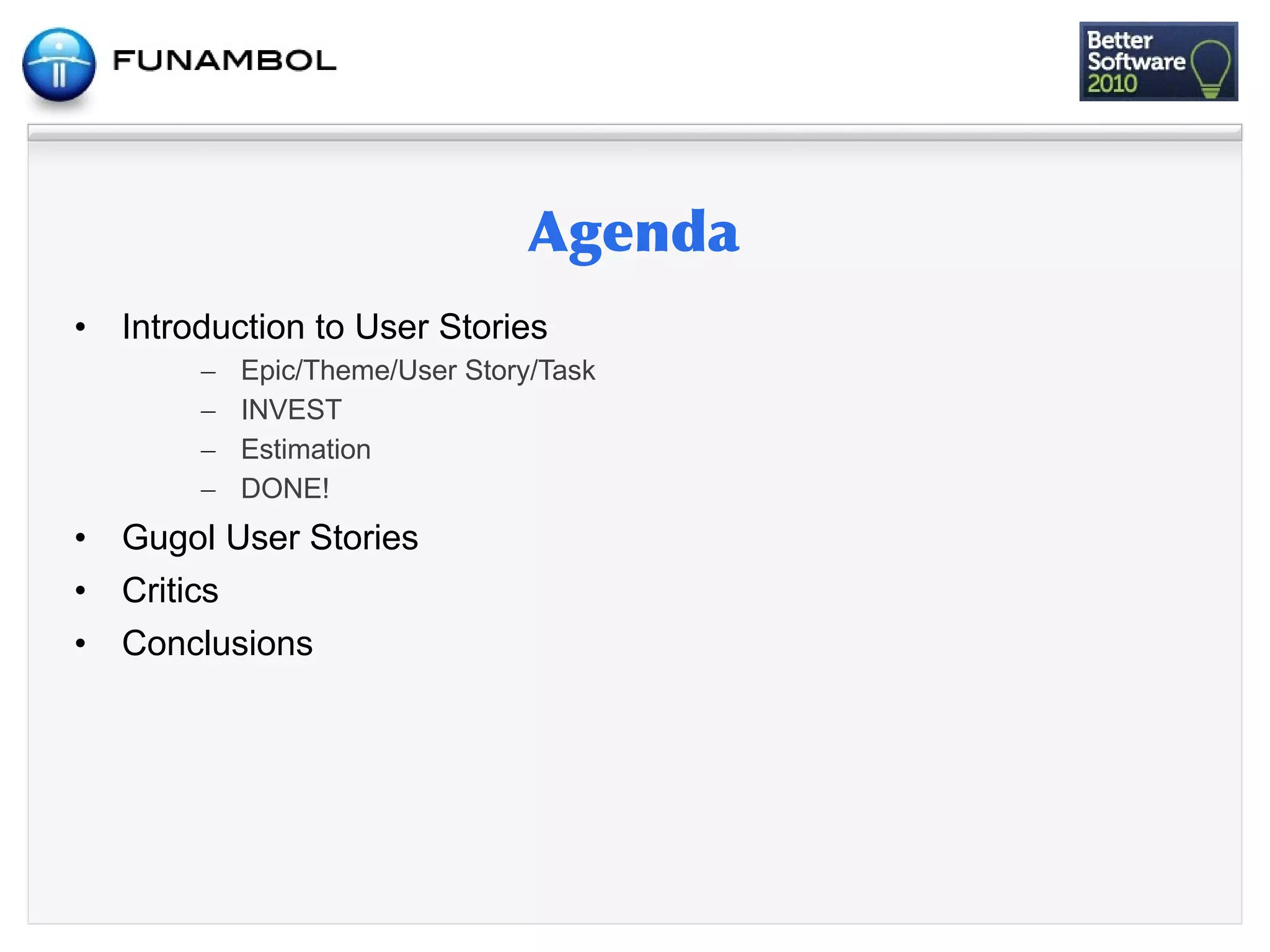
•   Introduction to User Stories
         –   Epic/Theme/User Story/Task
         –   INVEST
         –   Estimation
         –   DONE!
•   Gugol User Stories
•   Critics
•   Conclusions
•   In general or for your particular product/service/company,
       what would you rather have your customers talk about?
         – A. “Their            is awesome”
         – B. “Their           is awesome”
         – C. “Their              is awesome”
         – D. “ 	
    	
         ”

•   First-person language... reverse engineer
•   It's not about the tools we build, it's what our tools let them do
•             better is... better


    Thanks to Kathy Sierra - Talk at Business of Software 2009 [http://www.blip.tv/file/3346148]
•   What's that?                                                       Kent Beck coined the term
                                                                          user stories in Extreme
•   3C                                                                 Programming Explained 1 st
                                                                                     Edition, 1999
         – Card
         – Conversation
         – Confirmation
•   Limitations
         – It's not just “As a ... I want to... so that...”
         – Without acceptance tests are open to interpretation
         – They require close customer contact throughout the project which in some
                cases may be difficult or may be unnecessary overhead
         – Can have difficulty scaling to large projects
         – Conversation starters... fail to serve as a form of reliable documentation of
                the system
•   User stories provide a small-scale and easy-to-use presentation of
      information
         – generally formulated in the everyday language of the user
         – contain little detail, thus remaining open to interpretation
         – should help the reader understand what it is the software should accomplish
         –      	


•   Use cases in contrast describe a process and its steps in detail, and
      may be worded in terms of a formal model.
         – is intended to provide sufficient detail for it to be understood on its own
         – a generalized description of a set of interactions between the system and
               one or more actors, where an actor is either a user or another system
         –
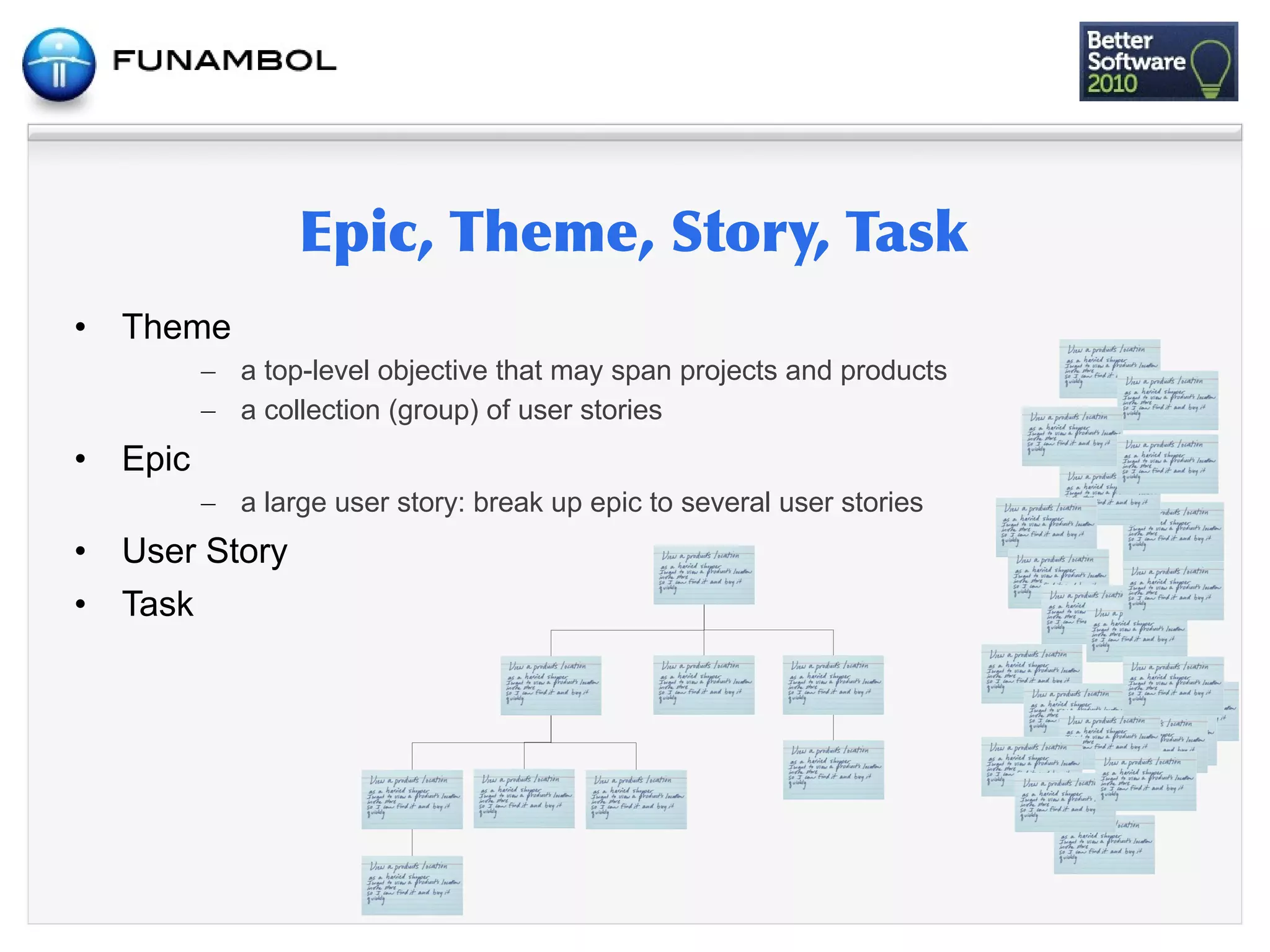
•   Theme
           – a top-level objective that may span projects and products
           – a collection (group) of user stories
•   Epic
           – a large user story: break up epic to several user stories
•   User Story
•   Task
• Independent
      – User Stories should be as independent as possible.

• Negotiable
      – User Stories are not a contract.

• Valuable
      – User Stories should be valuable to the user.

• Estimable
      – User Stories need to be possible to estimate.

• Small
      – User Stories should be small. Not too small. But not too big.

• Testable
      – User Stories need to be worded in a way that is testable
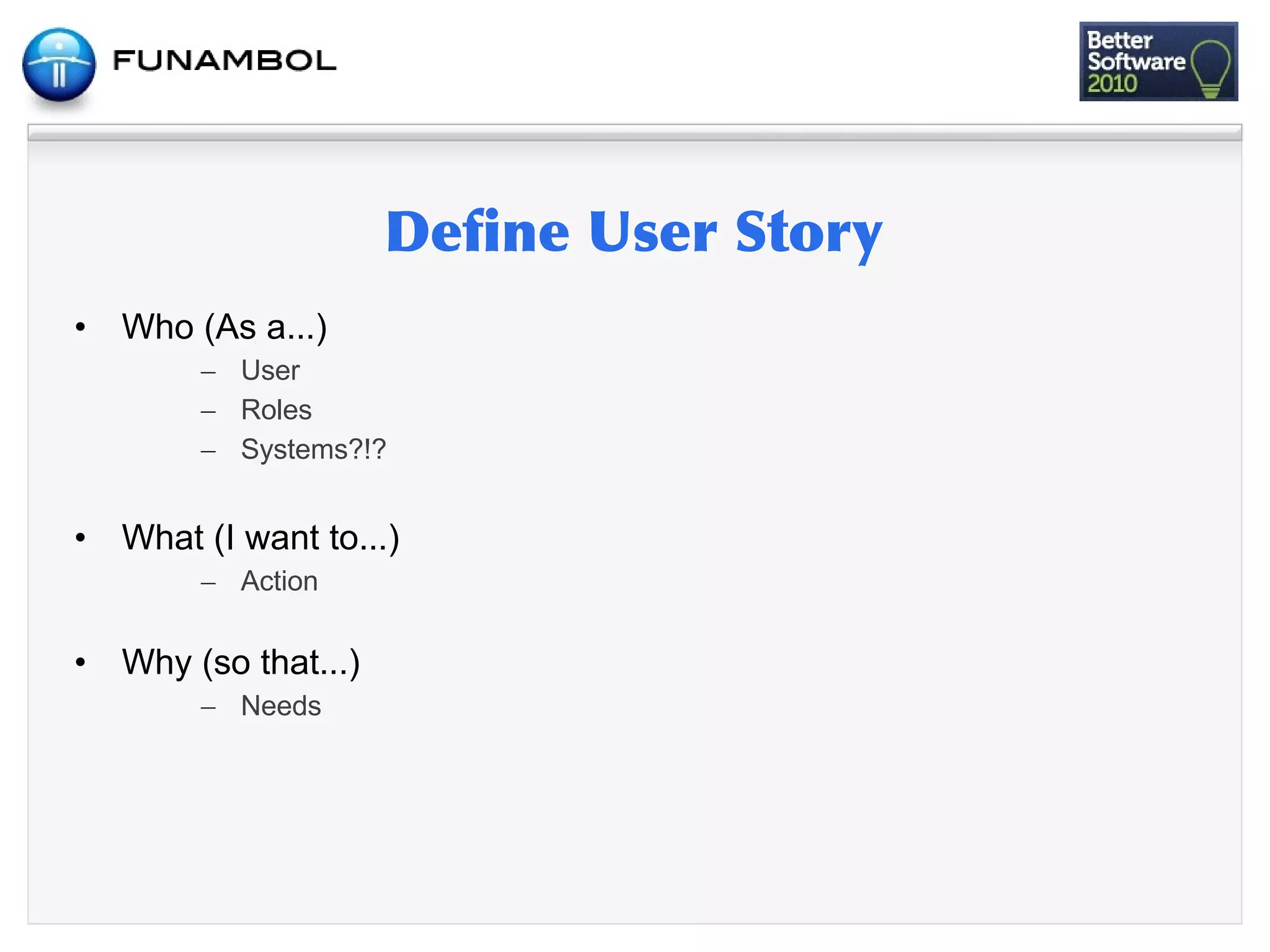
•   Who (As a...)
         – User
         – Roles
         – Systems?!?


•   What (I want to...)
         – Action

•   Why (so that...)
         – Needs
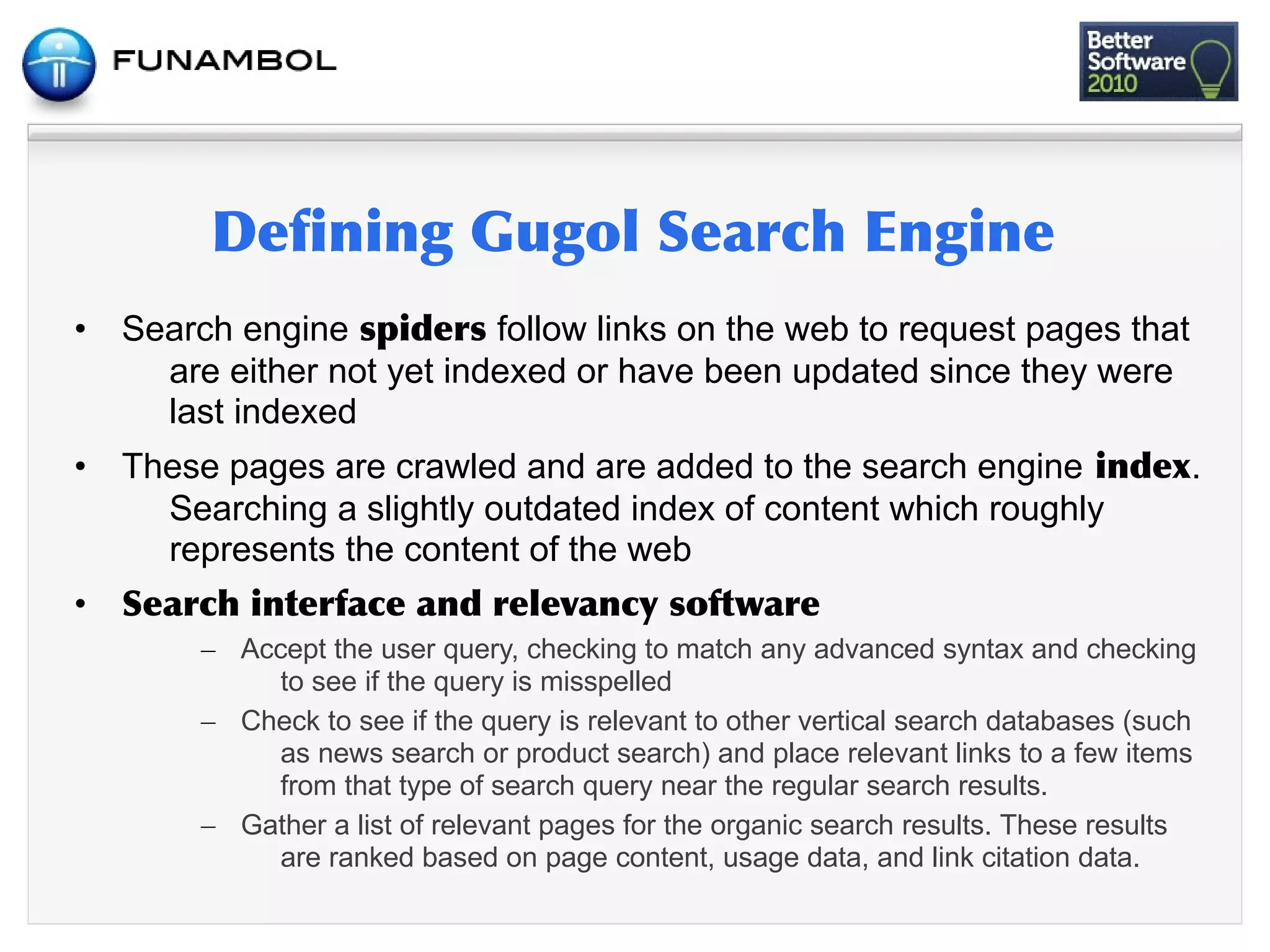
•   Search engine           follow links on the web to request pages that
      are either not yet indexed or have been updated since they were
      last indexed
•   These pages are crawled and are added to the search engine                          .
      Searching a slightly outdated index of content which roughly
      represents the content of the web
•           	


         – Accept the user query, checking to match any advanced syntax and checking
              to see if the query is misspelled
         – Check to see if the query is relevant to other vertical search databases (such
              as news search or product search) and place relevant links to a few items
              from that type of search query near the regular search results.
         – Gather a list of relevant pages for the organic search results. These results
              are ranked based on page content, usage data, and link citation data.
As a user I want to search the Internet so
    that I find the information I need
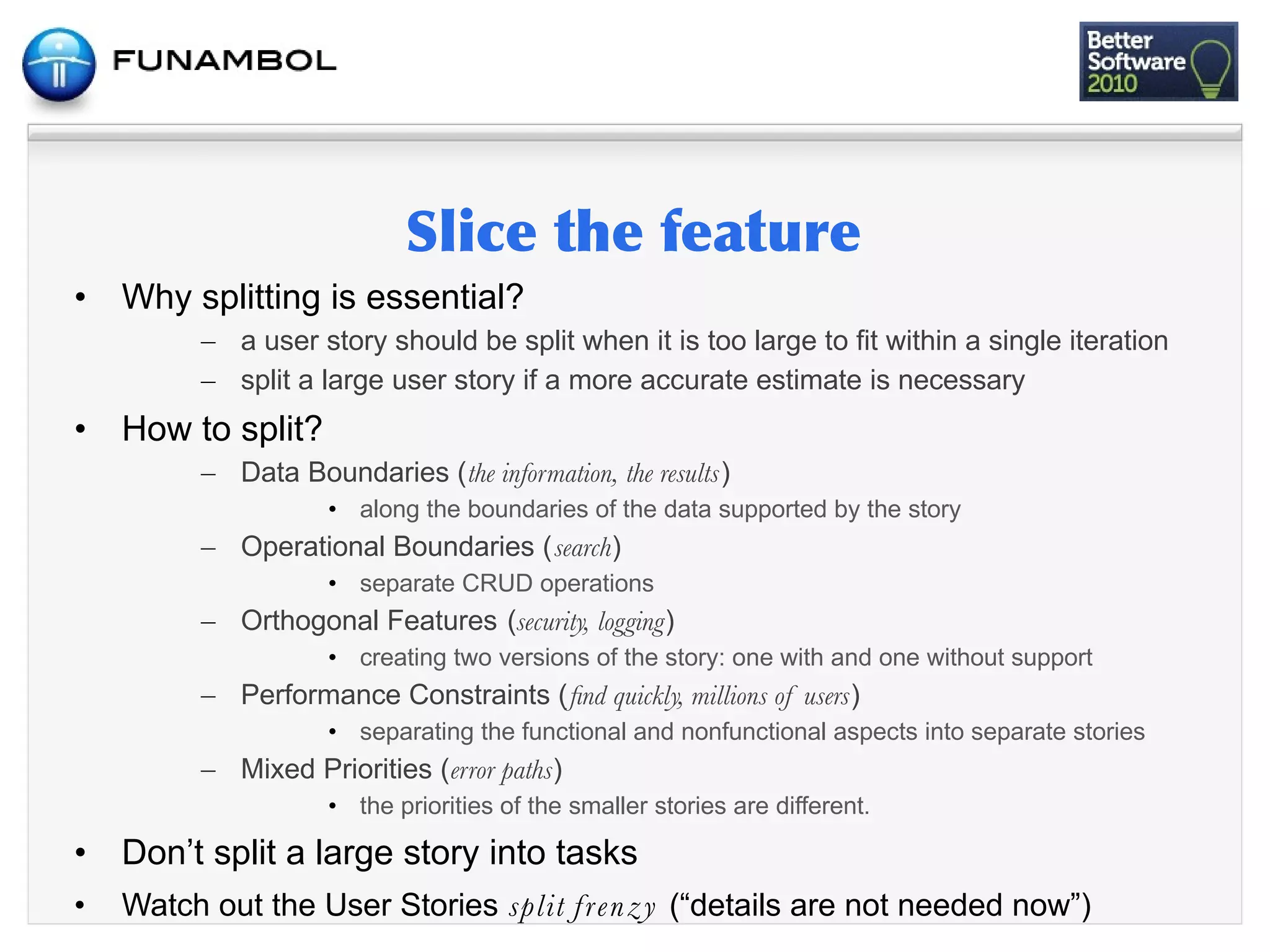
•   Why splitting is essential?
          – a user story should be split when it is too large to fit within a single iteration
          – split a large user story if a more accurate estimate is necessary
•   How to split?
          – Data Boundaries (the information, the results)
                     • along the boundaries of the data supported by the story
          – Operational Boundaries (search)
                     • separate CRUD operations
          – Orthogonal Features (security, logging)
                     • creating two versions of the story: one with and one without support
          – Performance Constraints (find quickly, millions of users)
                     • separating the functional and nonfunctional aspects into separate stories
          – Mixed Priorities (error paths)
                     • the priorities of the smaller stories are different.

•   Don’t split a large story into tasks
•   Watch out the User Stories split f re n z y (“details are not needed now”)
As a user I want to search the Internet so
    that I find the information I need
As a user I want to search the Internet so
    that I find the information I need
As a user I want to search the Internet so
     that I find the information I need
As a user I want to search the Internet so
     that I find the information I need
As a user I want to search the Internet so
    that I find the information I need
•   Data boundaries: search contents, input and results
•   Operational Boundaries: searching... “I'm Feeling Lucky”
•   Performances and scalability
•   Mixed Priorities:
         –   Ranking
         –   Advanced Search
         –   Web Services
         –   Localized searches
•   Web Search
         –   Simple input
         –   “I'm Feeling Lucky”
         –   No Ranking
         –   IP-local searches
         –   Subset of results
•   Data boundaries:
         –   News Search
         –   Image Search
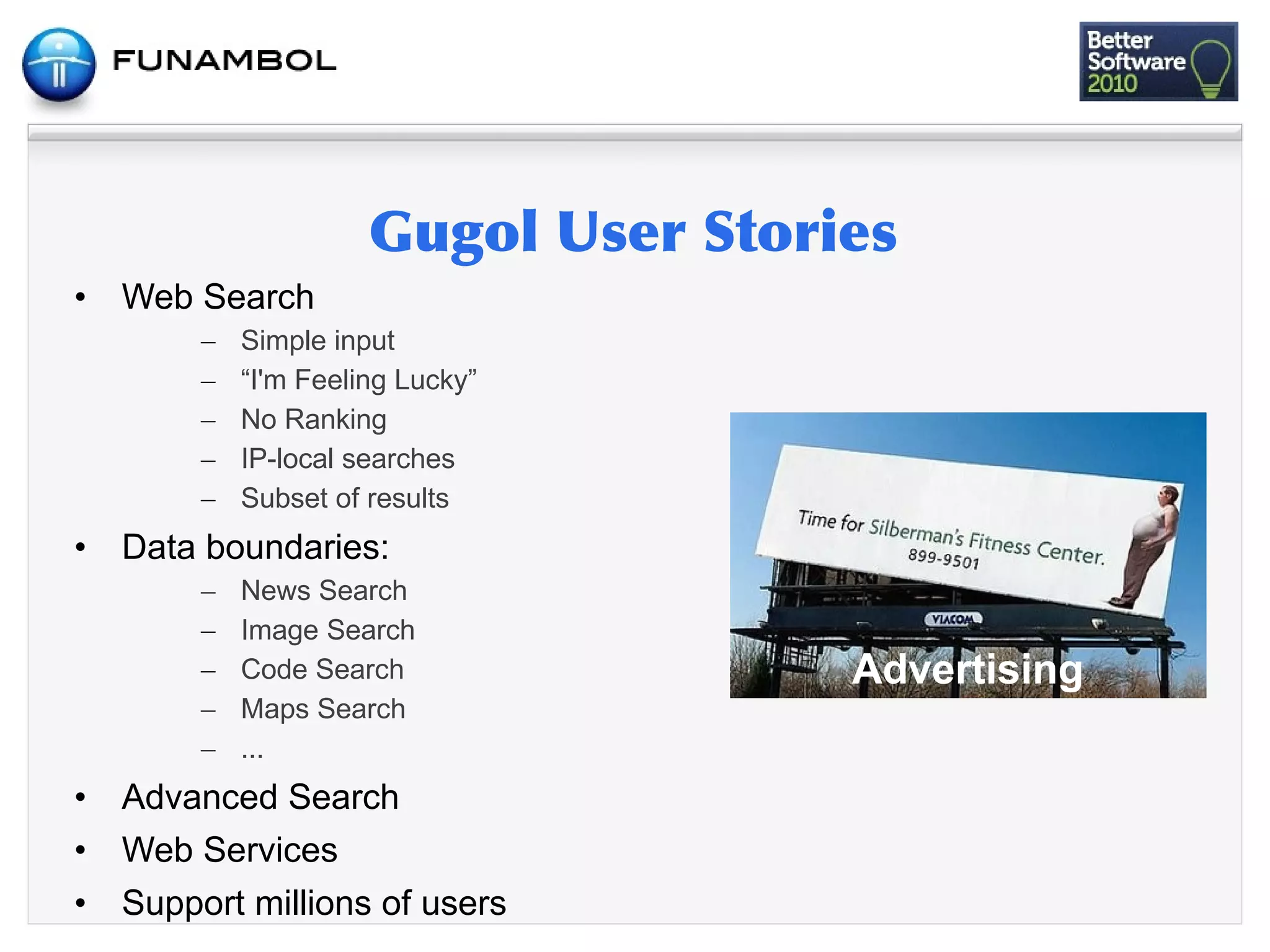
         –   Code Search                       Advertising
         –   Maps Search
         –   ...
•   Advanced Search
•   Web Services
•   Support millions of users
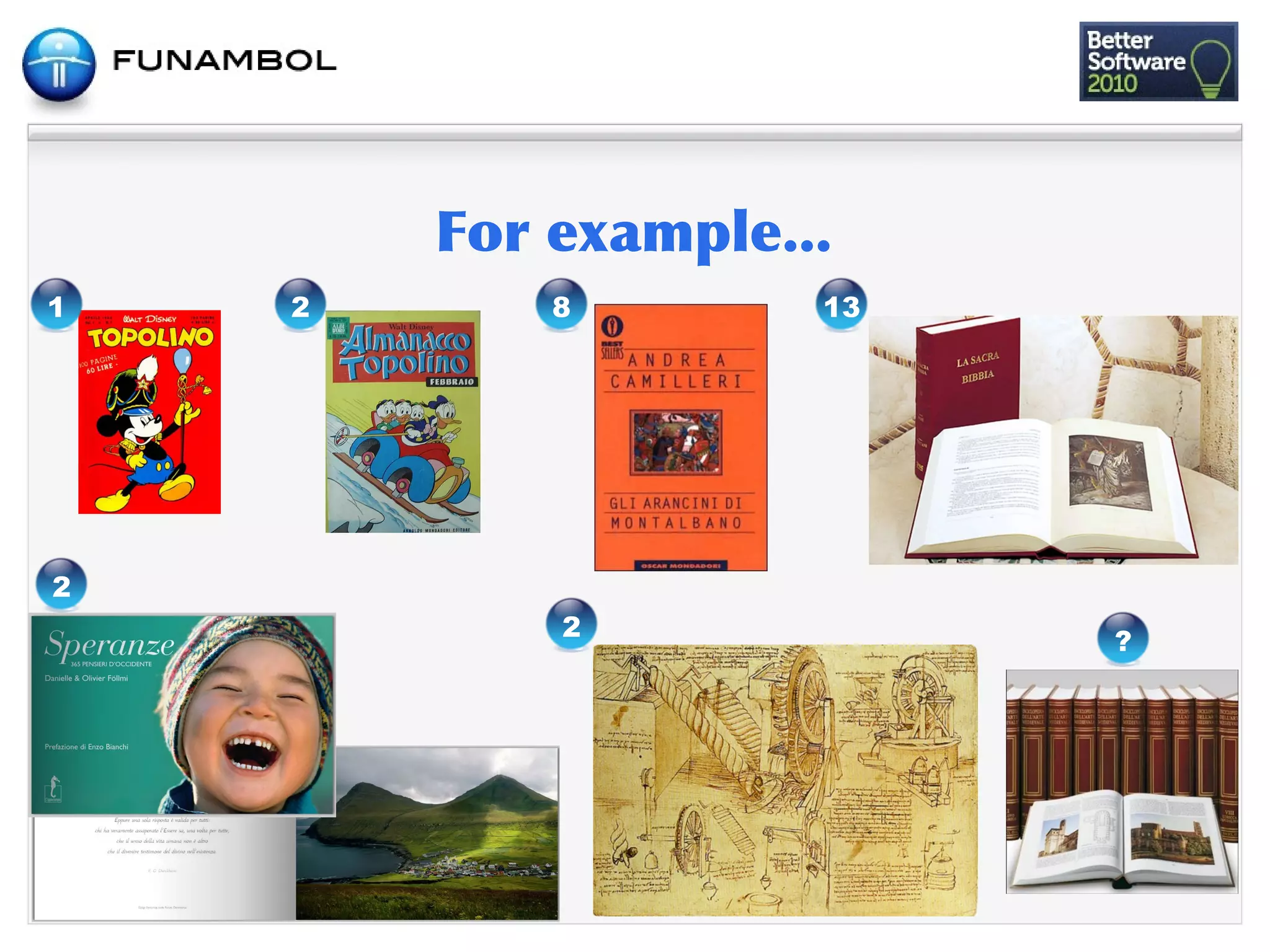
•   Story Points are units of         size used in estimating software
       requirements as an alternative to units of time
•   Measurement of complexity vs. man-day
•   Advantages:
         – cheaper to arrive at
         – collaborative estimation - it's not just developers who can or do estimate, it is
               a product team including analyst, tester and developers
         – the estimates of size are more transparent and universally agreed upon
•   Planning Poker and other techniques
•   Fibonacci sequence
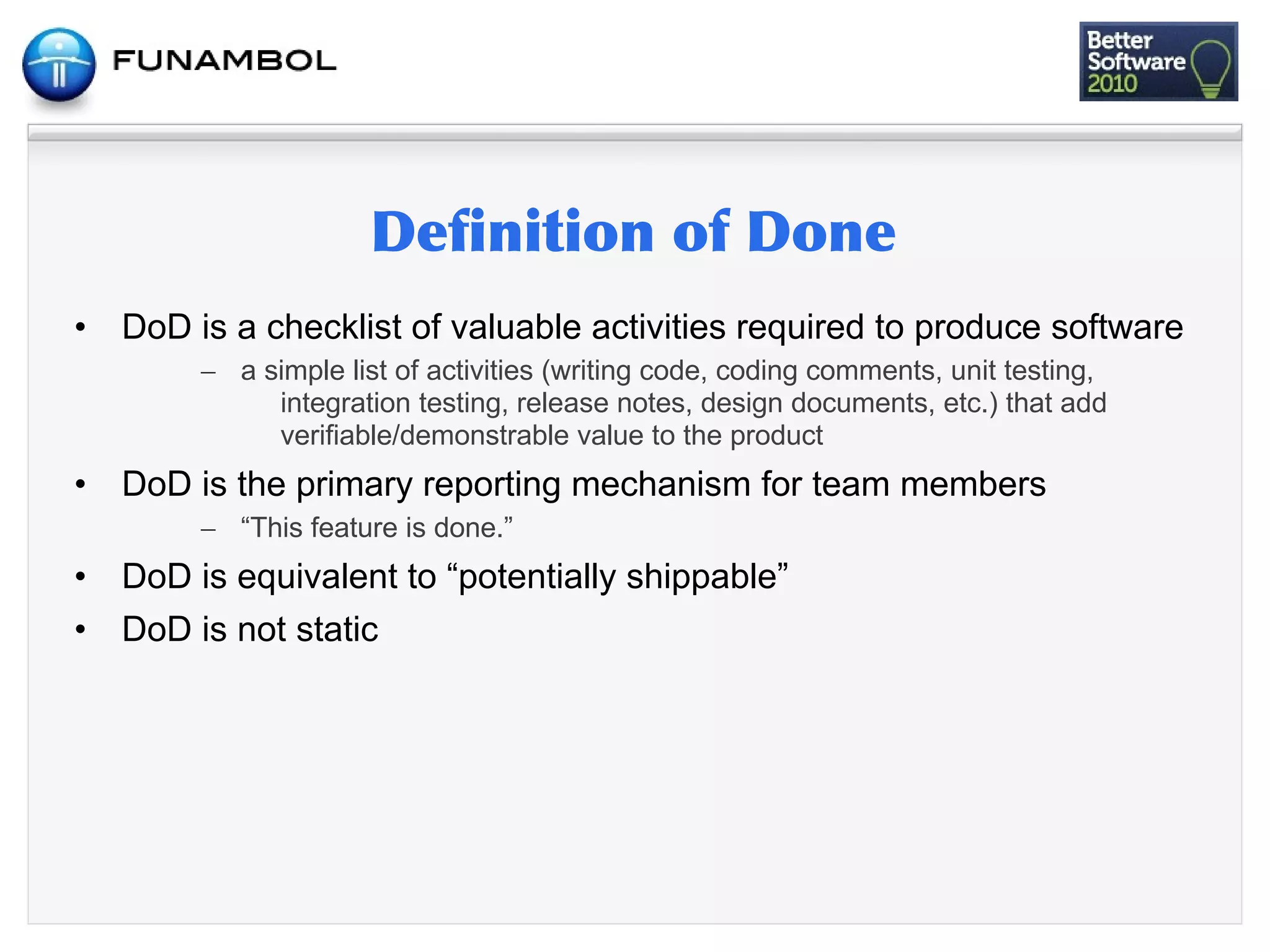
•   DoD is a checklist of valuable activities required to produce software
         – a simple list of activities (writing code, coding comments, unit testing,
              integration testing, release notes, design documents, etc.) that add
              verifiable/demonstrable value to the product
•   DoD is the primary reporting mechanism for team members
         – “This feature is done.”
•   DoD is equivalent to “potentially shippable”
•   DoD is not static
1   2         8   13


2
              2
                       ?
•   Web Search
         –   Simple input
         –   “I'm Feeling Lucky”
         –   No Ranking
         –   IP-local searches
         –   Subset of results
•   Data boundaries:
         –   News Search
         –   Image Search
         –   Code Search                       Advertising
         –   Maps Search
         –   ...
•   Advanced Search
•   Web Services
•   Support millions of users
•   Scaling:
    more than 4 billion of pages and 10Kb/page = tens of terabytes
     –   Performances
     –   Hardware requirements
     –   Handling Failures
     –   PageRank and Shards
•   Documenting Gugol with a list of “As a user..”?
•   Prototypes and Spikes
•   http://www.mountaingoatsoftware.com
•   http://en.wikipedia.org/wiki/History_of_Google
•   http://xprogramming.com
•   http://www.searchenginehistory.com/
•   http://headrush.typepad.com/
•   http://pragmaticagile.wordpress.com
Focus on what user does, not what you do


Don't build a better [x], build a better [user of x]


Thanks to Kathy Sierra - Talk at Business of Software 2009 [http://www.blip.tv/file/3346148]
Alla ricerca della User Story perduta

Alla ricerca della User Story perduta

  • 3.
    Ogni riferimento afatti realmente accaduti e/o a persone realmente esistenti è da ritenersi puramente casuale. Any resemblance to actual persons is purely coincidental
  • 7.
    As a userI want to search the Internet so that I find the information I need
  • 8.
    Software Engineer • Scrum Master in Funambol – 6 teams – 30 engineers schepis@funambol.com • 2,5 years = 50 iterations  3000 user stories • Links: – http://www.funambol.com – http://www.edschepis.net – http://pragmaticagile.wordpress.com edschepis
  • 9.
    Introduction to User Stories – Epic/Theme/User Story/Task – INVEST – Estimation – DONE! • Gugol User Stories • Critics • Conclusions
  • 11.
    In general or for your particular product/service/company, what would you rather have your customers talk about? – A. “Their is awesome” – B. “Their is awesome” – C. “Their is awesome” – D. “ ” • First-person language... reverse engineer • It's not about the tools we build, it's what our tools let them do • better is... better Thanks to Kathy Sierra - Talk at Business of Software 2009 [http://www.blip.tv/file/3346148]
  • 12.
    What's that? Kent Beck coined the term user stories in Extreme • 3C Programming Explained 1 st Edition, 1999 – Card – Conversation – Confirmation • Limitations – It's not just “As a ... I want to... so that...” – Without acceptance tests are open to interpretation – They require close customer contact throughout the project which in some cases may be difficult or may be unnecessary overhead – Can have difficulty scaling to large projects – Conversation starters... fail to serve as a form of reliable documentation of the system
  • 13.
    User stories provide a small-scale and easy-to-use presentation of information – generally formulated in the everyday language of the user – contain little detail, thus remaining open to interpretation – should help the reader understand what it is the software should accomplish – • Use cases in contrast describe a process and its steps in detail, and may be worded in terms of a formal model. – is intended to provide sufficient detail for it to be understood on its own – a generalized description of a set of interactions between the system and one or more actors, where an actor is either a user or another system –
  • 14.
    Theme – a top-level objective that may span projects and products – a collection (group) of user stories • Epic – a large user story: break up epic to several user stories • User Story • Task
  • 15.
    • Independent – User Stories should be as independent as possible. • Negotiable – User Stories are not a contract. • Valuable – User Stories should be valuable to the user. • Estimable – User Stories need to be possible to estimate. • Small – User Stories should be small. Not too small. But not too big. • Testable – User Stories need to be worded in a way that is testable
  • 16.
    Who (As a...) – User – Roles – Systems?!? • What (I want to...) – Action • Why (so that...) – Needs
  • 19.
    Search engine follow links on the web to request pages that are either not yet indexed or have been updated since they were last indexed • These pages are crawled and are added to the search engine . Searching a slightly outdated index of content which roughly represents the content of the web • – Accept the user query, checking to match any advanced syntax and checking to see if the query is misspelled – Check to see if the query is relevant to other vertical search databases (such as news search or product search) and place relevant links to a few items from that type of search query near the regular search results. – Gather a list of relevant pages for the organic search results. These results are ranked based on page content, usage data, and link citation data.
  • 20.
    As a userI want to search the Internet so that I find the information I need
  • 21.
    Why splitting is essential? – a user story should be split when it is too large to fit within a single iteration – split a large user story if a more accurate estimate is necessary • How to split? – Data Boundaries (the information, the results) • along the boundaries of the data supported by the story – Operational Boundaries (search) • separate CRUD operations – Orthogonal Features (security, logging) • creating two versions of the story: one with and one without support – Performance Constraints (find quickly, millions of users) • separating the functional and nonfunctional aspects into separate stories – Mixed Priorities (error paths) • the priorities of the smaller stories are different. • Don’t split a large story into tasks • Watch out the User Stories split f re n z y (“details are not needed now”)
  • 22.
    As a userI want to search the Internet so that I find the information I need
  • 23.
    As a userI want to search the Internet so that I find the information I need
  • 24.
    As a userI want to search the Internet so that I find the information I need
  • 25.
    As a userI want to search the Internet so that I find the information I need
  • 26.
    As a userI want to search the Internet so that I find the information I need
  • 27.
    Data boundaries: search contents, input and results • Operational Boundaries: searching... “I'm Feeling Lucky” • Performances and scalability • Mixed Priorities: – Ranking – Advanced Search – Web Services – Localized searches
  • 28.
    Web Search – Simple input – “I'm Feeling Lucky” – No Ranking – IP-local searches – Subset of results • Data boundaries: – News Search – Image Search – Code Search Advertising – Maps Search – ... • Advanced Search • Web Services • Support millions of users
  • 31.
    Story Points are units of size used in estimating software requirements as an alternative to units of time • Measurement of complexity vs. man-day • Advantages: – cheaper to arrive at – collaborative estimation - it's not just developers who can or do estimate, it is a product team including analyst, tester and developers – the estimates of size are more transparent and universally agreed upon • Planning Poker and other techniques • Fibonacci sequence
  • 32.
    DoD is a checklist of valuable activities required to produce software – a simple list of activities (writing code, coding comments, unit testing, integration testing, release notes, design documents, etc.) that add verifiable/demonstrable value to the product • DoD is the primary reporting mechanism for team members – “This feature is done.” • DoD is equivalent to “potentially shippable” • DoD is not static
  • 33.
    1 2 8 13 2 2 ?
  • 35.
    Web Search – Simple input – “I'm Feeling Lucky” – No Ranking – IP-local searches – Subset of results • Data boundaries: – News Search – Image Search – Code Search Advertising – Maps Search – ... • Advanced Search • Web Services • Support millions of users
  • 36.
    Scaling: more than 4 billion of pages and 10Kb/page = tens of terabytes – Performances – Hardware requirements – Handling Failures – PageRank and Shards • Documenting Gugol with a list of “As a user..”? • Prototypes and Spikes
  • 37.
    http://www.mountaingoatsoftware.com • http://en.wikipedia.org/wiki/History_of_Google • http://xprogramming.com • http://www.searchenginehistory.com/ • http://headrush.typepad.com/ • http://pragmaticagile.wordpress.com
  • 39.
    Focus on whatuser does, not what you do Don't build a better [x], build a better [user of x] Thanks to Kathy Sierra - Talk at Business of Software 2009 [http://www.blip.tv/file/3346148]