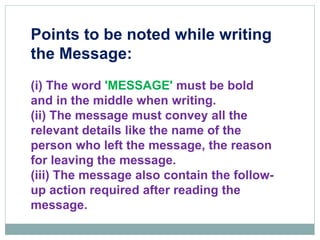
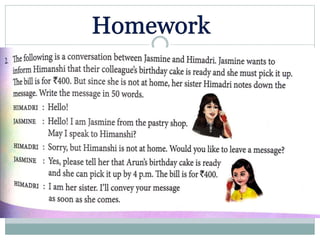
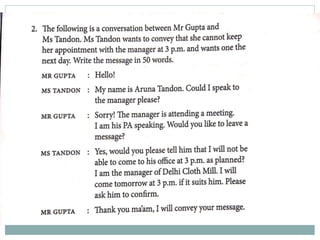
Points to be noted while writing
the Message:
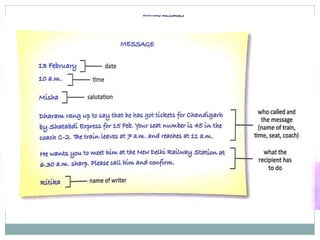
(i) The word 'MESSAGE' must be bold
and in the middle when writing.
(ii) The message must convey all the
relevant details like the name of the
person who left the message, the reason
for leaving the message.
(iii) The message also contain the follow-
up action required after reading the
message.
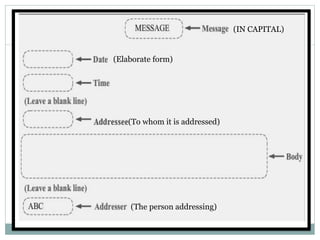
Format
(IN CAPITAL)
(Elaborate form)
(To whom it is addressed)
(The person addressing)
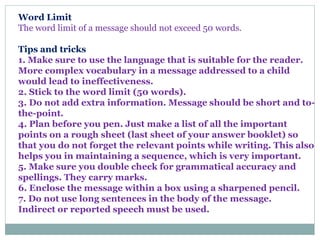
Word Limit
The word limit of a message should not exceed 50 words.
Tips and tricks
1. Make sure to use the language that is suitable for the reader.
More complex vocabulary in a message addressed to a child
would lead to ineffectiveness.
2. Stick to the word limit (50 words).
3. Do not add extra information. Message should be short and to-
the-point.
4. Plan before you pen. Just make a list of all the important
points on a rough sheet (last sheet of your answer booklet) so
that you do not forget the relevant points while writing. This also
helps you in maintaining a sequence, which is very important.
5. Make sure you double check for grammatical accuracy and
spellings. They carry marks.
6. Enclose the message within a box using a sharpened pencil.
7. Do not use long sentences in the body of the message.
Indirect or reported speech must be used.
Message writing
Message writing
Message writing
Message writing

Message writing

  • 5.
    Points to benoted while writing the Message: (i) The word 'MESSAGE' must be bold and in the middle when writing. (ii) The message must convey all the relevant details like the name of the person who left the message, the reason for leaving the message. (iii) The message also contain the follow- up action required after reading the message.
  • 6.
    Format (IN CAPITAL) (Elaborate form) (Towhom it is addressed) (The person addressing)
  • 7.
    Word Limit The wordlimit of a message should not exceed 50 words. Tips and tricks 1. Make sure to use the language that is suitable for the reader. More complex vocabulary in a message addressed to a child would lead to ineffectiveness. 2. Stick to the word limit (50 words). 3. Do not add extra information. Message should be short and to- the-point. 4. Plan before you pen. Just make a list of all the important points on a rough sheet (last sheet of your answer booklet) so that you do not forget the relevant points while writing. This also helps you in maintaining a sequence, which is very important. 5. Make sure you double check for grammatical accuracy and spellings. They carry marks. 6. Enclose the message within a box using a sharpened pencil. 7. Do not use long sentences in the body of the message. Indirect or reported speech must be used.