Retrospective study ofRetrospective study of
malignant pleural mesothelioma inmalignant pleural mesothelioma in
Al-Azhar University Hospitals and El-Al-Azhar University Hospitals and El-
Abassia Chest HospitalAbassia Chest Hospital
Ahmed Ali Abu-Naglah, Sohair Soliman, Nagwa
Fahmy and Hala Abdalla
Chest and General MedicineChest and General Medicine
Departments, Al-Azhar University.Departments, Al-Azhar University.
20042004
- The most common primary malignant
tumour of the pleura is malignant
mesothelioma, an insidious neoplasm
arising from the mesothelial surfaces
of pleural and peritoneal cavities as
well as from the tunica vaginalis and
pericardium.
- Eighty percent of all cases of mesothelioma
are pleural in origin (Albelda et al., 1998).
- The incidence of mesothelioma in the united
states is estimated to be 2200 cases per year
with reported rates increasing by as much as
50 percent in the past decade (Antman, 1993).
- Incidence is also increasing world
wide, particularly in Great Britian
where 2700 to 3000 deaths are
expected annually by 2020 (Peto et al.,
1995).
• After that time, mesothelioma rates are
expected to drop in England and other
developed countries because of recent
legislation aimed at reducing asbestos
exposure in the workplace and general
environment.
• In contrast, mesothelioma incidence rates are
predicted to escalate indefinitely in the third
world because of poor regulation of asbestos
mining and wide spread industrial and
household utilization of asbestos (Antman,
1993).
- The clinical course of mesotheioma is
one of steady deterioration to death
over 1-2 years.
- Patients are rarely alive more than 2
years after diagnosis (Scaton, 2000).
Aetiology:
Asbestos exposure
• Approximately 70% of cases of pleural
mesothelioma are associated with documented
asbestos exposure. (Albelda et al., 1998).
• Carcinogenic effects of asbestos appear to result
from it physical properties, rather than chemical
structure.
• Asbestos is not a specific molecule but the
commercial name for a group of hydrated
magnesium fibrous minerals.
Types of asbestos :
• Serpentine (chrysotile) fibers are curly and pliable.
• Amphiboles (crocidolite, amosite, tremolite,
anthophyiloye, actinolite) are long and needle
like.Fibers with a high length to width ratio, such as
crocidolite, are considered more carcinogenic.
- A mosite has an intermediate risk, chrysotile the
lowest.
Other etiologic factors
- Therapeutic irradiation.
- Intrapleural thorium dioxide (thorotrast).
- Inhalation of other fibrous silicates such as
erionite.
- Genetic predisposition to the neoplasm remains
to be shown.
• Carbone and co-workers 1999 found Simian
virus (SV 40) like sequences in 60% of frozen
mesothelioma specimens by PCR.
• The majority of these patients also had a
history of asbestos exposure raising the
possibility of SV 40 acting as a co-carcinogen.
High risk individuals
- Persons at high risk of mesothelioma can be
identified by tracing the processing and
commercial uses of asbestos.
• The mineral is mined, milled, and
incorporated into a wide range of industrial
and commercial products including
insulation, textiles, heat protectors, filters
and construction materials (spackling,
roofing, siding and floor ceiling tiles)..
High risk individuals (cont.)
- Workers with high levels of asbestos exposure are:
• Miners, millers, producers of asbestos products.
• Laborers who install plumbing, boiler and heating
equipment in ships factories and homes.
• Peoples who may not handle asbestos directly but
are in proximity to the materials.
• Household contact exposure
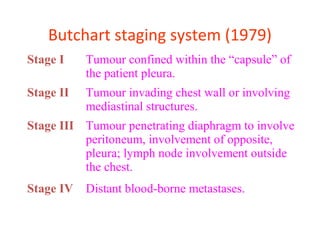
Butchart staging system (1979)
Stage I Tumour confined within the “capsule” of
the patient pleura.
Stage II Tumour invading chest wall or involving
mediastinal structures.
Stage III Tumour penetrating diaphragm to involve
peritoneum, involvement of opposite,
pleura; lymph node involvement outside
the chest.
Stage IV Distant blood-borne metastases.
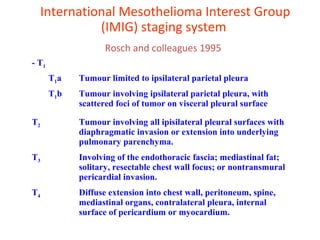
International Mesothelioma Interest Group
(IMIG) staging system
Rosch and colleagues 1995
- T1
T1a Tumour limited to ipsilateral parietal pleura
T1b Tumour involving ipsilateral parietal pleura, with
scattered foci of tumor on visceral pleural surface
T2 Tumour involving all ipisilateral pleural surfaces with
diaphragmatic invasion or extension into underlying
pulmonary parenchyma.
T3 Involving of the endothoracic fascia; mediastinal fat;
solitary, resectable chest wall focus; or nontransmural
pericardial invasion.
T4 Diffuse extension into chest wall, peritoneum, spine,
mediastinal organs, contralateral pleura, internal
surface of pericardium or myocardium.
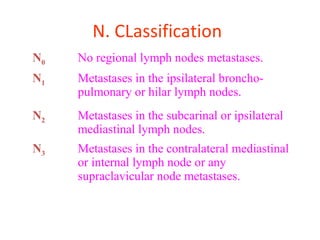
N0 No regional lymph nodes metastases.
N1 Metastases in the ipsilateral broncho-
pulmonary or hilar lymph nodes.
N2 Metastases in the subcarinal or ipsilateral
mediastinal lymph nodes.
N3 Metastases in the contralateral mediastinal
or internal lymph node or any
supraclavicular node metastases.
N. CLassification
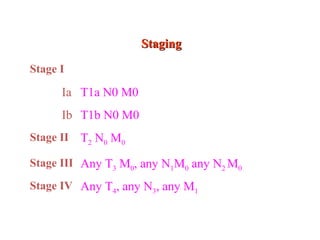
StagingStaging
Stage I
Ia T1a N0 M0
Ib T1b N0 M0
Stage II T2 N0 M0
Stage III Any T3 M0, any N1M0 any N2 M0
Stage IV Any T4, any N3, any M1
In this study we try to suspect the size of
problem of malignant pleural
mesothelioma, its pattern and its prognosis
in Egypt.
Patients and Methods:
• This retrospective study included all histo-
pathologically or cytologically proven malignant
pleural mesothelioma patients (747 patients).
• All patients were admitted at El-Abassia Chest
Hospital or Al-Azhar University Hospitals (Bab – El
Shariaa, El-Hussain, and El-Zahraa Hospitals)
during the period from 1/1/1996–until
31/12/2003.
• The patients who were suspected clinically and
radiologically but not proven pathologically were
excluded.
• The patients data in this study were
obtained from files of these patients at
these hospitals.
• The recorded data included the followings:
– Personal data of the patients:-
Name, Age, Sex, Address, Occupation,
Occupation of the husbands in female patients
(if possible) and special habits.
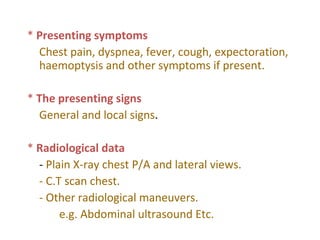
* Presenting symptoms
Chest pain, dyspnea, fever, cough, expectoration,
haemoptysis and other symptoms if present.
* The presenting signs
General and local signs.
* Radiological data
- Plain X-ray chest P/A and lateral views.
- C.T scan chest.
- Other radiological maneuvers.
e.g. Abdominal ultrasound Etc.
• Methods of pathological diagnosis
- Cytological examination of the pleural fluids.
- Histopathology of the pleural biopsy which
obtained by Abram’s needle, C.T. guided
percutanous cut needle, through thoracoscopy or
by open thoracotomy.
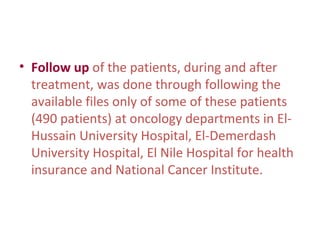
• Follow up of the patients, during and after
treatment, was done through following the
available files only of some of these patients
(490 patients) at oncology departments in El-
Hussain University Hospital, El-Demerdash
University Hospital, El Nile Hospital for health
insurance and National Cancer Institute.
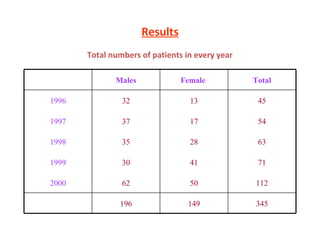
Results
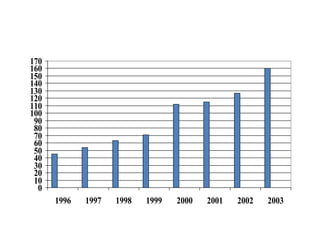
Total numbers of patients in every year
345149196
11250622000
7141301999
6328351998
5417371997
4513321996
TotalFemaleMales
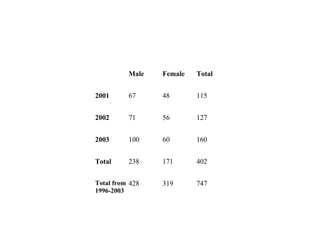
Male Female Total
2001 67 48 115
2002 71 56 127
2003 100 60 160
Total 238 171 402
Total from
1996-2003
428 319 747
0
10
20
30
40
50
60
70
80
90
100
110
120
130
140
150
160
170
1996 1997 1998 1999 2000 2001 2002 2003
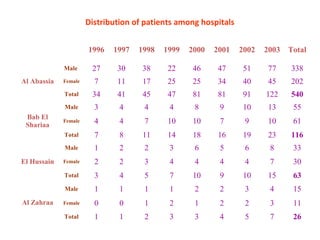
Distribution of patients among hospitals
1996 1997 1998 1999 2000 2001 2002 2003 Total
Al Abassia
Male 27 30 38 22 46 47 51 77 338
Female 7 11 17 25 25 34 40 45 202
Total 34 41 45 47 81 81 91 122 540
Bab El
Shariaa
Male 3 4 4 4 8 9 10 13 55
Female 4 4 7 10 10 7 9 10 61
Total 7 8 11 14 18 16 19 23 116
El Hussain
Male 1 2 2 3 6 5 6 8 33
Female 2 2 3 4 4 4 4 7 30
Total 3 4 5 7 10 9 10 15 63
Al Zahraa
Male 1 1 1 1 2 2 3 4 15
Female 0 0 1 2 1 2 2 3 11
Total 1 1 2 3 3 4 5 7 26
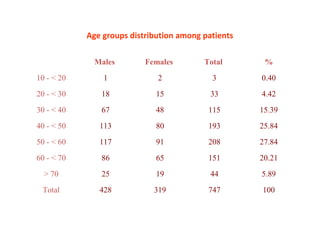
Age groups distribution among patients
Males Females Total %
10 - < 20 1 2 3 0.40
20 - < 30 18 15 33 4.42
30 - < 40 67 48 115 15.39
40 - < 50 113 80 193 25.84
50 - < 60 117 91 208 27.84
60 - < 70 86 65 151 20.21
> 70 25 19 44 5.89
Total 428 319 747 100
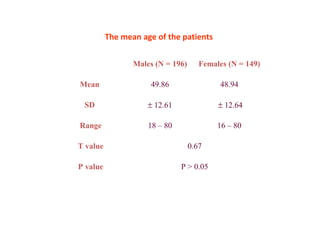
The mean age of the patients
Males (N = 196) Females (N = 149)
Mean 49.86 48.94
SD ± 12.61 ± 12.64
Range 18 – 80 16 – 80
T value 0.67
P value P > 0.05
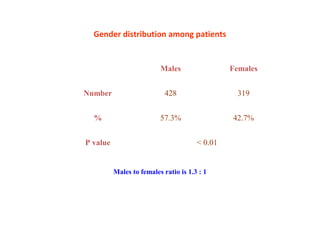
Gender distribution among patients
Males Females
Number 428 319
% 57.3% 42.7%
P value < 0.01
Males to females ratio is 1.3 : 1
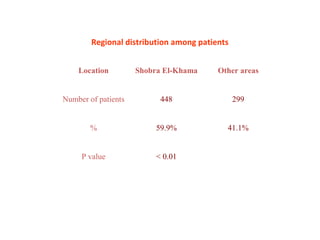
Regional distribution among patients
Location Shobra El-Khama Other areas
Number of patients 448 299
% 59.9% 41.1%
P value < 0.01
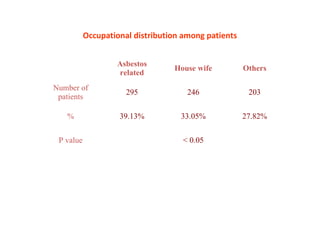
Occupational distribution among patients
Asbestos
related
House wife Others
Number of
patients
295 246 203
% 39.13% 33.05% 27.82%
P value < 0.05
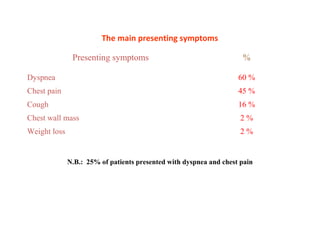
The main presenting symptoms
Presenting symptoms %
Dyspnea
Chest pain
Cough
Chest wall mass
Weight loss
60 %
45 %
16 %
2 %
2 %
N.B.: 25% of patients presented with dyspnea and chest pain
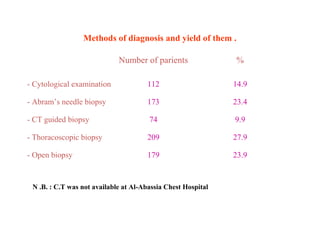
Methods of diagnosis and yield of them .
Number of parients %
- Cytological examination
- Abram’s needle biopsy
- CT guided biopsy
- Thoracoscopic biopsy
- Open biopsy
112
173
74
209
179
14.9
23.4
9.9
27.9
23.9
N .B. : C.T was not available at Al-Abassia Chest Hospital
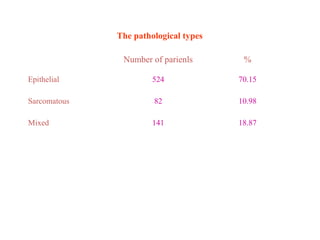
The pathological types
Number of parienls %
Epithelial
Sarcomatous
Mixed
524
82
141
70.15
10.98
18.87
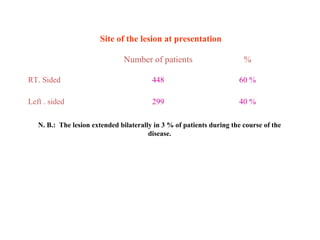
Site of the lesion at presentation
Number of patients %
RT. Sided
Left . sided
448
299
60 %
40 %
N. B.: The lesion extended bilaterally in 3 % of patients during the course of the
disease.
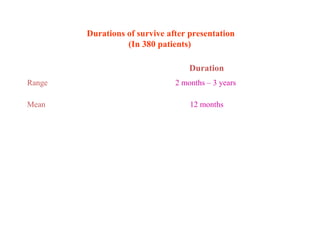
Durations of survive after presentation
(In 380 patients)
Duration
Range
Mean
2 months – 3 years
12 months
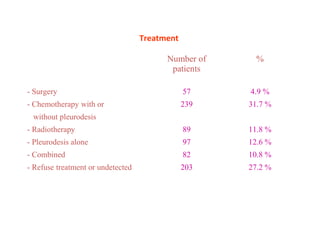
Treatment
Number of
patients
%
- Surgery
- Chemotherapy with or
without pleurodesis
- Radiotherapy
- Pleurodesis alone
- Combined
- Refuse treatment or undetected
57
239
89
97
82
203
4.9 %
31.7 %
11.8 %
12.6 %
10.8 %
27.2 %
Conclusion and
Recommendations
• Malignant pleural mesothelioma is increasing
progressively in Egypt specially in industrial areas.
• It affects younger age groups. About 45% of patients
below 50 years while in other countries the median
age of affection is 60 years.
• The males to females ratio is 1.3 : 1 while
in united states mesothelioma is
approximately three fold more in men
than in women. This because most of the
affected Egyptian women are living at
the industrial polluted areas.
• This disease is fatal within few months even in
younger patients.
• Preventive measures that attempt to eliminate or
at least reduce asbestos pollution are mandatory,
with the use of safer and alternative materials for
construction, insulation, and other consumer and
industrial applications and by dust control and
personal protection.
• .
• The factories which use any type
of asbestos materials must be
transferred to distinct areas away
from houses and populations
Thank you

Mesothelioma 1996 2003

  • 2.
    Retrospective study ofRetrospectivestudy of malignant pleural mesothelioma inmalignant pleural mesothelioma in Al-Azhar University Hospitals and El-Al-Azhar University Hospitals and El- Abassia Chest HospitalAbassia Chest Hospital Ahmed Ali Abu-Naglah, Sohair Soliman, Nagwa Fahmy and Hala Abdalla Chest and General MedicineChest and General Medicine Departments, Al-Azhar University.Departments, Al-Azhar University. 20042004
  • 3.
    - The mostcommon primary malignant tumour of the pleura is malignant mesothelioma, an insidious neoplasm arising from the mesothelial surfaces of pleural and peritoneal cavities as well as from the tunica vaginalis and pericardium.
  • 4.
    - Eighty percentof all cases of mesothelioma are pleural in origin (Albelda et al., 1998). - The incidence of mesothelioma in the united states is estimated to be 2200 cases per year with reported rates increasing by as much as 50 percent in the past decade (Antman, 1993).
  • 5.
    - Incidence isalso increasing world wide, particularly in Great Britian where 2700 to 3000 deaths are expected annually by 2020 (Peto et al., 1995).
  • 6.
    • After thattime, mesothelioma rates are expected to drop in England and other developed countries because of recent legislation aimed at reducing asbestos exposure in the workplace and general environment.
  • 7.
    • In contrast,mesothelioma incidence rates are predicted to escalate indefinitely in the third world because of poor regulation of asbestos mining and wide spread industrial and household utilization of asbestos (Antman, 1993).
  • 8.
    - The clinicalcourse of mesotheioma is one of steady deterioration to death over 1-2 years. - Patients are rarely alive more than 2 years after diagnosis (Scaton, 2000).
  • 9.
    Aetiology: Asbestos exposure • Approximately70% of cases of pleural mesothelioma are associated with documented asbestos exposure. (Albelda et al., 1998). • Carcinogenic effects of asbestos appear to result from it physical properties, rather than chemical structure. • Asbestos is not a specific molecule but the commercial name for a group of hydrated magnesium fibrous minerals.
  • 10.
    Types of asbestos: • Serpentine (chrysotile) fibers are curly and pliable. • Amphiboles (crocidolite, amosite, tremolite, anthophyiloye, actinolite) are long and needle like.Fibers with a high length to width ratio, such as crocidolite, are considered more carcinogenic. - A mosite has an intermediate risk, chrysotile the lowest.
  • 11.
    Other etiologic factors -Therapeutic irradiation. - Intrapleural thorium dioxide (thorotrast). - Inhalation of other fibrous silicates such as erionite. - Genetic predisposition to the neoplasm remains to be shown.
  • 12.
    • Carbone andco-workers 1999 found Simian virus (SV 40) like sequences in 60% of frozen mesothelioma specimens by PCR. • The majority of these patients also had a history of asbestos exposure raising the possibility of SV 40 acting as a co-carcinogen.
  • 13.
    High risk individuals -Persons at high risk of mesothelioma can be identified by tracing the processing and commercial uses of asbestos.
  • 14.
    • The mineralis mined, milled, and incorporated into a wide range of industrial and commercial products including insulation, textiles, heat protectors, filters and construction materials (spackling, roofing, siding and floor ceiling tiles)..
  • 15.
    High risk individuals(cont.) - Workers with high levels of asbestos exposure are: • Miners, millers, producers of asbestos products. • Laborers who install plumbing, boiler and heating equipment in ships factories and homes. • Peoples who may not handle asbestos directly but are in proximity to the materials. • Household contact exposure
  • 16.
    Butchart staging system(1979) Stage I Tumour confined within the “capsule” of the patient pleura. Stage II Tumour invading chest wall or involving mediastinal structures. Stage III Tumour penetrating diaphragm to involve peritoneum, involvement of opposite, pleura; lymph node involvement outside the chest. Stage IV Distant blood-borne metastases.
  • 17.
    International Mesothelioma InterestGroup (IMIG) staging system Rosch and colleagues 1995 - T1 T1a Tumour limited to ipsilateral parietal pleura T1b Tumour involving ipsilateral parietal pleura, with scattered foci of tumor on visceral pleural surface T2 Tumour involving all ipisilateral pleural surfaces with diaphragmatic invasion or extension into underlying pulmonary parenchyma. T3 Involving of the endothoracic fascia; mediastinal fat; solitary, resectable chest wall focus; or nontransmural pericardial invasion. T4 Diffuse extension into chest wall, peritoneum, spine, mediastinal organs, contralateral pleura, internal surface of pericardium or myocardium.
  • 18.
    N0 No regionallymph nodes metastases. N1 Metastases in the ipsilateral broncho- pulmonary or hilar lymph nodes. N2 Metastases in the subcarinal or ipsilateral mediastinal lymph nodes. N3 Metastases in the contralateral mediastinal or internal lymph node or any supraclavicular node metastases. N. CLassification
  • 19.
    StagingStaging Stage I Ia T1aN0 M0 Ib T1b N0 M0 Stage II T2 N0 M0 Stage III Any T3 M0, any N1M0 any N2 M0 Stage IV Any T4, any N3, any M1
  • 20.
    In this studywe try to suspect the size of problem of malignant pleural mesothelioma, its pattern and its prognosis in Egypt.
  • 21.
    Patients and Methods: •This retrospective study included all histo- pathologically or cytologically proven malignant pleural mesothelioma patients (747 patients). • All patients were admitted at El-Abassia Chest Hospital or Al-Azhar University Hospitals (Bab – El Shariaa, El-Hussain, and El-Zahraa Hospitals) during the period from 1/1/1996–until 31/12/2003. • The patients who were suspected clinically and radiologically but not proven pathologically were excluded.
  • 22.
    • The patientsdata in this study were obtained from files of these patients at these hospitals. • The recorded data included the followings: – Personal data of the patients:- Name, Age, Sex, Address, Occupation, Occupation of the husbands in female patients (if possible) and special habits.
  • 23.
    * Presenting symptoms Chestpain, dyspnea, fever, cough, expectoration, haemoptysis and other symptoms if present. * The presenting signs General and local signs. * Radiological data - Plain X-ray chest P/A and lateral views. - C.T scan chest. - Other radiological maneuvers. e.g. Abdominal ultrasound Etc.
  • 24.
    • Methods ofpathological diagnosis - Cytological examination of the pleural fluids. - Histopathology of the pleural biopsy which obtained by Abram’s needle, C.T. guided percutanous cut needle, through thoracoscopy or by open thoracotomy.
  • 25.
    • Follow upof the patients, during and after treatment, was done through following the available files only of some of these patients (490 patients) at oncology departments in El- Hussain University Hospital, El-Demerdash University Hospital, El Nile Hospital for health insurance and National Cancer Institute.
  • 26.
    Results Total numbers ofpatients in every year 345149196 11250622000 7141301999 6328351998 5417371997 4513321996 TotalFemaleMales
  • 27.
    Male Female Total 200167 48 115 2002 71 56 127 2003 100 60 160 Total 238 171 402 Total from 1996-2003 428 319 747
  • 28.
  • 29.
    Distribution of patientsamong hospitals 1996 1997 1998 1999 2000 2001 2002 2003 Total Al Abassia Male 27 30 38 22 46 47 51 77 338 Female 7 11 17 25 25 34 40 45 202 Total 34 41 45 47 81 81 91 122 540 Bab El Shariaa Male 3 4 4 4 8 9 10 13 55 Female 4 4 7 10 10 7 9 10 61 Total 7 8 11 14 18 16 19 23 116 El Hussain Male 1 2 2 3 6 5 6 8 33 Female 2 2 3 4 4 4 4 7 30 Total 3 4 5 7 10 9 10 15 63 Al Zahraa Male 1 1 1 1 2 2 3 4 15 Female 0 0 1 2 1 2 2 3 11 Total 1 1 2 3 3 4 5 7 26
  • 30.
    Age groups distributionamong patients Males Females Total % 10 - < 20 1 2 3 0.40 20 - < 30 18 15 33 4.42 30 - < 40 67 48 115 15.39 40 - < 50 113 80 193 25.84 50 - < 60 117 91 208 27.84 60 - < 70 86 65 151 20.21 > 70 25 19 44 5.89 Total 428 319 747 100
  • 31.
    The mean ageof the patients Males (N = 196) Females (N = 149) Mean 49.86 48.94 SD ± 12.61 ± 12.64 Range 18 – 80 16 – 80 T value 0.67 P value P > 0.05
  • 32.
    Gender distribution amongpatients Males Females Number 428 319 % 57.3% 42.7% P value < 0.01 Males to females ratio is 1.3 : 1
  • 33.
    Regional distribution amongpatients Location Shobra El-Khama Other areas Number of patients 448 299 % 59.9% 41.1% P value < 0.01
  • 34.
    Occupational distribution amongpatients Asbestos related House wife Others Number of patients 295 246 203 % 39.13% 33.05% 27.82% P value < 0.05
  • 35.
    The main presentingsymptoms Presenting symptoms % Dyspnea Chest pain Cough Chest wall mass Weight loss 60 % 45 % 16 % 2 % 2 % N.B.: 25% of patients presented with dyspnea and chest pain
  • 36.
    Methods of diagnosisand yield of them . Number of parients % - Cytological examination - Abram’s needle biopsy - CT guided biopsy - Thoracoscopic biopsy - Open biopsy 112 173 74 209 179 14.9 23.4 9.9 27.9 23.9 N .B. : C.T was not available at Al-Abassia Chest Hospital
  • 37.
    The pathological types Numberof parienls % Epithelial Sarcomatous Mixed 524 82 141 70.15 10.98 18.87
  • 38.
    Site of thelesion at presentation Number of patients % RT. Sided Left . sided 448 299 60 % 40 % N. B.: The lesion extended bilaterally in 3 % of patients during the course of the disease.
  • 39.
    Durations of surviveafter presentation (In 380 patients) Duration Range Mean 2 months – 3 years 12 months
  • 40.
    Treatment Number of patients % - Surgery -Chemotherapy with or without pleurodesis - Radiotherapy - Pleurodesis alone - Combined - Refuse treatment or undetected 57 239 89 97 82 203 4.9 % 31.7 % 11.8 % 12.6 % 10.8 % 27.2 %
  • 41.
    Conclusion and Recommendations • Malignantpleural mesothelioma is increasing progressively in Egypt specially in industrial areas. • It affects younger age groups. About 45% of patients below 50 years while in other countries the median age of affection is 60 years.
  • 42.
    • The malesto females ratio is 1.3 : 1 while in united states mesothelioma is approximately three fold more in men than in women. This because most of the affected Egyptian women are living at the industrial polluted areas.
  • 43.
    • This diseaseis fatal within few months even in younger patients. • Preventive measures that attempt to eliminate or at least reduce asbestos pollution are mandatory, with the use of safer and alternative materials for construction, insulation, and other consumer and industrial applications and by dust control and personal protection. • .
  • 44.
    • The factorieswhich use any type of asbestos materials must be transferred to distinct areas away from houses and populations
  • 45.