1
June 1st, 2017
Scott Laffer | Cumulus Networks
OpenStack Networks
The Web-Scale Way
2
Agenda
Who are we?
Why should you care about the network?
Tenant networks – What choices are there?
What do you need from your network?
Demo
3
Cumulus Networks Confidential 3
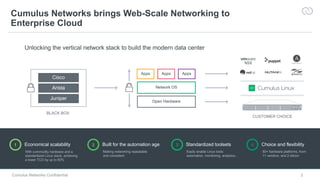
Cumulus Networks brings Web-Scale Networking to
Enterprise Cloud
Economical scalability
With commodity hardware and a
standardized Linux stack, achieving
a lower TCO by up to 60%
Network OS
Open Hardware
Apps Apps Apps
1 2 3 4Built for the automation age Standardized toolsets Choice and flexibility
Making networking repeatable
and consistent
Easily enable Linux tools:
automation, monitoring, analytics…
50+ hardware platforms, from
11 vendors, and 2 silicon
BLACK BOX
Arista
Juniper
Cisco
CUSTOMER CHOICE
Unlocking the vertical network stack to build the modern data center
Cumulus Linux
4
Why should you care about the network?
5
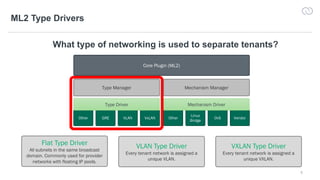
ML2 Type Drivers
What type of networking is used to separate tenants?
Other
Linux
Bridge
OvS VendorOther GRE VLAN VxLAN
Core Plugin (ML2)
Type Manager
Type Driver
Mechanism Manager
Mechanism Driver
Flat Type Driver
All subnets in the same broadcast
domain. Commonly used for provider
networks with floating IP pools.
VLAN Type Driver
Every tenant network is assigned a
unique VLAN.
VXLAN Type Driver
Every tenant network is assigned a
unique VXLAN.
6
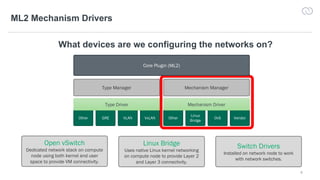
ML2 Mechanism Drivers
What devices are we configuring the networks on?
Other
Linux
Bridge
OvS VendorOther GRE VLAN VxLAN
Core Plugin (ML2)
Type Manager
Type Driver
Mechanism Manager
Mechanism Driver
Open vSwitch
Dedicated network stack on compute
node using both kernel and user
space to provide VM connectivity.
Linux Bridge
Uses native Linux kernel networking
on compute node to provide Layer 2
and Layer 3 connectivity.
Switch Drivers
Installed on network node to work
with network switches.
7
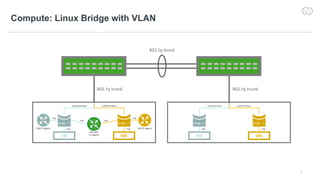
Compute: Linux Bridge with VLAN
VMVM
bridge - <>bridge - <>
subinterface
taptap
subinterface
802.1q trunk 802.1q trunk
802.1q bond
VMVM
bridge - <>bridge - <>
subinterface
taptap
tap tap
taptap
subinterface
vRouter
L3 Agent
DHCP AgentDHCP Agent
8
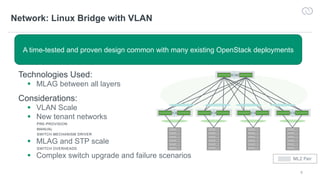
Network: Linux Bridge with VLAN
Technologies Used:
§ MLAG between all layers
Considerations:
§ VLAN Scale
§ New tenant networks
PRE-PROVISION
MANUAL
SWITCH MECHANISM DRIVER
§ MLAG and STP scale
SWITCH OVERHEADS
§ Complex switch upgrade and failure scenarios
A time-tested and proven design common with many existing OpenStack deployments
ML2 Pair
9
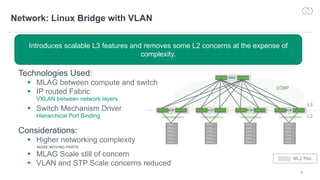
Network: Linux Bridge with VLAN
Technologies Used:
§ MLAG between compute and switch
§ IP routed Fabric
VXLAN between network layers
§ Switch Mechanism Driver
Hierarchical Port Binding
Considerations:
§ Higher networking complexity
MORE MOVING PARTS
§ MLAG Scale still of concern
§ VLAN and STP Scale concerns reduced
Introduces scalable L3 features and removes some L2 concerns at the expense of
complexity.
ML2 Pair
ECMP
L2
L3
10
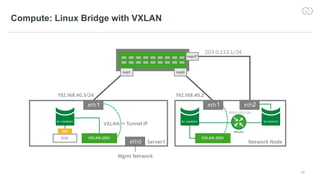
Compute: Linux Bridge with VXLAN
3
5
6
2
1
4
VXLAN –> Tunnel IP
Server1 Network Node
172.16.1.1
172.16.1.2
192.168.40.2192.168.40.3/24
VM
br-<random> br-<random> br-external
TAP
VXLAN-2061
eth0
eth0 eth0 eth0
swp1 swp8
swp47
vRouter
VXLAN-2061
Mgmt Network
203.0.113.1/24
203.0.113.2/24
1 1 2
1 1
11
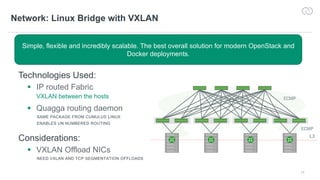
Network: Linux Bridge with VXLAN
Technologies Used:
§ IP routed Fabric
VXLAN between the hosts
§ Quagga routing daemon
SAME PACKAGE FROM CUMULUS LINUX
ENABLES UN NUMBERED ROUTING
Considerations:
§ VXLAN Offload NICs
NEED VXLAN AND TCP SEGMENTATION OFFLOADS
Simple, flexible and incredibly scalable. The best overall solution for modern OpenStack and
Docker deployments.
L3
ECMP
ECMP
12
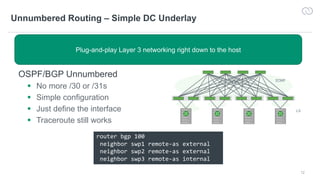
Unnumbered Routing – Simple DC Underlay
OSPF/BGP Unnumbered
§ No more /30 or /31s
§ Simple configuration
§ Just define the interface
§ Traceroute still works
router bgp 100
neighbor swp1 remote-as external
neighbor swp2 remote-as external
neighbor swp3 remote-as internal
Plug-and-play Layer 3 networking right down to the host
13
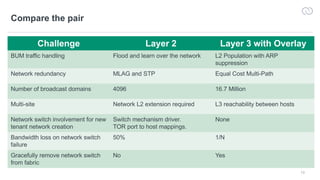
Compare the pair
Challenge Layer 2 Layer 3 with Overlay
BUM traffic handling Flood and learn over the network L2 Population with ARP
suppression
Network redundancy MLAG and STP Equal Cost Multi-Path
Number of broadcast domains 4096 16.7 Million
Multi-site Network L2 extension required L3 reachability between hosts
Network switch involvement for new
tenant network creation
Switch mechanism driver.
TOR port to host mappings.
None
Bandwidth loss on network switch
failure
50% 1/N
Gracefully remove network switch
from fabric
No Yes
14
Demo Time
15
Thank you!
Visit us at cumulusnetworks.com or follow us @cumulusnetworks
© 2017 Cumulus Networks. Cumulus Networks, the Cumulus Networks Logo, and Cumulus Linux are trademarks or registered trademarks of Cumulus
Networks, Inc. or its affiliates in the U.S. and other countries. Other names may be trademarks of their respective owners. The registered trademark
Linux® is used pursuant to a sublicense from LMI, the exclusive licensee of Linus Torvalds, owner of the mark on a world-wide basis.

OpenStack Networks the Web-Scale Way - Scott Laffer, Cumulus Networks

  • 1.
    1 June 1st, 2017 ScottLaffer | Cumulus Networks OpenStack Networks The Web-Scale Way
  • 2.
    2 Agenda Who are we? Whyshould you care about the network? Tenant networks – What choices are there? What do you need from your network? Demo
  • 3.
    3 Cumulus Networks Confidential3 Cumulus Networks brings Web-Scale Networking to Enterprise Cloud Economical scalability With commodity hardware and a standardized Linux stack, achieving a lower TCO by up to 60% Network OS Open Hardware Apps Apps Apps 1 2 3 4Built for the automation age Standardized toolsets Choice and flexibility Making networking repeatable and consistent Easily enable Linux tools: automation, monitoring, analytics… 50+ hardware platforms, from 11 vendors, and 2 silicon BLACK BOX Arista Juniper Cisco CUSTOMER CHOICE Unlocking the vertical network stack to build the modern data center Cumulus Linux
  • 4.
    4 Why should youcare about the network?
  • 5.
    5 ML2 Type Drivers Whattype of networking is used to separate tenants? Other Linux Bridge OvS VendorOther GRE VLAN VxLAN Core Plugin (ML2) Type Manager Type Driver Mechanism Manager Mechanism Driver Flat Type Driver All subnets in the same broadcast domain. Commonly used for provider networks with floating IP pools. VLAN Type Driver Every tenant network is assigned a unique VLAN. VXLAN Type Driver Every tenant network is assigned a unique VXLAN.
  • 6.
    6 ML2 Mechanism Drivers Whatdevices are we configuring the networks on? Other Linux Bridge OvS VendorOther GRE VLAN VxLAN Core Plugin (ML2) Type Manager Type Driver Mechanism Manager Mechanism Driver Open vSwitch Dedicated network stack on compute node using both kernel and user space to provide VM connectivity. Linux Bridge Uses native Linux kernel networking on compute node to provide Layer 2 and Layer 3 connectivity. Switch Drivers Installed on network node to work with network switches.
  • 7.
    7 Compute: Linux Bridgewith VLAN VMVM bridge - <>bridge - <> subinterface taptap subinterface 802.1q trunk 802.1q trunk 802.1q bond VMVM bridge - <>bridge - <> subinterface taptap tap tap taptap subinterface vRouter L3 Agent DHCP AgentDHCP Agent
  • 8.
    8 Network: Linux Bridgewith VLAN Technologies Used: § MLAG between all layers Considerations: § VLAN Scale § New tenant networks PRE-PROVISION MANUAL SWITCH MECHANISM DRIVER § MLAG and STP scale SWITCH OVERHEADS § Complex switch upgrade and failure scenarios A time-tested and proven design common with many existing OpenStack deployments ML2 Pair
  • 9.
    9 Network: Linux Bridgewith VLAN Technologies Used: § MLAG between compute and switch § IP routed Fabric VXLAN between network layers § Switch Mechanism Driver Hierarchical Port Binding Considerations: § Higher networking complexity MORE MOVING PARTS § MLAG Scale still of concern § VLAN and STP Scale concerns reduced Introduces scalable L3 features and removes some L2 concerns at the expense of complexity. ML2 Pair ECMP L2 L3
  • 10.
    10 Compute: Linux Bridgewith VXLAN 3 5 6 2 1 4 VXLAN –> Tunnel IP Server1 Network Node 172.16.1.1 172.16.1.2 192.168.40.2192.168.40.3/24 VM br-<random> br-<random> br-external TAP VXLAN-2061 eth0 eth0 eth0 eth0 swp1 swp8 swp47 vRouter VXLAN-2061 Mgmt Network 203.0.113.1/24 203.0.113.2/24 1 1 2 1 1
  • 11.
    11 Network: Linux Bridgewith VXLAN Technologies Used: § IP routed Fabric VXLAN between the hosts § Quagga routing daemon SAME PACKAGE FROM CUMULUS LINUX ENABLES UN NUMBERED ROUTING Considerations: § VXLAN Offload NICs NEED VXLAN AND TCP SEGMENTATION OFFLOADS Simple, flexible and incredibly scalable. The best overall solution for modern OpenStack and Docker deployments. L3 ECMP ECMP
  • 12.
    12 Unnumbered Routing –Simple DC Underlay OSPF/BGP Unnumbered § No more /30 or /31s § Simple configuration § Just define the interface § Traceroute still works router bgp 100 neighbor swp1 remote-as external neighbor swp2 remote-as external neighbor swp3 remote-as internal Plug-and-play Layer 3 networking right down to the host
  • 13.
    13 Compare the pair ChallengeLayer 2 Layer 3 with Overlay BUM traffic handling Flood and learn over the network L2 Population with ARP suppression Network redundancy MLAG and STP Equal Cost Multi-Path Number of broadcast domains 4096 16.7 Million Multi-site Network L2 extension required L3 reachability between hosts Network switch involvement for new tenant network creation Switch mechanism driver. TOR port to host mappings. None Bandwidth loss on network switch failure 50% 1/N Gracefully remove network switch from fabric No Yes
  • 14.
  • 15.
    15 Thank you! Visit usat cumulusnetworks.com or follow us @cumulusnetworks © 2017 Cumulus Networks. Cumulus Networks, the Cumulus Networks Logo, and Cumulus Linux are trademarks or registered trademarks of Cumulus Networks, Inc. or its affiliates in the U.S. and other countries. Other names may be trademarks of their respective owners. The registered trademark Linux® is used pursuant to a sublicense from LMI, the exclusive licensee of Linus Torvalds, owner of the mark on a world-wide basis.