THE RELATIONSHIP OF CROSS-CULTURAL SOCIAL
    NETWORK USAGE PATTERNS TO BRAND BUSINESS
    VALUE: AN EXPLORATORY INVESTIGATION OF
    BRANDED WEBSITES


G. Russell Merz, Ph.D.,
Professor, Eastern Michigan University
Silvina Diaz,
Client Services Team Lead, Foresee, LLC

A Presentation to the Twenty First Annual World Business Conference
International Management Development Association (IMDA), July 4-8,
2012
Agenda


    Background
    Conceptual Framework
    Research Problem, Questions and Hypotheses
    Methods
    Findings and Discussion
    Implications, Limitations and Future Research


2                                                   2
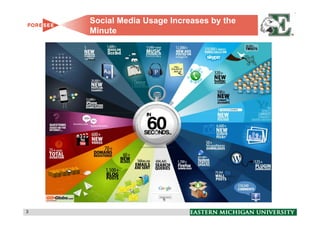
Social Media Usage Increases by the
    Minute


3                                         3
What are Social Media?

     Social media includes web-based and mobile based               Table 1: Social Media Examples
    technologies which are used to turn communication into
    interactive dialogue between organizations, communities,
    and individuals (Margold and Faulds 2009).

     Kaplan and Haenlein (2010) define social media as "a
    group of Internet-based applications that build on the
    ideological and technological foundations of Web 2.0, and
    that allow the creation and exchange of user-generated
    content.” Social media is ubiquitously accessible, and
    enabled by scalable communication technologies.

     This form of media ‘‘describes a variety of new sources
    of online information that are created, initiated, circulated
    and used by consumers intent on educating each other
    about products, brands, services, personalities, and
    issues’’ (Blackshaw and Nazzaro 2004).

     A common thread running through all definitions of social
    media is a blending of technology and social interaction
    for the co-creation of value.
                                                                     [Source: Margold and Faulds 2009]

4                                                                                                        4
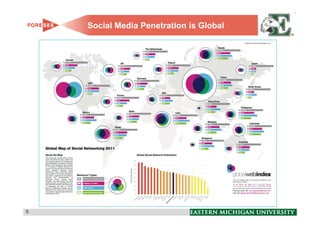
Social Media Penetration is Global


5                                        5
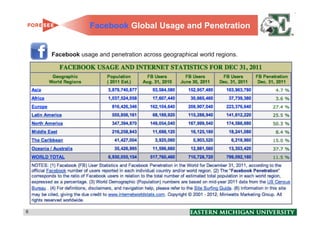
Facebook Global Usage and Penetration


    Facebook usage and penetration across geographical world regions.


6                                                                       6
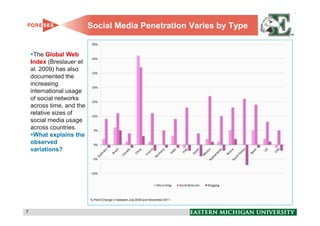
Social Media Penetration Varies by Type


     The Global Web
    Index (Breslauer et
    al. 2009) has also
    documented the
    increasing
    international usage
    of social networks
    across time, and the
    relative sizes of
    social media usage
    across countries.
     What explains the
    observed
    variations?


7                                                                    7
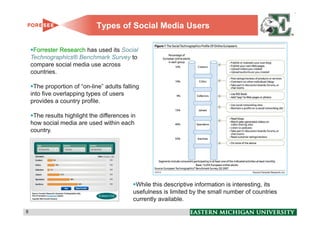
Types of Social Media Users

     Forrester Research has used its Social
    Technographics® Benchmark Survey to
    compare social media use across
    countries.

     The proportion of “on-line” adults falling
    into five overlapping types of users
    provides a country profile.

     The results highlight the differences in
    how social media are used within each
    country.


                                             While this descriptive information is interesting, its
                                            usefulness is limited by the small number of countries
                                            currently available.

8                                                                                                     8
Social Media and Global Business Use


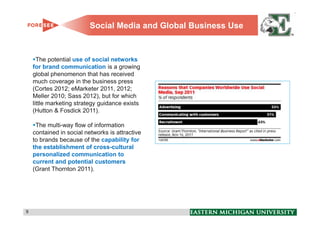
      The potential use of social networks
    for brand communication is a growing
    global phenomenon that has received
    much coverage in the business press
    (Cortes 2012; eMarketer 2011, 2012;
    Meller 2010; Sass 2012), but for which
    little marketing strategy guidance exists
    (Hutton & Fosdick 2011).

     The multi-way flow of information
    contained in social networks is attractive
    to brands because of the capability for
    the establishment of cross-cultural
    personalized communication to
    current and potential customers
    (Grant Thornton 2011).


9                                                                9
Expanding Global Business Use


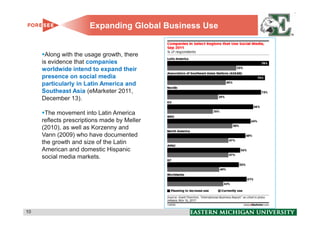
      Along with the usage growth, there
     is evidence that companies
     worldwide intend to expand their
     presence on social media
     particularly in Latin America and
     Southeast Asia (eMarketer 2011,
     December 13).

      The movement into Latin America
     reflects prescriptions made by Meller
     (2010), as well as Korzenny and
     Vann (2009) who have documented
     the growth and size of the Latin
     American and domestic Hispanic
     social media markets.


10                                                    10
Social Media Use and Consumer
                       Decision Making
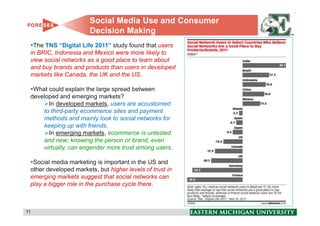
  The TNS “Digital Life 2011” study found that users
 in BRIC, Indonesia and Mexico were more likely to
 view social networks as a good place to learn about
 and buy brands and products than users in developed
 markets like Canada, the UK and the US.

  What could explain the large spread between
 developed and emerging markets?
       In developed markets, users are accustomed
     to third-party ecommerce sites and payment
     methods and mainly look to social networks for
     keeping up with friends.
       In emerging markets, ecommerce is untested
     and new; knowing the person or brand, even
     virtually, can engender more trust among users.

  Social media marketing is important in the US and
 other developed markets, but higher levels of trust in
 emerging markets suggest that social networks can
 play a bigger role in the purchase cycle there.


11                                                        11
Social Media Use and Brand Bonding

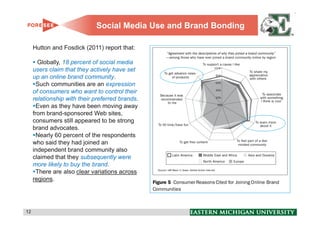
     Hutton and Fosdick (2011) report that:

       Globally, 18 percent of social media
     users claim that they actively have set
     up an online brand community.
       Such communities are an expression
     of consumers who want to control their
     relationship with their preferred brands.
       Even as they have been moving away
     from brand-sponsored Web sites,
     consumers still appeared to be strong
     brand advocates.
       Nearly 60 percent of the respondents
     who said they had joined an
     independent brand community also
     claimed that they subsequently were
     more likely to buy the brand.
       There are also clear variations across
     regions.


12                                                                12
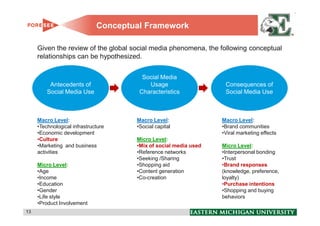
Conceptual Framework

     Given the review of the global social media phenomena, the following conceptual
     relationships can be hypothesized.


                                        Social Media
          Antecedents of                  Usage                    Consequences of
         Social Media Use              Characteristics             Social Media Use


     Macro Level:                     Macro Level:                Macro Level:
     •Technological infrastructure    •Social capital             •Brand communities
     •Economic development                                        •Viral marketing effects
     •Culture                         Micro Level:
     •Marketing and business          •Mix of social media used   Micro Level:
     activities                       •Reference networks         •Interpersonal bonding
                                      •Seeking /Sharing           •Trust
     Micro Level:                     •Shopping aid               •Brand responses
     •Age                             •Content generation         (knowledge, preference,
     •Income                          •Co-creation                loyalty)
     •Education                                                   •Purchase intentions
     •Gender                                                      •Shopping and buying
     •Life style                                                  behaviors
     •Product Involvement
13                                                                                           13
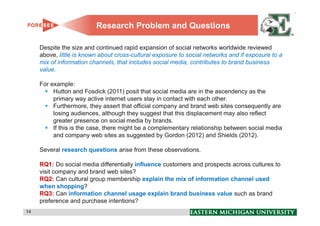
Research Problem and Questions

     Despite the size and continued rapid expansion of social networks worldwide reviewed
     above, little is known about cross-cultural exposure to social networks and if exposure to a
     mix of information channels, that includes social media, contributes to brand business
     value.

     For example:
          Hutton and Fosdick (2011) posit that social media are in the ascendency as the
          primary way active internet users stay in contact with each other.
          Furthermore, they assert that official company and brand web sites consequently are
          losing audiences, although they suggest that this displacement may also reflect
          greater presence on social media by brands.
          If this is the case, there might be a complementary relationship between social media
          and company web sites as suggested by Gordon (2012) and Shields (2012).

     Several research questions arise from these observations.

     RQ1: Do social media differentially influence customers and prospects across cultures to
     visit company and brand web sites?
     RQ2: Can cultural group membership explain the mix of information channel used
     when shopping?
     RQ3: Can information channel usage explain brand business value such as brand
     preference and purchase intentions?
14                                                                                                  14
Research Hypotheses—Study 1


     This study empirically explores the role that social networks play in the communication of
     brand information across cultural groups.

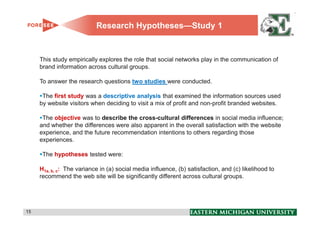
     To answer the research questions two studies were conducted.

      The first study was a descriptive analysis that examined the information sources used
     by website visitors when deciding to visit a mix of profit and non-profit branded websites.

      The objective was to describe the cross-cultural differences in social media influence;
     and whether the differences were also apparent in the overall satisfaction with the website
     experience, and the future recommendation intentions to others regarding those
     experiences.

      The hypotheses tested were:

     H1a, b, c: The variance in (a) social media influence, (b) satisfaction, and (c) likelihood to
     recommend the web site will be significantly different across cultural groups.


15                                                                                                    15
Methodology—Study 1

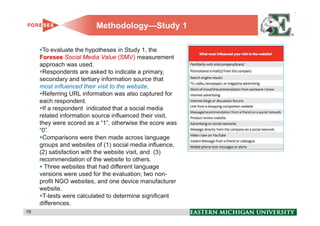
      To evaluate the hypotheses in Study 1, the
     Foresee Social Media Value (SMV) measurement
     approach was used.
      Respondents are asked to indicate a primary,
     secondary and tertiary information source that
     most influenced their visit to the website.
      Referring URL information was also captured for
     each respondent.
      If a respondent indicated that a social media
     related information source influenced their visit,
     they were scored as a “1”, otherwise the score was
     “0”.
      Comparisons were then made across language
     groups and websites of (1) social media influence,
     (2) satisfaction with the website visit, and (3)
     recommendation of the website to others.
       Three websites that had different language
     versions were used for the evaluation; two non-
     profit NGO websites, and one device manufacturer
     website.
      T-tests were calculated to determine significant
     differences.
16                                                        16
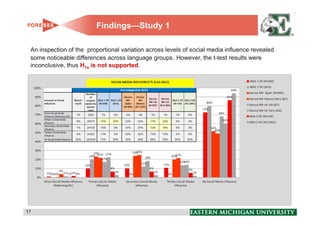
Findings—Study 1

 An inspection of the proportional variation across levels of social media influence revealed
 some noticeable differences across language groups. However, the t-test results were
 inconclusive, thus H1a is not supported.


17                                                                                              17
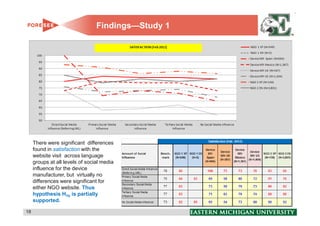
Findings—Study 1


     There were significant differences
     found in satisfaction with the
     website visit across language
     groups at all levels of social media
     influence for the device
     manufacturer, but virtually no
     differences were significant for
     either NGO website. Thus
     hypothesis H1b is partially
     supported.

18                                                  18
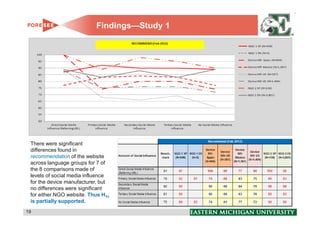
Findings—Study 1


 There were significant
 differences found in
 recommendation of the website
 across language groups for 7 of
 the 8 comparisons made of
 levels of social media influence
 for the device manufacturer, but
 no differences were significant
 for either NGO website. Thus H1c
 is partially supported.
19                                            19
Research Hypotheses—Study 2


      The second study empirically explored the relationships between culture, information
     channel use (including social media) and measures of brand business value (brand
     preferences and brand purchase intentions).

      The objective was to test a conceptual framework derived from secondary literature
     evidence suggesting the following explanatory relationships:

            Cultural Group       Information Channel Exposure          Brand Business Value

     A rationale for the effect of culture on exposure to information channels can be found
     research by Vasalou et al. (2010). In a study of 423 Facebook users from five countries they
     found that two user characteristics, “experience with the site,” and “culture,” shape the nature
     of true commitment, thus influencing the motivations for using Facebook, as well as the
     instrumental uses and the time invested on the site.

      Two hypotheses are tested:

     H2: The cultural profile of the website visitors positively explains the nature of the information
     channel mix used by visitors in their decision to visit the brand website.
     H3a, b: The information channel mix used by website visitors in their decision to visit the brand
     website significantly positively explains both (a) brand preferences and (b) brand purchase
     intentions.
20                                                                                                        20
Methodology—Study 2


     A two-step procedure was used to test the model.

      First, a descriptive analysis of the social network forms used by visitors (n=15000) to an
     international website for a branded smart-phone device was conducted. The analysis
     examined the cross-cultural differences in the use of social networks for acquiring
     information about the brand.

      Second, the cross-cultural brand communication model was specified and its explanatory
     power was evaluated. The intent of the model is to build a preliminary framework for
     explaining the role of culture and social network exposure in acquisition of brand
     information through a branded website and ultimately contribute to the brand commitment
     and purchase intentions. This conceptualization of brand value is consistent with recent
     reported social media research (Kamal & Carl 2011).


21                                                                                                 21
Findings—Study 2

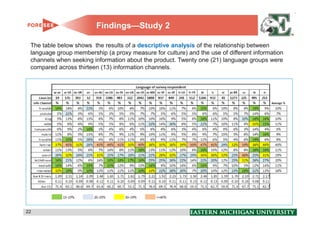
 The table below shows the results of a descriptive analysis of the relationship between
 language group membership (a proxy measure for culture) and the use of different information
 channels when seeking information about the product. Twenty one (21) language groups were
 compared across thirteen (13) information channels.


22                                                                                              22
Findings—Study 2

                                        Cultural               H2                                 Information                     H3a               Brand
                                        Groups                .348                                Channel Mix                    .308            Commitment
                                                              [4.25]                                                             [27.84]
                                                                                                              R2 = 0.121                                     R2 = 0.084
     More information channels


                                                                       Greater brand effects
                                                                                                                                  H3b               Brand
                                                                       Lower brand effects                                       .290              Purchase
                                                                                                                                 [27.98]
                                                                                                                                                             R2 = 0.095
     Fewer information channels


                                                                                                                                            Reflective Latent Variables
                                                                                               Formative Latent Variable


                                  Formative Latent Variable                          n = 15932 cases; t-stat for estimates shown in brackets are all significant at
                                                                                     p≤.000 based on bootstrapping 8000 cases 300 times.

23                                                                                                                                                                        23
Discussion and Contribution

     The analysis findings support all the
     hypothesized relationships.
                                                       Cultural                             H2      Information
     For Hypothesis 2, the results demonstrate that:   Groups                              .348     Channel Mix
                                                                                           [4.25]
                                                                                                              R2 = 0.121
      Cultural Group membership significantly
     affects the size and nature of the Information


                                                              More information channels
     Channel Mix used by visitors to a device
     manufacturer’s website, explaining 12.1% of
     the variance in mix size.
      Furthermore, the formative specification of
     the model provides insight into which cultural
     groups use more or fewer information
     channels.
      For example the results show that more
     information sources are used by South East


                                                              Fewer information channels
     Asian visitors [Thai (0.353) and Indonesian
     (0.264)] while fewer information sources are
     used by North American English [ US (-0.283),
     Canada (-0.563)] and Western European
     language [ German (-0.358), France (-0.383)]
     groups.
24                                                                                                                         24
Discussion and Contribution

 For Hypotheses 3a,b, the results demonstrate that:
                                                                                                    H3a
                                                        Information                                             Brand
                                                        Channel Mix                                .308      Commitment
  The size and composition of the Information                                                      [27.84]
                                                                                      R2 = 0.121                         R2 = 0.084
 Channel Mix (ICM) has a significant effect on both
 Brand Commitment (β=0.308) and Brand Purchase
 Intention (β=.290), explaining 8.4% and 9.5%
 respectfully of the variance.
  In addition, the formative specification of the ICM
 latent variable shows that higher levels of exposure
                                                                                                    H3b
 to ads on social networks (0.541), and friends on                                                             Brand
                                                                                                              Purchase
                                                                                                   .290
 social networks (0.300), were more likely to have                                                 [27.98]
                                                                                                                         R2 = 0.095
 positive brand related outcomes.


                                                              Greater brand effects
  The theoretical implications of the model findings
 are that:
      (1) Cultural background affects the mix of
           information resources that customers used
           before visiting the website; and ,
      (2) The mix of information resources used is
                                                              Lower brand effects
           directly related to the strength of brand
           bonding and purchase intentions.


25                                                                                                                                    25
Limitations and Future Research

     The limitations of the research reported here are its lack of breadth in explanatory variables
     and the need for better measurement of cultural group membership, social media exposure
     and influence.

     Future research should investigate the role of cultural values (e.g., Hofstede) as predictors
     of social media attraction and use. For instance, Korzenny and Vann (2009) suggest that
     among Hispanics “collectivistic values” are strong, and that their higher levels of social media
     usage may be reflective of these values. Girard and Bertsch (2011) explored the relationship
     between Hofstede’s dimensions and the six components of Forrester’s Social
     Technographics® scale for 13 countries. Their results were inconclusive. However, a follow-
     up study using the GLOBE societal values did identify some significant correlations.

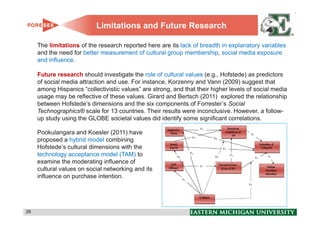
     Pookulangara and Koesler (2011) have
     proposed a hybrid model combining
     Hofstede’s cultural dimensions with the
     technology acceptance model (TAM) to
     examine the moderating influence of
     cultural values on social networking and its
     influence on purchase intention.


26                                                                                                      26
Thank You
     Any Questions?


27                    27
Selected Bibliography

     Austin, M., & Lerman, K. (2011). Lessons from the front lines: How to engage BRIC consumers in
     multinational online communities. ESOMAR: 3D Digital Dimensions, Miami, October. Retrieved
     December 28, 2011 from WARC web site: http://warc.com .
     Breslauer, B. Ruoss, S. & Smith, T. (2009). Social media trends around the world! – The global web
     index (GWI). ESOMAR: Online Research, Chicago, October. Retrieved December 28, 2011 from
     WARC web site: http://warc.com.
     eMarketer (2011, December 13). Companies worldwide plan to increase social media marketing.
     eMarketer: Digital Intelligence. Retrieved December 24, 2011 from eMarketer web site:
     http://www.emarketer.com/Articles/Print.aspx?R=1008731 .
     eMarketer (2012, January 5). Social networks more influential in emerging markets. eMarketer: Digital
     Intelligence. Retrieved December 24, 2011 from eMarketer web site:
     http://www.emarketer.com/Articles/Print.aspx?R=1008766 .
     Hutton, G. & Fosdick, M. (2011). The globalization of social media: consumer relationships with brands
     evolve in the digital space. Journal of Advertising Research, 51, 4, Retrieved December 28, 2011 from
     WARC web site: http://warc.com .
     Kamal, I., & Carl, W. (2011), Does investing in social media create business value? A study of the
     impact of exposure to social media on sales and brand perception, Ogilvey & Mather, Retrieved
     December 28, 2011from Ogilvy PR web site: http://blog.ogilvypr.com/2011/10/exposure-to-social-media-
     linked-with-changes-in-sales-and-brand-perception/ .
     Korzenny, F. & Vann, Lee. (2009). The multicultural world of social media marketing: Tapping into their
     connections. Quirk’s Marketing Research Review. June, 48-52. Retrieved March 31, 2012 from Quirk’s
     web site: http://www.quirks.com/articles/2009/20090606.aspx?searchID=373210567&sort=5&pg=1 .
     Pookulangara, S., Koesler, K. (2011). Cultural influence on consumers' usage of social networks and its'
     impact on online purchase intentions, Journal of Retailing and Consumer Services, 18(4), 348-354.

28                                                                                                              28
30
30        30
Background—Social Media and Culture

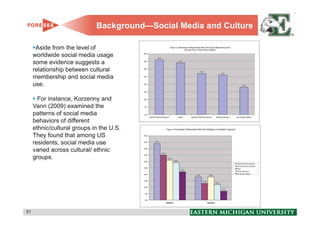
      Aside from the level of
     worldwide social media usage
     some evidence suggests a
     relationship between cultural
     membership and social media
     use.

       For instance, Korzenny and
     Vann (2009) examined the
     patterns of social media
     behaviors of different
     ethnic/cultural groups in the U.S.
     They found that among US
     residents, social media use
     varied across cultural/ ethnic
     groups.


31                                                                 31

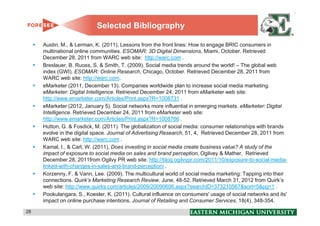
The Relationship of Cross-Cultural Social Network Usage Patterns to Brand Business Value

  • 1.
    THE RELATIONSHIP OFCROSS-CULTURAL SOCIAL NETWORK USAGE PATTERNS TO BRAND BUSINESS VALUE: AN EXPLORATORY INVESTIGATION OF BRANDED WEBSITES G. Russell Merz, Ph.D., Professor, Eastern Michigan University Silvina Diaz, Client Services Team Lead, Foresee, LLC A Presentation to the Twenty First Annual World Business Conference International Management Development Association (IMDA), July 4-8, 2012
  • 2.
    Agenda Background Conceptual Framework Research Problem, Questions and Hypotheses Methods Findings and Discussion Implications, Limitations and Future Research 2 2
  • 3.
    Social Media UsageIncreases by the Minute 3 3
  • 4.
    What are SocialMedia? Social media includes web-based and mobile based Table 1: Social Media Examples technologies which are used to turn communication into interactive dialogue between organizations, communities, and individuals (Margold and Faulds 2009). Kaplan and Haenlein (2010) define social media as "a group of Internet-based applications that build on the ideological and technological foundations of Web 2.0, and that allow the creation and exchange of user-generated content.” Social media is ubiquitously accessible, and enabled by scalable communication technologies. This form of media ‘‘describes a variety of new sources of online information that are created, initiated, circulated and used by consumers intent on educating each other about products, brands, services, personalities, and issues’’ (Blackshaw and Nazzaro 2004). A common thread running through all definitions of social media is a blending of technology and social interaction for the co-creation of value. [Source: Margold and Faulds 2009] 4 4
  • 5.
  • 6.
    Facebook Global Usageand Penetration Facebook usage and penetration across geographical world regions. 6 6
  • 7.
    Social Media PenetrationVaries by Type The Global Web Index (Breslauer et al. 2009) has also documented the increasing international usage of social networks across time, and the relative sizes of social media usage across countries. What explains the observed variations? 7 7
  • 8.
    Types of SocialMedia Users Forrester Research has used its Social Technographics® Benchmark Survey to compare social media use across countries. The proportion of “on-line” adults falling into five overlapping types of users provides a country profile. The results highlight the differences in how social media are used within each country. While this descriptive information is interesting, its usefulness is limited by the small number of countries currently available. 8 8
  • 9.
    Social Media andGlobal Business Use The potential use of social networks for brand communication is a growing global phenomenon that has received much coverage in the business press (Cortes 2012; eMarketer 2011, 2012; Meller 2010; Sass 2012), but for which little marketing strategy guidance exists (Hutton & Fosdick 2011). The multi-way flow of information contained in social networks is attractive to brands because of the capability for the establishment of cross-cultural personalized communication to current and potential customers (Grant Thornton 2011). 9 9
  • 10.
    Expanding Global BusinessUse Along with the usage growth, there is evidence that companies worldwide intend to expand their presence on social media particularly in Latin America and Southeast Asia (eMarketer 2011, December 13). The movement into Latin America reflects prescriptions made by Meller (2010), as well as Korzenny and Vann (2009) who have documented the growth and size of the Latin American and domestic Hispanic social media markets. 10 10
  • 11.
    Social Media Useand Consumer Decision Making The TNS “Digital Life 2011” study found that users in BRIC, Indonesia and Mexico were more likely to view social networks as a good place to learn about and buy brands and products than users in developed markets like Canada, the UK and the US. What could explain the large spread between developed and emerging markets? In developed markets, users are accustomed to third-party ecommerce sites and payment methods and mainly look to social networks for keeping up with friends. In emerging markets, ecommerce is untested and new; knowing the person or brand, even virtually, can engender more trust among users. Social media marketing is important in the US and other developed markets, but higher levels of trust in emerging markets suggest that social networks can play a bigger role in the purchase cycle there. 11 11
  • 12.
    Social Media Useand Brand Bonding Hutton and Fosdick (2011) report that: Globally, 18 percent of social media users claim that they actively have set up an online brand community. Such communities are an expression of consumers who want to control their relationship with their preferred brands. Even as they have been moving away from brand-sponsored Web sites, consumers still appeared to be strong brand advocates. Nearly 60 percent of the respondents who said they had joined an independent brand community also claimed that they subsequently were more likely to buy the brand. There are also clear variations across regions. 12 12
  • 13.
    Conceptual Framework Given the review of the global social media phenomena, the following conceptual relationships can be hypothesized. Social Media Antecedents of Usage Consequences of Social Media Use Characteristics Social Media Use Macro Level: Macro Level: Macro Level: •Technological infrastructure •Social capital •Brand communities •Economic development •Viral marketing effects •Culture Micro Level: •Marketing and business •Mix of social media used Micro Level: activities •Reference networks •Interpersonal bonding •Seeking /Sharing •Trust Micro Level: •Shopping aid •Brand responses •Age •Content generation (knowledge, preference, •Income •Co-creation loyalty) •Education •Purchase intentions •Gender •Shopping and buying •Life style behaviors •Product Involvement 13 13
  • 14.
    Research Problem andQuestions Despite the size and continued rapid expansion of social networks worldwide reviewed above, little is known about cross-cultural exposure to social networks and if exposure to a mix of information channels, that includes social media, contributes to brand business value. For example: Hutton and Fosdick (2011) posit that social media are in the ascendency as the primary way active internet users stay in contact with each other. Furthermore, they assert that official company and brand web sites consequently are losing audiences, although they suggest that this displacement may also reflect greater presence on social media by brands. If this is the case, there might be a complementary relationship between social media and company web sites as suggested by Gordon (2012) and Shields (2012). Several research questions arise from these observations. RQ1: Do social media differentially influence customers and prospects across cultures to visit company and brand web sites? RQ2: Can cultural group membership explain the mix of information channel used when shopping? RQ3: Can information channel usage explain brand business value such as brand preference and purchase intentions? 14 14
  • 15.
    Research Hypotheses—Study 1 This study empirically explores the role that social networks play in the communication of brand information across cultural groups. To answer the research questions two studies were conducted. The first study was a descriptive analysis that examined the information sources used by website visitors when deciding to visit a mix of profit and non-profit branded websites. The objective was to describe the cross-cultural differences in social media influence; and whether the differences were also apparent in the overall satisfaction with the website experience, and the future recommendation intentions to others regarding those experiences. The hypotheses tested were: H1a, b, c: The variance in (a) social media influence, (b) satisfaction, and (c) likelihood to recommend the web site will be significantly different across cultural groups. 15 15
  • 16.
    Methodology—Study 1 To evaluate the hypotheses in Study 1, the Foresee Social Media Value (SMV) measurement approach was used. Respondents are asked to indicate a primary, secondary and tertiary information source that most influenced their visit to the website. Referring URL information was also captured for each respondent. If a respondent indicated that a social media related information source influenced their visit, they were scored as a “1”, otherwise the score was “0”. Comparisons were then made across language groups and websites of (1) social media influence, (2) satisfaction with the website visit, and (3) recommendation of the website to others. Three websites that had different language versions were used for the evaluation; two non- profit NGO websites, and one device manufacturer website. T-tests were calculated to determine significant differences. 16 16
  • 17.
    Findings—Study 1 Aninspection of the proportional variation across levels of social media influence revealed some noticeable differences across language groups. However, the t-test results were inconclusive, thus H1a is not supported. 17 17
  • 18.
    Findings—Study 1 There were significant differences found in satisfaction with the website visit across language groups at all levels of social media influence for the device manufacturer, but virtually no differences were significant for either NGO website. Thus hypothesis H1b is partially supported. 18 18
  • 19.
    Findings—Study 1 Therewere significant differences found in recommendation of the website across language groups for 7 of the 8 comparisons made of levels of social media influence for the device manufacturer, but no differences were significant for either NGO website. Thus H1c is partially supported. 19 19
  • 20.
    Research Hypotheses—Study 2 The second study empirically explored the relationships between culture, information channel use (including social media) and measures of brand business value (brand preferences and brand purchase intentions). The objective was to test a conceptual framework derived from secondary literature evidence suggesting the following explanatory relationships: Cultural Group Information Channel Exposure Brand Business Value A rationale for the effect of culture on exposure to information channels can be found research by Vasalou et al. (2010). In a study of 423 Facebook users from five countries they found that two user characteristics, “experience with the site,” and “culture,” shape the nature of true commitment, thus influencing the motivations for using Facebook, as well as the instrumental uses and the time invested on the site. Two hypotheses are tested: H2: The cultural profile of the website visitors positively explains the nature of the information channel mix used by visitors in their decision to visit the brand website. H3a, b: The information channel mix used by website visitors in their decision to visit the brand website significantly positively explains both (a) brand preferences and (b) brand purchase intentions. 20 20
  • 21.
    Methodology—Study 2 A two-step procedure was used to test the model. First, a descriptive analysis of the social network forms used by visitors (n=15000) to an international website for a branded smart-phone device was conducted. The analysis examined the cross-cultural differences in the use of social networks for acquiring information about the brand. Second, the cross-cultural brand communication model was specified and its explanatory power was evaluated. The intent of the model is to build a preliminary framework for explaining the role of culture and social network exposure in acquisition of brand information through a branded website and ultimately contribute to the brand commitment and purchase intentions. This conceptualization of brand value is consistent with recent reported social media research (Kamal & Carl 2011). 21 21
  • 22.
    Findings—Study 2 Thetable below shows the results of a descriptive analysis of the relationship between language group membership (a proxy measure for culture) and the use of different information channels when seeking information about the product. Twenty one (21) language groups were compared across thirteen (13) information channels. 22 22
  • 23.
    Findings—Study 2 Cultural H2 Information H3a Brand Groups .348 Channel Mix .308 Commitment [4.25] [27.84] R2 = 0.121 R2 = 0.084 More information channels Greater brand effects H3b Brand Lower brand effects .290 Purchase [27.98] R2 = 0.095 Fewer information channels Reflective Latent Variables Formative Latent Variable Formative Latent Variable n = 15932 cases; t-stat for estimates shown in brackets are all significant at p≤.000 based on bootstrapping 8000 cases 300 times. 23 23
  • 24.
    Discussion and Contribution The analysis findings support all the hypothesized relationships. Cultural H2 Information For Hypothesis 2, the results demonstrate that: Groups .348 Channel Mix [4.25] R2 = 0.121 Cultural Group membership significantly affects the size and nature of the Information More information channels Channel Mix used by visitors to a device manufacturer’s website, explaining 12.1% of the variance in mix size. Furthermore, the formative specification of the model provides insight into which cultural groups use more or fewer information channels. For example the results show that more information sources are used by South East Fewer information channels Asian visitors [Thai (0.353) and Indonesian (0.264)] while fewer information sources are used by North American English [ US (-0.283), Canada (-0.563)] and Western European language [ German (-0.358), France (-0.383)] groups. 24 24
  • 25.
    Discussion and Contribution For Hypotheses 3a,b, the results demonstrate that: H3a Information Brand Channel Mix .308 Commitment The size and composition of the Information [27.84] R2 = 0.121 R2 = 0.084 Channel Mix (ICM) has a significant effect on both Brand Commitment (β=0.308) and Brand Purchase Intention (β=.290), explaining 8.4% and 9.5% respectfully of the variance. In addition, the formative specification of the ICM latent variable shows that higher levels of exposure H3b to ads on social networks (0.541), and friends on Brand Purchase .290 social networks (0.300), were more likely to have [27.98] R2 = 0.095 positive brand related outcomes. Greater brand effects The theoretical implications of the model findings are that: (1) Cultural background affects the mix of information resources that customers used before visiting the website; and , (2) The mix of information resources used is Lower brand effects directly related to the strength of brand bonding and purchase intentions. 25 25
  • 26.
    Limitations and FutureResearch The limitations of the research reported here are its lack of breadth in explanatory variables and the need for better measurement of cultural group membership, social media exposure and influence. Future research should investigate the role of cultural values (e.g., Hofstede) as predictors of social media attraction and use. For instance, Korzenny and Vann (2009) suggest that among Hispanics “collectivistic values” are strong, and that their higher levels of social media usage may be reflective of these values. Girard and Bertsch (2011) explored the relationship between Hofstede’s dimensions and the six components of Forrester’s Social Technographics® scale for 13 countries. Their results were inconclusive. However, a follow- up study using the GLOBE societal values did identify some significant correlations. Pookulangara and Koesler (2011) have proposed a hybrid model combining Hofstede’s cultural dimensions with the technology acceptance model (TAM) to examine the moderating influence of cultural values on social networking and its influence on purchase intention. 26 26
  • 27.
    Thank You Any Questions? 27 27
  • 28.
    Selected Bibliography Austin, M., & Lerman, K. (2011). Lessons from the front lines: How to engage BRIC consumers in multinational online communities. ESOMAR: 3D Digital Dimensions, Miami, October. Retrieved December 28, 2011 from WARC web site: http://warc.com . Breslauer, B. Ruoss, S. & Smith, T. (2009). Social media trends around the world! – The global web index (GWI). ESOMAR: Online Research, Chicago, October. Retrieved December 28, 2011 from WARC web site: http://warc.com. eMarketer (2011, December 13). Companies worldwide plan to increase social media marketing. eMarketer: Digital Intelligence. Retrieved December 24, 2011 from eMarketer web site: http://www.emarketer.com/Articles/Print.aspx?R=1008731 . eMarketer (2012, January 5). Social networks more influential in emerging markets. eMarketer: Digital Intelligence. Retrieved December 24, 2011 from eMarketer web site: http://www.emarketer.com/Articles/Print.aspx?R=1008766 . Hutton, G. & Fosdick, M. (2011). The globalization of social media: consumer relationships with brands evolve in the digital space. Journal of Advertising Research, 51, 4, Retrieved December 28, 2011 from WARC web site: http://warc.com . Kamal, I., & Carl, W. (2011), Does investing in social media create business value? A study of the impact of exposure to social media on sales and brand perception, Ogilvey & Mather, Retrieved December 28, 2011from Ogilvy PR web site: http://blog.ogilvypr.com/2011/10/exposure-to-social-media- linked-with-changes-in-sales-and-brand-perception/ . Korzenny, F. & Vann, Lee. (2009). The multicultural world of social media marketing: Tapping into their connections. Quirk’s Marketing Research Review. June, 48-52. Retrieved March 31, 2012 from Quirk’s web site: http://www.quirks.com/articles/2009/20090606.aspx?searchID=373210567&sort=5&pg=1 . Pookulangara, S., Koesler, K. (2011). Cultural influence on consumers' usage of social networks and its' impact on online purchase intentions, Journal of Retailing and Consumer Services, 18(4), 348-354. 28 28
  • 30.
  • 31.
    Background—Social Media andCulture Aside from the level of worldwide social media usage some evidence suggests a relationship between cultural membership and social media use. For instance, Korzenny and Vann (2009) examined the patterns of social media behaviors of different ethnic/cultural groups in the U.S. They found that among US residents, social media use varied across cultural/ ethnic groups. 31 31