Social Media and Girls
Finding Hope and Supporting Faith
Mercy Secondary Education Conference
12 October 2013

http://meh.religioused.org/mercy2013hess.pdf
introductions
• my own context and background
• three main parts
• (1) background literature
• (2) an analogy
• (3) examples and tools
• Q&A
Luther Seminary, Roman Catholic laywoman, media/religion/education
part one: three frames
from the literature
• what brain research is telling us
• the “sacred selves of
adolescent girls”
• pedagogies of recognition
research into adolescent brains...
adolescent brain
• has an increased capacity for language
and short-term memory
• reacts emotionally rather than logically

• responds to music as a vehicle to emotion
and information
• experiences emotions before it is able to
articulate them verbally
• works hard at developing self-awareness
and self-consciousness
• is more vulnerable to stress than the adult
brain
• is engaged in a constant struggle between
emotion/impulsivity and logic/moral
reasoning (Feinstein 2009, 73)

Baker /Edwards p. 4
girls’ brains,
in particular
• Female teens have more gray matter; male teens
have more white matter (grey matter contributes to
strong language skills, juggling of multiple tasks)
• The hippocampus of girls grows faster than boys,
allowing girls to be better at coordinating complex
social relationships, recognizing faces, and
distinguishing complex emotions.
• The hypothalamus, the part of the brain
responsible for emotions, sexual desire, and
controlling the body’s rhythms ... is smaller in girls,
allowing them to sit quietly longer and be less
physically aggressive than boys. Yet girls are just
as adept at and responsive to musical beats and
biological rhythms as boys...
• The corpus callosum, which links the two
hemispheres of the brain, is significantly larger in
females, allowing for greater information transfer
between the hemispheres.
• The anterior cingulate cortex, located in the frontal
lobe ... is larger in girls than boys. It allows for the
weighing of options and making decisions.

Baker / Edwards, pp. 4-5
implications? Dori Baker and Ned Edwards
• neuroplasticity, mirroring and the company of peers leads to...
• importance of thoughtful ritual (satisfies need for structure and organization)
• novelty (calls forth new synaptic connections)
• while sitting still may be easy, there is a need for social interaction
• feedback and reflection is crucial
• centering prayer and breath prayer are richly useful
• trusted circles (“girlfriend theology”)
sacred selves of adolescent girls (Evelyn Parker)
• realization (what is the reality of girls’ lives? can we hear their voices and
their truths?)
• resistance (what kinds of constructive resistance are possible? who are the
models we lift up, the stories we tell? how do we help them to connect with
movements?)
• resilience (how do we encourage and nurture support? what spiritualities are
we inviting them to practice?)
• ritual (brings it all together, re-members with God)
Louie Rodriguez’ “pedagogies of recognition”
• relational recognition: counter cultural in the context of NCLB and the
corporatization of secondary education, deeply present in a Mercy charism
(realization)
• curricular recognition: content that is directly relevant requires speaking to embodied
theologies of girls themselves (realization, creates room for resilience)
• contextualizing recognition: social context shapes engagement with learning, can we
“see” girls amidst social media practices? (realization, creates room for resistance)
• pedagogical recognition: pedagogies that disrupt “taken for granted” knowledges,
that allow for critical engagement (builds resistance, can draw on ritual)
• transformative recognition: education “for what?” (here is where our theological
commitments become a rich resource)
table buzz: what pedagogies are you drawing upon
in your contexts?
[break]
what does this look like in the midst of digital
media?
part two: an analogy by way of going forward
first, WHY and then, HOW
“This means of spreading information and
knowledge is giving birth to a new way of learning
and thinking, with unprecedented opportunities for
establishing relationships and building fellowship.”

Pope Benedict XVI, 45th
World Communications Day
“As with every other fruit of human ingenuity, the
new communications technologies must be placed
at the service of the integral good of the individual
and of the whole of humanity. If used wisely, they
can contribute to the satisfaction of the desire for
meaning, truth and unity which remain the most
profound aspirations of each human being.”

Pope Benedict XVI, 45th
World Communications Day
“The clear distinction between the producer and
consumer of information is relativized and
communication appears not only as an exchange
of data, but also as a form of sharing.”

Pope Benedict XVI, 45th
World Communications Day
“This dynamic has contributed to a new
appreciation of communication itself, which is seen
first of all as dialogue, exchange, solidarity and the
creation of positive relations. On the other hand,
this is contrasted with the limits typical of digital
communication: the one-sidedness of the
interaction, the tendency to communicate only
some parts of one’s interior world, the risk of
constructing a false image of oneself, which can
become a form of self-indulgence.”
Pope Benedict XVI, 45th
World Communications Day
is it typical? or are there practices we can learn
which emphasize dialogue, exchange, solidarity
and positive relations ?
HOW: keep in mind adaptive vs. technical
challenges
food
• we all require it to survive
• we are embedded in a culture
that offers us a lot of unhealthy
choices
• the artful practices of preparing
and eating food are stressed if
not extinct
• no clear social consensus
media
• we all require communication to
survive
• we are offered a lot of
unhealthy communication
practices
• artful practices of preparing
and engaging in
communication are stressed if
not extinct
• no clear social consensus
by way of the
analogy...
• help people develop healthy
practices around media
• encourage a diverse media diet
• encourage the production of
media
• provide ways to share more
communally in consuming preproduced media
• highlight our unique media of
spiritual and religious practice
for young children
• limit commercially produced media
consumption
• for the times you do engage media,
put good pieces in front of them
(Common Good radio, Children’s
literature, etc.)
• institute table prayers and
practices (candles, etc.)
• invite a biblical imagination into
daily practice (Bible Stories for the
40 days)
• invite them into civic engagement
for school age kids
• invite them to create media
(MyPopStudio, animoto, etc.)
• have clear family practices
around media use
• take charge of your news
• choose media with deep
theological themes to engage
together
• choose Wii or Kinect over more
solitary or less physical options
• engage bullying directly
• support them in civic
engagement
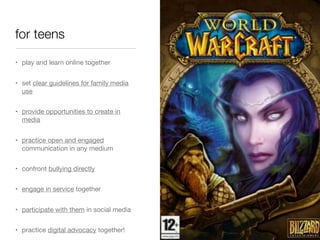
for teens
• play and learn online together
• set clear guidelines for family media
use
• provide opportunities to create in
media
• practice open and engaged
communication in any medium
• confront bullying directly
• engage in service together
• participate with them in social media
• practice digital advocacy together!
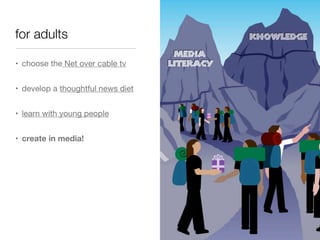
for adults
• choose the Net over cable tv
• develop a thoughtful news diet
• learn with young people
• create in media!
table buzz: what would you share with your table
mates for supporting “realization, resilience,
resistance and ritual” through digital media?
[break]
part three: participatory learning through creative
production
tackk.com, animoto.com, iMovie on iPad
StoryingFaith, Cyberpilgrim, TVbyGirls, Center for Digital Storytelling
examples from TVbyGirls...
remember...
we are made in the image of God, a God who is communicative within Godself,
and in communication with all of God’s Creation
to understand faith you need to understand practices
we know that faith has to be nurtured at in community
to understand media you need to understand practices of
communication in community
let’s help girls to:
realize
resist
be resilient
draw on ritual
in digital media!
more info: mhess@luthersem.edu
citations available here:
http://meh.religioused.org/mercy2013card.pdf

Mercy2013hess

  • 1.
    Social Media andGirls Finding Hope and Supporting Faith Mercy Secondary Education Conference 12 October 2013 http://meh.religioused.org/mercy2013hess.pdf
  • 2.
    introductions • my owncontext and background • three main parts • (1) background literature • (2) an analogy • (3) examples and tools • Q&A
  • 3.
    Luther Seminary, RomanCatholic laywoman, media/religion/education
  • 4.
    part one: threeframes from the literature • what brain research is telling us • the “sacred selves of adolescent girls” • pedagogies of recognition
  • 5.
  • 6.
    adolescent brain • hasan increased capacity for language and short-term memory • reacts emotionally rather than logically • responds to music as a vehicle to emotion and information • experiences emotions before it is able to articulate them verbally • works hard at developing self-awareness and self-consciousness • is more vulnerable to stress than the adult brain • is engaged in a constant struggle between emotion/impulsivity and logic/moral reasoning (Feinstein 2009, 73) Baker /Edwards p. 4
  • 7.
    girls’ brains, in particular •Female teens have more gray matter; male teens have more white matter (grey matter contributes to strong language skills, juggling of multiple tasks) • The hippocampus of girls grows faster than boys, allowing girls to be better at coordinating complex social relationships, recognizing faces, and distinguishing complex emotions. • The hypothalamus, the part of the brain responsible for emotions, sexual desire, and controlling the body’s rhythms ... is smaller in girls, allowing them to sit quietly longer and be less physically aggressive than boys. Yet girls are just as adept at and responsive to musical beats and biological rhythms as boys... • The corpus callosum, which links the two hemispheres of the brain, is significantly larger in females, allowing for greater information transfer between the hemispheres. • The anterior cingulate cortex, located in the frontal lobe ... is larger in girls than boys. It allows for the weighing of options and making decisions. Baker / Edwards, pp. 4-5
  • 8.
    implications? Dori Bakerand Ned Edwards • neuroplasticity, mirroring and the company of peers leads to... • importance of thoughtful ritual (satisfies need for structure and organization) • novelty (calls forth new synaptic connections) • while sitting still may be easy, there is a need for social interaction • feedback and reflection is crucial • centering prayer and breath prayer are richly useful • trusted circles (“girlfriend theology”)
  • 9.
    sacred selves ofadolescent girls (Evelyn Parker) • realization (what is the reality of girls’ lives? can we hear their voices and their truths?) • resistance (what kinds of constructive resistance are possible? who are the models we lift up, the stories we tell? how do we help them to connect with movements?) • resilience (how do we encourage and nurture support? what spiritualities are we inviting them to practice?) • ritual (brings it all together, re-members with God)
  • 11.
    Louie Rodriguez’ “pedagogiesof recognition” • relational recognition: counter cultural in the context of NCLB and the corporatization of secondary education, deeply present in a Mercy charism (realization) • curricular recognition: content that is directly relevant requires speaking to embodied theologies of girls themselves (realization, creates room for resilience) • contextualizing recognition: social context shapes engagement with learning, can we “see” girls amidst social media practices? (realization, creates room for resistance) • pedagogical recognition: pedagogies that disrupt “taken for granted” knowledges, that allow for critical engagement (builds resistance, can draw on ritual) • transformative recognition: education “for what?” (here is where our theological commitments become a rich resource)
  • 12.
    table buzz: whatpedagogies are you drawing upon in your contexts?
  • 13.
  • 14.
    what does thislook like in the midst of digital media?
  • 15.
    part two: ananalogy by way of going forward
  • 16.
    first, WHY andthen, HOW
  • 17.
    “This means ofspreading information and knowledge is giving birth to a new way of learning and thinking, with unprecedented opportunities for establishing relationships and building fellowship.” Pope Benedict XVI, 45th World Communications Day
  • 18.
    “As with everyother fruit of human ingenuity, the new communications technologies must be placed at the service of the integral good of the individual and of the whole of humanity. If used wisely, they can contribute to the satisfaction of the desire for meaning, truth and unity which remain the most profound aspirations of each human being.” Pope Benedict XVI, 45th World Communications Day
  • 19.
    “The clear distinctionbetween the producer and consumer of information is relativized and communication appears not only as an exchange of data, but also as a form of sharing.” Pope Benedict XVI, 45th World Communications Day
  • 20.
    “This dynamic hascontributed to a new appreciation of communication itself, which is seen first of all as dialogue, exchange, solidarity and the creation of positive relations. On the other hand, this is contrasted with the limits typical of digital communication: the one-sidedness of the interaction, the tendency to communicate only some parts of one’s interior world, the risk of constructing a false image of oneself, which can become a form of self-indulgence.” Pope Benedict XVI, 45th World Communications Day
  • 21.
    is it typical?or are there practices we can learn which emphasize dialogue, exchange, solidarity and positive relations ?
  • 22.
    HOW: keep inmind adaptive vs. technical challenges
  • 23.
    food • we allrequire it to survive • we are embedded in a culture that offers us a lot of unhealthy choices • the artful practices of preparing and eating food are stressed if not extinct • no clear social consensus
  • 24.
    media • we allrequire communication to survive • we are offered a lot of unhealthy communication practices • artful practices of preparing and engaging in communication are stressed if not extinct • no clear social consensus
  • 25.
    by way ofthe analogy... • help people develop healthy practices around media • encourage a diverse media diet • encourage the production of media • provide ways to share more communally in consuming preproduced media • highlight our unique media of spiritual and religious practice
  • 26.
    for young children •limit commercially produced media consumption • for the times you do engage media, put good pieces in front of them (Common Good radio, Children’s literature, etc.) • institute table prayers and practices (candles, etc.) • invite a biblical imagination into daily practice (Bible Stories for the 40 days) • invite them into civic engagement
  • 27.
    for school agekids • invite them to create media (MyPopStudio, animoto, etc.) • have clear family practices around media use • take charge of your news • choose media with deep theological themes to engage together • choose Wii or Kinect over more solitary or less physical options • engage bullying directly • support them in civic engagement
  • 28.
    for teens • playand learn online together • set clear guidelines for family media use • provide opportunities to create in media • practice open and engaged communication in any medium • confront bullying directly • engage in service together • participate with them in social media • practice digital advocacy together!
  • 29.
    for adults • choosethe Net over cable tv • develop a thoughtful news diet • learn with young people • create in media!
  • 30.
    table buzz: whatwould you share with your table mates for supporting “realization, resilience, resistance and ritual” through digital media?
  • 31.
  • 32.
    part three: participatorylearning through creative production
  • 33.
  • 34.
    StoryingFaith, Cyberpilgrim, TVbyGirls,Center for Digital Storytelling
  • 35.
  • 40.
  • 41.
    we are madein the image of God, a God who is communicative within Godself, and in communication with all of God’s Creation
  • 42.
    to understand faithyou need to understand practices
  • 43.
    we know thatfaith has to be nurtured at in community
  • 44.
    to understand mediayou need to understand practices of communication in community
  • 45.
    let’s help girlsto: realize resist be resilient draw on ritual in digital media!
  • 46.
    more info: mhess@luthersem.edu citationsavailable here: http://meh.religioused.org/mercy2013card.pdf