Becoming a white anti-racist
Presentation to the ULS faculty

25 April 2022

Mary E. Hess, PhD

meh.religioused.org
land acknowledgment
moment to breathe in God’s presence
perhaps a few ideas to start with, but I’m happy to
throw out this entire slide deck if you know what
you want to talk about!
fi
ve basic understandings
• We need as white people to confront racism because it’s morally wrong, but
also because it’s in the interest of our own mental health to do so.


• We need to take responsibility for doing the work of white antiracism and not
asking people of color to educate us about how racism works.


• We need to work out how best to use the strategic advantages conferred on us
by a white identity to push for change and racial justice.


• We need to understand racism as a system that works to secure the continued
dominance of one particular racial group, rather than the expression of
individual prejudice.


• We need to challenge the way that the mythical but powerful idea of white
supremacy keeps this system in place by explaining it as a “natural” ordering of
the world.
(Brook
fi
eld&Hess)
perceived theologically…
• God incarnate in the Christ draws us ever towards our neighbor, whether
perceived as friend or enemy. Ever sinner/saint we open ourselves to God’s
grace which is in
fi
nitely liberating.


• We are freed by grace to do this learning, and gifted with unique vocation by
God to live into beloved community.


• A preferential option for the poor (the anawim) points the way, as does the deep
conviction of God’s agency within our personal speci
fi
cities.


• Original sin invites us to recognize how we, as white people, are born into a
system of power that we can both lament and seek to resist and repair through
the power of our God.


• God’s love is “already/not yet” and while the world may tell differing stories
about the “natural” way of power, we know differently.
take a few minutes to talk about these in a
breakout group — maybe there’s something you
agree with, or disagree with, or need more
information about
what supports us in opening up in compassion?


“com” “passio” / suffering with
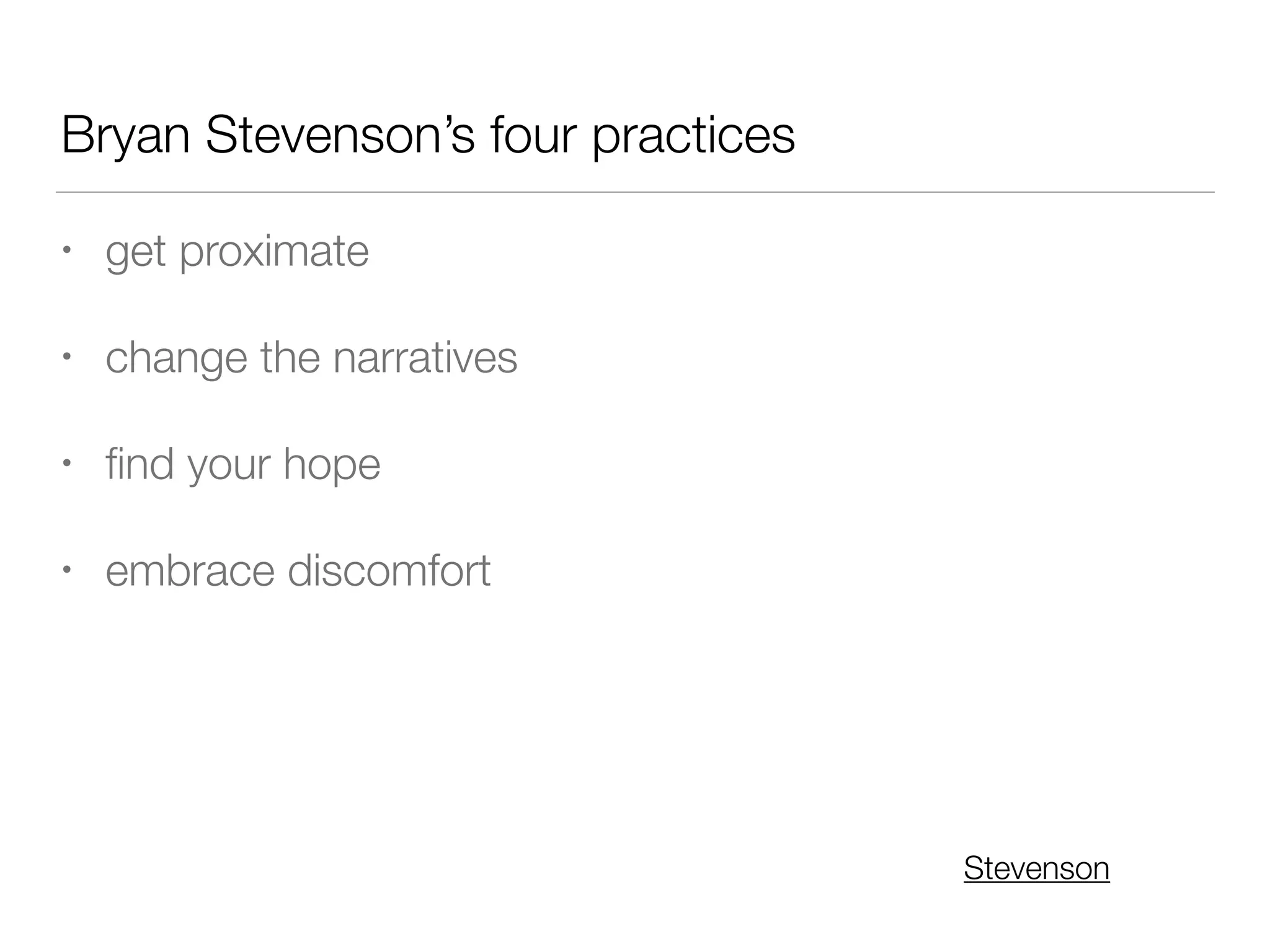
Bryan Stevenson’s four practices
• get proximate


• change the narratives


•
fi
nd your hope


• embrace discomfort
Stevenson
Old Testament scholar Walter Brueggemann views hope as trust in
what God has done and will do, in spite of evidence to the
contrary:


“Hope in gospel faith is not just a vague feeling that things will work
out, for it is evident that things will not just work out. Rather, hope
is the conviction, against a great deal of data, that God is tenacious
and persistent in overcoming the deathliness of the world, that God
intends joy and peace. Christians
fi
nd compelling evidence, in the
story of Jesus, that Jesus, with great persistence and great
vulnerability, everywhere he went, turned the enmity of society
toward a new possibility, turned the sadness of the world toward
joy, introduced a new regime where the dead are raised, the lost
are found, and the displaced are brought home again.”


Walter Brueggemann, A Gospel of Hope, compiled by Richard Floyd (Westminster John Knox Press: 2018), 104–105.
transformation rooted in hope will be…
• radical (both in dependence on God and in radical availability)


• embodied (called to be agents of of transformation … [which]
requires encounters with others who will stretch us and
change us)


• imaginative (transformation will be beyond what we can even
imagine, because hope and transformation are creative)


• relational (God’s ongoing relationship with us, inviting a
response, and our response in relationship with others creates
not only the possibilities but also the conditions for
transformation)
Cimperman, loc 644 of 3914
a few ideas for doing this work as a seminary
faculty
to start with…
• understand that for white faculty, at least, there are only two ways to do
this work: imperfectly, or not at all


• trust that the Holy Spirit is present and breathing through the work — so
learn to manage your own breath (Resmaa Menakem’s work is helpful
here)


• work collectively and structurally (here’s a handout with the basic table in
it)


• remember that working to embody the program outcomes and mission
statement of your school is vital


• use language that helps to meet people where they are, and then
stretches them into new understanding
let’s talk about the language we use and keep in
mind the “three c’s” of Kegan:


con
fi
rmation, contradiction, continuity
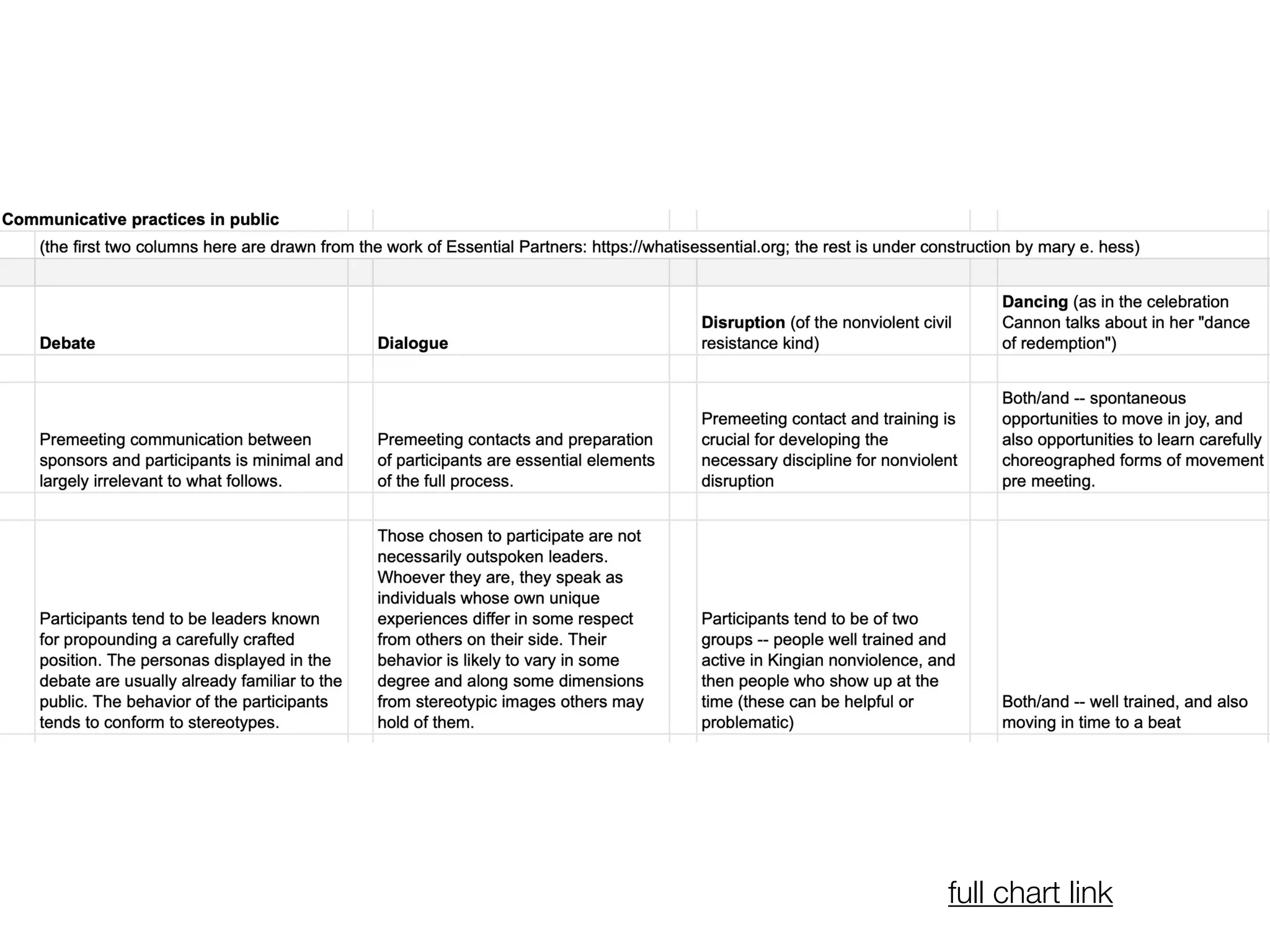
spectrum of educator and activist, perhaps linked
to spectrum of communicative practices
full chart link
privilege / advantage


justice / fairness


what are the nuances?


what biblical resonances might be helpful?
biblical texts and reconciliation: 2 Cor
• 2 Cor 5:19 is the shortest description of reconciliation: “in
Christ God was reconciling the world to himself, not
counting their trespasses against them, and entrusting
the message of reconciliation to us”


• recognize the complexity of both “vertical” and
“horizontal” reconciliation


• recognize that this is God’s work and God’s agency
“Instead of patriarchal stories of domination, Jesus taught and embodied service,
reconciliation, and self-giving.


Instead of stories of violent revolution or revenge on the one hand or compliant
submission on the other, Jesus taught and modeled transformative nonviolent
resistance.


Instead of the puri
fi
cation stories of scapegoating or ethnic cleansing, Jesus
encountered and engaged the other with respect, welcome, neighborliness, and
mutuality.


Instead of inhabiting a competitive story of accumulation, Jesus advocated
stewardship, generosity, sharing, and a vision of abundance for all.


Instead of advocating escapist stories of isolation, Jesus sent his followers into the
world to be agents of positive change, like salt, light, and yeast.


And instead of leaving the oppressed in stories of victimization, Jesus empowered
them with a vision of faith, hope, and love that could change the world.”
[1] Brian D. McLaren and Gareth Higgins, The Seventh Story: Us, Them, & the End of Violence (Porch: 2018), 79.


Richard Rohr's daily meditation for January 13, 2021
Kazu Haga offers a de
fi
nition of reconciliation in equation form (I like
his footnote version best):


forgiveness + accountability = reconciliation
where forgiveness is (understanding + grief) and accountability is
(remorse + insight + amends)
two rubrics from Luther (as examples, not necessarily
great ones)


formation


culture / context
mhess@religioused.org


meh.religioused.org
citations:


Image of the cross / heart on the Bible (https://pixabay.com/photos/love-died-cross-thorns-
crown-699480/)


Trinity knot (http://rapgenius.com/Action-bronson-the-come-up-lyrics#note-1452273)


Gratitude/grief quote (https://www.facebook.com/photo/?
fbid=10159555029226125&set=a.82638921124)


Pema Chodron quote (https://www.facebook.com/elephantjournal/photos/
a.192928654222/10159420694029223/)

Presentation to ULS faculty

  • 1.
    Becoming a whiteanti-racist Presentation to the ULS faculty 25 April 2022 Mary E. Hess, PhD meh.religioused.org
  • 2.
  • 3.
    moment to breathein God’s presence
  • 4.
    perhaps a fewideas to start with, but I’m happy to throw out this entire slide deck if you know what you want to talk about!
  • 7.
    fi ve basic understandings •We need as white people to confront racism because it’s morally wrong, but also because it’s in the interest of our own mental health to do so. • We need to take responsibility for doing the work of white antiracism and not asking people of color to educate us about how racism works. • We need to work out how best to use the strategic advantages conferred on us by a white identity to push for change and racial justice. • We need to understand racism as a system that works to secure the continued dominance of one particular racial group, rather than the expression of individual prejudice. • We need to challenge the way that the mythical but powerful idea of white supremacy keeps this system in place by explaining it as a “natural” ordering of the world. (Brook fi eld&Hess)
  • 8.
    perceived theologically… • Godincarnate in the Christ draws us ever towards our neighbor, whether perceived as friend or enemy. Ever sinner/saint we open ourselves to God’s grace which is in fi nitely liberating. • We are freed by grace to do this learning, and gifted with unique vocation by God to live into beloved community. • A preferential option for the poor (the anawim) points the way, as does the deep conviction of God’s agency within our personal speci fi cities. • Original sin invites us to recognize how we, as white people, are born into a system of power that we can both lament and seek to resist and repair through the power of our God. • God’s love is “already/not yet” and while the world may tell differing stories about the “natural” way of power, we know differently.
  • 9.
    take a fewminutes to talk about these in a breakout group — maybe there’s something you agree with, or disagree with, or need more information about
  • 11.
    what supports usin opening up in compassion? “com” “passio” / suffering with
  • 12.
    Bryan Stevenson’s fourpractices • get proximate • change the narratives • fi nd your hope • embrace discomfort Stevenson
  • 14.
    Old Testament scholarWalter Brueggemann views hope as trust in what God has done and will do, in spite of evidence to the contrary: “Hope in gospel faith is not just a vague feeling that things will work out, for it is evident that things will not just work out. Rather, hope is the conviction, against a great deal of data, that God is tenacious and persistent in overcoming the deathliness of the world, that God intends joy and peace. Christians fi nd compelling evidence, in the story of Jesus, that Jesus, with great persistence and great vulnerability, everywhere he went, turned the enmity of society toward a new possibility, turned the sadness of the world toward joy, introduced a new regime where the dead are raised, the lost are found, and the displaced are brought home again.” Walter Brueggemann, A Gospel of Hope, compiled by Richard Floyd (Westminster John Knox Press: 2018), 104–105.
  • 15.
    transformation rooted inhope will be… • radical (both in dependence on God and in radical availability) • embodied (called to be agents of of transformation … [which] requires encounters with others who will stretch us and change us) • imaginative (transformation will be beyond what we can even imagine, because hope and transformation are creative) • relational (God’s ongoing relationship with us, inviting a response, and our response in relationship with others creates not only the possibilities but also the conditions for transformation) Cimperman, loc 644 of 3914
  • 16.
    a few ideasfor doing this work as a seminary faculty
  • 17.
    to start with… •understand that for white faculty, at least, there are only two ways to do this work: imperfectly, or not at all • trust that the Holy Spirit is present and breathing through the work — so learn to manage your own breath (Resmaa Menakem’s work is helpful here) • work collectively and structurally (here’s a handout with the basic table in it) • remember that working to embody the program outcomes and mission statement of your school is vital • use language that helps to meet people where they are, and then stretches them into new understanding
  • 18.
    let’s talk aboutthe language we use and keep in mind the “three c’s” of Kegan: con fi rmation, contradiction, continuity
  • 19.
    spectrum of educatorand activist, perhaps linked to spectrum of communicative practices
  • 20.
  • 21.
    privilege / advantage justice/ fairness what are the nuances? what biblical resonances might be helpful?
  • 22.
    biblical texts andreconciliation: 2 Cor • 2 Cor 5:19 is the shortest description of reconciliation: “in Christ God was reconciling the world to himself, not counting their trespasses against them, and entrusting the message of reconciliation to us” • recognize the complexity of both “vertical” and “horizontal” reconciliation • recognize that this is God’s work and God’s agency
  • 23.
    “Instead of patriarchalstories of domination, Jesus taught and embodied service, reconciliation, and self-giving. Instead of stories of violent revolution or revenge on the one hand or compliant submission on the other, Jesus taught and modeled transformative nonviolent resistance. Instead of the puri fi cation stories of scapegoating or ethnic cleansing, Jesus encountered and engaged the other with respect, welcome, neighborliness, and mutuality. Instead of inhabiting a competitive story of accumulation, Jesus advocated stewardship, generosity, sharing, and a vision of abundance for all. Instead of advocating escapist stories of isolation, Jesus sent his followers into the world to be agents of positive change, like salt, light, and yeast. And instead of leaving the oppressed in stories of victimization, Jesus empowered them with a vision of faith, hope, and love that could change the world.” [1] Brian D. McLaren and Gareth Higgins, The Seventh Story: Us, Them, & the End of Violence (Porch: 2018), 79. Richard Rohr's daily meditation for January 13, 2021
  • 24.
    Kazu Haga offersa de fi nition of reconciliation in equation form (I like his footnote version best): forgiveness + accountability = reconciliation where forgiveness is (understanding + grief) and accountability is (remorse + insight + amends)
  • 25.
    two rubrics fromLuther (as examples, not necessarily great ones) formation culture / context
  • 26.
  • 27.
    citations: Image of thecross / heart on the Bible (https://pixabay.com/photos/love-died-cross-thorns- crown-699480/) Trinity knot (http://rapgenius.com/Action-bronson-the-come-up-lyrics#note-1452273) Gratitude/grief quote (https://www.facebook.com/photo/? fbid=10159555029226125&set=a.82638921124) Pema Chodron quote (https://www.facebook.com/elephantjournal/photos/ a.192928654222/10159420694029223/)