Merck & Co., Inc.
Merck ASCO Event
June 6, 2016
This presentation of Merck & Co., Inc., Kenilworth, NJ, USA (the “company”) includes “forward-
looking statements” within the meaning of the safe harbor provisions of the United States
Private Securities Litigation Reform Act of 1995. These statements are based upon the current
beliefs and expectations of the company’s management and are subject to significant risks and
uncertainties. There can be no guarantees with respect to pipeline products that the products
will receive the necessary regulatory approvals or that they will prove to be commercially
successful. If underlying assumptions prove inaccurate or risks or uncertainties materialize,
actual results may differ materially from those set forth in the forward-looking statements.
Risks and uncertainties include, but are not limited to, general industry conditions and
competition; general economic factors, including interest rate and currency exchange rate
fluctuations; the impact of pharmaceutical industry regulation and healthcare legislation in the
United States and internationally; global trends toward healthcare cost containment;
technological advances, new products and patents attained by competitors; challenges
inherent in new product development, including obtaining regulatory approval; the company’s
ability to accurately predict future market conditions; manufacturing difficulties or delays;
financial instability of international economies and sovereign risk; dependence on the
effectiveness of the company’s patents and other protections for innovative products; and the
exposure to litigation, including patent litigation, and/or regulatory actions.
The company undertakes no obligation to publicly update any forward-looking statement,
whether as a result of new information, future events or otherwise. Additional factors that could
cause results to differ materially from those described in the forward-looking statements can
be found in the company’s 2015 Annual Report on Form 10-K and the company’s other filings
with the Securities and Exchange Commission (SEC) available at the SEC’s Internet site
(www.sec.gov).
Forward-Looking Statement of
Merck & Co., Inc., Kenilworth, NJ, USA
2
• Strategy Overview
• Combination Strategy
• Biomarker Strategy
• Closing and Q&A
Agenda
3
Identify patients most likely to benefit from KEYTRUDA
Establish KEYTRUDA as a foundation for the treatment
of cancer in monotherapy and in combinations
Improve long-term disease control and survival
across a wide range of cancers
Merck’s Strategy in Oncology
4
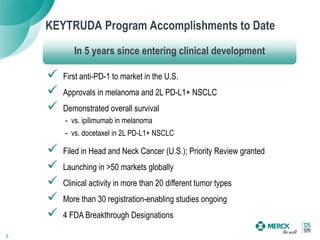
KEYTRUDA Program Accomplishments to Date
 First anti-PD-1 to market in the U.S.
 Approvals in melanoma and 2L PD-L1+ NSCLC
 Demonstrated overall survival
- vs. ipilimumab in melanoma
- vs. docetaxel in 2L PD-L1+ NSCLC
 Filed in Head and Neck Cancer (U.S.); Priority Review granted
 Launching in >50 markets globally
 Clinical activity in more than 20 different tumor types
 More than 30 registration-enabling studies ongoing
 4 FDA Breakthrough Designations
5
In 5 years since entering clinical development
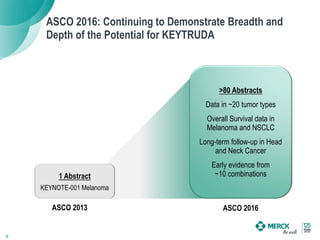
ASCO 2016: Continuing to Demonstrate Breadth and
Depth of the Potential for KEYTRUDA
1 Abstract
KEYNOTE-001 Melanoma
ASCO 2013
>80 Abstracts
Data in ~20 tumor types
Overall Survival data in
Melanoma and NSCLC
Long-term follow-up in Head
and Neck Cancer
Early evidence from
~10 combinations
ASCO 2016
6
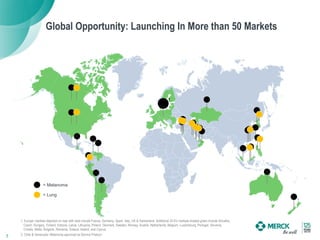
= Lung
= Melanoma
1. Europe: markets depicted on map with dots include France, Germany, Spain, Italy, UK & Switzerland. Additional 24 EU markets shaded green include Slovakia,
Czech, Hungary, Finland, Estonia, Latvia, Lithuania, Poland, Denmark, Sweden, Norway, Austria, Netherlands, Belgium, Luxembourg, Portugal, Slovenia,
Croatia, Malta, Bulgaria, Romania, Greece, Ireland, and Cyprus.
2. Chile & Venezuela: Melanoma approved as Service Product.
Global Opportunity: Launching In More than 50 Markets
7
1
REGISTRATION
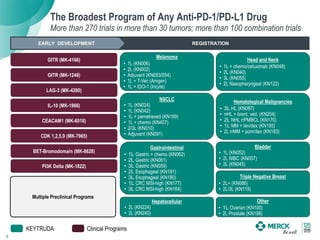
The Broadest Program of Any Anti-PD-1/PD-L1 Drug
More than 270 trials in more than 30 tumors; more than 100 combination trials
8
EARLY DEVELOPMENT
BET-Bromodomain (MK-8628)
GITR (MK-4166)
IL-10 (MK-1966)
Melanoma
• 1L (KN006)
• 2L (KN002)
• Adjuvant (KN053/054)
• 1L + T-Vec (Amgen)
• 1L + IDO-1 (Incyte)
NSCLC
• 1L (KN024)
• 1L (KN042)
• 1L + pemetrexed (KN189)
• 1L + chemo (KN407)
• 2/3L (KN010)
• Adjuvant (KN091)
Head and Neck
• 1L + chemo/cetuximab (KN048)
• 2L (KN040)
• 3L (KN055)
• 2L Nasopharyngeal (KN122)
Bladder
• 1L (KN052)
• 2L NIBC (KN057)
• 2L (KN045)
Gastrointestinal
• 1L Gastric + chemo (KN062)
• 2L Gastric (KN061)
• 3L Gastric (KN059)
• 2L Esophageal (KN181)
• 3L Esophageal (KN180)
• 1L CRC MSI-high (KN177)
• 3L CRC MSI-high (KN164)
Triple Negative Breast
• 2L+ (KN086)
• 2L/3L (KN119)
Hematological Malignancies
• 3L HL (KN087)
• rrHL + brent. ved. (KN204)
• 2L NHL rrPMBCL (KN170)
• 1L MM + len/dex (KN185)
• 2L rrMM + pom/dex (KN183)
CEACAM1 (MK-6018)
Other
• 1L Ovarian (KN100)
• 2L Prostate (KN199)
CDK 1,2,5,9 (MK-7965)
Hepatocellular
• 2L (KN224)
• 2L (KN240)
KEYTRUDA Clinical Programs
LAG-3 (MK-4280)
Multiple Preclinical Programs
GITR (MK-1248)
PI3K Delta (MK-1822)
-100
0
100
-100
0
100
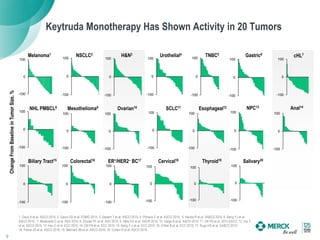
Keytruda Monotherapy Has Shown Activity in 20 Tumors
9
-100
0
100
-100
0
100
Melanoma1
-100
0
100
NSCLC2
-100
0
100
Gastric6
-100
0
100
-100
0
100
H&N3 TNBC5
-100
0
100
cHL7
-100
0
100
NHL PMBCL8
Urothelial4
ChangeFromBaselineinTumorSize,%
-100
0
100
Mesothelioma9
-100
0
100
Anal14
-100
0
100
-100
0
100
SCLC11
-100
0
100
NPC13
-100
0
100
Biliary Tract15
-100
0
100
Colorectal16
Esophageal12
-100
0
100
Ovarian10
-100
0
100
ER+/HER2– BC17
1. Daud A et al. ASCO 2015; 2. Garon EB et al. ESMO 2014; 3. Seiwert T et al. ASCO 2015; 4. Plimack E et al. ASCO 2015; 5. Nanda R et al. SABCS 2014; 6. Bang YJ et al.
ASCO 2015 ; 7. Moskowitz C et al. ASH 2014; 8. Zinzani PL et al. ASH 2015; 9. Alley EA et al. AACR 2015; 10. Varga A et al. ASCO 2015; 11. Ott PA et al. 2015 ASCO; 12. Doi T
et al. ASCO 2015; 13. Hsu C et al. ECC 2015; 14. Ott PA et al. ECC 2015; 15. Bang Y-J et al. ECC 2015; 16. O’Neil B et al. ECC 2015; 17. Rugo HS et al. SABCS 2015;
18. Frenel JS et al. ASCO 2016; 19. Mehnert JM et al. ASCO 2016; 20. Cohen R et al. ASCO 2016.
Cervical18 Thyroid19 Salivary20
-100
0
100
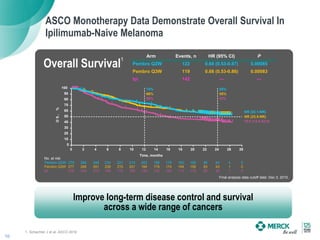
ASCO Monotherapy Data Demonstrate Overall Survival In
Ipilimumab-Naive Melanoma
10
1. Schachter J et al. ASCO 2016
Improve long-term disease control and survival
across a wide range of cancers
Arm Events, n HR (95% CI) P
Pembro Q2W 122 0.68 (0.53-0.87) 0.00085
Pembro Q3W 119 0.68 (0.53-0.86) 0.00083
Ipi 142 — —
Overall Survival
Final analysis data cutoff date: Dec 3, 2015.
0 2 4 6 8 10 12 14 16 18 20 22 24 26 28
0
10
20
30
40
50
60
70
80
90
100
Time, months
OS,%
279 266 249 234 221 215 202 188 176 163 156 96 44 4 0Pembro Q2W
277 266 251 238 215 201 184 179 174 164 156 93 43 1 0Pembro Q3W
278 242 213 189 170 159 145 132 122 113 110 69 28 1 0Ipi
No. at risk
74%
68%
59%
55%
55%
43%
NR (22.1-NR)
NR (23.5-NR)
16.0 (13.5-22.0)
1
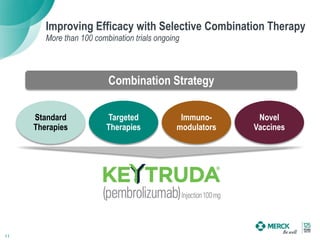
Improving Efficacy with Selective Combination Therapy
More than 100 combination trials ongoing
11
Standard
Therapies
Targeted
Therapies
Immuno-
modulators
Novel
Vaccines
Combination Strategy
Targeted
Therapies
Standard
Therapies
2
4 5
2
6 33
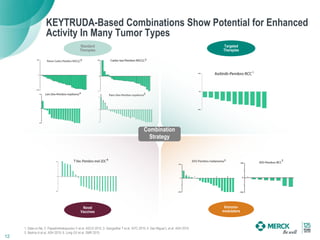
KEYTRUDA-Based Combinations Show Potential for Enhanced
Activity In Many Tumor Types
12
1. Data on file; 2. Papadimitrakopoulou V et al. ASCO 2015; 3. Gangadhar T et al. SITC 2015; 4. San Miguel L et al. ASH 2015.
5. Badros A et al. ASH 2015; 6. Long GV et al. SMR 2015.
Novel
Vaccines
Immuno-
modulators
1
Combination
Strategy
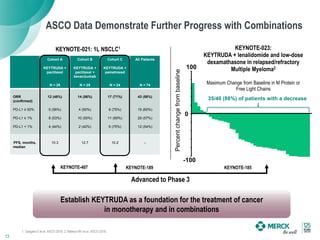
ASCO Data Demonstrate Further Progress with Combinations
KEYNOTE-021: 1L NSCLC1
Cohort A
KEYTRUDA +
paclitaxel
N = 25
Cohort B
KEYTRUDA +
paclitaxel +
bevacizumab
N = 25
Cohort C
KEYTRUDA +
pemetrexed
N = 24
All Patients
N = 74
ORR
(confirmed)
PD-L1 ≥ 50%
PD-L1 ≥ 1%
PD-L1 < 1%
12 (48%)
5 (56%)
8 (53%)
4 (44%)
14 (56%)
4 (50%)
10 (50%)
2 (40%)
17 (71%)
6 (75%)
11 (69%)
6 (75%)
43 (58%)
15 (60%)
29 (57%)
12 (54%)
PFS, months,
median
10.3 12.7 10.2 --
Advanced to Phase 3
1. Gadgeel S et al. ASCO 2016; 2. Mateos MV et al. ASCO 2016.
13
Establish KEYTRUDA as a foundation for the treatment of cancer
in monotherapy and in combinations
KEYNOTE-407 KEYNOTE-189 KEYNOTE-185
KEYNOTE-023:
KEYTRUDA + lenalidomide and low-dose
dexamathasone in relapsed/refractory
Multiple Myeloma2
Maximum Change from Baseline in M Protein or
Free Light Chains
Percentchangefrombaseline
35/40 (88%) of patients with a decrease
-100
0
100
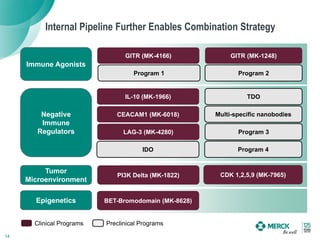
Internal Pipeline Further Enables Combination Strategy
BET-Bromodomain (MK-8628)
GITR (MK-1248)
IL-10 (MK-1966)
CEACAM1 (MK-6018)
GITR (MK-4166)
PI3K Delta (MK-1822)
IDO
LAG-3 (MK-4280)
Clinical Programs Preclinical Programs
Negative
Immune
Regulators
Epigenetics
Tumor
Microenvironment
Immune Agonists
Program 2
TDO
Multi-specific nanobodies
Program 3
14
Program 1
Program 4
CDK 1,2,5,9 (MK-7965)
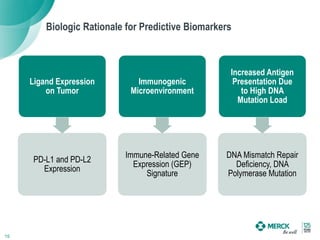
Biologic Rationale for Predictive Biomarkers
15
Ligand Expression
on Tumor
PD-L1 and PD-L2
Expression
Immunogenic
Microenvironment
Immune-Related Gene
Expression (GEP)
Signature
Increased Antigen
Presentation Due
to High DNA
Mutation Load
DNA Mismatch Repair
Deficiency, DNA
Polymerase Mutation
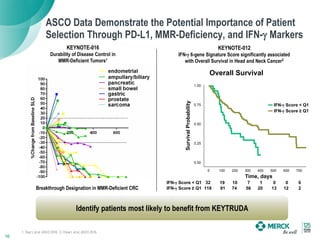
ASCO Data Demonstrate the Potential Importance of Patient
Selection Through PD-L1, MMR-Deficiency, and IFN-γ Markers
Breakthrough Designation in MMR-Deficient CRC
1. Diaz L et al. ASCO 2016; 2. Chow L et al. ASCO 2016.
16
Identify patients most likely to benefit from KEYTRUDA
KEYNOTE-016
Durability of Disease Control in
MMR-Deficient Tumors1
KEYNOTE-012
IFN-γ 6-gene Signature Score significantly associated
with Overall Survival in Head and Neck Cancer2
Overall Survival
0.00
0.25
0.50
0.75
1.00
0 100 200 300 400 500 600 700
Time, days
SurvivalProbability
32 19 10 7 1 0 0 0
118 91 74 56 20 13 12 2IFN-γ Score ≥ Q1
IFN-γ Score < Q1
IFN-γ Score < Q1
IFN-γ Score ≥ Q1
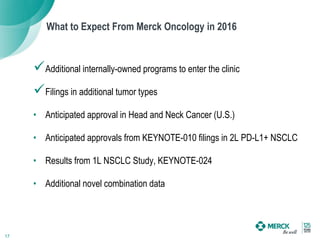
Additional internally-owned programs to enter the clinic
Filings in additional tumor types
• Anticipated approval in Head and Neck Cancer (U.S.)
• Anticipated approvals from KEYNOTE-010 filings in 2L PD-L1+ NSCLC
• Results from 1L NSCLC Study, KEYNOTE-024
• Additional novel combination data
What to Expect From Merck Oncology in 2016
17
Q&A
Frank Clyburn
President Merck Oncology
Roger M. Perlmutter
Executive Vice President and President
Merck Research Laboratories

Merck asco-briefing-slides

  • 1.
    Merck & Co.,Inc. Merck ASCO Event June 6, 2016
  • 2.
    This presentation ofMerck & Co., Inc., Kenilworth, NJ, USA (the “company”) includes “forward- looking statements” within the meaning of the safe harbor provisions of the United States Private Securities Litigation Reform Act of 1995. These statements are based upon the current beliefs and expectations of the company’s management and are subject to significant risks and uncertainties. There can be no guarantees with respect to pipeline products that the products will receive the necessary regulatory approvals or that they will prove to be commercially successful. If underlying assumptions prove inaccurate or risks or uncertainties materialize, actual results may differ materially from those set forth in the forward-looking statements. Risks and uncertainties include, but are not limited to, general industry conditions and competition; general economic factors, including interest rate and currency exchange rate fluctuations; the impact of pharmaceutical industry regulation and healthcare legislation in the United States and internationally; global trends toward healthcare cost containment; technological advances, new products and patents attained by competitors; challenges inherent in new product development, including obtaining regulatory approval; the company’s ability to accurately predict future market conditions; manufacturing difficulties or delays; financial instability of international economies and sovereign risk; dependence on the effectiveness of the company’s patents and other protections for innovative products; and the exposure to litigation, including patent litigation, and/or regulatory actions. The company undertakes no obligation to publicly update any forward-looking statement, whether as a result of new information, future events or otherwise. Additional factors that could cause results to differ materially from those described in the forward-looking statements can be found in the company’s 2015 Annual Report on Form 10-K and the company’s other filings with the Securities and Exchange Commission (SEC) available at the SEC’s Internet site (www.sec.gov). Forward-Looking Statement of Merck & Co., Inc., Kenilworth, NJ, USA 2
  • 3.
    • Strategy Overview •Combination Strategy • Biomarker Strategy • Closing and Q&A Agenda 3
  • 4.
    Identify patients mostlikely to benefit from KEYTRUDA Establish KEYTRUDA as a foundation for the treatment of cancer in monotherapy and in combinations Improve long-term disease control and survival across a wide range of cancers Merck’s Strategy in Oncology 4
  • 5.
    KEYTRUDA Program Accomplishmentsto Date  First anti-PD-1 to market in the U.S.  Approvals in melanoma and 2L PD-L1+ NSCLC  Demonstrated overall survival - vs. ipilimumab in melanoma - vs. docetaxel in 2L PD-L1+ NSCLC  Filed in Head and Neck Cancer (U.S.); Priority Review granted  Launching in >50 markets globally  Clinical activity in more than 20 different tumor types  More than 30 registration-enabling studies ongoing  4 FDA Breakthrough Designations 5 In 5 years since entering clinical development
  • 6.
    ASCO 2016: Continuingto Demonstrate Breadth and Depth of the Potential for KEYTRUDA 1 Abstract KEYNOTE-001 Melanoma ASCO 2013 >80 Abstracts Data in ~20 tumor types Overall Survival data in Melanoma and NSCLC Long-term follow-up in Head and Neck Cancer Early evidence from ~10 combinations ASCO 2016 6
  • 7.
    = Lung = Melanoma 1.Europe: markets depicted on map with dots include France, Germany, Spain, Italy, UK & Switzerland. Additional 24 EU markets shaded green include Slovakia, Czech, Hungary, Finland, Estonia, Latvia, Lithuania, Poland, Denmark, Sweden, Norway, Austria, Netherlands, Belgium, Luxembourg, Portugal, Slovenia, Croatia, Malta, Bulgaria, Romania, Greece, Ireland, and Cyprus. 2. Chile & Venezuela: Melanoma approved as Service Product. Global Opportunity: Launching In More than 50 Markets 7 1
  • 8.
    REGISTRATION The Broadest Programof Any Anti-PD-1/PD-L1 Drug More than 270 trials in more than 30 tumors; more than 100 combination trials 8 EARLY DEVELOPMENT BET-Bromodomain (MK-8628) GITR (MK-4166) IL-10 (MK-1966) Melanoma • 1L (KN006) • 2L (KN002) • Adjuvant (KN053/054) • 1L + T-Vec (Amgen) • 1L + IDO-1 (Incyte) NSCLC • 1L (KN024) • 1L (KN042) • 1L + pemetrexed (KN189) • 1L + chemo (KN407) • 2/3L (KN010) • Adjuvant (KN091) Head and Neck • 1L + chemo/cetuximab (KN048) • 2L (KN040) • 3L (KN055) • 2L Nasopharyngeal (KN122) Bladder • 1L (KN052) • 2L NIBC (KN057) • 2L (KN045) Gastrointestinal • 1L Gastric + chemo (KN062) • 2L Gastric (KN061) • 3L Gastric (KN059) • 2L Esophageal (KN181) • 3L Esophageal (KN180) • 1L CRC MSI-high (KN177) • 3L CRC MSI-high (KN164) Triple Negative Breast • 2L+ (KN086) • 2L/3L (KN119) Hematological Malignancies • 3L HL (KN087) • rrHL + brent. ved. (KN204) • 2L NHL rrPMBCL (KN170) • 1L MM + len/dex (KN185) • 2L rrMM + pom/dex (KN183) CEACAM1 (MK-6018) Other • 1L Ovarian (KN100) • 2L Prostate (KN199) CDK 1,2,5,9 (MK-7965) Hepatocellular • 2L (KN224) • 2L (KN240) KEYTRUDA Clinical Programs LAG-3 (MK-4280) Multiple Preclinical Programs GITR (MK-1248) PI3K Delta (MK-1822)
  • 9.
    -100 0 100 -100 0 100 Keytruda Monotherapy HasShown Activity in 20 Tumors 9 -100 0 100 -100 0 100 Melanoma1 -100 0 100 NSCLC2 -100 0 100 Gastric6 -100 0 100 -100 0 100 H&N3 TNBC5 -100 0 100 cHL7 -100 0 100 NHL PMBCL8 Urothelial4 ChangeFromBaselineinTumorSize,% -100 0 100 Mesothelioma9 -100 0 100 Anal14 -100 0 100 -100 0 100 SCLC11 -100 0 100 NPC13 -100 0 100 Biliary Tract15 -100 0 100 Colorectal16 Esophageal12 -100 0 100 Ovarian10 -100 0 100 ER+/HER2– BC17 1. Daud A et al. ASCO 2015; 2. Garon EB et al. ESMO 2014; 3. Seiwert T et al. ASCO 2015; 4. Plimack E et al. ASCO 2015; 5. Nanda R et al. SABCS 2014; 6. Bang YJ et al. ASCO 2015 ; 7. Moskowitz C et al. ASH 2014; 8. Zinzani PL et al. ASH 2015; 9. Alley EA et al. AACR 2015; 10. Varga A et al. ASCO 2015; 11. Ott PA et al. 2015 ASCO; 12. Doi T et al. ASCO 2015; 13. Hsu C et al. ECC 2015; 14. Ott PA et al. ECC 2015; 15. Bang Y-J et al. ECC 2015; 16. O’Neil B et al. ECC 2015; 17. Rugo HS et al. SABCS 2015; 18. Frenel JS et al. ASCO 2016; 19. Mehnert JM et al. ASCO 2016; 20. Cohen R et al. ASCO 2016. Cervical18 Thyroid19 Salivary20 -100 0 100
  • 10.
    ASCO Monotherapy DataDemonstrate Overall Survival In Ipilimumab-Naive Melanoma 10 1. Schachter J et al. ASCO 2016 Improve long-term disease control and survival across a wide range of cancers Arm Events, n HR (95% CI) P Pembro Q2W 122 0.68 (0.53-0.87) 0.00085 Pembro Q3W 119 0.68 (0.53-0.86) 0.00083 Ipi 142 — — Overall Survival Final analysis data cutoff date: Dec 3, 2015. 0 2 4 6 8 10 12 14 16 18 20 22 24 26 28 0 10 20 30 40 50 60 70 80 90 100 Time, months OS,% 279 266 249 234 221 215 202 188 176 163 156 96 44 4 0Pembro Q2W 277 266 251 238 215 201 184 179 174 164 156 93 43 1 0Pembro Q3W 278 242 213 189 170 159 145 132 122 113 110 69 28 1 0Ipi No. at risk 74% 68% 59% 55% 55% 43% NR (22.1-NR) NR (23.5-NR) 16.0 (13.5-22.0) 1
  • 11.
    Improving Efficacy withSelective Combination Therapy More than 100 combination trials ongoing 11 Standard Therapies Targeted Therapies Immuno- modulators Novel Vaccines Combination Strategy
  • 12.
    Targeted Therapies Standard Therapies 2 4 5 2 6 33 KEYTRUDA-BasedCombinations Show Potential for Enhanced Activity In Many Tumor Types 12 1. Data on file; 2. Papadimitrakopoulou V et al. ASCO 2015; 3. Gangadhar T et al. SITC 2015; 4. San Miguel L et al. ASH 2015. 5. Badros A et al. ASH 2015; 6. Long GV et al. SMR 2015. Novel Vaccines Immuno- modulators 1 Combination Strategy
  • 13.
    ASCO Data DemonstrateFurther Progress with Combinations KEYNOTE-021: 1L NSCLC1 Cohort A KEYTRUDA + paclitaxel N = 25 Cohort B KEYTRUDA + paclitaxel + bevacizumab N = 25 Cohort C KEYTRUDA + pemetrexed N = 24 All Patients N = 74 ORR (confirmed) PD-L1 ≥ 50% PD-L1 ≥ 1% PD-L1 < 1% 12 (48%) 5 (56%) 8 (53%) 4 (44%) 14 (56%) 4 (50%) 10 (50%) 2 (40%) 17 (71%) 6 (75%) 11 (69%) 6 (75%) 43 (58%) 15 (60%) 29 (57%) 12 (54%) PFS, months, median 10.3 12.7 10.2 -- Advanced to Phase 3 1. Gadgeel S et al. ASCO 2016; 2. Mateos MV et al. ASCO 2016. 13 Establish KEYTRUDA as a foundation for the treatment of cancer in monotherapy and in combinations KEYNOTE-407 KEYNOTE-189 KEYNOTE-185 KEYNOTE-023: KEYTRUDA + lenalidomide and low-dose dexamathasone in relapsed/refractory Multiple Myeloma2 Maximum Change from Baseline in M Protein or Free Light Chains Percentchangefrombaseline 35/40 (88%) of patients with a decrease -100 0 100
  • 14.
    Internal Pipeline FurtherEnables Combination Strategy BET-Bromodomain (MK-8628) GITR (MK-1248) IL-10 (MK-1966) CEACAM1 (MK-6018) GITR (MK-4166) PI3K Delta (MK-1822) IDO LAG-3 (MK-4280) Clinical Programs Preclinical Programs Negative Immune Regulators Epigenetics Tumor Microenvironment Immune Agonists Program 2 TDO Multi-specific nanobodies Program 3 14 Program 1 Program 4 CDK 1,2,5,9 (MK-7965)
  • 15.
    Biologic Rationale forPredictive Biomarkers 15 Ligand Expression on Tumor PD-L1 and PD-L2 Expression Immunogenic Microenvironment Immune-Related Gene Expression (GEP) Signature Increased Antigen Presentation Due to High DNA Mutation Load DNA Mismatch Repair Deficiency, DNA Polymerase Mutation
  • 16.
    ASCO Data Demonstratethe Potential Importance of Patient Selection Through PD-L1, MMR-Deficiency, and IFN-γ Markers Breakthrough Designation in MMR-Deficient CRC 1. Diaz L et al. ASCO 2016; 2. Chow L et al. ASCO 2016. 16 Identify patients most likely to benefit from KEYTRUDA KEYNOTE-016 Durability of Disease Control in MMR-Deficient Tumors1 KEYNOTE-012 IFN-γ 6-gene Signature Score significantly associated with Overall Survival in Head and Neck Cancer2 Overall Survival 0.00 0.25 0.50 0.75 1.00 0 100 200 300 400 500 600 700 Time, days SurvivalProbability 32 19 10 7 1 0 0 0 118 91 74 56 20 13 12 2IFN-γ Score ≥ Q1 IFN-γ Score < Q1 IFN-γ Score < Q1 IFN-γ Score ≥ Q1
  • 17.
    Additional internally-owned programsto enter the clinic Filings in additional tumor types • Anticipated approval in Head and Neck Cancer (U.S.) • Anticipated approvals from KEYNOTE-010 filings in 2L PD-L1+ NSCLC • Results from 1L NSCLC Study, KEYNOTE-024 • Additional novel combination data What to Expect From Merck Oncology in 2016 17
  • 18.
    Q&A Frank Clyburn President MerckOncology Roger M. Perlmutter Executive Vice President and President Merck Research Laboratories