A Field Guide to 
Seeking & Keeping a Mentor 
Tom L. Hayashi, MS Ed, MA, CFRE 
Principal 
Capacity Empowerment
AGENDA 
 Welcome & Introductions 
 What is Mentoring? 
 Mentoring Practice & Process: 
1. Seeking & Qualifying: Vision & Mission 
2. Keeping & Expanding: 5 Pitfalls, Resolution & 
Transition, Advisory Board of Mentors. 
 Q&A 
 Adjourn
Welcome & Introductions 
Name 
Home base 
Day Job 
Your experience with mentorship (Mentor/Mentee) 
Mentoring curiosity or expectations for this training
What is mentoring? 
The story of Mentor 
comes from Homer's 
Odyssey. Odysseus, 
king of Ithaca, fights in 
the Trojan War and 
entrusts the care of his 
household to Mentor, 
who serves as teacher 
and overseer of 
Odysseus' son, 
Telemachus.
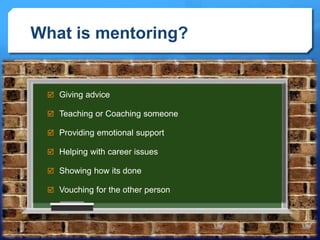
What is mentoring? 
 Giving advice 
 Teaching or Coaching someone 
 Providing emotional support 
 Helping with career issues 
 Showing how its done 
 Vouching for the other person
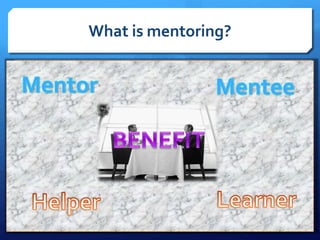
What is mentoring?
Critical Elements
Return on Investment (ROI) 
(Holincheck, 2006)
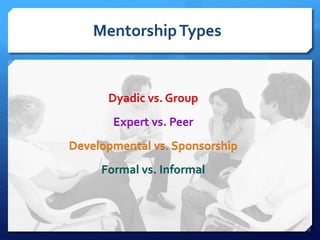
Mentorship Types 
Dyadic vs. Group 
Expert vs. Peer 
Developmental vs. Sponsorship 
Formal vs. Informal
Developmental Mentorship Model 
Engagement Matrix
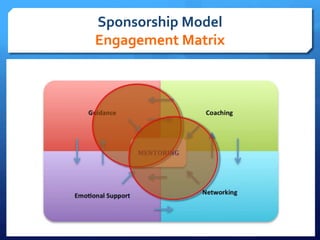
Sponsorship Model 
Engagement Matrix
Mentorship Process 
Search 
Introduction 
Engagement 
Resolution/Transition
Practice & Process
Seeking Mentors 
What do you wish for your life to look like? 
What is the end goal? 
Winning the battle(s) 
Achieving the milestones
Seeking Mentors
The right stuff 
Manages the relationship 
Encourages 
Nurtures 
Teaches 
Offers mutual respect 
Responds to the mentee’s needs 
From David Clutterbuck (2004) Everyone Needs a Mentor
Qualifying Mentors
Keeping & Expanding 
5 Pitfalls 
1. Neglect 
2. Work style 
differences 
3. Position power 
4. Incompetence 
5. Attitude
Five Ps 
Purpose 
People 
Process 
Politics 
Product
Mentoring Resolution/Transition 
 Decide—if transition is right for you and the date of transition 
 Elicit—feedback from others and mentor 
 Plan—start planning for the resolution or transition 
 Assess—for addressing developmental and situational issues 
 Reflect—reflect on the experience as a whole 
 Thank—acknowledge the mentor and celebrate success
Board of Advisory Mentors (BAM!) 
Personal 
Relations with family (partner, children, etc.) 
Life Transitions (Separation, Care Giving, Retirement, Grief or Loss) 
Professional 
Career guidance 
Networking 
Coaching 
Moral Support 
Subject Specific: Supervision, Promotion, Assignments
Q & A 
 What role are you playing in mentorship? 
Where are you in the mentorship process? 
 What questions do you have to enhance your 
mentorship practices? 
Where can you turn to for mentorship 
resources?
References 
 Clutterbuck, D. (2004). Everyone needs a mentor: Fostering 
talent in your organisation. CIPD Publishing. 
 Holincheck, J. (2006). Case study: Workforce analytics at Sun. 
Gartner Research Group. 
 Simon, S. A., & Eby, L. T. (2003). A typology of negative 
mentoring experiences: A multidimensional scaling study. 
Human Relations, 56(9), 1083-1106.
Contact Information 
Tom L. Hayashi, MS Ed, MA, CFRE 
Principal 
Capacity Empowerment 
562.221.1030 
tomhayashi@gmail.com

Field Guide to Seeking and Keeping Mentors

  • 1.
    A Field Guideto Seeking & Keeping a Mentor Tom L. Hayashi, MS Ed, MA, CFRE Principal Capacity Empowerment
  • 2.
    AGENDA  Welcome& Introductions  What is Mentoring?  Mentoring Practice & Process: 1. Seeking & Qualifying: Vision & Mission 2. Keeping & Expanding: 5 Pitfalls, Resolution & Transition, Advisory Board of Mentors.  Q&A  Adjourn
  • 3.
    Welcome & Introductions Name Home base Day Job Your experience with mentorship (Mentor/Mentee) Mentoring curiosity or expectations for this training
  • 4.
    What is mentoring? The story of Mentor comes from Homer's Odyssey. Odysseus, king of Ithaca, fights in the Trojan War and entrusts the care of his household to Mentor, who serves as teacher and overseer of Odysseus' son, Telemachus.
  • 5.
    What is mentoring?  Giving advice  Teaching or Coaching someone  Providing emotional support  Helping with career issues  Showing how its done  Vouching for the other person
  • 6.
  • 7.
  • 8.
    Return on Investment(ROI) (Holincheck, 2006)
  • 9.
    Mentorship Types Dyadicvs. Group Expert vs. Peer Developmental vs. Sponsorship Formal vs. Informal
  • 10.
  • 11.
  • 12.
    Mentorship Process Search Introduction Engagement Resolution/Transition
  • 13.
  • 14.
    Seeking Mentors Whatdo you wish for your life to look like? What is the end goal? Winning the battle(s) Achieving the milestones
  • 15.
  • 16.
    The right stuff Manages the relationship Encourages Nurtures Teaches Offers mutual respect Responds to the mentee’s needs From David Clutterbuck (2004) Everyone Needs a Mentor
  • 17.
  • 18.
    Keeping & Expanding 5 Pitfalls 1. Neglect 2. Work style differences 3. Position power 4. Incompetence 5. Attitude
  • 19.
    Five Ps Purpose People Process Politics Product
  • 20.
    Mentoring Resolution/Transition Decide—if transition is right for you and the date of transition  Elicit—feedback from others and mentor  Plan—start planning for the resolution or transition  Assess—for addressing developmental and situational issues  Reflect—reflect on the experience as a whole  Thank—acknowledge the mentor and celebrate success
  • 21.
    Board of AdvisoryMentors (BAM!) Personal Relations with family (partner, children, etc.) Life Transitions (Separation, Care Giving, Retirement, Grief or Loss) Professional Career guidance Networking Coaching Moral Support Subject Specific: Supervision, Promotion, Assignments
  • 22.
    Q & A  What role are you playing in mentorship? Where are you in the mentorship process?  What questions do you have to enhance your mentorship practices? Where can you turn to for mentorship resources?
  • 23.
    References  Clutterbuck,D. (2004). Everyone needs a mentor: Fostering talent in your organisation. CIPD Publishing.  Holincheck, J. (2006). Case study: Workforce analytics at Sun. Gartner Research Group.  Simon, S. A., & Eby, L. T. (2003). A typology of negative mentoring experiences: A multidimensional scaling study. Human Relations, 56(9), 1083-1106.
  • 24.
    Contact Information TomL. Hayashi, MS Ed, MA, CFRE Principal Capacity Empowerment 562.221.1030 tomhayashi@gmail.com

Editor's Notes

  • #4 2 National Mentorship Program: Young Professionals & College-to-Career 1 Youth Mentorship Program Research: Career Self-Efficacy (Confidence)
  • #5 When Athena visited Telemachus, she took the disguise of Mentor to hide herself from the suitors of Telemachus’s mother Penelope. As mentor, the goddess encouraged Telemachus to stand up against the suitors and go abroad to find out what happened to his father. What does it mean to you?
  • #7 Most common form of mentoring is dyadic or one-on-one but it there be group mentorship? Can a person who has less or equal experience than yourself?
  • #9 25% of employees who enrolled in a mentoring program had a positive salary-grade change, while only 5% of workers who did not participate in a mentoring program had a change. Mentors were promoted six times more often than those who did not mentor formally. Mentorees were promoted five times more often than those who were not formally mentored. Retention rates were higher for both mentorees (72%) and mentors (69%) than for employees who did not participate in a mentoring program.
  • #22 Some call this your cabinet…