Mentoring The
                                    Next Generation
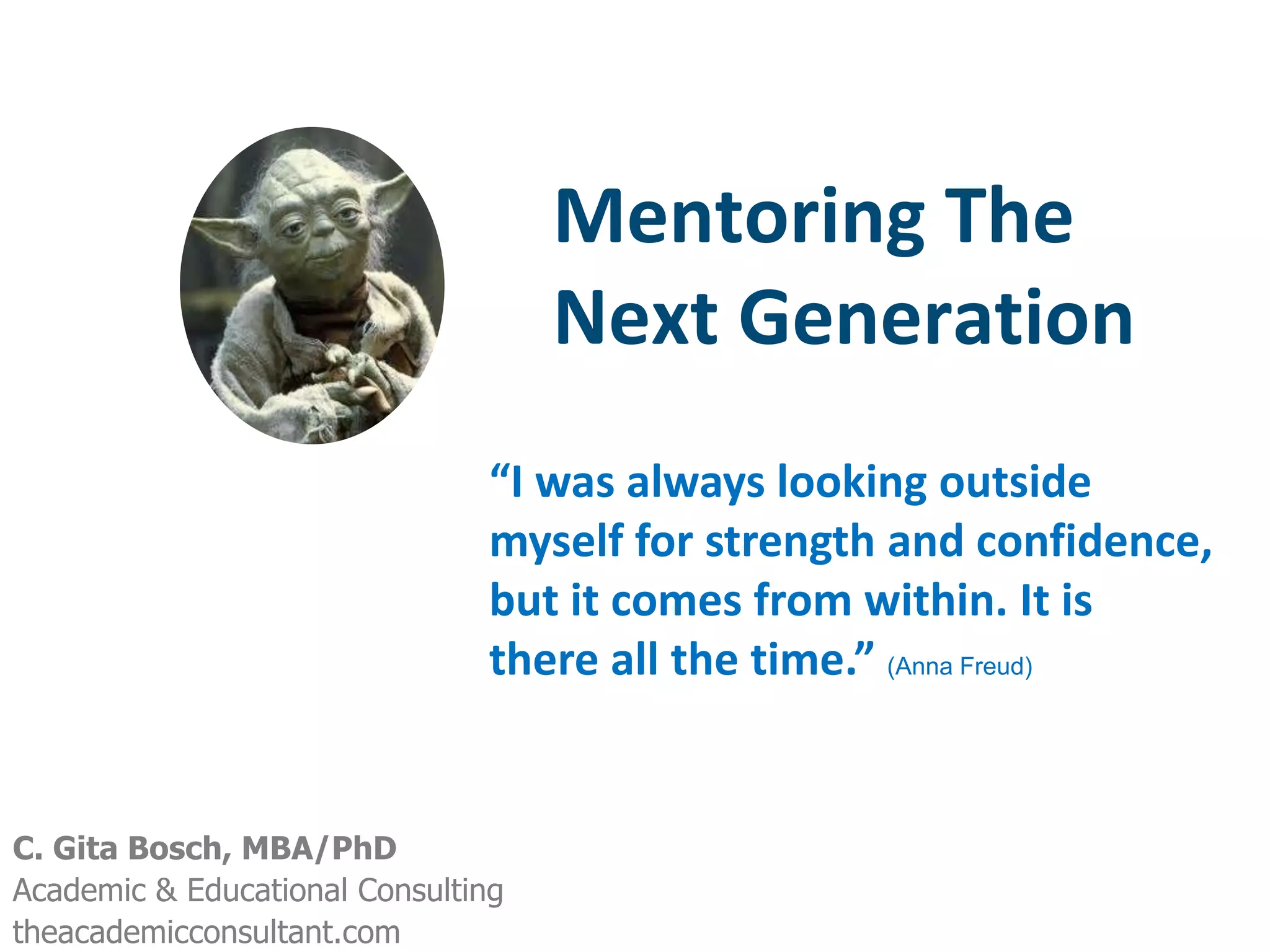
                               “I was always looking outside
                               myself for strength and confidence,
                               but it comes from within. It is
                               there all the time.” (Anna Freud)


C. Gita Bosch, MBA/PhD
Academic & Educational Consulting
theacademicconsultant.com
Mentoring Underrepresented Students
     Facilitated by C Gita Bosch

      A key to student success is mentoring. This is especially true
     for underrepresented minority (URM) students who may not
     have the social structure that provides role models and
     intellectual and emotional supports that students need to
     succeed. Mentoring can provide this infrastructure and fill in
     gaps in knowledge and access to available resources which
     many URM students need. Peer mentoring is critical for student
     success, but it has to be supported with faculty mentoring for
     optimal effectiveness. Many non-minority faculty are wary about
     taking on the role of mentor for URM students. This is usually
     not because they do not want to but rather it is usually because
     they are concerned that they do not know how. The discussion
     will focus on how faculty mentors can overcome the barriers
     and gain awareness, insight and strategies on mentoring URM
     students to increase the chances for their future success
SKGSBS
     professionally and personally.
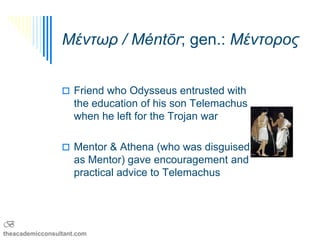
Μέντωρ / Méntōr; gen.: Μέντορος


                  Friend who Odysseus entrusted with
                     the education of his son Telemachus
                     when he left for the Trojan war

                  Mentor & Athena (who was disguised
                     as Mentor) gave encouragement and
                     practical advice to Telemachus


B
theacademicconsultant.com
Mentoring

                      A dynamic process in which a
                    mentor and mentee each learns to
                      respect and trust the other’s
                       commitment, expertise, and
                     individuality, and are willing to
                    invest time and energy to build a
                    unique, positive and productive
                               relationship

B
theacademicconsultant.com
What is mentoring?

                Share                                      One-on-one
                   Knowledge                               Group
                   Wisdom
                                                            In-person
                   Professional skills
                                                            In silico
                   Expertise
                                                            Structured
                Foster insight
                                                            Unstructured
                Fueled by human capital
                Requires engagement of the
                  faculty and the institution


B                                     “Mentoring is a brain to pick, an ear to listen,
theacademicconsultant.com             and a push in the right direction." John Crosby
What is mentoring?

                 Address personal, professional & academic needs
                        Help with mundane things
                        Help build the emotional and social fibers that some
                         underserved students may not have
                        Help reach academic success
                 Show someone cares
                        You cannot do everything
                        Point them in the right direction
                        Do not send them away

                                            "The greatest good you can do for another
B                                           is not just to share your riches but to reveal
theacademicconsultant.com                   to him his own.“ Benjamin Disraeli
Why mentor?
                Personal satisfaction from enriching the students’
                 experience
                Service to the College
                       Developing future leaders
                Personal growth
                       Enhance your coaching, feedback and leadership
                        skills
                Exposure to new and different perspectives and
                   thinking styles
                                           "Few things in the world are more
                                           powerful than a positive push. A smile. A
B                                          word of optimism and hope. A "you can do
theacademicconsultant.com                  it" when things are tough.“ Richard M. De Vos
How do you define diversity?
                  Diversity is a core value that embodies inclusiveness,
                     mutual respect, and varied perspectives and serves as a
                     catalyst for change that leads to equity

                  Inclusion is the core element to successfully achieve
                     diversity. This is done by nurturing the climate and culture
                     with education, policy, and practice to create an
                     environment that fosters belonging, respect, and value for
                     all and encourages engagement and connection
                     throughout the institution and community


B                                             “Honest differences are often a healthy
theacademicconsultant.com                     sign of progress.” Mahatma Gandhi
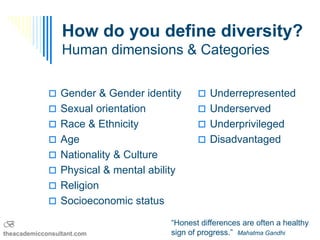
How do you define diversity?
                 Human dimensions & Categories

              Gender & Gender identity        Underrepresented
              Sexual orientation              Underserved
              Race & Ethnicity                Underprivileged
              Age                             Disadvantaged
              Nationality & Culture
              Physical & mental ability
              Religion
              Socioeconomic status

B                                      “Honest differences are often a healthy
theacademicconsultant.com              sign of progress.” Mahatma Gandhi
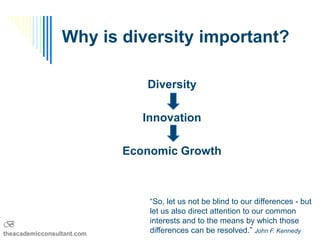
Why is diversity important?

                               Diversity

                               Innovation

                            Economic Growth


                                “So, let us not be blind to our differences - but
                                let us also direct attention to our common
B                               interests and to the means by which those
theacademicconsultant.com       differences can be resolved.” John F. Kennedy
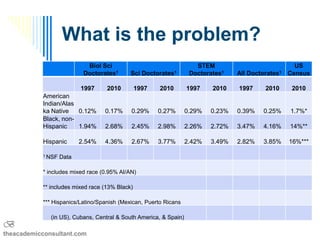
What is the problem?
                            Biol Sci                                  STEM                               US
                           Doctorates1      Sci   Doctorates1       Doctorates1    All   Doctorates1   Census

                          1997     2010         1997   2010        1997    2010    1997       2010      2010
           American
           Indian/Alas
           ka Native   0.12%      0.17%     0.29%      0.27%       0.29%   0.23%   0.39%      0.25%    1.7%*
           Black, non-
           Hispanic    1.94%      2.68%     2.45%      2.98%       2.26%   2.72%   3.47%      4.16%    14%**

           Hispanic       2.54%   4.36%     2.67%      3.77%       2.42%   3.49%   2.82%      3.85%    16%***

           1 NSF   Data

           * includes mixed race (0.95% AI/AN)

           ** includes mixed race (13% Black)

           *** Hispanics/Latino/Spanish (Mexican, Puerto Ricans

              (in US), Cubans, Central & South America, & Spain)
B
theacademicconsultant.com
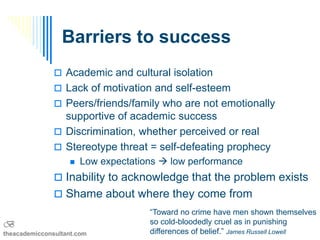
Barriers to success
                Academic and cultural isolation
                Lack of motivation and self-esteem
                Peers/friends/family who are not emotionally
                 supportive of academic success
                Discrimination, whether perceived or real
                Stereotype threat = self-defeating prophecy
                      Low expectations  low performance
                Inability to acknowledge that the problem exists
                Shame about where they come from
                                     “Toward no crime have men shown themselves
B                                    so cold-bloodedly cruel as in punishing
theacademicconsultant.com            differences of belief.” James Russell Lowell
How does mentoring help?
                 Personal and professional development
                        Communications
                        Financial obstacles
                 Motivate and give courage & confidence to go on
                 Removing institutional barriers
                 Access to informal networks and information
                 Avoids/decreases alienation
                 Retention
                 Diversity in disciplines

                                               “I never teach my pupils. I only
B                                              attempt to provide the conditions in
theacademicconsultant.com                      which they can learn.” Albert Einstein
What are the goals of mentoring?
                  Academic and social                 Encourage high academic
                     integration                        performance
                    Knowledge and skill                  Critical the first 2 years
                     development                          Build foundation
                    Nurture creativity                    knowledge
                    Support and motivate              Encourage pursuit of
                    Monitor and advise                 academic goals
                    Build lifelong coping skills      Prepare for graduate
                    Encourage a sense of               school
                     community                         Encourage participation in
                    Discuss class and                  academic meetings
                     research experiences               (network)

B                                                   "We make a living by what we get, we
theacademicconsultant.com                           make a life by what we give.“ Winston Churchill
First meeting
                  Take the initiative to schedule the meeting
                           Length of the meeting
                  Exchange of professional bio blurbs
                      Share professional and personal information
                      

                  Discuss
                           Confidentiality
                           General goals and focus of the relationship
                           Expectations about guidance you will offer
                           What you can offer: information, skills, experience
                  Individual Development Plan (IDP)
                  Schedule the next meeting

B                                            “The true teacher defends his pupils against
theacademicconsultant.com                    his own personal influence.” Amos Bronson Alcott
Second meeting

                  Discuss any questions or concerns from first
                   meeting
                  Discuss IDP
                           Long-, intermediate and short-term goals
                           Discuss training and educational needs/opportunities
                  Discuss general time-frame to evaluate the
                   relationship
                  Discuss future interactions


B                                       "Trust is something that happens within people
theacademicconsultant.com               only when it is created between people."Chip R. Bell
Next steps

                  Stay in regular/frequent contact
                           Email
                           Face-to-face
                  Formal v. informal meetings
                  Build trust
                           Follow through on commitments
                           Caring but honest feedback
                  IDP assessment


                                              “The trouble with most of us is that we
B                                             would rather be ruined by praise than
theacademicconsultant.com                     saved by criticism.” Norman Vincent Peale
Pitfalls in mentoring
                  Time constraints
                  Lack of expertise
                  Over-dependence
                  Imposing your values and perceptions
                           Lack of understanding/appreciation of cultural
                            differences
                           Need to understand and be mindful of behaviors
                            and attitudes and perceptions
                  Inability to establish trust
                  Lack of institutional recognition of mentoring

                                          “What we have done for ourselves alone dies
B                                         with us. What we have done for others and
theacademicconsultant.com                 the world remains and is immortal.” Albert Pine
Barriers to effective mentoring

                  Just providing the solutions
                  Assuming too much responsibility for the
                     student’s academic or career success
                    Neglecting commitments without valid reasons
                    Hesitating to contact your mentee if you have
                     not heard from her for a while
                    Having unrealistic expectations
                    Meeting in places that make you or your
                     mentee uncomfortable

B                                                 “Be the change you want to see
theacademicconsultant.com                         in the world.” Gandhi
What to do

                 Nurture & foster positive self-perception & self-worth
                 Help the mentee accept and cope with the “baggage”
                 Help find linkages in a foreign culture and new society
                 Work together to identify solutions
                 Create an atmosphere to give “permission” for the
                    student to share feelings and aspirations, express
                    concerns and identify problems
                        Issues are seen and unseen, need to bring them out (shame)


                                             "A lot of people have gone further than they
B                                            thought they could because someone else
theacademicconsultant.com                    thought they could.“ Unknown
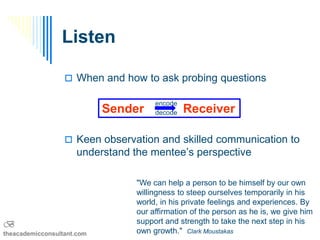
Listen

                   When and how to ask probing questions

                                      encode
                            Sender    decode   Receiver

                   Keen observation and skilled communication to
                     understand the mentee’s perspective

                                 "We can help a person to be himself by our own
                                 willingness to steep ourselves temporarily in his
                                 world, in his private feelings and experiences. By
                                 our affirmation of the person as he is, we give him
B                                support and strength to take the next step in his
theacademicconsultant.com        own growth." Clark Moustakas
Effective mentors
                  Take the initiative in the relationship
                  Challenge, motivate, inspire and encourage
                  Committed, patient and build trust
                  Open confidential communication
                  Encourage self-reflection, analysis and problem
                   solving
                  Respect your mentee's time and yours,
                   establish boundaries with your mentee


                                  “Any genuine teaching will result, if successful, in
B                                 someone’s knowing how to bring about a better
theacademicconsultant.com         condition of things than existed earlier.” John Dewey
Effective mentors

                  Open-minded to opportunities, new experiences
                     and different ideas, and learn from it
                    Share alternative perspectives
                    Be clear you are offering advice/suggestions
                    Share your coping mechanisms
                    Positive feedback v. unwarranted praise/flattery
                    Constructive criticism + constructive advice
                    Know when and how to end the relationship


B                                   “We must give lengthy deliberation to what has
theacademicconsultant.com           to be decided once and for all.” Publilius Syrus
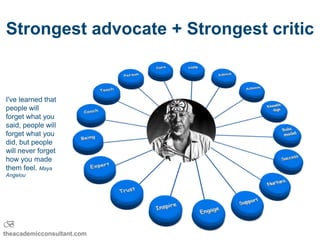
Strongest advocate + Strongest critic


I've learned that
people will
forget what you
said, people will
forget what you
did, but people
will never forget
how you made
them feel. Maya
Angelou


B
theacademicconsultant.com

Mentoring Underrepresented Students

  • 1.
    Mentoring The Next Generation “I was always looking outside myself for strength and confidence, but it comes from within. It is there all the time.” (Anna Freud) C. Gita Bosch, MBA/PhD Academic & Educational Consulting theacademicconsultant.com
  • 2.
    Mentoring Underrepresented Students Facilitated by C Gita Bosch A key to student success is mentoring. This is especially true for underrepresented minority (URM) students who may not have the social structure that provides role models and intellectual and emotional supports that students need to succeed. Mentoring can provide this infrastructure and fill in gaps in knowledge and access to available resources which many URM students need. Peer mentoring is critical for student success, but it has to be supported with faculty mentoring for optimal effectiveness. Many non-minority faculty are wary about taking on the role of mentor for URM students. This is usually not because they do not want to but rather it is usually because they are concerned that they do not know how. The discussion will focus on how faculty mentors can overcome the barriers and gain awareness, insight and strategies on mentoring URM students to increase the chances for their future success SKGSBS professionally and personally.
  • 3.
    Μέντωρ / Méntōr;gen.: Μέντορος  Friend who Odysseus entrusted with the education of his son Telemachus when he left for the Trojan war  Mentor & Athena (who was disguised as Mentor) gave encouragement and practical advice to Telemachus B theacademicconsultant.com
  • 4.
    Mentoring A dynamic process in which a mentor and mentee each learns to respect and trust the other’s commitment, expertise, and individuality, and are willing to invest time and energy to build a unique, positive and productive relationship B theacademicconsultant.com
  • 5.
    What is mentoring?  Share  One-on-one  Knowledge  Group  Wisdom  In-person  Professional skills  In silico  Expertise  Structured  Foster insight  Unstructured  Fueled by human capital  Requires engagement of the faculty and the institution B “Mentoring is a brain to pick, an ear to listen, theacademicconsultant.com and a push in the right direction." John Crosby
  • 6.
    What is mentoring?  Address personal, professional & academic needs  Help with mundane things  Help build the emotional and social fibers that some underserved students may not have  Help reach academic success  Show someone cares  You cannot do everything  Point them in the right direction  Do not send them away "The greatest good you can do for another B is not just to share your riches but to reveal theacademicconsultant.com to him his own.“ Benjamin Disraeli
  • 7.
    Why mentor?  Personal satisfaction from enriching the students’ experience  Service to the College  Developing future leaders  Personal growth  Enhance your coaching, feedback and leadership skills  Exposure to new and different perspectives and thinking styles "Few things in the world are more powerful than a positive push. A smile. A B word of optimism and hope. A "you can do theacademicconsultant.com it" when things are tough.“ Richard M. De Vos
  • 8.
    How do youdefine diversity?  Diversity is a core value that embodies inclusiveness, mutual respect, and varied perspectives and serves as a catalyst for change that leads to equity  Inclusion is the core element to successfully achieve diversity. This is done by nurturing the climate and culture with education, policy, and practice to create an environment that fosters belonging, respect, and value for all and encourages engagement and connection throughout the institution and community B “Honest differences are often a healthy theacademicconsultant.com sign of progress.” Mahatma Gandhi
  • 9.
    How do youdefine diversity? Human dimensions & Categories  Gender & Gender identity  Underrepresented  Sexual orientation  Underserved  Race & Ethnicity  Underprivileged  Age  Disadvantaged  Nationality & Culture  Physical & mental ability  Religion  Socioeconomic status B “Honest differences are often a healthy theacademicconsultant.com sign of progress.” Mahatma Gandhi
  • 10.
    Why is diversityimportant? Diversity Innovation Economic Growth “So, let us not be blind to our differences - but let us also direct attention to our common B interests and to the means by which those theacademicconsultant.com differences can be resolved.” John F. Kennedy
  • 11.
    What is theproblem? Biol Sci STEM US Doctorates1 Sci Doctorates1 Doctorates1 All Doctorates1 Census 1997 2010 1997 2010 1997 2010 1997 2010 2010 American Indian/Alas ka Native 0.12% 0.17% 0.29% 0.27% 0.29% 0.23% 0.39% 0.25% 1.7%* Black, non- Hispanic 1.94% 2.68% 2.45% 2.98% 2.26% 2.72% 3.47% 4.16% 14%** Hispanic 2.54% 4.36% 2.67% 3.77% 2.42% 3.49% 2.82% 3.85% 16%*** 1 NSF Data * includes mixed race (0.95% AI/AN) ** includes mixed race (13% Black) *** Hispanics/Latino/Spanish (Mexican, Puerto Ricans (in US), Cubans, Central & South America, & Spain) B theacademicconsultant.com
  • 12.
    Barriers to success  Academic and cultural isolation  Lack of motivation and self-esteem  Peers/friends/family who are not emotionally supportive of academic success  Discrimination, whether perceived or real  Stereotype threat = self-defeating prophecy  Low expectations  low performance  Inability to acknowledge that the problem exists  Shame about where they come from “Toward no crime have men shown themselves B so cold-bloodedly cruel as in punishing theacademicconsultant.com differences of belief.” James Russell Lowell
  • 13.
    How does mentoringhelp?  Personal and professional development  Communications  Financial obstacles  Motivate and give courage & confidence to go on  Removing institutional barriers  Access to informal networks and information  Avoids/decreases alienation  Retention  Diversity in disciplines “I never teach my pupils. I only B attempt to provide the conditions in theacademicconsultant.com which they can learn.” Albert Einstein
  • 14.
    What are thegoals of mentoring?  Academic and social  Encourage high academic integration performance  Knowledge and skill  Critical the first 2 years development  Build foundation  Nurture creativity knowledge  Support and motivate  Encourage pursuit of  Monitor and advise academic goals  Build lifelong coping skills  Prepare for graduate  Encourage a sense of school community  Encourage participation in  Discuss class and academic meetings research experiences (network) B "We make a living by what we get, we theacademicconsultant.com make a life by what we give.“ Winston Churchill
  • 15.
    First meeting  Take the initiative to schedule the meeting  Length of the meeting  Exchange of professional bio blurbs Share professional and personal information   Discuss  Confidentiality  General goals and focus of the relationship  Expectations about guidance you will offer  What you can offer: information, skills, experience  Individual Development Plan (IDP)  Schedule the next meeting B “The true teacher defends his pupils against theacademicconsultant.com his own personal influence.” Amos Bronson Alcott
  • 16.
    Second meeting  Discuss any questions or concerns from first meeting  Discuss IDP  Long-, intermediate and short-term goals  Discuss training and educational needs/opportunities  Discuss general time-frame to evaluate the relationship  Discuss future interactions B "Trust is something that happens within people theacademicconsultant.com only when it is created between people."Chip R. Bell
  • 17.
    Next steps  Stay in regular/frequent contact  Email  Face-to-face  Formal v. informal meetings  Build trust  Follow through on commitments  Caring but honest feedback  IDP assessment “The trouble with most of us is that we B would rather be ruined by praise than theacademicconsultant.com saved by criticism.” Norman Vincent Peale
  • 18.
    Pitfalls in mentoring  Time constraints  Lack of expertise  Over-dependence  Imposing your values and perceptions  Lack of understanding/appreciation of cultural differences  Need to understand and be mindful of behaviors and attitudes and perceptions  Inability to establish trust  Lack of institutional recognition of mentoring “What we have done for ourselves alone dies B with us. What we have done for others and theacademicconsultant.com the world remains and is immortal.” Albert Pine
  • 19.
    Barriers to effectivementoring  Just providing the solutions  Assuming too much responsibility for the student’s academic or career success  Neglecting commitments without valid reasons  Hesitating to contact your mentee if you have not heard from her for a while  Having unrealistic expectations  Meeting in places that make you or your mentee uncomfortable B “Be the change you want to see theacademicconsultant.com in the world.” Gandhi
  • 20.
    What to do  Nurture & foster positive self-perception & self-worth  Help the mentee accept and cope with the “baggage”  Help find linkages in a foreign culture and new society  Work together to identify solutions  Create an atmosphere to give “permission” for the student to share feelings and aspirations, express concerns and identify problems  Issues are seen and unseen, need to bring them out (shame) "A lot of people have gone further than they B thought they could because someone else theacademicconsultant.com thought they could.“ Unknown
  • 21.
    Listen  When and how to ask probing questions encode Sender decode Receiver  Keen observation and skilled communication to understand the mentee’s perspective "We can help a person to be himself by our own willingness to steep ourselves temporarily in his world, in his private feelings and experiences. By our affirmation of the person as he is, we give him B support and strength to take the next step in his theacademicconsultant.com own growth." Clark Moustakas
  • 22.
    Effective mentors  Take the initiative in the relationship  Challenge, motivate, inspire and encourage  Committed, patient and build trust  Open confidential communication  Encourage self-reflection, analysis and problem solving  Respect your mentee's time and yours, establish boundaries with your mentee “Any genuine teaching will result, if successful, in B someone’s knowing how to bring about a better theacademicconsultant.com condition of things than existed earlier.” John Dewey
  • 23.
    Effective mentors  Open-minded to opportunities, new experiences and different ideas, and learn from it  Share alternative perspectives  Be clear you are offering advice/suggestions  Share your coping mechanisms  Positive feedback v. unwarranted praise/flattery  Constructive criticism + constructive advice  Know when and how to end the relationship B “We must give lengthy deliberation to what has theacademicconsultant.com to be decided once and for all.” Publilius Syrus
  • 24.
    Strongest advocate +Strongest critic I've learned that people will forget what you said, people will forget what you did, but people will never forget how you made them feel. Maya Angelou B theacademicconsultant.com

Editor's Notes