MENTOR
Your Indexes
Bill Karwin
Independent Oracle Users Group • 2010-9-21
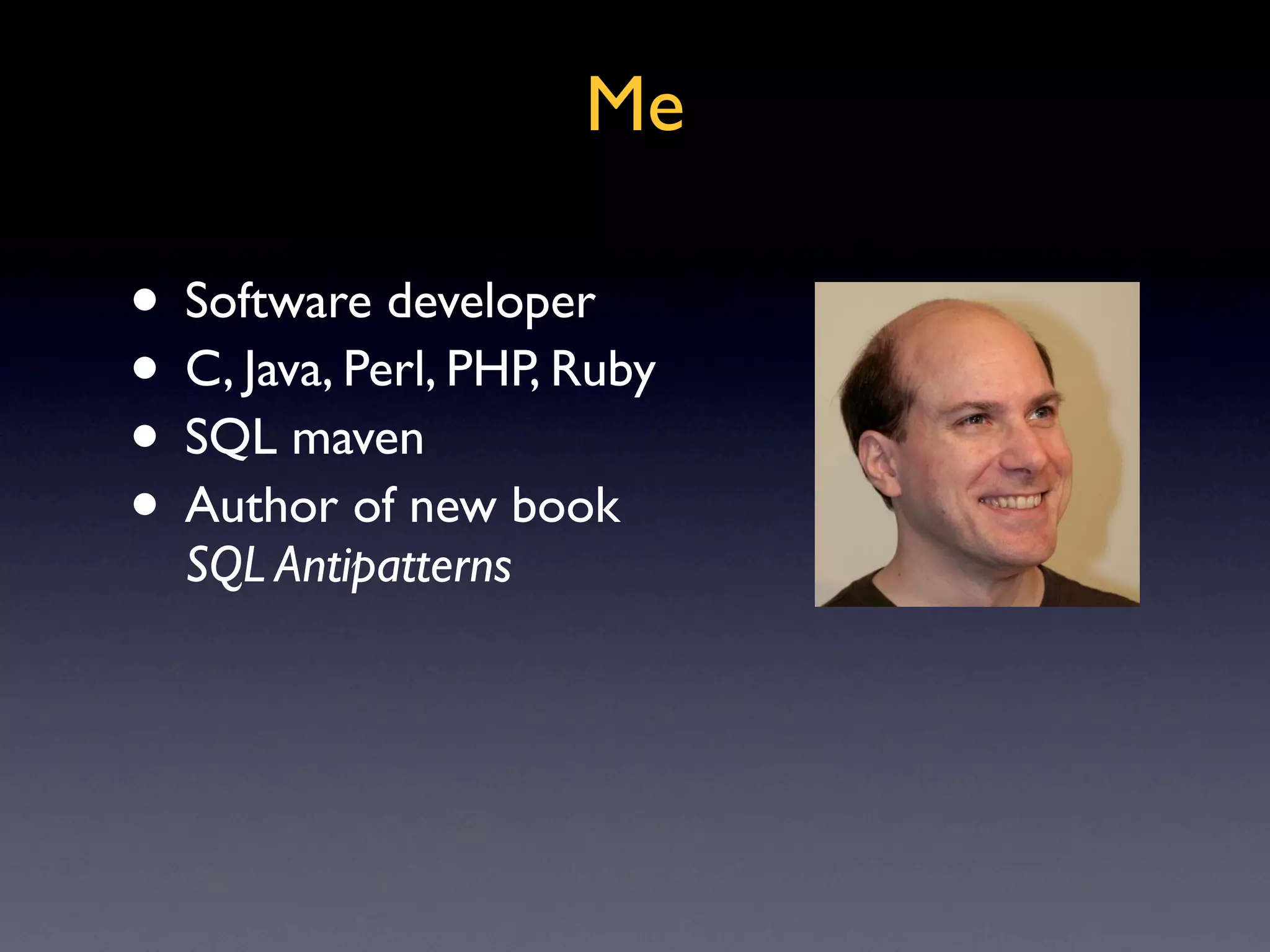
Me

• Software developer
• C, Java, Perl, PHP, Ruby
• SQL maven
• Author of new book
  SQL Antipatterns
“Whenever any result is sought, the
question will then arise—by what
course of calculation can these results
be arrived at by the machine in the
shortest time?”
           — Charles Babbage, Passages from the
                     Life of a Philosopher (1864)
Indexes
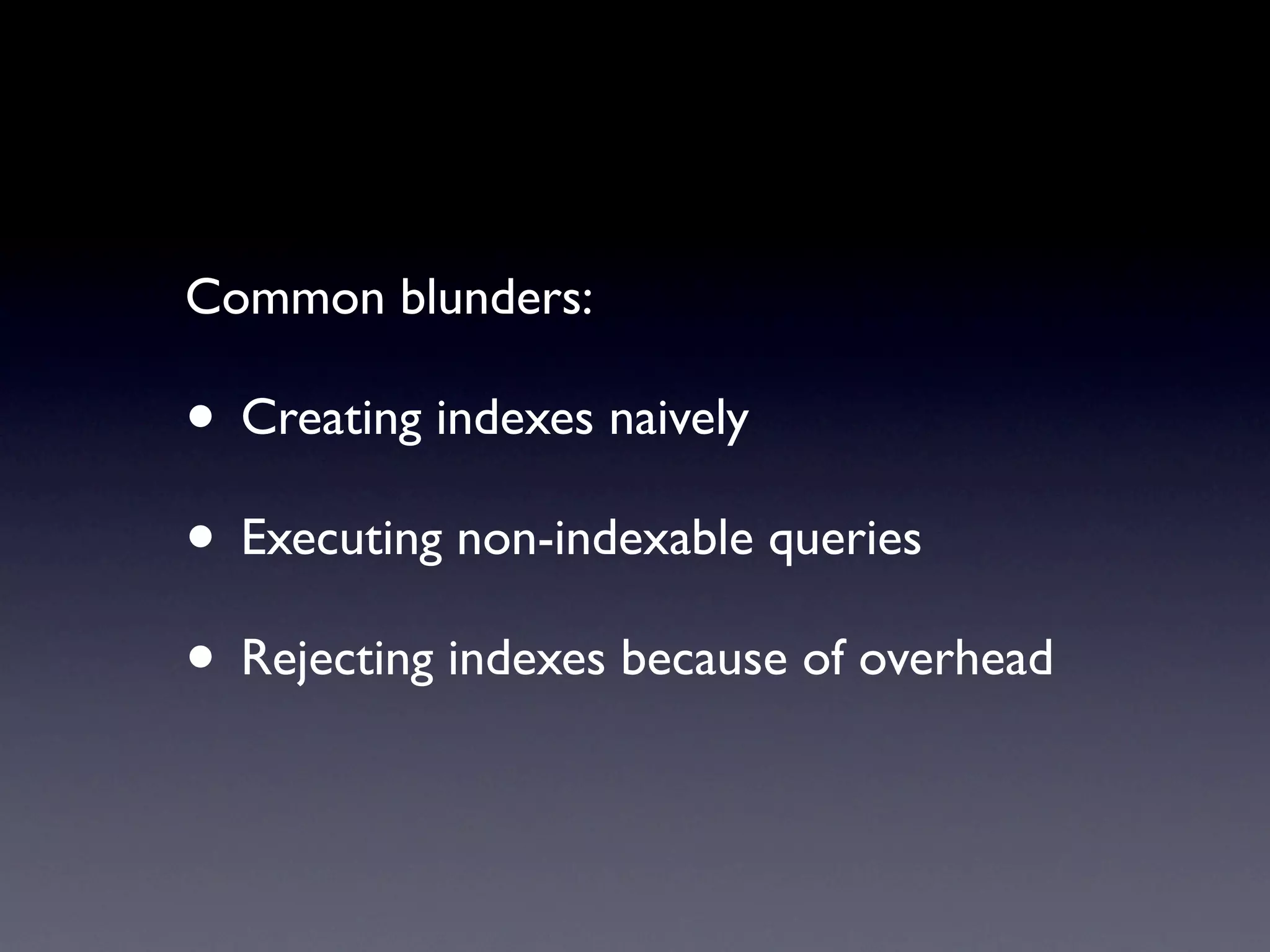
Common blunders:

• Creating indexes naively
• Executing non-indexable queries
• Rejecting indexes because of overhead
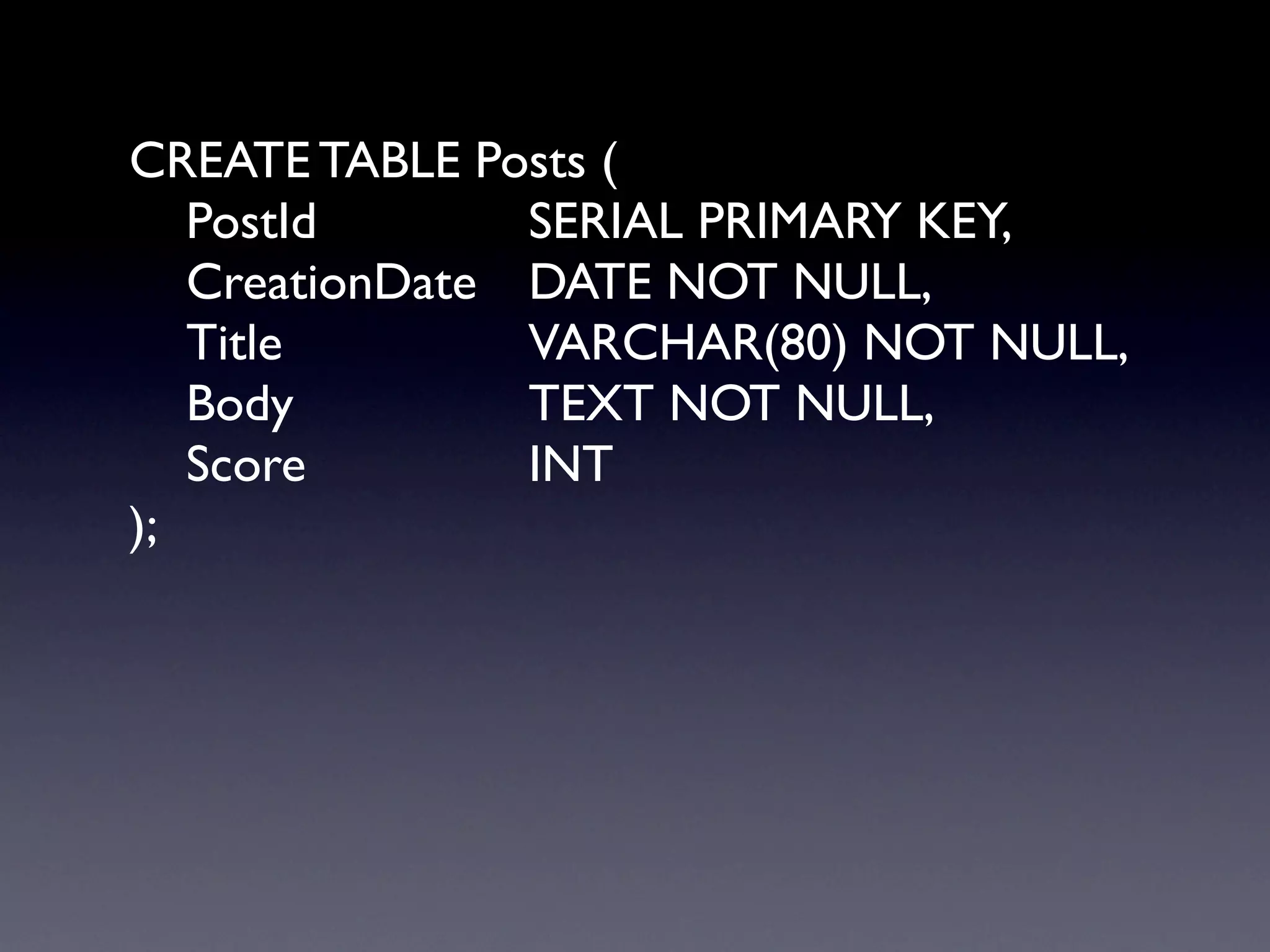
CREATE TABLE Posts (

 PostId


 SERIAL PRIMARY KEY,

 CreationDate
 DATE NOT NULL,

 Title


 VARCHAR(80) NOT NULL,

 Body


 TEXT NOT NULL,

 Score


 INT
);
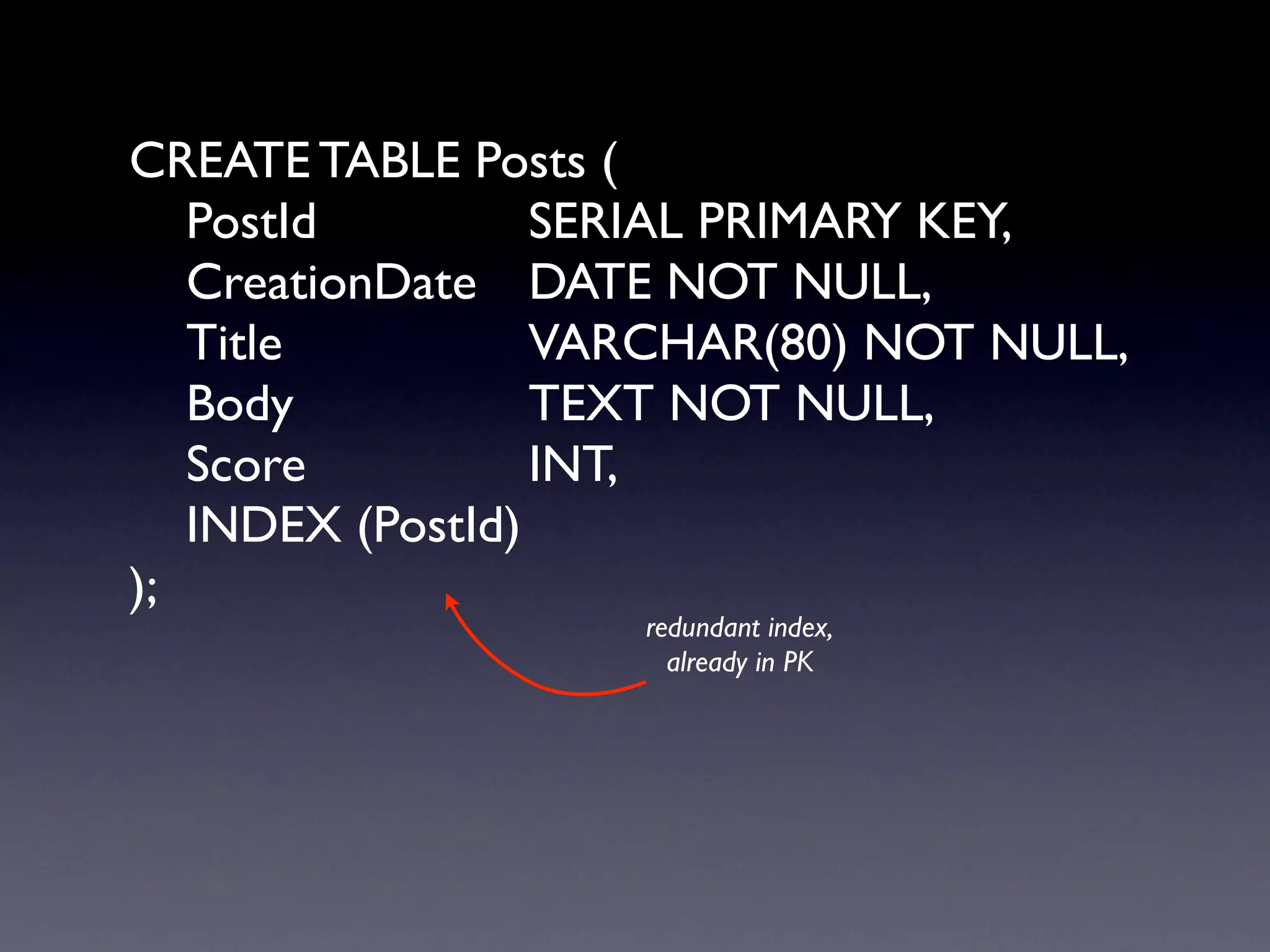
CREATE TABLE Posts (

 PostId


 SERIAL PRIMARY KEY,

 CreationDate
 DATE NOT NULL,

 Title


 VARCHAR(80) NOT NULL,

 Body


 TEXT NOT NULL,

 Score


 INT,

 INDEX (PostId)
);
                   redundant index,
                     already in PK
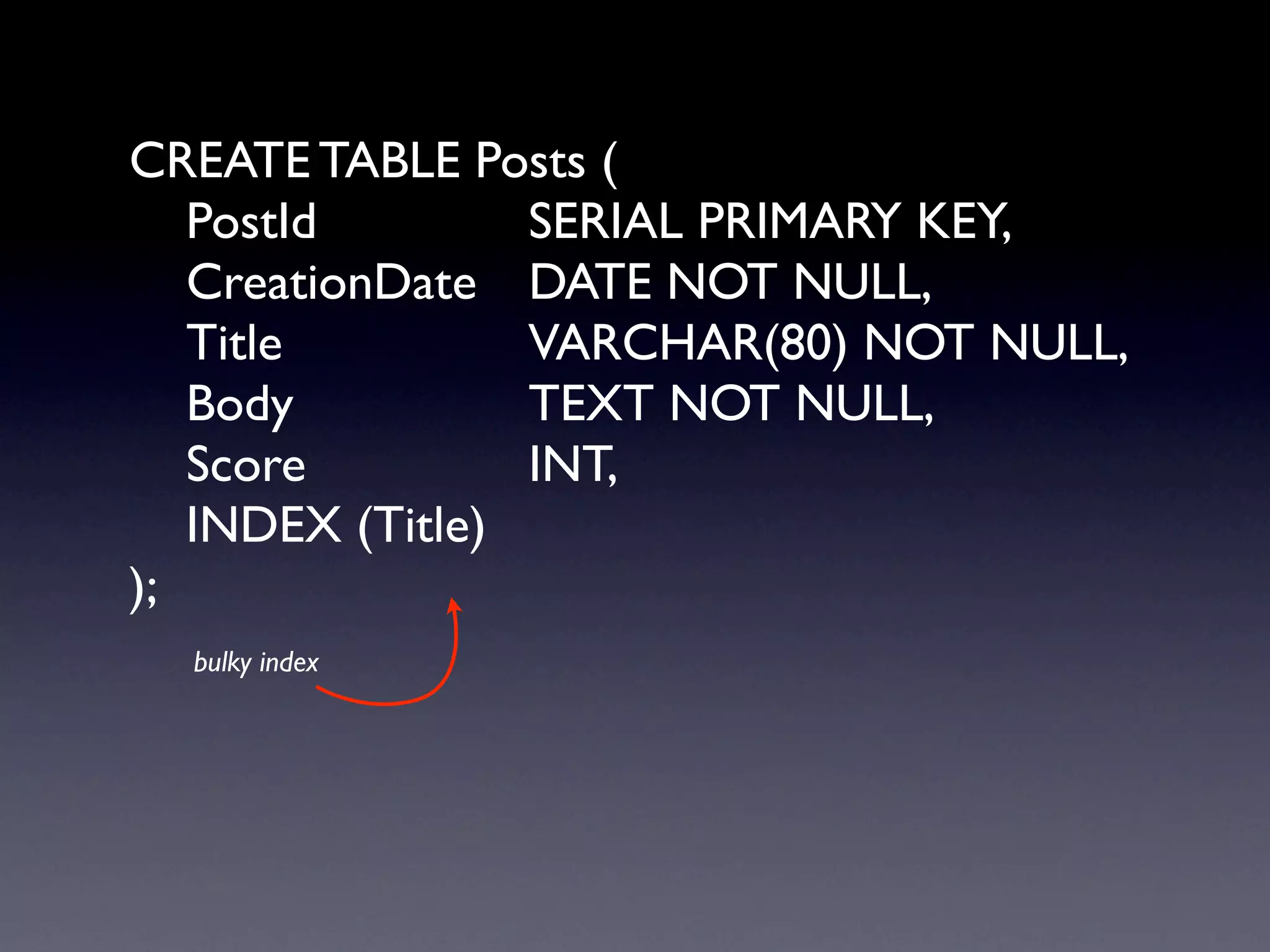
CREATE TABLE Posts (

 PostId


 SERIAL PRIMARY KEY,

 CreationDate
 DATE NOT NULL,

 Title


 VARCHAR(80) NOT NULL,

 Body


 TEXT NOT NULL,

 Score


 INT,

 INDEX (Title)
);
  bulky index
CREATE TABLE Posts (

 PostId


 SERIAL PRIMARY KEY,

 CreationDate
 DATE NOT NULL,

 Title


 VARCHAR(80) NOT NULL,

 Body


 TEXT NOT NULL,

 Score


 INT,

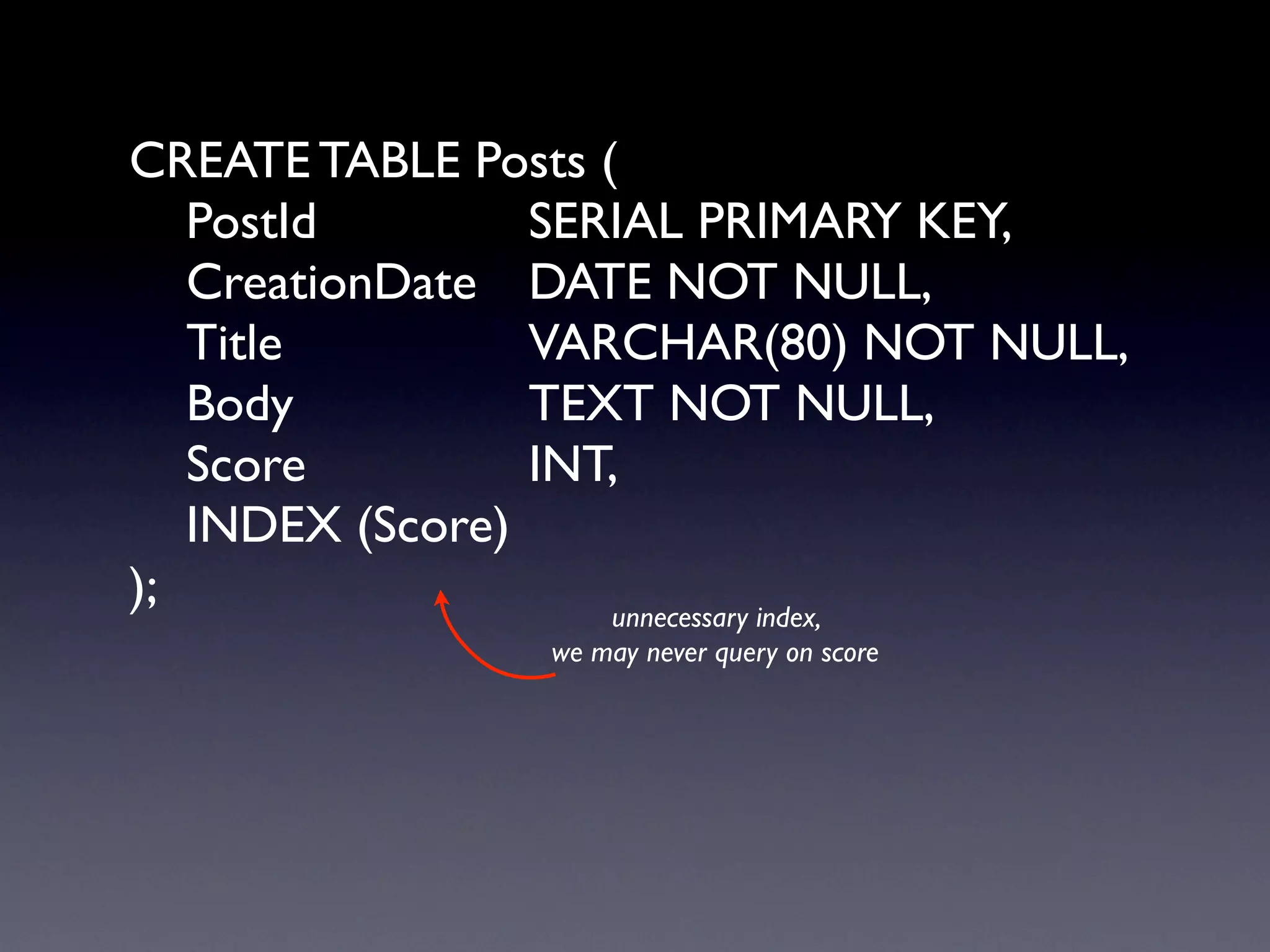
 INDEX (Score)
);                  unnecessary index,
                we may never query on score
CREATE TABLE Posts (

 PostId


 SERIAL PRIMARY KEY,

 CreationDate
 DATE NOT NULL,

 Title


 VARCHAR(80) NOT NULL,

 Body


 TEXT NOT NULL,

 Score


 INT,

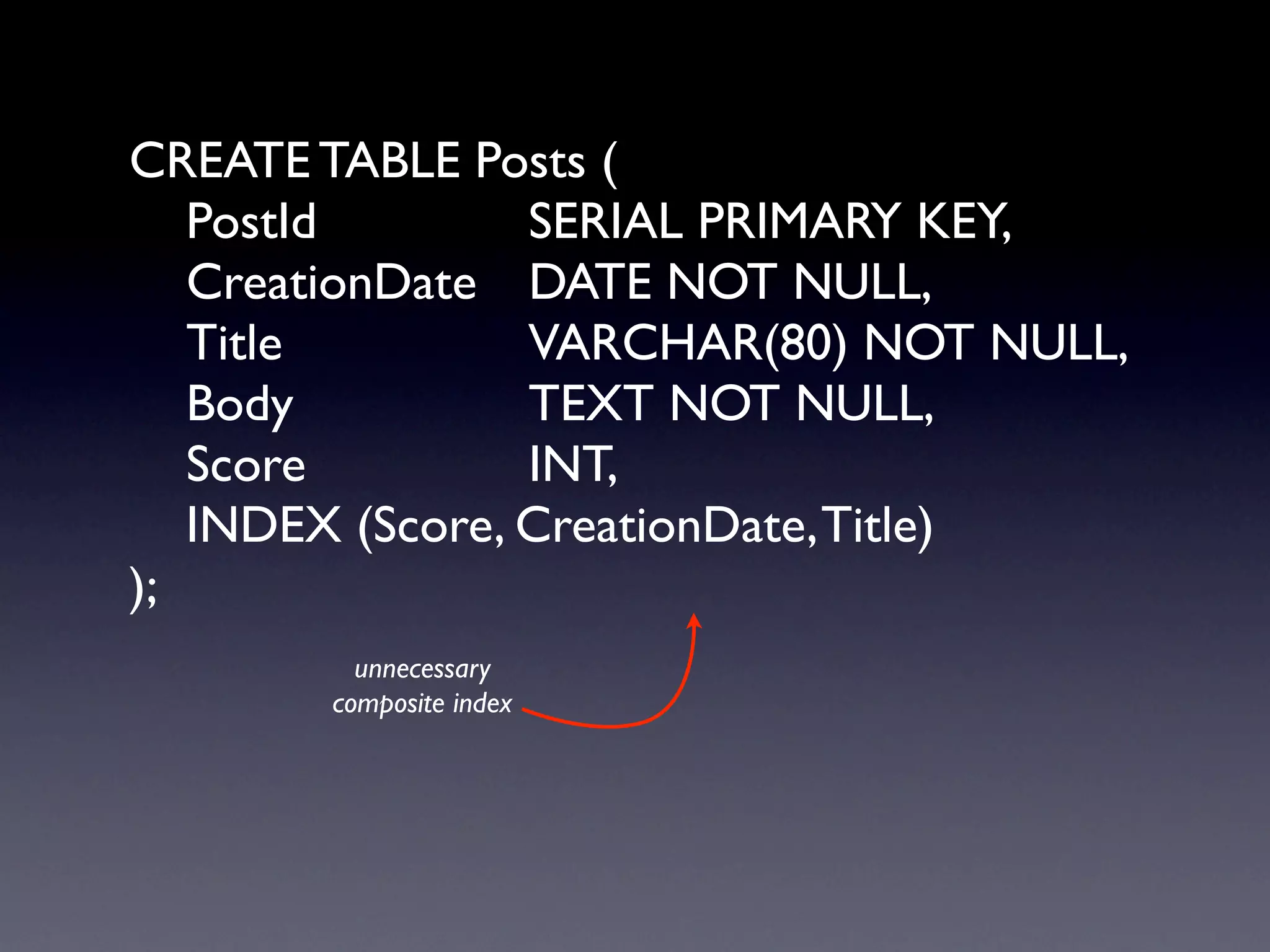
 INDEX (Score, CreationDate, Title)
);
         unnecessary
       composite index
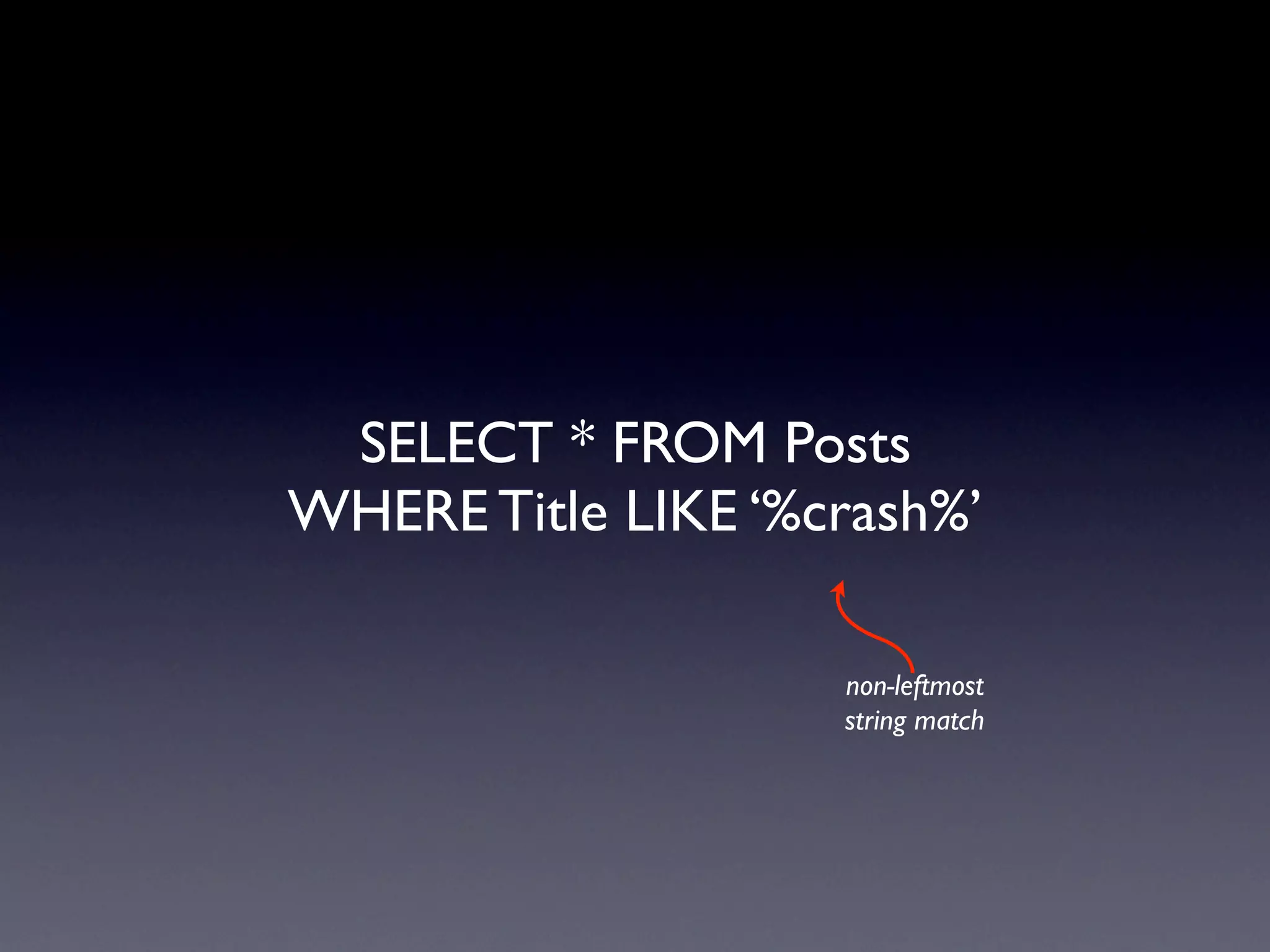
SELECT * FROM Posts
WHERE Title LIKE ‘%crash%’

                    non-leftmost
                    string match
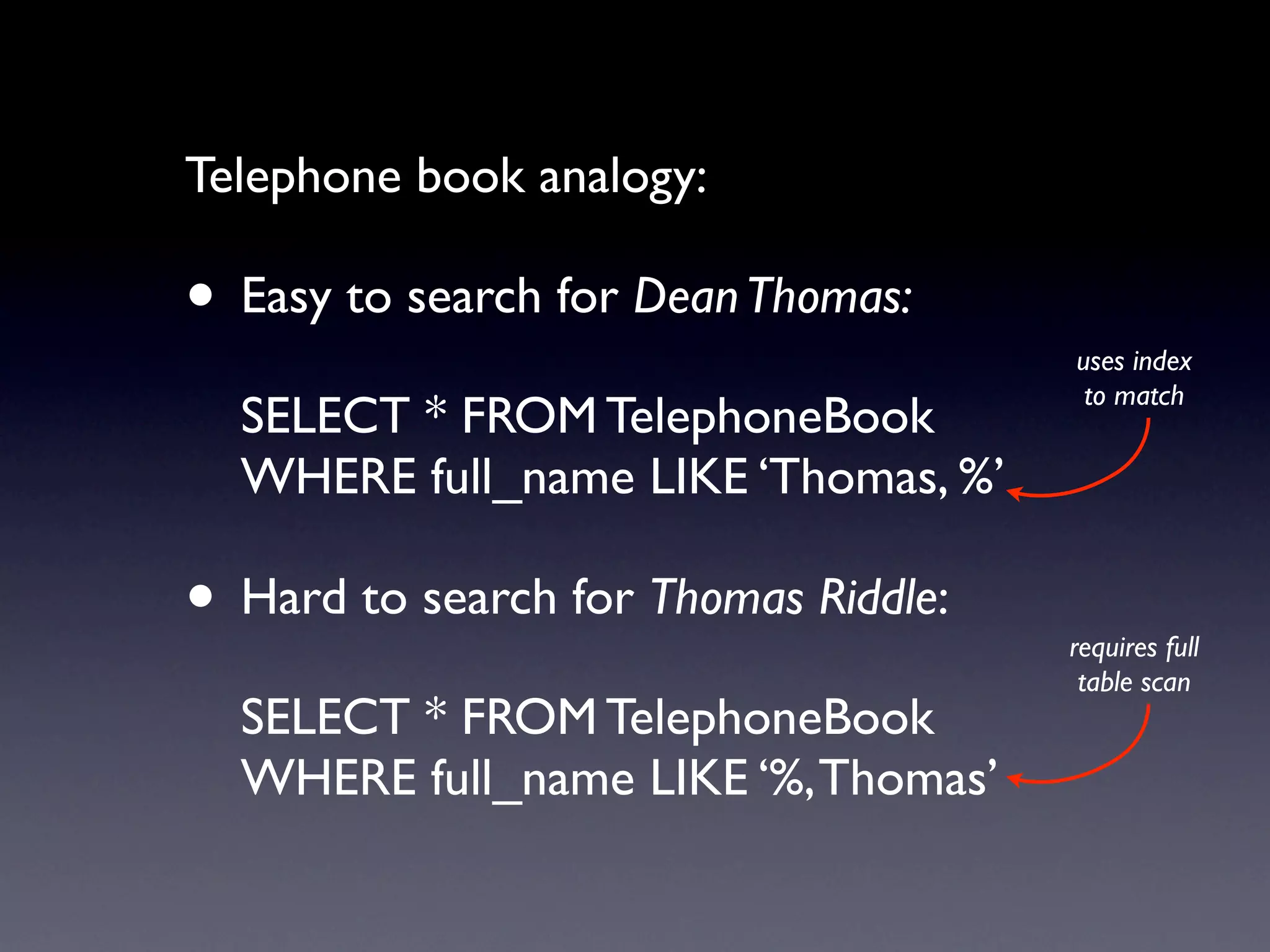
Telephone book analogy:

• Easy to search for Dean Thomas:
                                      uses index
                                       to match
  SELECT * FROM TelephoneBook
  WHERE full_name LIKE ‘Thomas, %’

• Hard to search for Thomas Riddle:   requires full
                                       table scan
  SELECT * FROM TelephoneBook
  WHERE full_name LIKE ‘%, Thomas’
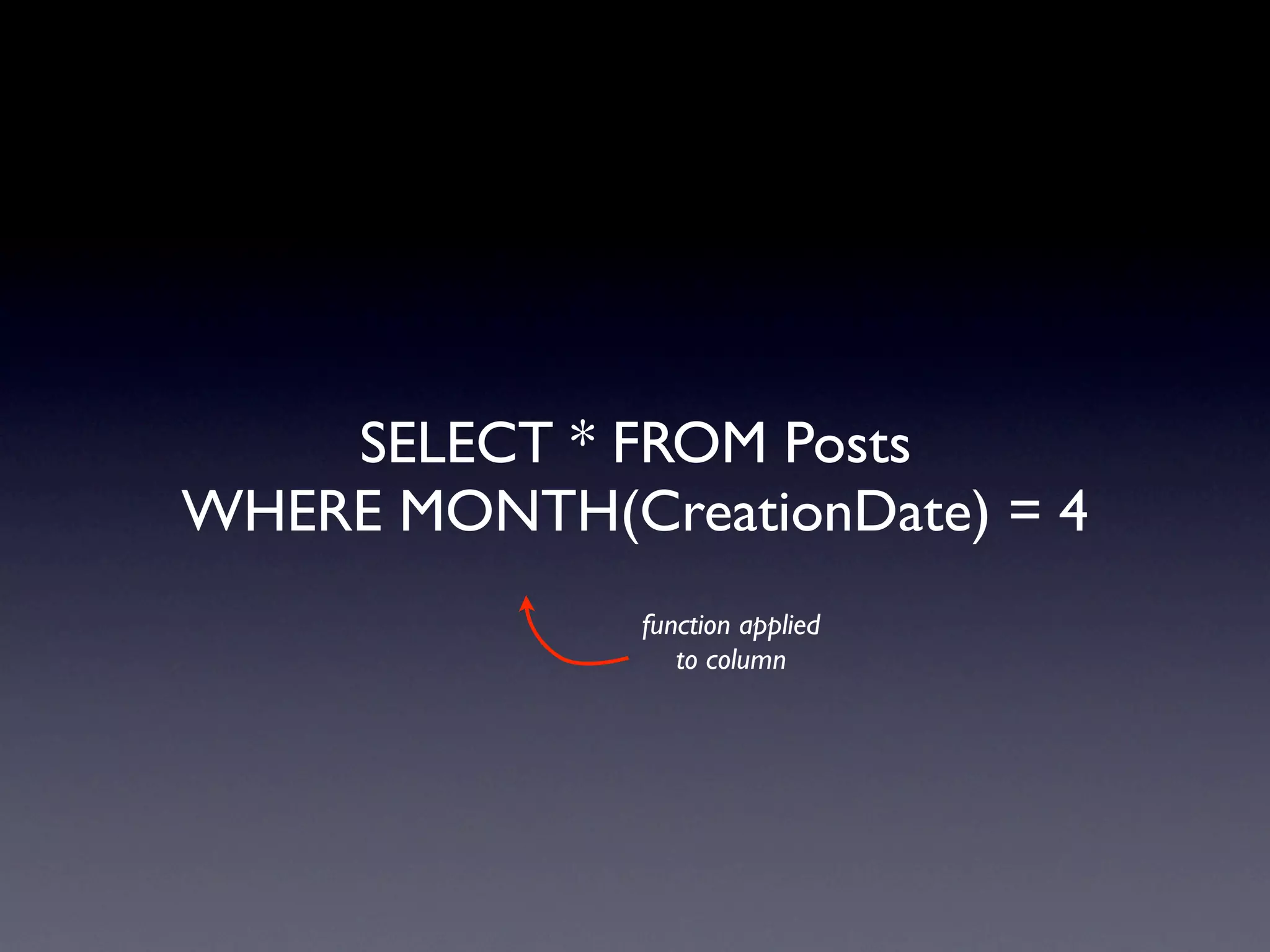
SELECT * FROM Posts
WHERE MONTH(CreationDate) = 4
              function applied
                 to column
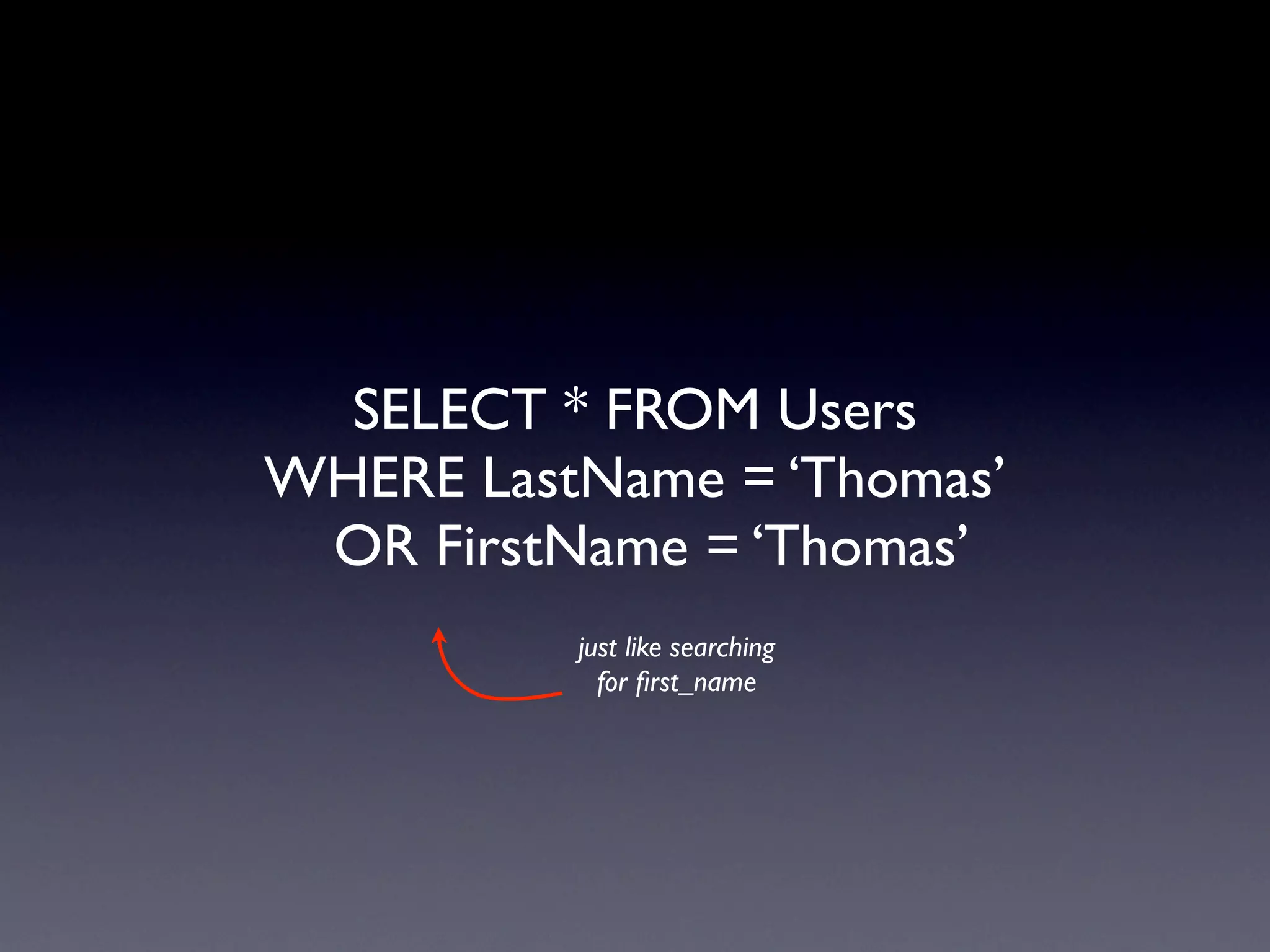
SELECT * FROM Users
WHERE LastName = ‘Thomas’
 OR FirstName = ‘Thomas’
          just like searching
            for first_name
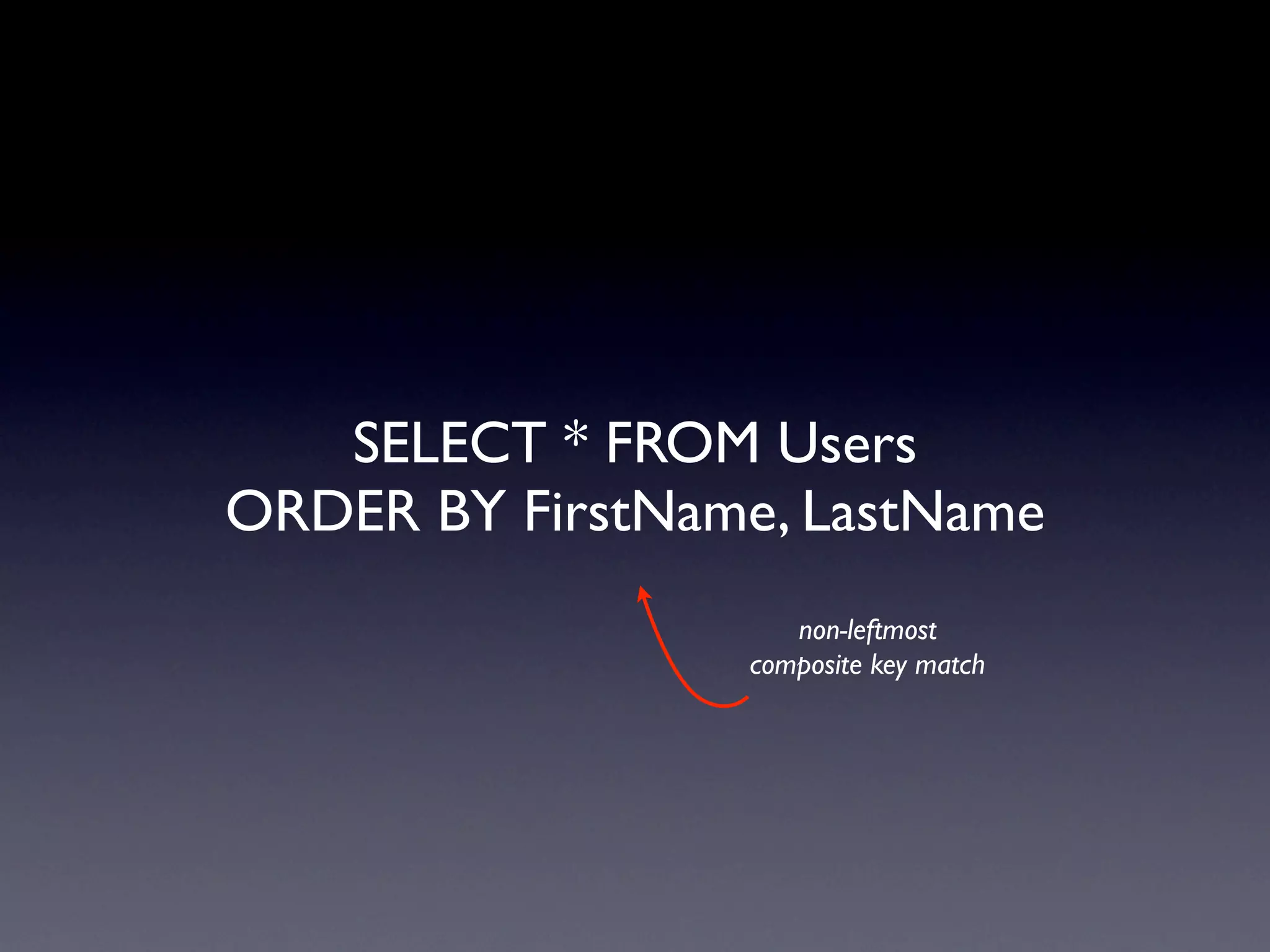
SELECT * FROM Users
ORDER BY FirstName, LastName
                    non-leftmost
                 composite key match
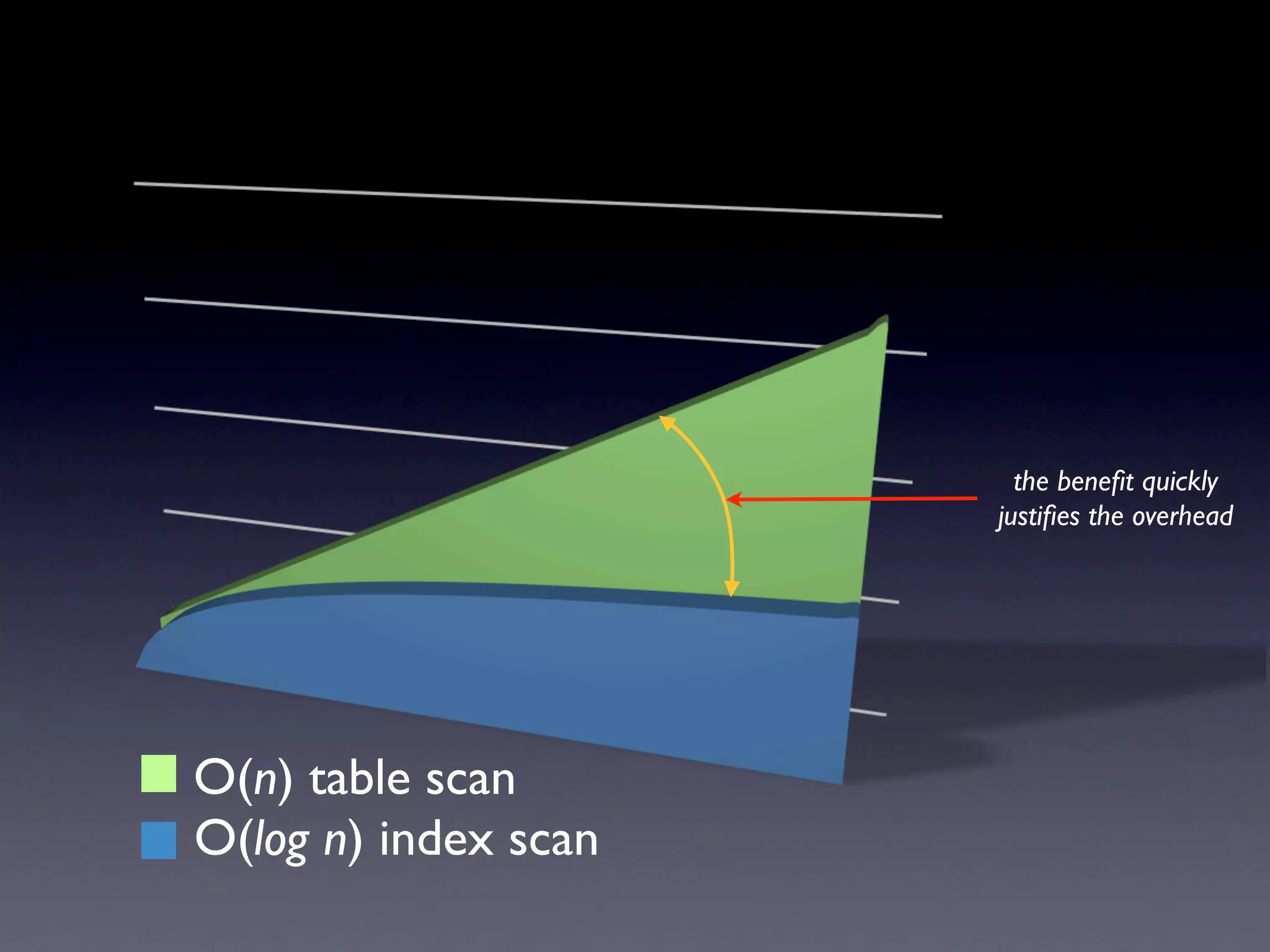
the benefit quickly
                      justifies the overhead


O(n) table scan
O(log n) index scan
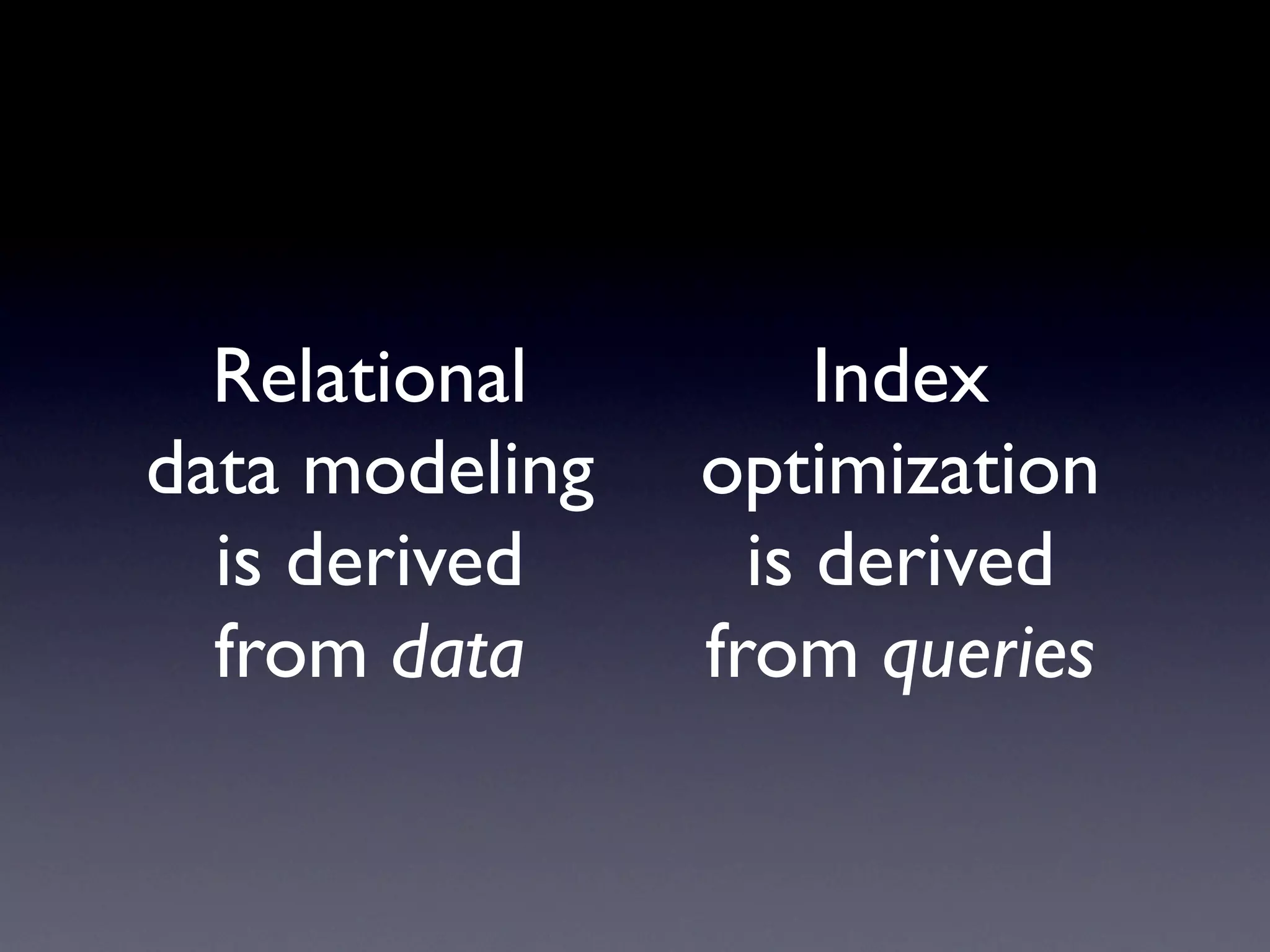
Relational         Index
data modeling   optimization
  is derived      is derived
  from data     from queries
MENTOR Your
  Indexes
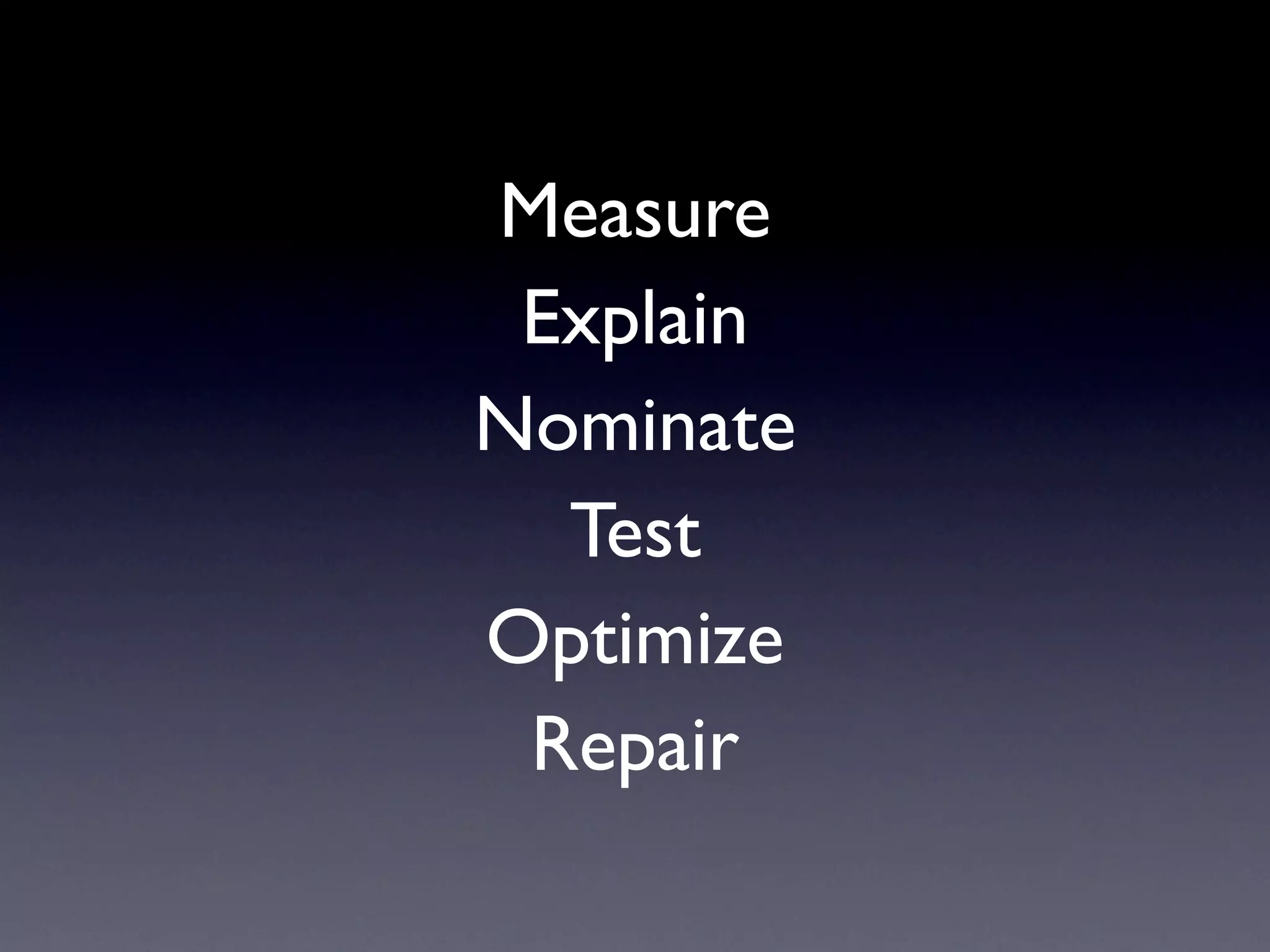
Measure
 Explain
Nominate
  Test
Optimize
 Repair
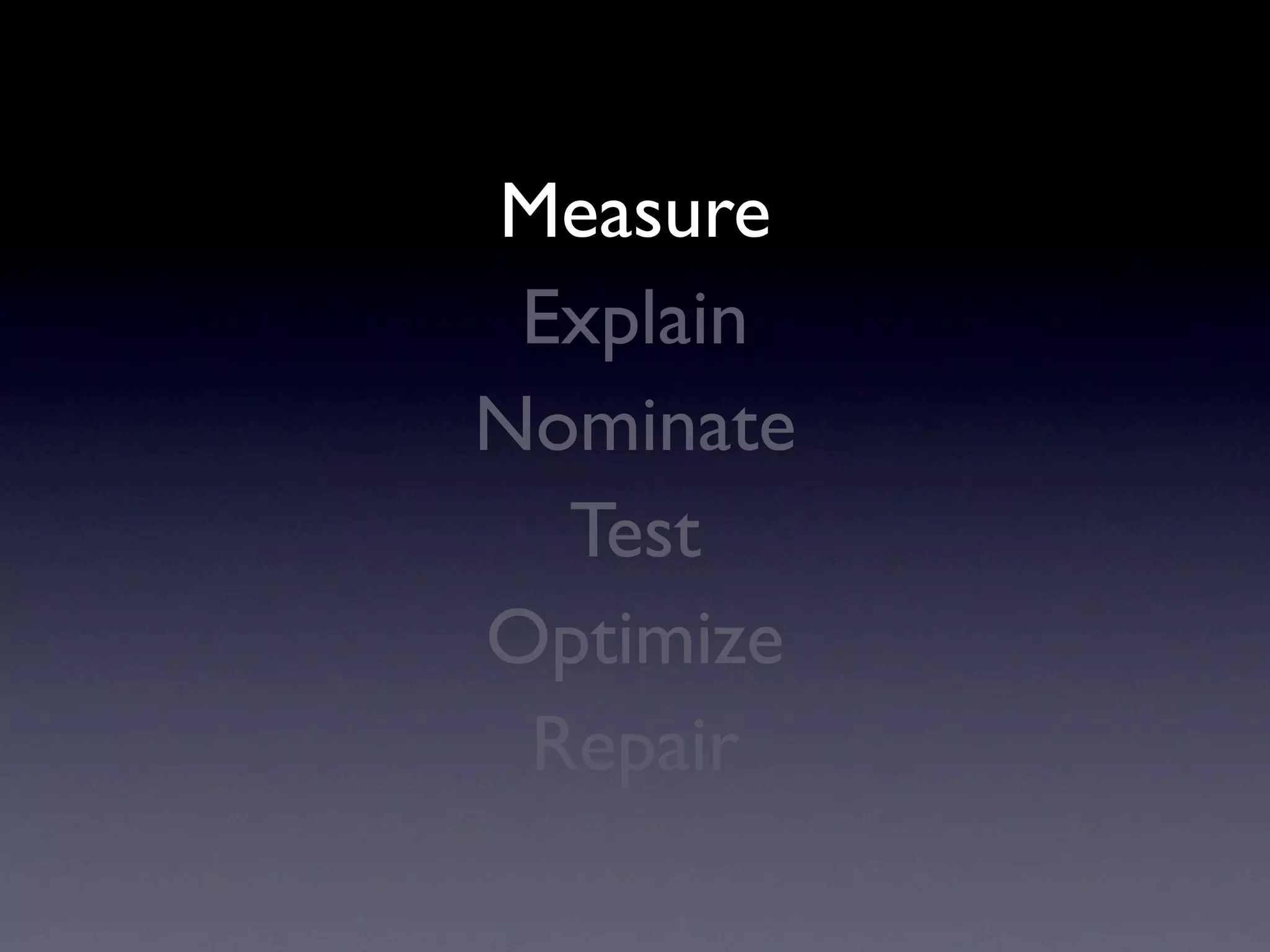
Measure
 Explain
Nominate
  Test
Optimize
 Repair
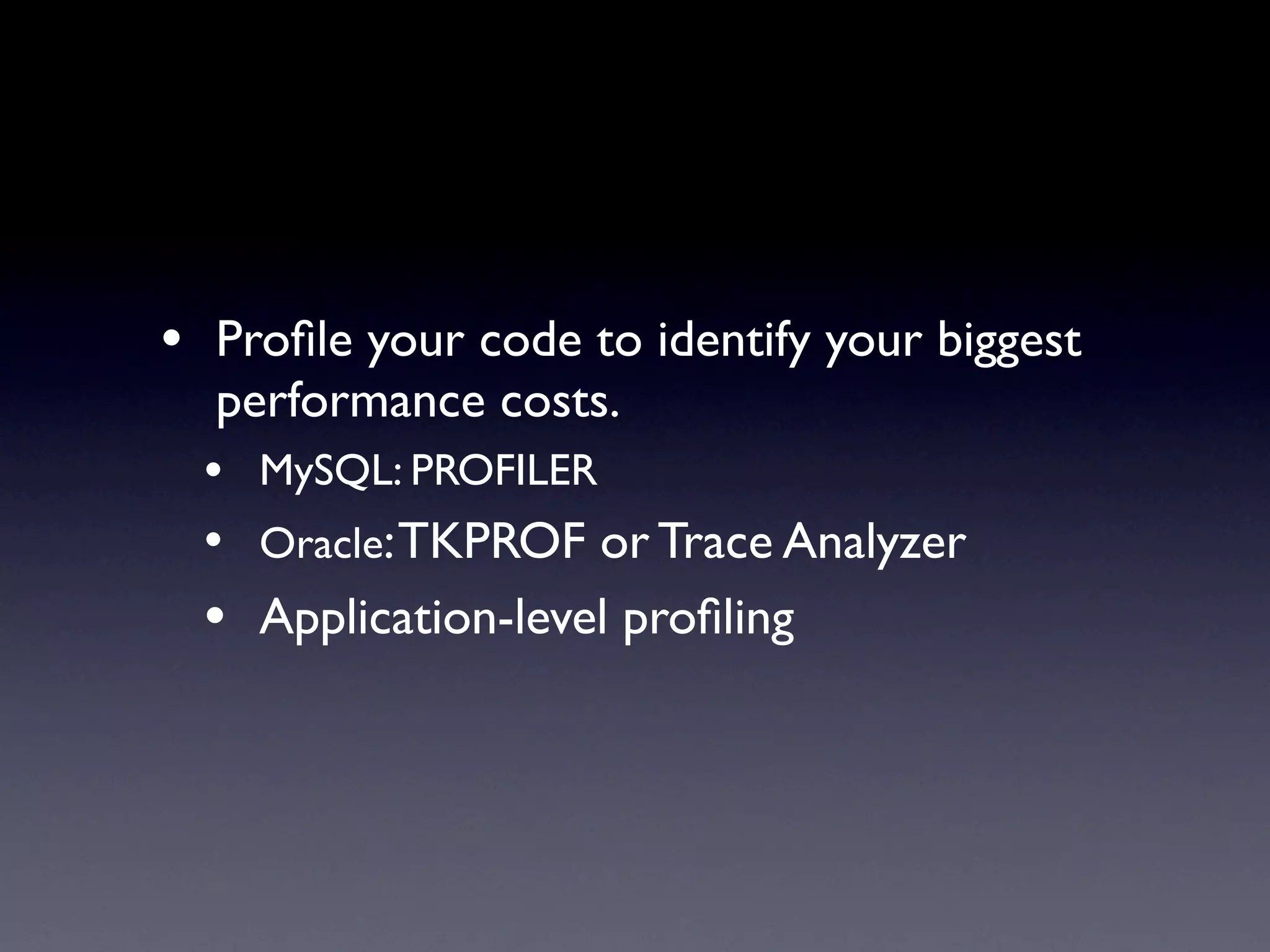
• Profile your code to identify your biggest
  performance costs.
  • MySQL: PROFILER
  • Oracle: TKPROF or Trace Analyzer
  • Application-level profiling
Measure
 Explain
Nominate
  Test
Optimize
 Repair
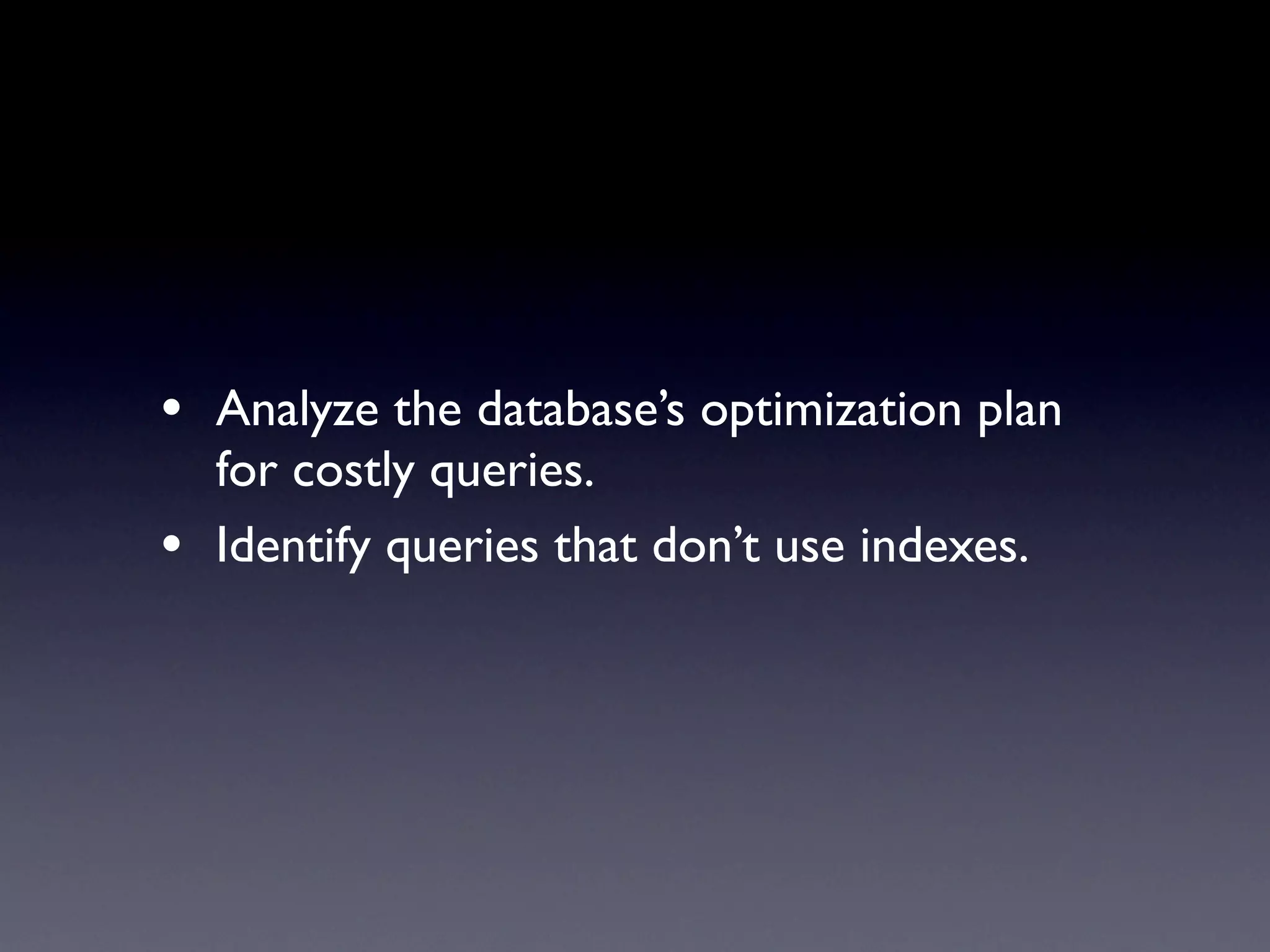
• Analyze the database’s optimization plan
    for costly queries.
•   Identify queries that don’t use indexes.
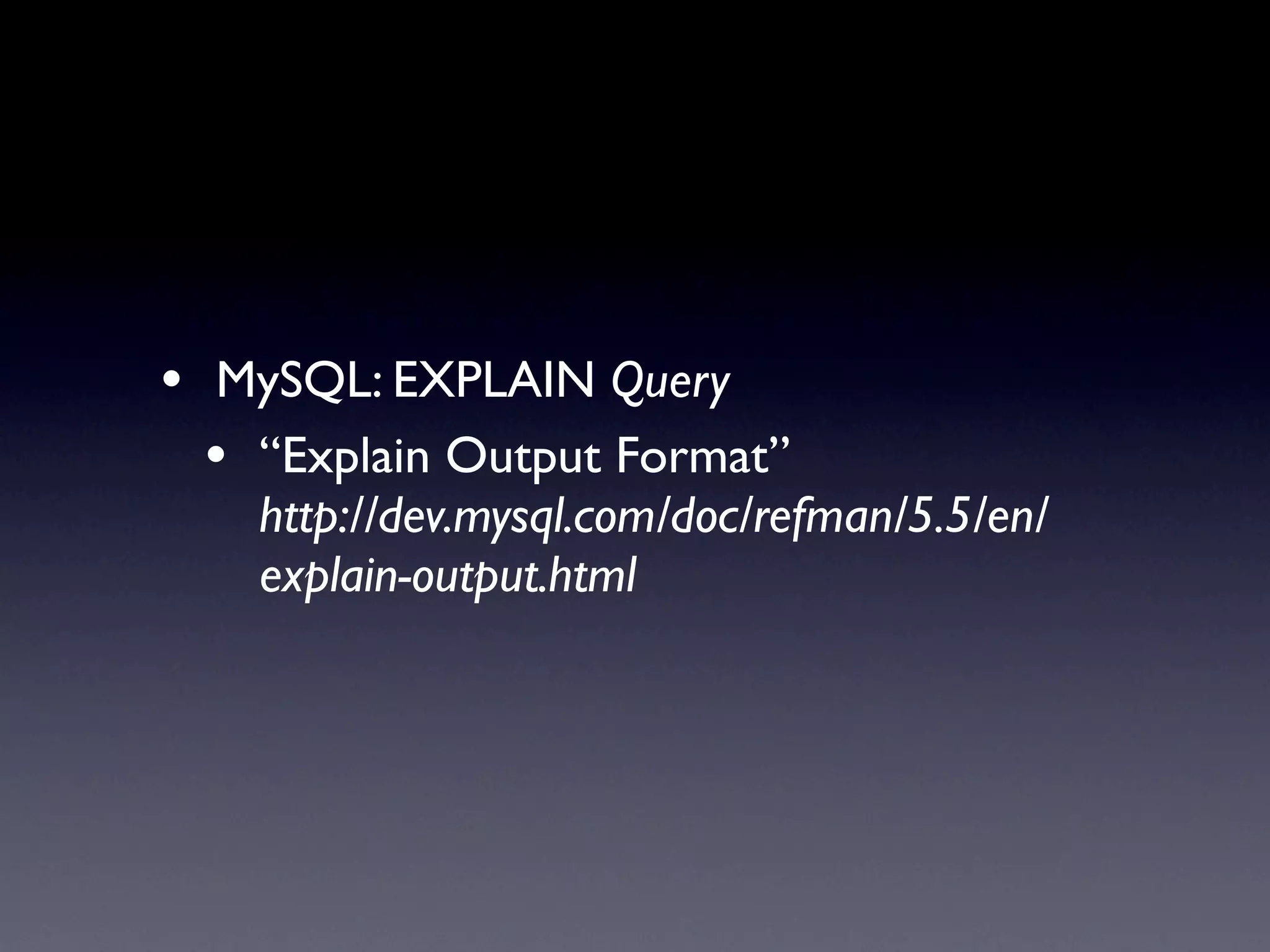
• MySQL: EXPLAIN Query
  • “Explain Output Format”
    http://dev.mysql.com/doc/refman/5.5/en/
    explain-output.html
• Oracle: EXPLAIN PLAN Query
  • “Understanding Explain Plan”
    http://www.orafaq.com/node/1420
Measure
 Explain
Nominate
  Test
Optimize
 Repair
• Which queries need optimization?
  • Frequently used queries
  • Very slow queries
  • Reports
• Which column(s) need indexes?
  • WHERE conditions
  • JOIN conditions
  • ORDER BY criteria
  • MIN() / MAX()
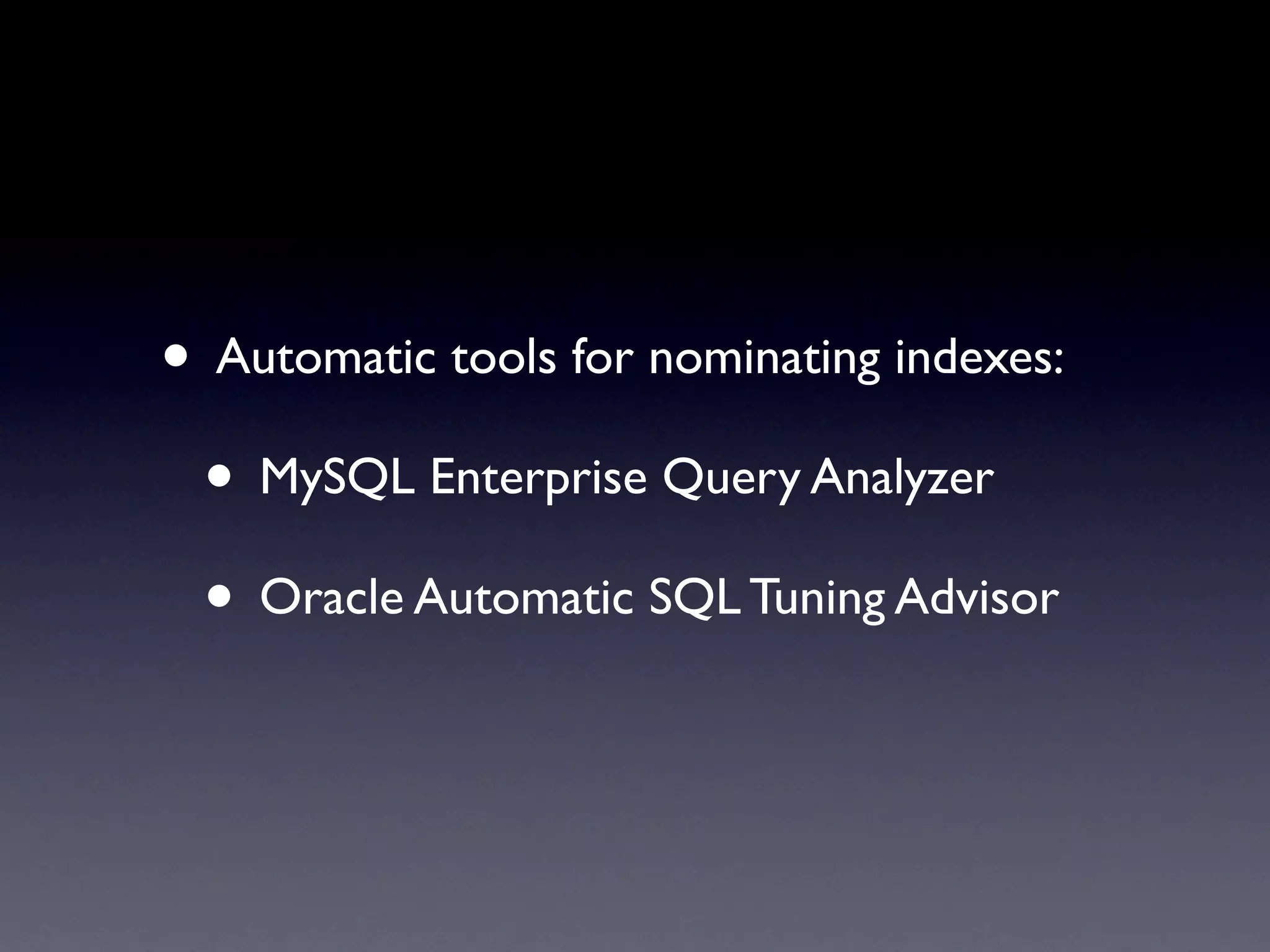
• Automatic tools for nominating indexes:
 • MySQL Enterprise Query Analyzer
 • Oracle Automatic SQL Tuning Advisor
Measure
 Explain
Nominate
  Test
Optimize
 Repair
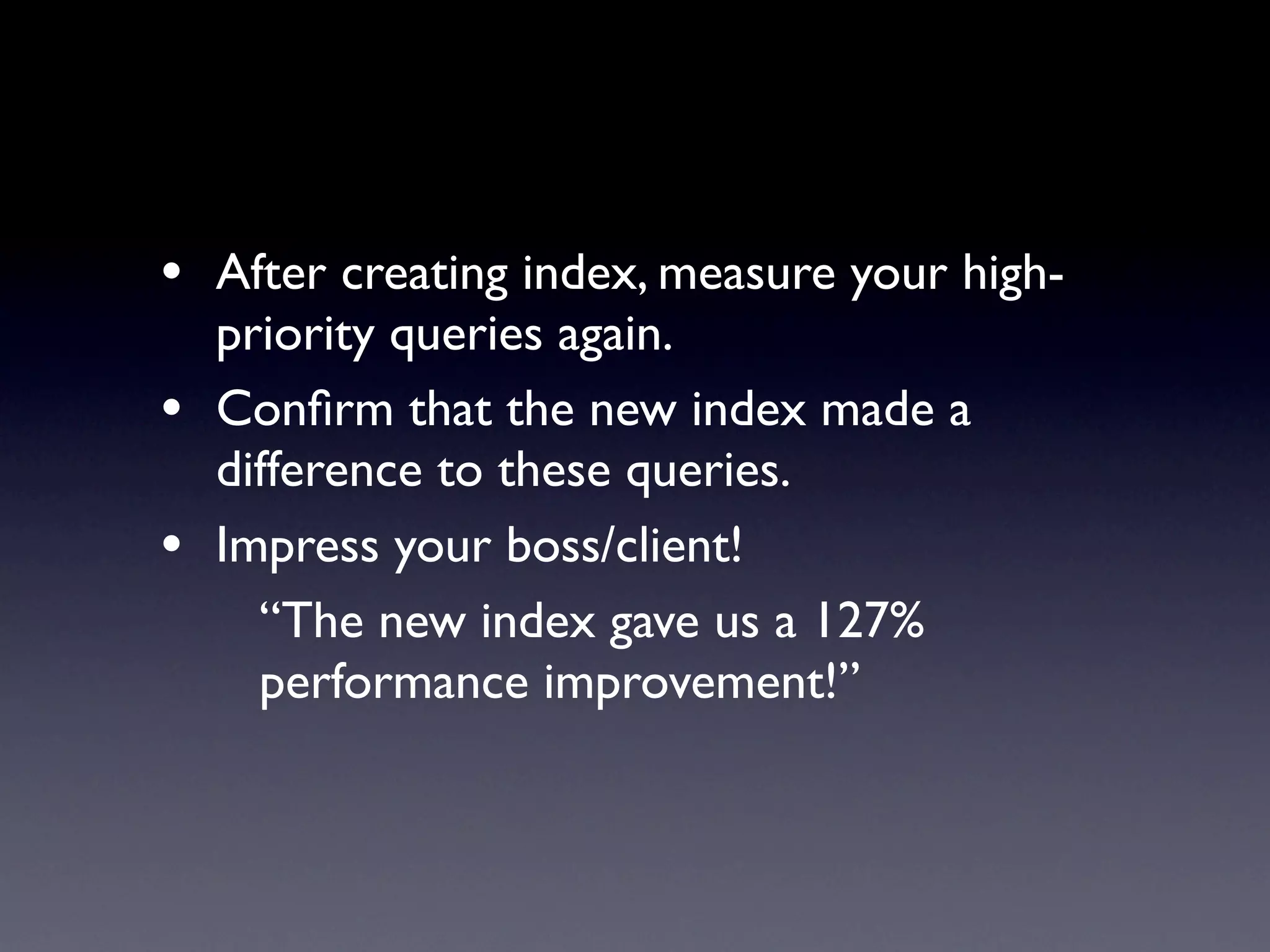
• After creating index, measure your high-
    priority queries again.
•   Confirm that the new index made a
    difference to these queries.
•   Impress your boss/client!
      “The new index gave us a 127%
      performance improvement!”
Measure
 Explain
Nominate
  Test
Optimize
 Repair
• Indexes are compact, frequently-used data
    structures.
•   Try to cache indexes in memory.
• Cache indexes in MySQL/InnoDB:
 • Increase innodb_buffer_pool_size
 • Used for both data and indexes
• Cache indexes in MySQL/MyISAM:
  • Increase key_buffer_size
  • LOAD INDEX INTO CACHE TableName
    [INDEX IndexName];
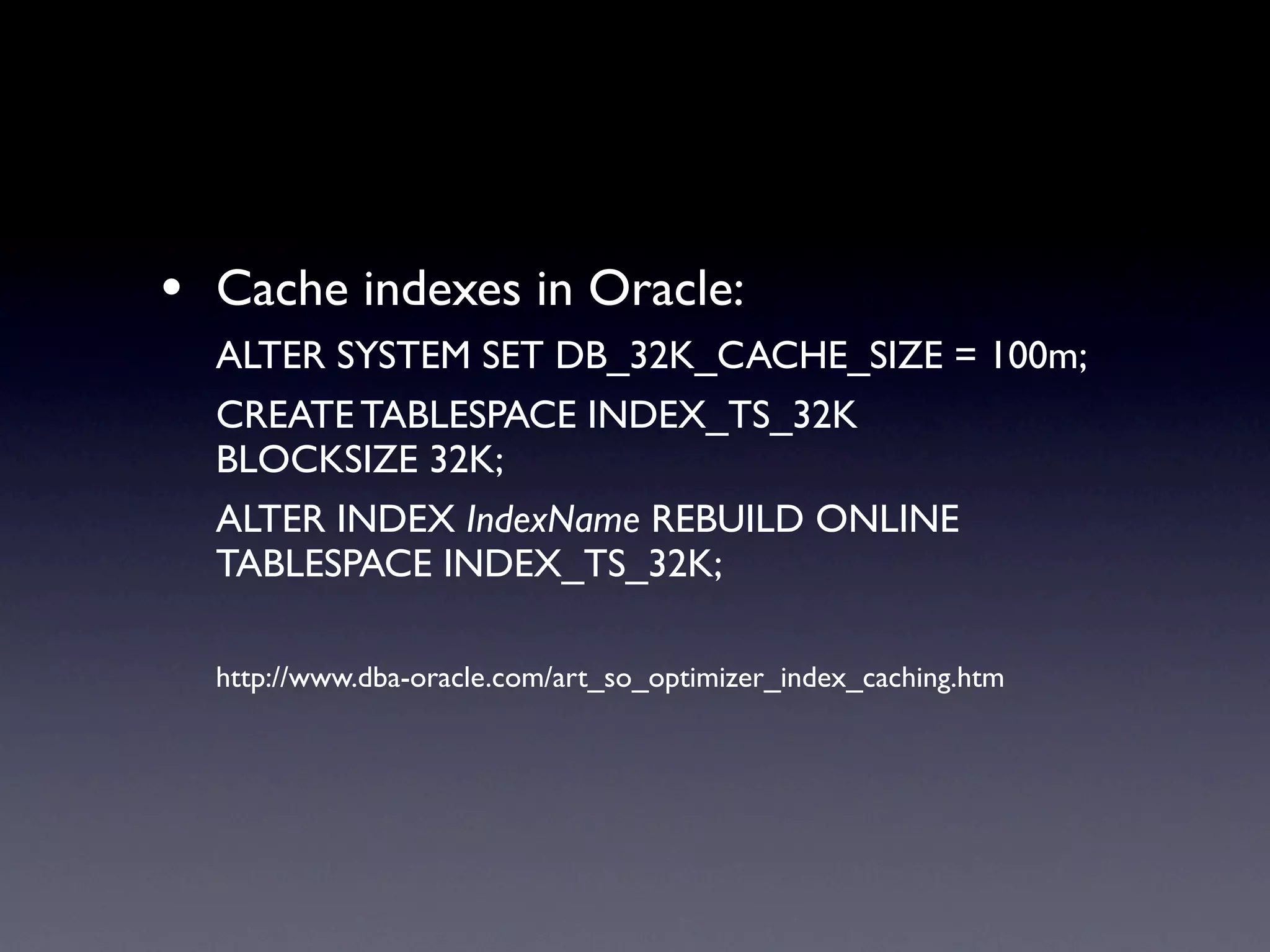
• Cache indexes in Oracle:
  ALTER SYSTEM SET DB_32K_CACHE_SIZE = 100m;
  CREATE TABLESPACE INDEX_TS_32K
  BLOCKSIZE 32K;
  ALTER INDEX IndexName REBUILD ONLINE
  TABLESPACE INDEX_TS_32K;

  http://www.dba-oracle.com/art_so_optimizer_index_caching.htm
Measure
 Explain
Nominate
  Test
Optimize
 Repair
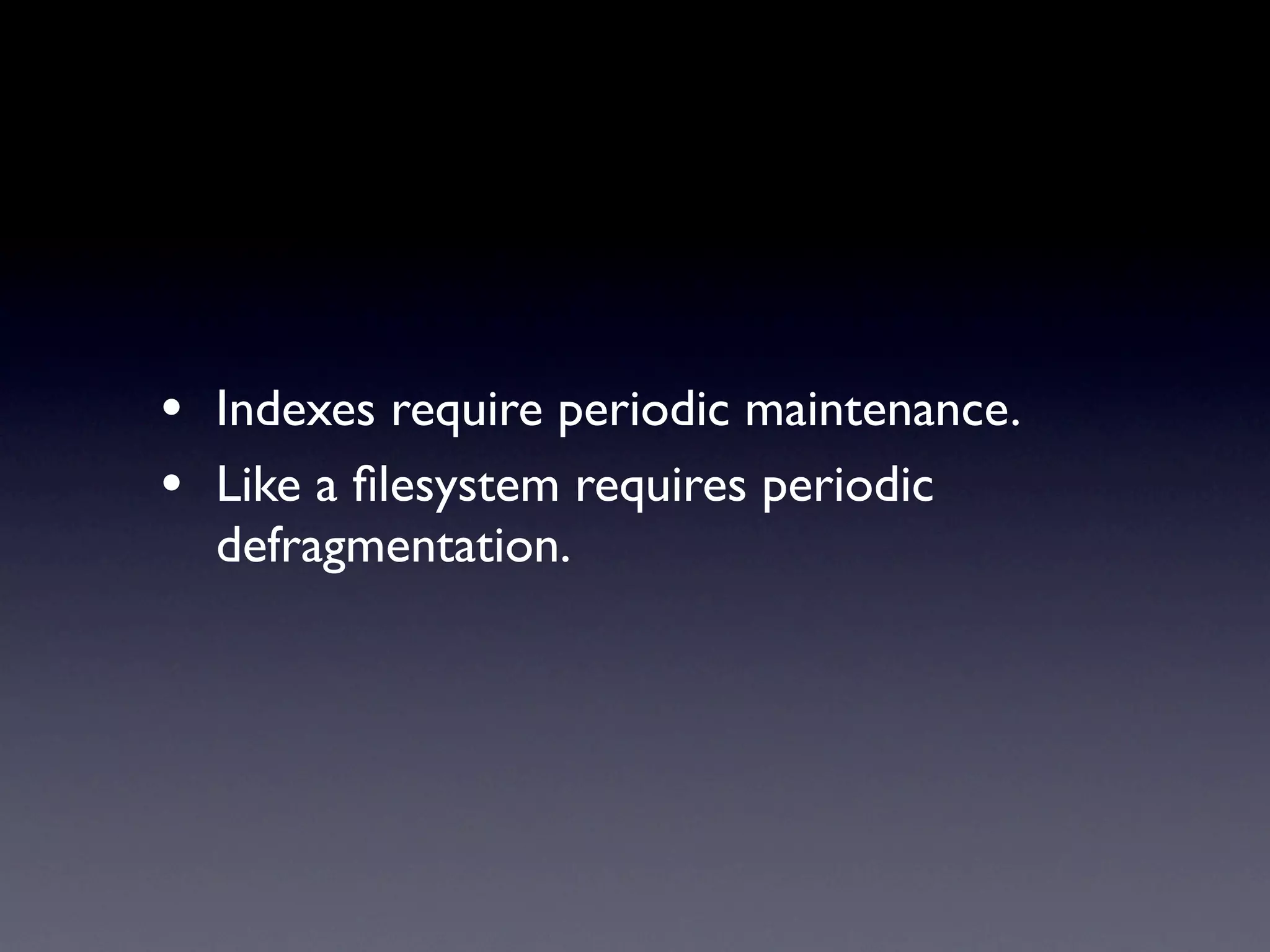
• Indexes require periodic maintenance.
• Like a filesystem requires periodic
  defragmentation.
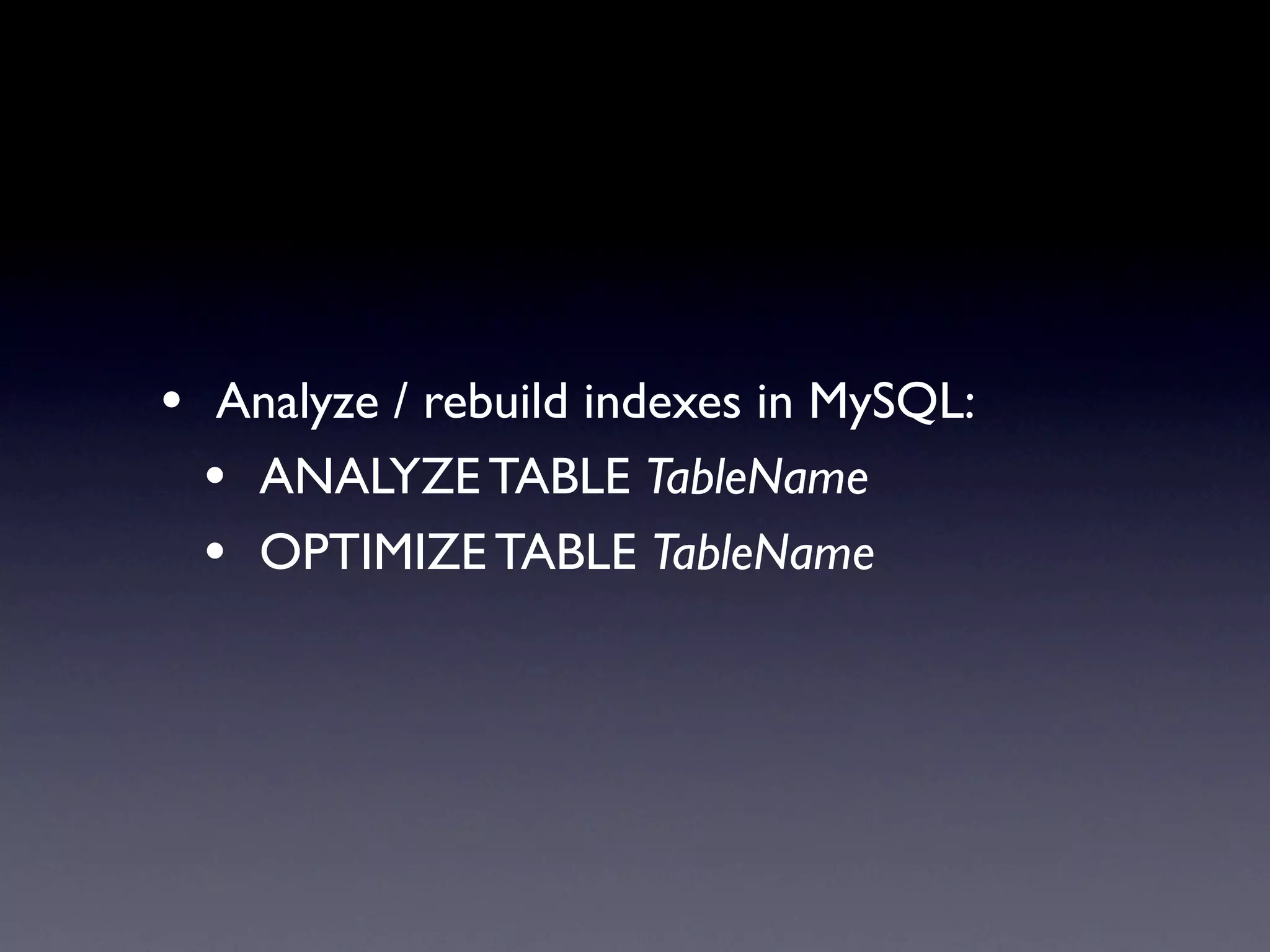
• Analyze / rebuild indexes in MySQL:
  • ANALYZE TABLE TableName
  • OPTIMIZE TABLE TableName
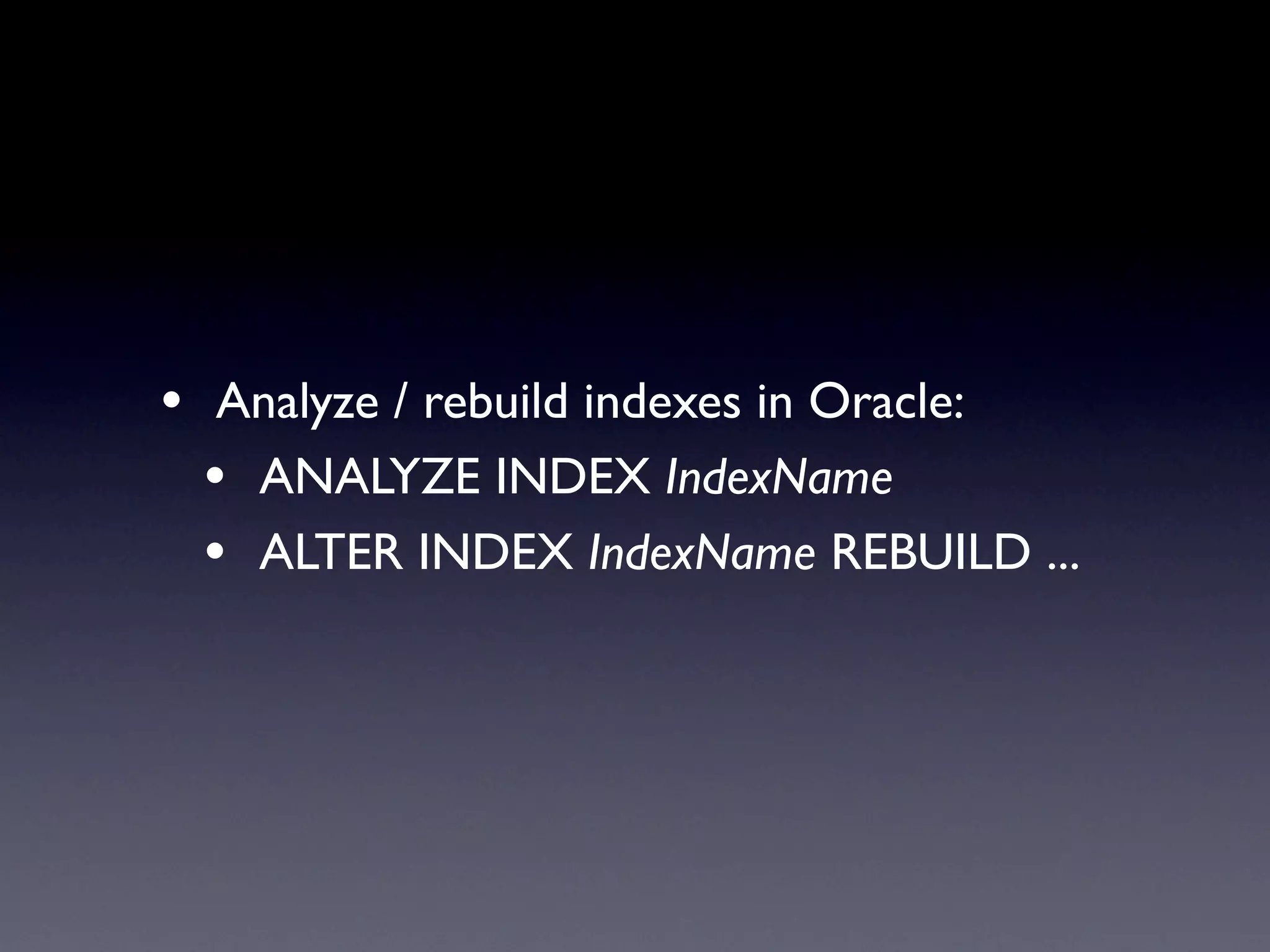
• Analyze / rebuild indexes in Oracle:
  • ANALYZE INDEX IndexName
  • ALTER INDEX IndexName REBUILD ...
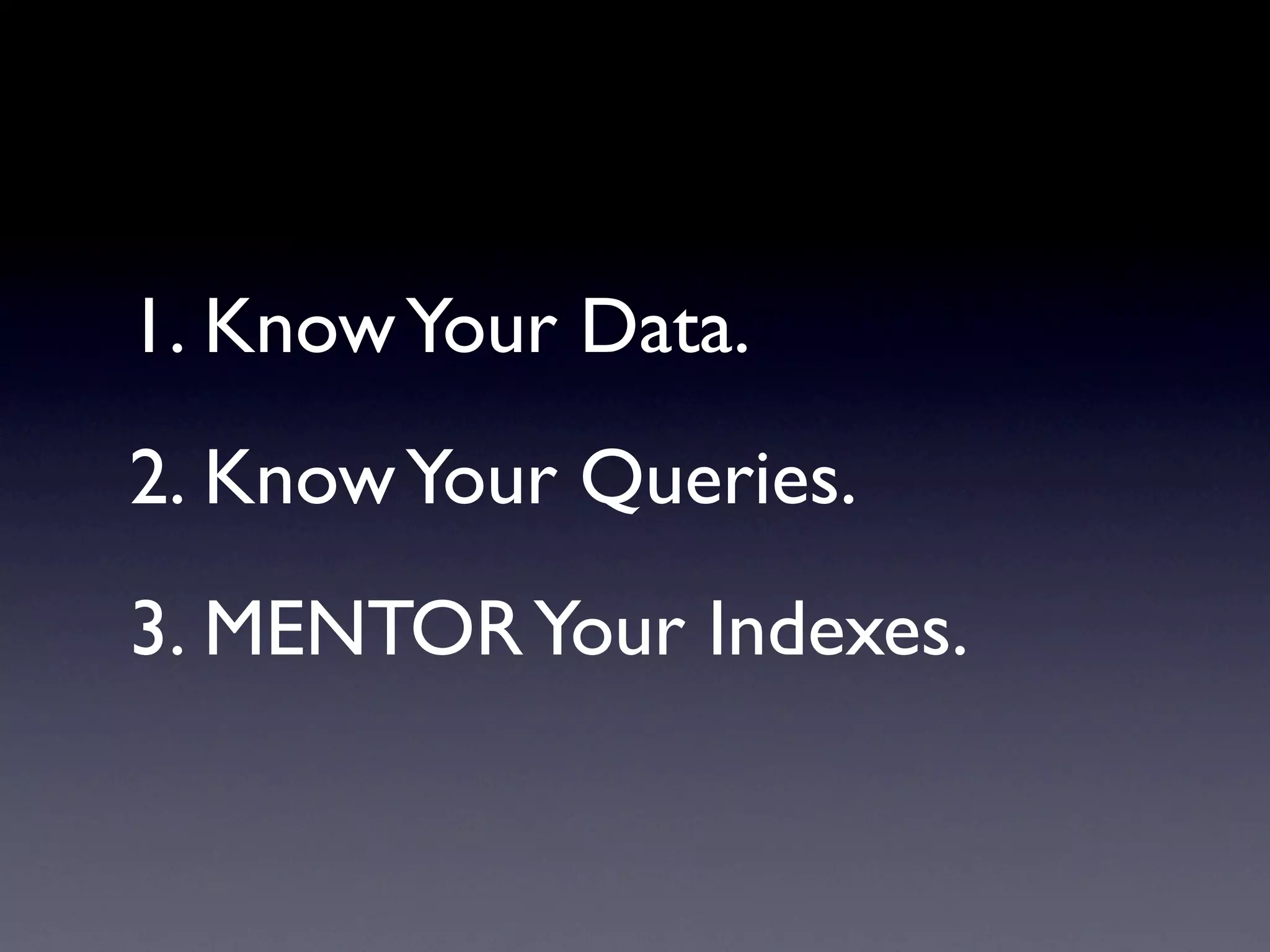
1. Know Your Data.
2. Know Your Queries.
3. MENTOR Your Indexes.
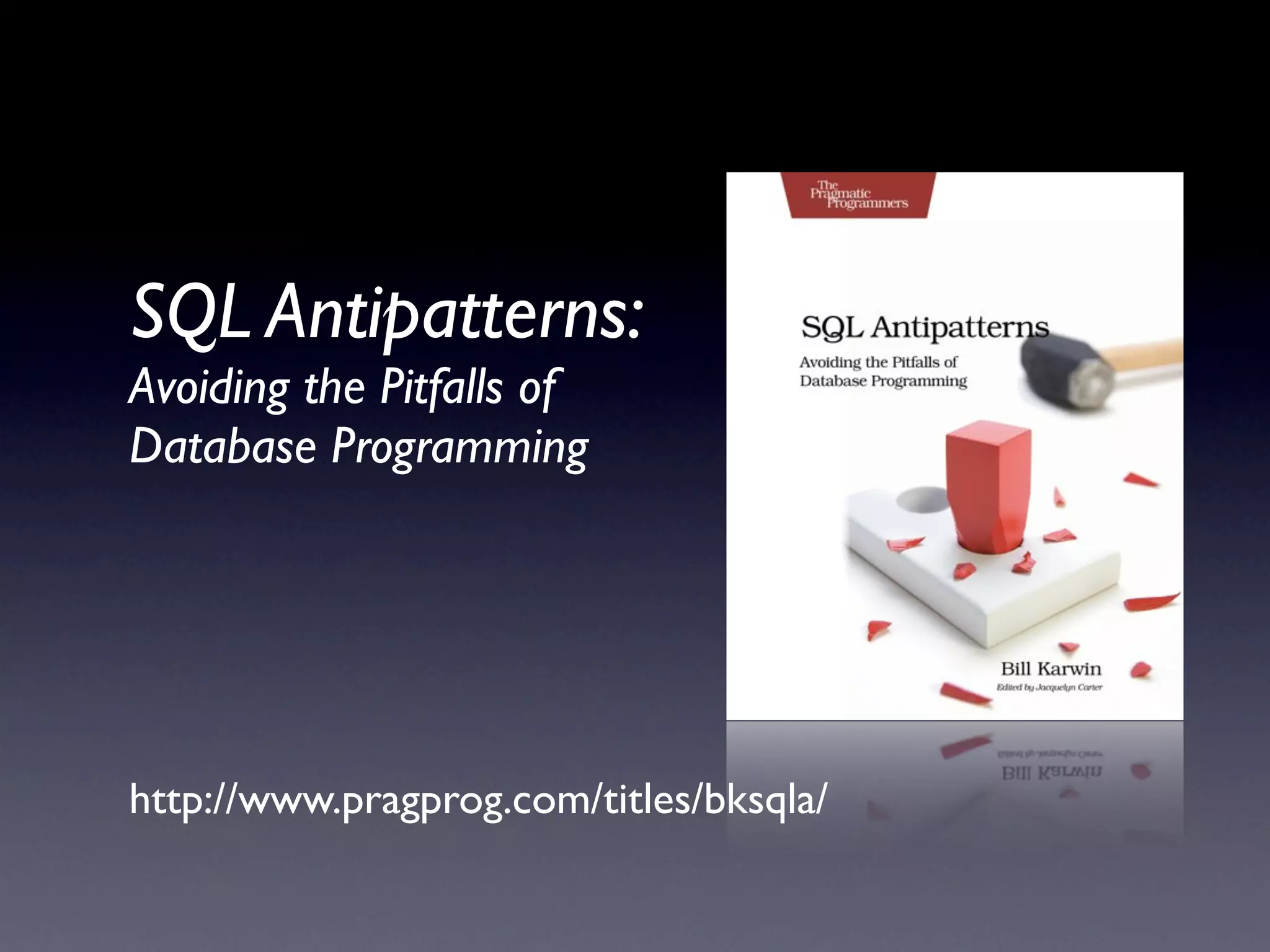
SQL Antipatterns:
Avoiding the Pitfalls of
Database Programming


http://www.pragprog.com/titles/bksqla/
Copyright 2010 Bill Karwin
        www.slideshare.net/billkarwin
              Released under a Creative Commons 3.0 License:
              http://creativecommons.org/licenses/by-nc-nd/3.0/

                You are free to share - to copy, distribute and
             transmit this work, under the following conditions:

   Attribution.                Noncommercial.          No Derivative Works.
You must attribute this    You may not use this work       You may not alter,
 work to Bill Karwin.       for commercial purposes.      transform, or build
                                                            upon this work.

Mentor Your Indexes

  • 1.
    MENTOR Your Indexes Bill Karwin IndependentOracle Users Group • 2010-9-21
  • 2.
    Me • Software developer •C, Java, Perl, PHP, Ruby • SQL maven • Author of new book SQL Antipatterns
  • 3.
    “Whenever any resultis sought, the question will then arise—by what course of calculation can these results be arrived at by the machine in the shortest time?” — Charles Babbage, Passages from the Life of a Philosopher (1864)
  • 4.
  • 5.
    Common blunders: • Creatingindexes naively • Executing non-indexable queries • Rejecting indexes because of overhead
  • 6.
    CREATE TABLE Posts( PostId SERIAL PRIMARY KEY, CreationDate DATE NOT NULL, Title VARCHAR(80) NOT NULL, Body TEXT NOT NULL, Score INT );
  • 7.
    CREATE TABLE Posts( PostId SERIAL PRIMARY KEY, CreationDate DATE NOT NULL, Title VARCHAR(80) NOT NULL, Body TEXT NOT NULL, Score INT, INDEX (PostId) ); redundant index, already in PK
  • 8.
    CREATE TABLE Posts( PostId SERIAL PRIMARY KEY, CreationDate DATE NOT NULL, Title VARCHAR(80) NOT NULL, Body TEXT NOT NULL, Score INT, INDEX (Title) ); bulky index
  • 9.
    CREATE TABLE Posts( PostId SERIAL PRIMARY KEY, CreationDate DATE NOT NULL, Title VARCHAR(80) NOT NULL, Body TEXT NOT NULL, Score INT, INDEX (Score) ); unnecessary index, we may never query on score
  • 10.
    CREATE TABLE Posts( PostId SERIAL PRIMARY KEY, CreationDate DATE NOT NULL, Title VARCHAR(80) NOT NULL, Body TEXT NOT NULL, Score INT, INDEX (Score, CreationDate, Title) ); unnecessary composite index
  • 11.
    SELECT * FROMPosts WHERE Title LIKE ‘%crash%’ non-leftmost string match
  • 12.
    Telephone book analogy: •Easy to search for Dean Thomas: uses index to match SELECT * FROM TelephoneBook WHERE full_name LIKE ‘Thomas, %’ • Hard to search for Thomas Riddle: requires full table scan SELECT * FROM TelephoneBook WHERE full_name LIKE ‘%, Thomas’
  • 13.
    SELECT * FROMPosts WHERE MONTH(CreationDate) = 4 function applied to column
  • 14.
    SELECT * FROMUsers WHERE LastName = ‘Thomas’ OR FirstName = ‘Thomas’ just like searching for first_name
  • 15.
    SELECT * FROMUsers ORDER BY FirstName, LastName non-leftmost composite key match
  • 16.
    the benefit quickly justifies the overhead O(n) table scan O(log n) index scan
  • 17.
    Relational Index data modeling optimization is derived is derived from data from queries
  • 18.
    MENTOR Your Indexes
  • 19.
    Measure Explain Nominate Test Optimize Repair
  • 20.
    Measure Explain Nominate Test Optimize Repair
  • 21.
    • Profile yourcode to identify your biggest performance costs. • MySQL: PROFILER • Oracle: TKPROF or Trace Analyzer • Application-level profiling
  • 22.
    Measure Explain Nominate Test Optimize Repair
  • 23.
    • Analyze thedatabase’s optimization plan for costly queries. • Identify queries that don’t use indexes.
  • 24.
    • MySQL: EXPLAINQuery • “Explain Output Format” http://dev.mysql.com/doc/refman/5.5/en/ explain-output.html
  • 25.
    • Oracle: EXPLAINPLAN Query • “Understanding Explain Plan” http://www.orafaq.com/node/1420
  • 26.
    Measure Explain Nominate Test Optimize Repair
  • 27.
    • Which queriesneed optimization? • Frequently used queries • Very slow queries • Reports
  • 28.
    • Which column(s)need indexes? • WHERE conditions • JOIN conditions • ORDER BY criteria • MIN() / MAX()
  • 29.
    • Automatic toolsfor nominating indexes: • MySQL Enterprise Query Analyzer • Oracle Automatic SQL Tuning Advisor
  • 30.
    Measure Explain Nominate Test Optimize Repair
  • 31.
    • After creatingindex, measure your high- priority queries again. • Confirm that the new index made a difference to these queries. • Impress your boss/client! “The new index gave us a 127% performance improvement!”
  • 32.
    Measure Explain Nominate Test Optimize Repair
  • 33.
    • Indexes arecompact, frequently-used data structures. • Try to cache indexes in memory.
  • 34.
    • Cache indexesin MySQL/InnoDB: • Increase innodb_buffer_pool_size • Used for both data and indexes • Cache indexes in MySQL/MyISAM: • Increase key_buffer_size • LOAD INDEX INTO CACHE TableName [INDEX IndexName];
  • 35.
    • Cache indexesin Oracle: ALTER SYSTEM SET DB_32K_CACHE_SIZE = 100m; CREATE TABLESPACE INDEX_TS_32K BLOCKSIZE 32K; ALTER INDEX IndexName REBUILD ONLINE TABLESPACE INDEX_TS_32K; http://www.dba-oracle.com/art_so_optimizer_index_caching.htm
  • 36.
    Measure Explain Nominate Test Optimize Repair
  • 37.
    • Indexes requireperiodic maintenance. • Like a filesystem requires periodic defragmentation.
  • 38.
    • Analyze /rebuild indexes in MySQL: • ANALYZE TABLE TableName • OPTIMIZE TABLE TableName
  • 39.
    • Analyze /rebuild indexes in Oracle: • ANALYZE INDEX IndexName • ALTER INDEX IndexName REBUILD ...
  • 40.
    1. Know YourData. 2. Know Your Queries. 3. MENTOR Your Indexes.
  • 41.
    SQL Antipatterns: Avoiding thePitfalls of Database Programming http://www.pragprog.com/titles/bksqla/
  • 42.
    Copyright 2010 BillKarwin www.slideshare.net/billkarwin Released under a Creative Commons 3.0 License: http://creativecommons.org/licenses/by-nc-nd/3.0/ You are free to share - to copy, distribute and transmit this work, under the following conditions: Attribution. Noncommercial. No Derivative Works. You must attribute this You may not use this work You may not alter, work to Bill Karwin. for commercial purposes. transform, or build upon this work.