Mapping out mentalism in present-
day linguistics and other related
disciplines
Nurul Arifin (21602073022)
malthufah muqawwamah (21602073023)
Applied Linguistics
MENTALISM IN GENERATIVE GRAMMAR
• Chomsky(1965:4) linguistics theory is mentalistic, since it
is concerned with discovering a mental reality underlying
actual behavior.
• competence-performance
The expanded use of competence in
the sub fields of generative linguistics
• Linguistics competence is considered to be the
mature form of the LAD.
• chomsky propose three interrelated components;
phonetic, phonological, morphological, styntactic
and semantic competence.
“Competence” Transported to the Study of Language in
Context
American linguist, Dell Hymes (1972) There is nothing social in the theory of
human language?
The Chomky’s notion of “competence” is problematic for at least 3 reasons
1. Competence of different degrees
2. Linguistic competence in Chomskyan sense is equal
3. Separation of “competence” from “performance”
Hymes – COMMUNICATIVE COMPETENCE
* Grammatically, with respect to competence
* Acceptability, with respect to performance
Hymes (1974: 195-7) “Sociolinguistics” interpreted in three different ways
1. Social as well as the linguistic
2. Socially realistic linguistics
3. Socially constituted linguistics
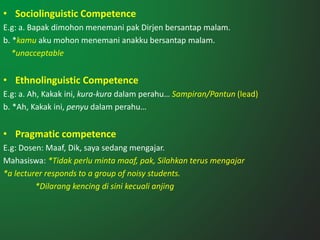
• Sociolinguistic Competence
E.g: a. Bapak dimohon menemani pak Dirjen bersantap malam.
b. *kamu aku mohon menemani anakku bersantap malam.
*unacceptable
• Ethnolinguistic Competence
E.g: a. Ah, Kakak ini, kura-kura dalam perahu… Sampiran/Pantun (lead)
b. *Ah, Kakak ini, penyu dalam perahu…
• Pragmatic competence
E.g: Dosen: Maaf, Dik, saya sedang mengajar.
Mahasiswa: *Tidak perlu minta maaf, pak, Silahkan terus mengajar
*a lecturer responds to a group of noisy students.
*Dilarang kencing di sini kecuali anjing
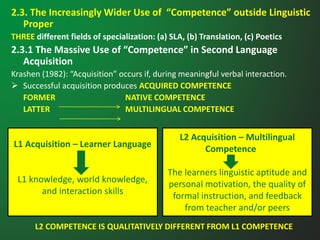
L1 Acquisition – Learner Language
L1 knowledge, world knowledge,
and interaction skills
2.3. The Increasingly Wider Use of “Competence” outside Linguistic
Proper
THREE different fields of specialization: (a) SLA, (b) Translation, (c) Poetics
2.3.1 The Massive Use of “Competence” in Second Language
Acquisition
Krashen (1982): “Acquisition” occurs if, during meaningful verbal interaction.
 Successful acquisition produces ACQUIRED COMPETENCE
FORMER NATIVE COMPETENCE
LATTER MULTILINGUAL COMPETENCE
L2 COMPETENCE IS QUALITATIVELY DIFFERENT FROM L1 COMPETENCE
L2 Acquisition – Multilingual
Competence
The learners linguistic aptitude and
personal motivation, the quality of
formal instruction, and feedback
from teacher and/or peers
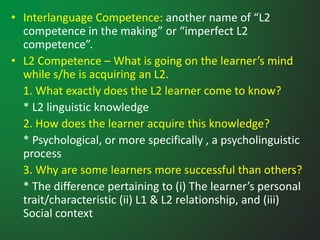
• Interlanguage Competence: another name of “L2
competence in the making” or “imperfect L2
competence”.
• L2 Competence – What is going on the learner’s mind
while s/he is acquiring an L2.
1. What exactly does the L2 learner come to know?
* L2 linguistic knowledge
2. How does the learner acquire this knowledge?
* Psychological, or more specifically , a psycholinguistic
process
3. Why are some learners more successful than others?
* The difference pertaining to (i) The learner’s personal
trait/characteristic (ii) L1 & L2 relationship, and (iii)
Social context
Errors across different linguistic
categories
NO Linguistic Categories Example
1 Lexical error After that we back to our home
2 Morphological Error … because went to mountain is my
first experience
3 Syntactic error In second day I go to the beach
4 Phonological Error Tony lost his bag – Pronounced
[bek] [bæg]
•Sociolinguistic competence
•Discourse competence
•Strategic competence
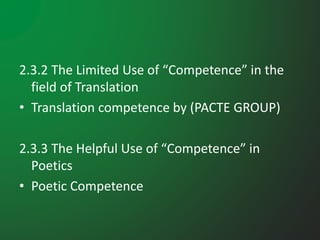
2.3.2 The Limited Use of “Competence” in the
field of Translation
• Translation competence by (PACTE GROUP)
2.3.3 The Helpful Use of “Competence” in
Poetics
• Poetic Competence
CONCLUSION
• Mentalism – Generative Grammar
• Competence & Performance
• Sub-fields of Generative Linguistics
• Linguistic proper (SLA, Translation, Poetics)

Mentalism: Competence & Performance

  • 1.
    Mapping out mentalismin present- day linguistics and other related disciplines Nurul Arifin (21602073022) malthufah muqawwamah (21602073023) Applied Linguistics
  • 2.
    MENTALISM IN GENERATIVEGRAMMAR • Chomsky(1965:4) linguistics theory is mentalistic, since it is concerned with discovering a mental reality underlying actual behavior. • competence-performance
  • 3.
    The expanded useof competence in the sub fields of generative linguistics • Linguistics competence is considered to be the mature form of the LAD. • chomsky propose three interrelated components; phonetic, phonological, morphological, styntactic and semantic competence.
  • 4.
    “Competence” Transported tothe Study of Language in Context American linguist, Dell Hymes (1972) There is nothing social in the theory of human language? The Chomky’s notion of “competence” is problematic for at least 3 reasons 1. Competence of different degrees 2. Linguistic competence in Chomskyan sense is equal 3. Separation of “competence” from “performance” Hymes – COMMUNICATIVE COMPETENCE * Grammatically, with respect to competence * Acceptability, with respect to performance Hymes (1974: 195-7) “Sociolinguistics” interpreted in three different ways 1. Social as well as the linguistic 2. Socially realistic linguistics 3. Socially constituted linguistics
  • 5.
    • Sociolinguistic Competence E.g:a. Bapak dimohon menemani pak Dirjen bersantap malam. b. *kamu aku mohon menemani anakku bersantap malam. *unacceptable • Ethnolinguistic Competence E.g: a. Ah, Kakak ini, kura-kura dalam perahu… Sampiran/Pantun (lead) b. *Ah, Kakak ini, penyu dalam perahu… • Pragmatic competence E.g: Dosen: Maaf, Dik, saya sedang mengajar. Mahasiswa: *Tidak perlu minta maaf, pak, Silahkan terus mengajar *a lecturer responds to a group of noisy students. *Dilarang kencing di sini kecuali anjing
  • 6.
    L1 Acquisition –Learner Language L1 knowledge, world knowledge, and interaction skills 2.3. The Increasingly Wider Use of “Competence” outside Linguistic Proper THREE different fields of specialization: (a) SLA, (b) Translation, (c) Poetics 2.3.1 The Massive Use of “Competence” in Second Language Acquisition Krashen (1982): “Acquisition” occurs if, during meaningful verbal interaction.  Successful acquisition produces ACQUIRED COMPETENCE FORMER NATIVE COMPETENCE LATTER MULTILINGUAL COMPETENCE L2 COMPETENCE IS QUALITATIVELY DIFFERENT FROM L1 COMPETENCE L2 Acquisition – Multilingual Competence The learners linguistic aptitude and personal motivation, the quality of formal instruction, and feedback from teacher and/or peers
  • 7.
    • Interlanguage Competence:another name of “L2 competence in the making” or “imperfect L2 competence”. • L2 Competence – What is going on the learner’s mind while s/he is acquiring an L2. 1. What exactly does the L2 learner come to know? * L2 linguistic knowledge 2. How does the learner acquire this knowledge? * Psychological, or more specifically , a psycholinguistic process 3. Why are some learners more successful than others? * The difference pertaining to (i) The learner’s personal trait/characteristic (ii) L1 & L2 relationship, and (iii) Social context
  • 8.
    Errors across differentlinguistic categories NO Linguistic Categories Example 1 Lexical error After that we back to our home 2 Morphological Error … because went to mountain is my first experience 3 Syntactic error In second day I go to the beach 4 Phonological Error Tony lost his bag – Pronounced [bek] [bæg] •Sociolinguistic competence •Discourse competence •Strategic competence
  • 9.
    2.3.2 The LimitedUse of “Competence” in the field of Translation • Translation competence by (PACTE GROUP) 2.3.3 The Helpful Use of “Competence” in Poetics • Poetic Competence
  • 10.
    CONCLUSION • Mentalism –Generative Grammar • Competence & Performance • Sub-fields of Generative Linguistics • Linguistic proper (SLA, Translation, Poetics)