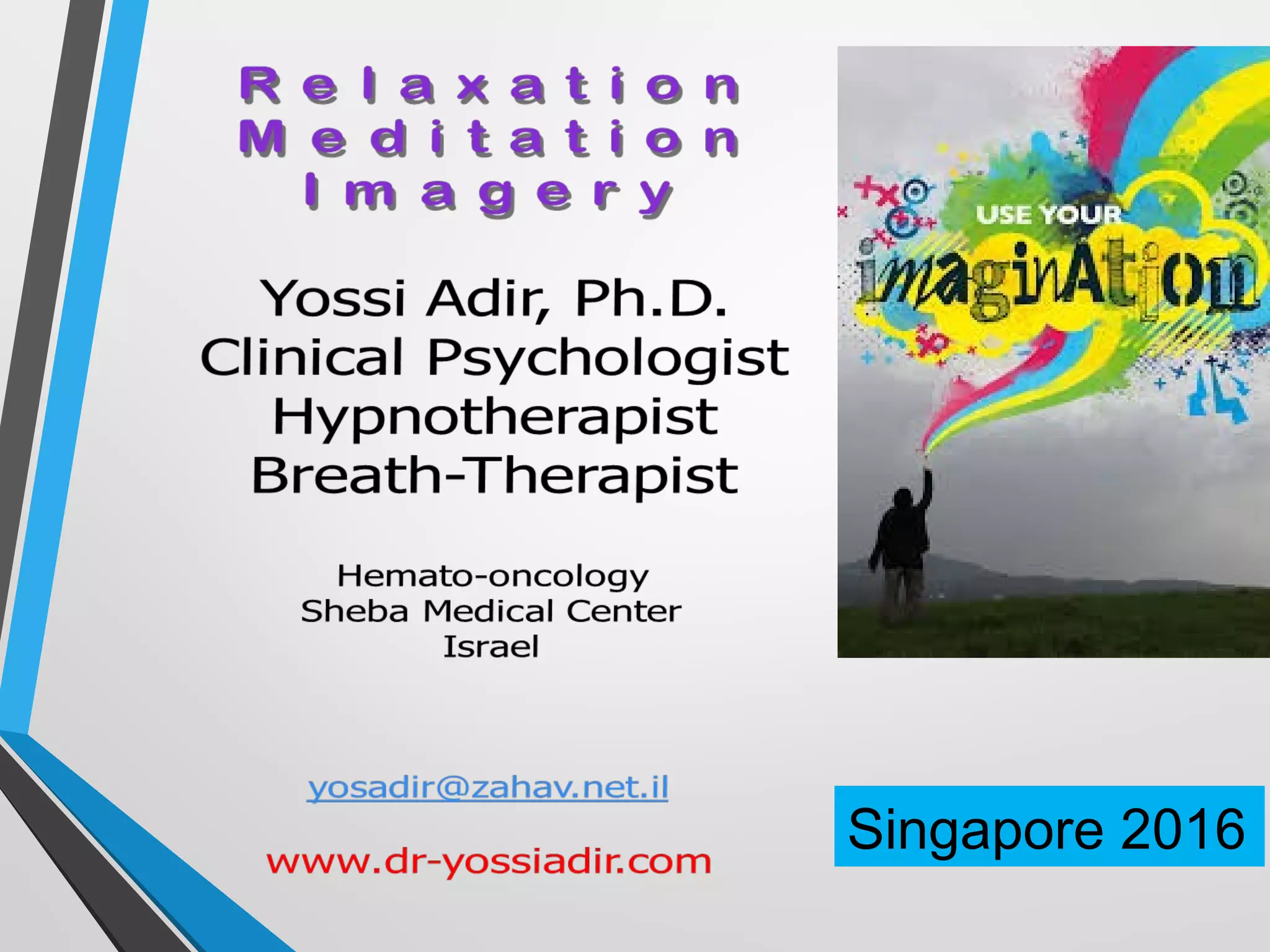
Singapore 2016
You
can not
hope
without
imagination
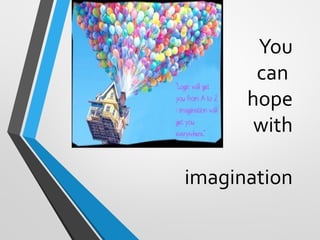
You
can
hope
with
imagination
QuotesQuotes
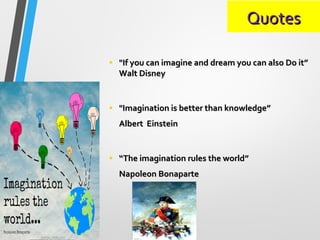
• "If you can imagine and dream you can also Do it”"If you can imagine and dream you can also Do it”
Walt DisneyWalt Disney
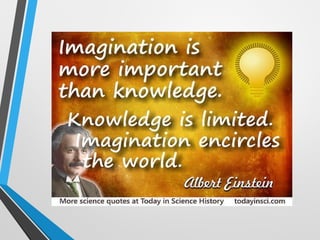
• "Imagination is better than knowledge”"Imagination is better than knowledge”
Albert EinsteinAlbert Einstein
• ““The imagination rules the world”The imagination rules the world”
Napoleon BonaparteNapoleon Bonaparte
Mindfulness
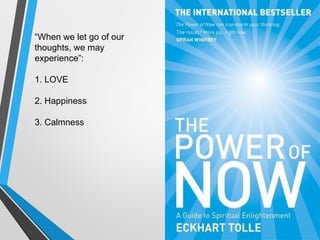
“When we let go of our
thoughts, we may
experience”:
1. LOVE
2. Happiness
3. Calmness
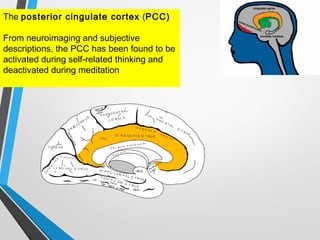
The posterior cingulate cortex (PCC)
From neuroimaging and subjective
descriptions, the PCC has been found to be
activated during self-related thinking and
deactivated during meditation
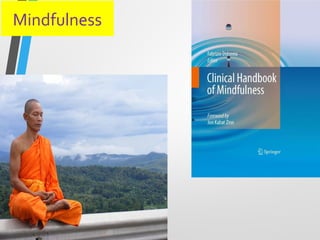
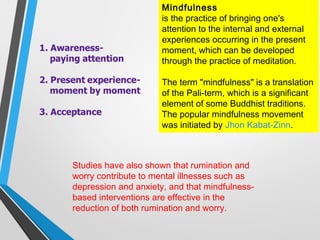
Mindfulness
is the practice of bringing one's
attention to the internal and external
experiences occurring in the present
moment, which can be developed
through the practice of meditation.
The term "mindfulness" is a translation
of the Pali-term, which is a significant
element of some Buddhist traditions.
The popular mindfulness movement
was initiated by Jhon Kabat-Zinn.
Studies have also shown that rumination and
worry contribute to mental illnesses such as
depression and anxiety, and that mindfulness-
based interventions are effective in the
reduction of both rumination and worry.
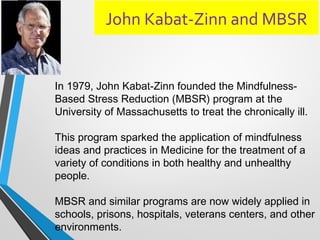
John Kabat-Zinn and MBSR
In 1979, John Kabat-Zinn founded the Mindfulness-
Based Stress Reduction (MBSR) program at the
University of Massachusetts to treat the chronically ill.
This program sparked the application of mindfulness
ideas and practices in Medicine for the treatment of a
variety of conditions in both healthy and unhealthy
people.
MBSR and similar programs are now widely applied in
schools, prisons, hospitals, veterans centers, and other
environments.
Mindfulness-based cognitive therapy
(MBCT(
MBCT is a psychological therapy designed to aid in preventing
the relapse of depression, specifically in individuals with Major
depressive disorder (MDD(.
It uses traditional cognitive behavioral therapy (CBT( methods
and adds in newer psychological strategies such as
mindfulness and mindfulness meditation.
Cognitive methods can include educating the participant about
depression.
Mindfulness and mindfulness meditation, focus on becoming
aware of all incoming thoughts and feelings and accepting
them, but not attaching or reacting to them.
MBCT
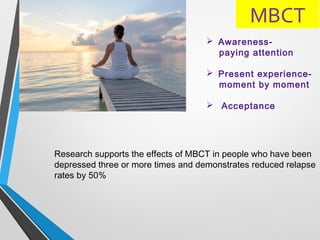
Research supports the effects of MBCT in people who have been
depressed three or more times and demonstrates reduced relapse
rates by 50%
 Awareness-
paying attention
 Present experience-
moment by moment
 Acceptance
Acceptance & Commitment
Therapy (ACT(
ACT is an approach to psychological intervention defined
in terms of certain theoretical processes, not a specific
technology.
In theoretical and process terms we can define ACT as a
psychological intervention based on modern behavioral
psychology, including Relational Frame Theory, that
applies mindfulness and acceptance processes, and
commitment and behavior change processes, to the
creation of psychological flexibility.
Relaxation
and Meditation-
techniques
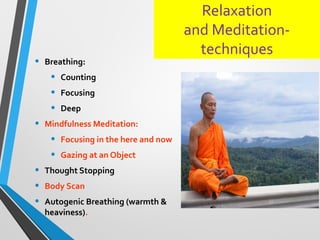
• Breathing:
• Counting
• Focusing
• Deep
• Mindfulness Meditation:
• Focusing in the here and now
• Gazing at an Object
• Thought Stopping
• Body Scan
• Autogenic Breathing (warmth &
heaviness).
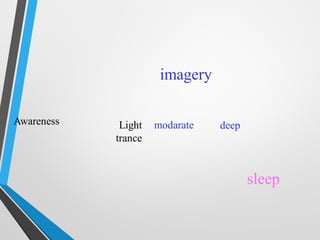
Awareness Light
trance
modarate deep
sleep
imagery
Imagery
Simple Definition of imagery:
•: pictures or photographs
•: language that causes people to imagine pictures in
their mind
•: pictures of people or things in a work of art
Source: Merriam-Webster's Learner's Dictionary
Imagery-definition
means to use figurative language to represent objects,
actions and ideas in such a way that it appeals to our
physical senses.
Usually it is thought that imagery makes use of
particular words that create visual representation of
ideas in our minds.
The word imagery is associated with mental pictures.
However, this idea is but partially correct.
Imagery, to be realistic, turns out to be more
complex than just a picture.
http://literarydevices.net/imagery/
Imagination-definition
The power of reproducing images stored in the memory
under the suggestion of associated images
(reproductive imagination( or of recombining former
experiences in the creation of new images directed at a
specific goal or aiding in the solution of problems
(creative imagination(.
www.dictionary.com
Guided Imagery-definition*
Guided imagery
is a mind-body intervention by which a trained practitioner or teacher helps
a participant or patient to evoke and generate mental images that simulate
or re-create the sensory perception of sights, sounds, tastes, smells,
movements, and images associated with touch, such as texture,
temperature, and pressure, as well as imaginative or mental content that
the participant or patient experiences as defying conventional sensory
categories, and that may precipitate strong emotions or feelings in the
absence of the stimuli to which correlating sensory receptors are
receptive.
The practitioner or teacher may facilitate this process in person to an
individual or a group. Alternatively, the participant or patient may follow
guidance provided by a sound recording, video, or audiovisual media
comprising spoken instruction that may be accompanied by music or
sound.
* Wikipedia
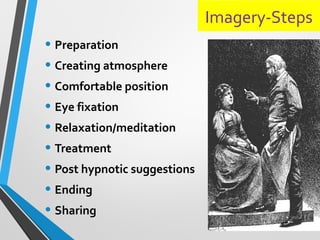
Imagery-Steps
• Preparation
• Creating atmosphere
• Comfortable position
• Eye fixation
• Relaxation/meditation
• Treatment
• Post hypnotic suggestions
• Ending
• Sharing
Inductions
• PMR-Jacobson
• Body scan
• Changing colors
• Moving a band
• Breathing
• Here and now
• Dropping a coin or pencil
• Gazing on an object
• Thought stopping
• Closing the gates.
Deepening techniques
• Counting
• Sunset
• Stairs
• Elevator
• Stepping down from a hill
• Motor techniques: heavy hand, hands getting close,
dropping a coin, etc.
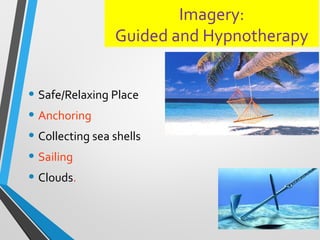
Imagery:
Guided and Hypnotherapy
• Safe/Relaxing Place
• Anchoring
• Collecting sea shells
• Sailing
• Clouds.
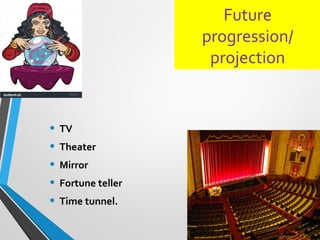
Future
progression/
projection
• TV
• Theater
• Mirror
• Fortune teller
• Time tunnel.
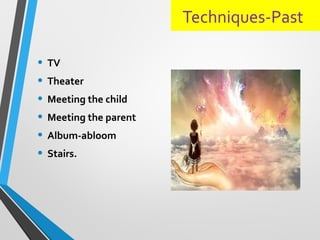
Techniques-Past
• TV
• Theater
• Meeting the child
• Meeting the parent
• Album-abloom
• Stairs.
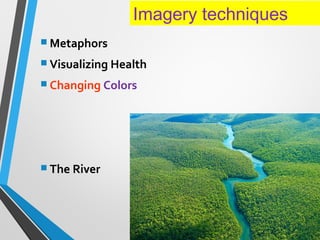
Metaphors
Visualizing Health
Changing Colors
The River
Imagery techniques
The Indian Reservation
and the Trees
Imagery techniques
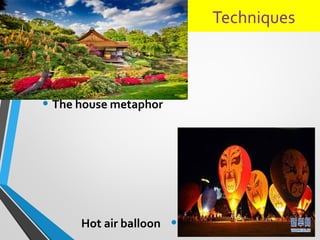
Techniques
• The house metaphor
•Hot air balloon
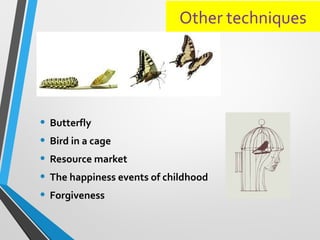
Other techniques
• Butterfly
• Bird in a cage
• Resource market
• The happiness events of childhood
• Forgiveness
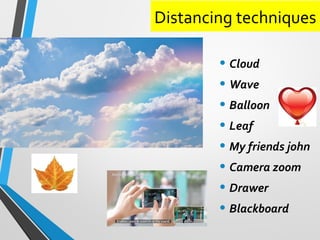
Distancing techniques
• Cloud
• Wave
• Balloon
• Leaf
• My friends john
• Camera zoom
• Drawer
• Blackboard
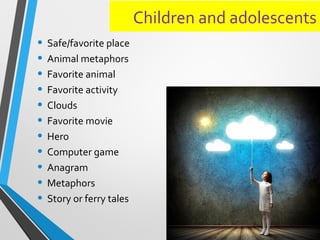
Children and adolescents
• Safe/favorite place
• Animal metaphors
• Favorite animal
• Favorite activity
• Clouds
• Favorite movie
• Hero
• Computer game
• Anagram
• Metaphors
• Story or ferry tales
Future-past progression/projection
Age regression and schema focusing
Safe place and Distancing
Stories and metaphors
Dissociation between past and present
Desensitization
Breaking the continuation of automatic behavior
Aversion
Positive reinforcement
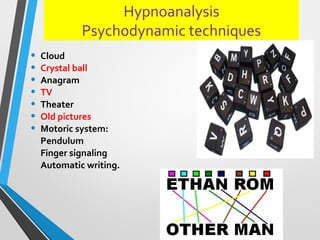
Hypnoanalysis
Psychodynamic techniques
• Cloud
• Crystal ball
• Anagram
• TV
• Theater
• Old pictures
• Motoric system:
Pendulum
Finger signaling
Automatic writing.
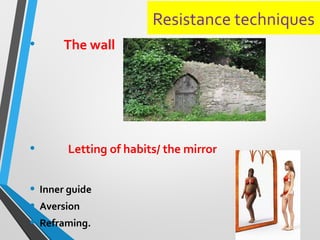
Resistance techniques
• The wall
• Letting of habits/ the mirror
• Inner guide
• Aversion
• Reframing.
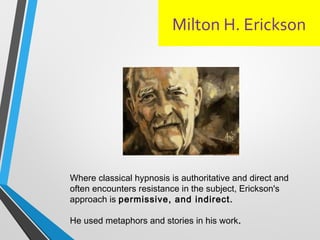
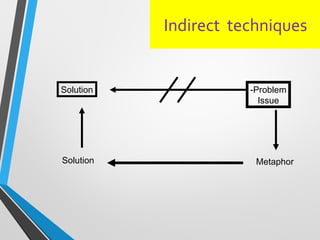
Milton H. Erickson
Where classical hypnosis is authoritative and direct and
often encounters resistance in the subject, Erickson's
approach is permissive, and indirect.
He used metaphors and stories in his work.
Indirect techniques
Problem-
Issue
MetaphorSolution
Solution
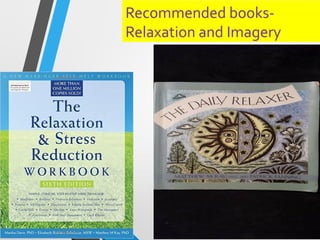
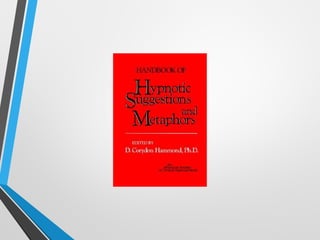
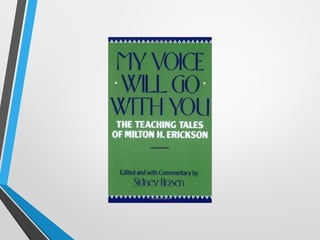
Recommended books-
Relaxation and Imagery
Important points
• Utilization
• Yes set
• Verbal-Nonverbal-Paraverbal
• Tests: Semaphore, Lemmon
• Pendulum
• Sitting position
• Repetition
• Silence and breaks
• Open suggestions
• Positive feedback
• Passing and leading
• Starting faster and gradually slowing
down
• Music.
Meditaion and imagery

Meditaion and imagery

  • 1.
  • 2.
  • 3.
  • 4.
    QuotesQuotes • "If youcan imagine and dream you can also Do it”"If you can imagine and dream you can also Do it” Walt DisneyWalt Disney • "Imagination is better than knowledge”"Imagination is better than knowledge” Albert EinsteinAlbert Einstein • ““The imagination rules the world”The imagination rules the world” Napoleon BonaparteNapoleon Bonaparte
  • 6.
  • 7.
    “When we letgo of our thoughts, we may experience”: 1. LOVE 2. Happiness 3. Calmness
  • 8.
    The posterior cingulatecortex (PCC) From neuroimaging and subjective descriptions, the PCC has been found to be activated during self-related thinking and deactivated during meditation
  • 10.
    Mindfulness is the practiceof bringing one's attention to the internal and external experiences occurring in the present moment, which can be developed through the practice of meditation. The term "mindfulness" is a translation of the Pali-term, which is a significant element of some Buddhist traditions. The popular mindfulness movement was initiated by Jhon Kabat-Zinn. Studies have also shown that rumination and worry contribute to mental illnesses such as depression and anxiety, and that mindfulness- based interventions are effective in the reduction of both rumination and worry.
  • 11.
    John Kabat-Zinn andMBSR In 1979, John Kabat-Zinn founded the Mindfulness- Based Stress Reduction (MBSR) program at the University of Massachusetts to treat the chronically ill. This program sparked the application of mindfulness ideas and practices in Medicine for the treatment of a variety of conditions in both healthy and unhealthy people. MBSR and similar programs are now widely applied in schools, prisons, hospitals, veterans centers, and other environments.
  • 12.
    Mindfulness-based cognitive therapy (MBCT( MBCTis a psychological therapy designed to aid in preventing the relapse of depression, specifically in individuals with Major depressive disorder (MDD(. It uses traditional cognitive behavioral therapy (CBT( methods and adds in newer psychological strategies such as mindfulness and mindfulness meditation. Cognitive methods can include educating the participant about depression. Mindfulness and mindfulness meditation, focus on becoming aware of all incoming thoughts and feelings and accepting them, but not attaching or reacting to them.
  • 13.
    MBCT Research supports theeffects of MBCT in people who have been depressed three or more times and demonstrates reduced relapse rates by 50%  Awareness- paying attention  Present experience- moment by moment  Acceptance
  • 14.
    Acceptance & Commitment Therapy(ACT( ACT is an approach to psychological intervention defined in terms of certain theoretical processes, not a specific technology. In theoretical and process terms we can define ACT as a psychological intervention based on modern behavioral psychology, including Relational Frame Theory, that applies mindfulness and acceptance processes, and commitment and behavior change processes, to the creation of psychological flexibility.
  • 15.
    Relaxation and Meditation- techniques • Breathing: •Counting • Focusing • Deep • Mindfulness Meditation: • Focusing in the here and now • Gazing at an Object • Thought Stopping • Body Scan • Autogenic Breathing (warmth & heaviness).
  • 16.
  • 17.
    Imagery Simple Definition ofimagery: •: pictures or photographs •: language that causes people to imagine pictures in their mind •: pictures of people or things in a work of art Source: Merriam-Webster's Learner's Dictionary
  • 18.
    Imagery-definition means to usefigurative language to represent objects, actions and ideas in such a way that it appeals to our physical senses. Usually it is thought that imagery makes use of particular words that create visual representation of ideas in our minds. The word imagery is associated with mental pictures. However, this idea is but partially correct. Imagery, to be realistic, turns out to be more complex than just a picture. http://literarydevices.net/imagery/
  • 19.
    Imagination-definition The power ofreproducing images stored in the memory under the suggestion of associated images (reproductive imagination( or of recombining former experiences in the creation of new images directed at a specific goal or aiding in the solution of problems (creative imagination(. www.dictionary.com
  • 20.
    Guided Imagery-definition* Guided imagery isa mind-body intervention by which a trained practitioner or teacher helps a participant or patient to evoke and generate mental images that simulate or re-create the sensory perception of sights, sounds, tastes, smells, movements, and images associated with touch, such as texture, temperature, and pressure, as well as imaginative or mental content that the participant or patient experiences as defying conventional sensory categories, and that may precipitate strong emotions or feelings in the absence of the stimuli to which correlating sensory receptors are receptive. The practitioner or teacher may facilitate this process in person to an individual or a group. Alternatively, the participant or patient may follow guidance provided by a sound recording, video, or audiovisual media comprising spoken instruction that may be accompanied by music or sound. * Wikipedia
  • 21.
    Imagery-Steps • Preparation • Creatingatmosphere • Comfortable position • Eye fixation • Relaxation/meditation • Treatment • Post hypnotic suggestions • Ending • Sharing
  • 22.
    Inductions • PMR-Jacobson • Bodyscan • Changing colors • Moving a band • Breathing • Here and now • Dropping a coin or pencil • Gazing on an object • Thought stopping • Closing the gates.
  • 23.
    Deepening techniques • Counting •Sunset • Stairs • Elevator • Stepping down from a hill • Motor techniques: heavy hand, hands getting close, dropping a coin, etc.
  • 24.
    Imagery: Guided and Hypnotherapy •Safe/Relaxing Place • Anchoring • Collecting sea shells • Sailing • Clouds.
  • 25.
    Future progression/ projection • TV • Theater •Mirror • Fortune teller • Time tunnel.
  • 26.
    Techniques-Past • TV • Theater •Meeting the child • Meeting the parent • Album-abloom • Stairs.
  • 27.
  • 28.
    The Indian Reservation andthe Trees Imagery techniques
  • 29.
    Techniques • The housemetaphor •Hot air balloon
  • 30.
    Other techniques • Butterfly •Bird in a cage • Resource market • The happiness events of childhood • Forgiveness
  • 31.
    Distancing techniques • Cloud •Wave • Balloon • Leaf • My friends john • Camera zoom • Drawer • Blackboard
  • 32.
    Children and adolescents •Safe/favorite place • Animal metaphors • Favorite animal • Favorite activity • Clouds • Favorite movie • Hero • Computer game • Anagram • Metaphors • Story or ferry tales
  • 33.
    Future-past progression/projection Age regressionand schema focusing Safe place and Distancing Stories and metaphors Dissociation between past and present Desensitization Breaking the continuation of automatic behavior Aversion Positive reinforcement
  • 34.
    Hypnoanalysis Psychodynamic techniques • Cloud •Crystal ball • Anagram • TV • Theater • Old pictures • Motoric system: Pendulum Finger signaling Automatic writing.
  • 35.
    Resistance techniques • Thewall • Letting of habits/ the mirror • Inner guide • Aversion • Reframing.
  • 36.
    Milton H. Erickson Whereclassical hypnosis is authoritative and direct and often encounters resistance in the subject, Erickson's approach is permissive, and indirect. He used metaphors and stories in his work.
  • 37.
  • 39.
  • 41.
    Important points • Utilization •Yes set • Verbal-Nonverbal-Paraverbal • Tests: Semaphore, Lemmon • Pendulum • Sitting position • Repetition • Silence and breaks • Open suggestions • Positive feedback • Passing and leading • Starting faster and gradually slowing down • Music.