Clinical description
Meningitisis the inflammation of the protective membranes
covering the brain and spinal cord known as the meninges.
The inflammation is usually caused by an infection of the fluid
surrounding the brain and spinal cord.
Meningitis can be life-threatening because of the
inflammation's proximity to the brain and spinal cord;
therefore the condition is classified as a medical emergency.
12/14/2025 2
3.
12/14/2025 3
Meninges
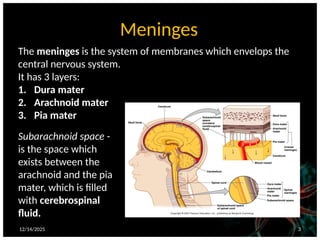
The meningesis the system of membranes which envelops the
central nervous system.
It has 3 layers:
1. Dura mater
2. Arachnoid mater
3. Pia mater
Subarachnoid space -
is the space which
exists between the
arachnoid and the pia
mater, which is filled
with cerebrospinal
fluid.
4.
Causes of Meningitis
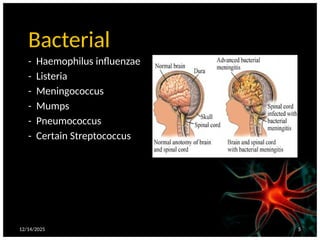
-Bacterial
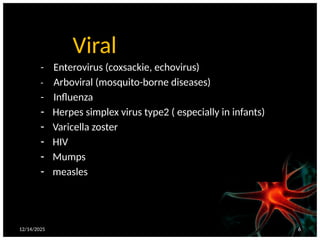
- Viral
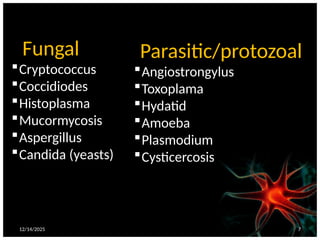
- Fungal
- Parasitic/ protozoal
- Physical injury
- Cancer
- Certain drugs ( mainly, NSAID’S)
- Head injury
- Cerebral abscess
- Middle ear infection
12/14/2025 4
8
Risk factors
• Age-children younger than 5 years
• Use of immunosuppressive drugs
• Chronic malnutrition
• AIDS
• CSF Shunt
• Chronic alcoholism
• Diabetes
• Pneumonia
9.
12/14/2025 9
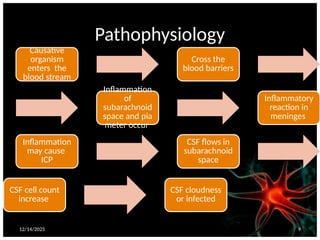
Pathophysiology
Causative
organism
enters the
bloodstream
Cross the
blood barriers
Inflammatory
reaction in
meninges
Inflammation
of
subarachnoid
space and pia
meter occur
Inflammation
may cause
ICP
CSF flows in
subarachnoid
space
CSF cloudness
or infected
CSF cell count
increase
12/14/2025 15
Treatment
• Antibioticsfor bacterial meningitis :Type vary depending on
the bacteria causing the infection.
• Antibiotics are not effective in viral meningitis.
• Other medications and intravenous fluids will be used to
treat symptoms such as brain swelling, shock, and seizures.
Prevention
• Haemophilus vaccine (HiB vaccine) in children.
• The pneumococcal conjugate vaccine is now a routine childhood
immunization and is very effective at preventing pneumococcal
meningitis.
• Household members and others in close contact with people who
have meningococcal meningitis should receive preventive antibiotics.
16.
12/14/2025 16
Nursing managements
•Altered body temp.
related to infectious
process.
Interventions:
• Monitor temperature
continuously
• Administer antipyretic
drugs as prescribed.
• Switch on fan and open
the windows.
• Cold sponge
17.
12/14/2025 17
Cont…..
• Ineffectivetissue
perfusion R/T infectious
process and cerebral
edema.
Interventions:
• Assess level of
consciousness
• Assess inc. ICP signs
• Provide calm and quit
environment
• Prepare patient for LP
for CSF evaluation.