Svitlana Vakulenko
Memory Networks for QA
on Tabular Data
Institute for Information Business
WU Vienna
@vendiSV
http://vendi12.github.io
Outline
1. Task: Question Answering (QA)
2. Method: Memory Networks
3. Application: Open Data Tables
4. Memory Networks for QA on Tabular data
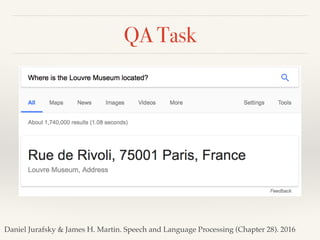
QA Task
Daniel Jurafsky & James H. Martin. Speech and Language Processing (Chapter 28). 2016
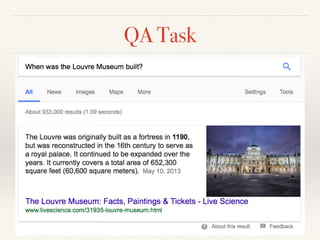
QA Task
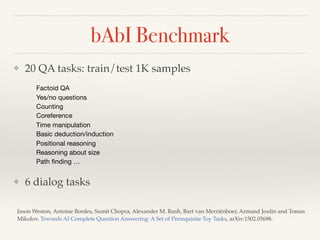
bAbI Benchmark
❖ 20 QA tasks: train/test 1K samples
	 

Factoid QA

	 	 Yes/no questions

	 	 Counting

	 	 Coreference

	 	 Time manipulation

	 	 Basic deduction/induction

	 	 Positional reasoning

	 	 Reasoning about size

	 	 Path finding …

❖ 6 dialog tasks
Jason Weston, Antoine Bordes, Sumit Chopra, Alexander M. Rush, Bart van Merriënboer, Armand Joulin and Tomas
Mikolov. Towards AI Complete Question Answering: A Set of Prerequisite Toy Tasks, arXiv:1502.05698.
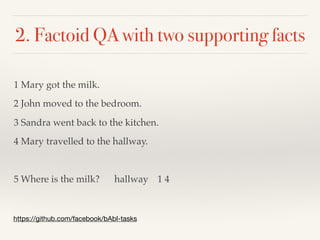
2. Factoid QA with two supporting facts
1 Mary got the milk.
2 John moved to the bedroom.
3 Sandra went back to the kitchen.
4 Mary travelled to the hallway.
5 Where is the milk? hallway 1 4
https://github.com/facebook/bAbI-tasks
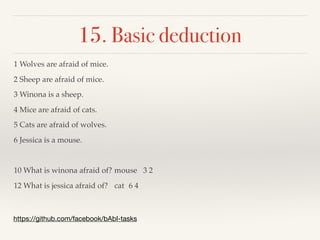
15. Basic deduction
1 Wolves are afraid of mice.
2 Sheep are afraid of mice.
3 Winona is a sheep.
4 Mice are afraid of cats.
5 Cats are afraid of wolves.
6 Jessica is a mouse.
10 What is winona afraid of? mouse 3 2
12 What is jessica afraid of? cat 6 4
https://github.com/facebook/bAbI-tasks
19. Path finding
1 The garden is west of the bathroom.
2 The bedroom is north of the hallway.
3 The office is south of the hallway.
4 The bathroom is north of the bedroom.
5 The kitchen is east of the bedroom.
6 How do you go from the bathroom to the hallway? s,s 4 2
https://github.com/facebook/bAbI-tasks
Memory Network (MemNN)
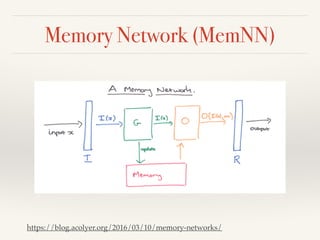
❖ Deep neural network architecture proposed by Facebook AI Research group
Memory: indexed array of objects (e.g. vectors)
❖ Components:
I: (input) convert incoming data to the internal representation.
G: (generalisation) update memories given input.
O: (output) produce output given the memories.
R: (response) convert output representation into a response.
J. Weston, S. Chopra, A. Bordes. Memory Networks. ICLR 2015

https://blog.acolyer.org/2016/03/10/memory-networks/
Memory Network (MemNN)
https://blog.acolyer.org/2016/03/10/memory-networks/
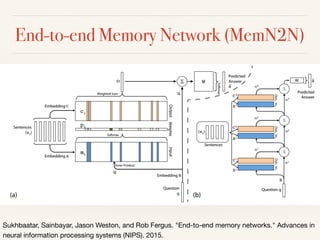
End-to-end Memory Network (MemN2N)
Sukhbaatar, Sainbayar, Jason Weston, and Rob Fergus. "End-to-end memory networks." Advances in
neural information processing systems (NIPS). 2015.
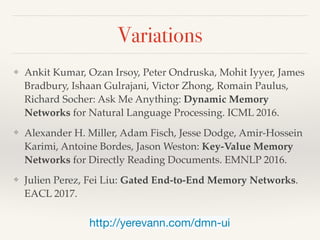
Variations
❖ Ankit Kumar, Ozan Irsoy, Peter Ondruska, Mohit Iyyer, James
Bradbury, Ishaan Gulrajani, Victor Zhong, Romain Paulus,
Richard Socher: Ask Me Anything: Dynamic Memory
Networks for Natural Language Processing. ICML 2016.
❖ Alexander H. Miller, Adam Fisch, Jesse Dodge, Amir-Hossein
Karimi, Antoine Bordes, Jason Weston: Key-Value Memory
Networks for Directly Reading Documents. EMNLP 2016.
❖ Julien Perez, Fei Liu: Gated End-to-End Memory Networks.
EACL 2017.
http://yerevann.com/dmn-ui
Application: Open Data
❖ Open Data -> Open Government
❖ Increasing transparency
❖ Empowering citizens and local communities
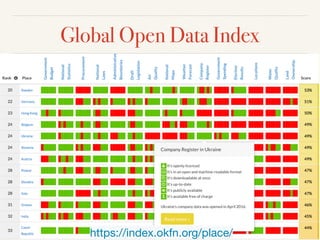
Global Open Data Index
https://index.okfn.org/place/
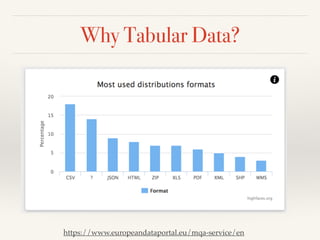
Why Tabular Data?
https://www.europeandataportal.eu/mqa-service/en
Memory Networks for QA on Tabular data
https://svakulenko.ai.wu.ac.at/tableqa
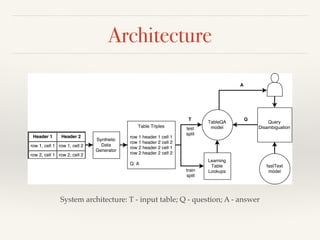
Architecture
System architecture: T - input table; Q - question; A - answer
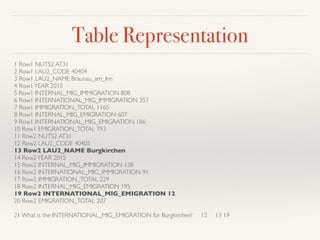
Table Representation
1 Row1 NUTS2 AT31
2 Row1 LAU2_CODE 40404
3 Row1 LAU2_NAME Braunau_am_Inn
4 Row1YEAR 2015
5 Row1 INTERNAL_MIG_IMMIGRATION 808
6 Row1 INTERNATIONAL_MIG_IMMIGRATION 357
7 Row1 IMMIGRATION_TOTAL 1165
8 Row1 INTERNAL_MIG_EMIGRATION 607
9 Row1 INTERNATIONAL_MIG_EMIGRATION 186
10 Row1 EMIGRATION_TOTAL 793
11 Row2 NUTS2 AT31
12 Row2 LAU2_CODE 40405
13 Row2 LAU2_NAME Burgkirchen
14 Row2YEAR 2015
15 Row2 INTERNAL_MIG_IMMIGRATION 138
16 Row2 INTERNATIONAL_MIG_IMMIGRATION 91
17 Row2 IMMIGRATION_TOTAL 229
18 Row2 INTERNAL_MIG_EMIGRATION 195
19 Row2 INTERNATIONAL_MIG_EMIGRATION 12
20 Row2 EMIGRATION_TOTAL 207
21 What is the INTERNATIONAL_MIG_EMIGRATION for Burgkirchen? 12 13 19
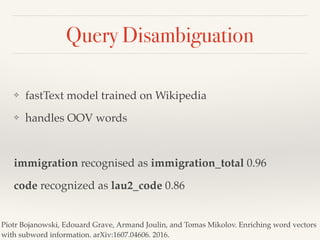
Query Disambiguation
❖ fastText model trained on Wikipedia
❖ handles OOV words
immigration recognised as immigration_total 0.96
code recognized as lau2_code 0.86
Piotr Bojanowski, Edouard Grave, Armand Joulin, and Tomas Mikolov. Enriching word vectors
with subword information. arXiv:1607.04606. 2016.
Evaluation
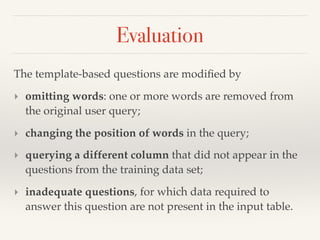
The template-based questions are modified by
‣ omitting words: one or more words are removed from
the original user query;
‣ changing the position of words in the query;
‣ querying a different column that did not appear in the
questions from the training data set;
‣ inadequate questions, for which data required to
answer this question are not present in the input table.
Results
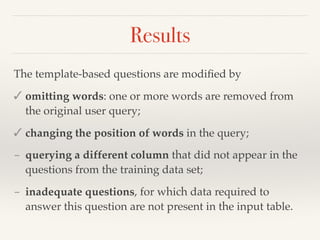
The template-based questions are modified by
✓ omitting words: one or more words are removed from
the original user query;
✓ changing the position of words in the query;
- querying a different column that did not appear in the
questions from the training data set;
- inadequate questions, for which data required to
answer this question are not present in the input table.
Results
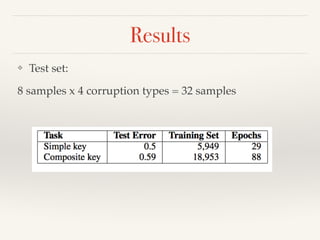
❖ Test set:
8 samples x 4 corruption types = 32 samples
Conclusions
❖ Fancy, but tricky!
❖ Know on what you train?
data sampling & variance to ensure generalisability
❖ Know what you trained?
interaction & visualisation of learned patterns
Future Work
❖ Scaling up experiments to real world tables (variance &
OOV words)
❖ New dataset for QA from open data tables
❖ Answering questions across tables
❖ Semantic integration of open data tables
❖ Joint training with other bAbI tasks for text
understanding
Future Work
https://m.me/OpenDataAssistant
Make data your friend!
Open Data Assistant: chatbot - dialogue interface
Sebastian Neumaier, Vadim Savenkov, and Svitlana Vakulenko. "Talking Open Data." ESWC (demo). 2017
References I
❖ Svitlana Vakulenko and Vadim Savenkov. TableQA: Question Answering on Tabular Data.
2017. https://arxiv.org/abs/1705.06504
❖ Jason Weston, Sumit Chopra, Antoine Bordes. Memory Networks. ICLR 2015 .
❖ Sukhbaatar, Sainbayar, Jason Weston, and Rob Fergus. "End-to-end memory networks."
Advances in neural information processing systems (NIPS). 2015.
❖ Ankit Kumar, Ozan Irsoy, Peter Ondruska, Mohit Iyyer, James Bradbury, Ishaan Gulrajani,
Victor Zhong, Romain Paulus, Richard Socher: Ask Me Anything: Dynamic Memory
Networks for Natural Language Processing. ICML 2016.
❖ Alexander H. Miller, Adam Fisch, Jesse Dodge, Amir-Hossein Karimi, Antoine Bordes, Jason
Weston: Key-Value Memory Networks for Directly Reading Documents. EMNLP 2016.
❖ Julien Perez, Fei Liu: Gated End-to-End Memory Networks. EACL 2017.
❖ Antoine Bordes, Nicolas Usunier, Sumit Chopra, Jason Weston: Large-scale Simple Question
Answering with Memory Networks. CoRR abs/1506.02075. 2015.
References II
Datasets
❖ Jason Weston, Antoine Bordes, Sumit Chopra, Alexander M. Rush, Bart van Merriënboer, Armand Joulin
and Tomas Mikolov. Towards AI Complete Question Answering: A Set of Prerequisite Toy Tasks, arXiv:
1502.05698.
❖ SimpleQuestions
❖ WebQuestions
❖ CNN QA
Videos
❖ CS224D Guest Lecture - Jason Weston - 2015 https://www.youtube.com/watch?v=6NHeIEaSie8&t=1435s
❖ Jason Weston. Memory Networks for Language Understanding, ICML Tutorial 2016
http://www.thespermwhale.com/jaseweston/icml2016/
http://techtalks.tv/talks/memory-networks-for-language-understanding/62356/
Blogs
❖ https://blog.init.ai/icml-2016-memory-networks-for-language-understanding-f2ed4c8819c4
❖ https://blog.acolyer.org/2016/03/10/memory-networks/
❖ https://yerevann.github.io/2016/02/05/implementing-dynamic-memory-networks/
AI Summit Vienna 2017
mostly.ai/summit 

Memory Networks for Question Answering on Tabular Data

  • 1.
    Svitlana Vakulenko Memory Networksfor QA on Tabular Data Institute for Information Business WU Vienna @vendiSV http://vendi12.github.io
  • 2.
    Outline 1. Task: QuestionAnswering (QA) 2. Method: Memory Networks 3. Application: Open Data Tables 4. Memory Networks for QA on Tabular data
  • 3.
    QA Task Daniel Jurafsky& James H. Martin. Speech and Language Processing (Chapter 28). 2016
  • 4.
  • 5.
    bAbI Benchmark ❖ 20QA tasks: train/test 1K samples Factoid QA Yes/no questions Counting Coreference Time manipulation Basic deduction/induction Positional reasoning Reasoning about size Path finding … ❖ 6 dialog tasks Jason Weston, Antoine Bordes, Sumit Chopra, Alexander M. Rush, Bart van Merriënboer, Armand Joulin and Tomas Mikolov. Towards AI Complete Question Answering: A Set of Prerequisite Toy Tasks, arXiv:1502.05698.
  • 6.
    2. Factoid QAwith two supporting facts 1 Mary got the milk. 2 John moved to the bedroom. 3 Sandra went back to the kitchen. 4 Mary travelled to the hallway. 5 Where is the milk? hallway 1 4 https://github.com/facebook/bAbI-tasks
  • 7.
    15. Basic deduction 1Wolves are afraid of mice. 2 Sheep are afraid of mice. 3 Winona is a sheep. 4 Mice are afraid of cats. 5 Cats are afraid of wolves. 6 Jessica is a mouse. 10 What is winona afraid of? mouse 3 2 12 What is jessica afraid of? cat 6 4 https://github.com/facebook/bAbI-tasks
  • 8.
    19. Path finding 1The garden is west of the bathroom. 2 The bedroom is north of the hallway. 3 The office is south of the hallway. 4 The bathroom is north of the bedroom. 5 The kitchen is east of the bedroom. 6 How do you go from the bathroom to the hallway? s,s 4 2 https://github.com/facebook/bAbI-tasks
  • 9.
    Memory Network (MemNN) ❖Deep neural network architecture proposed by Facebook AI Research group Memory: indexed array of objects (e.g. vectors) ❖ Components: I: (input) convert incoming data to the internal representation. G: (generalisation) update memories given input. O: (output) produce output given the memories. R: (response) convert output representation into a response. J. Weston, S. Chopra, A. Bordes. Memory Networks. ICLR 2015 https://blog.acolyer.org/2016/03/10/memory-networks/
  • 10.
  • 11.
    End-to-end Memory Network(MemN2N) Sukhbaatar, Sainbayar, Jason Weston, and Rob Fergus. "End-to-end memory networks." Advances in neural information processing systems (NIPS). 2015.
  • 12.
    Variations ❖ Ankit Kumar,Ozan Irsoy, Peter Ondruska, Mohit Iyyer, James Bradbury, Ishaan Gulrajani, Victor Zhong, Romain Paulus, Richard Socher: Ask Me Anything: Dynamic Memory Networks for Natural Language Processing. ICML 2016. ❖ Alexander H. Miller, Adam Fisch, Jesse Dodge, Amir-Hossein Karimi, Antoine Bordes, Jason Weston: Key-Value Memory Networks for Directly Reading Documents. EMNLP 2016. ❖ Julien Perez, Fei Liu: Gated End-to-End Memory Networks. EACL 2017. http://yerevann.com/dmn-ui
  • 13.
    Application: Open Data ❖Open Data -> Open Government ❖ Increasing transparency ❖ Empowering citizens and local communities
  • 14.
    Global Open DataIndex https://index.okfn.org/place/
  • 15.
  • 16.
    Memory Networks forQA on Tabular data https://svakulenko.ai.wu.ac.at/tableqa
  • 17.
    Architecture System architecture: T- input table; Q - question; A - answer
  • 18.
    Table Representation 1 Row1NUTS2 AT31 2 Row1 LAU2_CODE 40404 3 Row1 LAU2_NAME Braunau_am_Inn 4 Row1YEAR 2015 5 Row1 INTERNAL_MIG_IMMIGRATION 808 6 Row1 INTERNATIONAL_MIG_IMMIGRATION 357 7 Row1 IMMIGRATION_TOTAL 1165 8 Row1 INTERNAL_MIG_EMIGRATION 607 9 Row1 INTERNATIONAL_MIG_EMIGRATION 186 10 Row1 EMIGRATION_TOTAL 793 11 Row2 NUTS2 AT31 12 Row2 LAU2_CODE 40405 13 Row2 LAU2_NAME Burgkirchen 14 Row2YEAR 2015 15 Row2 INTERNAL_MIG_IMMIGRATION 138 16 Row2 INTERNATIONAL_MIG_IMMIGRATION 91 17 Row2 IMMIGRATION_TOTAL 229 18 Row2 INTERNAL_MIG_EMIGRATION 195 19 Row2 INTERNATIONAL_MIG_EMIGRATION 12 20 Row2 EMIGRATION_TOTAL 207 21 What is the INTERNATIONAL_MIG_EMIGRATION for Burgkirchen? 12 13 19
  • 19.
    Query Disambiguation ❖ fastTextmodel trained on Wikipedia ❖ handles OOV words immigration recognised as immigration_total 0.96 code recognized as lau2_code 0.86 Piotr Bojanowski, Edouard Grave, Armand Joulin, and Tomas Mikolov. Enriching word vectors with subword information. arXiv:1607.04606. 2016.
  • 20.
    Evaluation The template-based questionsare modified by ‣ omitting words: one or more words are removed from the original user query; ‣ changing the position of words in the query; ‣ querying a different column that did not appear in the questions from the training data set; ‣ inadequate questions, for which data required to answer this question are not present in the input table.
  • 21.
    Results The template-based questionsare modified by ✓ omitting words: one or more words are removed from the original user query; ✓ changing the position of words in the query; - querying a different column that did not appear in the questions from the training data set; - inadequate questions, for which data required to answer this question are not present in the input table.
  • 22.
    Results ❖ Test set: 8samples x 4 corruption types = 32 samples
  • 23.
    Conclusions ❖ Fancy, buttricky! ❖ Know on what you train? data sampling & variance to ensure generalisability ❖ Know what you trained? interaction & visualisation of learned patterns
  • 24.
    Future Work ❖ Scalingup experiments to real world tables (variance & OOV words) ❖ New dataset for QA from open data tables ❖ Answering questions across tables ❖ Semantic integration of open data tables ❖ Joint training with other bAbI tasks for text understanding
  • 25.
    Future Work https://m.me/OpenDataAssistant Make datayour friend! Open Data Assistant: chatbot - dialogue interface Sebastian Neumaier, Vadim Savenkov, and Svitlana Vakulenko. "Talking Open Data." ESWC (demo). 2017
  • 26.
    References I ❖ SvitlanaVakulenko and Vadim Savenkov. TableQA: Question Answering on Tabular Data. 2017. https://arxiv.org/abs/1705.06504 ❖ Jason Weston, Sumit Chopra, Antoine Bordes. Memory Networks. ICLR 2015 . ❖ Sukhbaatar, Sainbayar, Jason Weston, and Rob Fergus. "End-to-end memory networks." Advances in neural information processing systems (NIPS). 2015. ❖ Ankit Kumar, Ozan Irsoy, Peter Ondruska, Mohit Iyyer, James Bradbury, Ishaan Gulrajani, Victor Zhong, Romain Paulus, Richard Socher: Ask Me Anything: Dynamic Memory Networks for Natural Language Processing. ICML 2016. ❖ Alexander H. Miller, Adam Fisch, Jesse Dodge, Amir-Hossein Karimi, Antoine Bordes, Jason Weston: Key-Value Memory Networks for Directly Reading Documents. EMNLP 2016. ❖ Julien Perez, Fei Liu: Gated End-to-End Memory Networks. EACL 2017. ❖ Antoine Bordes, Nicolas Usunier, Sumit Chopra, Jason Weston: Large-scale Simple Question Answering with Memory Networks. CoRR abs/1506.02075. 2015.
  • 27.
    References II Datasets ❖ JasonWeston, Antoine Bordes, Sumit Chopra, Alexander M. Rush, Bart van Merriënboer, Armand Joulin and Tomas Mikolov. Towards AI Complete Question Answering: A Set of Prerequisite Toy Tasks, arXiv: 1502.05698. ❖ SimpleQuestions ❖ WebQuestions ❖ CNN QA Videos ❖ CS224D Guest Lecture - Jason Weston - 2015 https://www.youtube.com/watch?v=6NHeIEaSie8&t=1435s ❖ Jason Weston. Memory Networks for Language Understanding, ICML Tutorial 2016 http://www.thespermwhale.com/jaseweston/icml2016/ http://techtalks.tv/talks/memory-networks-for-language-understanding/62356/ Blogs ❖ https://blog.init.ai/icml-2016-memory-networks-for-language-understanding-f2ed4c8819c4 ❖ https://blog.acolyer.org/2016/03/10/memory-networks/ ❖ https://yerevann.github.io/2016/02/05/implementing-dynamic-memory-networks/
  • 28.
    AI Summit Vienna2017 mostly.ai/summit