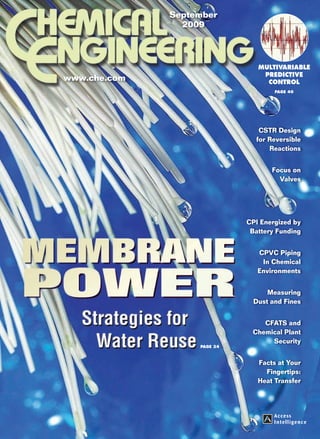
September
                                                                                2009


                                                                                                Multivariable
                                                                                                 Predictive
                                                                www.che.com                       control
                                                                                                     Page 40

             9
StrategieS for water reuSe • Multivariable Predictive control


                                                                                                CSTR Design
                                                                                               for Reversible
                                                                                                   Reactions


                                                                                                    Focus on
                                                                                                      Valves


                                                                                             CPI Energized by
                                                                                              Battery Funding


                                                                                                CPVC Piping
                                                                                                 In Chemical
                                                                                                Environments


                                                                                                   Measuring
                                                                                               Dust and Fines


                                                                                                 CFATS and
                                                                                              Chemical Plant
                                                                                                   Security
                                                                                   Page 34


                                                                                                Facts at Your
vol. 116 no. 9 SePteMber 2009


                                                                                                  Fingertips:
                                                                                                Heat Transfer


          •
Circle 01 on p. 62 or go to adlinks.che.com/23018-01
Circle 04 on p. 62 or go to adlinks.che.com/23018-04
Silverson’s high shear Batch mixers don’t just mix; they
emulsify, homogenize, solubilize, suspend, disperse
and disintegrate solids. Every high shear Batch mixer in
our range significantly outperforms conventional mixers by
cutting processing times by up to 90% while improving
quality, product consistency and process efficiency.


                           Silverson High Shear
                         Batch Mixers will:
                         • Process from 1 to 8000 gallons
                         • Eliminate agglomerates and
                           fish eyes
                         • Create stable emulsions
                           and suspensions
                         • Reduce particle size
                         • Rapidly dissolve solids
                         • Accelerate reactions

                         For more information or
                         a free trial give us a call @
                         800.204.6400


                                   Mixing at the speed of


                                   silverson.com
           Circle 13 on p. 62 or go to adlinks.che.com/23018-13
September 2009                                    In ThIs Issue                                        Volume 116, no. 9

                                                                                                       Commentary
                                                                                                       5 Editor’s Page
                                                                                                          Honoring in-
                                                                                                          novation The
                                                                                                          Kirkpatrick Chemi-
                                                                                                          cal Engineering
              www.che.com                                                                                 Achievement Award
                                                                                                          has honored the
                                                                                                          most noteworthy,
Cover story
                                                                                                          commercialized,
34 Cover Story Strategies For                                                                             chemical engineer-
   Water Reuse Membrane                                                                                   ing technologies
   technologies increase the                                                                              since 1933. This
   sustainability of industrial pro-                                                                      year’s five finalists
   cesses by enabling large-scale                                                                         have been selected
   water reuse
                                                                                                       departments
neWs
                                                                                                       Letters . . . . . . . . . 6
11 Chementator A cost-effective
   process for recycling wastewater; A pro-                                                            Bookshelf . . . . . 8, 9
   tective coating helps fine powders flow,        46 Engineering Practice CSTR Design for
                                                      Reversible Reactions Here, a design ap-          Who’s Who . . . . 31A
   without agglomeration; Process optimi-
   zation software allows rapid setup, cost           proach for continuous stirred-tank reactors      Reader Service
   savings; More efforts to make biofuels             is outlined for three cases of second-order      page . . . . . . . . . . 62
   from algae ... and from microorganisms;            reactions                                        Economic
   New heating technique improves zeolite          50 Engineering Practice CPVC Piping in              Indicators . . . 63, 64
   membrane performance; Pt-free catalysts            Chemical Environments: Evaluating the
   promise to lower fuel-cell costs ... as does       Safety Record No torches, fewer burn             advertisers
   reducing the Pt load; This process may             hazards and outstanding fire characteristics
   produce electricity from low-temperature                                                            Product Showcase . 56
                                                      make CPVC a safe, effective alternative for
   geothermal resources; An activated car-            industrial piping                                Classified
   bon for picking up heavy metals; Fast                                                               Advertising . . 57–60
   digestion makes better use of municipal         equipment & serviCes
   sludge; and more                                                                                    Advertiser Index . 61
                                                   32D-1 ISA Show Preview (Domestic
16 Newsfront CPI Energized By Battery                 Edition) These power supplies are op-            Coming in
    Funding The U.S. Dept. of Energy awards           timized for driving inductive loads; A           oCtober
    $1.5 billion to scale up battery production       new gage with data-logging feature is
                                                                                                       Look for: Feature
    for electric-powered cars                         introduced; This oxidation-and-reduction
                                                                                                       Reports on Filtra-
                                                      potential sensor is built to last; Measure
21 Newsfront Chemical Plant Security                                                                   tion; and Flowmeters;
                                                      water and CO2 to low ppm range with
    While security has long been a concern for                                                         an Environmental
                                                      this gas analyzer; Industrial electronics firm
    the CPI, impending regulatory changes (to                                                          Manager article on
                                                      offers a host of new products; Customers
    CFATS) have everyone’s attention                                                                   Preventing Dust Explo-
                                                      can configure these valves using online
                                                                                                       sions; an Engineer-
engineering                                           tools; and more
                                                                                                       ing Practice article
24 Solids Processing Measuring Dust and            32I-2 New Products & Services (Interna-             on Compressed Gas
    Fines in Polymer Pellets The ability to           tional Edition) Coriolis meters for low-flow     Cylinder Safety; A
    carry out such measurements can help              applications; An optimum valve for recip-        Focus on Analyzers;
    operators improve quality control, assess         rocating pumps; This thermocouple con-           News articles on
    equipment performance and optimize the            nector communicates wirelessly; A kneader        Chemical Engineering
    process                                           for high-fill, rigid-PVC compounding; Save       Salaries; and Pressure
                                                      space with a new size of mini ball valves;       Measurement & Con-
31B Facts At Your Fingertips Heat Transfer            Monitor processes remotely with this sta-        trol; Facts at Your
    This one-page guide outlines consider-            tion; and more                                   Fingertips on Corro-
    ations for designing a heat-transfer system
                                                   54 Focus Valves New radial diaphragm                sion; and more
40 Feature Report Multivariable Predictive            valves improve “cleanability”; Achieve lower
    Control: The Scope is Wider Than You              air leakage with these rotary valves; These      Cover: Double-walled
    Think With tighter integration between            sampling valves are designed for ease of         hollow-fiber ultrafiltra-
    process units and more aggressive opti-           use; This rotary valve is designed for com-      tion membranes are
    mization goals, this technique is gaining         plete shutoff and long life; Use this device     widely used in water
    attention throughout the CPI as an alterna-       to lock out plug valves; This valve is de-       treatment
    tive to PID control                               signed for slurries and corrosives; and more     The Dow Chemical Co.

                                                                  ChemiCal engineering www.Che.Com September 2009                    3
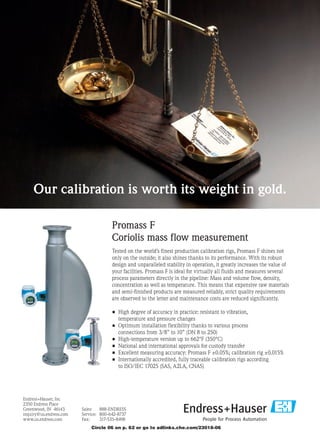
Our calibration is worth its weight in gold.

                                       Promass F
                                       Coriolis mass flow measurement
                                       Tested on the world’s finest production calibration rigs, Promass F shines not
                                       only on the outside; it also shines thanks to its performance. With its robust
                                       design and unparalleled stability in operation, it greatly increases the value of
                                       your facilities. Promass F is ideal for virtually all fluids and measures several
                                       process parameters directly in the pipeline: Mass and volume flow, density,
                                       concentration as well as temperature. This means that expensive raw materials
                                       and semi-finished products are measured reliably, strict quality requirements
                                       are observed to the letter and maintenance costs are reduced significantly.

                                       • High degree of accuracy in practice: resistant to vibration,
                                         temperature and pressure changes
                                       • Optimum installation flexibility thanks to various process
                                         connections from 3/8” to 10” (DN 8 to 250)
                                       • High-temperature version up to 662°F (350°C)
                                       • National and international approvals for custody transfer
                                       • Excellent measuring accuracy: Promass F ±0.05%; calibration rig ±0.015%
                                       • Internationally accredited, fully traceable calibration rigs according
                                         to ISO/IEC 17025 (SAS, A2LA, CNAS)


Endress+Hauser, Inc
2350 Endress Place
Greenwood, IN 46143      Sales:   888-ENDRESS
inquiry@us.endress.com   Service: 800-642-8737
www.us.endress.com       Fax:     317-535-8498
                             Circle 06 on p. 62 or go to adlinks.che.com/23018-06
Winner of Eight Jesse H. Neal
  Awards for Editorial Excellence
                                                                                   Editor’s Page


                Published since 1902
                                                                                  Honoring innovation
                                                                                  T
                An Access Intelligence Publication                                     he first round of judging in Chemical Engineering’s 2009 Kirkpatrick
PublisHEr                               Art & dEsiGN
                                                                                       Chemical Engineering Achievement Award competition (CE, January,
MikE O’rOurkE                           dAvid WHitcHEr                                 p. 19) has produced the following five finalists (in alphabetical order):
Publisher                               Art Director/                             •	The Dow Chemical Co. (Midland, Mich.) and BASF SE (Ludwigshafen,
morourke@che.com                        Editorial Production Manager
                                        dwhitcher@che.com                           Germany), for an industrial process for producing propylene oxide (PO)
EditOrs
                                        PrOductiON                                  via hydrogen peroxide
rEbEkkAH J. MArsHAll
Editor in Chief                         MicHAEl d. krAus                          •	DuPont (Wilmington, Del.), for commercializing Cerenol — a new family
                                        VP of Production & Manufacturing
rmarshall@che.com
                                        mkraus@accessintel.com
                                                                                    of high-performance polyether glycols made from corn-derived 1,3-pro-
dOrOtHy lOzOWski
Managing Editor                         stEvE OlsON                                 panediol (Bio-PDO)
dlozowski@che.com                       Director of Production &                  •	Lucite International (Southampton, U.K.), for its Alpha technology — a
                                        Manufacturing
GErAld ONdrEy (Frankfurt)               solson@accessintel.com                      new process for making methyl methacrylate (MMA)
Senior Editor
gondrey@che.com                         WilliAM c. GrAHAM                         •	Solvay S.A. (Brussels, Belgium), for its Epicerol process — a new process
                                        Ad Production Manager
kAtE tOrzEWski                          bgraham@che.com
                                                                                    for producing epichlorohydrin from glycerine
Assistant Editor
ktorzewski@che.com                      MArkEtiNG                                 •	Uhde GmbH (Dortmund) and Evonik Industries AG (Essen, both Ger-
scOtt JENkiNs                           HOlly rOuNtrEE                              many), for the HPPO process for making PO via H2O2
Associate Editor                        Marketing Manager
                                        hrountree@accessintel.com
                                                                                  From these five finalists — selected by heads of chemical engineering de-   de
sjenkins@che.com
                                        AudiENcE                                  partments of U.S. and European universities — the winner will be chosen by
cONtributiNG EditOrs                    dEvElOPMENt                               a board of judges composed of chemical-engineering-department heads that
suzANNE A. sHEllEy                      sylviA siErrA
sshelley@che.com                        Senior Vice President,
                                                                                  were selected by their peers. In the December issue, the winner will be an-an
cHArlEs butcHEr (U.K.)                  Corporate Audience Development            nounced, along with process details for all five technologies being honored.
                                        ssierra@accessintel.com
cbutcher@che.com                                                                     The aim of the biennial competition (established in 1933) is to honor the
PAul s. GrAd (Australia)                JOHN rOckWEll
pgrad@che.com                           Vice President,                           most noteworthy chemical engineering technology to have been commer-  commer
tEtsuO sAtOH (Japan)
                                        Audience Development Chemical             cialized during the previous two years, the key criteria being the novelty
                                        jrockwell@accessintel.com
tsatoh@che.com
                                        lAuriE HOfMANN
                                                                                  of the technology and the difficulty of the chemical engineering problems
JOy lEPrEE (New Jersey)                 Audience Marketing Director               encountered and solved. As editor of this magazine’s Chementator depart-
                                                                                                                                                         depart
jlepree@che.com
                                        lhofmann@Accessintel.com
GErAld PArkiNsON                                                                  ment, it gives me great pleasure to congratulate the chemical engineers
                                        tErry bEst
(California) gparkinson@che.com         Audience Development Manager              and chemists involved in developing these noteworthy process technolo-
                                                                                                                                                       technolo
EditOriAl                               tbest@accessintel.com                     gies because they — the people involved — are the ones being honored.
AdvisOry bOArd                          GEOrGE sEvEriNE                           It is through their efforts and innovations that keep the chemical process
                                        Fulfillment Manager
JOHN cArsON                             gseverine@accessintel.com                 industries (CPI) at the forefront of improving our standard of living, by
Jenike & Johanson, Inc.
dAvid dickEy                            JEN fElliNG                               enhancing the performance of products that are made and by reducing the
                                        List Sales, Statlistics (203) 778-8700
MixTech, Inc.
                                        j.felling@statlistics.com                 environmental impact of the methods used to make them.
MukEsH dOblE                            cONfErENcEs                                  Each of the five process technologies being honored involve alternative
IIT Madras, India
HENry kistEr                            dANA d. cArEy                             routes with “greener” feedstocks, when compared with the conventional
                                        Director, Global Event Sponsorships
Fluor Corp.
                                        dcarey@chemweek.com
                                                                                  routes used to making the products. They all tout lower energy consump-
                                                                                                                                                      consump
trEvOr klEtz                                                                      tion, reduced side products and, thus, lower production costs. And while
Loughborough University, U.K.           PEck siM
GErHArd krEysA
                                        Senior Manager,                           their employers will be happiest about the “bottom-line” advantages, we
                                        Conference Programming
DECHEMA e.V.                            psim@chemweek.com                         residents of planet Earth can take some comfort that efforts to cut costs
rAM rAMAcHANdrAN                        bEAtriz suArEz                            also reduce the impact to our climate, the air we breath, the water we drink
BOC
                                        Director of Conference Operations
                                        bsuarez@chemweek.com
                                                                                  and the land in which we grow our food.
iNfOrMAtiON sErvicEs
rObErt PAciOrEk                         cOrPOrAtE                                    While the five finalists now join a distinguished list of former Kirkpat-
Senior VP & Chief Information Officer   stEvE bArbEr                              rick honorees, they, and the nominees not making the final round, already
rpaciorek@accessintel.com               VP, Financial Planning & Internal Audit
                                        sbarber@accessintel.com
                                                                                  belong to an ever-growing list of companies and the engineers and chem- chem
cHArlEs sANds
Senior Developer                        briAN NEssEN                              ists they employ to continuously improve the process technologies used to
Web/business Applications Architect     Group Publisher                           make products.
csands@accessintel.com                  bnessen@accessintel.com
                                                                                     CE takes pride in honoring these achievements every two years with the
HEAdquArtErs
                                                                                  Kirkpatrick Chemical Engineering Achievement Award, every two alter-     alter
110 William Street, 11th Floor, New York, NY 10038, U.S.
Tel: 212-621-4900                         Fax: 212-621-4694                       nate years with the Personal Achievement Award, and
EurOPEAN EditOriAl OfficEs                                                        every month in the Chementator department. Readers
Zeilweg 44, D-60439 Frankfurt am Main, Germany                                    of CE regularly look to those pages to keep abreast of
Tel: 49-69-2547-2073                   Fax: 49-69-5700-2484
                                                                                  the latest process technology and equipment innova-innova
circulAtiON rEquEsts:
Tel: 847-564-9290                          Fax: 847-564-9453
                                                                                  tions that have been discovered, scaled up or commer-
                                                                                                                                    commer
Fullfillment Manager; P.O. Box 3588,                                              cialized for the first time. If you are working on such a
Northbrook, IL 60065-3588        email: clientservices@che.com
                                                                                  process and believe you and your employer deserve to
AdvErtisiNG rEquEsts: see p. 62
                                                                                  be recognized, too, please let us know; we’d love to hear
For photocopy or reuse requests: 800-772-3350 or info@copyright.com
For reprints: chemicalengineering@theygsgroup.com                                 from you.                                                 n
                                                                                                                             Gerald Ondrey
                                                                                                  ChemiCal engineering www.Che.Com September 2009          5
Raymond® & Bartlett-Snow™
          Thermal Equipment & Systems
                                                                                               Letters
          Raymond and Bartlett-Snow
                          ®                        ™


          products have been success-
          fully providing solutions for                                                      Honoring the man
          thermal process applications                                                       behind the scenes
          involving chemical, petro-                                                         The readers of Chemical En-
          chemical, ceramic, magnetic,                                                       gineering rarely get an inside
          metals, food, fertilizer, plastic,                                                 look at how this publication
          industrial solid waste and                                                         is put together. Since it would
          nuclear industries. For over a                                                     easily have gone undetected,
          century, we have provided                                                          we wish to recognize a long-
          innovative and dependable                                                          standing tradition that is
          equipment and systems for                                                          coming to a close. The October
          the changing needs of these industries worldwide.                                  issue will mark the first issue
                                                                                             in 50 years that does not involve Bill Graham, the person
                                                           Rotary Calciners                  who handles our print production.
                                                             Rotary Dryers                      Our readers do not know him, but most of our advertis-
                                                                                             ers have communicated with him in one way or another
                                                            Rotary Coolers                   since Aug. 24, 1959 (photo). For our readers, he has put
                                                              Rotary Kilns                   together an award winning publication every month and
                                                                                             never asked to be recognized. For our salespeople, he has
                                                              Flash Dryers
                                                                                             worked endless times to squeeze in a last minute ad or to
                                                                                             try to get a better position for one of their clients. For the
                                                 4525 Weaver Pkwy, Warrenville, IL 60555
                                                                                             editors, he is the one who puts together the puzzle and
                                                 Toll free: 877.661.5509                     makes everything fit each month.
                                                 Tel: 630.393.1000 • Fax: 630.393.1001
                       Air Preheater Company
                       Raymond Operations        Email: info@airpreheatercompany.com
                                                                                                Over the last 50 years, a lot of things have changed in the
                                                                                             publishing industry. When Bill started, we had prepress
                  TM


                                www.bartlettsnow.com                                         rooms, typesetting and negatives for all of the advertise-
         Circle 07 on p. 62 or go to adlinks.che.com/23018-07                                ments. These days everything is done digitally. Bill has
                                                                                             mastered the production work regardless of how it was done.
                                                                                                Bill has been many things to me since I joined Chemical
                                                                                             Engineering. He has been my historian, mentor and co-
                                                                                             worker, but mostly he has been my friend, and I am going
                                                                                             to miss him. Thank you, Bill, for your 50 years of service!
                                                                                                                                  Mike O’Rourke, Publisher
                                                                                                                                     Chemical Engineering

                                                                                             True loyalty deserves recognition
                                                                                             Over one’s career, colleagues frequently come and go —
                                                                                             sometimes without much pomp or circumstance mark-
                                                                                             ing their departures. In fact, an employee with five or
                                                                                             more years working with a single company has come to
                                                                                             be thought of as relatively loyal by today’s standards. A
                                                                                             higher exhibit of loyalty, however, is why we take pause
                                                                                             to honor our colleague Bill Graham, who, with this issue,
            HIGH ACCURACY FLOW METERS                                                        celebrates 50 years with Chemical Engineering.
          FOR HIGH TEMPERATURES                                                                 Bill has devoted his entire career to this publication and
                                                                                             holds it in the highest esteem. He never seeks recogni-
                 AND HIGH PRESSURES
                                                                                             tion and yet has been a key contributor to its success. The
                                                                                             magazine would never be what it is today without his flex-
          –   non-intrusive ultrasonic clamp-on technology                                   ibility, advice, hard work and, above all else, respect for
          –   for temperatures up to 750 °F
          –   independent of process pressure
                                                                                             the reader.
          –   multi-beam for high accuracy                        www.flexim.com                As our previous Editor-in-Chief once reassured me upon
                                                                  usinfo@flexim.com
          –   wide turn down                                                                 the departure of another colleague, there has never been,
          –   installation without process shut down              FLEXIM Instruments LLC     and never will be, a single individual whose exit would
          –   no maintenance                                      CA: (510) 420-6995         cause this magazine to cease publication. But Bill’s depar-
          –   no pressure loss                                    NY: (631) 492-2300
          –   standard volume calculation                         TX: (281) 635-2423         ture does mark the end of an era here. It will be another
                                                                                             32 years, at the very least, before we can celebrate an em-
          TYPICAL APPLICATIONS:
                                                                                             ployee’s 50 year anniversary. Thank you for your loyalty,
          HEAT TRANSFER OILS | BITUMEN | PITCH/TAR | COKER FEED | CRUDE OILS/SYNTHETIC       Bill. We will miss you.
          CRUDE | GAS OILS | REFINED PETROLEUM PRODUCTS | HOT OR TOXIC CHEMICALS                                    Rebekkah Marshall, Editor in Chief
                                                                                                                                  Chemical Engineering
         Circle 08 on p. 62 or go to adlinks.che.com/23018-08
        6 ChemiCal engineering www.Che.Com September 2009

87_Flexim-Anzeige-ChemEngin 1                                             11.01.2008 11:18:49 Uh
Do you see a dragon?
             We also see a challenge to reduce carbon
            footprints by using energy more efficiently.
      Veolia Energy develops and implements sustainable solutions such as cogeneration
      (capturing and converting heat into energy), renewable energy resources and
       optimized efficiency of customers’ on-site infrastructure and complex equipment.
        In 2008, the energy efficiency we created provided carbon emission reductions
          in excess of 6.2 million tons of carbon dioxide.

                  The environment is our universal challenge.


Learn more about the high-quality energy and facility operations and management           veolianorthamerica.com
services we have implemented for the Galleria Shopping Center in Houston.
                             Circle 09 on p. 62 or go to adlinks.che.com/23018-09
Bookshelf


Guidelines for Chemical Transportation Safety, Security, and         Chapter one introduces trans-
Risk Management, 2nd Edition. By the Center for Chemical          portation risk management, as
Process Safety/AIChE. John Wiley & Sons, Inc. 111 River           well as key stakeholders in the
St., Hoboken, NJ 07030. Web: wiley.com. 2008. 166 pages.          supply chain and risk management
$125.00                                                           process. Chapter two discusses
                                                                  baseline programs for safety and
Reviewed by: Stanley S. Grossel,                                  security management for all modes of hazardous material
Process Safety & Design Consultant, Clifton, N.J.                 transport that need to be in place prior to a risk analysis.
                                                                     Risk assessment fundamentals are discussed in Chap-


H
        azardous chemical transport poses significant pub-        ter three, as is a protocol for conducting transportation
        lic health and environmental risks. In 1995, the          risk assessments. Chapter four focuses on qualitative and
        CCPS published “Guidelines for Chemical Trans-            semi-qualitative techniques that can be used to analyze
portation Risk Analysis.” The book reviews risk analysis          the safe transport of hazardous materials. Chapter five
techniques used to evaluate chemical transportation oper-         provides an overview of quantitative risk analysis (QRA)
ations. The new edition serves as a complement to, rather         techniques for evaluating hazardous materials transpor-
than a replacement for, the 1995 edition, and the earlier         tation issues, including data sources and requirements,
guidelines are included in CD form along with four other          analysis techniques, and the generation and interpreta-
appendices. The new publication addresses transporta-             tion of quantitative risk results.
tion security and risk management broadly and provides               Chapter six presents current security guidelines and
tools and methods for a wider range of transportation             regulations, and a methodology for adapting and apply-
professionals and stakeholders. In particular, it introduces      ing security vulnerability assessment (SVA) techniques
qualitative and practical techniques for identifying and          designed for fixed chemical facilities to account for the
managing higher-level risk issues that balance safety and         differences specific to transportation. Risk reduction
security. Together, the two books can help effectively ana-       strategies are discussed in Chapter seven, which provides
lyze and manage chemical transportation risk.                     guidance on developing risk reduction strategies and


                                                     From formulation to wastewater treatment, Myron L
                                                     Water Quality Instruments provide accurate reliable
                                                     measurements of key parameters:
                                                     CONDUCTIVITY, RESISTIVITY, TDS,
                                                     ORP, PH & TEMPERATURE


                                                                                                     Monitor/
                                                      Ultrameter II 6P™      TechPro II TPH1™       controllers        pDS Meter ™

                                                          See our full line of quality instruments at www.myronl.com
    MADE IN USA
                                                               2450 Impala Drive Carlsbad, CA 92010 Tel: 760-438-2021 Fax: 760-931-9189

                                 Circle 10 on p. 62 or go to adlinks.che.com/23018-10
8     ChemiCal engineering www.Che.Com september 2009
highlights the factors that influence the different types
of safety and security measures that can be selected and
ultimately implemented. The book concludes with tips for
keeping risk management practices current with chang-
ing trends and regulations. It is an excellent information
source for those involved with chemical transport safety.

                 Petroleum Microbiology, Concepts,
                 Environmental Implications, In-
                 dustrial Applications, vols. 1 and 2.
                 By Jean-Paul Vandecasteele. Editions
                 Technip, 25 rue Ginoux, 75015 Paris,
                 France. Web: editionstechnip.com. 2008.
                 816 pages. $200.00

                 Scaling Analysis in Modeling
                 Transport and Reaction Processes:
                 A Systematic Approach to Model
                 Building and the Art of Approxima-
                 tion. By William Krantz. John Wiley
                 and Sons, 111 River Road, Hoboken, NJ
                 07030. Web: wiley.com. 2007. 529 pages.
                 $115.00.

                 Polymer Melt Processing: Founda-
                 tions in Fluid Mechanics and Heat           Circle 11 on p. 62 or go to adlinks.che.com/23018-11
                 Transfer. By Morton Denn. Cambridge
                 Univ. Press, 32 Avenue of the Americas,
                 New York, NY 10013-2473. Web: cam-
                 bridge.org. 2008. 250 pages. $99.00.

                 Reactive Distillation Design and
                 Control. By William Luyben and
                 Cheng-Ching Yu. John Wiley and Sons,
                 111 River Road, Hoboken, NJ 07030.
                 Web: wiley.com. 2008. 574 pages.
                 $130.00.

                 Diffusion: Mass Transfer in Fluid
                 Systems, 3rd Ed. by E.L. Cussler.
                 Cambridge University Press, 32 Av-
                 enue of the Americas, New York, NY
                 10013-2473. Web: cambridge.org. 2009.
                 631 pages. $80.00.

                 Nanotechnology: Basic Calcula-
                 tions for Engineers and Scientists.
                 By Louis Theodore. John Wiley and
                 Sons, 111 River Road, Hoboken, NJ
                 07030. Web: wiley.com. 2006. 459 pages.
                 $105.00.

                 Nano and Microsensors for Chemi-
                 cal and Biological Terrorism Sur-
                 veillance. Edited by Jeffrey Tok. RSC
                 Publishing, Milton Road, Cambridge,
                 CB4 0WF, UK. Web: rsc.org. 208 pages.
                 $148.00.                              ■
                                            Scott Jenkins
                                                             Circle 12 on p. 62 or go to adlinks.che.com/23018-12
                                                              ChemiCal engineering www.Che.Com september 2009 9
Circle 20 on p. 62 or go to adlinks.che.com/23018-20
Edited by Gerald Ondrey                                                                                                               September 2009

                                                        Untreated        Process              Oxygen and air injection
                                                        water            control              controlled by DO and
                                                                                              pH feedback loops                      Oxygen

A cost-effective process                                                                                  Return flow
                                                                                                          used for oxygenation
for recycling wastewater                                                                                  and process mixing

                                                                                                                             Air

A   wastewater treatment process that con-                             Bioreactor

    sumes less energy, produces less sludge                                                          Membrane                DO = dissolved O2
and makes available up to 75% of the water                                                            modules
                                                                                                                             RO = reverse osmosis
for reuse — including that of potable water                                                    Separation of biomass
quality — has been commercialized by                                                               /treated water
                                                                                                                   Treated
Linde Gases, a division of The Linde Group                                                       RO process         water           Water reuse/
(Munich, Germany; www.linde.com). The so-                            Bio-treatment             and water reuse                     final disposal
                                                                    and oxygenation
called Axenis process is suitable for treating
wastewater with soluble organic pollutants,                     The return flow from the UF membranes
such as that generated by biodiesel produc-                  is used for injecting O2 and air, and to                Making a C–F bond
tion and the food, dairy, paper-and-pulp, pig-               achieve mixing in the MBR, thereby elimi-               Pharmaceuticals and agro-
ments and cellulose (starches) industries,                   nating the need for an additional aeration              chemicals often incorporate
says Darren Gurney, process engineer at                      device and agitator, says Gurney. This con-             a fluorine atom within their
Linde Gases. Axenis handles wastewater                       figuration also has the effect of recovering            molecular structure to improve
with COD (chemical oxygen demand) lev-                       some of the energy needed for separation, he            properties, such as keeping the
els in the range of 2,000 to 100,000 mg/L,                   says. The controlled use of O2 (for biological          body from metabolizing a drug
he says.                                                     treatment) and air (to control pH) enables              too rapidly. However, adding a
   Axenis utilizes the patented, oxygen-based                the MBR to operate at about 5–10°C higher               fluorine to an aromatic ring at a
Vairox technology in a membrane bioreactor                   than conventional MBRs without the associ-              late stage of the synthesis can
                                                                                                                     be difficult and expensive due
(MBR) in combination with cross-flow ultra-                  ated production of surplus biological sludge.
                                                                                                                     to the harsh conditions needed
filtration (UF) and reverse osmosis (RO) in                  Operating at this higher temperature can                by traditional methods. Now,
an integrated, automated unit. In the pro-                   lead to a 10% or more increase in flux rate.            chemists at the Massachusetts
cess (flowsheet), wastewater is first fed to an              As a result, the reactor can be at least one-           Institute of Technology (MIT;
MBR, where bacteria oxidize the COD into                     half, and in some cases, as much as one-third           Cambridge; www.mit.edu) have
CO2 and water. The waste stream is then                      the size of conventional MBRs for the same              devised a new way to add a flu-
pumped through a tubular UF (cutoff range                    capacity, says Gurney.                                  orine atom to an aromatic com-
of 0.001 to 0.03 microns) membrane module                       The first commercial reference of Axenis             pound with a single catalytic
to remove suspended solids. Finally, RO is                   — a retrofit at a U.K. company treating 2               step. In the reaction, a palladium
used to remove dissolved inorganic com-                      m.t./d (metric tons per day) of COD — is now            catalyst is used to exchange a
                                                                                                                     triflate group (CF3SO3–) with a
pounds. Final water quality with BOD (bio-                   being built, and Gurney anticipates the first
                                                                                                                     fluoride ion, which is taken from
logical oxygen demand) and suspended sol-                    greenfield application to be announced in 6             a salt such as CeF.
ids levels of less than 5 mg/L are achieved.                 mo., with startup in 2010.


A protective coating helps fine powders flow, without agglomeration
A  team from Monash Institute of Phar-
   maceutical Science at Monash Uni-
versity (Melbourne, Australia; www.
                                                         Corp. (Osaka, Japan; www.hosokawami-
                                                         cron.co.jp/en) — that has a specially de-
                                                         signed fast blade, providing a fast mov-
                                                                                                         croscopy revealed significant differences
                                                                                                         in morphology: untreated and mixed
                                                                                                         batches were mostly agglomerated or had
pharm.monash.edu.au), has developed                      ing compressive surface. The process the        particles with smooth surfaces and sharp
an approach — a hybrid mixing and                        team has developed involves coating the         edges, whereas the Mechanofusion-pro-
milling process — for producing fine                     particles with a nano-layer of an addi-         cessed samples were de-agglomerated,
(1–20 µm) pharmaceutical powders with                    tive, which is polished into the particles’     and had rounded edges due to the attri-
good flow and de-agglomeration prop-                     surface. The coating is believed to im-         tion and deformation during the high-
erties. Team leader David Morton says                    prove flow properties by reducing inter-        shear dry-coating process. Changes in
similar methods have been applied for                    particle forces.                                surface textures indicated that the addi-
bulk pigments and ceramics, but are not                     Fine-milled lactose samples were used        tive had effectively coated the particles.
generally known for such fine and cohe-                  as model cohesive pharmaceutical pow-              The dry-coating process leads to a
sive powders that tend to form clumps                    ders, and about 1–2 wt.% magnesium              substantial improvement in flow prop-
that stick stubbornly together.                          stearate served as the additive. For com-       erties for these fine lactose powders.
  The team used a very high shear sys-                   parison, the samples were processed in          Changes in powder-packing structure
tem — a Nobilta “Mechanofusion” pro-                     a conventional mixer and the Mechano-           are thought to be responsible for an ob-
cessor developed by Hosokawa Micron                      fusion processor. Scanning electron mi-         served doubling of the pour density.
Note: For more information, circle the 3-digit number
on p. 62, or use the website designation.                                             CHeMICal eNgINeerINg www.CHe.COM SePTeMber 2009               11
C hementato R

                                                                                                       More efficient smelting
Process optimization software                                                                          the energy efficiency at two
                                                                                                       record-breaking aluminum
allows rapid setup, cost savings                                                                       smelters in the middle east has
                                                                                                       been increased by 18%, thanks

N   ew industrial process-optimization soft-
    ware can be fully operational in seven
days — months ahead of existing predic-
                                                   recipe requirements that need constant
                                                   correction, the software reduces out-of-
                                                   specification product and improves process
                                                                                                       to abb’s (Zurich, switzerland;
                                                                                                       www.abb.com) new rectiform-
                                                                                                       ers — the high-power compo-
tive monitoring systems, according to Slip-        efficiency. Companies can realize a 1–5% in-        nents that control and convert
stream Software (Alpharetta, Ga.; www.slip-        crease in efficiency, which, in a typical chem-     alternating current from the
                                                                                                       grid to direct current needed to
streamrpm.com). The company’s proprietary          ical plant, could mean a few million dollars
                                                                                                       power the electrolytic process
data-modeling tools are responsible for the        of savings annually, explains company CEO           and produce molten al in pots.
reduced setup time. By mining process his-         Gary Hopkins. In addition, predictive pro-          the rectiformers were devel-
tory information, and collecting data from         cess systems can take four to six months            oped for the sohar al smelter
sensors installed in the process stream,           of engineering time to set up, and can cost         in sultanate of oman, which
Slipstream software “dynamically reads,            close to $1 million. Slipstream software can        consists of 360 pots and pro-
models and auto-corrects customer recipes,”        achieve the same functionality in a week for        duces up to 360,000 ton/yr of
the company says.                                  around one-fifth of the price, he adds.             al — the world’s largest potline
   The process optimization software can be           According to Slipstream, a Belgian food-         (startup June 2008) — and
used in wet processes (using infrared spec-        additive manufacturer using its software            the Qatalum smelter in Qatar,
                                                                                                       which will become the world’s
troscopy as the basis for the sensors) or dry      saw a 4% efficiency jump, and a paper-pulp
                                                                                                       largest aluminum smelter when
(using characteristic sound vibrations) and        maker saw its profits jump by 20% after in-         it starts up in late 2009, with a
is designed to interface with a plant’s dis-       stalling the pattern modeling software.             production capacity of 585,000
tributed control (DCS) or supervisory con-            The new software represents an addition          ton/yr and 704 pots.
trol and data acquisition (SCADA) system.          to the company’s portfolio of root cause ana-           For these massive projects,
   Designed for industrial processes with          lytics products.                                    abb was able to extend the
                                                                                                       voltage limit of the rectiform-
                                                                                                       ers from 1,200 V d.c. to 1,650
More efforts to make biofuels from algae . . .                                                         V d.c. (for sohar) and 2,000 V
                                                                                                       d.c. for Qatalum. this enables
O  ver the past few weeks there has been
   a number of announcements on proj-
ects aimed to further develop algae-to-fu-
                                                     Meanwhile, petroleum major ExxonMo-
                                                   bil (Irvine, Tex.; www.exxonmobil.com) has
                                                   formed an alliance with Synthetic Genomics
                                                                                                       the devices to convert and
                                                                                                       deliver more power than previ-
                                                                                                       ously possible. as a result,
els technology (see also, “Pond Strength,”         Inc. (SGI; La Jolla, Calif.; www.syntheticge-       each smelter requires only five
CE, September 2008, pp. 22–25). Plankton           nomics.com) to develop next generation bio-         rectiformers instead of the six
Power (Wellfleet; www.planktonpower.com)           fuels from algae, following earlier leads by        needed at the lower voltage,
and the Regional Technology Development            Shell (CE, January 2008, p. 15), Akzo-Nobel         resulting in a “huge” savings in
Corp. of Cape Cod (RTDC; Woods Hole, both          (CE, July 2008, p. 16) and ConocoPhillips           investment, says abb.
Mass.; www.regionaltechcorp.org) have              (www.che.com, July 2, 2008).
formed a consortium to establish the Cape            In July, The Dow Chemical Co. (Midland,           Ag/polymer reflector
Cod Algae Biorefinery, which will focus on         Mich.; www.dow.com) said it would work              scientists at skyFuel inc.
pilot- and commercial-scale development of         with Algenol Biofuels, Inc. (Bonita Springs,        (arvada, Colo.; www.skyfuel.
algae-based biodiesel. The proposed biore-         Fla.; www.algenolbiofuels.com) to build and         com) and the national re-
finery will be located on 5 acres of land          operate a pilot-scale, algae-based integrated       newable energy laboratory
at the Massachusetts Military Reserva-             biorefinery to make ethanol.                        (golden, Colo.; www.nrel.gov)
tion (Bourne). Starting in the fall of 2010,         In Germany, scientists at the Karlsruhe           have developed a silvered
Plankton Power expects to produce 1-mil-           Institute of Technology (Germany; www.              polymer film as a less expen-
                                                                                                       sive alternative to glass mirror
lion gal/yr of biodiesel in pilot-scale opera-     kit.edu) are developing a closed, vertically
                                                                                                       reflectors. Curved sheets of
tions, using the company’s cold-saltwater          arranged photobioreactor that is said to            the reflective material are used
algae species. Commercial-scale operations         be five-times more efficient at converting          in solar troughs, which reflect
on 100 acres could produce 100-million gal/        solar energy into biomass than open ponds.          concentrated solar radiation on
yr, which would meet 5% of the demand for          A pulsed electric treatment process is also         a tube filled with a heat transfer
diesel and home heating fuel in the state of       being developed at KIT for extracting oils          fluid. Developers claim the cost
Massachusetts, says the firm.                      and other chemicals from biomass.                   advantage of the multi-layered
                                                                                                       polymer material is 30% when
                                                                                                       compared to glass mirrors,
. . . and from microorganisms                                                                          which are more expensive,
                                                                                                       heavier and more difficult to
L  ast month, BP Corp. (London; www.bp.com)
   signed a joint-development agreement with
Martek Biosciences Corp. (Columbia, Md.;
                                                   cept for large-scale, cost-effective production
                                                   of microbial biodiesel. The concept is to utilize
                                                   microorganisms to ferment sugars into lipids,
                                                                                                       install for collecting solar radia-
                                                                                                       tion. a pilot system including
                                                                                                       the polymer-silver reflectors is
www.martek.com) to work on the production          which will then be processed into liquid fuels.     operational at skyFuel’s facility
of microbial oils for biofuels applications. The   BP is contributing $10 million to the initial       in arvada, Colo.
two companies aim to establish proof of con-       phase of the collaboration.
    12   ChemiCal engineering www.Che.Com september 2009
New MAK & BAT values
                                                                                                  the senate Commission for
                                                                                                  the investigation of health haz-
                                                                                                  ards of Chemical Compounds
                                                                                                  in the work area, established
New heating technique improves                                                                    by the german research
zeolite membrane performance                                                                      Foundation (DFg; bonn) has
                                                                                                  issued the maK (maximum

A  dding a rapid heat-treatment step to the      Grain boundary defects form during calcina-      concentration at the workplace)
   process of making zeolite membranes           tion, a heating process required to remove       and bat (biological tolerance)
improves separation performance by elimi-        structure-directing agents (SDAs) from zeo-      Values list for 2009, which
                                                                                                  contains 62 changes and new
nating grain boundary defects, according to      lite pores. SDAs are added during synthesis
                                                                                                  entries. these include revised
researchers from the University of Minne-        to define zeolite pore size and shape.           assessments of oxides of nitro-
sota (UMN; Minneapolis, Minn.; www.umn.             The research group developed a rapid ther-    gen, and zinc and its inorganic
edu), who published their study in the July      mal processing (RTP) technique that may          compounds.
31 issue of Science.                             strengthen bonding between adjacent zeolite         although the trace element
   The study could inform efforts aimed at       crystal grains prior to removal of the SDAs.     zinc, which is ingested through
producing zeolite films for gas, liquid and      In RTP, an infrared-lamp-based furnace is        food, is a component of impor-
vapor membrane separations processes, as         used to heat synthesized zeolite membranes       tant enzymes, it can have toxic
well as for hybrid membrane-distillation         to 700°C within one minute prior to removal      effects on the lungs if inhaled.
processes that separate industrial mixtures.     of the SDAs. The elevated temperature is         therefore, the maximum con-
                                                                                                  centration of zinc oxide fumes
If zeolite membranes could be fabricated to      maintained for 30 s to 2 min before the mem-
                                                                                                  in the breathing air to which
deliver expected performance in flux and se-     brane is cooled by water circulation.            workers can be exposed without
lectivity, they could reduce the energy costs       Tsapatsis hypothesizes that the increased     suffering adverse health effects
associated with distillation by 10-fold, notes   crystal-to-crystal bonding — which may re-       is considerably lower than was
professor Michael Tsapatsis, a UMN chemi-        sult from condensation reactions of Si-OH        previously stated, says the DFg.
cal engineer who led the research.               groups on neighboring crystals — reduces the     there are also seven revisions
   Large-scale production of zeolite films has   development of cracks and grain boundary         or alterations in the carcino-
been plagued by the formation of cracks and      defects in the membrane. When SDAs were          genic substances category,
grain boundary defects. Membrane defects         removed in a subsequent heating step, the        including the categorization of
degrade selectivity by allowing molecules to     researchers observed an increased selectiv-      the chromates (except lead and
                                                                                                  barium chromate) as carcino-
bypass the zeolite pores that are designed       ity when the RTP-treated zeolite films were
                                                                                                  genic to humans. the complete
to discriminate among mixture components.        used to separate o-xylene from p-xylene.         list can be downloaded at www.
                                                                                                  dfg.de.


Pt-free catalysts promise to lower fuel-cell costs . . .                                          Dust explosion advice
                                                                                                  the U.s. occupational safety
S  howa Denko K.K. (Tokyo; www.sdk.co.jp/
   html/english) has developed a platinum-
substitute catalyst system for polymer elec-
                                                 efficiency, in terms of open-circuit voltage
                                                 and durability, among non-Pt catalysts an-
                                                 nounced so far. Enhanced durability has also
                                                                                                  and health admin. (osha;
                                                                                                  washington, D.C.; www.osha.
                                                                                                  gov) has recently published
trolyte fuel cells (PEFCs) under the New         been observed, with operation extending to       a new guidance document
Energy and Industrial Technology Devel-          more than 10,000 h, says the firm.               — hazard Communication
opment Organization’s (NEDO; Kawasaki,              Production costs for the new catalysts are    guidance for Combustible
Japan) project led by professor Kenichiro        about ¥500/kW ($5/kW), or less, which is         Dusts — that helps chemical
Ota of Yokohama National University. The         about 1/20th that of today’s Pt-based cata-      manufacturers and importers
new catalysts — based on niobium oxide           lysts. The company is working to improve         to recognize the potential
and titanium oxide, each containing nitro-       the catalyst performance using fine-particle     for dust explosions, identify
                                                                                                  appropriate protective measures
gen and carbon atoms — are used in both          manufacturing technologies and high-con-
                                                                                                  and the requirements for
the cathode and anode of a PEFC and are          ductivity carbon, and anticipates commer-        disseminating this information
said to achieve the world’s highest level of     cial production by 2015.                         on material safety data sheets
                                                                                                  and labels. the document can
                                                                                                  be downloaded from osha’s
. . . as does reducing the Pt load                                                                website for free.


A  technique for making PEFC elec-
   trodes with one fourth the amount
of platinum catalyst compared to con-
                                            materials with a high performance level
                                            when used in the membrane-electrode
                                            assembly (MEA) of PEFCs. Naitou fabri-
                                                                                        generation characteristics as conven-
                                                                                        tional systems even when reducing the
                                                                                        Pt content by 75%. The enhanced cata-
ventional PEFCs has been developed by       cated the composite catalyst, composed      lyst activity is thought to be the result of
Hosokawa Micron Corp. (Osaka, Japan;        of commercially available platinum-car-     increasing the electrochemically active
www.hosokawamicron.co.jp/en) in col-        bon particles and tungsten-carbide par-     surface created by MCB technology. The
laboration with professors Kiyoshi Ka-      ticles. Kanamura fabricated the MEA by      researchers believe the Pt load can be
namura, Tokyo Metropolitan University,      incorporating a Nafion membrane, and        reduced by 90% through optimizing the
and Makio Naitou, Osaka University.         evaluated the MEA’s power-generation        fine structure of the particles. Hosokawa
The method, known as mechanochemical        characteristics.                            Micron is continuing to improve its AMS-
bonding (MCB), produces stable, complex        The scientists obtained similar power-   Mini device for MCB applications.
                                                                     ChemiCal engineering www.Che.Com september 2009          13
C hementato R


This process may produce electricity
from low-temperature geothermal resources
T  he world has vast geothermal re-
   sources in the temperature range
of 150–250°F, but these temperatures
                                             ratory fellow Peter McGrail. “We have
                                             synthesized a number of MOHCs,” he
                                             says, “and the best ones we have discov-
                                                                                          as particles of less than 100 nm and ad-
                                                                                          sorbs as much as 30 wt.% of the fluid, so
                                                                                          that the working density of the alkane
are too low for economical exploitation,     ered so far have a latent heat of adsorp-    is not reduced. He adds that the MOHCs
using today’s technology. A process          tion that is 20 times the standard heat      are inexpensive and the main question
that could change the benchmark is           of vaporization of the working fluid.”       is whether the nanoparticles will with-
being developed at Pacific Northwest            McGrail declines to give details on       stand longterm cycling. PNNL plans to
National Laboratory (PNNL, Richland,         the composition of the MOHCs, but says       answer that question with a bench-scale,
Wash.; www.pnl.gov).                         the material is dispersed in the alkane      electricity-generating prototype unit.
   PNNL’s process would pump hot water
from a geothermal reservoir and extract
heat into a working fluid through a heat
exchanger, a conventional process. The
                                             An activated carbon for picking up heavy metals
new twist is that PNNL uses a bipha-
sic working fluid. It consists of a metal-
organic heat carrier (MOHC) suspended
                                             T he Agricultural Research Service
                                               (ARS, Beltsville, Md.; www.ars.usda.
                                             gov) has received a patent on a process
                                                                                          tons/yr of litter, according to the ARS.
                                                                                            The process was developed and has
                                                                                          been laboratory-tested at the ARS
in, for example, butane, pentane or pro-     for producing activated carbon from          Southern Regional Research Center
pane, which drives a turbine via a Rank-     poultry litter, which consists of bedding    (New Orleans, La.). Litter is ground
ine cycle. The biphasic fluid’s properties   materials such as sawdust and peanut         into a fine powder, pelletized, then py-
promise to boost the power-generation        shells, along with droppings and feath-      rolyzed at 1,300–1,500°F in a nitrogen
capacity of the turbine to near that of a    ers. U.S.-grown broiler chickens and tur-    atmosphere. Unlike conventional acti-
conventional steam turbine, says Labo-       keys produce an estimated 15-million         vated carbon, produced from coal, the


                     Lower operating costs
                             with variable pitch rotary screw vacuum pumps


                                                                                         COBRA variable pitch dry screw
                                                                                         pumps help optimize vacuum
                                                                                         efficiency and reduce operating
                                                                                         costs by combining high flow rates
                                                                                         with low power consumption and
                                                                                         reduced utilities.
                                                                                         Contact us today for a free cost
                                                                                         analysis for your process application.


          Visit us at the
           Chem Show
         November 17-19
          New York, NY
           Booth #210


                                    Circle 14 on p. 62 or go to adlinks.che.com/23018-14
    14   ChemiCal engineering www.Che.Com september 2009
Fast digestion makes better use of municipal sludge
T  he use of residual sludge from munici-
   pal sewage plants as fertilizer in ag-
riculture is controversial (due to heavy
                                            vest in the technology that is now state-
                                            of-the art in larger plants, according to
                                            a cost-benefit analysis performed by the
                                                                                         tems. About 60% of the organic matter is
                                                                                         converted into biogas. Using the biogas
                                                                                         to make electricity to run the plant, and
metals and other pollutants), and slurry    Fraunhofer Institute for Interfacial En-     the reduced volume of sludge needed to
can no longer be disposed of in landfills   gineering and Biotechnology (IGB; Stut-      be disposed of, can save the operator of a
in many countries. A less expensive al-     tgart, Germany; www.igb.fraunhofer.de).      small (28,000 inhabitants) sewage plant
ternative to incineration — high-rate di-      In the fast-digestion process developed   about €170,000/yr, according to IGB.
gestion of sludge into biogas — can lead    at IGB, sludge only needs to remain in
to substantial savings (even for small      the tower for 5–7 d instead of 30–50 d        Waste-heat recovery
sewage plants) despite the need to in-      as typical for conventional digestion sys-
                                                                                          GE Energy (Atlanta, Ga.; www.ge.com/
                                                                                          energy) and ECOS Ltd. (Slovenia) plan
                                                                                          to demonstrate a new waste-heat re-
                                                                                          covery system that is expected to boost
ARS material has a relatively high con-     roughly $1/kg for coal-derived carbon.        the electrical efficiency of a 7.2-MW
centration of phosphorous, which adds       However, she points out that conven-          biogas power plant by five percentage
a negative charge. This enables the car-    tional activated carbon is commonly           points. GE’s pilot ORC (organic Rankin
bon to adsorb heavy metal ions, such as     used to adsorb organics. The adsorption       cycle) waste-heat recovery system will
those of cadmium, copper, lead and zinc,    of metal ions would require post-treated      allow ECOS to capture more waste
says Isabel Lima, a research chemist at     carbon or ionic resins, both of which         heat created by its Bioplinarne Lendava
the center.                                 are much more expensive. Lima says            biogas plant, in eastern Slovenia. The
                                                                                          extra thermal power will be used to pro-
  Lima estimates that the process could     the technology is open for licensing by
                                                                                          duce steam, which in turn will generate
produce activated carbon for about          companies interested in building small        more electricity. ❏
$1.44/kg, or 65¢/lb. This compares with     plants in poultry-producing areas.     ■


                                                               Circle 15 on p. 62 or go to adlinks.che.com/23018-15
Li slab   Transition metal slab


 Newsfront


CPI ENErgIzEd by
battEry FUNdINg
        DOE Awards $1.5 billion to scale up battery
          production for electric-powered cars


E
      fforts toward large-scale produc-      technologies for road vehicles.
      tion of lithium-ion (Li-ion)-based        In an Aug. 5 speech to announce the
      car batteries got a big boost in       funding, U.S. Energy Secretary Ste-                     Transition
                                                                                           Li site   metal site   Oxygen site
      early August, when the Obama           ven Chu stated that the grants were
Administration announced $2.4 billion        handed out “not simply to boost a few       Figure 1. The structure of layered metal
in U.S. government investment aimed,         companies, but to start an entire ad-       oxides is similar among several types of
                                                                                         cathode materials used in Li-ion batteries
in part, at dramatically ramping up          vanced battery industry in America.”
                                                                                         that are designed specifically for hybrid
the supply chain for advanced batter-           The $2.4 billion in grants represents    electric and plug-in electric vehicles
ies for the auto industry. A majority of     the single biggest government invest-
this funding is funneling directly into      ment in electric vehicles ever. “It’s a     phate material, the crystal structure
the chemical process industries (CPI),       big deal,” says Jennifer Watts, com-        of which contains intercalated lithium
which are responsible for developing         munications manager at the Electric         ions (Figure 1). The dominant cathode
and commercializing the necessary            Drive Transportation Assn. (Washing-        material in batteries for portable elec-
technology. But CPI companies in-            ton, D.C.; www.electricdrive.org). Es-      tronic devices has been lithium cobalt
volved in this area will be challenged       tablishing a domestic manufacturing         oxide (LiCoO2), a material that is too
to produce batteries that meet the per-      base for advanced batteries is critical     costly and that carries too many safety
formance needs of the auto industry at       to the future of the auto industry, and     concerns to be used in HEV/PHEV bat-
affordable cost.                             the grant funding shows that govern-        teries. The DOE grant awards (Table
   Part of the recent economic stimulus      ment and industry “are on the same          1) support large-scale production of
package (American Recovery and Re-           page,” she commented.                       batteries containing several cathode
investment Act), the U.S. Dept. of En-          Meanwhile, it gives a shot in the arm    types, each exhibiting a unique struc-
ergy’s (DOE; Washington, D.C.; www.          to an already expanding market for          ture and different metal contents.
energy.gov) Electric Drive and Vehicle       battery technologies. Mid-August esti-         One approach to synthesizing cath-
Battery and Component Manufactur-            mates from the market research firm         odes that can handle automobile en-
ing Initiative awarded the $2.4 billion      Innovative Research and Products Inc.       vironments involves a metal oxide
in grants to 48 different battery-tech-      (iRAP; Stamford, Conn.; www.innore-         structure that includes manganese and
nology and electric-vehicle projects in      search.net) place the global market for     nickel along with cobalt. Known as an
20 states. Of the $2.4 billion total, $1.5   large-format Li-ion batteries for trans-    NMC cathode, the material forms the
billion in grants went to manufactur-        portation at $77 million in 2009. HEVs      basis of a proprietary battery technol-
ers of batteries or their components,        and PHEVs currently represent a neg-        ogy called superior lithium polymer
while the remaining $900 million went        ligible portion of that total. The global   battery (SLPB). SLPBs may be attrac-
to makers of electric drive components       market for Li-ion batteries in transpor-    tive to automakers because the technol-
and vehicles themselves. Each DOE-           tation is projected to reach $332 mil-      ogy has already been commercialized
grant dollar will be matched by invest-      lion by 2014, with electric automobiles     for specialized military and industrial
ments from the awardees.                     accounting for $87 million. Heavy-duty      applications. Dow Kokam, a joint ven-
   The auto industry is poised to roll out   hybrid electric vehicles (buses, train      ture of the Dow Chemical Co. (Mid-
new hybrid electric and plug-in hybrid       engines, trucks) will garner the largest    land, Mich.; www.dow.com) and Kokam
electric vehicles (HEVs and PHEVs) in        portion of the market, at $150 million      America (Lee’s Summit, Mo.; www.
the next several years, and are depend-      by 2014, iRAP projects.                     kokamamerica.com), was awarded $161
ing on a ready supply of automotive-                                                     million in DOE funds to produce SLPBs
grade Li-ion batteries. But the lack         Varying cathode approaches                  for the HEV/PHEV markets.
of manufacturing capacity has been           Among the crucial factors affecting            The NMC cathodes employed in the
a bottleneck, especially for U.S. auto-      battery performance, safety and cost, is    SLPB batteries exhibit low imped-
makers. The competitively awarded            the cathode active material. Cathodes       ance, good safety characteristics and
DOE grants accelerate progress toward        for Li-ion batteries generally consist      rapid charge and discharge, says Ravi
scaling-up production of viable battery      of layered metal oxide or metal phos-       Shanker, corporate director of Ven-
16   ChemiCal engineering www.Che.Com September 2009
A solution in every drop of
                                       water. In the simple bond of hydrogen and
                                       oxygen, the complexity of human need presents
                                       itself. But if we apply chemistry, using the Human
                                       Element as our filter, we discover solutions as vital as
                                       water itself. Solutions like advanced desalination and
                                       re-use technology from Dow Water Solutions that
                                       make the purification and recycling of municipal
                                       water possible.


                                       Dow Water Solutions’ reverse osmosis technology
                                       is at work in three wastewater reclamation and
                                       reuse facilities in Beijing, China. Reverse osmosis
                                       technology enables Beijing to meet its 50 percent

www.dow.com/hu
                                       wastewater reuse rate for the 2008 Beijing Olympic
®™The DOW Diamond Logo and Human       Games this summer. It also helps address growing
Element and design are trademarks of
The Dow Chemical Company © 2008        worldwide       demand   for   water    and    China’s
                                       own commitment to conservation and reuse. Caring
                                       for man is caring for the future of mankind.
                                       And that is what The Dow Chemical Company
                                       is all about.


                                       www.dowwatersolutions.com

                                       Circle 16 on p. 62 or go to adlinks.che.com/23018-16
Company name            Award           Technology                                               Editor's notes
  (project locations)     amount (in
                          millions of
                          U.S. dollars)
  Johnson Controls        299.2           Production of nickel-cobalt-metal battery cells and      Converted Michigan facil-
  Inc. (Holland, Mich.;                   packs, as well as production of battery separators (by   ity to be operational by
  Lebanon, Ore.)                          partner Entek) for hybrid and electric vehicles          end of 2010
  A123 Systems Inc.       249.1           Manufacturing of nano-iron phosphate cathode pow-        Initial public stock offering
  (Romulus, Mich.;                        der and electrode coatings; fabrication of battery       coming soon
  Brownstown, Mich.)                      cells and modules; and assembly of complete battery
                                          pack systems for hybrid and electric vehicles
  Dow Kokam (Mid-         161.0           Production of manganese-oxide cathode / graphite Li-     Battery production slated
  land, Mich.)                            ion batteries for hybrid and electric vehicles           for 2011
  Compact Power Inc.      151.4           Production of Li-polymer battery cells for the General   Manganese spinel-struc-
  – LG Chem Ltd. (St.                     Motors Volt using a manganese-based cathode and a        tured cathode material
  Clair, Pontiac and                      proprietary separator
  Holland, Mich. )
  EnerDel Inc. (India-    118.5           Production of Li-ion cells and packs for hybrid and      Initial capacity increase
  napolis, Ind.)                          electric vehicles. Primary lithium chemistries include   at existing plants, followed
                                          manganese spinel cathode and lithium titanate            by later purchase of new
                                          anode for high-power applications, as well as manga-     facilities space
                                          nese spinel cathode and amorphous carbon for high-
                                          energy applications


Table 1. Selected DOE grant recipients in the areas of battery, cell and materials manufacturing
under the Electric Drive and Vehicle Battery and Component Manufacturing Initiative                (Source: U.S. Department of Energy)

tures and Business Development at            The venture plans to begin con-          When operational, Dow Kokam ex-
Dow. In addition, NMC cathodes have        struction of an 800,000-ft2 SLPB plant     pects the facility to produce enough
40% higher energy density than that        in Midland, Mich. this autumn. SLPBs       batteries to supply 60,000 HEVs/
of another cathode material alterna-       will likely appear in road automobiles     PHEVs annually.
tive, lithium iron phosphate.              in 12–18 months, Shanker projects.           NMC cathode material is also the


                                                               The new RecipCOM delivers
                                                                 diagnostics, protection
                                                                   and therapy for your
                                                               reciprocating compressors.
                                                                              Spread the word!
Company name               Award           Technology                                                Editor's notes
(project locations)        amount (in
                           millions of
                           U.S. dollars)
General Motors             105.9           Production of high-volume battery packs for the GM        Chevy Volt anticipated to
Corp. (Brownstown,                         Volt. Cells will be from LG Chem and other cell provid-   be launched at the end of
Mich.)                                     ers to be named later                                     2010
Saft America Inc.          95.5            Production of Li-ion cells, modules and battery packs     New plant to make Li-ion
(Jacksonville, Fla.)                       for industrial and agricultural vehicles and defense      batteries for military, avia-
                                           application markets. Primary chemistries include          tion, energy storage
                                           nickel-cobalt-metal and iron phosphate
Celgard LLC – Poly-        49.2            Production of polymer separator material for Li-ion       Funding will help expand
pore (Charlotte,                           batteries                                                 existing plant and build
N.C.; Aiken, S.C.)                                                                                   new one
Toda America Inc.          35              Production of nickel-cobalt-metal cathode material for    Experienced metal oxide
(Goose Creek, S.C.)                        lithium-ion batteries                                     producer
Chemetall Foote            28.4            Production of battery-grade lithium carbonate and         Raw material production
Corp. (Nev.; N.C.)                         lithium hydroxide
Honeywell Interna-         27.3            Production of electrolyte salt (lithium hexafluorophos-   First U.S. producer of LiPF6
tional Inc. (N.Y.; Ill.)                   phate, or LiPF6) for Li-ion batteries
BASF Catalysts LLC         24.6            Production of nickel-cobalt-metal cathode material for    New plant operational in
(Elyria, Ohio)                             Li-ion batteries                                          2012


  choice of another DOE grant recipient.         materials, explains that NMC-type          BASF hopes to begin production of the
  BASF Catalysts LLC (Iselin, N.J.; cat-         cathodes contain only about one third      cathode material.
  alysts.basf.com) was awarded almost            the cobalt in LiCoO2 cathodes, allow-        Johnson Controls Inc. (JCI; Milwau-
  $25 million to help build a plant in           ing a corresponding price reduction.       kee, Wis.; www.johnsoncontrols.com)
  Elyria, Ohio for production of cathode         NMC-type cathodes “offer the best          recipient of the single largest DoE
  powders. Prashant Chintawar, BASF              combination of cost, safety and per-       award ($299 million), will produce
  senior manager for advanced cathode            formance,” adds Chintawar. By 2012,        batteries containing another layered


                                                                                                                                     www.hoerbiger.com


                                                                                                     Circle 18 on p. 62 or go to
                                                                                                     adlinks.che.com/23018-18


                                                                                              For more information please contact
                                                                                          compressor-mechatronics@hoerbiger.com
Newsfront


metal-oxide cathode — nickel-cobalt-       to be available in late 2010. Compact                    new space that will allow capacity
aluminum (NCA). Adding a small             Power was awarded a $151-million                         to grow to 60,000 packs by 2012 and
amount of aluminum improves cath-          DOE grant to scale up production of                      120,000 by 2015, EnerDel says.
ode performance at low cost, said Mi-      batteries with the Mn-spinel cathode,                       A different cathode technology un-
chael Andrew, director of government       which has better thermal stability and                   derlies batteries developed by A123
affairs and external communications        can discharge at higher current than                     Systems, Inc. (Watertown, Mass.; www.
at JCI. Batteries with NCA cathodes        cobalt oxide cathodes, but has a lower                   a123systems.com), which received one
satisfy customer requirements in a         energy density.                                          of the largest awards (over $249 mil-
host of areas, including cost, abuse          Manganese spinel cathodes are the                     lion) from the DOE program. A123
tolerance, and peak power generation,      foundation of HEV/PHEV batteries at                      Systems’ nanostructured lithium-iron-
Andrew notes. Production will begin        another DOE awardee, EnerDel Inc.                        phosphate cathode, based on technol-
in summer 2010.                            (Indianapolis, Ind.; www.enerdel.com).                   ogy licensed from MIT (Cambridge,
  A manganese oxide cathode with a         The company’s vehicle-suitable batter-                   Mass.; www.mit.edu), employs par-
spinel structure also appears to have      ies couple a lithium-manganese-oxide                     ticles an order of magnitude smaller
gotten a vote from a major customer.       (LMO) spinel cathode with a lithium                      (100 nm versus 10 µm) than conven-
Battery cells made by LG Chem (Seoul,      titanate anode to boost power. This                      tional lithium cobalt oxide cathode
S. Korea; www.lgchem.com) with Mn-         chemistry “provides the best power-to-                   material. Coupled with a proprietary
spinel cathodes will be part of battery    size ratio that we’ve seen, high safety                  doping technique to improve intrinsic
packs assembled by Compact Power           levels, and excellent cold-cranking capa-                conductivity, the smaller particle size
Inc. (Troy, Mich.; www.compactpower.       bility,” said EnerDel CEO Ulrik Grape.                   allows high discharge power and fast
com) for General Motors’ (Detroit,         EnerDel’s $118-million DOE grant will                    recharging. Lithium iron phosphate
Mich.; www.gm.com) PHEV, the Chevy         aid an expansion that includes increas-                  batteries have more favorable safety
Volt. Compact Power and its parent,        ing production capacity to 20,000 HEV/                   characteristics than cobalt oxide, and
LG Chem, were selected as suppli-          PHEV battery packs at existing facili-                   A123 will use its DOE award to sup-
ers for the Volt, which is anticipated     ties, followed later by the purchase of                                     (Continues on p. 23)


 Check Valves
 Built                               � Easily
                                                                                                       � 3A Compliant: third party

 to Your
                                                                                                           verified. 32Ra, finer finishes
                                          Disassembled:                                                    also available.
                                          spare parts
                                          available.


 Check
                                                                                                          � No Pooling: eliminates
                                                                                                              the pooling found in
                                 � Retrofit: for use                                                          globe-type bodies.


 List.
                                    in new or existing
                                    sanitary ferrules
                                    and replaces the
                                    gasket.                                                                 � Space Saving: compact;
                                                                                                                 seals on ferrule ID and
                                                                                                                 uses only one clamp.


  www.checkall.com
     West Des Moines, Iowa USA
     Phone: 515-224-2301                     US Patent Numbers: 5,033,503; 6,039,073; & 6,152,171
     sales@checkall.com                      Canadian Patent Number: 2,039,991                                                 Since 1958

                                 Circle 19 on p. 62 or go to adlinks.che.com/23018-19
20     ChemiCal engineering www.Che.Com September 2009
Source: Roberts Law Group PLLC


 Newsfront


 ChemiCal plant
                                                                                                                    Required if
                                                                                                                    1) the facility
                                                                                                                    possesses any of the
                                                                                                                    chemicals, at the
                                                                                                                    threshold quantities,


 seCurity
                                                                                                                    listed in Appendix A
                                                                                                                    or 2) the facility is
                                                                            DHS                                     directed to do so
                                                                                                                    by DHS

                                                                          Top screen
                                                                                                                        Not regulated
                                                   Does present a                             Does not present              Monitor
                                                   high level of                              a high level of               for material
                                                   security risk                              security risk                 modifications

                                                                         Security                  Final tier                Site Security
                                                     Regulated           Vulnerability             determination             Plan (SSP)
                                                                         Assessment (SVA)
  While security has long                                                                          and SVA review

                                                     Material
 been a concern for the CPI,                         modifications?
                                                                           Compliance and
                                                                           recordkeeping
                                                                                                    DHS reviews the SSP and conducts a
                                                                                                    facility inspection. If not approved,
                                                  Submit revised
impending changes to CFATS                        Top screen
                                                                                                    deficiencies must be corrected. The
                                                                                                    approved SSP is implemented

 have everyone’s attention                                          Figure 1. The CFATS process is summarized in this flowchart


S
       ecurity at many U.S. chemical fa-    dix A, which lists approximately 300            plan (SSP) to DHS within 120 days.
       cilities is currently regulated by   chemicals of interest (COI) and their           Roberts says that the first 140 or so
       the U.S. Department of Home-         individual screening threshold quanti-          “final tier letters” were sent out in May
       land Security (DHS; Washington,      ties (STQ), was published in November           2009, followed by about another 400 in
D.C.; www.dhs.gov) under the Chemi-         of the same year. In May 2009, a docu-          June. More tier letters are forthcoming.
cal Facility Anti-Terrorism Standard        ment entitled Risk-Based Performance            Those companies in receipt of the let-
(CFATS). This rule, however, is about       Standards Guidance was published.               ters are now in the stage of submitting
to expire next month, October 2009.         This guide elaborates on the eighteen           their SSPs. DHS will review the SSPs
All expectations are that CFATS will        risk-based performance standards                and determine compliance. However,
be extended for a year, while proposed      (RBPSs) that are established in CFATS,          “because the regulations are perfor-
modifications to the standard continue      and identifies the areas for which a fa-        mance-based and risk-driven, what
to be debated in the U.S. Congress.         cility’s security will be examined, such        ‘compliance’ means can change from
    As they work to comply with             as perimeter security, access control,          facility to facility,” says Roberts. He fur-
CFATS, the chemical process indus-          personnel surety (a check on personnel          ther explains that denial leads to fur-
tries (CPI) are keeping a watchful eye      credentials) and cyber security.                ther consultation and “The process of
on the Congressional proceedings that          Compliance with CFATS begins with            compliance [with CFATS] is continuous
are leading to proposed changes in the      an assessment tool developed by DHS             as facilities change.” Roberts refers to a
regulation.“CFATS — it is by far the        called the Top-Screen, to assist DHS in         chart as a quick summary of the overall
most dramatic issue affecting chemi-        determining which chemical facilities           CFATS compliance process (Figure 1).
cal plant security today,” notes Robert     meet the criteria for being high-risk.
Hile, director of integrated security so-   Sites possessing chemicals as listed in         The big issues
lutions at Siemens Building Technolo-       Appendix A at or above the STQs must            There doesn’t seem to be any disagree-
gies, Inc. (Buffalo Grove, Ill.; www.usa.   submit the Top-Screen questionnaire to          ment among the CPI that security
siemens.com/security).                      DHS for review. As Steve Roberts, an at-        regulations are a good idea. In fact the
                                            torney who specializes in CFATS issues          Society of Chemical Manufacturers
CFATS in action                             (Roberts Law Group PLLC; Houston;               and Affiliates (SOCMA; Washington
CFATS has come a long way in a short        www.chemicalsecurity.com) explains,             D.C.; www.socma.com) commends the
time. The approval of the DHS Appro-        those facilities deemed high-level risk         U.S. Senate for approving legislation
priations Act in October 2006 gave the      are then required to submit a security          that would extend existing chemical
DHS authority to regulate the security      vulnerability assessment (SVA), after           security standards for one year. The
of high-risk chemical facilities. CFATS,    which a facility is categorized into a          American Chemistry Council (ACC;
the implementing regulation, was pub-       final risk tier. These facilities must          Arlington, Va.; www.americanchemis-
lished in April 2007 and its Appen-         then develop and submit a site security         try.com) notes that security has long
                                                                      ChemiCal engineering www.Che.Com September 2009                   21
ADT Advanced Integration


 Newsfront


been a priority for its members, who        Figure 2. Ground retract-
have invested about $8 billion on fa-       able automobile barriers
                                            (GRAB) stop the unauthorized
cility security enhancements under          entry of vehicles up to 15,000
ACC’s Responsible Care Security Code.       lb, traveling at speeds up to 50
In a recently issued statement, Marty       miles per hour
Durbin, ACC’s vice president of Federal
Affairs says, “We believe the ongoing
implementation of the Chemical Fa-          it is appropriate for DHS to encourage       lowed. Jensen says that the ACC feels
cility Anti-Terrorism Standards dem-        the use of IST, but it should be on a vol-   adamantly that it is not necessary for
onstrates a smart and aggressive ap-        untary basis, possibly with incentives       courts to get involved. SOCMA’s All-
proach to both securing and protecting      (not necessarily financial) to facilities    mond notes that a citizen suit provi-
the economic viability of this essential    that implement it. SOCMA’s opposi-           sion is common in environmental law,
part of the nation’s infrastructure.”       tion to mandatory IST is founded on          but it doesn’t even seem feasible in a
   There also doesn’t seem to be any dis-   several fronts. First, IST within a se-      security framework since the details of
sension “on the Hill” about extending       curity framework is already addressed        a facility’s security plan would not be
CFATS. As she addressed the approxi-        by two other well-entrenched regula-         accessible to the public because they
mately 350 participants at the 2009         tions: 1) the U.S. Environmental Pro-        are deemed CVI (chemical-terrorism
Chemical Sector Security Summit held        tection Agency’s (EPA) Risk Manage-          vulnerability information), which is
in Baltimore, Md. on June 29 to July 1,     ment Program Rule (RMP); and 2) the          confidential and known only to DHS
Holly Idelson, majority counsel for the     U.S. Occupational Safety and Health          and designated facility employees.
Senate Homeland Security and Govern-        Admin.’s (OSHA) Process Safety Man-            While the IST and civil suits issues
ment Affairs Committee put it this way,     agement Regulation. A great concern          are the main areas of disagreement
“The debate is what should the program      is that a chemical deemed to be a safer      between the organizations represent-
be, not should there be a program.” Ms.     alternative might be mandated by             ing the CPI and the proposed House
Idelson made it clear that as the Senate    government officials without a full un-      bill, there are other areas of discus-
committee works on defining what the        derstanding of the many ramifications        sion. These questions include who
program should be, it welcomes input        of that chemical substitution.               should be covered in CFATS, such
from the CPI to let the members know           Allmond uses manufacturers of active      as when it comes to water-treatment
what is working and what is not work-       pharmaceutical ingredients (APIs) as         facilities and industrial versus agri-
ing in CFATS, saying, “Our [the Senate      an example of where unexpected com-          cultural uses of ammonium nitrate.
Committee’s] door is open.”                 plications could arise. API manufactur-      ACC’s Jensen puts it into perspective,
   Since the clock has just about run       ers go through a lengthy process of U.S.     though, when he says, “We [the CPI,
out for a standalone security bill this     Food and Drug Administration (FDA)           U.S. Congress and DHS] agree on
year, CFATS is well on its way to a         approvals. If, for example, a so-called      more than we disagree” including the
one-year extension. It is also expected     “safer alternative” compound were            overall objective of having permanent
that in this upcoming year discussions      mandated, this new compound might            Federal chemical security regulations.
about what a permanent rule should          require an untenable amount of retest-
look like will intensify. While the U.S.    ing before the switch could occur, and it    Integrators and suppliers
Senate has not yet formed its own ver-      might not be approved by the FDA.            As tiered facilities move forward with
sion of a bill, The House of Represen-         The ACC also opposes mandatory            their site plans, a number of companies
tatives has proposed a revision to the      IST. Scott Jensen, director of commu-        are positioning themselves to help with
current CFATS standard. The details         nications for ACC says that making           the process of CFATS compliance and
are where the dissension begins.            IST mandatory in a security regula-          implementation. Hile says that Siemens
   Bill Allmond, vice president of Gov-     tion brings “discomfort and concern          can help “from start to finish”, offering
ernment Relations and ChemStew-             for facility operators since determina-      “assistance from the very early stages
ards for SOCMA explains that the two        tion is based on one factor, whereas         all the way through to the implementa-
main points in the House’s bill that        a facility makes that determination          tion.” One form of assistance is a sur-
SOCMA opposes are: 1) mandated in-          based on many factors.” Jensen states        vey package that helps to break down
herently safer technologies (IST); and      simply that ACC’s position is that “it       CFATS into “layman’s” terms giving a
2) a civil suits clause.                    is not necessary to include [manda-          facility a sort of template to help form
   IST encompasses a wide breadth           tory] IST” in the security bill because      the SVA, and then further down the line
of chemical processing procedures,          the current CFATS program allows for         to help with the plan (SSP). Siemens is
equipment, protection and the use of        and encourages IST implementation.           poised to offer an array of surveillance
safer substances. Allmond states that          Both SOCMA and the ACC also               products and perimeter-intrusion-de-
SOCMA “adamantly opposes manda-             oppose the civil suits clause in the         tection systems. The majority of RBPSs
tory IST” and more to the point “What       House’s proposed legislature, which          in CFATS deal with the physical secu-
SOCMA opposes the most is getting           would allow any citizen to sue a com-        rity of a site, so these types of products
into [mandatory] chemical substitu-         pany if their perception is that the         are expected to be an important part of
tion.” He explains that SOCMA agrees        CFATS regulation is not being fol-           a site’s security plan.
22   ChemiCal engineering www.Che.Com September 2009
Andrew Wray, senior global market-       have been around for some time, but           at the Dow Chemical Co. puts it, “In se-
ing manager with Honeywell Process          never utilized in the private sector          curity you have a purposeful, intelligent
Solutions (Phoenix, Ariz.; www.honey-       the way they are now,” says Loughin           adversary. How do you measure that?”
well.com) says that to achieve increas-     as he gives examples of fiber-based           Still, Cosman and his colleagues on the
ing levels of security, more and more       fence detection, thermal imaging,             ISA99 Committee, with contributions
technology needs to be integrated.          video analytics and radar. “I believe         from other groups, such as ACC’s Chem
Honeywell is well-positioned to offer       the day of the six-foot chain-link fence      ITC, are making headway in defining
integration with a single system for        is over for the highest-risk facilities,”     cyber-security standards that will be
control, he adds. Looking ahead, Wray       he says, citing that K-rated and high-        applicable to a broad industry base. A
says that “as more and more systems         security-fencing and barrier technol-         concept gaining momentum is the de-
are integrated into the network, more       ogy are now being used (Figure 2).            velopment of security assurance levels
products need to make decisions ‘at         Loughin notes that ADT has Safety             (SALs), comparable to SILs. Cosman
the edge’.” To explain what he means        (Support Anti-terrorism by Fostering          says that the “SAL concept has a lot
by at the edge, Wray gives the example      Effective Technologies) Act Certifica-        of promise. It is going to get us some-
of a card reader at a facility perimeter.   tion for electronic security services.        where, I just don’t know how far.”
While the card reader likely has local      This DHS-designated certification is             John Cusimano, director of se-
decision-making capabilities, new           a way to manage the risk of liability,        curity solutions for exida (Sellers-
technology is emerging that will check      says Roberts, who advises companies           ville, Pa.; www.exida.com) explains
the integrity of the reader’s data prior    to consider Safety Act protection as a        that it has been a long process, but
to gaining access to the network.           factor when selecting a security ven-         the IT security and control-system
   “Integration of multiple technolo-       dor during the procurement process.           communities have successfully co-
gies is key,” agrees Ryan Loughin, di-                                                    operated to develop cyber standards
rector of the Petro-Chem and Energy         The cyber side                                and methodologies, and that “Re-
Div. of ADT Advanced Integration            While the bulk of CFATS focuses on            cently the safety system community
(Norristown, Pa.; www.adtbusiness.          the physical plant, it also addresses         has joined this effort, bringing [its]
com/petrochem-ce). He goes on to say        cyber security, which is undoubtedly          proven risk-mitigation engineering
that “The overall security philoso-         an integral part of overall security.         methods to the table.” Among other
phy at a plant is changing. Security        Part of the issue with regulating cyber       services, exida offers a Control Sys-
is now a program much like safety           security is how to quantify what level        tem Security Assessment to review
has been for years…CFATS is driv-           of cyber security one needs, or has. Ex-      the cyber-security environment of a
ing this program-related process.”          perts are using their experience with         facility and compare it with indus-
Loughin explains that a tiered facil-       safety standards to focus on this issue.      try best practices with recommen-
ity faces two basic threats: toxic re-         In the safety arena, metrics can be        dations to address possible gaps. As
lease, and theft and diversion. ADT’s       assigned according to probability on a        momentum increases in the efforts to
approach to working with a facility         scale of safety integrity levels (SILs; see   standardize cyber security, everyone
with one or both of these threats is        CE, Sept. 2007, pp. 69–74). Assigning         seems to agree in the prediction that
to consider three key factors: deter,       metrics to security, however, poses a big-    it will become a more integral part of
detect and delay. “Many of the tech-        ger challenge. As Eric Cosman, co-chair       future security regulations.           ■
nologies being used on these facilities     of the ISA99 Committee and who works                                Dorothy Lozowski

CPI EnErgIzEd                               consortium headed by the Karlsruhe            (Suwon, S. Korea; www.samsungsdi.
                 (Continued from p. 20)     Institute of Technology (Karlsruhe,           com) was selected by BMW (Munich;
port construction of a Michigan facil-      Germany; www.kit.edu) to develop              www.bmw.com) to supply Li-ion batter-
ity to produce battery component ma-        novel battery materials that will in-         ies for its “Megacity” electric vehicle.
terials, battery cells and battery packs    crease energy density in cells intended          Even as commercial production of
for HEVs and PHEVs.                         for electric vehicles.                        Li-ion batteries draws near, indus-
                                               Private sector players in Europe are       trial R&D moves forward on several
European battery activity                   positioning themselves for the advanced       fronts, including exploring new elec-
While the U.S. DOE grant program was        battery market as well. Evonik Indus-         trode material combinations and
grabbing attention in August, efforts       tries AG (Essen, Germany; www.evonik.         structures, as well as processing
to develop batteries for HEVs/PHEVs         com) and Daimler AG (Stuttgart, Ger-          improvements to lower cost and im-
continued elsewhere. In July, the Euro-     many; www.daimler.com) established a          prove consistency and quality. At the
pean Commission (Brussels, Belgium;         development and production partner-           same time, academic laboratories are
ec.europa.eu) identified “high-density      ship and launched plans to construct          further investigating the application
batteries” as a priority in its funding     a Li-ion battery plant in Kamenz, Ger-        of nanoscale engineering to electrode
to develop HEVs and PHEVs.                  many. Production will begin in 2011.          materials, reaction dynamics on elec-
  With €20 million from its own eco-        SB LiMotive, a joint venture of Robert        trode surfaces, novel electrode mate-
nomic stimulus package, the German          Bosch GmbH (Gerlingen, Germany;               rials and electrolytes.                  ■
government is setting up a research         www.bosch.com) and Samsung SDI                                            Scott Jenkins
                                                                    ChemiCal engineering www.Che.Com September 2009              23
Solids Processing


Measuring
Dust	and	Fines	                                                                                                 FIGURE 1. Many types of dust


In	Polymer	Pellets
                                                                                                                 and fines form during the han-
                                                                                                                  dling of bulk plastic pellets. A
                                                                                                                 single pellet is shown here for
                                                                                                                                size comparison

                                                                              9                                                          100

  The ability to carry out                                                    8                                                          90

 such measurements can                                                                                                                   80


                                                                                                                                               Cumulative fraction, vol. %
                                              Differential fraction, vol. %


                                                                              7


  help operators improve                                                      6
                                                                                                                                         70

                                                                                                                                         60
  quality control, assess                                                     5
                                                                                                                                         50

 equipment performance
                                                                              4
                                                                                                                                         40
                                                                              3
 and optimize the process                                                     2
                                                                                                                                         30

                                                                                                                                         20

                                                                              1                                                          10

Shrikant Dhodapkar                                                            0                                                          0
Remi Trottier                                                                     10    100                  1,000                   10,000
Billy Smith                                                                            Particle size, micrometers
The Dow Chemical Co.                          FIGURE 2. Pneumatic conveying systems routinely create dust and fines when
                                              moving polyethylene pellets. The size distribution shown here was measured
                                              using an image analyzer


P
         lastics are most commonly            collection	in	cyclones	(Figure	1).	The	                 nants in pellets can lead to numerous
         produced and sold in pellet          particle	size	distribution	of	dust	and	                 problems	 in	 the	 downstream	 pro-
         form due to the superior han-        fines	(Figure	2)	can	vary	depending	                    cesses, including the following:
         dling characteristics of pellets     on type of polymer, process condi-                      1.	Gel	formation	in	film	applications
in downstream applications. From              tions and specific hardware of the                      2.		 requent	clogging	of	filters	in	pneu-
                                                                                                         F
the moment the polymer is pelletized          handling system                                            matic conveying systems
from its molten state, the pellets or       •		 hips,	 undersize	 pellets,	 miscuts	
                                              C                                                       3.		 ross-contamination	 problems	 in	
                                                                                                         C
granules undergo a series of handling         and	broken	fragments	that	are	gen-                         multi-product plants
steps as they move from the producer          erated during pelletization, convey-                    4.	Defects	in	the	finished	product
to the consumer. For instance, post-          ing and collection in cyclones                          5.		 ariability	 of	 slip	 additives	 or	 pro-
                                                                                                         V
pelletization steps include:                •		 hopped	 or	 smashed	 pellets,	
                                              C                                                          cessing aids
•	Hydraulic	conveying                         so-called worms or smeared polymer                      6.		 olor	issues	(such	as	black	specks	or	
                                                                                                         C
•	Drying	(typically	via	spin	drying)          crumbs	that	are	generated	by	rotary	                       color	inconsistencies)	resulting	from	
•	In-process	pneumatic	conveying              airlocks	(feeders)                                         degraded fines dislodging from pro-
•	Silo	storage                              •		 roken	
                                              B            tails	    that	    result	                    cess	equipment
•		 ackaging	(via	bulk	shipment,	or	in	
  P                                           from     poor     pelletization    and                  7.		 rocess	 safety	 issues	 (such	 as	 in-
                                                                                                         P
  bags	or	boxes)                              subsequent	handling                                        creased	risk	of	dust	explosion	in	the	
•		 nloading	 (via	 pneumatic	 convey-
  U                                         •		 treamers,	 floss,	 angel	 hair,	 rib-
                                              S                                                          fines-collection	system)
  ing)	and	silo	storage                       bons	or	snake-skins	that	are	gener-                     8.		 ndustrial	 hygiene	 concerns	 associ-
                                                                                                         I
•	Conveying	to	processing	equipment           ated during pneumatic conveying                            ated	with	respirable	dust
•	Blending	and	feeding                        (Figure	3)                                              9.		 lugging	problems	at	various	stages	
                                                                                                         P
As	 a	 consequence	 of	 this	 repeated	     Many	 of	 the	 terms	 noted	 above	 are	                     of the end user’s process, resulting
handling, the	 pellets	 often	 become	      synonymous and thus are used inter-                          from streamers, floss, angel hair
contaminated with various unwanted          changeably,	 based on the shape and                          and	ribbons
species, namely:                            size.	Streamers	can	be	up	to	a	couple	                    10.	 Inconsistent	 pellet	 feedrates	 into	
•		 ust	 or	 fines	 that	 are	 generated	
  D                                         of meters in length.                                      	 		 he	throat	of	an	extruder,	resulting	in	
                                                                                                          t
  during pelletization, conveying and          The	 presence	 of	 these	 contami-                         gage variations of profiles and films
24   ChemiCal engineering www.Che.Com September 2009
Dust / fines


                                                                                    Tails and
                                                                                    short streamers


                                                                                           counterflowing air. This method is
                                                                                           quick but usually results in relatively
                                                                                           poor separation efficiency and high
                                                                                           variability. Separation via air classifi-
                                                                                           cation can also be affected by the rela-
                       12 in                                                               tive humidity of the elutriation air.
                                                                                              By contrast, wet classification is the
FIGURE 3. The steamers, floss, angel hair and
ribbons shown here are examples of the types                                               most effective method for separation of
of impurities that typically form when plastic                                             Group 1 species from pellets and gran-
pellets are pneumatically conveyed                                                         ules. Dispersing the pellets in a liquid
                                                                                           or washing them with a liquid breaks
FIGURE 4. This illustration shows how the separation of fines,                             down the attractive forces between
tails and short streamers can be improved when the wet separa-              Water
                                                                          flow with
                                                                                           the fines and the pellets, thereby al-
tion process incorporates a screen with elongated apertures                                lowing them to then be easily removed
                                                                         bubbling air
                                                                                           by	 mechanical	 separation.	 However,	
To alleviate these problems and de-            charges, the existence of waxy and          this approach adds a drying step to
liver the cleanest possible product to         sticky additives, and the presence          the measurement process.
the customer, many of today’s plastics         of fines at particularly small                 Demineralized water, ethanol or
producers use dust- and streamer-              particle sizes (< 50 µm) and low levels     a mixture of water and ethanol are
removal devices in their processes.            (< 50 ppm).                                 commonly used for washing. Safe han-
Further discussion of these devices is            This article summarizes the exist-       dling characteristics and inertness to
beyond the scope of this article.              ing standards for quantifying un-           the polymer (and its additives) are key
   Efforts to quantify the unwanted            wanted contaminants such as dust,           considerations when selecting the liq-
species in the plastic pellets have            fines and streamers in plastic pellets,     uid washing media.
long been a source of confusion,               discusses the limitations of these ap-         Group	 2 species are the most dif-
contention and miscommunication                proaches, and highlights some of the        ficult and challenging to separate
among plastic producers, users of              recent advances.                            from the pellets, since most separa-
the pellets (converters) and vendors                                                       tion techniques rely on differences in
of solids-handling equipment. Such             Measurement techniques                      particle size. The air-classification ap-
problems can be avoided if there is            In general, unwanted species contami-       proach can be used if the aerodynamic
mutual agreement by all stakehold-             nating a batch of plastic pellets can be    diameters of various fractions are sig-
ers on an appropriate standard for             broadly classified into three groups,       nificantly different and electrostatic
the measurement of dust, fines and             based on their size relative to the         forces are minimal.
streamers. A reliable, robust and well-        pellets or granules (the prime                 One may also exploit the differences
documented standard serves a variety           product) themselves:                        in shape for separation. For instance, a
of purposes including the following:           •		 roup 1 (size < pellets). Fines, dust,
                                                 G                                         new, innovative approach has been de-
•		 nsures	greater	quality	control	in	a	
   E                                             chips, fragments, undersize pellets,      veloped by the authors of this article,
   manufacturing process                         miscuts, smears, worms and ill-           to effectively separate Group 2 species
•		 rovides	 a	 basis	 for	 product	
   P                                             formed pellets                            from plastic pellets. The core idea is to
   specification                               •		 roup 2 (size ~ pellets).	 Tails,
                                                 G                                         use a rectangular aperture (such as a
•		 erves	 as	 a	 troubleshooting	 tool	 to	
   S                                             smears, worms and small streamers         wedge-wire screen) coupled with a wet
   relate pellet quality with process          •		 roup 3 (size > pellets). Stream-
                                                 G                                         washing approach, to separate the pel-
   conditions                                    ers, floss, angel hair, ribbons and       lets from the unwanted species.
•		 elps	 to	 identify	 opportunities	 for	
   H                                             snake skins                                  The width of the aperture is slightly
   process optimization                        Group	1 species can typically be sep-       smaller than the diameter of the pel-
•		 nables	 performance	 evaluation	 of	
   E                                           arated from the pellets by dry siev-        lets, which prevents them from pass-
   pellet-cleaning devices                     ing or air classification if there is no    ing	 through.	 However,	 the	 longer	 di-
A varied and creative collection of            tendency for the particles to adhere        mension of the aperture allows the
dust- and fines-measurement tech-              to the pellets, for instance, due to        tails, polymer smears, agglomerates
niques have evolved over the years             electrostatics, van der Waals forces,       and small streamers that are longer
based on experiences derived from a            surface tension and other adhesive          than the pellet size to pass through,
wide	 spectrum	 of	 applications.	 His-        tendencies. Anti-static additives are       along with the wash liquid (Figure 4).
torically, these techniques have been          used to minimize the electrostatic             Group	 3 species are most effec-
based on dry sieving or counter-flow           buildup.	 However,	 dry	 sieving	 is	       tively separated by dry screening. The
air-classification concepts.                   often unable to separate sticky fines       screener can be a vibrating type, or a
   However,	 for	 plastics	 applications,	     (such as those that are rich in             Trommel (rotating cylinder) type. For
the quality of data gathered using             waxy additives).                            a meaningful estimation, the sample
these methods is often compromised,              Using an air-classification approach,     size must be large enough to capture a
due to the presence of electrostatic           the finer fraction is elutriated by the     sufficient number of streamers.
                                                                      ChemiCal engineering www.Che.Com September 2009           25
Solids Processing                                                Column C2                            Column C1

                                                                                    Outlet, open only when*

Existing standards                          FIGURE 5. The
Today, there are three primary stan-        elements of the wet
                                            process that is de-
dards for measuring fines in plastic        fined in FEM-2482
pellets or granules, and each is dis-                                      Overflow pipe                               Column head
                                            are shown here
cussed below:
                                                                                                                       Retention
•		 EM-2482:	 Test method to de-
  F
                                                                                                                       sieve*
  termine the content of fines and
  streamers in plastic pellets (1999)                                              Retention
•		 STM	 D	 1921-06: Standard test
  A                                                                                medium                             Contaminated
                                                                                   for fines                          product
  method for particle size (sieve anal-
                                                                                   classification
  ysis) of plastic materials (2006)
•		 STM	 D	 7486-08: Standard test
  A
  method for measurement of fines
  and dust particles on plastic pellets                                                                                Support sieve

  by wet analysis (2008)

FEM-2482                                                                       Column foot
The European Federation of Materials
Handling (FEM) put forth a well-docu-                                                                                         Air
                                                                       Fluid                                                  supply*
mented and comprehensive procedure                                     pump          Throttle                           Air
(FEM-2482) in 1999 to address the                                                    valve                              filter*
ambiguity associated with measuring
fines and streamers in plastic pellets.
In this standard, the fines are defined
                                                                               M                Flowmeter          Throttle valve*
as the particle fraction below 500
µm. The lower limit of this fraction                              * Only if flotation mode 2 is used
depends on the needs of downstream
processes. Three classes of fines were      wet process with two possible operat-               retention sieve shown in Figure 5 is a
proposed, namely:                           ing modes.                                          500-µm wire mesh that prevents the
•	Type	A:	63 to 500 µm                      Mode 1. Fluidization mode is used                   pellets from being carried over to Col-
•	Type	B: 45 to 500 µm                      when the density of washing liquid is               umn C2.
•	Type	C:	20 to 500 µm                      lower than the true density of the pel-               The FEM-2482 standard also pro-
The process schematic for measure-          lets. A retention sieve (Figure 5) is not           vides details on various aspects of the
ment of fines using FEM-2482 is             used in Column C1 during fluidiza-                  measurement process, such as:
shown in Figure 5.                          tion mode. The upward velocity of the               •		 izing	and	configuration	of	
                                                                                                  S
   When it comes to plastic pellets, the    liquid is set according to the Stokes                 the apparatus
typical level of fines in the final prod-   velocity for the largest particle to be             •	Selection	of	classification	screens
uct can range from 10 to 2,000 ppm.         separated. The carryover fraction is                •	Ancillary	equipment
Pellets with fines content in excess of     further classified in Column C2.                    •		 election	of	guidelines	for	
                                                                                                  S
500 ppm are usually deemed “dusty.” It      Mode 2. Flotation mode is used when                   wash liquid
should be noted that the fines fraction     the density of the washing liquid is                •	Test	procedure
below 20 µm is not measured by this         higher than the density of the pellets.             •	Interpretation	of	results	
method, since this ultrafine fraction       Since water is the safe choice as the               •	Error	analysis
passes through the retention medium         washing liquid for most polyolefins pel-            Sampling guidelines per FEM-
(Column C2). However, the ability to        lets whose density is lower than water,             2482). A sample size of 1 L or larger
measure this fraction can be impor-         this mode is most commonly used.                    is recommended for fines analysis.
tant for certain applications (such as         Using the FEM-2482 method, the                   As a general rule of thumb, the maxi-
the manufacture of optical lenses and       agitation and circulation of pellets are            mum size of a sample is dictated by
digital storage media).                     achieved by injecting air bubbles in                the size of the washing column (C1).
   The particle fraction above 500          Column C1. The intensity of circulation             To achieve good dispersion and wash-
µm with a form deviating from the           can be adjusted by the air-flow throttle            ing, the volume of a sample should not
usual pellet shape is defined as the        valve (Figure 5). The authors of this               exceed      half    the    volume     of
streamer content. Streamers are also        article have evaluated numerous alter-              Column C1.
known by numerous other names               natives for mixing and agitation (such                For streamer content analysis con-
— angel hair, floss, snake-skins, rib-      as the use of directional water jets and            ducted using the dry-screening ap-
bons, film or foil. As noted earlier,       agitators) and have concluded that the              proach, the sample volume should be
dry screening is an effective way to        use of air bubbles is the most effective            at least 50 L. Since streamers are not
separate these species from pellets.        means of agitation and recirculation                dispersed homogenously within the
   The FEM-2482 method is based on          of pellets in the wash column. The top              bulk, larger samples are always pre-
26   ChemiCal engineering www.Che.Com September 2009
FIGURE 7. As noted
                                                                                                       in the in FEM-2482 wet
                                                                                                       process, a wedge-wire
                                                                                                       screen with elongated
                                                                                                       aperatures (right) is a
                                                                                                       more-effective alternative
                                                                                                       to the standard 500-μm
                      5 cm                                                                             retention screen (left).

FIGURE 6. A typical pellet with a tail formed
during pelletization is shown in the inset, while
the larger image shows the typical size distribu-
tion of broken tails


ferred. Note that this standard lacks        the fines, tails and small streamers        buildup during dry sieving is ad-
details regarding methods and devices        to efficiently pass through. The tails      dressed by adding an anti-static addi-
to use for separation of streamers from      and small streamers align themselves        tive (up to 1 wt.%). However, the prob-
the pellets.                                 with the liquid flow and pass through       lem of sticky fines and agglomerates
   Special care must be given when           the rectangular aperture (Figure 4).        is not addressed in this standard and
handling samples during filling, dis-           Alternatively, a punched plate with      thus remains unresolved.
charging and transportation. The             elongated openings can also be used.           One fundamental problem with
methodology of sampling depends on           However, the use of square wire-mesh        separation processes using sieves
product and plant surroundings.              with larger opening inevitably results      is the inherent inefficiency of sieve-
Limitations of FEM-2482. Despite             in occlusion of the openings as the tails   based separation methods to separate
the comprehensive nature of this             and streamers hang up on the mesh.          fibrous fines that are longer than the
standard, it has several shortcomings,          The wedge-wire retention screen          mesh opening size, even if the fiber di-
including the following:                     also allows chips, undersize pellets,       ameter is much smaller.
1. Fines smaller than 20 µm in size          miscuts and broken pellet fragments
are not measured or collected by the         to pass through and get carried over to     ASTM D 7486-08
finest retention medium (Column C2).         Column C2 (Figure 5). Therefore, it is      This is a recent addition to the stan-
The limit on the lower cut is due to         recommended that the fines classifica-      dards for fines and dust measurement
physical limitations posed by the            tion screen-stack (Figure 5) preferably     in plastic pellets. It proposes a wet
screening operation.                         have a top sieve with 1-mm opening.         washing technique. The sample (typi-
2. In this standard, fines are defined       The remainder of the sieves can be          cally 100 g) is placed on a filter funnel
as the fraction with particle size           chosen per the FEM-2482 guideline.          assembly, consisting of a 200-mm diam-
smaller than 500 µm. However, par-                                                       eter, wire-cloth sieve with 500-µm open-
ticles with size greater than 500 µm         ASTM D 1921-06                              ing. The filtration disc (90 mm in dia.) is
can exist in the fines (Figure 2). Dry       This method covers the measurement          made of glass microfiber, and the media
screening may not be the appropri-           of particle-size distribution of plastic    has a pore size of 0.7 µm to 2.7 µm. The
ate method for separating these fines        materials in various forms — pellets,       typical lower limit is 1.6 µm due to fil-
from the pellets, especially when the        granules and powders. It is based on        tration rate limitations.
fines are sticky, waxy and specifically      the dry-sieving approach, hence the            The pellets are washed with a strong
fibrous in nature. Similarly, quantifi-      lower limit of measurement is about         jet of water (500 mL/min) until they
cation of broken tails with size vary-       38 µm (No. 400 sieve).                      are visibly clean and no particles are
ing from a fraction of the pellet size to       The standard proposes two methods        observed in the wash liquid. The filter
several pellet diameters is especially       — A and B — both of which are dis-          disc is then removed from the assem-
challenging (Figure 6). Typical pellet       cussed below.                               bly, dried in an oven and then weighed
size is between 3 and 5 mm.                  Method A. This method uses multiple         to measure the fines content.
   The first limitation has been ad-         screens stacked on top of each other. A        This method addresses the defi-
dressed by a recent ASTM standard            complete distribution of particle sizes     ciency of FEM-2482 in its inability
(D 7486-08, discussed below), which          can be obtained, which can then be used     to quantify fines smaller than 20 µm,
recommends using a filtration disc           to determine the mean particle diame-       since fines as small as 0.7 µm can be
made of glass microfibers to collect         ter. The suggested sample size is 50 g.     captured on the filter disc. However,
fines as small as 0.7 µm.                    Method B. This is an abbreviated            smaller sample size (100 g) and pos-
   The second limitation can be ad-          version of Method A that uses lim-          sible operator dependence for effective
dressed by replacing the 500-µm wire-        ited screens. It is typically used to get   washing of pellets are the shortcom-
mesh retention screen (shown in Fig-         specific cuts (such as percent passing      ings of this method.
ure 5) with a wedge-wire screen (see         through, or the percent retained) on           When streamers (such as a fraction
Figure 7). The rectangular aperture          certain screens. The suggested sample       greater than 500 µm) are present, the
of the wedge-wire screen is designed         size is 100 g.                              standard proposes using the ASTM D
to retain the pellets while allowing            The problem of electrostatic charge      1921-06 method.
                                                                    ChemiCal engineering www.Che.Com September 2009             27
Table. Summary of fineS-meaSuremenT TechniqueS and STandardS
 fines/dust mea-        Pros                             cons                                                applicability
 surement method
 Dry sieving            Easy to implement                Loss of fines during handling                       Suitable for coarse
 (ASTM D1921-06)        Inexpensive                      Poor separation if electrostatic or                 fines (> 500 μm)
                                                         adhesive forces are present
                                                         Fibrous fines longer than sieve
                                                         opening do not separate effectively
                                                         Small sample size
 Air classification     Short test duration              Accuracy affected by air humidity                   Excellent qualitative test
 (Fluidized beds,       Good for qualitative testing     and static generation                               Generally not recommended for
 zig-zag classifiers)                                    Does not remove fines effectively                   polymer fines measurement
                                                         when the adhesion forces are present                More suitable for non-polymer
                                                         Poor recovery of separated fines                    applications
 Wet separation         Robust method                    Upper and lower cuts on particle                    Applicable for most
 process                Operator independent             size are restrictive                                polymers
 (FEM-2482)                                              Sample size is limited for
                        Well defined procedure
                                                         commercial units
                        Commercial equipment
                        available                        Fibrous fines longer than sieve
                                                         opening do not separate effectively
 Wet separation         Robust method                Limitation due to lower cut size                        Wider applicability
 process                Operator independent         (20 μm) still remains                                   than original method
 (Modified
 FEM-2482 sith          Well defined procedure
 wedge-wire             Eliminates the limitation on
 retention screen)      upper cut (500 μm) for fines
                        Wedge wire enables efficient
                        separation of broken tails
 Wet sieving            Address lower cut size limita-   Small sample size                                   For applications where
 (ASTM D7486-08)        tion of FEM-2482 down to         Washing is manual and may not                       fines less than 20 μm
                        0.7 μm                           remove strongly adhered fines                       are important
                        Commercial equipment             Fibrous fines longer than sieve
                        available                        opening do not separate effectively

  The methods discussed above are                                                                                       FIGURE 8. This
summarized in Table 1. The applica-              0.7      20     38              500             ~10                    figure shows
                                                 μm       μm     μm              μm              mm                     the range of ap-
bility range for each method based on                                                                                   plicability for the
particle size is shown in Figure 8.                                       Particle size
                                                                                                                        various measure-
                                                          ASTM D 7486-08                                                ment standards
Tips for success                                           Wet analysis
                                                                                                                        discussed here,
To ensure maximum reliability during                                                   ASTM D-1921                      based on particle
                                                                                                                        size
measurement of fines or dust in plas-                                                  Dry screening
tic pellets, readers are encouraged to
do the following:                                                                 FEM-2482
•		 nderstand	the	nature	and	content	
  U                                                             Wet analysis                 Dry screening
  of typical non-pellet fraction (such
                                                                               Modified FEM-2482
  as fines, dust, streamers) in the
  bulk material                                                        Wet analysis                    Dry screening
•		 dentify	 the	 key	 requirements	 for	
  I
                                                           Typical size range
  downstream processes and be clear                       pellets and granules
  about the purpose of the mea-                                 1 – 5mm
  surement (for instance, are the
  measurements being sought to
  reduce process variability, meet          Readers should note that obtaining a               large sample from the process and re-
  product specification, assist in          “representative sample” for fines and              duce it to the appropriate analytical
  troubleshooting	 or	 optimize	 equip-     dust analysis is a difficult task that             size using a sample splitting process
  ment performance?)                        presents its own challenges. Specifi-              (such as a riffler). However, one must
•		 dentify	 the	 most	 suitable	 test	
  I                                         cally, the samples inevitably become               pay close attention to the loss of fines
  method(s) for the purpose, and es-        biased, due to the attraction of fines             during this step, otherwise the results
  tablish specific testing parameters       towards any sampling device or sam-                will be biased. Purging the sampling
  based on the material at hand             pling container. For example, the use              line before taking the sample, taking
•		 nderstand	 the	 accuracy,	 precision	
  U                                         of a plastic scoop can result in signifi-          spot samples to create a composite,
  and reproducibility of the chosen         cant loss of fines from the sample, due            analyzing the entire sample, rinsing
  test method                               to electrostatic attraction between the            the sample container to recover fines
•		 btain	 representative	 samples	 and	
  O                                         fines and the scoop itself.                        and the use of anti-static sprays will
  follow good sampling guidelines              It	is	a	common	practice	to	obtain	a	            help to reduce sampling errors.
28   ChemiCal engineering www.Che.Com September 2009
Solids Processing


Closing thoughts                                          During the past decade, signifi-                       processes. The success of these stan-
One of the key metrics of product qual-                 cant progress has been made toward                       dards hinges upon the user’s under-
ity for polymer pellets is the amount of                the standardization of measurement                       standing of the underlying concepts
fines, dust and streamers that are gen-                 methods available to quantify these                      and careful attention to the details.
erated during handling. The presence                    unwanted contaminants. These stan-                       In this article, the authors have also
of such unwanted species has a direct                   dards provide a common basis for                         introduced an innovative approach to
bearing on downstream applications,                     evaluating product quality, for assess-                  measure tails and short streamers in
and therefore to the acceptability and                  ing the performance for pellet-clean-                    the pellets.                        ■
value of the final product.                             ing systems, and for troubleshooting                                  Edited by Suzanne Shelley

Authors
                     Shrikant Dhodapkar is a                               Remi Trottier is a senior                                Billy Smith is a senior re-
                     technical leader in the Dow                           specialist in the Solids Pro-                            search chemical technologist
                     Elastomers Process R&D                                cessing Discipline of Engi-                              in the Fluid and Mechanics
                     Group at The Dow Chemi-                               neering & Process Sciences                               Mixing Group in Engineer-
                     cal Co. (Freeport, TX 77541;                          at The Dow Chemical Co.                                  ing and Process Sciences
                     Phone: 979-238-7940; Email:                           (Phone: 979-238-2908; Email:                             at The Dow Chemical Co.
                     sdhodapkar@dow.com)         and                       ratrottier@dow.com). He re-                              (Phone: 979-238-2097; Email:
                     Adjunct Professor of Chemical                         ceived his Ph.D. in chemical                             BGSmith2@dow.com). He re-
                     Engineering at the University                         engineering from Loughbor-                               ceived his Bachelors degree
                     of Pittsburgh. He received his                        ough University of Technol-                              in Applied Technology in In-
                     B.Tech. in chemical engineer-                         ogy, U.K,, and M.S. and B.S.                             dustrial Management and an
                     ing from I.I.T-Delhi (India)                          degrees in Applied Physics                               Associate of Science degree in
and his M.S.Ch.E. and Ph.D. from the University         at Laurentian University, Sudbury, Ont. He has           physics and chemistry. For the past 10 years, he
of Pittsburgh. During the past 20 years, he has         more than 20 years of experience in particle char-       has worked on numerous projects related to fluid
published numerous papers in particle technology        acterization, aerosol science, air filtration and sol-   mechanics and mixing technology. He has exten-
and contributed chapters to several handbooks.          ids processing technology. He has authored some          sive laboratory experience in both lab equipment
He has extensive industrial experience in powder        20 papers, has been an instructor of the course          and wet chemistry.
characterization, fluidization, pneumatic convey-       on Particle Characterization at the International
ing, silo design, gas-solid separation, mixing, coat-   Powder & Bulk Solids Conference/Exhibition for
ing, computer modeling and the design of solids         the past 15 years, and has authored an article on
processing plants. He is a member of AIChE and          particle characterization for the “Kirk-Othmer
past chair of the Particle Technology Forum.            Encyclopedia of Chemical Technology.”


Circle 21 on p. 62 or go to adlinks.che.com/23018-21                                 Circle 22 on p. 62 or go to adlinks.che.com/23018-22
                                                                                      ChemiCal engineering www.Che.Com September 2009                         29
September 2009


                CHe.COm


 Literature Review
Featuring Brochures and Catalogs of Products and Services for the CPI
                                                                                                                 Visit CE Lit Online
                                                                                                                    at che.com

 EquipNet provides asset management ser-                                   BWB Technologies
 vices to world-class chemical companies                                   Model XP Flame Photometer
                                    Our offerings include asset            The BWB- XP is a high quality, high perfor-
                                   evaluation and appraisal, site          mance instrument employing modern technol-
                                   reconfiguration consulting,             ogy to measure alkali and alkaline earth met-
                                   project management, and sales           als Sodium (Na), Potassium (K), Lithium (Li),
                                   and marketing. These services           Calcium (Ca) and Barium (Ba). Liquid samples,
                                   yield a large supply of high-           when introduced to a flame fuelled by pro-
                                   quality process equipment and           pane or lpg, will emit light of a specific wavelength, the intensity of
                                   unused MRO parts available for          which will be proportional to the concentration of the ions present.
                                   sale at the EquipNet Market-            The principle has been understood for over one hundred years, but
 Place™, the largest website of its kind. Contact: E.J. Paturzo,           the BWB-XP brings 21st century technology to the technique, mak-
 Managing Director: Chemical (781) 821-3482 x100                           ing analysis more reliable, accurate and simple than ever before.
 epaturzo@equipnet.com www.EquipNet.com                                    BWB Technologies www.bwbtech.com/ce
     Circle 290 on p. 62 or go to adlinks.che.com/23018-290                    Circle 291 on p. 62 or go to adlinks.che.com/23018-291


 These railcar movers are best for                                         NEW 3 Inch Stainless Steel
 small to mid-size applications                                            2-Way Solenoid Valves
                           The CUB® Railcar Mover is designed                            Magnatrol now offers its popular Stainless Steel
                           to move one railcar or a group of railcars                    Solenoid valve in a 3 inch size. Full port; require
                           safely. It moves along a steel runway utiliz-                  NO differential pressure to open and are easily
                           ing a carriage assembly without dangerous                          serviced while in the pipeline. Applications in-
                           wire ropes. Two pivoting arms securely cap-                         clude Deionized Water, Ammonias, Vegetable
 ture the railcar truck frame. A variable speed motor drive powers                             Oil, Fuel Oil, Gas, Steam, Solvents, Cryogenics
 a chain and sprocket arrangement that allows the CUB to travel in                             and Oxygen. Valves are of a packless con-
 a swift bi-directional manner. Safe, easy to install and operate, the     struction with continuous duty coils for all AC and DC voltages,
 CUB is ideal for small to mid-sized railcar loading, unloading and        available normally open or normally closed with 150 and 300lb
 repositioning. H&P offers a complete line of railcar movers from 1        flanged connections. For literature or same day quotation contact:
 railcar to a complete train. Visit us at www.heylpatterson.com            MAGNATROL VALVE CORPORATION PHONE: 973-427-4341
 P 412-788-9810 F412-788-9822 E info@heylpatterson.com                     E-MAIL: info@magnatrol.com WEB SITE: www.magnatrol.com
      Circle 292 on p. 62 or go to adlinks.che.com/23018-292                   Circle 293 on p. 62 or go to adlinks.che.com/23018-293


 Midwesco® Launches One Piece                                              ALL 316SS Solenoid Valve up to 6” Pipe Size
 Molded Bottom Pleated Bag                                                 All wetted components are made from 316SS. This rotary shaft
 New Pleat+Plus® Molded Design Eliminates Abrasion                         type solenoid valve completely isolates the fluid from all magnetic
 Issues Compared to Traditional Metal End Caps.                                                 solenoid components. Easily handles cor-
                    Midwesco®’s customers indicated that they                                   rosive or viscous fluids. Available in ½” to 6”
                      desired an improvement in the traditional                                 pipe sizes. For literature or same day quota-
                       metal end cap in the pleated bag design. The                             tion contact:
                       traditional metal end cap can create abrasion                            CLARK-COOPER DIVISION
                      in the recess as well as shrinkage and chem-                              Magnatrol Valve Corporation
                   istry fluctuations between the potting compound                              855 Industrial Hwy - Unit # 4
 and the end cap. Midwesco®’s new molded bottom integrates a                                    Cinnaminson, NJ 08077-1933
 universal pleat spacing and inner core rest-up while improving our                             Phone: 856-829-4580 - Fax: 856-829-7303
 interlocking adhesive seal. Contact: Darlene Lowman Midwesco®                                  E-Mail: techsupport@clarkcooper.com
 Filter Resources, Inc. Phone 800-336-7300 Fax 540-667-9074                                     Website: www.clarkcooper.com
     Circle 294 on p. 62 or go to adlinks.che.com/23018-294                    Circle 295 on p. 62 or go to adlinks.che.com/23018-295
Chemical Engineering’s Literature Review                                                                                     September 2009


         Mag Hydroxide                                                                   Measure Color for Optimal Quality
         Mixing Magnesium Hydroxide Is Fast  Easy With Pulsair                                               The UltraScan VIS spectrophotometer objec-
                                                  • Pulsair can mix mag                                       tively quantifies slight lot differences in yel-
                                                  hydroxide in all kinds of                                   lowness and color for clear and chromatic
                                                  tanks: steel - stainless steel                              chemicals. It measures both reflected and
                                                  - polyethylene - fiberglass                                 transmitted color, and meets CIE and ASTM
                                                  - concrete - wooden - totes                                 guidelines. As recommended by the CIE,
                                                  and drums • No special                                      spectral data is measured, and tristimulus
         requirents • No internal baffels • No structural supports • No rein-                                 color calculated, from 360 to 780nm. Its light
         forcments • Low maintenance • Most installations take less than                                      source is controlled in the ultraviolet region
         a day • Retrofit exisitng caustic or storage tanks. Sound easy? It is           for the accurate measurement of whitening agents. APHA, Saybolt,
         easy! Call Pulsair Systems for additional Information and pricing               Gardner, ASTM D 1500, Yellowness, Whiteness and Haze can be
         800-582-7797 Or by email sales@pulsair.com Pulsair Systems,                     measured. The sphere minimizes effects introduced by sample haze.
         Inc., Bellevue, WA; Tel: 800-582-7797; www.pulsair.com                          www.hunterlab.com 703-471-6870 info@hunterlab.com
             Circle 296 on p. 62 or go to adlinks.che.com/23018-296                          Circle 297 on p. 62 or go to adlinks.che.com/23018-297


         Cleveland Wire Cloth	                                       Wire Cloth          Place Your Ad Here!
                                       Specializes in high temperature, corro-                                           Advertise in Chemical Engineer-
                                       sion resistant, and specialty metals and                                          ing Literature Review, a special
                                       alloys for process functions, as well as                                          bound-in-the-magazine supplement
                                       OEM components. Wire cloth is woven to                                            that can showcase your latest cata-
                                       precise, customer requirements. Catalog                                           logs, brochures, and spec sheets.
                                       includes application data, design guide-                                          Reach over 266,700 engineering
                                       lines, technical specifications, ordering
                                                                                                                         professionals who turn to Chemical
                                       information, and a new, interactive CD with
                                                                                                                         Engineering every month for just this
                                       a wire cloth specifications calculator.
                                                                                                                         kind of production information.
                                       Tel: 800-321-3234 (U.S.  Canada) or
                                       216-341-1832; Fax: 216-341-1876;                                                  Contact: Helene Hicks
                                       cleveland@wirecloth.com;                                                          Inside Sales Manager
                                       www.wirecloth.com                                                                 Phone: 212 621-4958 Fax: 212 621-4976
                                                                                                                         hhicks@che.com
              Circle 298 on p. 62 or go to adlinks.che.com/23018-298                                                www.che.com


                                                            Literature Review
                        SEPTEMBER                                                                2009
                    Chemical Engineers
                  Total Circulation: 65,427*
                     Domestic: 57,282*

                                                                                  MARCH, JUNE, SEPTEMBER  DECEMBER


                                                                                  Chemical Engineering is the preferred
                                                                         publication among               CHEM Show Attendees
                                                                                                                  o engineering information
                                                                                                                  l coverage
                                                                             of t    c     mical rocess
                                                                                                              s
                                                                                                                  e if
                * (BPA Audit December 2008)                               The Wayman Group, 2007 CHEMshow survey


               Contact: Helene Hicks
               212-621-4958 hhicks@che.com for advertising information.                                                    Dec. closing: 11/3


10_CHE_090109_LIT.indd 31                                                                                                                               8/27/09 10:04:32 AM
People

WHO’S WHO


      Coote                     Roscoe                  VanDyke                    Reichert                   Welp

Arthur D. Little (London) appoints       AIChE (New York) names Miriam             president of the global chemical and
Joseph L. Coote as global energy and     Cortes-Caminero executive director of     industrial business unit.
chemicals practice leader.               its Society for Biological Engineering.
                                                                                   Mark Henning becomes general man-
Aaron Cunningham is named                Rick VanDyke, a senior group man-         ager for Dow Microbial Control
marketing specialist at Oseco            ager of factory automation control        (Buffalo Grove, Ill.).
(Broken Arrow, Okla.).                   system technology systems for the
                                         Frito-Lay division of PepsiCo, joins      Bill Harvey becomes director of
Choren Industries (Freiberg, Ger-        the board of directors of the Orga-       logistics engineering for
many) appoints Marcell Ulrichs CEO.      nization for Machine Automation           ChemLogix LLC (Blue Bell, Pa.).
                                         and Control (OMAC; Research Tri-
Peter Roscoe becomes general             angle Park, N.C.).                        Martin Welp is head of the polyesters
manager of the power generation                                                    and adhesive resins product line at
group of the consultancy ESR Tech-       OPW Fluid Transfer Group (Mason,          Evonik (Essen, Germany).            ■
nology (Warrington, U.K.).               Ohio) appoints Jeff Reichert vice-                             Suzanne Shelley


                                 Circle 23 on p. 62 or go to adlinks.che.com/23018-23
31A    ChemiCal engineering www.Che.Com September 2009
Heat Transfer:
                                                                                                           System Design II
       Department Editor: Scott Jenkins

EXPANSION TANK                                    satisfactorily by relatively simple “on-off”        attention must be paid to achieving turbu-
                                                  or “high-low” controllers. However, units           lent flow (without stagnation zones) around
A well designed expansion tank:                   of all sizes will operate more uniformly if         the heat transfer surfaces to eliminate hot
1. Maintains a static pump-suction head           equipped with modulating temperature con-           spots and localized fluid boiling.
2. Compensates for temperature-related            trols. Install user controls to regulate the flow
volume and pressure changes                       of the heat transfer fluid in proportion to         VALVES
3. Provides a means of venting moisture           the energy consumption of the equipment.
and low boilers                                                                                       Cast- or forged-steel valves with 13-chrome
                                                  In a multiple-user system, separate controls
4. Prevents fluid oxidation                                                                           trim are satisfactory for service in organic
                                                  should be installed on each consuming unit
    Usually, the expansion tank is installed                                                          heat-transfer-fluid systems. Globe valves
                                                  to assure the proper energy delivery.
at the highest point in the system and is                                                             with an outside screw (as a protection
connected to the suction side of the pumps.       FIRE RESISTANCE                                     against high temperatures) should be used
It should serve as the main venting point of                                                          throughout the system when tight sealing of
the system, as well as provide for system         Materials considered NOT fire-resistant:            fluids is desired, and should be installed up-
fluid expansion, which can be 25% or              •		 ow	melting	point	metals:	aluminum,	
                                                    L                                                 stream and downstream of each pump and
more depending on fluid choice and on the           copper                                            at each user. Gate valves are acceptable
operating temperature range. For heat-            •		 lastomers
                                                    E                                                 for use, but not to provide reliable positive
ing circuits, the expansion tank should be        •		 olytetrafluoroethylene	(PTFE)	gaskets	and	
                                                    P                                                 shut-off.
sized so that it is one-quarter full at ambient     packing                                               The use of valve stem seals can be effec-
temperature and three-quarters full when          •		 on-asbestos,	fiber-reinforced	rubber	
                                                    N                                                 tive in minimizing system leakage. For valve
the system is at operating temperature. For         bound gaskets                                     stem seals:
cooling, it should be vice versa.                 Materials considered fire resistant:                •		 lexible	graphite	packing	with	inner	
                                                                                                         F
    The double drop-leg expansion tank            •		 igh-melting-point	metals:	carbon	and	
                                                    H                                                    and outer anti-extrusion rings of braided
provides greater flexibility of operation           stainless steel, nickel alloys                       graphite fiber gives the best results for
than a single leg tank. From a single-leg         •		 lexible	graphite	packing	and	gaskets
                                                    F                                                    elevated temperature systems.
expansion tank, venting of nonconden-             •		 sbestos	packing	and	gaskets
                                                    A                                                 •		 TFE	packing	often	works	in	systems	
                                                                                                         P
sibles is often difficult in heating systems                                                             operating up to 400°F (200°C).
as is purging of air and water on startup.        HEATER                                              •		 etal	bellows-sealed	valves	are	frequently	
                                                                                                         M
A double-leg expansion tank provides unin-                                                               used with excellent results, but these
                                                  Two basic fired-heater designs for indirect            valves are relatively expensive, especially
terrupted flow on startup and significantly
                                                  heat transfer systems are available: liquid            in larger sizes.
improves the venting capability of the
                                                  tube and fire tube types.                           •		 iber	packing	materials	have	given	poor	
                                                                                                         F
system. All vent lines should be routed to a
                                                  •		n	liquid	tube	heaters,	fluid	is	pumped	
                                                    I                                                    performance in service with organic
safe location.
                                                    through the tubes as it is heated. The fire          fluids, and are not recommended.
    Experience indicates that systems with
                                                    is outside the tubes.
expansion tanks open to the atmosphere
                                                  •		n	fire	tube	heaters,	fluid	flows	through	the	
                                                    I                                                 References and further reading
have fluid contamination problems related
                                                    heater “shell” around the outside of the          1. Wagner W. “Heat Transfer Technique with
to oxidation and excessive moisture. There-
                                                    fire tubes.                                          Organic Media.” Grafelfing-München: Technis-
fore, open expansion tanks should not be                                                                 cher Verlag Resch KG, 1977.
                                                  Liquid tube heaters are preferred at all
employed in systems using organic heat
                                                  temperatures. At temperatures below                 2. Gamble CE. Cost Management in Heat Trans-
transfer fluids.                                                                                         fer Systems. Chemical Engineering Progress,
                                                  500°F (260°C), fire tube heaters with a
    An effective way to minimize fluid oxida-                                                            July 2006 pp. 22–26.
                                                  special baffle design to eliminate hot spots
tion is to blanket the expansion tank vapor                                                           3. “Systems Design Data.” Pub. #7239193ver. C,
                                                  can be used.
space with an inert gas (for example, nitro-                                                             Solutia Inc., 1999.
                                                      Two basic configurations for electrical
gen, CO2, or natural gas). When using a                                                               4. “System Design and Maintenance.” Pub. #TBS
                                                  heaters are available: container design and            10-25 (E), Solutia Inc., 1998.
nitrogen blanket, moisture should be driven
                                                  tubular design.                                     5. “Liquid Phase Design Guide.” Pub.
off from the fluid before the gas pressure is
                                                  •		n	the	container	design,	one	or	more	elec-
                                                    I                                                    #7239128C, Solutia Inc., 1999.
set. If this is not practical, air contact can
                                                    trical heating elements are inserted into a
be minimized by a cold seal trap arrange-
                                                    container through which fluid flows.              Acknowledgment
ment. Low boilers and moisture can collect
                                                  •		n	the	tubular	design,	the	heating	elements	
                                                    I
in the cold seal trap, so the fluid in the trap                                                       Material for this “Facts at Your Fingertips” was
                                                    are inserted longitudinally into tubes            supplied by Solutia Inc.
should be discarded periodically.
                                                    through which the fluid flows.
CONTROLS                                          The tubular design is preferred for the heat-
                                                                                                      NOTICE: Although these recommendations are
                                                  ing of organic fluids. If the container design      believed to be correct, Solutia Inc. makes no
Install heater controls to regulate the firing    is to be used, due to the unpredictable             representations or warranties as to the complete-
mechanism in direct proportion to the             flow conditions around the elements, heat           ness or accuracy thereof. Nothing contained
required output. These controls should            flux should be limited to 1–2 W/cm2. For            herein is to be construed as a recommendation
                                                                                                      to use any product, process, equipment or
increase or decrease the heat input to            all heater types, the maximum heat flux at
                                                                                                      formulation in conflict with any patent, and So-
maintain the heat transfer fluid at the oper-     the surface of the heat source and the fluid        lutia Inc. makes no representation or warranty,
ating temperature required by the energy          velocity over it should be in proper balance        express or implied, that the use thereof will not
demand. Small units may be operated               to avoid excessive film temperature. Careful        infringe any patent.


       Facts at Your Fingertips Sponsored by
Circle 05 on p. 62 or go to adlinks.che.com/23018-05
Barben Analyzer Technology


                       Show Preview

T
         he Instrument Society
         of America (ISA) 2009
         exhibitor show Expo
         2009 will be held Oc-
tober 6–8 at the Reliant Center
in Houston. Over 300 exhibi-
tors are expected to display
automation-and-control tech-
nology products and services.
The show is organized into
six different tracks, in-
cluding categories for
safety, process auto-
                                                                                            Martel
mation and control,                                                                         Electronics
as well as a new
section on energy
and the environ-
ment. In addition to exhibitors’ booths,
the anticipated 11,000–12,000 attendees
will be able to listen to daily keynote ad-
dresses and a newly added program high-
lighting industrial security. Participants
also will have an opportunity to sit in on
the ISA Industry Standards Forum or
attend several exhibitor educational pro-
grams. In addition, a larger-than-usual
number of co-locating meetings are sched-                                                                            AMETEK
                                                                                                                     Process Instruments
uled to coincide with the Expo. Additional
information about the show can be found            Kepco
at www.isa.org.
   Expo 2009 attendees are encour-                 A new gage with data logging                  in several models for inline, hot-tap
aged to visit Chemical Engineering at              feature is introduced                         or quick-change fittings and can be
Booth 1604. Examples of technology                 A data-logging feature is now avail-          used for process measurements at
slated for exhibit at the Expo include             able for the BetaGauge PI digital             temperatures up to 140°C and pres-
the following new products.                        pressure-test gages (photo), and can          sures exceeding 3,000 psi. Booth 2735
                                                   be used with a new software applica-          — Barben Analyzer Technology LLC,
These power supplies are opti-                     tion. BetaLOG can collect pressure            Carson City, Nev.
mized for driving inductive loads                  data on multiple BetaGauge PIs and            www.BAT4ph.com
These 200- and 400-W bipolar-oper-                 can accommodate varying time inter-
ational power supplies (photo) are                 vals and lengths of data logging runs.        Measure water and CO2 to low
designed for stable operation in cur-              Four different types of data capture          ppm range with this gas analyzer
rent or current-limit mode to electric             allow users to log either all data or         A new gas analyzer using diode-laser
inductance loads of up to 1 Henry. The             only points of interest. Booth 2316 —         absorption spectroscopy cost-effec-
models are suitable for applications               Martel Electronics Corp., Derry, N.H.         tively measures water vapor and car-
such as motor testing, magnetic com-               www.martelcorp.com                            bon dioxide in natural gas and hydro-
ponent testing, industrial applications                                                          carbon streams. The model 5100-NCM
with inductive loads, driving CRT                  This oxidation and reduction po-              (photo) is tunable and has a limit of
coils, cryogenic applications and pow-             tential sensor is built to last               detection in the low ppm range. The
ering correcting magnets for particle              A newly released oxidation-reduction          laser-based analyzer features com-
accelerators. Booth 2610 — Kepco Inc.,             sensor is built with a patented tech-         pact, fully enclosed optics and sample
Flushing, N.Y.                                     nology, known as axial ion path, to           conditioning. Booth 1907 — Ametek
www.kepcopower.com                                 allow stability, long life and reliabil-      Process Instruments, Pittsburgh, Pa.
                                                   ity. The sensor (photo) is available          www.ametekpi.com
Note: For more information, circle the 3-digit number                 ChemiCal engineering www.Che.Com September 2009                32D-1
on p. 62, or use the website designation.
Show Preview


Industrial electronics firm              universal isolator. Booth 1949 —
offers a host of new products            Weidmuller Group, Richmond, Va.
This company is trotting out a host of   www.weidmuller.com
new products at the ISA show. Com-
pany offerings include pre-assembled     Customers can configure these
specific interface cables, new indus-    valves using online tool
trial Ethernet routers (photo), indus-   The 8262/8263 Series solenoid valves
trial power supplies, a new line of      are available with a Web-based tool
a.c. DIN-rail receptacles, and a new     that customers can use to rapidly build


                                                                                                                 Weidmuller


                                                                                   a valve to meet specific requirements
                                                                                   before ordering. The two-way valves
                                                                                   have higher pressure ratings and can
                                                                                   be used to control the flow of air, water
                                                                                   and light oils in industrial-, agricul-
                                                                                   tural- and food-products-machinery
                                                                                   applications. The valves are available
                                                                                   in brass and stainless steel, and come
                                                                                   in three pipe sizes, from 1/8 in. to 3/8
                                                                                   in. Booth 1743 — ASCO Valve Inc.,
                                                                                   Florham Park, N.J.,
                                                                                   www.ascovalve.com

                                                                                   This fluid-level transmitter has a
                                                                                   simple design and installs easily
                                                                                   The digital E3 Modulevel detects
                                                                                   liquid level changes using a simple
                                                                                   buoyancy principle. Features of the
                                                                                   transmitter include a simple linkage
                                                                                   between the level-sensing element
                                                                                   and the output electronics, as well as
                                                                                   a vertical construction to allow low
                                                                                   product weight and easier installa-
                                                                                   tion. The transmitter is available in
                                                                                   multiple configurations and pressure
                                                                                   ratings for use in a variety of process
                                                                                   applications. Booth 2133 — Magnet-
                                                                                   rol International, Downers Grove, Ill.
                                                                                   www.magnetrol.com

                                                                                   These shielded Ethernet switches
                                                                                   can reduce wiring costs
                                                                                   The ToughNet M12 Series of Ethernet
                                                                                   switches are designed for installation
                                                                                   directly on electronic devices at field
                                                                                   sites without an enclosure, which re-
                                                                                   duces wiring costs. The switches can
                                                                                   be used for applications where elec-
                                                                                   tronics devices must withstand harsh
                                                                                   conditions, such as vibrations, voltage
                                                                                   variations and electromagnetic inter-
          Circle 30 on p. 62 or go to adlinks.che.com/23018-30
32D-2   ChemiCal engineering www.Che.Com September 2009
Sealevel Systems                                                                  Universal Monitors


ference. The switches operate within a   tain no moving parts and so avoid          This gas-sample probe is coupled
temperature range of –40°C to 75°C.      the costs of replacing paddlewheels.       with an ammonia converter
Booth 2501 — Moxa Americas Inc.,         P420 Series plastic flowmeters (photo)     The newly introduced model 270/NH3
Brea, Calif.                             are designed for cost-effectiveness in     Gas Sample Probe and Ammonia Con-
www.moxa.com                             processing water, brine and corrosive      verter (photo, p. 32D-4) is designed to
                                         fluids in water treatment, chemical        provide users with both a converted
Plastic flowmeters that avoid            and desalination applications. PVC         and an un-converted sample stream.
paddlewheel replacement cost             and CPVC types are available in six        This ability provides the means to
These polyvinyl chloride (PVC) and       pipe diameters for flowrates from 6 to     measure ammonia slip normally found
chlorinated PVC (CPVC) flowrate          200 gal/min. Booth 2504 — Universal        at the exit of a selective catalytic re-
transmitters are offered at the same     Monitors Inc., Hazel Park, Mich.           duction (SCR) process, using the “Dual
price as paddlewheel meters, but con-    www.flowmeters.com                         NOx Differential Method.” The sample


                                                                 Sulzer SMXLTM and SMRTM
                                                                 Heat exchangers for
                                                                 viscous and temperature
                                                                 sensitive media


                                                                                                            MOVING AHEAD
                                                                 CT.36e


                                                                                                       Sulzer Chemtech


                                                                 www.sulzerchemtech.com


 Circle 31 on p. 62 or go to adlinks.che.com/23018-31        Circle 32 on p. 62 or go to adlinks.che.com/23018-32
                                                           ChemiCal engineering www.Che.Com September 2009               32D-3
Show Preview


probe and ammonia converter                                                                               easy to install and re-
are configured as one unit,                                                                               quires minimal main-
providing filtration and con-                                                                             tenance. It requires a
version directly at the source                                                                            smaller straight pipe
of measurement. The model                                                                                 run than many other
includes filter purging and a                                                                             flowmeters — 1–3 pipe
calibration gas inlet port for                                                                            diameters upstream of
                                                                                      Universal Analyzers
EPA (Environmental Pro-                                                                                   the flowmeter and 0–1
tection Agency) compliance.                                                                               downstream.      Booth
Booth 2735 — Universal Ana-                                                                               2434 — McCrometer
lyzers Inc., Carson City, Nev.            can be used as standalone software or       Inc., Hernet, Calif.
www.universalanalyzers.com                be integrated with other company ap-        www.mccrometer.com
                                          plications. Booth 2649 — Aveva Group
Plant instrumentation software is         PLC, Houston                                This embedded computer offers
for contractors and operators             www.aveva.com                               input and output flexibility
Newly introduced plant instrumen-                                                     The Relio R9 embedded computer
tation software aids in specifying,       This flowmeter delivers high                (photo, p. 32D-3) is designed to maxi-
designing and maintaining plant in-       accuracy in small lines                     mize I/O flexibility. The reduced in-
strumentation and control systems.        Designed for liquid or gas line sizes       struction set computer (RISC) is rated
AVEVA Instrumentation represents          from one to six inches, the Wafer-Cone      for a wide temperature range and has a
an addition to this company’s soft-       flowmeter can achieve accuracies of         compact housing that can be mounted
ware portfolio and is designed for both   ±1.0%. The flowmeter can be used to         in many locations. Booth 2437 — Sea-
plant EPC (engineering, procurement       measure natural gas flow from well-         level Systems Inc., Liberty, S.C.
and construction) contractors and         heads, as well as in small process lines,   www.sealevel.com ■
plant owner-operators. The product        burners or cooling systems. The unit is                               Scott Jenkins


                                 Circle 33 on p. 62 or go to adlinks.che.com/23018-33
32D-4   ChemiCal engineering www.Che.Com September 2009
*e. mission. one of the four members of the e.q.p.e.c. (enemies of quality,
production, environment and costs). wreaks havoc on the environment.


           Jamesbury Emission-Pak® valves keep your
           emissions under control
           Many process streams encourage fugitive losses. Metso Automation’s Emission-Pak provides
           a quick, easy way of assuring compliance with emissions standards.
           Mounted on Jamesbury® valves, Emission-Pak combines a PTFE/graphite body seal and
           gasket, which maintains a leak-free joint at the valve bonnet, with a double-packed,
           live-loaded V-ring steam seal mechanism that maintains a constant packing force without
           over-compression.
           Emission-Pak is available in a wide range of corrosion resistant trim materials,
           and is suitable for use in extreme pressure and temperature situations.


           www.metso.com/automation


                                         Circle 34 on p. 62 or go to adlinks.che.com/23018-34
Hoerbiger Kompressortechnik Holding


        Coriolis meters for
                                                                                                                                     EM-Technik
        low-flow applications
        The Micro Motion Elite Corio-
        lis meter range has been
        expanded for low-flow ap-
        plications (photo). Avail-
        able in two sizes (2- and
        4-mm nominal dia.), the new
        meters deliver flowrates of
                                                     Emerson Process
        2 to 330 kg/h with accuracies                Management
        of ±0.05% (liquid flow), ±0.35%
        (gas flow), and ±0.0000 g/mL (liquid
        density). Wetted parts are of 316L
        stainless steel and the sensor
        enclosure is available with
        polished-316L external sur-
        face and rounded corners.
        For corrosive and high-pres-
        sure applications, the meters
        are also available in nickel alloy
        construction and are rated to 413
        bar. — Emerson Process Management,
        Baar, Switzerland
        www.emersonprocess.eu

        An optimum valve for                                     Omega Engineering
        reciprocating pumps
        The CL pump valve (photo) for recip-        R, S, B, C or N calibra-
        rocating pumps combines the two key         tion connector. When
        factors for cutting operating costs into    activated, the connector
        one valve: optimum performance and          will transmit readings
        efficient service. The CL pump valve        continuously at a pre-
        has an optimized design and a combi-        set time interval that
        nation of proven materials. They can        was programmed by the
        be incorporated into any reciprocating      user. Each unit mea-                                                                   Buss

        pump and are suitable for use with          sures and transmits TC input readings      ers directly into the gelled PVC melt.
        any aqueous solution. The valve fea-        and connector ambient temperatures         Both the intake zones have a larger
        tures heavy duty, non-metallic sealing      to a receiver, which are displayed on      housing and screw diameter, enabling
        elements, springs that do not come in       the PC screen in real time using free      the biggest possible fillers uptake
        contact with the medium being han-          software. — Omega Engineering, Inc.,       volume in the process zone. Trials on
        dled, and optimized flow control. —         Stamford, Conn.                            the quantec 50EV test facility have
        Hoerbiger Kompressortechnik Holding         www.omega.com                              shown that with 100 phr chalk filling,
        GmbH, Vienna, Austria                                                                  throughputs as high as 390 kg/h are
        www.hoerbiger.com                           A kneader for high-fill,                   possible with consistently excellent
                                                    rigid-PVC compounding                      compound quality. These results have
        This thermocouple connector                 The 4-flight quantec Kneader (photo)       been confirmed with quantec Kneader
        communicates wirelessly                     performs rigid PVC compounding with        sizes up to 110EV. — Buss AG,
        The MWCT Wireless Smart Thermo-             up to 100 phr (parts-per-hundred rub-      Pratteln, Switzerland
        couple Connector Series (photo) fea-        ber) fillers possible. Among the Knead-    www.busscorp.com
        tures stand-alone, battery-powered          er’s new engineering features are an
        thermocouple (TC) connectors that           extension of the process zone to 15        Save space with
        transmit measurement data back to a         L/D (screw length-to-diameter ratio),      a new size of mini ball valves
        mating receiver up to 90 m away. Each       and the addition of a downstream           The Series 6L mini ball valves are now
        unit is factory set as a Type J, K, T, E,   vertical Inlet Screw for feeding fill-     available with a nominal diameter of
        32I-2     Chemical Engineering www.che.com september 2009                         Note: For more information, circle the 3-digit number
                                                                                                       on p. 62, or use the website designation.


14_CHE_090109_NPi.indd 2                                                                                                               8/27/09 10:14:06 AM
© 2009 Swagelok Company


                                                            Contrary to what you may think, we’re much more than a tube fitting company.
                                                            And we have our obsession with Customer Focus to thank for that. Yes, we’re
                          In addition to tube fittings,      known throughout the world for our tube fittings. And yes, we’ve been at it for over
                                                            60 years. But when companies are looking harder than ever for greater value, it’s
                          we also make valves,              our broad range of products, including orbital welders, modular systems, and a
                          regulators, filters,               complete line of hose, that helps us offer more than you expect. See for yourself

                          and happier customers.            at swagelok.com/moreproducts.


                                              Circle 35 on p. 62 or go to adlinks.che.com/23018-35
New Products


DN 02 and female G-thread 1/16                                                                      ger Meter valve range,
in. This makes them especially                                                                      is suitable for use in
suitable for space-saving mount-                                                                    critical areas, such as
ing. The ball is manufactured in                                                                    bioreactors pharmaceu-
one piece with the PTFE stem                                                                        ticals, biologics and food
centered by sealing sleeves, and                                                                    processing. The Series
the stem sealed with an O-ring.                                                                     SCV-09 is a modulating
The mini ball valves are used in                                                                    diaphragm style valve
laboratory and analytical appli- FF-Automation                  Pump Engineering
                                                                                                    that meets the manu-
cations and the pharmaceutical                                                                      facturing standards of
industry. — EM-Technik GmbH, Max- and calendar controls, data logging.               3A Sanitary Standards. The valve
dorf, Germany                           ModBus interface and so on. The unit         uses a patented sealing arrangement
www.em-technik.com                      allows many communication possibili-         that avoids metal-to-metal contact,
                                        ties, including GSM, GPRS, WLAN,             which could result in metal particles
Monitor processes remotely              Internet, RS-485 and TETRA. Appli-           being released into sensitive prod-
with this station                       cation programs and configuration            ucts, while providing a similar level of
The new AutoLog RTU (photo) is suit- parameters can be changed remotely,             control to a metal plug and seat. The
able for remote monitoring and con- without costly onsite visits. — FF-Au-           valve is available in sizes 1/2, 3/4 and
trol of oil and gas pipelines, cathodic tomation Oy, Vantaa, Finland                 1 in. with 316L stainless-steel body.
protection, tanks, pumping stations, www.ff-automation.com                           It is suitable for low to medium flow-
buildings, water treatment plants                                                    rates and has a maximum operating
and environmental supervision. It An aseptic valve is designed for                   pressure of 10 bar. — Pump Engineer-
can be used for any small to medium critical areas                                   ing Ltd., Littlehampton, U.K.
I/O quantity applications. RTU has This patented, compact aseptic control            www.pumpeng.co.uk                       ■
PLC features, PID controllers, clock valve (photo) newly added to the Bad-                                     Gerald Ondrey


                                                                  Harness the power
                                                                  of positive press.
                                                                  Custom reprints from Chemical Engineering
                                                                  could be one of the smartest marketing
                                                                  decisions you make.


                                                                                                 Contact The YGS Group
                                                                                                 at 717.399.1900 x100 or
                                                                                                    learn more online at
                                                                                               www.theYGSgroup.com/reprints


                                                                          The YGS Group is the authorized provider of
                                                                          custom reprints from Chemical Engineering.


Circle 36 on p. 62 or go to adlinks.che.com/23018-36
32I-4                                             Chem Eng_Quarter Vert.indd 1
        ChemiCal engineering www.Che.Com september 2009                                                                 3/10/09 3:10:03 PM
Circle 24 on p. 62 or go to adlinks.che.com/23018-24
cover story
 feature report


Strategies for
Water Reuse
                      Membrane technologies increase the sustainability
                 of industrial processes by enabling large-scale water reuse
Peter Aerts and Flora Tong                     Secondly, population growth and            The main technical challenge to
Dow Water  Process Solutions               urbanization, which go hand in hand        reuse this blowdown water is the un-
                                            with industrialization and an im-          stable pH of the water with high salt
                                            provement of the living standard, cre-     content (referred to as total dissolved


I
    n more and more locations, the          ate a local imbalance between water        solids or TDS), high hardness (high
    availability of fresh water re-         supply and demand. This is currently       concentration of Ca+2) and high alka-
    sources is limited and water reuse      occurring in Asia and is influenc-         linity (HCO3–). Sometimes blowdown
    is becoming increasingly impor-         ing policy makers to stimulate water       contains high levels of Si, SO4–2, chem-
tant. For many industrial applications,     reuse. Water reuse has some practical      ical oxygen demand (COD) and quite
the availability of water is essentially    challenges in these regions, though.       often high levels of suspended solids.
a “license to operate”.                     First, the lack of infrastructure drives   The water quality varies substantially
   A large component of the water           the popularity of modular technol-         with region, since the feed source for
consumption in many chemical pro-           ogy offerings; and second, the need to     cooling towers is surface water.
cess industries (CPI) is high- and low-     achieve very stringent quality speci-         In a cooling tower, the absorbed
pressure boiler water. As such, reusing     fications of reused water drives tech-     heat is released to the atmosphere by
cooling water blowdown — water dis-         nology development.                        the evaporation of some of the cool-
charged from the cooling water system          Membranes are an important              ing water in mechanical forced-draft
— for boiler water makeup can be a          technology used for water treatment,       or induced-draft towers. More than
very attractive option in water-stressed    and various types of membranes are         90% of all the water used by indus-
areas. Another option gaining atten-        available to address different needs,      try and about two-thirds of the total
tion is recycling municipal wastewater      as illustrated in Figure 1. Figure 2       wastewater generated by U.S. manu-
for industrial uses. In this article, the   offers an illustration of the multiple     facturing plants is the result of cool-
technology options, advantages and          layers that allow wastewater to be         ing operations. The circulation rate
disadvantages of using membranes to         successfully treated using mem-            of cooling water in a typical 700-MW
reuse water for these key industrial        brane technology.                          coal-fired power plant with a cooling
applications are discussed.                                                            tower amounts to about 71,600 m3/h
                                            process water from                         (315,000 gal/min) and the circulat-
the drivers for reuse                       cooling towers                             ing water requires a makeup rate of
Water reuse has several drivers. First      Blowdown characteristics                   perhaps 5% (or 3,600 m3/h). In many
of all, the need for water reuse is re-     Cooling tower blowdown water is            petroleum refineries, makeup water to
lated to freshwater availability, which     often discharged to the sanitary sewer     the cooling tower can account for up
depends on the natural environment,         system, however, for power plants,         to 50% of the total demand for fresh
climate and the industrial and urban        petroleum refineries, petrochemical        water. A typical large refinery process-
pollution related to the use of water.      and chemical plants, as well as natu-      ing 40,000 metric tons (m.t.) of crude
The affordability of water treatment        ral-gas process plants, cooling tower      oil per day (300,000 bbl/d) circulates
compared to the price of freshwater         blowdown water is recognized as the        about 80,000 m3/h of water through
is a driver for reuse in areas where        best available water source to reuse       its cooling tower system of which half
the two are similar. In regions where       because of the large volume that is        (40,000 m3/h) needs to be replenished.
freshwater is relatively inexpensive,       available and the mature technology           In open, recirculating cooling-water
unfortunately, water conservation and       options that are proven to achieve the     systems, the concentration of mineral
reuse are not high priorities.              right water quality.                       salts increases as evaporation occurs.
34   ChemiCal engineering www.Che.Com September 2009
Membrane Filtration Spectrum
        Ionic range                  Molecular range               Macro molecular range                      Micro particle range            Macro particle range

      Reative size of common materials

                Metal ions                                                                          Latex/Emulsions
                                        Endotoxins/Pyrogens                                                   Bacteria

                        Insecticides                                                          Colloids

                       Soluble salts                                            Viruses                                        Algae

                                                Dissolved organics                                                                                    Human hair
                       Antibiotics                                                                                                     Giardia
                                                                                                                          Crypto

   Micrometers, log scale
   0.0001                    0.001                         0.01                       0.1                         1.0                    10                       100
   Approximate molecular weight, daltons
                       100     200      1,000     10,000 20,000           100,000                 500,000

   Angstrom units, log scale
    1                          10                          100                    1,000                           104                    105                      106
                                                                                            2,0     3,0 5,0 8,0
                                        20      30 50 80          20    30 500 80              00      00 00 00
            2      3     5 8                                        0     0       0                                       2    3   5 8            2     3   5 8

      Separation processes
          Reverse osmosis                                                                   Microfiltration

                  IX            Nanofiltration

        Electrodeionization                                  Ultrafiltration


Figure 1. Membranes are used in a spectrum of filtration applications
                                                                                                                         down is minimized, the concentration
   Brine channel                                                                                                         ratio increases. The amount of blow-
   spacer                             Leaf width
                                                                                                                         down minimization that is possible
                                                                                                                         and its potential savings is guided by
   Product                                                              Water flow
   water
                                                                                                                         the quality of the feedwater.
                                                                                                                            Most of the scaling impurities in
                                                                                                                         cooling water are alkaline, usually in
                                                                                                                         the form of Ca+2, Ba+2, Sr+2 and Mg+2
                             Leaf                                                                                        associated with bicarbonate and silica.
                             length                                                         Membranes                    The higher the concentration of these
                                                                                                                         impurities, the higher the pH value of
                                                                        Permeate channel spacer
                                                                                                                         the water will be. These impurities, es-
                                                                                              Brine seal                 pecially calcium bicarbonate, are less
                                                                                                                         soluble at higher pH values. There-
         Brine
                                                                                                                         fore, acid (usually sulfuric) is added
                                                                                                      Feed               to the circulating water to lower the
         Brine                                                                                                           pH and increase the solubility of the
Figure 2. This spiral-wound RO membrane actually consists of two membranes
                                                                                                                         impurities so they can be removed by
with a brine channel spacer at the feed side and a permeate channel spacer at the                                        proper blowdown of the system.
permeate side, which allow the product water to move to the center of the element                                           Corrosive salts are part of the dis-
                                                                                                                         solved solids, sulfates and chlorides,
When the concentration of mineral                           mineral salts and dissolved contami-                         which can be kept under corrosive
salts exceeds their solubility, fouling                     nants. The discharged volume needs                           limits by disposing of a percentage of
and scale formation on heat exchange                        to be replenished with fresh makeup                          the re-circulated water and by add-
surfaces will occur. The water is cycled                    water. Clearly, management of cooling                        ing fresh water to the cooling tower.
through the cooling water system nu-                        tower blowdown is necessary to prevent                       Corrosion can be minimized by the
merous times before the water becomes                       fouling and scaling and to efficiently                       addition of a corrosion inhibitor that
saturated and must be discharged out                        use the makeup-water resource. Water                         reacts with a metallic surface, or the
of the system. This discharged water,                       consumption of cooling towers can be                         environment this surface is exposed
which is called blowdown water, is con-                     reduced significantly by minimizing                          to, as a result giving the surface a cer-
trolled by a conductivity sensor and                        blowdown in coordination with an in-                         tain level of protection.
bleed valve in the tower basin to moni-                     tegrated operation and maintenance                              Despite the various qualities of cool-
tor the upper concentration limit of the                    program. Obviously, when the blow-                           ing-tower blowdown water, it is often
                                                                                             ChemiCal engineering www.Che.Com September 2009                            35
Cover Story


recycled as boiler makeup water.           fulltime condensate polishing
Quality needed for boilers                 requirements. Neither AVT nor
Boilers are mainly classified by low       phosphate chemistry is practical
pressure ( 600 psig), medium pres-        in BWR primary systems since
sure (600–2,400 psig) and high pres-       condensate circulating through
sure (2,400 psig) systems. Any water      the nuclear reactor has the po-
used for this application needs to be      tential for induced radioactivity.
pretreated or polished. The type of        High pressure: As the boiler
condensate polishing operation de-         pressure increases beyond 2,450
pends on the operating parameters.         psig (169 bar), demineraliza-
Low pressure: For low pressure             tion of makeup water of the
boilers at steam pressures below           major contaminant ions, such
600 psig (41 bar), boiler feedwater is     as sodium and silica, becomes
treated to prevent hard scale forma-       mandatory to satisfy the water
tion and corrosion in the boiler. Some     quality requirements. Chemical
type of chemical addition, such as         treatment of the boiler or steam
phosphate addition, is used together       generator system shifts from
with gross particulate filtration and      phosphate treatment to the use
decarbonation. Boiler water salts are      of AVT using ammonia or amines
kept from the steam cycle by control       to elevate pH and control corro-
of the entrainment carryover and by        sion in the high temperature and
boiler blowdown.                           wet-steam areas of the steam-
Medium pressure: For medium                condensate loop. The optimum
pressure boilers with steam pressures      pH range depends on the ma-
of 600 to 2,400 psig (41 to 165 bar),      terials of construction; at least FIGURE 3. This is an example of a fiberglass
control of silica, control of corrosion,   9.3 for all-ferrous systems and reverse osmosis (RO) membrane element
and removal of particulate matter are      8.8–9.2 for systems containing
required. Control of silica is neces-      copper. For high pressure boilers, full- followed by strong-base-anion ex-
sary to prevent silica from volatilizing   flow condensate polishing is a critical change resins (in the OH– or Cl– form)
with the steam and depositing on the       operation for the removal of soluble to remove ions. This is followed down-
turbine blades. Makeup feedwater de-       and insoluble corrosion products, and stream with a mixed bed.
mineralization with an anion bed can       for the removal of contaminant ions as      The main considerations for de-
control the silica levels in the water     a result of a condenser in-leakage.      mineralization operation using ion
if it cannot be controlled economi-           In North America, pressurized- exchange resins are operating eco-
cally with boiler blowdown. Control        water-reactor (PWR) plants using nomics, quality and reliability of resin
of corrosion is mainly done by add-        recirculating-type steam generators performance and minimizing environ-
ing phosphates or using all volatile       (RSGs) have focused their secondary mental costs. The primary variables in
treatment (AVT). AVT uses ammonia          cycle, water-chemistry program on determining the operating economics
or other volatile amines (morpholine,      the minimization of insoluble-corro- are costs associated with regeneration,
monoethanolamine) to adjust water          sion-product transport and sodium- waste neutralization and disposal, as
pH and control corrosion in that way.      to-chloride molar ratio control in the well as, resin replacement and dis-
Condensate “scavenging” is often used      tubesheet crevice areas of the steam posal. Field experience and laboratory
to remove corrosion products from          generator. A shift to the use of organic tests show that ion-exchange resins of
condensate returning from the tur-         amines (monoethanolamine in most uniform particle size offer numerous
bine. Condensate scavenging uses a         cases) for pH control and procedural advantages over resins with a conven-
cation-resin deep bed operated in the      changes in the resin-regeneration tional Gaussian particle-size distribu-
sodium or amine form to filter partic-     process have been instrumental in tion. These advantages include, but
ulate matter and to remove all hard-       achieving the desired improvements are not limited to, higher regeneration
ness ions.                                 in secondary-cycle water chemistry. In efficiency, greater operating capac-
   While many systems in the 600 to        addition to AVT chemistry, hydrazine ity, reduced leakage and better rinse
2,400 psig (41 to 165 bar) pressure        is added to scavenge trace amounts of characteristics. The second method
range do not require condensate pol-       dissolved oxygen and maintain reduc- uses reverse osmosis membranes at
ishing, there are exceptions. For ex-      ing conditions.                          a recovery of 70–75% to remove 99%
ample, nuclear-fueled boiling water                                                 of all the ions present in the water. As
reactors (BWR) have historically been      Boiler-water preparation                 a second step downstream for further
“zero solids” systems, even though the     There are several main routes used to polishing to achieve low conductivity
boilers used typically operate near        prepare boiler water. The most known in boiler makeup water, either mixed-
1,250 psi (86 bar). They have stringent    method is using strong-acid-cation ex- bed ion exchange or electrodeioniza-
feedwater-quality requirements and         change resins (in the H+ or Na+ form) tion (EDI) is used.
36   ChemiCal engineering www.Che.Com September 2009
Electrodeionization: Electrodeion-          tenance costs. RO elements are also        tration and pH adjustment prior to the
ization is a continuous and chemical-       frequently used in double-pass RO          RO elements. Iron coagulants with or
free process of removing ionized and        systems to produce high purity water       without polymeric flocculants (anionic
ionizable species from the feedwater        in a simpler continuous process.           and nonionic) may be used to improve
using direct current (d.c.) power. EDI                                                 the solid-liquid separation.
can produce up to 18 mΩ-cm high-pu-         Blowdown as boiler makeup                     The advantages of lime softening
rity water with high silica and boron       Currently, most newly built fossil-        are the high removal efficiency for
rejection (micro-ohm centimeters are        fuel power plants with recycle cooling     hardness and alkalinity, and less scal-
a unit of resistivity for pure water).      systems and some existing fossil-fuel      ing potential for RO membranes re-
As a result, EDI can replace conven-        power plants already employ waste-         sulting in a lower cleaning frequency,
tional mixed-bed ion exchange, and          water reuse. There are mainly three        which makes this technique suitable
eliminate the need to store and handle      types of reuse systems: chemical soft-     for large-scale wastewater reuse. The
hazardous chemicals used for resin          ening, a high-efficiency reverse osmo-     disadvantages are the large footprint,
regeneration and associated waste           sis, and ultrafiltration combined with     the fact that it is labor intensive and
neutralization requirements. Direct         reverse osmosis.                           the need of pH adjustment and media
current is applied across the cells. The    Chemical softening: Lime softening         filters prior to RO trains. Further po-
d.c. electrical field splits a small per-   can be used to remove carbonate hard-      tential risks include the residual hard-
centage of water molecules (H2O) into       ness by adding hydrated lime:              ness if only lime is applied (which will
hydrogen (H+) and hydroxyl (OH–)                                                       affect scaling on the RO membranes)
ions. The H+ and OH– ions attach            Ca(HCO3)2 + Ca(OH)2 →                      and the possibility to clog subsequent
themselves to the cation and anion          2 CaCO3 + 2 H2O                     (1)    filters due to slow reaction.
resin sites, continuously regenerat-                                                   High efficiency RO: Increased RO-
                                            Mg(HCO3)2 + 2 Ca(OH)2 → Mg(OH)2
ing the resins. Since hydrogen ions                                                    process efficiency is obtained by combin-
                                            + 2 CaCO3 + 2H2O             (2)
have a positive charge and hydroxyl                                                    ing several industry-proven treatment
ions have a negative charge, each will      As a result calcium, barium, stron-        steps into a single process that has the
migrate through its respective resin,       tium, and organic substances are           ability to treat difficult water at high re-
then through its respective permeable       reduced significantly. Colloids and        coveries and increased flux rates.
membrane and into the concentrate           suspended solids can be removed by            In the first step, the feedwater un-
chamber due to ionic attraction to the      adding coagulants or flocculants just      dergoes a weak-acid cation (WAC),
cathode or anode. Cation membranes          before lime dosing.                        partial softening before a strong acid
are permeable only to cations and will         The noncarbonate calcium hardness       cation (SAC) completes the soften-
not allow anions or water to pass, and      can be further reduced by adding so-       ing, followed by chemical injection
anion membranes are permeable only          dium carbonate or “soda ash”:              to raise the pH. When hydrogen ions
to anions and will not allow cations or                                                are exchanged with hardness ions,
                                            CaCl2 + Na2CO3 →
water to pass. The H+ and OH– ions                                                     a balanced hardness-to-alkalinity
                                            2 NaCl + CaCO3                      (3)
collect in the concentrate (C) chamber                                                 ratio is achieved during the process,
to yield water. Contaminant ions, dis-      The lime soda-ash process can also be      improving WAC efficiency. Hydrogen
solved in the feedwater, attach to their    used to reduce the silica concentra-       ions also reduce the pH, causing the
respective ion exchange resin, displac-     tion. When sodium aluminate and fer-       water stream to be acidic and convert-
ing H+ and OH– ions. Once within the        ric chloride are added, the precipitate    ing much of the alkalinity to carbonic
resin bed, the ions join in the migra-      will include calcium carbonate and a       acid and CO2. Adding more acid at
tion of other ions and permeate the         complex with silicic acid, aluminum        this stage converts remaining alka-
membrane into the C chambers. The           oxide, and iron. After the clarifica-      linity to CO2. Degasification (such as
contaminant ions are trapped in the         tion step, an RO operation is carried      removal of carbon dioxide and other
C chamber and are recirculated and          out. This requires a pH adjustment         gases) follows. In this stage, the pH
bled out of the system.                     and media filters upfront in order to      can be increased to 10.5; this will raise
   In many industrial systems, re-          protect the RO membranes. A con-           the solubility of silicates and destroy
verse osmosis (RO) elements (Figure         ventional RO system can tolerate 150       any biological components. Next, the
3) serve as pretreatment for ion ex-        mg/L silica in feedwater.                  feedwater enters the RO membranes.
change resin beds. When installed be-          With the hot lime-silicic-acid re-      These membranes must be of suffi-
fore ion exchange beds, RO elements         moval process at 60–70°C, silica can be    cient quality and robustness to with-
reduce demineralizer operating costs        reduced to 1 mg/L by adding a mixture      stand the high pH operation (Figure
dramatically. For example, pretreat-        of lime and porous magnesium oxide.        4). Under these conditions, there is lit-
ing water for boiler makeup with RO         This process requires a reactor with       tle or no scaling or fouling. This allows
elements removes silica, dissolved          a high concentration of precipitated       operation at very high water recovery
solids and total organic carbon (TOC).      particles serving as crystallization nu-   of 85–95%, relative to conventional
This extends the life of ion exchange       clei. This is usually achieved by upflow   RO at about 75%.
resins and lowers chemical regenera-        solids-contact clarifiers. The effluent       The advantages of this more-effi-
tion usage, waste handling and main-        from this process requires media fil-      cient RO process include total hard-
                                                                   ChemiCal engineering www.Che.Com September 2009             37
Cover Story


ness removal (more than 99.5%) and          flow distribution through the
substantial silica removal combined         bore of hollow fiber compared
with high water recovery without the        to the outside-in configura-
risk of scaling. This operation avoids      tions. UF systems are typically
biofouling and organic fouling because      operated in crossflow mode at
bacteria, viruses, spores, and endotox-     high recovery and flux rates.
ins are either lysed or saponified at       Cleaning is done frequently
these operating conditions. Removal         using backwashing, and air-
of scaling constituents in the pretreat-    scouring techniques are often
ment steps eliminates the need for          used to reduce fouling. The
scale inhibitors in the high efficiency     last step involves a classical
RO. The combination of WAC and SAC          RO setup that operates at a
increases the regeneration efficiency       water recovery of 70–75%.
for resin beds. The disadvantages of           The advantages of the com-
this technology are the higher cost of      bined UF and RO technologies
regeneration chemicals and license          are highly efficient suspended-
fees together with the higher complex-      solids removal and the ability
ity of the system.                          to automate and expand the FIGURE 4. Quality control is applied during
Coagulation followed by UF and              membrane filtration units. membrane fabrication. Here a membrane sheet is
RO: A third technology is based on          The disadvantages include a being rolled on the manufacturing floor
coagulation-flocculation and clarifi-       limited number of water types
cation followed by membrane tech-           that are applicable because of the lack tions, which are interrelated with the
niques. This process setup is designed      of a removal step for hardness-alka- cleaning frequency and membrane
to treat raw waters containing high         linity in pretreatment. Classical ways replacement rates.
concentrations of suspended matter          to prevent RO scaling by antiscalant-      Reverse osmosis products with a
resulting in a high silt-density index      pH adjustment use a large amount of higher fouling resistance for organic
(SDI). Classical coagulation-floccula-      chemicals. The recovery of RO units is fouling, biofouling and scaling are nat-
tion techniques are used where hy-          also relatively low because of the lack urally preferred in this cooling tower
droxide flocs grow and settle in spe-       of hardness-alkalinity removal.          blowdown application. Higher pH
cifically designed reaction chambers.          Selection of RO membranes is tolerance will allow longer operation
The hydroxide sludge is removed,            highly dependent on the permeate- life. Large systems require low energy
and the supernatant water is further        water quality requirements. Higher- membrane with higher salt rejection
treated by media filtration. For the        rejection, RO membranes are re- and potentially could benefit from a
coagulation-flocculation process, ei-       quired and dependent on the type of 16-in. element where the availability
ther a solids-contact type clarifier or a   boiler, the need for TDS removal (in of space is a constraint.
compact coagulation-flocculation reac-      case of ion exchange) and the cycles       It is expected that UF products with
tor may be used.                            of concentration. Fouling resistant a smaller pore size for lower molec-
   In a second operation, ultrafiltration   membranes can be chosen if the ular-weight cut off (MWCO) will be
(UF) membranes remove virtually all         makeup water has a high tendency able to remove TOC more effectively.
suspended matter and also dissolved         for biofouling or microbial growth. A higher flux will reduce the overall
organic compounds, depending on             The typical recovery of an RO sys- operating and capital costs. Further-
their molecular mass and on the mo-         tem is equal to or less than 70–75% more, easy cleaning and improved
lecular mass cut-off of the membrane.       (except for the more efficient process cleaning protocols of membranes will
Hence, an SDI 1 can be achieved            mentioned earlier). And most plants establish UF as a premier solution in
with a well-designed and properly           will experience a significant increase the water reuse industry.
maintained UF system. Hollow fibers         in cleaning frequency when the sys-
are the most commonly used UF mem-          tem recovery is 80%. Undoubtedly, MuniCipal water
brane configuration (cover image),          a high recovery will cause a higher aS a SourCe
which can be operated in two different      concentration factor, which increases Due to increasing water stress and
ways: feed flow can be from outside-in      the operational risk. In the case of the resulting competition for high quality
or inside-out.                              more efficient RO process described, fresh-water resources, the use of con-
    For outside-in configurations, there    the recovery can be as high as 90% ventional water sources for industrial
is more flexibility in the amount of        but robust RO membranes need to cooling water and boiler water makeup
feed to flow around the hollow fibers,      be chosen to withstand the long ex- may be limited or restricted. However,
whereas for inside-out configurations       posure to high pH. Overall, one can reclaimed water is a constant water
the pressure drop through the inner         say that the maximum system recov- source with little competition to ac-
volume of the hollow fibers is a limi-      ery and sustainable flux will depend cess this resource. As a result, the use
tation. Inside-out configurations, how-     on the actual water conditions, the of treated wastewater from municipal
ever, provide a much-more uniform           pretreatment and operating condi- sewage-treatment plants can be a valu-
38   ChemiCal engineering www.Che.Com September 2009
able diversification strategy for indus-      technology. Today, this reuse scheme               by ion exchange or electrodeionization
trial water supply, including cooling         is present on all continents. Gener-               for the makeup of boiler feedwater;
and boiler water. Furthermore, the cost       ally, three main membrane technology               and 3) The use of membrane bioreac-
of fresh water and wastewater, in addi-       solutions for the treatment of tertiary            tors (MBR) as a direct pretreatment of
tion to scarcity of fresh water, is driving   effluent for industrial water use can              reverse osmosis is expected to be used
the end user to reuse and recycle their       be distinguished: 1) The use of ultra-             more frequently in the future as a low
water resources. Additional benefits of       filtration pretreatment of the effluent            footprint solution for onsite wastewa-
the use of municipal wastewater are           before RO for use in cooling water; 2)             ter reclamation.                     ■
that the treated effluent from highly         Further polishing of the RO effluent                         Edited by Dorothy Lozowski
urbanized areas is more stable in qual-
ity than river water and therefore, less      Authors
maintenance and process control are                              Peter E.M. Aerts is senior                         Flora (Xiaolan) Tong is
                                                                 research specialist at Dow                         a technical service and de-
required. Lastly, permits and adminis-                           Water  Process Solutions                          velopment engineer at Dow
trative burdens are often less for reuse                         and global application devel-                      Water  Process Solutions
                                                                 opment leader for wastewater                       (DWPS RD, No. 936,
than for conventional water resources.                           and water reuse applications                       Zhangheng Road, Zhangji-
                                                                 (DWPS RD, 1691 N Swede                           ang Hi-Tech Park, Shang-
In addition, public acceptance of this                           Road, Larkin Laboratory                            hai, 201203, P.R.C. Phone:
reuse scheme is high.                                            120-3, Midland, MI 48674;                          +86-21-38511671;       Fax:
                                                                 Phone: 989-636-5487; Fax:                          +86-21-58954597;     Email:
   Municipal water reclamation for                               989-638-9944; Email: paerts@                       ftong@dow.com. She has an
industrial water use (mainly cooling                             dow.com). He holds an M.S.                         M.S. in materials science
                                              in chemical and biochemical engineering and        and engineering from the Dept. of Chemical
water use) has a long track record. The       a Ph.D. in applied biological sciences from KU     Engineering, Tsinghua University (China).
first installation was introduced in the      Leuven (Belgium). Aerts has a profound un-         Tong provides technical service to regional
                                              derstanding of membrane technologies through       customers and is engaged in application devel-
1940s, while most of the installations        his research and application development of        opment for wastewater and water reuse in the
                                              ultrafiltration, MBR, nanofiltration and reverse   Asia Pacific region.
began operating in the 1990s in North         osmosis in wastewater and water reuse applica-
America and Europe due to increased           tions. He has also been involved in membrane
                                              development, filtration products development
water stress and large-scale use of RO        and application research.


                                    Circle 25 on p. 62 or go to adlinks.che.com/23018-25
                                                                          ChemiCal engineering www.Che.Com September 2009                   39
Feature Report


Multivariable Predictive Control:

The Scope is Wider
Than You Think
Rafael Lopes,
Robert K. Jonas and                           With increasingly tighter integration between
Alexandre Dalmax
Honeywell International                      process units and more aggressive optimization

M
           ore and more, the chemical      goals, this technique is gaining attention throughout
           process industries (CPI) are
           seeking out the benefits of             the CPI as an alternative to PID control
           flexible production and max-
imizing energy and material recovery.
Process units are becoming tightly         and sudden disturbances, varying               process delays, nonlinear processes,
integrated, and the failure of one unit    transport delays, the anomalies of             and noisy process signals. This leads
can seriously degrade overall produc-      sensors (such as ore slurry densities          to suboptimal control and increased
tivity. Meanwhile, with the influx of      and pulp consistencies), non-linear            tuning effort
larger and larger scale operations,        temperature behaviors, and many of          •		 ID	is	not	as	robust	as	alternatives,	
                                                                                          P
even small changes in productivity         the unique issues associated with a            often delivering higher process
can seriously affect profitability.        given process.                                 variability
   While the petrochemical industries         In order to successfully implement       •		 ID	tuning	is	not	easy	to	handle.	Ef-
                                                                                          P
have been successful in using multi-       multivariable control, it is necessary         fective tuning requires experience,
variable predictive control (MPC) to       to have a good methodology such as             extensive training, and an invest-
manage such complexities, the rest of      the following:                                 ment in tuning software
the CPI leaves room for much wider         1. Assess                                   •		 ID	 transfers	 process-signal	 noise	
                                                                                          P
and more frequent MPC deployment           2. Define                                      directly to its controller output. This
and the higher productivity and lower      3. Execute                                     accelerates valve wear and increases
costs that accompany it. These sec-        4. Deliver                                     energy usage
tors have been slow to adopt MPC, but      5. Sustain                                  These weaknesses add up over time,
that trend appears to be changing. The     The bottom line is that the selection       with the net impact being that PID
reliability and amount of automation       process must strive for MPC software        use may actually increase process
in industries, such as pulp and paper,     that is robust and can therefore sus-       variability, decrease production and
and mining and metals have improved.       tain more time on-control and there-        product quality, and ultimately in-
MPC has been successfully imple-           fore generate more benefits.                crease operating and maintenance
mented in ore grinding, smelting, and                                                  costs. Figure 1 shows an example of
in all parts of alumina refining. In the   Problems with the status quo                poor PID behavior.
pulp industry, MPC also is now a real-     While proportional–integral–deriva-            This case represents a heat duty
ity and has been implemented success-      tive (PID) controllers are applicable to    control (QC) loop, cascaded with a
fully in lime kilns and bleach plants.     many control problems, they can per-        steam flow loop, which is connected
   MPC requirements are to deeply          form poorly in some applications.           directly to a control valve. Any QC
study and understand the process, use         PID controllers, when used alone,        variation leads to a bottom level vari-
operators’ and engineers’ experience,      can give poor performance when the          ation. This bottom level swing leads
find the key variables and solve the       PID loop gains must be reduced so           to a column-bottom temperature
control problem. But, the main require-    that the control system does not over-      variation. The bottom temperature
ments that are consistent across the       shoot, oscillate or “hunt” about the        variation covaries with the exchanger
CPI for a good multivariable control       control setpoint value. Another prob-       outlet temperature. Meanwhile, the
implementation are an MPC control-         lem faced with PID controllers is that      exchanger outlet temperature leads to
ler and model that are robust enough       they are linear. In summary, PID limi-      a QC variation. Also, this control loop
to handle changing plant conditions.       tations are:                                is sending two different signals for the
An MPC must be able to handle large        •		 ID	controls	have	difficulty	handling	
                                             P                                         same valve (QC level correction and
40   ChemiCal engineering www.Che.Com September 2009
ExpErt SyStEmS
                                                                                                and mpC
                                                                                        An expert system is essentially software
                                                                                        that provides a compilation of equa-
                                                                                        tions, rules of thumb, and do’s and
                                                                                        don’ts — all based on the knowledge
                                                                                        and skills that an experienced engineer
                                                                                        would apply to solving a problem.
                                                                                          On the other hand, MPC is based on
                                                                                        empirical modeling, predicting the pro-
                                                                                        cess behavior in the future. Thus, MPC
Figure 1. PID controllers can actually increase process variability, especially with    has much higher capabilities than an
multiple input, single output situations                                                expert system.


                                                                                          While MPC is certainly different
                                                                                       than PID and expert systems (see
                                                                                       box for more), a common perception
                                                                                       is that MPC is more difficult to apply.
                                                                                       Actually, the reverse is true. The com-
                                                                                       plexity of application is internal to
                                                                                       the software, thus the people imple-
                                                                                       menting MPC need only to define
Figure 2. The right half of this graph shows reduced variability after the imple-      models and then configure desired
mentation of MPC in an ASU and an oxygen purity within the 99.5% target                operation targets. Model definition
                                                                                       has been made much easier through
                                                                                       use of automated modeling software,
                                                                                       process stepper applications, and on-
                                                                                       line and on-control modeling software.
                                                                                       In expert rules, fuzzy logic and com-
                                                                                       plex PID strategies, the implementer
                                                                                       needs to be a process and control ex-
                                                                                       pert, and needs to carefully design a
                                                                                       system. The expert needs to consider
                                                                                       how to deliver the majority of benefits
                                                                                       given the limitations of these control
                                                                                       technologies. For example, expert sys-
                                                                                       tem and complex PID strategies have
                                                                                       difficulties in the following areas:
                                                                                       •		 ime-based	 dynamics	 require	 some	
                                                                                         T
                                                                                         skill and effort to implement, and
                                                                                         thus are often eliminated or simpli-
                                                                                         fied to reduce cost and effort
Figure 3. After the implementation of MPC (red lines) the vacuum distillation pro-
cess experienced much less variability and a lower fraction of lights in heavies       •		 nteractions	 between	 controls	 and	
                                                                                         I
                                                                                         process require some skill and effort
flow variation correction), which gen-      models, in order to take more timely         to implement, and thus are often
erates a high frequency upset. This is      preventive and corrective actions to         eliminated or simplified to reduce
an example of how the PID would deal        ensure better regulation and plant           cost and effort
poorly with a MISO (multiple input,         stability. These models consider the in-   •		 esign,	 building,	 testing,	 commis-
                                                                                         D
single output) situation.                   teractions between the key plant vari-       sioning, and maintaining a com-
   Because of the widespread use of PID     ables and, therefore, MPC is consid-         plex custom application, and the
— and the technology’s inherent weak-       ered a multiple input, multiple output       resulting complexity (cost) versus
nesses — regulatory (or direct) process     (MIMO) technology. In addition, the          benefits
controls remain one of the last frontiers   predictive capability of model-based       •		 oor	 operator	 acceptance	 and	 utili-
                                                                                         P
for pushing performance further.            MPC further reduces plant variability        zation due to elimination and sim-
   One of the effective and leading ad-     and allows plants to operate closer to       plification of dynamics and interac-
vanced control technologies is MPC.         the real plant limits, enabling more         tions. Simply stated, the advanced
The philosophy of MPC is to predict         productivity and cost reductions than        controls do not respond to many sit-
the plant behavior, based on heuristic      any other advanced control technology.       uations. It is not uncommon to have
                                                                    ChemiCal engineering www.Che.Com September 2009           41
Feature Report


  less than 50% control utilization
MPC examples in the CPI
Air separation units compared
with MPC for common petrochemi-
cal vacuum distillation towers. In
this example, a petroleum refinery’s
vacuum distillation column will be
compared with a steel mill’s air sepa-
ration unit (ASU).
   Vacuum distillation of petroleum
hydrocarbons is a well-known, refining
process commonly used to minimize
thermal cracking of heavier fractions
of crude oil and obtain lighter desired
products. Distilling these heavier ma-
terials under lower pressure decreases
the boiling temperature of the various
hydrocarbon fractions in the feed and        Figure 4. This example shows the reduced variability that MPC achieved in an alu-
                                             mina digestion plant. Similar benefits can be expected in cellulose digestion
therefore minimizes thermal crack-
ing of these fractions. It is important      cess variations, however, they are typi-    industry. The second example will de-
in such systems to reduce pressure as        cally detuned in order to avoid large os-   scribe	the	MPC	similarities	between	a	
much as possible to improve vapor-           cillations in the plant conditions, which   cellulose pulp, continuous digestion
ization. Vaporization is enhanced by         can lead to variations in flowrate and      unit and an alumina digestion unit.
various methods, such as the addition        purity of the ASU plant products.              For cellulose production, wood and
of steam at the furnace inlet and at            In both vacuum distillation and air      caustic soda are heated and then fed
the bottom of the vacuum distillation        separation, the main challenges are as      into the continuous digester. The wood
column. Vacuum is created and main-          follows: increase throughput; reduce        can be impregnated with white liquor
tained using cooling water condens-          operator intervention; less downtime        in countercurrent flow, while black li-
ers and steam driven ejectors. In a          or fewer loss-producing events; the         quor is added to the wood material at
conventional system of this type, the        ability to change production rates very     the inlet to the impregnation vessel.
first stage condenses the steam and          quickly, without upsetting the plant        The object of this procedure is primar-
compresses non-compressible gases,           and the key purities.                       ily to increase the concentration of ac-
while the second and third stages re-           Common manipulated variables for         tive chemicals in the digesting liquor
move the non-condensable gases from          both cases would be as follows:             by withdrawing a certain amount
the condensers. The vacuum produced          •		 team	consumption
                                                S                                        of impregnation liquid in which the
is limited to the vapor pressure of          •		 eedrate
                                                F                                        content of active chemicals has been
the water used in the condensers. If         •		 op	pressure	control
                                                T                                        substantially consumed. The liquid-to-
colder water is supplied to condensers,      Common controlled variables for both        wood ratio in the digester is thereby
a lower absolute pressure can be ob-         cases would be as follows:                  lowered, thus giving a high concentra-
tained in the vacuum tower.                  •		 team	valve	openings
                                                S                                        tion of active chemicals, which results
   Cryogenic ASUs have been used to          •		 ain	product	qualities	(for	instance,	
                                                M                                        in rapid digestion. Then, the cellulose
produce oxygen, nitrogen, argon and             oxygen purity in air for ASU, lights     is withdrawn from the pulp, going to
other gases, as desired. An ASU gen-            in heavies in petrochemical vacuum       the purification processes.
erates gases by refrigerating air and           distillation column)                        For the alumina digestion unit, the
distilling it, so energy is the primary      •		 ressure	 differential	 through	 the	
                                                P                                        digesters provide a means of: mixing
production cost of an ASU. ASUs may             column                                   the heated spent liquor and bauxite
be integrated into a network, with a         •		 olumn	bottom	level
                                                C                                        slurry to arrive at a target digestion
centrally managed pipeline network           Figure 2 illustrates the oxygen purity      temperature; maintaining that tem-
for transporting the output gases to         before	and	after	MPC,	while	Figure	3	       perature for a lapse of time sufficient
customers, or can be stand-alone units       shows the lights in heavy specification     to dissolve the alumina from the baux-
without a network connection. Tradi-         before	 and	 after	 MPC.	 Both	 figures	    ite; and reducing the silica dissolved
tional regulatory controllers, such as       show a clear reduction in variability       by the desilication reaction to a toler-
PID controllers, can be used to control      and a clear shift toward the desired        able level.
various flowrates in an ASU. For ex-         setpoint. For example, the oxygen-pu-          The digestion of bauxite to extract
ample, PID controllers have been used        rity target was 99.5%, and the speci-       alumina is carried out in a train con-
to control the flowrate of the rich liquid   fication for total lights in heavies is     sisting of vertical digesters arranged
into the low pressure column in ASUs.        lower than 0.8%                             in series. The digester train has one
PID controllers work well under steady       MPC for digestion units in alu-             set of small digesters, followed by a set
state conditions, with only minor pro-       mina refinery and pulp-and-paper            of large vertical digesters. The small
42   ChemiCal engineering www.Che.Com September 2009
But,	if	the	software	is	sufficiently	ro-
                                                                                                                bust, the effects of a model mismatch
                                                                                                                will be minimized. Some technologies
                                                                                                                consider this robustness in their algo-
                                                                                                                rithms and the controller behavior is
                                                                                                                smoother.                             ■
                                                                                                                          Edited by Rebekkah Marshall


                                                                                                                Authors
                                                                                                                                      Rafael Lopes Duarte Bar-
                                                                                                                                      ros is the advanced solutions
                                                                                                                                      leader	 at	 the	 Honeywell	 do	
                                                                                                                                      Brasil	 Center	 of	 Excellence	
                                                                                                                                      (Av.	 Tamboré,	 576,	 Tamboré	
                                                                                                                                      06460-000,	 Barueri,	 SP,	 Bra-
                                                                                                                                      zil;	Phone:	+55-11-3475-1900;	
                                                                                                                                      Fax:	+55-11-3475-1950;	Email:	
                                                                                                                                      rafael.lopes@honeywell.com).	
                                                                                                                                      He	 has	 six	 years	 experience	
                                                                                                                                      as a chemical and automation
Figure 5. Most data gathered in a plant test such as this one are not suitable on                                                     engineer, with emphasis on
their own for building an MPC model. In most CPI sectors robust software is needed                              process	engineering.	His	main	areas	of	specialty	
                                                                                                                are multivariable process control, realtime opti-
                                                                                                                mization,	manufacturing	execution	systems	and	
digesters, which are equipped with ag-                    Robustness is key. Even	though	MPC	                   all the solutions related to process optimization
itators, provide for dissolution of alu-                  can be implemented in areas different                 for	 the	 chemical	 process	 industries	 (including	
                                                                                                                specialty	 chemicals,	 petrochemicals,	 pulp	 and	
mina and the large digesters, without                     than traditional petrochemical appli-                 paper,	 metals	 and	 mining).	 He	 has	 a	 B.S.Ch.E.	
agitators, provide additional holding                     cations, the software has to be much                  from	the	Instituto	Militar	de	Engenharia	(Mili-
                                                                                                                tary	 Institute	 of	 Engineering),	 in	 Brazil	 and	 is	
time to ensure liquor desilication.                       more robust. This is because, gener-                  working	 on	 a	 Ph.D.	 in	 Chemical	 Engineering	
   Some of the common manipulated                         ally,	the	data	gathered	for	the	control-              from	 the	 University	 of	 São	 Paulo.	 Barros	 has	
                                                                                                                more	than	10	published	papers	in	international	
variables in either the cellulose or alu-                 ler	 modeling	 are	 not	 very	 good.	 For	            congresses and technical magazines.
mina case are as follows:                                 example,	 in	 an	 alumina	 refinery,	 the	                                  Robert (Bob) K. Jonas
                                                                                                                                      has worked in the area of
•		 team	flow	to	liquor	heating	(before	
  S                                                       feed	is	a	slurry	and	not	a	liquid	(as	in	                                   advanced controls and solu-
  it gets into the digesters)                             petrochemical plants). Meanwhile, the                                       tions	 for	 over	 18	 years	 with	
                                                                                                                                      Honeywell	 (Honeywell	 In-
•		 iquor	 and	 pulp	 (wood	 or	 bauxite)	
  L                                                       number of operational procedures is                                         ternational,	 2500	 W.	 Union	
  flows                                                   larger than in a petrochemical plant.                                       Hills	 Dr.,	 Phoenix,	AZ	 85053;	
                                                                                                                                      Phone:	 602-313-5541;	 Email:	
•		 ressure	controls
  P                                                          Figure	5	shows	an	example	of	data	                                       bob.jonas@honeywell.com).	
                                                                                                                                      The	majority	of	his	experience	
Some of the common controlled vari-                       gathered to make a modeling work.                                           has been with installing and
ables are as follows:                                     Less	than	half	of	the	steps	shown	here	                                     consulting regarding model
                                                                                                                predictive	controls	(MPC).	He	has	been	a	consul-
•		 atio	of	product	to	total	caustic
  R                                                       can be used to model the plant. In this               tant	in	the	development	of	two	MPC	products	by	
•		 team	valves
  S                                                       particular data set, there are gaps in                Honeywell.	 In	 addition,	 Bob	 has	 developed	 and	
                                                                                                                installed other advanced control strategies in-
•		 igestion	residence	times
  D                                                       the data, plant bumps and non-re-                     cluding	Expert	Rules,	Fuzzy	Logic,	and	complex-
•		 eed	temperatures
  F                                                       sponsive loops. If the control engineer               cascaded	 regulatory	 schemes.	 Bob	 has	 spent	
                                                                                                                seven	 years	 in	 the	 mining	 and	 metals	 industry	
Figure	 4	 shows	 a	 real	 gain	 example	                 uses this data to build the controller                in various roles relating to advanced control:
                                                                                                                advanced controls project leader, performing ad-
in an alumina digestion plant, which                      models, there will be some model mis-                 vanced controls studies and consulting, as well
is	similar	(from	a	process	control	per-                   matches	 (gains	 smaller	 than	 reality,	             as developing business through benefit-based
                                                                                                                analysis	 of	 advanced	 controls.	 In	 addition,	 Bob	
spective) to a cellulose digestion unit.                  different	 dynamic	 responses	 than	 re-              has applied or consulted on advanced controls
Despite	 obvious	 similarities,	 many	                    ality,	wrong	times	to	steady	state	and	               for power generation, pulping, and petrochemi-
                                                                                                                cal industries. He has a B.S. in electrical engi-
column distillation and cellulose di-                     so on).                                               neering	from	Colorado	State	University,	special-
gesters	utilize	MPC,	while	many	ASUs	                        If a controller with these model                   izing	in	control	systems.
                                                                                                                                      Alexandre Dalmax is a
and	 alumina	 digesters	 still	 only	 use	                mismatches is implemented, sources                                          sales	manager	for	Honeywell’s	
expert	systems.	                                          of	 controller	 inefficiency	 will	 exist.	                                 metal and mining verticals in
                                                                                                                                      Brazil	 (Honeywell	 do	 Brasil,	
                                                                                                                                      Rua	 Pernambuco,	 353/1006,	
                                                                                                                                      Funcionários	30151-150,	Belo	
References                                                    and	Best	Practices	for	Automatic	Process	Con-
                                                              trol,	2006.	http://www.controlguru.com/pages/                           Horizonte,	MG,	Brazil;	Phone:	
1. Ha,	 Bao,	 Cryogenic	 distillation	 system	 for	           table.html	(accessed	February	25,	2008).                                +55-31-3261-4321;	           Fax:	
    air	 separation.	 U.S.	 Patent	 6,196,024,	 June	                                                                                 +55-31-3261-4841;	 Email:	 al-
    2001.	                                                6.	 Electronic	 Design:	 What’s	 All	 This	 P-I-D	                          exandre.dalmax@honeywell.
                                                              Stuff,	Anyhow?	2005.	http://electronicdesign.                           com). He has more than 20
2.	 Seiver,	 D.S.,	 and	 Marin,	 O.	 (to	 Air	 Liquide	       com/Articles/ArticleID/6131/6131.html	 (ac-
    America	Corp.),	Adaptive	control	for	air	sep-                                                                                     years	experience	on	the	auto-
                                                              cessed	February	25,	2008).                        mation/computational	engineering	areas.	Before	
    aration	unit,	U.S.	Patent	5,313,800,	Septem-
    ber	2003.                                             7.	 Morrison,	Don,	Is	it	time	to	replace	PID?,	In-    joining	Honeywell,	he	held	positions	at	Siemens	
                                                              Tech,	 March	 2005.	 http://findarticles.com/p/   VAI,	Dupont	Safety	Resources	and	ICSA	do	Bra-
3.	 Midland	Ross	Corp.,	Apparatus	For	Catalytic	              articles/mi_qa3739/is_200503/ai_n13454538	        sil. He holds the following academic degrees:
    Reforming,	U.S.	Pat.	3,617,227,	1971.                     (accessed	February	25,	2008).                     Technical	 Professional	 in	 eletrical	 technology	
4.	 De	 La	 Roza,	 Joaquin,	 Continuous	 digestion	                                                             by	the	Centro	Federal	de	Educação	Tecnológica	
                                                          8.	 Bandali,	Zul,	Air	Separation	Units	Gets	Fast	     de	Minas	Gerais	(CEFET);	Computational	engi-
    apparatus	for	the	production	of	highly	puri-              Fix,	 Chem. Proc., http://chemicalprocessing.
    fied	cellulose,	U.S.	Pat.	2,542,801,	Feb.	1951.	                                                            neer	 by	 Universidade	 Federal	 de	 Minas	 Gerais	
                                                              com/articles/2008/002.html	 (accessed	 Febru-     (UFMG),	 Brazil;	 and	 business,	 controlling	 and	
5.	 Practical	 Process	 Control:	 Proven	 Methods	            ary	25,	2008).                                    financing	MBA	by	UFMG.

                                                                                       ChemiCal engineering www.Che.Com September 2009                             43
Circle XX on p. 62 or go to adlinks.che.com/23018-XX
Circle 26 on p. 62 or go to adlinks.che.com/23018-26
November 17-19, 2009

                           Connecting Processor Needs
                              to Supplier Solutions
                              The Chemical Process
                             Industries’ #1 Event for:
                            Sustainable and Green Process Operations


          Learn the Latest Processing Solutions
             that Can Improve Your Business
       Register now for the
 Chemical Engineering Professional
       Education Program!
A two-day educational program developed by Chemical   Wireless
Engineering Magazine presenting four tracks on
practical solutions for your applications.
The tracks and sessions being offered are:
                                                      Career
  Solids Processing

 Product Quality                                      Cost-Effective Conservation


     Register now and gain insight and information to help your business today!


                                  Register today!
 Visit www.chemshow.com
CHf       CGf
                                                                                                                        CHn   CGn
                                                                                            CAf       CAf                                CAf = CAn
 Engineering Practice
 Feature Report                                                                                                      CAn      CAn

                                                                                                                                                CA(n–1) – CAn
                                                                                                                                         Xn =
                                                                                                                                                  CA(n–1)


CSTR Design
                                                                                                                   CAn–1       CAn–1


for Reversible
                                                                                                                                                CA1 – CA2
                                                                                                                                         X2 =
                                                                                                                                                  CA1


                                                                                                                     CA1       CA1


Reactions
                                                                                                                                                CA0 – CA1
                                                                                                                                         X1 =
                                                                                                                                                  CA0


                                                                                                                     CA0       CA0

                                                                                           CAo        CAo
      Here, a design approach for continuous                                            Xf =
                                                                                             CA0 – CAf             CA0 = M  1.0                 Product:
                                                                                               CA0                                              CGf and CHf
     stirred-tank reactors is outlined for three                                            Plug-flow             Multiple backmixed
                                                                                             reactor                    reactors
          cases of second-order reactions
                                                                                        Figure 1. Conversion in plug-flow reactors and
                                                                                        CSTRs for second order reactions is shown here,
Ralph Levine                                                                            with conversion per stage shown for the CSTR case


M
          ultiple CSTRs (continuous         stage, the number of stages of equal                        and CH0 are equal to zero, and the fol-
          stirred-tank reactors) are        volume, as well as the volumetric ef-                       lowing expressions are true:
          advantageous in situations        ficiency of the CSTR stages and the
          where the reaction is slow;       plugflow reactor.                                               CGf    C A0 X f
two immiscible liquids are present and         The reactor design is developed by                                                                           (2b)
require higher agitation rates; or vis-     selecting a conversion in the first stage.
cous liquids are present that require       Then, the second-stage conversion is                            CHf = C A 0 X f
                                                                                                                                                            (2c)
high agitation rates. Unlike in plug-       equal to that of the first stage, since
flow reactors, agitation is easily avail-   it requires an equal volume. This pro-                                      2                   2
able in CSTRs. In this article, batch       cedure is continued until the fraction                           C A0 X f         C A0   C Af        CGf   CHf
and plugflow reactors are analyzed          of reactant exiting each reactor stage
                                                                                                                                                            (2d)
and compared to multiple CSTRs.             reaches the desired value in the last
   The number of reactors required in       stage, or slightly less than the plugflow
a CSTR system is based on the con-          case, as illustrated in Figure 1.                           The ratio may be different, as, for ex-
version for each stage. When the final         The kinetic rate conversion of a re-                     ample, the concentration of G in the
stage obtains the fraction of uncon-        versible bi-molecular reaction at con-                      product may be five times that of H.
verted reactant that is equal to the        stant temperature and flowrate is rep-                      However, we assume that the products
desired final value from the plug-flow      resented by Equation (1). The reaction                      are equal (CGf = CHf).
case, the CSTR system is complete.          is illustrated below (nomenclature is
   The volumetric efficiency of mul-        defined on p. 49.                                           Expressing reaction rate. The rate
tiple CSTRs is expressed as a function                                                                  equation can be modified to include
of conversion per stage and gives the       2A          G       H                                       conversion and equilibrium constant
total conversion required. In this ar-                                                                  terms. Substituting Equations (1), and
ticle, we will apply this to reversible     −r = kF C A 2 − kR CG CH                                    (2d) into Equation (1) give an expres-
second-order reactions.                                                                         (1)     sion for rate.
                                            kR     kF K                                                                              2                          2
2nd-order, reversible reactions                                                                 (2)                  2
                                                                                                              r kF C A 0 1 X f              kF K C A 0 X f
The first case presented here is a
kinetic process requiring a double                          2                     2                                                                         (3a)
                                             C A0 X f               C A0   C Af
component (2A) to be fed to a reactor,                                                         (2a)
and producing two products (G and                CG 0       CGf        CH 0       CHf                                                       X f2 K 1
                                                                                                              r kF C 2 1 2 X f
H). The design may be calculated for                                                                                    A0
                                                                                                                                                 K
both CSTR and plug-flow reactors, de-       Assume that G and H compounds are
termining the conversion in the first       not present in the feed. Therefore, CG0                                                                         (3b)
46   ChemiCal engineering www.Che.Com september 2009
K 1 2                                 V                                                     tion (11a), based on each stage having
         2
  r kF C A 0              Xf           2Xf   1                 k C X                    ln 1      X f Xe
                                                             v F A0 e                                       (6b)   the same volume and conditions.
                        K
                                                                                                                              2

                                 (3c)                        Volume of each CSTR stage. An ex-                          X1          CA2        C Ae C A1         C Ae
                                                                                                                    1
At equilibrium, the net reaction rate                        pression for the first stage of a CSTR                     Xe          C A1       C Ae C A 0        C Ae
equals zero.                                                 is given in Equation (7). The first stage               CA2     C Ae                                       (11a)
                                                             conversion, X1, occurs in each of the
         K 1                                                                                                         C A0    C Ae
0            X e2        2 Xe 1                              successive stages (X2, X3, and so on),
          K                                        (4a)      and each has the same volume and re-                  Continue this process for the nth stage
                                                             action temperature.                                   to obtain the following equations.
Using the quadratic equation, Equa-
tion (4a) is simplified to Equation (4c).                     V1           X1                                                 n
                                                                                                                        X1          C An        C Ae
                                                             vC A 0         r                                (7)    1
     2        2
                   2
                        4 K 1 K                                                                                         Xe          C A0        C Ae
                                                                                                                                                                         (12)
Xe
             2 K 1 K                                         Substituting Equation (5c) into (7) and
                                                 (4b)        rearranging gives Equation (7a).                                  X1                  C An        C Ae
                                                                                                                   n log 1                 log
         1    1        1 K                                   V1 CA 0 kF  X1 X e                                                Xe                  C A0        C Ae
Xe
             K 1 K                                               v      1 X1 X e                            (7a)                                                        (12a)
                                                   (4c)
                                                                                                                              n
                                                             Equation (7a) has only one indepen-                        X1                 Xf      C An        C Ae
The quadratic equation can also be                           dent variable (V1). If each stirred reac-              1               1                                   (12b)
                                                                                                                        Xe                 Xe      C A0        C Ae
used to simplify Equation (3c), result-                      tor stage is to be of equal volume and
ing in Equation (5a).                                        volumetric flowrate, then the result is
                                                             a constant conversion per stage. That                 Total volume of all stages. Substi-
         2    4 41           1 K                             is, each stage, when at a fixed set of                tute Equation (7a) into (13a).
Xf
              2 K 1 K                                        conditions, has the same conversion
                                                                                                                   VT   nV1
                                                       (5)   from each stage, expressed as:                                                                             (13a)
                                                             X1 = X2 = X3... = Xn
         1    1        1 K                                                                                         VT                 V1                        X1 X e
Xf                                                                                                                    kC          n      kC            n
             K 1 K                                           Number of stages. Conversion for                       v F A0            v F A0               1      X1 X e
                                 (5a)                        stage 1 is expressed by equation (8).
The reaction rate expression can then                                                                                                                                   (13b)
be expressed as Equations (5b) and                           X1       C A0       C A1     C A0               (8)    VT
                                                                                                                        k C
(5c).                                                                                                                v F A0
                                                             The equilibrium conversion is based                           C            C Ae                            (13c)
         2
               (
−r = kF CA 0 X e − X f       )                               on time to reach a net reaction rate                      log An
                                                                                                                           C A0         C Ae           X1 X e
                                                 (5b)        of zero, which may be calculated by
                                                             Equation (4b) or (9).                                   log 1        X1 X e          1        X1 X e
         2
                ⎣        (
−r = kF CA 0 Xe ⎡1 − X f X e ⎤
                             ⎦          )
                                                   (5c)      Xe       C A0       C Ae     C A0               (9)   By definition, CAn = CA0(1 – Xf), where
                                                                                                                   Xf is the total conversion in the nth
Stirred reactor in a batch or plug-                          Subtract Equation (9) from (8) and di-                stage or the final desired conversion of
flow reactor. The batch reactor case                         vide by (9) to obtain Equations (10a)                 the plug-flow reactor. By the method
and the ideal continuous plugflow                            and (10b).                                            used to obtain Equation (10), the fol-
case are given in Equation (6).                                                                                    lowing equation is similarly derived.
  The reaction time is t for the batch                                                                      (10)   Substitution of Equation (12b) into
                                                             Xe       X1        C A1     C Ae     C A0
case, and V/v for the plugflow case.                                                                               (13c) gives Equation (13d).
                                                              X e − X1 C A1 − C Ae                                  VT
       = ⌠ dX
 V         Xf
                                                                      =                                                 k C
         ⌡0 −r                                         (6)       Xe     C A 0 − C Ae                       (10a)     v F A0
vC A 0                                                                                                                                                                  (13d)
                                                                                                                      log 1 X f X e                    X1 X e
Substituting Equation (5c) into (6) and                                                C A1     C Ae
                                                             1    X1 X e                                             log 1        X1 X e           1       X1 X e
rearranging, gives Equation (6a).                                                      C A0     C Ae       (10b)

 V                               Xf       dX                 The exit concentration, CA1, can be                   Volumetric efficiency
         (
       k C2 X =
vC A 0 F A 0 e
                   )         ∫   0
                                         (
                                      1 − X f Xe   )         calculated from Equation (10b). Also,                 Since VT/v in Equation (13c) is resi-
                                                             the exit concentration from the second                dence time, as is V/v in Equation (6b),
                                                   (6a)      stage, CA2, can be calculated from Equa-              for CSTRs, these terms are equiva-
                                                                                                 ChemiCal engineering www.Che.Com september 2009                          47
Table 1.VolumeTric efficiency for equaTion (14a)


 Engineering Practice                                                                                                                                              (14a)


                                                         X1/Xe           Xe              1–(X1/Xe)            log[1–(X1/Xe)]         (V/VT)Xe                V/VT
lent. The volumetric flowrate is the
                                                         0.1             0.7             0.9                  –0.046                 0.948                   1.355
same in all cases (a batch operation
for one complete reaction cycle). Thus,                  0.2             0.7             0.8                  –0.097                 0.893                   1.275
the ratio of comparison should be V for                  0.3             0.7             0.7                  –0.155                 0.832                   1.189
plugflow or batch operation (reaction
                                                         0.4             0.7             0.6                  –0.222                 0.766                   1.095
volume and time only) compared to
VT for multiple CSTRs. This ratio (V/                    0.5             0.7             0.5                  –0.301                 0.693                   0.990
VT), volumetric efficiency is expressed                  0.6             0.7             0.4                  –0.398                 0.611                   0.873
as Equation (14), and is derived from
                                                         0.7             0.7             0.3                  –0.523                 0.516                   0.737
Equations (6b) and (13d).
 V                                                       0.8             0.7             0.2                  –0.699                 0.402                   0.575
    k C X
  v F A0 e                                               0.9             0.7             0.1                  –1.000                 0.256                   0.366
  VT
      k C                          (14)                 TABLE 1. For any ratio of conversion per stage to equilibrium conversion, this table
   v F A0                                               provides the corresponding volumetric efficiency, based on Equation (14a)
        2.303 log 1 X f X e
                                                                          M 1                                     The volumetric efficiency is calculated
         X1 X e        log 1          X f Xe            0        X e2          Xe          M
                                                                          KCB0                                    as Equation (23).
     1       X1 X e     log 1         X1 X e                                          (18a)                        V
                                                        Using the quadratic equation, Equa-
                                                                                                                   VT
                                                        tion (18a) becomes (18b).                                                                                     (23)
 V           2.303 log 1       X1 X e                                                                                  2.303 1 X 1 X e
                                                (14a)
                                                                                            2                                                        log 1     X1 X e
                                                                  M 1           M 1                                     Xe    X 1 Xe
 VT                X e X1 X e                                                                       4M
                                                                  KCB0          KCB0
 log 1         X1 X e                                   Xe                                                (18b)
                                                                                   2                              Reversible production of a
                                                                                                                  dimer from twin reactants
Volumetric efficiency is independent                    Using Equations (17) and (18a), an ex-
                                                                                                                  In another alternate but similar case,
of the initial or final concentration                   pression for Xf is found.
                                                                                                                  Equation (15) is modified for double
and velocity constant at constant tem-
                                                                        M 1                                       components that are reversibly re-
perature, as well as overall conver-                      r kF CB0 X f2
                                                                2
                                                                              Xf M
                                                                        KCB0                                      acted to form a dimer, as shown in the
sion. It is dependent on only the ratio                                               (19a)
                                                                                                                  reaction below. As in this last case,
of the first stage conversion compared                  Equation (19a) can be simplified to
                                                                                                                  there is only one product.
to the equilibrium conversion. Calcu-                   Equation (19b) using the quadratic
lations for Equation (14a) are shown                    equation.                                                  2A P
in Table 1.                                                                                     2                 −r = kF C A 0 2 − kR CP
                                                                    M 1                M 1                                                                            (24)
                                                                                                     4M
Reversible production of a                                          KCB0               KCB0               (19b)   CPf = C A 0 X f
dimer from two reactants                                Xf                                                                                                            (25)
Another case exists, where two com-                                                  2                                                           2

ponents are reversibly reacted to form                                                                              r kF C A 0 2 1        Xf           kF K C A 0 X f
a single product, a dimer, rather than                          2
                                                          r kF CB0 X e 1               X f Xe             (19c)                                                      (26a)
two products (as shown in the reaction                                                                                           2        2
below). This case is similar to the pre-                                                                            r kF C A 0       Xf         2 KC A 0 X f         1
                                                        V1 kF CB0 X e
vious case, but but with only one prod-                                            ln 1         X1 X e (20a)                                                         (26b)
uct, as shown below in Equation (15).                              v
                                                                                                                  At equilibrium, the rate is zero.
                                                        The volume of each backmixed stage
C        D     P                                        is equal.                                                 0     X e2   2 KC A 0 X e 1
                                                                                                                                                (27a)
  r kF CB CD          kR C p                                                                                      Using the quadratic equation, Equa-
                                                 (15)   V1 kF CB0 X e                  X1 X e                     tion (27a) becomes (27b).
                                                                   v           1         X1 X e           (20b)
CB0 X f        CB0    CBf      C pf
                                                (16a)                                                             X e 1 KC A 0                1 KC A 0
                                                                                                                                                         2
                                                                                                                                                              1
                                                                               CB1       CBe                                                                         (27b)
C pf     CB0 X f                                        1        X1 X e
                                                (16b)                                                      (21)
                                                                               CB0       CBe                      Xf     1 KC A 0             1 KC A 0
                                                                                                                                                         2
                                                                                                                                                               1
                                                Xf                                                                                                                   (28a)
                                                         CBn       CBe
  r kF CB20          1 Xf      M       Xf                                  1       X f Xe                          r kF C A 0 12
                                                                                                                                              X f Xe
                                               KCB0      CB0       CBe                                                                                               (28b)
                                                                               n
                                                 (17)        1      X1 X e                                 (22)   For a plugflow reactor, the following
At equilibrium, the rate is zero.                                                                                 expression is true.
48       ChemiCal engineering www.Che.Com september 2009
Summary of equatioNS                                                                                                            Subscripts
                                                                  [6]           NomeNclature                         0      Initial conditions
 B D             P S
                                                                                                                 1,2,3      First, second and third stages
                                      2
          M 1                 M 1                     4M 1 K      K             C Concentration,                    A       For component A
 Xe                                                                                moles/unit volume
                                                                                                                     C      For component C
                            2 K 1 K                                             k Reaction rate
                                                                                   constant                         D       For component D
                                          2
                                                                                K Equilibrium constant               e      Equilibrium conditions
             M 1               M 1                    4M 1 K      K
 Xf                                                                             M Initial mole ratio of D/B          f      Overall or final conditions
                              2 K 1 K                                           n Number of stages                   F      Conditions for forward reaction
 2A          G    H                                                                                                 G       For component G
                                                                                 r Reaction rate
         1        1   1 K                                                        t Reaction time                    H       For component H
 Xe                                                                             V Reactor volume                      j     Any stage in the series of reactor stages
              K 1 K                                                                                                  n      The nth stage
                                                                                v Volumetric flowrate
                                                                                X Conversion                         P      For component P
         1        1   1 K
 Xf                                                                                                                  R      Conditions for reverse reaction
                 K 1 K                                                                                               T      The total of all n stages
 C    D          P
                                      2                                  References                                       Author
         M 1               M 1                                                                                                               Ralph Levine is a retired
                                                  4M                     1. Levenspiel, O., “Chemical Reaction Engi-                         chemical engineer currently
         KCB0              KCB0                                             neering,” John Wiley  Sons, Inc., 1962.                         working as a consultant
 Xe                                                                      2. Levine, R., Hydro. Proc., July 1967, pp.                         for plants, design or opera-
                              2                                             158–160.                                                         tions and RD (578 Arbor
                                              2                                                                                              Meadow Dr., Ballwin, Mo.
             M 1               M 1                                       3. Levine, R. A New Design Approach for                             63021; Email: ralphle2000@
                                                      4M                    Backmixed Reactors — Part I, Chem.                               yahoo.com). Levine earned a
             KCB0              KCB0                                         Eng. July 1, 1968, pp. 62–67.                                    B.S.Ch.E. from the City Uni-
 Xf                                                                      4. Levine, R. A New Design Approach for                             versity of New York, and did
                               2                                            Backmixed Reactors — Part II, Chem.                              graduate work at Louisiana
                                                                            Eng. July 29, 1968, pp. 145–150.                                 State University and the Uni-
 2A          P                                                                                                            versity of Delaware. Levine later served as an
                                                  2                      5. Levine, R. A New Design Approach for          engineer for the U.S. Army Chemical Corps. He
 X e 1 KC A 0                 1 KC A 0                 1                    Backmixed Reactors — Part III, Chem.          has worked for DuPont, Cities Service Co., and
                                                                            Eng. Aug 12, 1968, pp. 167–171.               most recently, Columbian Chemical Co. Levine
                                                  2                      6. Levine, R. CSTRs: Bound for Maximum           has filed several U.S. patents during his career,
 Xf      1 KC A 0              1 KC A 0                1                    Conversion, Chem. Eng. Jan. 2009, pp.         and is a published author, with his work fea-
                                                                            30–34.                                        tured in Chemical Engineering and Hydrocar-
                                                                        CPD-5    8/20/07     10:34 AM      Page 1         bon Processing.

V C A 0 kF X e
                           ln 1       X f Xe               (29)
         v
The expression for multiple CSTRs is
given as Equation (30).                                                    The best way to heat and cool
V1 C A 0 kF           X1 X e                               (30)            the most corrosive materials.
    v             1       X 1 Xe

                      n
 1     X1 X e              1       X f Xe
  C An       C Ae                                          (31)
  C A0       C Ae
                                                                           Nothing controls
The volumetric efficiency is found to                                      temperatures of
be Equation (32).                                                          corrosives and high
                                                                           purity materials better
 V           2.303        1        X1 X e                                  than AMETEK fluoropoly-
                                                           (32)
 VT            Xe                 X1 X e                                   mer heat exchangers. Not
                                                                           glass. Not silicon carbide
 log 1           X1 X e
                                                                           or graphite units. Available
The last two cases presented here are                                      with steel or non-metallic
reversible and have only one product.                                      shells, diameters from 3
The differences between these cases                                        to 14 and metric designs,
are the values calculated based on                                         AMETEK heat exchangers
the quadratic equation for both Xe                                         include TEMA/ANSI nozzle and
and Xf. All second order reactions that                                    end connections. To learn more
are reversible and produce one or two                                      call (302) 456-4431 or visit:
products require the quadratic equa-                                       www.ametekfpp.com
tion for the calculation of Xe and Xf for
each case. A summary of these equa-
tions is presented in the box above. ■
              Edited by Kate Torzewski
                                                                                    Circle 27 on p. 62 or go to adlinks.che.com/23018-27
                                                                                                ChemiCal engineering www.Che.Com september 2009                        49
Engineering Practice
                                                                                      No torches, fewer burn
                                                                                     hazards and outstanding
                                                                                        fire characteristics
                                                                                         make CPVC a safe,
                                                                                       effective alternative
                                                                                       for industrial piping
CPVC Piping In Chemical Environments:


Evaluating the                                                                       Metallic pipe safety concerns
                                                                                     Statistically speaking, metal domi-
                                                                                     nates the industrial piping market.
                                                                                     Still today, a large number of chemi-


Safety Record
                                                                                     cal processing plants utilize some
                                                                                     grade of steel for their industrial pip-
                                                                                     ing system. This is somewhat surpris-
                                                                                     ing when considering the wide array
                                                                                     of safety risks associated with metal.
                                                                                     When referring to safety, this author
Donald Townley, The Lubrizol Corp.                                                   is considering risks associated with
                                                                                     installation, maintenance and ongo-


T
      here are many considerations         savings. Meanwhile, there is a certain    ing operation.
      when choosing piping materials       reliability benefit, since CPVC has ex-      Starting with installation, metal
      for an industrial system. Histori-   cellent resistance to a broad range of    piping presents two primary safety
      cally, when options were more        corrosive environments.                   hazards. The most serious is the fire
limited, the decision-making process          When considering which material        risk associated with the open flame of
was relatively straightforward. It         offers the best solution for a specific   the welding torch required to install
was a matter of choosing what grade        application, a number of criteria com-    a metallic piping system. This is an
of metal to install. Today, there is a     monly top the priority list. Is the ma-   important consideration whether the
larger array of high-performance, non-     terial compatible with the chemistry      project involves new construction or
metallic options to also consider. Chlo-   of the liquids being transported? Is it   plant upgrades (additions). However,
rinated polyvinyl chloride (CPVC) is       designed to meet the specific tempera-    the risk is greatest when a line is being
an example of a newer generation of        ture and pressure requirements of the     replaced or added to an existing oper-
materials. Although it has a proven        system? What is the projected life of     ation because of the possible proxim-
50-yr track record in industrial envi-     the system? Will it perform reliably      ity of hazardous chemicals and other
ronments (having been invented by          over the life of the system without       flammable materials. Due to the in-
The Lubrizol Corp., formerly BFGoo-        requiring costly, periodic downtime?      herent fire risks associated with weld-
drich Performance Materials, back in       How easy is the system to install and     ing, a metal pipe installation requires
1959), it has made major inroads in        maintain? And, of course, the big ques-   a hot work permit, which requires a
the past decade into numerous indus-       tion on everyone’s mind is how much       time-intensive approval process.
trial applications.                        will the system cost to install and op-      A second safety concern during the
   There are many reasons why CPVC         erate over the long term?                 installation process relates to the
piping is specified more often today.         In an industrial setting that is       weight of metal piping. As a heavier
(for more on specifying CPVC, see CE,      closely monitored and regulated by        material (relative to most non-metallic
October 2006, pp. 34–38) Better educa-     the U.S. Occupational Safety and          piping), metal creates the additional
tion and general awareness of the high-    Health Admin. (OSHA) and Environ-         risk of worker strains and sprains
performance thermoplastic have cer-        mental Protection Agency (EPA) stan-      during installation. The weight cre-
tainly factored into the market shift.     dards and where hundreds, or even         ates the additional need for heavy
In addition, ongoing price increases       thousands, of lives are at stake, there   machinery on the job site, which can
for metal products are also pressuring     is one other significant consideration    create its own safety concerns.
bottom-line conscious owners and spec-     — the safety performance of the pip-         Once a metal piping line is up and
ifiers to search for more cost-effective   ing material. This article highlights     running, a significant safety concern
options. Fast and easy installations are   common safety concerns associated         stems from its burn potential. Metal
certainly a contributing factor, as this   with some of the most popular piping      is a tremendous heat conductor, which
not only contributes to the installer’s    materials on the market today and         means it transmits heat easily from
ability to complete the project on time,   compares their overall performance        the interior to the exterior of the pipe.
but can also result in significant cost    from a safety perspective.                Contact burn injuries are addressed
50   ChemiCal engineering www.Che.Com september 2009
Weak acids
                                              Weak bases
                                              Salts                     Figure 1.      uous tests, not only in the laboratory
                                              Strong acids         CPVC stands up      under simulated real-world conditions,
                                                                     to many of the
                                                                   same aggressive
                                                                                       but also in actual pulp and paper mills
            Excellent                         Aliphatics
                                              Strong bases           chemicals that    and other CPI plants. Since not all
                                                                      corrode steel    solvent cements are derived from the
              Good                            Strong oxidants                          same chemistries, it is critical to al-
                                              Halogens                                 ways check product labels and, if in
               Fair                                                                    doubt, talk directly with the manufac-
                                              Aromatic solvents                        turer to ensure that the solvent cement
               Poor
                                              Esters and ketones                       is designed for a specific application.
                                                                                       Solvent safety. One safety concern
by OSHA guidelines and are covered             CPVC also completely eliminates         that had been linked with the solvent
by ASTM, which has developed its            the fire risk of welding pipe. Instead,    cements used with CPVC pipe and fit-
Standard Guide for Heated System            CPVC systems can be installed by           tings in years past was the presence
Surface Conditions that Produce Con-        solvent cementing, flanging or thread-     of volatile organic compounds (VOCs).
tact Burn Injuries. Depending on the        ing. Any piping modifications or pipe      Fortunately, there has been a major
temperature of the fluid being con-         repairs can also be made equally           trend in the industry, as a result of
veyed, the potential for burns must be      quickly, easily and safely without the     tougher ASTM standards and other
mitigated with the addition of insula-      need for a welder or lifting device to     protocols, for manufacturers to reduce
tion around the pipe. At this point, the    hoist equipment into place. This also      the level of VOCs in the solvent ce-
conductivity of metal not only repre-       means avoiding the hassle and delays       ments they manufacture. Although it
sents a safety concern, but also a cost     of requesting a hot work permit.           is still important to check the product
concern, since the addition of insula-      Cementing. Solvent cementing, which        label to determine the level of VOCs
tion increases the overall cost of any      is by far the most common installation     in a specific product, many leading
piping project in the form of increased     method used for CPVC industrial pip-       manufacturers have chosen to meet
labor and material costs.                   ing systems, creates a highly reliable     the most stringent VOC emission
   By far the greatest ongoing safety       joint by chemically fusing the pipe to     limits in the U.S. — those set by Rule
concern associated with a metallic          the fitting. When installed correctly, a   1168/316A, which was established by
piping system, however, is the risk of      solvent-cemented CPVC joint actually       California’s South Coast Air Quality
leaks and premature failures as a re-       becomes the strongest part of the en-      Management District (SCAQMD).
sult of corrosion. The financial rami-      tire system, offering more durability         Proper safety precautions should
fications of leaking pipes are obvious      than either the pipe or fitting alone.     still be followed. Similar to the guide-
and include downtime, possible prop-        This contrasts sharply with metallic       lines in place when welding metallic
erty damage, and the actual repair or       systems and other plastic piping ma-       pipe, there are common-sense safety
replacement costs for the failed pipe-      terials for which the joint is often the   guidelines that should be followed
line. An overriding consideration, and      most vulnerable and likely to be the       when solvent cementing CPVC pipe
one that cannot be measured in dol-         source of initial leaks.                   and fittings. Just as you wouldn’t want
lars, is the risk to plant workers from     Solvents. Despite the proven superi-       to inhale the gases generated while
a leaking pipe. The exact chemical          ority of CPVC solvent-cemented joints,     welding steel pipe, neither should you
makeup of the fluid being transported,      it is important to choose the right sol-   inhale solvents. Always ensure ad-
as well as its temperature, will deter-     vent cement for a given application.       equate ventilation, especially when
mine the severity of the risk.              The chemical process industries (CPI)      working in confined spaces where
                                            routinely use many strong, inorganic       there is little or no air movement.
CPVC: A safer alternative                   acids, bases and salts, some of which      Proper eye protection should also be
Choosing a non-metallic alternative,        may be chemically incompatible with        worn to prevent solvents from splash-
such as CPVC, eliminates, or at least       the fillers used in standard solvent       ing into the eyes. Special solvent-re-
minimizes, all of the safety risks men-     cements. That’s why, beginning in the      sistant gloves should also be used to
tioned above that are typical of any        late 1990s, newer-generation solvent       prevent epidermal absorption. Due to
metallic pipe installation.                 cements were tested and developed to       the vapors that could be ingested, in-
Installation. Starting with the in-         resist chemical attack. These specially    stallers should not eat, drink or smoke
stallation process, CPVC is often           formulated CPVC solvent cements are        when using solvent cement. And,
preferred because it is lightweight —       designed to handle even the strongest      since solvents are flammable, always
roughly one eighth the weight of com-       oxidizing chemicals, such as sodium        take care to avoid working near open
parably sized steel pipe. Not only does     hypochlorite, sulfuric acid and other      flames or sparks.
its lightweight design minimize the         highly aggressive caustics. Over the       Corrosion. Once installation is com-
risk of worker injuries, but it typically   more than ten years since their in-        plete, CPVC offers many additional
eliminates the need for heavy equip-        troduction to the market, these high       safety advantages over traditional
ment, which can present additional          strength, chemical-resistant solvent       metallic systems — starting with a
safety risks.                               cements have been subjected to stren-      highly reliable performance. In a large
                                                                   ChemiCal engineering www.Che.Com september 2009          51
Estimated pipe surface temperature vs. internal fluid
                                                                                                                     with 73 °F (23 °C) air circulating at 0.75 ft/s


                                                                                                                                                                                  Estimated pipe surface temperature, °C
                                                                     Estimated pipe surface temperature, °F
                                                                                                              180
 Engineering Practice                                                                                         170
                                                                                                                                                                             80
                                                                                                                                                                             75
                                                                                                              160                                                            70
                                                                                                                       Steel, all sizes
                                             Figure 2. At el-                                                 150                                                            65
percentage of metallic piping failures,
corrosion is identified as the root cause.   evated internal-fluid                                            140                                                            60
                                             temperatures, the                                                      3-in., schedule 80 CPVC pipe
Corrosion can occur for any number of        surface temperature                                              130                                                            55
reasons but, in the most basic sense,        of CPVC pipe is sig-                                                                                                            50
                                                                                                              120
it is classified into two major catego-      nificantly lower than
                                                                                                                                                                             45
ries. Internal corrosion, which is the       the internal fluid                                               110                          12-in., schedule 80 CPVC pipe
most common, results from chemicals          temperature                                                                                                                     40
                                                                                                              100
inside the transported fluid eating                                                                              140     145    150       155   160   165    170   175     180
away at the metal surface. External                                                                                                   Internal temperature, °F
corrosion, as the name implies, results
from salts or acids that are in the air      — approximately 1/300th that of steel.                                                    the past, materials such as polypro-
(or in the ground in the case of buried      As a result, the surface temperature of                                                   pylene (PP) and standard PVC have
pipelines) and are incompatible with         CPVC pipe is significantly lower than                                                     often been specified for low-temper-
the metal surface. Whether the prob-         the internal fluid temperature. Metal,                                                    ature process fluids. The problem is
lem starts from the inside of the pipe       on the other hand, because of its high                                                    that, as a result of the sun and ambi-
and works its way out, or vice versa,        thermal conductivity, will have an                                                        ent air temperature, pipe (even when
the outcome is the same — a costly           exterior surface temperature nearly                                                       painted white) retains heat. Recent
and potentially unsafe chemical leak.        equal to the temperature of the fluid                                                     testing has confirmed that this heat
An overhead leak presents additional         being conveyed (Figure 2).                                                                buildup can cause the pipe’s surface
concerns for workers, while a leaking           The actual surface temperature of                                                      temperature to rise above the maxi-
pipe outdoors or underground could           pipe in a working system is dependent                                                     mum temperature rating of 170°F for
potentially represent serious environ-       on many factors, including ambient                                                        PP and 140°F for PVC. The actual sur-
mental concerns.                             temperature, air circulation velocity                                                     face temperature is dependent on fac-
   But CPVC stands up to many of the         and direction. ASTM sets very specific                                                    tors such as the ambient temperature
same aggressive chemicals that cor-          standards with regard to acceptable                                                       the color of the pipe, angle of the sun,
rode steel (Figure 1), and it does so in     surface operating conditions for heated                                                   surface and air conditions. So even if
very extreme temperature environ-            systems. Within the ASTM guide (Des-                                                      the outside temperature is only 95°F
ments. In fact, CPVC is pressure rated       ignation: C1055-03) is a specific nota-                                                   for PP pipe or 80°F for PVC pipe, the
for temperatures up to 200°F. That           tion that if the surface temperature                                                      surface temperature could easily be
makes it ideally suited, with mini-          exceeds 70°C (158°F) and the surface                                                      greater than the temperature rating
mized safety concerns, in a number of        is metallic, it may present a hazard                                                      of the material. The surface tempera-
process industries, including chemical,      regardless of contact duration. It ad-                                                    ture of CPVC pipe, on the other hand,
pulp and paper, metal treating, chlor-       ditionally notes that non-metallic skin                                                   would not be expected to exceed the
alkali, fertilizers, mining, wastewater      contact may be safe for limited expo-                                                     200°F temperature rating even when
treatment and semiconductors. That’s         sure at temperatures above 70°C.                                                          the ambient temperature reaches
not to say that CPVC is suitable for all                                                                                               120°F (Figure 3).
applications. Like metal, it also has its    CPVC versus other plastics                                                                   Heat buildup is a problem for all
limitations and areas where it cannot        Much of this article has addressed the                                                    plastics, because every plastic mate-
be used safely. For example, CPVC is         safety attributes of CPVC as they com-                                                    rial has a maximum pressure rating
not recommended for use with most            pare to metal. This is largely because                                                    after which point its performance and
polar organic materials, including           metal is still frequently specified in                                                    reliability are compromised (unlike
various solvents.                            many applications where CPVC has                                                          metals with pressure ratings that
Contact burns. Contact burn inju-            proven to be a more cost-effective, re-                                                   are not significantly affected by tem-
ries were also previously discussed          liable and safer alternative. However,                                                    perature). So whether you’ve installed
as a risk when working around metal          there are a number of applications                                                        CPVC, PVC or PP, you need to consider
piping systems. Hyperthermia (high           where plastics other than CPVC are                                                        more than just the process tempera-
temperature exposure) is a very real         being considered.                                                                         ture if the pipe is going to be outdoors.
threat in many chemical processing              All piping materials have their                                                        It is the surface temperature that af-
environments and can lead to irre-           strengths and weaknesses. And in                                                          fects performance. This reinforces the
versible damage. The chemical reac-          some cases, there may be more than                                                        need to consider all variables when
tions occurring within the skin cells        one material that is well suited for a                                                    choosing a particular piping material
upon exposure and the relationships          specific application. However, there                                                      because, in this case, the ambient tem-
between exposure temperature and             are a number of situations for which                                                      perature could have a major effect on
duration on the transfer of heat into        CPVC offers additional safety benefits                                                    the final performance.
the skin have been subjects of exten-        over other plastics.                                                                      Fire performance. When comparing
sive research.                               Outdoor installations. Consider, for                                                      CPVC to other plastic piping materi-
   Safety-conscious specifiers should        example, pipelines that are installed                                                     als, another key safety consideration
be interested in noting that CPVC has        outdoors and subject to the effects of                                                    is the product’s fire performance. Not
a very low thermal conductivity value        the sun and ambient temperature. In                                                       all plastics exhibit the same fire per-
52   ChemiCal engineering www.Che.Com september 2009
Effect of direct sunlight on material temperature
                                                    and pressure rating using ASTM D4803
when exposed to direct sunlight
   Surface temperature, °F


                                  200
                                  190                                      CPVC is pressure rated up to 200°F.
                                  180                                      The surface temperature of CPVC will
                                                                           not exceed its pressure/temperature
                                  170                                      rating even in the extreme case of 120°F
                                  160       PP is pressure rated to 170°F  outdoor conditions
                                  150                                                                                 CPVC pipe
                                  140                                                                               PP pipe
                                        PVC is pressure                                                             (green)
                                  130 rated to 140°F
                                                                                                                PVC pipe
                                  120                                                                           (painted white)
                                     70            80              90      100              110           120
                                                               Outside temperature, °F


           Figure 3. This chart shows that, under the most severe conditions (clear skies, no
           wind, sun perpendicular to the specimen), significant heat buildup can occur through
           the pipe wall due to the effects of solar radiation. This greatly affects the temperature/
           pressure ratio of the pipe material, even at moderate temperatures (Heat buildup was
           calculated using ASTM D4803 standard)

           formance characteristics in terms of                                 testing than many traditional materi-
           flame propagation and smoke genera-                                  als to ensure a reliable performance,
           tion. But CPVC rates well in both cat-                               superior durability and long service
           egories — an important consideration                                 life — all factors that can affect the
           in case of a catastrophic incident.                                  overall safety of an industrial piping
           CPVC has a flash ignition tempera-                                   system. Testing has included mini-
           ture of 900°F. This is the lowest tem-                               mum burst pressure requirements, di-
           perature at which combustible gas can                                mensional tolerances, residual stress
           be ignited by a small, external flame.                               requirements, drop impact require-
           Many other ordinary combustibles,                                    ments and fusion property testing.
           such as wood, ignite at 500°F or less.                                  The reality is that CPVC can be
              Furthermore, CPVC will not sus-                                   safely used in systems throughout
           tain burning. It must be forced to                                   nearly any industrial plant because
           burn due to its exceptionally high                                   of its durability, long service life and
           limiting oxygen index (LOI) of 60.                                   high performance characteristics.
           LOI is the percentage of oxygen                                      CPVC industrial piping systems offer
           needed in an atmosphere to support                                   numerous benefits to industrial pro-
           combustion. Because the Earth’s at-                                  cessing plants — most notably in their
           mosphere is only 21% oxygen , CPVC                                   ability to stand up to aggressive chem-
           will not burn unless a flame is con-                                 icals and high temperatures. These
           stantly applied. Burning stops when                                  features, combined with superior cor-
           the ignition source is removed. Other                                rosion resistance, help make CPVC a
           plastics have a much lower LOI — PP,                                 safe, smart material choice in many
           for instance, has an LOI of 18 — and,                                industrial environments.
           as a result, will burn after the flame                                  When teamed up with its excel-
           source has been removed.                                             lent balance of mechanical strength,
                                                                                low thermal conductivity, and limited
           Final remarks                                                        flame propagation and low smoke gen-
           One of the most critical factors in the                              eration, CPVC provides an excellent
           successful design, installation and                                  value in terms of safety.              n
           operation of a safe industrial piping                                               Edited by Gerald Ondrey
           system is the use of a material that
           best suits the application. No single
                                                                                Author
                                                                                                   Donald Townley is the
           material is right for all applications.                                                 market manager for Cor-
           All materials, whether metal or plas-                                                   zan    Industrial     Systems,
                                                                                                   which is part of The Lubri-
           tic, have strengths and weaknesses                                                      zol Corp. (9911 Brecksville
                                                                                                   Road, Cleveland, OH 44141.
           and perform differently given varying                                                   Phone: 216-447-5244; Fax:
           temperatures, environments, flow-                                                       216-447-6211; Email: donald.
                                                                                                   townley@lubrizol.com). Town-
           rates and pressures.                                                                    ley has been with Lubrizol
              For those people responsible for                                                     for 19 years. Prior to this, he
                                                                                                   worked for eight years with
           specifying materials that are both                                   BP. He holds a B.S.M.E. from the University of
           cost-effective and safe, it’s important                              Cincinnati, and an M.B.A. from Kent State Uni-
                                                                                versity. Townley is a registered PE in the state
           to note that CPVC has undergone more                                 of Ohio.
Focus on

Valves


               Swagelok


                                                                                                                     Emerson Process
                                                                                                                     Management
New radial diaphragm valves                blades, as well as redesigned air vents
improve 'cleanability'                     to help minimize leakage and optimize
A single-body valve design with bore-      venting. The new rotary valves are                                      minimiz-
                                                                                      enables complete shutoff. By minimiz
line seal that minimizes entrapment        available for medium (22 psi) to high      ing contact between the seal ring and
areas is responsible for the ease of       (50 psi) pressure applications, and for    the valve disk, seal wear is reduced.
cleaning. The DR Series of valves          conveying capacities of between 4,500      A related product from the same com-
(photo) is designed for sterile flow       lb/h and 220,000 lb/h. — Pelletron         pany is a newly introduced butterfly
streams in media preparation, fer-         Corp., Lancaster, Pa.                      valve offering high throttling per-
mentation, separation, petroleum re-       www.pelletroncorp.com                      formance, ideal for applications that
fining, purification and other applica-                                               involve fast processes and varying
tions. The valves can be manufactured      These sampling valves are de-              pressure drops. — Emerson Process
in a variety of configurations and sizes   signed for ease of use                     Management, Hatfield, Penn.
from ½ to 2 in. Made of 316L stain-        “Quick Advance” (QA) sampling              www.emersonprocess.com
less steel with modified PTFE wetted       valves offer “ease of use” in collecting
single-piece diaphragms, the valves        truly representative samples. The QA       This valve packing achieves
can accommodate system pressures           valves employ a rack and gear com-         ultra-low emission
of up to 150 psig and operating tem-       bination that provides a full piston       A new low-emission valve stem spool
peratures up to 137°C. Also offered        motion while the handle only travels       packing delivers emissions perfor-
are stream selection valves to deliver     one-third of a turn. Valve design also     mance of 20 ppm average leakage.
samples to a single analyzer. The SSV      reduces dead space to eliminate the        Two unique types of graphite pack-
Series houses double-block, bleed and      need to purge the valve prior to collec-   ing comprise the new style 212-ULE
actuation functions within a single        tion. The valve line is compliant with     product. The new packing is self-lu-
compact module. — Swagelok Co.,            international standards and is avail-      bricating for low valve-stem friction,
Solon, Ohio                                able in a range of materials. — Strah-     nonhardening, dimensionally stable
www.swagelok.com                           man Valves Inc., Bethlehem, Pa.            and corrosion-resistant. The pack-
                                           www.enr-corp.com                           ing can withstand temperatures of
Achieve lower air leakage with                                                        –200°C to 650°C in steam and non-
these rotary valves                        This rotary valve is designed for          oxidizing environments (up to 455°C
Newly designed rotary valves for pneu-     complete shutoff and long life             in media containing free oxygen) and
matic conveying of granular products       The POSI-SEAL rotary valve (photo)         its maximum pressure rating is 4,500
feature expanded tips at the ends of       is suited to on/off process applications   psig. — Garlock Sealing Technologies,
rotor blades to reduce air leakage. The    requiring tight shutoffs. The pressure-    Palmyra, N.Y.
valves have an increased number of         assisting action of the valve seal ring    www.212ULE.com
54    ChemiCal engineering www.Che.Com September 2009                             Note: For more information, circle the 3-digit number
                                                                                               on p. 62, or use the website designation.
Vortex Valves


                                              has the same face-to-face dimensions
                                              as plug or ball valves up to 12 in. The
                                              valve can also function as a throttling
                                              manual-control valve. — Red Valve                                          HF Inverting
                                              Company Inc., Carnegie, Pa.                                                Filter
                                              www.redvalve.com                                                           Centrifuge

                                              This valve is available in manual
                                              or actuated models                            Cutting edge centrifuge technology for
                                              DAB Series diaphragm valves can be            filtration, washing and drying of
                                              operated manually or actuated pneu-           solid/liquid suspensions
                                              matically or electrically. The valves         • Increase production
                                                                                            • Improve productivity - Thin Cake
                                              are constructed of all plastic, and             Processing
                                              engineered to handle difficult media,         • Eliminate Operator Exposure - Full
                                              such as corrosive fluids, abrasive mix-         Containment
                                              tures and slurries. DAB Series valves         • Effective Automated CIP
                                              feature a multi-turn design for con-          • Widest Range of Applications - Hardest
                                                                                              to Easiest Filtering Products
                                              trol, are self-draining to reduce or
                                                                                            • Lowest Possible Moistures - PAC ™
                                              eliminate dead volume, and are rated            Technology
                                              to 150 psi. — Haywood Flow Control            • Dry Product Inside the Centrifuge -
                                              Systems, Clemmons, N.C.                         PAC™ Technology
                                              www.haywardflowcontrol.com

                                              A valve control system with on-                Conical Vacuum
                                              board diagnostics capability                   Dryer - Mixer
                                              The Axiom valve control system now             Advanced technology
                                              offers an on-board diagnostics abil-           for simultaneous
                                                                                             multi-function
                                              ity to predict potential problems in
                                                                                             drying and mixing
                                              automated valves, thereby reducing
                                              process downtime and maintenance
                                              costs. The system can sound local and          • Full Containment Operation
Use this device to lock out                   remote alerts for such occurances as           • Largest Heat Transfer Surface Area
plug valves                                   a jammed valve or actuator, a drop in          • Automatic CIP
                                                                                             • Handles the Widest Range of Materials
A new device to lockout plug valves           pneumatic supply or an open solenoid           • Variable Volume Batch Sizes
is now available. The easy-to-use de-         circuit. Alerts are cleared when nor-          • Gentle Low Shear Drying  Mixing
vice secures manually actuated plug           mal operating conditions are restored.         • Quick  Trouble Free Product
valves and can be used to comply with         — StoneL Corp., Fergus Falls, Minn.              Discharging
relevant Occupational Safety and              www.stonel.com
Health Administration (OSHA) regu-
                                                                                                               Pennwalt
lations. Available in four sizes to fit       This line diverter can handle
                                                                                                               Super-D-Canter
plug valves from 1 to 8 in. in diameter,      positive or negative pressures
                                                                                                                Cutting edge continuous
the device is compatible with plug            The Quantum series line diverter                                  centrifuge technology
valves from many manufacturers. The           (photo) can accommodate either                                    for separation of
valve lockout device has a base that re-      positive or vaccuum pressures of                                  slurries into liquid or
mains in place once applied and does          up to 15 psig in pneumatic convey-                                solid phases.
not interfere with valve activation by        ing systems. The four-way diverter            • Only (1) drive motor
wrench or removable handle. — Brady           can direct dry bulk material to four          • High Abrasion Points are fitted with
                                                                                              replaceable parts
Worldwide Inc., Milwaukee, Wis.               destinations or converge material             • Advanced Polymer injection system
www.bradyid.com                               from four sources to one destination,         • Most economical cost
                                              and is available in 2-in. to 6-in. pipe       Ideal for:
This valve is designed for slur-              or tube diameters. A wide range of            • Ethanol Stillage Dewatering
ries and corrosives.                          modifications are available for the           • Sludge Thickening  Dewatering
                                                                                            • Chemical Intermediates  Fine Chemical
The Series 75 pinch valve is designed         diverter valve to allow its use in
                                                                                            • Production of Plastics (PVC Dewatering)
to alleviate difficulties associated with     high- and low-temperature or humid            • Clarification of Liquids
ball and plug valves in applications          environments, as well as with corro-          • Distillery Stillage
involving tough slurries, and abrasive        sive or hazardous materials. —Vor-
or corrosive chemicals. Its full port de-     tex Valves NA, Salina, Kan.
sign eliminates dead spots, crevices,         www.vortexvalves.com ■
seats and bearings. The pinch valve                                   Scott Jenkins
                                                                                        Circle 29 on p. 62 or go to adlinks.che.com/23018-29
SEALS/GUARDS 2C AD-07            8/15/07     8:59 AM         Page 1

ProDUCt SHOWC ASE
              Krytox
                                  ®


 Fluorinated Lubricants
                                                   Protect pressure or vacuum
                                                   instruments from clogging,
                                                   corrosion and damage.
                                                 Compact and Economical, Plast-O-Matic
                                                 Gauge Guards prevent dangerous leaks and
                                                 allow dependable instrument readings from
                                                 full vacuum to 250 psi.
                                                 • PTFE or FKM
Krytox® Fluorinated Greases and Oils               diaphragms.
are: Chemically Inert. Insoluble in common
solvents.Thermally stable.Temperature range      • PVC, Polypro or
(-103˚F to 800˚F). Nonflammable. Nontoxic.         PVDF bodies.
Oxygen Compatible - safe for oxygen serv-
ice. Low Vapor Pressure. Low Outgassing. No      • Available with
Migration - no silicones or hydrocarbons.                   or without
Krytox offers Extreme Pressure, Anticorrosion               gauges.
and Antiwear properties. Mil-spec, Aerospace
and Food Grades (H1 and H2) available!                       • Gauge
Useful in Vacuum Systems.                                      Shields for
We also offer a complete line of inert                         harsh environments.
fluorinated Dry Lubricants and Release
Agents.
For technical information, call 203.743.4447
800.992.2424 (8AM - 4 PM ET).

                      m
                      s
miller-stephenson chemical company, inc.         PLAST-O-MATIC VALVES, INC.
  California - Illinois - Connecticut - Canada          CEDAR GROVE, NJ 07009
    e-mail: support@miller-stephenson.com         (973) 256-3000 • Fax: (973) 256-4745
           www.miller-stephenson.com             www.plastomatic.com • info@plastomatic.com
     Circle 201 on p. 62 or go to                   Circle 202 on p. 62 or go to                    Circle 203 on p. 62 or go to
     adlinks.che.com/23018-201                      adlinks.che.com/23018-202                       adlinks.che.com/23018-203


 Software
                                                                  CA
                                                                  Co PE-O
                                                                    mp PE
                                                                       lian N
                                                                           t!

                                                                                                     Circle 241 on p. 62 or go to
HTRI Xchanger Suite® – an integrated, easy-to-use suite of tools that                                adlinks.che.com/23018-241
delivers accurate design calculations for
                                                                                              engineering e-material, e-solutions, e-courses
      • shell-and-tube heat exchangers                    • fired heaters                     and e-seminars for energy conversion systems:
      • jacketed-pipe heat exchangers                     • air coolers                       • Physical Properties • Steam Approximations
                                                                                              • Power Cycles        • Power Cycle Components/Processes
      • hairpin heat exchangers                           • economizers                       • Compressible Flow
                                                                                                           ENGINEERING SOFTWARE
      • plate-and-frame heat exchangers                   • tube layouts                                     Phone/FaX: (301) 540-3605
                                                                                                    web Site: http://www.engineering-4e.com
      • spiral plate heat exchangers                      • vibration analysis                     Visit the web site to check out free demos etc.!

Interfaces with many process simulator and physical property                                          Circle 242 on p. 62 or go to
                                                                                                      adlinks.che.com/23018-242
packages either directly or via CAPE-OPEN.

Heat Transfer Research, Inc.
150 Venture Drive
                                                                   HTRI@HTRI.net
                                                                    www.HTRI.net
                                                                                                 Get CoNNeCteD toDaY
College Station, Texas 77845, USA
             Circle 240 on p. 62 or go to adlinks.che.com/23018-240
                                                                                                    www.che.com
56     ChemiCal engineering www.Che.Com SePTemBer 2009
Intelligen Suite
    The Market-Leading Engineering Suite for Modeling, Evaluation,
  Scheduling, and Debottlenecking of Single  Multi-Product Facilities

           SuperPro                                                                           SchedulePro


                                                          R e cipe D B

  Use SuperPro Designer to model, evaluate, and                                              Switch to SchedulePro to schedule, model,
  debottleneck batch and continuous processes                                                 and debottleneck multi-product facilities


   Tracking of equipment occupancy                 Tracking demand for resources                     Inventory tracking for raw materials,
       in multi-product facilities               (e.g., labor, materials, utilities, etc.)           intermediates, products, and wastes

SuperPro Designer is a comprehensive process simulator that facilitates modeling, cost analysis, debottlenecking, cycle time
reduction, and environmental impact assessment of biochemical, specialty chemical, pharmaceutical (bulk  fine), food, consumer
product, mineral processing, water purification, wastewater treatment, and related processes. Its development was initiated at the
Massachusetts Institute of Technology (MIT). SuperPro is already in use at more than 400 companies and 500 universities around
the world (including 18 of the top 20 pharmaceutical companies and 9 of the top 10 biopharmaceutical companies).

SchedulePro is a versatile finite capacity scheduling tool that generates feasible production schedules for multi-product facilities that
do not violate constraints related to the limited availability of facilities, equipment, resources and work areas. It can be used in
conjunction with SuperPro (by importing its recipes) or independently (by creating recipes directly in SchedulePro). Any industry
that manufactures multiple products by sharing production lines and resources can benefit from the use of SchedulePro. Engineering
companies use it as a modeling tool to size utilities for batch plants, identify equipment requirements, reduce cycle times, and
debottleneck facilities.
                                             Circle 243 on p. 62 or go to adlinks.che.com/23018-243

             Visit our website to download detailed product literature
                   and functional evaluation versions of our tools
         INTELLIGEN, INC. • 2326 Morse Avenue • Scotch Plains, NJ 07076 • USA
                         Tel: (908) 654-0088 • Fax: (908) 654-3866
                 Email: info@intelligen.com • Website: www.intelligen.com
         Intelligen also has offices in Europe and representatives in countries around the world
RecRuitment


          The TECHNISCHE UNIVERSITÄT MÜNCHEN is creating a new core competence in its
                    
                  
          strategic development through trans-disciplinary teaching and research activities. New
        
          professorships are being created to stimulate activity across the faculties. To this end,
        
         these professorships will require teaching and research in two or more faculties.
                                         
                               TUM Center for Electrical Mobility
                                  
                              Chair for Technical Electrochemistry
        
         research center for electrical mobility is being developed in the MUNICH   
          A              SCHOOL
                      
          OF ENGINEERING with the participation of several faculties of engineering and natural
        
          sciences. In this context a new chair for Technical Electrochemistry will be created under
        
         the leadership of the faculty for chemistry. A complete concept for an economically and
          technologically promising electric vehicle of the future will be developed in the Center
        
          Mobility.
          for Electrical           
                      
                    
          The scientific emphasis of the professorship will be the fundamentals of electrochemistry,
        
         in particular in the development of new electrochemical storage for electrical mobility.
           intended   existing activities  storage cell technology
          The professorship is   to strengthen   in     
          by improving the current technologies as well as developing completely new storage
        
        
          systems. We are looking for an internationally distinguished individual with research
        
        
          achievements in the area of electrochemical systems.
                     
                  well as  
          The teaching activity will cover the complete range of electrochemistry as  energy
          sciences. The professorship will also include participation in the planned master course
        
          of studies for electrical mobility, as well as related courses of studies which will be set
        
        
          up. Appointment is planned at the level of Full Professor (W3).
        
        
        
          Formal requirements for the professorship are a university diploma, teaching qualifications
          and a PhD degree. Excellent research accomplishments are obligatory; these may
        
         or a formal
          have been gained outside of academia. Postdoctoral teaching experience
         lecturing qualification is required. Applicants should not have passed the age of 52 at
             exceptions to the age limit are possible. 
          the time of their nomination. Well justified        
                        
        
         Persons with disabilities will be given preference over other applicants with comparable
         qualifications.

         The TECHNISCHE UNIVERSITÄT MÜNCHEN is striving to increase the proportion of
         women in research and education. Female scientists are therefore especially encouraged
         to apply for this position.

         Applications including CV, credentials, publication list, a short overview of research
         interests and relevant documents should be sent by September 30, 2009 to Prof.
         Dr. Thorsten Bach, Dean of the Faculty of Chemistry, TECHNISCHE UNIVERSITÄT
         MÜNCHEN, Lichtenbergstr. 4, D-85747 Garching, Germany.


                                     Circle 244 on p. 62 or go to adlinks.che.com/23018-244


58   ChemiCal engineering www.Che.Com SePTemBer 2009
NEw  UsED EqUipmENT
                                     Exclusive Seller of Chemical Production Equipment from
                                     Equipment produced intermediates  active ingredients
                                       in batches ranging from 100 gallon to 4,000 gallon                                           in Rahway, NJ


                                         88252 :: Pfaudler 1500 Gal. Glass Lined Reactor
                                                                                                                               EquipNet.com/merck
                                         88303 :: Tolan 1000 Gal. SS Reactor
                                         88260 :: DeLaval Mark III 48” x 24” Hastelloy                                         +1.781.821.3482
                                                  C-276 Basket Centrifuge                                                      Sales@EquipNet.com
                                        141597 :: 21 Ft3 Jacketed Pfaulder Glass Lined
                                                  Double Cone Dryer
                                        182982 :: Perkins Podbielniak Model B10P
                                                  Liquid Extractor

                                                    Circle 247 on p. 62 or go to adlinks.che.com/23018-247


                                                                                                    Wedge-Wire Screen Manufacturer:
                                     CUSTOM TANKS                                                  filtration screens, resin traps, strainer
                                                                                                    baskets, hub and header laterals, media
                                     PRESSURE VESSELS                                               retention nozzels, and custom filtration
                                                                                                    products manufactured with stainless
                                                                                                    steel and special alloys.
                                       Vessels, reactors and storage                                Contact: Jan or Steve
                                        tanks designed to meet your                                 18102 E. Hardy Rd., Houston, TX 77073
                                           special requirements!                                    Ph: (281) 233-0214; Fax: (281) 233-0487
                                                                                                    Toll free: (800) 577-5068
                                 	    •	2	ASME	Certified	plants	in	the	USA                          www.alloyscreenworks.com
                                 	    •	USFDA,	BISSC,	ABS,	API	and	UL	code
                                 	    	 requirements
                                 	    •	316	and	304	stainless	steel,	and
                                 	      many	alloys                                                       Circle 250 on p. 62 or go to
                                                                                                          adlinks.che.com/23018-250
                                                                                           ASW Classified Ad_12-10-08.indd 1        12/10/08 5:05:26 PM
                                     Call Ross today!
  Circle 245 on p. 62 or go to       1-800-524-ROSS                                                        FILTER PRESSES
  adlinks.che.com/23018-245          www.storagevessels.com                                         Shriver • JWI • Komline • Sperry
                                                                                                   Recessed and Plate  frame designs
                                           Circle 248 on p. 62 or go to
                                           adlinks.che.com/23018-248                                    PARTS SERVICE CENTER
GET CONNECTED TODAY                                                                                       Plates: Poly • Alum  CI
                                                                                                           Filter cloth and paper
 www.che.com                              KILO LAB CENTRIFUGE
                                                                                                       Side bars • Hydraulic cylinders
                                                                                                      Avery Filter Company, Westwood, NJ
                                 •	For	R		D,	and	Small	Scale	Processing                             Phone: 201-666-9664 • Fax 201-666-3802
                                 •	Multiple	capacities	available
                                                                                                          E-mail: larry@averyfilter.com
                                 •	Basket	filtration	or	solid	/	
                                   liquid	sedimentation	capability                                           www.averyfilter.com
                                 •	Hard-	and	Soft-sided	Contain-
                                   ment	for	Potent	Materials                                              Circle 251 on p. 62 or go to
                                 •	Rental	Equipment	Available                                             adlinks.che.com/23018-251
                                 •	Variable	Speed	up	to	3000	
                                   RPM
                                 •	Ideal	for	Installation	in	a	Fume	
                                   Hood
                                 •	Explosion-Proof                                                  Advertise in
                                 •	Cart-Mounted	Installation	for	Easy	Portability
                                 •	Available	in	316L	Stainless,	904L	Stainless,	and	
                                   Hastelloy
                                                                                                    the Classified
                                                                                                     For	more	information	on	
                                                   ROUSSELET                                         classified	advertising,	
                                                   ROBATEL                                           please	contact:	
                                         703	West	Housatonic	Street	–	Ste	L15,	
                                         Pittsfield,	Massachusetts	01201-6616                        Helene Hicks
                                       Phone: 413.499.4818 • Fax: 413.499.5648
                                                email: sales@robatel.com                             Tel: 212.621.4958
                                          www.rousselet-robatel.com/che09
                                                                                                     Fax: 212.621.4976
  Circle 246 on p. 62 or go to
  adlinks.che.com/23018-246
                                           Circle 249 on p. 62 or go to
                                           adlinks.che.com/23018-249
                                                                                                     email: hhicks@che.com
                                                                      ChemiCal engineering www.Che.Com SePTemBer 2009                               59
TOLL                                 TesTING seRvICes
     MANUFACTURING
                                           Is Your Dust Safe?
                                           We keep you in compliance for OSHA, NEP  NFPA 654…
                                           Dust Explosivity Testing Services:
                                           ■ ASTM E 1226 Explosion Severity Test -
                                               (KSt Pmax and dP/dt)
                                           ■ ASTM E 2019 Minimum Ignition Energy - (MIE)
                                           ■ ASTM E 1515 Minimum Explosible
                                               Concentration - (MEC)
                                           ■ ASTM E 1491 Minimum Autoignition
                                               Temperature of a Dust Cloud - (MAIT)
                                           ■ ASTM E 2021 Hot Surface Ignition Temperature
                                               of Dust Layers - (AIT)
                                           ■ Limiting Oxygen Concentration - (LOC)

                                           Flammability Limits for Gases and Vapors at Temperature
                                           and Pressure Conditions of Interest Testing Services:
                                           ■ Lower Flammability Limit (LFL) and Upper Flammability Limit (UFL)
                                               at ambient conditions and at elevated temperature and pressure
                                               conditions
                                           ■   Flash point testing
                                           ■   Autoignition temperature evaluation
                                           ■   Flammability propagation tests
                                           ■   Determine Limiting Oxygen Concentration (LOC) for a single or
                                               multi-component mixtures at ambient or elevated temperatures and
                                               pressures
                                           ■   Construct flammability envelopes for single and multi-component
                                               systems at various temperature and pressure conditions

      Circle 252 on p. 62 or go to         In addition to our suite of explosibility tests, we offer consulting services
      adlinks.che.com/23018-252
                                           to help assess explosion hazard risks. Our engineers can design
                                           and conduct flammability experiments to suit specific process needs.

      ADVERTISE IN
     THE ClASSIfIED
      Contact Helene Hicks
       Tel: 212-621-4958
                                            (877) FAUSKE1 ■ Email: info@fauske.com ■ WWW.FAUSKE.COM
       Fax: 212-621-4976
     Email: hhicks@che.com                          Circle 254 on p. 62 or go to adlinks.che.com/23018-254


                                                                   CRYSTALLIZATION  PRECIPITATION

     CONsULTING                                                   Dr. Wayne J. Genck Genck International
                                                                  3 Somonauk Court, Park Forest, IL. 60466
                                                                  Tel (708) 748-7200 Fax (708) 748-7208
                                                                  genckintl@aol.com – http://www.genckintl.com

                                     	   •	Design/Scale-up	              •	Troubleshooting	        •	Particle	Habit
                                     	   •	Size	Distribution	            •	Purity	                 •	Product	Micro-Analysis
                                     	   •	Laboratory	Investigations	    •	Caking	                 •	Polymorphism
                                     	   •	Filtration	                   •	Drying	                 •	Kinetics	Studies

                                                                   ◆◆◆		Industrial	Seminars		◆◆◆
      Circle 253 on p. 62 or go to
      adlinks.che.com/23018-253                     Circle 255 on p. 62 or go to adlinks.che.com/23018-255

60   ChemiCal engineering www.Che.Com SePTemBer 2009
New  Used eqUipmeNt
      PROCESS  MACHINERY                                  Wabash sells  Rents
                                                                             boilers                          centrifuge geArBOXeS
           CONTROL                                                     20,000 - 400,000 #/Hr.
                                                                Diesel  turbine Generators                  Parts  Service for: • Bird
          ABB/BAILEY                                                      50 - 25,000 KW
           INFI90TM/NETWORK90TM                                        Gears  turbines                                             • Alfa-Laval
                                                                           25 - 4000 HP
                  SymphonyTM                                   We stock large inventories of:                                       • Sharples
                 FOXBORO                                    Air Pre-Heaters • Economizers • Deaerators
                                                          Pumps • Motors • Fuel Oil Heating and Pump Sets
                   I/A SeriesTM                              Valves • Tubes • Controls • Compressors
                                                             Pulverizers • Rental Boilers  Generators
       Cost-effective replacement, repair, and
                                                               24/7 Fast emergency service
     repair/exchange of hard-to-find DCS parts.
                                                                      800-704-2002
         ONE YEAR WARRANTY
                                                                                                                                A Revolution in Gear Box Technologies
                                                        Phone: 847-541-5600 Fax: 847-541-1279
                                                               www.wabashpower.com                                               (515) 266-8225
           We also purchase surplus or                                                                                       fax (515) 266-5676
         decommissioned DCS equipment.                  wabash               Power equiPment Co.                  E-mail: sales@revtechlc.com
   (770)271-9932         www.pmcx.com                    444 Carpenter Ave., wheeling, iL 60090                  Web Site: www.revtechlc.com

          Circle 256 on p. 62 or go to                        Circle 257 on p. 62 or go to                      Circle 258 on p. 62 or go to
          adlinks.che.com/23018-256                           adlinks.che.com/23018-257                         adlinks.che.com/23018-258


 Advertisers’ Index
 Advertiser                   Page number              Advertiser                        Page number        Advertiser                       Page number
  Phone number              Reader Service #            Phone number                   Reader Service #      Phone number                  Reader Service #
 A Box 4 U                                        1    Fauske  Assoc                       9 * Myron L Co                          8
  877-522-6948                                          877-FAUSKE1                             760-438-2021
                  adlinks.che.com/23018-04                           adlinks.che.com/23018-11                adlinks.che.com/23018-10
 Alstom Power Inc                     6                Fike Corp                            32 * Paharpur Cooling Towers              39
  877-661-5509                                          1-866-758-6004                            91 33-4013-3000
               adlinks.che.com/23018-07                               adlinks.che.com/23018-23                  adlinks.che.com/23018-25
 Ametek                              49 * Flexim GmbH                            6                          Pelletron                                                    29
  302-456-4431                             49 (0) 93 66 76 60                                                717-293-4008
               adlinks.che.com/23018-27                   adlinks.che.com/23018-08                                          adlinks.che.com/23018-22
 Auma Riester GmbH  Co KG           53 Heinkel USA                             55                          Rembe GmbH Safety + Control            9
               adlinks.che.com/23018-28    856-467-3399                                                      49 (0) 29 61-7405-0
 Badger Meter Inc               FOURTH                                    adlinks.che.com/23018-29                          adlinks.che.com/23018-12
  918-836-8411                   COVER                 Hoerbiger Kompressortechnik
                adlinks.che.com/23018-03                                                                    Silverson Machines Inc               2
                                                        Holding                        18-19
                                                                                                             800-204-6400
 Bryan Research                   THIRD                             adlinks.che.com/23018-18
                                                                                                                          adlinks.che.com/23018-13
    Engineering                 COVER
                                                       Honeywell Process              SECOND
  1-800-776-5220                                                                                            Solutia Therminol                    32
                                                         Solutions                      COVER
                adlinks.che.com/23018-02                                                                     1-800-246-2463
                                                        1-877-466-3993
 Busch LLC                          14                                                                                     adlinks.che.com/23018-05
                                                                       adlinks.che.com/23018-01
  1-800-USA-PUMP
                                                       International Exposition Co           45 SRI Consulting                         10
              adlinks.che.com/23018-14                                                                           adlinks.che.com/23018-20
                                                        203-221-9232
 Check-All Valve Mfg Co               20                               adlinks.che.com/23081-24 * Sulzer Chemtech AG                32D-3
  515-224-2301                                                                                     1-918-446-6672
                adlinks.che.com/23018-19               ISA                                   44
                                                                       adlinks.che.com/23018-26                  adlinks.che.com/23018-32
 Chemstations Inc                     15
  800-243-6223                                         Load Controls Inc                    29 • Swagelok                         32I-3
                adlinks.che.com/23018-15                888-600-3247                                           adlinks.che.com/23018-35
 Dow Water  Process Solutions        17                              adlinks.che.com/23018-21 • Trustchem Co Ltd                 32I-4
                adlinks.che.com/23018-16               MB Industries                     32D-2    86-25-84729801
* Endress + Hauser                     4                337-334-1900                                           adlinks.che.com/23018-36
   888-ENDRESS                                                        adlinks.che.com/23018-30 Veolia Environment                     7
                adlinks.che.com/23018-06               Membrana                              32D-4                          adlinks.che.com/23018-09
 • International Section                                                  adlinks.che.com/23018-33
                                                                                                            Western States Machine Co         32D-3
 * Additional information in                          • Metso France                         32I-1           513-863-4758
   2006 Buyers’ Guide                                                     adlinks.che.com/23018-34                         adlinks.che.com/23018-31

                                                                                       ChemiCal engineering www.Che.Com SePTemBer 2009                                  61
New Product Information September 2009

                         JustFAXit! or go to www.che.com/adlinks
                         Fill out the form and circle or write in the number(s)                                                                                    go on the web and fill out the


                                                                                                                                                                                                                                              ✁
                         below, cut it out, and fax it to 800-571-7730.                                                                                            online reader service card.
name                                                                                                                                                       title

Company

address

City                                                                                                   State/province                                                   Zip/postal Code

Country                                                                                               telephone                                                        Fax

email     |    |     |        |    |   |     |         |     |   |     |        |     |     |    |     |     |     |   |   |   |   |    |   |    |     |   |   |    |   |   |   |   |   |   |   |   |    |    |   |   |   |   |

FREE PRODUCT INFO                                                          14         engineering, Design  Construc-                       29         10 to 49 employees                           47       pollution Control equipment
(please answer all the questions)                                                     tion Firms                                            30         50 to 99 employees                                     Systems
                                                                           15         engineering/environmental Ser-                        31         100 to 249 employees                         48       pumps
YOUR INDUSTRY
                                                                                      vices                                                 32         250 to 499 employees                         49       Safety equipment  Services
01 Food  beverages
                                                                           16         equipment manufacturer                                33         500 to 999 employees                         50       Size reduction  agglomeration
02 wood, pulp  paper
                                                                           17         energy incl. Co-generation                            34         1,000 or more employees                               equipment
03 inorganic Chemicals
                                                                           18         other————————————                                     YOU RECOMMEND,                                          51       Solids handling equipment
04 plastics, Synthetic resins
                                                                           JOB FUNCTION                                                     SPECIFY, PURCHASE                                       52       tanks, Vessels, reactors
05 Drugs  Cosmetics                                                                                                                        (please circle all that apply)
                                                                           20 Corporate management                                                                                                  53       Valves
06 Soaps  Detergents                                                                                                                       40         Drying equipment
                                                                           21 plant operations incl. mainte-                                                                                        54       engineering Computers/Soft-
07 paints  allied products                                                                                                                 41         Filtration/Separation equipment
                                                                               nance                                                                                                                         ware/peripherals
08 organic Chemicals                                                                                                                        42         heat transfer/energy Conserva-
                                                                           22 engineering                                                                                                           55       water treatment Chemicals
09 agricultural Chemicals                                                                                                                              tion equipment
                                                                           23 research  Development                                                                                                          equipment
10 petroleum refining,                                                                                                                      43         instrumentation  Control Sys-
                                                                           24 Safety  environmental                                                                                                56       hazardous waste management
   Coal products                                                                                                                                       tems
                                                                           26 other————————————                                                                                                              Systems
11 rubber  misc. plastics                                                                                                                  44         mixing, blending equipment                   57       Chemicals  raw materials
12 Stone, Clay, glass, Ceramics                                            EMPLOYEE SIZE                                                    45         motors, motor Controls                       58       materials of Construction
13 metallurgical  metal products                                          28 less than 10 employees                                        46         piping, tubing, Fittings                     59       Compressors

1    16   31    46       61       76   91        106       121   136   151          166    181   196   211       226 241 256 271 286 301 316 331 346 361 376 391 406 421 436 451 466 481 496 511                              526 541 556 571 586
2    17   32    47       62       77   92        107       122   137   152          167    182   197   212 227 242 257 272 287 302 317 332 347 362 377 392 407 422 437 452 467 482 497 512 527 542 557 572 587
3    18   33    48       63       78   93        108       123   138   153          168    183   198   213 228 243 258 273 288 303 318 333 348 363 378 393 408 423 438 453 468 483 498 513 528 543 558 573 588
4    19   34    49       64       79   94        109       124   139   154          169    184   199   214 229 244 259 274             289 304 319 334 349 364 379 394 409 424 439 454 469 484 499 514 529 544 559 574                        589
5    20   35    50       65       80   95        110       125   140   155          170    185   200 215 230 245 260 275 290 305 320 335 350 365 380 395 410 425 440 455 470 485 500 515 530 545 560 575 590
6    21   36    51       66       81   96        111       126   141   156          171    186   201 216 231 246 261 276 291 306 321 336 351 366 381 396 411                            426 441 456 471 486 501 516 531 546 561 576 591
7    22   37    52       67       82   97        112       127   142   157          172    187   202 217 232 247 262 277 292 307 322 337 352 367 382 397 412 427 442 457 472 487 502 517 532 547 562 577 592
8    23   38    53       68       83   98        113       128   143   158          173    188   203 218 233 248 263 278 293 308 323 338 353 368 383 398 413 428 443 458 473 488 503 518 533 548 563 578 593
9    24   39    54       69       84   99        114       129   144   159          174    189   204 219 234 249 264 279 294 309 324 339 354 369 384 399 414 429 444 459 474                                 489 504 519 534 549 564 579 594
10   25   40    55       70       85   100       115       130   145   160          175    190   205 220 235 250 265 280 295 310 325 340 355 370 385 400 415 430 445 460 475 490 505 520 535 550 565 580 595
11   26   41    56       71       86   101       116       131   146   161          176    191   206 221 236 251 266 281 296 311                 326 341 356 371 386 401 416 431 446 461 476 491 506 521 536 551 566 581 596
12   27   42    57       72       87   102       117       132   147   162          177    192   207 222 237 252 267 282 297 312 327 342 357 372 387 402 417 432 447 462 477 492 507 522 537 552 567 582 597
13   28   43    58       73       88   103       118       133   148   163          178    193   208 223 238 253 268 283 298 313 328 343 358 373 388 403 418 433 448 463 478 493 508 523 538 553 568 583 598
14   29   44    59       74       89   104       119       134   149   164          179    194   209 224 239 254 269 284 299 314 329 344 359 374                        389 404 419 434 449 464 479 494 509 524 539 554 569 584 599
15   30   45    60       75       90   105       120       135   150   165          180    195   210 225 240 255 270 285 300 315 330 345 360 375 390 405 420 435 450 465 480 495 510 525 540 555 570 585 600

if number(s) do not appear above,
please write them here and circle:                                                                                     Fax this page back to 800-571-7730
                                                                                            Advertising sAles representAtives
Mike O’rourke, Publisher                                                                  North America                                              george gortz,                                  Helene Hicks,
Chemical Engineering                                                                      Jason Bullock,                                             District Sales Manager                         Inside Sales Manager
110 william St., new York, nY 10038-3901                                                  District Sales Manager                                     Chemical Engineering                           Chemical Engineering;
tel: 215-340-1366; Fax: 609-482-4146                                                      Chemical Engineering                                       2612 edgerton road                             110 william St., new York, nY 10038-3901
E-mail: morourke@che.com                                                                  8325 broadway, Ste. 202/pmb 261                            University heights, oh 44118                   tel: 212-621-4958; Fax: 212-621-4976;
Alabama, Canada, Connecticut, Delaware,                                                   pearland, tX 77581                                         tel: 216-932-2700; Fax 216-932-5810            E-mail: hhicks@che.com
Florida, Maine, Maryland, Massachusetts,                                                  tel: 281-485-4077; Fax: 281-485-1285                       E-mail: ggortz@che.com                         Product Showcase, Literature Reviews,
New Hampshire, New Jersey, New York (minus                                                E-mail: jbullock@che.com;                                  Indiana, Illinois, Iowa, Kentucky,             Classified Display Advertising
Western New York), North  South Carolina,                                                Arkansas, Arizona, California,                             Michigan, Minnesota, Ohio, Western             Alaska, Hawaii, Idaho, Mississippi,
Pennsylvania (minus Western Pennsylvania),                                                Colorado, Georgia, Kansas,                                 New York, Western Pennsylvania,                Montana, Nebraska, New Mexico,
Rhode Island, Tennessee, Vermont, Virginia,                                               Louisiana, Missouri, Nevada,                               Wisconsin                                      North  South Dakota, Oregon, Utah,
Washington, D.C., West Virginia, Latin America                                            Oklahoma, Texas                                                                                           Washington, Wyoming

International                                                                dipali dhar                                                             Ferruccio silvera                              rudy teng
                                                                             Chemical Engineering                                                    Chemical Engineering                           Chemical Engineering
petra trautes
                                                                             110 william St., new York, nY 10038-3901                                Silvera pubblicita                             professional publication agency
Chemical Engineering
                                                                             tel: 212-621-4919; Fax: 212-621-4990                                    Viale monza, 24 milano 20127, italy            6F-3 # 103 Fen liau St neihu
Zeilweg 44
                                                                             E-mail: ddhar@chemweek.com                                              tel: 39-02-284-6716; Fax:                      taipei 114 taiwan
D-60439 Frankfurt am main
                                                                             India                                                                   39-02-289-3849                                 tel: 886-2-2799-3110 ext 330;
germany
                                                                                                                                                     E-mail: ferruccio@silvera.it/www.              Fax: 886-2-2799-5560
phone: +49-69-2547-2073                                                      Katshuhiro ishii
                                                                                                                                                     silvera.it                                     E-mail: rudy_teng@ppa.com.tw
Fax: +49-69-5700-2484                                                        Chemical Engineering
                                                                                                                                                     Andorra, France, Gibraltar, Greece,            or idpt808@seed.net.tw
email: ptrautes@che.com                                                      ace media Service inc., 12-6, 4-chome
                                                                                                                                                     Israel, Italy, Portugal, Spain                 Asia-Pacific, Hong Kong, People’s
Austria, Czech Republic, Benelux,                                            nishiiko, adachi-ku, tokyo 121, Japan
                                                                                                                                                                                                    Republic of China, Taiwan
Eastern Europe, Germany, Scandinavia,                                        tel: 81-3-5691-3335; Fax: 81-3-5691-3336
Switzerland, United Kingdom                                                  e-mail: amskatsu@dream.com
                                                                             Japan

     62        ChemiCal engineering www.Che.Com September 2009
Economic Indicators
                                                                Business neWs
                                                          construct a treatment plant with capacity to               Teijin Nestex textile dyeing company will
Plant Watch
                                                          process approximately 150-million gal/yr of                dissolve and liquidate
Cement plant expansion in the Ukraine                     washwater.The treatment process will take                  August 3, 2009 — Teijin Fibers Ltd. (Osaka, Ja-
decreases environmental emissions                         byproducts from the distillation process and               pan; www.teijinfiber.com) has announced
August 20, 2009 — ABB Switzerland Ltd. (Zur-              turn them into clean water and biogas for                  plans to withdraw from the operations of
ich, Switzerland; www.abb.com) has won an                 green energy.This process enables Diageo                   Teijin Group’s core textile-yarns dyeing plant,
order from international building materials               to recycle water, provide a clean source                   Teijin Nestex Ltd., based in Ishikawa, Japan,
group CRH to deliver electrical and auto-                 of energy to its distillery, and create a rich             and to dissolve and liquidate the company
mation equipment for Podilsky Cement’s                    fertilizer that can be used by public/private              at the end of March 2010.Teijin Nestex’s
new production line. Once the project is                  organizations. Diageo is already in talks with             predecessor Daishojiseren Ltd. joined the
completed, the cement production line will                organizations that are interested in using                 Teijin Group in 1951 and the company has
have a daily output of 7,500 tons.The Podilsky            the fertilizer. Once in operation in 2010, the             functioned as the Group’s core textile-yarns
Cement factory, located near Kiev, is one                 distillery will have the capacity to distill up to         dyeing plant for approximately 50 years.
of the biggest cement plants in the Ukraine.              20-million gal/yr of rum.                                  During this time, the increasing shift of textile
The expansion project will help the plant                                                                            manufacturing offshore has significantly
decrease emissions from fossil fuel combus-                                                                          hampered the company’s profitability.
tion by changing the technology of cement
                                                          Mergers and acquisitions
production from a wet production process to               Solvay increases investment in innovative
                                                                                                                     Arkema to buy
a state-of-the-art dry production process.                printed electronics
                                                                                                                     certain assets from Dow
                                                          August 20, 2009 — By investing $12 million,
                                                                                                                     August 3, 2009 — Arkema (Colombes,
KBR awarded contract for                                  Solvay (Brussels, Belgium; www.solvay.com)
                                                                                                                     France; www.arkema.com) and The Dow
 refinery in Angola...                                    has become the largest minority sharehold-
                                                                                                                     Chemical Co. (Midland, Mich.; www.dow.
August 20, 2009 — KBR (Houston; www.kbr.                  er in Plextronics, Inc. (Pittsburgh, Pa.; www.
                                                                                                                     com) have entered into an agreement for
com) has been awarded a contract by                       plextronics.com). Plextronics specializes in
                                                                                                                     Dow to meet U.S. Federal Trade Commis-
Sonangol, E.P. to provide license and engi-               the development and commercialization
                                                                                                                     sion (FTC)-required divestitures related
neering services for fluid-catalytic-cracking             of polymer-based technologies for printed
                                                                                                                     to its acquisition of Rohm and Haas.This
(FCC) and hydroprocessing technologies                    electronics, such as organic solar cell and
                                                                                                                     comes ahead of the November 27, 2009
for the Sonaref Refinery to be located in                 OLED (organic light-emitting diode) lighting.
                                                                                                                     deadline. Arkema will buy a Clear Lake,
Lobito, Angola.The 200,000-bbl/d grassroots                                                                          Tex., acrylic acid and esters plant and the
refinery is being built to reduce the country’s           SABIC and Mitsubishi Rayon
                                                                                                                     UCAR Emulsion Systems specialty-latex
dependence on imported products.                          form a joint venture
                                                                                                                     businesses in North America for a fair-
                                                          August 10, 2009 — Saudi Basic Industries
                                                                                                                     value consideration of $50 million (2009
...And a FEED contract by VCNG                            Corp. (SABIC; Riyadh, Saudi Arabia; www.
                                                                                                                     estimated revenue for these businesses
August 5, 2009 — KBR has been awarded                     sabic.com) and Mitsubishi Rayon Co. (MRC;
                                                                                                                     is approximately $450 million).The pro-
a contract by Verkhnechonskneftegas                       Tokyo; www.mrc.co.jp) have signed a letter of
                                                                                                                     ceeds from the sale are accretive to Dow’s
(VCNG) to provide front-end engineering                   intent (LoI) to establish a 50/50 joint venture
                                                                                                                     shareholders and will be used for further
and design (FEED) services for the VC FFD                 (JV) in Saudi Arabia.The LoI outlines the prin-
                                                                                                                     deleveraging.The selection of Arkema as
Project located in the Eastern Siberia region             cipal terms of the proposed $1-billion JV in-
                                                                                                                     the buyer must be approved by the FTC,
of Russia. KBR will provide FEED services for a           cluding the structure, technology, marketing
                                                                                                                     and the two companies will be shortly re-
new, 140,000-bbl/d oil facility, which will be            and feedstock supply, with startup targeted
                                                                                                                     viewing the proposed transaction with FTC
tied back, via a new 85-kilometer pipeline,               for 2013. Under the LoI, the JV will utilize the
                                                                                                                     authorities.The deal is expected to close in
to the existing East Siberian Pacific Ocean               ethylene-based Alpha process commercial-
                                                                                                                     the 4th quarter of 2009.
(ESPO) pipeline.                                          ized by Lucite (a wholly owned subsidiary of
                                                          MRC) to manufacture methyl methacrylate
                                                                                                                     Dow to divest ownership in Optimal Group
Diageo USVI enters contract for rum-                      (MMA) monomer, with a design capacity of
                                                                                                                     of Companies to Petronas
distillery washwater-treatment unit                       250,000 metric tons per year (m.t./yr).Also,
                                                                                                                     July 31, 2009 — The Dow Chemical Co. (Dow;
July 21, 2009 — Diageo USVI (London; www.                 the JV company will manufacture polym-
                                                                                                                     Midland Michigan; www.dow.com) and
diageo.com) has awarded a contract                        ethyl methacrylate (PMMA), with a design
                                                                                                                     Petroliam Nasional Berhad (Petronas) have
to Veolia Water Solutions  Technologies                  capacity of 30,000 m.t./yr.
                                                                                                                     announced that they have reached an
(VWS; Saint Maurice, France; www.veolia-                                                                             agreement for Dow’s Union Carbide Corp.
waterst.com) for the turnkey design, build,               Oxea completes acquisition of
                                                                                                                     subsidiary to sell its entire shares of owner-
and startup of the washwater treatment                    production plant in the Netherlands
                                                                                                                     ship in the Optimal Group of Companies
plant that will support its planned Captain               August 3, 2009 — Oxea (Oberhausen,
                                                                                                                     (Optimal) to Petronas for $660 million. Pet-
Morgan rum distillery on St. Croix, U.S.Virgin            Germany; www.oxea-chemicals.com), the
                                                                                                                     ronas would fund this acquisition through
Islands.The washwater treatment plant will                global chemical company, has complet-
                                                                                                                     internally generated funds.The transaction,
be located in the western half of the 25-acre             ed its acquisition of assets of the Amster-
                                                                                                                     subject to customary conditions and ap-
building site at the St. Croix Renaissance                dam Esters Plant from ExxonMobil Chemi-
                                                                                                                     provals, is expected to close by the end of
Industrial Park.VWS, through its U.S. busi-               cal Holland B.V. Details of the transaction
                                                                                                                     the 3rd quarter of 2009.                       ■
nesses Biothane and N.A. Water Systems, will              were not disclosed.
                                                                                                                                                     Dorothy Lozowski


                 For additional news as it develops, please visit www.che.com
September 2009; VOL. 116; NO. 9
Chemical Engineering copyright @ 2009 (ISSN 0009-2460) is published monthly, with an additional issue in October, by Access Intelligence, LLC, 4 Choke Cherry Road,
2nd Floor, Rockville, MD, 20850. Chemical Engineering Executive, Editorial, Advertising and Publication Offices: 110 William Street, 11th Floor, New York, NY 10038; Phone:
212-621-4674, Fax: 212-621-4694. Subscription rates: $59.00 U.S. and U.S. possessions, Canada, Mexico; $179 International. $20.00 Back issue  Single copy sales. Periodicals
postage paid at Rockville, MD and additional mailing offices. Postmaster: Send address changes to Chemical Engineering, Fulfillment Manager, P.O. Box 3588, Northbrook,
IL 60065-3588. Phone: 847-564-9290, Fax: 847-564-9453, email: clientservices@che.com. Change of address, two to eight week notice requested. For information regarding
article reprints, please contact Angie Van Gorder at angie.vangorder@theygsgroup.com. Contents may not be reproduced in any form without written permission. Publica-
tions Mail Product Sales Agreement No. PM40063731. Return undeliverable Canadian Addresses to: P.O. Box 1632, Windsor, ON N9A7C9.

FOR MORE ECONOMIC INDICATORS, SEE NExT PAGE                                               ChemiCal engineering www.Che.Com September 2009                                63
Economic Indicators                                                                                                                                 2009                    2008

                            dOwnLOAd ThE cepci TwO wEEkS SOOnER AT www.che.com/pci
CHEMICAL ENGINEERING PLANT COST INDEX (CEPCI)
                                                                                                                              650
          (1957-59 = 100)                                    Jun. '09     May. '09         Jun. '08
                                                             Prelim.       Final            Final         Annual Index:
CE Index                                                      508.9        509.1            597.1         2001 = 394.3        600
Equipment                                                     596.8        596.8            729.7
 Heat exchangers  tanks                                      529.9        529.9            738.2
                                                                                                          2002 = 395.6
 Process machinery                                            583.0        583.0            658.7         2003 = 402.0        550
 Pipe, valves  fittings                                      748.1        748.1            858.8
                                                                                                          2004 = 444.2
 Process instruments                                          388.9        389.0            452.8
 Pumps  compressors                                          896.7        896.7            865.9         2005 = 468.2        500

 Electrical equipment                                         458.9        458.9            459.0         2006 = 499.6
 Structural supports  misc                                   602.4        602.4            793.1                             450
Construction labor                                            326.0        326.6            319.4         2007 = 525.4
Buildings                                                     485.2        485.4            515.3         2008 = 575.4
Engineering  supervision                                     347.3        347.9            353.9                             400
                                                                                                                                     J     F M A M J              J   A S O N D
Starting with the April 2007 Final numbers, several of the data series for labor and compressors have been
converted to accommodate series IDs that were discontinued by the U.S. Bureau of Labor Statistics


 CURRENT BUSINESS INDICATORS                                                        LATEST                                  PREVIOUS                                    YEAR AGO
 CPI output index (2000 = 100)                                                Jul. '09    =        89.8     Jun. '09   =     89.1    May. '09       =     89.1        Jul. '08   =    106.1
 CPI value of output, $ billions                                             Jun. '09     =   1,480.4      May. '09    =   1,424.8       Apr. '09   =   1,394.1       Jun. '08   =   2,073.9
 CPI operating rate, %                                                        Jul. '09    =        66.0     Jun. '09   =     65.4    May. '09       =     65.2        Jul. '08   =     77.7
 Producer prices, industrial chemicals (1982 = 100)                           Jul. '09    =    234.6        Jun. '09   =    229.8    May. '09       =    218.8        Jul. '08   =    315.6
 Industrial Production in Manufacturing (2002=100)*                           Jul. '09    =        94.8     Jun. '09   =     93.9    May. '09       =     94.4        Jul. '08   =    110.8
 Hourly earnings index, chemical  allied products (1992 = 100)               Jul. '09    =    149.1        Jun. '09   =    147.6    May. '09       =    147.2        Jul. '08   =    141.7
 Productivity index, chemicals  allied products (1992 = 100)                 Jul. '09    =    128.5        Jun. '09   =    128.6    May. '09       =    128.8        Jul. '08   =    130.6


     CPI OUTPUT INDEX (2000 = 100)                                CPI OUTPUT VALUE ($ BILLIONS)                                      CPI OPERATING RATE (%)
 120                                                       2500                                                             85


 110                                                       2200                                                             80


 100                                                       1900                                                             75


  90                                                       1600                                                             70


  80                                                       1300                                                             65


  70                                                       1000                                                             60
        J F M A M J                J A S O N D                    J F M A M J                 J A S O N D                        J F M A M J                 J A S O N D
*Due to discontinuance, the Index of Industrial Activity has been replaced by the Industrial Production in Manufacturing index from the U.S. Federal Reserve Board.
Current business indicators provided by Global insight, Inc., Lexington, Mass.


MARSHALL  SWIFT EQUIPMENT COST INDEX                                                                                                                   CURRENT TRENDS
                                                                                                           1500
        (1926 = 100)

M  S IndEx
                                      2nd Q
                                       2009
                                      1,462.9
                                                  1st Q
                                                  2009
                                                 1,477.7
                                                             4th Q
                                                              2008
                                                             1,487.2
                                                                          3rd Q
                                                                           2008
                                                                          1,469.5
                                                                                         2nd Q
                                                                                          2008
                                                                                         1,431.7
                                                                                                           1485

                                                                                                           1470
                                                                                                                                                     F  inal estimates for May
                                                                                                                                                        and preliminary esti-
                                                                                                                                                    mates for the June CEPCI
Process industries, average           1,534.2    1,553.2     1,561.2      1,538.2        1,491.7
 Cement                               1,532.5    1,551.1     1,553.4      1,522.2        1,473.5
                                                                                                                                                    indicate that there was
                                                                                                           1455
 Chemicals                            1,504.8    1,523.8     1,533.7      1,511.5        1,464.8                                                    a very slight decrease in
 Clay products                        1,512.9    1,526.4     1,524.4      1,495.6        1,453.5           1440                                     equipment prices from
 Glass                                1,420.1    1,439.8     1,448.1      1,432.4        1,385.1
                                                                                                           1425
                                                                                                                                                    month to month. Mean-
 Paint                                1,535.9    1,554.1     1,564.2      1,543.9        1,494.8                                                    while, estimates for the
 Paper                                1,435.6    1,453.3     1,462.9      1,443.1        1,400.0           1410                                     May, June (both revised)
 Petroleum products                   1,643.5    1,663.6     1,668.9      1,644.4        1,594.4
                                                                                                           1395                                     and July operating rates
 Rubber                               1,581.1    1,600.3     1,604.6      1,575.6        1,537.5
                                                                                                                                                    confirm that slowly but
Related industries                                                                                         1380
 Electrical power                     1,394.7    1,425.0     1,454.2      1,454.4        1,412.8
                                                                                                                                                    surely, shuttered facilities
 Mining, milling                      1,562.9    1,573.0     1,567.5      1,546.2        1,498.9           1365                                     and process units are com-
 Refrigeration                        1,789.0    1,807.3     1,818.1      1,793.1        1,741.4                                                    ing back on-stream, and
                                                                                                           1350
 Steam power                          1,490.8    1,509.3     1,521.9      1,499.3        1,453.2                                                    widespread capacity cor-
                                                                                                           1335                                     rections are behind us.
                                              Annual Index:                                                                                           Visit www.che.com/pci
                                                                                                           1320
        2001 = 1,093.9             2003 = 1,123.6        2005 = 1,244.5             2007 = 1,373.3                1st 2nd 3rd 4th                   for more on capital cost
        2002 = 1,104.2             2004 = 1,178.5        2006 = 1,302.3             2008 = 1,449.3                     Quarter
                                                                                                                                                    trends and methodology. ■


64     ChemiCal engineering www.Che.Com September 2009
(Advertisement)


                PROCESS INSIGHT
                Selecting the Best Solvent for Gas Treating
Selecting the best amine/solvent for gas treating is not a trivial task.     Tertiary Amines
There are a number of amines available to remove contaminants such            A tertiary amine such as MDEA is often used to selectively remove
as CO2, H2S and organic sulfur compounds from sour gas streams.              H2S, especially for cases with a high CO2 to H2S ratio in the sour gas.
The most commonly used amines are methanolamine (MEA),                       One benefit of selective absorption of H2S is a Claus feed rich in H2S .
diethanolamine (DEA), and methyldiethanolamine (MDEA). Other                 MDEA can remove H2S to 4 ppm while maintaining 2% or less CO2 in
amines include diglycolamine® (DGA), diisopropanolamine (DIPA),              the treated gas using relatively less energy for regeneration than that
and triethanolamine (TEA). Mixtures of amines can also be used to            for DEA. Higher weight percent amine and less CO2 absorbed results
customize or optimize the acid gas recovery. Temperature, pressure,          in lower circulation rates as well. Typical solution strengths are 40-50
sour gas composition, and purity requirements for the treated gas            weight % with a maximum rich loading of 0.55 mole/mole. Because
must all be considered when choosing the most appropriate amine for          MDEA is not prone to degradation, corrosion is low and a reclaimer
a given application.                                                         is unnecessary. Operating pressure can range from atmospheric,
                                                                             typical of tail gas treating units, to over 1,000 psia.
                                                                             Mixed Solvents
                                                                             In certain situations, the solvent can be “customized” to optimize the
                                                                             sweetening process. For example, adding a primary or secondary
                                                                             amine to MDEA can increase the rate of CO2 absorption without
                                                                             compromising the advantages of MDEA. Another less obvious
                                                                             application is adding MDEA to an existing DEA unit to increase the
                                                                             effective weight % amine to absorb more acid gas without increasing
                                                                             circulation rate or reboiler duty. Many plants utilize a mixture of amine
                                                                             with physical solvents. SULFINOL is a licensed product from Shell Oil
                                                                             Products that combines an amine with a physical solvent. Advantages
                                                                             of this solvent are increased mercaptan pickup, lower regeneration
                                                                             energy, and selectivity to H2S.

Primary Amines                                                               Choosing the Best Alternative
The primary amine MEA removes both CO2 and H2S from sour gas                 Given the wide variety of gas treating
and is effective at low pressure. Depending on the conditions, MEA           options, a process simulator that can
can remove H2S to less than 4 ppmv while removing CO2 to less than           accurately predict sweetening results is a
100 ppmv. MEA systems generally require a reclaimer to remove                necessity when attempting to determine
degraded products from circulation. Typical solution strength ranges         the best option. ProMax® has been proven
                                                                             to accurately predict results for numerous
from 10 to 20 weight % with a maximum rich loading of 0.35 mole
                                                                             process schemes. Additionally, ProMax
acid gas/mole MEA. DGA® is another primary amine that removes
                                                                             can utilize a scenario tool to perform
CO2, H2S, COS, and mercaptans. Typical solution strengths are 50-
                                                                             feasibility studies. The scenario tool may
60 weight %, which result in lower circulation rates and less energy
                                                                             be used to systematically vary selected
required for stripping as compared with MEA. DGA also requires
                                                                             parameters in an effort to determine the
reclaiming to remove the degradation products.                               optimum operating conditions and the appropriate solvent. These
Secondary Amines                                                             studies can determine rich loading, reboiler duty, acid gas content of
The secondary amine DEA removes both CO2 and H2S but generally               the sweet gas, amine losses, required circulation rate, type of amine
requires higher pressure than MEA to meet overhead specifications.            or physical solvent, weight percent of amine, and other parameters.
Because DEA is a weaker amine than MEA, it requires less energy for          ProMax can model virtually any flow process or configuration
stripping. Typical solution strength ranges from 25 to 35 weight % with      including multiple columns, liquid hydrocarbon treating, and split flow
a maximum rich loading of 0.35 mole/mole. DIPA is a secondary amine          processes. In addition, ProMax can accurately model caustic treating
that exhibits some selectivity for H2S although it is not as pronounced      applications as well as physical solvent sweetening with solvents such
as for tertiary amines. DIPA also removes COS. Solutions are low             as Coastal AGR®, methanol, and NMP. For more information about
in corrosion and require relatively low energy for regeneration. The         ProMax and its ability to determine the appropriate solvent for a given
most common applications for DIPA are in the ADIP® and SULFINOL®             set of conditions, contact Bryan Research  Engineering.
processes.

                                                      Bryan Research  Engineering, Inc.
                                                      P.O. Box 4747 • Bryan, Texas USA • 77805
                                                      979-776-5220 • www.bre.com • sales@bre.com
                                                      Circle 02 on p. 62 or go to adlinks.che.com/23018-02
Badger Meter RESEARCH CONTROL®                Badger Meter’s RESEARCH CONTROL Valves have been


Low and Micro Flow Valves
                                                               ®

                                                           ®             ®


                http://www.badgermeter.com/Industrial/Valve-Products.aspx
                                         800-364-9876


                  Circle 03 on p. 62 or go to adlinks.che.com/23018-03

Membrane Power

  • 1.
    September 2009 Multivariable Predictive www.che.com control Page 40 9 StrategieS for water reuSe • Multivariable Predictive control CSTR Design for Reversible Reactions Focus on Valves CPI Energized by Battery Funding CPVC Piping In Chemical Environments Measuring Dust and Fines CFATS and Chemical Plant Security Page 34 Facts at Your vol. 116 no. 9 SePteMber 2009 Fingertips: Heat Transfer •
  • 2.
    Circle 01 onp. 62 or go to adlinks.che.com/23018-01
  • 3.
    Circle 04 onp. 62 or go to adlinks.che.com/23018-04
  • 4.
    Silverson’s high shearBatch mixers don’t just mix; they emulsify, homogenize, solubilize, suspend, disperse and disintegrate solids. Every high shear Batch mixer in our range significantly outperforms conventional mixers by cutting processing times by up to 90% while improving quality, product consistency and process efficiency. Silverson High Shear Batch Mixers will: • Process from 1 to 8000 gallons • Eliminate agglomerates and fish eyes • Create stable emulsions and suspensions • Reduce particle size • Rapidly dissolve solids • Accelerate reactions For more information or a free trial give us a call @ 800.204.6400 Mixing at the speed of silverson.com Circle 13 on p. 62 or go to adlinks.che.com/23018-13
  • 5.
    September 2009 In ThIs Issue Volume 116, no. 9 Commentary 5 Editor’s Page Honoring in- novation The Kirkpatrick Chemi- cal Engineering www.che.com Achievement Award has honored the most noteworthy, Cover story commercialized, 34 Cover Story Strategies For chemical engineer- Water Reuse Membrane ing technologies technologies increase the since 1933. This sustainability of industrial pro- year’s five finalists cesses by enabling large-scale have been selected water reuse departments neWs Letters . . . . . . . . . 6 11 Chementator A cost-effective process for recycling wastewater; A pro- Bookshelf . . . . . 8, 9 tective coating helps fine powders flow, 46 Engineering Practice CSTR Design for Reversible Reactions Here, a design ap- Who’s Who . . . . 31A without agglomeration; Process optimi- zation software allows rapid setup, cost proach for continuous stirred-tank reactors Reader Service savings; More efforts to make biofuels is outlined for three cases of second-order page . . . . . . . . . . 62 from algae ... and from microorganisms; reactions Economic New heating technique improves zeolite 50 Engineering Practice CPVC Piping in Indicators . . . 63, 64 membrane performance; Pt-free catalysts Chemical Environments: Evaluating the promise to lower fuel-cell costs ... as does Safety Record No torches, fewer burn advertisers reducing the Pt load; This process may hazards and outstanding fire characteristics produce electricity from low-temperature Product Showcase . 56 make CPVC a safe, effective alternative for geothermal resources; An activated car- industrial piping Classified bon for picking up heavy metals; Fast Advertising . . 57–60 digestion makes better use of municipal equipment & serviCes sludge; and more Advertiser Index . 61 32D-1 ISA Show Preview (Domestic 16 Newsfront CPI Energized By Battery Edition) These power supplies are op- Coming in Funding The U.S. Dept. of Energy awards timized for driving inductive loads; A oCtober $1.5 billion to scale up battery production new gage with data-logging feature is Look for: Feature for electric-powered cars introduced; This oxidation-and-reduction Reports on Filtra- potential sensor is built to last; Measure 21 Newsfront Chemical Plant Security tion; and Flowmeters; water and CO2 to low ppm range with While security has long been a concern for an Environmental this gas analyzer; Industrial electronics firm the CPI, impending regulatory changes (to Manager article on offers a host of new products; Customers CFATS) have everyone’s attention Preventing Dust Explo- can configure these valves using online sions; an Engineer- engineering tools; and more ing Practice article 24 Solids Processing Measuring Dust and 32I-2 New Products & Services (Interna- on Compressed Gas Fines in Polymer Pellets The ability to tional Edition) Coriolis meters for low-flow Cylinder Safety; A carry out such measurements can help applications; An optimum valve for recip- Focus on Analyzers; operators improve quality control, assess rocating pumps; This thermocouple con- News articles on equipment performance and optimize the nector communicates wirelessly; A kneader Chemical Engineering process for high-fill, rigid-PVC compounding; Save Salaries; and Pressure space with a new size of mini ball valves; Measurement & Con- 31B Facts At Your Fingertips Heat Transfer Monitor processes remotely with this sta- trol; Facts at Your This one-page guide outlines consider- tion; and more Fingertips on Corro- ations for designing a heat-transfer system 54 Focus Valves New radial diaphragm sion; and more 40 Feature Report Multivariable Predictive valves improve “cleanability”; Achieve lower Control: The Scope is Wider Than You air leakage with these rotary valves; These Cover: Double-walled Think With tighter integration between sampling valves are designed for ease of hollow-fiber ultrafiltra- process units and more aggressive opti- use; This rotary valve is designed for com- tion membranes are mization goals, this technique is gaining plete shutoff and long life; Use this device widely used in water attention throughout the CPI as an alterna- to lock out plug valves; This valve is de- treatment tive to PID control signed for slurries and corrosives; and more The Dow Chemical Co. ChemiCal engineering www.Che.Com September 2009 3
  • 6.
    Our calibration isworth its weight in gold. Promass F Coriolis mass flow measurement Tested on the world’s finest production calibration rigs, Promass F shines not only on the outside; it also shines thanks to its performance. With its robust design and unparalleled stability in operation, it greatly increases the value of your facilities. Promass F is ideal for virtually all fluids and measures several process parameters directly in the pipeline: Mass and volume flow, density, concentration as well as temperature. This means that expensive raw materials and semi-finished products are measured reliably, strict quality requirements are observed to the letter and maintenance costs are reduced significantly. • High degree of accuracy in practice: resistant to vibration, temperature and pressure changes • Optimum installation flexibility thanks to various process connections from 3/8” to 10” (DN 8 to 250) • High-temperature version up to 662°F (350°C) • National and international approvals for custody transfer • Excellent measuring accuracy: Promass F ±0.05%; calibration rig ±0.015% • Internationally accredited, fully traceable calibration rigs according to ISO/IEC 17025 (SAS, A2LA, CNAS) Endress+Hauser, Inc 2350 Endress Place Greenwood, IN 46143 Sales: 888-ENDRESS inquiry@us.endress.com Service: 800-642-8737 www.us.endress.com Fax: 317-535-8498 Circle 06 on p. 62 or go to adlinks.che.com/23018-06
  • 7.
    Winner of EightJesse H. Neal Awards for Editorial Excellence Editor’s Page Published since 1902 Honoring innovation T An Access Intelligence Publication he first round of judging in Chemical Engineering’s 2009 Kirkpatrick PublisHEr Art & dEsiGN Chemical Engineering Achievement Award competition (CE, January, MikE O’rOurkE dAvid WHitcHEr p. 19) has produced the following five finalists (in alphabetical order): Publisher Art Director/ • The Dow Chemical Co. (Midland, Mich.) and BASF SE (Ludwigshafen, morourke@che.com Editorial Production Manager dwhitcher@che.com Germany), for an industrial process for producing propylene oxide (PO) EditOrs PrOductiON via hydrogen peroxide rEbEkkAH J. MArsHAll Editor in Chief MicHAEl d. krAus • DuPont (Wilmington, Del.), for commercializing Cerenol — a new family VP of Production & Manufacturing rmarshall@che.com mkraus@accessintel.com of high-performance polyether glycols made from corn-derived 1,3-pro- dOrOtHy lOzOWski Managing Editor stEvE OlsON panediol (Bio-PDO) dlozowski@che.com Director of Production & • Lucite International (Southampton, U.K.), for its Alpha technology — a Manufacturing GErAld ONdrEy (Frankfurt) solson@accessintel.com new process for making methyl methacrylate (MMA) Senior Editor gondrey@che.com WilliAM c. GrAHAM • Solvay S.A. (Brussels, Belgium), for its Epicerol process — a new process Ad Production Manager kAtE tOrzEWski bgraham@che.com for producing epichlorohydrin from glycerine Assistant Editor ktorzewski@che.com MArkEtiNG • Uhde GmbH (Dortmund) and Evonik Industries AG (Essen, both Ger- scOtt JENkiNs HOlly rOuNtrEE many), for the HPPO process for making PO via H2O2 Associate Editor Marketing Manager hrountree@accessintel.com From these five finalists — selected by heads of chemical engineering de- de sjenkins@che.com AudiENcE partments of U.S. and European universities — the winner will be chosen by cONtributiNG EditOrs dEvElOPMENt a board of judges composed of chemical-engineering-department heads that suzANNE A. sHEllEy sylviA siErrA sshelley@che.com Senior Vice President, were selected by their peers. In the December issue, the winner will be an-an cHArlEs butcHEr (U.K.) Corporate Audience Development nounced, along with process details for all five technologies being honored. ssierra@accessintel.com cbutcher@che.com The aim of the biennial competition (established in 1933) is to honor the PAul s. GrAd (Australia) JOHN rOckWEll pgrad@che.com Vice President, most noteworthy chemical engineering technology to have been commer- commer tEtsuO sAtOH (Japan) Audience Development Chemical cialized during the previous two years, the key criteria being the novelty jrockwell@accessintel.com tsatoh@che.com lAuriE HOfMANN of the technology and the difficulty of the chemical engineering problems JOy lEPrEE (New Jersey) Audience Marketing Director encountered and solved. As editor of this magazine’s Chementator depart- depart jlepree@che.com lhofmann@Accessintel.com GErAld PArkiNsON ment, it gives me great pleasure to congratulate the chemical engineers tErry bEst (California) gparkinson@che.com Audience Development Manager and chemists involved in developing these noteworthy process technolo- technolo EditOriAl tbest@accessintel.com gies because they — the people involved — are the ones being honored. AdvisOry bOArd GEOrGE sEvEriNE It is through their efforts and innovations that keep the chemical process Fulfillment Manager JOHN cArsON gseverine@accessintel.com industries (CPI) at the forefront of improving our standard of living, by Jenike & Johanson, Inc. dAvid dickEy JEN fElliNG enhancing the performance of products that are made and by reducing the List Sales, Statlistics (203) 778-8700 MixTech, Inc. j.felling@statlistics.com environmental impact of the methods used to make them. MukEsH dOblE cONfErENcEs Each of the five process technologies being honored involve alternative IIT Madras, India HENry kistEr dANA d. cArEy routes with “greener” feedstocks, when compared with the conventional Director, Global Event Sponsorships Fluor Corp. dcarey@chemweek.com routes used to making the products. They all tout lower energy consump- consump trEvOr klEtz tion, reduced side products and, thus, lower production costs. And while Loughborough University, U.K. PEck siM GErHArd krEysA Senior Manager, their employers will be happiest about the “bottom-line” advantages, we Conference Programming DECHEMA e.V. psim@chemweek.com residents of planet Earth can take some comfort that efforts to cut costs rAM rAMAcHANdrAN bEAtriz suArEz also reduce the impact to our climate, the air we breath, the water we drink BOC Director of Conference Operations bsuarez@chemweek.com and the land in which we grow our food. iNfOrMAtiON sErvicEs rObErt PAciOrEk cOrPOrAtE While the five finalists now join a distinguished list of former Kirkpat- Senior VP & Chief Information Officer stEvE bArbEr rick honorees, they, and the nominees not making the final round, already rpaciorek@accessintel.com VP, Financial Planning & Internal Audit sbarber@accessintel.com belong to an ever-growing list of companies and the engineers and chem- chem cHArlEs sANds Senior Developer briAN NEssEN ists they employ to continuously improve the process technologies used to Web/business Applications Architect Group Publisher make products. csands@accessintel.com bnessen@accessintel.com CE takes pride in honoring these achievements every two years with the HEAdquArtErs Kirkpatrick Chemical Engineering Achievement Award, every two alter- alter 110 William Street, 11th Floor, New York, NY 10038, U.S. Tel: 212-621-4900 Fax: 212-621-4694 nate years with the Personal Achievement Award, and EurOPEAN EditOriAl OfficEs every month in the Chementator department. Readers Zeilweg 44, D-60439 Frankfurt am Main, Germany of CE regularly look to those pages to keep abreast of Tel: 49-69-2547-2073 Fax: 49-69-5700-2484 the latest process technology and equipment innova-innova circulAtiON rEquEsts: Tel: 847-564-9290 Fax: 847-564-9453 tions that have been discovered, scaled up or commer- commer Fullfillment Manager; P.O. Box 3588, cialized for the first time. If you are working on such a Northbrook, IL 60065-3588 email: clientservices@che.com process and believe you and your employer deserve to AdvErtisiNG rEquEsts: see p. 62 be recognized, too, please let us know; we’d love to hear For photocopy or reuse requests: 800-772-3350 or info@copyright.com For reprints: chemicalengineering@theygsgroup.com from you. n Gerald Ondrey ChemiCal engineering www.Che.Com September 2009 5
  • 8.
    Raymond® & Bartlett-Snow™ Thermal Equipment & Systems Letters Raymond and Bartlett-Snow ® ™ products have been success- fully providing solutions for Honoring the man thermal process applications behind the scenes involving chemical, petro- The readers of Chemical En- chemical, ceramic, magnetic, gineering rarely get an inside metals, food, fertilizer, plastic, look at how this publication industrial solid waste and is put together. Since it would nuclear industries. For over a easily have gone undetected, century, we have provided we wish to recognize a long- innovative and dependable standing tradition that is equipment and systems for coming to a close. The October the changing needs of these industries worldwide. issue will mark the first issue in 50 years that does not involve Bill Graham, the person Rotary Calciners who handles our print production. Rotary Dryers Our readers do not know him, but most of our advertis- ers have communicated with him in one way or another Rotary Coolers since Aug. 24, 1959 (photo). For our readers, he has put Rotary Kilns together an award winning publication every month and never asked to be recognized. For our salespeople, he has Flash Dryers worked endless times to squeeze in a last minute ad or to try to get a better position for one of their clients. For the 4525 Weaver Pkwy, Warrenville, IL 60555 editors, he is the one who puts together the puzzle and Toll free: 877.661.5509 makes everything fit each month. Tel: 630.393.1000 • Fax: 630.393.1001 Air Preheater Company Raymond Operations Email: info@airpreheatercompany.com Over the last 50 years, a lot of things have changed in the publishing industry. When Bill started, we had prepress TM www.bartlettsnow.com rooms, typesetting and negatives for all of the advertise- Circle 07 on p. 62 or go to adlinks.che.com/23018-07 ments. These days everything is done digitally. Bill has mastered the production work regardless of how it was done. Bill has been many things to me since I joined Chemical Engineering. He has been my historian, mentor and co- worker, but mostly he has been my friend, and I am going to miss him. Thank you, Bill, for your 50 years of service! Mike O’Rourke, Publisher Chemical Engineering True loyalty deserves recognition Over one’s career, colleagues frequently come and go — sometimes without much pomp or circumstance mark- ing their departures. In fact, an employee with five or more years working with a single company has come to be thought of as relatively loyal by today’s standards. A higher exhibit of loyalty, however, is why we take pause to honor our colleague Bill Graham, who, with this issue, HIGH ACCURACY FLOW METERS celebrates 50 years with Chemical Engineering. FOR HIGH TEMPERATURES Bill has devoted his entire career to this publication and holds it in the highest esteem. He never seeks recogni- AND HIGH PRESSURES tion and yet has been a key contributor to its success. The magazine would never be what it is today without his flex- – non-intrusive ultrasonic clamp-on technology ibility, advice, hard work and, above all else, respect for – for temperatures up to 750 °F – independent of process pressure the reader. – multi-beam for high accuracy www.flexim.com As our previous Editor-in-Chief once reassured me upon usinfo@flexim.com – wide turn down the departure of another colleague, there has never been, – installation without process shut down FLEXIM Instruments LLC and never will be, a single individual whose exit would – no maintenance CA: (510) 420-6995 cause this magazine to cease publication. But Bill’s depar- – no pressure loss NY: (631) 492-2300 – standard volume calculation TX: (281) 635-2423 ture does mark the end of an era here. It will be another 32 years, at the very least, before we can celebrate an em- TYPICAL APPLICATIONS: ployee’s 50 year anniversary. Thank you for your loyalty, HEAT TRANSFER OILS | BITUMEN | PITCH/TAR | COKER FEED | CRUDE OILS/SYNTHETIC Bill. We will miss you. CRUDE | GAS OILS | REFINED PETROLEUM PRODUCTS | HOT OR TOXIC CHEMICALS Rebekkah Marshall, Editor in Chief Chemical Engineering Circle 08 on p. 62 or go to adlinks.che.com/23018-08 6 ChemiCal engineering www.Che.Com September 2009 87_Flexim-Anzeige-ChemEngin 1 11.01.2008 11:18:49 Uh
  • 9.
    Do you seea dragon? We also see a challenge to reduce carbon footprints by using energy more efficiently. Veolia Energy develops and implements sustainable solutions such as cogeneration (capturing and converting heat into energy), renewable energy resources and optimized efficiency of customers’ on-site infrastructure and complex equipment. In 2008, the energy efficiency we created provided carbon emission reductions in excess of 6.2 million tons of carbon dioxide. The environment is our universal challenge. Learn more about the high-quality energy and facility operations and management veolianorthamerica.com services we have implemented for the Galleria Shopping Center in Houston. Circle 09 on p. 62 or go to adlinks.che.com/23018-09
  • 10.
    Bookshelf Guidelines for ChemicalTransportation Safety, Security, and Chapter one introduces trans- Risk Management, 2nd Edition. By the Center for Chemical portation risk management, as Process Safety/AIChE. John Wiley & Sons, Inc. 111 River well as key stakeholders in the St., Hoboken, NJ 07030. Web: wiley.com. 2008. 166 pages. supply chain and risk management $125.00 process. Chapter two discusses baseline programs for safety and Reviewed by: Stanley S. Grossel, security management for all modes of hazardous material Process Safety & Design Consultant, Clifton, N.J. transport that need to be in place prior to a risk analysis. Risk assessment fundamentals are discussed in Chap- H azardous chemical transport poses significant pub- ter three, as is a protocol for conducting transportation lic health and environmental risks. In 1995, the risk assessments. Chapter four focuses on qualitative and CCPS published “Guidelines for Chemical Trans- semi-qualitative techniques that can be used to analyze portation Risk Analysis.” The book reviews risk analysis the safe transport of hazardous materials. Chapter five techniques used to evaluate chemical transportation oper- provides an overview of quantitative risk analysis (QRA) ations. The new edition serves as a complement to, rather techniques for evaluating hazardous materials transpor- than a replacement for, the 1995 edition, and the earlier tation issues, including data sources and requirements, guidelines are included in CD form along with four other analysis techniques, and the generation and interpreta- appendices. The new publication addresses transporta- tion of quantitative risk results. tion security and risk management broadly and provides Chapter six presents current security guidelines and tools and methods for a wider range of transportation regulations, and a methodology for adapting and apply- professionals and stakeholders. In particular, it introduces ing security vulnerability assessment (SVA) techniques qualitative and practical techniques for identifying and designed for fixed chemical facilities to account for the managing higher-level risk issues that balance safety and differences specific to transportation. Risk reduction security. Together, the two books can help effectively ana- strategies are discussed in Chapter seven, which provides lyze and manage chemical transportation risk. guidance on developing risk reduction strategies and From formulation to wastewater treatment, Myron L Water Quality Instruments provide accurate reliable measurements of key parameters: CONDUCTIVITY, RESISTIVITY, TDS, ORP, PH & TEMPERATURE Monitor/ Ultrameter II 6P™ TechPro II TPH1™ controllers pDS Meter ™ See our full line of quality instruments at www.myronl.com MADE IN USA 2450 Impala Drive Carlsbad, CA 92010 Tel: 760-438-2021 Fax: 760-931-9189 Circle 10 on p. 62 or go to adlinks.che.com/23018-10 8 ChemiCal engineering www.Che.Com september 2009
  • 11.
    highlights the factorsthat influence the different types of safety and security measures that can be selected and ultimately implemented. The book concludes with tips for keeping risk management practices current with chang- ing trends and regulations. It is an excellent information source for those involved with chemical transport safety. Petroleum Microbiology, Concepts, Environmental Implications, In- dustrial Applications, vols. 1 and 2. By Jean-Paul Vandecasteele. Editions Technip, 25 rue Ginoux, 75015 Paris, France. Web: editionstechnip.com. 2008. 816 pages. $200.00 Scaling Analysis in Modeling Transport and Reaction Processes: A Systematic Approach to Model Building and the Art of Approxima- tion. By William Krantz. John Wiley and Sons, 111 River Road, Hoboken, NJ 07030. Web: wiley.com. 2007. 529 pages. $115.00. Polymer Melt Processing: Founda- tions in Fluid Mechanics and Heat Circle 11 on p. 62 or go to adlinks.che.com/23018-11 Transfer. By Morton Denn. Cambridge Univ. Press, 32 Avenue of the Americas, New York, NY 10013-2473. Web: cam- bridge.org. 2008. 250 pages. $99.00. Reactive Distillation Design and Control. By William Luyben and Cheng-Ching Yu. John Wiley and Sons, 111 River Road, Hoboken, NJ 07030. Web: wiley.com. 2008. 574 pages. $130.00. Diffusion: Mass Transfer in Fluid Systems, 3rd Ed. by E.L. Cussler. Cambridge University Press, 32 Av- enue of the Americas, New York, NY 10013-2473. Web: cambridge.org. 2009. 631 pages. $80.00. Nanotechnology: Basic Calcula- tions for Engineers and Scientists. By Louis Theodore. John Wiley and Sons, 111 River Road, Hoboken, NJ 07030. Web: wiley.com. 2006. 459 pages. $105.00. Nano and Microsensors for Chemi- cal and Biological Terrorism Sur- veillance. Edited by Jeffrey Tok. RSC Publishing, Milton Road, Cambridge, CB4 0WF, UK. Web: rsc.org. 208 pages. $148.00. ■ Scott Jenkins Circle 12 on p. 62 or go to adlinks.che.com/23018-12 ChemiCal engineering www.Che.Com september 2009 9
  • 12.
    Circle 20 onp. 62 or go to adlinks.che.com/23018-20
  • 13.
    Edited by GeraldOndrey September 2009 Untreated Process Oxygen and air injection water control controlled by DO and pH feedback loops Oxygen A cost-effective process Return flow used for oxygenation for recycling wastewater and process mixing Air A wastewater treatment process that con- Bioreactor sumes less energy, produces less sludge Membrane DO = dissolved O2 and makes available up to 75% of the water modules RO = reverse osmosis for reuse — including that of potable water Separation of biomass quality — has been commercialized by /treated water Treated Linde Gases, a division of The Linde Group RO process water Water reuse/ (Munich, Germany; www.linde.com). The so- Bio-treatment and water reuse final disposal and oxygenation called Axenis process is suitable for treating wastewater with soluble organic pollutants, The return flow from the UF membranes such as that generated by biodiesel produc- is used for injecting O2 and air, and to Making a C–F bond tion and the food, dairy, paper-and-pulp, pig- achieve mixing in the MBR, thereby elimi- Pharmaceuticals and agro- ments and cellulose (starches) industries, nating the need for an additional aeration chemicals often incorporate says Darren Gurney, process engineer at device and agitator, says Gurney. This con- a fluorine atom within their Linde Gases. Axenis handles wastewater figuration also has the effect of recovering molecular structure to improve with COD (chemical oxygen demand) lev- some of the energy needed for separation, he properties, such as keeping the els in the range of 2,000 to 100,000 mg/L, says. The controlled use of O2 (for biological body from metabolizing a drug he says. treatment) and air (to control pH) enables too rapidly. However, adding a Axenis utilizes the patented, oxygen-based the MBR to operate at about 5–10°C higher fluorine to an aromatic ring at a Vairox technology in a membrane bioreactor than conventional MBRs without the associ- late stage of the synthesis can be difficult and expensive due (MBR) in combination with cross-flow ultra- ated production of surplus biological sludge. to the harsh conditions needed filtration (UF) and reverse osmosis (RO) in Operating at this higher temperature can by traditional methods. Now, an integrated, automated unit. In the pro- lead to a 10% or more increase in flux rate. chemists at the Massachusetts cess (flowsheet), wastewater is first fed to an As a result, the reactor can be at least one- Institute of Technology (MIT; MBR, where bacteria oxidize the COD into half, and in some cases, as much as one-third Cambridge; www.mit.edu) have CO2 and water. The waste stream is then the size of conventional MBRs for the same devised a new way to add a flu- pumped through a tubular UF (cutoff range capacity, says Gurney. orine atom to an aromatic com- of 0.001 to 0.03 microns) membrane module The first commercial reference of Axenis pound with a single catalytic to remove suspended solids. Finally, RO is — a retrofit at a U.K. company treating 2 step. In the reaction, a palladium used to remove dissolved inorganic com- m.t./d (metric tons per day) of COD — is now catalyst is used to exchange a triflate group (CF3SO3–) with a pounds. Final water quality with BOD (bio- being built, and Gurney anticipates the first fluoride ion, which is taken from logical oxygen demand) and suspended sol- greenfield application to be announced in 6 a salt such as CeF. ids levels of less than 5 mg/L are achieved. mo., with startup in 2010. A protective coating helps fine powders flow, without agglomeration A team from Monash Institute of Phar- maceutical Science at Monash Uni- versity (Melbourne, Australia; www. Corp. (Osaka, Japan; www.hosokawami- cron.co.jp/en) — that has a specially de- signed fast blade, providing a fast mov- croscopy revealed significant differences in morphology: untreated and mixed batches were mostly agglomerated or had pharm.monash.edu.au), has developed ing compressive surface. The process the particles with smooth surfaces and sharp an approach — a hybrid mixing and team has developed involves coating the edges, whereas the Mechanofusion-pro- milling process — for producing fine particles with a nano-layer of an addi- cessed samples were de-agglomerated, (1–20 µm) pharmaceutical powders with tive, which is polished into the particles’ and had rounded edges due to the attri- good flow and de-agglomeration prop- surface. The coating is believed to im- tion and deformation during the high- erties. Team leader David Morton says prove flow properties by reducing inter- shear dry-coating process. Changes in similar methods have been applied for particle forces. surface textures indicated that the addi- bulk pigments and ceramics, but are not Fine-milled lactose samples were used tive had effectively coated the particles. generally known for such fine and cohe- as model cohesive pharmaceutical pow- The dry-coating process leads to a sive powders that tend to form clumps ders, and about 1–2 wt.% magnesium substantial improvement in flow prop- that stick stubbornly together. stearate served as the additive. For com- erties for these fine lactose powders. The team used a very high shear sys- parison, the samples were processed in Changes in powder-packing structure tem — a Nobilta “Mechanofusion” pro- a conventional mixer and the Mechano- are thought to be responsible for an ob- cessor developed by Hosokawa Micron fusion processor. Scanning electron mi- served doubling of the pour density. Note: For more information, circle the 3-digit number on p. 62, or use the website designation. CHeMICal eNgINeerINg www.CHe.COM SePTeMber 2009 11
  • 14.
    C hementato R More efficient smelting Process optimization software the energy efficiency at two record-breaking aluminum allows rapid setup, cost savings smelters in the middle east has been increased by 18%, thanks N ew industrial process-optimization soft- ware can be fully operational in seven days — months ahead of existing predic- recipe requirements that need constant correction, the software reduces out-of- specification product and improves process to abb’s (Zurich, switzerland; www.abb.com) new rectiform- ers — the high-power compo- tive monitoring systems, according to Slip- efficiency. Companies can realize a 1–5% in- nents that control and convert stream Software (Alpharetta, Ga.; www.slip- crease in efficiency, which, in a typical chem- alternating current from the grid to direct current needed to streamrpm.com). The company’s proprietary ical plant, could mean a few million dollars power the electrolytic process data-modeling tools are responsible for the of savings annually, explains company CEO and produce molten al in pots. reduced setup time. By mining process his- Gary Hopkins. In addition, predictive pro- the rectiformers were devel- tory information, and collecting data from cess systems can take four to six months oped for the sohar al smelter sensors installed in the process stream, of engineering time to set up, and can cost in sultanate of oman, which Slipstream software “dynamically reads, close to $1 million. Slipstream software can consists of 360 pots and pro- models and auto-corrects customer recipes,” achieve the same functionality in a week for duces up to 360,000 ton/yr of the company says. around one-fifth of the price, he adds. al — the world’s largest potline The process optimization software can be According to Slipstream, a Belgian food- (startup June 2008) — and used in wet processes (using infrared spec- additive manufacturer using its software the Qatalum smelter in Qatar, which will become the world’s troscopy as the basis for the sensors) or dry saw a 4% efficiency jump, and a paper-pulp largest aluminum smelter when (using characteristic sound vibrations) and maker saw its profits jump by 20% after in- it starts up in late 2009, with a is designed to interface with a plant’s dis- stalling the pattern modeling software. production capacity of 585,000 tributed control (DCS) or supervisory con- The new software represents an addition ton/yr and 704 pots. trol and data acquisition (SCADA) system. to the company’s portfolio of root cause ana- For these massive projects, Designed for industrial processes with lytics products. abb was able to extend the voltage limit of the rectiform- ers from 1,200 V d.c. to 1,650 More efforts to make biofuels from algae . . . V d.c. (for sohar) and 2,000 V d.c. for Qatalum. this enables O ver the past few weeks there has been a number of announcements on proj- ects aimed to further develop algae-to-fu- Meanwhile, petroleum major ExxonMo- bil (Irvine, Tex.; www.exxonmobil.com) has formed an alliance with Synthetic Genomics the devices to convert and deliver more power than previ- ously possible. as a result, els technology (see also, “Pond Strength,” Inc. (SGI; La Jolla, Calif.; www.syntheticge- each smelter requires only five CE, September 2008, pp. 22–25). Plankton nomics.com) to develop next generation bio- rectiformers instead of the six Power (Wellfleet; www.planktonpower.com) fuels from algae, following earlier leads by needed at the lower voltage, and the Regional Technology Development Shell (CE, January 2008, p. 15), Akzo-Nobel resulting in a “huge” savings in Corp. of Cape Cod (RTDC; Woods Hole, both (CE, July 2008, p. 16) and ConocoPhillips investment, says abb. Mass.; www.regionaltechcorp.org) have (www.che.com, July 2, 2008). formed a consortium to establish the Cape In July, The Dow Chemical Co. (Midland, Ag/polymer reflector Cod Algae Biorefinery, which will focus on Mich.; www.dow.com) said it would work scientists at skyFuel inc. pilot- and commercial-scale development of with Algenol Biofuels, Inc. (Bonita Springs, (arvada, Colo.; www.skyfuel. algae-based biodiesel. The proposed biore- Fla.; www.algenolbiofuels.com) to build and com) and the national re- finery will be located on 5 acres of land operate a pilot-scale, algae-based integrated newable energy laboratory at the Massachusetts Military Reserva- biorefinery to make ethanol. (golden, Colo.; www.nrel.gov) tion (Bourne). Starting in the fall of 2010, In Germany, scientists at the Karlsruhe have developed a silvered Plankton Power expects to produce 1-mil- Institute of Technology (Germany; www. polymer film as a less expen- sive alternative to glass mirror lion gal/yr of biodiesel in pilot-scale opera- kit.edu) are developing a closed, vertically reflectors. Curved sheets of tions, using the company’s cold-saltwater arranged photobioreactor that is said to the reflective material are used algae species. Commercial-scale operations be five-times more efficient at converting in solar troughs, which reflect on 100 acres could produce 100-million gal/ solar energy into biomass than open ponds. concentrated solar radiation on yr, which would meet 5% of the demand for A pulsed electric treatment process is also a tube filled with a heat transfer diesel and home heating fuel in the state of being developed at KIT for extracting oils fluid. Developers claim the cost Massachusetts, says the firm. and other chemicals from biomass. advantage of the multi-layered polymer material is 30% when compared to glass mirrors, . . . and from microorganisms which are more expensive, heavier and more difficult to L ast month, BP Corp. (London; www.bp.com) signed a joint-development agreement with Martek Biosciences Corp. (Columbia, Md.; cept for large-scale, cost-effective production of microbial biodiesel. The concept is to utilize microorganisms to ferment sugars into lipids, install for collecting solar radia- tion. a pilot system including the polymer-silver reflectors is www.martek.com) to work on the production which will then be processed into liquid fuels. operational at skyFuel’s facility of microbial oils for biofuels applications. The BP is contributing $10 million to the initial in arvada, Colo. two companies aim to establish proof of con- phase of the collaboration. 12 ChemiCal engineering www.Che.Com september 2009
  • 15.
    New MAK &BAT values the senate Commission for the investigation of health haz- ards of Chemical Compounds in the work area, established New heating technique improves by the german research zeolite membrane performance Foundation (DFg; bonn) has issued the maK (maximum A dding a rapid heat-treatment step to the Grain boundary defects form during calcina- concentration at the workplace) process of making zeolite membranes tion, a heating process required to remove and bat (biological tolerance) improves separation performance by elimi- structure-directing agents (SDAs) from zeo- Values list for 2009, which contains 62 changes and new nating grain boundary defects, according to lite pores. SDAs are added during synthesis entries. these include revised researchers from the University of Minne- to define zeolite pore size and shape. assessments of oxides of nitro- sota (UMN; Minneapolis, Minn.; www.umn. The research group developed a rapid ther- gen, and zinc and its inorganic edu), who published their study in the July mal processing (RTP) technique that may compounds. 31 issue of Science. strengthen bonding between adjacent zeolite although the trace element The study could inform efforts aimed at crystal grains prior to removal of the SDAs. zinc, which is ingested through producing zeolite films for gas, liquid and In RTP, an infrared-lamp-based furnace is food, is a component of impor- vapor membrane separations processes, as used to heat synthesized zeolite membranes tant enzymes, it can have toxic well as for hybrid membrane-distillation to 700°C within one minute prior to removal effects on the lungs if inhaled. processes that separate industrial mixtures. of the SDAs. The elevated temperature is therefore, the maximum con- centration of zinc oxide fumes If zeolite membranes could be fabricated to maintained for 30 s to 2 min before the mem- in the breathing air to which deliver expected performance in flux and se- brane is cooled by water circulation. workers can be exposed without lectivity, they could reduce the energy costs Tsapatsis hypothesizes that the increased suffering adverse health effects associated with distillation by 10-fold, notes crystal-to-crystal bonding — which may re- is considerably lower than was professor Michael Tsapatsis, a UMN chemi- sult from condensation reactions of Si-OH previously stated, says the DFg. cal engineer who led the research. groups on neighboring crystals — reduces the there are also seven revisions Large-scale production of zeolite films has development of cracks and grain boundary or alterations in the carcino- been plagued by the formation of cracks and defects in the membrane. When SDAs were genic substances category, grain boundary defects. Membrane defects removed in a subsequent heating step, the including the categorization of degrade selectivity by allowing molecules to researchers observed an increased selectiv- the chromates (except lead and barium chromate) as carcino- bypass the zeolite pores that are designed ity when the RTP-treated zeolite films were genic to humans. the complete to discriminate among mixture components. used to separate o-xylene from p-xylene. list can be downloaded at www. dfg.de. Pt-free catalysts promise to lower fuel-cell costs . . . Dust explosion advice the U.s. occupational safety S howa Denko K.K. (Tokyo; www.sdk.co.jp/ html/english) has developed a platinum- substitute catalyst system for polymer elec- efficiency, in terms of open-circuit voltage and durability, among non-Pt catalysts an- nounced so far. Enhanced durability has also and health admin. (osha; washington, D.C.; www.osha. gov) has recently published trolyte fuel cells (PEFCs) under the New been observed, with operation extending to a new guidance document Energy and Industrial Technology Devel- more than 10,000 h, says the firm. — hazard Communication opment Organization’s (NEDO; Kawasaki, Production costs for the new catalysts are guidance for Combustible Japan) project led by professor Kenichiro about ¥500/kW ($5/kW), or less, which is Dusts — that helps chemical Ota of Yokohama National University. The about 1/20th that of today’s Pt-based cata- manufacturers and importers new catalysts — based on niobium oxide lysts. The company is working to improve to recognize the potential and titanium oxide, each containing nitro- the catalyst performance using fine-particle for dust explosions, identify appropriate protective measures gen and carbon atoms — are used in both manufacturing technologies and high-con- and the requirements for the cathode and anode of a PEFC and are ductivity carbon, and anticipates commer- disseminating this information said to achieve the world’s highest level of cial production by 2015. on material safety data sheets and labels. the document can be downloaded from osha’s . . . as does reducing the Pt load website for free. A technique for making PEFC elec- trodes with one fourth the amount of platinum catalyst compared to con- materials with a high performance level when used in the membrane-electrode assembly (MEA) of PEFCs. Naitou fabri- generation characteristics as conven- tional systems even when reducing the Pt content by 75%. The enhanced cata- ventional PEFCs has been developed by cated the composite catalyst, composed lyst activity is thought to be the result of Hosokawa Micron Corp. (Osaka, Japan; of commercially available platinum-car- increasing the electrochemically active www.hosokawamicron.co.jp/en) in col- bon particles and tungsten-carbide par- surface created by MCB technology. The laboration with professors Kiyoshi Ka- ticles. Kanamura fabricated the MEA by researchers believe the Pt load can be namura, Tokyo Metropolitan University, incorporating a Nafion membrane, and reduced by 90% through optimizing the and Makio Naitou, Osaka University. evaluated the MEA’s power-generation fine structure of the particles. Hosokawa The method, known as mechanochemical characteristics. Micron is continuing to improve its AMS- bonding (MCB), produces stable, complex The scientists obtained similar power- Mini device for MCB applications. ChemiCal engineering www.Che.Com september 2009 13
  • 16.
    C hementato R Thisprocess may produce electricity from low-temperature geothermal resources T he world has vast geothermal re- sources in the temperature range of 150–250°F, but these temperatures ratory fellow Peter McGrail. “We have synthesized a number of MOHCs,” he says, “and the best ones we have discov- as particles of less than 100 nm and ad- sorbs as much as 30 wt.% of the fluid, so that the working density of the alkane are too low for economical exploitation, ered so far have a latent heat of adsorp- is not reduced. He adds that the MOHCs using today’s technology. A process tion that is 20 times the standard heat are inexpensive and the main question that could change the benchmark is of vaporization of the working fluid.” is whether the nanoparticles will with- being developed at Pacific Northwest McGrail declines to give details on stand longterm cycling. PNNL plans to National Laboratory (PNNL, Richland, the composition of the MOHCs, but says answer that question with a bench-scale, Wash.; www.pnl.gov). the material is dispersed in the alkane electricity-generating prototype unit. PNNL’s process would pump hot water from a geothermal reservoir and extract heat into a working fluid through a heat exchanger, a conventional process. The An activated carbon for picking up heavy metals new twist is that PNNL uses a bipha- sic working fluid. It consists of a metal- organic heat carrier (MOHC) suspended T he Agricultural Research Service (ARS, Beltsville, Md.; www.ars.usda. gov) has received a patent on a process tons/yr of litter, according to the ARS. The process was developed and has been laboratory-tested at the ARS in, for example, butane, pentane or pro- for producing activated carbon from Southern Regional Research Center pane, which drives a turbine via a Rank- poultry litter, which consists of bedding (New Orleans, La.). Litter is ground ine cycle. The biphasic fluid’s properties materials such as sawdust and peanut into a fine powder, pelletized, then py- promise to boost the power-generation shells, along with droppings and feath- rolyzed at 1,300–1,500°F in a nitrogen capacity of the turbine to near that of a ers. U.S.-grown broiler chickens and tur- atmosphere. Unlike conventional acti- conventional steam turbine, says Labo- keys produce an estimated 15-million vated carbon, produced from coal, the Lower operating costs with variable pitch rotary screw vacuum pumps COBRA variable pitch dry screw pumps help optimize vacuum efficiency and reduce operating costs by combining high flow rates with low power consumption and reduced utilities. Contact us today for a free cost analysis for your process application. Visit us at the Chem Show November 17-19 New York, NY Booth #210 Circle 14 on p. 62 or go to adlinks.che.com/23018-14 14 ChemiCal engineering www.Che.Com september 2009
  • 17.
    Fast digestion makesbetter use of municipal sludge T he use of residual sludge from munici- pal sewage plants as fertilizer in ag- riculture is controversial (due to heavy vest in the technology that is now state- of-the art in larger plants, according to a cost-benefit analysis performed by the tems. About 60% of the organic matter is converted into biogas. Using the biogas to make electricity to run the plant, and metals and other pollutants), and slurry Fraunhofer Institute for Interfacial En- the reduced volume of sludge needed to can no longer be disposed of in landfills gineering and Biotechnology (IGB; Stut- be disposed of, can save the operator of a in many countries. A less expensive al- tgart, Germany; www.igb.fraunhofer.de). small (28,000 inhabitants) sewage plant ternative to incineration — high-rate di- In the fast-digestion process developed about €170,000/yr, according to IGB. gestion of sludge into biogas — can lead at IGB, sludge only needs to remain in to substantial savings (even for small the tower for 5–7 d instead of 30–50 d Waste-heat recovery sewage plants) despite the need to in- as typical for conventional digestion sys- GE Energy (Atlanta, Ga.; www.ge.com/ energy) and ECOS Ltd. (Slovenia) plan to demonstrate a new waste-heat re- covery system that is expected to boost ARS material has a relatively high con- roughly $1/kg for coal-derived carbon. the electrical efficiency of a 7.2-MW centration of phosphorous, which adds However, she points out that conven- biogas power plant by five percentage a negative charge. This enables the car- tional activated carbon is commonly points. GE’s pilot ORC (organic Rankin bon to adsorb heavy metal ions, such as used to adsorb organics. The adsorption cycle) waste-heat recovery system will those of cadmium, copper, lead and zinc, of metal ions would require post-treated allow ECOS to capture more waste says Isabel Lima, a research chemist at carbon or ionic resins, both of which heat created by its Bioplinarne Lendava the center. are much more expensive. Lima says biogas plant, in eastern Slovenia. The extra thermal power will be used to pro- Lima estimates that the process could the technology is open for licensing by duce steam, which in turn will generate produce activated carbon for about companies interested in building small more electricity. ❏ $1.44/kg, or 65¢/lb. This compares with plants in poultry-producing areas. ■ Circle 15 on p. 62 or go to adlinks.che.com/23018-15
  • 18.
    Li slab Transition metal slab Newsfront CPI ENErgIzEd by battEry FUNdINg DOE Awards $1.5 billion to scale up battery production for electric-powered cars E fforts toward large-scale produc- technologies for road vehicles. tion of lithium-ion (Li-ion)-based In an Aug. 5 speech to announce the car batteries got a big boost in funding, U.S. Energy Secretary Ste- Transition Li site metal site Oxygen site early August, when the Obama ven Chu stated that the grants were Administration announced $2.4 billion handed out “not simply to boost a few Figure 1. The structure of layered metal in U.S. government investment aimed, companies, but to start an entire ad- oxides is similar among several types of cathode materials used in Li-ion batteries in part, at dramatically ramping up vanced battery industry in America.” that are designed specifically for hybrid the supply chain for advanced batter- The $2.4 billion in grants represents electric and plug-in electric vehicles ies for the auto industry. A majority of the single biggest government invest- this funding is funneling directly into ment in electric vehicles ever. “It’s a phate material, the crystal structure the chemical process industries (CPI), big deal,” says Jennifer Watts, com- of which contains intercalated lithium which are responsible for developing munications manager at the Electric ions (Figure 1). The dominant cathode and commercializing the necessary Drive Transportation Assn. (Washing- material in batteries for portable elec- technology. But CPI companies in- ton, D.C.; www.electricdrive.org). Es- tronic devices has been lithium cobalt volved in this area will be challenged tablishing a domestic manufacturing oxide (LiCoO2), a material that is too to produce batteries that meet the per- base for advanced batteries is critical costly and that carries too many safety formance needs of the auto industry at to the future of the auto industry, and concerns to be used in HEV/PHEV bat- affordable cost. the grant funding shows that govern- teries. The DOE grant awards (Table Part of the recent economic stimulus ment and industry “are on the same 1) support large-scale production of package (American Recovery and Re- page,” she commented. batteries containing several cathode investment Act), the U.S. Dept. of En- Meanwhile, it gives a shot in the arm types, each exhibiting a unique struc- ergy’s (DOE; Washington, D.C.; www. to an already expanding market for ture and different metal contents. energy.gov) Electric Drive and Vehicle battery technologies. Mid-August esti- One approach to synthesizing cath- Battery and Component Manufactur- mates from the market research firm odes that can handle automobile en- ing Initiative awarded the $2.4 billion Innovative Research and Products Inc. vironments involves a metal oxide in grants to 48 different battery-tech- (iRAP; Stamford, Conn.; www.innore- structure that includes manganese and nology and electric-vehicle projects in search.net) place the global market for nickel along with cobalt. Known as an 20 states. Of the $2.4 billion total, $1.5 large-format Li-ion batteries for trans- NMC cathode, the material forms the billion in grants went to manufactur- portation at $77 million in 2009. HEVs basis of a proprietary battery technol- ers of batteries or their components, and PHEVs currently represent a neg- ogy called superior lithium polymer while the remaining $900 million went ligible portion of that total. The global battery (SLPB). SLPBs may be attrac- to makers of electric drive components market for Li-ion batteries in transpor- tive to automakers because the technol- and vehicles themselves. Each DOE- tation is projected to reach $332 mil- ogy has already been commercialized grant dollar will be matched by invest- lion by 2014, with electric automobiles for specialized military and industrial ments from the awardees. accounting for $87 million. Heavy-duty applications. Dow Kokam, a joint ven- The auto industry is poised to roll out hybrid electric vehicles (buses, train ture of the Dow Chemical Co. (Mid- new hybrid electric and plug-in hybrid engines, trucks) will garner the largest land, Mich.; www.dow.com) and Kokam electric vehicles (HEVs and PHEVs) in portion of the market, at $150 million America (Lee’s Summit, Mo.; www. the next several years, and are depend- by 2014, iRAP projects. kokamamerica.com), was awarded $161 ing on a ready supply of automotive- million in DOE funds to produce SLPBs grade Li-ion batteries. But the lack Varying cathode approaches for the HEV/PHEV markets. of manufacturing capacity has been Among the crucial factors affecting The NMC cathodes employed in the a bottleneck, especially for U.S. auto- battery performance, safety and cost, is SLPB batteries exhibit low imped- makers. The competitively awarded the cathode active material. Cathodes ance, good safety characteristics and DOE grants accelerate progress toward for Li-ion batteries generally consist rapid charge and discharge, says Ravi scaling-up production of viable battery of layered metal oxide or metal phos- Shanker, corporate director of Ven- 16 ChemiCal engineering www.Che.Com September 2009
  • 19.
    A solution inevery drop of water. In the simple bond of hydrogen and oxygen, the complexity of human need presents itself. But if we apply chemistry, using the Human Element as our filter, we discover solutions as vital as water itself. Solutions like advanced desalination and re-use technology from Dow Water Solutions that make the purification and recycling of municipal water possible. Dow Water Solutions’ reverse osmosis technology is at work in three wastewater reclamation and reuse facilities in Beijing, China. Reverse osmosis technology enables Beijing to meet its 50 percent www.dow.com/hu wastewater reuse rate for the 2008 Beijing Olympic ®™The DOW Diamond Logo and Human Games this summer. It also helps address growing Element and design are trademarks of The Dow Chemical Company © 2008 worldwide demand for water and China’s own commitment to conservation and reuse. Caring for man is caring for the future of mankind. And that is what The Dow Chemical Company is all about. www.dowwatersolutions.com Circle 16 on p. 62 or go to adlinks.che.com/23018-16
  • 20.
    Company name Award Technology Editor's notes (project locations) amount (in millions of U.S. dollars) Johnson Controls 299.2 Production of nickel-cobalt-metal battery cells and Converted Michigan facil- Inc. (Holland, Mich.; packs, as well as production of battery separators (by ity to be operational by Lebanon, Ore.) partner Entek) for hybrid and electric vehicles end of 2010 A123 Systems Inc. 249.1 Manufacturing of nano-iron phosphate cathode pow- Initial public stock offering (Romulus, Mich.; der and electrode coatings; fabrication of battery coming soon Brownstown, Mich.) cells and modules; and assembly of complete battery pack systems for hybrid and electric vehicles Dow Kokam (Mid- 161.0 Production of manganese-oxide cathode / graphite Li- Battery production slated land, Mich.) ion batteries for hybrid and electric vehicles for 2011 Compact Power Inc. 151.4 Production of Li-polymer battery cells for the General Manganese spinel-struc- – LG Chem Ltd. (St. Motors Volt using a manganese-based cathode and a tured cathode material Clair, Pontiac and proprietary separator Holland, Mich. ) EnerDel Inc. (India- 118.5 Production of Li-ion cells and packs for hybrid and Initial capacity increase napolis, Ind.) electric vehicles. Primary lithium chemistries include at existing plants, followed manganese spinel cathode and lithium titanate by later purchase of new anode for high-power applications, as well as manga- facilities space nese spinel cathode and amorphous carbon for high- energy applications Table 1. Selected DOE grant recipients in the areas of battery, cell and materials manufacturing under the Electric Drive and Vehicle Battery and Component Manufacturing Initiative (Source: U.S. Department of Energy) tures and Business Development at The venture plans to begin con- When operational, Dow Kokam ex- Dow. In addition, NMC cathodes have struction of an 800,000-ft2 SLPB plant pects the facility to produce enough 40% higher energy density than that in Midland, Mich. this autumn. SLPBs batteries to supply 60,000 HEVs/ of another cathode material alterna- will likely appear in road automobiles PHEVs annually. tive, lithium iron phosphate. in 12–18 months, Shanker projects. NMC cathode material is also the The new RecipCOM delivers diagnostics, protection and therapy for your reciprocating compressors. Spread the word!
  • 21.
    Company name Award Technology Editor's notes (project locations) amount (in millions of U.S. dollars) General Motors 105.9 Production of high-volume battery packs for the GM Chevy Volt anticipated to Corp. (Brownstown, Volt. Cells will be from LG Chem and other cell provid- be launched at the end of Mich.) ers to be named later 2010 Saft America Inc. 95.5 Production of Li-ion cells, modules and battery packs New plant to make Li-ion (Jacksonville, Fla.) for industrial and agricultural vehicles and defense batteries for military, avia- application markets. Primary chemistries include tion, energy storage nickel-cobalt-metal and iron phosphate Celgard LLC – Poly- 49.2 Production of polymer separator material for Li-ion Funding will help expand pore (Charlotte, batteries existing plant and build N.C.; Aiken, S.C.) new one Toda America Inc. 35 Production of nickel-cobalt-metal cathode material for Experienced metal oxide (Goose Creek, S.C.) lithium-ion batteries producer Chemetall Foote 28.4 Production of battery-grade lithium carbonate and Raw material production Corp. (Nev.; N.C.) lithium hydroxide Honeywell Interna- 27.3 Production of electrolyte salt (lithium hexafluorophos- First U.S. producer of LiPF6 tional Inc. (N.Y.; Ill.) phate, or LiPF6) for Li-ion batteries BASF Catalysts LLC 24.6 Production of nickel-cobalt-metal cathode material for New plant operational in (Elyria, Ohio) Li-ion batteries 2012 choice of another DOE grant recipient. materials, explains that NMC-type BASF hopes to begin production of the BASF Catalysts LLC (Iselin, N.J.; cat- cathodes contain only about one third cathode material. alysts.basf.com) was awarded almost the cobalt in LiCoO2 cathodes, allow- Johnson Controls Inc. (JCI; Milwau- $25 million to help build a plant in ing a corresponding price reduction. kee, Wis.; www.johnsoncontrols.com) Elyria, Ohio for production of cathode NMC-type cathodes “offer the best recipient of the single largest DoE powders. Prashant Chintawar, BASF combination of cost, safety and per- award ($299 million), will produce senior manager for advanced cathode formance,” adds Chintawar. By 2012, batteries containing another layered www.hoerbiger.com Circle 18 on p. 62 or go to adlinks.che.com/23018-18 For more information please contact compressor-mechatronics@hoerbiger.com
  • 22.
    Newsfront metal-oxide cathode —nickel-cobalt- to be available in late 2010. Compact new space that will allow capacity aluminum (NCA). Adding a small Power was awarded a $151-million to grow to 60,000 packs by 2012 and amount of aluminum improves cath- DOE grant to scale up production of 120,000 by 2015, EnerDel says. ode performance at low cost, said Mi- batteries with the Mn-spinel cathode, A different cathode technology un- chael Andrew, director of government which has better thermal stability and derlies batteries developed by A123 affairs and external communications can discharge at higher current than Systems, Inc. (Watertown, Mass.; www. at JCI. Batteries with NCA cathodes cobalt oxide cathodes, but has a lower a123systems.com), which received one satisfy customer requirements in a energy density. of the largest awards (over $249 mil- host of areas, including cost, abuse Manganese spinel cathodes are the lion) from the DOE program. A123 tolerance, and peak power generation, foundation of HEV/PHEV batteries at Systems’ nanostructured lithium-iron- Andrew notes. Production will begin another DOE awardee, EnerDel Inc. phosphate cathode, based on technol- in summer 2010. (Indianapolis, Ind.; www.enerdel.com). ogy licensed from MIT (Cambridge, A manganese oxide cathode with a The company’s vehicle-suitable batter- Mass.; www.mit.edu), employs par- spinel structure also appears to have ies couple a lithium-manganese-oxide ticles an order of magnitude smaller gotten a vote from a major customer. (LMO) spinel cathode with a lithium (100 nm versus 10 µm) than conven- Battery cells made by LG Chem (Seoul, titanate anode to boost power. This tional lithium cobalt oxide cathode S. Korea; www.lgchem.com) with Mn- chemistry “provides the best power-to- material. Coupled with a proprietary spinel cathodes will be part of battery size ratio that we’ve seen, high safety doping technique to improve intrinsic packs assembled by Compact Power levels, and excellent cold-cranking capa- conductivity, the smaller particle size Inc. (Troy, Mich.; www.compactpower. bility,” said EnerDel CEO Ulrik Grape. allows high discharge power and fast com) for General Motors’ (Detroit, EnerDel’s $118-million DOE grant will recharging. Lithium iron phosphate Mich.; www.gm.com) PHEV, the Chevy aid an expansion that includes increas- batteries have more favorable safety Volt. Compact Power and its parent, ing production capacity to 20,000 HEV/ characteristics than cobalt oxide, and LG Chem, were selected as suppli- PHEV battery packs at existing facili- A123 will use its DOE award to sup- ers for the Volt, which is anticipated ties, followed later by the purchase of (Continues on p. 23) Check Valves Built � Easily � 3A Compliant: third party to Your verified. 32Ra, finer finishes Disassembled: also available. spare parts available. Check � No Pooling: eliminates the pooling found in � Retrofit: for use globe-type bodies. List. in new or existing sanitary ferrules and replaces the gasket. � Space Saving: compact; seals on ferrule ID and uses only one clamp. www.checkall.com West Des Moines, Iowa USA Phone: 515-224-2301 US Patent Numbers: 5,033,503; 6,039,073; & 6,152,171 sales@checkall.com Canadian Patent Number: 2,039,991 Since 1958 Circle 19 on p. 62 or go to adlinks.che.com/23018-19 20 ChemiCal engineering www.Che.Com September 2009
  • 23.
    Source: Roberts LawGroup PLLC Newsfront ChemiCal plant Required if 1) the facility possesses any of the chemicals, at the threshold quantities, seCurity listed in Appendix A or 2) the facility is DHS directed to do so by DHS Top screen Not regulated Does present a Does not present Monitor high level of a high level of for material security risk security risk modifications Security Final tier Site Security Regulated Vulnerability determination Plan (SSP) Assessment (SVA) While security has long and SVA review Material been a concern for the CPI, modifications? Compliance and recordkeeping DHS reviews the SSP and conducts a facility inspection. If not approved, Submit revised impending changes to CFATS Top screen deficiencies must be corrected. The approved SSP is implemented have everyone’s attention Figure 1. The CFATS process is summarized in this flowchart S ecurity at many U.S. chemical fa- dix A, which lists approximately 300 plan (SSP) to DHS within 120 days. cilities is currently regulated by chemicals of interest (COI) and their Roberts says that the first 140 or so the U.S. Department of Home- individual screening threshold quanti- “final tier letters” were sent out in May land Security (DHS; Washington, ties (STQ), was published in November 2009, followed by about another 400 in D.C.; www.dhs.gov) under the Chemi- of the same year. In May 2009, a docu- June. More tier letters are forthcoming. cal Facility Anti-Terrorism Standard ment entitled Risk-Based Performance Those companies in receipt of the let- (CFATS). This rule, however, is about Standards Guidance was published. ters are now in the stage of submitting to expire next month, October 2009. This guide elaborates on the eighteen their SSPs. DHS will review the SSPs All expectations are that CFATS will risk-based performance standards and determine compliance. However, be extended for a year, while proposed (RBPSs) that are established in CFATS, “because the regulations are perfor- modifications to the standard continue and identifies the areas for which a fa- mance-based and risk-driven, what to be debated in the U.S. Congress. cility’s security will be examined, such ‘compliance’ means can change from As they work to comply with as perimeter security, access control, facility to facility,” says Roberts. He fur- CFATS, the chemical process indus- personnel surety (a check on personnel ther explains that denial leads to fur- tries (CPI) are keeping a watchful eye credentials) and cyber security. ther consultation and “The process of on the Congressional proceedings that Compliance with CFATS begins with compliance [with CFATS] is continuous are leading to proposed changes in the an assessment tool developed by DHS as facilities change.” Roberts refers to a regulation.“CFATS — it is by far the called the Top-Screen, to assist DHS in chart as a quick summary of the overall most dramatic issue affecting chemi- determining which chemical facilities CFATS compliance process (Figure 1). cal plant security today,” notes Robert meet the criteria for being high-risk. Hile, director of integrated security so- Sites possessing chemicals as listed in The big issues lutions at Siemens Building Technolo- Appendix A at or above the STQs must There doesn’t seem to be any disagree- gies, Inc. (Buffalo Grove, Ill.; www.usa. submit the Top-Screen questionnaire to ment among the CPI that security siemens.com/security). DHS for review. As Steve Roberts, an at- regulations are a good idea. In fact the torney who specializes in CFATS issues Society of Chemical Manufacturers CFATS in action (Roberts Law Group PLLC; Houston; and Affiliates (SOCMA; Washington CFATS has come a long way in a short www.chemicalsecurity.com) explains, D.C.; www.socma.com) commends the time. The approval of the DHS Appro- those facilities deemed high-level risk U.S. Senate for approving legislation priations Act in October 2006 gave the are then required to submit a security that would extend existing chemical DHS authority to regulate the security vulnerability assessment (SVA), after security standards for one year. The of high-risk chemical facilities. CFATS, which a facility is categorized into a American Chemistry Council (ACC; the implementing regulation, was pub- final risk tier. These facilities must Arlington, Va.; www.americanchemis- lished in April 2007 and its Appen- then develop and submit a site security try.com) notes that security has long ChemiCal engineering www.Che.Com September 2009 21
  • 24.
    ADT Advanced Integration Newsfront been a priority for its members, who Figure 2. Ground retract- have invested about $8 billion on fa- able automobile barriers (GRAB) stop the unauthorized cility security enhancements under entry of vehicles up to 15,000 ACC’s Responsible Care Security Code. lb, traveling at speeds up to 50 In a recently issued statement, Marty miles per hour Durbin, ACC’s vice president of Federal Affairs says, “We believe the ongoing implementation of the Chemical Fa- it is appropriate for DHS to encourage lowed. Jensen says that the ACC feels cility Anti-Terrorism Standards dem- the use of IST, but it should be on a vol- adamantly that it is not necessary for onstrates a smart and aggressive ap- untary basis, possibly with incentives courts to get involved. SOCMA’s All- proach to both securing and protecting (not necessarily financial) to facilities mond notes that a citizen suit provi- the economic viability of this essential that implement it. SOCMA’s opposi- sion is common in environmental law, part of the nation’s infrastructure.” tion to mandatory IST is founded on but it doesn’t even seem feasible in a There also doesn’t seem to be any dis- several fronts. First, IST within a se- security framework since the details of sension “on the Hill” about extending curity framework is already addressed a facility’s security plan would not be CFATS. As she addressed the approxi- by two other well-entrenched regula- accessible to the public because they mately 350 participants at the 2009 tions: 1) the U.S. Environmental Pro- are deemed CVI (chemical-terrorism Chemical Sector Security Summit held tection Agency’s (EPA) Risk Manage- vulnerability information), which is in Baltimore, Md. on June 29 to July 1, ment Program Rule (RMP); and 2) the confidential and known only to DHS Holly Idelson, majority counsel for the U.S. Occupational Safety and Health and designated facility employees. Senate Homeland Security and Govern- Admin.’s (OSHA) Process Safety Man- While the IST and civil suits issues ment Affairs Committee put it this way, agement Regulation. A great concern are the main areas of disagreement “The debate is what should the program is that a chemical deemed to be a safer between the organizations represent- be, not should there be a program.” Ms. alternative might be mandated by ing the CPI and the proposed House Idelson made it clear that as the Senate government officials without a full un- bill, there are other areas of discus- committee works on defining what the derstanding of the many ramifications sion. These questions include who program should be, it welcomes input of that chemical substitution. should be covered in CFATS, such from the CPI to let the members know Allmond uses manufacturers of active as when it comes to water-treatment what is working and what is not work- pharmaceutical ingredients (APIs) as facilities and industrial versus agri- ing in CFATS, saying, “Our [the Senate an example of where unexpected com- cultural uses of ammonium nitrate. Committee’s] door is open.” plications could arise. API manufactur- ACC’s Jensen puts it into perspective, Since the clock has just about run ers go through a lengthy process of U.S. though, when he says, “We [the CPI, out for a standalone security bill this Food and Drug Administration (FDA) U.S. Congress and DHS] agree on year, CFATS is well on its way to a approvals. If, for example, a so-called more than we disagree” including the one-year extension. It is also expected “safer alternative” compound were overall objective of having permanent that in this upcoming year discussions mandated, this new compound might Federal chemical security regulations. about what a permanent rule should require an untenable amount of retest- look like will intensify. While the U.S. ing before the switch could occur, and it Integrators and suppliers Senate has not yet formed its own ver- might not be approved by the FDA. As tiered facilities move forward with sion of a bill, The House of Represen- The ACC also opposes mandatory their site plans, a number of companies tatives has proposed a revision to the IST. Scott Jensen, director of commu- are positioning themselves to help with current CFATS standard. The details nications for ACC says that making the process of CFATS compliance and are where the dissension begins. IST mandatory in a security regula- implementation. Hile says that Siemens Bill Allmond, vice president of Gov- tion brings “discomfort and concern can help “from start to finish”, offering ernment Relations and ChemStew- for facility operators since determina- “assistance from the very early stages ards for SOCMA explains that the two tion is based on one factor, whereas all the way through to the implementa- main points in the House’s bill that a facility makes that determination tion.” One form of assistance is a sur- SOCMA opposes are: 1) mandated in- based on many factors.” Jensen states vey package that helps to break down herently safer technologies (IST); and simply that ACC’s position is that “it CFATS into “layman’s” terms giving a 2) a civil suits clause. is not necessary to include [manda- facility a sort of template to help form IST encompasses a wide breadth tory] IST” in the security bill because the SVA, and then further down the line of chemical processing procedures, the current CFATS program allows for to help with the plan (SSP). Siemens is equipment, protection and the use of and encourages IST implementation. poised to offer an array of surveillance safer substances. Allmond states that Both SOCMA and the ACC also products and perimeter-intrusion-de- SOCMA “adamantly opposes manda- oppose the civil suits clause in the tection systems. The majority of RBPSs tory IST” and more to the point “What House’s proposed legislature, which in CFATS deal with the physical secu- SOCMA opposes the most is getting would allow any citizen to sue a com- rity of a site, so these types of products into [mandatory] chemical substitu- pany if their perception is that the are expected to be an important part of tion.” He explains that SOCMA agrees CFATS regulation is not being fol- a site’s security plan. 22 ChemiCal engineering www.Che.Com September 2009
  • 25.
    Andrew Wray, seniorglobal market- have been around for some time, but at the Dow Chemical Co. puts it, “In se- ing manager with Honeywell Process never utilized in the private sector curity you have a purposeful, intelligent Solutions (Phoenix, Ariz.; www.honey- the way they are now,” says Loughin adversary. How do you measure that?” well.com) says that to achieve increas- as he gives examples of fiber-based Still, Cosman and his colleagues on the ing levels of security, more and more fence detection, thermal imaging, ISA99 Committee, with contributions technology needs to be integrated. video analytics and radar. “I believe from other groups, such as ACC’s Chem Honeywell is well-positioned to offer the day of the six-foot chain-link fence ITC, are making headway in defining integration with a single system for is over for the highest-risk facilities,” cyber-security standards that will be control, he adds. Looking ahead, Wray he says, citing that K-rated and high- applicable to a broad industry base. A says that “as more and more systems security-fencing and barrier technol- concept gaining momentum is the de- are integrated into the network, more ogy are now being used (Figure 2). velopment of security assurance levels products need to make decisions ‘at Loughin notes that ADT has Safety (SALs), comparable to SILs. Cosman the edge’.” To explain what he means (Support Anti-terrorism by Fostering says that the “SAL concept has a lot by at the edge, Wray gives the example Effective Technologies) Act Certifica- of promise. It is going to get us some- of a card reader at a facility perimeter. tion for electronic security services. where, I just don’t know how far.” While the card reader likely has local This DHS-designated certification is John Cusimano, director of se- decision-making capabilities, new a way to manage the risk of liability, curity solutions for exida (Sellers- technology is emerging that will check says Roberts, who advises companies ville, Pa.; www.exida.com) explains the integrity of the reader’s data prior to consider Safety Act protection as a that it has been a long process, but to gaining access to the network. factor when selecting a security ven- the IT security and control-system “Integration of multiple technolo- dor during the procurement process. communities have successfully co- gies is key,” agrees Ryan Loughin, di- operated to develop cyber standards rector of the Petro-Chem and Energy The cyber side and methodologies, and that “Re- Div. of ADT Advanced Integration While the bulk of CFATS focuses on cently the safety system community (Norristown, Pa.; www.adtbusiness. the physical plant, it also addresses has joined this effort, bringing [its] com/petrochem-ce). He goes on to say cyber security, which is undoubtedly proven risk-mitigation engineering that “The overall security philoso- an integral part of overall security. methods to the table.” Among other phy at a plant is changing. Security Part of the issue with regulating cyber services, exida offers a Control Sys- is now a program much like safety security is how to quantify what level tem Security Assessment to review has been for years…CFATS is driv- of cyber security one needs, or has. Ex- the cyber-security environment of a ing this program-related process.” perts are using their experience with facility and compare it with indus- Loughin explains that a tiered facil- safety standards to focus on this issue. try best practices with recommen- ity faces two basic threats: toxic re- In the safety arena, metrics can be dations to address possible gaps. As lease, and theft and diversion. ADT’s assigned according to probability on a momentum increases in the efforts to approach to working with a facility scale of safety integrity levels (SILs; see standardize cyber security, everyone with one or both of these threats is CE, Sept. 2007, pp. 69–74). Assigning seems to agree in the prediction that to consider three key factors: deter, metrics to security, however, poses a big- it will become a more integral part of detect and delay. “Many of the tech- ger challenge. As Eric Cosman, co-chair future security regulations. ■ nologies being used on these facilities of the ISA99 Committee and who works Dorothy Lozowski CPI EnErgIzEd consortium headed by the Karlsruhe (Suwon, S. Korea; www.samsungsdi. (Continued from p. 20) Institute of Technology (Karlsruhe, com) was selected by BMW (Munich; port construction of a Michigan facil- Germany; www.kit.edu) to develop www.bmw.com) to supply Li-ion batter- ity to produce battery component ma- novel battery materials that will in- ies for its “Megacity” electric vehicle. terials, battery cells and battery packs crease energy density in cells intended Even as commercial production of for HEVs and PHEVs. for electric vehicles. Li-ion batteries draws near, indus- Private sector players in Europe are trial R&D moves forward on several European battery activity positioning themselves for the advanced fronts, including exploring new elec- While the U.S. DOE grant program was battery market as well. Evonik Indus- trode material combinations and grabbing attention in August, efforts tries AG (Essen, Germany; www.evonik. structures, as well as processing to develop batteries for HEVs/PHEVs com) and Daimler AG (Stuttgart, Ger- improvements to lower cost and im- continued elsewhere. In July, the Euro- many; www.daimler.com) established a prove consistency and quality. At the pean Commission (Brussels, Belgium; development and production partner- same time, academic laboratories are ec.europa.eu) identified “high-density ship and launched plans to construct further investigating the application batteries” as a priority in its funding a Li-ion battery plant in Kamenz, Ger- of nanoscale engineering to electrode to develop HEVs and PHEVs. many. Production will begin in 2011. materials, reaction dynamics on elec- With €20 million from its own eco- SB LiMotive, a joint venture of Robert trode surfaces, novel electrode mate- nomic stimulus package, the German Bosch GmbH (Gerlingen, Germany; rials and electrolytes. ■ government is setting up a research www.bosch.com) and Samsung SDI Scott Jenkins ChemiCal engineering www.Che.Com September 2009 23
  • 26.
    Solids Processing Measuring Dust and Fines FIGURE 1. Many types of dust In Polymer Pellets and fines form during the han- dling of bulk plastic pellets. A single pellet is shown here for size comparison 9 100 The ability to carry out 8 90 such measurements can 80 Cumulative fraction, vol. % Differential fraction, vol. % 7 help operators improve 6 70 60 quality control, assess 5 50 equipment performance 4 40 3 and optimize the process 2 30 20 1 10 Shrikant Dhodapkar 0 0 Remi Trottier 10 100 1,000 10,000 Billy Smith Particle size, micrometers The Dow Chemical Co. FIGURE 2. Pneumatic conveying systems routinely create dust and fines when moving polyethylene pellets. The size distribution shown here was measured using an image analyzer P lastics are most commonly collection in cyclones (Figure 1). The nants in pellets can lead to numerous produced and sold in pellet particle size distribution of dust and problems in the downstream pro- form due to the superior han- fines (Figure 2) can vary depending cesses, including the following: dling characteristics of pellets on type of polymer, process condi- 1. Gel formation in film applications in downstream applications. From tions and specific hardware of the 2. requent clogging of filters in pneu- F the moment the polymer is pelletized handling system matic conveying systems from its molten state, the pellets or • hips, undersize pellets, miscuts C 3. ross-contamination problems in C granules undergo a series of handling and broken fragments that are gen- multi-product plants steps as they move from the producer erated during pelletization, convey- 4. Defects in the finished product to the consumer. For instance, post- ing and collection in cyclones 5. ariability of slip additives or pro- V pelletization steps include: • hopped or smashed pellets, C cessing aids • Hydraulic conveying so-called worms or smeared polymer 6. olor issues (such as black specks or C • Drying (typically via spin drying) crumbs that are generated by rotary color inconsistencies) resulting from • In-process pneumatic conveying airlocks (feeders) degraded fines dislodging from pro- • Silo storage • roken B tails that result cess equipment • ackaging (via bulk shipment, or in P from poor pelletization and 7. rocess safety issues (such as in- P bags or boxes) subsequent handling creased risk of dust explosion in the • nloading (via pneumatic convey- U • treamers, floss, angel hair, rib- S fines-collection system) ing) and silo storage bons or snake-skins that are gener- 8. ndustrial hygiene concerns associ- I • Conveying to processing equipment ated during pneumatic conveying ated with respirable dust • Blending and feeding (Figure 3) 9. lugging problems at various stages P As a consequence of this repeated Many of the terms noted above are of the end user’s process, resulting handling, the pellets often become synonymous and thus are used inter- from streamers, floss, angel hair contaminated with various unwanted changeably, based on the shape and and ribbons species, namely: size. Streamers can be up to a couple 10. Inconsistent pellet feedrates into • ust or fines that are generated D of meters in length. he throat of an extruder, resulting in t during pelletization, conveying and The presence of these contami- gage variations of profiles and films 24 ChemiCal engineering www.Che.Com September 2009
  • 27.
    Dust / fines Tails and short streamers counterflowing air. This method is quick but usually results in relatively poor separation efficiency and high variability. Separation via air classifi- cation can also be affected by the rela- 12 in tive humidity of the elutriation air. By contrast, wet classification is the FIGURE 3. The steamers, floss, angel hair and ribbons shown here are examples of the types most effective method for separation of of impurities that typically form when plastic Group 1 species from pellets and gran- pellets are pneumatically conveyed ules. Dispersing the pellets in a liquid or washing them with a liquid breaks FIGURE 4. This illustration shows how the separation of fines, down the attractive forces between tails and short streamers can be improved when the wet separa- Water flow with the fines and the pellets, thereby al- tion process incorporates a screen with elongated apertures lowing them to then be easily removed bubbling air by mechanical separation. However, To alleviate these problems and de- charges, the existence of waxy and this approach adds a drying step to liver the cleanest possible product to sticky additives, and the presence the measurement process. the customer, many of today’s plastics of fines at particularly small Demineralized water, ethanol or producers use dust- and streamer- particle sizes (< 50 µm) and low levels a mixture of water and ethanol are removal devices in their processes. (< 50 ppm). commonly used for washing. Safe han- Further discussion of these devices is This article summarizes the exist- dling characteristics and inertness to beyond the scope of this article. ing standards for quantifying un- the polymer (and its additives) are key Efforts to quantify the unwanted wanted contaminants such as dust, considerations when selecting the liq- species in the plastic pellets have fines and streamers in plastic pellets, uid washing media. long been a source of confusion, discusses the limitations of these ap- Group 2 species are the most dif- contention and miscommunication proaches, and highlights some of the ficult and challenging to separate among plastic producers, users of recent advances. from the pellets, since most separa- the pellets (converters) and vendors tion techniques rely on differences in of solids-handling equipment. Such Measurement techniques particle size. The air-classification ap- problems can be avoided if there is In general, unwanted species contami- proach can be used if the aerodynamic mutual agreement by all stakehold- nating a batch of plastic pellets can be diameters of various fractions are sig- ers on an appropriate standard for broadly classified into three groups, nificantly different and electrostatic the measurement of dust, fines and based on their size relative to the forces are minimal. streamers. A reliable, robust and well- pellets or granules (the prime One may also exploit the differences documented standard serves a variety product) themselves: in shape for separation. For instance, a of purposes including the following: • roup 1 (size < pellets). Fines, dust, G new, innovative approach has been de- • nsures greater quality control in a E chips, fragments, undersize pellets, veloped by the authors of this article, manufacturing process miscuts, smears, worms and ill- to effectively separate Group 2 species • rovides a basis for product P formed pellets from plastic pellets. The core idea is to specification • roup 2 (size ~ pellets). Tails, G use a rectangular aperture (such as a • erves as a troubleshooting tool to S smears, worms and small streamers wedge-wire screen) coupled with a wet relate pellet quality with process • roup 3 (size > pellets). Stream- G washing approach, to separate the pel- conditions ers, floss, angel hair, ribbons and lets from the unwanted species. • elps to identify opportunities for H snake skins The width of the aperture is slightly process optimization Group 1 species can typically be sep- smaller than the diameter of the pel- • nables performance evaluation of E arated from the pellets by dry siev- lets, which prevents them from pass- pellet-cleaning devices ing or air classification if there is no ing through. However, the longer di- A varied and creative collection of tendency for the particles to adhere mension of the aperture allows the dust- and fines-measurement tech- to the pellets, for instance, due to tails, polymer smears, agglomerates niques have evolved over the years electrostatics, van der Waals forces, and small streamers that are longer based on experiences derived from a surface tension and other adhesive than the pellet size to pass through, wide spectrum of applications. His- tendencies. Anti-static additives are along with the wash liquid (Figure 4). torically, these techniques have been used to minimize the electrostatic Group 3 species are most effec- based on dry sieving or counter-flow buildup. However, dry sieving is tively separated by dry screening. The air-classification concepts. often unable to separate sticky fines screener can be a vibrating type, or a However, for plastics applications, (such as those that are rich in Trommel (rotating cylinder) type. For the quality of data gathered using waxy additives). a meaningful estimation, the sample these methods is often compromised, Using an air-classification approach, size must be large enough to capture a due to the presence of electrostatic the finer fraction is elutriated by the sufficient number of streamers. ChemiCal engineering www.Che.Com September 2009 25
  • 28.
    Solids Processing Column C2 Column C1 Outlet, open only when* Existing standards FIGURE 5. The Today, there are three primary stan- elements of the wet process that is de- dards for measuring fines in plastic fined in FEM-2482 pellets or granules, and each is dis- Overflow pipe Column head are shown here cussed below: Retention • EM-2482: Test method to de- F sieve* termine the content of fines and streamers in plastic pellets (1999) Retention • STM D 1921-06: Standard test A medium Contaminated for fines product method for particle size (sieve anal- classification ysis) of plastic materials (2006) • STM D 7486-08: Standard test A method for measurement of fines and dust particles on plastic pellets Support sieve by wet analysis (2008) FEM-2482 Column foot The European Federation of Materials Handling (FEM) put forth a well-docu- Air Fluid supply* mented and comprehensive procedure pump Throttle Air (FEM-2482) in 1999 to address the valve filter* ambiguity associated with measuring fines and streamers in plastic pellets. In this standard, the fines are defined M Flowmeter Throttle valve* as the particle fraction below 500 µm. The lower limit of this fraction * Only if flotation mode 2 is used depends on the needs of downstream processes. Three classes of fines were wet process with two possible operat- retention sieve shown in Figure 5 is a proposed, namely: ing modes. 500-µm wire mesh that prevents the • Type A: 63 to 500 µm Mode 1. Fluidization mode is used pellets from being carried over to Col- • Type B: 45 to 500 µm when the density of washing liquid is umn C2. • Type C: 20 to 500 µm lower than the true density of the pel- The FEM-2482 standard also pro- The process schematic for measure- lets. A retention sieve (Figure 5) is not vides details on various aspects of the ment of fines using FEM-2482 is used in Column C1 during fluidiza- measurement process, such as: shown in Figure 5. tion mode. The upward velocity of the • izing and configuration of S When it comes to plastic pellets, the liquid is set according to the Stokes the apparatus typical level of fines in the final prod- velocity for the largest particle to be • Selection of classification screens uct can range from 10 to 2,000 ppm. separated. The carryover fraction is • Ancillary equipment Pellets with fines content in excess of further classified in Column C2. • election of guidelines for S 500 ppm are usually deemed “dusty.” It Mode 2. Flotation mode is used when wash liquid should be noted that the fines fraction the density of the washing liquid is • Test procedure below 20 µm is not measured by this higher than the density of the pellets. • Interpretation of results method, since this ultrafine fraction Since water is the safe choice as the • Error analysis passes through the retention medium washing liquid for most polyolefins pel- Sampling guidelines per FEM- (Column C2). However, the ability to lets whose density is lower than water, 2482). A sample size of 1 L or larger measure this fraction can be impor- this mode is most commonly used. is recommended for fines analysis. tant for certain applications (such as Using the FEM-2482 method, the As a general rule of thumb, the maxi- the manufacture of optical lenses and agitation and circulation of pellets are mum size of a sample is dictated by digital storage media). achieved by injecting air bubbles in the size of the washing column (C1). The particle fraction above 500 Column C1. The intensity of circulation To achieve good dispersion and wash- µm with a form deviating from the can be adjusted by the air-flow throttle ing, the volume of a sample should not usual pellet shape is defined as the valve (Figure 5). The authors of this exceed half the volume of streamer content. Streamers are also article have evaluated numerous alter- Column C1. known by numerous other names natives for mixing and agitation (such For streamer content analysis con- — angel hair, floss, snake-skins, rib- as the use of directional water jets and ducted using the dry-screening ap- bons, film or foil. As noted earlier, agitators) and have concluded that the proach, the sample volume should be dry screening is an effective way to use of air bubbles is the most effective at least 50 L. Since streamers are not separate these species from pellets. means of agitation and recirculation dispersed homogenously within the The FEM-2482 method is based on of pellets in the wash column. The top bulk, larger samples are always pre- 26 ChemiCal engineering www.Che.Com September 2009
  • 29.
    FIGURE 7. Asnoted in the in FEM-2482 wet process, a wedge-wire screen with elongated aperatures (right) is a more-effective alternative to the standard 500-μm 5 cm retention screen (left). FIGURE 6. A typical pellet with a tail formed during pelletization is shown in the inset, while the larger image shows the typical size distribu- tion of broken tails ferred. Note that this standard lacks the fines, tails and small streamers buildup during dry sieving is ad- details regarding methods and devices to efficiently pass through. The tails dressed by adding an anti-static addi- to use for separation of streamers from and small streamers align themselves tive (up to 1 wt.%). However, the prob- the pellets. with the liquid flow and pass through lem of sticky fines and agglomerates Special care must be given when the rectangular aperture (Figure 4). is not addressed in this standard and handling samples during filling, dis- Alternatively, a punched plate with thus remains unresolved. charging and transportation. The elongated openings can also be used. One fundamental problem with methodology of sampling depends on However, the use of square wire-mesh separation processes using sieves product and plant surroundings. with larger opening inevitably results is the inherent inefficiency of sieve- Limitations of FEM-2482. Despite in occlusion of the openings as the tails based separation methods to separate the comprehensive nature of this and streamers hang up on the mesh. fibrous fines that are longer than the standard, it has several shortcomings, The wedge-wire retention screen mesh opening size, even if the fiber di- including the following: also allows chips, undersize pellets, ameter is much smaller. 1. Fines smaller than 20 µm in size miscuts and broken pellet fragments are not measured or collected by the to pass through and get carried over to ASTM D 7486-08 finest retention medium (Column C2). Column C2 (Figure 5). Therefore, it is This is a recent addition to the stan- The limit on the lower cut is due to recommended that the fines classifica- dards for fines and dust measurement physical limitations posed by the tion screen-stack (Figure 5) preferably in plastic pellets. It proposes a wet screening operation. have a top sieve with 1-mm opening. washing technique. The sample (typi- 2. In this standard, fines are defined The remainder of the sieves can be cally 100 g) is placed on a filter funnel as the fraction with particle size chosen per the FEM-2482 guideline. assembly, consisting of a 200-mm diam- smaller than 500 µm. However, par- eter, wire-cloth sieve with 500-µm open- ticles with size greater than 500 µm ASTM D 1921-06 ing. The filtration disc (90 mm in dia.) is can exist in the fines (Figure 2). Dry This method covers the measurement made of glass microfiber, and the media screening may not be the appropri- of particle-size distribution of plastic has a pore size of 0.7 µm to 2.7 µm. The ate method for separating these fines materials in various forms — pellets, typical lower limit is 1.6 µm due to fil- from the pellets, especially when the granules and powders. It is based on tration rate limitations. fines are sticky, waxy and specifically the dry-sieving approach, hence the The pellets are washed with a strong fibrous in nature. Similarly, quantifi- lower limit of measurement is about jet of water (500 mL/min) until they cation of broken tails with size vary- 38 µm (No. 400 sieve). are visibly clean and no particles are ing from a fraction of the pellet size to The standard proposes two methods observed in the wash liquid. The filter several pellet diameters is especially — A and B — both of which are dis- disc is then removed from the assem- challenging (Figure 6). Typical pellet cussed below. bly, dried in an oven and then weighed size is between 3 and 5 mm. Method A. This method uses multiple to measure the fines content. The first limitation has been ad- screens stacked on top of each other. A This method addresses the defi- dressed by a recent ASTM standard complete distribution of particle sizes ciency of FEM-2482 in its inability (D 7486-08, discussed below), which can be obtained, which can then be used to quantify fines smaller than 20 µm, recommends using a filtration disc to determine the mean particle diame- since fines as small as 0.7 µm can be made of glass microfibers to collect ter. The suggested sample size is 50 g. captured on the filter disc. However, fines as small as 0.7 µm. Method B. This is an abbreviated smaller sample size (100 g) and pos- The second limitation can be ad- version of Method A that uses lim- sible operator dependence for effective dressed by replacing the 500-µm wire- ited screens. It is typically used to get washing of pellets are the shortcom- mesh retention screen (shown in Fig- specific cuts (such as percent passing ings of this method. ure 5) with a wedge-wire screen (see through, or the percent retained) on When streamers (such as a fraction Figure 7). The rectangular aperture certain screens. The suggested sample greater than 500 µm) are present, the of the wedge-wire screen is designed size is 100 g. standard proposes using the ASTM D to retain the pellets while allowing The problem of electrostatic charge 1921-06 method. ChemiCal engineering www.Che.Com September 2009 27
  • 30.
    Table. Summary offineS-meaSuremenT TechniqueS and STandardS fines/dust mea- Pros cons applicability surement method Dry sieving Easy to implement Loss of fines during handling Suitable for coarse (ASTM D1921-06) Inexpensive Poor separation if electrostatic or fines (> 500 μm) adhesive forces are present Fibrous fines longer than sieve opening do not separate effectively Small sample size Air classification Short test duration Accuracy affected by air humidity Excellent qualitative test (Fluidized beds, Good for qualitative testing and static generation Generally not recommended for zig-zag classifiers) Does not remove fines effectively polymer fines measurement when the adhesion forces are present More suitable for non-polymer Poor recovery of separated fines applications Wet separation Robust method Upper and lower cuts on particle Applicable for most process Operator independent size are restrictive polymers (FEM-2482) Sample size is limited for Well defined procedure commercial units Commercial equipment available Fibrous fines longer than sieve opening do not separate effectively Wet separation Robust method Limitation due to lower cut size Wider applicability process Operator independent (20 μm) still remains than original method (Modified FEM-2482 sith Well defined procedure wedge-wire Eliminates the limitation on retention screen) upper cut (500 μm) for fines Wedge wire enables efficient separation of broken tails Wet sieving Address lower cut size limita- Small sample size For applications where (ASTM D7486-08) tion of FEM-2482 down to Washing is manual and may not fines less than 20 μm 0.7 μm remove strongly adhered fines are important Commercial equipment Fibrous fines longer than sieve available opening do not separate effectively The methods discussed above are FIGURE 8. This summarized in Table 1. The applica- 0.7 20 38 500 ~10 figure shows μm μm μm μm mm the range of ap- bility range for each method based on plicability for the particle size is shown in Figure 8. Particle size various measure- ASTM D 7486-08 ment standards Tips for success Wet analysis discussed here, To ensure maximum reliability during ASTM D-1921 based on particle size measurement of fines or dust in plas- Dry screening tic pellets, readers are encouraged to do the following: FEM-2482 • nderstand the nature and content U Wet analysis Dry screening of typical non-pellet fraction (such Modified FEM-2482 as fines, dust, streamers) in the bulk material Wet analysis Dry screening • dentify the key requirements for I Typical size range downstream processes and be clear pellets and granules about the purpose of the mea- 1 – 5mm surement (for instance, are the measurements being sought to reduce process variability, meet Readers should note that obtaining a large sample from the process and re- product specification, assist in “representative sample” for fines and duce it to the appropriate analytical troubleshooting or optimize equip- dust analysis is a difficult task that size using a sample splitting process ment performance?) presents its own challenges. Specifi- (such as a riffler). However, one must • dentify the most suitable test I cally, the samples inevitably become pay close attention to the loss of fines method(s) for the purpose, and es- biased, due to the attraction of fines during this step, otherwise the results tablish specific testing parameters towards any sampling device or sam- will be biased. Purging the sampling based on the material at hand pling container. For example, the use line before taking the sample, taking • nderstand the accuracy, precision U of a plastic scoop can result in signifi- spot samples to create a composite, and reproducibility of the chosen cant loss of fines from the sample, due analyzing the entire sample, rinsing test method to electrostatic attraction between the the sample container to recover fines • btain representative samples and O fines and the scoop itself. and the use of anti-static sprays will follow good sampling guidelines It is a common practice to obtain a help to reduce sampling errors. 28 ChemiCal engineering www.Che.Com September 2009
  • 31.
    Solids Processing Closing thoughts During the past decade, signifi- processes. The success of these stan- One of the key metrics of product qual- cant progress has been made toward dards hinges upon the user’s under- ity for polymer pellets is the amount of the standardization of measurement standing of the underlying concepts fines, dust and streamers that are gen- methods available to quantify these and careful attention to the details. erated during handling. The presence unwanted contaminants. These stan- In this article, the authors have also of such unwanted species has a direct dards provide a common basis for introduced an innovative approach to bearing on downstream applications, evaluating product quality, for assess- measure tails and short streamers in and therefore to the acceptability and ing the performance for pellet-clean- the pellets. ■ value of the final product. ing systems, and for troubleshooting Edited by Suzanne Shelley Authors Shrikant Dhodapkar is a Remi Trottier is a senior Billy Smith is a senior re- technical leader in the Dow specialist in the Solids Pro- search chemical technologist Elastomers Process R&D cessing Discipline of Engi- in the Fluid and Mechanics Group at The Dow Chemi- neering & Process Sciences Mixing Group in Engineer- cal Co. (Freeport, TX 77541; at The Dow Chemical Co. ing and Process Sciences Phone: 979-238-7940; Email: (Phone: 979-238-2908; Email: at The Dow Chemical Co. sdhodapkar@dow.com) and ratrottier@dow.com). He re- (Phone: 979-238-2097; Email: Adjunct Professor of Chemical ceived his Ph.D. in chemical BGSmith2@dow.com). He re- Engineering at the University engineering from Loughbor- ceived his Bachelors degree of Pittsburgh. He received his ough University of Technol- in Applied Technology in In- B.Tech. in chemical engineer- ogy, U.K,, and M.S. and B.S. dustrial Management and an ing from I.I.T-Delhi (India) degrees in Applied Physics Associate of Science degree in and his M.S.Ch.E. and Ph.D. from the University at Laurentian University, Sudbury, Ont. He has physics and chemistry. For the past 10 years, he of Pittsburgh. During the past 20 years, he has more than 20 years of experience in particle char- has worked on numerous projects related to fluid published numerous papers in particle technology acterization, aerosol science, air filtration and sol- mechanics and mixing technology. He has exten- and contributed chapters to several handbooks. ids processing technology. He has authored some sive laboratory experience in both lab equipment He has extensive industrial experience in powder 20 papers, has been an instructor of the course and wet chemistry. characterization, fluidization, pneumatic convey- on Particle Characterization at the International ing, silo design, gas-solid separation, mixing, coat- Powder & Bulk Solids Conference/Exhibition for ing, computer modeling and the design of solids the past 15 years, and has authored an article on processing plants. He is a member of AIChE and particle characterization for the “Kirk-Othmer past chair of the Particle Technology Forum. Encyclopedia of Chemical Technology.” Circle 21 on p. 62 or go to adlinks.che.com/23018-21 Circle 22 on p. 62 or go to adlinks.che.com/23018-22 ChemiCal engineering www.Che.Com September 2009 29
  • 32.
    September 2009 CHe.COm Literature Review Featuring Brochures and Catalogs of Products and Services for the CPI Visit CE Lit Online at che.com EquipNet provides asset management ser- BWB Technologies vices to world-class chemical companies Model XP Flame Photometer Our offerings include asset The BWB- XP is a high quality, high perfor- evaluation and appraisal, site mance instrument employing modern technol- reconfiguration consulting, ogy to measure alkali and alkaline earth met- project management, and sales als Sodium (Na), Potassium (K), Lithium (Li), and marketing. These services Calcium (Ca) and Barium (Ba). Liquid samples, yield a large supply of high- when introduced to a flame fuelled by pro- quality process equipment and pane or lpg, will emit light of a specific wavelength, the intensity of unused MRO parts available for which will be proportional to the concentration of the ions present. sale at the EquipNet Market- The principle has been understood for over one hundred years, but Place™, the largest website of its kind. Contact: E.J. Paturzo, the BWB-XP brings 21st century technology to the technique, mak- Managing Director: Chemical (781) 821-3482 x100 ing analysis more reliable, accurate and simple than ever before. epaturzo@equipnet.com www.EquipNet.com BWB Technologies www.bwbtech.com/ce Circle 290 on p. 62 or go to adlinks.che.com/23018-290 Circle 291 on p. 62 or go to adlinks.che.com/23018-291 These railcar movers are best for NEW 3 Inch Stainless Steel small to mid-size applications 2-Way Solenoid Valves The CUB® Railcar Mover is designed Magnatrol now offers its popular Stainless Steel to move one railcar or a group of railcars Solenoid valve in a 3 inch size. Full port; require safely. It moves along a steel runway utiliz- NO differential pressure to open and are easily ing a carriage assembly without dangerous serviced while in the pipeline. Applications in- wire ropes. Two pivoting arms securely cap- clude Deionized Water, Ammonias, Vegetable ture the railcar truck frame. A variable speed motor drive powers Oil, Fuel Oil, Gas, Steam, Solvents, Cryogenics a chain and sprocket arrangement that allows the CUB to travel in and Oxygen. Valves are of a packless con- a swift bi-directional manner. Safe, easy to install and operate, the struction with continuous duty coils for all AC and DC voltages, CUB is ideal for small to mid-sized railcar loading, unloading and available normally open or normally closed with 150 and 300lb repositioning. H&P offers a complete line of railcar movers from 1 flanged connections. For literature or same day quotation contact: railcar to a complete train. Visit us at www.heylpatterson.com MAGNATROL VALVE CORPORATION PHONE: 973-427-4341 P 412-788-9810 F412-788-9822 E info@heylpatterson.com E-MAIL: info@magnatrol.com WEB SITE: www.magnatrol.com Circle 292 on p. 62 or go to adlinks.che.com/23018-292 Circle 293 on p. 62 or go to adlinks.che.com/23018-293 Midwesco® Launches One Piece ALL 316SS Solenoid Valve up to 6” Pipe Size Molded Bottom Pleated Bag All wetted components are made from 316SS. This rotary shaft New Pleat+Plus® Molded Design Eliminates Abrasion type solenoid valve completely isolates the fluid from all magnetic Issues Compared to Traditional Metal End Caps. solenoid components. Easily handles cor- Midwesco®’s customers indicated that they rosive or viscous fluids. Available in ½” to 6” desired an improvement in the traditional pipe sizes. For literature or same day quota- metal end cap in the pleated bag design. The tion contact: traditional metal end cap can create abrasion CLARK-COOPER DIVISION in the recess as well as shrinkage and chem- Magnatrol Valve Corporation istry fluctuations between the potting compound 855 Industrial Hwy - Unit # 4 and the end cap. Midwesco®’s new molded bottom integrates a Cinnaminson, NJ 08077-1933 universal pleat spacing and inner core rest-up while improving our Phone: 856-829-4580 - Fax: 856-829-7303 interlocking adhesive seal. Contact: Darlene Lowman Midwesco® E-Mail: techsupport@clarkcooper.com Filter Resources, Inc. Phone 800-336-7300 Fax 540-667-9074 Website: www.clarkcooper.com Circle 294 on p. 62 or go to adlinks.che.com/23018-294 Circle 295 on p. 62 or go to adlinks.che.com/23018-295
  • 33.
    Chemical Engineering’s LiteratureReview September 2009 Mag Hydroxide Measure Color for Optimal Quality Mixing Magnesium Hydroxide Is Fast Easy With Pulsair The UltraScan VIS spectrophotometer objec- • Pulsair can mix mag tively quantifies slight lot differences in yel- hydroxide in all kinds of lowness and color for clear and chromatic tanks: steel - stainless steel chemicals. It measures both reflected and - polyethylene - fiberglass transmitted color, and meets CIE and ASTM - concrete - wooden - totes guidelines. As recommended by the CIE, and drums • No special spectral data is measured, and tristimulus requirents • No internal baffels • No structural supports • No rein- color calculated, from 360 to 780nm. Its light forcments • Low maintenance • Most installations take less than source is controlled in the ultraviolet region a day • Retrofit exisitng caustic or storage tanks. Sound easy? It is for the accurate measurement of whitening agents. APHA, Saybolt, easy! Call Pulsair Systems for additional Information and pricing Gardner, ASTM D 1500, Yellowness, Whiteness and Haze can be 800-582-7797 Or by email sales@pulsair.com Pulsair Systems, measured. The sphere minimizes effects introduced by sample haze. Inc., Bellevue, WA; Tel: 800-582-7797; www.pulsair.com www.hunterlab.com 703-471-6870 info@hunterlab.com Circle 296 on p. 62 or go to adlinks.che.com/23018-296 Circle 297 on p. 62 or go to adlinks.che.com/23018-297 Cleveland Wire Cloth Wire Cloth Place Your Ad Here! Specializes in high temperature, corro- Advertise in Chemical Engineer- sion resistant, and specialty metals and ing Literature Review, a special alloys for process functions, as well as bound-in-the-magazine supplement OEM components. Wire cloth is woven to that can showcase your latest cata- precise, customer requirements. Catalog logs, brochures, and spec sheets. includes application data, design guide- Reach over 266,700 engineering lines, technical specifications, ordering professionals who turn to Chemical information, and a new, interactive CD with Engineering every month for just this a wire cloth specifications calculator. kind of production information. Tel: 800-321-3234 (U.S. Canada) or 216-341-1832; Fax: 216-341-1876; Contact: Helene Hicks cleveland@wirecloth.com; Inside Sales Manager www.wirecloth.com Phone: 212 621-4958 Fax: 212 621-4976 hhicks@che.com Circle 298 on p. 62 or go to adlinks.che.com/23018-298 www.che.com Literature Review SEPTEMBER 2009 Chemical Engineers Total Circulation: 65,427* Domestic: 57,282* MARCH, JUNE, SEPTEMBER DECEMBER Chemical Engineering is the preferred publication among CHEM Show Attendees o engineering information l coverage of t c mical rocess s e if * (BPA Audit December 2008) The Wayman Group, 2007 CHEMshow survey Contact: Helene Hicks 212-621-4958 hhicks@che.com for advertising information. Dec. closing: 11/3 10_CHE_090109_LIT.indd 31 8/27/09 10:04:32 AM
  • 34.
    People WHO’S WHO Coote Roscoe VanDyke Reichert Welp Arthur D. Little (London) appoints AIChE (New York) names Miriam president of the global chemical and Joseph L. Coote as global energy and Cortes-Caminero executive director of industrial business unit. chemicals practice leader. its Society for Biological Engineering. Mark Henning becomes general man- Aaron Cunningham is named Rick VanDyke, a senior group man- ager for Dow Microbial Control marketing specialist at Oseco ager of factory automation control (Buffalo Grove, Ill.). (Broken Arrow, Okla.). system technology systems for the Frito-Lay division of PepsiCo, joins Bill Harvey becomes director of Choren Industries (Freiberg, Ger- the board of directors of the Orga- logistics engineering for many) appoints Marcell Ulrichs CEO. nization for Machine Automation ChemLogix LLC (Blue Bell, Pa.). and Control (OMAC; Research Tri- Peter Roscoe becomes general angle Park, N.C.). Martin Welp is head of the polyesters manager of the power generation and adhesive resins product line at group of the consultancy ESR Tech- OPW Fluid Transfer Group (Mason, Evonik (Essen, Germany). ■ nology (Warrington, U.K.). Ohio) appoints Jeff Reichert vice- Suzanne Shelley Circle 23 on p. 62 or go to adlinks.che.com/23018-23 31A ChemiCal engineering www.Che.Com September 2009
  • 35.
    Heat Transfer: System Design II Department Editor: Scott Jenkins EXPANSION TANK satisfactorily by relatively simple “on-off” attention must be paid to achieving turbu- or “high-low” controllers. However, units lent flow (without stagnation zones) around A well designed expansion tank: of all sizes will operate more uniformly if the heat transfer surfaces to eliminate hot 1. Maintains a static pump-suction head equipped with modulating temperature con- spots and localized fluid boiling. 2. Compensates for temperature-related trols. Install user controls to regulate the flow volume and pressure changes of the heat transfer fluid in proportion to VALVES 3. Provides a means of venting moisture the energy consumption of the equipment. and low boilers Cast- or forged-steel valves with 13-chrome In a multiple-user system, separate controls 4. Prevents fluid oxidation trim are satisfactory for service in organic should be installed on each consuming unit Usually, the expansion tank is installed heat-transfer-fluid systems. Globe valves to assure the proper energy delivery. at the highest point in the system and is with an outside screw (as a protection connected to the suction side of the pumps. FIRE RESISTANCE against high temperatures) should be used It should serve as the main venting point of throughout the system when tight sealing of the system, as well as provide for system Materials considered NOT fire-resistant: fluids is desired, and should be installed up- fluid expansion, which can be 25% or • ow melting point metals: aluminum, L stream and downstream of each pump and more depending on fluid choice and on the copper at each user. Gate valves are acceptable operating temperature range. For heat- • lastomers E for use, but not to provide reliable positive ing circuits, the expansion tank should be • olytetrafluoroethylene (PTFE) gaskets and P shut-off. sized so that it is one-quarter full at ambient packing The use of valve stem seals can be effec- temperature and three-quarters full when • on-asbestos, fiber-reinforced rubber N tive in minimizing system leakage. For valve the system is at operating temperature. For bound gaskets stem seals: cooling, it should be vice versa. Materials considered fire resistant: • lexible graphite packing with inner F The double drop-leg expansion tank • igh-melting-point metals: carbon and H and outer anti-extrusion rings of braided provides greater flexibility of operation stainless steel, nickel alloys graphite fiber gives the best results for than a single leg tank. From a single-leg • lexible graphite packing and gaskets F elevated temperature systems. expansion tank, venting of nonconden- • sbestos packing and gaskets A • TFE packing often works in systems P sibles is often difficult in heating systems operating up to 400°F (200°C). as is purging of air and water on startup. HEATER • etal bellows-sealed valves are frequently M A double-leg expansion tank provides unin- used with excellent results, but these Two basic fired-heater designs for indirect valves are relatively expensive, especially terrupted flow on startup and significantly heat transfer systems are available: liquid in larger sizes. improves the venting capability of the tube and fire tube types. • iber packing materials have given poor F system. All vent lines should be routed to a • n liquid tube heaters, fluid is pumped I performance in service with organic safe location. through the tubes as it is heated. The fire fluids, and are not recommended. Experience indicates that systems with is outside the tubes. expansion tanks open to the atmosphere • n fire tube heaters, fluid flows through the I References and further reading have fluid contamination problems related heater “shell” around the outside of the 1. Wagner W. “Heat Transfer Technique with to oxidation and excessive moisture. There- fire tubes. Organic Media.” Grafelfing-München: Technis- fore, open expansion tanks should not be cher Verlag Resch KG, 1977. Liquid tube heaters are preferred at all employed in systems using organic heat temperatures. At temperatures below 2. Gamble CE. Cost Management in Heat Trans- transfer fluids. fer Systems. Chemical Engineering Progress, 500°F (260°C), fire tube heaters with a An effective way to minimize fluid oxida- July 2006 pp. 22–26. special baffle design to eliminate hot spots tion is to blanket the expansion tank vapor 3. “Systems Design Data.” Pub. #7239193ver. C, can be used. space with an inert gas (for example, nitro- Solutia Inc., 1999. Two basic configurations for electrical gen, CO2, or natural gas). When using a 4. “System Design and Maintenance.” Pub. #TBS heaters are available: container design and 10-25 (E), Solutia Inc., 1998. nitrogen blanket, moisture should be driven tubular design. 5. “Liquid Phase Design Guide.” Pub. off from the fluid before the gas pressure is • n the container design, one or more elec- I #7239128C, Solutia Inc., 1999. set. If this is not practical, air contact can trical heating elements are inserted into a be minimized by a cold seal trap arrange- container through which fluid flows. Acknowledgment ment. Low boilers and moisture can collect • n the tubular design, the heating elements I in the cold seal trap, so the fluid in the trap Material for this “Facts at Your Fingertips” was are inserted longitudinally into tubes supplied by Solutia Inc. should be discarded periodically. through which the fluid flows. CONTROLS The tubular design is preferred for the heat- NOTICE: Although these recommendations are ing of organic fluids. If the container design believed to be correct, Solutia Inc. makes no Install heater controls to regulate the firing is to be used, due to the unpredictable representations or warranties as to the complete- mechanism in direct proportion to the flow conditions around the elements, heat ness or accuracy thereof. Nothing contained required output. These controls should flux should be limited to 1–2 W/cm2. For herein is to be construed as a recommendation to use any product, process, equipment or increase or decrease the heat input to all heater types, the maximum heat flux at formulation in conflict with any patent, and So- maintain the heat transfer fluid at the oper- the surface of the heat source and the fluid lutia Inc. makes no representation or warranty, ating temperature required by the energy velocity over it should be in proper balance express or implied, that the use thereof will not demand. Small units may be operated to avoid excessive film temperature. Careful infringe any patent. Facts at Your Fingertips Sponsored by
  • 36.
    Circle 05 onp. 62 or go to adlinks.che.com/23018-05
  • 37.
    Barben Analyzer Technology Show Preview T he Instrument Society of America (ISA) 2009 exhibitor show Expo 2009 will be held Oc- tober 6–8 at the Reliant Center in Houston. Over 300 exhibi- tors are expected to display automation-and-control tech- nology products and services. The show is organized into six different tracks, in- cluding categories for safety, process auto- Martel mation and control, Electronics as well as a new section on energy and the environ- ment. In addition to exhibitors’ booths, the anticipated 11,000–12,000 attendees will be able to listen to daily keynote ad- dresses and a newly added program high- lighting industrial security. Participants also will have an opportunity to sit in on the ISA Industry Standards Forum or attend several exhibitor educational pro- grams. In addition, a larger-than-usual number of co-locating meetings are sched- AMETEK Process Instruments uled to coincide with the Expo. Additional information about the show can be found Kepco at www.isa.org. Expo 2009 attendees are encour- A new gage with data logging in several models for inline, hot-tap aged to visit Chemical Engineering at feature is introduced or quick-change fittings and can be Booth 1604. Examples of technology A data-logging feature is now avail- used for process measurements at slated for exhibit at the Expo include able for the BetaGauge PI digital temperatures up to 140°C and pres- the following new products. pressure-test gages (photo), and can sures exceeding 3,000 psi. Booth 2735 be used with a new software applica- — Barben Analyzer Technology LLC, These power supplies are opti- tion. BetaLOG can collect pressure Carson City, Nev. mized for driving inductive loads data on multiple BetaGauge PIs and www.BAT4ph.com These 200- and 400-W bipolar-oper- can accommodate varying time inter- ational power supplies (photo) are vals and lengths of data logging runs. Measure water and CO2 to low designed for stable operation in cur- Four different types of data capture ppm range with this gas analyzer rent or current-limit mode to electric allow users to log either all data or A new gas analyzer using diode-laser inductance loads of up to 1 Henry. The only points of interest. Booth 2316 — absorption spectroscopy cost-effec- models are suitable for applications Martel Electronics Corp., Derry, N.H. tively measures water vapor and car- such as motor testing, magnetic com- www.martelcorp.com bon dioxide in natural gas and hydro- ponent testing, industrial applications carbon streams. The model 5100-NCM with inductive loads, driving CRT This oxidation and reduction po- (photo) is tunable and has a limit of coils, cryogenic applications and pow- tential sensor is built to last detection in the low ppm range. The ering correcting magnets for particle A newly released oxidation-reduction laser-based analyzer features com- accelerators. Booth 2610 — Kepco Inc., sensor is built with a patented tech- pact, fully enclosed optics and sample Flushing, N.Y. nology, known as axial ion path, to conditioning. Booth 1907 — Ametek www.kepcopower.com allow stability, long life and reliabil- Process Instruments, Pittsburgh, Pa. ity. The sensor (photo) is available www.ametekpi.com Note: For more information, circle the 3-digit number ChemiCal engineering www.Che.Com September 2009 32D-1 on p. 62, or use the website designation.
  • 38.
    Show Preview Industrial electronicsfirm universal isolator. Booth 1949 — offers a host of new products Weidmuller Group, Richmond, Va. This company is trotting out a host of www.weidmuller.com new products at the ISA show. Com- pany offerings include pre-assembled Customers can configure these specific interface cables, new indus- valves using online tool trial Ethernet routers (photo), indus- The 8262/8263 Series solenoid valves trial power supplies, a new line of are available with a Web-based tool a.c. DIN-rail receptacles, and a new that customers can use to rapidly build Weidmuller a valve to meet specific requirements before ordering. The two-way valves have higher pressure ratings and can be used to control the flow of air, water and light oils in industrial-, agricul- tural- and food-products-machinery applications. The valves are available in brass and stainless steel, and come in three pipe sizes, from 1/8 in. to 3/8 in. Booth 1743 — ASCO Valve Inc., Florham Park, N.J., www.ascovalve.com This fluid-level transmitter has a simple design and installs easily The digital E3 Modulevel detects liquid level changes using a simple buoyancy principle. Features of the transmitter include a simple linkage between the level-sensing element and the output electronics, as well as a vertical construction to allow low product weight and easier installa- tion. The transmitter is available in multiple configurations and pressure ratings for use in a variety of process applications. Booth 2133 — Magnet- rol International, Downers Grove, Ill. www.magnetrol.com These shielded Ethernet switches can reduce wiring costs The ToughNet M12 Series of Ethernet switches are designed for installation directly on electronic devices at field sites without an enclosure, which re- duces wiring costs. The switches can be used for applications where elec- tronics devices must withstand harsh conditions, such as vibrations, voltage variations and electromagnetic inter- Circle 30 on p. 62 or go to adlinks.che.com/23018-30 32D-2 ChemiCal engineering www.Che.Com September 2009
  • 39.
    Sealevel Systems Universal Monitors ference. The switches operate within a tain no moving parts and so avoid This gas-sample probe is coupled temperature range of –40°C to 75°C. the costs of replacing paddlewheels. with an ammonia converter Booth 2501 — Moxa Americas Inc., P420 Series plastic flowmeters (photo) The newly introduced model 270/NH3 Brea, Calif. are designed for cost-effectiveness in Gas Sample Probe and Ammonia Con- www.moxa.com processing water, brine and corrosive verter (photo, p. 32D-4) is designed to fluids in water treatment, chemical provide users with both a converted Plastic flowmeters that avoid and desalination applications. PVC and an un-converted sample stream. paddlewheel replacement cost and CPVC types are available in six This ability provides the means to These polyvinyl chloride (PVC) and pipe diameters for flowrates from 6 to measure ammonia slip normally found chlorinated PVC (CPVC) flowrate 200 gal/min. Booth 2504 — Universal at the exit of a selective catalytic re- transmitters are offered at the same Monitors Inc., Hazel Park, Mich. duction (SCR) process, using the “Dual price as paddlewheel meters, but con- www.flowmeters.com NOx Differential Method.” The sample Sulzer SMXLTM and SMRTM Heat exchangers for viscous and temperature sensitive media MOVING AHEAD CT.36e Sulzer Chemtech www.sulzerchemtech.com Circle 31 on p. 62 or go to adlinks.che.com/23018-31 Circle 32 on p. 62 or go to adlinks.che.com/23018-32 ChemiCal engineering www.Che.Com September 2009 32D-3
  • 40.
    Show Preview probe andammonia converter easy to install and re- are configured as one unit, quires minimal main- providing filtration and con- tenance. It requires a version directly at the source smaller straight pipe of measurement. The model run than many other includes filter purging and a flowmeters — 1–3 pipe calibration gas inlet port for diameters upstream of Universal Analyzers EPA (Environmental Pro- the flowmeter and 0–1 tection Agency) compliance. downstream. Booth Booth 2735 — Universal Ana- 2434 — McCrometer lyzers Inc., Carson City, Nev. can be used as standalone software or Inc., Hernet, Calif. www.universalanalyzers.com be integrated with other company ap- www.mccrometer.com plications. Booth 2649 — Aveva Group Plant instrumentation software is PLC, Houston This embedded computer offers for contractors and operators www.aveva.com input and output flexibility Newly introduced plant instrumen- The Relio R9 embedded computer tation software aids in specifying, This flowmeter delivers high (photo, p. 32D-3) is designed to maxi- designing and maintaining plant in- accuracy in small lines mize I/O flexibility. The reduced in- strumentation and control systems. Designed for liquid or gas line sizes struction set computer (RISC) is rated AVEVA Instrumentation represents from one to six inches, the Wafer-Cone for a wide temperature range and has a an addition to this company’s soft- flowmeter can achieve accuracies of compact housing that can be mounted ware portfolio and is designed for both ±1.0%. The flowmeter can be used to in many locations. Booth 2437 — Sea- plant EPC (engineering, procurement measure natural gas flow from well- level Systems Inc., Liberty, S.C. and construction) contractors and heads, as well as in small process lines, www.sealevel.com ■ plant owner-operators. The product burners or cooling systems. The unit is Scott Jenkins Circle 33 on p. 62 or go to adlinks.che.com/23018-33 32D-4 ChemiCal engineering www.Che.Com September 2009
  • 41.
    *e. mission. oneof the four members of the e.q.p.e.c. (enemies of quality, production, environment and costs). wreaks havoc on the environment. Jamesbury Emission-Pak® valves keep your emissions under control Many process streams encourage fugitive losses. Metso Automation’s Emission-Pak provides a quick, easy way of assuring compliance with emissions standards. Mounted on Jamesbury® valves, Emission-Pak combines a PTFE/graphite body seal and gasket, which maintains a leak-free joint at the valve bonnet, with a double-packed, live-loaded V-ring steam seal mechanism that maintains a constant packing force without over-compression. Emission-Pak is available in a wide range of corrosion resistant trim materials, and is suitable for use in extreme pressure and temperature situations. www.metso.com/automation Circle 34 on p. 62 or go to adlinks.che.com/23018-34
  • 42.
    Hoerbiger Kompressortechnik Holding Coriolis meters for EM-Technik low-flow applications The Micro Motion Elite Corio- lis meter range has been expanded for low-flow ap- plications (photo). Avail- able in two sizes (2- and 4-mm nominal dia.), the new meters deliver flowrates of Emerson Process 2 to 330 kg/h with accuracies Management of ±0.05% (liquid flow), ±0.35% (gas flow), and ±0.0000 g/mL (liquid density). Wetted parts are of 316L stainless steel and the sensor enclosure is available with polished-316L external sur- face and rounded corners. For corrosive and high-pres- sure applications, the meters are also available in nickel alloy construction and are rated to 413 bar. — Emerson Process Management, Baar, Switzerland www.emersonprocess.eu An optimum valve for Omega Engineering reciprocating pumps The CL pump valve (photo) for recip- R, S, B, C or N calibra- rocating pumps combines the two key tion connector. When factors for cutting operating costs into activated, the connector one valve: optimum performance and will transmit readings efficient service. The CL pump valve continuously at a pre- has an optimized design and a combi- set time interval that nation of proven materials. They can was programmed by the be incorporated into any reciprocating user. Each unit mea- Buss pump and are suitable for use with sures and transmits TC input readings ers directly into the gelled PVC melt. any aqueous solution. The valve fea- and connector ambient temperatures Both the intake zones have a larger tures heavy duty, non-metallic sealing to a receiver, which are displayed on housing and screw diameter, enabling elements, springs that do not come in the PC screen in real time using free the biggest possible fillers uptake contact with the medium being han- software. — Omega Engineering, Inc., volume in the process zone. Trials on dled, and optimized flow control. — Stamford, Conn. the quantec 50EV test facility have Hoerbiger Kompressortechnik Holding www.omega.com shown that with 100 phr chalk filling, GmbH, Vienna, Austria throughputs as high as 390 kg/h are www.hoerbiger.com A kneader for high-fill, possible with consistently excellent rigid-PVC compounding compound quality. These results have This thermocouple connector The 4-flight quantec Kneader (photo) been confirmed with quantec Kneader communicates wirelessly performs rigid PVC compounding with sizes up to 110EV. — Buss AG, The MWCT Wireless Smart Thermo- up to 100 phr (parts-per-hundred rub- Pratteln, Switzerland couple Connector Series (photo) fea- ber) fillers possible. Among the Knead- www.busscorp.com tures stand-alone, battery-powered er’s new engineering features are an thermocouple (TC) connectors that extension of the process zone to 15 Save space with transmit measurement data back to a L/D (screw length-to-diameter ratio), a new size of mini ball valves mating receiver up to 90 m away. Each and the addition of a downstream The Series 6L mini ball valves are now unit is factory set as a Type J, K, T, E, vertical Inlet Screw for feeding fill- available with a nominal diameter of 32I-2 Chemical Engineering www.che.com september 2009 Note: For more information, circle the 3-digit number on p. 62, or use the website designation. 14_CHE_090109_NPi.indd 2 8/27/09 10:14:06 AM
  • 43.
    © 2009 SwagelokCompany Contrary to what you may think, we’re much more than a tube fitting company. And we have our obsession with Customer Focus to thank for that. Yes, we’re In addition to tube fittings, known throughout the world for our tube fittings. And yes, we’ve been at it for over 60 years. But when companies are looking harder than ever for greater value, it’s we also make valves, our broad range of products, including orbital welders, modular systems, and a regulators, filters, complete line of hose, that helps us offer more than you expect. See for yourself and happier customers. at swagelok.com/moreproducts. Circle 35 on p. 62 or go to adlinks.che.com/23018-35
  • 44.
    New Products DN 02and female G-thread 1/16 ger Meter valve range, in. This makes them especially is suitable for use in suitable for space-saving mount- critical areas, such as ing. The ball is manufactured in bioreactors pharmaceu- one piece with the PTFE stem ticals, biologics and food centered by sealing sleeves, and processing. The Series the stem sealed with an O-ring. SCV-09 is a modulating The mini ball valves are used in diaphragm style valve laboratory and analytical appli- FF-Automation Pump Engineering that meets the manu- cations and the pharmaceutical facturing standards of industry. — EM-Technik GmbH, Max- and calendar controls, data logging. 3A Sanitary Standards. The valve dorf, Germany ModBus interface and so on. The unit uses a patented sealing arrangement www.em-technik.com allows many communication possibili- that avoids metal-to-metal contact, ties, including GSM, GPRS, WLAN, which could result in metal particles Monitor processes remotely Internet, RS-485 and TETRA. Appli- being released into sensitive prod- with this station cation programs and configuration ucts, while providing a similar level of The new AutoLog RTU (photo) is suit- parameters can be changed remotely, control to a metal plug and seat. The able for remote monitoring and con- without costly onsite visits. — FF-Au- valve is available in sizes 1/2, 3/4 and trol of oil and gas pipelines, cathodic tomation Oy, Vantaa, Finland 1 in. with 316L stainless-steel body. protection, tanks, pumping stations, www.ff-automation.com It is suitable for low to medium flow- buildings, water treatment plants rates and has a maximum operating and environmental supervision. It An aseptic valve is designed for pressure of 10 bar. — Pump Engineer- can be used for any small to medium critical areas ing Ltd., Littlehampton, U.K. I/O quantity applications. RTU has This patented, compact aseptic control www.pumpeng.co.uk ■ PLC features, PID controllers, clock valve (photo) newly added to the Bad- Gerald Ondrey Harness the power of positive press. Custom reprints from Chemical Engineering could be one of the smartest marketing decisions you make. Contact The YGS Group at 717.399.1900 x100 or learn more online at www.theYGSgroup.com/reprints The YGS Group is the authorized provider of custom reprints from Chemical Engineering. Circle 36 on p. 62 or go to adlinks.che.com/23018-36 32I-4 Chem Eng_Quarter Vert.indd 1 ChemiCal engineering www.Che.Com september 2009 3/10/09 3:10:03 PM
  • 45.
    Circle 24 onp. 62 or go to adlinks.che.com/23018-24
  • 46.
    cover story featurereport Strategies for Water Reuse Membrane technologies increase the sustainability of industrial processes by enabling large-scale water reuse Peter Aerts and Flora Tong Secondly, population growth and The main technical challenge to Dow Water Process Solutions urbanization, which go hand in hand reuse this blowdown water is the un- with industrialization and an im- stable pH of the water with high salt provement of the living standard, cre- content (referred to as total dissolved I n more and more locations, the ate a local imbalance between water solids or TDS), high hardness (high availability of fresh water re- supply and demand. This is currently concentration of Ca+2) and high alka- sources is limited and water reuse occurring in Asia and is influenc- linity (HCO3–). Sometimes blowdown is becoming increasingly impor- ing policy makers to stimulate water contains high levels of Si, SO4–2, chem- tant. For many industrial applications, reuse. Water reuse has some practical ical oxygen demand (COD) and quite the availability of water is essentially challenges in these regions, though. often high levels of suspended solids. a “license to operate”. First, the lack of infrastructure drives The water quality varies substantially A large component of the water the popularity of modular technol- with region, since the feed source for consumption in many chemical pro- ogy offerings; and second, the need to cooling towers is surface water. cess industries (CPI) is high- and low- achieve very stringent quality speci- In a cooling tower, the absorbed pressure boiler water. As such, reusing fications of reused water drives tech- heat is released to the atmosphere by cooling water blowdown — water dis- nology development. the evaporation of some of the cool- charged from the cooling water system Membranes are an important ing water in mechanical forced-draft — for boiler water makeup can be a technology used for water treatment, or induced-draft towers. More than very attractive option in water-stressed and various types of membranes are 90% of all the water used by indus- areas. Another option gaining atten- available to address different needs, try and about two-thirds of the total tion is recycling municipal wastewater as illustrated in Figure 1. Figure 2 wastewater generated by U.S. manu- for industrial uses. In this article, the offers an illustration of the multiple facturing plants is the result of cool- technology options, advantages and layers that allow wastewater to be ing operations. The circulation rate disadvantages of using membranes to successfully treated using mem- of cooling water in a typical 700-MW reuse water for these key industrial brane technology. coal-fired power plant with a cooling applications are discussed. tower amounts to about 71,600 m3/h process water from (315,000 gal/min) and the circulat- the drivers for reuse cooling towers ing water requires a makeup rate of Water reuse has several drivers. First Blowdown characteristics perhaps 5% (or 3,600 m3/h). In many of all, the need for water reuse is re- Cooling tower blowdown water is petroleum refineries, makeup water to lated to freshwater availability, which often discharged to the sanitary sewer the cooling tower can account for up depends on the natural environment, system, however, for power plants, to 50% of the total demand for fresh climate and the industrial and urban petroleum refineries, petrochemical water. A typical large refinery process- pollution related to the use of water. and chemical plants, as well as natu- ing 40,000 metric tons (m.t.) of crude The affordability of water treatment ral-gas process plants, cooling tower oil per day (300,000 bbl/d) circulates compared to the price of freshwater blowdown water is recognized as the about 80,000 m3/h of water through is a driver for reuse in areas where best available water source to reuse its cooling tower system of which half the two are similar. In regions where because of the large volume that is (40,000 m3/h) needs to be replenished. freshwater is relatively inexpensive, available and the mature technology In open, recirculating cooling-water unfortunately, water conservation and options that are proven to achieve the systems, the concentration of mineral reuse are not high priorities. right water quality. salts increases as evaporation occurs. 34 ChemiCal engineering www.Che.Com September 2009
  • 47.
    Membrane Filtration Spectrum Ionic range Molecular range Macro molecular range Micro particle range Macro particle range Reative size of common materials Metal ions Latex/Emulsions Endotoxins/Pyrogens Bacteria Insecticides Colloids Soluble salts Viruses Algae Dissolved organics Human hair Antibiotics Giardia Crypto Micrometers, log scale 0.0001 0.001 0.01 0.1 1.0 10 100 Approximate molecular weight, daltons 100 200 1,000 10,000 20,000 100,000 500,000 Angstrom units, log scale 1 10 100 1,000 104 105 106 2,0 3,0 5,0 8,0 20 30 50 80 20 30 500 80 00 00 00 00 2 3 5 8 0 0 0 2 3 5 8 2 3 5 8 Separation processes Reverse osmosis Microfiltration IX Nanofiltration Electrodeionization Ultrafiltration Figure 1. Membranes are used in a spectrum of filtration applications down is minimized, the concentration Brine channel ratio increases. The amount of blow- spacer Leaf width down minimization that is possible and its potential savings is guided by Product Water flow water the quality of the feedwater. Most of the scaling impurities in cooling water are alkaline, usually in the form of Ca+2, Ba+2, Sr+2 and Mg+2 Leaf associated with bicarbonate and silica. length Membranes The higher the concentration of these impurities, the higher the pH value of Permeate channel spacer the water will be. These impurities, es- Brine seal pecially calcium bicarbonate, are less soluble at higher pH values. There- Brine fore, acid (usually sulfuric) is added Feed to the circulating water to lower the Brine pH and increase the solubility of the Figure 2. This spiral-wound RO membrane actually consists of two membranes impurities so they can be removed by with a brine channel spacer at the feed side and a permeate channel spacer at the proper blowdown of the system. permeate side, which allow the product water to move to the center of the element Corrosive salts are part of the dis- solved solids, sulfates and chlorides, When the concentration of mineral mineral salts and dissolved contami- which can be kept under corrosive salts exceeds their solubility, fouling nants. The discharged volume needs limits by disposing of a percentage of and scale formation on heat exchange to be replenished with fresh makeup the re-circulated water and by add- surfaces will occur. The water is cycled water. Clearly, management of cooling ing fresh water to the cooling tower. through the cooling water system nu- tower blowdown is necessary to prevent Corrosion can be minimized by the merous times before the water becomes fouling and scaling and to efficiently addition of a corrosion inhibitor that saturated and must be discharged out use the makeup-water resource. Water reacts with a metallic surface, or the of the system. This discharged water, consumption of cooling towers can be environment this surface is exposed which is called blowdown water, is con- reduced significantly by minimizing to, as a result giving the surface a cer- trolled by a conductivity sensor and blowdown in coordination with an in- tain level of protection. bleed valve in the tower basin to moni- tegrated operation and maintenance Despite the various qualities of cool- tor the upper concentration limit of the program. Obviously, when the blow- ing-tower blowdown water, it is often ChemiCal engineering www.Che.Com September 2009 35
  • 48.
    Cover Story recycled asboiler makeup water. fulltime condensate polishing Quality needed for boilers requirements. Neither AVT nor Boilers are mainly classified by low phosphate chemistry is practical pressure ( 600 psig), medium pres- in BWR primary systems since sure (600–2,400 psig) and high pres- condensate circulating through sure (2,400 psig) systems. Any water the nuclear reactor has the po- used for this application needs to be tential for induced radioactivity. pretreated or polished. The type of High pressure: As the boiler condensate polishing operation de- pressure increases beyond 2,450 pends on the operating parameters. psig (169 bar), demineraliza- Low pressure: For low pressure tion of makeup water of the boilers at steam pressures below major contaminant ions, such 600 psig (41 bar), boiler feedwater is as sodium and silica, becomes treated to prevent hard scale forma- mandatory to satisfy the water tion and corrosion in the boiler. Some quality requirements. Chemical type of chemical addition, such as treatment of the boiler or steam phosphate addition, is used together generator system shifts from with gross particulate filtration and phosphate treatment to the use decarbonation. Boiler water salts are of AVT using ammonia or amines kept from the steam cycle by control to elevate pH and control corro- of the entrainment carryover and by sion in the high temperature and boiler blowdown. wet-steam areas of the steam- Medium pressure: For medium condensate loop. The optimum pressure boilers with steam pressures pH range depends on the ma- of 600 to 2,400 psig (41 to 165 bar), terials of construction; at least FIGURE 3. This is an example of a fiberglass control of silica, control of corrosion, 9.3 for all-ferrous systems and reverse osmosis (RO) membrane element and removal of particulate matter are 8.8–9.2 for systems containing required. Control of silica is neces- copper. For high pressure boilers, full- followed by strong-base-anion ex- sary to prevent silica from volatilizing flow condensate polishing is a critical change resins (in the OH– or Cl– form) with the steam and depositing on the operation for the removal of soluble to remove ions. This is followed down- turbine blades. Makeup feedwater de- and insoluble corrosion products, and stream with a mixed bed. mineralization with an anion bed can for the removal of contaminant ions as The main considerations for de- control the silica levels in the water a result of a condenser in-leakage. mineralization operation using ion if it cannot be controlled economi- In North America, pressurized- exchange resins are operating eco- cally with boiler blowdown. Control water-reactor (PWR) plants using nomics, quality and reliability of resin of corrosion is mainly done by add- recirculating-type steam generators performance and minimizing environ- ing phosphates or using all volatile (RSGs) have focused their secondary mental costs. The primary variables in treatment (AVT). AVT uses ammonia cycle, water-chemistry program on determining the operating economics or other volatile amines (morpholine, the minimization of insoluble-corro- are costs associated with regeneration, monoethanolamine) to adjust water sion-product transport and sodium- waste neutralization and disposal, as pH and control corrosion in that way. to-chloride molar ratio control in the well as, resin replacement and dis- Condensate “scavenging” is often used tubesheet crevice areas of the steam posal. Field experience and laboratory to remove corrosion products from generator. A shift to the use of organic tests show that ion-exchange resins of condensate returning from the tur- amines (monoethanolamine in most uniform particle size offer numerous bine. Condensate scavenging uses a cases) for pH control and procedural advantages over resins with a conven- cation-resin deep bed operated in the changes in the resin-regeneration tional Gaussian particle-size distribu- sodium or amine form to filter partic- process have been instrumental in tion. These advantages include, but ulate matter and to remove all hard- achieving the desired improvements are not limited to, higher regeneration ness ions. in secondary-cycle water chemistry. In efficiency, greater operating capac- While many systems in the 600 to addition to AVT chemistry, hydrazine ity, reduced leakage and better rinse 2,400 psig (41 to 165 bar) pressure is added to scavenge trace amounts of characteristics. The second method range do not require condensate pol- dissolved oxygen and maintain reduc- uses reverse osmosis membranes at ishing, there are exceptions. For ex- ing conditions. a recovery of 70–75% to remove 99% ample, nuclear-fueled boiling water of all the ions present in the water. As reactors (BWR) have historically been Boiler-water preparation a second step downstream for further “zero solids” systems, even though the There are several main routes used to polishing to achieve low conductivity boilers used typically operate near prepare boiler water. The most known in boiler makeup water, either mixed- 1,250 psi (86 bar). They have stringent method is using strong-acid-cation ex- bed ion exchange or electrodeioniza- feedwater-quality requirements and change resins (in the H+ or Na+ form) tion (EDI) is used. 36 ChemiCal engineering www.Che.Com September 2009
  • 49.
    Electrodeionization: Electrodeion- tenance costs. RO elements are also tration and pH adjustment prior to the ization is a continuous and chemical- frequently used in double-pass RO RO elements. Iron coagulants with or free process of removing ionized and systems to produce high purity water without polymeric flocculants (anionic ionizable species from the feedwater in a simpler continuous process. and nonionic) may be used to improve using direct current (d.c.) power. EDI the solid-liquid separation. can produce up to 18 mΩ-cm high-pu- Blowdown as boiler makeup The advantages of lime softening rity water with high silica and boron Currently, most newly built fossil- are the high removal efficiency for rejection (micro-ohm centimeters are fuel power plants with recycle cooling hardness and alkalinity, and less scal- a unit of resistivity for pure water). systems and some existing fossil-fuel ing potential for RO membranes re- As a result, EDI can replace conven- power plants already employ waste- sulting in a lower cleaning frequency, tional mixed-bed ion exchange, and water reuse. There are mainly three which makes this technique suitable eliminate the need to store and handle types of reuse systems: chemical soft- for large-scale wastewater reuse. The hazardous chemicals used for resin ening, a high-efficiency reverse osmo- disadvantages are the large footprint, regeneration and associated waste sis, and ultrafiltration combined with the fact that it is labor intensive and neutralization requirements. Direct reverse osmosis. the need of pH adjustment and media current is applied across the cells. The Chemical softening: Lime softening filters prior to RO trains. Further po- d.c. electrical field splits a small per- can be used to remove carbonate hard- tential risks include the residual hard- centage of water molecules (H2O) into ness by adding hydrated lime: ness if only lime is applied (which will hydrogen (H+) and hydroxyl (OH–) affect scaling on the RO membranes) ions. The H+ and OH– ions attach Ca(HCO3)2 + Ca(OH)2 → and the possibility to clog subsequent themselves to the cation and anion 2 CaCO3 + 2 H2O (1) filters due to slow reaction. resin sites, continuously regenerat- High efficiency RO: Increased RO- Mg(HCO3)2 + 2 Ca(OH)2 → Mg(OH)2 ing the resins. Since hydrogen ions process efficiency is obtained by combin- + 2 CaCO3 + 2H2O (2) have a positive charge and hydroxyl ing several industry-proven treatment ions have a negative charge, each will As a result calcium, barium, stron- steps into a single process that has the migrate through its respective resin, tium, and organic substances are ability to treat difficult water at high re- then through its respective permeable reduced significantly. Colloids and coveries and increased flux rates. membrane and into the concentrate suspended solids can be removed by In the first step, the feedwater un- chamber due to ionic attraction to the adding coagulants or flocculants just dergoes a weak-acid cation (WAC), cathode or anode. Cation membranes before lime dosing. partial softening before a strong acid are permeable only to cations and will The noncarbonate calcium hardness cation (SAC) completes the soften- not allow anions or water to pass, and can be further reduced by adding so- ing, followed by chemical injection anion membranes are permeable only dium carbonate or “soda ash”: to raise the pH. When hydrogen ions to anions and will not allow cations or are exchanged with hardness ions, CaCl2 + Na2CO3 → water to pass. The H+ and OH– ions a balanced hardness-to-alkalinity 2 NaCl + CaCO3 (3) collect in the concentrate (C) chamber ratio is achieved during the process, to yield water. Contaminant ions, dis- The lime soda-ash process can also be improving WAC efficiency. Hydrogen solved in the feedwater, attach to their used to reduce the silica concentra- ions also reduce the pH, causing the respective ion exchange resin, displac- tion. When sodium aluminate and fer- water stream to be acidic and convert- ing H+ and OH– ions. Once within the ric chloride are added, the precipitate ing much of the alkalinity to carbonic resin bed, the ions join in the migra- will include calcium carbonate and a acid and CO2. Adding more acid at tion of other ions and permeate the complex with silicic acid, aluminum this stage converts remaining alka- membrane into the C chambers. The oxide, and iron. After the clarifica- linity to CO2. Degasification (such as contaminant ions are trapped in the tion step, an RO operation is carried removal of carbon dioxide and other C chamber and are recirculated and out. This requires a pH adjustment gases) follows. In this stage, the pH bled out of the system. and media filters upfront in order to can be increased to 10.5; this will raise In many industrial systems, re- protect the RO membranes. A con- the solubility of silicates and destroy verse osmosis (RO) elements (Figure ventional RO system can tolerate 150 any biological components. Next, the 3) serve as pretreatment for ion ex- mg/L silica in feedwater. feedwater enters the RO membranes. change resin beds. When installed be- With the hot lime-silicic-acid re- These membranes must be of suffi- fore ion exchange beds, RO elements moval process at 60–70°C, silica can be cient quality and robustness to with- reduce demineralizer operating costs reduced to 1 mg/L by adding a mixture stand the high pH operation (Figure dramatically. For example, pretreat- of lime and porous magnesium oxide. 4). Under these conditions, there is lit- ing water for boiler makeup with RO This process requires a reactor with tle or no scaling or fouling. This allows elements removes silica, dissolved a high concentration of precipitated operation at very high water recovery solids and total organic carbon (TOC). particles serving as crystallization nu- of 85–95%, relative to conventional This extends the life of ion exchange clei. This is usually achieved by upflow RO at about 75%. resins and lowers chemical regenera- solids-contact clarifiers. The effluent The advantages of this more-effi- tion usage, waste handling and main- from this process requires media fil- cient RO process include total hard- ChemiCal engineering www.Che.Com September 2009 37
  • 50.
    Cover Story ness removal(more than 99.5%) and flow distribution through the substantial silica removal combined bore of hollow fiber compared with high water recovery without the to the outside-in configura- risk of scaling. This operation avoids tions. UF systems are typically biofouling and organic fouling because operated in crossflow mode at bacteria, viruses, spores, and endotox- high recovery and flux rates. ins are either lysed or saponified at Cleaning is done frequently these operating conditions. Removal using backwashing, and air- of scaling constituents in the pretreat- scouring techniques are often ment steps eliminates the need for used to reduce fouling. The scale inhibitors in the high efficiency last step involves a classical RO. The combination of WAC and SAC RO setup that operates at a increases the regeneration efficiency water recovery of 70–75%. for resin beds. The disadvantages of The advantages of the com- this technology are the higher cost of bined UF and RO technologies regeneration chemicals and license are highly efficient suspended- fees together with the higher complex- solids removal and the ability ity of the system. to automate and expand the FIGURE 4. Quality control is applied during Coagulation followed by UF and membrane filtration units. membrane fabrication. Here a membrane sheet is RO: A third technology is based on The disadvantages include a being rolled on the manufacturing floor coagulation-flocculation and clarifi- limited number of water types cation followed by membrane tech- that are applicable because of the lack tions, which are interrelated with the niques. This process setup is designed of a removal step for hardness-alka- cleaning frequency and membrane to treat raw waters containing high linity in pretreatment. Classical ways replacement rates. concentrations of suspended matter to prevent RO scaling by antiscalant- Reverse osmosis products with a resulting in a high silt-density index pH adjustment use a large amount of higher fouling resistance for organic (SDI). Classical coagulation-floccula- chemicals. The recovery of RO units is fouling, biofouling and scaling are nat- tion techniques are used where hy- also relatively low because of the lack urally preferred in this cooling tower droxide flocs grow and settle in spe- of hardness-alkalinity removal. blowdown application. Higher pH cifically designed reaction chambers. Selection of RO membranes is tolerance will allow longer operation The hydroxide sludge is removed, highly dependent on the permeate- life. Large systems require low energy and the supernatant water is further water quality requirements. Higher- membrane with higher salt rejection treated by media filtration. For the rejection, RO membranes are re- and potentially could benefit from a coagulation-flocculation process, ei- quired and dependent on the type of 16-in. element where the availability ther a solids-contact type clarifier or a boiler, the need for TDS removal (in of space is a constraint. compact coagulation-flocculation reac- case of ion exchange) and the cycles It is expected that UF products with tor may be used. of concentration. Fouling resistant a smaller pore size for lower molec- In a second operation, ultrafiltration membranes can be chosen if the ular-weight cut off (MWCO) will be (UF) membranes remove virtually all makeup water has a high tendency able to remove TOC more effectively. suspended matter and also dissolved for biofouling or microbial growth. A higher flux will reduce the overall organic compounds, depending on The typical recovery of an RO sys- operating and capital costs. Further- their molecular mass and on the mo- tem is equal to or less than 70–75% more, easy cleaning and improved lecular mass cut-off of the membrane. (except for the more efficient process cleaning protocols of membranes will Hence, an SDI 1 can be achieved mentioned earlier). And most plants establish UF as a premier solution in with a well-designed and properly will experience a significant increase the water reuse industry. maintained UF system. Hollow fibers in cleaning frequency when the sys- are the most commonly used UF mem- tem recovery is 80%. Undoubtedly, MuniCipal water brane configuration (cover image), a high recovery will cause a higher aS a SourCe which can be operated in two different concentration factor, which increases Due to increasing water stress and ways: feed flow can be from outside-in the operational risk. In the case of the resulting competition for high quality or inside-out. more efficient RO process described, fresh-water resources, the use of con- For outside-in configurations, there the recovery can be as high as 90% ventional water sources for industrial is more flexibility in the amount of but robust RO membranes need to cooling water and boiler water makeup feed to flow around the hollow fibers, be chosen to withstand the long ex- may be limited or restricted. However, whereas for inside-out configurations posure to high pH. Overall, one can reclaimed water is a constant water the pressure drop through the inner say that the maximum system recov- source with little competition to ac- volume of the hollow fibers is a limi- ery and sustainable flux will depend cess this resource. As a result, the use tation. Inside-out configurations, how- on the actual water conditions, the of treated wastewater from municipal ever, provide a much-more uniform pretreatment and operating condi- sewage-treatment plants can be a valu- 38 ChemiCal engineering www.Che.Com September 2009
  • 51.
    able diversification strategyfor indus- technology. Today, this reuse scheme by ion exchange or electrodeionization trial water supply, including cooling is present on all continents. Gener- for the makeup of boiler feedwater; and boiler water. Furthermore, the cost ally, three main membrane technology and 3) The use of membrane bioreac- of fresh water and wastewater, in addi- solutions for the treatment of tertiary tors (MBR) as a direct pretreatment of tion to scarcity of fresh water, is driving effluent for industrial water use can reverse osmosis is expected to be used the end user to reuse and recycle their be distinguished: 1) The use of ultra- more frequently in the future as a low water resources. Additional benefits of filtration pretreatment of the effluent footprint solution for onsite wastewa- the use of municipal wastewater are before RO for use in cooling water; 2) ter reclamation. ■ that the treated effluent from highly Further polishing of the RO effluent Edited by Dorothy Lozowski urbanized areas is more stable in qual- ity than river water and therefore, less Authors maintenance and process control are Peter E.M. Aerts is senior Flora (Xiaolan) Tong is research specialist at Dow a technical service and de- required. Lastly, permits and adminis- Water Process Solutions velopment engineer at Dow trative burdens are often less for reuse and global application devel- Water Process Solutions opment leader for wastewater (DWPS RD, No. 936, than for conventional water resources. and water reuse applications Zhangheng Road, Zhangji- (DWPS RD, 1691 N Swede ang Hi-Tech Park, Shang- In addition, public acceptance of this Road, Larkin Laboratory hai, 201203, P.R.C. Phone: reuse scheme is high. 120-3, Midland, MI 48674; +86-21-38511671; Fax: Phone: 989-636-5487; Fax: +86-21-58954597; Email: Municipal water reclamation for 989-638-9944; Email: paerts@ ftong@dow.com. She has an industrial water use (mainly cooling dow.com). He holds an M.S. M.S. in materials science in chemical and biochemical engineering and and engineering from the Dept. of Chemical water use) has a long track record. The a Ph.D. in applied biological sciences from KU Engineering, Tsinghua University (China). first installation was introduced in the Leuven (Belgium). Aerts has a profound un- Tong provides technical service to regional derstanding of membrane technologies through customers and is engaged in application devel- 1940s, while most of the installations his research and application development of opment for wastewater and water reuse in the ultrafiltration, MBR, nanofiltration and reverse Asia Pacific region. began operating in the 1990s in North osmosis in wastewater and water reuse applica- America and Europe due to increased tions. He has also been involved in membrane development, filtration products development water stress and large-scale use of RO and application research. Circle 25 on p. 62 or go to adlinks.che.com/23018-25 ChemiCal engineering www.Che.Com September 2009 39
  • 52.
    Feature Report Multivariable PredictiveControl: The Scope is Wider Than You Think Rafael Lopes, Robert K. Jonas and With increasingly tighter integration between Alexandre Dalmax Honeywell International process units and more aggressive optimization M ore and more, the chemical goals, this technique is gaining attention throughout process industries (CPI) are seeking out the benefits of the CPI as an alternative to PID control flexible production and max- imizing energy and material recovery. Process units are becoming tightly and sudden disturbances, varying process delays, nonlinear processes, integrated, and the failure of one unit transport delays, the anomalies of and noisy process signals. This leads can seriously degrade overall produc- sensors (such as ore slurry densities to suboptimal control and increased tivity. Meanwhile, with the influx of and pulp consistencies), non-linear tuning effort larger and larger scale operations, temperature behaviors, and many of • ID is not as robust as alternatives, P even small changes in productivity the unique issues associated with a often delivering higher process can seriously affect profitability. given process. variability While the petrochemical industries In order to successfully implement • ID tuning is not easy to handle. Ef- P have been successful in using multi- multivariable control, it is necessary fective tuning requires experience, variable predictive control (MPC) to to have a good methodology such as extensive training, and an invest- manage such complexities, the rest of the following: ment in tuning software the CPI leaves room for much wider 1. Assess • ID transfers process-signal noise P and more frequent MPC deployment 2. Define directly to its controller output. This and the higher productivity and lower 3. Execute accelerates valve wear and increases costs that accompany it. These sec- 4. Deliver energy usage tors have been slow to adopt MPC, but 5. Sustain These weaknesses add up over time, that trend appears to be changing. The The bottom line is that the selection with the net impact being that PID reliability and amount of automation process must strive for MPC software use may actually increase process in industries, such as pulp and paper, that is robust and can therefore sus- variability, decrease production and and mining and metals have improved. tain more time on-control and there- product quality, and ultimately in- MPC has been successfully imple- fore generate more benefits. crease operating and maintenance mented in ore grinding, smelting, and costs. Figure 1 shows an example of in all parts of alumina refining. In the Problems with the status quo poor PID behavior. pulp industry, MPC also is now a real- While proportional–integral–deriva- This case represents a heat duty ity and has been implemented success- tive (PID) controllers are applicable to control (QC) loop, cascaded with a fully in lime kilns and bleach plants. many control problems, they can per- steam flow loop, which is connected MPC requirements are to deeply form poorly in some applications. directly to a control valve. Any QC study and understand the process, use PID controllers, when used alone, variation leads to a bottom level vari- operators’ and engineers’ experience, can give poor performance when the ation. This bottom level swing leads find the key variables and solve the PID loop gains must be reduced so to a column-bottom temperature control problem. But, the main require- that the control system does not over- variation. The bottom temperature ments that are consistent across the shoot, oscillate or “hunt” about the variation covaries with the exchanger CPI for a good multivariable control control setpoint value. Another prob- outlet temperature. Meanwhile, the implementation are an MPC control- lem faced with PID controllers is that exchanger outlet temperature leads to ler and model that are robust enough they are linear. In summary, PID limi- a QC variation. Also, this control loop to handle changing plant conditions. tations are: is sending two different signals for the An MPC must be able to handle large • ID controls have difficulty handling P same valve (QC level correction and 40 ChemiCal engineering www.Che.Com September 2009
  • 53.
    ExpErt SyStEmS and mpC An expert system is essentially software that provides a compilation of equa- tions, rules of thumb, and do’s and don’ts — all based on the knowledge and skills that an experienced engineer would apply to solving a problem. On the other hand, MPC is based on empirical modeling, predicting the pro- cess behavior in the future. Thus, MPC Figure 1. PID controllers can actually increase process variability, especially with has much higher capabilities than an multiple input, single output situations expert system. While MPC is certainly different than PID and expert systems (see box for more), a common perception is that MPC is more difficult to apply. Actually, the reverse is true. The com- plexity of application is internal to the software, thus the people imple- menting MPC need only to define Figure 2. The right half of this graph shows reduced variability after the imple- models and then configure desired mentation of MPC in an ASU and an oxygen purity within the 99.5% target operation targets. Model definition has been made much easier through use of automated modeling software, process stepper applications, and on- line and on-control modeling software. In expert rules, fuzzy logic and com- plex PID strategies, the implementer needs to be a process and control ex- pert, and needs to carefully design a system. The expert needs to consider how to deliver the majority of benefits given the limitations of these control technologies. For example, expert sys- tem and complex PID strategies have difficulties in the following areas: • ime-based dynamics require some T skill and effort to implement, and thus are often eliminated or simpli- fied to reduce cost and effort Figure 3. After the implementation of MPC (red lines) the vacuum distillation pro- cess experienced much less variability and a lower fraction of lights in heavies • nteractions between controls and I process require some skill and effort flow variation correction), which gen- models, in order to take more timely to implement, and thus are often erates a high frequency upset. This is preventive and corrective actions to eliminated or simplified to reduce an example of how the PID would deal ensure better regulation and plant cost and effort poorly with a MISO (multiple input, stability. These models consider the in- • esign, building, testing, commis- D single output) situation. teractions between the key plant vari- sioning, and maintaining a com- Because of the widespread use of PID ables and, therefore, MPC is consid- plex custom application, and the — and the technology’s inherent weak- ered a multiple input, multiple output resulting complexity (cost) versus nesses — regulatory (or direct) process (MIMO) technology. In addition, the benefits controls remain one of the last frontiers predictive capability of model-based • oor operator acceptance and utili- P for pushing performance further. MPC further reduces plant variability zation due to elimination and sim- One of the effective and leading ad- and allows plants to operate closer to plification of dynamics and interac- vanced control technologies is MPC. the real plant limits, enabling more tions. Simply stated, the advanced The philosophy of MPC is to predict productivity and cost reductions than controls do not respond to many sit- the plant behavior, based on heuristic any other advanced control technology. uations. It is not uncommon to have ChemiCal engineering www.Che.Com September 2009 41
  • 54.
    Feature Report less than 50% control utilization MPC examples in the CPI Air separation units compared with MPC for common petrochemi- cal vacuum distillation towers. In this example, a petroleum refinery’s vacuum distillation column will be compared with a steel mill’s air sepa- ration unit (ASU). Vacuum distillation of petroleum hydrocarbons is a well-known, refining process commonly used to minimize thermal cracking of heavier fractions of crude oil and obtain lighter desired products. Distilling these heavier ma- terials under lower pressure decreases the boiling temperature of the various hydrocarbon fractions in the feed and Figure 4. This example shows the reduced variability that MPC achieved in an alu- mina digestion plant. Similar benefits can be expected in cellulose digestion therefore minimizes thermal crack- ing of these fractions. It is important cess variations, however, they are typi- industry. The second example will de- in such systems to reduce pressure as cally detuned in order to avoid large os- scribe the MPC similarities between a much as possible to improve vapor- cillations in the plant conditions, which cellulose pulp, continuous digestion ization. Vaporization is enhanced by can lead to variations in flowrate and unit and an alumina digestion unit. various methods, such as the addition purity of the ASU plant products. For cellulose production, wood and of steam at the furnace inlet and at In both vacuum distillation and air caustic soda are heated and then fed the bottom of the vacuum distillation separation, the main challenges are as into the continuous digester. The wood column. Vacuum is created and main- follows: increase throughput; reduce can be impregnated with white liquor tained using cooling water condens- operator intervention; less downtime in countercurrent flow, while black li- ers and steam driven ejectors. In a or fewer loss-producing events; the quor is added to the wood material at conventional system of this type, the ability to change production rates very the inlet to the impregnation vessel. first stage condenses the steam and quickly, without upsetting the plant The object of this procedure is primar- compresses non-compressible gases, and the key purities. ily to increase the concentration of ac- while the second and third stages re- Common manipulated variables for tive chemicals in the digesting liquor move the non-condensable gases from both cases would be as follows: by withdrawing a certain amount the condensers. The vacuum produced • team consumption S of impregnation liquid in which the is limited to the vapor pressure of • eedrate F content of active chemicals has been the water used in the condensers. If • op pressure control T substantially consumed. The liquid-to- colder water is supplied to condensers, Common controlled variables for both wood ratio in the digester is thereby a lower absolute pressure can be ob- cases would be as follows: lowered, thus giving a high concentra- tained in the vacuum tower. • team valve openings S tion of active chemicals, which results Cryogenic ASUs have been used to • ain product qualities (for instance, M in rapid digestion. Then, the cellulose produce oxygen, nitrogen, argon and oxygen purity in air for ASU, lights is withdrawn from the pulp, going to other gases, as desired. An ASU gen- in heavies in petrochemical vacuum the purification processes. erates gases by refrigerating air and distillation column) For the alumina digestion unit, the distilling it, so energy is the primary • ressure differential through the P digesters provide a means of: mixing production cost of an ASU. ASUs may column the heated spent liquor and bauxite be integrated into a network, with a • olumn bottom level C slurry to arrive at a target digestion centrally managed pipeline network Figure 2 illustrates the oxygen purity temperature; maintaining that tem- for transporting the output gases to before and after MPC, while Figure 3 perature for a lapse of time sufficient customers, or can be stand-alone units shows the lights in heavy specification to dissolve the alumina from the baux- without a network connection. Tradi- before and after MPC. Both figures ite; and reducing the silica dissolved tional regulatory controllers, such as show a clear reduction in variability by the desilication reaction to a toler- PID controllers, can be used to control and a clear shift toward the desired able level. various flowrates in an ASU. For ex- setpoint. For example, the oxygen-pu- The digestion of bauxite to extract ample, PID controllers have been used rity target was 99.5%, and the speci- alumina is carried out in a train con- to control the flowrate of the rich liquid fication for total lights in heavies is sisting of vertical digesters arranged into the low pressure column in ASUs. lower than 0.8% in series. The digester train has one PID controllers work well under steady MPC for digestion units in alu- set of small digesters, followed by a set state conditions, with only minor pro- mina refinery and pulp-and-paper of large vertical digesters. The small 42 ChemiCal engineering www.Che.Com September 2009
  • 55.
    But, if the software is sufficiently ro- bust, the effects of a model mismatch will be minimized. Some technologies consider this robustness in their algo- rithms and the controller behavior is smoother. ■ Edited by Rebekkah Marshall Authors Rafael Lopes Duarte Bar- ros is the advanced solutions leader at the Honeywell do Brasil Center of Excellence (Av. Tamboré, 576, Tamboré 06460-000, Barueri, SP, Bra- zil; Phone: +55-11-3475-1900; Fax: +55-11-3475-1950; Email: rafael.lopes@honeywell.com). He has six years experience as a chemical and automation Figure 5. Most data gathered in a plant test such as this one are not suitable on engineer, with emphasis on their own for building an MPC model. In most CPI sectors robust software is needed process engineering. His main areas of specialty are multivariable process control, realtime opti- mization, manufacturing execution systems and digesters, which are equipped with ag- Robustness is key. Even though MPC all the solutions related to process optimization itators, provide for dissolution of alu- can be implemented in areas different for the chemical process industries (including specialty chemicals, petrochemicals, pulp and mina and the large digesters, without than traditional petrochemical appli- paper, metals and mining). He has a B.S.Ch.E. agitators, provide additional holding cations, the software has to be much from the Instituto Militar de Engenharia (Mili- tary Institute of Engineering), in Brazil and is time to ensure liquor desilication. more robust. This is because, gener- working on a Ph.D. in Chemical Engineering Some of the common manipulated ally, the data gathered for the control- from the University of São Paulo. Barros has more than 10 published papers in international variables in either the cellulose or alu- ler modeling are not very good. For congresses and technical magazines. mina case are as follows: example, in an alumina refinery, the Robert (Bob) K. Jonas has worked in the area of • team flow to liquor heating (before S feed is a slurry and not a liquid (as in advanced controls and solu- it gets into the digesters) petrochemical plants). Meanwhile, the tions for over 18 years with Honeywell (Honeywell In- • iquor and pulp (wood or bauxite) L number of operational procedures is ternational, 2500 W. Union flows larger than in a petrochemical plant. Hills Dr., Phoenix, AZ 85053; Phone: 602-313-5541; Email: • ressure controls P Figure 5 shows an example of data bob.jonas@honeywell.com). The majority of his experience Some of the common controlled vari- gathered to make a modeling work. has been with installing and ables are as follows: Less than half of the steps shown here consulting regarding model predictive controls (MPC). He has been a consul- • atio of product to total caustic R can be used to model the plant. In this tant in the development of two MPC products by • team valves S particular data set, there are gaps in Honeywell. In addition, Bob has developed and installed other advanced control strategies in- • igestion residence times D the data, plant bumps and non-re- cluding Expert Rules, Fuzzy Logic, and complex- • eed temperatures F sponsive loops. If the control engineer cascaded regulatory schemes. Bob has spent seven years in the mining and metals industry Figure 4 shows a real gain example uses this data to build the controller in various roles relating to advanced control: advanced controls project leader, performing ad- in an alumina digestion plant, which models, there will be some model mis- vanced controls studies and consulting, as well is similar (from a process control per- matches (gains smaller than reality, as developing business through benefit-based analysis of advanced controls. In addition, Bob spective) to a cellulose digestion unit. different dynamic responses than re- has applied or consulted on advanced controls Despite obvious similarities, many ality, wrong times to steady state and for power generation, pulping, and petrochemi- cal industries. He has a B.S. in electrical engi- column distillation and cellulose di- so on). neering from Colorado State University, special- gesters utilize MPC, while many ASUs If a controller with these model izing in control systems. Alexandre Dalmax is a and alumina digesters still only use mismatches is implemented, sources sales manager for Honeywell’s expert systems. of controller inefficiency will exist. metal and mining verticals in Brazil (Honeywell do Brasil, Rua Pernambuco, 353/1006, Funcionários 30151-150, Belo References and Best Practices for Automatic Process Con- trol, 2006. http://www.controlguru.com/pages/ Horizonte, MG, Brazil; Phone: 1. Ha, Bao, Cryogenic distillation system for table.html (accessed February 25, 2008). +55-31-3261-4321; Fax: air separation. U.S. Patent 6,196,024, June +55-31-3261-4841; Email: al- 2001. 6. Electronic Design: What’s All This P-I-D exandre.dalmax@honeywell. Stuff, Anyhow? 2005. http://electronicdesign. com). He has more than 20 2. Seiver, D.S., and Marin, O. (to Air Liquide com/Articles/ArticleID/6131/6131.html (ac- America Corp.), Adaptive control for air sep- years experience on the auto- cessed February 25, 2008). mation/computational engineering areas. Before aration unit, U.S. Patent 5,313,800, Septem- ber 2003. 7. Morrison, Don, Is it time to replace PID?, In- joining Honeywell, he held positions at Siemens Tech, March 2005. http://findarticles.com/p/ VAI, Dupont Safety Resources and ICSA do Bra- 3. Midland Ross Corp., Apparatus For Catalytic articles/mi_qa3739/is_200503/ai_n13454538 sil. He holds the following academic degrees: Reforming, U.S. Pat. 3,617,227, 1971. (accessed February 25, 2008). Technical Professional in eletrical technology 4. De La Roza, Joaquin, Continuous digestion by the Centro Federal de Educação Tecnológica 8. Bandali, Zul, Air Separation Units Gets Fast de Minas Gerais (CEFET); Computational engi- apparatus for the production of highly puri- Fix, Chem. Proc., http://chemicalprocessing. fied cellulose, U.S. Pat. 2,542,801, Feb. 1951. neer by Universidade Federal de Minas Gerais com/articles/2008/002.html (accessed Febru- (UFMG), Brazil; and business, controlling and 5. Practical Process Control: Proven Methods ary 25, 2008). financing MBA by UFMG. ChemiCal engineering www.Che.Com September 2009 43
  • 56.
    Circle XX onp. 62 or go to adlinks.che.com/23018-XX Circle 26 on p. 62 or go to adlinks.che.com/23018-26
  • 57.
    November 17-19, 2009 Connecting Processor Needs to Supplier Solutions The Chemical Process Industries’ #1 Event for: Sustainable and Green Process Operations Learn the Latest Processing Solutions that Can Improve Your Business Register now for the Chemical Engineering Professional Education Program! A two-day educational program developed by Chemical Wireless Engineering Magazine presenting four tracks on practical solutions for your applications. The tracks and sessions being offered are: Career Solids Processing Product Quality Cost-Effective Conservation Register now and gain insight and information to help your business today! Register today! Visit www.chemshow.com
  • 58.
    CHf CGf CHn CGn CAf CAf CAf = CAn Engineering Practice Feature Report CAn CAn CA(n–1) – CAn Xn = CA(n–1) CSTR Design CAn–1 CAn–1 for Reversible CA1 – CA2 X2 = CA1 CA1 CA1 Reactions CA0 – CA1 X1 = CA0 CA0 CA0 CAo CAo Here, a design approach for continuous Xf = CA0 – CAf CA0 = M 1.0 Product: CA0 CGf and CHf stirred-tank reactors is outlined for three Plug-flow Multiple backmixed reactor reactors cases of second-order reactions Figure 1. Conversion in plug-flow reactors and CSTRs for second order reactions is shown here, Ralph Levine with conversion per stage shown for the CSTR case M ultiple CSTRs (continuous stage, the number of stages of equal and CH0 are equal to zero, and the fol- stirred-tank reactors) are volume, as well as the volumetric ef- lowing expressions are true: advantageous in situations ficiency of the CSTR stages and the where the reaction is slow; plugflow reactor. CGf C A0 X f two immiscible liquids are present and The reactor design is developed by (2b) require higher agitation rates; or vis- selecting a conversion in the first stage. cous liquids are present that require Then, the second-stage conversion is CHf = C A 0 X f (2c) high agitation rates. Unlike in plug- equal to that of the first stage, since flow reactors, agitation is easily avail- it requires an equal volume. This pro- 2 2 able in CSTRs. In this article, batch cedure is continued until the fraction C A0 X f C A0 C Af CGf CHf and plugflow reactors are analyzed of reactant exiting each reactor stage (2d) and compared to multiple CSTRs. reaches the desired value in the last The number of reactors required in stage, or slightly less than the plugflow a CSTR system is based on the con- case, as illustrated in Figure 1. The ratio may be different, as, for ex- version for each stage. When the final The kinetic rate conversion of a re- ample, the concentration of G in the stage obtains the fraction of uncon- versible bi-molecular reaction at con- product may be five times that of H. verted reactant that is equal to the stant temperature and flowrate is rep- However, we assume that the products desired final value from the plug-flow resented by Equation (1). The reaction are equal (CGf = CHf). case, the CSTR system is complete. is illustrated below (nomenclature is The volumetric efficiency of mul- defined on p. 49. Expressing reaction rate. The rate tiple CSTRs is expressed as a function equation can be modified to include of conversion per stage and gives the 2A G H conversion and equilibrium constant total conversion required. In this ar- terms. Substituting Equations (1), and ticle, we will apply this to reversible −r = kF C A 2 − kR CG CH (2d) into Equation (1) give an expres- second-order reactions. (1) sion for rate. kR kF K 2 2 2nd-order, reversible reactions (2) 2 r kF C A 0 1 X f kF K C A 0 X f The first case presented here is a kinetic process requiring a double 2 2 (3a) C A0 X f C A0 C Af component (2A) to be fed to a reactor, (2a) and producing two products (G and CG 0 CGf CH 0 CHf X f2 K 1 r kF C 2 1 2 X f H). The design may be calculated for A0 K both CSTR and plug-flow reactors, de- Assume that G and H compounds are termining the conversion in the first not present in the feed. Therefore, CG0 (3b) 46 ChemiCal engineering www.Che.Com september 2009
  • 59.
    K 1 2 V tion (11a), based on each stage having 2 r kF C A 0 Xf 2Xf 1 k C X ln 1 X f Xe v F A0 e (6b) the same volume and conditions. K 2 (3c) Volume of each CSTR stage. An ex- X1 CA2 C Ae C A1 C Ae 1 At equilibrium, the net reaction rate pression for the first stage of a CSTR Xe C A1 C Ae C A 0 C Ae equals zero. is given in Equation (7). The first stage CA2 C Ae (11a) conversion, X1, occurs in each of the K 1 C A0 C Ae 0 X e2 2 Xe 1 successive stages (X2, X3, and so on), K (4a) and each has the same volume and re- Continue this process for the nth stage action temperature. to obtain the following equations. Using the quadratic equation, Equa- tion (4a) is simplified to Equation (4c). V1 X1 n X1 C An C Ae vC A 0 r (7) 1 2 2 2 4 K 1 K Xe C A0 C Ae (12) Xe 2 K 1 K Substituting Equation (5c) into (7) and (4b) rearranging gives Equation (7a). X1 C An C Ae n log 1 log 1 1 1 K V1 CA 0 kF X1 X e Xe C A0 C Ae Xe K 1 K v 1 X1 X e (7a) (12a) (4c) n Equation (7a) has only one indepen- X1 Xf C An C Ae The quadratic equation can also be dent variable (V1). If each stirred reac- 1 1 (12b) Xe Xe C A0 C Ae used to simplify Equation (3c), result- tor stage is to be of equal volume and ing in Equation (5a). volumetric flowrate, then the result is a constant conversion per stage. That Total volume of all stages. Substi- 2 4 41 1 K is, each stage, when at a fixed set of tute Equation (7a) into (13a). Xf 2 K 1 K conditions, has the same conversion VT nV1 (5) from each stage, expressed as: (13a) X1 = X2 = X3... = Xn 1 1 1 K VT V1 X1 X e Xf kC n kC n K 1 K Number of stages. Conversion for v F A0 v F A0 1 X1 X e (5a) stage 1 is expressed by equation (8). The reaction rate expression can then (13b) be expressed as Equations (5b) and X1 C A0 C A1 C A0 (8) VT k C (5c). v F A0 The equilibrium conversion is based C C Ae (13c) 2 ( −r = kF CA 0 X e − X f ) on time to reach a net reaction rate log An C A0 C Ae X1 X e (5b) of zero, which may be calculated by Equation (4b) or (9). log 1 X1 X e 1 X1 X e 2 ⎣ ( −r = kF CA 0 Xe ⎡1 − X f X e ⎤ ⎦ ) (5c) Xe C A0 C Ae C A0 (9) By definition, CAn = CA0(1 – Xf), where Xf is the total conversion in the nth Stirred reactor in a batch or plug- Subtract Equation (9) from (8) and di- stage or the final desired conversion of flow reactor. The batch reactor case vide by (9) to obtain Equations (10a) the plug-flow reactor. By the method and the ideal continuous plugflow and (10b). used to obtain Equation (10), the fol- case are given in Equation (6). lowing equation is similarly derived. The reaction time is t for the batch (10) Substitution of Equation (12b) into Xe X1 C A1 C Ae C A0 case, and V/v for the plugflow case. (13c) gives Equation (13d). X e − X1 C A1 − C Ae VT = ⌠ dX V Xf = k C ⌡0 −r (6) Xe C A 0 − C Ae (10a) v F A0 vC A 0 (13d) log 1 X f X e X1 X e Substituting Equation (5c) into (6) and C A1 C Ae 1 X1 X e log 1 X1 X e 1 X1 X e rearranging, gives Equation (6a). C A0 C Ae (10b) V Xf dX The exit concentration, CA1, can be Volumetric efficiency ( k C2 X = vC A 0 F A 0 e ) ∫ 0 ( 1 − X f Xe ) calculated from Equation (10b). Also, Since VT/v in Equation (13c) is resi- the exit concentration from the second dence time, as is V/v in Equation (6b), (6a) stage, CA2, can be calculated from Equa- for CSTRs, these terms are equiva- ChemiCal engineering www.Che.Com september 2009 47
  • 60.
    Table 1.VolumeTric efficiencyfor equaTion (14a) Engineering Practice (14a) X1/Xe Xe 1–(X1/Xe) log[1–(X1/Xe)] (V/VT)Xe V/VT lent. The volumetric flowrate is the 0.1 0.7 0.9 –0.046 0.948 1.355 same in all cases (a batch operation for one complete reaction cycle). Thus, 0.2 0.7 0.8 –0.097 0.893 1.275 the ratio of comparison should be V for 0.3 0.7 0.7 –0.155 0.832 1.189 plugflow or batch operation (reaction 0.4 0.7 0.6 –0.222 0.766 1.095 volume and time only) compared to VT for multiple CSTRs. This ratio (V/ 0.5 0.7 0.5 –0.301 0.693 0.990 VT), volumetric efficiency is expressed 0.6 0.7 0.4 –0.398 0.611 0.873 as Equation (14), and is derived from 0.7 0.7 0.3 –0.523 0.516 0.737 Equations (6b) and (13d). V 0.8 0.7 0.2 –0.699 0.402 0.575 k C X v F A0 e 0.9 0.7 0.1 –1.000 0.256 0.366 VT k C (14) TABLE 1. For any ratio of conversion per stage to equilibrium conversion, this table v F A0 provides the corresponding volumetric efficiency, based on Equation (14a) 2.303 log 1 X f X e M 1 The volumetric efficiency is calculated X1 X e log 1 X f Xe 0 X e2 Xe M KCB0 as Equation (23). 1 X1 X e log 1 X1 X e (18a) V Using the quadratic equation, Equa- VT tion (18a) becomes (18b). (23) V 2.303 log 1 X1 X e 2.303 1 X 1 X e (14a) 2 log 1 X1 X e M 1 M 1 Xe X 1 Xe VT X e X1 X e 4M KCB0 KCB0 log 1 X1 X e Xe (18b) 2 Reversible production of a dimer from twin reactants Volumetric efficiency is independent Using Equations (17) and (18a), an ex- In another alternate but similar case, of the initial or final concentration pression for Xf is found. Equation (15) is modified for double and velocity constant at constant tem- M 1 components that are reversibly re- perature, as well as overall conver- r kF CB0 X f2 2 Xf M KCB0 acted to form a dimer, as shown in the sion. It is dependent on only the ratio (19a) reaction below. As in this last case, of the first stage conversion compared Equation (19a) can be simplified to there is only one product. to the equilibrium conversion. Calcu- Equation (19b) using the quadratic lations for Equation (14a) are shown equation. 2A P in Table 1. 2 −r = kF C A 0 2 − kR CP M 1 M 1 (24) 4M Reversible production of a KCB0 KCB0 (19b) CPf = C A 0 X f dimer from two reactants Xf (25) Another case exists, where two com- 2 2 ponents are reversibly reacted to form r kF C A 0 2 1 Xf kF K C A 0 X f a single product, a dimer, rather than 2 r kF CB0 X e 1 X f Xe (19c) (26a) two products (as shown in the reaction 2 2 below). This case is similar to the pre- r kF C A 0 Xf 2 KC A 0 X f 1 V1 kF CB0 X e vious case, but but with only one prod- ln 1 X1 X e (20a) (26b) uct, as shown below in Equation (15). v At equilibrium, the rate is zero. The volume of each backmixed stage C D P is equal. 0 X e2 2 KC A 0 X e 1 (27a) r kF CB CD kR C p Using the quadratic equation, Equa- (15) V1 kF CB0 X e X1 X e tion (27a) becomes (27b). v 1 X1 X e (20b) CB0 X f CB0 CBf C pf (16a) X e 1 KC A 0 1 KC A 0 2 1 CB1 CBe (27b) C pf CB0 X f 1 X1 X e (16b) (21) CB0 CBe Xf 1 KC A 0 1 KC A 0 2 1 Xf (28a) CBn CBe r kF CB20 1 Xf M Xf 1 X f Xe r kF C A 0 12 X f Xe KCB0 CB0 CBe (28b) n (17) 1 X1 X e (22) For a plugflow reactor, the following At equilibrium, the rate is zero. expression is true. 48 ChemiCal engineering www.Che.Com september 2009
  • 61.
    Summary of equatioNS Subscripts [6] NomeNclature 0 Initial conditions B D P S 1,2,3 First, second and third stages 2 M 1 M 1 4M 1 K K C Concentration, A For component A Xe moles/unit volume C For component C 2 K 1 K k Reaction rate constant D For component D 2 K Equilibrium constant e Equilibrium conditions M 1 M 1 4M 1 K K Xf M Initial mole ratio of D/B f Overall or final conditions 2 K 1 K n Number of stages F Conditions for forward reaction 2A G H G For component G r Reaction rate 1 1 1 K t Reaction time H For component H Xe V Reactor volume j Any stage in the series of reactor stages K 1 K n The nth stage v Volumetric flowrate X Conversion P For component P 1 1 1 K Xf R Conditions for reverse reaction K 1 K T The total of all n stages C D P 2 References Author M 1 M 1 Ralph Levine is a retired 4M 1. Levenspiel, O., “Chemical Reaction Engi- chemical engineer currently KCB0 KCB0 neering,” John Wiley Sons, Inc., 1962. working as a consultant Xe 2. Levine, R., Hydro. Proc., July 1967, pp. for plants, design or opera- 2 158–160. tions and RD (578 Arbor 2 Meadow Dr., Ballwin, Mo. M 1 M 1 3. Levine, R. A New Design Approach for 63021; Email: ralphle2000@ 4M Backmixed Reactors — Part I, Chem. yahoo.com). Levine earned a KCB0 KCB0 Eng. July 1, 1968, pp. 62–67. B.S.Ch.E. from the City Uni- Xf 4. Levine, R. A New Design Approach for versity of New York, and did 2 Backmixed Reactors — Part II, Chem. graduate work at Louisiana Eng. July 29, 1968, pp. 145–150. State University and the Uni- 2A P versity of Delaware. Levine later served as an 2 5. Levine, R. A New Design Approach for engineer for the U.S. Army Chemical Corps. He X e 1 KC A 0 1 KC A 0 1 Backmixed Reactors — Part III, Chem. has worked for DuPont, Cities Service Co., and Eng. Aug 12, 1968, pp. 167–171. most recently, Columbian Chemical Co. Levine 2 6. Levine, R. CSTRs: Bound for Maximum has filed several U.S. patents during his career, Xf 1 KC A 0 1 KC A 0 1 Conversion, Chem. Eng. Jan. 2009, pp. and is a published author, with his work fea- 30–34. tured in Chemical Engineering and Hydrocar- CPD-5 8/20/07 10:34 AM Page 1 bon Processing. V C A 0 kF X e ln 1 X f Xe (29) v The expression for multiple CSTRs is given as Equation (30). The best way to heat and cool V1 C A 0 kF X1 X e (30) the most corrosive materials. v 1 X 1 Xe n 1 X1 X e 1 X f Xe C An C Ae (31) C A0 C Ae Nothing controls The volumetric efficiency is found to temperatures of be Equation (32). corrosives and high purity materials better V 2.303 1 X1 X e than AMETEK fluoropoly- (32) VT Xe X1 X e mer heat exchangers. Not glass. Not silicon carbide log 1 X1 X e or graphite units. Available The last two cases presented here are with steel or non-metallic reversible and have only one product. shells, diameters from 3 The differences between these cases to 14 and metric designs, are the values calculated based on AMETEK heat exchangers the quadratic equation for both Xe include TEMA/ANSI nozzle and and Xf. All second order reactions that end connections. To learn more are reversible and produce one or two call (302) 456-4431 or visit: products require the quadratic equa- www.ametekfpp.com tion for the calculation of Xe and Xf for each case. A summary of these equa- tions is presented in the box above. ■ Edited by Kate Torzewski Circle 27 on p. 62 or go to adlinks.che.com/23018-27 ChemiCal engineering www.Che.Com september 2009 49
  • 62.
    Engineering Practice No torches, fewer burn hazards and outstanding fire characteristics make CPVC a safe, effective alternative for industrial piping CPVC Piping In Chemical Environments: Evaluating the Metallic pipe safety concerns Statistically speaking, metal domi- nates the industrial piping market. Still today, a large number of chemi- Safety Record cal processing plants utilize some grade of steel for their industrial pip- ing system. This is somewhat surpris- ing when considering the wide array of safety risks associated with metal. When referring to safety, this author Donald Townley, The Lubrizol Corp. is considering risks associated with installation, maintenance and ongo- T here are many considerations savings. Meanwhile, there is a certain ing operation. when choosing piping materials reliability benefit, since CPVC has ex- Starting with installation, metal for an industrial system. Histori- cellent resistance to a broad range of piping presents two primary safety cally, when options were more corrosive environments. hazards. The most serious is the fire limited, the decision-making process When considering which material risk associated with the open flame of was relatively straightforward. It offers the best solution for a specific the welding torch required to install was a matter of choosing what grade application, a number of criteria com- a metallic piping system. This is an of metal to install. Today, there is a monly top the priority list. Is the ma- important consideration whether the larger array of high-performance, non- terial compatible with the chemistry project involves new construction or metallic options to also consider. Chlo- of the liquids being transported? Is it plant upgrades (additions). However, rinated polyvinyl chloride (CPVC) is designed to meet the specific tempera- the risk is greatest when a line is being an example of a newer generation of ture and pressure requirements of the replaced or added to an existing oper- materials. Although it has a proven system? What is the projected life of ation because of the possible proxim- 50-yr track record in industrial envi- the system? Will it perform reliably ity of hazardous chemicals and other ronments (having been invented by over the life of the system without flammable materials. Due to the in- The Lubrizol Corp., formerly BFGoo- requiring costly, periodic downtime? herent fire risks associated with weld- drich Performance Materials, back in How easy is the system to install and ing, a metal pipe installation requires 1959), it has made major inroads in maintain? And, of course, the big ques- a hot work permit, which requires a the past decade into numerous indus- tion on everyone’s mind is how much time-intensive approval process. trial applications. will the system cost to install and op- A second safety concern during the There are many reasons why CPVC erate over the long term? installation process relates to the piping is specified more often today. In an industrial setting that is weight of metal piping. As a heavier (for more on specifying CPVC, see CE, closely monitored and regulated by material (relative to most non-metallic October 2006, pp. 34–38) Better educa- the U.S. Occupational Safety and piping), metal creates the additional tion and general awareness of the high- Health Admin. (OSHA) and Environ- risk of worker strains and sprains performance thermoplastic have cer- mental Protection Agency (EPA) stan- during installation. The weight cre- tainly factored into the market shift. dards and where hundreds, or even ates the additional need for heavy In addition, ongoing price increases thousands, of lives are at stake, there machinery on the job site, which can for metal products are also pressuring is one other significant consideration create its own safety concerns. bottom-line conscious owners and spec- — the safety performance of the pip- Once a metal piping line is up and ifiers to search for more cost-effective ing material. This article highlights running, a significant safety concern options. Fast and easy installations are common safety concerns associated stems from its burn potential. Metal certainly a contributing factor, as this with some of the most popular piping is a tremendous heat conductor, which not only contributes to the installer’s materials on the market today and means it transmits heat easily from ability to complete the project on time, compares their overall performance the interior to the exterior of the pipe. but can also result in significant cost from a safety perspective. Contact burn injuries are addressed 50 ChemiCal engineering www.Che.Com september 2009
  • 63.
    Weak acids Weak bases Salts Figure 1. uous tests, not only in the laboratory Strong acids CPVC stands up under simulated real-world conditions, to many of the same aggressive but also in actual pulp and paper mills Excellent Aliphatics Strong bases chemicals that and other CPI plants. Since not all corrode steel solvent cements are derived from the Good Strong oxidants same chemistries, it is critical to al- Halogens ways check product labels and, if in Fair doubt, talk directly with the manufac- Aromatic solvents turer to ensure that the solvent cement Poor Esters and ketones is designed for a specific application. Solvent safety. One safety concern by OSHA guidelines and are covered CPVC also completely eliminates that had been linked with the solvent by ASTM, which has developed its the fire risk of welding pipe. Instead, cements used with CPVC pipe and fit- Standard Guide for Heated System CPVC systems can be installed by tings in years past was the presence Surface Conditions that Produce Con- solvent cementing, flanging or thread- of volatile organic compounds (VOCs). tact Burn Injuries. Depending on the ing. Any piping modifications or pipe Fortunately, there has been a major temperature of the fluid being con- repairs can also be made equally trend in the industry, as a result of veyed, the potential for burns must be quickly, easily and safely without the tougher ASTM standards and other mitigated with the addition of insula- need for a welder or lifting device to protocols, for manufacturers to reduce tion around the pipe. At this point, the hoist equipment into place. This also the level of VOCs in the solvent ce- conductivity of metal not only repre- means avoiding the hassle and delays ments they manufacture. Although it sents a safety concern, but also a cost of requesting a hot work permit. is still important to check the product concern, since the addition of insula- Cementing. Solvent cementing, which label to determine the level of VOCs tion increases the overall cost of any is by far the most common installation in a specific product, many leading piping project in the form of increased method used for CPVC industrial pip- manufacturers have chosen to meet labor and material costs. ing systems, creates a highly reliable the most stringent VOC emission By far the greatest ongoing safety joint by chemically fusing the pipe to limits in the U.S. — those set by Rule concern associated with a metallic the fitting. When installed correctly, a 1168/316A, which was established by piping system, however, is the risk of solvent-cemented CPVC joint actually California’s South Coast Air Quality leaks and premature failures as a re- becomes the strongest part of the en- Management District (SCAQMD). sult of corrosion. The financial rami- tire system, offering more durability Proper safety precautions should fications of leaking pipes are obvious than either the pipe or fitting alone. still be followed. Similar to the guide- and include downtime, possible prop- This contrasts sharply with metallic lines in place when welding metallic erty damage, and the actual repair or systems and other plastic piping ma- pipe, there are common-sense safety replacement costs for the failed pipe- terials for which the joint is often the guidelines that should be followed line. An overriding consideration, and most vulnerable and likely to be the when solvent cementing CPVC pipe one that cannot be measured in dol- source of initial leaks. and fittings. Just as you wouldn’t want lars, is the risk to plant workers from Solvents. Despite the proven superi- to inhale the gases generated while a leaking pipe. The exact chemical ority of CPVC solvent-cemented joints, welding steel pipe, neither should you makeup of the fluid being transported, it is important to choose the right sol- inhale solvents. Always ensure ad- as well as its temperature, will deter- vent cement for a given application. equate ventilation, especially when mine the severity of the risk. The chemical process industries (CPI) working in confined spaces where routinely use many strong, inorganic there is little or no air movement. CPVC: A safer alternative acids, bases and salts, some of which Proper eye protection should also be Choosing a non-metallic alternative, may be chemically incompatible with worn to prevent solvents from splash- such as CPVC, eliminates, or at least the fillers used in standard solvent ing into the eyes. Special solvent-re- minimizes, all of the safety risks men- cements. That’s why, beginning in the sistant gloves should also be used to tioned above that are typical of any late 1990s, newer-generation solvent prevent epidermal absorption. Due to metallic pipe installation. cements were tested and developed to the vapors that could be ingested, in- Installation. Starting with the in- resist chemical attack. These specially stallers should not eat, drink or smoke stallation process, CPVC is often formulated CPVC solvent cements are when using solvent cement. And, preferred because it is lightweight — designed to handle even the strongest since solvents are flammable, always roughly one eighth the weight of com- oxidizing chemicals, such as sodium take care to avoid working near open parably sized steel pipe. Not only does hypochlorite, sulfuric acid and other flames or sparks. its lightweight design minimize the highly aggressive caustics. Over the Corrosion. Once installation is com- risk of worker injuries, but it typically more than ten years since their in- plete, CPVC offers many additional eliminates the need for heavy equip- troduction to the market, these high safety advantages over traditional ment, which can present additional strength, chemical-resistant solvent metallic systems — starting with a safety risks. cements have been subjected to stren- highly reliable performance. In a large ChemiCal engineering www.Che.Com september 2009 51
  • 64.
    Estimated pipe surfacetemperature vs. internal fluid with 73 °F (23 °C) air circulating at 0.75 ft/s Estimated pipe surface temperature, °C Estimated pipe surface temperature, °F 180 Engineering Practice 170 80 75 160 70 Steel, all sizes Figure 2. At el- 150 65 percentage of metallic piping failures, corrosion is identified as the root cause. evated internal-fluid 140 60 temperatures, the 3-in., schedule 80 CPVC pipe Corrosion can occur for any number of surface temperature 130 55 reasons but, in the most basic sense, of CPVC pipe is sig- 50 120 it is classified into two major catego- nificantly lower than 45 ries. Internal corrosion, which is the the internal fluid 110 12-in., schedule 80 CPVC pipe most common, results from chemicals temperature 40 100 inside the transported fluid eating 140 145 150 155 160 165 170 175 180 away at the metal surface. External Internal temperature, °F corrosion, as the name implies, results from salts or acids that are in the air — approximately 1/300th that of steel. the past, materials such as polypro- (or in the ground in the case of buried As a result, the surface temperature of pylene (PP) and standard PVC have pipelines) and are incompatible with CPVC pipe is significantly lower than often been specified for low-temper- the metal surface. Whether the prob- the internal fluid temperature. Metal, ature process fluids. The problem is lem starts from the inside of the pipe on the other hand, because of its high that, as a result of the sun and ambi- and works its way out, or vice versa, thermal conductivity, will have an ent air temperature, pipe (even when the outcome is the same — a costly exterior surface temperature nearly painted white) retains heat. Recent and potentially unsafe chemical leak. equal to the temperature of the fluid testing has confirmed that this heat An overhead leak presents additional being conveyed (Figure 2). buildup can cause the pipe’s surface concerns for workers, while a leaking The actual surface temperature of temperature to rise above the maxi- pipe outdoors or underground could pipe in a working system is dependent mum temperature rating of 170°F for potentially represent serious environ- on many factors, including ambient PP and 140°F for PVC. The actual sur- mental concerns. temperature, air circulation velocity face temperature is dependent on fac- But CPVC stands up to many of the and direction. ASTM sets very specific tors such as the ambient temperature same aggressive chemicals that cor- standards with regard to acceptable the color of the pipe, angle of the sun, rode steel (Figure 1), and it does so in surface operating conditions for heated surface and air conditions. So even if very extreme temperature environ- systems. Within the ASTM guide (Des- the outside temperature is only 95°F ments. In fact, CPVC is pressure rated ignation: C1055-03) is a specific nota- for PP pipe or 80°F for PVC pipe, the for temperatures up to 200°F. That tion that if the surface temperature surface temperature could easily be makes it ideally suited, with mini- exceeds 70°C (158°F) and the surface greater than the temperature rating mized safety concerns, in a number of is metallic, it may present a hazard of the material. The surface tempera- process industries, including chemical, regardless of contact duration. It ad- ture of CPVC pipe, on the other hand, pulp and paper, metal treating, chlor- ditionally notes that non-metallic skin would not be expected to exceed the alkali, fertilizers, mining, wastewater contact may be safe for limited expo- 200°F temperature rating even when treatment and semiconductors. That’s sure at temperatures above 70°C. the ambient temperature reaches not to say that CPVC is suitable for all 120°F (Figure 3). applications. Like metal, it also has its CPVC versus other plastics Heat buildup is a problem for all limitations and areas where it cannot Much of this article has addressed the plastics, because every plastic mate- be used safely. For example, CPVC is safety attributes of CPVC as they com- rial has a maximum pressure rating not recommended for use with most pare to metal. This is largely because after which point its performance and polar organic materials, including metal is still frequently specified in reliability are compromised (unlike various solvents. many applications where CPVC has metals with pressure ratings that Contact burns. Contact burn inju- proven to be a more cost-effective, re- are not significantly affected by tem- ries were also previously discussed liable and safer alternative. However, perature). So whether you’ve installed as a risk when working around metal there are a number of applications CPVC, PVC or PP, you need to consider piping systems. Hyperthermia (high where plastics other than CPVC are more than just the process tempera- temperature exposure) is a very real being considered. ture if the pipe is going to be outdoors. threat in many chemical processing All piping materials have their It is the surface temperature that af- environments and can lead to irre- strengths and weaknesses. And in fects performance. This reinforces the versible damage. The chemical reac- some cases, there may be more than need to consider all variables when tions occurring within the skin cells one material that is well suited for a choosing a particular piping material upon exposure and the relationships specific application. However, there because, in this case, the ambient tem- between exposure temperature and are a number of situations for which perature could have a major effect on duration on the transfer of heat into CPVC offers additional safety benefits the final performance. the skin have been subjects of exten- over other plastics. Fire performance. When comparing sive research. Outdoor installations. Consider, for CPVC to other plastic piping materi- Safety-conscious specifiers should example, pipelines that are installed als, another key safety consideration be interested in noting that CPVC has outdoors and subject to the effects of is the product’s fire performance. Not a very low thermal conductivity value the sun and ambient temperature. In all plastics exhibit the same fire per- 52 ChemiCal engineering www.Che.Com september 2009
  • 65.
    Effect of directsunlight on material temperature and pressure rating using ASTM D4803 when exposed to direct sunlight Surface temperature, °F 200 190 CPVC is pressure rated up to 200°F. 180 The surface temperature of CPVC will not exceed its pressure/temperature 170 rating even in the extreme case of 120°F 160 PP is pressure rated to 170°F outdoor conditions 150 CPVC pipe 140 PP pipe PVC is pressure (green) 130 rated to 140°F PVC pipe 120 (painted white) 70 80 90 100 110 120 Outside temperature, °F Figure 3. This chart shows that, under the most severe conditions (clear skies, no wind, sun perpendicular to the specimen), significant heat buildup can occur through the pipe wall due to the effects of solar radiation. This greatly affects the temperature/ pressure ratio of the pipe material, even at moderate temperatures (Heat buildup was calculated using ASTM D4803 standard) formance characteristics in terms of testing than many traditional materi- flame propagation and smoke genera- als to ensure a reliable performance, tion. But CPVC rates well in both cat- superior durability and long service egories — an important consideration life — all factors that can affect the in case of a catastrophic incident. overall safety of an industrial piping CPVC has a flash ignition tempera- system. Testing has included mini- ture of 900°F. This is the lowest tem- mum burst pressure requirements, di- perature at which combustible gas can mensional tolerances, residual stress be ignited by a small, external flame. requirements, drop impact require- Many other ordinary combustibles, ments and fusion property testing. such as wood, ignite at 500°F or less. The reality is that CPVC can be Furthermore, CPVC will not sus- safely used in systems throughout tain burning. It must be forced to nearly any industrial plant because burn due to its exceptionally high of its durability, long service life and limiting oxygen index (LOI) of 60. high performance characteristics. LOI is the percentage of oxygen CPVC industrial piping systems offer needed in an atmosphere to support numerous benefits to industrial pro- combustion. Because the Earth’s at- cessing plants — most notably in their mosphere is only 21% oxygen , CPVC ability to stand up to aggressive chem- will not burn unless a flame is con- icals and high temperatures. These stantly applied. Burning stops when features, combined with superior cor- the ignition source is removed. Other rosion resistance, help make CPVC a plastics have a much lower LOI — PP, safe, smart material choice in many for instance, has an LOI of 18 — and, industrial environments. as a result, will burn after the flame When teamed up with its excel- source has been removed. lent balance of mechanical strength, low thermal conductivity, and limited Final remarks flame propagation and low smoke gen- One of the most critical factors in the eration, CPVC provides an excellent successful design, installation and value in terms of safety. n operation of a safe industrial piping Edited by Gerald Ondrey system is the use of a material that best suits the application. No single Author Donald Townley is the material is right for all applications. market manager for Cor- All materials, whether metal or plas- zan Industrial Systems, which is part of The Lubri- tic, have strengths and weaknesses zol Corp. (9911 Brecksville Road, Cleveland, OH 44141. and perform differently given varying Phone: 216-447-5244; Fax: temperatures, environments, flow- 216-447-6211; Email: donald. townley@lubrizol.com). Town- rates and pressures. ley has been with Lubrizol For those people responsible for for 19 years. Prior to this, he worked for eight years with specifying materials that are both BP. He holds a B.S.M.E. from the University of cost-effective and safe, it’s important Cincinnati, and an M.B.A. from Kent State Uni- versity. Townley is a registered PE in the state to note that CPVC has undergone more of Ohio.
  • 66.
    Focus on Valves Swagelok Emerson Process Management New radial diaphragm valves blades, as well as redesigned air vents improve 'cleanability' to help minimize leakage and optimize A single-body valve design with bore- venting. The new rotary valves are minimiz- enables complete shutoff. By minimiz line seal that minimizes entrapment available for medium (22 psi) to high ing contact between the seal ring and areas is responsible for the ease of (50 psi) pressure applications, and for the valve disk, seal wear is reduced. cleaning. The DR Series of valves conveying capacities of between 4,500 A related product from the same com- (photo) is designed for sterile flow lb/h and 220,000 lb/h. — Pelletron pany is a newly introduced butterfly streams in media preparation, fer- Corp., Lancaster, Pa. valve offering high throttling per- mentation, separation, petroleum re- www.pelletroncorp.com formance, ideal for applications that fining, purification and other applica- involve fast processes and varying tions. The valves can be manufactured These sampling valves are de- pressure drops. — Emerson Process in a variety of configurations and sizes signed for ease of use Management, Hatfield, Penn. from ½ to 2 in. Made of 316L stain- “Quick Advance” (QA) sampling www.emersonprocess.com less steel with modified PTFE wetted valves offer “ease of use” in collecting single-piece diaphragms, the valves truly representative samples. The QA This valve packing achieves can accommodate system pressures valves employ a rack and gear com- ultra-low emission of up to 150 psig and operating tem- bination that provides a full piston A new low-emission valve stem spool peratures up to 137°C. Also offered motion while the handle only travels packing delivers emissions perfor- are stream selection valves to deliver one-third of a turn. Valve design also mance of 20 ppm average leakage. samples to a single analyzer. The SSV reduces dead space to eliminate the Two unique types of graphite pack- Series houses double-block, bleed and need to purge the valve prior to collec- ing comprise the new style 212-ULE actuation functions within a single tion. The valve line is compliant with product. The new packing is self-lu- compact module. — Swagelok Co., international standards and is avail- bricating for low valve-stem friction, Solon, Ohio able in a range of materials. — Strah- nonhardening, dimensionally stable www.swagelok.com man Valves Inc., Bethlehem, Pa. and corrosion-resistant. The pack- www.enr-corp.com ing can withstand temperatures of Achieve lower air leakage with –200°C to 650°C in steam and non- these rotary valves This rotary valve is designed for oxidizing environments (up to 455°C Newly designed rotary valves for pneu- complete shutoff and long life in media containing free oxygen) and matic conveying of granular products The POSI-SEAL rotary valve (photo) its maximum pressure rating is 4,500 feature expanded tips at the ends of is suited to on/off process applications psig. — Garlock Sealing Technologies, rotor blades to reduce air leakage. The requiring tight shutoffs. The pressure- Palmyra, N.Y. valves have an increased number of assisting action of the valve seal ring www.212ULE.com 54 ChemiCal engineering www.Che.Com September 2009 Note: For more information, circle the 3-digit number on p. 62, or use the website designation.
  • 67.
    Vortex Valves has the same face-to-face dimensions as plug or ball valves up to 12 in. The valve can also function as a throttling manual-control valve. — Red Valve HF Inverting Company Inc., Carnegie, Pa. Filter www.redvalve.com Centrifuge This valve is available in manual or actuated models Cutting edge centrifuge technology for DAB Series diaphragm valves can be filtration, washing and drying of operated manually or actuated pneu- solid/liquid suspensions matically or electrically. The valves • Increase production • Improve productivity - Thin Cake are constructed of all plastic, and Processing engineered to handle difficult media, • Eliminate Operator Exposure - Full such as corrosive fluids, abrasive mix- Containment tures and slurries. DAB Series valves • Effective Automated CIP feature a multi-turn design for con- • Widest Range of Applications - Hardest to Easiest Filtering Products trol, are self-draining to reduce or • Lowest Possible Moistures - PAC ™ eliminate dead volume, and are rated Technology to 150 psi. — Haywood Flow Control • Dry Product Inside the Centrifuge - Systems, Clemmons, N.C. PAC™ Technology www.haywardflowcontrol.com A valve control system with on- Conical Vacuum board diagnostics capability Dryer - Mixer The Axiom valve control system now Advanced technology offers an on-board diagnostics abil- for simultaneous multi-function ity to predict potential problems in drying and mixing automated valves, thereby reducing process downtime and maintenance costs. The system can sound local and • Full Containment Operation Use this device to lock out remote alerts for such occurances as • Largest Heat Transfer Surface Area plug valves a jammed valve or actuator, a drop in • Automatic CIP • Handles the Widest Range of Materials A new device to lockout plug valves pneumatic supply or an open solenoid • Variable Volume Batch Sizes is now available. The easy-to-use de- circuit. Alerts are cleared when nor- • Gentle Low Shear Drying Mixing vice secures manually actuated plug mal operating conditions are restored. • Quick Trouble Free Product valves and can be used to comply with — StoneL Corp., Fergus Falls, Minn. Discharging relevant Occupational Safety and www.stonel.com Health Administration (OSHA) regu- Pennwalt lations. Available in four sizes to fit This line diverter can handle Super-D-Canter plug valves from 1 to 8 in. in diameter, positive or negative pressures Cutting edge continuous the device is compatible with plug The Quantum series line diverter centrifuge technology valves from many manufacturers. The (photo) can accommodate either for separation of valve lockout device has a base that re- positive or vaccuum pressures of slurries into liquid or mains in place once applied and does up to 15 psig in pneumatic convey- solid phases. not interfere with valve activation by ing systems. The four-way diverter • Only (1) drive motor wrench or removable handle. — Brady can direct dry bulk material to four • High Abrasion Points are fitted with replaceable parts Worldwide Inc., Milwaukee, Wis. destinations or converge material • Advanced Polymer injection system www.bradyid.com from four sources to one destination, • Most economical cost and is available in 2-in. to 6-in. pipe Ideal for: This valve is designed for slur- or tube diameters. A wide range of • Ethanol Stillage Dewatering ries and corrosives. modifications are available for the • Sludge Thickening Dewatering • Chemical Intermediates Fine Chemical The Series 75 pinch valve is designed diverter valve to allow its use in • Production of Plastics (PVC Dewatering) to alleviate difficulties associated with high- and low-temperature or humid • Clarification of Liquids ball and plug valves in applications environments, as well as with corro- • Distillery Stillage involving tough slurries, and abrasive sive or hazardous materials. —Vor- or corrosive chemicals. Its full port de- tex Valves NA, Salina, Kan. sign eliminates dead spots, crevices, www.vortexvalves.com ■ seats and bearings. The pinch valve Scott Jenkins Circle 29 on p. 62 or go to adlinks.che.com/23018-29
  • 68.
    SEALS/GUARDS 2C AD-07 8/15/07 8:59 AM Page 1 ProDUCt SHOWC ASE Krytox ® Fluorinated Lubricants Protect pressure or vacuum instruments from clogging, corrosion and damage. Compact and Economical, Plast-O-Matic Gauge Guards prevent dangerous leaks and allow dependable instrument readings from full vacuum to 250 psi. • PTFE or FKM Krytox® Fluorinated Greases and Oils diaphragms. are: Chemically Inert. Insoluble in common solvents.Thermally stable.Temperature range • PVC, Polypro or (-103˚F to 800˚F). Nonflammable. Nontoxic. PVDF bodies. Oxygen Compatible - safe for oxygen serv- ice. Low Vapor Pressure. Low Outgassing. No • Available with Migration - no silicones or hydrocarbons. or without Krytox offers Extreme Pressure, Anticorrosion gauges. and Antiwear properties. Mil-spec, Aerospace and Food Grades (H1 and H2) available! • Gauge Useful in Vacuum Systems. Shields for We also offer a complete line of inert harsh environments. fluorinated Dry Lubricants and Release Agents. For technical information, call 203.743.4447 800.992.2424 (8AM - 4 PM ET). m s miller-stephenson chemical company, inc. PLAST-O-MATIC VALVES, INC. California - Illinois - Connecticut - Canada CEDAR GROVE, NJ 07009 e-mail: support@miller-stephenson.com (973) 256-3000 • Fax: (973) 256-4745 www.miller-stephenson.com www.plastomatic.com • info@plastomatic.com Circle 201 on p. 62 or go to Circle 202 on p. 62 or go to Circle 203 on p. 62 or go to adlinks.che.com/23018-201 adlinks.che.com/23018-202 adlinks.che.com/23018-203 Software CA Co PE-O mp PE lian N t! Circle 241 on p. 62 or go to HTRI Xchanger Suite® – an integrated, easy-to-use suite of tools that adlinks.che.com/23018-241 delivers accurate design calculations for engineering e-material, e-solutions, e-courses • shell-and-tube heat exchangers • fired heaters and e-seminars for energy conversion systems: • jacketed-pipe heat exchangers • air coolers • Physical Properties • Steam Approximations • Power Cycles • Power Cycle Components/Processes • hairpin heat exchangers • economizers • Compressible Flow ENGINEERING SOFTWARE • plate-and-frame heat exchangers • tube layouts Phone/FaX: (301) 540-3605 web Site: http://www.engineering-4e.com • spiral plate heat exchangers • vibration analysis Visit the web site to check out free demos etc.! Interfaces with many process simulator and physical property Circle 242 on p. 62 or go to adlinks.che.com/23018-242 packages either directly or via CAPE-OPEN. Heat Transfer Research, Inc. 150 Venture Drive HTRI@HTRI.net www.HTRI.net Get CoNNeCteD toDaY College Station, Texas 77845, USA Circle 240 on p. 62 or go to adlinks.che.com/23018-240 www.che.com 56 ChemiCal engineering www.Che.Com SePTemBer 2009
  • 69.
    Intelligen Suite The Market-Leading Engineering Suite for Modeling, Evaluation, Scheduling, and Debottlenecking of Single Multi-Product Facilities SuperPro SchedulePro R e cipe D B Use SuperPro Designer to model, evaluate, and Switch to SchedulePro to schedule, model, debottleneck batch and continuous processes and debottleneck multi-product facilities Tracking of equipment occupancy Tracking demand for resources Inventory tracking for raw materials, in multi-product facilities (e.g., labor, materials, utilities, etc.) intermediates, products, and wastes SuperPro Designer is a comprehensive process simulator that facilitates modeling, cost analysis, debottlenecking, cycle time reduction, and environmental impact assessment of biochemical, specialty chemical, pharmaceutical (bulk fine), food, consumer product, mineral processing, water purification, wastewater treatment, and related processes. Its development was initiated at the Massachusetts Institute of Technology (MIT). SuperPro is already in use at more than 400 companies and 500 universities around the world (including 18 of the top 20 pharmaceutical companies and 9 of the top 10 biopharmaceutical companies). SchedulePro is a versatile finite capacity scheduling tool that generates feasible production schedules for multi-product facilities that do not violate constraints related to the limited availability of facilities, equipment, resources and work areas. It can be used in conjunction with SuperPro (by importing its recipes) or independently (by creating recipes directly in SchedulePro). Any industry that manufactures multiple products by sharing production lines and resources can benefit from the use of SchedulePro. Engineering companies use it as a modeling tool to size utilities for batch plants, identify equipment requirements, reduce cycle times, and debottleneck facilities. Circle 243 on p. 62 or go to adlinks.che.com/23018-243 Visit our website to download detailed product literature and functional evaluation versions of our tools INTELLIGEN, INC. • 2326 Morse Avenue • Scotch Plains, NJ 07076 • USA Tel: (908) 654-0088 • Fax: (908) 654-3866 Email: info@intelligen.com • Website: www.intelligen.com Intelligen also has offices in Europe and representatives in countries around the world
  • 70.
    RecRuitment The TECHNISCHE UNIVERSITÄT MÜNCHEN is creating a new core competence in its                         strategic development through trans-disciplinary teaching and research activities. New  professorships are being created to stimulate activity across the faculties. To this end,   these professorships will require teaching and research in two or more faculties.  TUM Center for Electrical Mobility  Chair for Technical Electrochemistry   research center for electrical mobility is being developed in the MUNICH    A              SCHOOL                OF ENGINEERING with the participation of several faculties of engineering and natural  sciences. In this context a new chair for Technical Electrochemistry will be created under   the leadership of the faculty for chemistry. A complete concept for an economically and technologically promising electric vehicle of the future will be developed in the Center    Mobility. for Electrical                                        The scientific emphasis of the professorship will be the fundamentals of electrochemistry,   in particular in the development of new electrochemical storage for electrical mobility.    intended   existing activities  storage cell technology The professorship is   to strengthen   in      by improving the current technologies as well as developing completely new storage   systems. We are looking for an internationally distinguished individual with research   achievements in the area of electrochemical systems.                         well as   The teaching activity will cover the complete range of electrochemistry as  energy sciences. The professorship will also include participation in the planned master course  of studies for electrical mobility, as well as related courses of studies which will be set   up. Appointment is planned at the level of Full Professor (W3).    Formal requirements for the professorship are a university diploma, teaching qualifications and a PhD degree. Excellent research accomplishments are obligatory; these may   or a formal have been gained outside of academia. Postdoctoral teaching experience  lecturing qualification is required. Applicants should not have passed the age of 52 at      exceptions to the age limit are possible.  the time of their nomination. Well justified                           Persons with disabilities will be given preference over other applicants with comparable qualifications. The TECHNISCHE UNIVERSITÄT MÜNCHEN is striving to increase the proportion of women in research and education. Female scientists are therefore especially encouraged to apply for this position. Applications including CV, credentials, publication list, a short overview of research interests and relevant documents should be sent by September 30, 2009 to Prof. Dr. Thorsten Bach, Dean of the Faculty of Chemistry, TECHNISCHE UNIVERSITÄT MÜNCHEN, Lichtenbergstr. 4, D-85747 Garching, Germany. Circle 244 on p. 62 or go to adlinks.che.com/23018-244 58 ChemiCal engineering www.Che.Com SePTemBer 2009
  • 71.
    NEw UsEDEqUipmENT Exclusive Seller of Chemical Production Equipment from Equipment produced intermediates active ingredients in batches ranging from 100 gallon to 4,000 gallon in Rahway, NJ 88252 :: Pfaudler 1500 Gal. Glass Lined Reactor EquipNet.com/merck 88303 :: Tolan 1000 Gal. SS Reactor 88260 :: DeLaval Mark III 48” x 24” Hastelloy +1.781.821.3482 C-276 Basket Centrifuge Sales@EquipNet.com 141597 :: 21 Ft3 Jacketed Pfaulder Glass Lined Double Cone Dryer 182982 :: Perkins Podbielniak Model B10P Liquid Extractor Circle 247 on p. 62 or go to adlinks.che.com/23018-247 Wedge-Wire Screen Manufacturer: CUSTOM TANKS filtration screens, resin traps, strainer baskets, hub and header laterals, media PRESSURE VESSELS retention nozzels, and custom filtration products manufactured with stainless steel and special alloys. Vessels, reactors and storage Contact: Jan or Steve tanks designed to meet your 18102 E. Hardy Rd., Houston, TX 77073 special requirements! Ph: (281) 233-0214; Fax: (281) 233-0487 Toll free: (800) 577-5068 • 2 ASME Certified plants in the USA www.alloyscreenworks.com • USFDA, BISSC, ABS, API and UL code requirements • 316 and 304 stainless steel, and many alloys Circle 250 on p. 62 or go to adlinks.che.com/23018-250 ASW Classified Ad_12-10-08.indd 1 12/10/08 5:05:26 PM Call Ross today! Circle 245 on p. 62 or go to 1-800-524-ROSS FILTER PRESSES adlinks.che.com/23018-245 www.storagevessels.com Shriver • JWI • Komline • Sperry Recessed and Plate frame designs Circle 248 on p. 62 or go to adlinks.che.com/23018-248 PARTS SERVICE CENTER GET CONNECTED TODAY Plates: Poly • Alum CI Filter cloth and paper www.che.com KILO LAB CENTRIFUGE Side bars • Hydraulic cylinders Avery Filter Company, Westwood, NJ • For R D, and Small Scale Processing Phone: 201-666-9664 • Fax 201-666-3802 • Multiple capacities available E-mail: larry@averyfilter.com • Basket filtration or solid / liquid sedimentation capability www.averyfilter.com • Hard- and Soft-sided Contain- ment for Potent Materials Circle 251 on p. 62 or go to • Rental Equipment Available adlinks.che.com/23018-251 • Variable Speed up to 3000 RPM • Ideal for Installation in a Fume Hood • Explosion-Proof Advertise in • Cart-Mounted Installation for Easy Portability • Available in 316L Stainless, 904L Stainless, and Hastelloy the Classified For more information on ROUSSELET classified advertising, ROBATEL please contact: 703 West Housatonic Street – Ste L15, Pittsfield, Massachusetts 01201-6616 Helene Hicks Phone: 413.499.4818 • Fax: 413.499.5648 email: sales@robatel.com Tel: 212.621.4958 www.rousselet-robatel.com/che09 Fax: 212.621.4976 Circle 246 on p. 62 or go to adlinks.che.com/23018-246 Circle 249 on p. 62 or go to adlinks.che.com/23018-249 email: hhicks@che.com ChemiCal engineering www.Che.Com SePTemBer 2009 59
  • 72.
    TOLL TesTING seRvICes MANUFACTURING Is Your Dust Safe? We keep you in compliance for OSHA, NEP NFPA 654… Dust Explosivity Testing Services: ■ ASTM E 1226 Explosion Severity Test - (KSt Pmax and dP/dt) ■ ASTM E 2019 Minimum Ignition Energy - (MIE) ■ ASTM E 1515 Minimum Explosible Concentration - (MEC) ■ ASTM E 1491 Minimum Autoignition Temperature of a Dust Cloud - (MAIT) ■ ASTM E 2021 Hot Surface Ignition Temperature of Dust Layers - (AIT) ■ Limiting Oxygen Concentration - (LOC) Flammability Limits for Gases and Vapors at Temperature and Pressure Conditions of Interest Testing Services: ■ Lower Flammability Limit (LFL) and Upper Flammability Limit (UFL) at ambient conditions and at elevated temperature and pressure conditions ■ Flash point testing ■ Autoignition temperature evaluation ■ Flammability propagation tests ■ Determine Limiting Oxygen Concentration (LOC) for a single or multi-component mixtures at ambient or elevated temperatures and pressures ■ Construct flammability envelopes for single and multi-component systems at various temperature and pressure conditions Circle 252 on p. 62 or go to In addition to our suite of explosibility tests, we offer consulting services adlinks.che.com/23018-252 to help assess explosion hazard risks. Our engineers can design and conduct flammability experiments to suit specific process needs. ADVERTISE IN THE ClASSIfIED Contact Helene Hicks Tel: 212-621-4958 (877) FAUSKE1 ■ Email: info@fauske.com ■ WWW.FAUSKE.COM Fax: 212-621-4976 Email: hhicks@che.com Circle 254 on p. 62 or go to adlinks.che.com/23018-254 CRYSTALLIZATION PRECIPITATION CONsULTING Dr. Wayne J. Genck Genck International 3 Somonauk Court, Park Forest, IL. 60466 Tel (708) 748-7200 Fax (708) 748-7208 genckintl@aol.com – http://www.genckintl.com • Design/Scale-up • Troubleshooting • Particle Habit • Size Distribution • Purity • Product Micro-Analysis • Laboratory Investigations • Caking • Polymorphism • Filtration • Drying • Kinetics Studies ◆◆◆ Industrial Seminars ◆◆◆ Circle 253 on p. 62 or go to adlinks.che.com/23018-253 Circle 255 on p. 62 or go to adlinks.che.com/23018-255 60 ChemiCal engineering www.Che.Com SePTemBer 2009
  • 73.
    New UsedeqUipmeNt PROCESS MACHINERY Wabash sells Rents boilers centrifuge geArBOXeS CONTROL 20,000 - 400,000 #/Hr. Diesel turbine Generators Parts Service for: • Bird ABB/BAILEY 50 - 25,000 KW INFI90TM/NETWORK90TM Gears turbines • Alfa-Laval 25 - 4000 HP SymphonyTM We stock large inventories of: • Sharples FOXBORO Air Pre-Heaters • Economizers • Deaerators Pumps • Motors • Fuel Oil Heating and Pump Sets I/A SeriesTM Valves • Tubes • Controls • Compressors Pulverizers • Rental Boilers Generators Cost-effective replacement, repair, and 24/7 Fast emergency service repair/exchange of hard-to-find DCS parts. 800-704-2002 ONE YEAR WARRANTY A Revolution in Gear Box Technologies Phone: 847-541-5600 Fax: 847-541-1279 www.wabashpower.com (515) 266-8225 We also purchase surplus or fax (515) 266-5676 decommissioned DCS equipment. wabash Power equiPment Co. E-mail: sales@revtechlc.com (770)271-9932 www.pmcx.com 444 Carpenter Ave., wheeling, iL 60090 Web Site: www.revtechlc.com Circle 256 on p. 62 or go to Circle 257 on p. 62 or go to Circle 258 on p. 62 or go to adlinks.che.com/23018-256 adlinks.che.com/23018-257 adlinks.che.com/23018-258 Advertisers’ Index Advertiser Page number Advertiser Page number Advertiser Page number Phone number Reader Service # Phone number Reader Service # Phone number Reader Service # A Box 4 U 1 Fauske Assoc 9 * Myron L Co 8 877-522-6948 877-FAUSKE1 760-438-2021 adlinks.che.com/23018-04 adlinks.che.com/23018-11 adlinks.che.com/23018-10 Alstom Power Inc 6 Fike Corp 32 * Paharpur Cooling Towers 39 877-661-5509 1-866-758-6004 91 33-4013-3000 adlinks.che.com/23018-07 adlinks.che.com/23018-23 adlinks.che.com/23018-25 Ametek 49 * Flexim GmbH 6 Pelletron 29 302-456-4431 49 (0) 93 66 76 60 717-293-4008 adlinks.che.com/23018-27 adlinks.che.com/23018-08 adlinks.che.com/23018-22 Auma Riester GmbH Co KG 53 Heinkel USA 55 Rembe GmbH Safety + Control 9 adlinks.che.com/23018-28 856-467-3399 49 (0) 29 61-7405-0 Badger Meter Inc FOURTH adlinks.che.com/23018-29 adlinks.che.com/23018-12 918-836-8411 COVER Hoerbiger Kompressortechnik adlinks.che.com/23018-03 Silverson Machines Inc 2 Holding 18-19 800-204-6400 Bryan Research THIRD adlinks.che.com/23018-18 adlinks.che.com/23018-13 Engineering COVER Honeywell Process SECOND 1-800-776-5220 Solutia Therminol 32 Solutions COVER adlinks.che.com/23018-02 1-800-246-2463 1-877-466-3993 Busch LLC 14 adlinks.che.com/23018-05 adlinks.che.com/23018-01 1-800-USA-PUMP International Exposition Co 45 SRI Consulting 10 adlinks.che.com/23018-14 adlinks.che.com/23018-20 203-221-9232 Check-All Valve Mfg Co 20 adlinks.che.com/23081-24 * Sulzer Chemtech AG 32D-3 515-224-2301 1-918-446-6672 adlinks.che.com/23018-19 ISA 44 adlinks.che.com/23018-26 adlinks.che.com/23018-32 Chemstations Inc 15 800-243-6223 Load Controls Inc 29 • Swagelok 32I-3 adlinks.che.com/23018-15 888-600-3247 adlinks.che.com/23018-35 Dow Water Process Solutions 17 adlinks.che.com/23018-21 • Trustchem Co Ltd 32I-4 adlinks.che.com/23018-16 MB Industries 32D-2 86-25-84729801 * Endress + Hauser 4 337-334-1900 adlinks.che.com/23018-36 888-ENDRESS adlinks.che.com/23018-30 Veolia Environment 7 adlinks.che.com/23018-06 Membrana 32D-4 adlinks.che.com/23018-09 • International Section adlinks.che.com/23018-33 Western States Machine Co 32D-3 * Additional information in • Metso France 32I-1 513-863-4758 2006 Buyers’ Guide adlinks.che.com/23018-34 adlinks.che.com/23018-31 ChemiCal engineering www.Che.Com SePTemBer 2009 61
  • 74.
    New Product InformationSeptember 2009 JustFAXit! or go to www.che.com/adlinks Fill out the form and circle or write in the number(s) go on the web and fill out the ✁ below, cut it out, and fax it to 800-571-7730. online reader service card. name title Company address City State/province Zip/postal Code Country telephone Fax email | | | | | | | | | | | | | | | | | | | | | | | | | | | | | | | | | | | | | | | | | | | FREE PRODUCT INFO 14 engineering, Design Construc- 29 10 to 49 employees 47 pollution Control equipment (please answer all the questions) tion Firms 30 50 to 99 employees Systems 15 engineering/environmental Ser- 31 100 to 249 employees 48 pumps YOUR INDUSTRY vices 32 250 to 499 employees 49 Safety equipment Services 01 Food beverages 16 equipment manufacturer 33 500 to 999 employees 50 Size reduction agglomeration 02 wood, pulp paper 17 energy incl. Co-generation 34 1,000 or more employees equipment 03 inorganic Chemicals 18 other———————————— YOU RECOMMEND, 51 Solids handling equipment 04 plastics, Synthetic resins JOB FUNCTION SPECIFY, PURCHASE 52 tanks, Vessels, reactors 05 Drugs Cosmetics (please circle all that apply) 20 Corporate management 53 Valves 06 Soaps Detergents 40 Drying equipment 21 plant operations incl. mainte- 54 engineering Computers/Soft- 07 paints allied products 41 Filtration/Separation equipment nance ware/peripherals 08 organic Chemicals 42 heat transfer/energy Conserva- 22 engineering 55 water treatment Chemicals 09 agricultural Chemicals tion equipment 23 research Development equipment 10 petroleum refining, 43 instrumentation Control Sys- 24 Safety environmental 56 hazardous waste management Coal products tems 26 other———————————— Systems 11 rubber misc. plastics 44 mixing, blending equipment 57 Chemicals raw materials 12 Stone, Clay, glass, Ceramics EMPLOYEE SIZE 45 motors, motor Controls 58 materials of Construction 13 metallurgical metal products 28 less than 10 employees 46 piping, tubing, Fittings 59 Compressors 1 16 31 46 61 76 91 106 121 136 151 166 181 196 211 226 241 256 271 286 301 316 331 346 361 376 391 406 421 436 451 466 481 496 511 526 541 556 571 586 2 17 32 47 62 77 92 107 122 137 152 167 182 197 212 227 242 257 272 287 302 317 332 347 362 377 392 407 422 437 452 467 482 497 512 527 542 557 572 587 3 18 33 48 63 78 93 108 123 138 153 168 183 198 213 228 243 258 273 288 303 318 333 348 363 378 393 408 423 438 453 468 483 498 513 528 543 558 573 588 4 19 34 49 64 79 94 109 124 139 154 169 184 199 214 229 244 259 274 289 304 319 334 349 364 379 394 409 424 439 454 469 484 499 514 529 544 559 574 589 5 20 35 50 65 80 95 110 125 140 155 170 185 200 215 230 245 260 275 290 305 320 335 350 365 380 395 410 425 440 455 470 485 500 515 530 545 560 575 590 6 21 36 51 66 81 96 111 126 141 156 171 186 201 216 231 246 261 276 291 306 321 336 351 366 381 396 411 426 441 456 471 486 501 516 531 546 561 576 591 7 22 37 52 67 82 97 112 127 142 157 172 187 202 217 232 247 262 277 292 307 322 337 352 367 382 397 412 427 442 457 472 487 502 517 532 547 562 577 592 8 23 38 53 68 83 98 113 128 143 158 173 188 203 218 233 248 263 278 293 308 323 338 353 368 383 398 413 428 443 458 473 488 503 518 533 548 563 578 593 9 24 39 54 69 84 99 114 129 144 159 174 189 204 219 234 249 264 279 294 309 324 339 354 369 384 399 414 429 444 459 474 489 504 519 534 549 564 579 594 10 25 40 55 70 85 100 115 130 145 160 175 190 205 220 235 250 265 280 295 310 325 340 355 370 385 400 415 430 445 460 475 490 505 520 535 550 565 580 595 11 26 41 56 71 86 101 116 131 146 161 176 191 206 221 236 251 266 281 296 311 326 341 356 371 386 401 416 431 446 461 476 491 506 521 536 551 566 581 596 12 27 42 57 72 87 102 117 132 147 162 177 192 207 222 237 252 267 282 297 312 327 342 357 372 387 402 417 432 447 462 477 492 507 522 537 552 567 582 597 13 28 43 58 73 88 103 118 133 148 163 178 193 208 223 238 253 268 283 298 313 328 343 358 373 388 403 418 433 448 463 478 493 508 523 538 553 568 583 598 14 29 44 59 74 89 104 119 134 149 164 179 194 209 224 239 254 269 284 299 314 329 344 359 374 389 404 419 434 449 464 479 494 509 524 539 554 569 584 599 15 30 45 60 75 90 105 120 135 150 165 180 195 210 225 240 255 270 285 300 315 330 345 360 375 390 405 420 435 450 465 480 495 510 525 540 555 570 585 600 if number(s) do not appear above, please write them here and circle: Fax this page back to 800-571-7730 Advertising sAles representAtives Mike O’rourke, Publisher North America george gortz, Helene Hicks, Chemical Engineering Jason Bullock, District Sales Manager Inside Sales Manager 110 william St., new York, nY 10038-3901 District Sales Manager Chemical Engineering Chemical Engineering; tel: 215-340-1366; Fax: 609-482-4146 Chemical Engineering 2612 edgerton road 110 william St., new York, nY 10038-3901 E-mail: morourke@che.com 8325 broadway, Ste. 202/pmb 261 University heights, oh 44118 tel: 212-621-4958; Fax: 212-621-4976; Alabama, Canada, Connecticut, Delaware, pearland, tX 77581 tel: 216-932-2700; Fax 216-932-5810 E-mail: hhicks@che.com Florida, Maine, Maryland, Massachusetts, tel: 281-485-4077; Fax: 281-485-1285 E-mail: ggortz@che.com Product Showcase, Literature Reviews, New Hampshire, New Jersey, New York (minus E-mail: jbullock@che.com; Indiana, Illinois, Iowa, Kentucky, Classified Display Advertising Western New York), North South Carolina, Arkansas, Arizona, California, Michigan, Minnesota, Ohio, Western Alaska, Hawaii, Idaho, Mississippi, Pennsylvania (minus Western Pennsylvania), Colorado, Georgia, Kansas, New York, Western Pennsylvania, Montana, Nebraska, New Mexico, Rhode Island, Tennessee, Vermont, Virginia, Louisiana, Missouri, Nevada, Wisconsin North South Dakota, Oregon, Utah, Washington, D.C., West Virginia, Latin America Oklahoma, Texas Washington, Wyoming International dipali dhar Ferruccio silvera rudy teng Chemical Engineering Chemical Engineering Chemical Engineering petra trautes 110 william St., new York, nY 10038-3901 Silvera pubblicita professional publication agency Chemical Engineering tel: 212-621-4919; Fax: 212-621-4990 Viale monza, 24 milano 20127, italy 6F-3 # 103 Fen liau St neihu Zeilweg 44 E-mail: ddhar@chemweek.com tel: 39-02-284-6716; Fax: taipei 114 taiwan D-60439 Frankfurt am main India 39-02-289-3849 tel: 886-2-2799-3110 ext 330; germany E-mail: ferruccio@silvera.it/www. Fax: 886-2-2799-5560 phone: +49-69-2547-2073 Katshuhiro ishii silvera.it E-mail: rudy_teng@ppa.com.tw Fax: +49-69-5700-2484 Chemical Engineering Andorra, France, Gibraltar, Greece, or idpt808@seed.net.tw email: ptrautes@che.com ace media Service inc., 12-6, 4-chome Israel, Italy, Portugal, Spain Asia-Pacific, Hong Kong, People’s Austria, Czech Republic, Benelux, nishiiko, adachi-ku, tokyo 121, Japan Republic of China, Taiwan Eastern Europe, Germany, Scandinavia, tel: 81-3-5691-3335; Fax: 81-3-5691-3336 Switzerland, United Kingdom e-mail: amskatsu@dream.com Japan 62 ChemiCal engineering www.Che.Com September 2009
  • 75.
    Economic Indicators Business neWs construct a treatment plant with capacity to Teijin Nestex textile dyeing company will Plant Watch process approximately 150-million gal/yr of dissolve and liquidate Cement plant expansion in the Ukraine washwater.The treatment process will take August 3, 2009 — Teijin Fibers Ltd. (Osaka, Ja- decreases environmental emissions byproducts from the distillation process and pan; www.teijinfiber.com) has announced August 20, 2009 — ABB Switzerland Ltd. (Zur- turn them into clean water and biogas for plans to withdraw from the operations of ich, Switzerland; www.abb.com) has won an green energy.This process enables Diageo Teijin Group’s core textile-yarns dyeing plant, order from international building materials to recycle water, provide a clean source Teijin Nestex Ltd., based in Ishikawa, Japan, group CRH to deliver electrical and auto- of energy to its distillery, and create a rich and to dissolve and liquidate the company mation equipment for Podilsky Cement’s fertilizer that can be used by public/private at the end of March 2010.Teijin Nestex’s new production line. Once the project is organizations. Diageo is already in talks with predecessor Daishojiseren Ltd. joined the completed, the cement production line will organizations that are interested in using Teijin Group in 1951 and the company has have a daily output of 7,500 tons.The Podilsky the fertilizer. Once in operation in 2010, the functioned as the Group’s core textile-yarns Cement factory, located near Kiev, is one distillery will have the capacity to distill up to dyeing plant for approximately 50 years. of the biggest cement plants in the Ukraine. 20-million gal/yr of rum. During this time, the increasing shift of textile The expansion project will help the plant manufacturing offshore has significantly decrease emissions from fossil fuel combus- hampered the company’s profitability. tion by changing the technology of cement Mergers and acquisitions production from a wet production process to Solvay increases investment in innovative Arkema to buy a state-of-the-art dry production process. printed electronics certain assets from Dow August 20, 2009 — By investing $12 million, August 3, 2009 — Arkema (Colombes, KBR awarded contract for Solvay (Brussels, Belgium; www.solvay.com) France; www.arkema.com) and The Dow refinery in Angola... has become the largest minority sharehold- Chemical Co. (Midland, Mich.; www.dow. August 20, 2009 — KBR (Houston; www.kbr. er in Plextronics, Inc. (Pittsburgh, Pa.; www. com) have entered into an agreement for com) has been awarded a contract by plextronics.com). Plextronics specializes in Dow to meet U.S. Federal Trade Commis- Sonangol, E.P. to provide license and engi- the development and commercialization sion (FTC)-required divestitures related neering services for fluid-catalytic-cracking of polymer-based technologies for printed to its acquisition of Rohm and Haas.This (FCC) and hydroprocessing technologies electronics, such as organic solar cell and comes ahead of the November 27, 2009 for the Sonaref Refinery to be located in OLED (organic light-emitting diode) lighting. deadline. Arkema will buy a Clear Lake, Lobito, Angola.The 200,000-bbl/d grassroots Tex., acrylic acid and esters plant and the refinery is being built to reduce the country’s SABIC and Mitsubishi Rayon UCAR Emulsion Systems specialty-latex dependence on imported products. form a joint venture businesses in North America for a fair- August 10, 2009 — Saudi Basic Industries value consideration of $50 million (2009 ...And a FEED contract by VCNG Corp. (SABIC; Riyadh, Saudi Arabia; www. estimated revenue for these businesses August 5, 2009 — KBR has been awarded sabic.com) and Mitsubishi Rayon Co. (MRC; is approximately $450 million).The pro- a contract by Verkhnechonskneftegas Tokyo; www.mrc.co.jp) have signed a letter of ceeds from the sale are accretive to Dow’s (VCNG) to provide front-end engineering intent (LoI) to establish a 50/50 joint venture shareholders and will be used for further and design (FEED) services for the VC FFD (JV) in Saudi Arabia.The LoI outlines the prin- deleveraging.The selection of Arkema as Project located in the Eastern Siberia region cipal terms of the proposed $1-billion JV in- the buyer must be approved by the FTC, of Russia. KBR will provide FEED services for a cluding the structure, technology, marketing and the two companies will be shortly re- new, 140,000-bbl/d oil facility, which will be and feedstock supply, with startup targeted viewing the proposed transaction with FTC tied back, via a new 85-kilometer pipeline, for 2013. Under the LoI, the JV will utilize the authorities.The deal is expected to close in to the existing East Siberian Pacific Ocean ethylene-based Alpha process commercial- the 4th quarter of 2009. (ESPO) pipeline. ized by Lucite (a wholly owned subsidiary of MRC) to manufacture methyl methacrylate Dow to divest ownership in Optimal Group Diageo USVI enters contract for rum- (MMA) monomer, with a design capacity of of Companies to Petronas distillery washwater-treatment unit 250,000 metric tons per year (m.t./yr).Also, July 31, 2009 — The Dow Chemical Co. (Dow; July 21, 2009 — Diageo USVI (London; www. the JV company will manufacture polym- Midland Michigan; www.dow.com) and diageo.com) has awarded a contract ethyl methacrylate (PMMA), with a design Petroliam Nasional Berhad (Petronas) have to Veolia Water Solutions Technologies capacity of 30,000 m.t./yr. announced that they have reached an (VWS; Saint Maurice, France; www.veolia- agreement for Dow’s Union Carbide Corp. waterst.com) for the turnkey design, build, Oxea completes acquisition of subsidiary to sell its entire shares of owner- and startup of the washwater treatment production plant in the Netherlands ship in the Optimal Group of Companies plant that will support its planned Captain August 3, 2009 — Oxea (Oberhausen, (Optimal) to Petronas for $660 million. Pet- Morgan rum distillery on St. Croix, U.S.Virgin Germany; www.oxea-chemicals.com), the ronas would fund this acquisition through Islands.The washwater treatment plant will global chemical company, has complet- internally generated funds.The transaction, be located in the western half of the 25-acre ed its acquisition of assets of the Amster- subject to customary conditions and ap- building site at the St. Croix Renaissance dam Esters Plant from ExxonMobil Chemi- provals, is expected to close by the end of Industrial Park.VWS, through its U.S. busi- cal Holland B.V. Details of the transaction the 3rd quarter of 2009. ■ nesses Biothane and N.A. Water Systems, will were not disclosed. Dorothy Lozowski For additional news as it develops, please visit www.che.com September 2009; VOL. 116; NO. 9 Chemical Engineering copyright @ 2009 (ISSN 0009-2460) is published monthly, with an additional issue in October, by Access Intelligence, LLC, 4 Choke Cherry Road, 2nd Floor, Rockville, MD, 20850. Chemical Engineering Executive, Editorial, Advertising and Publication Offices: 110 William Street, 11th Floor, New York, NY 10038; Phone: 212-621-4674, Fax: 212-621-4694. Subscription rates: $59.00 U.S. and U.S. possessions, Canada, Mexico; $179 International. $20.00 Back issue Single copy sales. Periodicals postage paid at Rockville, MD and additional mailing offices. Postmaster: Send address changes to Chemical Engineering, Fulfillment Manager, P.O. Box 3588, Northbrook, IL 60065-3588. Phone: 847-564-9290, Fax: 847-564-9453, email: clientservices@che.com. Change of address, two to eight week notice requested. For information regarding article reprints, please contact Angie Van Gorder at angie.vangorder@theygsgroup.com. Contents may not be reproduced in any form without written permission. Publica- tions Mail Product Sales Agreement No. PM40063731. Return undeliverable Canadian Addresses to: P.O. Box 1632, Windsor, ON N9A7C9. FOR MORE ECONOMIC INDICATORS, SEE NExT PAGE ChemiCal engineering www.Che.Com September 2009 63
  • 76.
    Economic Indicators 2009 2008 dOwnLOAd ThE cepci TwO wEEkS SOOnER AT www.che.com/pci CHEMICAL ENGINEERING PLANT COST INDEX (CEPCI) 650 (1957-59 = 100) Jun. '09 May. '09 Jun. '08 Prelim. Final Final Annual Index: CE Index 508.9 509.1 597.1 2001 = 394.3 600 Equipment 596.8 596.8 729.7 Heat exchangers tanks 529.9 529.9 738.2 2002 = 395.6 Process machinery 583.0 583.0 658.7 2003 = 402.0 550 Pipe, valves fittings 748.1 748.1 858.8 2004 = 444.2 Process instruments 388.9 389.0 452.8 Pumps compressors 896.7 896.7 865.9 2005 = 468.2 500 Electrical equipment 458.9 458.9 459.0 2006 = 499.6 Structural supports misc 602.4 602.4 793.1 450 Construction labor 326.0 326.6 319.4 2007 = 525.4 Buildings 485.2 485.4 515.3 2008 = 575.4 Engineering supervision 347.3 347.9 353.9 400 J F M A M J J A S O N D Starting with the April 2007 Final numbers, several of the data series for labor and compressors have been converted to accommodate series IDs that were discontinued by the U.S. Bureau of Labor Statistics CURRENT BUSINESS INDICATORS LATEST PREVIOUS YEAR AGO CPI output index (2000 = 100) Jul. '09 = 89.8 Jun. '09 = 89.1 May. '09 = 89.1 Jul. '08 = 106.1 CPI value of output, $ billions Jun. '09 = 1,480.4 May. '09 = 1,424.8 Apr. '09 = 1,394.1 Jun. '08 = 2,073.9 CPI operating rate, % Jul. '09 = 66.0 Jun. '09 = 65.4 May. '09 = 65.2 Jul. '08 = 77.7 Producer prices, industrial chemicals (1982 = 100) Jul. '09 = 234.6 Jun. '09 = 229.8 May. '09 = 218.8 Jul. '08 = 315.6 Industrial Production in Manufacturing (2002=100)* Jul. '09 = 94.8 Jun. '09 = 93.9 May. '09 = 94.4 Jul. '08 = 110.8 Hourly earnings index, chemical allied products (1992 = 100) Jul. '09 = 149.1 Jun. '09 = 147.6 May. '09 = 147.2 Jul. '08 = 141.7 Productivity index, chemicals allied products (1992 = 100) Jul. '09 = 128.5 Jun. '09 = 128.6 May. '09 = 128.8 Jul. '08 = 130.6 CPI OUTPUT INDEX (2000 = 100) CPI OUTPUT VALUE ($ BILLIONS) CPI OPERATING RATE (%) 120 2500 85 110 2200 80 100 1900 75 90 1600 70 80 1300 65 70 1000 60 J F M A M J J A S O N D J F M A M J J A S O N D J F M A M J J A S O N D *Due to discontinuance, the Index of Industrial Activity has been replaced by the Industrial Production in Manufacturing index from the U.S. Federal Reserve Board. Current business indicators provided by Global insight, Inc., Lexington, Mass. MARSHALL SWIFT EQUIPMENT COST INDEX CURRENT TRENDS 1500 (1926 = 100) M S IndEx 2nd Q 2009 1,462.9 1st Q 2009 1,477.7 4th Q 2008 1,487.2 3rd Q 2008 1,469.5 2nd Q 2008 1,431.7 1485 1470 F inal estimates for May and preliminary esti- mates for the June CEPCI Process industries, average 1,534.2 1,553.2 1,561.2 1,538.2 1,491.7 Cement 1,532.5 1,551.1 1,553.4 1,522.2 1,473.5 indicate that there was 1455 Chemicals 1,504.8 1,523.8 1,533.7 1,511.5 1,464.8 a very slight decrease in Clay products 1,512.9 1,526.4 1,524.4 1,495.6 1,453.5 1440 equipment prices from Glass 1,420.1 1,439.8 1,448.1 1,432.4 1,385.1 1425 month to month. Mean- Paint 1,535.9 1,554.1 1,564.2 1,543.9 1,494.8 while, estimates for the Paper 1,435.6 1,453.3 1,462.9 1,443.1 1,400.0 1410 May, June (both revised) Petroleum products 1,643.5 1,663.6 1,668.9 1,644.4 1,594.4 1395 and July operating rates Rubber 1,581.1 1,600.3 1,604.6 1,575.6 1,537.5 confirm that slowly but Related industries 1380 Electrical power 1,394.7 1,425.0 1,454.2 1,454.4 1,412.8 surely, shuttered facilities Mining, milling 1,562.9 1,573.0 1,567.5 1,546.2 1,498.9 1365 and process units are com- Refrigeration 1,789.0 1,807.3 1,818.1 1,793.1 1,741.4 ing back on-stream, and 1350 Steam power 1,490.8 1,509.3 1,521.9 1,499.3 1,453.2 widespread capacity cor- 1335 rections are behind us. Annual Index: Visit www.che.com/pci 1320 2001 = 1,093.9 2003 = 1,123.6 2005 = 1,244.5 2007 = 1,373.3 1st 2nd 3rd 4th for more on capital cost 2002 = 1,104.2 2004 = 1,178.5 2006 = 1,302.3 2008 = 1,449.3 Quarter trends and methodology. ■ 64 ChemiCal engineering www.Che.Com September 2009
  • 77.
    (Advertisement) PROCESS INSIGHT Selecting the Best Solvent for Gas Treating Selecting the best amine/solvent for gas treating is not a trivial task. Tertiary Amines There are a number of amines available to remove contaminants such A tertiary amine such as MDEA is often used to selectively remove as CO2, H2S and organic sulfur compounds from sour gas streams. H2S, especially for cases with a high CO2 to H2S ratio in the sour gas. The most commonly used amines are methanolamine (MEA), One benefit of selective absorption of H2S is a Claus feed rich in H2S . diethanolamine (DEA), and methyldiethanolamine (MDEA). Other MDEA can remove H2S to 4 ppm while maintaining 2% or less CO2 in amines include diglycolamine® (DGA), diisopropanolamine (DIPA), the treated gas using relatively less energy for regeneration than that and triethanolamine (TEA). Mixtures of amines can also be used to for DEA. Higher weight percent amine and less CO2 absorbed results customize or optimize the acid gas recovery. Temperature, pressure, in lower circulation rates as well. Typical solution strengths are 40-50 sour gas composition, and purity requirements for the treated gas weight % with a maximum rich loading of 0.55 mole/mole. Because must all be considered when choosing the most appropriate amine for MDEA is not prone to degradation, corrosion is low and a reclaimer a given application. is unnecessary. Operating pressure can range from atmospheric, typical of tail gas treating units, to over 1,000 psia. Mixed Solvents In certain situations, the solvent can be “customized” to optimize the sweetening process. For example, adding a primary or secondary amine to MDEA can increase the rate of CO2 absorption without compromising the advantages of MDEA. Another less obvious application is adding MDEA to an existing DEA unit to increase the effective weight % amine to absorb more acid gas without increasing circulation rate or reboiler duty. Many plants utilize a mixture of amine with physical solvents. SULFINOL is a licensed product from Shell Oil Products that combines an amine with a physical solvent. Advantages of this solvent are increased mercaptan pickup, lower regeneration energy, and selectivity to H2S. Primary Amines Choosing the Best Alternative The primary amine MEA removes both CO2 and H2S from sour gas Given the wide variety of gas treating and is effective at low pressure. Depending on the conditions, MEA options, a process simulator that can can remove H2S to less than 4 ppmv while removing CO2 to less than accurately predict sweetening results is a 100 ppmv. MEA systems generally require a reclaimer to remove necessity when attempting to determine degraded products from circulation. Typical solution strength ranges the best option. ProMax® has been proven to accurately predict results for numerous from 10 to 20 weight % with a maximum rich loading of 0.35 mole process schemes. Additionally, ProMax acid gas/mole MEA. DGA® is another primary amine that removes can utilize a scenario tool to perform CO2, H2S, COS, and mercaptans. Typical solution strengths are 50- feasibility studies. The scenario tool may 60 weight %, which result in lower circulation rates and less energy be used to systematically vary selected required for stripping as compared with MEA. DGA also requires parameters in an effort to determine the reclaiming to remove the degradation products. optimum operating conditions and the appropriate solvent. These Secondary Amines studies can determine rich loading, reboiler duty, acid gas content of The secondary amine DEA removes both CO2 and H2S but generally the sweet gas, amine losses, required circulation rate, type of amine requires higher pressure than MEA to meet overhead specifications. or physical solvent, weight percent of amine, and other parameters. Because DEA is a weaker amine than MEA, it requires less energy for ProMax can model virtually any flow process or configuration stripping. Typical solution strength ranges from 25 to 35 weight % with including multiple columns, liquid hydrocarbon treating, and split flow a maximum rich loading of 0.35 mole/mole. DIPA is a secondary amine processes. In addition, ProMax can accurately model caustic treating that exhibits some selectivity for H2S although it is not as pronounced applications as well as physical solvent sweetening with solvents such as for tertiary amines. DIPA also removes COS. Solutions are low as Coastal AGR®, methanol, and NMP. For more information about in corrosion and require relatively low energy for regeneration. The ProMax and its ability to determine the appropriate solvent for a given most common applications for DIPA are in the ADIP® and SULFINOL® set of conditions, contact Bryan Research Engineering. processes. Bryan Research Engineering, Inc. P.O. Box 4747 • Bryan, Texas USA • 77805 979-776-5220 • www.bre.com • sales@bre.com Circle 02 on p. 62 or go to adlinks.che.com/23018-02
  • 78.
    Badger Meter RESEARCHCONTROL® Badger Meter’s RESEARCH CONTROL Valves have been Low and Micro Flow Valves ® ® ® http://www.badgermeter.com/Industrial/Valve-Products.aspx 800-364-9876 Circle 03 on p. 62 or go to adlinks.che.com/23018-03