



February
                                                                                            2009                   HEAT
                                                                                                                EXCHANGERS
                                                                                                                    Page 40


                                                               www.che.com

       2
nanotechnology • heat exchangers


                                                                                                                  Page 34


                                                                                 Eye-and-Face
Vol. 116 No. 2 February 2009


                                                                             Protective Equipment
                                                 Oil From Sand          Flow Measurement  Control    Water Reuse Systems

                                                                          Facts at Your Fingertips:   Selecting a Conveyor
                                                                                 Pipe Sizing


                                    01_CHE_021509_COV.indd 1                                                           1/23/09 2:25:48 PM
Performance Fluids from Dow


     Fluids that
     Move Your
     World


      It takes the right fluids to achieve high levels of performance,                 ™
                                                                                                                   help maintain winter aviation
      productivity and economy. For operating supplies that meet critical     safety while contributing to on-time flight departure performance.
      functional and protection needs in demanding applications, choose       www.ucaradf.com
      performance fluids from Dow. We supply advanced, proven, and
      reliable solutions for heat transfer, lubrication, fluid power, freeze   We stand behind our fluids with a global support team that can
      and corrosion protection, and deicing.                                  provide the application, technical, regulatory, sales and customer
                                                                              service assistance you require. For fluids that perform, choose
                           ™                                   †
                                                                              performance fluids from Dow.
                      increase processing efficiency and economics in
      high temperature processing environments. www.dowtherm.com

                           ™          ™
                                                                                          U.S, Canada, and Mexico: 1-800-447-4369
                           help prevent system corrosion and freeze                           Latin America: (+55) 11-5188-9222
      damage in water-based HVAC, food and beverage, and other                          Europe: +800-3-694-6367* or (+32) 3-450-2240
      systems. www.dowfrost.com                                                       Asia-Pacific: +800-7776-7776* or (+60) 3-7958-3392
                  ™
                                          help protect circulating
      systems against corrosion and cavitation erosion damage in gas
      pipeline compressor engines and other oil and gas service.
      www.norkool.com

                ™
                                          reduce wear and extend the life             ®TM
                                                                                         Trademark of The Dow Chemical Company (“Dow”) or an affiliated company of Dow
                                                                                       †SYLTHERM Fluids are manufactured by Dow Corning Corporation and distributed by
      of industrial, mobile, marine and other equipment while offering                                          The Dow Chemical Company
      important fire-resistance and economic benefits. www.ucon.com                                       *Toll-free service not available in all countries.


                                             Circle 01 on p. 62 or go to adlinks.che.com/23011-01


Dow Chemical 4-08.indd 1                                                                                                                                            1/23/09 11:02:10 AM
More of what you want                                                                                Convey pneumatically to/from
                                                                                                        multiple discharge/inlet points
   from a bulk solids conveyor:                                                                         Flexicon pneumatic con-
                                                                                                        veying systems transport a
                                                                                                        broad range of bulk materi-
    Flexicon® flexible screw conveyors deliver                                                          als over short or long dis-
    unique advantages you need to improve                                                               tances between single or
    productivity and quality while cutting cost:                                                        multiple inlet and dis-
                                                                                                        charge points in small to
                                                                                                        high capacities. Offered in
   � Gentle conveying of bulk ingredients from large                                                    both positive pressure or
     pellets to sub-micron powders                                                                      vacuum configurations,
   � Sanitary conveying: enclosed tube prevents                                                         from single-point “up-and-
                                                                                                        in” installations to mobile
     contamination of product and plant—cleans                                                          units to cross-plant sys-
     quickly, thoroughly. Available to 3-A standards                                                    tems complete with rotary
   � Multi-directional conveying: vertically, horizontally                                              airlock valves, pick-up
                                                                                                        adapters, filter receivers,
     or at any angle, around, over, or under obstruc-                                                   cyclone separators, fill/pass
     tions, to nearby or distant plant locations                                                        valves, hand-held pick-up wands, silos, day bins and more.
   � Positive conveying of free-flowing products
                                                                                                        Available designed, constructed and finished to industrial
                                                                                                        and sanitary standards.
     as well as materials and blends that separate,
     fluidize, degrade, pack, cake, smear, seize,
     or plug
                                                                                                        Dust-free bulk bag
   � Simple conveying: rugged inner screw is the
                                                                                                        untying, retying, removal
     only moving part contacting material, increasing
     reliability while cutting maintenance                                                              Revolutionary discharger
                                                                                                        features a SPOUT-LOCK®
                                                                                                        clamp ring* that creates a
                                                                                                        high-integrity, clean seal
                                                                                                        between bag spout and
                                                                                                        hopper, preventing contam-
                                                                                                        ination and dust during
                                                                                                        hook-up and discharge.
                                                                                                        TELE-TUBE® telescoping
                                                                                                        tube* raises the clamp ring
                                                        MEETS 3-A
                                                         SANITARY                                       to make connection, then
                                                        STANDARDS                                       lowers, applying continual
                                                                                                        tension to keep spout taut
                                                                                                        as bag empties/elongates,
                                                                                                        preventing dead spots and
                                                                                                        flow restrictions. POWER-

   Less of what you don’t:                                                                              CINCHER® flow control
                                                                                                        valve* cinches the spout concentrically for easy, leak-proof
                                                                                                        retying of partially empty bags. BAG-VAC® dust collector cre-
                                                                                                        ates negative pressure within dust-tight system to collapse
   Flexicon conveyors offer solutions to problems that can exist with other                             empty bags prior to retying and disconnection, eliminating
   types of conveyor systems:                                                                           dust from manual flattening of empty bags.

   � Contamination due to crevices, separators,              Whether you need a basic conveyor or
     internal bearings, filters, seals, air streams,         a plant-wide bulk handling system          Connect bulk bags quickly,
     or cleaning difficulty                                  engineered with custom conveyors, bulk
                                                             bag equipment, and weighing systems,       easily, safely at floor level
   � Limited angles of incline or straight-only
                                                             Flexicon offers precisely what you want.   New SWING-DOWN™ bulk
     conveyor paths                                          And eliminates precisely what you don’t.   bag filler* lowers and
   � Product degradation due to high impact at                                                          pivots the fill head, stop-
     elbows, crushing in troughs, or grinding                                                           ping it in a vertically-orient-
                                                              FLEXICON CORPORATION
                                                                                                        ed position that places the
     between moving parts                                     2400 Emrick Blvd.                         bag inlet spout inflatable
   � Separation of blends                                     Bethlehem, PA 18020-8006 USA              connection, inflator button,
                                                              Tel: 1 888 FLEXICON (1 888 353 9426)      and four bag loop latches
   � Problematic conveying of materials that                  Tel: 1 610 814 2400                       within one arm's length of
     fluidize, degrade, plug, pack, cake or smear             Fax: 1 610 814 0600                       an operator standing on the
   � Cost, wear, and/or maintenance of
                                                              E-mail: sales@flexicon.com                plant floor, allowing safe,
                                                                                                        rapid bag connections.
     components such as blowers, compressors,                UNITED KINGDOM                             Eliminates danger of step-
     filters, separators, internal bearings, shaft seals,    +44 (0)1227 374710                         ping onto and over roller
     chains, etc.                                            AUSTRALIA                                  conveyors to access rear
                                                             +61 (0)2 9482 4033                         bag hooks and spout con-
                                                                                                        nection collars, standing on
                                                             SOUTH AFRICA                               the conveyor with head and arms inserted beneath opera-
   www.flexicon.com                                          +27 (0)41 453 1871                         tional fill head components, and straining to pull bag spouts
                                                                                                        upward over inflatable collars while reaching for bag inflator
                                                                                                        buttons. Available to industrial, food, dairy and pharmaceuti-
     Call for free,
     new CD ROM
                                                                                                        cal standards with numerous performance enhancements.

                                                                             ®

                                                                                                        *Patent(s) granted and/or pending. ©2005 Flexicon Corporation.
                                                                                                                                                                          V-0554


                                                                                                        Flexicon Corporation has registrations and pending applications
                                                                                                        for the trademark FLEXICON throughout the world.
                        Circle 04 on p. 62 or go to adlinks.che.com/23011-04


Flexicon 4-07.indd 1                                                                                                                                      1/23/09 11:16:08 AM
Circle 05 on p. 62 or go to adlinks.che.com/23011-05


Solutia 7-08.indd 1                                                          1/23/09 11:22:09 AM
February 2009                                       In This Issue                                          Volume 116, no. 2


                                                                                                                   Commentary
                                                                                                                   5	  ditor’s Page
                                                                                                                      E
                                                                                                                      Is change coming
                                                                                                                      to the CPI? The
                                                                                                                      new U.S. Presidential
                                                                                                                      administration brings
                           www.che.com                                                                                with it a renewed
                                                                                                                      focus on science,
        Cover story                                                                                                   which has often
        34	 over Story NANO Know-How This brief
           C                                                                                                          been the missing link
             introduction to nanotechnology provides a                                                                between the CPI,
             basic understanding to those new to the field                                                            policy and public
                                                                                                                      opinion
        NEWS
        11	 
            Chementator Construction to begin on a                                                                 departments
             large solar plant in Spain; This centrifugal re-                                                      Letters...................... 6
             actor/separator speeds up biodiesel produc-                                                           Calendar. ............. 8, 9
                                                                                                                           .
             tion; A new syngas catalyst passes pilot tests;
             A Ni-based syngas catalyst promises to slash                                                          Who’s Who. ........... 32
                                                                                                                            .
             reformer size and costs; A pilot-step closer                                                          Reader
             to second-generation biofuels; Progress on                                                            Service page........... 62
             a promising separation technology; Sonicat-                                                           Economic
             ing slurries speed soil remediation; A sound                                                          Indicators. ........ 63, 64
                                                                                                                             .
                                                                   equipment  services
             way to reuse low-temperature waste heat;
             Commercialization nears for producing caro-           32 -1 Show Preview Interphex (North
                                                                     D
             tenoids from engineered yeasts; and more                 American Edition) TThe world's largest       advertisers
                                                                      pharmaceutical conference and exhibi-        Product
        19	 ewsfront Oil From Sand The oil sands in-
           N
                                                                      tion, Interphex, will be held again at the
             dustry is growing fast, and so is its impact on                                                       Showcase...........54, 55
                                                                                                                           .
                                                                      Jacob K. Javits Convention Center in
             the environment                                                                                       Classified
                                                                      New York from March 17 to 19, 2009.
        23	 ewsfront Taking the Plunge Chemical
           N                                                          This show preview includes a sampling        Advertising........56–60
             processors should begin looking into water               of the equipment and services that can       Advertiser Index...... 61
             reuse systems now, as experts suggest tight-             be found at the exhibition
             ening water supplies will soon be a reality
                                                                   32I-1 New Products  Services                   coming
             across the U.S.
                                                                   	(International Edition) This compact          in March
        Engineering                                                  I/O block module handles up to 16             Look for: Feature Re-
                                                                     signals; Level control, even for sticky       ports on Compressed
        27	
           Solids Processing Selecting a Conveyor
                                                                     materials; Remove vapors from gases           Gas Cylinder Safety;
              Characteristics of flexible screw, aero-me-
                                                                     with this line of disposable filters; This    Gas Applications in
              chanical, vacuum and pneumatic conveyors
                                                                     dosing pump features a hydraulically          Fine and Specialty
              are discussed here
                                                                     activated diaphragm; Shred big parts          Chemistry; Combining
        31	
           Facts At Your Fingertips Pipe Sizing                      with this compact system; A dew point         Rupture Disk Devices
              This one-page guide provides the formulas              transmitter for when the pressure is on;      with Safety Relief
              needed to approximate friction factors, dis-           A low-cost solution for remote moni-          Valves; and Getting
              charge, pressure drop, and pipe diameter               toring and control; This module lets          the Most Out of Your
        40 	 eature Report Part 1 Plate Heat Exchang-
            F                                                        flowmeters communicate via fieldbus;          Rupture Disk; A You
             ers: Avoiding Common Misconceptions A                   This water distribution system is pre-        and Your Job article
             solid understanding of the critical areas presented     validated; and more                           on Increasing Produc-
             here will insure good performance                                                                     tivity by Using Web
                                                                   52	 ocus Flow Measurement  Control
                                                                      F                                            2.0 Tools; A Focus
        44 	 eature Report Part 2 Compact Heat Ex-
            F                                                          This unit offers measurements for low       on Milling  Grind-
             changers: Improving Heat Recovery These                   flows in the millimeter range; Use this     ing; News articles
             units offer distinct advantages over shell-and-           thickness gauge for ultrasonic clamp-on     on Solar Energy; and
             tube heat exchangers, as quantified by the ex-            flowmeters; Remote mass flowmeter for       Wireless Instrumenta-
             ample presented here                                      small lines in hazardous areas; A new       tion  Networking;
        48	 nvironmental Manager Eye-and-Face
           E                                                           technology platform for flow computers      Facts at Your Finger-
             Personal Protective Equipment Protecting                  is introduced; Measure mass or volu-        tips on Membranes;
             the eyes and face in the workplace is impera-             metric energy flow with this meter; This    An Achema Show
             tive to preventing the estimated 10–20% of                Coriolis mass flowmeter is corrosion-re-    Preview; and more
             work-related eye injuries that result in tem-             sistant; Custom calibrate these variable
             porary or permanent vision loss                           area flowmeters; and more                   Cover: David Whitcher

                                                                                  Chemical Engineering www.che.com February 2009                3


02_CHE_021509_TOC.indd 3                                                                                                                  1/26/09 8:38:53 AM
Circle 06 on p. 62 or go to adlinks.che.com/23011-06


swagelok 6-06.indd 1                                                          1/23/09 11:36:49 AM
Winner of Eight Jesse H. Neal
      Awards for Editorial Excellence
                                                                                       Editor’s Page


                    Published since 1902
                                                                                      Is change coming to the CPI?
                                                                                      A
                    An Access Intelligence Publication                                     lthough the inauguration of the U.S.’s 44th President is now fading into
    Publisher                               Art  Design
                                                                                           memory, the changes that Barack Obama’s Administration will bring to
    Mike O’Rourke                           DAVID WHITCHER
                                                                                           the chemical process industries (CPI) are only beginning to reveal them-
    Publisher                               Art Director/                             selves. One thing is very clear, though: In these tough economic times, some
    morourke@che.com                        Editorial Production Manager
                                            dwhitcher@che.com
                                                                                      very important policy issues are on the agenda with direct implications to our
    Editors
                                            Production                                field. At the top of the list are plant security and energy, both of which are
    Rebekkah j. Marshall
    Editor in Chief                         MICHAEL D. KRAUS                          complicated by a longstanding public-relations challenge.
    rmarshall@che.com                       VP of Production  Manufacturing             As change in Washington gets off the ground, an additional shift in leader-
                                            mkraus@accessintel.com
    Dorothy Lozowski
                                            Steve Olson
                                                                                      ship has already taken root on the other side of the Potomac River. In Septem-
    Managing Editor
    dlozowski@che.com                       Director of Production                   ber of last year Cal Dooley, a 14-year member of the U.S. House of Representa-
                                            Manufacturing
    GERALD ONDREY (Frankfurt)               solson@accessintel.com
                                                                                      tives, officially took reigns as president and CEO of the American Chemistry
    Senior Editor
    gondrey@che.com                         WILLIAM C. GRAHAM                         Council (ACC; Arlington, Va.; www.americanchemistry.com). With first-hand
    kate torzewski
                                            Ad Production Manager                     appreciation for advocacy in Washington, Dooley is wasting no time reaching
                                            bgraham@che.com
    Assistant Editor
                                            Marketing
                                                                                      out to the new legislative and executive branches of government.
    ktorzewski@che.com
                                            Holly Rountree
                                                                                         One of the first major steps Dooley took after the November election in-
    SUZANNE A. SHELLEY
    Contributing Editor                     Marketing Manager                         volves a letter and paper detailing ACC’s clean-energy economic-recovery
                                            hrountree@accessintel.com
    sshelley@che.com                                                                  proposals, both of which were sent on December 18, 2008 to congressional
                                            Audience
    CORRESPONDENTS                          Development                               leadership, committee leaders in both parties and the Obama transition.
    Charles ButcheR (U.K.)
                                            Sylvia sierra                                Dooley writes, “The ACC supports new government investment in clean
    cbutcher@che.com
                                            Senior Vice President,                    energy programs because these programs create jobs, improve the nation’s
    Paul S. Grad (Australia)                Corporate Audience Development
    pgrad@che.com                           ssierra@accessintel.com                   energy security, and reduce greenhouse gas emissions. American chemistry
    Tetsuo Satoh (Japan)                    John Rockwell                             also plays an important role in achieving these goals. Our industry produces
                                            Vice President,
    tsatoh@che.com
                                            Audience Development Chemical
                                                                                      materials that make the rest of the economy more energy efficient (for in-
    Joy LePree (New Jersey)                 jrockwell@accessintel.com                 stance, insulation, light-weight vehicle parts). We also make materials used
    jlepree@che.com
    Gerald parkinson
                                            Laurie Hofmann                            in clean energy technologies (for instance, wind turbines, solar panels, lith-
                                            Audience Marketing Director
    (California) gparkinson@che.com         lhofmann@Accessintel.com                  ium-ion batteries). At the same time, American chemistry invests in technol-
    Editorial                               Terry Best                                ogies and services that improve the energy efficiency of our own operations
    Advisory Board                          Audience Development Manager
                                            tbest@accessintel.com
                                                                                      (for instance, high efficiency combined heat and power systems). Given that
    John Carson
    Jenike  Johanson, Inc.                 George Severine                           our products are the fundamental building blocks of green technologies and
    David Dickey                            Fulfillment Manager                       energy efficiency, we believe our workforce is employed in ‘green jobs’. It is
                                            gseverine@accessintel.com
    MixTech, Inc.
                                            Christie Lamont
                                                                                      imperative that these domestic jobs be retained and expanded.”
    Mukesh Doble                            List Sales, World Data 561-393-8200          From the Executive Summary of the American Recovery and Reinvest-
    IIT Madras, India
    Henry Kister
                                            Conferences                               ment Bill of 2009 that was released by the House of Representatives Ap-
    Fluor Corp.                             Dana D. Carey                             propriations Committee on January 16th, it appears that lawmakers heard
                                            Director, Global Event Sponsorships
    Trevor Kletz                            dcarey@chemweek.com                       at least part of ACC’s message. The stimulus includes funding for science
    Loughborough University, U.K.
                                            Peck Sim                                  and technology, especially in the areas of renewable, clean energy. ACC’s
    Gerhard Kreysa
    DECHEMA e.V.
                                            Senior Manager,
                                            Conference Programming
                                                                                      response, conveyed more recent letters to Congress, urges the committee
    Ram Ramachandran                        psim@chemweek.com                         to bulk up investments in gasification technologies, carbon capture and se-
    BOC                                     Beatriz Suarez                            questration systems, and buildings and industrial efficiency programs. .
                                            Director of Conference Operations
    Information
                                            bsuarez@chemweek.com                         The key undertone to these and other recent policy discussions is simply
    services
    Robert Paciorek
                                            Corporate                                 science, which has often been the missing link where policy and public opinion
    Senior VP  Chief Information Officer   Steve Barber                              come together. “We are committed to advancing our public policy priorities on
    rpaciorek@accessintel.com               VP, Financial Planning  Internal Audit
                                            sbarber@accessintel.com
                                                                                      science-based foundation. Our industry’s commitment to solid research and
    Charles Sands
    Senior Developer                        Brian Nessen                              good science has driven us to be among the most innovative sectors in the
    Web/business Applications Architect     Group Publisher                           world. Science is the basis for our strong safety, health and environmental
    csands@accessintel.com                  bnessen@accessintel.com
                                                                                      performance, and will continue to be the hallmark pillar of the business of
    Headquarters
                                                                                      chemistry,” Dooley tells CE.
    110 William Street, 11th Floor, New York, NY 10038, U.S.
    Tel: 212-621-4900	                        Fax: 212-621-4694                          ACC has been very supportive of Obama’s key Admin-
    European Editorial offices                                                        istration appointments, which in themselves indicate an
    Zeilweg 44, D-60439 Frankfurt am Main, Germany                                    outstretched arm to science. In a statement released dur-
    Tel: 49-69-2547-2073 	                 Fax: 49-69-5700-2484
                                                                                      ing Senate confirmation hearings, Dooley used the word
    Circulation Requests:
    Tel: 847-564-9290	                         Fax: 847-564-9453
                                                                                      “exciting” to describe the selection of Nobel-prize winning
    Fullfillment Manager; P.O. Box 3588,                                              physicist Dr. Steven Chu, for U.S. Secretary of Energy.
    Northbrook, IL 60065-3588        email: clientservices@che.com
                                                                                         So while we cannot fully answer how change is coming
    Advertising Requests: see p. 62
                                                                                      to the CPI, there is some solace the premise that science is
    For photocopy or reuse requests: 800-772-3350 or info@copyright.com
    For reprints: chemicalengineering@theygsgroup.com                                 descending — in force — on Washington.                   ■
                                                                                                                             Rebekkah Marshall
                                                                                                        Chemical Engineering www.che.com February 2009          5


03_CHE_021509_ED.indd 5                                                                                                                                    1/27/09 2:40:05 PM
Letters


                                                                Sharing personal achievement
                                                                I read with much surprise and pleasure your December
                                                                2008 issue, which covered Chemical Engineering’s 2008
                                                                Personal Achievement Awards. The nomination is very
                                                                meaningful for me coming from people in my team, and
                                                                the selection is truly humbling. However, I wish to say
                                                                that the efforts put in to improve the performance and
                                                                protect the environment, and the record performances of
                                                                the companies come as a result of team work. Most of the
                                                                actual modification work has been done by the dedicated
                                                                personnel in the two companies, namely See Sen Chemi-
                                                                cal Bhd and Malay-Sino Chemical Industries Sdn Bhd.
                                                                Both are companies with histories spanning 30 years.
                                                                But both companies have been breaking records every
                                                                year for the past few years due to the tireless efforts of
                                                                their dedicated technical personnel. Most of the improve-
                                                                ments are from application of basic good engineering
                                                                practice, like going back to basics, while also looking
                                                                after the environment. This has really yielded dividends
                                                                for the company. I see my selection for the award more as
                                                                a recognition of all the effort put in by all the dedicated
                                                                personnel in these two companies. There is much more
                                                                for us to achieve.
                                                                                                       Shyam Lakshmanan
                                                                        See Sen Chemical Bhd and Malay-Sino Chemical
                                                                                                         Industries Sdn Bhd.


                                                                ACS Rubber division, call for papers
                                                                The Rubber division of the American Chemical Society
                                                                (www.rubber.org) is now accepting online abstract submis-
                                                                sions for the 176th technical meeting being held during
                                                                the Rubber Expo, October 13–15, 2009, Pittsburgh, Pa.
                                                                   Scheduled symposia include the following:
                                                                • Automobile Elastomers and Engineered Products
                                                                • Contributed Sessions
                                                                •  lastomeric Materials: Challenges in Pharmaceutical/
                                                                  E
                                                                  Biomedical Applications
                                                                • Elastomers for Wire  Cable Industry
                                                                • Filler Reinforcement of Rubber
                                                                • Mixing and Processing
                                                                • Natural Rubber and Natural Rubber-based Products
                                                                • New Commercial Developments
                                                                • Rubber Recycling
                                                                • Rubber Science
                                                                • Rubber Testing
                                                                • Science of Rubber Stabilization  Vulcanization
                                                                •  ynthetic Rubbers and Synthetic Rubber-based Products
                                                                  S
                                                                • Thermoplastic Elastomers
                                                                • Tire Technology
                                                                Abstract Deadline: April 10, 2009.


                                                                Postscripts, corrections
                                                                November 2008, Bringing the corrosion resistance of tan-
                                                                talum to off-the-shelf stainless-steel parts, p. 16: In the
                                                                original version, the company location and Website are
                                                                both misspelled. The corrected details are Tantaline (Lyn-
                                                                gby, Denmark; www.tantaline.com).
         Circle 07 on p. 62 or go to adlinks.che.com/23011-07
        6 Chemical Engineering www.che.com February 2009


04_CHE_021509_LET.indd 6                                                                                             1/23/09 8:57:03 AM
Circle 08 on p. 62 or go to adlinks.che.com/23011-08


Honeywell 10-07.indd 1                                                          1/23/09 11:43:01 AM
Chemical Engineering half              3 3/8 x 10:Inter labmate half page


                                                                                  Calendar


                                                                                 NORTH AMERICA
                                                                                 Coating 2009 West. The Powder Coating Insti-
            THE WORLD FORUM OF THE PROCESS INDUSTRIES
                                                                                 tute (The Woodlands, Tex.). Phone: 832-585-0770; Fax:
                                                                                 832-585-0220; Web: thecoatingshow.com
                                                                                 Las Vegas, Nev.                                 Mar. 2–3

                                                                                 Sustainability in Packaging 2009. IntertechPira Ltd.
                                                                                 (Portland, Maine). Phone: 207-781 9800; Fax: 207-781
                                                                                 2150; Web: sustainability-in-packaging.com
                                                                                 Orlando, Fla.                                   Mar. 2–4

                                                                                 Pittcon 2009. The Pittsburgh Conference on Analytical
                                                                                 Chemistry and Applied Spectroscopy, Inc. (Pittsburgh,
                                                                                 Pa.). Phone: 412-825-3220; Web: pittcon.org
                                                                                 Chicago, Ill.                                  Mar. 8–13

                                                                                 Renewable Energy World Conference  Expo.
                                                                                 PennWell (Tulsa, Okla.). Phone: 918-831-9161; Fax:
                                                                                 918-831-9160; Web: renewableenergyworld-events.com
                                                                                 Las Vegas, Nev.                              Mar. 10–12

                                                                                 Strategize to Optimize — PAS Users Conference
                                                                                 2009. PAS, Inc. (Houston. Tex.). Phone: 281-286-6565;
         Be part of the                                                          Fax: 281-286-6767; Web: pas.com/usersconference
                                                                                 Houston, Tex.                                 Mar. 9–11

             bigger picture...                                                   2009 AATCC International Conference. American
                                                                                 Association of Textile Chemists  Colorists (Research Tri-
                                                                                 angle Park, S.C.). Phone: 919-549-8141; Fax: 919-549-8933;
          ... and see innovations of today                                       Web: aatc.org/ice
                for the solutions of tomorrow                                    Myrtle Beach, S.C.                            Mar. 10–12

                                                                                 Design  Manufacturing South. Canon Communica-
          The global appeal of ACHEMA gives you a competitive edge by            tions (Los Angeles, Calif.). Phone: 310-445-4200; Fax:
          allowing you to see the bigger picture.                                310-996-9499; Web: canontradeshows.com
          ACHEMA attracts engineers, chemists and decision makers from around    Charlotte, N.C.                                Mar. 11–12
          the world to a single venue to showcase solutions, share ideas and
          interface across technology disciplines.                               Interphex 2009. Reed Exhibitions (Norwalk, Conn.).
          Be better prepared for the challenges to come – Attend ACHEMA.         Phone: 203-840-5533; Fax: 203-840-9533;
                                                                                 Web: interphex.com
              �   CHEMICAL ENGINEERING         �   SAFETY                        New York, N.Y.                            Mar. 17–19
              �   BIOTECHNOLOGY                �   ADVANCED MATERIALS
              �   ANALYTICAL TECHNIQUES        �   ENVIRONMENTAL PROTECTION
              �   FLUID HANDLING               �   RESEARCH                      2009 National Petrochemical  Refiners Associa-
              �   PROCESS AUTOMATION           �   SPECIAL SHOW:
                                                   INNOVATIVE CONCEPTS FOR THE
                                                                                 tion Annual Meeting. NPRA (Washington, D.C.). Phone:
              �   PHARMACEUTICAL TECHNOLOGY
              �   THERMAL AND MECHANICAL           USE OF RESOURCES              202-457-0480; Fax: 202-457-0486; Web: npra.org
                  PROCESSES                                                      San Antonio, Tex.                           Mar. 22–24

         4,000 EXHIBITORS � 180,000 ATTENDEES � 30,000 EXECUTIVES                ACS Spring 2009 National Meeting  Exhibition.
                      100 COUNTRIES � 900 LECTURES                               American Chemical Society (Washington, D.C.). Phone:
                                                                                 781-273-3322; Fax: 781-273-6603; Web: acs.org
                                                                                 Salt Lake City, Utah                         Mar. 22–26

                                                                                 FIATECH 2009 Technology Conference  Show-
                                                                                 case. FIATECH (Austin, Tex.). Phone: 512-232-9600; Fax:
                                           www.achema.de                         512-232-9677; Web: fiatech.org
                                           www.dechema.de                        Las Vegas, Nev.                               Apr. 6–8

                                                                                 2009 Water Security Congress. American Water
                                                                                 Works Association (Denver. Colo.). Phone: 303-794-7711;
         Circle 09 on p. 62 or go to adlinks.che.com/23011-09
        8 Chemical Engineering www.che.com february 2009


05_CHE_021509_CAL.indd 8                                                                                                            1/22/09 11:13:41 AM
Raymond®  Bartlett-Snow™
                                                                         Thermal Equipment  Systems
                                                                         Raymond® and Bartlett-Snow™
                                                                         products have been success-
        Fax: 303-347-0804; Web: awwa.org                                 fully providing solutions for
        Washington, D.C.                               Apr. 8–10        thermal process applications
                                                                         involving chemical, petro-
        54th ISA Analysis Division Symposium. The Inter-                 chemical, ceramic, magnetic,
        national Society of Automation (Research Triangle Park.          metals, food, fertilizer, plastic,
        N.C.). Phone: 919-549-8411; Fax: 919-549-8288;                   industrial solid waste and
        Web: isa.org/analysissymp                                        nuclear industries. For over a
        Houston, Tex.                                Apr. 19–23         century, we have provided
                                                                         innovative and dependable
        Process Technology for Industry West. Canon                      equipment and systems for
        Communications LLC (Los Angeles, Calif.). Phone:                 the changing needs of these industries worldwide.
        310-445-4200; Fax: 310-996-9499; Web: ptxwest.com
        Anaheim, Calif.                             Apr. 23–24                                                                                 Rotary Calciners
                                                                                                                                                    Rotary Dryers
        2009 AIChE Spring National Meeting. American
        Institute of Chemical Engineers (New York, N.Y.). Phone:                                                                                   Rotary Coolers
        203-702-7660; Fax: 203-775-5177; Web: aiche.org                                                                                               Rotary Kilns
        Tampa, Fla.                                  Apr. 26–30
                                                                                                                                                      Flash Dryers
        Europe
        9th European Gasification Conference. Institute                                                                       4525 Weaver Pkwy, Warrenville, IL 60555
        of Chemical Engineers (Rugby, U.K.). Phone: +44 01788                                                                 Toll free: 877.661.5509
                                                                                                                              Tel: 630.393.1000 • Fax: 630.393.1001
        578214; Fax: +44 01788 560833;                                               Air Preheater Company
                                                                                     Raymond Operations                       Email: info@airpreheatercompany.com
        Web: icheme.org/gasification2009
                                                                                TM


        Düsseldorf, Germany                         Mar. 23–25                         www.airpreheatercompany.com
                                                                         Circle 10 on p. 62 or go to adlinks.che.com/23011-10
        LogiChem Europe 2009. Worldwide Business Research
        (London, U.K.). Phone: + 44 (0) 20 7368 9465; Fax: + 44 (0)
        20 7368 9401; Web: logichemeurope.com
        Düsseldorf, Germany                       Mar. 31–Apr. 3
                                                                         MAXIMIZE YOUR MEMBRANE’S
        Interkama. Deutsche Messe (Hannover, Germany).
                                                                         PERFORMANCE
                                                                         NanoCeram® continues to re-write the rules of filtration.
        Phone: +49 511 89-0; Fax: +49 511 89-32626;
        Web: hannovermesse.de                                                             Even when compared to a typical ultraporous membrane, NanoCeram®
        Hannover, Germany                          Apr. 20–24                            pleated filters provide:
                                                                                            - Much Higher Flowrate
        Asia  Elsewhere                                                                    - Greater Particle Retention, including Colloids
        Wetex 2009 — Water, Energy Technology and Envi-
                                                                                            - Superior Dirt-holding Capacity
        ronment Exhibition. Dubai Electricity  Water Author-
        ity (Dubai, U.A.E.). Phone: +971 4 324 44 44; Fax: +971 4                           - Reliability
        324 81 11; Web: wetex.ae                                                          NanoCeram’s® ultra-low SDI values and its’ extraordinary turbidity reduction
        Dubai, U.A.E.                                 Mar. 10–12                         and adsorption capacity can significantly reduce the energy  maintenance
                                                                                          costs for your membranes. And, by using standard equipment already
                                                                                          installed in your plant, NanoCeram’s® many benefits include a very low
        ARTC 12th Annual Meeting, Refining and Petro-                                     capital investment.
        chemical. Incisive Media Ltd. (London, U.K.). Phone: +44
        (0) 207 004 7576; Web: gtforum.com                                                Ask us about our new stainless steel HyFlo™ Multi-Round Big Blue Filter
                                                                                          Housings for higher flow applications.
        Kuala Lumpur, Malaysia                       Mar. 10–12

        16th Middle East Oil  Gas Conference  Exhibi-
        tion. Arabian Exhibition Management WLL (Manama,
        Bahrain). Phone: + 973 17 55 00 33; Fax: + 973 17 55 32
        88; Web: meos2009.com
        Manama, Bahrain                              Mar. 15–18

        Powder World 2009. China Powder Technology As-                                                                              407-322-2500
        sociation (Beijing, China). Phone: 010-88365655 ; Fax:                                                                                             www.argonide.com
        010-68361726; Web: powderworld.com                                                       ARGONIDE CORPORATION 291 Power Court • Sanford, FL 32771
        Beijing, China                                Apr. 1–3 ■                                        NanoCeram® is a Registered Trademark of the Argonide Corporation 2005. All right reserved.
                                                                                                                    HyFlow™ is a Trademark of the Argonide Corporation 2007. All rights reserved.
                                                    Kate Torzewski
                                                                         Circle 11 on p. 62 or go to adlinks.che.com/23011-11
                                                                            Chemical Engineering www.che.com february 2009 9
                                                                Argonide_ChemicalEngineering_rev1c.indd 1                                                                       1/14/09 9:14:30 PM


05_CHE_021509_CAL.indd 9                                                                                                                                                              1/22/09 11:14:12 AM
Your process must remain on target
                                                                  at a certain temperature.

                                                           Can your mixing valves keep it there?


                                                        For worry-free heat exchanger control, choose the Fisher® GX 3-way
                                                        valve from Emerson. It provides accurate, constant control of
                                                        temperature for either mixing or splitting service. And its robust,
                                                        low-profile design fits tight spaces. There’s no better way to stop
                                                        temperature fluctuations than the Fisher GX 3-way valve. Learn more
                                                        at www.Fisher.com/gxCE or contact an Emerson sales office.


                                                                Circle 12 on p. 62 or go to adlinks.che.com/23011-12
       The Emerson logo is a trademark and service mark of Emerson Electric Co. © 2008 Fisher Controls International LLC MU35-CD197


Emerson Valve 1-09.indd 1                                                                                                             1/23/09 11:47:07 AM
Edited by Gerald Ondrey                                                                                                 February 2009


     Construction to begin
     on a large solar plant in Spain
     T  hanks to a �171-million financing deal, con-
        struction can begin on what is claimed to
     be the world’s first utility-grade solar power
     plant with central tower and salt receiver
     technology. When the so-called Gemasolar
     plant — located in Fuentes de Andalucia,
     Spain — is operational in 2011, it will produce
     17 MWe of power, reducing CO2 emissions by
     more than 50,000 metric tons per year (m.t./
     yr) that would be released by a conventional
     power plant of the same capacity.
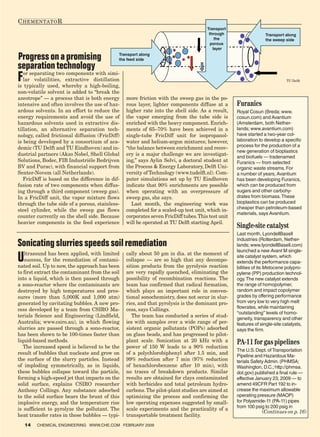
        The Gemasolar plant (diagram) will con-
     sist of 2,500 heliostats, which will track
     the sun and focus sunlight to a receiver at
     the top of a tower. There, 95% of the radia-
     tion is absorbed and converted to thermal
     energy, which is used to heat molten salts                                                                                      Torresol Energy

     (potassium and sodium nitrates). The hot
     salts descend to a tank where it is stored              com), a strategic alliance between Sener
     at about 500°C. In a second loop, the mol-              Ingeniería y Sistemas (Madrid; www.sener.       A new bioplastic
     ten salt passes through a heat exchanger.               es) and Masdar (www.masdaruae.com), Abu         Up to now, the main plastic
     and the energy is used to produce steam,                Dhabi’s renewable-energy initiative. The en-    produced from renewable re-
     which drives a turbine for generating elec-             gineering, procurement, construction contract   sources has been polylactic
     tricity. The molten salt’s storage capacity is          has been awarded to a consortium, including     acid (PLA), which is derived
     designed to enable power generation for 15              Sener and AMSA, an ACS Cobra (Madrid;           from corn starch. However, be-
     hours without sunlight.                                 www.grupocobra.com) subsidiary. Sener will      cause PLA does not have the
        Gemasolar is a project of Torresol Energy            provide the technology, the detailed design     same level of performance as
     S.A. (Madrid, Spain; www.torresolenergy.                and commissioning of the plant.                 petroleum-derived plastics, PLA
                                                                                                             has not been actively adopted
                                                                                                             by certain industries, accord-

     This centrifugal reactor/separator                                                                      ing to Teijin Ltd. (Tokyo, Japan;
                                                                                                             www.teijin.co.jp/english). The
     speeds up biodiesel production                                                                          company plans to change this
                                                                                                             situation with the commercial

     A  continuous process for producing biod-
        iesel that has a residence time of about
     one minute, versus several hours for a con-
                                                             tor and rapidly mixed at 3,600 rpm. The re-
                                                             action time is approximately 1 min, at which
                                                             point the lighter methyl esters (biodiesel)
                                                                                                             launch, later this year, of a
                                                                                                             new heat-resistant bioplastic,
                                                                                                             dubbed Biofront. Biofront is a
     ventional batch process, has been developed             and heavier glycerol are separated by the       stereocomplex PLA made with
     at Oak Ridge National Laboratory (ORNL;                 centrifugal action. The biodiesel yield for a   high-purity L- and D-lactate,
                                                                                                             which has a melting point of
     Oak Ridge, Tenn.; www.ornl.gov). The pro-               5:1 oil-to-methoxide ratio is about 95%, with
                                                                                                             210°C — significantly higher
     cess uses a centrifuge for simultaneous                 less than 1% carryover of either phase into
                                                                                                             than the 170°C for conventional
     synthesis of biodiesel and separation of the            the other, he says. Current work is focused     PLAs — and “rivals” that of
     biodiesel from the glycerol byproduct. ORNL             on increasing the yield.                        polybutylene terephthalate
     has done laboratory tests and is collaborat-              Initially, the researchers were working       (PBT), says the firm.
     ing with biodiesel producer Nu-Energie                  with a conventional centrifugal contactor,         Teijin is currently operating a
     (Surgoinsville, Tenn.) to do a pilot test at the        but the residence time was too short at the     200-ton/yr Biofront pilot plant. It
     Nu-Energie facilities later this year.                  3,600-rpm speed required for thorough mix-      recently acquired a 1,000 ton/yr
       The key to the process is a Couette reac-             ing, says Tsouris. “The Couette unit provides   PLA demonstration plant from
     tor/separator, a type of centrifuge that until          a residence time of about one minute,” he       Toyoto Motor Corp. (Tokyo); this
                                                                                                             new facility is expected to pro-
     now has been used only in the laboratory,               says. He adds that the reactor/separator can
                                                                                                             duce Biofront later this summer.
     says Costa Tsouris, a research engineer with            be scaled up to production size and promises
                                                                                                             A 10,000-ton/yr Biofront plant is
     ORNL. Food-grade soy oil and sodium meth-               to reduce the size of the production equip-     also expected to be completed
     oxide (a mixture of methanol and sodium                 ment to well below 10% of that used in a        in 2010.
     hydroxide) are fed separately into the reac-            conventional batch operation.
     Note: For more information, circle the 3-digit number
     on p. 62, or use the website designation.                                     Chemical Engineering www.che.com February 2009            11


06_CHE_021509_CHM.indd 11                                                                                                              1/26/09 8:46:39 AM
C hementato R                                                                                         Final specs for SIF
                                                                                                            Last month, the Fieldbus
                                                                                                            Foundation (Austin, Tex.;
                                                                                                            www.fieldbus.org) released
                                                                                                            the latest device-development
     A new syngas catalyst passes pilot tests . . .                                                         solutions for its Foundation
                                                                                                            for Safety Instrumented Func-

     M    itsunori Shimura and colleagues at            conditions of 900°C (outlet temperature),           tions (SIF) technology, which
          the RD Center of Chiyoda Corp. (Yo-          1.9 MPa (gauge) and a molar feed ratio of           includes the Foundation for
                                                                                                            SIF final Technical Specifica-
     kohama, Japan; www.chiyoda.co.jp) have             CH4:CO2:H2O = 1.0:0.4:1.15, the new cata-
                                                                                                            tion package, SIF Interop-
     developed a new catalyst for producing a           lyst produced a syngas with H2-to-CO mole
                                                                                                            erability Test Kit (ITK) and
     synthesis gas (syngas; hydrogen and carbon         ratio of 2.0, making it especially suitable         updated DD (Device Descrip-
     monoxide) from steam reforming of meth-            for gas-to-liquids (GTL) applications, or for       tion) Library with SIF function
     ane. The catalyst consists of precious met-        the production of oxo-alcohols (such as n-          blocks. The new technical
     als selectively loaded on the surface of the       butanol) and acetic acid, says the company.         specification defines analog
     firm’s commercial, egg-shell-shaped sup-           In laboratory trials, the catalyst has also         input (AI) blocks for fieldbus
     port, which results in an effective utilization    shown 1,000-h of operation, without deacti-         transmitters and other SIF
     of the costly metals.                              vation, for producing syngas with H2-to-CO          devices. Future updates to the
        The catalyst has been demonstrated in           ratios of 1.0.                                      specification will include digi-
                                                                                                            tal output (DO) blocks.
     a pilot reformer (single, 12-m long tube             The catalyst and associated syngas-pro-
     with 110-mm dia.), which showed stable,            duction process are being developed for a
     on-stream operation for 7,000 h, with mini-        national GTL project coordinated by JOG-            Drought-tolerant corn
     mal carbon formation (less than 0.1 wt.%)          MEC (Japan Oil, Gas and Metals National             First results have been
     on the catalyst. With a feed of natural            Corp.). A 500-bbl/d GTL plant is under con-         achieved from a plant biotech
     gas (85 vol.% CH4), and typical operating          struction with startup later this year.             collaboration between BASF
                                                                                                            Plant Science (Limburgerhof,
                                                                                                            Germany; www.basf.com/plant-
     . . . and a Ni-based syngas catalyst                                                                   science) and Monsanto Co. (St.
                                                                                                            Louis, Mo.; www.monsanto.
     promises to slash reformer size and costs                                                              com) for a drought-tolerant
                                                                                                            corn. The product has moved

      K  eiichi Tomishige, an associate profes-
         sor at University of Tsukuba (www.ims.
      tsukuba.ac.jp), has developed a new high-
                                                        suppression of hot spots and carbon forma-
                                                        tion. The catalyst is also less prone to deac-
                                                        tivation by oxidation of Ni, he says.
                                                                                                            into the final phase prior to an
                                                                                                            anticipated market launch early
                                                                                                            next decade, and Monsanto
      performance catalyst for the highly efficient        Because of the enhanced reactivity, Tom-         has submitted the product to
      production of syngas, with support from the       ishige estimates that reformers operating           the U.S. Food and Drug Admin.
                                                                                                            (FDA; Washington, D.C.) for
      New Energy and Industrial Technology De-          with the new catalyst can be one-fourth
                                                                                                            regulatory clearance.
      velopment Organization (Kawasaki, both            the size of a conventional reformer with the
                                                                                                               Drought-tolerant corn is de-
      Japan). The nickel-based catalyst is selec-       same production capacity. And the cost of           signed to provide farmers with
      tively impregnated with small amounts of          the catalyst is expected to be significantly        yield stability during periods
      precious metals (Pt, Pd and Rh) on the sur-       lower due to the use of predominantly nickel        when water supply is scarce by
      face. By performing the impregnation se-          with reduced amounts of precious metals.            mitigating the effects of water
      quentially, rather than by conventional co-          The researchers are planning to scale up         stress within a corn plant.
      impregnation, Tomishige is able to control        their work and apply the catalyst technol-          Field trials for the new corn
      the structure of bi-metallic (Ni and precious     ogy to the oxidative-reforming of other hy-         met or exceeded the 6–10%
      metal) particles on the surface. This leads to    drocarbon feeds, such as city gas, gasoline,        target yield enhancement over
                                                                                                            the average yield of 70–130
      active sites that accelerate both exothermic      methanol and kerosene, with the aim to pro-
                                                                                                            bushels per acre in some key
      and endothermic reactions, resulting in the       duce H2 for fuel cells.
                                                                                                            drought-prone areas of the
                                                                                                            U.S., says BASF.

      A pilot-step closer to second-generation biofuels
      L urgi GmbH (Frankfurt, Germany;
        www.lurgi.com) is building a pilot
      plant to demonstrate the viability of its
                                                    500°C) converts biomass into a trans-
                                                    portable, liquid intermediate product
                                                    (bioliqSynCrude) whose energy den-
                                                                                                  the basis of Lurgi’s proprietary Multi-
                                                                                                  Purpose Gasifier (MPG) — is equipped
                                                                                                  with a castable, lined cooling screen
      three-stage bioliq process for produc-        sity is 13–15 times higher than that          that is cooled with pressurized water,
      ing liquid fuels from biomass. The pilot      of straw. The bioliqSynCrude is then          and whose internal surface is pro-
      plant — an entrained-flow gasifier for        preheated to around 80°C, pressurized         tected from corrosion and erosion by
      the production of synthesis gas — will be     and fed to the bioliq gasifier, where it is   a layer of slag. Crude syngas and slag
      located at the Karlsruhe Research Cen-        converted (at above 1,400°C) into syn-        are drawn off via a quench at the bot-
      ter (FZK; Germany; www.fzk.de), and is        gas. In the final step, the syngas (pro-      tom of the reactor.
      part of a joint project with the Karlsruhe    duced at high pressure) is purified and          The fast pyrolysis pilot plant — the
      Institute of Technology (KIT).                fed to a synthesis unit for conversion        first step of bioliq — was commissioned
         In the first step of the bioliq process,   to fuels.                                     last year at KIT; startup for the bioliq
      a fast pyrolysis process (operating at           The bioliq gasifier — developed on         gasifier is planned for the Fall of 2011.
          12   Chemical Engineering www.che.com February 2009


06_CHE_021509_CHM.indd 12                                                                                                           1/26/09 8:47:48 AM
Ideas that tailor the
        broadest line
        to move your product.
        Performanteed                                                  ™


         Hapman’s Tubular Drag:                                                        3 ways to convey.
                                                                                                 convey
         no downtime, no dust,                                                         One Performanteed™
         no worries. Guaranteed!                                                       solution.
         Replace several conveyors and eliminate multiple transfer                     Only Hapman offers three types of conveyor
         points with the Hapman tubular drag conveyor. Gentle handling                 systems—and the 60+ years expertise to
         eliminates product degradation, and the completely sealed                     determine which is best for your specific
         system provides dust-free operation. Hapman’s exclusive                       application. Our tailor-made solutions and
         self-cleaning discharge gate provides 100% discharge for faster               broadest material handling line carry the
         material changeover.                                                          industry’s only true performance guarantee.


         Unlike cable conveyors, Hapman’s heavy-duty chain allows
         for starting and stopping under load, day in and day out.
         Performanteed™.


            Helix™ flexible screw MiniVac™ pneumatic               Bag dump        PosiPortion™                 Bulk bag             Bulk bag
            conveyors             conveyors                        stations        feeders                      fillers               unloaders


         “Only Hapman offers Performantee™,
         the first and only true performance
         guarantee in the industry. We guarantee
         that our equipment will achieve
                                                                                       USA · Kalamazoo, Michigan
         the specific results for which it
         was designed and manufactured. If it                                          www.ideasthatmove.net
         doesn’t, we’ll revise, repair, or make whatever                                UK · Bristol, England         Europe · Bratislava, Slovakia
                                                                                        www.hapman.co.uk              www.hapman.eu
         changes are necessary. Performanteed.”
                                                                                        India · Vadodara, Gujarat
         Ned Thompson, president, Hapman                                                www.hapman.in
                                                  Circle 13 on p. 62 or go to adlinks.che.com/23011-13


HAP_CE 7.875x10.75_tubular drag.indd 1                                                                                                        12/10/08 1:44:37 PM


Hapman 2-09.indd 1                                                                                                                            1/23/09 12:00:44 PM
C hementato R
                                                                                           Transport
                                                                                            through                   Transport along
                                                                                               the                    the sweep side
                                                                                             porous
                                                                                              layer

     Progress on a promising                      Transport along
                                                  the feed side
     separation technology
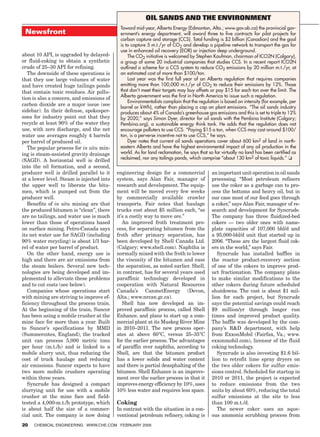
     F  or separating two components with simi-
        lar volatilities, extractive distillation
     is typically used, whereby a high-boiling,
                                                                                                                                 TU Delft


     non-volatile solvent is added to “break the
     azeotrope” — a process that is both energy       more friction with the sweep gas in the po-
     intensive and often involves the use of haz-     rous layer, lighter components diffuse at a       Furanics
     ardous solvents. In an effort to reduce the      higher rate into the shell side. As a result,     Royal Cosun (Breda; www.
     energy requirements and avoid the use of         the vapor emerging from the tube side is          cosun.com) and Avantium
     hazardous solvents used in extractive dis-       enriched with the heavy component. Enrich-        (Amsterdam, both Nether-
     tillation, an alternative separation tech-       ments of 65–70% have been achieved in a           lands; www.avantium.com)
     nology, called frictional diffusion (FricDiff)   single-tube FricDiff unit for isopropanol-        have started a two-year col-
     is being developed by a consortium of aca-       water and helium-argon mixtures; however,         laboration to develop a specific
                                                                                                        process for the production of a
     demic (TU Delft and TU Eindhoven) and in-        “the balance between enrichment and recov-
                                                                                                        new generation of bioplastics
     dustrial partners (Akzo Nobel, Shell Global      ery is a major challenge we are investigat-
                                                                                                        and biofuels — tradenamed
     Solutions, Bodec, FIB Industriële Bedrijven      ing,” says Aylin Selvi, a doctoral student at     Furanics — from selected
     BV and Purac), with financial support from       the Process  Energy Laboratory, Delft Uni-       organic waste streams. For
     Senter-Novem (all Netherlands).                  versity of Technology (www.tudelft.nl). Com-      a number of years, Avantium
        FricDiff is based on the difference in dif-   puter simulations set up by TU Eindhoven          has been developing Furanics,
     fusion rate of two components when diffus-       indicate that 90% enrichments are possible        which can be produced from
     ing through a third component (sweep gas).       when operating with an overpressure of            sugars and other carbohy-
     In a FricDiff unit, the vapor mixture flows      sweep gas, she says.                              drates from biomass. These
     through the tube side of a porous, stainless-      Last month, the engineering work was            bioplastics can be produced
                                                                                                        cheaper than petroleum-based
     steel cylinder, while the sweep gas flows        completed for a scaled-up test unit, which in-
                                                                                                        materials, says Avantium.
     counter currently on the shell side. Because     corporates seven FricDiff tubes. This test unit
     heavier components in the feed experience        will be operated at TU Delft starting April.
                                                                                                        Single-site catalyst
                                                                                                        Last month, LyondellBasell
                                                                                                        Industries (Rotterdam, Nether-
     Sonicating slurries speeds soil remediation                                                        lands; www.lyondellBasell.com)
                                                                                                        launched a new Avant M single-
     U  ltrasound has been applied, with limited
        success, for the remediation of contami-
     nated soil. Up to now, the approach has been
                                                      cally about 50 µm in dia. at the moment of
                                                      collapse — are so high that any decompo-
                                                      sition products from the pyrolysis reaction
                                                                                                        site catalyst system, which
                                                                                                        extends the performance capa-
                                                                                                        bilities of its Metocene polypro-
     to first extract the contaminant from the soil   are very rapidly quenched, eliminating the        pylene (PP) production technol-
     into a liquid, which is then passed through      possibility of recombination reactions. The       ogy. The new catalyst extends
     a sono-reactor where the contaminants are        team has confirmed that radical formation,        the range of homopolymer,
     destroyed by high temperatures and pres-         which plays an important role in conven-          random and impact copolymer
     sures (more than 5,000K and 1,000 atm)           tional sonochemistry, does not occur in slur-     grades by offering performance
     generated by cavitating bubbles. A new pro-      ries, and that pyrolysis is the dominant pro-     from very low to very high melt
                                                                                                        flowrates, while maintaining
     cess developed by a team from CSIRO Ma-          cess, says Collings.
                                                                                                        “outstanding” levels of homo-
     terials Science and Engineering (Lindfield,         The team has conducted a series of stud-
                                                                                                        geneity, transparency and other
     Australia; www.csiro.au), in which flowing       ies with samples over a wide range of per-        features of single-site catalysts,
     slurries are passed through a sono-reactor,      sistent organic pollutants (POPs) adsorbed        says the firm.
     has been shown to be 100-times faster than       on glass beads, and has progressed to pilot-
     liquid-based methods.                            plant scale. Sonication at 20 kHz with a          PA-11 for gas pipelines
        The increased speed is believed to be the     power of 150 W leads to a 90% reduction
                                                                                                        The U.S. Dept. of Transportation
     result of bubbles that nucleate and grow on      of a polychlorobiphenyl after 1.5 min, and
                                                                                                        Pipeline and Hazardous Ma-
     the surface of the slurry particles. Instead     99% reduction after 7 min (97% reduction          terials Safety Admin. (PHMSA;
     of imploding symmetrically, as in liquids,       of hexachlorobenzene after 10 min), with          Washington, D.C.; http://phmsa.
     these bubbles collapse toward the particle,      no traces of breakdown products. Similar          dot.gov) published a final rule —
     forming a high-speed jet that impacts on the     results are obtained for clays contaminated       effective January 23, 2009 — to
     solid surface, explains CSIRO researcher         with herbicides and total petroleum hydro-        amend 49CFR Part 192 to in-
     Anthony Collings. Any substance adsorbed         carbons. The pilot-plant studies are aimed at     crease the maximum allowable
     to the solid surface bears the brunt of this     optimizing the process and confirming the         operating pressure (MAOP)
     implosive energy, and the temperature rise       low operating expenses suggested by small-        for Polyamide-11 (PA-11) pipes
                                                                                                        from 100 psig to 200 psig in
     is sufficient to pyrolyze the pollutant. The     scale experiments and the practicality of a
                                                                                                                     (Continues on p. 16)
     heat transfer rates in these bubbles — typi-     transportable treatment facility.
         14    Chemical Engineering www.che.com February 2009


06_CHE_021509_CHM.indd 14                                                                                                        1/26/09 8:50:52 AM
Circle 14 on p. 62 or go to adlinks.che.com/23011-14


A Box 4 U 1-09.indd 1                                                          1/23/09 12:03:23 PM
C hementato R


      A sound way to reuse
      low-temperature waste heat
      I n a so-called thermoacoustic en-
        gine, researchers from the Energy
      Research Center of the Netherlands
      (ECN; Petten, Netherlands; www.
      ecn.nl) have achieved a record ef-
      ficiency in the conversion of heat to
      sound, improving the existing record
      of 41% to 48% of the maximum pos-
      sible efficiency (Carnot efficiency).
      The engine is being developed as a
      way to utilize the huge quantities
      of waste heat, which normally can-
      not be reused because the tempera-
      ture level is too low and is thus released      torus configuration. In operation (sche-
      to the environment. ECN is working with         matic, left), the thermoacoustic engine con-
      two equipment manufacturers — Bron-             verts thermal energy into acoustic energy.
      swerk Heat Transfer B.V. (Nijkerk; www.         This acoustic energy is then used in a heat
      bronswerk.nl) and Dahlman (Maassluis,           pump to upgrade waste heat into medium-                                    ECN
      both Netherlands; www.dahlman.nl) — to          pressure steam, for example.
      develop a system that uses a thermoacous-          The prototype engine operating at ECN
      tic heat pump driven by a thermoacoustic        has achieved the record efficiency when
                                                                                                      (Continued from p. 14)
      engine to upgrade waste heat.                   driven by heat at high (500–600°C) tem-
         The thermoacoustic engine is composed        peratures. The next step is to extrapolate      certain pipelines. The rule also
      of three main parts (diagram, right): a ther-   this performance to engines that operate at     includes an increase in the
      modymamic part, consisting of a regenera-       much lower (100–150°C) temperatures, says       design factor from 0.32 to 0.40,
      tor, two heat exchangers and a thermal buf-     project leader Simon Spoelstra. An inte-        which applies to PA-11 pipe
      fer tube; an acoustic network, consisting of    grated laboratory system (engine plus heat      with standard dimensional ratio
      an acoustic compliance and an inertance;        pump) that delivers the required perfor-        (SDR) in diameters 4 in. and
      and a resonator. The thermodynamic part         mance under relevant industrial conditions      smaller. Service tubing sizes
      and the acoustic network are placed in a        is planned for operation in 2010.               may have lower SDRs.
                                                                                                         The new rule gives opera-
                                                                                                      tors of natural gas pipelines
                                                                                                      the option to use PA-11 pipe
     Commercialization nears for producing                                                            in certain pipeline systems.
                                                                                                      Arkema Inc. (Philadelphia,
     cartenoids from engineered yeasts                                                                Pa.; www.arkema-inc.com),
                                                                                                      which petitioned the rule

     I n late 2009, Microbia PE, Inc. (Lexington,
       Mass.; www.microbia-pe.com) will begin
     commercialization of its initial carotenoid
                                                      chemical-synthesis manufacturers today.
                                                      Furthermore, “for some of the more com-
                                                      plex carotenoids with greater chirality,” he
                                                                                                      change back in October
                                                                                                      2004 following extentensive
                                                                                                      field tests of its Rilsan PA11
     products. Microbia plans to produce b-caro-      says, “we believe our costs will be signifi-    pipes, says the amended
                                                                                                      rule will enable the oil and
     tene, astaxanthin, zeaxanthin, cathaxanthin      cantly lower.”
                                                                                                      gas industry to “fully realize
     and lutein — all five carotenoid products           Microbia’s fermentation process is carried   the cost-saving and ease of
     that currently have significant commercial       out with the yeast Yarrowia lipolytica. Un-     installation benefits of Rilsan
     value. These carotenoids have primary ap-        like most fermentation processes for carote-    P11.” For the same cost ben-
     plications as food ingredients, dietary sup-     noid manufacture, this yeast achieves very      efits, Rilsan PA11 pipes offer
     plements and animal feed ingredients.            high yields of the carotenoids, with a unique   all the advantages of conven-
        Though chemically identical to carote-        strain engineered for the production of each    tional polyethylene pipes at
     noids that are currently on the market, this     carotenoid. A series of optimized enzymatic     pressures normally requiring
     firm’s products will be made by fermenta-        steps facilitates efficient biosynthesis.       steel, including coiled pipe
     tion of natural raw materials, such as sugar        In addition to the technology inherent in    that can be plowed or planted,
                                                                                                      joined by butt fusion and elec-
     and vegetable oils, rather than by conver-       its carotenoid commercial interests, Micro-
                                                                                                      trofusion, and squeezed off
     sion from petrochemical-based materials.         bia is also collaborating with partners, such   like conventional pipe, says
        Microbia CEO Richard Bailey explains          as Tate  Lyle Plc (London, U.K.), to develop   the firm. ❏
     that projected product costs are at least        bioprocesses for manufacturing larger-vol-
     on par with products from the lowest-cost,       ume, commodity chemicals.                  ■
          16   Chemical Engineering www.che.com February 2009


06_CHE_021509_CHM.indd 16                                                                                                    1/26/09 8:53:20 AM
Circle 15 on p. 62 or go to adlinks.che.com/23011-15


Badger Meter 2-09.indd 1                                             1/23/09 12:06:44 PM
Circle 16 on p. 62 or go to
                          adlinks.che.com/23011-16


Flexitallic 2-09.indd 1                            1/23/09 12:10:52 PM
Suncor


          Newsfront                                                                                                                                          This portable
                                                                                                                                                            crusher works


        Oil from
                                                                                                                                                               at the mine
                                                                                                                                                                      face


        sand
             The oil sands industry
                is growing fast,
              and so is its impact                                                                                                                                      CAPP
                                                                                        6,000
             on the environment                                                                      Actual     Forecast
                                                                                                                Oil sands production
                                                         Thousands of barrels per day


                                                                                        5,000                    2007 = 1.2 million bbl/d     June '08 moderate


        I
                                                                                                                 2013 = 2.0 million bbl/d     growth forecast
            n these hard economic times, peo-                                                                    2018 = 3.0 million bbl/d
                                                                                        4,000                    2020 = 3.3 million bbl/d
            ple working in troubled businesses
                                                                                                                                                      Oil sands
            may well envy the situation of Al-                                                                                                     future potential
                                                                                        3,000
            berta’s oil sands industry. The Ca-
        nadian Association of Petroleum Pro-                                            2,000                            Oil sands in production
                                                                                                                         and under construction
        ducers (CAPP, Calgary, Alberta; www.
        capp.ca) predicts that the production                                           1,000
        of synthetic crude from oil sands will                                                                         Convetional oil
        reach 3.3-million bbl/d by 2020, up                                                0
        from 1.2-million bbl/d in 2007. Much                                               2002   2004   2006   2008   2010     2012        2014   2016   2018        2020
        of this oil will be sent to the U.S. via an
        expanding network of pipelines (CE,           figure 1. Despite its rapid growth, Western Canada’s production of bitumen from
                                                      oil sands will actually dip below last June’s “moderate growth” (MG) forecast over the
        May 2008, p. 22).                             coming years. Conventional oil production will decline
           As it happens, though, the industry
        has been impacted by the current busi-        ment in oil sands in 2009 is expected                                Syncrude Canada Ltd. (Fort McMur-
        ness recession causing a number of com-       to be about $985 million, down from                                  ray, Alta; www.syncrude.ca) reported
        panies to delay their expansion plans.        about $1.4 billion in 2008.                                          operating costs, including purchased
        For example, Suncor Energy (Calgary;             Alberta’s recoverable reserves of                                 energy costs, of $24.64/bbl for 2007,
        www.suncor.com) announced a $20.6             oil sands total about 175-billion bbl,                               down from $26.46/bbl in 2006.
        billion* expansion program a year ago,        says Greg Stringham, CAPP’s vice-                                       In a surface-mining operation, oil
        with the goal of expanding production         president for oil sands and markets.                                 sand is scooped up by huge shov-
        from 350,000 bbl/d to 550,000 bbl/d by        Currently, about half the production is                              els, trucked to a crusher, then slur-
        2012. More recently, the completion           done by surface-mining the sand and                                  ried with warm water and piped to
        date has been pushed back to 2013 and         its associated bitumen, then separating                              an extraction plant. There, hot water
        the company has scaled back its capital       and upgrading the bitumen to obtain a                                (40–50°C) is added, air and process
        spending plans for 2009 by more than          synthetic crude (syncrude) for refining.                             aids are injected into the stream, and
        one-third. Similarly, Fort Hills Energy       However, only about 20% of the re-                                   the mixture is fed to a conical primary
        L.P., a new venture, has deferred a           serves are amenable to surface mining,                               separation vessel. Sand settles to the
        final investment decision on mining           so the trend is toward increased use of                              bottom of the vessel and the overflow
        operations and delayed indefinitely a         in situ processing to exploit deposits                               is a froth that contains about 60% bi-
        decision to build an upgrader (delayed        200 ft or more below the surface.                                    tumen, 30% water and 10% clay.
        coker). Petro-Canada (Calgary; www.                                                                                   Naphtha is typically mixed with the
        petro-canada.ca), the majority partner        Process technology                                                   froth to lower the viscosity of the bi-
        in Fort Hills, has reduced its capital        The main drivers for technology in-                                  tumen, making it easier to separate it
        and exploration expenditures to about         novations in oil sands production are                                from the water and clay by centrifug-
        $4 billion this year, down from about $6      a desire to reduce costs and environ-                                ing or settling. Finally, the bitumen
        billion in 2008. Petro-Canada’s invest-       mental impacts. Operating costs vary                                 and naphtha are separated by distil-
        *All dollars are Canadian (CAN$1 = US$0.82,
                                                      widely, but are currently in the range                               lation. The naphtha is recycled and
        January 13)                                   of US$30–35/bbl, says Stringham.                                     the bitumen, whose specific gravity is
                                                                                                         Chemical Engineering www.che.com February 2009                      19


07_CHE_021509_NF1.indd 19                                                                                                                                               1/26/09 9:03:20 AM
date.
                                                                             Oil Sands and the Environment
ecast.
                                                                Toward mid-year, Alberta Energy (Edmonton, Alta.; www.gov.ab.ca) the provincial gov-
wth fore-
                      Newsfront                                 ernment’s energy department, will award three to five contracts for pilot projects for
                                                                carbon capture and storage (CCS). Total funding is $2 billion (Canadian) and the goal
om the                                                          is to capture 5 m.t./yr of CO2 and develop a pipeline network to transport the gas for
                                                                use in enhanced oil recovery (EOR) or injection deep underground.
                    about 10 API, is upgraded by delayed-           The CO2 initiative is welcomed by Stephen Kaufman, chairman of ICO2N (Calgary),
                    or fluid-coking to obtain a synthetic       a group of some 20 industrial companies that studies CCS. In a recent report ICO2N
                    crude of 25–30 API for refining.            outlined a scheme for a CCS system to reduce CO2 emissions by 20 million m.t./yr, at
                       The downside of these operations is      an estimated cost of more than $100/ton.
                    that they use large volumes of water            Last year was the first full year of an Alberta regulation that requires companies
                    and have created huge tailings ponds        emitting more than 100,000 m.t./yr of CO2 to reduce their emissions by 12%. Those
                    that contain toxic residues. Air pollu-     that don’t meet their targets may buy offsets or pay $15 for each ton over the limit. The
                                                                Alberta government was the first in North America to issue such a regulation.
                    tion is also a concern, and emissions of
                                                                    Environmentalists complain that the regulation is based on intensity (for example, per
                    carbon dioxide are a major issue (see
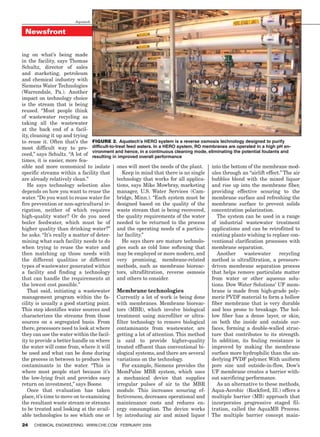
                                                                barrel or kWh), rather than placing a cap on plant emissions. “The oil sands industry
                    sidebar). In their defense, spokesper-      produces about 4% of Canada’s greenhouse gas emissions and this is set to triple to 12%
                    sons for industry point out that they       by 2020,” says Simon Dyer, director for oil sands with the Pembina Institute (Calgary;
                    recycle at least 90% of the water they      Pembina.org), a sustainable energy think tank. He adds that the regulation does not
                    use, with zero discharge, and the net       encourage polluters to use CCS. “Paying $15 a ton, when CCS may cost around $100/
                    water use averages roughly 4 barrels        ton, is a perverse incentive not to use CCS,” he says.
                    per barrel of produced oil.                     Dyer notes that current oil sands operations cover about 600 km2 of land in north-
                       The popular process for in situ min-     eastern Alberta and have the highest environmental impact of any oil production in the
                    ing is steam-assisted gravity drainage      world. As for land reclamation, he says that so far virtually no land has been certified as
                                                                reclaimed, nor any tailings ponds, which comprise “about 130 km2 of toxic liquids.” ❏
                    (SAGD). A horizontal well is drilled
                    into the oil formation, and a second,
                    producer well is drilled parallel to it    engineering design for a commercial             an important unit operation in oil sands
                    at a lower level. Steam is injected into   system, says Alan Fair, manager of              processing. “Most petroleum refiners
                    the upper well to liberate the bitu-       research and development. The equip-            use the coker as a garbage can to pro-
                    men, which is pumped out from the          ment will be moved every few weeks              cess the bottoms and heavy oil, but in
                    producer well.                             by commercially available crawler               our case most of our feed goes through
                       Benefits of in situ mining are that     transports. Fair notes that haulage             a coker,” says Alan Fair, manager of re-
                    the produced bitumen is “clean”, there     trucks cost about $5 million each, “so          search and development for Syncrude.
                    are no tailings, and water use is much     it’s a costly way to move ore.”                 The company has three fluidized-bed
                    lower than those of operations based          An improved froth treatment pro-             cokers — two older ones with name-
                    on surface mining. Petro-Canada says       cess, for separating bitumen from the           plate capacities of 107,000 bbl/d and
                    its net water use for SAGD (including      froth after primary separation, has             a 95,000-bbl/d unit that started up in
                    90% water recycling) is about 1/3 bar-     been developed by Shell Canada Ltd.             2006. “These are the largest fluid cok-
                    rel of water per barrel of product.        (Calgary; www.shell.com). Naphtha is            ers in the world,” says Fair.
                       On the other hand, energy use is        normally mixed with the froth to lower             Syncrude has installed baffles in
                    high and there are air emissions from      the viscosity of the bitumen and ease           the reactor product-recovery section
                    the steam boilers. Several new tech-       the separation, as noted earlier. Shell,        of one of the cokers to improve prod-
                    nologies are being developed and im-       in contrast, has for several years used         uct fractionation. The company plans
                    plemented to alleviate these problems      paraffinic technology developed in              to make similar modifications to the
                    and to cut costs (see below).              cooperation with Natural Resources              other cokers during future scheduled
                       Companies whose operations start        Canada’s CanmetEnergy (Devon,                   shutdowns. The cost is about $1 mil-
                    with mining are striving to improve ef-    Alta.; www.nrcan.gc.ca).                        lion for each project, but Syncrude
                    ficiency throughout the process train.        Shell has now developed an im-               says the potential savings could reach
                    At the beginning of the train, Suncor      proved paraffinic process, called Shell         $9 million/yr through longer run
                    has been using a mobile crusher at the     Enhance, and plans to start up a com-           times and improved product quality.
                    mine face for more than a year. Built      mercial plant at its Muskeg River Mine          The baffle was developed by the com-
                    to Suncor’s specifications by MMD          in 2010–2011. The new process oper-             pany’s RD department, with help
                    (Summercotes, England), the tracked        ates at above 60°C, versus 25–35°C              from ExxonMobil (Fairfax, Va.; www.
                    unit can process 5,000 metric tons         for the earlier process. The advantages         exxonmobil.com), licensor of the fluid
                    per hour (m.t./h) and is linked to a       of paraffin over naphtha, according to          coking technology.
                    mobile slurry unit, thus reducing the      Shell, are that the bitumen product                Syncrude is also investing $1.6 bil-
                    cost of truck haulage and reducing         has a lower solids and water content            lion to retrofit lime spray dryers on
                    air emissions. Suncor expects to have      and there is partial deasphalting of the        the two older cokers for sulfur emis-
                    two more mobile crushers operating         bitumen. Shell Enhance is an improve-           sions control. Scheduled for startup in
                    within three years.                        ment over the earlier process in that it        2010 or 2011, the project is expected
                       Syncrude has designed a compact         improves energy efficiency by 10%, uses         to reduce emissions from the two
                    slurrying unit for use with a mobile       10% less water and requires less space.         units by about 60%, reducing the total
                    crusher at the mine face and field-                                                        sulfur emissions at the site to less
                    tested a 4,000-m.t./h prototype, which     Coking                                          than 100 m.t./d.
                    is about half the size of a commer-        In contrast with the situation in a con-           The newer coker uses an aque-
                    cial unit. The company is now doing        ventional petroleum refinery, coking is         ous ammonia scrubbing process from
                    20    Chemical Engineering www.che.com February 2009


            07_CHE_021509_NF1.indd 20                                                                                                                 1/26/09 9:04:28 AM
Silverson’s high shear In-Line mixers outperform conventional mixers,
                          cutting processing times by up to 90%! And every one of our mixers will
                          emulsify, homogenize, solubilize, suspend, disperse          disintegrate
                          solids in times superior to any machine on the market while improving your
                          product quality, consistency and process efficiency.


                                                               Silverson High Shear
                                                            In-Line Mixers will:
                                                            • Eliminate agglomerates
                                                              and fish eyes
                                                            • Create stable emulsions
                                                              and suspensions
                                                            • Reduce particle size
                                                            • Rapidly dissolve solids
                                                            • Accelerate reactions
                                                            • Self-pump at throughputs
                                                              from 5 to 50,000 gallons/hour

                                                            For more information or
                                                            a free trial give us a call @
                                                            800.204.6400


                                                                               Mixing at the speed of


                                                                               silverson.com

                        Circle 17 on p. 62 or go to adlinks.che.com/23011-17


Silverson 3-08.indd 1                                                                              1/23/09 12:12:41 PM
Suncor


          Newsfront


        Marsulex Inc. (Toronto; www.mar-
        sulex.com). The NH3 reacts with SO2
        to form an ammonium-sulfite slurry,
        then air is bubbled through the slurry
        to obtain ammonium sulfate, which is
        sold to the fertilizer industry.
           Syncrude chose this process because
        ammonia is generated as a byproduct
        in the hydrotreating plant, says Paul
                                                    figure 2.
        Ibbotson, a process engineer. However,      The drawing shows
        trace compounds in the gas caused an        the layout of Suncor's
        odor, so the company has been buying        planned expansion
        NH3 until it finds a way to deal with
        the offending compounds.
           Suncor will install three trains of      lead operations engineer. CNRL is            new technologies that reduce or avoid
        paired delayed cokers for its planned       using the process to treat the tailings      these problems.
        200,000-bbl/d expansion. The project,       from its new 110,000-bbl/d oil sands            Petrobank Energy and Resources
        dubbed Voyageur, will process bitumen       plant, now starting up. Paradis expects      Ltd. (Calgary; www.petrobank.com) is
        from a combination of surface- and in       it will permit settlement of the tailings    piloting a process called THAI (Toe-to-
        situ-mined sources (Figure 2). The          within weeks, rather than years.             Heel Air Injection). A horizontal pro-
        company has been using some SAGD               An improved process will be used in       ducer well with a slotted liner is drilled
        for about five years, says a company        the project’s second stage, when the         at the base of the oil sands formation,
        spokesman, “but in the next 5–7 years       plant will increase oil production to        which may be 20–30 m thick, then a
        we expect it to account for about 50%       232,000 bbl/d. The tailings volume will      vertical injector well is drilled to the
        of our bitumen recovery.”                   be reduced by thickeners and cyclones.       end (toe) of the producer well. Steam
                                                    Warm water will be recycled to the pro-      is injected for 2-–3 months to raise the
        Tailings treatment                          cess from the thickener, and waste heat      reservoir temperature to about 100°C.
        Surface-mining operations produce           from the coker will be used to heat the      Finally, air is injected at 450–550 psi,
        tailings that are a mixture of water,       process water, eliminating the use of        initiating a combustion front that
        clay, sand, residual bitumen and            natural gas. About 26 m.t./h of CO2 will     moves along the axis of the producer
        naphthenic acids. The problem is that       be obtained from the onsite H2 plant.        well, causing oil to flow into the well.
        the clay stays suspended, settling to a     The deposited tailings may be traffica-         “The oil just rises to the surface by
        maximum of only 30–40% solids con-          ble “almost immediately,” says Paradis.      gas lift, without pumping,” says Barry
        tent after 3–5 yr, says Randy Mikula,          In another process, developed by Syn-     Noble, a management adviser with
        team leader for the extraction and          crude in collaboration with Canmet,          Petrobank. Asphaltenes remain in the
        tailings group with Canmet.                 organic polymers are added to tailings,      sand to provide fuel, he says, so the
           Indeed, Suncor is only now reclaim-      which are then centrifuged to separate       produced bitumen has an API gravity
        ing its first tailings pond after decades   the clay from the water. Syncrude has        “in the middle teens,” versus eight for
        of operation. Suncor pioneered the use      tested the process at a scale of 20 m.t./h   raw bitumen. Compared with SAGD,
        of consolidated tailings technology, de-    and increased the solids content of the      there are substantial savings in capi-
        veloped in association with Canmet,         tailings from 17–20% to 55–60%. The          tal costs and water and energy, he
        in which tailings are consolidated by       separated water was returned to the          adds, because steam is used only at the
        chemical treatment. In Suncor’s case,       bitumen-extraction process.                  beginning of the cycle. Petrobank has
        gypsum (from SO2 scrubbing) is added           As an alternative to consolidating        piloted the process and plans to build a
        to the tailings to accelerate the release   tailings, Syncrude has piloted a water       10,000-bbl/d demonstration plant.
        of water. Suncor’s Pond 1 is now being      capping method, in which lakes have             Shell is developing an In situ Upgrad-
        infilled with sand, after which the         been built in former mines, with soft        ing Process (IUP) in which the oil is
        company will contour the surface and        tailings forming sedimentary bottoms.        heated by electrical resistance heaters
        plant vegetation.                           Syncrude says its research indicates         that are inserted in wells. The heat up-
           A process in which CO2 is injected       that the lakes will, over time, support      grades the bitumen into a lighter crude
        into the tailings pipeline is being com-    plant and wildlife.                          and gas that can be recovered, leaving
        mercialized by Canadian Natural Re-                                                      coke in the ground. Shell has been field-
        sources Ltd. (CNRL, Calgary; www.           In situ processes                            testing IUP for several years, using 18
        cnrl.com). CNRL developed the process       The conventional in situ mining pro-         heaters and three producer wells. So
        in collaboration with Canmet. The in-       cess is SAGD, as noted earlier, but this     far, more than 100,000 bbl of light oil
        jected CO2 forms carbonic acid, which       method uses large volumes of natural         has been produced at the site, but Shell
        changes the pH and coagulates the           gas to raise steam, and there are air        says further work is necessary before
        clay, thereby increasing the settling       emissions from the steam boilers. A          the process can be commercialized.	 ■
        rate of the tailings, says Theo Paradis,    number of companies are working on                                   Gerald Parkinson
        22    Chemical Engineering www.che.com February 2009


07_CHE_021509_NF1.indd 22                                                                                                           1/26/09 9:07:26 AM
Newsfront                                                                                                 Figure 1. Aqua-Aer-
                                                                                                                    obic System’s AquaMB
                                                                                                                    Process offers a multi-
                                                                                                                   ple barrier concept. The


       Taking the
                                                                                                                      progressively staged
                                                                                                                    treatment approach al-
                                                                                                                   lows the membranes to
                                                                                                                        operate at elevated
                                                                                                                       permeability, reduc-


       Plunge
                                                                                                                         ing the membrane
                                                                                                                              area required


             Chemical processors should begin
           looking into water reuse systems now,
            as experts suggest tightening water
        supplies will soon be a reality across the U.S.
                                                                                                            Aqua-Aerobic Systems


        G
               lobally, water reuse and recy-      38% of the U.S. was experiencing mod-       ties of water reuse and recycling as
               cling are not uncommon — with       erate to severe levels of drought. By       part of the permitting process. Already
               parts of Australia, South Africa    2013, the same index estimates at least     in some areas of the U.S. and around
               and the Middle East rather          36 states will face water shortages.        the world, the only way to get a permit
        heartily embracing the practice. Even         As a result, the availability of mu-     for an expansion is to go to zero-liquid
        in Europe, it is estimated that 75 to      nicipal facilities to take on the water     discharge,” he says.
        80% of water is reused. However, be-       needs of the CPI and other large indus-        “In the western world, the value of
        cause fresh water is prevalent and         trial users will start shrinking, causing   water in dollars per gallon is not at
        plentiful in most parts of the U.S., few   the use of freshwater to become more        the point where zero-liquid discharge
        domestic chemical processors, or other     costly, says Mark Boone, vice president     or water recycling will necessarily pro-
        industrial consumers of water, have        of sales and marketing with HPD, a          vide a return on investment. However
        yet to take the plunge when it comes       Veolia Water Solutions and Technolo-        that doesn’t mean that it won’t be the
        to treating and reusing contaminated       gies company, (Chicago, Ill.).              case in the future because high-qual-
        water supplies.                               As the availability of freshwater        ity water is becoming more precious as
           However, industry experts antici-       starts shrinking and plant sites start      its availability continues to dwindle,”
        pate that this will soon change, send-     to grow, it will become more of a chal-     explains Boone.
        ing the U.S. chemical process indus-       lenge to access a broad array of fresh-
        tries (CPI) on a quest to find the best    water sources, reasons Chuck Martz,         Technology selection
        and most economical method of treat-       global marketing director for Dow           With that in mind, now may be the
        ing and recycling wastewater from          Water Solutions (Midland, Mich.).           time to start considering the risk of
        their own plants or from the munici-       “For this reason, getting to zero liquid    not having freshwater available and,
        palities that supply their water.          discharge or using less scarce sources      based on that risk, considering the
           “With 36 states expected to expe-       of water to reduce the freshwater foot-     most promising technologies for recy-
        rience moderate to extreme water           print is certainly a growing trend,”        cling contaminated water. While there
        shortages by the year 2013, the time       notes Martz.                                are several capable technologies cur-
        has come for the U.S. to rethink its          As a matter of fact, conservation        rently available (see for example, CE,
        approach to the treatment, storage         may soon be mandated in many areas,         September 2008, pp. 44–50, and CE,
        and reuse of water on a residential,       according to Boone, who says the per-       October 2008, pp. 60–68), finding the
        industrial and municipal level,” says      mitting process for chemical proces-        one that is right for a given plant or
        Shane Keaney, president of Bord na         sors and other industrial water users       application can be tricky because there
        Móna Environmental Products U.S.           looking to expand or update facilities      is no single technology that works for
        Inc. (Greensboro, N.C.).                   is becoming more stringent. “Almost         every application.
           According to the Palmer Hydrologi-      any processor seeking a permit is              When you look at reusing water, the
        cal Drought Index, at the end of 2007      being asked to examine the possibili-       form of treatment will vary depend-
                                                                            Chemical Engineering www.che.com February 2009              23


08_CHE_021509_NF2.indd 23                                                                                                          1/22/09 12:04:07 PM
Aquatech


          Newsfront


        ing on what’s being made
        in the facility, says Thomas
        Schultz, director of sales
        and marketing, petroleum
        and chemical industry with
        Siemens Water Technologies
        (Warrendale, Pa.). Another
        impact on technology choice
        is the stream that is being
        reused. “Most people think
        of wastewater recycling as
        taking all the wastewater
        at the back end of a facil-
        ity, cleaning it up and trying
        to reuse it. Often that’s the Figure 2. Aquatech’s HERO system is a reverse osmosis technology designed to purify
        most difficult way to pro- difficult-to-treat feed waters. In a HERO system, RO membranes are operated in a high pH en-
                                          vironment and hence, in a continuous cleaning mode, eliminating the potential foulants and
        ceed,” says Schultz. “A lot of resulting in improved overall performance
        times, it is easier, more fea-
        sible and more economical to isolate ones will meet the needs of the plant.             into the bottom of the membrane mod-
        specific streams within a facility that         Keep in mind that there is no single ules through an “airlift effect.” The air
        are already relatively clean.”               technology that works for all applica- bubbles blend with the mixed liquor
           He says technology selection also tions, says Mike Mowbray, marketing and rise up into the membrane fiber,
        depends on how you want to reuse the manager, U.S. Water Services (Cam- providing effective scouring to the
        water. “Do you want to reuse water for bridge, Minn.). “Each system must be membrane surface and refreshing the
        fire prevention or non-agricultural ir- designed based on the quality of the membrane surface to prevent solids
        rigation, neither of which requires waste stream that is being recovered, concentration polarization.
        high-quality water? Or do you need the quality requirements of the water                   The system can be used in a range
        boiler feedwater, which must be of needed to be returned to the process of industrial wastewater treatment
        higher quality than drinking water?” and the operating needs of a particu- applications and can be retrofitted to
        he asks. “It’s really a matter of deter- lar facility.”                                 existing plants wishing to replace con-
        mining what each facility needs to do           He says there are mature technolo- ventional clarification processes with
        when trying to reuse the water and gies such as cold lime softening that membrane separation.
        then matching up those needs with may be employed or more modern, and                      Another     wastewater       recycling
        the different qualities or different very promising, membrane-related method is ultrafiltration, a pressure-
        types of wastewater generated within methods, such as membrane bioreac- driven membrane separation process
        a facility and finding a technology tors, ultrafiltration, reverse osmosis that helps remove particulate matter
        that can handle the requirements at and others to consider.                             from water or other aqueous solu-
        the lowest cost possible.”                                                              tions. Dow Water Solutions’ UF mem-
           That said, initiating a wastewater Membrane technologies                             brane is made from high-grade poly-
        management program within the fa- Currently a lot of work is being done meric PVDF material to form a hollow
        cility is usually a good starting point. with membranes. Membrane bioreac- fiber membrane that is very durable
        This step identifies water sources and tors (MBR), which involve biological and less prone to breakage. The hol-
        characterizes the streams from those treatment using microfilter or ultra- low fiber has a dense layer, or skin,
        sources on a segregated basis. From filter technology to remove biological on both the inside and outside sur-
        there, processors need to look at where contaminants from wastewater, are faces, forming a double-walled struc-
        they can use the water within the facil- getting a lot of attention. This method ture that contributes to its strength.
        ity to provide a better handle on where is said to provide higher-quality In addition, its fouling resistance is
        the water will come from, where it will treated effluent than conventional bi- improved by making the membrane
        be used and what can be done during ological systems, and there are several surface more hydrophilic than the un-
        the process in between to produce less variations on the technology.                    derlying PVDF polymer. With uniform
        contaminants in the water. “This is             For example, Siemens provides the pore size and outside-in-flow, Dow’s
        where most people start because it’s MemPulse MBR system, which uses UF membrane creates a barrier with-
        the low-lying fruit and provides easy a mechanical device that supplies out sacrificing performance.
        return on investment,” says Boone.           irregular pulses of air to the MBR            As an alternative to these methods,
           Once that evaluation has taken module. This increases scouring ef- Aqua-Aerobic (Rockford, Ill.) offers a
        place, it’s time to move on to examining fectiveness, decreases operational and multiple barrier (MB) approach that
        the resultant waste stream or streams maintenance costs and reduces en- incorporates progressive staged fil-
        to be treated and looking at the avail- ergy consumption. The device works tration, called the AquaMB Process.
        able technologies to see which one or by introducing air and mixed liquor The multiple barrier concept main-
        24    Chemical Engineering www.che.com February 2009


08_CHE_021509_NF2.indd 24                                                                                                         1/22/09 12:07:50 PM
Water Supply
                 and Reuse
             Service Providers
          Aqua-Aerobic www.aqua-aerobic.com
          Aquatech         www.aquatech.com      recovery, reducing the cost per gallon                Concentrated waste streams
          Bord na Móna Environmental              for pure water production and is not                  While the water treatment technolo-
          	 Products U.S    www.bnm-us.com       limited by Silt Density Index (SDI),                  gies may differ, they have one thing
          Dow Water Solutions
                                                  which is a contributor to conven-                     in common — the creation of a con-
                    www.dow.com/liquidseps       tional RO fouling. Since SDI is not                   centrated waste stream. “There’s a
                                                  a limiting factor, up-stream systems                  little thing that people tend to for-
          GE Water  Process Technologies
                             www.gewater.com
                                                  such as microfiltration or ultrafiltra-               get when they are looking into re-
                                                  tion may not be necessary with this                   cycling of wastewater, and that is
          Microdyne Nadir
                                                  RO system.                                            concentrated waste,” warns Siemens’
                      www.microdyn-nadir.de
          Siemens Water Technologies
                       www.water.siemens.com
                                                                               
          U.S. Water Services	                                        
                      www.uswaterservices.com
          Veolia Water Solutions                                      
          	 and Technologies	
                       www.veoliawaterna.com                       
                                                                               
        tains the focus on contaminant re-
        moval in the biological reactor, with-
        out interference from the membrane
        operations. This progressively staged
        treatment approach allows the mem-
        branes to operate at elevated per-
        meability, reducing the membrane          
        area required. Depending on the           
        membrane type selected (submerged
        or pressure) the membrane area re-            
        quired to process a given flow is as       
                                                   
        little as 20% of that required with a
                                                   
        membrane bioreactor.                       
           The multiple-barrier layout also        
        provides the operator with the abil-       
        ity to discharge high-quality effluent     
        directly from the sequencing batch         
        reactor, cloth-media filtration system     
        or from the membranes. The mem-            
                                                   
        branes can also be operated on an as-
                                                   
        needed basis.
           For difficult-to-treat water such as    
        that coming from cooling tower blow-       
        down, high silica well and surface         
        waters, process wastewaters high in        
        organics, mining wastewaters, pro-         
        duced water and other waste streams,       
        reverse osmosis (RO) can be used fol-      
        lowing, or in some cases instead of,       
        other membrane treatments.                 
                                                   
           Aquatech (Canonsburg, Pa.) offers
                                                   
        a High Efficiency Reverse Osmosis,         
        or HERO, System for such situa-
        tions, saying it offers benefits be-       
        yond conventional RO processes. In         
        a HERO system, RO membranes are            
        operated in a high pH environment
                                                   
        and in a continuous cleaning mode,
        eliminating potential foulants, and              
        resulting in improved performance.             
        The system provides higher water
                                                                Circle 18 on p. 62 or go to adlinks.che.com/23011-18
                                                                                 Chemical Engineering www.che.com February 2009                     25


08_CHE_021509_NF2.indd 25                                                                                                                      1/22/09 12:08:34 PM
HeBei DaTang WangTang International
                                                      HuaTan Electricity Co. Ltd.


          Newsfront


        Schultz. “What happens with these          Figure 3. Skids
                                                   of Dow Ultrafiltration
        systems is that when you extract the       modules, such as
        clean water from the waste, you end        these in the HeBei
        up concentrating the waste. It may         WangTang Power
        be a small amount of waste, but it’s       Plant in China, meet
        a higher strength because it’s been        the challenges of high
                                                   turbidity and fluctuat-
        concentrated and you now have to           ing water temperature
        dispose of this waste.”                    to produce acceptable
          This is typically where recycling        feed water
                                                                                    process water gets expensive and be-
                                                                                    comes “bogged down,” says Boone.
                                                                                    “Pretreatment and membrane system
                                                                                    are manageable costs and can provide
                                                                                    an economic benefit even at today’s
                                                                                    water values. But because of the con-
                                                                                    centrated waste, water recyclers are
                                                                                    forced to either deep well inject, dis-
                                                                                    charge to a surface water body or ther-
                                                                                    mally treat the concentrate.
                                                                                       On the bright side, however, Boone
                                                                                    says there are advances to these
                                                                                    technologies that may make dealing
                                                                                    with the concentrated waste stream
                                                                                    more feasible. “We are looking at get-
                                                                                    ting greater performance and greater
                                                                                    recovery out of membrane systems,
                                                                                    which reduces the volume of concen-
                                                                                    trate being produced,” he says. In ad-
                                                                                    dition, the application of advanced
                                                                                    and more affordable evaporation and
                                                                                    crystallization technology is becoming
                                                                                    an option. “We are working on a vari-
                                                                                    ety of aspects to reduce the capital and
                                                                                    operating costs of the final concentrate
                                                                                    processing systems,” notes Boone.

                                                                                    Return on recycling investment
                                                                                    While there is still no or only a mar-
                                                                                    ginal payback for water recycling
                                                                                    in most parts of the U.S., that will
                                                                                    change as the technology continues
                                                                                    to advance and be employed by more
                                                                                    processors, according to the experts.
                                                                                    Until then, processors can take baby
                                                                                    steps toward water recycling that will
                                                                                    provide a return on investment, says
                                                                                    U.S. Water Services’ Mowbray.
                                                                                      If water is heated, minimizing dis-
                                                                                    charge or reusing and recovering the
                                                                                    heat usually provides a surprisingly
                                                                                    fast ROI. “While more sophisticated
                                                                                    systems can be expensive, as fresh
                                                                                    water becomes more valuable and
                                                                                    sewer charges increase, the ROI on
                                                                                    these projects gets much better,” notes
                                                                                    Mowbray. “And if discharge permits
                                                                                    can only be met through water reuse,
                                                                                    then the ROI is pretty easy to meet.”	
                                                                                                                         ■
                    Circle 19 on p. 62 or go to adlinks.che.com/23011-19
                                                                                                                Joy LePree
        26    Chemical Engineering www.che.com February 2009


08_CHE_021509_NF2.indd 26                                                                                            1/22/09 12:09:35 PM
Solids Processing


        Selecting
        A Conveyor
            Characteristics of flexible screw,
        aero-mechanical, vacuum and pneumatic
             conveyors are discussed here                                   Figure 1. Flexible screw conveyors are the simplest and
                                                                            least expensive solution and can be curved to some extent,
                                                                            depending on the diameter
        Michel Podevyn, Spiroflow Systems, Inc.


        C
              onveyor selection is always de-       provides the user with the flexibility      it is ideal for maintaining a constant
              fined by the larger project that      to route the conveyor around obstacles      head of material in packing machine
              it is meant to serve. First, there    anywhere between the inlet and out-         hoppers by gently filling to the high
              is a broad range of performance       let. Normally, using only one continu-      level control rather than dumping
        factors that must be met. Meanwhile,        ous curve is recommended.                   pulsed batches. Because the in-flight
        health, safety and environmental con-          For most applications, the spiral        product is constant, flexible spiral con-
        siderations usually outweigh the costs      itself has a round cross section, but a     veyors will give very accurate, highly
        involved. After that, it comes down to      flat or profiled version can also be used   repeatable batches if controlled by a
        the usual commercial considerations         for fine, cohesive or easily smeared        simple time switch.
        of price and delivery.                      materials.                                     Although flexible spiral conveyors
           What follows are the main param-            Flexible screw conveyors are de-         need to run full of product, they can
        eters, benefits and disadvantages           signed to operate when full of mate-        be emptied at the end of a batch op-
        of four different types of conveyors,       rial; running empty will lead to exces-     eration or at the end of a shift by re-
        namely flexible screw, aero-mechani-        sive noise and wear. Having a head of       moving an end bung and running the
        cal, vacuum and pneumatic.                  material in the feed hopper is desir-       conveyor in reverse at a reduced speed
           Meanwhile, the task of working           able since it helps with the elevation of   if necessary.
        with vendors — both after and often         material upon startup of the conveyor.
        during the choice in conveyor type             The main benefit of the flexible         Aero-mechanical conveyors
        has been made — is covered in the           screw conveyor is its inherent simplic-     The second type of conveyor, the aero-
        box on p. 28.                               ity, which translates into low initial      mechanical conveyor (AMC; Figure 2),
                                                    cost, quick installation and low main-      is ideal for total transfer of products
        Flexible screw conveyors                    tenance. For the needs of pharma-           at distances from 10 to 85 ft at rates of
        Flexible screw conveyors (Figure 1)         ceutical, food and dairy applications,      up to 120 ton/h.
        are often the simplest and lowest cost      specific models are available that can         An alternative and more descrip-
        solution for transferring a variety of      be safely stripped down in minutes for      tive name of the AMC is a rope and
        materials from Point A to Point B at        thorough cleaning.                          disk conveyor. This is because the
        rates of up to 40 ton/h over distances         Wear is only a problem with abra-        AMC consists of several evenly spaced
        of up to 65 ft. If greater conveying dis-   sive products; operating lifetime with      polyurethane disks attached to a wire
        tances are required, multiple systems       other materials is almost indefinite.       rope. The rope and disks travel in a
        can be linked together.                     Tubes and spirals can be easily re-         continuous loop fashion at a consis-
           Flexible screw conveyors consist of      placed. One of the latest developments      tently high speed within parallel steel
        a special heat-treated and tempered         is abrasion-resistant rubber tubes for      tubes. At each end, there are enclosed
        carbon or stainless-steel spiral that       such applications as aggregates, sand,      housings. Within these housings, the
        rotates within an ultra-high-molecu-        cement and glass cullet.                    rope assembly runs from one tube to
        lar-weight polyethylene (UHMWPE),              Since this type of conveyor should       the other around specially designed
        food-grade tube. This type of conveyor      always operate while full, it is not        sprockets. One of these sprockets
        is well suited for powdered, granular       recommended for transferring pre-           drives the rope and disks while the
        or flaked materials with a bulk den-        weighed batches to a receiver. Flexible     other sprocket provides tension to the
        sity up to 150 lb/ft3.                      screw conveyors are best used to de-        rope. The high speed of the disks pro-
           The term flexible means that this        liver product from storage or a bag tip     duces an air stream that fluidizes and
        type of conveyor can be curved to some      station to a weigh hopper or a vessel       entrains the product in airflow until it
        extent, depending on its diameter. This     with a high level switch. For example,      is centrifugally ejected at the outlet.
                                                                             Chemical Engineering www.che.com February 2009           27


09_CHE_021509_SP.indd 27                                                                                                          1/23/09 3:31:05 PM
Solids Processing


                                  Information to prepare for potential vendors

         A  s part of the selection pro-
            cess, an engineer needs to
         do his or her homework and
                                                ple, from a silo, bulk bag,
                                                or bag tip station)?
                                             6.  o what is the product being
                                                T
                                                                                   conveyor be transferring
                                                                                   material to a receiver of a
                                                                                   given size, on load cells; or
                                                                                                                      18. Will the conveyor operate in
                                                                                                                      	 dusty or otherwise haz-
                                                                                                                         a
                                                                                                                         ardous area (for instance,
         provide the supplier with an-          conveyed (such as a mixer,         is it a continuous process?           will NEMA-rated explosion-
         swers to certain questions. At a       sifter, mill or reactor)?        13. How often / for how long            proof motors and other such
         minimum, the engineer should        7. f it’s a reactor of any type,
                                                I                                	will the conveyor operate             equipment be required)?
         be prepared to provide an-             is there any steam, gas or         each day?                          19. Is the conveyor manufac-
         swers to the following 21 ques-        solvent given off that might     14. Is it important to deliver       	 turer also supplying the con-
         tions for all of the bulk materi-      enter the conveyor?              	 material to the receiver
                                                                                   the                                   trol panel, level sensors and
         als to be conveyed:                 8.  hat is the horizontal con-
                                                W                                  in a homogenous manner,               other accessories?
         1.  hat materials need to be
            W                                   veying distance?                   such as when flakes are            20. Will the conveyor be read-
            conveyed?                        9.  hat is the vertical height
                                                W                                  added to a liquid to make a        	 accessible for mainte-
                                                                                                                         ily
         2.  hat is the bulk density?
            W                                   to which the product has to        lump-free paste?                      nance purposes?
         3.  hat is the condition of the
            W                                   be conveyed?                     15. If the product is a mixture,     21. How long is the conveyor
            product or material in terms     10. What is the route of the        	 it essential that the integrity
                                                                                   is                                 	 expected to run between
            of such criteria as moisture     	 conveyor (such as inside,          of the mix be maintained?             services?
            content, average particle           outside or number of bends       16. Is the material fragile and       Beside the questions above, a
            size and temperature?               required)?                       	how important is it to minimize     supplier will most likely also
         4. s the product likely to
            I                                11. What is the conveying rate        damage during conveying?            require additional information.
            change in any way in the         	 n pounds per hour or the
                                                i                                17. What accessories are              What kind of information de-
            future?                             batch size over a given time?    	required (such as a bag tip         pends on the type of conveyor
         5.  rom what is the product
            F                                12. Will a pre-weighed batch          station, bulk bag discharger        being considered and the sup-
            being conveyed (for exam-        	 conveyed, or will the
                                                be                                 or receiver hopper)?                plier itself.                ❏

        This method of conveying facilitates             current of air in which the bulk solid             Despite these drawbacks, properly
        capacities up to 120 ton/h with low en-          is carried similar to the mechanism of           maintained rope and disk assemblies
        ergy requirements, minimal product               a vacuum or pneumatic system. How-               on arduous duties have been known to
        degradation and virtually no separa-             ever, unlike vacuum or pneumatic sys-            last 14 years and longer.
        tion of mixtures.                                tems, the AMC has a very important                 The effort, worry and cost of this
           AMCs effectively operate as mechan-           advantage in that it does not need a             regular maintenance can be avoided
        ical vacuum conveyors and should not             cyclone or filter to separate the prod-          by selecting an AMC with an integral
        be confused with drag-link type con-             uct from the air. This not only saves in         automatic rope-tension monitoring
        veyors. Drag-link conveyors are slow-            capital cost but also reduces mainte-            and adjustment system.
        moving, heavy duty devices in which              nance and eliminates environmental
        cast iron disks are often linked with            issues since the air carrying the mate-          Vacuum conveyors
        rods or chains and where the product             rial is recycled and not released at the         The third conveyor type, vacuum con-
        is scraped along inside the tube.                outlet. The material is separated from           veyors (Figure 3), is the obvious choice
           Over the years, the AMC has proven            the air that carries it, and the unloaded        where products need to be conveyed
        to be a cost efficient method of convey-         air current is directed down into the            over longer distances and torturous
        ing materials, dust-free and without             return section of the tube where it is           routes. Vacuum conveying is usually
        the need for filtration. The AMC offers          retained in the tube circuit.                    restricted to throughputs of around 10
        total batch transfer, contaminant free              An AMC should always be started               ton/h at distances over 330 ft.
        delivery and operation at any angle              empty and fed at a controlled rate.                 A vacuum conveyor uses the nega-
        (including vertical) without any loss of         With free-flowing products, a simple             tive air pressure to convey materials
        capacity. For easy cleaning, AMCs can            slide gate may be all that is required           through an enclosed pipeline. It pro-
        also be supplied with access panels.             in terms of additional equipment. In             vides a solution for users requiring a
           Besides straight-line operation,              other cases, a controlled feed device,           system that is easy to route, has few
        AMCs are available in a multitude                such as a rotary valve or flexible screw         moving parts, is dust tight in opera-
        of “round the corner” configurations.            conveyor, should be used.                        tion and empties a product leaving
        Other than free flowing powders, such               One disadvantage of an AMC is that            minimum residue. Since the air is
        as acrylics, flour and carbon black,             maintenance can range from moder-                sucked-in, vacuum conveyors are the
        AMCs can also convey difficult mate-             ate to high. The rope tension needs              preferred choice for toxic or otherwise
        rials, such as titanium dioxide. They            to be adjusted regularly during the              hazardous materials in the event of
        also do not have any problem convey-             all-important startup period and then            accidental damage to the conveying
        ing granules, flakes or chips.                   checked periodically. Rope life depends          tubes because the escape of product to
           A major benefit of this type of con-          upon the length of the conveyor, the             the atmosphere is minimized.
        veyor is that degradation of the ma-             number of starts and stops, solids load-            Either an exhauster or a side-chan-
        terial is almost negligible. This is             ing and whether routine inspection               nel, high-efficiency fan located at the
        because an AMC creates a moving                  and tensioning is properly performed.            receiving end of the system, provides
        28    Chemical Engineering www.che.com February 2009


09_CHE_021509_SP.indd 28                                                                                                                        1/23/09 3:32:11 PM
Figure 2. This aero-mechanical con-          Figure 3. The premise for vacuum con-             Figure 4. In complying with pharma-
        veyor (AMC) operates high up into the        veying is simplicity in operation, inherent       ceutical and food standards, pneumatic
        roof area. In this situation, rope tension   reliability and hygienic transfer of material.    conveyors are easy to clean with mini-
        maintenance could be more difficult with-    The basic principle of this type of system        mal product degradation
        out the use of scaffolding or a mobile       is to convey the product from a feed or
        access platform                              supply source into a delivery point sus-
                                                     pended in a relatively uniform system

        the motive force. For low capacity con-      conveying systems are normally the               •  ibratory feeders: Vibratory feed-
                                                                                                        V
        veying air-powered, venturi systems          luxury of big league applications, such            ers are ideal if only very short con-
        are ideal. Venturi systems offer low         as the rapid discharging of road and               veying distances are required
        capital cost and are not as expensive        rail tankers into silos and the trans-           •  ir slides: Air slides are fine for
                                                                                                        A
        to operate as many people have been          fer of product from silos to large-scale           dense materials that only require
        led to believe.                              production processes. Capacities of up             downhill conveying
           Vacuum systems are normally the           to 100 ton/h are not unusual.                    In some applications, a mix of differ-
        only conveying choice for customers             The two main disadvantages for                ent conveyor types is appropriate. For
        that want to withdraw material out of        pneumatic conveyors are the rela-                example, short “easy to clean” flexible
        bags or other open top containers such       tively high initial installation cost and        screw conveyors are often used to pro-
        as kegs and drums. Vacuum systems            the amount of filtration required. As            vide a long distance, AMC with a consis-
        are also ideal for applications with         with vacuum conveyors, self-cleaning             tent in-feed of material.            ■
        multiple inlets.                             reverse-jet filters are a big help in re-                  Edited by Rebekkah Marshall
           Reverse-jet, self-cleaning filters        ducing maintenance. Maintenance is
        clean the conveying air and return the       required to make sure these systems
                                                                                                      Author
        air to the atmosphere after use. This-       are free of leaks to ensure optimum                                 Michel Podevyn is presi-
        type of filter reduces maintenance and       efficiency and, above all, to avoid the                             dent and CEO of Spiroflow
        minimizes product loss.                      associated health and environmental                                 Systems, Inc. (2806 Gray Fox
                                                                                                                         Road, Monroe, NC 28110;
                                                     issues that are associated with leaks.                              Phone: 704-291-9595, Fax:
                                                                                                                         704-291-9594; Email: info@
        Pneumatic conveyors                                                                                              spiroflowsystems.com; Web-
        Pneumatic conveyors (Figure 4) are           Other types of conveyors                                            site: www.spiroflowsystems.
                                                                                                                         com). Of Belgian origin,
        probably the most versatile of all con-      Beside these four types of conveyors,                               Podevyn spent much of his
        veying systems, with the main negative       there are several additional types                                  life in the U.K. where he was
                                                                                                                         instrumental in the develop-
        aspect being high cost. There is virtu-      available. These include the following:          ment of the Flexible Screw Conveyor. Originally
        ally no limitation on capacity, product      •  igid screw conveyors: Beware of
                                                       R                                              targeted at applications in the plastics industry,
                                                                                                      the flexible screw conveyor is now universally
        type, distance or routing. Lean phase          the seals and bearings, which come             used across the chemical process industries.
                                                                                                      With this development, Podevyn established
        systems (where the ratio of product            into contact with the bulk solid ma-           Spiroflow Systems Ltd. in Lancashire, U.K. In
        to air is low) can move mountains of           terial being conveyed                          the 1980s, he formed Spiroflow Systems, Inc. on
                                                                                                      back of the former Orthos Inc. in Monroe, N.C.
        product. Dense phase or plug flow sys-       •  ucket elevators: This type of con-
                                                       B                                              This acquisition took Spiroflow into the aero-
        tems move “slugs” of product at lower          veyor is ideal for the most delicate           mechanical conveyor market. Over 20 years ago,
                                                                                                      Podevyn also anticipated the appeal of the now
        speeds with minimal degradation.               products but generally not for those           ubiquitous Bulk Bag and, as a result, developed
          Positive-pressure, pneumatic con-            that are dusty                                 a range of bulk bag filling and bulk bag discharg-
                                                                                                      ing units, most of which are either fed or evacu-
        veying is generally used to convey           •  lat belt conveyors: This type of
                                                       F                                              ated by one of the company’s conveyors. Podevyn
                                                                                                      is also chairman of the Spiroflow Group, which
        materials from a single source to one          conveyor is mainly used in quarries            has a similar manufacturing operation in the
        or multiple destinations. Pneumatic            and mines                                      U.K. to serve the European market.

                                                                               Chemical Engineering www.che.com February 2009                       29


09_CHE_021509_SP.indd 29                                                                                                                        1/23/09 3:39:07 PM
Circle xx on p. xx or go to adlinks.che.com/23011-xx


SRI 2-09.indd 1                                                          1/23/09 12:15:15 PM
Pipe Sizing

                Department Editor: Kate Torzewski

            Friction Factor                                          Hydraulically smooth pipes. Equations (1)
                                                                                                                                                             NOMENCLATURE
                                                                     and (3) allow us to find an expression for the
            Fluid flowing through pipes experiences                  discharge of a smooth pipe.                          	  D	 Diameter of pipe, m
            resistance due to viscosity, turbulence and
                                                                                                                          	 DR	  Diameter of very rough pipe, m
            roughness of the pipe surface. The Darcy-
                                                                                                                          	 DS	  Diameter of very smooth pipe, m
            Weisbach Equation (1) is commonly used for
                                                                                                                  (10)   	 D1	  Diameter of standard commercially
            the analysis of steady-state, Newtonian-fluid                                                                         available pipe, m
            flow inside pipes. It summarizes the relations                                                                	   f	 Darcy friction factor, dimensionless
            between frictional head loss, fluid properties,
                                                                                                                          	  g	  Gravitational acceleration, m/s2
            pipe geometry and discharge.                                                                          (11)   	 Gu	  Dynamic roughness, dimensionless
                                                                     Commercial pipes. Equations (1) and (6) allow        	  hf	 Frictional head loss, m
                                                                     us to find an expression for the discharge of a      	   L	 Length of pipe, m
                                                              (1)
                                                                     commercial pipe.                                     	  Q	 Volumetric flowrate, m3/s
            For laminar flow (Re  2,100), the friction fac-                                                              	 P	 Pressure drop, N/m2
            tor is a function of Reynolds number only.                                                                    	 Re	  Reynolds number, dimensionless,
                                                                                                                          		 Re = 4Q/D
                                                              (2)
                                                                                                                          	  X	  Dimensionless parameter (Eq. [11])
            In turbulent flow (Re  4,000), f depends upon                                                                	    	 Pipe roughness, m
            Reynolds number and pipe roughness.                                                                           	  	  Dimensionless parameter (Eq. [16])
            Hydraulically smooth pipes. In this case, the                                                                 	  	 Viscosity, N-s/m2
            friction factor is solely a function of Re. For the                                                   (12)
                                                                                                                          	   	 Density, kg/m3
            determination of friction factor, Von Kármán                                                                  	  	  Diameter multiplier, dimensionless
            and Prandtl [2] developed Equation (3).                  Pipe Diameter
                                                                     Rearranging Equation (1) to yield an expres-
                                                                                                                                                   1.8
                                                              (3)   sion for pipe diameter gives Equation (13).
                                                                                                                                                   1.7
            This correlation must be solved by iterative
            procedures, but simpler correlations given by                                                                                          1.6


                                                                                                                          Diameter multiplier, ψ
            Colebrook [3] and Blasius [4] are written as                                                          (13)                            1.5
            Equations (4) and (5), respectively.                     Smooth pipes. Substituting Equation (5) for f                                 1.4
                              Re                                     yields a correlation for pipe diameter.
                                                                                                                                                   1.3

                                                              (4)                                                                                 1.2

                                                                                                                  (14)                            1.1
                                                              (5)
                                                                     Commercial pipes. Determining the diameter                                    1.0
            Commercial pipe. In this case, f is governed
                                                                     of a rough pipe requires the use of Gu, the                                   0.9
            by both Re and relative roughness, expressed                                                                                                 1   10   100   1,000 1x10⁴ 1x10⁵ 1x10⁶
                                                                     dynamic roughness.
            as ε/D. The Colebrook-White’s Equation (6) is                                                                                                                  Gu
            used to calculate f [3].                                                                              (15)   Figure 1 is a plot with Gu as abscissa and Ψ as
                                                                     Manipulating Equation (7) to reflect Gu and          ordinate. It has the expected limit at Gu = 0, at
                                                                     substituting into the expression for pipe di-        Ψ = 1. First, estimate a pipe diameter assuming
                                                              (6)
                                                                     ameter gives Equation (17), commercial pipe          smooth pipe. Using this diameter, calculate Gu from
            As this equation requires trial-and-error solu-          diameter. Several design parameters can be           Equation (15). Then, from Figure 1, get the value
            tion, Altshul [5] has developed Equation (7), a          condensed into a constant, named λ.
                                                                                                                          of Ψ and multiply it by the diameter to get actual
            computationally simpler choice.                                                                               diameter needed for the commercial pipe.


                                                              (7)                                                (16)   Graphical Sizing Method
                                                                                                                          To avoid lengthy calculations, a graphical
            Pressure Drop                                                                                                 method can be used to approximate pipe
                                                                                                                  (17)   diameter. Dividing Equation (17) by Equation
            To determine pressure drop, discharge and
                                                                     The range of Gu is: 0  Gu  106, based on           (18), we get the diameter multiplier, Ψ.
            diameter must be known.
            Hydraulically smooth pipes. Using Equa-                  the known ranges of Re and ε/D for all pipe
            tion (1) and the friction factor correlation for         and flow conditions. Substituting these two ex-                                                                        (20)
            smooth pipe, Equation (8) is found.                      treme values of Gu into Equation (15) gives the      A graphical method using Ψ can help to quickly
                                                                     following extreme cases, which a pipe diameter       estimate the degree of roughness the chosen
                                                                     must fall between.                                   pipe can withstand.
                                                                     Case 1: Extremely smooth pipe. Gu = 0.
                                                              (8)                                                        References
            Commercial pipes. Using Equation (1) and                                                                      1.	 ulyani, B. B., Approximating Equations for Pipe Siz-
                                                                                                                             G
            the friction factor correlation for smooth pipe,                                                                 ing, Chem. Eng., February 2001, pp. 105–108.
                                                                                                                  (18)
            Equation (9) is found.                                                                                        2.	 on Kármán, T. J., Turbulence and skin friction, J.
                                                                                                                             V
                                                                     Case 2: Extremely rough pipe. Gu = 106                  Aerospace Sci., 7, 1–20, 1934.
                                                                                                                          3.	 olebrook, C. F., and White, C. M., J. of Institution
                                                                                                                             C
                                                                                                                             of Civil Engineers (London), 10, 1, pp. 99–118,
                                                          (9)                                                               1937–1938.

                                                                                                                  (19)   4.	 lausius, H., Das Anlichkeitsgesetz bei Reibungs-
                                                                                                                             B
            Discharge                                                Here, we see that even for very rough pipe (ε/D
                                                                                                                             vorgängen in Flüssigkeiten, Forschungsarbeit Arb.
                                                                                                                             Ing.-Wes., No. 131, Belin, 1913.
            To determine discharge, pressure drop and                = 0.01, Re = 108), the diameter estimate will be     5.	 ltshul A. D., and Kiselev, P. G., “Gidravlika i Aerodina-
                                                                                                                             A
            diameter must be known.                                  only about five thirds of that for smooth pipe.         mika,” 2nd ed., pp. 166–`96, Strojizdat Moscow, 1975.


10_CHE_021509_FACTS.indd 31                                                                                                                                                             1/26/09 9:10:13 AM
People

       WHO’S WHO


               O’Keefe                            Newton                              Sanderlin                                    Torrence                                                   Wallace

       Stephen Weinberg joins Audubon                            Microbia Precision Engineering,                                   David Torrence is named vice-president
       Engineering Solutions (Houston,                           Inc. (Lexington, Mass.) elects Gaye                               and general manager of Plastomer
       Tex.) as director of process technology.                  Bok senior director, commercial devel-                            Technologies (Houston, Tex.).
                                                                 opment, and elects Sam Zeller senior
       Haws Corp. (Sparks, Nev.) names                           director, regulatory affairs.                                     PPG Industries (Pittsburgh, Pa.)
       William O'Keefe corporate marketing                                                                                         appoints Charles F. Kahle II chief
       manager.                                                  Bob Newton joins MIOX Corp. (Al-                                  technology officer.
                                                                 buquerque, N.M.) as vice-president,
       Honeywell Process Solutions                               industrial markets.                                               Klaus Fuchs is appointed president
       (Phoenix, Ariz.) appoints Normal                                                                                            and CEO of Siltronic AG (Munich,
       Gilsdorf president.                                       Bryan Sanderlin is appointed president                            Germany).
                                                                 of OSECO (Broken Arrow, Okla.).
       Bill St. Thomas becomes sales man-                                                                                          Swagelok (Solon, Ohio) names Deric
       ager of North America of Ipsen, Inc.                      PAS Inc. (Houston, Tex.) elects Chris                             Wallace regional director, Europe.	 ■
       (Rockford, Ill.)                                          Lyden president.                                                                          Kate Torzewski


                                                                                              YOU’VE BEEN FEATURED!
                                                                                              Don’t assume they’ll read your article.


            HIGH ACCURACY FLOW METERS
          FOR HIGH TEMPERATURES
                 AND HIGH PRESSURES

          –   non-intrusive ultrasonic clamp-on technology                                        Place your press directly in the                                              September
                                                                                                                                                                                  2008                        CPI WATER


                                                                                                  hands of those who matter most—
                                                                                                                                                                                                                REUSE


          –   for temperatures up to 750 °F                                                                                                                       www.che.com


          –   independent of process pressure                                                     your customers and prospects,
                                                                                                                                                                                                            Weighing News

                                                                                                                                                                                                              Crystallization

                                                                  www.flexim.com
          –   multi-beam for high accuracy                                                        with custom reprints from
                                                                                                                                                                                                            Pipes  Fittings


                                                                  usinfo@flexim.com
          –   wide turn down                                                                      Chemical Engineering.                                                                              Measurement Accuracy


          –   installation without process shut down              FLEXIM Instruments LLC
                                                                                                                                                                                                    Algae to Fuels and More

                                                                                                                                                                                                 Optimize Your Process Plant


          –   no maintenance                                      CA: (510) 420-6995
                                                                                                                                                                                  Predicting Water Content In Compressed Air

                                                                                                                                                                                    Show Previews: ISA, Weftec and Powtech


          –   no pressure loss                                    NY: (631) 492-2300
                                                                                                                     integrated publishing solutions
          –   standard volume calculation                         TX: (281) 635-2423

                                                                                                  800.290.5460 I chemicalengineering@theYGSgroup.com

          TYPICAL APPLICATIONS:
          HEAT TRANSFER OILS | BITUMEN | PITCH/TAR | COKER FEED | CRUDE OILS/SYNTHETIC                                    The YGS Group is the authorized provider of
                                                                                                                                                               d    f
                                                                                                                      custom reprint products from Chemical Engineering.
          CRUDE | GAS OILS | REFINED PETROLEUM PRODUCTS | HOT OR TOXIC CHEMICALS


        Circle 21 on p. 62 or go to adlinks.che.com/23011-21
         32 Chemical 1
87_Flexim-Anzeige-ChemEngin Engineering www.che.com February 2009 11:18:49 Uh Vert.indd
                                                        11.01.2008 Eng_Quarter
                                                               Chem                                            1                                                                                                10/23/08 4:43:09 PM


11_CHE_021509_WW.indd 32                                                                                                                                                                                                        1/22/09 11:39:36 AM
Continental Disc


         Show Preview


       Swagelok


                                                                                                                                  AdvantaPure


       T
                   he world’s largest pharma-             stainless-steel overbraid, and a smooth,   vides excellent peristaltic-pump life,
                   ceutical conference and ex-            noncontaminating silicone cover for no     can be aseptically sealed in seconds,
                   hibition, Interphex, will be           braid fray. Booth 2145 — Swagelok,         and welds directly to biobag contain-
                   held at the Jacob K. Javits            Solon, Ohio                                ers, thus eliminating the need for
                   Convention Center in New               Booth 2145                                 silicone tubing grafts. Other products
       York from March 17–19, 2009.                       www.swagelok.com                           available from the company include
       	 On the show floor, attendees will find                                                      silicone manifolds and molded com-
       equipment and solutions for drug man-              These discs allows 95% of the              ponents, fluoropolymer hose, silicone
       ufacturing, from process development               rated burst pressure                       tubing and reinforced hose, Advan-
       to market delivery. Interphex has or-              The Ultrx HP and Star X HP reverse         taLabel hose-identification solutions
       ganized the exhibitor list of nearly 800           acting discs (photo) achieve and con-      and RFID tags to uniquely identify
       companies into four major segments:                trol burst pressures at close toler-       individual process components and
       Facilities, Outsourcing  Contract                 ances. Their design allows pressuriza-     hose assemblies. GammaTag RFID
       Services, Information Technology, and              tion up to 95% of the rated (marked)       tags may be attached to single-use
       Manufacturing/Processing.                          burst pressure under normal operat-        products, healthcare equipment and
         For more information, visit the show             ing conditions for ratings above 40        medical devices that require gamma
       website at www.interphex.com. Here is              psig. In this case, a standard burst       sterilization before use. Booth 1555 —
       a sampling of the technology that will             tolerance of ±5% applies to the rated      AdvantaPure, Southampton, Pa.
       be found at the exhibition.                        burst pressure. For rated burst pres-      www.advantapure.com
                                                          sures below 40 psig, the recommended
       This clean hose withstands                         operating pressure is 95% of the value     Lab centrifuge with
       extreme temperatures                               of the rated burst pressure minus the      interchangeable bowl feature
       The Coreflex Series U-COR smooth-                  burst tolerance (2 psig). The Ultrx HP     This lab-scale separator is ideal for
       bore hose (photo) is designed to maxi-             excels in all-liquid systems as well as    research and development purposes.
       mize hoop strength, which helps reduce             gaseous or partial gas/liquid systems.     The new SC 5 unit allows the opera-
       kinking while keeping the hose flexible.           The Star X HP is designed to provide       tor to switch between three different
       Coupled with sanitary end connections,             protection at burst pressures as low       bowl sizes. This enables the separator
       Coreflex hose promotes increased drain-            as 13 psig. Booth 1772 — Continental       to process varying batch sizes from 20
       ability and flowrates. Swagelok Core-              Disc Corp., Liberty, Mo.                   to 400 L. Available as a package unit,
       flex Series U-COR hose has insulation              www.contdisc.com                           the SC 5 can be ordered with all com-
       from internal system fluid temperature                                                        ponents pre-installed on a stainless-
       extremes, making it particularly useful            Find clean hoses and labeling              steel frame, including the centrifuge,
       for steam and other high-temperature               systems from this company                  control cabinet, fittings, instruments,
       applications. Features of the U-COR                AdvantaFlex        biopharmaceutical-      pipework and wiring. To accommodate
       hose include a smooth-bore Fluoropo-               grade tubing (photo) is designed for       a wide range of process settings, bowl
       lymer core, reinforced with a silicone             media and viral filling and for sam-       speed can be adjusted between 8,000
       layer bonded to the core, a 300 Series             pling applications. AdvantaFlex pro-       and 12,000 rpm. The SC 5 unit also
       Note: For more information, circle the 3-digit number                   Chemical Engineering www.che.com february 2009        32D-1
       on p. 62, or use the website designation.


12_CHE_021509_SHOW.indd 1                                                                                                            1/22/09 11:27:45 AM
KMPT USA


         Show Preview


       features a nozzle design that ensures      processes. Booth 1172 — Jenike 
       clean-in-place (CIP) cleaning and a        Johanson, Tyngsboro, Mass.
       low-maintenance flat belt drive. Booth     www.jenike.com
       1779 — GEA Westfalia Separator,
       Northvale, N.J.                            Use this dryer for small-scale
       www.wsus.com                               production or trials
                                                  The Helical Dryer Model HD 40
       Test the flow properties of                (photo) is the latest development in
       powders in small sample sizes              the Krauss-Maffei dryer equipment
       As part of its position in characteriz-    product line. The unit is fully mobile,
       ing powder flow properties and segre-      and provided with a PLC-based con-
       gation tendencies, this firm has jointly   trol panel including wireless data
       developed with Pfizer material spar-       logging for operation in hazardous
       ing segregation testers. These testers     material areas. With a batch work-
       allow the use of smaller starting sam-     ing capacity of 40 L, the unit can be        Powder-testing ensures powder
       ples of blended powders, more accurate     used as a small-production dryer or          and process compatibility
       and repeatable test sequences, as well     for test trials for scaleup to production    The FT4 powder tester delivers the
       as contained recovery of typical unit      size batch mixer/dryers. Key features        insight into powder behavior that is
       dose sample sizes. In conjunction with     include a heatable shaft-mixing as-          needed to understand powders, achieve
       other available testers and analytical     sembly, bottom discharge, only one me-       compatibility between powder and
       methods, the underlying relationships      chanical seal, easy access for inspec-       plant and enable process optimization.
       between powder flow sequences and          tion and full cleanablility with CIP         The FT4 performs a range of method-
       segregation behaviors can be deter-        spray devices. Booth 3105 — KMPT             ologies, measuring shear, bulk and dy-
       mined and used to provide practical        USA, Inc., Florence, Ky.                     namic properties in a short time, using
       improvements to powder handling            www.kmpt.com                                 relatively small amounts of material.


        Circle 23 on p. 62 or go to adlinks.che.com/23011-23            Circle 24 on p. 62 or go to adlinks.che.com/23011-24
       32D-2     Chemical Engineering www.che.com february 2009


12_CHE_021509_SHOW.indd 2                                                                                                      1/22/09 11:31:55 AM
A solution in every drop of
                                                   water. In the simple bond of hydrogen and
                                                   oxygen, the complexity of human need presents
                                                   itself. But if we apply chemistry, using the Human
                                                   Element as our filter, we discover solutions as vital as
                                                   water itself. Solutions like advanced desalination and
                                                   re-use technology from Dow Water Solutions that
                                                   make the purification and recycling of municipal
                                                   water possible.


                                                   Dow Water Solutions’ reverse osmosis technology
                                                   is at work in three wastewater reclamation and
                                                   reuse facilities in Beijing, China. Reverse osmosis
                                                   technology enables Beijing to meet its 50 percent

            www.dow.com/hu
                                                   wastewater reuse rate for the 2008 Beijing Olympic
            ®™The DOW Diamond Logo and Human       Games this summer. It also helps address growing
            Element and design are trademarks of
            The Dow Chemical Company © 2008        worldwide       demand   for   water    and    China’s
                                                   own commitment to conservation and reuse. Caring
                                                   for man is caring for the future of mankind.
                                                   And that is what The Dow Chemical Company
                                                   is all about.


                                                   www.dowwatersolutions.com

                                                   Circle 25 on p. 62 or go to adlinks.che.com/23011-25


Dow Water 10-08.indd 1                                                                                 1/23/09 12:20:00 PM
Show Preview


       In addition, it is possible to define, in   according to the firm. The design
       terms of easily measurable param-           of the conveyor improves the vac-
       eters, the characteristics of materials     uum-assisted flow by 25% without
       that will be optimal for a given piece      affecting energy consumption. The
       of plant — a hopper or a tablet press,      C2100-64 is able to transport up to
       for example. Developing formulations        1.0–1.5 ton/h. This stainless-steel
       that meet this specification ensures        conveyor operates at feed pres-
       compatibility between the plant and         sures between 58 and 87 psi and
       powder, thereby building quality into       at working temperatures between                                      PIAB
       the manufacturing process from the          0 and 140°F. Booth 2922 — PIAB,
       outset. Booth 1269 — Freeman Tech-          Inc. Hingham, Mass.                       nent is tailored to the individual ap-
       nology, Welland, U.K.                       www.piab.com                              plication in close consultation with the
       www.freemantech.co.uk                                                                 customer. Insitec LPS is supplied with
                                                   Perform automatic particle sizing         the this firm’s Link software package,
       This energy-efficient vacuum                in wet processes                          which simplifies operation and facili-
       conveyor works in limited spaces            The flexible design of the Insitec LPS    tates integration with existing control
       This compact yet powerful new convey-       wet-process, particle-size analyzer en-   platforms. Operating 24/7, it requires
       ing solution, the C2100-64 vacuum con-      ables it to be customized for specific    little manual intervention and gener-
       veyor, quietly and hygienically trans-      applications in the pharmaceutical        ates particle size data at the frequency
       ports powder and bulk materials in          industry. Incorporating a sampler,        needed for realtime process control. An
       limited spaces. The C2100-64 conveyor       pre-diluter, cascade diluter and mea-     Intrinsically Safe (IS) version is also
       (photo) features COAX multistage ejec-      surement cell, the Insitec LPS is a       available. Booth 1038 — Malvern In-
       tor technology, consuming less air and      fully automated system that measures      struments, Malvern, U.K.
       energy than any other compressed-air-       particles from 0.1 to 1000 microns in     www.malvern.com 	                     ■
       driven conveyor currently available,        almost any wet stream. Each compo-                                Kate Torzewski


                                         Circle 26 on p. 62 or go to adlinks.che.com/23011-26
       32D-4     Chemical Engineering www.che.com february 2009


12_CHE_021509_SHOW.indd 4                                                                                                      1/22/09 11:33:12 AM
Milton Roy Europe


        February


                                                                                  Rechner
        This compact I/O block module                                             Industrie-
                                                                                  Elektronik
        handles up to 16 signals
        This new series of compact I/O mod-
        ules (photo) uses technology based
        on the reliable BL67 modular I/O
        system, and includes different BL67
        electronic components and a pro-
        grammable gateway within a single
        epoxy-sealed housing that is resistant
        to dirt and shock. Up to 16 digital or
        analog signals on one single I/O block
        module provide increased ap-                                                 Hans Turck
        plication compatibility and en-
        able the user to move towards
        a consistently decentralized
        process. The IP67 sta-
        tions will be available in
        three housing sizes and
        six different I/O profiles
        for Profibus-DP and De-
        viceNet. The BL compact
        series will soon also sup-
        port all established field-
        bus protocols as well as
        Industrial Ethernet and IO-
        Link. — Hans Turck GmbH
         Co. KG, Muelheim an der
        Ruhr, Germany
        www.turck.com                                       Parker Hannifin

        Level control,
        even for sticky materials                          Remove vapors from gases with              This dosing pump features a hy-
        Originally designed to cope with the               this line of disposable filters            draulically activated diaphragm
        problems associated with adhesive                  This new line of Balston In-Line Dis-      Primeroy L (photo) is the second
        products, the 26 Series capacitive sen-            posable Adsorption Filters (photo) is      product of this firm’s range of com-
        sors (photo) have been found to have               designed to remove vapors from gases.      pact industrial dosing pumps. It is
        “excellent characteristics” for even               Hydrocarbons, ketones, carbon diox-        designed around the GSD (Global
        general use in level control. They typi-           ide, ammonia, mercury, methanol and        Security Device) diaphragm liquid
        cally overcome the problems caused                 freons are just a few of the many va-      end, which provides a triple hydrau-
        by products sticking to the sensor                 pors that can be adsorbed. Each filter     lic security: internal pressure safety
        and the need for continual readjust-               is capable of handling up to 50 psig op-   valve; diaphragm controlled hydrau-
        ment. This Series has been extended                erating pressure in gas service and up     lic oil refill; and protection valve pre-
        with the new Easy Teach range, with                to 70 psig in liquid service. The units    venting the diaphragm from over-
        housing lengths that can reach deeper              come standard with a 1/2-in. tube con-     running and extruding. The pump
        into containers. These sensors have a              nection and are constructed in nylon.      provides flowrates of 3,300 L/h with
        G 1 1/2-in process connection, and are             The filters can be used for sample         a maximum pressure of 45 bars. The
        available in lengths up to 2,000 mm.               analysis, venting applications, emis-      pump is compliant with the API 675
        They are suitable for both wet and dry             sions monitoring, and direct food con-     and ATEX CE EX II 2G c T4 stan-
        areas. — Rechner Industrie-Elektronik              tact applications. — Parker Hannifin       dards. Milton Roy Europe, Pont-
        GmbH, Lampertheim, Germany                         Corp., Haverhill, Mass.                    Saint-Pierre, France
        www.rechner-sensors.de                             www.parker.com                             www.miltonroy-europe.com
        Note: For more information, circle the 3-digit number                   Chemical Engineering www.che.com february 2009             32I-1
        on p. 62, or use the website designation.


13_CHE_021509_NPi.indd 1                                                                                                                 1/22/09 12:23:13 PM
Siemmens


          New Products
        Herbold Mechersheim


                                                                                                                           FF-Automation


        Shred big parts
        with this compact system
        HR 102 P (photo) is a new single-shaft                       Michell Instruments

        shredder that requires minimal space
        for shredding bulky hollow bodies,
        such as barrels (up to 220 L), purg-       measurement circuitry to form a fully       This module lets flowmeters
        ings, tops and tails occurring during      calibrated and interchange sensor           communicate via fieldbus
        the production. Another application        transmitter. Calibration exchange,          This firm has developed a new commu-
        is bulky thermoforming waste, large        or service, can be affected in seconds,     nication module (photo) for connecting
        injection-molded parts, and loose film     even by untrained personnel. Ongo-          flow instruments to Foundation Field-
        waste. In addition to the conventional     ing operating costs are said to be low      bus (FF). The module is suitable for
        horizontal pushing device, this shred-     because of the transmitter’s stability      the series of Sitrans F M 6000 and Si-
        der has an additional pneumatically        and reliability. Typical applications in-   trans F C MASS 6000 devices, which
        operated pushing device acting from        clude compressed air dryers, hydrogen       are part of the USM II (Universal
        above that has a positive effect on        content in power generators, indus-         Signal Module) family. Based on the
        the material being sized by the rotor.     trial gas manufacturing and supply.         plug-and-play principle, the user sim-
        If quality granulate is required, it is    — Michell Instruments, Ely, U.K.            ply clicks the module into the mount
        also possible to add a subsequent low-     www.michell.com                             of the instrument. In addition to the
        speed granulator from the firm’s ma-                                                   new FF module, there are additional
        chine series. — Herbold Mechersheim        A low-cost solution for remote              modules available for Profibus PA/DP,
        GmbH, Mechkersheim, Germany                monitoring and control                      HART, Modbus RTU and DeviceNet.
        www.herbold.com                            The AutoLog ControlMan (photo) uses         — Siemmens Industry Automation Di-
                                                   existing GSM/GPRS and internet net-         vision, Nuremberg, Germany
        A dew point transmitter for when           works for communication, so users do        www.siemens.com
        the pressure is on                         not need to invest in their own net-
        The Easidew T.X. dew point transmit-       working, server or maintenance staff.       This water distribution system
        ter (photo) has been enhanced to take      Everything is offered as remotely           is pre-validated
        accurate measurements in pressures         hosted service. Users can simply open       Nexus (photo, p. 32I-3) is a range of
        of up to 450 bar (6,500 psi). The device   a web browser from any PC and log           standard, packaged, pre-validated dis-
        is a fully configured and calibrated       in to monitor and control their re-         tribution systems for purified water
        moisture transmitter that can be in-       morte targets. Services include all the     and water for injection (WFI), provid-
        stantly incorporated into an air or        standard SCADA features, such as            ing flowrates up to 30 m3/h. Each pack-
        gas management and control system.         alarms, trends, reports, controls and       age is complete with an inverter-driven
        The unit incorporates an Advanced          process views. — FF-Automation Ltd.,        pump, ASME BPE pipework, double
        Ceramic Moisture Sensor coupled            Vantaa, Finland                             tube-sheet heat exchanger and control
        with advanced microprocessor-based         www.ff-automation.com                       panel. The hygienic design and fabri-
        32I-2     Chemical Engineering www.che.com february 2009


13_CHE_021509_NPi.indd 2                                                                                                        1/23/09 8:31:02 AM
Veolia Water Solutions
       and Technologies


        cation in 316L stainless steel are fully
        compliant with GAMP, ISPE, cGMP
        and FDA requirements. Standard in-
        strumentation consists of conductivity
        monitoring, temperature control and a
        loop-return flowmeter with options for
        TOC (total organic carbon) and ozone
                                                   K-Tron
        monitoring. Sanitation is performed
        either by electrolytically generated
        ozone (with ultraviolet O3 destruction),   costs. The VRS vertical pump also al-
        or hot water at 85°C (121 for WFI). —      lows for liner replacement without re-
        Veolia Water Solutions and Technolo-       quiring a change of the entire pump
        gies, Saint Maurice, France                casing. The impellers are built with
        www.pharma.veoliawaterst.com               tighter tolerances than other vertical
                                                   pumps, which improves the operating
        An enhanced way to feed small              efficiency and saves up to 40% in en-
        quantities of ingredients                  ergy costs, says the manufacturer. The
        An enhanced version of this firm’s mi-     VRS pumps are available in 2-, 3-, 5-
        cro-ingredient feeder MT12 (photo) is      and 6-in. dia. with 4 and 6-ft lengths.
        now available in both pharmaceutical       They can handle duties with up to 120
        and non-pharmaceutical models. The         ft head, solids up to 1/4 in., and 75 psi
        system accurately feeds free-flowing       working pressure. — ITT Corp., White
        or difficult to handle powders at flow-    Plains, N.Y.
        rates as low as 20 g/h and as high as      www.itt.com
        2 kg/h, depending on the material.
        Both loss-in-weight and volumetric         Comprehensive rheological solu-
        feeder models are available. Among         tion for the petrochemical sector
        the new enhancements are: a new in-        In December, this firm introduced a
        verted hopper design (negative cone),      comprehensive portfolio for the petro-
        to aid material flow; a revised bottom     chemical industry that enables analy-
        agitator design driven from below the      ses of crude oil through refined prod-
        sealed shaft; a new sanitary scale de-     ucts, such as bitumin. The firm offers a
        sign, which includes internal cabling      range of accessories for its rheometers
        and strong frame for better stability      so customers can, for example, simu-
        and accuracy; and a draft shield with      late conveyance conditions in pipe-
        loss-in-weight models for feeding at       lines. A variety of pressure sensor sys-
        very low rates. — K-Tron (Switzer-         tems, for pressures up to 40 bars and
        land) Ltd., Niederlenz, Switzerland        temperatures to 300°C, is available as
        www.ktron.com                              well as a chemically resistant Hastel-
                                                   loy version. The RheoScope module for
        Cut costs when operating with              the Haake Mars rheometer platform
        this vertical pump                         enables simultaneous measurements
        The Goulds VRS vertical rubber-lined       of rheological characteristics and
        cantilever sump pump is said to set        structural formations. This capabil-
        new standards for energy efficiency        ity allows users to learn more about
        and other costs. The VRS liners, im-       crystal growth in crude oil (waxing), to
                                                                                               Circle 27 on p. 62 or go to
        pellers and casing halves are all inter-   help optimize the flow of oil through       adlinks.che.com/23011-27
        changeable with the firm’s SRL hori-       pipelines. — Thermo Fisher Scientific,
        zontal pumps, resulting in reduced         Inc., Karlsruhe, Germany
        parts inventory and maintenance            www.thermofisher.com


13_CHE_021509_NPi.indd 3                                                                                                     1/22/09 12:25:53 PM
Amplicon                                                 Allison Engineering


          New Products


        Air sampling when
        sterility is a must
        Good Air-monitoring Practice (GAP)
        requests that all the material used
        for the microbiological monitoring of
        the environment is sterile, and ster-
        ilization compliance must be docu-
        mented for the inspector authorities.     Connect Ethernet over distances            vertical scanning. Typical applications
        The Dispo-Head sterile disposable         up to 10 km without drivers                include identifying methane hotspots
        aspirating head for microbiological air   This firm has added a new range of         and measuring CH4 fluxes in landfills,
        samplers of this firm’s SAS family has    Ethernet Extenders (photo), which          quantifying leaks of CH4 in natural-gas
        been produced to meet these GAP re-       uses DSL technology to extend com-         production and processes, quantifying
        quirements. Each unit is individually     munications links up to 10 km over a       CH4 and NH3 emissions and measur-
        packaged and includes a sterilization     single pair of copper wires. The units     ing CH4 and CO2 from area sources. —
        certificate. One cubic meter of air can   can operate transparently as part of an    Allison Engineering, Basildon, U.K.
        be sampled in about three minutes,        existing network with no drivers to in-    www.allison.co.uk
        when used with the DUO-SAS-360. —         stall or complex setup procedures. All
        International Pbi S.p.A., Milan, Italy    IP traffic that could be sent across a     Improve pipetting
        www.internationalpbi.it                   standard patch cable can be sent across    with realtime sensing
                                                  an Ethernet Extender link. The extend-     E-Man Hybrid is a new generation
        Monitor industrial effluents with         ers can be used to connect two existing    pipette incorporating the operational
        this conductivity sensor                  LANs or to connect two isolated Ether-     simplicity of a manual pipet with real-
        The InPro7250PFA inductive conduc-        net devices together — one of which is     time sensing technology. That means
        tivity sensor is engineered to endure     typically a PC running application soft-   the pipette allows for realtime moni-
        the most hazardous conditions while       ware. — Amplicon, Brighton, U.K.           toring of the position of the piston and
        screening for manufacturing seepage.      www.amplicon.co.uk                         the amount of liquid dispensed. With
        It features a hermetically sealed cal-                                               continuous volume tracking in place,
        culation system and a safeguard for       Ensure enclosure safety                    the pipette offers great value for titra-
        maintaining stable conductivity for       with this purge system                     tions and partial dispensing, as well as
        difficult-to-measure    developments      The newest version of the x-purge is       for measuring aspirated fluids. GMP/
        in pulp and paper processes and in-       designed to achieve hazardous area         GLP functions, such as saved calibra-
        dustrial wastewater. It consists of       requirements for general-purpose en-       tion and service alerts, are built in.
        two high-precission coils hermeti-        closures and their internal electronics.   Precision is increased because a visual
        cally sealed in a chemically resis-       The unit does so by continuously purg-     alert indicates inadequately executed
        tant polymer matrix, and is inert to      ing the enclosure with compressed air      pipetting cycles. — Rainin, a Mettler
        strong mineral acids, inorganic bases     or nitrogen. The positive pressure in      Toledo Co., Greifensee, Switzerland
        and oxidizing agents and salt solu-       the enclosure ensures gas flow from in-    www.mt.com
        tions. — Mettler Toledo, Greifensee,      side to outside and eliminates the pos-
        Switzerland                               sibility of flammable gases re-entering    This analog signals conditioner
        www.mt.com                                the enclosure. The unit is constructed     comes in a small package
                                                  from stainless steel, which offers the     With the new miniMOORE family of
        Monitor moisture content                  benefits of strength and corrosion re-     multichannel signal conditioners, up
        with this NIR gauge                       sistance. The x-purge is certified under   to four low-cost I/O channels are deliv-
        Critical control of moisture content      NFPA Class 1, Div. 1., and another         ered in a 1-in. footprint — equivalent to
        can be used to control product qual-      version, the z-purge, is certified under   0.25 in./channel. Providing 1,000 Vrms
        ity, improve productivity, save fuel      NFPA Class 1, Div. 2. — Eclipse Tech-      input-to-output and channel-to-channel
        consumption and optimize drying pro-      nologies, Inc., Houston, Tex.              signal isolation, the complete mini-
        cesses. The CM710e range of Ether-        www.eclipsetechnologiesinc.com             MOORE family can be used to isolate,
        net-enabled, online gauges uses near-                                                convert, boost and split analog signals.
        infrared (NIR) technology to measure      Check for leaks over a wide area           The metal housing protects against
        moisture. The system’s operator           with this laser-based system               radio frequency and electromagnetic in-
        workstation enables local interaction     The portable Boreal Laser Gas Finder 2     terference (EMI), which may be present
        with an individual gauge, while the       (photo) is ideal for open-path, ambient    from walkie-talkies, motors, transform-
        human-machine interface provides          gas detection and multiple-path moni-      ers and fluorescent lights. The signal
        supervisory access to up to 16 Series     toring applications. The unit is perma-    conditioners come in two- and four-
        710e gauges within the same network.      nently calibrated, can be easily setup     channel versions. — Moore Industries-
        — NDC Infrared Engineering Ltd.,          and operating in less than 10 minutes.     International, Inc., North Hills, Calif.
        Maldon, U.K.                              An automated scanning mount enables        www.miinet.com                          ■
        www.ndcchemicals.com                      full 360-deg. horizontal and 120-deg.                                Gerald Ondrey
        32I-4     Chemical Engineering www.che.com february 2009


13_CHE_021509_NPi.indd 4                                                                                                          1/22/09 12:26:38 PM
Circle 22 on p. 62 or go to adlinks.che.com/23011-22


Interphex .indd 1                                                          1/23/09 12:17:13 PM
Image courtesy Rice University, Yakobson Lab


          Cover Story
          Feature Report


        Nano Know-How
         This brief introduction to
         nanotechnology provides
         a basic understanding to
           those new to the field

        Charles R. Richard
        Patent Attorney                            Figure 1. A graphene sheet (bottom) is a sheet of sp2-hybridized carbon atoms. A sin-
                                                   gle-walled carbon nanotube (top) is equivalent to a graphene sheet rolled into a cylinder


        M
                  ost chemical engineers and       based on that used by the National               Nanotechnology has been described
                  chemists are aware of the        Nanotechnology Initiative (NNI; Ar-           as being in the border area of sizes im-
                  recent excitement generated      lington, Va.; www.nano.gov).                  portant in physics and electrical engi-
                  by nanotechnology, but many      	 Nanotechnology may be defined as            neering, chemistry and chemical en-
        may wonder what all the fuss is about.     research or technology development            gineering, biology and biotechnology,
        Nanotechnology deals with small,           at the atomic, molecular or macro-            as well as mechanical engineering.
        nanometer-scale objects, which chemi-      molecular levels, in the length scale         To put the size range here into some
        cal engineers and chemists deal with       of about 1–100 nm, resulting in: (a)          concrete perspective, the diameter of
        everyday, at least in the form of atoms    the creation and/or use of materials,         a hydrogen atom is about 0.1 nm; that
        and molecules. Even so, those who re-      structures, features, devices or sys-         of a silicon atom is about 0.33 nm; the
        alize that there is some distinction are   tems that have novel properties and/          diameter of a carbon nanotube, dis-
        often a little unsure of the “nuts and     or functions because of their size or         cussed later, is often about 1 nm; the
        bolts” involved.                           (b) the ability to control or manipu-         minimum feature on microchips is
           Unfortunately, as with many new         late on the atomic scale.                     less than 90 nm in size; the size of a
        technology areas, much of the litera-         It is important to note that nano-         smallpox virus particle is about 100
        ture on nanotechnology is either highly    technology is concerned with items            nm; the wavelength of visible light is
        specialized or contains much hype and      of small size where the size factor           from about 400 to 700 nm; and the size
        little substance. It is therefore diffi-   relates to their having “novel proper-        of a small bacterium is about 1,000 nm
        cult for those new to the field to get a   ties and/or functions”. As shall be de-       or 1 micron.
        general understanding of it using rea-     scribed later, the “novelty” is usually
        sonable time and effort. This article is   noticeable in some manner from a              Nanointeractions
        intended to help fill in the gap, with     macro point of view. Here, “novel” re-        What we normally perceive about
        enough of the basics covered to pro-       fers to things observable that would          the world on the “macro” level might
        vide a useful overview applicable to       be unexpected to those previously             be thought of as some sort of average
        a chemical engineer’s field. The main      unfamiliar with nanotechnology; ex-           or composite of what goes on at the
        topics covered are the definition of       amples of this will be given below.           “micro” level. However, what is ob-
        nanotechnology, some history, interac-        Nanotechnology is also concerned           served on a macro level is often very
        tions, characterization, materials, ap-    with controlling and manipulating on          different in many respects from what
        plications, safety concerns and trends.    the atomic scale, as on a more indi-          would be observed on a micro level.
                                                   vidual particle rather than a collective      Using more sophisticated terms, the
        Definition                                 basis, even visually in some sense. It        macro is the world of classical phys-
        It is important to actually define nano-   is distinct from the “coarser” and more       ics and chemistry, and the micro is
        technology, which in itself may allevi-    “free-form” technologies that chemical        the world of quantum physics and
        ate confusion that many have on the        engineers and chemists usually use to         chemistry. For our purposes, the world
        subject. The definition given here is      manipulate atoms and molecules.               of nanotechnology can be thought
        34    Chemical Engineering www.che.com February 2009


14_CHE_021509_KT.indd 34                                                                                                                   1/23/09 3:01:54 PM
Schrodinger equation


w
                                                                     where,
                                                                     	    h 	= 	 Planck’s constant
                                                                     	 m 	= 	 particle mass
                                                                     	 ψ(x) 	= 	 ave function; /ψ(x)2 is the probability of finding the particle at
                                                                                 w
                                                                                 location x
                                                                     	    x 	= 	 dimensional coordinate
                                                                     	 U(x) 	= 	 potential energy at x
                                                                     	    E 	= 	 article energy at discrete values corresponding to allowable
                                                                                 p
                                                                                 energy levels


                                                                    electron at the surface of          good company; it is said that Einstein
                                                                    one of the metal slabs, U           once remarked concerning the proba-
                                                                    would be the potential en-          bilistic nature of quantum mechan-
                                                                    ergy barrier presented to           ics that he did not believe that God
            Figure 2. Nanoparticles have dimensions be-             the electron by the gap, and        played dice with the universe — but
            tween 1–100 nm. Here, a nanoparticle known as a
            Buckyball is shown; it is a spherical particle made     E would be the energy of the        observable electron tunneling seems
            up of carbon atoms                                      electron with E  U. Classi-        to say otherwise.
                                                                    cal physics would say that
            of as falling at the interface of these the electron had insufficient energy                Nanocharacterization
            other two worlds. Stated another way, to cross the barrier, but application                 There are many ways to characterize
            nanotechnology is concerned with a of the Schrodinger equation reveals                      nanomaterials, including visualization
            level smaller than the bulk, but at or that there is some probability that                  in some sense. Some methods are very
            slightly above the atomic.                    the electron would cross the barrier.         similar to those that have been used in
               A detailed discussion of quantum Under the right conditions, this elec-                  characterizations of more conventional
            principles is beyond the scope of this tron tunneling results in an experi-                 materials for many years. This section
            article, but a brief description of some mentally observable current; such a                will concentrate on some of the newer
            main features is helpful in under- current is the basis of Scanning Tun-                    and more highly specialized instru-
            standing nanotechnology.                      neling Microscopy, which is discussed         ments and techniques that are most
               According to the de Broglie theory, later. The solution of the Schrodinger               popular at the moment. They are all
            particles of matter may sometimes act equation in this and other situations                 some form of microscopy or spectros-
            as waves, as does light. At the same may be found in most standard engi-                    copy, and some of these techniques
            velocity, smaller and lighter (micro) neering physics and physical chemis-                  have been adapted for manipulation of
            particles, such as electrons, have lon- try texts, as well as in standard texts             individual nanosized particles as well.
            ger and more noticeable wavelengths on quantum mechanics. The solution                      Nanocharacterization instruments and
            than larger and heavier (macro) par- applicable to tunneling in Scanning                    techniques are useful in research, de-
            ticles, such as baseballs. Noticeable Tunneling Microscopy is considered                    velopment, manufacturing and quality
            wave behavior of particles is usually further below.                                        control in nanotechnology.
            a phenomenon of micro as opposed to             It is important to note that the sit-          Most readers have probably used
            macro particles.                              uation in tunneling is not analogous          a conventional light microscope and
               The basic equation of mechanics de- to situations where some particles in                other analytical techniques — usually
            scribing the quantum situation is the a large collection have sufficient en-                spectroscopy — that use or measure
            Schrodinger equation. This equation ergy to cross a barrier, while the av-                  some type of radiation or beam. The
            may be thought of as an energy bal- erage energy of the particles is less                   basic concepts of all of these are in
            ance. Its one-dimensional, time-inde- than required. Consider particles of                  many ways applicable to what will be
            pendent form may be expressed as the reactants in a chemical reaction hav-                  covered here.
            equation in the box above.                    ing different energies, some above               Conventional light microscopy has
               Many interesting and often coun- and some below the energy of activa-                    only very limited direct use in the
            terintuitive conclusions about the tion barrier for the reaction; in chem-                  characterization of items important
            world from a quantum perspective istry, we learn that only particles that                   in nanotechnology. The basic limita-
            can be derived from applying the actually have the energy sufficient to                     tion, its resolution, is proportional to
            Schrodinger equation in an appropri- get over the energy barrier will react.                the wavelength of the light being used.
            ate form in various situations. One In tunneling, none of the electrons in                  Ultraviolet light, as opposed to vis-
            such conclusion worth noting, since it question has energy larger than the                  ible, may be used for an improvement
            is the basis for an important instru- barrier. It is the wave nature of the                 given its shorter wavelength. Since re-
            ment to be discussed later, is the ex- electrons that makes tunneling pos-                  fractive index is also a factor in deter-
            istence of electron tunneling through sible; recall the relation of the wave                mining resolution, oil immersion may
            a potential barrier. Such a barrier ex- function of the Schrodinger equation                be used to alter the refractive index to
            ists between two slabs of metal sepa- and probability of particle location                  improve the situation as well. The fun-
            rated by a short gap. In this situation, given above. If readers feel that this             damental limitation on resolution of
            the particle in question would be an is too strange to be true, they are in                 ordinary light microscopes is usually
                                                                                  Chemical Engineering www.che.com February 2009                    35


    14_CHE_021509_KT.indd 35                                                                                                                    1/23/09 3:03:29 PM
Cover Story


        given as half the wavelength of light       position, bonding and atomic spacing.       phonograph arm with a needle read-
        used; the limit is sometimes given as       TEM is usually more successful when         ing a record surface.
        200 nm which is about half the small-       thinner samples are used.                   	 Because of the great sensitivity of
        est wavelength for visible light. This                                                  measurement possible, very detailed
        makes it of limited use in nanotech-        Scanning tunneling microscopy               maps of surfaces can be obtained. The
        nology, which has a usual upper limit       Another technique that is very popu-        technique can be used to sense surface
        of interest of 100 nm. There are some       lar in nanocharaterization is Scanning      topography, for height or other proper-
        newer near-field techniques, however,       Tunneling Microscopy (STM), which           ties, to very small resolutions. Spacial
        that are said to get this limit down to     was mentioned earlier in the discus-        resolutions well below 1 nm have been
        a tenth of the wavelength used.             sion about the Schrodinger equation. In     reported — there is at least one report
                                                    STM, a sharp metallic tip is brought in     of a figure as low as 0.01 nm, which, if
        Electron microscopy                         close proximity to a sample with either     accurate, would be truly remarkable,
        A further improvement on microscopy         the tip or the sample or both capable       considering this is one-tenth the diam-
        can be achieved by recognizing that         of being precisely moved to allow for       eter of a hydrogen atom. Interestingly,
        electrons have a wave-like character.       a tightly controlled gap and scanning       the tips may be chemically modified
        Therefore, they can be used in micros-      of the sample surface. The main limi-       and adapted accordingly for very de-
        copy like light. Electron wavelength is     tations of this technique are that the      tailed chemical or biological sensing.
        inversely proportional to the square        sample must be reasonably electrically      One advantage of AFM over STM is
        root of the electron’s acceleration volt-   conducting, and only a small surface        its ability to analyze non-electrically
        age. Resolutions of 1 nm down to 0.1        area can usually be scanned.                conducting samples.
        nm have been reported for electron             From the solution of the Schro-
        microscopes. These microscopes have         dinger equation for this situation, it      Other techniques
        been used in some form for many             can be shown that the probability of        Other techniques useful in nanochar-
        years; however, they have been re-          tunneling, and hence tunneling cur-         acterization involve various surface
        cently improved in many respects. One       rent, is proportional to exp[–1.025 d(U     bombardments with either charged
        important difference between electron       – E)1/2], where U and E are expressed       particle beams or electromagnetic
        microscopes and ordinary light micro-       in electron volts (eV) and d is the dis-    waves, such as focused ion beams,
        scopes is in the lenses used; electron      tance between the tip and sample in         focused electron beams or X-rays.
        microscopes do not use glass lenses,        angstroms (1 angstrom equals 0.1            Ions or electrons from the beam or
        but rather some form of electromag-         nm). (U – E) can be approximated by         sample coming off, as well as photons,
        netic or similar lenses.                    the average work function of the tip        X-rays, fluorescence or the like may
        	 There are two major kinds of elec-        and sample; the work function is the        be detected and used to characterize
        tron microscopy: Scanning Electron          amount of energy required to remove         properties of the sample with various
        Microscopy (SEM) and Transmission           an electron from a surface. From this       resolutions, depending on the exact
        Electron Microscopy (TEM). The main         proportionality, we may determine           technique. These properties may sim-
        difference is in what the electrons do      many facts about a particular surface.      ply be surface height topography, but
        or which electrons are used in detec-       For example, taking 5 eV as a normal        at times might also be something else,
        tion. In SEM, the electron beam scans       average work function, the tunneling        such as chemical composition — sur-
        across the field of interest, and the       current will change by an order of mag-     face or otherwise. These techniques
        electrons that are knocked off the          nitude for each 1 angstrom change in d.     are often termed spectroscopic, and
        surface atoms — or sometimes from a         This sort of data indicates changes in      may be more familiar to readers, at
        little deeper as well — and those from      surface height topography and yields        least in general principles, than some
        the beam that bounce off the surface        surface maps on a very small, even          of the microscopic techniques dis-
        are detected and used in characteriza-      atomic scale of resolution. Resolutions     cussed previously.
        tion of surface or deeper features.         of 0.1 nm have been reported for STM.       	 Specific examples include Scanning
        	 In TEM, the electron beam is aimed        This technique has been adapted to          Ion Mass Spectroscopy (SIMS), where
        at the field of interest, and the trans-    chemical analysis, and even manipu-         an ion beam hits a sample and ions
        mitted electrons — those that pass          lation, down to the single-molecule or      knocked off the sample are detected;
        through the sample and perhaps              even atomic level.                          Particle Induced X-ray Emission (PIXE),
        some knocked off sample atoms and                                                       where a high energy ion beam (such
        through the sample — are detected           Atomic force microscopy                     as of helium ions) hits the sample and
        for characterization. Of the trans-         A newer and very popular technique          emitted X-rays are detected; and X-ray
        mitted electrons, three types may be        is Atomic Force Microscopy (AFM).           Photoelectron Spectroscopy (XPS),
        detected for different purposes: the        This technique involves bringing a          where samples are hit with X-rays and
        unscattered carry information about         cantilever with a sharp tip over the        photoelectrons coming off the sample
        the sample thickness, the elastically       surface of interest; the tip-surface in-    are detected. These three specific tech-
        scattered carry crystallographic type       teraction, a force, results in deflection   niques are all very good for providing
        information and the inelastically           or oscillation of the cantilever, which     detailed chemical analyses, especially
        scattered carry information on com-         is measured. An analogy for this is a       over small spacial ranges.
        36    Chemical Engineering www.che.com February 2009


14_CHE_021509_KT.indd 36                                                                                                         1/23/09 3:04:25 PM
Table 1. Issued U.S. Patents
                                                 Claiming Nanotubes, Nanoparticles
                                                 and/or Nanowires in Various Years
                                              Year         U.S. Patents     Year        U.S. Patents
                                                         Issued in Year               Issued in Year
           The types of microscopy before 1982                   0          2004             406             CNT’s; the single-wall type
        and spectroscopy described          1982-1991             7         2005             482             can be visualized as one
        herein and combinations of          1992-1996            43         2006             665             rolled up sheet of graphene
        these, as well as certain oth-      1997-2001           276         2007             828             and the multi-wall as two
        ers, may be used in nanochar-         2002              171         2008     885 (estimated)*        or more nested rolled up
                                              2003              287                                          sheets of graphene. Based
        acterization, with the prob-
        able exception of most light *Data was collected on 10/30/08 with the 2008 number as of then at 737. on how the graphene sheet
        microscopy as noted above.                                                                           is wrapped when forming a
        Nanocharacterization is a fertile area dimensions and much longer in a third CNT cylinder (its helicity), the result
        of development in itself. As noted pre- dimension, usually 1,000 times or is termed zigzag, chiral or armchair.
        viously, many of these techniques have more so. Thus, they are wire-like and Interestingly, the type of wrapping af-
        been adapted for nanoscale manipula- not sheets, so in a sense they are one fects some properties of CNT’s; they
        tion.                                      dimensional objects. Since quantum- are either metallic (and electrically
                                                   mechanical effects are important at conducting) or semiconductors, and all
        Nanomaterials                              these dimensions, they are sometimes armchair types are metallic.
        If one defined nanomaterials simply as called quantum wires.                                  Carbon nanotubes may be made by
        materials having constituent particles 	 There are many types of nanowires: arc discharge, laser ablation or chemi-
        with at least one dimension between 1 metallic (such as Pt), semiconductors cal vapor deposition. The single-wall
        and 100 nm, then many, if not all, ma- (such as Si or GaN) or even insulating variety is usually favored because of
        terials would be included depending on (such as SiO2). There is a class called its electrical properties and may be
        the interpretation of “constituent” par- molecular nanowires, which may be separated out from other forms that
        ticles. As discussed earlier, size is not organic or inorganic based, with mo- are made along with it by centrifuga-
        quite enough to define things in the lecular type subunits, but this nomen- tion and microfiltration. A double-wall
        nanoworld. We must also consider if clature is usually limited to electrical variety may preserve some of these
        the material has some novel properties conductors measuring less than 3 nm desirable electrical properties and has
        and functions due to particles, or even in two dimensions. Nanowires may ex- added chemical resistance. It is pos-
        parts, in the 1 to 100 nm size range.      hibit peculiar properties like quantum sible to functionalize CNT’s. Van der
           There are many classes of materi- confinement of electrons (since they Waals forces are very important in
        als that could be described here, but are basically one dimensional), quan- CNT’s, making them stick and clump
        we will focus on some very basic ones: titized conductance and edge effects together. Because of this, they are often
        quantum dots, nanowires, nanotubes, relating to conductance. They appear stored in surfactants to keep them well
        nanoparticles and a mention of nano- to have great potential for use in very suspended and separated. CNT’s, espe-
        assemblies. Among these categories small electrical circuits and as addi- cially the purified single-walled type,
        may be some overlap.                       tives in composite materials.                   are still rather expensive (probably
                                                                                                   many dollars per gram), though prices
        Quantum dots                               Nanotubes                                       have recently started to decrease.
        A quantum dot, also called a Qdot, is A nanotube for purposes here will be                    CNT’s have some very special and de-
        a nanosized semiconductor of such di- limited to carbon nanotubes (CNT’s), sirable properties relating to electrical
        mension that there is quantum con- which have had considerable atten- conductance, strength and elasticity.
        finement of electrons in all directions; tion lately; other types are usually Carbon nanotubes have been found, in
        it is like a point or zero-dimensional classified as nanowires, as technically at least some forms, to have electrical
        object. As a result, it has many peculiar are CNT’s as well. CNT’s are basi- conductance at least as good as copper
        properties. One that has been dramati- cally made up of one or more graphene (but some reports say much higher)
        cally demonstrated is the difference in sheets (Figure 1) separately rolled into and thermal conductivity at least that
        coloration of fluorescence emissions of cylinders that may be closed at one or of diamond; it is possible that CNT’s
        dots of the same material, depending both ends. A graphene sheet is a sheet in some form may exhibit “ballistic” —
        on the size of the dot. These materials of bonded carbon atoms (sp2 hybrid- very high to nearly perfect — electri-
        appear to have great application po- ized); graphite is made up of stacks of cal and thermal conductivity. Interest-
        tential in electronics and in quantum graphene sheets. CNT’s are considered ingly, CNT’s may exhibit good thermal
        computing; the latter is a computer ar- to be part of the fullerene family, which insulating properties lateral to their
        chitecture that uses quantum states as represents a distinct form of carbon. axis, but good conductivity along it.
        its basis with — theoretically for now Buckyballs, comprised of all carbon In at least some forms, they are some
        at least — enormous capacity improve- and shaped like soccer balls (Figure 2) of the strongest and stiffest materials
        ment over current systems.                 are also in this family. CNT’s are usu- known, perhaps 100 times as strong
                                                   ally around 1 nm in diameter, but much as steel, but much lighter. They are
        Nanowires                                  longer than this — maybe even up to a not as resistant to compression. CNT’s
        A nanowire is composed of thin lines millimeter or so.                                     have great potential for use as struc-
        of some material, between 1 and 10            CNT’s come in several forms. There tural materials, such as in the space
        nm (possibly somewhat larger) in two are both single-wall and multi-wall elevator and in more practical places,
                                                                             Chemical Engineering www.che.com February 2009            37


14_CHE_021509_KT.indd 37                                                                                                           1/23/09 3:04:58 PM
Cover Story


        as an additive in composites, in drug        even some cancer therapies. There are         Safety Concerns
        delivery and in electrical circuits.         likely some sensors based on nano-            As is common with new technologies,
                                                     technology on the market by now and           there is concern that nanotechnol-
        Nanoparticles and                            perhaps a “lab on a chip” using micro-        ogy might present significant safety
        nanoassemblies                               fluidics as well. Additionally, there are     issues. While it may be unwise to
        Nanoparticles are particles that have        many applications, such as in electron-       be alarmists and risk missing some
        all dimensions between 1 and 100 nm          ics, batteries, fuel cells, and photo cells   monumental breakthroughs, given
        and have novel properties as a result        that should be out in the market soon         that nanotechnology is very new and
        of their size. They may be made of           if not already available.                     unexplored territory, it would seem
        many different materials.                       It is interesting to consider some         prudent to proceed with some caution
          In addition to the types of materials      applications mentioned here in more           until the area is better understood.
        described here, nanomaterials include        detail. Some sunscreens now contain              Given the small size of nanomateri-
        nanoassemblies, which are structures,        nanoparticles of titanium oxide or zinc       als, they might easily and unintention-
        features, devices and systems that can       oxide; these materials were known for         ally penetrate the bodies of humans
        be thought of as more highly manufac-        many years to work well in sunscreens,        and other animals via inhalation or
        tured nanosized items.                       but had the drawback of being bright          other means. There is some indica-
                                                     white when in larger particle form, as        tion that nanomaterials like carbon
        Creating nanomaterials                       many readers probably recall from sad         nanotubes cause severe inflammatory
        Generally, nanomaterials may be made         experience. The nanoparticle forms            responses when inhaled by animals,
        by either top-down methods like mill-        work at least as well in this applica-        which leads to fear that diseases simi-
        ing, or bottom-up methods like chemical      tion and have the advantage of being          lar to silicosis, asbestosis or related
        vapor deposition or fine electroplating.     transparent. As to catalysts, many            conditions might result in those suf-
        Sometimes, these materials are made          crystalline materials have a differ-          ficiently exposed. Of course, even if
        by refining conventional materials.          ent crystal structure when nanosized          these potential hazards are real, it is
           We can often learn from nature how        than when a bulk material, which can          possible that the materials could still
        best to make and even apply these ma-        boost their catalytic effectiveness.          be used with proper handling, as is the
        terials. This has been called bio-mim-          An interesting application of nano-        case with many chemicals and nuclear
        icry. For example, the “self-assembly”       materials in coatings is the ceramic          materials. Further study on the safety
        that occurs in many natural — and by         nanocomposite used by the U.S. Navy           of nanomaterials is warranted.
        extension in some conventional syn-          to coat main propulsion shafts on                There is a doomsday scenario pro-
        thetic processes — is worth study in         ships. The original shafts were wear-         posed involving nanotechnology that
        this regard. This can include how a          ing down in about a year, causing a           should be mentioned, even if it might
        string of amino acids apparently folds       serious maintenance problem. With             be a little far fetched. In this scenario,
        by itself into the correct conformation      the nanocomposite coating, the shafts         the world and all its resources are
        to form an active enzyme, the forma-         were found to last at least four years        consumed in the runaway production
        tion of lipid bilayers and micelles, and     with no signs of wear. Previously, no         of self-replicating nano-sized robots.
        the use of miniature templates as in         coating was found that would survive          All that remains is a “grey goo,” a term
        DNA or protein synthesis or perhaps          in the environment, protect the shaft         coined by Eric Drexler.
        virus particle assembly. It is possible to   and not cause a corrosion problem.               Leaving the issue of grey goo aside,
        have nanomaterials that are hybrids          It is believed that the size of the par-      it might be useful to consider how
        of natural and synthetic materials; as       ticles allowed them to pack tighter in        we may be caught by surprise in less
        an example, DNA may be coupled with          this service, making the coating long         dramatic but still problematic ways,
        synthetic particles in some identifica-      wearing and successful. A similar rea-        due to undesirable consequences of
        tion techniques.                             son may explain how nanosized dental          nanotechnology products. As an il-
                                                     restoratives work.                            lustration, consider that there has
        Applications                                    Sporting equipment like tennis             been recent concern focused on socks
        The possible applications of nanomate-       racquets, baseball bats and golf clubs        treated with silver nanoparticles to
        rials are nearly limitless. Only some of     seems to take advantage of CNT fi-            control foot odor. It is suspected that
        the applications that currently exist or     bers for added strength. Silver nano-         these nanoparticles come off during
        are possible in the future are described     particles are the nanoagent at work in        washing and might kill off bacteria
        in this article.                             the wound dressings mentioned, sil-           that break down waste in sewage
           Nanomaterials have great potential        ver having a good anti-bacterial effect;      treatment plants. Whether or not
        in many applications. Some products          however, note the possible safety issue       such a problem can be foreseen, we
        that currently use nanomaterials             mentioned for another application of          need to keep our collective eyes open
        include computer hard drives, sun-           these particles below. The nanotech-          when dealing with new technology.
        screens, catalysts, coatings, sport-         nology involved in cancer therapies           There have been discussions, and
        ing equipment, stain resistant pants,        is often the delivery agent of a previ-       maybe by now some action, on estab-
        dental restoratives, quantum dot             ously known drug, the size of the plat-       lishing industry-wide safety councils
        fluorescers, dressings for wounds, and       form being an important factor.               and safety standards.
        38    Chemical Engineering www.che.com February 2009


14_CHE_021509_KT.indd 38                                                                                                              1/23/09 3:05:40 PM
history of nanotechnology

          S
               urprisingly, the history of nanotechnology may actually go         that might be attempted on a very small scale. It is truly amaz-
               back many centuries, perhaps even to ancient times, in at          ing how much foresight Feynman had, especially when keeping
               least some sense. There is evidence that gold nanoparticles        in mind that many relevant facts that we take for granted today
          were used in coloring glass in medieval times and possibly even         as common knowledge were not known or well understood at
          during the days of the ancient Romans; here the size of the par-        the time, and many characterization techniques were in early
          ticles is related to the color. More recently, but still decades ago,   stages of development at best. These were the days when the
          carbon nanoparticles, better known as carbon black, were first          limited special effects of the original Star Trek series would have
          used in making tires. Fumed silica is probably another example of       seemed sophisticated.
          a nanoparticle that has been made for many decades. It might be           Since the 1959 Feynman speech, knowledge and applications
          argued that people did not fully appreciate what they were doing        of nanotechnology have grown dramatically. One simple but truly
          in these examples of early applications of nanotechnology, but          exciting example of these developments was the 1989 project by
          they were actual applications nonetheless.                              IBM workers to spell out the letters “IBM” in atoms, which was
            Many regard that nanotechnology really came into being when           done by manipulating single atoms of xenon on a nickel surface
          the physicist, Richard Feynman, delivered his 1959 speech,              using a scanning tunneling microscope. A picture of the result
          “There’s Plenty of Room at the Bottom”; the text of the speech is       is available on IBM’s website (www-03.ibm.com/press/us/en/
          available on the web and is well worth reading. At the time of          pressrelease/20360.wss). From a more practical standpoint,
          writing, a transcript of the speech was available at www.zyvex.         many applications have actually resulted in products currently
          com/nanotech/feynman.html. Feynman described many things                available on the market as described herein.                    ❏


        Trends                                           court case involving Cox-2 inhibitors            tions of some instruments and tech-
        Nanotechnology is currently applied              before some were found to be danger-             niques described in this article.
        in many areas, and these applica-                ous, a judge remarked that the patent               There are states and regional groups
        tion areas each has its own direction            application in question was more re-             in many parts of the U.S., as well as in
        and growth rate. Detailed analyses of            search plan than research results; the           other countries, that actively promote
        trends in such a complex field is beyond         claims in controversy were invalidated,          nanotechnology research and devel-
        the scope of this article, but it would be       but not before a great deal of time and          opment. Many corporations, industry
        helpful to see how one area of interest          money were spent on the case.                    groups and universities in the U.S.
        has progressed. A subset of nanomate-               Anecdotally, nanotechnology exam-             and around the world have programs
        rials — nanotubes, nanoparticles and             iners at the U.S. Patent Office complain         devoted to nanotechnology.            ■
        nanowires — is chosen here as the il-            that the “over-claiming disease” has                           Edited by Kate Torzewski
        lustration, with relevant U.S. patent            spread to applications they see. Hope-
        issuances as indicator. These data are           fully, the level of hype, waste and public       References
        given in Table 1 and show that this              relations missteps associated with bio-          1. 	 Wilson, M., others, “Nanotechnology: Basic Sci-
                                                                                                               ence and Emerging Technologies,” Chapman
        area is growing at a significant rate.           technology by its critics will not spread             and Hall/CRC, 2002.
           It might be useful to consider how            to nanotechnology as well, but as with           2. 	 Kelsall, R., others, eds., “Nanoscale Science
                                                                                                               and Technology,” John Wiley and Sons, 2005.
        biotechnology developed when trying              all new “big things,” the danger exists.         3. 	 Foster, L., ed., “Nanotechnology: Science, Inno-
        to predict how many big-picture sub-                The estimated current and potential                vation and Opportunity,” Prentice Hall, 2006.
        sets of nanotechnology will fare. Bio-           value of the market for nanotechnol-             Acknowledgements
        technology is one of the newer technol-          ogy and its products, as well as corre-          The author wishes to acknowledge Drs. Boris
        ogy areas and attracts the attention             sponding investment, is estimated at             Veytsman and Samar Guharay, who provided
                                                                                                          excellent instruction and class notes in gradu-
        and imagination of the technical com-            some astoundingly large numbers —                ate nanotechnology courses he took from them at
                                                                                                          George Mason University, and Dr. Richard Col-
        munity and even the general public. It           suffice it to say that these are always          ton, of the Institute for Nanoscience at NRL who
        could be argued that it is being sub-            reported in many billions of dollars or          gave an excellent guest presentation and a great
                                                                                                          hands-on tour of his nanotechnology lab at NRL
        sumed into the larger umbrella group             more. It may be a bit tricky to tell how         as part of the aforementioned nanotechnology
        of nanotechnologies to some extent as            accurate these estimates are, since              courses. Knowledge gained from these gentlemen
                                                                                                          was very helpful in preparing this article.
        well. Thus, it makes for a good study            some appear to count entire situations
        model here.                                      that have just a small nanotechnology            Author
           Critics regard the development of             content. It seems that hype has crept                                 Charles R. Richard (Email:
        biotechnology as messy, expensive and            in here to some extent.                                               crobrich@yahoo.com; Website:
                                                                                                                               www.crichardlaw.com) is a pat-
        over-hyped in many respects, and see                In any case, there is some real mar-                               ent attorney in Washington,
                                                                                                                               D.C. Mr. Richard graduated
        it as disappointing, considering efforts         ket potential here. Many national and                                 from the University of Louisi-
        and money expended versus useful                 regional governments and groups, in-                                  ana (Lafayette) in 1980 with a
                                                                                                                               B.S. in microbiology, and later
        products brought to market. Whether              dustries and universities are getting                                 earned a B.S.Ch.E. there in
        or not this is fair, it is clear that all is     seriously involved. On the national                                   1985, as well as an M.S.Ch.E.
                                                                                                                               in 1988 from Tulane Univer-
        not smooth sailing for biotech. Most             level in the U.S., we have the National                               sity (New Orleans, La.). In
        readers are probably aware of the pub-           Nanotechnology Initiative. The U.S.              1998, Mr. Richard earned his Juris Doctorate from
                                                                                                          the University of Houston. He has also completed
        lic relations issues that biotechnology          government has many labs involved                graduate coursework in nanotechnology at George
                                                                                                          Mason University (Fairfax, Va.). Before attending
        has had with genetically modified foods.         in nanotechnology research, with one             law school, Mr. Richard worked as a chemical en-
        There has also been much controversy             being the Institute for Nanoscience at           gineer, primarily in refinery process control. Since
                                                                                                          law school, he has been a patent examiner in oil
        and expensive litigation concerning bio-         the Naval Research Laboratory (NRL;              field chemistry and has practiced law in firms
        technology patents; many applicants              Washington, D.C.; www.nrl.navy.                  and in-house where he has worked primarily in
                                                                                                          the chemical patent area, especially in polymers,
        seemed to overreach and over claim,              mil/nanoscience). The NRL has been               oil field fluids and nanotechnology. Mr. Richard is
        thus making development difficult                known to give very informative tours             licensed to practice law in New York State and the
                                                                                                          District of Columbia and is registered to practice
        in many respects. In one memorable               to the public that include demonstra-            before the U.S. Patent and Trademark Office.

                                                                                     Chemical Engineering www.che.com February 2009                        39


14_CHE_021509_KT.indd 39                                                                                                                               1/23/09 3:06:27 PM
Feature Report                                                                                                      Part 1


        Plate Heat Exchangers:
        Avoiding Common Misconceptions
        Jeff Kerner
        Alberts  Associates, Inc.
                                                          A solid understanding of the critical areas
                                                         presented here will insure good performance

        T
               he use of gasketed plate-and-
               frame heat exchangers has
               gained tremendous acceptance in     primarily for dairy applications. In      cleaning. Still, for clean fluids in non-
               the chemical process industries     these services, low temperatures of       cycling services requiring compact-
        (CPI) over the past 20 years due to        95°C and pressures of 3­ 5 barg were
                                                                              –              ness and efficiency and where design
        their high heat-transfer coefficients,     not of concern. To make the transition    temperatures and pressures exceed
        compactness and low cost. However, it      to industrial applications, gasketed-     the capability of gasketed types, these
        is important for the engineer who is       plate heat-exchanger manufacturers        gasket-free plate heat exchangers are
        selecting this type of heat exchanger      in the 1960s developed pressing pat-      a valuable alternative. (See Part 2,
        to be aware of critical areas in design    terns leading to “stiffer” plates and     pp. 44–47 for more on these types of
        or selection so that possible operat-      more secure gasket sealing techniques     heat exchangers.)
        ing or maintenance problems can be         that allowed design temperatures and         An easy to remember and good rule
        avoided once the heat exchangers are       pressures of up to 115°C and 10 barg.     of thumb that the author likes to use
        in use. This article addresses these         Since then, however, manufactur-        when considering the limits for stan-
        critical areas, which should be con-       ers have made significant strides in      dard gasketed “plate and frame” heat
        sidered at the very beginning of the       expanding the temperature and pres-       exchangers is “350°F and 300 psig,”
        equipment-design task.                     sure envelopes within which these         for the design temperature and design
           Today, while there are a variety of     heat exchangers can safely work.          pressure, respectively.
        heat exchangers using thin, corru-         Standard, gasketed plate-and-frame
        gated plate technology, the gasketed       heat exchangers now routinely are         Fouling considerations
        type of plate heat exchanger (Figures      available with elastomeric seals that     It has been demonstrated over the
        1 and 2) is the one most familiar to the   can be used with confidence up to         years by many sources (Ref. [1, 2] are
        engineer and is therefore the focus of     180°C. Maximum design pressures           typical) that plate heat exchangers
        this article. The author will point out    for gasketed plate heat exchangers        exhibit — and can be designed for —
        more recent design variations of corru-    can reach in excess of 20 barg, which,    much lower fouling factors than con-
        gated plate technology that uses plate     while not viewed as high for some in-     ventional shell-and-tube designs. This
        packs that are sealed without gaskets      dustries, probably covers 90% of most     is due to the turbulence and high wall-
        using brazed plates, laser-welded          CPI applications.                         shear stress that the fluids in plate
        plates or newer, fusion-based sealing        As mentioned earlier, the devel-        heat exchangers exhibit, due to highly
        technology, which may allow the engi-      opment of brazed, laser-welded and        turbulent flow between corrugated,
        neer to expand beyond the limitations      fused plate technology has allowed        parallel plates. The author prefers,
        of the gasketed plate type. In any case,   the fabrication of gasket-free plate      though, to clarify this greater fouling
        it is important to note that high turbu-   heat exchangers (Figure 3). This has      resistance as resistance to “micro-foul-
        lence and high wall-shear stress due       expanded the operating boundaries         ing” (that is, fouling due to sedimenta-
        to flow in closely spaced corrugated       of plate heat exchangers to tempera-      tion of suspended fine particles, scal-
        plate channels is the key to the high      tures of up to 550°C and pressures up     ing, crystallization or some biofilms).
        heat-transfer coefficients and com-        to 54 barg. However, the overall appli-   In this case, it is very important that
        pactness for this general class of heat    cation of welded-plate heat-exchanger     the engineer bring to the attention of
        exchangers, whether they be gasketed       technology is limited by fatigue char-    the manufacturer, who is carrying out
        or gasket-free.                            acteristics of the plate if temperature   the design of the plate heat exchanger,
                                                   or pressure cycling is a factor in the    the presence of these phenomena and
        Limitations of P and T                     process for which they are consid-        their fouling potential so that the
        Most importantly, the engineer select-     ered. In addition, these gasket-free      manufacturer can design the plate
        ing gasketed plate exchangers must         types should not be used for fluids       heat exchanger for high wall-shear
        be aware of their temperature (T)          that contain solids or tend to foul,      stress. Wall shear stress is a measure
        and pressure (P) limitations. When         since for most of them, the sealing       of the stress along the face of the cor-
        plate heat exchangers were first de-       methods used do not allow opening of      rugated plate expressed as a pressure
        veloped in the 1930s, they were used       the heat exchanger for inspection or      (force/area). In a plate heat exchanger,
        40    Chemical Engineering www.che.com February 2009


15_CHE_021509_GSO1.indd 40                                                                                                     1/22/09 11:46:20 AM
Alfa Laval                                         Alfa Laval


                                                                                                Figure 2. Corrugated plates, such
                                                                                                as the one shown here, are used in
                                                                                                the most familiar type of gasketed
                                                                                                plate heat exchangers


                                                                                                    fouling, these materials are not avail-
        Figure 1.                                                                                   able in corrugated plate technology.
        Shown here is a cut
        away of a gasketed type of
        plate heat exchanger. The corrugated                                                        Shell-and-tube fouling factors
        plates are shown in more detail in Figure 2                                                 Plate-heat-exchanger fouling factors
                                                                                                    can be as low as one tenth that of shell-
        the wall shear stress, t, is calculated       ate contact points where fibers can get       and-tube fouling factors for the same
        using Equation (1):                           trapped, building up over relatively          fluids [2]. There is a danger in using a
                                                      short periods of time and plugging            shell-and-tube fouling factor in plate-
        t = (DP  s)/2L	                      (1)
                                                      flow paths, requiring that the heat           heat-exchanger designs, since, like
        where                                         exchanger be opened (perhaps too fre-         other parallel flow path heat trans-
        t = wall shear stress, Pa or N/m2 (SI),       quently) for cleaning. In these cases,        fer devices, this is usually achieved
        or psi (U.S.)                                 the engineer should consider the wide-        in a plate heat exchanger by adding
        DP = pressure drop through plate heat         gap plate heat exchanger, which does          plates in parallel, thus lowering the
        exchanger, Pa (psi  6,894 = Pa)              a good job of passing fibers and large        flow rate per channel, which results in
        s = plate pressing depth, mm                  particles and has become a workhorse          lowering the pressure drop in the heat
        L = effective plate length, mm (mea-          in ethanol plants and other bio-based         exchanger. This lower pressure drop,
        sured as centerline-centerline dis-           chemical manufacturing processes              in turn, lowers the wall shear stress
        tance between top and bottom ports            where fibers are a natural occurrence         and fluid velocity in those channels.
        plus one port diameter)                       as a result of using biomass feedstock.       In the author’s experience, safe and
           The higher the wall shear stress           However, in using wide-gap plate heat         proven fouling factors for plate heat
        that the plate heat exchanger is de-          exchangers, the engineer must con-            exchanger design are 10% excess sur-
        signed for, the greater the resistance        sider the trade-off between the ability       face area, also expressed as 10% safety
        to “micro-fouling” due to fine particles,     to handle fibers and larger particles         margin, equivalent to approximately
        scaling, crystallization or similar           with the somewhat lower heat trans-           (but not exactly) a cleanliness factor
        surface mechanisms [3]. However, if           fer coefficients that are a result of the     of 90%. To better understand fouling
        suspended particles are going to be           lower wall shear in these more widely         factors in plate heat exchangers and
        of such a size that they may not be           spaced channels.                              their relation to other terms for de-
        able to pass through the corrugations            In applications where large parti-         scribing fouling, the author refers the
        of the plate channels, then “macro-           cles or fibers can be removed from the        reader to Ref. [4].
        fouling” (that is, plugging) of the heat      fluids without affecting the process,
        exchanger is a real concern. Here, the        this should be done using static bas-         Disproportionate flow ratios
        engineer must compare the depth of            ket strainers or automatic backwash-          It is very common for the process en-
        the plate groove (pressing depth) to          able strainers upstream of the plate          gineer who commonly selects shell-
        the maximum diameter particle in the          heat exchanger.                               and-tube heat exchangers to inad-
        fluid stream. It is not recommended              Biological fouling, typically when         vertently design for disproportionate
        to design plate heat exchangers to            natural or untreated river, lake or           flow ratios between hot and cold side
        handle fluids containing particles            ocean water is used as the coolant, can       flows in a plate heat exchanger. This
        with diameters greater than 75% of            be a problem for all types of heat ex-        is because shell-and-tube designs re-
        the plate pressing depth. A good rule         changers. As in the case of shell and         quire high shell-side flows to create
        of thumb is to keep particles below 2.5       tubes, the foulant and the fouling            as much turbulence as possible on the
        mm, although “deep groove” or “wide           mechanism must first be identified,           shell side. While these high shell-side
        gap” plate designs are available from         so that an effective solution such as         flowrates allow the shell and tube to
        many manufacturers that can tolerate          strainers, inline injection of biocides       run more efficiently (at the expense of
        larger particles, up to 18 mm.                or regular clean-in-place (CIP) proce-        high pumping costs and water usage),
           Fibers can be particularly problem-        dures can be followed.                        using disproportionate flowrates when
        atic in plate heat exchangers since the          It should be noted that while heat         specifying a plate heat exchanger will
        same plate corrugations that create           transfer surfaces of copper or copper-        immediately eliminate the advantages
        turbulence and high heat transfer cre-        based alloys offer resistance to biological   of high thermal efficiency and low cost
                                                                                Chemical Engineering www.che.com February 2009             41


15_CHE_021509_GSO1.indd 41                                                                                                            1/22/09 11:47:31 AM
Alfa Laval              Alfa Laval


         Feature Report                                                                                 Figure 4. Glue-free gaskets are
                                                                                                           typically held onto the outside
                                                                                                                   edge of the plate with a
                                                                                                                       rubber clip molded
        that the engineer is seeking                                                                                        into the gasket
        from the plate design.                                                                                                        itself
           The reason for this can
        be explained as follows: In
        a plate heat exchanger, two
        plates form a channel. So, in
        a 100-plate unit, there will be
        50 channels for the hot side
        and 50 channels for the cold                            Figure 3.
        side. Due to the identical ge-                          Brazed, laser-welded            exchanger designs, especially where
        ometry between the hot-side                             and fused plate technol-        these particles can be greater than 2.5
        flow channel and the cold-side                          ogy is used for fabricating     mm, which, as mentioned earlier, is the
        flow channel in a plate heat                            the gasket-free plate heat      author’s rule-of-thumb threshold value
                                                                exchanger shown here
        exchanger — unlike in a shell                                                           where straining or other solids removal
        and tube, where tube diameter                                                           methods should be considered.
        is independent of shell diameter — a       Nozzle velocities                            Nozzle placement. Do not use one
        hot side flowrate of 100 gal/min with a    Pressure drop is the price we generally      of the upper nozzles on the heat ex-
        cold side flowrate of, say, 500 gal/min    pay for heat transfer. The pressure-         changer for the incoming dirty water.
        will almost always require that the        drop losses in any heat exchanger            Instead, use one of the lower connec-
        plate heat exchanger be designed to        are made up of the entrance and exit         tions, forcing the particles to make a
        accommodate the flowrate and pres-         losses as well as the losses as the fluid    90-deg. turn as they leave the port of
        sure drop of the 500 gal/min higher        flows through the heat transfer pas-         each plate channel and flow upwards
        flow fluid. This leaves the lower flow     sages. Too high a nozzle velocity for        through the channel itself. If the fluid
        side with low wall shear, low channel      either the hot or cold fluid can result      velocity at that point is not too high,
        velocity and possibly poor fluid distri-   in wasted pressure drop getting into         the particle has a good chance of fall-
        bution, all resulting in heat transfer     and out of the heat exchanger, thus re-      ing to the bottom of the port, thus
        coefficients that are well below what      ducing the useful pressure drop that         staying out of the heat transfer chan-
        the plate heat exchanger can achieve       contributes to high heat-transfer co-        nel where it can get trapped, causing
        with more balanced flows. Again, the       efficients in the plate channels them-       surface fouling or plugging.
        author’s rule of thumb is to keep the      selves. In the worst case, high nozzle       Clean-out port. In standard gas-
        volumetric flow ratios between hot         velocities can cause erosion of the port     keted plate-and-frame heat exchang-
        and cold fluids of similar viscosities     in the first few plates of the plate pack    ers where debris or particles greater
        at two-to-one or less. Of course, the      (after the first few plates, the flowrate    than 2.5 mm may be present, consider
        adverse effect of disproportionate flow    drops off as the fluid divides among         the use of a “clean-out” port on the back
        ratios can be lessened by designing        the plate channels).                         cover of the plate heat exchanger. This
        for an extremely high pressure drop           Typical safe velocities are not too       port should be installed directly oppo-
        on the high flow side or by designing      different than those for shell and           site the inlet port carrying the dirty
        for more flow paths for the high flow      tube models, which are 5–6 m/s. In           fluid into the heat exchanger, so that
        fluid, but this creates high pumping       any case, be careful of pressure drops       with the exchanger off-line, vented and
        costs or complicated plate-pack reas-      through the nozzles and the ports of         drained, the clean-out port can be taken
        sembly (after opening) in the field;       a plate heat exchanger that are in ex-       off to remove any accumulated trash in
        based on the author’s experience, this     cess of 35% of the total pressure drop       the port area of the heat exchanger.
        approach should be avoided.                through the heat exchanger, since that          Some manufacturers now offer a
                                                   can cause maldistribution in the plate       basket-type port strainer that can be
        Optimized cooling-water flow               pack. In the case of maldistribution,        installed and removed easily through
        Responsible heat-exchanger manufac-        most fluids, particularly viscous ones,      the clean-out port on the back cover of
        turers will almost always evaluate for     may not have sufficient pressure after       the heat exchanger. Although the heat
        their customers an alternate design        they enter the heat exchanger to make        exchanger must be taken out of service
        in which the coolant flow is optimized     their way to the back of the plate pack,     during the removal and cleaning of
        to yield the most efficient — and          thus leaving some of the heat transfer       the port strainer, this task can be done
        hence the lowest cost — selection. The     area unwetted and, therefore, unused.        without disturbing the piping or open-
        coolant flow that the manufacturer                                                      ing the heat exchanger itself.
        will come up with is usually lower         Solids in cooling water
        than the user allowed for, thus saving     In those applications where cooling          Glued versus glue-free gaskets
        water and pumping costs while creat-       water containing silt, broken sea shells     Most gasketed plate-heat-exchanger
        ing a more efficient, balanced design.     or other sediment from rivers, lakes or      manufacturers today offer gaskets in
        If the manufacturer does not offer an      oceans are used, the author has found        both a glued and a glue-free option.
        optimized alternate, the process engi-     it useful to incorporate two concepts        The glue-free gaskets are typically
        neer should ask for one.                   in standard, gasketed plate-heat-            held on to the outside edge of the plate
        42    Chemical Engineering www.che.com February 2009


15_CHE_021509_GSO1.indd 42                                                                                                         1/22/09 11:48:16 AM
with a clip molded right into the gas-       port can cause erosion and noise prob-    Summary
        ket itself (Figure 4). The advantage of      lems. Steam velocities in excess of 100   As with all process equipment, know-
        glue-free gaskets is that they are eas-      m/s should be avoided.                    ing where, why and how to install the
        ily removed and replaced in the field           Secondly, the very high heat-trans-    equipment in the proper application
        by the operator, since there is no epoxy     fer coefficients encountered when         ensures good performance with expec-
        glue or other adhesive bond that needs       using plate heat exchangers in steam      tations fulfilled for that equipment. A
        to be broken in order to separate the        heating service can result in small       solid understanding of critical areas
        gasket from the plate.                       heat-transfer areas and therefore         in the design and selection of gasketed
           However, there can be a problem           relatively small plate packs. As a re-    plate heat exchangers, as the author
        with the glue-free gaskets in services       sult, the fluid to be heated (typically   has tried to outline in this paper, is no
        where the heat exchanger is going to         water) may experience an excessive        exception to that philosophy.
        be opened frequently for cleaning or         pressure drop, and the heat exchanger        Don’t hesitate to ask questions of
        inspection. The glue free gasket is held     will have to be oversized (typically by   operating and maintenance personnel,
        onto the plate by molded clips that are      adding plates in parallel) to keep the    who will be responsible for using the
        spaced about 12 in. apart. If not careful    water-side pressure drop within speci-    equipment, about the nature of the flu-
        during disassembly, the maintenance          fied limits. This can add unnecessary     ids, past experience with other types of
        people may allow the gasket to stretch       surface area and cost.                    heat exchangers in the intended service
        if the portion between the clips sticks         Thirdly, the small volume in the       and other background that will make
        onto the neighboring plate as the plate      plate channel can lead to “stalling” as   your installation successful. Make sure
        pack is opened up. It is not possible to     the steam present in the channels rap-    that you consult with knowledgeable
        get such a stretched gasket back into        idly condenses and forms a vacuum.        manufacturers with considerable expe-
        the recessed groove it sits in.              Vacuum formation followed by con-         rience who can help you recognize and
           In cases where frequent cleaning or       densate build-up can create repeated      avert design pitfalls.	                ■
        inspection is anticipated, glued gas-        water hammer, which can damage the                       Edited by Gerald Ondrey
        kets, although a bit more expensive,         heat exchanger and downstream equip-
        will allow the plate pack to be opened       ment. In this case, the design engineer   Acknowledgements
        and closed many, many times before the       should look for plate heat exchangers     The author wishes to acknowledge Bennat
                                                                                               Drazner, senior heat-transfer specialist at Alfa
        gaskets need attention. In cases where       offered by some manufacturers that are    Laval, Inc. (Richmond, Va.) and also long-time
        frequent opening is not expected but         specifically designed for steam heating   member of the HTRI Technical Committee, for
                                                                                               his proof-reading and many contributions to
        where chemical or temperature attack         service. These steam-heating plate ex-    this paper.
        of the gasket over time is a factor, glue-   changers have large ports, short chan-
        free gaskets should be considered since      nel lengths and deep plate-pressing       References
        they can be quickly and easily replaced      depths to avoid the problems described    1. 	 Cooper, A., Suitor, J.W., Usher, J.D., Cooling
                                                                                                    Water Fouling in Plate Heat Exchangers,
        on a preventative maintenance basis.         above for standard gasketed-plate heat         Heat Transfer Engineering, January–March,
           Plate gaskets, whether glued or           exchangers in steam service.                   1980.
        glue-free, should have a life of sev-                                                  2. 	 Panchal, C.B., Fouling in Compact Heat Ex-
                                                                                                    changers, Argonne National Laboratories.
        eral years, unless they are in a service     Flanged versus studded ports              3. 	 Novak, L., “Fouling in Plate Heat Exchang-
        where they are subject to chemical or        There is no need to design or select           ers and Its Reduction by Proper Design,” Alfa
                                                                                                    Laval AB, Lund, Sweden.
        oxidative attack or are running contin-      plate heat exchangers with costly ex-
                                                                                               4. 	 Kerner, J.W., Sizing Plate Heat Exchangers,
        uously at their temperature limit. It is     tended nozzles terminating in flanged          Chem. Eng., November, 1993.
        not at all necessary to replace plate        connections. Almost all gasketed plate    5. 	 Trom, L., Bergquist J-O. and Gromwell, J.,
                                                                                                    “Higher Reliability Increases: Application
        gaskets every time the unit is opened.       manufacturers today use lined, stud-           Available for Plate Heat Exchangers”, ASME
        The author has installed plate heat          ded ports. The lining is usually the           HTD-Vol. 201, Book No. H00759-1992).
        exchangers in modest temperature             same material as the plate to prevent     Author
        (50–65°C), water-water service where         the fluid from coming in contact with                        Jeff Kerner is president of
                                                                                                                  Alberts  Associates, Inc.
        the heat exchangers are still operat-        the painted, carbon-steel frame. The                         (3070 Bristol Pike, Suite 216,
        ing with the original gaskets after 20       studded-port connections present a                           Bensalem, PA 19020. Phone:
                                                                                                                  215–244–6350; Email: Jeff.
        years. Well-designed gaskets sit in a        raised-face or a flat-face ANSI bolt                         Kerner@albertsinc.com). He
        recessed groove, and even when the           pattern to the user’s field piping and                       has been providing heat trans-
                                                                                                                  fer solutions to the process
        plate pack is fully tightened, the gas-      have the advantage of no moment                              industry for over 30 years. A
        kets are not excessively compressed          arm to transmit nozzle loads. Linear                         chemical engineering gradu-
                                                                                                                  ate of The Cooper Union (New
        enough to become damaged.                    loads (Fx, Fy, Fz) as well as bending                        York, N.Y.), he also received a
                                                                                               M.S.E. in ChE from the University of Michigan.
                                                     loads (Mx, My, Mz) are taken by the       Previously, he worked at DuPont and Rohm 
        Steam heater service                         heavy steel frame and not by the          Haas. Kerner has been active in the American
                                                                                               Institute of Chemical Engineers (AIChE), having
        There are three points to look out for       plates. Typical allowable port load-      served as chairman of the Philadelphia subsection
        when selecting plate heat exchangers         ings for the plate heat exchanger with    and on AIChE’s national committee on employ-
                                                                                               ment guidelines. He is a professional engineer
        for steam heating service. First, when       studded ports are much greater than       registered in Pennsylvania, Delaware and New
        using plate heat exchangers in this ap-      those for the plate heat exchanger        Jersey. He has authored or coauthored several pa-
                                                                                               pers on plate heat exchangers and speaks exten-
        plication, high steam velocity in the        with nozzled ports [5].                   sively on heat transfer and process equipment.

                                                                             Chemical Engineering www.che.com February 2009                   43


15_CHE_021509_GSO1.indd 43                                                                                                                1/27/09 7:43:24 AM
Feature Report                                                                                                      Part 2


        Compact Heat Exchangers:
        Improving Heat Recovery
        Johan Gunnarsson                                 These units offer distinct advantages over
        Alfa Laval Lund AB
                                                             shell-and-tube heat exchangers,
        Iain Sinclair and Francisco J. Alanis
        AspenTech UK Ltd.                               as quantified by the example presented here


        G
               lobal warming is of major con-      use corrugated plates between the           450°C and 40 barg. CHEs are often the
               cern today. There is increasing     heating and cooling media. The de-          best alternative when the application
               pressure on industry to reduce      sign provides the advantages of high        allows gasketed or fully welded plate
               both energy usage and the as-       turbulence, high heat-transfer coef-        heat exchangers, when a high-grade,
        sociated CO2 emissions. An important       ficients and high fouling resistance.       expensive construction material is re-
        and profitable action that industry can    High heat-transfer coefficients allow       quired for the heat exchanger, when
        take is to recover more process energy     smaller heat-transfer areas compared        plot space is a problem or when en-
        and thus improve the efficient use of      to traditional shell-and-tube heat          hanced energy recovery is important.
        that energy. This not only reduces the     exchangers used for the same duty.             When the application allows shell-
        cost of primary energy supply and          This ultimately results in significant      and-tube heat exchangers to be manu-
        lowers CO2 emissions, but also pro-        size reductions and weight savings as       factured completely of carbon steel,
        vides benefits in terms of reductions      less material is needed to construct        such design normally provides the
        in heat rejection and in the associated    the unit. This is especially important      most cost-efficient solution. However,
        equipment and operating costs. While       when working with expensive corro-          even in those cases, CHEs can have
        making such investments, it is also        sion-resistant metals such as titanium      advantages, such as space savings, su-
        important that financial returns are       and Hastelloys, for example.                perior heat recovery and a higher re-
        maximized and that further opportu-           The gasketed plate heat exchanger        sistance to fouling, which make them
        nities for saving energy and reducing      is often the most efficient solution.       well worth considering.
        emissions are not missed. This article     In petrochemical and petroleum-re-             If you do not know if your applica-
        considers the use of compact heat ex-      finery applications, however, gaskets       tion can be handled by compact heat
        changers (CHEs) for improved heat          frequently cannot be used because           exchangers, ask a vendor. Suppliers
        recovery, as they often achieve higher     aggressive media result in a short          are normally willing to give you a
        levels of savings with a better payout     lifetime for the gaskets or because a       quick budget quote when their equip-
        rate than more conventional alterna-       potential risk of leakage is unaccept-      ment is appropriate for your applica-
        tives. (for Part 1, see pp. 42–45)         able. In these cases, all-welded com-       tion so that you can compare solutions
                                                   pact heat exchangers without inter-         and determine which would be best for
        Compact heat exchangers                    plate gaskets should be considered.         you. As part of the vendor enquiry, de-
        The dominant type of heat exchanger        There are several different kinds           sign options for enhanced heat recov-
        in process plants today is the shell and   available in the market today. In the       ery can be quantified and additional
        tube. In many cases, it is an appropri-    case presented in this article, a unit      energy saving benefits and capital cost
        ate selection for the service required.    with overall fully counter-current flow     changes can be defined. At this stage,
        However, because engineers are famil-      is used to enable the required heat re-     in some circumstances, it may be favor-
        iar with shell-and-tube varieties, they    covery, while also allowing mechanical      able to respecify the heat-exchanger
        tend to select them “by default,” with-    cleaning. In addition, all welds are ac-    performance requirements to take ad-
        out considering alternatives. If engi-     cessible for repair purposes if this type   vantage of the improved heat recovery
        neers’ minds were opened to alterna-       of maintenance becomes necessary            that can be achieved with a CHE.
        tive technologies, such as compact heat    during the life of the exchanger.
        exchangers, many heat-exchanger                                                        CHE versus shell-and-tube
        specifications might look different.       When to use CHEs                            All-welded CHEs consist of plates
           There are many different kinds of       CHEs can be used in most industrial         that are welded together (Figure 1).
        compact heat exchangers. The most          applications as long as design temper-      Among the many models available on
        common is the gasketed plate-and-          ature and pressure are within the ac-       the market today, all have one thing in
        frame heat exchanger. All CHEs             cepted range, which normally is up to       common: they do not have inter-plate
        44    Chemical Engineering www.che.com February 2009


16_CHE_021509_GSO2.indd 44                                                                                                     1/23/09 12:39:07 PM
Alfa Laval


                                                                            Table 1. required minimum performance
                                                                                  of replacement heat exchanger
                                                                     Process fluid                T in, °C     T out, °C    Duty, kW
                                                                     Hot side      Quench water   88.6         58.9         10,000
                                                                     Cold side     Polished       18.0         77.0
                                                                                   water


                                                                    Figure 1. All-welded          a single heat exchanger, operating
                                                                    compact heat exchang-         with crossing temperatures and a
                                                                    ers are very compact
                                                                    compared to shell-and-
                                                                                                  close temperature approach can re-
                                                                    tube heat exchangers          place several shell-and-tube heat
                                                                                                  exchangers placed in a serial one-
                                                                                                  pass arrangement, to emulate the
                                                                                                  counter-current flow of the compact
                                                                                                  heat exchanger design
        gaskets. This feature is what makes           needed for a shell-and-tube exchanger.    As a result, CHEs may be more cost-
        them suitable for processes involving         Space savings are accompanied by          effective and may present a more
        aggressive media or high tempera-             savings on foundations and construc-      practical alternative to shell-and-tube
        tures where gaskets cannot be used.           tional steel work, and so on. The space   heat exchangers. In addition to the
           On the other hand, some of these all-      needed for maintenance is also much       financial benefits, space savings can
        welded heat exchangers are sealed and         smaller as no tube-bundle access and      also be an important factor for up-
        cannot be opened for inspection and           withdrawal space is required.             grading existing plants as well as for
        mechanical cleaning. Others can be               Due to the short path through the      new plant designs.
        opened, allowing the entire heat-trans-       heat exchanger, the pressure drop            The advantages of CHEs over shell-
        fer area and all welds to be reached,         can be kept relatively low, although      and-tube heat exchangers will become
        cleaned and repaired if necessary.            this depends on the number of passes      clear with the following example taken
           Because all-welded heat-exchanger          and the phase of the fluid. For most      from an actual application.
        plates cannot be pressed in carbon            liquid-to-liquid duties, a 70–100 kPa
        steel, plate packs are available only         pressure drop is normal, while for a      A real application example
        in stainless steel or higher-grade met-       two-phase flow, the pressure drop can     In a recent feasibility study for im-
        als. The cost of an all-welded compact        be as low as 2–5 kPa.                     proving the energy efficiency of a Eu-
        heat exchanger is higher than that               Regarding heat recovery, the main      ropean ethylene plant, a number of
        of a gasketed plate heat exchanger.           advantage of the CHE is that it op-       opportunities to increase the export of
        Nevertheless, in cases where gaskets          erates efficiently with crossing tem-     high-pressure (HP) steam to the site’s
        cannot be used, all-welded compact            peratures and close temperature ap-       utility system were identified. The
        plate heat exchangers are still often         proaches. This makes it possible to       changes included unloading the refrig-
        a strong alternative to shell-and-tube        transfer more heat from one stream        erant compressors and increasing heat
        heat exchangers.                              to another or to use a heating medium     recovery from the quench water loop.
           The most-efficient, compact, plate-        that is just a few degrees warmer than       One such opportunity was the re-
        heat-exchanger designs have counter-          the cold medium.                          placement of an existing quench water/
        current flows or an “overall counter-            There are two main reasons why         polished water shell-and-tube heat ex-
        current flow” created by multi-pass           all-welded CHEs are more thermally        changer that was limiting heat recov-
        arrangements on both the hot and              efficient than shell-and-tube heat ex-    ery. From an energy point of view, it was
        cold sides. Such units can be designed        changers:                                 desirable to maximize heat transfer
        to work with crossing temperatures            •	 ll-welded CHEs have high heat-
                                                        A                                       between these streams. This would re-
        and with temperature approaches                 transfer coefficients. This is due to   duce both the low-pressure (LP) steam
        (the difference between the outlet              the high turbulence created in the      required for boiler feed water (BFW)
        temperature of one stream and the               corrugated plate channels. The high     deaeration (due to an increase in de-
        inlet temperature of the other stream)          turbulence results in thin laminar      aerator BFW feed temperature) and
        as close as 3°C.                                films on the surface of the heat-       would also reduce the heat-duty load
           As mentioned before, all-welded              transfer area. These have a much        on the cooling water tower (a site bot-
        CHEs are very compact in compari-               lower resistance to heat transfer       tleneck), due to a reduction in quench
        son to shell-and-tube heat exchang-             compared to the thicker film found      water cooling against cooling water.
        ers. CHEs have this advantage due               in a shell-and-tube heat exchanger         The required minimum performance
        to their higher heat-transfer coeffi-         •	 ounter-current flows (or over-
                                                        C                                       of the replacement heat exchanger is
        cient and the resulting much smaller            all counter-current flows) can be       detailed in Table 1.
        heat-transfer area. The units typically         achieved in all-welded compact             A preliminary assessment of the
        occupy only a fraction of the space             heat exchangers. This means that        suitability of a shell-and-tube heat
                                                                                Chemical Engineering www.che.com February 2009         45


16_CHE_021509_GSO2.indd 45                                                                                                        1/23/09 12:40:19 PM
Feature Report


                                  Table 2. A summary of alternative heat-exchanger designs

        Case         Type                               # of        Heat      LMTD*      Overall heat-         DP      DP      Heat       Pur-
                                                        units       duty,     corrected, transfer coef-        hot     cold    transfer   chase
                                                                    kW        °C         ficient,              side,   side,   area,      cost,
                                                                                         W/(m2K)               kPa     kPa     m2         %

        Base         Shell-and-tube      BEM            2           10,000    23.3             921             7       17      468        100

        Case 1       Compact HE          CPK75-202      1           10,000    23.3             3,373           50      97      129        99.6

        Case 2       Compact HE          CPK75-252      1           10,810    15.9             3,667           73      64      161        111.6

        Case 3a      Compact HE          CPK75-302      1           11,310    14.8             3,993           53      104     193        125.5

        Case 3b      Shell-and-tube      BEM            2           11,310    14.9             879             9       22      864        169.1

        * Logarithmic mean temperature difference


                             Table 3. Monetary saving comparison of compact heat exchangers
                                                    versus shell-and-tube heat exchangers
         Case          Type                                 # of     Heat duty       LP steam saving           CO2 credits            Total
                                                            units    kW                                                               Million €/yr
                                                                                     m.t./hr    Million €/yr   m.t./   Million €/yr
                                                                                                               hr

         Base          Shell-and-tube      BEM              2        10,000          11.7       1.38           3.0     0.50           1.88

         Case 1        Compact HE          CPK75-202        1        10,000          11.7       1.38           3-0     0.50           1.88

         Case 2        Compact HE          CPK75-252        1        10,810          13.0       1.53           3.2     0.54           2.08

         Case 3a       Compact HE          CPK75-302        1        11,310          13.8       1.63           3.4     0.57           2.20

         Case 3b       Shell-and-tube      BEM              2        11,310          13.8       1.63           3.4     0.57           2.20


        exchanger indicated that two shells in         cal) to decrease the temperature ap-              costs are usually small when compared
        series (468 m2) would be an economical         proach to 3–5°C. To take advantage of             to the overall energy savings achieved,
        compromise, achieving a heat recovery          this potential, various improved heat             the financial outcome for this example
        of 10 MW with an 11.6˚C temperature            recovery designs were investigated.               is unlikely to change.
        approach at the hot end.                          A summary of alternative heat-                    The installation cost of shell-and-
           At this stage, a compact heat ex-           exchanger designs is shown in Table               tube heat exchangers will be higher,
        changer was compared with the shell-           2. There, it can be seen that the heat-           especially for a multi-shell design.
        and-tube alternative. An all-welded            transfer coefficient for the compact              In this case, the total installed cost
        rather than a gasketed plate heat ex-          heat exchanger is much higher than                comparison would therefore be sig-
        changer was chosen because of limited          for the shell-and-tube heat exchanger.            nificantly more favorable for compact
        gasket lifetime when there is contact          This is due to the highly turbulent flow          heat exchangers than the purchase
        with quench water. Additionally, be-           created by the corrugated plates in the           cost comparison given above.
        cause of potential quench-water side           CHE. As a result, a much smaller heat-               For the heat exchangers considered
        fouling, an all-welded heat exchanger          transfer area is required. When com-              in this example, Table 3 shows how
        that could be mechanically cleaned             paring the cost of the all-welded CHE             energy and emissions reductions im-
        was preferred.                                 and the shell-and-tube heat exchanger,            prove as the cold-side outlet tempera-
           As mentioned previously, select-            it should be remembered that the plate            ture is increased to reduce the hot-end
        ing an all-welded CHE instead of a             material in the CHE is stainless steel            temperature approach from 11.6°C
        shell-and-tube heat exchanger makes            (ANSI 316L), while carbon steel is used           to 3.9˚C. To achieve this, 50% more
        it possible to further increase energy         in the shell-and-tube heat exchanger.             compact heat exchanger surface area
        savings, by reducing temperature ap-              It should also be noted that the pres-         is required. This increases the cost of
        proach. In this case, the hot-end tem-         sure drop is higher for the compact heat          the unit by only 26%; however, on the
        perature approach determines the               exchanger than for the shell-and-tube             other hand, two shell-and-tube heat
        duty and thus the size and design of           heat exchanger. This will, of course, in-         exchangers in series would be required
        the heat exchanger. For a compact heat         crease the fluid-pumping cost. A true             to achieve the same performance,
        exchanger with counter-current flows           comparison must take these costs into             which would require 85% more heat-
        it is normally possible (and economi-          account. However, since the pumping               transfer area, at a 69% higher cost.
        46    Chemical Engineering www.che.com February 2009


16_CHE_021509_GSO2.indd 46                                                                                                                   1/23/09 12:41:07 PM
Alfa Laval


        Alfa Laval
                                                                     Figure 3. Coun-
                                                                     ter-current flows
           88.6°C                                                    can be achieved in          Quench
                                                                     all-welded compact           water
                T2                                                   heat exchang-               88.6 °C                                                 T2
                                                                     ers. This means
                                                                     that a single heat
                                                         T1          exchanger, operat-
                                                                     ing with crossing
                                                                     temperatures and
                                                                     close temperature                                                               Polished
                                                         18°C        approach, can                  T1
                                                                                                                                                      water
                                                                     replace several                                                                  18 °C
                                                                     shell-and-tube heat
                                                                     exchangers placed
        Figure 2. For a compact heat exchanger with                  in a serial, one-pass
        counter-current flow, as shown in Figure 3, it is            arrangement
        normally possible to decrease the temperature ap-
        proach to 3–5°C

           All design options offer reasonable                very easy to clean. Their panels                  Finally, all-welded compact heat
        monetary savings. Heat exchanger se-                  can simply be removed to allow me-              exchangers can often improve heat
        lection is therefore primarily driven by              chanical cleaning with high-pres-               recovery, while achieving greater sav-
        capital cost. A compact heat exchanger                sure water. Shell-and-tube heat                 ings with a better payback rate than
        design allows improved heat recovery                  exchangers, on the other hand, take             more conventional alternatives such
        with only a marginally longer payback                 longer to clean                                 as shell-and-tube heat exchangers.	 n
        time, and therefore, is a strong candi-                                                                             Edited by Gerald Ondrey
        date for selection.                               Final remarks
           The all-welded compact heat ex-                There is increasing pressure on in-
        changer in Case 3a provides maximum               dustry today to reduce CO2 emissions.               Authors
                                                                                                                                   Johan Gunnarsson is mar-
        energy savings and CO2 credits at a               Reducing energy use by improving                                         keting manager, petrochemi-
        lower size, cost and payback time than            process heat recovery, is an effective                                   cals market unit at Alfa Laval
                                                                                                                                   AB (Rudeboksvägen 1, P.O.
        the corresponding shell-and-tube heat             way for companies to respond to this                                     Box 74, SE-221 00 Lund, Swe-
        exchanger in Case 3b. With 17% ad-                pressure.                                                                den; Phone: +46-46-36-6500;
                                                                                                                                   Fax: +46-46-30-7577; Email:
        ditional monetary saving, the payback                Reducing energy use lowers costs                                      johan.gunnarsson@alfalaval.
        time for the compact heat exchanger               for primary energy supply and thus                                       com). Prior to joining Alfa
                                                                                                                                   Laval in 2004, he worked as a
        is only 8% longer, whilst the payback             reduces operating costs. Also if pri-                                    process engineer at VS Vin
                                                                                                                                   och Sprit AB (Åhus, Sweden).
        time for the shell-and–tube heat ex-              mary energy supply is reduced, heat                 Gunnarsson earned an M.S.Ch.E. degree from
        changer design is 44% longer.                     rejection must also reduce. Overall,                Lund Institute of Technology (Lund, Sweden).
           The following two points should also           the capital investment cost for all heat                                 Iain J.C. Sinclair is the
                                                                                                                                   manager of Petrochemical
        be noted:                                         transfer equipment is often lower.                                       Services EMEA at Aspen-
        •	 he installation cost of the all-
          T                                                  It is our experience that opportuni-                                  Tech     Ltd.,    (Warrington,
                                                                                                                                   U.K.; Email: iain.sinclair@
          welded CHE should be lower than for             ties for improved heat recovery and                                      aspentech.com). He is a fellow
                                                                                                                                   of the institution of chemical
          a shell-and-tube, especially when the           reduced CO2 emissions exist in most                                      engineers (F.I.Chem.E) and a
          shell-and-tube design is a multi-shell          chemical process industries (CPI)                                        chartered engineer (C.Eng).
                                                                                                                                   Iain has extensive process
          arrangement, as in this comparrison             plants, and that some of these oppor-                                    engineering experience and
        •	 ll-welded CHEs often provide bet-
          A                                               tunities can be realized with short                                      is currently managing Euro-
                                                                                                              pean petrochemical services within AspenTech
          ter lifecycle performance and lower             payback times. This allows companies                Ltd. and supports petrochemicals, ethylene, aro-
          maintenance costs than shell-and-               to contribute to CO2 reduction initia-              matics and energy reduction studies worldwide.
                                                                                                              His expertise includes process design improve-
          tube designs, because there is less             tives and to reap financial benefits.               ment, debottlenecking and energy reduction.
          fouling. Less fouling means less-                  Effective feasibility studies for reduc-                              Francisco Alanis is a prin-
                                                                                                                                   cipal consultant in Aspen-
          frequent cleaning, which in turn                ing energy use should follow a system-                                   Tech’s APAC services or-
          reduces downtime (or at least the               atic approach and involve equipment                                      ganization. He is based in
                                                                                                                                   Shanghai (Email: francisco.
          maintenance work). Compact all-                 vendors, to ensure that all potential                                    alanis@aspentech.com), and is
          welded heat exchangers are also                 opportunities are fully exploited.                                       responsible for managing and
                                                                                                                                   executing process modeling,
                                                                                                                                   energy improvement and low
                                                                                                                                   cost revamp projects. Fran-
       References                                         3.	 Zhang, Xiquan and others, Planning ahead,
                                                              Hydrocarbon Processing, December, 2007.
                                                                                                                                   cisco joined AspenTech over
                                                                                                                                   10 years ago, and specializes
       1.	 Lee, Doo-Hyun and others, Improving the                                                            in the field of process design and performance im-
           competitiveness of Aromatics plants by re-     4.	 Barnes, P. and others, Saving fuel costs with
                                                              WPHEs, PTQ (Petroleum Technology Quar-          provement. Prior to joining AspenTech, he worked
           ducing production costs, Paper presented at                                                        with Linnhoff March in Houston, Tex. Alanis grad-
           the ERTC Petrochemicals Conference, Brus-          tely), Q2, 2005.
                                                                                                              uated in chemical engineering from Universidad
           sels, October 16–17, 2007.                     5.	 Spangler, R. and others, Design of a Crude/     Michoacana de San Nicolás de Hidalgo (UMSNH;
       2.	 Lee, Jin-Jong and others, Reduce revamp            Vacuum Unit Revamp for Refinery Flexibil-       Mexico) and also earned a M.Sc. and Ph.D. from
           costs by optimizing design and operations,         ity, NPRA Annual Meeting, Salt Lake City,       the University of Manchester Institute of Science
           Hydrocarbon Processing, April 2007.                Utah, March 19–21, 2006.                        and Technology (UMIST; U.K.).

                                                                                        Chemical Engineering www.che.com February 2009                        47


16_CHE_021509_GSO2.indd 47                                                                                                                              1/23/09 12:42:43 PM
Environmental Manager
         Solids Processing


        Eye-and-Face Personal
        Protective
        Equipment
                                                                                                                  Gateway Safety


               Protecting the eyes and face in the workplace                                                                   FIGURE 1.
                                                                                                                       Safety glasses help
                                                                                                          shield eyes from impact hazards
                 is imperative to preventing the estimated
                    10–20% of work-related eye injuries                                       OSHA compliance
             that result in temporary or permanent vision loss                                OSHA defines minimum require-
                                                                                              ments for workplace PPE in Subpart I
                                                                                              of the Occupational Safety and Health
        Victor J. D’Amato                                                                     Standards for general industry em-
        Atrium Environmental Health and Safety Services                                       ployers (29 CFR 1910), which include


        E
                                                                                              the chemical process industries (CPI).
                 ye injuries of all types occur   relatively inexpensive compared to          The general requirements of this stan-
                 at a rate of more than 2,000     the potential expense of an injury. But,    dard include that employers select
                 per day in the U.S., and half    no dollar figure can adequately reflect     PPE for their employees based on the
                 of those occur in the work-      the personal toll these accidents take      hazards present in the workplace, and
        place. In 2006, the U.S. Bureau of        on injured workers. Prevent Blind-          that employers train employees on the
        Labor Statistics (BLS) reported over      ness America estimates that 10–20%          proper use and limitations of the PPE
        52,000 workplace injuries to the eyes     of work-related eye injuries result in      selected for use. In November 2007,
        and face, and approximately 70% of        temporary or permanent vision loss.         OSHA updated the standard to spe-
        those were eye injuries [1]. The need       This article outlines the basics of       cifically require employers to pay for
        to protect the face and eyes in the       eye-and-face protection programs for        the PPE required under the standard,
        workplace is clear.                       plant operations, including key com-        with some limited exceptions [3].
           Implementing an eye-and-face           pliance requirements and practical             The OSHA Eye and Face Protection
        protection program is important for       information for personal protective         Standard (29 CFR 1910.133) was estab-
        several reasons. One is compliance.       equipment (PPE) selection.                  lished specifically to protect employees
        Between October 2006 and Septem-                                                      from eye and face hazards in the work-
        ber 2007, more than 450 citations re-     The causes of injuries                      place. To comply with this standard,
        sulted in more than $215,000 in fines     Most impacts to the face come from          employers must ensure the following:
        and penalties to manufacturers for        flying objects, usually particulate          1.  mployees who may be exposed to
                                                                                                  E
        failure to comply with the U.S. Occu-     matter. When a particle hits the face it        eye or face hazards from flying parti-
        pational Safety  Health Administra-      might cause a cut or scratch, and the           cles, molten metal, liquid chemicals,
        tion (OSHA) standard for eye and face     skin will repair itself over time given         acids, caustic gases, vapors or poten-
        protection [2].                           proper medical attention. If the par-           tially injurious light radiation use
           Another reason is the cost of eye      ticle hits the eye, it causes direct dam-       appropriate eye or face protection.
        and face injuries. The financial cost     age, and it is far more difficult for the    2.  mployees who may be exposed to
                                                                                                  E
        of these injuries is enormous and can     eye to repair itself.                           a hazard from flying objects use
        range from $300 to $3,000 per case.          BLS reports that of the nearly 36,000        eye protection that provides side
        More than $300 million per year is lost   injuries to workers’ eyes in 2006, nearly       protection.
        in production time, medical expenses,     70% resulted from contact with objects       3.  mployees who require prescrip-
                                                                                                  E
        and workers’ compensation according       like flying particles, falling objects or       tion lenses while engaged in op-
        to OSHA. The return on investment         sparks striking the eye. Contact with           erations that involve eye haz-
        for implementing an eye-and-face          chemicals was responsible for the re-           ards wear eye protection that
        safety program is huge as its cost is     maining 30% of eye injuries.                    incorporates the prescription in
        48    Chemical Engineering www.che.com February 2009


17_CHE_021509_EM.indd 48                                                                                                           1/23/09 1:07:17 PM
Gateway Safety                                   table 1. Hazard Assessment
                                                    Hazard type        Examples of hazard           Common related tasks
                                                    Impact             Flying objects, such as      Chipping, grinding, machining, masonry
                                                                       large chips, fragments,      work, wood working, sawing, drilling, chisel-
                                                                       particles, sand and dirt     ing, powered fastening, riveting and sanding
                                                    Heat               Anything emitting ex-        Furnace operations, pouring, casting, hot
                                                                       treme heat                   dipping and welding
                                                       Chemicals       Splash, fumes, vapors        Acid and chemical handling, degreasing,
                                                                       and irritating mists         plating and working with blood
                                                           Dust        Harmful dust                 Woodworking, buffing and generally dusty
                                                                                                    conditions
                                                           Optical     Radiant energy, glare        Welding, torch-cutting, brazing, soldering and
                                                           radiation   and intense light            laser work
                                                           Source: U.S. Dept. of Labor, Occupational Safety  Health Administration (OSHA), Eye and
        FIGURE 2. Face                                     Face Protection eTool, http://www.osha.gov/SLTC/etools/eyeandface/ppe/selection.html
        shields protect the
        entire face, but do not                           2.  dentify the sources of the haz-
                                                             I                                        may have been manufactured to
        protect the eyes from                                ards. Talk to employees as they          meet earlier editions of ANSI Z87.1.
        impact hazards when
        worn alone. Safety glasses                           know best about their trades,            OSHA requires that eye and face
        or goggles should also be worn                       work areas and processes.                PPE purchased after July 1994 be
                                                             Consider all possible hazards,           manufactured to meet the 1989 edi-
                                                             even those that seem minor or            tion of ANSI Z87.1.
           its design, or that they wear eye        	unlikely. Some examples of eye and                 Eye and face PPE that meets the cri-
           protection that can be worn over           face hazards and typical sources are            teria specified in ANSI Z87.1 must be
           the prescription lenses without            summarized in Table 1.                          marked with a manufacturer’s unique
           disturbing the proper position of        3.  rganize the data collected. De-
                                                       O                                              marking and the “Z87” marking. Spe-
           the prescription lenses or the pro-         velop a table or spreadsheet listing           cial purpose lenses and shaded lenses
           tective lenses.                             the occupations, work areas, and               must also be marked indicating the
        4. Eye-and-face personal protective
                                                      processes you identify, the hazards            purpose and shade. Eye and face PPE
           equipment is distinctly marked so           identified in each category, and the           must be selected based on the hazards
           that the manufacturer is clearly            sources of the hazards.                        identified in the hazard assessment.
           identified.                              4.  nalyze your data, considering the
                                                       A                                              Some examples of the types of protec-
        5.  mployees who may be exposed
           E                                           probability and severity of each               tion available for hazards are summa-
           to injurious light radiation during         hazard. Keep in mind that mul-                 rized in the next sections.
           work process, such as welding, ther-        tiple hazards and sources may be                  Ultimately, the eye and face pro-
           mal cutting, brazing, torch solder-         present. This will help in deciding            tection must be comfortable to wear
           ing, and using lasers, use eye protec-      which PPE is appropriate.                      and not interfere with the employee’s
           tion equipped with filter lenses that    5.  ertify your assessment. OSHA re-
                                                       C                                              work. Poor-fitting PPE will not afford
           have a shade number appropriate             quires that every employer verify its          the necessary protection, may be un-
           for the work being performed.               assessment, identifying the areas              comfortable to wear, and may not get
                                                       assessed, who performed the assess-            used. Since eye-and-face protection
        implementation                                 ment, and the dates it was performed.          devices can come in different sizes,
        Implementing a practical, effective         6.  eview and update your assessment
                                                       R                                              care should be taken to ensure that
        PPE program includes the following             on a routine basis, or if changes in the       the right size is selected.
        straightforward steps, which are de-           workplace or processes are planned.            Impact hazards. Safety spectacles
        scribed in more detail below.                                                                 (Figure 1) are intended to shield the
        1. Assess the workplace for hazards.        PPE selection                                     wearer’s eyes from impact hazards,
        2. Select PPE based on these hazards.       The American National Standards                   such as flying fragments, objects,
        3. Train workers on proper PPE use.         Institute (ANSI) standard for eye and             large chips, and particles. Workers
        4. Determine how prompt emergency
                                                   face protection (Z87.1) sets forth cri-           are required to use eye safety spec-
           care will be provided in the event of    teria related to the description, gen-            tacles with side shields when there is
           an accident.                             eral requirements, testing, marking,              a hazard from flying objects. Non side-
                                                    selection, care and use of eye and face           shield spectacles are not acceptable
        Hazard assessment                           PPE in the workplace. The 2003 edi-               eye protection for impact hazards. The
        OSHA provides guidance on conduct-          tion specifies requirements for safety            selection of safety glasses is almost in-
        ing hazard assessments, which are           glasses, safety goggles, face shields             finite as a host of manufacturers have
        summarized as follows [4].                  and full-face and hooded respirators.             stepped up to meet employee demand.
        1.  he first step in the hazard assess-
           T                                        This ANSI standard is revised and                    Safety goggles are also intended to
           ment for eye and face protection is      updated routinely to reflect current              shield the wearer’s eyes from impact
           to walk through your facility and        technologies and the current state of             hazards. Goggles fit the face immedi-
           identify the potential hazards that      practice. While most PPE manufac-                 ately surrounding the eyes and form
           can injure the eyes or face. Hazards     turers have adopted the 2003 edition              a protective seal around the eyes. This
           should be assessed by occupation or      of the standard in new products, eye              prevents objects from entering under
           trade, work area and work activity.      and face PPE currently being used                 or around the goggles.
                                                                                 Chemical Engineering www.che.com February 2009                  49


17_CHE_021509_EM.indd 49                                                                                                                     1/23/09 1:08:35 PM
Environmental Manager


           Face shields (Figure 2) are intended     presents additional hazards
        to protect the entire face or portions of   to contact lens wearers. Safety
        it, but they do not protect employees’      goggles should be worn when
        eyes from impact hazards when worn          dust is present. Safety goggles
        alone. Face shields should be used in       are the only effective type of eye
        combination with safety spectacles or       protection from nuisance dust.
        goggles for additional protection. Face-    Optical radiation hazards.
        shield windows are made of varying          Welding, thermal cutting, braz-
        types of transparent materials and          ing, laser work and similar
        in varying thicknesses, both of which       operations create intense con-
        should be considered when selecting         centrations of heat, ultraviolet,
        face shields for specific tasks. Window     infrared, and reflected-light ra-
        and headgear devices are available in       diation. Some of these activities
        various combinations to be compatible       can produce optical radiation
        with other PPE, such as hardhats.           intensities greater than those
           Welding shields (Figure 3) provide       experienced when looking di-
        eye and face protection from flying         rectly at the sun. Unprotected
        particulate matter during welding,          exposure may result in eye in-
        thermal cutting and other hot-work          juries including retinal burns,
        activities. These shields are typically     cataracts, and permanent blind-
        equipped with shaded lenses that pro-       ness. Many lasers produce invis-
        vide protection from optical radiation.     ible ultraviolet, and other forms
        Heat hazards. Working with heat             of non-ionizing radiation.          FIGURE 3. Welding shields are typically equipped
                                                                                        with shaded lenses to protect from optical radiation
        requires goggles or safety spectacles          The OSHA standard (29 CFR
        with special-purpose lenses and side        1010.133) includes a table that lists Institute for Occupational Safety
        shields. However, many heat-hazard          the minimum shade requirements and Health (NIOSH) issued a Cur-
        exposures require the use of a face         for eye protection during industrial rent Intelligence Bulletin (CIB) on
        shield in addition to safety spectacles     processes that generate optical radia- the use of contact lenses in chemical
        or goggles.  When selecting PPE, con-       tion. The selection of eye protection for environments. In this CIB, NIOSH
        sider the source and intensity of the       lasers should depend on the lasers in recommends that workers be permit-
        heat and the type of splashes that may      use and the operating conditions, and ted to wear contact lenses when han-
        occur in the workplace.                     should be consistent with the laser dling hazardous chemicals provided
        Chemical hazards. Safety goggles            manufacturer’s specifications.              that certain safety guidelines are fol-
        (Figure 4) protect the eyes, eye sock-      PPE and prescription lenses. If lowed and that contact lenses are not
        ets, and the facial area immediately        employees wear reading glasses with banned by regulation or contraindi-
        surrounding the eyes from a vari-           basic magnification, ANSI-approved cated by medical or industrial hygiene
        ety of chemical hazards. The protec-        safety glasses and goggles with read- recommendations. OSHA recommends
        tive seal formed around the eyes is         ing magnifiers in the lenses are an op- against contact-lens use when work-
        especially important when work-             tion. It’s also possible to buy prescrip- ing with certain chemicals, including
        ing with or around liquids that may         tion safety glasses and goggles that acrylonitrile, methylene chloride, 1,2
        splash, spray or mist. Several kinds        are compliant with the ANSI stan- dibromo-3-chloropropane,                       ethylene
        of cover-type goggles are available:        dard. ANSI-compliant goggles and oxide and methylene dianiline.
        direct vented, indirectly vented or         safety glasses are also available to fit       The NIOSH recommendations are
        non-vented. It’s important to select        over prescription glasses; but, they specifically intended for work with chem-
        the right type. Vented goggles, for         can be uncomfortable and less likely ical hazards, and do not address hazards
        example, may be less effective in pro-      to be worn.                                 from heat, radiation, or high-dust or
        tecting the eyes from splashes and             Wearing contact lenses under some high-particulate environments [5].
        respiratory aerosols than non-vented        circumstances provides workers with Usable life of PPE. All PPE has a
        or indirectly vented goggles.               a greater choice of eye and face pro- usable lifespan. Most manufacturers
           Face shields are intended to protect     tection and better visual acuity. How- recommend how frequently eye-and-
        the entire face from a variety of chemi-    ever, the risk of injury to the eye from face protection equipment should be
        cal hazards, particularly when pour-        chemical exposure is unknown for con- replaced. If the PPE becomes dam-
        ing chemicals or where splashes may         tact lens wearers compared with non- aged or distorted, it must be replaced
        occur. Face shields are considered sec-     wearers working with chemicals. It is to work properly. As far as the usable
        ondary protection and must be used in       important to note that contact lenses life of a product, a good rule of thumb
        addition to safety goggles to provide       are not eye protective devices, and is if your safety glasses are more than
        adequate protection.                        wearing them does not reduce the re- five years old, they may not be compli-
        Dust hazards. Working in a dusty en-        quirement for eye and face protection. ant with the latest ANSI standards, so
        vironment can cause eye injuries and           In June 2005, the U.S. National you should get a new pair.
        50    Chemical Engineering www.che.com February 2009


17_CHE_021509_EM.indd 50                                                                                                              1/23/09 1:10:43 PM
Summary of NIOSH Recommended Safety Guidelines
                                     for Contact Lens Use in Chemical Environments
      1.	 onduct an eye-injury hazard
         C                                             protection for all workers ex-     about any defined areas where        contact lenses as soon as prac-
         evaluation* in the workplace                  posed to eye injury hazards,       contact lenses are restricted.       tical. Do not delay irrigation
         that includes an assessment of                regardless of contact lens      6.	dentify to supervisors all con-
                                                                                          I                                    while waiting for contact lens
         the following:                                wear.                              tact lens wearers working in         removal.
      	 	 •Chemical exposures	                      3.	 stablish a written policy
                                                       E                                  chemical environments to en-      9.	nstruct workers who wear con-
                                                                                                                               I
      	 	 •Contact lens use                            documenting general safety re-     sure that the proper hazard as-      tact lenses to remove the lenses
      	 •
       	  Appropriate eye and face 	                quirements for wearing contact     sessment is completed and the        at the first signs of eye redness
           protection for contact lens	                lenses, including the eye and      proper eye protection and first      or irritation.
           wearers                                     face protection required and       aid equipment are available.      10. Evaluate restrictions on
      2.	 rovide suitable eye and face
         P                                             any contact lens wear restric-  7.	 rain medical and first aid per- 	
                                                                                          T                                    contact lens wear on a case-
                                                       tions by work location or task.    sonnel in the removal of contact     by-case basis, taking into
       * NIOSH recommends that eye injury           4.	 omply with current OSHA
                                                       C                                  lenses and have the appropri-        account the visual require-
       hazard evaluations be conducted by
       competent, qualified persons such as
                                                       regulations on contact lens        ate equipment available.             ments of individual workers
       certified industrial hygienists, certified      wear and eye and face           8.	n the event of a chemical
                                                                                          I                                    wearing contact lenses as
       safety professionals, or toxicologists.         protection.                        exposure, begin eye irriga-          recommended by a qualified
       Information from the hazard evaluation
       should be provided to the examining oc-      5.	 otify workers and visitors
                                                       N                                  tion immediately and remove          ophthalmologist or optometrist.
       cupational health nurse or occupational
       medicine physician.                           Source: Contact Lens Use in a Chemical Environment, Current Intelligence Bulletin 59, NIOSH Publication No. 2005-139: June 2005


                                                                                FIGURE 4. Safety goggles form a               requirements. The OSHA guidelines
                                                                                   protective seal around the eyes            in Ref. 4 also include a useful PPE se-
                                                                                                                              lection guide.
                                                                                                                                 The American Industrial Hygiene
                                                                                   Training must be con-                      Association website (www.aiha.org) of-
                                                                                   ducted prior to an em-                     fers more information on occupational
                                                                                   ployee’s assignment                        health and  safety topics including a
                                                                                   to the work area or                        list of industrial hygiene consultants
                                                                                  task where the haz-                         who specialize in safety issues. 	   ■
                                                                            ards may be present, and                          		         Edited by Dorothy Lozowski
                                                                          at the time when the eye and
        Gateway Safety
                                                                         face protection is issued. There                     References
                                                                       is no annual requirement for re-                       1. 	 Bureau of Labor Statistics, Case and De-
                                                                                                                                   mographic Characteristics for Work-related
                                                                    training; the onus of ensuring that                            Injuries and Illnesses Involving Days Away
        Employee training                                          employees understand when and how                               From Work (2006), http://stats.bls.gov/iif/os-
                                                                                                                                   hcdnew.htm
        BLS reports that workers injured                           to use their eye and face protection                       2. 	 Occupational Safety  Health Administra-
        while not wearing protective eyewear                       is on the employer. OSHA does state                             tion Inspection Data, http://www.osha.gov/
                                                                                                                                   pls/imis/industryprofile.html
        often say they believed it was not re-                     that when employees are found wear-
                                                                                                                              3. 	 Occupational Safety  Health Adminis-
        quired by the situation. Even though                       ing PPE improperly or not at all, they                          tration, Employer Payment for Personal
        the vast majority of employers furnish                     need to be retrained.                                           Protective Equipment; Final Rule – FR
                                                                                                                                   72:64341-64430, Table XV-2 l, Vol. 72, No.
        eye protection to employees at no cost,                                                                                    220, Nov. 15, 2007.
        about 40% of workers report they re-                       Emergency care                                             4. 	 Occupational Safety  Health Administra-
                                                                                                                                   tion, Compliance Guidelines for Hazard
        ceive no information on where and                          OSHA mandates that if a hazard ex-                              Assessment and Personal Protective Equip-
        what kind of eyewear should be used.                       ists, a means for flushing the eye must                         ment Selection, 29 CFR 1910, Subpart I, Ap-
                                                                                                                                   pendix B .
        OSHA requires that all employees                           be provided. The eye-and-face protec-
                                                                                                                              5. 	 Contact Lens Use in a Chemical Environ-
        who use PPE for protection against                         tion program should include consider-                           ment, Current Intelligence Bulletin 59,
        workplace hazards be trained in when                       ations for emergency eyewash stations                           NIOSH Publication No. 2005-139, June 2005.
        and how to use their PPE. This train-                      that provide a full 15-min flush. There
                                                                                                                              Author
        ing must include the following:                            is an ANSI standard (Z358) for eye-                                            Victor D’Amato is the direc-
        1.  summary of the occupations, work
           A                                                       wash stations. In the field, eyewash                                           tor for Atrium Environmental,
                                                                                                                                                  Health and Safety Services,
           areas or tasks where eye and face                       bottles can be on hand for interim as-                                         LLC (11495 Sunset Hills Road
           protection is necessary.                                sistance until an eyewash station can                                          Suite 210, Reston, VA 20190;
                                                                                                                                                  Phone: 703–689–9482; Email:
        2.  hat types of eye and face protec-
           W                                                       be reached. There are also portable                                            vdamato@atriumehs.com).  He
           tion are necessary for each occupa-                     eyewash stations available that can                                            has been providing environ-
                                                                                                                                                  mental, safety and industrial
           tion, work area or task.                                dispense water for 15 minutes.                                                 hygiene support to manufac-
        3. How the eye and face protection is
                                                                                                                                                 turing, research and develop-
                                                                                                                                                  ment, utilities, telecommunica-
           put on, taken off, adjusted and worn                    Resources                                                  tions, aerospace, shipyard, facilities management
                                                                                                                              and defense industries for more than 20 years.
           to be effective.                                        OSHA has an excellent Eye and                              He has a B.S. in Environmental Health from Old
        4.  he limitations of the eye and face
           T                                                       Face Protection eTool on its website                       Dominion University, and a M.S. in Engineering
                                                                                                                              Management from The George Washington Uni-
           protection used.                                        (http://www.osha.gov/SLTC/etools/                          versity.  He is an American Board of Industrial
        5.  he manufacturer’s recommenda-
           T                                                       eyeandface/ppe/selection.html) that                        Hygiene Certified Industrial Hygienist (CIH) and
                                                                                                                              a Board of Certified Safety Professionals Certi-
           tions on the proper care, mainte-                       can assist with hazard assessments,                        fied Safety Professional (CSP). He is a member
           nance, useful life and disposal of eye                  provides information about selecting                       of the American Industrial Hygiene Association
                                                                                                                              (AIHA) and has served as president of the AIHA
           and face protection devices.                            PPE and summarizes specific OSHA                           Potomac Section.

                                                                                                     Chemical Engineering www.che.com February 2009                               51


17_CHE_021509_EM.indd 51                                                                                                                                                     1/23/09 1:12:19 PM
Sensirion


        Focus on


        Flow
        Measurement
         Control                                                                              Fluid Components International


        This unit offers measurements for              ous areas or hard-to-reach places.
        low flows in the milliliter range              Designed for line sizes from 0.25 to
        The SLQ-HC60 (photo) fills a gap in            2.0 in. with a flow range of 0.01 to
        the existing range of products for pre-        559 scfm, the ST75 provides three
        cise measurement in the low flowrate           outputs: the mass flowrate, total-
        range, below 100 mL/min. This wa-              ized flow and media temperature.
        ter-resistant meter operates without           Its flow element has a no-moving
        moving parts and can detect bubbles            parts design that employs plati-
        in the microliter range as well. The           num RTD sensors embedded in
        unit requires a supply voltage of 24           mass thermowells with micropro-
        V and provides a 0–10-V analog out-            cessor electronics calibrated to lab-
        put signal. The simple, straight flow          oratory standards for a wide range
        channel of the SLQ-HC60 can be con-            of gases including: natural gas,
        nected to 1/8-in. or 3-mm plastic hoses        methane, nitrogen, carbon dioxide,
        via threaded couples. — Sensirion AG,          argon, all inert gases, compressed
        Staefa, Switzerland                            air and more. — Fluid Components        Emerson Process Management
        www.sensirion.com                              International, San Marcos, Calif.
                                                       www.fluidcomponents.com                       plications as well as fiscal metering,
        Use this thickness gauge for                                                                 product costing and efficiency moni-
        ultrasonic clamp-on flowmeters                 A new technology platform for                 toring. With automatic compensation
        Since even the smallest miscalculation         flow computers is introduced                  for changes in steam density, the unit
        of the pipe-wall thickness can have a          The FloBossT107 flow manager (photo)          provides 4–20-mA and pulsed outputs
        major impact on a clamp-on flowme-             is the newest addition to this compa-         proportional to mass or energy flow,
        ter’s accuracy, a pipe thickness gauge         ny’s FloBoss family of natural gas and        as well as realtime displays of steam
        needs to be extremely accurate. The            liquids flow computers. In addition to        pressure, temperature, flowrate and
        Sitrans F US thickness gauge operates          a new highly scalable technology plat-        total flow in both English and SI units.
        at a 5-MHz frequency enabling it to            form, the FloBoss 107 also features           Featuring a wafer design, the unit can
        measure even the smallest pipe thick-          new, dynamic configuration software           be mounted in either vertical or hori-
        ness. Although the thickness gauge             and an LCD touchpad to enhance ease           zontal lines and requires straight line
        was originally designed to increase            of use. In addition to its many new           runs of only six pipe diameters up-
        the accuracy of clamp-on flowmeters,           features, the FloBoss 107 retains all of      stream and three downstream. These
        it can be used to measure the thick-           the tried and true features including         factors help make the DIVA flowmeter
        ness of any pipe wall from 0.1 to 200          highly accurate measurement calcula-          easily installed where other meters,
        mm (0.03 to 7.9 in.). It works on vari-        tions, extensive data archival capabili-      such as orifice plates or vortex meters,
        ous metallic and non-metallic materi-          ties, broad communications support,           cannot be applied. — Spirax Sarco,
        als, such as steel, aluminum, titanium,        low power consumption, PID loop               Inc., Bythewood, S.C.
        plastics and ceramics. — Siemens En-           control, logic/sequencing control and         www.spiraxsarco.com/us
        ergy  Automation, Alpharetta, Ga.             environmental ruggedness. The flow
        www.sea.siemens.com                            manager supports up to four meter             This Coriolis mass flowmeter
                                                       runs using multi-variable sensors.            is corrosion-resistant
        Remote mass flowmeter for                      — Emerson Process Management, St.             The tantalum version of the Opti-
        small lines in hazardous areas                 Louis, Mo.                                    mass 7300 Coriolis mass flowmeter
        Engineers who need to measure pro-             www.emersonprocess.com                        (photo, p.53) was launched to handle
        cess gas, fuel gas or waste gases as                                                         the highly aggressive and corrosive
        well as air in small-line sizes will find      Measure mass or volumetric                    fluids found in the CPI (chemical pro-
        the ST75 Flow Meter (photo) is now             energy flow with this meter                   cess industries). The twin, bent-tube
        available in a remote mountable con-           The DIVA compact steam flowmeter              design of some Coriolis meters has
        figuration for applications in hazard-         is offered for general metering ap-           made the use of tantalum expensive.
        52    Chemical Engineering www.che.com February 2009


18_CHE_021509_CUS.indd 52                                                                                                             1/22/09 11:23:41 AM
Universal Flow Monitors


                                                                                                 and bluff can transmit hot water or
                                                                                                 other fluids with maximum operating
        Krohne                                                                                   temperature of 180°F, compared to a
                                                                                                 maximum of 140°F with PVC units.
                                                                                                 Five pipe diameters from 0.5 to 2 in.
                                                                                                 are offered, providing flowrates from
                                                                                                 12 to 200 gal/min. — Universal Flow
                                                                                                 Monitors, Inc., Hazel Park, Mich.
                                                                                                 www.flowmeters.com

                                                                                                 This bolt-on heating jacket en-
                                                                                                 closes visual flow indicators
                                                                                                 Composed of “clamshell” halves con-
                                                                                                 sisting of a carbon or stainless-steel
                                                                                                 pressure chamber within an alumi-
                                                                                                 num casting, this heating jacket allows
                                                                                                 direct observation of high-tempera-
                                                                                                 ture or temperature-sensitive process
                                                                                                 fluids without creating a cold spot on
                                          Swagelok
                                                                                                 temperature-controlled process pip-
                                                                                                 ing. This new jacket fits directly on
        This was due to the flange, flow split-      marked to specific applications. The G      the manufacturer’s standard view-
        ter and measuring tubes all being            Series models feature glass measuring       thru visual flow indicator, exposing
        made from tantalum. With the advent          tubes, which enable direct view of the      only the small area of the indicator’s
        of the single, straight-tube design, the     process reading and flow at the meter.      viewing port to ambient temperature.
        material looked more attractive due to       For use in difficult operating condi-       Tested in accordance with the ASME
        the fact that only the measuring tube        tions where pressure or temperature         Boiler and Pressure Vessel Code, Sec.
        and raised face of the process flange        is a factor, the M Series models are        VIII, Div. 1 standards, the jackets
        needs to be made from tantalum. To           equipped with metal measuring tubes         are capable of maintaining operating
        overcome tensile-strength issues, this       and mechanical or electronic displays.      temperatures up to 750°F. Heating
        company uses tantalum Ta10W, which           NPT and flange-end connections are          media ranges from hot water to steam
        is made up of 10% tungsten and 90%           available in sizes from 1/8 to 1¼ in.       to hot oil and vapors. — LJ Star Inc.,
        tantalum. The manufacturer has found         Available options include high/low          Twinsburg, Ohio
        this to be an ideal material for use in      flow indicators, transistor relays and      www.ljstar.com
        the Optimass 7300, as tungsten pro-          4–20-mA analog outputs. — Swagelok
        vides the additional tensile strength        Co., Solon, Ohio                            Low-cost injection-molded
        required to handle the stresses associ-      www.swagelok.com                            flowmeters are available
        ated with straight-tube technology. —                                                    Manufactured from polysulfone, a
        Krohne, Inc., Peabody, Mass.                 These transmitters are for higher           heat-resistant thermoplastic, these
        www.krohne.com                               temperature water and corrosives            flowmeters provide good chemical re-
                                                     Made of chlorinated polyvinyl chloride      sistance. For easy installation, Quik
        Custom calibrate these                       (CPVC), these flowrate transmitters         Loc connectors couple the meter body
        variable area flowmeters                     offer heat resistance in processing         to the pipe connectors at the end of
        Used to measure liquid and gas flow-         corrosive fluids, water, brine and low-     the flowmeter. Features include easy-
        rates by means of a tapered tube and         viscosity fluids in water treatment,        to-read, direct-reading dual scales
        float, these variable area flowmeters        chemical and desalination applica-          available in overlapping flow ranges
        (photo) feature individually calibrated      tions. The P420 Series (photo) offers a     for water or air. Models are available
        scales and a 10:1 turndown ratio.            wide selection of cost-effective plastic    with 316 stainless-steel, PTFE or PVC
        All units are factory calibrated and         flowmeters without moving parts that        floats. — Dakota Instruments, Inc.,
        marked to indicate the specific media,       can stick, bind or coat when processing     Orangeburg, N.Y.
        flow range, and accuracy class. In ad-       water or corrosives. P420 vortex-shed-      www.dakotainstruments.com ■
        dition, they can be calibrated and           ding meters with CPVC body, sensor                               Dorothy Lozowski
                                                                             Chemical Engineering www.che.com February 2009           53


18_CHE_021509_CUS.indd 53                                                                                                        1/22/09 11:24:19 AM
PRODUCT SHOWC ASE
                                                 Heat                                            DESIGN FLOW
                                              Exchangers                                          SOLUTIONS
                                                                                                Free downloadable demo
                                                                                                DFS Version
                                                                                                4 is the most
                                                                                                comprehen-
                                             Shell  Tube                                       sive, cost ef-
                                             •Deliveries are prompt                             fective engi-
                                             • tandard units are Sized and Selected by
                                              S
                                              Computer for greater accuracy                     neering aid
                                             • apabilities in sizes up to 80” diameter,
                                              C                                                 available for complete hydraulic
                                              50 ton capacity.                                  analysis of complex piping; effec-
                                             Standard or Custom Built                           tive solutions to fluid flow prob-
                                             to suit your requirements                          lems; and fast, reliable reference
                                             Quality Heat Exchangers                            information. See our website,
                                             Economy Priced!                                    www.abzinc.com/che, for more
                                             Prompt Delivery!                                                    information and
                                             Send for Data Book Catalogs                                         to download a
                                             and Capability Brochure
                                                                                                                 free demo today.
                                             Doyle                                             ABZ, Incorporated
                                             Roth Mfg.                                          4451 Brookfield
                                                                                                 Corporate Drive, Suite 107
                                                Phone: (212) 269-7840                           Chantilly, VA 20151
                                                 Fax: (212) 248-4780                            Phone: 800-747-7401
                                                   E-mail Address:                              Fax: 703-631-5282
                                                 doyleroth@aol.com                              email: sales@abzinc.com
                                                 www.doyleroth.com                              www.abzinc.com/che
              Circle 201 on p. 62 or go to       Circle 202 on p. 62 or go to                      Circle 203 on p. 62 or go to
              adlinks.che.com/23011-201          adlinks.che.com/23011-202                         adlinks.che.com/23011-203


                             NEW!

                     March
                                                          MARCH, JUNE, SEPTEMBER  DECEMBER


                    Literature
                    Reviews                                       Chemical Engineering
                                                               is the preferred publication
                                                              among CHEM Show Attendees
                                                      • Provides the most useful how-to engineering information
                                                      • Offers the most in-depth global coverage
                    Visit che.com                       of the chemical process industries*

                    to view online                    • Best delivers technical news that is helpful in your job
                                                      • ONE publication I would choose if I could receive only ONE
                      Plus more!                      * The Wayman Group, 2007 CHEMshow survey


                                             Total Circulation: 65,837                     Domestic: 57,963    (BPA Audit January 2008)
                 Contact: Helene Hicks
                 212-621-4958 hhicks@che.com for advertising information.                              June closing: 5/5
       54


19_CHE_020109_Classified.indd 54                                                                                                 1/23/09 4:35:36 PM
Particulate Monitors -
                                                                                                           Compare to Filter Sense


                                                                                                       T   he most advanced continuous
                                                                                                           measuring system for monitoring
                                                                                                       particulate emissions. Midwesco’s
                                                                                                       black box is suitable for your bag
                                                                                                       filter, cartridge filter, dust collector
                                                                                                       and cyclone application(s).

                                                                                                       •     AC Electrodynamic measurement
                                                                                                             principal.
                                                                                                       •     Measurement stability, velocity
                                                                                                             insensitivity and tolerance to
                                                                                                             dust build up.
                                                                                                       •     Electronically records data
                                                                                                             directly into a PLC.
                                                                                                       •     Midwesco’s on/off-site technical
                                                                                                             support. Visit our site for more
                                                                                                             info.


         SEALS/GUARDS 2C AD-07             8/15/07    8:59 AM       Page 1                                  www.midwescofilter.com
             Circle 204 on p. 62 or go to                   Circle 205 on p. 62 or go to                   Circle 206 on p. 62 or go to
             adlinks.che.com/23011-204                      adlinks.che.com/23011-205                      adlinks.che.com/23011-206

                                                                                                           Video Demonstration
                                                       MAG HYDROXIDE                                         How to Measure
                                                                                                              Chemical Color
             Protect pressure or vacuum
             instruments from clogging,
             corrosion and damage.
          Compact and Economical, Plast-O-Matic
          Gauge Guards prevent dangerous leaks and                                                                                  Visit Us at
          allow dependable instrument readings from   MIXING MAGNESIUM HYDROXIDE IS FAST                                             PITTCON
                                                             AND EASY WITH PULSAIR                                                 Booth #1748
          full vacuum to 250 psi.
          • PTFE or FKM                               • PULSAIR CAN MIX MAG HYDROXIDE IN
            diaphragms.                               ALL KINDS OF TANKS: STEEL - STAINLESS
                                                      STEEL - POLYETHYLENE - FIBERGLASS - CON-
          • PVC, Polypro or                           CRETE - WOODEN - TOTES AND DRUMS                 Visit www.hunterlab.com to view a
            PVDF bodies.                                                                               free video of the measurement of a
                                                      • NO SPECIAL REQUIRENTS
          • Available with                            • NO INTERNAL BAFFELS                            chemical product to determine color
                     or without                       • NO STRUCTURAL SUPPORTS                         characteristics that correlate to product
                     gauges.                          • NO REINFORCMENTS                               quality. HunterLab systems measure the
                                                      • LOW MAINTENANCE                                color of chemical  petroleum products
                        • Gauge                       • MOST INSTALLATIONS TAKE LESS
                                                                                                       in the form of powders, pellets, granules,
                          Shields for                   THAN A DAY
                                                                                                       tablets, fibers, pastes and liquids. They
                                                      • RETROFIT EXISITNG CAUSTIC OR STORAGE
                          harsh environments.           TANKS                                          also measure metrics such as APHA/
                                                                                                       PtCo/Hazen, Gardner Scale, Saybolt,
                                                             SOUND EASY? IT IS EASY!
                                                                                                       ASTM D1500, yellowness/whiteness and
                                                              CALL PULSAIR SYSTEMS FOR ADDITIONAL
                                                                    INFORMATION AND PRICING            transmission haze.
                                                          800-582-7797 OR BY EMAIL SALES@PULSAIR.COM
                                                                                                            info@hunterlab.com 703-471-6870
                                                                                                                 www.hunterlab.com
          PLAST-O-MATIC VALVES, INC.
                CEDAR GROVE, NJ 07009
          (973) 256-3000 • Fax: (973) 256-4745
         www.plastomatic.com • info@plastomatic.com            www.pulsair.com
             Circle 207 on p. 62 or go to                   Circle 208 on p. 62 or go to                   Circle 209 on p. 62 or go to
             adlinks.che.com/23011-207                      adlinks.che.com/23011-208                      adlinks.che.com/23011-209 55


19_CHE_020109_Classified.indd 55                                                                                                            1/23/09 4:37:13 PM
Intelligen Suite
             The Market-Leading Engineering Suite for Modeling, Evaluation,
           Scheduling, and Debottlenecking of Single  Multi-Product Facilities

                      SuperPro                                                                         SchedulePro


                                                                   R e cipe D B

           Use SuperPro Designer to model, evaluate, and                                              Switch to SchedulePro to schedule, model,
           debottleneck batch and continuous processes                                                 and debottleneck multi-product facilities


             Tracking of equipment occupancy                Tracking demand for resources                     Inventory tracking for raw materials,
                 in multi-product facilities              (e.g., labor, materials, utilities, etc.)           intermediates, products, and wastes

         SuperPro Designer is a comprehensive process simulator that facilitates modeling, cost analysis, debottlenecking, cycle time
         reduction, and environmental impact assessment of biochemical, specialty chemical, pharmaceutical (bulk  fine), food, consumer
         product, mineral processing, water purification, wastewater treatment, and related processes. Its development was initiated at the
         Massachusetts Institute of Technology (MIT). SuperPro is already in use at more than 400 companies and 500 universities around
         the world (including 18 of the top 20 pharmaceutical companies and 9 of the top 10 biopharmaceutical companies).

         SchedulePro is a versatile finite capacity scheduling tool that generates feasible production schedules for multi-product facilities that
         do not violate constraints related to the limited availability of facilities, equipment, resources and work areas. It can be used in
         conjunction with SuperPro (by importing its recipes) or independently (by creating recipes directly in SchedulePro). Any industry
         that manufactures multiple products by sharing production lines and resources can benefit from the use of SchedulePro. Engineering
         companies use it as a modeling tool to size utilities for batch plants, identify equipment requirements, reduce cycle times, and
         debottleneck facilities.
                                                      Circle 240 on p. 62 or go to adlinks.che.com/23011-240

                        Visit our website to download detailed product literature
                              and functional evaluation versions of our tools
                   INTELLIGEN, INC. • 2326 Morse Avenue • Scotch Plains, NJ 07076 • USA
                                   Tel: (908) 654-0088 • Fax: (908) 654-3866
                           Email: info@intelligen.com • Website: www.intelligen.com
                    Intelligen also has offices in Europe and representatives in countries around the world


19_CHE_020109_Classified.indd 56                                                                                                              1/23/09 4:40:05 PM
Software
                                                                  CA
                                                                  Co PE-O
                                                                    mp PE
                                                                       lian N
                                                                           t!

            HTRI Xchanger Suite® – an integrated, easy-to-use suite of tools that
            delivers accurate design calculations for
                  • shell-and-tube heat exchangers          • fired heaters
                  • jacketed-pipe heat exchangers           • air coolers
                  • hairpin heat exchangers                 • economizers
                  • plate-and-frame heat exchangers         • tube layouts
                  • spiral plate heat exchangers            • vibration analysis
            Interfaces with many process simulator and physical property
            packages either directly or via CAPE-OPEN.

           Heat Transfer Research, Inc.                            HTRI@HTRI.net
           150 Venture Drive                                        www.HTRI.net
           College Station, Texas 77845, USA
                        Circle 241 on p. 62 or go to adlinks.che.com/23011-241


                                                        ADVERTISE IN
                                                       THE Classified
                                                         Contact Helene Hicks
                                                          Tel: 212-621-4958
                                                          Fax: 212-621-4976
                Circle 242 on p. 62 or go to
                adlinks.che.com/23011-242               Email: hhicks@che.com


            New  Used Equipment
                HOCKMEYER
              Equipment Corporation
               A leader in the grinding and
                   dispersion industries

            New  Used Equipment
             Dispersers • Mills • Mixers •
                Tank  Tote Washers •
            Particle Size Analysis • Vessels

             Visit us at www.hockmeyer.com
                or call us at 252-338-4705

            Wanted to purchase:
            Used Dispersers  Mixers

                Circle 244 on p. 62 or go to            Circle 245 on p. 62 or go to          Circle 243 on p. 62 or go to
                adlinks.che.com/23011-244               adlinks.che.com/23011-245             adlinks.che.com/23011-243
                                                                          Chemical Engineering www.che.com FEBRUARY 2009     57


19_CHE_020109_Classified.indd 57                                                                                       1/23/09 4:41:22 PM
New  Used Equipment
            Process Filtration Equipment                             Wedge-Wire Screen Manufacturer:
          JWI Filter presses with polypro recessed plates            filtration screens, resin traps, strainer
                Sizes available: 2, 3, 5, 12, 25, cu. ft.            baskets, hub and header laterals, media
             Sparkler  Niagara horizontal plate filters,            retention nozzels, and custom filtration
                Model 33D17, 18S23, 1824S, 3348S                     products manufactured with stainless
                 Komline 1' x 12' SS Vac. Belt Filter                steel and special alloys.
                Nutsche filter, 10 gal, 316 SS, 35 psi               Contact: Jan or Steve
           Stainless Steel ERTEL  STAR Filter presses               18102 E. Hardy Rd., Houston, TX 77073
          Star 18 diameter SS plates, 14 chamber, 45 sq. ft.        Ph: (281) 233-0214; Fax: (281) 233-0487
             Netzsch 10 cu. ft. 630 mm, polypro plates
                                                                     Toll free: (800) 577-5068
                   Several small Oberlin belt filters
                                                                     www.alloyscreenworks.com
               Avery Filter Company, Westwood, NJ
              Phone: 201-666-9664 Fax 201-666-3802
                  E-mail: larry@averyfilter.com
                     www.averyfilter.com
                 Circle 246 on p. 62 or go to                              Circle 247 on p. 62 or go to
                 adlinks.che.com/23011-246                                 adlinks.che.com/23011-247                            Circle 248 on p. 62 or go to
                                                            ASW Classified Ad_12-10-08.indd 1        12/10/08 5:05:26 PM        adlinks.che.com/23011-248

               Wabash Sells  Rents                                   PROCESS  MACHINERY                                               TOLL SCREENING
                                 Boilers                                                                                            by the screening specialists
                           20,000 - 400,000 #/Hr.                          CONTROL                                         • reduced screening costs
                    Diesel  Turbine Generators
                              50 - 25,000 KW                              ABB/BAILEY                                       • maximized yield and efficiency
                           Gears  Turbines                                                                                • from 10 microns to 10 mesh
                               25 - 4000 HP
                                                                            INFI90TM/NETWORK90TM
                                                                                                                           • from 100 to 1,000,000 pounds
                   We stock large inventories of:                                 SymphonyTM
                                                                                                                           • receive the benefits of high-tech screening
                                                                                                                             
                Air Pre-Heaters • Economizers • Deaerators
              Pumps • Motors • Fuel Oil Heating and Pump Sets                      FOXBORO                                   before you buy
                 Valves • Tubes • Controls • Compressors                             I/A SeriesTM                          Discover how much your product can be
                 Pulverizers • Rental Boilers  Generators
                                                                       Cost-effective replacement, repair, and             improved using our technologies!!
                   24/7 Fast Emergency Service
                          800-704-2002                               repair/exchange of hard-to-find DCS parts.
          Phone: 847-541-5600 Fax: 847-541-1279                           ONE YEAR WARRANTY
                   www.wabashpower.com
                                                                            We also purchase surplus or
          wabash                 Power Equipment Co.
                                                                          decommissioned DCS equipment.                    800–AT ELCAN         sales@minox-elcan.com
           444 Carpenter Ave., Wheeling, IL 60090                  (770)271-9932            www.pmcx.com                          www. minox-elcan.com
                  Circle 249 on p. 62 or go to                            Circle 250 on p. 62 or go to                           Circle 251 on p. 62 or go to
                  adlinks.che.com/23011-249                               adlinks.che.com/23011-250                              adlinks.che.com/23011-251


                      Are you in it?                                                  Register (or update) your company listing today in

                                                                           Chemical Engineering’s Buyers’ Guide
                                                                                        and ensure MAXIMUM exposure to thousands
                                                                                        of key chemical process industry professionals.

                                                                                         Go online now
                                                                                      www.cebuyersguide.com
                                                                                                        Get Noticed!
                                                                                              with enhanced listings and logos.
                                                                                            Contact Helene Hicks at 212-621-4958
                                                                                                        Do it today ...
                                                                                            the 2010 Buyers’ Guide print edition
                                                                                                    closes August 1, 2009
                                                                                                                                                                     14060


         58      Chemical Engineering www.che.com FEBRUARY 2009


19_CHE_020109_Classified.indd 58                                                                                                                                     1/23/09 4:42:04 PM
RAILCAR MOVING                                                 Filter Presses         WAT E R W O R K S                                  800.232.9334                     219.663.8210
                                                                           Clarifiers
                                                                          Sand Filters
                                                                        Tanks Pumps
                                                                                                www.airtowater.com
                                                                           Filtration
                                                                                                 NEW USED SURPLUS
                                                                          Accessories                                                        Filtration Equipment
                                                                                      Circle 254 on p. 62 or go to adlinks.che.com/23011-254
               The CUB is an electromechanical
                            ™

                machine designed to move single
                   railcars or groups of cars.
                                                                             API/Fine Chemical
               Some advantages of the CUB™ are:                              Facilities for Sale!
                    •Fast Installation
                                                                       131481 - Complete API/ Fine Chemicals Processing Facility
                    •One Person Operation
                                                                                Location: Turkey
                    •Little Maintenance Requirements
                    •Low Investment/Operating Costs                    141514 - Pilot Scale Manufacturing Process Plant
                                                                               Location: Belgium
                      Ask about our complete line
                       of Railcar Moving Devices                                                                                              Pilot Scale  Production Equipment Available
                                                                                                                                              131940 - (5) Appx 10,000 L Glass Lined Horizontal Single Wall Tanks
                                                                                                                                              83228 - 1991 Summix Bolz 980L Stainless Steel Nauta Style Dryer
                                                                                                                                              83218 - Guedu 90 No/Po 90 L Stainless Steel Pressure Dryer
               www.heylpatterson.com                                                                                                          83224 - Franco-Montan 600 L Stainless Steel Vacuum Tray Dryer
           P   412-788-9810 F 412-788-9822 E info@heylpatterson.com                                                                           and many more ...

                   Circle 252 on p. 62 or go to                       EquipNet.com/chemical                                              +1.781.821-3482
                   adlinks.che.com/23011-252
                                                                                      Circle 261 on p. 62 or go to adlinks.che.com/23011-261

               TOLL                                                          KILO LAB CENTRIFUGE
               MANUFACTURING                                          •	For R  D, and Small Scale Processing
                                                                      •	Multiple capacities available
                                                                      •	Basket filtration or solid /
                                                                        liquid sedimentation capability
                                                                      •	Hard- and Soft-sided Contain-
                                                                        ment for Potent Materials
                                                                      •	Rental Equipment Available
                                                                      •	Variable Speed up to 3000
                                                                        RPM
                                                                      •	Ideal for Installation in a Fume
                                                                        Hood
                                                                      •	Explosion-Proof
                                                                      •	Cart-Mounted Installation for Easy Portability
                                                                      •	Available in 316L Stainless, 904L Stainless, and
                                                                        Hastelloy

                                                                                       ROUSSELET
                                                                                       ROBATEL
                                                                            703 West Housatonic Street – Ste L15,
                                                                            Pittsfield, Massachusetts 01201-6616
                                                                          Phone: 413.499.4818 • Fax: 413.499.5648
                                                                                   email: sales@robatel.com
                                                                             www.rousselet-robatel.com/che09
                                                                             Circle 255 on p. 62 or go to
                                                                             adlinks.che.com/23011-255


                                                                          centrifuge GEARBOXES
                                                                         Parts  Service for: • Bird
                                                                                                         • Alfa-Laval
                                                                                                         • Sharples


                                                                                                     A Revolution in Gear Box Technologies


                                                                                                    (515) 266-8225
                                                                                                Fax (515) 266-5676
                                                                               E-mail: sales@revtechlc.com                                                   Circle 257 on p. 62 or go to
                                                                              Web Site: www.revtechlc.com                                                    adlinks.che.com/23011-257
                   Circle 253 on p. 62 or go to                              Circle 256 on p. 62 or go to
                   adlinks.che.com/23011-253                                 adlinks.che.com/23011-256
                                                                                                                  Chemical Engineering www.che.com FEBRUARY 2009                                                59


19_CHE_020109_Classified.indd 59                                                                                                                                                                        1/23/09 4:44:53 PM
Consulting                                            testing services
                HIGH SHEAR                                              Is Your Dust Safe?
                  MIXERS                                             
                                                                        We keep you in compliance for OSHA, NEP  NFPA 654…

                      World’s Widest Selection,                         Dust Explosivity Testing Services:
                  Single Stage to Ultra High Shear!                     ■	ASTM E 1226 Explosion Severity Test -
                                                                          (KSt Pmax and dP/dt)
          	        • 1⁄2 -200 HP batch and inline                       ■	ASTM E 2019 Minimum Ignition Energy - (MIE)
          	        • Free trials in your plant                          ■	ASTM E 1515 Minimum Explosible
          	        • Many sizes in stock                                  Concentration - (MEC)
                                                                        ■	ASTM E 1491 Minimum Autoignition
              Ross will beat any major manufacturer’s quote!              Temperature of a Dust Cloud - (MAIT)
                                                                        ■	ASTM E 2021 Hot Surface Ignition Temperature
              1-800-243-ROSS                                              of Dust Layers - (AIT)
              USA Tel: 631-234-0500 Fax: 631-234-0691
                                  •                                     ■	Limiting Oxygen Concentration - (LOC)
              www.highshearmixers.com                                    

                   Circle 258 on p. 62 or go to                         Flammability Limits for Gases and Vapors at Temperature
                   adlinks.che.com/23011-258                            and Pressure Conditions of Interest Testing Services:
                                                                        ■	Lower Flammability Limit (LFL) and Upper Flammability Limit (UFL)
                                                                          at ambient conditions and at elevated temperature and pressure
                                                                          conditions
                                                                        ■	Flash point testing
                                                                        ■	Autoignition temperature evaluation
                                                                        ■	Flammability propagation tests
                                                                        ■	Determine Limiting Oxygen Concentration (LOC) for a single or
                                                                          multi-component mixtures at ambient or elevated temperatures and
                  Circle 259 on p. 62 or go to                            pressures
                  adlinks.che.com/23011-259                             ■	Construct flammability envelopes for single and multi-component
                                                                          systems at various temperature and pressure conditions


          Recruitment                                                   In addition to our suite of explosibility tests, we offer consulting services
                                                                        to help assess explosion hazard risks. Our engineers can design
                                                                        and conduct flammability experiments to suit specific process needs.
                    Administrative
                   Services Manager
              Administrative Services Manager: acts as
              assistant manager to CEO, handles HR and
              finance oversights, is liaison officer with
              Europeon plant affiliate,is responsible for overall
              management in absence of CEO, creates and                 (877) FAUSKE1 ■ Email: info@fauske.com ■ WWW.FAUSKE.COM
              controls plant operating procedures, oversees
              purchasing and inventory management. 40                           Circle 260 on p. 62 or go to adlinks.che.com/23011-260
              hrs./wk, permanent, $48131/yr. engineering
              degree required.
              Send resumes to Zestron Corporation, 11285
              Assett Loop, Manassas, VA 20109. References
              musts be written and verified. Job located in
                                                                          Advertise in the Classified
              Northern Virginia.                                          Interested? For more information
                                                                          on classified advertising, please contact:
                                                                          Helene Hicks
              GET CONNECTED TODAY                                         Tel: 212.621.4958
                 www.che.com                                              Fax: 212.621.4976
                                                                          email: hhicks@che.com
                                                                                                                           C LA S S I F IE D A D V ER T I S ING T HAT WOR K S


         60        Chemical Engineering www.che.com FEBRUARY 2009


19_CHE_020109_Classified.indd 60                                                                                                                                       1/23/09 4:46:54 PM
Advertisers’ Index
      Advertiser	          Page number           Advertiser	           Page number           Advertiser	           Page number            Advertiser	                         Page number
       Phone number	       Reader Service #       Phone number	        Reader Service #        Phone number	       Reader Service #         Phone number	                     Reader Service #
     A Box 4 U	                          15      Dickow Pump Company	                26 * Flexim GmbH	                               32   Silverson Machines, Inc.	                                   21
      877-522-6948                                800-880-4442                                510-420-6995                                 800-204-6400
      		        adlinks.che.com/23011-14          		        adlinks.che.com/23011-19          		        adlinks.che.com/23011-21           		        adlinks.che.com/23011-17

    * Alstom Power Incorporated	 9               Dow High Temp	SECOND
      877-661-5509
                                                                                             Flexitallic	                            18 * Solex	                                                            6
                                                 			            COVER                         1-281-604-2400                               		                  adlinks.che.com/23011-07
      		        adlinks.che.com/23011-10          1-800-447-4369                              		        adlinks.che.com/23011-16
                                                  		         adlinks.che.com/23011-01
     Argonide Corporation	                 9                                                                                              Solutia Therminol	                                                2
                                                                                                                                           1-800-426-2463
      407-322-2500                               Dow Water Solutions	            32D-3       Hapman	                                 13
      		        adlinks.che.com/23011-11                                                                                                   		        adlinks.che.com/23011-05
                                                  		          adlinks.che.com/23011-25        		          adlinks.che.com/23011-13

     Badger Meter Inc.	                  17      Emerson Process                                                                          SRI Consulting	                                             30
      918-836-8411                                                                           Honeywell Process                             		                  adlinks.che.com/23011-20
                                                 	 Management	                        10
      		        adlinks.che.com/23011-15                                                     	Solutions	                              7
                                                  		          adlinks.che.com/23011-12
                                                                                              1-877-466-3993
                                                                                                                                          Swagelok Company	                                                 4
    * Buss-Sms-Canzler                      * Endress + Hauser 	 FOURTH
                                                                                              		        adlinks.che.com/23011-08
                                                                                                                                           		                  adlinks.che.com/23011-06
    	 Gmbh	                           32I-3 			                   COVER
      	49 60 33-85 - 0                                                                       Interphex	                              33 * TLV Corporation	
      		         adlinks.che.com/23011-27
                                                  888-ENDRESS                                                                                                                               THIRD
                                                  		      adlinks.che.com/23011-03            		          adlinks.che.com/23011-22
                                                                                                                                        			                                                COVER
     Dechema E.V.	                         8                                                                                               704-597-9070
                                                 Fauske  Associates	                25      Load Controls, Inc.	            32D-2         		        adlinks.che.com/23011-02
      		          adlinks.che.com/23011-09
                                                  	877-FAUSKE1                                888-600-3247
                                                  		       adlinks.che.com/23011-18           		        adlinks.che.com/23011-23
      • International Section                                                                                                             Western States
                                                 Flexicon Corp	                        1                                                  	 Machine Co	                                       32D-2
      *  dditional information in
        A                                         	1-888-353-9426                            Membrana	                       32D-4         513-863-4758
        2006 Buyers’ Guide                        		         adlinks.che.com/23011-04         		          adlinks.che.com/23011-26         		        adlinks.che.com/23011-24


       See bottom of next page for advertising sales representatives' contact information                                                  Advertisers’
                  Classified Index - February 2009 (212) 621-4958 Fax: (212) 621-4976                                                      Product Showcase. .  .  .  .  .  .  . 54-55
                                                                                                                                           Computer Software . .  .  .  .  .  .  . 56-57
       Send Advertisements and Box replies to: Helene Hicks, Chemical Engineering, 110 William St., 11th Floor, New York, NY 10038
                                                                                                                                           Consulting . .  .  .  .  .  .  .  .  .  .  .  .  .  .  .  . 60
    Advertiser            Page number          Advertiser            Page number Advertiser                     Page number             Equipment, Used or
      Phone number       Reader Service #         Phone number       Reader Service #        Phone number       Reader Service #        Surplus New for Sale. .  .  .  .  .  . 57-59
                                                                                                                                           Testing Services. .  .  .  .  .  .  .  .  .  .  .  . 60
     ABZ	                                54      Equipnet	                           59      Indeck	                             59
      800-747-7401                                781-821-3482                                847-541-8300                                Advertiser                         Page number
      		       adlinks.che.com/23011-203          		       adlinks.che.com/23011-261          		       adlinks.che.com/23011-257           Phone number                     Reader Service #

     Alloy Screen Works	                 58      e-simulators	                       57      Intelligen	                         56       Process Machinery	                                         58
      281-233-0214                                                                            908-654-0088                                 770-271-9932
                                                  480-380-4738
      		       adlinks.che.com/23011-247                                                      		       adlinks.che.com/23011-240           		       adlinks.che.com/23011-250
                                                  		       adlinks.che.com/23011-242

     Avery Filter Company	               58                                                  Magnatrol Valves	                   55       Pulsair Systems	                                           55
      201-666-9664                               Fauske  Association	               60       973-427-4341                                 800-582-7797
      		       adlinks.che.com/23011-246          877-FAUSKE1                                 		       adlinks.che.com/23011-204           		       adlinks.che.com/23011-208
                                                  		      adlinks.che.com/23011-260
     Charles Ross                                                                            Midwesco Filter                              Rev Tech	                                                  59
      Son Company	                      60      Heat Transfer                               		 Resources	                       55        515-266-8225
      880-243-ROSS                                                                            540-667-8500                                 		       adlinks.che.com/23011-256
                                                 		 Reasearch, Inc.	                 57
      		      adlinks.che.com/23011-258                                                       		       adlinks.che.com/23011-206
                                                  979-690-5050
                                                                                                                                          Robatel 	                                                  59
                                                  		       adlinks.che.com/23011-241
     Clark-Cooper	                       54                                                  Minox/Elcan	                        58        413-499-4818
      856-829-4580                                                                            800-AT ELCAN                                 		       adlinks.che.com/23011-255
      		       adlinks.che.com/23011-201         Heyl  Patterson	                   59       		       adlinks.che.com/23011-251
                                                  412-788-9810                                                                            Wabash Power
     Cooper Equipment	                   57       		       adlinks.che.com/23011-252         NATUREX	                            59       		 Equipment Company	                                      58
      281-494-7400                                                                            201-440-5000                                 800-704-2002
      		       adlinks.che.com/23011-245         HFP Acoustical                               		       adlinks.che.com/23011-253           		       adlinks.che.com/23011-249
                                                 		 Consultants	                     60      Outotec	                            57
     CU Services	                        55       888-789-9400                                                                            Water Works	                                               59
      847-439-2303                                                                            358-20-529-211                               800-232-9334
                                                  		       adlinks.che.com/23011-259
      		       adlinks.che.com/23011-205                                                      		       adlinks.che.com/23011-243           		       adlinks.che.com/23011-254

     Doyle  Roth	                       54      Hockmeyer	                          57      Plast-O-Matic Valves, Inc.	 55               Xchanger Inc.	                                             58
      212-269-7840                                252-338-4705                                973-256-3000                                 952-933-2559
      		       adlinks.che.com/23011-202          		       adlinks.che.com/23011-244          		       adlinks.che.com/23011-207           		       adlinks.che.com/23011-248


                                                                                                   Chemical Engineering www.che.com February 2009                                                 61


20_CHE_021509_AD_IND_RS.indd 61                                                                                                                                                          1/23/09 8:20:10 AM
New Product Information February 2009

                             JustFAXit! or go to www.che.com/adlinks
                             Fill out the form and circle or write in the number(s)                                                                     Go on the Web and fill out the


                                                                                                                                                                                                                                   ✁
                             below, cut it out, and fax it to 800-571-7730.                                                                             online reader service card.
    Name		                                                                                                                                      Title

    Company

    Address

    City	                                                                                      State/Province		                                              Zip/Postal Code

    Country	                                                                                  Telephone		                                                   Fax

    Email     |    |     |        |    |   |     |         |    |   |   |     |   |    |   |   |   |     |   |   |   |   |    |   |   |     |   |   |    |   |   |   |   |   |   |   |   |     |   |   |   |   |   |

    FREE PRODUCT INFO                                                       14	Engineering, Design  Construc-                    29	       10 to 49 Employees                           47	 Pollution Control Equipment
    (please answer all the questions)                                          tion Firms                                         30	       50 to 99 Employees                                Systems
                                                                            15	Engineering/Environmental Ser-                     31	       100 to 249 Employees                         48	 Pumps
    YOUR INDUSTRY
                                                                               vices                                              32	       250 to 499 Employees                         49	 Safety Equipment  Services
    01	 Food  Beverages
                                                                            16	Equipment Manufacturer                             33	       500 to 999 Employees                         50	 Size Reduction  Agglomeration
    02	Wood, Pulp  Paper
                                                                            17	Energy incl. Co-generation                         34	       1,000 or more Employees                          Equipment
    03	Inorganic Chemicals
                                                                            18	Other————————————                                  YOU RECOMMEND,                                         51	 Solids Handling Equipment
    04	 Plastics, Synthetic Resins
                                                                            JOB FUNCTION                                          SPECIFY, PURCHASE                                      52	 Tanks, Vessels, Reactors
    05	 Drugs  Cosmetics                                                                                                         (please circle all that apply)
                                                                            20	 Corporate Management                                                                                     53	 Valves
    06	 Soaps  Detergents                                                                                                        40	 Drying Equipment
                                                                            21	 Plant Operations incl. Mainte-                                                                           54	Engineering Computers/Soft-
    07	 Paints  Allied Products                                                                                                  41	 Filtration/Separation Equipment
                                                                                nance                                                                                                        ware/Peripherals
    08	Organic Chemicals                                                                                                          42	Heat Transfer/Energy Conserva-
                                                                            22	Engineering                                                                                               55	Water Treatment Chemicals
    09	Agricultural Chemicals                                                                                                         tion Equipment
                                                                            23	Research  Development                                                                                         Equipment
    10	 Petroleum Refining,                                                                                                       43	Instrumentation  Control Sys-
                                                                            24	 Safety  Environmental                                                                                   56	Hazardous Waste Management
        Coal Products                                                                                                                 tems
                                                                            26	Other————————————                                                                                             Systems
    11	Rubber  Misc. Plastics                                                                                                    44	Mixing, Blending Equipment                          57	 Chemicals  Raw Materials
    12	 Stone, Clay, Glass, Ceramics                                        EMPLOYEE SIZE                                         45	Motors, Motor Controls                              58	Materials of Construction
    13	Metallurgical  Metal Products                                       28	Less than 10 Employees                             46	 Piping, Tubing, Fittings                           59	 Compressors

    1    16   31    46       61       76   91        106 121 136 151 166 181 196 211                   226 241 256 271 286 301 316 331 346 361 376 391 406 421 436 451 466 481 496 511                             526 541 556 571 586
    2    17   32    47       62       77   92        107 122 137 152 167 182 197 212 227 242 257 272 287 302 317 332 347 362 377 392 407 422 437 452 467 482 497 512 527 542 557 572 587
    3    18   33    48       63       78   93        108 123 138 153 168 183 198 213 228 243 258 273 288 303 318 333 348 363 378 393 408 423 438 453 468 483 498 513 528 543 558 573 588
    4    19   34    49       64       79   94        109 124 139 154 169 184 199 214 229 244 259 274                         289 304 319 334 349 364 379 394 409 424 439 454 469 484 499 514 529 544 559 574                       589
    5    20   35    50       65       80   95        110       125 140 155 170 185 200 215 230 245 260 275 290 305 320 335 350 365 380 395 410 425 440 455 470 485 500 515 530 545 560 575 590
    6    21   36    51       66       81   96        111       126 141 156 171 186 201 216 231 246 261 276 291 306 321 336 351 366 381 396 411                               426 441 456 471 486 501 516 531 546 561 576 591
    7    22   37    52       67       82   97        112       127 142 157 172 187 202 217 232 247 262 277 292 307 322 337 352 367 382 397 412 427 442 457 472 487 502 517 532 547 562 577 592
    8    23   38    53       68       83   98        113       128 143 158 173 188 203 218 233 248 263 278 293 308 323 338 353 368 383 398 413 428 443 458 473 488 503 518 533 548 563 578 593
    9    24   39    54       69       84   99        114       129 144 159 174        189 204 219 234 249 264 279 294 309 324 339 354 369 384 399 414 429 444 459 474                              489 504 519 534 549 564 579 594
    10   25   40    55       70       85   100 115             130 145 160 175 190 205 220 235 250 265 280 295 310 325 340 355 370 385 400 415 430 445 460 475 490 505 520 535 550 565 580 595
    11   26   41    56       71       86   101       116       131 146 161 176        191 206 221 236 251 266 281 296 311             326 341 356 371 386 401 416 431 446 461 476 491 506 521 536 551 566 581 596
    12   27   42    57       72       87   102 117             132 147 162 177 192 207 222 237 252 267 282 297 312 327 342 357 372 387 402 417 432 447 462 477 492 507 522 537 552 567 582 597
    13   28   43    58       73       88   103 118             133 148 163 178 193 208 223 238 253 268 283 298 313 328 343 358 373 388 403 418 433 448 463 478 493 508 523 538 553 568 583 598
    14   29   44    59       74       89   104 119             134 149 164 179 194 209 224 239 254 269 284 299 314 329 344 359 374                           389 404 419 434 449 464 479 494 509 524 539 554 569 584 599
    15   30   45    60       75       90   105 120 135 150 165 180 195 210 225 240 255 270 285 300 315 330 345 360 375 390 405 420 435 450 465 480 495 510 525 540 555 570 585 600

    If number(s) do not appear above,
    please write them here and circle:                                                                       Fax this page back to 800-571-7730
                                                                                       Advertising Sales Representatives
    Mike O’Rourke, Publisher                                                      North America                                           George Gortz,                                  Helene Hicks,
    Chemical Engineering                                                          Jason Bullock,                                          District Sales Manager                         Inside Sales Manager
    5 Lynbrook Lane, Doylestown, PA 18901                                         District Sales Manager                                  Chemical Engineering                           Chemical Engineering;
    Tel: 215-340-1366; Fax: 609-482-4146                                          Chemical Engineering                                    2612 Edgerton Road                             110 William St., New York, NY 10038-3901
    E-mail: morourke@che.com                                                      8325 Broadway, Ste. 202/PMB 261                         University Heights, OH 44118                   Tel: 212-621-4958; Fax: 212-621-4976;
    Alabama, Canada, Connecticut, Delaware,                                       Pearland, TX 77581                                      Tel: 216-932-2700; Fax 216-932-5810            E-mail: hhicks@che.com
    Florida, Maine, Maryland, Massachusetts,                                      Tel: 281-485-4077; Fax: 281-485-1285                    E-mail: ggortz@che.com                         Product Showcase, Literature Reviews,
    New Hampshire, New Jersey, New York (minus                                    E-mail: jbullock@che.com;                               Indiana, Illinois, Iowa, Kentucky,             Classified Display Advertising
    Western New York), North  South Carolina,                                    Arkansas, Arizona, California,                          Michigan, Minnesota, Ohio, Western             Alaska, Hawaii, Idaho, Mississippi,
    Pennsylvania (minus Western Pennsylvania),                                    Colorado, Georgia, Kansas,                              New York, Western Pennsylvania,                Montana, Nebraska, New Mexico,
    Rhode Island, Tennessee, Vermont, Virginia,                                   Louisiana, Missouri, Nevada,                            Wisconsin                                      North  South Dakota, Oregon, Utah,
    Washington, D.C., West Virginia, Latin America                                Oklahoma, Texas                                                                                        Washington, Wyoming

    International                                                            Dipali Dhar                                                  Ferruccio Silvera                              Rudy Teng
                                                                             Chemical Engineering                                         Chemical Engineering                           Chemical Engineering
    Petra Trautes
                                                                             110 William St., New York, NY 10038-3901                     Silvera Pubblicita                             Professional Publication Agency
    Chemical Engineering
                                                                             Tel: 212-621-4919; Fax: 212-621-4990                         Viale Monza, 24 Milano 20127, Italy            6F-3 # 103 Fen Liau St Neihu
    Zeilweg 44
                                                                             E-mail: ddhar@chemweek.com                                   Tel: 39-02-284-6716; Fax:                      Taipei 114 Taiwan
    D-60439 Frankfurt am Main
                                                                             India                                                        39-02-289-3849                                 Tel: 886-2-2799-3110 ext 330;
    Germany
                                                                                                                                          E-mail: ferruccio@silvera.it/www.              Fax: 886-2-2799-5560
    Phone: +49-69-2547-2073                                                  Katshuhiro Ishii
                                                                                                                                          silvera.it                                     E-mail: rudy_teng@ppa.com.tw
    Fax: +49-69-5700-2484                                                    Chemical Engineering
                                                                                                                                          Andorra, France, Gibraltar, Greece,            or idpt808@seed.net.tw
    Email: ptrautes@che.com                                                  Ace Media Service Inc., 12-6, 4-chome
                                                                                                                                          Israel, Italy, Portugal, Spain                 Asia-Pacific, Hong Kong, People’s
    Austria, Czech Republic, Benelux,                                        Nishiiko, Adachi-ku, Tokyo 121, Japan
                                                                                                                                                                                         Republic of China, Taiwan
    Eastern Europe, Germany, Scandinavia,                                    Tel: 81-3-5691-3335; Fax: 81-3-5691-3336
    Switzerland, United Kingdom                                              E-mail: amskatsu@dream.com
                                                                             Japan

         62        Chemical Engineering www.che.com February 2009


20_CHE_021509_AD_IND_RS.indd 62                                                                                                                                                                                           1/23/09 10:05:46 AM
Economic Indicators

                                                                         Business News
                                                                   Dow Corning invests in emerging,                            the Hoechst Industrial Park near Frankfurt.
        Plant Watch
                                                                   global solar-power industry                                 The company also runs a chlorinated
        Linde and Samsung Engineering to build                     December 17, 2008 — Dow Corning                             hydrocarbon plant, along with calcium
        ethylene plant in India                                    Corp. (Midland, Mich.) has announced                        chloride and solid caustic facilities. Financial
        January 7, 2009 — The Linde Group (Munich,                 several billion dollars of investment to                    details were not disclosed.
        Germany) and its consortium partner                        provide critical materials to the solar
        Samsung Engineering Co. have been                          technology industry.This investment                         …and divests non-stick coatings
        awarded the contract to build a turnkey                    includes construction of a new monosilane                   activities
        ethylene plant in Dahej, India.The plant,                  manufacturing facility in Hemlock, Mich.The                 January 16, 2009 — AkzoNobel has agreed
        commissioned by the Indian company                         investment also includes up to $3.0 billion                 to divest its non-stick coatings business
        OPAL, a subsidiary of the state-owned                      at Dow Corning joint ventures, Hemlock                      to privately owned, U.S.-based Whitford
        ONGC (Oil and Natural Gas Corp. Ltd.), is                  Semiconductor Corp. and Hemlock                             Worldwide. Financial details have not been
        part of a new petrochemical complex. It                    Semiconductor LLC. The companies will                       disclosed.The deal involves AkzoNobel’s
        will produce 1.1 million ton/yr of ethylene,               expand Hemlock Semiconductor Corp.’s                        global cookware and bakeware activities,
        400,000 ton/yr of propylene, 150,000                       existing Michigan manufacturing facility                    which operate out of five sites in the U.S.,
        ton/yr of benzene and 115,000 ton/yr of                    and build a new site in Clarksville,Tenn.                   China, India, Brazil and Italy.The transaction
        butadiene.This plant will be the largest of its            to increase manufacturing capacity                          is expected to be completed in the 1st Q
        kind in India and one of the largest ethylene              for polycrystalline silicon (polysilicon).                  of 2009.
        plants in the world.                                       Construction of both the polysilicon
                                                                   expansions and the new monosilane site                      Samsung Petrochemical and PSE
        Axens awarded petrochemical                                are to begin immediately.                                   collaborate on PTA optimization
        complex in Kazakhstan                                                                                                  January 14, 2009 — Samsung
        January 5, 2009 — Kazakhstan’s JSC Trade                                                                               Petrochemical Co. (Seoul, Korea), a
        House KazMunaiGaz has selected Axens’                      Mergers and
                                                                                                                               producer of purified terephthalic acid
        (Rueil-Malmaison Cedex, France) ParamaX                    Acquisitions
                                                                                                                               (PTA), and Process Systems Enterprise (PSE),
        Technology Suite for the first major aromatics             Dow and Süd-Chemie seek alternative                         providers of modeling technology and
        complex to be located at the Atyrau refinery               routes to chemicals                                         process optimization services, have signed
        in Kazakhstan.The Atyrau refinery processes                January 22, 2009 — The Dow Chemical                         an agreement for joint development of new
        up to 5.0 million metric tons (m.t.) per year of           Co. (Midland, Mich.) and Süd-Chemie AG                      high-performance technologies for PTA
        crude oil.The grassroots plant will produce                (Munich, Germany) have announced an                         production.The new developments will aim
        496,000 m.t./yr paraxylene and 133,000                     agreement to research alternative routes                    primarily at reducing operating costs and
        m.t./yr benzene. Plant startup is planned for              to produce chemicals that help reduce                       improving product quality.
        the 2012–2013 timeframe.                                   dependence on traditional sources of
                                                                   oil and gas.The collaborative research                      Total purchases 50% stake in AMSO and
        Uhde wins several contracts for                            aims to convert synthesis gas (syngas)                      will develop shale oil in Colorado
        aromatics plants                                           into building-block chemicals in a more                     January 14, 2009 — Total (Courbevoie,
        December 18, 2008 — Uhde GmbH                              efficient and economical process.The two                    France) announced that it will acquire a
        (Dortmund, Germany) has been awarded a                     companies will be developing the terms                      50% stake in IDT Corp.’s American Shale Oil,
        contract by Risun Chemical Co. of China to                 of the joint RD effort within a couple of                  LLC (AMSO) subsidiary. Under the terms
        build an aromatics plant at Tangshan some                  months with a plan to initiate the program                  of the agreement,Total and IDT will jointly
        150 km east of Beijing.The new plant will                  in April 2009. Focusing on the development                  develop a research and demonstration
        produce benzene, toluene and xylene from                   and manufacturing of catalysts for the                      program to produce and commercialize
        coke-oven light oil. High-purity aromatics                 conversion of syngas to chemicals and the                   shale oil using a new in-situ technology in
        are processed by the chemical industry                     direct conversion of syngas to olefins, this                western Colorado.
        into essential intermediate products                       joint research program will be conducted
        used, for example, in the production of                    at Dow’s Terneuzen, Netherlands, site and at                Borealis launches Mobility Business Unit
        plastics.The plant, which is designed for                  Süd-Chemie’s catalyst RD centers in both                   for automotive applications
        a throughput capacity of 200,000 m.t. of                   Germany and the U.S.                                        January 13, 2009 — Borealis (Vienna,
        coke-oven light oil per year, is due to come                                                                           Austria) is launching a new business unit
        on stream in 2010 and joins a major high-                  AkzoNobel finalizes acquisition of                          dedicated to future development of its
        purity aromatics plant being built by Xingtai              Germany-based LII Europe…                                   automotive business.The Business Unit
        Risun Coal  Chemical Co., a subsidiary                    January 19, 2009 — AkzoNobel (Amsterdam,                    Mobility, which came into being on January
        of the Risun Group at Xingtai, using Uhde’s                Netherlands) has strengthened its European                  1, will be led by Harald Hammer, previously
        process.This second plant will start up                    chemicals portfolio with the acquisition of                 CEO of Borouge Marketing Co., a Borealis
        around mid-2009, and together the two                      the business and assets of LII Europe.The                   joint venture based in Singapore.The new
        plants will mean that the Risun Group will                 acquired activities will be integrated into                 business unit will also incorporate Borealis’s
        gain a production capacity of 260,000 m.t./                AkzoNobel Industrial Chemicals. LII Europe                  battery application business.                ■
        yr of high-purity aromatics.                               operates a multi-client chlorine cluster on                                              Dorothy Lozowski


                                For additional news as it develops, please visit www.che.com
        February 2009; VOL. 116; NO. 2
        Chemical Engineering copyright @ 2008 (ISSN 0009-2460) is published monthly, with an additional issue in October, by Access Intelligence, LLC, 4 Choke Cherry Road, 2nd
        Floor, Rockville, MD, 20850. Chemical Engineering Executive, Editorial, Advertising and Publication Offices: 110 William Street, 11th Floor, New York, NY 10038; Phone: 212-621-
        4674, Fax: 212-621-4694. Subscription rates: $59.00 U.S. and U.S. possessions, Canada, Mexico; $179 International. $20.00 Back issue  Single copy sales. Periodicals postage
        paid at Rockville, MD and additional mailing offices. Postmaster: Send address changes to Chemical Engineering, Fulfillment Manager, P.O. Box 3588, Northbrook, IL 60065-
        3588. Phone: 847-564-9290, Fax: 847-564-9453, email: clientservices@che.com. Change of address, two to eight week notice requested. For information regarding article
        reprints, please contact Angie Van Gorder at angie.vangorder@theygsgroup.com. Contents may not be reproduced in any form without written permission. Publications
        Mail Product Sales Agreement No. 40558009. Return undeliverable Canadian Addresses to: P.O. Box 1632, Windsor, ON N9A7C9.


        For more Economic Indicators, See Next Page                                                   Chemical Engineering www.che.com February 2009                                63


21_CHE_021509_EI.indd 63                                                                                                                                                        1/26/09 9:16:25 AM
Economic Indicators                                                                                                                          2008                       2007

                                         download the cepci two weeks sooner at www.che.com/pci
            CHEMICAL ENGINEERING PLANT COST INDEX (CEPCI)
                                                                                                                                     650
                      (1957-59 = 100)                                 Nov. '08	    Oct. '08	Nov. '07
                                                                      Prelim.	      Final	   Final	              Annual Index:
          CE Index                                                    566.1	        592.2	   526.0               2000 = 394.1        600
          Equipment	                                                  681.3	        720.0	   624.4
            Heat exchangers  tanks
                                                                                                                 2001 = 394.3
                                                                      655.8	        711.7	   593.5
            Process machinery	                                        641.1	        664.7	   597.9               2002 = 395.6        550
            Pipe, valves  fittings	                                  831.8	        864.0	   731.1               2003 = 402.0
            Process instruments 	                                     415.8	        439.0	   416.9
            Pumps  compressors                                       896.5	        893.0	   842.9               2004 = 444.2        500

            Electrical equipment	                                     461.7	        471.9	   437.4               2005 = 468.2
            Structural supports  misc                                718.0	        771.8	   660.4
                                                                                                                 2006 = 499.6        450
          Construction labor	                                         325.5	        326.2	   317.9
          Buildings	                                                  513.5	        522.8	   477.1               2007 = 525.4
          Engineering  supervision                                   350.6	        351.3	   357.0                                   400
                                                                                                                                           J    F M A M J               J    A S O N D
          Starting with the April 2007 Final numbers, several of the data series for labor and compressors have been
          converted to accommodate series IDs that were discontinued by the U.S. Bureau of Labor Statistics


            CURRENT BUSINESS INDICATORS                                             LATEST	                                          PREVIOUS	                                YEAR AGO

            CPI output index (2000 = 100)	                                            Dec. '08	    =	 95.1	        Nov. '08	     =	   97.9	    Oct. '08	     =	    102.4	    Dec. '07	   =	    109.1
            CPI value of output, $ billions	                                          Nov. '08	    =	 1,558.4	     Oct. '08	     =	 1,744.1	   Sept. '08	    =	   1,835.2	   Nov. '07	   =	   1,858.6
            CPI operating rate, % 	                                                   Dec. '08	    =	 69.9	        Nov. '08	     =	   72.1	    Oct. '08	     =	     75.5	    Dec. '07	   =	     81.5
            Construction cost index (1967 = 100)		                                    Jan. '09	    =	 795.9	       Dec. '08	     =	 796.1	     Nov. '08	     =	    800.9	    Jan. '08	   =	    753.2
            Producer prices, industrial chemicals (1982 = 100)	                       Dec. '08	    =	 225.2	       Nov. '08	     =	 260.6	     Oct. '08	     =	    286.9	    Dec. '07	   =	    245.1
            Industrial Production in Manufacturing (2002=100)*	                       Dec. '08	    =	 102.5	       Nov. '08	     =	 105.0	     Oct. '08	     =	    107.4	    Dec. '07	   =	    113.8
            Hourly earnings index, chemical  allied products (1992 = 100)            Dec. '08	    =	 145.0	       Nov. '08	     =	 146.1	     Oct. '08	     =	    143.9	    Dec. '07	   =	    142.8
            Productivity index, chemicals  allied products (1992 = 100)              Dec. '08	    =	 123.3	       Nov. '08	     =	 125.3	     Oct. '08	     =	    129.7	    Dec. '07	   =	    136.2


            115
                   CPI OUTPUT INDEX (2000 = 100)	                          CPI OUTPUT VALUE ($ Billions)	                           85
                                                                                                                                           CPI OPERATING RATE (%)
                                                                    2500


            110                                                     2200                                                            81


            105                                                     1900                                                            77


            100                                                     1600                                                            73


             95                                                     1300                                                            69


             90                                                     1000                                                            65
                   J F M A M J            J A S O N D                      J F M A M J               J A S O N D                         J F M A M J                 J A S O N D
          *Due to discontinuance, the Index of Industrial Activity has been replaced by the Industrial Production in Manufacturing index from the U.S. Federal Reserve Board.
          Current business indicators provided by Global insight, Inc., Lexington, Mass.


                   MARSHALL  SWIFT EQUIPMENT COST INDEX                                                                                                    Current trends
                      (1926 = 100)           4th Q	        3rd Q	       2nd Q	         1st Q	       4th Q	       1500                                  The CEPCI continues its de-
                                             2008	         2008	        2008	          2008	        2007         1485                                  cline in the November prelim-
            M  S Index                      1,487.2 	 1,469.5 	 1,431.7 	             1,408.6 	    1,399.2                                            inary numbers (top), reflect-
            Process industries, average	                                                                         1470
                                             1,561.2 	 1,538.2 	 1,491.7 	             1,463.2 	    1,452.3                                            ing a substantial decrease
             Cement	                         1,553.4 	 1,522.2 	 1,473.5 	             1,448.1 	    1,435.3      1455
                                                                                                                                                       in copper and steel prices
             Chemicals	                      1,533.7 	 1,511.5 	 1,464.8 	             1,438.5 	    1,427.9      1440
             Clay products	                  1,524.4 	 1,495.6 	 1,453.5 	             1,429.1 	    1,415.0
                                                                                                                                                       caused by an overall eco-
             Glass	                          1,448.1 	 1,432.4 	 1,385.1 	             1,359.7 	    1,348.8
                                                                                                                 1425                                  nomic slowdown worldwide.
             Paint 	                         1,564.2 	 1,543.9 	 1,494.8 	             1,467.6 	    1,457.1
                                                                                                                  1410                                 Meanwhile, the drop in the
             Paper 	                         1,462.9 	 1,443.1 	 1,400.0 	             1,377.7 	    1,369.2      1395                                  CPI operating rate (middle)
             Petroleum products 	            1,668.9 	 1,644.4 	 1,594.4 	             1,555.8 	    1,543.7      1380                                  from this time last year is the
             Rubber	                         1,604.6 	 1,575.6 	 1,537.5 	             1,512.3 	    1,500.1      1365                                  largest since the worst of the
            Related industries               				
                                                                                                                 1350                                  1973 recession with one ex-
             Electrical power	               1,454.2 	 1,454.4 	 1,412.8 	             1,380.4 	    1,374.9
                                                                                                                 1335
                                                                                                                                                       ception: the Sept. 2008 num-
             Mining, milling	                1,567.5 	 1,546.2 	 1,498.9 	             1,473.3 	    1,460.8
                                                                                                                                                       ber, which reflected unusual
             Refrigeration 	                 1,818.1 	 1,793.1 	 1,741.4 	             1,711.9 	    1,698.8      1320
             Steam power 	                   1,521.9 	 1,499.3 	 1,453.2 	             1,426.8 	    1,416.4
                                                                                                                         1st 2nd 3rd 4th               shutdowns resulting from two
                                                                                                                              Quarter
                                                                                                                                                       Gulf Coast hurricanes.
                   Annual Index:
                  	                                                                                                                                     Visit www.che.com/pci for
                      2001 = 1,093.9	       2003 = 1,123.6 	        2005 = 1,244.5	          2007 = 1,373.3
                  	                                                                                                                                    more on the CEPCI.     ■
                      2002 = 1,104.2 	      2004 = 1,178.5	         2006 = 1,302.3	          2008 = 1,449.3


         64        Chemical Engineering www.che.com february 2009


21_CHE_021509_EI.indd 64                                                                                                                                                                      1/26/09 9:17:15 AM
Superheated
                                                            steam
                     650 psig
                                                             Cold
                                                          condensate


                                        Free
                     925 psig       Float Trap


                                                                      Conquer
                   1500 psig
                                                                    Superheat!
                                     This thermograph of a 1,000                     simple operation ensures
                                     psig steam line to vacuum                       superior reliability. Unlike
                                     discharge clearly shows the                     other designs, there are no
                                     outstanding performance                         levers or linkages—the float
                                     delivered by       Free Float                   itself provides sealing, and is
                                     steam traps. As you can see,                    the only moving part. The
                                     they not only survive                           result is exceptional service life
                   1150 psig         superheat, they conquer it!                     under the most demanding
                                     Only       Free Float traps have                conditions.
                                     3-point seating—a patented                         For maximum reliability and
                                     technology that provides                        energy efficiency, choose from
                                     effective sealing even in severe                     ’s extensive line of high
                                     service like no-load superheat.                 pressure Free Float traps to
                                        In addition, the Free Float’s                keep superheat under control.
                     650 psig


                                              13901 South Lakes Drive, Charlotte, NC 28273-6790
                                                          Tel: 704-597-9070 Fax: 704-583-1610
         Circle 02 on p. 62 or go to adlinks.che.com/23011-02                       www.tlv.com


TLV 2-09.indd 1                                                                                               1/23/09 11:07:15 AM
Our calibration is worth its weight in gold.

                                                 Promass F
                                                 Coriolis mass flow measurement
                                                 Tested on the world’s finest production calibration rigs, Promass F shines not
                                                 only on the outside; it also shines thanks to its performance. With its robust
                                                 design and unparalleled stability in operation, it greatly increases the value of
                                                 your facilities. Promass F is ideal for virtually all fluids and measures several
                                                 process parameters directly in the pipeline: Mass and volume flow, density,
                                                 concentration as well as temperature. This means that expensive raw materials
                                                 and semi-finished products are measured reliably, strict quality requirements
                                                 are observed to the letter and maintenance costs are reduced significantly.

                                                 • High degree of accuracy in practice: resistant to vibration,
                                                   temperature and pressure changes
                                                 • Optimum installation flexibility thanks to various process
                                                   connections from 3/8” to 10” (DN 8 to 250)
                                                 • High-temperature version up to 662°F (350°C)
                                                 • National and international approvals for custody transfer
                                                 • Excellent measuring accuracy: Promass F ±0.05%; calibration rig ±0.015%
                                                 • Internationally accredited, fully traceable calibration rigs according
                                                   to ISO/IEC 17025 (SAS, A2LA, CNAS)


          Endress+Hauser, Inc
          2350 Endress Place
          Greenwood, IN 46143      Sales:   888-ENDRESS
          inquiry@us.endress.com   Service: 800-642-8737
          www.us.endress.com       Fax:     317-535-8498
                                                                          Circle 03 on p. 62 or go to adlinks.che.com/23011-03


Endress2-09.indd 1                                                                                                             1/23/09 11:11:47 AM

Nano Know How

  • 1.
    February 2009 HEAT EXCHANGERS Page 40 www.che.com 2 nanotechnology • heat exchangers Page 34 Eye-and-Face Vol. 116 No. 2 February 2009 Protective Equipment Oil From Sand Flow Measurement Control Water Reuse Systems Facts at Your Fingertips: Selecting a Conveyor Pipe Sizing 01_CHE_021509_COV.indd 1 1/23/09 2:25:48 PM
  • 2.
    Performance Fluids fromDow Fluids that Move Your World It takes the right fluids to achieve high levels of performance, ™ help maintain winter aviation productivity and economy. For operating supplies that meet critical safety while contributing to on-time flight departure performance. functional and protection needs in demanding applications, choose www.ucaradf.com performance fluids from Dow. We supply advanced, proven, and reliable solutions for heat transfer, lubrication, fluid power, freeze We stand behind our fluids with a global support team that can and corrosion protection, and deicing. provide the application, technical, regulatory, sales and customer service assistance you require. For fluids that perform, choose ™ † performance fluids from Dow. increase processing efficiency and economics in high temperature processing environments. www.dowtherm.com ™ ™ U.S, Canada, and Mexico: 1-800-447-4369 help prevent system corrosion and freeze Latin America: (+55) 11-5188-9222 damage in water-based HVAC, food and beverage, and other Europe: +800-3-694-6367* or (+32) 3-450-2240 systems. www.dowfrost.com Asia-Pacific: +800-7776-7776* or (+60) 3-7958-3392 ™ help protect circulating systems against corrosion and cavitation erosion damage in gas pipeline compressor engines and other oil and gas service. www.norkool.com ™ reduce wear and extend the life ®TM Trademark of The Dow Chemical Company (“Dow”) or an affiliated company of Dow †SYLTHERM Fluids are manufactured by Dow Corning Corporation and distributed by of industrial, mobile, marine and other equipment while offering The Dow Chemical Company important fire-resistance and economic benefits. www.ucon.com *Toll-free service not available in all countries. Circle 01 on p. 62 or go to adlinks.che.com/23011-01 Dow Chemical 4-08.indd 1 1/23/09 11:02:10 AM
  • 3.
    More of whatyou want Convey pneumatically to/from multiple discharge/inlet points from a bulk solids conveyor: Flexicon pneumatic con- veying systems transport a broad range of bulk materi- Flexicon® flexible screw conveyors deliver als over short or long dis- unique advantages you need to improve tances between single or productivity and quality while cutting cost: multiple inlet and dis- charge points in small to high capacities. Offered in � Gentle conveying of bulk ingredients from large both positive pressure or pellets to sub-micron powders vacuum configurations, � Sanitary conveying: enclosed tube prevents from single-point “up-and- in” installations to mobile contamination of product and plant—cleans units to cross-plant sys- quickly, thoroughly. Available to 3-A standards tems complete with rotary � Multi-directional conveying: vertically, horizontally airlock valves, pick-up adapters, filter receivers, or at any angle, around, over, or under obstruc- cyclone separators, fill/pass tions, to nearby or distant plant locations valves, hand-held pick-up wands, silos, day bins and more. � Positive conveying of free-flowing products Available designed, constructed and finished to industrial and sanitary standards. as well as materials and blends that separate, fluidize, degrade, pack, cake, smear, seize, or plug Dust-free bulk bag � Simple conveying: rugged inner screw is the untying, retying, removal only moving part contacting material, increasing reliability while cutting maintenance Revolutionary discharger features a SPOUT-LOCK® clamp ring* that creates a high-integrity, clean seal between bag spout and hopper, preventing contam- ination and dust during hook-up and discharge. TELE-TUBE® telescoping tube* raises the clamp ring MEETS 3-A SANITARY to make connection, then STANDARDS lowers, applying continual tension to keep spout taut as bag empties/elongates, preventing dead spots and flow restrictions. POWER- Less of what you don’t: CINCHER® flow control valve* cinches the spout concentrically for easy, leak-proof retying of partially empty bags. BAG-VAC® dust collector cre- ates negative pressure within dust-tight system to collapse Flexicon conveyors offer solutions to problems that can exist with other empty bags prior to retying and disconnection, eliminating types of conveyor systems: dust from manual flattening of empty bags. � Contamination due to crevices, separators, Whether you need a basic conveyor or internal bearings, filters, seals, air streams, a plant-wide bulk handling system Connect bulk bags quickly, or cleaning difficulty engineered with custom conveyors, bulk bag equipment, and weighing systems, easily, safely at floor level � Limited angles of incline or straight-only Flexicon offers precisely what you want. New SWING-DOWN™ bulk conveyor paths And eliminates precisely what you don’t. bag filler* lowers and � Product degradation due to high impact at pivots the fill head, stop- elbows, crushing in troughs, or grinding ping it in a vertically-orient- FLEXICON CORPORATION ed position that places the between moving parts 2400 Emrick Blvd. bag inlet spout inflatable � Separation of blends Bethlehem, PA 18020-8006 USA connection, inflator button, Tel: 1 888 FLEXICON (1 888 353 9426) and four bag loop latches � Problematic conveying of materials that Tel: 1 610 814 2400 within one arm's length of fluidize, degrade, plug, pack, cake or smear Fax: 1 610 814 0600 an operator standing on the � Cost, wear, and/or maintenance of E-mail: sales@flexicon.com plant floor, allowing safe, rapid bag connections. components such as blowers, compressors, UNITED KINGDOM Eliminates danger of step- filters, separators, internal bearings, shaft seals, +44 (0)1227 374710 ping onto and over roller chains, etc. AUSTRALIA conveyors to access rear +61 (0)2 9482 4033 bag hooks and spout con- nection collars, standing on SOUTH AFRICA the conveyor with head and arms inserted beneath opera- www.flexicon.com +27 (0)41 453 1871 tional fill head components, and straining to pull bag spouts upward over inflatable collars while reaching for bag inflator buttons. Available to industrial, food, dairy and pharmaceuti- Call for free, new CD ROM cal standards with numerous performance enhancements. ® *Patent(s) granted and/or pending. ©2005 Flexicon Corporation. V-0554 Flexicon Corporation has registrations and pending applications for the trademark FLEXICON throughout the world. Circle 04 on p. 62 or go to adlinks.che.com/23011-04 Flexicon 4-07.indd 1 1/23/09 11:16:08 AM
  • 4.
    Circle 05 onp. 62 or go to adlinks.che.com/23011-05 Solutia 7-08.indd 1 1/23/09 11:22:09 AM
  • 5.
    February 2009 In This Issue Volume 116, no. 2 Commentary 5 ditor’s Page E Is change coming to the CPI? The new U.S. Presidential administration brings www.che.com with it a renewed focus on science, Cover story which has often 34 over Story NANO Know-How This brief C been the missing link introduction to nanotechnology provides a between the CPI, basic understanding to those new to the field policy and public opinion NEWS 11 Chementator Construction to begin on a departments large solar plant in Spain; This centrifugal re- Letters...................... 6 actor/separator speeds up biodiesel produc- Calendar. ............. 8, 9 . tion; A new syngas catalyst passes pilot tests; A Ni-based syngas catalyst promises to slash Who’s Who. ........... 32 . reformer size and costs; A pilot-step closer Reader to second-generation biofuels; Progress on Service page........... 62 a promising separation technology; Sonicat- Economic ing slurries speed soil remediation; A sound Indicators. ........ 63, 64 . equipment services way to reuse low-temperature waste heat; Commercialization nears for producing caro- 32 -1 Show Preview Interphex (North D tenoids from engineered yeasts; and more American Edition) TThe world's largest advertisers pharmaceutical conference and exhibi- Product 19 ewsfront Oil From Sand The oil sands in- N tion, Interphex, will be held again at the dustry is growing fast, and so is its impact on Showcase...........54, 55 . Jacob K. Javits Convention Center in the environment Classified New York from March 17 to 19, 2009. 23 ewsfront Taking the Plunge Chemical N This show preview includes a sampling Advertising........56–60 processors should begin looking into water of the equipment and services that can Advertiser Index...... 61 reuse systems now, as experts suggest tight- be found at the exhibition ening water supplies will soon be a reality 32I-1 New Products Services coming across the U.S. (International Edition) This compact in March Engineering I/O block module handles up to 16 Look for: Feature Re- signals; Level control, even for sticky ports on Compressed 27 Solids Processing Selecting a Conveyor materials; Remove vapors from gases Gas Cylinder Safety; Characteristics of flexible screw, aero-me- with this line of disposable filters; This Gas Applications in chanical, vacuum and pneumatic conveyors dosing pump features a hydraulically Fine and Specialty are discussed here activated diaphragm; Shred big parts Chemistry; Combining 31 Facts At Your Fingertips Pipe Sizing with this compact system; A dew point Rupture Disk Devices This one-page guide provides the formulas transmitter for when the pressure is on; with Safety Relief needed to approximate friction factors, dis- A low-cost solution for remote moni- Valves; and Getting charge, pressure drop, and pipe diameter toring and control; This module lets the Most Out of Your 40 eature Report Part 1 Plate Heat Exchang- F flowmeters communicate via fieldbus; Rupture Disk; A You ers: Avoiding Common Misconceptions A This water distribution system is pre- and Your Job article solid understanding of the critical areas presented validated; and more on Increasing Produc- here will insure good performance tivity by Using Web 52 ocus Flow Measurement Control F 2.0 Tools; A Focus 44 eature Report Part 2 Compact Heat Ex- F This unit offers measurements for low on Milling Grind- changers: Improving Heat Recovery These flows in the millimeter range; Use this ing; News articles units offer distinct advantages over shell-and- thickness gauge for ultrasonic clamp-on on Solar Energy; and tube heat exchangers, as quantified by the ex- flowmeters; Remote mass flowmeter for Wireless Instrumenta- ample presented here small lines in hazardous areas; A new tion Networking; 48 nvironmental Manager Eye-and-Face E technology platform for flow computers Facts at Your Finger- Personal Protective Equipment Protecting is introduced; Measure mass or volu- tips on Membranes; the eyes and face in the workplace is impera- metric energy flow with this meter; This An Achema Show tive to preventing the estimated 10–20% of Coriolis mass flowmeter is corrosion-re- Preview; and more work-related eye injuries that result in tem- sistant; Custom calibrate these variable porary or permanent vision loss area flowmeters; and more Cover: David Whitcher Chemical Engineering www.che.com February 2009 3 02_CHE_021509_TOC.indd 3 1/26/09 8:38:53 AM
  • 6.
    Circle 06 onp. 62 or go to adlinks.che.com/23011-06 swagelok 6-06.indd 1 1/23/09 11:36:49 AM
  • 7.
    Winner of EightJesse H. Neal Awards for Editorial Excellence Editor’s Page Published since 1902 Is change coming to the CPI? A An Access Intelligence Publication lthough the inauguration of the U.S.’s 44th President is now fading into Publisher Art Design memory, the changes that Barack Obama’s Administration will bring to Mike O’Rourke DAVID WHITCHER the chemical process industries (CPI) are only beginning to reveal them- Publisher Art Director/ selves. One thing is very clear, though: In these tough economic times, some morourke@che.com Editorial Production Manager dwhitcher@che.com very important policy issues are on the agenda with direct implications to our Editors Production field. At the top of the list are plant security and energy, both of which are Rebekkah j. Marshall Editor in Chief MICHAEL D. KRAUS complicated by a longstanding public-relations challenge. rmarshall@che.com VP of Production Manufacturing As change in Washington gets off the ground, an additional shift in leader- mkraus@accessintel.com Dorothy Lozowski Steve Olson ship has already taken root on the other side of the Potomac River. In Septem- Managing Editor dlozowski@che.com Director of Production ber of last year Cal Dooley, a 14-year member of the U.S. House of Representa- Manufacturing GERALD ONDREY (Frankfurt) solson@accessintel.com tives, officially took reigns as president and CEO of the American Chemistry Senior Editor gondrey@che.com WILLIAM C. GRAHAM Council (ACC; Arlington, Va.; www.americanchemistry.com). With first-hand kate torzewski Ad Production Manager appreciation for advocacy in Washington, Dooley is wasting no time reaching bgraham@che.com Assistant Editor Marketing out to the new legislative and executive branches of government. ktorzewski@che.com Holly Rountree One of the first major steps Dooley took after the November election in- SUZANNE A. SHELLEY Contributing Editor Marketing Manager volves a letter and paper detailing ACC’s clean-energy economic-recovery hrountree@accessintel.com sshelley@che.com proposals, both of which were sent on December 18, 2008 to congressional Audience CORRESPONDENTS Development leadership, committee leaders in both parties and the Obama transition. Charles ButcheR (U.K.) Sylvia sierra Dooley writes, “The ACC supports new government investment in clean cbutcher@che.com Senior Vice President, energy programs because these programs create jobs, improve the nation’s Paul S. Grad (Australia) Corporate Audience Development pgrad@che.com ssierra@accessintel.com energy security, and reduce greenhouse gas emissions. American chemistry Tetsuo Satoh (Japan) John Rockwell also plays an important role in achieving these goals. Our industry produces Vice President, tsatoh@che.com Audience Development Chemical materials that make the rest of the economy more energy efficient (for in- Joy LePree (New Jersey) jrockwell@accessintel.com stance, insulation, light-weight vehicle parts). We also make materials used jlepree@che.com Gerald parkinson Laurie Hofmann in clean energy technologies (for instance, wind turbines, solar panels, lith- Audience Marketing Director (California) gparkinson@che.com lhofmann@Accessintel.com ium-ion batteries). At the same time, American chemistry invests in technol- Editorial Terry Best ogies and services that improve the energy efficiency of our own operations Advisory Board Audience Development Manager tbest@accessintel.com (for instance, high efficiency combined heat and power systems). Given that John Carson Jenike Johanson, Inc. George Severine our products are the fundamental building blocks of green technologies and David Dickey Fulfillment Manager energy efficiency, we believe our workforce is employed in ‘green jobs’. It is gseverine@accessintel.com MixTech, Inc. Christie Lamont imperative that these domestic jobs be retained and expanded.” Mukesh Doble List Sales, World Data 561-393-8200 From the Executive Summary of the American Recovery and Reinvest- IIT Madras, India Henry Kister Conferences ment Bill of 2009 that was released by the House of Representatives Ap- Fluor Corp. Dana D. Carey propriations Committee on January 16th, it appears that lawmakers heard Director, Global Event Sponsorships Trevor Kletz dcarey@chemweek.com at least part of ACC’s message. The stimulus includes funding for science Loughborough University, U.K. Peck Sim and technology, especially in the areas of renewable, clean energy. ACC’s Gerhard Kreysa DECHEMA e.V. Senior Manager, Conference Programming response, conveyed more recent letters to Congress, urges the committee Ram Ramachandran psim@chemweek.com to bulk up investments in gasification technologies, carbon capture and se- BOC Beatriz Suarez questration systems, and buildings and industrial efficiency programs. . Director of Conference Operations Information bsuarez@chemweek.com The key undertone to these and other recent policy discussions is simply services Robert Paciorek Corporate science, which has often been the missing link where policy and public opinion Senior VP Chief Information Officer Steve Barber come together. “We are committed to advancing our public policy priorities on rpaciorek@accessintel.com VP, Financial Planning Internal Audit sbarber@accessintel.com science-based foundation. Our industry’s commitment to solid research and Charles Sands Senior Developer Brian Nessen good science has driven us to be among the most innovative sectors in the Web/business Applications Architect Group Publisher world. Science is the basis for our strong safety, health and environmental csands@accessintel.com bnessen@accessintel.com performance, and will continue to be the hallmark pillar of the business of Headquarters chemistry,” Dooley tells CE. 110 William Street, 11th Floor, New York, NY 10038, U.S. Tel: 212-621-4900 Fax: 212-621-4694 ACC has been very supportive of Obama’s key Admin- European Editorial offices istration appointments, which in themselves indicate an Zeilweg 44, D-60439 Frankfurt am Main, Germany outstretched arm to science. In a statement released dur- Tel: 49-69-2547-2073 Fax: 49-69-5700-2484 ing Senate confirmation hearings, Dooley used the word Circulation Requests: Tel: 847-564-9290 Fax: 847-564-9453 “exciting” to describe the selection of Nobel-prize winning Fullfillment Manager; P.O. Box 3588, physicist Dr. Steven Chu, for U.S. Secretary of Energy. Northbrook, IL 60065-3588 email: clientservices@che.com So while we cannot fully answer how change is coming Advertising Requests: see p. 62 to the CPI, there is some solace the premise that science is For photocopy or reuse requests: 800-772-3350 or info@copyright.com For reprints: chemicalengineering@theygsgroup.com descending — in force — on Washington. ■ Rebekkah Marshall Chemical Engineering www.che.com February 2009 5 03_CHE_021509_ED.indd 5 1/27/09 2:40:05 PM
  • 8.
    Letters Sharing personal achievement I read with much surprise and pleasure your December 2008 issue, which covered Chemical Engineering’s 2008 Personal Achievement Awards. The nomination is very meaningful for me coming from people in my team, and the selection is truly humbling. However, I wish to say that the efforts put in to improve the performance and protect the environment, and the record performances of the companies come as a result of team work. Most of the actual modification work has been done by the dedicated personnel in the two companies, namely See Sen Chemi- cal Bhd and Malay-Sino Chemical Industries Sdn Bhd. Both are companies with histories spanning 30 years. But both companies have been breaking records every year for the past few years due to the tireless efforts of their dedicated technical personnel. Most of the improve- ments are from application of basic good engineering practice, like going back to basics, while also looking after the environment. This has really yielded dividends for the company. I see my selection for the award more as a recognition of all the effort put in by all the dedicated personnel in these two companies. There is much more for us to achieve. Shyam Lakshmanan See Sen Chemical Bhd and Malay-Sino Chemical Industries Sdn Bhd. ACS Rubber division, call for papers The Rubber division of the American Chemical Society (www.rubber.org) is now accepting online abstract submis- sions for the 176th technical meeting being held during the Rubber Expo, October 13–15, 2009, Pittsburgh, Pa. Scheduled symposia include the following: • Automobile Elastomers and Engineered Products • Contributed Sessions • lastomeric Materials: Challenges in Pharmaceutical/ E Biomedical Applications • Elastomers for Wire Cable Industry • Filler Reinforcement of Rubber • Mixing and Processing • Natural Rubber and Natural Rubber-based Products • New Commercial Developments • Rubber Recycling • Rubber Science • Rubber Testing • Science of Rubber Stabilization Vulcanization • ynthetic Rubbers and Synthetic Rubber-based Products S • Thermoplastic Elastomers • Tire Technology Abstract Deadline: April 10, 2009. Postscripts, corrections November 2008, Bringing the corrosion resistance of tan- talum to off-the-shelf stainless-steel parts, p. 16: In the original version, the company location and Website are both misspelled. The corrected details are Tantaline (Lyn- gby, Denmark; www.tantaline.com). Circle 07 on p. 62 or go to adlinks.che.com/23011-07 6 Chemical Engineering www.che.com February 2009 04_CHE_021509_LET.indd 6 1/23/09 8:57:03 AM
  • 9.
    Circle 08 onp. 62 or go to adlinks.che.com/23011-08 Honeywell 10-07.indd 1 1/23/09 11:43:01 AM
  • 10.
    Chemical Engineering half 3 3/8 x 10:Inter labmate half page Calendar NORTH AMERICA Coating 2009 West. The Powder Coating Insti- THE WORLD FORUM OF THE PROCESS INDUSTRIES tute (The Woodlands, Tex.). Phone: 832-585-0770; Fax: 832-585-0220; Web: thecoatingshow.com Las Vegas, Nev. Mar. 2–3 Sustainability in Packaging 2009. IntertechPira Ltd. (Portland, Maine). Phone: 207-781 9800; Fax: 207-781 2150; Web: sustainability-in-packaging.com Orlando, Fla. Mar. 2–4 Pittcon 2009. The Pittsburgh Conference on Analytical Chemistry and Applied Spectroscopy, Inc. (Pittsburgh, Pa.). Phone: 412-825-3220; Web: pittcon.org Chicago, Ill. Mar. 8–13 Renewable Energy World Conference Expo. PennWell (Tulsa, Okla.). Phone: 918-831-9161; Fax: 918-831-9160; Web: renewableenergyworld-events.com Las Vegas, Nev. Mar. 10–12 Strategize to Optimize — PAS Users Conference 2009. PAS, Inc. (Houston. Tex.). Phone: 281-286-6565; Be part of the Fax: 281-286-6767; Web: pas.com/usersconference Houston, Tex. Mar. 9–11 bigger picture... 2009 AATCC International Conference. American Association of Textile Chemists Colorists (Research Tri- angle Park, S.C.). Phone: 919-549-8141; Fax: 919-549-8933; ... and see innovations of today Web: aatc.org/ice for the solutions of tomorrow Myrtle Beach, S.C. Mar. 10–12 Design Manufacturing South. Canon Communica- The global appeal of ACHEMA gives you a competitive edge by tions (Los Angeles, Calif.). Phone: 310-445-4200; Fax: allowing you to see the bigger picture. 310-996-9499; Web: canontradeshows.com ACHEMA attracts engineers, chemists and decision makers from around Charlotte, N.C. Mar. 11–12 the world to a single venue to showcase solutions, share ideas and interface across technology disciplines. Interphex 2009. Reed Exhibitions (Norwalk, Conn.). Be better prepared for the challenges to come – Attend ACHEMA. Phone: 203-840-5533; Fax: 203-840-9533; Web: interphex.com � CHEMICAL ENGINEERING � SAFETY New York, N.Y. Mar. 17–19 � BIOTECHNOLOGY � ADVANCED MATERIALS � ANALYTICAL TECHNIQUES � ENVIRONMENTAL PROTECTION � FLUID HANDLING � RESEARCH 2009 National Petrochemical Refiners Associa- � PROCESS AUTOMATION � SPECIAL SHOW: INNOVATIVE CONCEPTS FOR THE tion Annual Meeting. NPRA (Washington, D.C.). Phone: � PHARMACEUTICAL TECHNOLOGY � THERMAL AND MECHANICAL USE OF RESOURCES 202-457-0480; Fax: 202-457-0486; Web: npra.org PROCESSES San Antonio, Tex. Mar. 22–24 4,000 EXHIBITORS � 180,000 ATTENDEES � 30,000 EXECUTIVES ACS Spring 2009 National Meeting Exhibition. 100 COUNTRIES � 900 LECTURES American Chemical Society (Washington, D.C.). Phone: 781-273-3322; Fax: 781-273-6603; Web: acs.org Salt Lake City, Utah Mar. 22–26 FIATECH 2009 Technology Conference Show- case. FIATECH (Austin, Tex.). Phone: 512-232-9600; Fax: www.achema.de 512-232-9677; Web: fiatech.org www.dechema.de Las Vegas, Nev. Apr. 6–8 2009 Water Security Congress. American Water Works Association (Denver. Colo.). Phone: 303-794-7711; Circle 09 on p. 62 or go to adlinks.che.com/23011-09 8 Chemical Engineering www.che.com february 2009 05_CHE_021509_CAL.indd 8 1/22/09 11:13:41 AM
  • 11.
    Raymond® Bartlett-Snow™ Thermal Equipment Systems Raymond® and Bartlett-Snow™ products have been success- Fax: 303-347-0804; Web: awwa.org fully providing solutions for Washington, D.C. Apr. 8–10 thermal process applications involving chemical, petro- 54th ISA Analysis Division Symposium. The Inter- chemical, ceramic, magnetic, national Society of Automation (Research Triangle Park. metals, food, fertilizer, plastic, N.C.). Phone: 919-549-8411; Fax: 919-549-8288; industrial solid waste and Web: isa.org/analysissymp nuclear industries. For over a Houston, Tex. Apr. 19–23 century, we have provided innovative and dependable Process Technology for Industry West. Canon equipment and systems for Communications LLC (Los Angeles, Calif.). Phone: the changing needs of these industries worldwide. 310-445-4200; Fax: 310-996-9499; Web: ptxwest.com Anaheim, Calif. Apr. 23–24 Rotary Calciners Rotary Dryers 2009 AIChE Spring National Meeting. American Institute of Chemical Engineers (New York, N.Y.). Phone: Rotary Coolers 203-702-7660; Fax: 203-775-5177; Web: aiche.org Rotary Kilns Tampa, Fla. Apr. 26–30 Flash Dryers Europe 9th European Gasification Conference. Institute 4525 Weaver Pkwy, Warrenville, IL 60555 of Chemical Engineers (Rugby, U.K.). Phone: +44 01788 Toll free: 877.661.5509 Tel: 630.393.1000 • Fax: 630.393.1001 578214; Fax: +44 01788 560833; Air Preheater Company Raymond Operations Email: info@airpreheatercompany.com Web: icheme.org/gasification2009 TM Düsseldorf, Germany Mar. 23–25 www.airpreheatercompany.com Circle 10 on p. 62 or go to adlinks.che.com/23011-10 LogiChem Europe 2009. Worldwide Business Research (London, U.K.). Phone: + 44 (0) 20 7368 9465; Fax: + 44 (0) 20 7368 9401; Web: logichemeurope.com Düsseldorf, Germany Mar. 31–Apr. 3 MAXIMIZE YOUR MEMBRANE’S Interkama. Deutsche Messe (Hannover, Germany). PERFORMANCE NanoCeram® continues to re-write the rules of filtration. Phone: +49 511 89-0; Fax: +49 511 89-32626; Web: hannovermesse.de Even when compared to a typical ultraporous membrane, NanoCeram® Hannover, Germany Apr. 20–24 pleated filters provide: - Much Higher Flowrate Asia Elsewhere - Greater Particle Retention, including Colloids Wetex 2009 — Water, Energy Technology and Envi- - Superior Dirt-holding Capacity ronment Exhibition. Dubai Electricity Water Author- ity (Dubai, U.A.E.). Phone: +971 4 324 44 44; Fax: +971 4 - Reliability 324 81 11; Web: wetex.ae NanoCeram’s® ultra-low SDI values and its’ extraordinary turbidity reduction Dubai, U.A.E. Mar. 10–12 and adsorption capacity can significantly reduce the energy maintenance costs for your membranes. And, by using standard equipment already installed in your plant, NanoCeram’s® many benefits include a very low ARTC 12th Annual Meeting, Refining and Petro- capital investment. chemical. Incisive Media Ltd. (London, U.K.). Phone: +44 (0) 207 004 7576; Web: gtforum.com Ask us about our new stainless steel HyFlo™ Multi-Round Big Blue Filter Housings for higher flow applications. Kuala Lumpur, Malaysia Mar. 10–12 16th Middle East Oil Gas Conference Exhibi- tion. Arabian Exhibition Management WLL (Manama, Bahrain). Phone: + 973 17 55 00 33; Fax: + 973 17 55 32 88; Web: meos2009.com Manama, Bahrain Mar. 15–18 Powder World 2009. China Powder Technology As- 407-322-2500 sociation (Beijing, China). Phone: 010-88365655 ; Fax: www.argonide.com 010-68361726; Web: powderworld.com ARGONIDE CORPORATION 291 Power Court • Sanford, FL 32771 Beijing, China Apr. 1–3 ■ NanoCeram® is a Registered Trademark of the Argonide Corporation 2005. All right reserved. HyFlow™ is a Trademark of the Argonide Corporation 2007. All rights reserved. Kate Torzewski Circle 11 on p. 62 or go to adlinks.che.com/23011-11 Chemical Engineering www.che.com february 2009 9 Argonide_ChemicalEngineering_rev1c.indd 1 1/14/09 9:14:30 PM 05_CHE_021509_CAL.indd 9 1/22/09 11:14:12 AM
  • 12.
    Your process mustremain on target at a certain temperature. Can your mixing valves keep it there? For worry-free heat exchanger control, choose the Fisher® GX 3-way valve from Emerson. It provides accurate, constant control of temperature for either mixing or splitting service. And its robust, low-profile design fits tight spaces. There’s no better way to stop temperature fluctuations than the Fisher GX 3-way valve. Learn more at www.Fisher.com/gxCE or contact an Emerson sales office. Circle 12 on p. 62 or go to adlinks.che.com/23011-12 The Emerson logo is a trademark and service mark of Emerson Electric Co. © 2008 Fisher Controls International LLC MU35-CD197 Emerson Valve 1-09.indd 1 1/23/09 11:47:07 AM
  • 13.
    Edited by GeraldOndrey February 2009 Construction to begin on a large solar plant in Spain T hanks to a �171-million financing deal, con- struction can begin on what is claimed to be the world’s first utility-grade solar power plant with central tower and salt receiver technology. When the so-called Gemasolar plant — located in Fuentes de Andalucia, Spain — is operational in 2011, it will produce 17 MWe of power, reducing CO2 emissions by more than 50,000 metric tons per year (m.t./ yr) that would be released by a conventional power plant of the same capacity. The Gemasolar plant (diagram) will con- sist of 2,500 heliostats, which will track the sun and focus sunlight to a receiver at the top of a tower. There, 95% of the radia- tion is absorbed and converted to thermal energy, which is used to heat molten salts Torresol Energy (potassium and sodium nitrates). The hot salts descend to a tank where it is stored com), a strategic alliance between Sener at about 500°C. In a second loop, the mol- Ingeniería y Sistemas (Madrid; www.sener. A new bioplastic ten salt passes through a heat exchanger. es) and Masdar (www.masdaruae.com), Abu Up to now, the main plastic and the energy is used to produce steam, Dhabi’s renewable-energy initiative. The en- produced from renewable re- which drives a turbine for generating elec- gineering, procurement, construction contract sources has been polylactic tricity. The molten salt’s storage capacity is has been awarded to a consortium, including acid (PLA), which is derived designed to enable power generation for 15 Sener and AMSA, an ACS Cobra (Madrid; from corn starch. However, be- hours without sunlight. www.grupocobra.com) subsidiary. Sener will cause PLA does not have the Gemasolar is a project of Torresol Energy provide the technology, the detailed design same level of performance as S.A. (Madrid, Spain; www.torresolenergy. and commissioning of the plant. petroleum-derived plastics, PLA has not been actively adopted by certain industries, accord- This centrifugal reactor/separator ing to Teijin Ltd. (Tokyo, Japan; www.teijin.co.jp/english). The speeds up biodiesel production company plans to change this situation with the commercial A continuous process for producing biod- iesel that has a residence time of about one minute, versus several hours for a con- tor and rapidly mixed at 3,600 rpm. The re- action time is approximately 1 min, at which point the lighter methyl esters (biodiesel) launch, later this year, of a new heat-resistant bioplastic, dubbed Biofront. Biofront is a ventional batch process, has been developed and heavier glycerol are separated by the stereocomplex PLA made with at Oak Ridge National Laboratory (ORNL; centrifugal action. The biodiesel yield for a high-purity L- and D-lactate, which has a melting point of Oak Ridge, Tenn.; www.ornl.gov). The pro- 5:1 oil-to-methoxide ratio is about 95%, with 210°C — significantly higher cess uses a centrifuge for simultaneous less than 1% carryover of either phase into than the 170°C for conventional synthesis of biodiesel and separation of the the other, he says. Current work is focused PLAs — and “rivals” that of biodiesel from the glycerol byproduct. ORNL on increasing the yield. polybutylene terephthalate has done laboratory tests and is collaborat- Initially, the researchers were working (PBT), says the firm. ing with biodiesel producer Nu-Energie with a conventional centrifugal contactor, Teijin is currently operating a (Surgoinsville, Tenn.) to do a pilot test at the but the residence time was too short at the 200-ton/yr Biofront pilot plant. It Nu-Energie facilities later this year. 3,600-rpm speed required for thorough mix- recently acquired a 1,000 ton/yr The key to the process is a Couette reac- ing, says Tsouris. “The Couette unit provides PLA demonstration plant from tor/separator, a type of centrifuge that until a residence time of about one minute,” he Toyoto Motor Corp. (Tokyo); this new facility is expected to pro- now has been used only in the laboratory, says. He adds that the reactor/separator can duce Biofront later this summer. says Costa Tsouris, a research engineer with be scaled up to production size and promises A 10,000-ton/yr Biofront plant is ORNL. Food-grade soy oil and sodium meth- to reduce the size of the production equip- also expected to be completed oxide (a mixture of methanol and sodium ment to well below 10% of that used in a in 2010. hydroxide) are fed separately into the reac- conventional batch operation. Note: For more information, circle the 3-digit number on p. 62, or use the website designation. Chemical Engineering www.che.com February 2009 11 06_CHE_021509_CHM.indd 11 1/26/09 8:46:39 AM
  • 14.
    C hementato R Final specs for SIF Last month, the Fieldbus Foundation (Austin, Tex.; www.fieldbus.org) released the latest device-development A new syngas catalyst passes pilot tests . . . solutions for its Foundation for Safety Instrumented Func- M itsunori Shimura and colleagues at conditions of 900°C (outlet temperature), tions (SIF) technology, which the RD Center of Chiyoda Corp. (Yo- 1.9 MPa (gauge) and a molar feed ratio of includes the Foundation for SIF final Technical Specifica- kohama, Japan; www.chiyoda.co.jp) have CH4:CO2:H2O = 1.0:0.4:1.15, the new cata- tion package, SIF Interop- developed a new catalyst for producing a lyst produced a syngas with H2-to-CO mole erability Test Kit (ITK) and synthesis gas (syngas; hydrogen and carbon ratio of 2.0, making it especially suitable updated DD (Device Descrip- monoxide) from steam reforming of meth- for gas-to-liquids (GTL) applications, or for tion) Library with SIF function ane. The catalyst consists of precious met- the production of oxo-alcohols (such as n- blocks. The new technical als selectively loaded on the surface of the butanol) and acetic acid, says the company. specification defines analog firm’s commercial, egg-shell-shaped sup- In laboratory trials, the catalyst has also input (AI) blocks for fieldbus port, which results in an effective utilization shown 1,000-h of operation, without deacti- transmitters and other SIF of the costly metals. vation, for producing syngas with H2-to-CO devices. Future updates to the The catalyst has been demonstrated in ratios of 1.0. specification will include digi- tal output (DO) blocks. a pilot reformer (single, 12-m long tube The catalyst and associated syngas-pro- with 110-mm dia.), which showed stable, duction process are being developed for a on-stream operation for 7,000 h, with mini- national GTL project coordinated by JOG- Drought-tolerant corn mal carbon formation (less than 0.1 wt.%) MEC (Japan Oil, Gas and Metals National First results have been on the catalyst. With a feed of natural Corp.). A 500-bbl/d GTL plant is under con- achieved from a plant biotech gas (85 vol.% CH4), and typical operating struction with startup later this year. collaboration between BASF Plant Science (Limburgerhof, Germany; www.basf.com/plant- . . . and a Ni-based syngas catalyst science) and Monsanto Co. (St. Louis, Mo.; www.monsanto. promises to slash reformer size and costs com) for a drought-tolerant corn. The product has moved K eiichi Tomishige, an associate profes- sor at University of Tsukuba (www.ims. tsukuba.ac.jp), has developed a new high- suppression of hot spots and carbon forma- tion. The catalyst is also less prone to deac- tivation by oxidation of Ni, he says. into the final phase prior to an anticipated market launch early next decade, and Monsanto performance catalyst for the highly efficient Because of the enhanced reactivity, Tom- has submitted the product to production of syngas, with support from the ishige estimates that reformers operating the U.S. Food and Drug Admin. (FDA; Washington, D.C.) for New Energy and Industrial Technology De- with the new catalyst can be one-fourth regulatory clearance. velopment Organization (Kawasaki, both the size of a conventional reformer with the Drought-tolerant corn is de- Japan). The nickel-based catalyst is selec- same production capacity. And the cost of signed to provide farmers with tively impregnated with small amounts of the catalyst is expected to be significantly yield stability during periods precious metals (Pt, Pd and Rh) on the sur- lower due to the use of predominantly nickel when water supply is scarce by face. By performing the impregnation se- with reduced amounts of precious metals. mitigating the effects of water quentially, rather than by conventional co- The researchers are planning to scale up stress within a corn plant. impregnation, Tomishige is able to control their work and apply the catalyst technol- Field trials for the new corn the structure of bi-metallic (Ni and precious ogy to the oxidative-reforming of other hy- met or exceeded the 6–10% metal) particles on the surface. This leads to drocarbon feeds, such as city gas, gasoline, target yield enhancement over the average yield of 70–130 active sites that accelerate both exothermic methanol and kerosene, with the aim to pro- bushels per acre in some key and endothermic reactions, resulting in the duce H2 for fuel cells. drought-prone areas of the U.S., says BASF. A pilot-step closer to second-generation biofuels L urgi GmbH (Frankfurt, Germany; www.lurgi.com) is building a pilot plant to demonstrate the viability of its 500°C) converts biomass into a trans- portable, liquid intermediate product (bioliqSynCrude) whose energy den- the basis of Lurgi’s proprietary Multi- Purpose Gasifier (MPG) — is equipped with a castable, lined cooling screen three-stage bioliq process for produc- sity is 13–15 times higher than that that is cooled with pressurized water, ing liquid fuels from biomass. The pilot of straw. The bioliqSynCrude is then and whose internal surface is pro- plant — an entrained-flow gasifier for preheated to around 80°C, pressurized tected from corrosion and erosion by the production of synthesis gas — will be and fed to the bioliq gasifier, where it is a layer of slag. Crude syngas and slag located at the Karlsruhe Research Cen- converted (at above 1,400°C) into syn- are drawn off via a quench at the bot- ter (FZK; Germany; www.fzk.de), and is gas. In the final step, the syngas (pro- tom of the reactor. part of a joint project with the Karlsruhe duced at high pressure) is purified and The fast pyrolysis pilot plant — the Institute of Technology (KIT). fed to a synthesis unit for conversion first step of bioliq — was commissioned In the first step of the bioliq process, to fuels. last year at KIT; startup for the bioliq a fast pyrolysis process (operating at The bioliq gasifier — developed on gasifier is planned for the Fall of 2011. 12 Chemical Engineering www.che.com February 2009 06_CHE_021509_CHM.indd 12 1/26/09 8:47:48 AM
  • 15.
    Ideas that tailorthe broadest line to move your product. Performanteed ™ Hapman’s Tubular Drag: 3 ways to convey. convey no downtime, no dust, One Performanteed™ no worries. Guaranteed! solution. Replace several conveyors and eliminate multiple transfer Only Hapman offers three types of conveyor points with the Hapman tubular drag conveyor. Gentle handling systems—and the 60+ years expertise to eliminates product degradation, and the completely sealed determine which is best for your specific system provides dust-free operation. Hapman’s exclusive application. Our tailor-made solutions and self-cleaning discharge gate provides 100% discharge for faster broadest material handling line carry the material changeover. industry’s only true performance guarantee. Unlike cable conveyors, Hapman’s heavy-duty chain allows for starting and stopping under load, day in and day out. Performanteed™. Helix™ flexible screw MiniVac™ pneumatic Bag dump PosiPortion™ Bulk bag Bulk bag conveyors conveyors stations feeders fillers unloaders “Only Hapman offers Performantee™, the first and only true performance guarantee in the industry. We guarantee that our equipment will achieve USA · Kalamazoo, Michigan the specific results for which it was designed and manufactured. If it www.ideasthatmove.net doesn’t, we’ll revise, repair, or make whatever UK · Bristol, England Europe · Bratislava, Slovakia www.hapman.co.uk www.hapman.eu changes are necessary. Performanteed.” India · Vadodara, Gujarat Ned Thompson, president, Hapman www.hapman.in Circle 13 on p. 62 or go to adlinks.che.com/23011-13 HAP_CE 7.875x10.75_tubular drag.indd 1 12/10/08 1:44:37 PM Hapman 2-09.indd 1 1/23/09 12:00:44 PM
  • 16.
    C hementato R Transport through Transport along the the sweep side porous layer Progress on a promising Transport along the feed side separation technology F or separating two components with simi- lar volatilities, extractive distillation is typically used, whereby a high-boiling, TU Delft non-volatile solvent is added to “break the azeotrope” — a process that is both energy more friction with the sweep gas in the po- intensive and often involves the use of haz- rous layer, lighter components diffuse at a Furanics ardous solvents. In an effort to reduce the higher rate into the shell side. As a result, Royal Cosun (Breda; www. energy requirements and avoid the use of the vapor emerging from the tube side is cosun.com) and Avantium hazardous solvents used in extractive dis- enriched with the heavy component. Enrich- (Amsterdam, both Nether- tillation, an alternative separation tech- ments of 65–70% have been achieved in a lands; www.avantium.com) nology, called frictional diffusion (FricDiff) single-tube FricDiff unit for isopropanol- have started a two-year col- is being developed by a consortium of aca- water and helium-argon mixtures; however, laboration to develop a specific process for the production of a demic (TU Delft and TU Eindhoven) and in- “the balance between enrichment and recov- new generation of bioplastics dustrial partners (Akzo Nobel, Shell Global ery is a major challenge we are investigat- and biofuels — tradenamed Solutions, Bodec, FIB Industriële Bedrijven ing,” says Aylin Selvi, a doctoral student at Furanics — from selected BV and Purac), with financial support from the Process Energy Laboratory, Delft Uni- organic waste streams. For Senter-Novem (all Netherlands). versity of Technology (www.tudelft.nl). Com- a number of years, Avantium FricDiff is based on the difference in dif- puter simulations set up by TU Eindhoven has been developing Furanics, fusion rate of two components when diffus- indicate that 90% enrichments are possible which can be produced from ing through a third component (sweep gas). when operating with an overpressure of sugars and other carbohy- In a FricDiff unit, the vapor mixture flows sweep gas, she says. drates from biomass. These through the tube side of a porous, stainless- Last month, the engineering work was bioplastics can be produced cheaper than petroleum-based steel cylinder, while the sweep gas flows completed for a scaled-up test unit, which in- materials, says Avantium. counter currently on the shell side. Because corporates seven FricDiff tubes. This test unit heavier components in the feed experience will be operated at TU Delft starting April. Single-site catalyst Last month, LyondellBasell Industries (Rotterdam, Nether- Sonicating slurries speeds soil remediation lands; www.lyondellBasell.com) launched a new Avant M single- U ltrasound has been applied, with limited success, for the remediation of contami- nated soil. Up to now, the approach has been cally about 50 µm in dia. at the moment of collapse — are so high that any decompo- sition products from the pyrolysis reaction site catalyst system, which extends the performance capa- bilities of its Metocene polypro- to first extract the contaminant from the soil are very rapidly quenched, eliminating the pylene (PP) production technol- into a liquid, which is then passed through possibility of recombination reactions. The ogy. The new catalyst extends a sono-reactor where the contaminants are team has confirmed that radical formation, the range of homopolymer, destroyed by high temperatures and pres- which plays an important role in conven- random and impact copolymer sures (more than 5,000K and 1,000 atm) tional sonochemistry, does not occur in slur- grades by offering performance generated by cavitating bubbles. A new pro- ries, and that pyrolysis is the dominant pro- from very low to very high melt flowrates, while maintaining cess developed by a team from CSIRO Ma- cess, says Collings. “outstanding” levels of homo- terials Science and Engineering (Lindfield, The team has conducted a series of stud- geneity, transparency and other Australia; www.csiro.au), in which flowing ies with samples over a wide range of per- features of single-site catalysts, slurries are passed through a sono-reactor, sistent organic pollutants (POPs) adsorbed says the firm. has been shown to be 100-times faster than on glass beads, and has progressed to pilot- liquid-based methods. plant scale. Sonication at 20 kHz with a PA-11 for gas pipelines The increased speed is believed to be the power of 150 W leads to a 90% reduction The U.S. Dept. of Transportation result of bubbles that nucleate and grow on of a polychlorobiphenyl after 1.5 min, and Pipeline and Hazardous Ma- the surface of the slurry particles. Instead 99% reduction after 7 min (97% reduction terials Safety Admin. (PHMSA; of imploding symmetrically, as in liquids, of hexachlorobenzene after 10 min), with Washington, D.C.; http://phmsa. these bubbles collapse toward the particle, no traces of breakdown products. Similar dot.gov) published a final rule — forming a high-speed jet that impacts on the results are obtained for clays contaminated effective January 23, 2009 — to solid surface, explains CSIRO researcher with herbicides and total petroleum hydro- amend 49CFR Part 192 to in- Anthony Collings. Any substance adsorbed carbons. The pilot-plant studies are aimed at crease the maximum allowable to the solid surface bears the brunt of this optimizing the process and confirming the operating pressure (MAOP) implosive energy, and the temperature rise low operating expenses suggested by small- for Polyamide-11 (PA-11) pipes from 100 psig to 200 psig in is sufficient to pyrolyze the pollutant. The scale experiments and the practicality of a (Continues on p. 16) heat transfer rates in these bubbles — typi- transportable treatment facility. 14 Chemical Engineering www.che.com February 2009 06_CHE_021509_CHM.indd 14 1/26/09 8:50:52 AM
  • 17.
    Circle 14 onp. 62 or go to adlinks.che.com/23011-14 A Box 4 U 1-09.indd 1 1/23/09 12:03:23 PM
  • 18.
    C hementato R A sound way to reuse low-temperature waste heat I n a so-called thermoacoustic en- gine, researchers from the Energy Research Center of the Netherlands (ECN; Petten, Netherlands; www. ecn.nl) have achieved a record ef- ficiency in the conversion of heat to sound, improving the existing record of 41% to 48% of the maximum pos- sible efficiency (Carnot efficiency). The engine is being developed as a way to utilize the huge quantities of waste heat, which normally can- not be reused because the tempera- ture level is too low and is thus released torus configuration. In operation (sche- to the environment. ECN is working with matic, left), the thermoacoustic engine con- two equipment manufacturers — Bron- verts thermal energy into acoustic energy. swerk Heat Transfer B.V. (Nijkerk; www. This acoustic energy is then used in a heat bronswerk.nl) and Dahlman (Maassluis, pump to upgrade waste heat into medium- ECN both Netherlands; www.dahlman.nl) — to pressure steam, for example. develop a system that uses a thermoacous- The prototype engine operating at ECN tic heat pump driven by a thermoacoustic has achieved the record efficiency when (Continued from p. 14) engine to upgrade waste heat. driven by heat at high (500–600°C) tem- The thermoacoustic engine is composed peratures. The next step is to extrapolate certain pipelines. The rule also of three main parts (diagram, right): a ther- this performance to engines that operate at includes an increase in the modymamic part, consisting of a regenera- much lower (100–150°C) temperatures, says design factor from 0.32 to 0.40, tor, two heat exchangers and a thermal buf- project leader Simon Spoelstra. An inte- which applies to PA-11 pipe fer tube; an acoustic network, consisting of grated laboratory system (engine plus heat with standard dimensional ratio an acoustic compliance and an inertance; pump) that delivers the required perfor- (SDR) in diameters 4 in. and and a resonator. The thermodynamic part mance under relevant industrial conditions smaller. Service tubing sizes and the acoustic network are placed in a is planned for operation in 2010. may have lower SDRs. The new rule gives opera- tors of natural gas pipelines the option to use PA-11 pipe Commercialization nears for producing in certain pipeline systems. Arkema Inc. (Philadelphia, cartenoids from engineered yeasts Pa.; www.arkema-inc.com), which petitioned the rule I n late 2009, Microbia PE, Inc. (Lexington, Mass.; www.microbia-pe.com) will begin commercialization of its initial carotenoid chemical-synthesis manufacturers today. Furthermore, “for some of the more com- plex carotenoids with greater chirality,” he change back in October 2004 following extentensive field tests of its Rilsan PA11 products. Microbia plans to produce b-caro- says, “we believe our costs will be signifi- pipes, says the amended rule will enable the oil and tene, astaxanthin, zeaxanthin, cathaxanthin cantly lower.” gas industry to “fully realize and lutein — all five carotenoid products Microbia’s fermentation process is carried the cost-saving and ease of that currently have significant commercial out with the yeast Yarrowia lipolytica. Un- installation benefits of Rilsan value. These carotenoids have primary ap- like most fermentation processes for carote- P11.” For the same cost ben- plications as food ingredients, dietary sup- noid manufacture, this yeast achieves very efits, Rilsan PA11 pipes offer plements and animal feed ingredients. high yields of the carotenoids, with a unique all the advantages of conven- Though chemically identical to carote- strain engineered for the production of each tional polyethylene pipes at noids that are currently on the market, this carotenoid. A series of optimized enzymatic pressures normally requiring firm’s products will be made by fermenta- steps facilitates efficient biosynthesis. steel, including coiled pipe tion of natural raw materials, such as sugar In addition to the technology inherent in that can be plowed or planted, joined by butt fusion and elec- and vegetable oils, rather than by conver- its carotenoid commercial interests, Micro- trofusion, and squeezed off sion from petrochemical-based materials. bia is also collaborating with partners, such like conventional pipe, says Microbia CEO Richard Bailey explains as Tate Lyle Plc (London, U.K.), to develop the firm. ❏ that projected product costs are at least bioprocesses for manufacturing larger-vol- on par with products from the lowest-cost, ume, commodity chemicals. ■ 16 Chemical Engineering www.che.com February 2009 06_CHE_021509_CHM.indd 16 1/26/09 8:53:20 AM
  • 19.
    Circle 15 onp. 62 or go to adlinks.che.com/23011-15 Badger Meter 2-09.indd 1 1/23/09 12:06:44 PM
  • 20.
    Circle 16 onp. 62 or go to adlinks.che.com/23011-16 Flexitallic 2-09.indd 1 1/23/09 12:10:52 PM
  • 21.
    Suncor Newsfront This portable crusher works Oil from at the mine face sand The oil sands industry is growing fast, and so is its impact CAPP 6,000 on the environment Actual Forecast Oil sands production Thousands of barrels per day 5,000 2007 = 1.2 million bbl/d June '08 moderate I 2013 = 2.0 million bbl/d growth forecast n these hard economic times, peo- 2018 = 3.0 million bbl/d 4,000 2020 = 3.3 million bbl/d ple working in troubled businesses Oil sands may well envy the situation of Al- future potential 3,000 berta’s oil sands industry. The Ca- nadian Association of Petroleum Pro- 2,000 Oil sands in production and under construction ducers (CAPP, Calgary, Alberta; www. capp.ca) predicts that the production 1,000 of synthetic crude from oil sands will Convetional oil reach 3.3-million bbl/d by 2020, up 0 from 1.2-million bbl/d in 2007. Much 2002 2004 2006 2008 2010 2012 2014 2016 2018 2020 of this oil will be sent to the U.S. via an expanding network of pipelines (CE, figure 1. Despite its rapid growth, Western Canada’s production of bitumen from oil sands will actually dip below last June’s “moderate growth” (MG) forecast over the May 2008, p. 22). coming years. Conventional oil production will decline As it happens, though, the industry has been impacted by the current busi- ment in oil sands in 2009 is expected Syncrude Canada Ltd. (Fort McMur- ness recession causing a number of com- to be about $985 million, down from ray, Alta; www.syncrude.ca) reported panies to delay their expansion plans. about $1.4 billion in 2008. operating costs, including purchased For example, Suncor Energy (Calgary; Alberta’s recoverable reserves of energy costs, of $24.64/bbl for 2007, www.suncor.com) announced a $20.6 oil sands total about 175-billion bbl, down from $26.46/bbl in 2006. billion* expansion program a year ago, says Greg Stringham, CAPP’s vice- In a surface-mining operation, oil with the goal of expanding production president for oil sands and markets. sand is scooped up by huge shov- from 350,000 bbl/d to 550,000 bbl/d by Currently, about half the production is els, trucked to a crusher, then slur- 2012. More recently, the completion done by surface-mining the sand and ried with warm water and piped to date has been pushed back to 2013 and its associated bitumen, then separating an extraction plant. There, hot water the company has scaled back its capital and upgrading the bitumen to obtain a (40–50°C) is added, air and process spending plans for 2009 by more than synthetic crude (syncrude) for refining. aids are injected into the stream, and one-third. Similarly, Fort Hills Energy However, only about 20% of the re- the mixture is fed to a conical primary L.P., a new venture, has deferred a serves are amenable to surface mining, separation vessel. Sand settles to the final investment decision on mining so the trend is toward increased use of bottom of the vessel and the overflow operations and delayed indefinitely a in situ processing to exploit deposits is a froth that contains about 60% bi- decision to build an upgrader (delayed 200 ft or more below the surface. tumen, 30% water and 10% clay. coker). Petro-Canada (Calgary; www. Naphtha is typically mixed with the petro-canada.ca), the majority partner Process technology froth to lower the viscosity of the bi- in Fort Hills, has reduced its capital The main drivers for technology in- tumen, making it easier to separate it and exploration expenditures to about novations in oil sands production are from the water and clay by centrifug- $4 billion this year, down from about $6 a desire to reduce costs and environ- ing or settling. Finally, the bitumen billion in 2008. Petro-Canada’s invest- mental impacts. Operating costs vary and naphtha are separated by distil- *All dollars are Canadian (CAN$1 = US$0.82, widely, but are currently in the range lation. The naphtha is recycled and January 13) of US$30–35/bbl, says Stringham. the bitumen, whose specific gravity is Chemical Engineering www.che.com February 2009 19 07_CHE_021509_NF1.indd 19 1/26/09 9:03:20 AM
  • 22.
    date. Oil Sands and the Environment ecast. Toward mid-year, Alberta Energy (Edmonton, Alta.; www.gov.ab.ca) the provincial gov- wth fore- Newsfront ernment’s energy department, will award three to five contracts for pilot projects for carbon capture and storage (CCS). Total funding is $2 billion (Canadian) and the goal om the is to capture 5 m.t./yr of CO2 and develop a pipeline network to transport the gas for use in enhanced oil recovery (EOR) or injection deep underground. about 10 API, is upgraded by delayed- The CO2 initiative is welcomed by Stephen Kaufman, chairman of ICO2N (Calgary), or fluid-coking to obtain a synthetic a group of some 20 industrial companies that studies CCS. In a recent report ICO2N crude of 25–30 API for refining. outlined a scheme for a CCS system to reduce CO2 emissions by 20 million m.t./yr, at The downside of these operations is an estimated cost of more than $100/ton. that they use large volumes of water Last year was the first full year of an Alberta regulation that requires companies and have created huge tailings ponds emitting more than 100,000 m.t./yr of CO2 to reduce their emissions by 12%. Those that contain toxic residues. Air pollu- that don’t meet their targets may buy offsets or pay $15 for each ton over the limit. The Alberta government was the first in North America to issue such a regulation. tion is also a concern, and emissions of Environmentalists complain that the regulation is based on intensity (for example, per carbon dioxide are a major issue (see barrel or kWh), rather than placing a cap on plant emissions. “The oil sands industry sidebar). In their defense, spokesper- produces about 4% of Canada’s greenhouse gas emissions and this is set to triple to 12% sons for industry point out that they by 2020,” says Simon Dyer, director for oil sands with the Pembina Institute (Calgary; recycle at least 90% of the water they Pembina.org), a sustainable energy think tank. He adds that the regulation does not use, with zero discharge, and the net encourage polluters to use CCS. “Paying $15 a ton, when CCS may cost around $100/ water use averages roughly 4 barrels ton, is a perverse incentive not to use CCS,” he says. per barrel of produced oil. Dyer notes that current oil sands operations cover about 600 km2 of land in north- The popular process for in situ min- eastern Alberta and have the highest environmental impact of any oil production in the ing is steam-assisted gravity drainage world. As for land reclamation, he says that so far virtually no land has been certified as reclaimed, nor any tailings ponds, which comprise “about 130 km2 of toxic liquids.” ❏ (SAGD). A horizontal well is drilled into the oil formation, and a second, producer well is drilled parallel to it engineering design for a commercial an important unit operation in oil sands at a lower level. Steam is injected into system, says Alan Fair, manager of processing. “Most petroleum refiners the upper well to liberate the bitu- research and development. The equip- use the coker as a garbage can to pro- men, which is pumped out from the ment will be moved every few weeks cess the bottoms and heavy oil, but in producer well. by commercially available crawler our case most of our feed goes through Benefits of in situ mining are that transports. Fair notes that haulage a coker,” says Alan Fair, manager of re- the produced bitumen is “clean”, there trucks cost about $5 million each, “so search and development for Syncrude. are no tailings, and water use is much it’s a costly way to move ore.” The company has three fluidized-bed lower than those of operations based An improved froth treatment pro- cokers — two older ones with name- on surface mining. Petro-Canada says cess, for separating bitumen from the plate capacities of 107,000 bbl/d and its net water use for SAGD (including froth after primary separation, has a 95,000-bbl/d unit that started up in 90% water recycling) is about 1/3 bar- been developed by Shell Canada Ltd. 2006. “These are the largest fluid cok- rel of water per barrel of product. (Calgary; www.shell.com). Naphtha is ers in the world,” says Fair. On the other hand, energy use is normally mixed with the froth to lower Syncrude has installed baffles in high and there are air emissions from the viscosity of the bitumen and ease the reactor product-recovery section the steam boilers. Several new tech- the separation, as noted earlier. Shell, of one of the cokers to improve prod- nologies are being developed and im- in contrast, has for several years used uct fractionation. The company plans plemented to alleviate these problems paraffinic technology developed in to make similar modifications to the and to cut costs (see below). cooperation with Natural Resources other cokers during future scheduled Companies whose operations start Canada’s CanmetEnergy (Devon, shutdowns. The cost is about $1 mil- with mining are striving to improve ef- Alta.; www.nrcan.gc.ca). lion for each project, but Syncrude ficiency throughout the process train. Shell has now developed an im- says the potential savings could reach At the beginning of the train, Suncor proved paraffinic process, called Shell $9 million/yr through longer run has been using a mobile crusher at the Enhance, and plans to start up a com- times and improved product quality. mine face for more than a year. Built mercial plant at its Muskeg River Mine The baffle was developed by the com- to Suncor’s specifications by MMD in 2010–2011. The new process oper- pany’s RD department, with help (Summercotes, England), the tracked ates at above 60°C, versus 25–35°C from ExxonMobil (Fairfax, Va.; www. unit can process 5,000 metric tons for the earlier process. The advantages exxonmobil.com), licensor of the fluid per hour (m.t./h) and is linked to a of paraffin over naphtha, according to coking technology. mobile slurry unit, thus reducing the Shell, are that the bitumen product Syncrude is also investing $1.6 bil- cost of truck haulage and reducing has a lower solids and water content lion to retrofit lime spray dryers on air emissions. Suncor expects to have and there is partial deasphalting of the the two older cokers for sulfur emis- two more mobile crushers operating bitumen. Shell Enhance is an improve- sions control. Scheduled for startup in within three years. ment over the earlier process in that it 2010 or 2011, the project is expected Syncrude has designed a compact improves energy efficiency by 10%, uses to reduce emissions from the two slurrying unit for use with a mobile 10% less water and requires less space. units by about 60%, reducing the total crusher at the mine face and field- sulfur emissions at the site to less tested a 4,000-m.t./h prototype, which Coking than 100 m.t./d. is about half the size of a commer- In contrast with the situation in a con- The newer coker uses an aque- cial unit. The company is now doing ventional petroleum refinery, coking is ous ammonia scrubbing process from 20 Chemical Engineering www.che.com February 2009 07_CHE_021509_NF1.indd 20 1/26/09 9:04:28 AM
  • 23.
    Silverson’s high shearIn-Line mixers outperform conventional mixers, cutting processing times by up to 90%! And every one of our mixers will emulsify, homogenize, solubilize, suspend, disperse disintegrate solids in times superior to any machine on the market while improving your product quality, consistency and process efficiency. Silverson High Shear In-Line Mixers will: • Eliminate agglomerates and fish eyes • Create stable emulsions and suspensions • Reduce particle size • Rapidly dissolve solids • Accelerate reactions • Self-pump at throughputs from 5 to 50,000 gallons/hour For more information or a free trial give us a call @ 800.204.6400 Mixing at the speed of silverson.com Circle 17 on p. 62 or go to adlinks.che.com/23011-17 Silverson 3-08.indd 1 1/23/09 12:12:41 PM
  • 24.
    Suncor Newsfront Marsulex Inc. (Toronto; www.mar- sulex.com). The NH3 reacts with SO2 to form an ammonium-sulfite slurry, then air is bubbled through the slurry to obtain ammonium sulfate, which is sold to the fertilizer industry. Syncrude chose this process because ammonia is generated as a byproduct in the hydrotreating plant, says Paul figure 2. Ibbotson, a process engineer. However, The drawing shows trace compounds in the gas caused an the layout of Suncor's odor, so the company has been buying planned expansion NH3 until it finds a way to deal with the offending compounds. Suncor will install three trains of lead operations engineer. CNRL is new technologies that reduce or avoid paired delayed cokers for its planned using the process to treat the tailings these problems. 200,000-bbl/d expansion. The project, from its new 110,000-bbl/d oil sands Petrobank Energy and Resources dubbed Voyageur, will process bitumen plant, now starting up. Paradis expects Ltd. (Calgary; www.petrobank.com) is from a combination of surface- and in it will permit settlement of the tailings piloting a process called THAI (Toe-to- situ-mined sources (Figure 2). The within weeks, rather than years. Heel Air Injection). A horizontal pro- company has been using some SAGD An improved process will be used in ducer well with a slotted liner is drilled for about five years, says a company the project’s second stage, when the at the base of the oil sands formation, spokesman, “but in the next 5–7 years plant will increase oil production to which may be 20–30 m thick, then a we expect it to account for about 50% 232,000 bbl/d. The tailings volume will vertical injector well is drilled to the of our bitumen recovery.” be reduced by thickeners and cyclones. end (toe) of the producer well. Steam Warm water will be recycled to the pro- is injected for 2-–3 months to raise the Tailings treatment cess from the thickener, and waste heat reservoir temperature to about 100°C. Surface-mining operations produce from the coker will be used to heat the Finally, air is injected at 450–550 psi, tailings that are a mixture of water, process water, eliminating the use of initiating a combustion front that clay, sand, residual bitumen and natural gas. About 26 m.t./h of CO2 will moves along the axis of the producer naphthenic acids. The problem is that be obtained from the onsite H2 plant. well, causing oil to flow into the well. the clay stays suspended, settling to a The deposited tailings may be traffica- “The oil just rises to the surface by maximum of only 30–40% solids con- ble “almost immediately,” says Paradis. gas lift, without pumping,” says Barry tent after 3–5 yr, says Randy Mikula, In another process, developed by Syn- Noble, a management adviser with team leader for the extraction and crude in collaboration with Canmet, Petrobank. Asphaltenes remain in the tailings group with Canmet. organic polymers are added to tailings, sand to provide fuel, he says, so the Indeed, Suncor is only now reclaim- which are then centrifuged to separate produced bitumen has an API gravity ing its first tailings pond after decades the clay from the water. Syncrude has “in the middle teens,” versus eight for of operation. Suncor pioneered the use tested the process at a scale of 20 m.t./h raw bitumen. Compared with SAGD, of consolidated tailings technology, de- and increased the solids content of the there are substantial savings in capi- veloped in association with Canmet, tailings from 17–20% to 55–60%. The tal costs and water and energy, he in which tailings are consolidated by separated water was returned to the adds, because steam is used only at the chemical treatment. In Suncor’s case, bitumen-extraction process. beginning of the cycle. Petrobank has gypsum (from SO2 scrubbing) is added As an alternative to consolidating piloted the process and plans to build a to the tailings to accelerate the release tailings, Syncrude has piloted a water 10,000-bbl/d demonstration plant. of water. Suncor’s Pond 1 is now being capping method, in which lakes have Shell is developing an In situ Upgrad- infilled with sand, after which the been built in former mines, with soft ing Process (IUP) in which the oil is company will contour the surface and tailings forming sedimentary bottoms. heated by electrical resistance heaters plant vegetation. Syncrude says its research indicates that are inserted in wells. The heat up- A process in which CO2 is injected that the lakes will, over time, support grades the bitumen into a lighter crude into the tailings pipeline is being com- plant and wildlife. and gas that can be recovered, leaving mercialized by Canadian Natural Re- coke in the ground. Shell has been field- sources Ltd. (CNRL, Calgary; www. In situ processes testing IUP for several years, using 18 cnrl.com). CNRL developed the process The conventional in situ mining pro- heaters and three producer wells. So in collaboration with Canmet. The in- cess is SAGD, as noted earlier, but this far, more than 100,000 bbl of light oil jected CO2 forms carbonic acid, which method uses large volumes of natural has been produced at the site, but Shell changes the pH and coagulates the gas to raise steam, and there are air says further work is necessary before clay, thereby increasing the settling emissions from the steam boilers. A the process can be commercialized. ■ rate of the tailings, says Theo Paradis, number of companies are working on Gerald Parkinson 22 Chemical Engineering www.che.com February 2009 07_CHE_021509_NF1.indd 22 1/26/09 9:07:26 AM
  • 25.
    Newsfront Figure 1. Aqua-Aer- obic System’s AquaMB Process offers a multi- ple barrier concept. The Taking the progressively staged treatment approach al- lows the membranes to operate at elevated permeability, reduc- Plunge ing the membrane area required Chemical processors should begin looking into water reuse systems now, as experts suggest tightening water supplies will soon be a reality across the U.S. Aqua-Aerobic Systems G lobally, water reuse and recy- 38% of the U.S. was experiencing mod- ties of water reuse and recycling as cling are not uncommon — with erate to severe levels of drought. By part of the permitting process. Already parts of Australia, South Africa 2013, the same index estimates at least in some areas of the U.S. and around and the Middle East rather 36 states will face water shortages. the world, the only way to get a permit heartily embracing the practice. Even As a result, the availability of mu- for an expansion is to go to zero-liquid in Europe, it is estimated that 75 to nicipal facilities to take on the water discharge,” he says. 80% of water is reused. However, be- needs of the CPI and other large indus- “In the western world, the value of cause fresh water is prevalent and trial users will start shrinking, causing water in dollars per gallon is not at plentiful in most parts of the U.S., few the use of freshwater to become more the point where zero-liquid discharge domestic chemical processors, or other costly, says Mark Boone, vice president or water recycling will necessarily pro- industrial consumers of water, have of sales and marketing with HPD, a vide a return on investment. However yet to take the plunge when it comes Veolia Water Solutions and Technolo- that doesn’t mean that it won’t be the to treating and reusing contaminated gies company, (Chicago, Ill.). case in the future because high-qual- water supplies. As the availability of freshwater ity water is becoming more precious as However, industry experts antici- starts shrinking and plant sites start its availability continues to dwindle,” pate that this will soon change, send- to grow, it will become more of a chal- explains Boone. ing the U.S. chemical process indus- lenge to access a broad array of fresh- tries (CPI) on a quest to find the best water sources, reasons Chuck Martz, Technology selection and most economical method of treat- global marketing director for Dow With that in mind, now may be the ing and recycling wastewater from Water Solutions (Midland, Mich.). time to start considering the risk of their own plants or from the munici- “For this reason, getting to zero liquid not having freshwater available and, palities that supply their water. discharge or using less scarce sources based on that risk, considering the “With 36 states expected to expe- of water to reduce the freshwater foot- most promising technologies for recy- rience moderate to extreme water print is certainly a growing trend,” cling contaminated water. While there shortages by the year 2013, the time notes Martz. are several capable technologies cur- has come for the U.S. to rethink its As a matter of fact, conservation rently available (see for example, CE, approach to the treatment, storage may soon be mandated in many areas, September 2008, pp. 44–50, and CE, and reuse of water on a residential, according to Boone, who says the per- October 2008, pp. 60–68), finding the industrial and municipal level,” says mitting process for chemical proces- one that is right for a given plant or Shane Keaney, president of Bord na sors and other industrial water users application can be tricky because there Móna Environmental Products U.S. looking to expand or update facilities is no single technology that works for Inc. (Greensboro, N.C.). is becoming more stringent. “Almost every application. According to the Palmer Hydrologi- any processor seeking a permit is When you look at reusing water, the cal Drought Index, at the end of 2007 being asked to examine the possibili- form of treatment will vary depend- Chemical Engineering www.che.com February 2009 23 08_CHE_021509_NF2.indd 23 1/22/09 12:04:07 PM
  • 26.
    Aquatech Newsfront ing on what’s being made in the facility, says Thomas Schultz, director of sales and marketing, petroleum and chemical industry with Siemens Water Technologies (Warrendale, Pa.). Another impact on technology choice is the stream that is being reused. “Most people think of wastewater recycling as taking all the wastewater at the back end of a facil- ity, cleaning it up and trying to reuse it. Often that’s the Figure 2. Aquatech’s HERO system is a reverse osmosis technology designed to purify most difficult way to pro- difficult-to-treat feed waters. In a HERO system, RO membranes are operated in a high pH en- vironment and hence, in a continuous cleaning mode, eliminating the potential foulants and ceed,” says Schultz. “A lot of resulting in improved overall performance times, it is easier, more fea- sible and more economical to isolate ones will meet the needs of the plant. into the bottom of the membrane mod- specific streams within a facility that Keep in mind that there is no single ules through an “airlift effect.” The air are already relatively clean.” technology that works for all applica- bubbles blend with the mixed liquor He says technology selection also tions, says Mike Mowbray, marketing and rise up into the membrane fiber, depends on how you want to reuse the manager, U.S. Water Services (Cam- providing effective scouring to the water. “Do you want to reuse water for bridge, Minn.). “Each system must be membrane surface and refreshing the fire prevention or non-agricultural ir- designed based on the quality of the membrane surface to prevent solids rigation, neither of which requires waste stream that is being recovered, concentration polarization. high-quality water? Or do you need the quality requirements of the water The system can be used in a range boiler feedwater, which must be of needed to be returned to the process of industrial wastewater treatment higher quality than drinking water?” and the operating needs of a particu- applications and can be retrofitted to he asks. “It’s really a matter of deter- lar facility.” existing plants wishing to replace con- mining what each facility needs to do He says there are mature technolo- ventional clarification processes with when trying to reuse the water and gies such as cold lime softening that membrane separation. then matching up those needs with may be employed or more modern, and Another wastewater recycling the different qualities or different very promising, membrane-related method is ultrafiltration, a pressure- types of wastewater generated within methods, such as membrane bioreac- driven membrane separation process a facility and finding a technology tors, ultrafiltration, reverse osmosis that helps remove particulate matter that can handle the requirements at and others to consider. from water or other aqueous solu- the lowest cost possible.” tions. Dow Water Solutions’ UF mem- That said, initiating a wastewater Membrane technologies brane is made from high-grade poly- management program within the fa- Currently a lot of work is being done meric PVDF material to form a hollow cility is usually a good starting point. with membranes. Membrane bioreac- fiber membrane that is very durable This step identifies water sources and tors (MBR), which involve biological and less prone to breakage. The hol- characterizes the streams from those treatment using microfilter or ultra- low fiber has a dense layer, or skin, sources on a segregated basis. From filter technology to remove biological on both the inside and outside sur- there, processors need to look at where contaminants from wastewater, are faces, forming a double-walled struc- they can use the water within the facil- getting a lot of attention. This method ture that contributes to its strength. ity to provide a better handle on where is said to provide higher-quality In addition, its fouling resistance is the water will come from, where it will treated effluent than conventional bi- improved by making the membrane be used and what can be done during ological systems, and there are several surface more hydrophilic than the un- the process in between to produce less variations on the technology. derlying PVDF polymer. With uniform contaminants in the water. “This is For example, Siemens provides the pore size and outside-in-flow, Dow’s where most people start because it’s MemPulse MBR system, which uses UF membrane creates a barrier with- the low-lying fruit and provides easy a mechanical device that supplies out sacrificing performance. return on investment,” says Boone. irregular pulses of air to the MBR As an alternative to these methods, Once that evaluation has taken module. This increases scouring ef- Aqua-Aerobic (Rockford, Ill.) offers a place, it’s time to move on to examining fectiveness, decreases operational and multiple barrier (MB) approach that the resultant waste stream or streams maintenance costs and reduces en- incorporates progressive staged fil- to be treated and looking at the avail- ergy consumption. The device works tration, called the AquaMB Process. able technologies to see which one or by introducing air and mixed liquor The multiple barrier concept main- 24 Chemical Engineering www.che.com February 2009 08_CHE_021509_NF2.indd 24 1/22/09 12:07:50 PM
  • 27.
    Water Supply and Reuse Service Providers Aqua-Aerobic www.aqua-aerobic.com Aquatech www.aquatech.com recovery, reducing the cost per gallon Concentrated waste streams Bord na Móna Environmental for pure water production and is not While the water treatment technolo- Products U.S www.bnm-us.com limited by Silt Density Index (SDI), gies may differ, they have one thing Dow Water Solutions which is a contributor to conven- in common — the creation of a con- www.dow.com/liquidseps tional RO fouling. Since SDI is not centrated waste stream. “There’s a a limiting factor, up-stream systems little thing that people tend to for- GE Water Process Technologies www.gewater.com such as microfiltration or ultrafiltra- get when they are looking into re- tion may not be necessary with this cycling of wastewater, and that is Microdyne Nadir RO system. concentrated waste,” warns Siemens’ www.microdyn-nadir.de Siemens Water Technologies www.water.siemens.com  U.S. Water Services  www.uswaterservices.com Veolia Water Solutions  and Technologies www.veoliawaterna.com   tains the focus on contaminant re- moval in the biological reactor, with- out interference from the membrane operations. This progressively staged treatment approach allows the mem- branes to operate at elevated per- meability, reducing the membrane  area required. Depending on the  membrane type selected (submerged or pressure) the membrane area re-  quired to process a given flow is as   little as 20% of that required with a  membrane bioreactor.  The multiple-barrier layout also  provides the operator with the abil-  ity to discharge high-quality effluent  directly from the sequencing batch  reactor, cloth-media filtration system  or from the membranes. The mem-   branes can also be operated on an as-  needed basis. For difficult-to-treat water such as  that coming from cooling tower blow-  down, high silica well and surface  waters, process wastewaters high in  organics, mining wastewaters, pro-  duced water and other waste streams,  reverse osmosis (RO) can be used fol-  lowing, or in some cases instead of,  other membrane treatments.   Aquatech (Canonsburg, Pa.) offers  a High Efficiency Reverse Osmosis,  or HERO, System for such situa- tions, saying it offers benefits be-  yond conventional RO processes. In  a HERO system, RO membranes are  operated in a high pH environment  and in a continuous cleaning mode, eliminating potential foulants, and  resulting in improved performance.  The system provides higher water Circle 18 on p. 62 or go to adlinks.che.com/23011-18 Chemical Engineering www.che.com February 2009 25 08_CHE_021509_NF2.indd 25 1/22/09 12:08:34 PM
  • 28.
    HeBei DaTang WangTangInternational HuaTan Electricity Co. Ltd. Newsfront Schultz. “What happens with these Figure 3. Skids of Dow Ultrafiltration systems is that when you extract the modules, such as clean water from the waste, you end these in the HeBei up concentrating the waste. It may WangTang Power be a small amount of waste, but it’s Plant in China, meet a higher strength because it’s been the challenges of high turbidity and fluctuat- concentrated and you now have to ing water temperature dispose of this waste.” to produce acceptable This is typically where recycling feed water process water gets expensive and be- comes “bogged down,” says Boone. “Pretreatment and membrane system are manageable costs and can provide an economic benefit even at today’s water values. But because of the con- centrated waste, water recyclers are forced to either deep well inject, dis- charge to a surface water body or ther- mally treat the concentrate. On the bright side, however, Boone says there are advances to these technologies that may make dealing with the concentrated waste stream more feasible. “We are looking at get- ting greater performance and greater recovery out of membrane systems, which reduces the volume of concen- trate being produced,” he says. In ad- dition, the application of advanced and more affordable evaporation and crystallization technology is becoming an option. “We are working on a vari- ety of aspects to reduce the capital and operating costs of the final concentrate processing systems,” notes Boone. Return on recycling investment While there is still no or only a mar- ginal payback for water recycling in most parts of the U.S., that will change as the technology continues to advance and be employed by more processors, according to the experts. Until then, processors can take baby steps toward water recycling that will provide a return on investment, says U.S. Water Services’ Mowbray. If water is heated, minimizing dis- charge or reusing and recovering the heat usually provides a surprisingly fast ROI. “While more sophisticated systems can be expensive, as fresh water becomes more valuable and sewer charges increase, the ROI on these projects gets much better,” notes Mowbray. “And if discharge permits can only be met through water reuse, then the ROI is pretty easy to meet.” ■ Circle 19 on p. 62 or go to adlinks.che.com/23011-19 Joy LePree 26 Chemical Engineering www.che.com February 2009 08_CHE_021509_NF2.indd 26 1/22/09 12:09:35 PM
  • 29.
    Solids Processing Selecting A Conveyor Characteristics of flexible screw, aero-mechanical, vacuum and pneumatic conveyors are discussed here Figure 1. Flexible screw conveyors are the simplest and least expensive solution and can be curved to some extent, depending on the diameter Michel Podevyn, Spiroflow Systems, Inc. C onveyor selection is always de- provides the user with the flexibility it is ideal for maintaining a constant fined by the larger project that to route the conveyor around obstacles head of material in packing machine it is meant to serve. First, there anywhere between the inlet and out- hoppers by gently filling to the high is a broad range of performance let. Normally, using only one continu- level control rather than dumping factors that must be met. Meanwhile, ous curve is recommended. pulsed batches. Because the in-flight health, safety and environmental con- For most applications, the spiral product is constant, flexible spiral con- siderations usually outweigh the costs itself has a round cross section, but a veyors will give very accurate, highly involved. After that, it comes down to flat or profiled version can also be used repeatable batches if controlled by a the usual commercial considerations for fine, cohesive or easily smeared simple time switch. of price and delivery. materials. Although flexible spiral conveyors What follows are the main param- Flexible screw conveyors are de- need to run full of product, they can eters, benefits and disadvantages signed to operate when full of mate- be emptied at the end of a batch op- of four different types of conveyors, rial; running empty will lead to exces- eration or at the end of a shift by re- namely flexible screw, aero-mechani- sive noise and wear. Having a head of moving an end bung and running the cal, vacuum and pneumatic. material in the feed hopper is desir- conveyor in reverse at a reduced speed Meanwhile, the task of working able since it helps with the elevation of if necessary. with vendors — both after and often material upon startup of the conveyor. during the choice in conveyor type The main benefit of the flexible Aero-mechanical conveyors has been made — is covered in the screw conveyor is its inherent simplic- The second type of conveyor, the aero- box on p. 28. ity, which translates into low initial mechanical conveyor (AMC; Figure 2), cost, quick installation and low main- is ideal for total transfer of products Flexible screw conveyors tenance. For the needs of pharma- at distances from 10 to 85 ft at rates of Flexible screw conveyors (Figure 1) ceutical, food and dairy applications, up to 120 ton/h. are often the simplest and lowest cost specific models are available that can An alternative and more descrip- solution for transferring a variety of be safely stripped down in minutes for tive name of the AMC is a rope and materials from Point A to Point B at thorough cleaning. disk conveyor. This is because the rates of up to 40 ton/h over distances Wear is only a problem with abra- AMC consists of several evenly spaced of up to 65 ft. If greater conveying dis- sive products; operating lifetime with polyurethane disks attached to a wire tances are required, multiple systems other materials is almost indefinite. rope. The rope and disks travel in a can be linked together. Tubes and spirals can be easily re- continuous loop fashion at a consis- Flexible screw conveyors consist of placed. One of the latest developments tently high speed within parallel steel a special heat-treated and tempered is abrasion-resistant rubber tubes for tubes. At each end, there are enclosed carbon or stainless-steel spiral that such applications as aggregates, sand, housings. Within these housings, the rotates within an ultra-high-molecu- cement and glass cullet. rope assembly runs from one tube to lar-weight polyethylene (UHMWPE), Since this type of conveyor should the other around specially designed food-grade tube. This type of conveyor always operate while full, it is not sprockets. One of these sprockets is well suited for powdered, granular recommended for transferring pre- drives the rope and disks while the or flaked materials with a bulk den- weighed batches to a receiver. Flexible other sprocket provides tension to the sity up to 150 lb/ft3. screw conveyors are best used to de- rope. The high speed of the disks pro- The term flexible means that this liver product from storage or a bag tip duces an air stream that fluidizes and type of conveyor can be curved to some station to a weigh hopper or a vessel entrains the product in airflow until it extent, depending on its diameter. This with a high level switch. For example, is centrifugally ejected at the outlet. Chemical Engineering www.che.com February 2009 27 09_CHE_021509_SP.indd 27 1/23/09 3:31:05 PM
  • 30.
    Solids Processing Information to prepare for potential vendors A s part of the selection pro- cess, an engineer needs to do his or her homework and ple, from a silo, bulk bag, or bag tip station)? 6. o what is the product being T conveyor be transferring material to a receiver of a given size, on load cells; or 18. Will the conveyor operate in dusty or otherwise haz- a ardous area (for instance, provide the supplier with an- conveyed (such as a mixer, is it a continuous process? will NEMA-rated explosion- swers to certain questions. At a sifter, mill or reactor)? 13. How often / for how long proof motors and other such minimum, the engineer should 7. f it’s a reactor of any type, I will the conveyor operate equipment be required)? be prepared to provide an- is there any steam, gas or each day? 19. Is the conveyor manufac- swers to the following 21 ques- solvent given off that might 14. Is it important to deliver turer also supplying the con- tions for all of the bulk materi- enter the conveyor? material to the receiver the trol panel, level sensors and als to be conveyed: 8. hat is the horizontal con- W in a homogenous manner, other accessories? 1. hat materials need to be W veying distance? such as when flakes are 20. Will the conveyor be read- conveyed? 9. hat is the vertical height W added to a liquid to make a accessible for mainte- ily 2. hat is the bulk density? W to which the product has to lump-free paste? nance purposes? 3. hat is the condition of the W be conveyed? 15. If the product is a mixture, 21. How long is the conveyor product or material in terms 10. What is the route of the it essential that the integrity is expected to run between of such criteria as moisture conveyor (such as inside, of the mix be maintained? services? content, average particle outside or number of bends 16. Is the material fragile and Beside the questions above, a size and temperature? required)? how important is it to minimize supplier will most likely also 4. s the product likely to I 11. What is the conveying rate damage during conveying? require additional information. change in any way in the n pounds per hour or the i 17. What accessories are What kind of information de- future? batch size over a given time? required (such as a bag tip pends on the type of conveyor 5. rom what is the product F 12. Will a pre-weighed batch station, bulk bag discharger being considered and the sup- being conveyed (for exam- conveyed, or will the be or receiver hopper)? plier itself. ❏ This method of conveying facilitates current of air in which the bulk solid Despite these drawbacks, properly capacities up to 120 ton/h with low en- is carried similar to the mechanism of maintained rope and disk assemblies ergy requirements, minimal product a vacuum or pneumatic system. How- on arduous duties have been known to degradation and virtually no separa- ever, unlike vacuum or pneumatic sys- last 14 years and longer. tion of mixtures. tems, the AMC has a very important The effort, worry and cost of this AMCs effectively operate as mechan- advantage in that it does not need a regular maintenance can be avoided ical vacuum conveyors and should not cyclone or filter to separate the prod- by selecting an AMC with an integral be confused with drag-link type con- uct from the air. This not only saves in automatic rope-tension monitoring veyors. Drag-link conveyors are slow- capital cost but also reduces mainte- and adjustment system. moving, heavy duty devices in which nance and eliminates environmental cast iron disks are often linked with issues since the air carrying the mate- Vacuum conveyors rods or chains and where the product rial is recycled and not released at the The third conveyor type, vacuum con- is scraped along inside the tube. outlet. The material is separated from veyors (Figure 3), is the obvious choice Over the years, the AMC has proven the air that carries it, and the unloaded where products need to be conveyed to be a cost efficient method of convey- air current is directed down into the over longer distances and torturous ing materials, dust-free and without return section of the tube where it is routes. Vacuum conveying is usually the need for filtration. The AMC offers retained in the tube circuit. restricted to throughputs of around 10 total batch transfer, contaminant free An AMC should always be started ton/h at distances over 330 ft. delivery and operation at any angle empty and fed at a controlled rate. A vacuum conveyor uses the nega- (including vertical) without any loss of With free-flowing products, a simple tive air pressure to convey materials capacity. For easy cleaning, AMCs can slide gate may be all that is required through an enclosed pipeline. It pro- also be supplied with access panels. in terms of additional equipment. In vides a solution for users requiring a Besides straight-line operation, other cases, a controlled feed device, system that is easy to route, has few AMCs are available in a multitude such as a rotary valve or flexible screw moving parts, is dust tight in opera- of “round the corner” configurations. conveyor, should be used. tion and empties a product leaving Other than free flowing powders, such One disadvantage of an AMC is that minimum residue. Since the air is as acrylics, flour and carbon black, maintenance can range from moder- sucked-in, vacuum conveyors are the AMCs can also convey difficult mate- ate to high. The rope tension needs preferred choice for toxic or otherwise rials, such as titanium dioxide. They to be adjusted regularly during the hazardous materials in the event of also do not have any problem convey- all-important startup period and then accidental damage to the conveying ing granules, flakes or chips. checked periodically. Rope life depends tubes because the escape of product to A major benefit of this type of con- upon the length of the conveyor, the the atmosphere is minimized. veyor is that degradation of the ma- number of starts and stops, solids load- Either an exhauster or a side-chan- terial is almost negligible. This is ing and whether routine inspection nel, high-efficiency fan located at the because an AMC creates a moving and tensioning is properly performed. receiving end of the system, provides 28 Chemical Engineering www.che.com February 2009 09_CHE_021509_SP.indd 28 1/23/09 3:32:11 PM
  • 31.
    Figure 2. Thisaero-mechanical con- Figure 3. The premise for vacuum con- Figure 4. In complying with pharma- veyor (AMC) operates high up into the veying is simplicity in operation, inherent ceutical and food standards, pneumatic roof area. In this situation, rope tension reliability and hygienic transfer of material. conveyors are easy to clean with mini- maintenance could be more difficult with- The basic principle of this type of system mal product degradation out the use of scaffolding or a mobile is to convey the product from a feed or access platform supply source into a delivery point sus- pended in a relatively uniform system the motive force. For low capacity con- conveying systems are normally the • ibratory feeders: Vibratory feed- V veying air-powered, venturi systems luxury of big league applications, such ers are ideal if only very short con- are ideal. Venturi systems offer low as the rapid discharging of road and veying distances are required capital cost and are not as expensive rail tankers into silos and the trans- • ir slides: Air slides are fine for A to operate as many people have been fer of product from silos to large-scale dense materials that only require led to believe. production processes. Capacities of up downhill conveying Vacuum systems are normally the to 100 ton/h are not unusual. In some applications, a mix of differ- only conveying choice for customers The two main disadvantages for ent conveyor types is appropriate. For that want to withdraw material out of pneumatic conveyors are the rela- example, short “easy to clean” flexible bags or other open top containers such tively high initial installation cost and screw conveyors are often used to pro- as kegs and drums. Vacuum systems the amount of filtration required. As vide a long distance, AMC with a consis- are also ideal for applications with with vacuum conveyors, self-cleaning tent in-feed of material. ■ multiple inlets. reverse-jet filters are a big help in re- Edited by Rebekkah Marshall Reverse-jet, self-cleaning filters ducing maintenance. Maintenance is clean the conveying air and return the required to make sure these systems Author air to the atmosphere after use. This- are free of leaks to ensure optimum Michel Podevyn is presi- type of filter reduces maintenance and efficiency and, above all, to avoid the dent and CEO of Spiroflow minimizes product loss. associated health and environmental Systems, Inc. (2806 Gray Fox Road, Monroe, NC 28110; issues that are associated with leaks. Phone: 704-291-9595, Fax: 704-291-9594; Email: info@ Pneumatic conveyors spiroflowsystems.com; Web- Pneumatic conveyors (Figure 4) are Other types of conveyors site: www.spiroflowsystems. com). Of Belgian origin, probably the most versatile of all con- Beside these four types of conveyors, Podevyn spent much of his veying systems, with the main negative there are several additional types life in the U.K. where he was instrumental in the develop- aspect being high cost. There is virtu- available. These include the following: ment of the Flexible Screw Conveyor. Originally ally no limitation on capacity, product • igid screw conveyors: Beware of R targeted at applications in the plastics industry, the flexible screw conveyor is now universally type, distance or routing. Lean phase the seals and bearings, which come used across the chemical process industries. With this development, Podevyn established systems (where the ratio of product into contact with the bulk solid ma- Spiroflow Systems Ltd. in Lancashire, U.K. In to air is low) can move mountains of terial being conveyed the 1980s, he formed Spiroflow Systems, Inc. on back of the former Orthos Inc. in Monroe, N.C. product. Dense phase or plug flow sys- • ucket elevators: This type of con- B This acquisition took Spiroflow into the aero- tems move “slugs” of product at lower veyor is ideal for the most delicate mechanical conveyor market. Over 20 years ago, Podevyn also anticipated the appeal of the now speeds with minimal degradation. products but generally not for those ubiquitous Bulk Bag and, as a result, developed Positive-pressure, pneumatic con- that are dusty a range of bulk bag filling and bulk bag discharg- ing units, most of which are either fed or evacu- veying is generally used to convey • lat belt conveyors: This type of F ated by one of the company’s conveyors. Podevyn is also chairman of the Spiroflow Group, which materials from a single source to one conveyor is mainly used in quarries has a similar manufacturing operation in the or multiple destinations. Pneumatic and mines U.K. to serve the European market. Chemical Engineering www.che.com February 2009 29 09_CHE_021509_SP.indd 29 1/23/09 3:39:07 PM
  • 32.
    Circle xx onp. xx or go to adlinks.che.com/23011-xx SRI 2-09.indd 1 1/23/09 12:15:15 PM
  • 33.
    Pipe Sizing Department Editor: Kate Torzewski Friction Factor Hydraulically smooth pipes. Equations (1) NOMENCLATURE and (3) allow us to find an expression for the Fluid flowing through pipes experiences discharge of a smooth pipe. D Diameter of pipe, m resistance due to viscosity, turbulence and DR Diameter of very rough pipe, m roughness of the pipe surface. The Darcy- DS Diameter of very smooth pipe, m Weisbach Equation (1) is commonly used for (10) D1 Diameter of standard commercially the analysis of steady-state, Newtonian-fluid available pipe, m flow inside pipes. It summarizes the relations f Darcy friction factor, dimensionless between frictional head loss, fluid properties, g Gravitational acceleration, m/s2 pipe geometry and discharge. (11) Gu Dynamic roughness, dimensionless Commercial pipes. Equations (1) and (6) allow hf Frictional head loss, m us to find an expression for the discharge of a L Length of pipe, m (1) commercial pipe. Q Volumetric flowrate, m3/s For laminar flow (Re 2,100), the friction fac- P Pressure drop, N/m2 tor is a function of Reynolds number only. Re Reynolds number, dimensionless, Re = 4Q/D (2) X Dimensionless parameter (Eq. [11]) In turbulent flow (Re 4,000), f depends upon  Pipe roughness, m Reynolds number and pipe roughness.  Dimensionless parameter (Eq. [16]) Hydraulically smooth pipes. In this case, the  Viscosity, N-s/m2 friction factor is solely a function of Re. For the (12)  Density, kg/m3 determination of friction factor, Von Kármán  Diameter multiplier, dimensionless and Prandtl [2] developed Equation (3). Pipe Diameter Rearranging Equation (1) to yield an expres- 1.8 (3) sion for pipe diameter gives Equation (13). 1.7 This correlation must be solved by iterative procedures, but simpler correlations given by 1.6 Diameter multiplier, ψ Colebrook [3] and Blasius [4] are written as (13) 1.5 Equations (4) and (5), respectively. Smooth pipes. Substituting Equation (5) for f 1.4 Re yields a correlation for pipe diameter. 1.3 (4) 1.2 (14) 1.1 (5) Commercial pipes. Determining the diameter 1.0 Commercial pipe. In this case, f is governed of a rough pipe requires the use of Gu, the 0.9 by both Re and relative roughness, expressed 1 10 100 1,000 1x10⁴ 1x10⁵ 1x10⁶ dynamic roughness. as ε/D. The Colebrook-White’s Equation (6) is Gu used to calculate f [3]. (15) Figure 1 is a plot with Gu as abscissa and Ψ as Manipulating Equation (7) to reflect Gu and ordinate. It has the expected limit at Gu = 0, at substituting into the expression for pipe di- Ψ = 1. First, estimate a pipe diameter assuming (6) ameter gives Equation (17), commercial pipe smooth pipe. Using this diameter, calculate Gu from As this equation requires trial-and-error solu- diameter. Several design parameters can be Equation (15). Then, from Figure 1, get the value tion, Altshul [5] has developed Equation (7), a condensed into a constant, named λ. of Ψ and multiply it by the diameter to get actual computationally simpler choice. diameter needed for the commercial pipe. (7) (16) Graphical Sizing Method To avoid lengthy calculations, a graphical Pressure Drop method can be used to approximate pipe (17) diameter. Dividing Equation (17) by Equation To determine pressure drop, discharge and The range of Gu is: 0 Gu 106, based on (18), we get the diameter multiplier, Ψ. diameter must be known. Hydraulically smooth pipes. Using Equa- the known ranges of Re and ε/D for all pipe tion (1) and the friction factor correlation for and flow conditions. Substituting these two ex- (20) smooth pipe, Equation (8) is found. treme values of Gu into Equation (15) gives the A graphical method using Ψ can help to quickly following extreme cases, which a pipe diameter estimate the degree of roughness the chosen must fall between. pipe can withstand. Case 1: Extremely smooth pipe. Gu = 0. (8) References Commercial pipes. Using Equation (1) and 1. ulyani, B. B., Approximating Equations for Pipe Siz- G the friction factor correlation for smooth pipe, ing, Chem. Eng., February 2001, pp. 105–108. (18) Equation (9) is found. 2. on Kármán, T. J., Turbulence and skin friction, J. V Case 2: Extremely rough pipe. Gu = 106 Aerospace Sci., 7, 1–20, 1934. 3. olebrook, C. F., and White, C. M., J. of Institution C of Civil Engineers (London), 10, 1, pp. 99–118, (9) 1937–1938. (19) 4. lausius, H., Das Anlichkeitsgesetz bei Reibungs- B Discharge Here, we see that even for very rough pipe (ε/D vorgängen in Flüssigkeiten, Forschungsarbeit Arb. Ing.-Wes., No. 131, Belin, 1913. To determine discharge, pressure drop and = 0.01, Re = 108), the diameter estimate will be 5. ltshul A. D., and Kiselev, P. G., “Gidravlika i Aerodina- A diameter must be known. only about five thirds of that for smooth pipe. mika,” 2nd ed., pp. 166–`96, Strojizdat Moscow, 1975. 10_CHE_021509_FACTS.indd 31 1/26/09 9:10:13 AM
  • 34.
    People WHO’S WHO O’Keefe Newton Sanderlin Torrence Wallace Stephen Weinberg joins Audubon Microbia Precision Engineering, David Torrence is named vice-president Engineering Solutions (Houston, Inc. (Lexington, Mass.) elects Gaye and general manager of Plastomer Tex.) as director of process technology. Bok senior director, commercial devel- Technologies (Houston, Tex.). opment, and elects Sam Zeller senior Haws Corp. (Sparks, Nev.) names director, regulatory affairs. PPG Industries (Pittsburgh, Pa.) William O'Keefe corporate marketing appoints Charles F. Kahle II chief manager. Bob Newton joins MIOX Corp. (Al- technology officer. buquerque, N.M.) as vice-president, Honeywell Process Solutions industrial markets. Klaus Fuchs is appointed president (Phoenix, Ariz.) appoints Normal and CEO of Siltronic AG (Munich, Gilsdorf president. Bryan Sanderlin is appointed president Germany). of OSECO (Broken Arrow, Okla.). Bill St. Thomas becomes sales man- Swagelok (Solon, Ohio) names Deric ager of North America of Ipsen, Inc. PAS Inc. (Houston, Tex.) elects Chris Wallace regional director, Europe. ■ (Rockford, Ill.) Lyden president. Kate Torzewski YOU’VE BEEN FEATURED! Don’t assume they’ll read your article. HIGH ACCURACY FLOW METERS FOR HIGH TEMPERATURES AND HIGH PRESSURES – non-intrusive ultrasonic clamp-on technology Place your press directly in the September 2008 CPI WATER hands of those who matter most— REUSE – for temperatures up to 750 °F www.che.com – independent of process pressure your customers and prospects, Weighing News Crystallization www.flexim.com – multi-beam for high accuracy with custom reprints from Pipes Fittings usinfo@flexim.com – wide turn down Chemical Engineering. Measurement Accuracy – installation without process shut down FLEXIM Instruments LLC Algae to Fuels and More Optimize Your Process Plant – no maintenance CA: (510) 420-6995 Predicting Water Content In Compressed Air Show Previews: ISA, Weftec and Powtech – no pressure loss NY: (631) 492-2300 integrated publishing solutions – standard volume calculation TX: (281) 635-2423 800.290.5460 I chemicalengineering@theYGSgroup.com TYPICAL APPLICATIONS: HEAT TRANSFER OILS | BITUMEN | PITCH/TAR | COKER FEED | CRUDE OILS/SYNTHETIC The YGS Group is the authorized provider of d f custom reprint products from Chemical Engineering. CRUDE | GAS OILS | REFINED PETROLEUM PRODUCTS | HOT OR TOXIC CHEMICALS Circle 21 on p. 62 or go to adlinks.che.com/23011-21 32 Chemical 1 87_Flexim-Anzeige-ChemEngin Engineering www.che.com February 2009 11:18:49 Uh Vert.indd 11.01.2008 Eng_Quarter Chem 1 10/23/08 4:43:09 PM 11_CHE_021509_WW.indd 32 1/22/09 11:39:36 AM
  • 35.
    Continental Disc Show Preview Swagelok AdvantaPure T he world’s largest pharma- stainless-steel overbraid, and a smooth, vides excellent peristaltic-pump life, ceutical conference and ex- noncontaminating silicone cover for no can be aseptically sealed in seconds, hibition, Interphex, will be braid fray. Booth 2145 — Swagelok, and welds directly to biobag contain- held at the Jacob K. Javits Solon, Ohio ers, thus eliminating the need for Convention Center in New Booth 2145 silicone tubing grafts. Other products York from March 17–19, 2009. www.swagelok.com available from the company include On the show floor, attendees will find silicone manifolds and molded com- equipment and solutions for drug man- These discs allows 95% of the ponents, fluoropolymer hose, silicone ufacturing, from process development rated burst pressure tubing and reinforced hose, Advan- to market delivery. Interphex has or- The Ultrx HP and Star X HP reverse taLabel hose-identification solutions ganized the exhibitor list of nearly 800 acting discs (photo) achieve and con- and RFID tags to uniquely identify companies into four major segments: trol burst pressures at close toler- individual process components and Facilities, Outsourcing Contract ances. Their design allows pressuriza- hose assemblies. GammaTag RFID Services, Information Technology, and tion up to 95% of the rated (marked) tags may be attached to single-use Manufacturing/Processing. burst pressure under normal operat- products, healthcare equipment and For more information, visit the show ing conditions for ratings above 40 medical devices that require gamma website at www.interphex.com. Here is psig. In this case, a standard burst sterilization before use. Booth 1555 — a sampling of the technology that will tolerance of ±5% applies to the rated AdvantaPure, Southampton, Pa. be found at the exhibition. burst pressure. For rated burst pres- www.advantapure.com sures below 40 psig, the recommended This clean hose withstands operating pressure is 95% of the value Lab centrifuge with extreme temperatures of the rated burst pressure minus the interchangeable bowl feature The Coreflex Series U-COR smooth- burst tolerance (2 psig). The Ultrx HP This lab-scale separator is ideal for bore hose (photo) is designed to maxi- excels in all-liquid systems as well as research and development purposes. mize hoop strength, which helps reduce gaseous or partial gas/liquid systems. The new SC 5 unit allows the opera- kinking while keeping the hose flexible. The Star X HP is designed to provide tor to switch between three different Coupled with sanitary end connections, protection at burst pressures as low bowl sizes. This enables the separator Coreflex hose promotes increased drain- as 13 psig. Booth 1772 — Continental to process varying batch sizes from 20 ability and flowrates. Swagelok Core- Disc Corp., Liberty, Mo. to 400 L. Available as a package unit, flex Series U-COR hose has insulation www.contdisc.com the SC 5 can be ordered with all com- from internal system fluid temperature ponents pre-installed on a stainless- extremes, making it particularly useful Find clean hoses and labeling steel frame, including the centrifuge, for steam and other high-temperature systems from this company control cabinet, fittings, instruments, applications. Features of the U-COR AdvantaFlex biopharmaceutical- pipework and wiring. To accommodate hose include a smooth-bore Fluoropo- grade tubing (photo) is designed for a wide range of process settings, bowl lymer core, reinforced with a silicone media and viral filling and for sam- speed can be adjusted between 8,000 layer bonded to the core, a 300 Series pling applications. AdvantaFlex pro- and 12,000 rpm. The SC 5 unit also Note: For more information, circle the 3-digit number Chemical Engineering www.che.com february 2009 32D-1 on p. 62, or use the website designation. 12_CHE_021509_SHOW.indd 1 1/22/09 11:27:45 AM
  • 36.
    KMPT USA Show Preview features a nozzle design that ensures processes. Booth 1172 — Jenike clean-in-place (CIP) cleaning and a Johanson, Tyngsboro, Mass. low-maintenance flat belt drive. Booth www.jenike.com 1779 — GEA Westfalia Separator, Northvale, N.J. Use this dryer for small-scale www.wsus.com production or trials The Helical Dryer Model HD 40 Test the flow properties of (photo) is the latest development in powders in small sample sizes the Krauss-Maffei dryer equipment As part of its position in characteriz- product line. The unit is fully mobile, ing powder flow properties and segre- and provided with a PLC-based con- gation tendencies, this firm has jointly trol panel including wireless data developed with Pfizer material spar- logging for operation in hazardous ing segregation testers. These testers material areas. With a batch work- allow the use of smaller starting sam- ing capacity of 40 L, the unit can be Powder-testing ensures powder ples of blended powders, more accurate used as a small-production dryer or and process compatibility and repeatable test sequences, as well for test trials for scaleup to production The FT4 powder tester delivers the as contained recovery of typical unit size batch mixer/dryers. Key features insight into powder behavior that is dose sample sizes. In conjunction with include a heatable shaft-mixing as- needed to understand powders, achieve other available testers and analytical sembly, bottom discharge, only one me- compatibility between powder and methods, the underlying relationships chanical seal, easy access for inspec- plant and enable process optimization. between powder flow sequences and tion and full cleanablility with CIP The FT4 performs a range of method- segregation behaviors can be deter- spray devices. Booth 3105 — KMPT ologies, measuring shear, bulk and dy- mined and used to provide practical USA, Inc., Florence, Ky. namic properties in a short time, using improvements to powder handling www.kmpt.com relatively small amounts of material. Circle 23 on p. 62 or go to adlinks.che.com/23011-23 Circle 24 on p. 62 or go to adlinks.che.com/23011-24 32D-2 Chemical Engineering www.che.com february 2009 12_CHE_021509_SHOW.indd 2 1/22/09 11:31:55 AM
  • 37.
    A solution inevery drop of water. In the simple bond of hydrogen and oxygen, the complexity of human need presents itself. But if we apply chemistry, using the Human Element as our filter, we discover solutions as vital as water itself. Solutions like advanced desalination and re-use technology from Dow Water Solutions that make the purification and recycling of municipal water possible. Dow Water Solutions’ reverse osmosis technology is at work in three wastewater reclamation and reuse facilities in Beijing, China. Reverse osmosis technology enables Beijing to meet its 50 percent www.dow.com/hu wastewater reuse rate for the 2008 Beijing Olympic ®™The DOW Diamond Logo and Human Games this summer. It also helps address growing Element and design are trademarks of The Dow Chemical Company © 2008 worldwide demand for water and China’s own commitment to conservation and reuse. Caring for man is caring for the future of mankind. And that is what The Dow Chemical Company is all about. www.dowwatersolutions.com Circle 25 on p. 62 or go to adlinks.che.com/23011-25 Dow Water 10-08.indd 1 1/23/09 12:20:00 PM
  • 38.
    Show Preview In addition, it is possible to define, in according to the firm. The design terms of easily measurable param- of the conveyor improves the vac- eters, the characteristics of materials uum-assisted flow by 25% without that will be optimal for a given piece affecting energy consumption. The of plant — a hopper or a tablet press, C2100-64 is able to transport up to for example. Developing formulations 1.0–1.5 ton/h. This stainless-steel that meet this specification ensures conveyor operates at feed pres- compatibility between the plant and sures between 58 and 87 psi and powder, thereby building quality into at working temperatures between PIAB the manufacturing process from the 0 and 140°F. Booth 2922 — PIAB, outset. Booth 1269 — Freeman Tech- Inc. Hingham, Mass. nent is tailored to the individual ap- nology, Welland, U.K. www.piab.com plication in close consultation with the www.freemantech.co.uk customer. Insitec LPS is supplied with Perform automatic particle sizing the this firm’s Link software package, This energy-efficient vacuum in wet processes which simplifies operation and facili- conveyor works in limited spaces The flexible design of the Insitec LPS tates integration with existing control This compact yet powerful new convey- wet-process, particle-size analyzer en- platforms. Operating 24/7, it requires ing solution, the C2100-64 vacuum con- ables it to be customized for specific little manual intervention and gener- veyor, quietly and hygienically trans- applications in the pharmaceutical ates particle size data at the frequency ports powder and bulk materials in industry. Incorporating a sampler, needed for realtime process control. An limited spaces. The C2100-64 conveyor pre-diluter, cascade diluter and mea- Intrinsically Safe (IS) version is also (photo) features COAX multistage ejec- surement cell, the Insitec LPS is a available. Booth 1038 — Malvern In- tor technology, consuming less air and fully automated system that measures struments, Malvern, U.K. energy than any other compressed-air- particles from 0.1 to 1000 microns in www.malvern.com ■ driven conveyor currently available, almost any wet stream. Each compo- Kate Torzewski Circle 26 on p. 62 or go to adlinks.che.com/23011-26 32D-4 Chemical Engineering www.che.com february 2009 12_CHE_021509_SHOW.indd 4 1/22/09 11:33:12 AM
  • 39.
    Milton Roy Europe February Rechner This compact I/O block module Industrie- Elektronik handles up to 16 signals This new series of compact I/O mod- ules (photo) uses technology based on the reliable BL67 modular I/O system, and includes different BL67 electronic components and a pro- grammable gateway within a single epoxy-sealed housing that is resistant to dirt and shock. Up to 16 digital or analog signals on one single I/O block module provide increased ap- Hans Turck plication compatibility and en- able the user to move towards a consistently decentralized process. The IP67 sta- tions will be available in three housing sizes and six different I/O profiles for Profibus-DP and De- viceNet. The BL compact series will soon also sup- port all established field- bus protocols as well as Industrial Ethernet and IO- Link. — Hans Turck GmbH Co. KG, Muelheim an der Ruhr, Germany www.turck.com Parker Hannifin Level control, even for sticky materials Remove vapors from gases with This dosing pump features a hy- Originally designed to cope with the this line of disposable filters draulically activated diaphragm problems associated with adhesive This new line of Balston In-Line Dis- Primeroy L (photo) is the second products, the 26 Series capacitive sen- posable Adsorption Filters (photo) is product of this firm’s range of com- sors (photo) have been found to have designed to remove vapors from gases. pact industrial dosing pumps. It is “excellent characteristics” for even Hydrocarbons, ketones, carbon diox- designed around the GSD (Global general use in level control. They typi- ide, ammonia, mercury, methanol and Security Device) diaphragm liquid cally overcome the problems caused freons are just a few of the many va- end, which provides a triple hydrau- by products sticking to the sensor pors that can be adsorbed. Each filter lic security: internal pressure safety and the need for continual readjust- is capable of handling up to 50 psig op- valve; diaphragm controlled hydrau- ment. This Series has been extended erating pressure in gas service and up lic oil refill; and protection valve pre- with the new Easy Teach range, with to 70 psig in liquid service. The units venting the diaphragm from over- housing lengths that can reach deeper come standard with a 1/2-in. tube con- running and extruding. The pump into containers. These sensors have a nection and are constructed in nylon. provides flowrates of 3,300 L/h with G 1 1/2-in process connection, and are The filters can be used for sample a maximum pressure of 45 bars. The available in lengths up to 2,000 mm. analysis, venting applications, emis- pump is compliant with the API 675 They are suitable for both wet and dry sions monitoring, and direct food con- and ATEX CE EX II 2G c T4 stan- areas. — Rechner Industrie-Elektronik tact applications. — Parker Hannifin dards. Milton Roy Europe, Pont- GmbH, Lampertheim, Germany Corp., Haverhill, Mass. Saint-Pierre, France www.rechner-sensors.de www.parker.com www.miltonroy-europe.com Note: For more information, circle the 3-digit number Chemical Engineering www.che.com february 2009 32I-1 on p. 62, or use the website designation. 13_CHE_021509_NPi.indd 1 1/22/09 12:23:13 PM
  • 40.
    Siemmens New Products Herbold Mechersheim FF-Automation Shred big parts with this compact system HR 102 P (photo) is a new single-shaft Michell Instruments shredder that requires minimal space for shredding bulky hollow bodies, such as barrels (up to 220 L), purg- measurement circuitry to form a fully This module lets flowmeters ings, tops and tails occurring during calibrated and interchange sensor communicate via fieldbus the production. Another application transmitter. Calibration exchange, This firm has developed a new commu- is bulky thermoforming waste, large or service, can be affected in seconds, nication module (photo) for connecting injection-molded parts, and loose film even by untrained personnel. Ongo- flow instruments to Foundation Field- waste. In addition to the conventional ing operating costs are said to be low bus (FF). The module is suitable for horizontal pushing device, this shred- because of the transmitter’s stability the series of Sitrans F M 6000 and Si- der has an additional pneumatically and reliability. Typical applications in- trans F C MASS 6000 devices, which operated pushing device acting from clude compressed air dryers, hydrogen are part of the USM II (Universal above that has a positive effect on content in power generators, indus- Signal Module) family. Based on the the material being sized by the rotor. trial gas manufacturing and supply. plug-and-play principle, the user sim- If quality granulate is required, it is — Michell Instruments, Ely, U.K. ply clicks the module into the mount also possible to add a subsequent low- www.michell.com of the instrument. In addition to the speed granulator from the firm’s ma- new FF module, there are additional chine series. — Herbold Mechersheim A low-cost solution for remote modules available for Profibus PA/DP, GmbH, Mechkersheim, Germany monitoring and control HART, Modbus RTU and DeviceNet. www.herbold.com The AutoLog ControlMan (photo) uses — Siemmens Industry Automation Di- existing GSM/GPRS and internet net- vision, Nuremberg, Germany A dew point transmitter for when works for communication, so users do www.siemens.com the pressure is on not need to invest in their own net- The Easidew T.X. dew point transmit- working, server or maintenance staff. This water distribution system ter (photo) has been enhanced to take Everything is offered as remotely is pre-validated accurate measurements in pressures hosted service. Users can simply open Nexus (photo, p. 32I-3) is a range of of up to 450 bar (6,500 psi). The device a web browser from any PC and log standard, packaged, pre-validated dis- is a fully configured and calibrated in to monitor and control their re- tribution systems for purified water moisture transmitter that can be in- morte targets. Services include all the and water for injection (WFI), provid- stantly incorporated into an air or standard SCADA features, such as ing flowrates up to 30 m3/h. Each pack- gas management and control system. alarms, trends, reports, controls and age is complete with an inverter-driven The unit incorporates an Advanced process views. — FF-Automation Ltd., pump, ASME BPE pipework, double Ceramic Moisture Sensor coupled Vantaa, Finland tube-sheet heat exchanger and control with advanced microprocessor-based www.ff-automation.com panel. The hygienic design and fabri- 32I-2 Chemical Engineering www.che.com february 2009 13_CHE_021509_NPi.indd 2 1/23/09 8:31:02 AM
  • 41.
    Veolia Water Solutions and Technologies cation in 316L stainless steel are fully compliant with GAMP, ISPE, cGMP and FDA requirements. Standard in- strumentation consists of conductivity monitoring, temperature control and a loop-return flowmeter with options for TOC (total organic carbon) and ozone K-Tron monitoring. Sanitation is performed either by electrolytically generated ozone (with ultraviolet O3 destruction), costs. The VRS vertical pump also al- or hot water at 85°C (121 for WFI). — lows for liner replacement without re- Veolia Water Solutions and Technolo- quiring a change of the entire pump gies, Saint Maurice, France casing. The impellers are built with www.pharma.veoliawaterst.com tighter tolerances than other vertical pumps, which improves the operating An enhanced way to feed small efficiency and saves up to 40% in en- quantities of ingredients ergy costs, says the manufacturer. The An enhanced version of this firm’s mi- VRS pumps are available in 2-, 3-, 5- cro-ingredient feeder MT12 (photo) is and 6-in. dia. with 4 and 6-ft lengths. now available in both pharmaceutical They can handle duties with up to 120 and non-pharmaceutical models. The ft head, solids up to 1/4 in., and 75 psi system accurately feeds free-flowing working pressure. — ITT Corp., White or difficult to handle powders at flow- Plains, N.Y. rates as low as 20 g/h and as high as www.itt.com 2 kg/h, depending on the material. Both loss-in-weight and volumetric Comprehensive rheological solu- feeder models are available. Among tion for the petrochemical sector the new enhancements are: a new in- In December, this firm introduced a verted hopper design (negative cone), comprehensive portfolio for the petro- to aid material flow; a revised bottom chemical industry that enables analy- agitator design driven from below the ses of crude oil through refined prod- sealed shaft; a new sanitary scale de- ucts, such as bitumin. The firm offers a sign, which includes internal cabling range of accessories for its rheometers and strong frame for better stability so customers can, for example, simu- and accuracy; and a draft shield with late conveyance conditions in pipe- loss-in-weight models for feeding at lines. A variety of pressure sensor sys- very low rates. — K-Tron (Switzer- tems, for pressures up to 40 bars and land) Ltd., Niederlenz, Switzerland temperatures to 300°C, is available as www.ktron.com well as a chemically resistant Hastel- loy version. The RheoScope module for Cut costs when operating with the Haake Mars rheometer platform this vertical pump enables simultaneous measurements The Goulds VRS vertical rubber-lined of rheological characteristics and cantilever sump pump is said to set structural formations. This capabil- new standards for energy efficiency ity allows users to learn more about and other costs. The VRS liners, im- crystal growth in crude oil (waxing), to Circle 27 on p. 62 or go to pellers and casing halves are all inter- help optimize the flow of oil through adlinks.che.com/23011-27 changeable with the firm’s SRL hori- pipelines. — Thermo Fisher Scientific, zontal pumps, resulting in reduced Inc., Karlsruhe, Germany parts inventory and maintenance www.thermofisher.com 13_CHE_021509_NPi.indd 3 1/22/09 12:25:53 PM
  • 42.
    Amplicon Allison Engineering New Products Air sampling when sterility is a must Good Air-monitoring Practice (GAP) requests that all the material used for the microbiological monitoring of the environment is sterile, and ster- ilization compliance must be docu- mented for the inspector authorities. Connect Ethernet over distances vertical scanning. Typical applications The Dispo-Head sterile disposable up to 10 km without drivers include identifying methane hotspots aspirating head for microbiological air This firm has added a new range of and measuring CH4 fluxes in landfills, samplers of this firm’s SAS family has Ethernet Extenders (photo), which quantifying leaks of CH4 in natural-gas been produced to meet these GAP re- uses DSL technology to extend com- production and processes, quantifying quirements. Each unit is individually munications links up to 10 km over a CH4 and NH3 emissions and measur- packaged and includes a sterilization single pair of copper wires. The units ing CH4 and CO2 from area sources. — certificate. One cubic meter of air can can operate transparently as part of an Allison Engineering, Basildon, U.K. be sampled in about three minutes, existing network with no drivers to in- www.allison.co.uk when used with the DUO-SAS-360. — stall or complex setup procedures. All International Pbi S.p.A., Milan, Italy IP traffic that could be sent across a Improve pipetting www.internationalpbi.it standard patch cable can be sent across with realtime sensing an Ethernet Extender link. The extend- E-Man Hybrid is a new generation Monitor industrial effluents with ers can be used to connect two existing pipette incorporating the operational this conductivity sensor LANs or to connect two isolated Ether- simplicity of a manual pipet with real- The InPro7250PFA inductive conduc- net devices together — one of which is time sensing technology. That means tivity sensor is engineered to endure typically a PC running application soft- the pipette allows for realtime moni- the most hazardous conditions while ware. — Amplicon, Brighton, U.K. toring of the position of the piston and screening for manufacturing seepage. www.amplicon.co.uk the amount of liquid dispensed. With It features a hermetically sealed cal- continuous volume tracking in place, culation system and a safeguard for Ensure enclosure safety the pipette offers great value for titra- maintaining stable conductivity for with this purge system tions and partial dispensing, as well as difficult-to-measure developments The newest version of the x-purge is for measuring aspirated fluids. GMP/ in pulp and paper processes and in- designed to achieve hazardous area GLP functions, such as saved calibra- dustrial wastewater. It consists of requirements for general-purpose en- tion and service alerts, are built in. two high-precission coils hermeti- closures and their internal electronics. Precision is increased because a visual cally sealed in a chemically resis- The unit does so by continuously purg- alert indicates inadequately executed tant polymer matrix, and is inert to ing the enclosure with compressed air pipetting cycles. — Rainin, a Mettler strong mineral acids, inorganic bases or nitrogen. The positive pressure in Toledo Co., Greifensee, Switzerland and oxidizing agents and salt solu- the enclosure ensures gas flow from in- www.mt.com tions. — Mettler Toledo, Greifensee, side to outside and eliminates the pos- Switzerland sibility of flammable gases re-entering This analog signals conditioner www.mt.com the enclosure. The unit is constructed comes in a small package from stainless steel, which offers the With the new miniMOORE family of Monitor moisture content benefits of strength and corrosion re- multichannel signal conditioners, up with this NIR gauge sistance. The x-purge is certified under to four low-cost I/O channels are deliv- Critical control of moisture content NFPA Class 1, Div. 1., and another ered in a 1-in. footprint — equivalent to can be used to control product qual- version, the z-purge, is certified under 0.25 in./channel. Providing 1,000 Vrms ity, improve productivity, save fuel NFPA Class 1, Div. 2. — Eclipse Tech- input-to-output and channel-to-channel consumption and optimize drying pro- nologies, Inc., Houston, Tex. signal isolation, the complete mini- cesses. The CM710e range of Ether- www.eclipsetechnologiesinc.com MOORE family can be used to isolate, net-enabled, online gauges uses near- convert, boost and split analog signals. infrared (NIR) technology to measure Check for leaks over a wide area The metal housing protects against moisture. The system’s operator with this laser-based system radio frequency and electromagnetic in- workstation enables local interaction The portable Boreal Laser Gas Finder 2 terference (EMI), which may be present with an individual gauge, while the (photo) is ideal for open-path, ambient from walkie-talkies, motors, transform- human-machine interface provides gas detection and multiple-path moni- ers and fluorescent lights. The signal supervisory access to up to 16 Series toring applications. The unit is perma- conditioners come in two- and four- 710e gauges within the same network. nently calibrated, can be easily setup channel versions. — Moore Industries- — NDC Infrared Engineering Ltd., and operating in less than 10 minutes. International, Inc., North Hills, Calif. Maldon, U.K. An automated scanning mount enables www.miinet.com ■ www.ndcchemicals.com full 360-deg. horizontal and 120-deg. Gerald Ondrey 32I-4 Chemical Engineering www.che.com february 2009 13_CHE_021509_NPi.indd 4 1/22/09 12:26:38 PM
  • 43.
    Circle 22 onp. 62 or go to adlinks.che.com/23011-22 Interphex .indd 1 1/23/09 12:17:13 PM
  • 44.
    Image courtesy RiceUniversity, Yakobson Lab Cover Story Feature Report Nano Know-How This brief introduction to nanotechnology provides a basic understanding to those new to the field Charles R. Richard Patent Attorney Figure 1. A graphene sheet (bottom) is a sheet of sp2-hybridized carbon atoms. A sin- gle-walled carbon nanotube (top) is equivalent to a graphene sheet rolled into a cylinder M ost chemical engineers and based on that used by the National Nanotechnology has been described chemists are aware of the Nanotechnology Initiative (NNI; Ar- as being in the border area of sizes im- recent excitement generated lington, Va.; www.nano.gov). portant in physics and electrical engi- by nanotechnology, but many Nanotechnology may be defined as neering, chemistry and chemical en- may wonder what all the fuss is about. research or technology development gineering, biology and biotechnology, Nanotechnology deals with small, at the atomic, molecular or macro- as well as mechanical engineering. nanometer-scale objects, which chemi- molecular levels, in the length scale To put the size range here into some cal engineers and chemists deal with of about 1–100 nm, resulting in: (a) concrete perspective, the diameter of everyday, at least in the form of atoms the creation and/or use of materials, a hydrogen atom is about 0.1 nm; that and molecules. Even so, those who re- structures, features, devices or sys- of a silicon atom is about 0.33 nm; the alize that there is some distinction are tems that have novel properties and/ diameter of a carbon nanotube, dis- often a little unsure of the “nuts and or functions because of their size or cussed later, is often about 1 nm; the bolts” involved. (b) the ability to control or manipu- minimum feature on microchips is Unfortunately, as with many new late on the atomic scale. less than 90 nm in size; the size of a technology areas, much of the litera- It is important to note that nano- smallpox virus particle is about 100 ture on nanotechnology is either highly technology is concerned with items nm; the wavelength of visible light is specialized or contains much hype and of small size where the size factor from about 400 to 700 nm; and the size little substance. It is therefore diffi- relates to their having “novel proper- of a small bacterium is about 1,000 nm cult for those new to the field to get a ties and/or functions”. As shall be de- or 1 micron. general understanding of it using rea- scribed later, the “novelty” is usually sonable time and effort. This article is noticeable in some manner from a Nanointeractions intended to help fill in the gap, with macro point of view. Here, “novel” re- What we normally perceive about enough of the basics covered to pro- fers to things observable that would the world on the “macro” level might vide a useful overview applicable to be unexpected to those previously be thought of as some sort of average a chemical engineer’s field. The main unfamiliar with nanotechnology; ex- or composite of what goes on at the topics covered are the definition of amples of this will be given below. “micro” level. However, what is ob- nanotechnology, some history, interac- Nanotechnology is also concerned served on a macro level is often very tions, characterization, materials, ap- with controlling and manipulating on different in many respects from what plications, safety concerns and trends. the atomic scale, as on a more indi- would be observed on a micro level. vidual particle rather than a collective Using more sophisticated terms, the Definition basis, even visually in some sense. It macro is the world of classical phys- It is important to actually define nano- is distinct from the “coarser” and more ics and chemistry, and the micro is technology, which in itself may allevi- “free-form” technologies that chemical the world of quantum physics and ate confusion that many have on the engineers and chemists usually use to chemistry. For our purposes, the world subject. The definition given here is manipulate atoms and molecules. of nanotechnology can be thought 34 Chemical Engineering www.che.com February 2009 14_CHE_021509_KT.indd 34 1/23/09 3:01:54 PM
  • 45.
    Schrodinger equation w where, h = Planck’s constant m = particle mass ψ(x) = ave function; /ψ(x)2 is the probability of finding the particle at w location x x = dimensional coordinate U(x) = potential energy at x E = article energy at discrete values corresponding to allowable p energy levels electron at the surface of good company; it is said that Einstein one of the metal slabs, U once remarked concerning the proba- would be the potential en- bilistic nature of quantum mechan- ergy barrier presented to ics that he did not believe that God Figure 2. Nanoparticles have dimensions be- the electron by the gap, and played dice with the universe — but tween 1–100 nm. Here, a nanoparticle known as a Buckyball is shown; it is a spherical particle made E would be the energy of the observable electron tunneling seems up of carbon atoms electron with E U. Classi- to say otherwise. cal physics would say that of as falling at the interface of these the electron had insufficient energy Nanocharacterization other two worlds. Stated another way, to cross the barrier, but application There are many ways to characterize nanotechnology is concerned with a of the Schrodinger equation reveals nanomaterials, including visualization level smaller than the bulk, but at or that there is some probability that in some sense. Some methods are very slightly above the atomic. the electron would cross the barrier. similar to those that have been used in A detailed discussion of quantum Under the right conditions, this elec- characterizations of more conventional principles is beyond the scope of this tron tunneling results in an experi- materials for many years. This section article, but a brief description of some mentally observable current; such a will concentrate on some of the newer main features is helpful in under- current is the basis of Scanning Tun- and more highly specialized instru- standing nanotechnology. neling Microscopy, which is discussed ments and techniques that are most According to the de Broglie theory, later. The solution of the Schrodinger popular at the moment. They are all particles of matter may sometimes act equation in this and other situations some form of microscopy or spectros- as waves, as does light. At the same may be found in most standard engi- copy, and some of these techniques velocity, smaller and lighter (micro) neering physics and physical chemis- have been adapted for manipulation of particles, such as electrons, have lon- try texts, as well as in standard texts individual nanosized particles as well. ger and more noticeable wavelengths on quantum mechanics. The solution Nanocharacterization instruments and than larger and heavier (macro) par- applicable to tunneling in Scanning techniques are useful in research, de- ticles, such as baseballs. Noticeable Tunneling Microscopy is considered velopment, manufacturing and quality wave behavior of particles is usually further below. control in nanotechnology. a phenomenon of micro as opposed to It is important to note that the sit- Most readers have probably used macro particles. uation in tunneling is not analogous a conventional light microscope and The basic equation of mechanics de- to situations where some particles in other analytical techniques — usually scribing the quantum situation is the a large collection have sufficient en- spectroscopy — that use or measure Schrodinger equation. This equation ergy to cross a barrier, while the av- some type of radiation or beam. The may be thought of as an energy bal- erage energy of the particles is less basic concepts of all of these are in ance. Its one-dimensional, time-inde- than required. Consider particles of many ways applicable to what will be pendent form may be expressed as the reactants in a chemical reaction hav- covered here. equation in the box above. ing different energies, some above Conventional light microscopy has Many interesting and often coun- and some below the energy of activa- only very limited direct use in the terintuitive conclusions about the tion barrier for the reaction; in chem- characterization of items important world from a quantum perspective istry, we learn that only particles that in nanotechnology. The basic limita- can be derived from applying the actually have the energy sufficient to tion, its resolution, is proportional to Schrodinger equation in an appropri- get over the energy barrier will react. the wavelength of the light being used. ate form in various situations. One In tunneling, none of the electrons in Ultraviolet light, as opposed to vis- such conclusion worth noting, since it question has energy larger than the ible, may be used for an improvement is the basis for an important instru- barrier. It is the wave nature of the given its shorter wavelength. Since re- ment to be discussed later, is the ex- electrons that makes tunneling pos- fractive index is also a factor in deter- istence of electron tunneling through sible; recall the relation of the wave mining resolution, oil immersion may a potential barrier. Such a barrier ex- function of the Schrodinger equation be used to alter the refractive index to ists between two slabs of metal sepa- and probability of particle location improve the situation as well. The fun- rated by a short gap. In this situation, given above. If readers feel that this damental limitation on resolution of the particle in question would be an is too strange to be true, they are in ordinary light microscopes is usually Chemical Engineering www.che.com February 2009 35 14_CHE_021509_KT.indd 35 1/23/09 3:03:29 PM
  • 46.
    Cover Story given as half the wavelength of light position, bonding and atomic spacing. phonograph arm with a needle read- used; the limit is sometimes given as TEM is usually more successful when ing a record surface. 200 nm which is about half the small- thinner samples are used. Because of the great sensitivity of est wavelength for visible light. This measurement possible, very detailed makes it of limited use in nanotech- Scanning tunneling microscopy maps of surfaces can be obtained. The nology, which has a usual upper limit Another technique that is very popu- technique can be used to sense surface of interest of 100 nm. There are some lar in nanocharaterization is Scanning topography, for height or other proper- newer near-field techniques, however, Tunneling Microscopy (STM), which ties, to very small resolutions. Spacial that are said to get this limit down to was mentioned earlier in the discus- resolutions well below 1 nm have been a tenth of the wavelength used. sion about the Schrodinger equation. In reported — there is at least one report STM, a sharp metallic tip is brought in of a figure as low as 0.01 nm, which, if Electron microscopy close proximity to a sample with either accurate, would be truly remarkable, A further improvement on microscopy the tip or the sample or both capable considering this is one-tenth the diam- can be achieved by recognizing that of being precisely moved to allow for eter of a hydrogen atom. Interestingly, electrons have a wave-like character. a tightly controlled gap and scanning the tips may be chemically modified Therefore, they can be used in micros- of the sample surface. The main limi- and adapted accordingly for very de- copy like light. Electron wavelength is tations of this technique are that the tailed chemical or biological sensing. inversely proportional to the square sample must be reasonably electrically One advantage of AFM over STM is root of the electron’s acceleration volt- conducting, and only a small surface its ability to analyze non-electrically age. Resolutions of 1 nm down to 0.1 area can usually be scanned. conducting samples. nm have been reported for electron From the solution of the Schro- microscopes. These microscopes have dinger equation for this situation, it Other techniques been used in some form for many can be shown that the probability of Other techniques useful in nanochar- years; however, they have been re- tunneling, and hence tunneling cur- acterization involve various surface cently improved in many respects. One rent, is proportional to exp[–1.025 d(U bombardments with either charged important difference between electron – E)1/2], where U and E are expressed particle beams or electromagnetic microscopes and ordinary light micro- in electron volts (eV) and d is the dis- waves, such as focused ion beams, scopes is in the lenses used; electron tance between the tip and sample in focused electron beams or X-rays. microscopes do not use glass lenses, angstroms (1 angstrom equals 0.1 Ions or electrons from the beam or but rather some form of electromag- nm). (U – E) can be approximated by sample coming off, as well as photons, netic or similar lenses. the average work function of the tip X-rays, fluorescence or the like may There are two major kinds of elec- and sample; the work function is the be detected and used to characterize tron microscopy: Scanning Electron amount of energy required to remove properties of the sample with various Microscopy (SEM) and Transmission an electron from a surface. From this resolutions, depending on the exact Electron Microscopy (TEM). The main proportionality, we may determine technique. These properties may sim- difference is in what the electrons do many facts about a particular surface. ply be surface height topography, but or which electrons are used in detec- For example, taking 5 eV as a normal at times might also be something else, tion. In SEM, the electron beam scans average work function, the tunneling such as chemical composition — sur- across the field of interest, and the current will change by an order of mag- face or otherwise. These techniques electrons that are knocked off the nitude for each 1 angstrom change in d. are often termed spectroscopic, and surface atoms — or sometimes from a This sort of data indicates changes in may be more familiar to readers, at little deeper as well — and those from surface height topography and yields least in general principles, than some the beam that bounce off the surface surface maps on a very small, even of the microscopic techniques dis- are detected and used in characteriza- atomic scale of resolution. Resolutions cussed previously. tion of surface or deeper features. of 0.1 nm have been reported for STM. Specific examples include Scanning In TEM, the electron beam is aimed This technique has been adapted to Ion Mass Spectroscopy (SIMS), where at the field of interest, and the trans- chemical analysis, and even manipu- an ion beam hits a sample and ions mitted electrons — those that pass lation, down to the single-molecule or knocked off the sample are detected; through the sample and perhaps even atomic level. Particle Induced X-ray Emission (PIXE), some knocked off sample atoms and where a high energy ion beam (such through the sample — are detected Atomic force microscopy as of helium ions) hits the sample and for characterization. Of the trans- A newer and very popular technique emitted X-rays are detected; and X-ray mitted electrons, three types may be is Atomic Force Microscopy (AFM). Photoelectron Spectroscopy (XPS), detected for different purposes: the This technique involves bringing a where samples are hit with X-rays and unscattered carry information about cantilever with a sharp tip over the photoelectrons coming off the sample the sample thickness, the elastically surface of interest; the tip-surface in- are detected. These three specific tech- scattered carry crystallographic type teraction, a force, results in deflection niques are all very good for providing information and the inelastically or oscillation of the cantilever, which detailed chemical analyses, especially scattered carry information on com- is measured. An analogy for this is a over small spacial ranges. 36 Chemical Engineering www.che.com February 2009 14_CHE_021509_KT.indd 36 1/23/09 3:04:25 PM
  • 47.
    Table 1. IssuedU.S. Patents Claiming Nanotubes, Nanoparticles and/or Nanowires in Various Years Year U.S. Patents Year U.S. Patents Issued in Year Issued in Year The types of microscopy before 1982 0 2004 406 CNT’s; the single-wall type and spectroscopy described 1982-1991 7 2005 482 can be visualized as one herein and combinations of 1992-1996 43 2006 665 rolled up sheet of graphene these, as well as certain oth- 1997-2001 276 2007 828 and the multi-wall as two ers, may be used in nanochar- 2002 171 2008 885 (estimated)* or more nested rolled up 2003 287 sheets of graphene. Based acterization, with the prob- able exception of most light *Data was collected on 10/30/08 with the 2008 number as of then at 737. on how the graphene sheet microscopy as noted above. is wrapped when forming a Nanocharacterization is a fertile area dimensions and much longer in a third CNT cylinder (its helicity), the result of development in itself. As noted pre- dimension, usually 1,000 times or is termed zigzag, chiral or armchair. viously, many of these techniques have more so. Thus, they are wire-like and Interestingly, the type of wrapping af- been adapted for nanoscale manipula- not sheets, so in a sense they are one fects some properties of CNT’s; they tion. dimensional objects. Since quantum- are either metallic (and electrically mechanical effects are important at conducting) or semiconductors, and all Nanomaterials these dimensions, they are sometimes armchair types are metallic. If one defined nanomaterials simply as called quantum wires. Carbon nanotubes may be made by materials having constituent particles There are many types of nanowires: arc discharge, laser ablation or chemi- with at least one dimension between 1 metallic (such as Pt), semiconductors cal vapor deposition. The single-wall and 100 nm, then many, if not all, ma- (such as Si or GaN) or even insulating variety is usually favored because of terials would be included depending on (such as SiO2). There is a class called its electrical properties and may be the interpretation of “constituent” par- molecular nanowires, which may be separated out from other forms that ticles. As discussed earlier, size is not organic or inorganic based, with mo- are made along with it by centrifuga- quite enough to define things in the lecular type subunits, but this nomen- tion and microfiltration. A double-wall nanoworld. We must also consider if clature is usually limited to electrical variety may preserve some of these the material has some novel properties conductors measuring less than 3 nm desirable electrical properties and has and functions due to particles, or even in two dimensions. Nanowires may ex- added chemical resistance. It is pos- parts, in the 1 to 100 nm size range. hibit peculiar properties like quantum sible to functionalize CNT’s. Van der There are many classes of materi- confinement of electrons (since they Waals forces are very important in als that could be described here, but are basically one dimensional), quan- CNT’s, making them stick and clump we will focus on some very basic ones: titized conductance and edge effects together. Because of this, they are often quantum dots, nanowires, nanotubes, relating to conductance. They appear stored in surfactants to keep them well nanoparticles and a mention of nano- to have great potential for use in very suspended and separated. CNT’s, espe- assemblies. Among these categories small electrical circuits and as addi- cially the purified single-walled type, may be some overlap. tives in composite materials. are still rather expensive (probably many dollars per gram), though prices Quantum dots Nanotubes have recently started to decrease. A quantum dot, also called a Qdot, is A nanotube for purposes here will be CNT’s have some very special and de- a nanosized semiconductor of such di- limited to carbon nanotubes (CNT’s), sirable properties relating to electrical mension that there is quantum con- which have had considerable atten- conductance, strength and elasticity. finement of electrons in all directions; tion lately; other types are usually Carbon nanotubes have been found, in it is like a point or zero-dimensional classified as nanowires, as technically at least some forms, to have electrical object. As a result, it has many peculiar are CNT’s as well. CNT’s are basi- conductance at least as good as copper properties. One that has been dramati- cally made up of one or more graphene (but some reports say much higher) cally demonstrated is the difference in sheets (Figure 1) separately rolled into and thermal conductivity at least that coloration of fluorescence emissions of cylinders that may be closed at one or of diamond; it is possible that CNT’s dots of the same material, depending both ends. A graphene sheet is a sheet in some form may exhibit “ballistic” — on the size of the dot. These materials of bonded carbon atoms (sp2 hybrid- very high to nearly perfect — electri- appear to have great application po- ized); graphite is made up of stacks of cal and thermal conductivity. Interest- tential in electronics and in quantum graphene sheets. CNT’s are considered ingly, CNT’s may exhibit good thermal computing; the latter is a computer ar- to be part of the fullerene family, which insulating properties lateral to their chitecture that uses quantum states as represents a distinct form of carbon. axis, but good conductivity along it. its basis with — theoretically for now Buckyballs, comprised of all carbon In at least some forms, they are some at least — enormous capacity improve- and shaped like soccer balls (Figure 2) of the strongest and stiffest materials ment over current systems. are also in this family. CNT’s are usu- known, perhaps 100 times as strong ally around 1 nm in diameter, but much as steel, but much lighter. They are Nanowires longer than this — maybe even up to a not as resistant to compression. CNT’s A nanowire is composed of thin lines millimeter or so. have great potential for use as struc- of some material, between 1 and 10 CNT’s come in several forms. There tural materials, such as in the space nm (possibly somewhat larger) in two are both single-wall and multi-wall elevator and in more practical places, Chemical Engineering www.che.com February 2009 37 14_CHE_021509_KT.indd 37 1/23/09 3:04:58 PM
  • 48.
    Cover Story as an additive in composites, in drug even some cancer therapies. There are Safety Concerns delivery and in electrical circuits. likely some sensors based on nano- As is common with new technologies, technology on the market by now and there is concern that nanotechnol- Nanoparticles and perhaps a “lab on a chip” using micro- ogy might present significant safety nanoassemblies fluidics as well. Additionally, there are issues. While it may be unwise to Nanoparticles are particles that have many applications, such as in electron- be alarmists and risk missing some all dimensions between 1 and 100 nm ics, batteries, fuel cells, and photo cells monumental breakthroughs, given and have novel properties as a result that should be out in the market soon that nanotechnology is very new and of their size. They may be made of if not already available. unexplored territory, it would seem many different materials. It is interesting to consider some prudent to proceed with some caution In addition to the types of materials applications mentioned here in more until the area is better understood. described here, nanomaterials include detail. Some sunscreens now contain Given the small size of nanomateri- nanoassemblies, which are structures, nanoparticles of titanium oxide or zinc als, they might easily and unintention- features, devices and systems that can oxide; these materials were known for ally penetrate the bodies of humans be thought of as more highly manufac- many years to work well in sunscreens, and other animals via inhalation or tured nanosized items. but had the drawback of being bright other means. There is some indica- white when in larger particle form, as tion that nanomaterials like carbon Creating nanomaterials many readers probably recall from sad nanotubes cause severe inflammatory Generally, nanomaterials may be made experience. The nanoparticle forms responses when inhaled by animals, by either top-down methods like mill- work at least as well in this applica- which leads to fear that diseases simi- ing, or bottom-up methods like chemical tion and have the advantage of being lar to silicosis, asbestosis or related vapor deposition or fine electroplating. transparent. As to catalysts, many conditions might result in those suf- Sometimes, these materials are made crystalline materials have a differ- ficiently exposed. Of course, even if by refining conventional materials. ent crystal structure when nanosized these potential hazards are real, it is We can often learn from nature how than when a bulk material, which can possible that the materials could still best to make and even apply these ma- boost their catalytic effectiveness. be used with proper handling, as is the terials. This has been called bio-mim- An interesting application of nano- case with many chemicals and nuclear icry. For example, the “self-assembly” materials in coatings is the ceramic materials. Further study on the safety that occurs in many natural — and by nanocomposite used by the U.S. Navy of nanomaterials is warranted. extension in some conventional syn- to coat main propulsion shafts on There is a doomsday scenario pro- thetic processes — is worth study in ships. The original shafts were wear- posed involving nanotechnology that this regard. This can include how a ing down in about a year, causing a should be mentioned, even if it might string of amino acids apparently folds serious maintenance problem. With be a little far fetched. In this scenario, by itself into the correct conformation the nanocomposite coating, the shafts the world and all its resources are to form an active enzyme, the forma- were found to last at least four years consumed in the runaway production tion of lipid bilayers and micelles, and with no signs of wear. Previously, no of self-replicating nano-sized robots. the use of miniature templates as in coating was found that would survive All that remains is a “grey goo,” a term DNA or protein synthesis or perhaps in the environment, protect the shaft coined by Eric Drexler. virus particle assembly. It is possible to and not cause a corrosion problem. Leaving the issue of grey goo aside, have nanomaterials that are hybrids It is believed that the size of the par- it might be useful to consider how of natural and synthetic materials; as ticles allowed them to pack tighter in we may be caught by surprise in less an example, DNA may be coupled with this service, making the coating long dramatic but still problematic ways, synthetic particles in some identifica- wearing and successful. A similar rea- due to undesirable consequences of tion techniques. son may explain how nanosized dental nanotechnology products. As an il- restoratives work. lustration, consider that there has Applications Sporting equipment like tennis been recent concern focused on socks The possible applications of nanomate- racquets, baseball bats and golf clubs treated with silver nanoparticles to rials are nearly limitless. Only some of seems to take advantage of CNT fi- control foot odor. It is suspected that the applications that currently exist or bers for added strength. Silver nano- these nanoparticles come off during are possible in the future are described particles are the nanoagent at work in washing and might kill off bacteria in this article. the wound dressings mentioned, sil- that break down waste in sewage Nanomaterials have great potential ver having a good anti-bacterial effect; treatment plants. Whether or not in many applications. Some products however, note the possible safety issue such a problem can be foreseen, we that currently use nanomaterials mentioned for another application of need to keep our collective eyes open include computer hard drives, sun- these particles below. The nanotech- when dealing with new technology. screens, catalysts, coatings, sport- nology involved in cancer therapies There have been discussions, and ing equipment, stain resistant pants, is often the delivery agent of a previ- maybe by now some action, on estab- dental restoratives, quantum dot ously known drug, the size of the plat- lishing industry-wide safety councils fluorescers, dressings for wounds, and form being an important factor. and safety standards. 38 Chemical Engineering www.che.com February 2009 14_CHE_021509_KT.indd 38 1/23/09 3:05:40 PM
  • 49.
    history of nanotechnology S urprisingly, the history of nanotechnology may actually go that might be attempted on a very small scale. It is truly amaz- back many centuries, perhaps even to ancient times, in at ing how much foresight Feynman had, especially when keeping least some sense. There is evidence that gold nanoparticles in mind that many relevant facts that we take for granted today were used in coloring glass in medieval times and possibly even as common knowledge were not known or well understood at during the days of the ancient Romans; here the size of the par- the time, and many characterization techniques were in early ticles is related to the color. More recently, but still decades ago, stages of development at best. These were the days when the carbon nanoparticles, better known as carbon black, were first limited special effects of the original Star Trek series would have used in making tires. Fumed silica is probably another example of seemed sophisticated. a nanoparticle that has been made for many decades. It might be Since the 1959 Feynman speech, knowledge and applications argued that people did not fully appreciate what they were doing of nanotechnology have grown dramatically. One simple but truly in these examples of early applications of nanotechnology, but exciting example of these developments was the 1989 project by they were actual applications nonetheless. IBM workers to spell out the letters “IBM” in atoms, which was Many regard that nanotechnology really came into being when done by manipulating single atoms of xenon on a nickel surface the physicist, Richard Feynman, delivered his 1959 speech, using a scanning tunneling microscope. A picture of the result “There’s Plenty of Room at the Bottom”; the text of the speech is is available on IBM’s website (www-03.ibm.com/press/us/en/ available on the web and is well worth reading. At the time of pressrelease/20360.wss). From a more practical standpoint, writing, a transcript of the speech was available at www.zyvex. many applications have actually resulted in products currently com/nanotech/feynman.html. Feynman described many things available on the market as described herein. ❏ Trends court case involving Cox-2 inhibitors tions of some instruments and tech- Nanotechnology is currently applied before some were found to be danger- niques described in this article. in many areas, and these applica- ous, a judge remarked that the patent There are states and regional groups tion areas each has its own direction application in question was more re- in many parts of the U.S., as well as in and growth rate. Detailed analyses of search plan than research results; the other countries, that actively promote trends in such a complex field is beyond claims in controversy were invalidated, nanotechnology research and devel- the scope of this article, but it would be but not before a great deal of time and opment. Many corporations, industry helpful to see how one area of interest money were spent on the case. groups and universities in the U.S. has progressed. A subset of nanomate- Anecdotally, nanotechnology exam- and around the world have programs rials — nanotubes, nanoparticles and iners at the U.S. Patent Office complain devoted to nanotechnology. ■ nanowires — is chosen here as the il- that the “over-claiming disease” has Edited by Kate Torzewski lustration, with relevant U.S. patent spread to applications they see. Hope- issuances as indicator. These data are fully, the level of hype, waste and public References given in Table 1 and show that this relations missteps associated with bio- 1. Wilson, M., others, “Nanotechnology: Basic Sci- ence and Emerging Technologies,” Chapman area is growing at a significant rate. technology by its critics will not spread and Hall/CRC, 2002. It might be useful to consider how to nanotechnology as well, but as with 2. Kelsall, R., others, eds., “Nanoscale Science and Technology,” John Wiley and Sons, 2005. biotechnology developed when trying all new “big things,” the danger exists. 3. Foster, L., ed., “Nanotechnology: Science, Inno- to predict how many big-picture sub- The estimated current and potential vation and Opportunity,” Prentice Hall, 2006. sets of nanotechnology will fare. Bio- value of the market for nanotechnol- Acknowledgements technology is one of the newer technol- ogy and its products, as well as corre- The author wishes to acknowledge Drs. Boris ogy areas and attracts the attention sponding investment, is estimated at Veytsman and Samar Guharay, who provided excellent instruction and class notes in gradu- and imagination of the technical com- some astoundingly large numbers — ate nanotechnology courses he took from them at George Mason University, and Dr. Richard Col- munity and even the general public. It suffice it to say that these are always ton, of the Institute for Nanoscience at NRL who could be argued that it is being sub- reported in many billions of dollars or gave an excellent guest presentation and a great hands-on tour of his nanotechnology lab at NRL sumed into the larger umbrella group more. It may be a bit tricky to tell how as part of the aforementioned nanotechnology of nanotechnologies to some extent as accurate these estimates are, since courses. Knowledge gained from these gentlemen was very helpful in preparing this article. well. Thus, it makes for a good study some appear to count entire situations model here. that have just a small nanotechnology Author Critics regard the development of content. It seems that hype has crept Charles R. Richard (Email: biotechnology as messy, expensive and in here to some extent. crobrich@yahoo.com; Website: www.crichardlaw.com) is a pat- over-hyped in many respects, and see In any case, there is some real mar- ent attorney in Washington, D.C. Mr. Richard graduated it as disappointing, considering efforts ket potential here. Many national and from the University of Louisi- and money expended versus useful regional governments and groups, in- ana (Lafayette) in 1980 with a B.S. in microbiology, and later products brought to market. Whether dustries and universities are getting earned a B.S.Ch.E. there in or not this is fair, it is clear that all is seriously involved. On the national 1985, as well as an M.S.Ch.E. in 1988 from Tulane Univer- not smooth sailing for biotech. Most level in the U.S., we have the National sity (New Orleans, La.). In readers are probably aware of the pub- Nanotechnology Initiative. The U.S. 1998, Mr. Richard earned his Juris Doctorate from the University of Houston. He has also completed lic relations issues that biotechnology government has many labs involved graduate coursework in nanotechnology at George Mason University (Fairfax, Va.). Before attending has had with genetically modified foods. in nanotechnology research, with one law school, Mr. Richard worked as a chemical en- There has also been much controversy being the Institute for Nanoscience at gineer, primarily in refinery process control. Since law school, he has been a patent examiner in oil and expensive litigation concerning bio- the Naval Research Laboratory (NRL; field chemistry and has practiced law in firms technology patents; many applicants Washington, D.C.; www.nrl.navy. and in-house where he has worked primarily in the chemical patent area, especially in polymers, seemed to overreach and over claim, mil/nanoscience). The NRL has been oil field fluids and nanotechnology. Mr. Richard is thus making development difficult known to give very informative tours licensed to practice law in New York State and the District of Columbia and is registered to practice in many respects. In one memorable to the public that include demonstra- before the U.S. Patent and Trademark Office. Chemical Engineering www.che.com February 2009 39 14_CHE_021509_KT.indd 39 1/23/09 3:06:27 PM
  • 50.
    Feature Report Part 1 Plate Heat Exchangers: Avoiding Common Misconceptions Jeff Kerner Alberts Associates, Inc. A solid understanding of the critical areas presented here will insure good performance T he use of gasketed plate-and- frame heat exchangers has gained tremendous acceptance in primarily for dairy applications. In cleaning. Still, for clean fluids in non- the chemical process industries these services, low temperatures of cycling services requiring compact- (CPI) over the past 20 years due to 95°C and pressures of 3­ 5 barg were – ness and efficiency and where design their high heat-transfer coefficients, not of concern. To make the transition temperatures and pressures exceed compactness and low cost. However, it to industrial applications, gasketed- the capability of gasketed types, these is important for the engineer who is plate heat-exchanger manufacturers gasket-free plate heat exchangers are selecting this type of heat exchanger in the 1960s developed pressing pat- a valuable alternative. (See Part 2, to be aware of critical areas in design terns leading to “stiffer” plates and pp. 44–47 for more on these types of or selection so that possible operat- more secure gasket sealing techniques heat exchangers.) ing or maintenance problems can be that allowed design temperatures and An easy to remember and good rule avoided once the heat exchangers are pressures of up to 115°C and 10 barg. of thumb that the author likes to use in use. This article addresses these Since then, however, manufactur- when considering the limits for stan- critical areas, which should be con- ers have made significant strides in dard gasketed “plate and frame” heat sidered at the very beginning of the expanding the temperature and pres- exchangers is “350°F and 300 psig,” equipment-design task. sure envelopes within which these for the design temperature and design Today, while there are a variety of heat exchangers can safely work. pressure, respectively. heat exchangers using thin, corru- Standard, gasketed plate-and-frame gated plate technology, the gasketed heat exchangers now routinely are Fouling considerations type of plate heat exchanger (Figures available with elastomeric seals that It has been demonstrated over the 1 and 2) is the one most familiar to the can be used with confidence up to years by many sources (Ref. [1, 2] are engineer and is therefore the focus of 180°C. Maximum design pressures typical) that plate heat exchangers this article. The author will point out for gasketed plate heat exchangers exhibit — and can be designed for — more recent design variations of corru- can reach in excess of 20 barg, which, much lower fouling factors than con- gated plate technology that uses plate while not viewed as high for some in- ventional shell-and-tube designs. This packs that are sealed without gaskets dustries, probably covers 90% of most is due to the turbulence and high wall- using brazed plates, laser-welded CPI applications. shear stress that the fluids in plate plates or newer, fusion-based sealing As mentioned earlier, the devel- heat exchangers exhibit, due to highly technology, which may allow the engi- opment of brazed, laser-welded and turbulent flow between corrugated, neer to expand beyond the limitations fused plate technology has allowed parallel plates. The author prefers, of the gasketed plate type. In any case, the fabrication of gasket-free plate though, to clarify this greater fouling it is important to note that high turbu- heat exchangers (Figure 3). This has resistance as resistance to “micro-foul- lence and high wall-shear stress due expanded the operating boundaries ing” (that is, fouling due to sedimenta- to flow in closely spaced corrugated of plate heat exchangers to tempera- tion of suspended fine particles, scal- plate channels is the key to the high tures of up to 550°C and pressures up ing, crystallization or some biofilms). heat-transfer coefficients and com- to 54 barg. However, the overall appli- In this case, it is very important that pactness for this general class of heat cation of welded-plate heat-exchanger the engineer bring to the attention of exchangers, whether they be gasketed technology is limited by fatigue char- the manufacturer, who is carrying out or gasket-free. acteristics of the plate if temperature the design of the plate heat exchanger, or pressure cycling is a factor in the the presence of these phenomena and Limitations of P and T process for which they are consid- their fouling potential so that the Most importantly, the engineer select- ered. In addition, these gasket-free manufacturer can design the plate ing gasketed plate exchangers must types should not be used for fluids heat exchanger for high wall-shear be aware of their temperature (T) that contain solids or tend to foul, stress. Wall shear stress is a measure and pressure (P) limitations. When since for most of them, the sealing of the stress along the face of the cor- plate heat exchangers were first de- methods used do not allow opening of rugated plate expressed as a pressure veloped in the 1930s, they were used the heat exchanger for inspection or (force/area). In a plate heat exchanger, 40 Chemical Engineering www.che.com February 2009 15_CHE_021509_GSO1.indd 40 1/22/09 11:46:20 AM
  • 51.
    Alfa Laval Alfa Laval Figure 2. Corrugated plates, such as the one shown here, are used in the most familiar type of gasketed plate heat exchangers fouling, these materials are not avail- Figure 1. able in corrugated plate technology. Shown here is a cut away of a gasketed type of plate heat exchanger. The corrugated Shell-and-tube fouling factors plates are shown in more detail in Figure 2 Plate-heat-exchanger fouling factors can be as low as one tenth that of shell- the wall shear stress, t, is calculated ate contact points where fibers can get and-tube fouling factors for the same using Equation (1): trapped, building up over relatively fluids [2]. There is a danger in using a short periods of time and plugging shell-and-tube fouling factor in plate- t = (DP  s)/2L (1) flow paths, requiring that the heat heat-exchanger designs, since, like where exchanger be opened (perhaps too fre- other parallel flow path heat trans- t = wall shear stress, Pa or N/m2 (SI), quently) for cleaning. In these cases, fer devices, this is usually achieved or psi (U.S.) the engineer should consider the wide- in a plate heat exchanger by adding DP = pressure drop through plate heat gap plate heat exchanger, which does plates in parallel, thus lowering the exchanger, Pa (psi  6,894 = Pa) a good job of passing fibers and large flow rate per channel, which results in s = plate pressing depth, mm particles and has become a workhorse lowering the pressure drop in the heat L = effective plate length, mm (mea- in ethanol plants and other bio-based exchanger. This lower pressure drop, sured as centerline-centerline dis- chemical manufacturing processes in turn, lowers the wall shear stress tance between top and bottom ports where fibers are a natural occurrence and fluid velocity in those channels. plus one port diameter) as a result of using biomass feedstock. In the author’s experience, safe and The higher the wall shear stress However, in using wide-gap plate heat proven fouling factors for plate heat that the plate heat exchanger is de- exchangers, the engineer must con- exchanger design are 10% excess sur- signed for, the greater the resistance sider the trade-off between the ability face area, also expressed as 10% safety to “micro-fouling” due to fine particles, to handle fibers and larger particles margin, equivalent to approximately scaling, crystallization or similar with the somewhat lower heat trans- (but not exactly) a cleanliness factor surface mechanisms [3]. However, if fer coefficients that are a result of the of 90%. To better understand fouling suspended particles are going to be lower wall shear in these more widely factors in plate heat exchangers and of such a size that they may not be spaced channels. their relation to other terms for de- able to pass through the corrugations In applications where large parti- scribing fouling, the author refers the of the plate channels, then “macro- cles or fibers can be removed from the reader to Ref. [4]. fouling” (that is, plugging) of the heat fluids without affecting the process, exchanger is a real concern. Here, the this should be done using static bas- Disproportionate flow ratios engineer must compare the depth of ket strainers or automatic backwash- It is very common for the process en- the plate groove (pressing depth) to able strainers upstream of the plate gineer who commonly selects shell- the maximum diameter particle in the heat exchanger. and-tube heat exchangers to inad- fluid stream. It is not recommended Biological fouling, typically when vertently design for disproportionate to design plate heat exchangers to natural or untreated river, lake or flow ratios between hot and cold side handle fluids containing particles ocean water is used as the coolant, can flows in a plate heat exchanger. This with diameters greater than 75% of be a problem for all types of heat ex- is because shell-and-tube designs re- the plate pressing depth. A good rule changers. As in the case of shell and quire high shell-side flows to create of thumb is to keep particles below 2.5 tubes, the foulant and the fouling as much turbulence as possible on the mm, although “deep groove” or “wide mechanism must first be identified, shell side. While these high shell-side gap” plate designs are available from so that an effective solution such as flowrates allow the shell and tube to many manufacturers that can tolerate strainers, inline injection of biocides run more efficiently (at the expense of larger particles, up to 18 mm. or regular clean-in-place (CIP) proce- high pumping costs and water usage), Fibers can be particularly problem- dures can be followed. using disproportionate flowrates when atic in plate heat exchangers since the It should be noted that while heat specifying a plate heat exchanger will same plate corrugations that create transfer surfaces of copper or copper- immediately eliminate the advantages turbulence and high heat transfer cre- based alloys offer resistance to biological of high thermal efficiency and low cost Chemical Engineering www.che.com February 2009 41 15_CHE_021509_GSO1.indd 41 1/22/09 11:47:31 AM
  • 52.
    Alfa Laval Alfa Laval Feature Report Figure 4. Glue-free gaskets are typically held onto the outside edge of the plate with a rubber clip molded that the engineer is seeking into the gasket from the plate design. itself The reason for this can be explained as follows: In a plate heat exchanger, two plates form a channel. So, in a 100-plate unit, there will be 50 channels for the hot side and 50 channels for the cold Figure 3. side. Due to the identical ge- Brazed, laser-welded exchanger designs, especially where ometry between the hot-side and fused plate technol- these particles can be greater than 2.5 flow channel and the cold-side ogy is used for fabricating mm, which, as mentioned earlier, is the flow channel in a plate heat the gasket-free plate heat author’s rule-of-thumb threshold value exchanger shown here exchanger — unlike in a shell where straining or other solids removal and tube, where tube diameter methods should be considered. is independent of shell diameter — a Nozzle velocities Nozzle placement. Do not use one hot side flowrate of 100 gal/min with a Pressure drop is the price we generally of the upper nozzles on the heat ex- cold side flowrate of, say, 500 gal/min pay for heat transfer. The pressure- changer for the incoming dirty water. will almost always require that the drop losses in any heat exchanger Instead, use one of the lower connec- plate heat exchanger be designed to are made up of the entrance and exit tions, forcing the particles to make a accommodate the flowrate and pres- losses as well as the losses as the fluid 90-deg. turn as they leave the port of sure drop of the 500 gal/min higher flows through the heat transfer pas- each plate channel and flow upwards flow fluid. This leaves the lower flow sages. Too high a nozzle velocity for through the channel itself. If the fluid side with low wall shear, low channel either the hot or cold fluid can result velocity at that point is not too high, velocity and possibly poor fluid distri- in wasted pressure drop getting into the particle has a good chance of fall- bution, all resulting in heat transfer and out of the heat exchanger, thus re- ing to the bottom of the port, thus coefficients that are well below what ducing the useful pressure drop that staying out of the heat transfer chan- the plate heat exchanger can achieve contributes to high heat-transfer co- nel where it can get trapped, causing with more balanced flows. Again, the efficients in the plate channels them- surface fouling or plugging. author’s rule of thumb is to keep the selves. In the worst case, high nozzle Clean-out port. In standard gas- volumetric flow ratios between hot velocities can cause erosion of the port keted plate-and-frame heat exchang- and cold fluids of similar viscosities in the first few plates of the plate pack ers where debris or particles greater at two-to-one or less. Of course, the (after the first few plates, the flowrate than 2.5 mm may be present, consider adverse effect of disproportionate flow drops off as the fluid divides among the use of a “clean-out” port on the back ratios can be lessened by designing the plate channels). cover of the plate heat exchanger. This for an extremely high pressure drop Typical safe velocities are not too port should be installed directly oppo- on the high flow side or by designing different than those for shell and site the inlet port carrying the dirty for more flow paths for the high flow tube models, which are 5–6 m/s. In fluid into the heat exchanger, so that fluid, but this creates high pumping any case, be careful of pressure drops with the exchanger off-line, vented and costs or complicated plate-pack reas- through the nozzles and the ports of drained, the clean-out port can be taken sembly (after opening) in the field; a plate heat exchanger that are in ex- off to remove any accumulated trash in based on the author’s experience, this cess of 35% of the total pressure drop the port area of the heat exchanger. approach should be avoided. through the heat exchanger, since that Some manufacturers now offer a can cause maldistribution in the plate basket-type port strainer that can be Optimized cooling-water flow pack. In the case of maldistribution, installed and removed easily through Responsible heat-exchanger manufac- most fluids, particularly viscous ones, the clean-out port on the back cover of turers will almost always evaluate for may not have sufficient pressure after the heat exchanger. Although the heat their customers an alternate design they enter the heat exchanger to make exchanger must be taken out of service in which the coolant flow is optimized their way to the back of the plate pack, during the removal and cleaning of to yield the most efficient — and thus leaving some of the heat transfer the port strainer, this task can be done hence the lowest cost — selection. The area unwetted and, therefore, unused. without disturbing the piping or open- coolant flow that the manufacturer ing the heat exchanger itself. will come up with is usually lower Solids in cooling water than the user allowed for, thus saving In those applications where cooling Glued versus glue-free gaskets water and pumping costs while creat- water containing silt, broken sea shells Most gasketed plate-heat-exchanger ing a more efficient, balanced design. or other sediment from rivers, lakes or manufacturers today offer gaskets in If the manufacturer does not offer an oceans are used, the author has found both a glued and a glue-free option. optimized alternate, the process engi- it useful to incorporate two concepts The glue-free gaskets are typically neer should ask for one. in standard, gasketed plate-heat- held on to the outside edge of the plate 42 Chemical Engineering www.che.com February 2009 15_CHE_021509_GSO1.indd 42 1/22/09 11:48:16 AM
  • 53.
    with a clipmolded right into the gas- port can cause erosion and noise prob- Summary ket itself (Figure 4). The advantage of lems. Steam velocities in excess of 100 As with all process equipment, know- glue-free gaskets is that they are eas- m/s should be avoided. ing where, why and how to install the ily removed and replaced in the field Secondly, the very high heat-trans- equipment in the proper application by the operator, since there is no epoxy fer coefficients encountered when ensures good performance with expec- glue or other adhesive bond that needs using plate heat exchangers in steam tations fulfilled for that equipment. A to be broken in order to separate the heating service can result in small solid understanding of critical areas gasket from the plate. heat-transfer areas and therefore in the design and selection of gasketed However, there can be a problem relatively small plate packs. As a re- plate heat exchangers, as the author with the glue-free gaskets in services sult, the fluid to be heated (typically has tried to outline in this paper, is no where the heat exchanger is going to water) may experience an excessive exception to that philosophy. be opened frequently for cleaning or pressure drop, and the heat exchanger Don’t hesitate to ask questions of inspection. The glue free gasket is held will have to be oversized (typically by operating and maintenance personnel, onto the plate by molded clips that are adding plates in parallel) to keep the who will be responsible for using the spaced about 12 in. apart. If not careful water-side pressure drop within speci- equipment, about the nature of the flu- during disassembly, the maintenance fied limits. This can add unnecessary ids, past experience with other types of people may allow the gasket to stretch surface area and cost. heat exchangers in the intended service if the portion between the clips sticks Thirdly, the small volume in the and other background that will make onto the neighboring plate as the plate plate channel can lead to “stalling” as your installation successful. Make sure pack is opened up. It is not possible to the steam present in the channels rap- that you consult with knowledgeable get such a stretched gasket back into idly condenses and forms a vacuum. manufacturers with considerable expe- the recessed groove it sits in. Vacuum formation followed by con- rience who can help you recognize and In cases where frequent cleaning or densate build-up can create repeated avert design pitfalls. ■ inspection is anticipated, glued gas- water hammer, which can damage the Edited by Gerald Ondrey kets, although a bit more expensive, heat exchanger and downstream equip- will allow the plate pack to be opened ment. In this case, the design engineer Acknowledgements and closed many, many times before the should look for plate heat exchangers The author wishes to acknowledge Bennat Drazner, senior heat-transfer specialist at Alfa gaskets need attention. In cases where offered by some manufacturers that are Laval, Inc. (Richmond, Va.) and also long-time frequent opening is not expected but specifically designed for steam heating member of the HTRI Technical Committee, for his proof-reading and many contributions to where chemical or temperature attack service. These steam-heating plate ex- this paper. of the gasket over time is a factor, glue- changers have large ports, short chan- free gaskets should be considered since nel lengths and deep plate-pressing References they can be quickly and easily replaced depths to avoid the problems described 1. Cooper, A., Suitor, J.W., Usher, J.D., Cooling Water Fouling in Plate Heat Exchangers, on a preventative maintenance basis. above for standard gasketed-plate heat Heat Transfer Engineering, January–March, Plate gaskets, whether glued or exchangers in steam service. 1980. glue-free, should have a life of sev- 2. Panchal, C.B., Fouling in Compact Heat Ex- changers, Argonne National Laboratories. eral years, unless they are in a service Flanged versus studded ports 3. Novak, L., “Fouling in Plate Heat Exchang- where they are subject to chemical or There is no need to design or select ers and Its Reduction by Proper Design,” Alfa Laval AB, Lund, Sweden. oxidative attack or are running contin- plate heat exchangers with costly ex- 4. Kerner, J.W., Sizing Plate Heat Exchangers, uously at their temperature limit. It is tended nozzles terminating in flanged Chem. Eng., November, 1993. not at all necessary to replace plate connections. Almost all gasketed plate 5. Trom, L., Bergquist J-O. and Gromwell, J., “Higher Reliability Increases: Application gaskets every time the unit is opened. manufacturers today use lined, stud- Available for Plate Heat Exchangers”, ASME The author has installed plate heat ded ports. The lining is usually the HTD-Vol. 201, Book No. H00759-1992). exchangers in modest temperature same material as the plate to prevent Author (50–65°C), water-water service where the fluid from coming in contact with Jeff Kerner is president of Alberts Associates, Inc. the heat exchangers are still operat- the painted, carbon-steel frame. The (3070 Bristol Pike, Suite 216, ing with the original gaskets after 20 studded-port connections present a Bensalem, PA 19020. Phone: 215–244–6350; Email: Jeff. years. Well-designed gaskets sit in a raised-face or a flat-face ANSI bolt Kerner@albertsinc.com). He recessed groove, and even when the pattern to the user’s field piping and has been providing heat trans- fer solutions to the process plate pack is fully tightened, the gas- have the advantage of no moment industry for over 30 years. A kets are not excessively compressed arm to transmit nozzle loads. Linear chemical engineering gradu- ate of The Cooper Union (New enough to become damaged. loads (Fx, Fy, Fz) as well as bending York, N.Y.), he also received a M.S.E. in ChE from the University of Michigan. loads (Mx, My, Mz) are taken by the Previously, he worked at DuPont and Rohm Steam heater service heavy steel frame and not by the Haas. Kerner has been active in the American Institute of Chemical Engineers (AIChE), having There are three points to look out for plates. Typical allowable port load- served as chairman of the Philadelphia subsection when selecting plate heat exchangers ings for the plate heat exchanger with and on AIChE’s national committee on employ- ment guidelines. He is a professional engineer for steam heating service. First, when studded ports are much greater than registered in Pennsylvania, Delaware and New using plate heat exchangers in this ap- those for the plate heat exchanger Jersey. He has authored or coauthored several pa- pers on plate heat exchangers and speaks exten- plication, high steam velocity in the with nozzled ports [5]. sively on heat transfer and process equipment. Chemical Engineering www.che.com February 2009 43 15_CHE_021509_GSO1.indd 43 1/27/09 7:43:24 AM
  • 54.
    Feature Report Part 2 Compact Heat Exchangers: Improving Heat Recovery Johan Gunnarsson These units offer distinct advantages over Alfa Laval Lund AB shell-and-tube heat exchangers, Iain Sinclair and Francisco J. Alanis AspenTech UK Ltd. as quantified by the example presented here G lobal warming is of major con- use corrugated plates between the 450°C and 40 barg. CHEs are often the cern today. There is increasing heating and cooling media. The de- best alternative when the application pressure on industry to reduce sign provides the advantages of high allows gasketed or fully welded plate both energy usage and the as- turbulence, high heat-transfer coef- heat exchangers, when a high-grade, sociated CO2 emissions. An important ficients and high fouling resistance. expensive construction material is re- and profitable action that industry can High heat-transfer coefficients allow quired for the heat exchanger, when take is to recover more process energy smaller heat-transfer areas compared plot space is a problem or when en- and thus improve the efficient use of to traditional shell-and-tube heat hanced energy recovery is important. that energy. This not only reduces the exchangers used for the same duty. When the application allows shell- cost of primary energy supply and This ultimately results in significant and-tube heat exchangers to be manu- lowers CO2 emissions, but also pro- size reductions and weight savings as factured completely of carbon steel, vides benefits in terms of reductions less material is needed to construct such design normally provides the in heat rejection and in the associated the unit. This is especially important most cost-efficient solution. However, equipment and operating costs. While when working with expensive corro- even in those cases, CHEs can have making such investments, it is also sion-resistant metals such as titanium advantages, such as space savings, su- important that financial returns are and Hastelloys, for example. perior heat recovery and a higher re- maximized and that further opportu- The gasketed plate heat exchanger sistance to fouling, which make them nities for saving energy and reducing is often the most efficient solution. well worth considering. emissions are not missed. This article In petrochemical and petroleum-re- If you do not know if your applica- considers the use of compact heat ex- finery applications, however, gaskets tion can be handled by compact heat changers (CHEs) for improved heat frequently cannot be used because exchangers, ask a vendor. Suppliers recovery, as they often achieve higher aggressive media result in a short are normally willing to give you a levels of savings with a better payout lifetime for the gaskets or because a quick budget quote when their equip- rate than more conventional alterna- potential risk of leakage is unaccept- ment is appropriate for your applica- tives. (for Part 1, see pp. 42–45) able. In these cases, all-welded com- tion so that you can compare solutions pact heat exchangers without inter- and determine which would be best for Compact heat exchangers plate gaskets should be considered. you. As part of the vendor enquiry, de- The dominant type of heat exchanger There are several different kinds sign options for enhanced heat recov- in process plants today is the shell and available in the market today. In the ery can be quantified and additional tube. In many cases, it is an appropri- case presented in this article, a unit energy saving benefits and capital cost ate selection for the service required. with overall fully counter-current flow changes can be defined. At this stage, However, because engineers are famil- is used to enable the required heat re- in some circumstances, it may be favor- iar with shell-and-tube varieties, they covery, while also allowing mechanical able to respecify the heat-exchanger tend to select them “by default,” with- cleaning. In addition, all welds are ac- performance requirements to take ad- out considering alternatives. If engi- cessible for repair purposes if this type vantage of the improved heat recovery neers’ minds were opened to alterna- of maintenance becomes necessary that can be achieved with a CHE. tive technologies, such as compact heat during the life of the exchanger. exchangers, many heat-exchanger CHE versus shell-and-tube specifications might look different. When to use CHEs All-welded CHEs consist of plates There are many different kinds of CHEs can be used in most industrial that are welded together (Figure 1). compact heat exchangers. The most applications as long as design temper- Among the many models available on common is the gasketed plate-and- ature and pressure are within the ac- the market today, all have one thing in frame heat exchanger. All CHEs cepted range, which normally is up to common: they do not have inter-plate 44 Chemical Engineering www.che.com February 2009 16_CHE_021509_GSO2.indd 44 1/23/09 12:39:07 PM
  • 55.
    Alfa Laval Table 1. required minimum performance of replacement heat exchanger Process fluid T in, °C T out, °C Duty, kW Hot side Quench water 88.6 58.9 10,000 Cold side Polished 18.0 77.0 water Figure 1. All-welded a single heat exchanger, operating compact heat exchang- with crossing temperatures and a ers are very compact compared to shell-and- close temperature approach can re- tube heat exchangers place several shell-and-tube heat exchangers placed in a serial one- pass arrangement, to emulate the counter-current flow of the compact heat exchanger design gaskets. This feature is what makes needed for a shell-and-tube exchanger. As a result, CHEs may be more cost- them suitable for processes involving Space savings are accompanied by effective and may present a more aggressive media or high tempera- savings on foundations and construc- practical alternative to shell-and-tube tures where gaskets cannot be used. tional steel work, and so on. The space heat exchangers. In addition to the On the other hand, some of these all- needed for maintenance is also much financial benefits, space savings can welded heat exchangers are sealed and smaller as no tube-bundle access and also be an important factor for up- cannot be opened for inspection and withdrawal space is required. grading existing plants as well as for mechanical cleaning. Others can be Due to the short path through the new plant designs. opened, allowing the entire heat-trans- heat exchanger, the pressure drop The advantages of CHEs over shell- fer area and all welds to be reached, can be kept relatively low, although and-tube heat exchangers will become cleaned and repaired if necessary. this depends on the number of passes clear with the following example taken Because all-welded heat-exchanger and the phase of the fluid. For most from an actual application. plates cannot be pressed in carbon liquid-to-liquid duties, a 70–100 kPa steel, plate packs are available only pressure drop is normal, while for a A real application example in stainless steel or higher-grade met- two-phase flow, the pressure drop can In a recent feasibility study for im- als. The cost of an all-welded compact be as low as 2–5 kPa. proving the energy efficiency of a Eu- heat exchanger is higher than that Regarding heat recovery, the main ropean ethylene plant, a number of of a gasketed plate heat exchanger. advantage of the CHE is that it op- opportunities to increase the export of Nevertheless, in cases where gaskets erates efficiently with crossing tem- high-pressure (HP) steam to the site’s cannot be used, all-welded compact peratures and close temperature ap- utility system were identified. The plate heat exchangers are still often proaches. This makes it possible to changes included unloading the refrig- a strong alternative to shell-and-tube transfer more heat from one stream erant compressors and increasing heat heat exchangers. to another or to use a heating medium recovery from the quench water loop. The most-efficient, compact, plate- that is just a few degrees warmer than One such opportunity was the re- heat-exchanger designs have counter- the cold medium. placement of an existing quench water/ current flows or an “overall counter- There are two main reasons why polished water shell-and-tube heat ex- current flow” created by multi-pass all-welded CHEs are more thermally changer that was limiting heat recov- arrangements on both the hot and efficient than shell-and-tube heat ex- ery. From an energy point of view, it was cold sides. Such units can be designed changers: desirable to maximize heat transfer to work with crossing temperatures • ll-welded CHEs have high heat- A between these streams. This would re- and with temperature approaches transfer coefficients. This is due to duce both the low-pressure (LP) steam (the difference between the outlet the high turbulence created in the required for boiler feed water (BFW) temperature of one stream and the corrugated plate channels. The high deaeration (due to an increase in de- inlet temperature of the other stream) turbulence results in thin laminar aerator BFW feed temperature) and as close as 3°C. films on the surface of the heat- would also reduce the heat-duty load As mentioned before, all-welded transfer area. These have a much on the cooling water tower (a site bot- CHEs are very compact in compari- lower resistance to heat transfer tleneck), due to a reduction in quench son to shell-and-tube heat exchang- compared to the thicker film found water cooling against cooling water. ers. CHEs have this advantage due in a shell-and-tube heat exchanger The required minimum performance to their higher heat-transfer coeffi- • ounter-current flows (or over- C of the replacement heat exchanger is cient and the resulting much smaller all counter-current flows) can be detailed in Table 1. heat-transfer area. The units typically achieved in all-welded compact A preliminary assessment of the occupy only a fraction of the space heat exchangers. This means that suitability of a shell-and-tube heat Chemical Engineering www.che.com February 2009 45 16_CHE_021509_GSO2.indd 45 1/23/09 12:40:19 PM
  • 56.
    Feature Report Table 2. A summary of alternative heat-exchanger designs Case Type # of Heat LMTD* Overall heat- DP DP Heat Pur- units duty, corrected, transfer coef- hot cold transfer chase kW °C ficient, side, side, area, cost, W/(m2K) kPa kPa m2 % Base Shell-and-tube BEM 2 10,000 23.3 921 7 17 468 100 Case 1 Compact HE CPK75-202 1 10,000 23.3 3,373 50 97 129 99.6 Case 2 Compact HE CPK75-252 1 10,810 15.9 3,667 73 64 161 111.6 Case 3a Compact HE CPK75-302 1 11,310 14.8 3,993 53 104 193 125.5 Case 3b Shell-and-tube BEM 2 11,310 14.9 879 9 22 864 169.1 * Logarithmic mean temperature difference Table 3. Monetary saving comparison of compact heat exchangers versus shell-and-tube heat exchangers Case Type # of Heat duty LP steam saving CO2 credits Total units kW Million €/yr m.t./hr Million €/yr m.t./ Million €/yr hr Base Shell-and-tube BEM 2 10,000 11.7 1.38 3.0 0.50 1.88 Case 1 Compact HE CPK75-202 1 10,000 11.7 1.38 3-0 0.50 1.88 Case 2 Compact HE CPK75-252 1 10,810 13.0 1.53 3.2 0.54 2.08 Case 3a Compact HE CPK75-302 1 11,310 13.8 1.63 3.4 0.57 2.20 Case 3b Shell-and-tube BEM 2 11,310 13.8 1.63 3.4 0.57 2.20 exchanger indicated that two shells in cal) to decrease the temperature ap- costs are usually small when compared series (468 m2) would be an economical proach to 3–5°C. To take advantage of to the overall energy savings achieved, compromise, achieving a heat recovery this potential, various improved heat the financial outcome for this example of 10 MW with an 11.6˚C temperature recovery designs were investigated. is unlikely to change. approach at the hot end. A summary of alternative heat- The installation cost of shell-and- At this stage, a compact heat ex- exchanger designs is shown in Table tube heat exchangers will be higher, changer was compared with the shell- 2. There, it can be seen that the heat- especially for a multi-shell design. and-tube alternative. An all-welded transfer coefficient for the compact In this case, the total installed cost rather than a gasketed plate heat ex- heat exchanger is much higher than comparison would therefore be sig- changer was chosen because of limited for the shell-and-tube heat exchanger. nificantly more favorable for compact gasket lifetime when there is contact This is due to the highly turbulent flow heat exchangers than the purchase with quench water. Additionally, be- created by the corrugated plates in the cost comparison given above. cause of potential quench-water side CHE. As a result, a much smaller heat- For the heat exchangers considered fouling, an all-welded heat exchanger transfer area is required. When com- in this example, Table 3 shows how that could be mechanically cleaned paring the cost of the all-welded CHE energy and emissions reductions im- was preferred. and the shell-and-tube heat exchanger, prove as the cold-side outlet tempera- As mentioned previously, select- it should be remembered that the plate ture is increased to reduce the hot-end ing an all-welded CHE instead of a material in the CHE is stainless steel temperature approach from 11.6°C shell-and-tube heat exchanger makes (ANSI 316L), while carbon steel is used to 3.9˚C. To achieve this, 50% more it possible to further increase energy in the shell-and-tube heat exchanger. compact heat exchanger surface area savings, by reducing temperature ap- It should also be noted that the pres- is required. This increases the cost of proach. In this case, the hot-end tem- sure drop is higher for the compact heat the unit by only 26%; however, on the perature approach determines the exchanger than for the shell-and-tube other hand, two shell-and-tube heat duty and thus the size and design of heat exchanger. This will, of course, in- exchangers in series would be required the heat exchanger. For a compact heat crease the fluid-pumping cost. A true to achieve the same performance, exchanger with counter-current flows comparison must take these costs into which would require 85% more heat- it is normally possible (and economi- account. However, since the pumping transfer area, at a 69% higher cost. 46 Chemical Engineering www.che.com February 2009 16_CHE_021509_GSO2.indd 46 1/23/09 12:41:07 PM
  • 57.
    Alfa Laval Alfa Laval Figure 3. Coun- ter-current flows 88.6°C can be achieved in Quench all-welded compact water T2 heat exchang- 88.6 °C T2 ers. This means that a single heat T1 exchanger, operat- ing with crossing temperatures and close temperature Polished 18°C approach, can T1 water replace several 18 °C shell-and-tube heat exchangers placed Figure 2. For a compact heat exchanger with in a serial, one-pass counter-current flow, as shown in Figure 3, it is arrangement normally possible to decrease the temperature ap- proach to 3–5°C All design options offer reasonable very easy to clean. Their panels Finally, all-welded compact heat monetary savings. Heat exchanger se- can simply be removed to allow me- exchangers can often improve heat lection is therefore primarily driven by chanical cleaning with high-pres- recovery, while achieving greater sav- capital cost. A compact heat exchanger sure water. Shell-and-tube heat ings with a better payback rate than design allows improved heat recovery exchangers, on the other hand, take more conventional alternatives such with only a marginally longer payback longer to clean as shell-and-tube heat exchangers. n time, and therefore, is a strong candi- Edited by Gerald Ondrey date for selection. Final remarks The all-welded compact heat ex- There is increasing pressure on in- changer in Case 3a provides maximum dustry today to reduce CO2 emissions. Authors Johan Gunnarsson is mar- energy savings and CO2 credits at a Reducing energy use by improving keting manager, petrochemi- lower size, cost and payback time than process heat recovery, is an effective cals market unit at Alfa Laval AB (Rudeboksvägen 1, P.O. the corresponding shell-and-tube heat way for companies to respond to this Box 74, SE-221 00 Lund, Swe- exchanger in Case 3b. With 17% ad- pressure. den; Phone: +46-46-36-6500; Fax: +46-46-30-7577; Email: ditional monetary saving, the payback Reducing energy use lowers costs johan.gunnarsson@alfalaval. time for the compact heat exchanger for primary energy supply and thus com). Prior to joining Alfa Laval in 2004, he worked as a is only 8% longer, whilst the payback reduces operating costs. Also if pri- process engineer at VS Vin och Sprit AB (Åhus, Sweden). time for the shell-and–tube heat ex- mary energy supply is reduced, heat Gunnarsson earned an M.S.Ch.E. degree from changer design is 44% longer. rejection must also reduce. Overall, Lund Institute of Technology (Lund, Sweden). The following two points should also the capital investment cost for all heat Iain J.C. Sinclair is the manager of Petrochemical be noted: transfer equipment is often lower. Services EMEA at Aspen- • he installation cost of the all- T It is our experience that opportuni- Tech Ltd., (Warrington, U.K.; Email: iain.sinclair@ welded CHE should be lower than for ties for improved heat recovery and aspentech.com). He is a fellow of the institution of chemical a shell-and-tube, especially when the reduced CO2 emissions exist in most engineers (F.I.Chem.E) and a shell-and-tube design is a multi-shell chemical process industries (CPI) chartered engineer (C.Eng). Iain has extensive process arrangement, as in this comparrison plants, and that some of these oppor- engineering experience and • ll-welded CHEs often provide bet- A tunities can be realized with short is currently managing Euro- pean petrochemical services within AspenTech ter lifecycle performance and lower payback times. This allows companies Ltd. and supports petrochemicals, ethylene, aro- maintenance costs than shell-and- to contribute to CO2 reduction initia- matics and energy reduction studies worldwide. His expertise includes process design improve- tube designs, because there is less tives and to reap financial benefits. ment, debottlenecking and energy reduction. fouling. Less fouling means less- Effective feasibility studies for reduc- Francisco Alanis is a prin- cipal consultant in Aspen- frequent cleaning, which in turn ing energy use should follow a system- Tech’s APAC services or- reduces downtime (or at least the atic approach and involve equipment ganization. He is based in Shanghai (Email: francisco. maintenance work). Compact all- vendors, to ensure that all potential alanis@aspentech.com), and is welded heat exchangers are also opportunities are fully exploited. responsible for managing and executing process modeling, energy improvement and low cost revamp projects. Fran- References 3. Zhang, Xiquan and others, Planning ahead, Hydrocarbon Processing, December, 2007. cisco joined AspenTech over 10 years ago, and specializes 1. Lee, Doo-Hyun and others, Improving the in the field of process design and performance im- competitiveness of Aromatics plants by re- 4. Barnes, P. and others, Saving fuel costs with WPHEs, PTQ (Petroleum Technology Quar- provement. Prior to joining AspenTech, he worked ducing production costs, Paper presented at with Linnhoff March in Houston, Tex. Alanis grad- the ERTC Petrochemicals Conference, Brus- tely), Q2, 2005. uated in chemical engineering from Universidad sels, October 16–17, 2007. 5. Spangler, R. and others, Design of a Crude/ Michoacana de San Nicolás de Hidalgo (UMSNH; 2. Lee, Jin-Jong and others, Reduce revamp Vacuum Unit Revamp for Refinery Flexibil- Mexico) and also earned a M.Sc. and Ph.D. from costs by optimizing design and operations, ity, NPRA Annual Meeting, Salt Lake City, the University of Manchester Institute of Science Hydrocarbon Processing, April 2007. Utah, March 19–21, 2006. and Technology (UMIST; U.K.). Chemical Engineering www.che.com February 2009 47 16_CHE_021509_GSO2.indd 47 1/23/09 12:42:43 PM
  • 58.
    Environmental Manager Solids Processing Eye-and-Face Personal Protective Equipment Gateway Safety Protecting the eyes and face in the workplace FIGURE 1. Safety glasses help shield eyes from impact hazards is imperative to preventing the estimated 10–20% of work-related eye injuries OSHA compliance that result in temporary or permanent vision loss OSHA defines minimum require- ments for workplace PPE in Subpart I of the Occupational Safety and Health Victor J. D’Amato Standards for general industry em- Atrium Environmental Health and Safety Services ployers (29 CFR 1910), which include E the chemical process industries (CPI). ye injuries of all types occur relatively inexpensive compared to The general requirements of this stan- at a rate of more than 2,000 the potential expense of an injury. But, dard include that employers select per day in the U.S., and half no dollar figure can adequately reflect PPE for their employees based on the of those occur in the work- the personal toll these accidents take hazards present in the workplace, and place. In 2006, the U.S. Bureau of on injured workers. Prevent Blind- that employers train employees on the Labor Statistics (BLS) reported over ness America estimates that 10–20% proper use and limitations of the PPE 52,000 workplace injuries to the eyes of work-related eye injuries result in selected for use. In November 2007, and face, and approximately 70% of temporary or permanent vision loss. OSHA updated the standard to spe- those were eye injuries [1]. The need This article outlines the basics of cifically require employers to pay for to protect the face and eyes in the eye-and-face protection programs for the PPE required under the standard, workplace is clear. plant operations, including key com- with some limited exceptions [3]. Implementing an eye-and-face pliance requirements and practical The OSHA Eye and Face Protection protection program is important for information for personal protective Standard (29 CFR 1910.133) was estab- several reasons. One is compliance. equipment (PPE) selection. lished specifically to protect employees Between October 2006 and Septem- from eye and face hazards in the work- ber 2007, more than 450 citations re- The causes of injuries place. To comply with this standard, sulted in more than $215,000 in fines Most impacts to the face come from employers must ensure the following: and penalties to manufacturers for flying objects, usually particulate 1. mployees who may be exposed to E failure to comply with the U.S. Occu- matter. When a particle hits the face it eye or face hazards from flying parti- pational Safety Health Administra- might cause a cut or scratch, and the cles, molten metal, liquid chemicals, tion (OSHA) standard for eye and face skin will repair itself over time given acids, caustic gases, vapors or poten- protection [2]. proper medical attention. If the par- tially injurious light radiation use Another reason is the cost of eye ticle hits the eye, it causes direct dam- appropriate eye or face protection. and face injuries. The financial cost age, and it is far more difficult for the 2. mployees who may be exposed to E of these injuries is enormous and can eye to repair itself. a hazard from flying objects use range from $300 to $3,000 per case. BLS reports that of the nearly 36,000 eye protection that provides side More than $300 million per year is lost injuries to workers’ eyes in 2006, nearly protection. in production time, medical expenses, 70% resulted from contact with objects 3. mployees who require prescrip- E and workers’ compensation according like flying particles, falling objects or tion lenses while engaged in op- to OSHA. The return on investment sparks striking the eye. Contact with erations that involve eye haz- for implementing an eye-and-face chemicals was responsible for the re- ards wear eye protection that safety program is huge as its cost is maining 30% of eye injuries. incorporates the prescription in 48 Chemical Engineering www.che.com February 2009 17_CHE_021509_EM.indd 48 1/23/09 1:07:17 PM
  • 59.
    Gateway Safety table 1. Hazard Assessment Hazard type Examples of hazard Common related tasks Impact Flying objects, such as Chipping, grinding, machining, masonry large chips, fragments, work, wood working, sawing, drilling, chisel- particles, sand and dirt ing, powered fastening, riveting and sanding Heat Anything emitting ex- Furnace operations, pouring, casting, hot treme heat dipping and welding Chemicals Splash, fumes, vapors Acid and chemical handling, degreasing, and irritating mists plating and working with blood Dust Harmful dust Woodworking, buffing and generally dusty conditions Optical Radiant energy, glare Welding, torch-cutting, brazing, soldering and radiation and intense light laser work Source: U.S. Dept. of Labor, Occupational Safety Health Administration (OSHA), Eye and FIGURE 2. Face Face Protection eTool, http://www.osha.gov/SLTC/etools/eyeandface/ppe/selection.html shields protect the entire face, but do not 2. dentify the sources of the haz- I may have been manufactured to protect the eyes from ards. Talk to employees as they meet earlier editions of ANSI Z87.1. impact hazards when worn alone. Safety glasses know best about their trades, OSHA requires that eye and face or goggles should also be worn work areas and processes. PPE purchased after July 1994 be Consider all possible hazards, manufactured to meet the 1989 edi- even those that seem minor or tion of ANSI Z87.1. its design, or that they wear eye unlikely. Some examples of eye and Eye and face PPE that meets the cri- protection that can be worn over face hazards and typical sources are teria specified in ANSI Z87.1 must be the prescription lenses without summarized in Table 1. marked with a manufacturer’s unique disturbing the proper position of 3. rganize the data collected. De- O marking and the “Z87” marking. Spe- the prescription lenses or the pro- velop a table or spreadsheet listing cial purpose lenses and shaded lenses tective lenses. the occupations, work areas, and must also be marked indicating the 4. Eye-and-face personal protective processes you identify, the hazards purpose and shade. Eye and face PPE equipment is distinctly marked so identified in each category, and the must be selected based on the hazards that the manufacturer is clearly sources of the hazards. identified in the hazard assessment. identified. 4. nalyze your data, considering the A Some examples of the types of protec- 5. mployees who may be exposed E probability and severity of each tion available for hazards are summa- to injurious light radiation during hazard. Keep in mind that mul- rized in the next sections. work process, such as welding, ther- tiple hazards and sources may be Ultimately, the eye and face pro- mal cutting, brazing, torch solder- present. This will help in deciding tection must be comfortable to wear ing, and using lasers, use eye protec- which PPE is appropriate. and not interfere with the employee’s tion equipped with filter lenses that 5. ertify your assessment. OSHA re- C work. Poor-fitting PPE will not afford have a shade number appropriate quires that every employer verify its the necessary protection, may be un- for the work being performed. assessment, identifying the areas comfortable to wear, and may not get assessed, who performed the assess- used. Since eye-and-face protection implementation ment, and the dates it was performed. devices can come in different sizes, Implementing a practical, effective 6. eview and update your assessment R care should be taken to ensure that PPE program includes the following on a routine basis, or if changes in the the right size is selected. straightforward steps, which are de- workplace or processes are planned. Impact hazards. Safety spectacles scribed in more detail below. (Figure 1) are intended to shield the 1. Assess the workplace for hazards. PPE selection wearer’s eyes from impact hazards, 2. Select PPE based on these hazards. The American National Standards such as flying fragments, objects, 3. Train workers on proper PPE use. Institute (ANSI) standard for eye and large chips, and particles. Workers 4. Determine how prompt emergency face protection (Z87.1) sets forth cri- are required to use eye safety spec- care will be provided in the event of teria related to the description, gen- tacles with side shields when there is an accident. eral requirements, testing, marking, a hazard from flying objects. Non side- selection, care and use of eye and face shield spectacles are not acceptable Hazard assessment PPE in the workplace. The 2003 edi- eye protection for impact hazards. The OSHA provides guidance on conduct- tion specifies requirements for safety selection of safety glasses is almost in- ing hazard assessments, which are glasses, safety goggles, face shields finite as a host of manufacturers have summarized as follows [4]. and full-face and hooded respirators. stepped up to meet employee demand. 1. he first step in the hazard assess- T This ANSI standard is revised and Safety goggles are also intended to ment for eye and face protection is updated routinely to reflect current shield the wearer’s eyes from impact to walk through your facility and technologies and the current state of hazards. Goggles fit the face immedi- identify the potential hazards that practice. While most PPE manufac- ately surrounding the eyes and form can injure the eyes or face. Hazards turers have adopted the 2003 edition a protective seal around the eyes. This should be assessed by occupation or of the standard in new products, eye prevents objects from entering under trade, work area and work activity. and face PPE currently being used or around the goggles. Chemical Engineering www.che.com February 2009 49 17_CHE_021509_EM.indd 49 1/23/09 1:08:35 PM
  • 60.
    Environmental Manager Face shields (Figure 2) are intended presents additional hazards to protect the entire face or portions of to contact lens wearers. Safety it, but they do not protect employees’ goggles should be worn when eyes from impact hazards when worn dust is present. Safety goggles alone. Face shields should be used in are the only effective type of eye combination with safety spectacles or protection from nuisance dust. goggles for additional protection. Face- Optical radiation hazards. shield windows are made of varying Welding, thermal cutting, braz- types of transparent materials and ing, laser work and similar in varying thicknesses, both of which operations create intense con- should be considered when selecting centrations of heat, ultraviolet, face shields for specific tasks. Window infrared, and reflected-light ra- and headgear devices are available in diation. Some of these activities various combinations to be compatible can produce optical radiation with other PPE, such as hardhats. intensities greater than those Welding shields (Figure 3) provide experienced when looking di- eye and face protection from flying rectly at the sun. Unprotected particulate matter during welding, exposure may result in eye in- thermal cutting and other hot-work juries including retinal burns, activities. These shields are typically cataracts, and permanent blind- equipped with shaded lenses that pro- ness. Many lasers produce invis- vide protection from optical radiation. ible ultraviolet, and other forms Heat hazards. Working with heat of non-ionizing radiation. FIGURE 3. Welding shields are typically equipped with shaded lenses to protect from optical radiation requires goggles or safety spectacles The OSHA standard (29 CFR with special-purpose lenses and side 1010.133) includes a table that lists Institute for Occupational Safety shields. However, many heat-hazard the minimum shade requirements and Health (NIOSH) issued a Cur- exposures require the use of a face for eye protection during industrial rent Intelligence Bulletin (CIB) on shield in addition to safety spectacles processes that generate optical radia- the use of contact lenses in chemical or goggles.  When selecting PPE, con- tion. The selection of eye protection for environments. In this CIB, NIOSH sider the source and intensity of the lasers should depend on the lasers in recommends that workers be permit- heat and the type of splashes that may use and the operating conditions, and ted to wear contact lenses when han- occur in the workplace. should be consistent with the laser dling hazardous chemicals provided Chemical hazards. Safety goggles manufacturer’s specifications. that certain safety guidelines are fol- (Figure 4) protect the eyes, eye sock- PPE and prescription lenses. If lowed and that contact lenses are not ets, and the facial area immediately employees wear reading glasses with banned by regulation or contraindi- surrounding the eyes from a vari- basic magnification, ANSI-approved cated by medical or industrial hygiene ety of chemical hazards. The protec- safety glasses and goggles with read- recommendations. OSHA recommends tive seal formed around the eyes is ing magnifiers in the lenses are an op- against contact-lens use when work- especially important when work- tion. It’s also possible to buy prescrip- ing with certain chemicals, including ing with or around liquids that may tion safety glasses and goggles that acrylonitrile, methylene chloride, 1,2 splash, spray or mist. Several kinds are compliant with the ANSI stan- dibromo-3-chloropropane, ethylene of cover-type goggles are available: dard. ANSI-compliant goggles and oxide and methylene dianiline. direct vented, indirectly vented or safety glasses are also available to fit The NIOSH recommendations are non-vented. It’s important to select over prescription glasses; but, they specifically intended for work with chem- the right type. Vented goggles, for can be uncomfortable and less likely ical hazards, and do not address hazards example, may be less effective in pro- to be worn. from heat, radiation, or high-dust or tecting the eyes from splashes and Wearing contact lenses under some high-particulate environments [5]. respiratory aerosols than non-vented circumstances provides workers with Usable life of PPE. All PPE has a or indirectly vented goggles. a greater choice of eye and face pro- usable lifespan. Most manufacturers Face shields are intended to protect tection and better visual acuity. How- recommend how frequently eye-and- the entire face from a variety of chemi- ever, the risk of injury to the eye from face protection equipment should be cal hazards, particularly when pour- chemical exposure is unknown for con- replaced. If the PPE becomes dam- ing chemicals or where splashes may tact lens wearers compared with non- aged or distorted, it must be replaced occur. Face shields are considered sec- wearers working with chemicals. It is to work properly. As far as the usable ondary protection and must be used in important to note that contact lenses life of a product, a good rule of thumb addition to safety goggles to provide are not eye protective devices, and is if your safety glasses are more than adequate protection. wearing them does not reduce the re- five years old, they may not be compli- Dust hazards. Working in a dusty en- quirement for eye and face protection. ant with the latest ANSI standards, so vironment can cause eye injuries and In June 2005, the U.S. National you should get a new pair. 50 Chemical Engineering www.che.com February 2009 17_CHE_021509_EM.indd 50 1/23/09 1:10:43 PM
  • 61.
    Summary of NIOSHRecommended Safety Guidelines for Contact Lens Use in Chemical Environments 1. onduct an eye-injury hazard C protection for all workers ex- about any defined areas where contact lenses as soon as prac- evaluation* in the workplace posed to eye injury hazards, contact lenses are restricted. tical. Do not delay irrigation that includes an assessment of regardless of contact lens 6. dentify to supervisors all con- I while waiting for contact lens the following: wear. tact lens wearers working in removal. •Chemical exposures 3. stablish a written policy E chemical environments to en- 9. nstruct workers who wear con- I •Contact lens use documenting general safety re- sure that the proper hazard as- tact lenses to remove the lenses • Appropriate eye and face quirements for wearing contact sessment is completed and the at the first signs of eye redness protection for contact lens lenses, including the eye and proper eye protection and first or irritation. wearers face protection required and aid equipment are available. 10. Evaluate restrictions on 2. rovide suitable eye and face P any contact lens wear restric- 7. rain medical and first aid per- T contact lens wear on a case- tions by work location or task. sonnel in the removal of contact by-case basis, taking into * NIOSH recommends that eye injury 4. omply with current OSHA C lenses and have the appropri- account the visual require- hazard evaluations be conducted by competent, qualified persons such as regulations on contact lens ate equipment available. ments of individual workers certified industrial hygienists, certified wear and eye and face 8. n the event of a chemical I wearing contact lenses as safety professionals, or toxicologists. protection. exposure, begin eye irriga- recommended by a qualified Information from the hazard evaluation should be provided to the examining oc- 5. otify workers and visitors N tion immediately and remove ophthalmologist or optometrist. cupational health nurse or occupational medicine physician. Source: Contact Lens Use in a Chemical Environment, Current Intelligence Bulletin 59, NIOSH Publication No. 2005-139: June 2005 FIGURE 4. Safety goggles form a requirements. The OSHA guidelines protective seal around the eyes in Ref. 4 also include a useful PPE se- lection guide. The American Industrial Hygiene Training must be con- Association website (www.aiha.org) of- ducted prior to an em- fers more information on occupational ployee’s assignment health and  safety topics including a to the work area or list of industrial hygiene consultants task where the haz- who specialize in safety issues. ■ ards may be present, and Edited by Dorothy Lozowski at the time when the eye and Gateway Safety face protection is issued. There References is no annual requirement for re- 1. Bureau of Labor Statistics, Case and De- mographic Characteristics for Work-related training; the onus of ensuring that Injuries and Illnesses Involving Days Away Employee training employees understand when and how From Work (2006), http://stats.bls.gov/iif/os- hcdnew.htm BLS reports that workers injured to use their eye and face protection 2. Occupational Safety Health Administra- while not wearing protective eyewear is on the employer. OSHA does state tion Inspection Data, http://www.osha.gov/ pls/imis/industryprofile.html often say they believed it was not re- that when employees are found wear- 3. Occupational Safety Health Adminis- quired by the situation. Even though ing PPE improperly or not at all, they tration, Employer Payment for Personal the vast majority of employers furnish need to be retrained. Protective Equipment; Final Rule – FR 72:64341-64430, Table XV-2 l, Vol. 72, No. eye protection to employees at no cost, 220, Nov. 15, 2007. about 40% of workers report they re- Emergency care 4. Occupational Safety Health Administra- tion, Compliance Guidelines for Hazard ceive no information on where and OSHA mandates that if a hazard ex- Assessment and Personal Protective Equip- what kind of eyewear should be used. ists, a means for flushing the eye must ment Selection, 29 CFR 1910, Subpart I, Ap- pendix B . OSHA requires that all employees be provided. The eye-and-face protec- 5. Contact Lens Use in a Chemical Environ- who use PPE for protection against tion program should include consider- ment, Current Intelligence Bulletin 59, workplace hazards be trained in when ations for emergency eyewash stations NIOSH Publication No. 2005-139, June 2005. and how to use their PPE. This train- that provide a full 15-min flush. There Author ing must include the following: is an ANSI standard (Z358) for eye- Victor D’Amato is the direc- 1. summary of the occupations, work A wash stations. In the field, eyewash tor for Atrium Environmental, Health and Safety Services, areas or tasks where eye and face bottles can be on hand for interim as- LLC (11495 Sunset Hills Road protection is necessary. sistance until an eyewash station can Suite 210, Reston, VA 20190; Phone: 703–689–9482; Email: 2. hat types of eye and face protec- W be reached. There are also portable vdamato@atriumehs.com).  He tion are necessary for each occupa- eyewash stations available that can has been providing environ- mental, safety and industrial tion, work area or task. dispense water for 15 minutes. hygiene support to manufac- 3. How the eye and face protection is turing, research and develop- ment, utilities, telecommunica- put on, taken off, adjusted and worn Resources tions, aerospace, shipyard, facilities management and defense industries for more than 20 years. to be effective. OSHA has an excellent Eye and He has a B.S. in Environmental Health from Old 4. he limitations of the eye and face T Face Protection eTool on its website Dominion University, and a M.S. in Engineering Management from The George Washington Uni- protection used. (http://www.osha.gov/SLTC/etools/ versity.  He is an American Board of Industrial 5. he manufacturer’s recommenda- T eyeandface/ppe/selection.html) that Hygiene Certified Industrial Hygienist (CIH) and a Board of Certified Safety Professionals Certi- tions on the proper care, mainte- can assist with hazard assessments, fied Safety Professional (CSP). He is a member nance, useful life and disposal of eye provides information about selecting of the American Industrial Hygiene Association (AIHA) and has served as president of the AIHA and face protection devices. PPE and summarizes specific OSHA Potomac Section. Chemical Engineering www.che.com February 2009 51 17_CHE_021509_EM.indd 51 1/23/09 1:12:19 PM
  • 62.
    Sensirion Focus on Flow Measurement Control Fluid Components International This unit offers measurements for ous areas or hard-to-reach places. low flows in the milliliter range Designed for line sizes from 0.25 to The SLQ-HC60 (photo) fills a gap in 2.0 in. with a flow range of 0.01 to the existing range of products for pre- 559 scfm, the ST75 provides three cise measurement in the low flowrate outputs: the mass flowrate, total- range, below 100 mL/min. This wa- ized flow and media temperature. ter-resistant meter operates without Its flow element has a no-moving moving parts and can detect bubbles parts design that employs plati- in the microliter range as well. The num RTD sensors embedded in unit requires a supply voltage of 24 mass thermowells with micropro- V and provides a 0–10-V analog out- cessor electronics calibrated to lab- put signal. The simple, straight flow oratory standards for a wide range channel of the SLQ-HC60 can be con- of gases including: natural gas, nected to 1/8-in. or 3-mm plastic hoses methane, nitrogen, carbon dioxide, via threaded couples. — Sensirion AG, argon, all inert gases, compressed Staefa, Switzerland air and more. — Fluid Components Emerson Process Management www.sensirion.com International, San Marcos, Calif. www.fluidcomponents.com plications as well as fiscal metering, Use this thickness gauge for product costing and efficiency moni- ultrasonic clamp-on flowmeters A new technology platform for toring. With automatic compensation Since even the smallest miscalculation flow computers is introduced for changes in steam density, the unit of the pipe-wall thickness can have a The FloBossT107 flow manager (photo) provides 4–20-mA and pulsed outputs major impact on a clamp-on flowme- is the newest addition to this compa- proportional to mass or energy flow, ter’s accuracy, a pipe thickness gauge ny’s FloBoss family of natural gas and as well as realtime displays of steam needs to be extremely accurate. The liquids flow computers. In addition to pressure, temperature, flowrate and Sitrans F US thickness gauge operates a new highly scalable technology plat- total flow in both English and SI units. at a 5-MHz frequency enabling it to form, the FloBoss 107 also features Featuring a wafer design, the unit can measure even the smallest pipe thick- new, dynamic configuration software be mounted in either vertical or hori- ness. Although the thickness gauge and an LCD touchpad to enhance ease zontal lines and requires straight line was originally designed to increase of use. In addition to its many new runs of only six pipe diameters up- the accuracy of clamp-on flowmeters, features, the FloBoss 107 retains all of stream and three downstream. These it can be used to measure the thick- the tried and true features including factors help make the DIVA flowmeter ness of any pipe wall from 0.1 to 200 highly accurate measurement calcula- easily installed where other meters, mm (0.03 to 7.9 in.). It works on vari- tions, extensive data archival capabili- such as orifice plates or vortex meters, ous metallic and non-metallic materi- ties, broad communications support, cannot be applied. — Spirax Sarco, als, such as steel, aluminum, titanium, low power consumption, PID loop Inc., Bythewood, S.C. plastics and ceramics. — Siemens En- control, logic/sequencing control and www.spiraxsarco.com/us ergy Automation, Alpharetta, Ga. environmental ruggedness. The flow www.sea.siemens.com manager supports up to four meter This Coriolis mass flowmeter runs using multi-variable sensors. is corrosion-resistant Remote mass flowmeter for — Emerson Process Management, St. The tantalum version of the Opti- small lines in hazardous areas Louis, Mo. mass 7300 Coriolis mass flowmeter Engineers who need to measure pro- www.emersonprocess.com (photo, p.53) was launched to handle cess gas, fuel gas or waste gases as the highly aggressive and corrosive well as air in small-line sizes will find Measure mass or volumetric fluids found in the CPI (chemical pro- the ST75 Flow Meter (photo) is now energy flow with this meter cess industries). The twin, bent-tube available in a remote mountable con- The DIVA compact steam flowmeter design of some Coriolis meters has figuration for applications in hazard- is offered for general metering ap- made the use of tantalum expensive. 52 Chemical Engineering www.che.com February 2009 18_CHE_021509_CUS.indd 52 1/22/09 11:23:41 AM
  • 63.
    Universal Flow Monitors and bluff can transmit hot water or other fluids with maximum operating Krohne temperature of 180°F, compared to a maximum of 140°F with PVC units. Five pipe diameters from 0.5 to 2 in. are offered, providing flowrates from 12 to 200 gal/min. — Universal Flow Monitors, Inc., Hazel Park, Mich. www.flowmeters.com This bolt-on heating jacket en- closes visual flow indicators Composed of “clamshell” halves con- sisting of a carbon or stainless-steel pressure chamber within an alumi- num casting, this heating jacket allows direct observation of high-tempera- ture or temperature-sensitive process fluids without creating a cold spot on Swagelok temperature-controlled process pip- ing. This new jacket fits directly on This was due to the flange, flow split- marked to specific applications. The G the manufacturer’s standard view- ter and measuring tubes all being Series models feature glass measuring thru visual flow indicator, exposing made from tantalum. With the advent tubes, which enable direct view of the only the small area of the indicator’s of the single, straight-tube design, the process reading and flow at the meter. viewing port to ambient temperature. material looked more attractive due to For use in difficult operating condi- Tested in accordance with the ASME the fact that only the measuring tube tions where pressure or temperature Boiler and Pressure Vessel Code, Sec. and raised face of the process flange is a factor, the M Series models are VIII, Div. 1 standards, the jackets needs to be made from tantalum. To equipped with metal measuring tubes are capable of maintaining operating overcome tensile-strength issues, this and mechanical or electronic displays. temperatures up to 750°F. Heating company uses tantalum Ta10W, which NPT and flange-end connections are media ranges from hot water to steam is made up of 10% tungsten and 90% available in sizes from 1/8 to 1¼ in. to hot oil and vapors. — LJ Star Inc., tantalum. The manufacturer has found Available options include high/low Twinsburg, Ohio this to be an ideal material for use in flow indicators, transistor relays and www.ljstar.com the Optimass 7300, as tungsten pro- 4–20-mA analog outputs. — Swagelok vides the additional tensile strength Co., Solon, Ohio Low-cost injection-molded required to handle the stresses associ- www.swagelok.com flowmeters are available ated with straight-tube technology. — Manufactured from polysulfone, a Krohne, Inc., Peabody, Mass. These transmitters are for higher heat-resistant thermoplastic, these www.krohne.com temperature water and corrosives flowmeters provide good chemical re- Made of chlorinated polyvinyl chloride sistance. For easy installation, Quik Custom calibrate these (CPVC), these flowrate transmitters Loc connectors couple the meter body variable area flowmeters offer heat resistance in processing to the pipe connectors at the end of Used to measure liquid and gas flow- corrosive fluids, water, brine and low- the flowmeter. Features include easy- rates by means of a tapered tube and viscosity fluids in water treatment, to-read, direct-reading dual scales float, these variable area flowmeters chemical and desalination applica- available in overlapping flow ranges (photo) feature individually calibrated tions. The P420 Series (photo) offers a for water or air. Models are available scales and a 10:1 turndown ratio. wide selection of cost-effective plastic with 316 stainless-steel, PTFE or PVC All units are factory calibrated and flowmeters without moving parts that floats. — Dakota Instruments, Inc., marked to indicate the specific media, can stick, bind or coat when processing Orangeburg, N.Y. flow range, and accuracy class. In ad- water or corrosives. P420 vortex-shed- www.dakotainstruments.com ■ dition, they can be calibrated and ding meters with CPVC body, sensor Dorothy Lozowski Chemical Engineering www.che.com February 2009 53 18_CHE_021509_CUS.indd 53 1/22/09 11:24:19 AM
  • 64.
    PRODUCT SHOWC ASE Heat DESIGN FLOW Exchangers SOLUTIONS Free downloadable demo DFS Version 4 is the most comprehen- Shell Tube sive, cost ef- •Deliveries are prompt fective engi- • tandard units are Sized and Selected by S Computer for greater accuracy neering aid • apabilities in sizes up to 80” diameter, C available for complete hydraulic 50 ton capacity. analysis of complex piping; effec- Standard or Custom Built tive solutions to fluid flow prob- to suit your requirements lems; and fast, reliable reference Quality Heat Exchangers information. See our website, Economy Priced! www.abzinc.com/che, for more Prompt Delivery! information and Send for Data Book Catalogs to download a and Capability Brochure free demo today. Doyle ABZ, Incorporated Roth Mfg. 4451 Brookfield Corporate Drive, Suite 107 Phone: (212) 269-7840 Chantilly, VA 20151 Fax: (212) 248-4780 Phone: 800-747-7401 E-mail Address: Fax: 703-631-5282 doyleroth@aol.com email: sales@abzinc.com www.doyleroth.com www.abzinc.com/che Circle 201 on p. 62 or go to Circle 202 on p. 62 or go to Circle 203 on p. 62 or go to adlinks.che.com/23011-201 adlinks.che.com/23011-202 adlinks.che.com/23011-203 NEW! March MARCH, JUNE, SEPTEMBER DECEMBER Literature Reviews Chemical Engineering is the preferred publication among CHEM Show Attendees • Provides the most useful how-to engineering information • Offers the most in-depth global coverage Visit che.com of the chemical process industries* to view online • Best delivers technical news that is helpful in your job • ONE publication I would choose if I could receive only ONE Plus more! * The Wayman Group, 2007 CHEMshow survey Total Circulation: 65,837 Domestic: 57,963 (BPA Audit January 2008) Contact: Helene Hicks 212-621-4958 hhicks@che.com for advertising information. June closing: 5/5 54 19_CHE_020109_Classified.indd 54 1/23/09 4:35:36 PM
  • 65.
    Particulate Monitors - Compare to Filter Sense T he most advanced continuous measuring system for monitoring particulate emissions. Midwesco’s black box is suitable for your bag filter, cartridge filter, dust collector and cyclone application(s). • AC Electrodynamic measurement principal. • Measurement stability, velocity insensitivity and tolerance to dust build up. • Electronically records data directly into a PLC. • Midwesco’s on/off-site technical support. Visit our site for more info. SEALS/GUARDS 2C AD-07 8/15/07 8:59 AM Page 1 www.midwescofilter.com Circle 204 on p. 62 or go to Circle 205 on p. 62 or go to Circle 206 on p. 62 or go to adlinks.che.com/23011-204 adlinks.che.com/23011-205 adlinks.che.com/23011-206 Video Demonstration MAG HYDROXIDE How to Measure Chemical Color Protect pressure or vacuum instruments from clogging, corrosion and damage. Compact and Economical, Plast-O-Matic Gauge Guards prevent dangerous leaks and Visit Us at allow dependable instrument readings from MIXING MAGNESIUM HYDROXIDE IS FAST PITTCON AND EASY WITH PULSAIR Booth #1748 full vacuum to 250 psi. • PTFE or FKM • PULSAIR CAN MIX MAG HYDROXIDE IN diaphragms. ALL KINDS OF TANKS: STEEL - STAINLESS STEEL - POLYETHYLENE - FIBERGLASS - CON- • PVC, Polypro or CRETE - WOODEN - TOTES AND DRUMS Visit www.hunterlab.com to view a PVDF bodies. free video of the measurement of a • NO SPECIAL REQUIRENTS • Available with • NO INTERNAL BAFFELS chemical product to determine color or without • NO STRUCTURAL SUPPORTS characteristics that correlate to product gauges. • NO REINFORCMENTS quality. HunterLab systems measure the • LOW MAINTENANCE color of chemical petroleum products • Gauge • MOST INSTALLATIONS TAKE LESS in the form of powders, pellets, granules, Shields for THAN A DAY tablets, fibers, pastes and liquids. They • RETROFIT EXISITNG CAUSTIC OR STORAGE harsh environments. TANKS also measure metrics such as APHA/ PtCo/Hazen, Gardner Scale, Saybolt, SOUND EASY? IT IS EASY! ASTM D1500, yellowness/whiteness and CALL PULSAIR SYSTEMS FOR ADDITIONAL INFORMATION AND PRICING transmission haze. 800-582-7797 OR BY EMAIL SALES@PULSAIR.COM info@hunterlab.com 703-471-6870 www.hunterlab.com PLAST-O-MATIC VALVES, INC. CEDAR GROVE, NJ 07009 (973) 256-3000 • Fax: (973) 256-4745 www.plastomatic.com • info@plastomatic.com www.pulsair.com Circle 207 on p. 62 or go to Circle 208 on p. 62 or go to Circle 209 on p. 62 or go to adlinks.che.com/23011-207 adlinks.che.com/23011-208 adlinks.che.com/23011-209 55 19_CHE_020109_Classified.indd 55 1/23/09 4:37:13 PM
  • 66.
    Intelligen Suite The Market-Leading Engineering Suite for Modeling, Evaluation, Scheduling, and Debottlenecking of Single Multi-Product Facilities SuperPro SchedulePro R e cipe D B Use SuperPro Designer to model, evaluate, and Switch to SchedulePro to schedule, model, debottleneck batch and continuous processes and debottleneck multi-product facilities Tracking of equipment occupancy Tracking demand for resources Inventory tracking for raw materials, in multi-product facilities (e.g., labor, materials, utilities, etc.) intermediates, products, and wastes SuperPro Designer is a comprehensive process simulator that facilitates modeling, cost analysis, debottlenecking, cycle time reduction, and environmental impact assessment of biochemical, specialty chemical, pharmaceutical (bulk fine), food, consumer product, mineral processing, water purification, wastewater treatment, and related processes. Its development was initiated at the Massachusetts Institute of Technology (MIT). SuperPro is already in use at more than 400 companies and 500 universities around the world (including 18 of the top 20 pharmaceutical companies and 9 of the top 10 biopharmaceutical companies). SchedulePro is a versatile finite capacity scheduling tool that generates feasible production schedules for multi-product facilities that do not violate constraints related to the limited availability of facilities, equipment, resources and work areas. It can be used in conjunction with SuperPro (by importing its recipes) or independently (by creating recipes directly in SchedulePro). Any industry that manufactures multiple products by sharing production lines and resources can benefit from the use of SchedulePro. Engineering companies use it as a modeling tool to size utilities for batch plants, identify equipment requirements, reduce cycle times, and debottleneck facilities. Circle 240 on p. 62 or go to adlinks.che.com/23011-240 Visit our website to download detailed product literature and functional evaluation versions of our tools INTELLIGEN, INC. • 2326 Morse Avenue • Scotch Plains, NJ 07076 • USA Tel: (908) 654-0088 • Fax: (908) 654-3866 Email: info@intelligen.com • Website: www.intelligen.com Intelligen also has offices in Europe and representatives in countries around the world 19_CHE_020109_Classified.indd 56 1/23/09 4:40:05 PM
  • 67.
    Software CA Co PE-O mp PE lian N t! HTRI Xchanger Suite® – an integrated, easy-to-use suite of tools that delivers accurate design calculations for • shell-and-tube heat exchangers • fired heaters • jacketed-pipe heat exchangers • air coolers • hairpin heat exchangers • economizers • plate-and-frame heat exchangers • tube layouts • spiral plate heat exchangers • vibration analysis Interfaces with many process simulator and physical property packages either directly or via CAPE-OPEN. Heat Transfer Research, Inc. HTRI@HTRI.net 150 Venture Drive www.HTRI.net College Station, Texas 77845, USA Circle 241 on p. 62 or go to adlinks.che.com/23011-241 ADVERTISE IN THE Classified Contact Helene Hicks Tel: 212-621-4958 Fax: 212-621-4976 Circle 242 on p. 62 or go to adlinks.che.com/23011-242 Email: hhicks@che.com New Used Equipment HOCKMEYER Equipment Corporation A leader in the grinding and dispersion industries New Used Equipment Dispersers • Mills • Mixers • Tank Tote Washers • Particle Size Analysis • Vessels Visit us at www.hockmeyer.com or call us at 252-338-4705 Wanted to purchase: Used Dispersers Mixers Circle 244 on p. 62 or go to Circle 245 on p. 62 or go to Circle 243 on p. 62 or go to adlinks.che.com/23011-244 adlinks.che.com/23011-245 adlinks.che.com/23011-243 Chemical Engineering www.che.com FEBRUARY 2009 57 19_CHE_020109_Classified.indd 57 1/23/09 4:41:22 PM
  • 68.
    New UsedEquipment Process Filtration Equipment Wedge-Wire Screen Manufacturer: JWI Filter presses with polypro recessed plates filtration screens, resin traps, strainer Sizes available: 2, 3, 5, 12, 25, cu. ft. baskets, hub and header laterals, media Sparkler Niagara horizontal plate filters, retention nozzels, and custom filtration Model 33D17, 18S23, 1824S, 3348S products manufactured with stainless Komline 1' x 12' SS Vac. Belt Filter steel and special alloys. Nutsche filter, 10 gal, 316 SS, 35 psi Contact: Jan or Steve Stainless Steel ERTEL STAR Filter presses 18102 E. Hardy Rd., Houston, TX 77073 Star 18 diameter SS plates, 14 chamber, 45 sq. ft. Ph: (281) 233-0214; Fax: (281) 233-0487 Netzsch 10 cu. ft. 630 mm, polypro plates Toll free: (800) 577-5068 Several small Oberlin belt filters www.alloyscreenworks.com Avery Filter Company, Westwood, NJ Phone: 201-666-9664 Fax 201-666-3802 E-mail: larry@averyfilter.com www.averyfilter.com Circle 246 on p. 62 or go to Circle 247 on p. 62 or go to adlinks.che.com/23011-246 adlinks.che.com/23011-247 Circle 248 on p. 62 or go to ASW Classified Ad_12-10-08.indd 1 12/10/08 5:05:26 PM adlinks.che.com/23011-248 Wabash Sells Rents PROCESS MACHINERY TOLL SCREENING Boilers by the screening specialists 20,000 - 400,000 #/Hr. CONTROL • reduced screening costs Diesel Turbine Generators 50 - 25,000 KW ABB/BAILEY • maximized yield and efficiency Gears Turbines • from 10 microns to 10 mesh 25 - 4000 HP INFI90TM/NETWORK90TM • from 100 to 1,000,000 pounds We stock large inventories of: SymphonyTM • receive the benefits of high-tech screening Air Pre-Heaters • Economizers • Deaerators Pumps • Motors • Fuel Oil Heating and Pump Sets FOXBORO before you buy Valves • Tubes • Controls • Compressors I/A SeriesTM Discover how much your product can be Pulverizers • Rental Boilers Generators Cost-effective replacement, repair, and improved using our technologies!! 24/7 Fast Emergency Service 800-704-2002 repair/exchange of hard-to-find DCS parts. Phone: 847-541-5600 Fax: 847-541-1279 ONE YEAR WARRANTY www.wabashpower.com We also purchase surplus or wabash Power Equipment Co. decommissioned DCS equipment. 800–AT ELCAN sales@minox-elcan.com 444 Carpenter Ave., Wheeling, IL 60090 (770)271-9932 www.pmcx.com www. minox-elcan.com Circle 249 on p. 62 or go to Circle 250 on p. 62 or go to Circle 251 on p. 62 or go to adlinks.che.com/23011-249 adlinks.che.com/23011-250 adlinks.che.com/23011-251 Are you in it? Register (or update) your company listing today in Chemical Engineering’s Buyers’ Guide and ensure MAXIMUM exposure to thousands of key chemical process industry professionals. Go online now www.cebuyersguide.com Get Noticed! with enhanced listings and logos. Contact Helene Hicks at 212-621-4958 Do it today ... the 2010 Buyers’ Guide print edition closes August 1, 2009 14060 58 Chemical Engineering www.che.com FEBRUARY 2009 19_CHE_020109_Classified.indd 58 1/23/09 4:42:04 PM
  • 69.
    RAILCAR MOVING Filter Presses WAT E R W O R K S 800.232.9334 219.663.8210 Clarifiers Sand Filters Tanks Pumps www.airtowater.com Filtration NEW USED SURPLUS Accessories Filtration Equipment Circle 254 on p. 62 or go to adlinks.che.com/23011-254 The CUB is an electromechanical ™ machine designed to move single railcars or groups of cars. API/Fine Chemical Some advantages of the CUB™ are: Facilities for Sale! •Fast Installation 131481 - Complete API/ Fine Chemicals Processing Facility •One Person Operation Location: Turkey •Little Maintenance Requirements •Low Investment/Operating Costs 141514 - Pilot Scale Manufacturing Process Plant Location: Belgium Ask about our complete line of Railcar Moving Devices Pilot Scale Production Equipment Available 131940 - (5) Appx 10,000 L Glass Lined Horizontal Single Wall Tanks 83228 - 1991 Summix Bolz 980L Stainless Steel Nauta Style Dryer 83218 - Guedu 90 No/Po 90 L Stainless Steel Pressure Dryer www.heylpatterson.com 83224 - Franco-Montan 600 L Stainless Steel Vacuum Tray Dryer P 412-788-9810 F 412-788-9822 E info@heylpatterson.com and many more ... Circle 252 on p. 62 or go to EquipNet.com/chemical +1.781.821-3482 adlinks.che.com/23011-252 Circle 261 on p. 62 or go to adlinks.che.com/23011-261 TOLL KILO LAB CENTRIFUGE MANUFACTURING • For R D, and Small Scale Processing • Multiple capacities available • Basket filtration or solid / liquid sedimentation capability • Hard- and Soft-sided Contain- ment for Potent Materials • Rental Equipment Available • Variable Speed up to 3000 RPM • Ideal for Installation in a Fume Hood • Explosion-Proof • Cart-Mounted Installation for Easy Portability • Available in 316L Stainless, 904L Stainless, and Hastelloy ROUSSELET ROBATEL 703 West Housatonic Street – Ste L15, Pittsfield, Massachusetts 01201-6616 Phone: 413.499.4818 • Fax: 413.499.5648 email: sales@robatel.com www.rousselet-robatel.com/che09 Circle 255 on p. 62 or go to adlinks.che.com/23011-255 centrifuge GEARBOXES Parts Service for: • Bird • Alfa-Laval • Sharples A Revolution in Gear Box Technologies (515) 266-8225 Fax (515) 266-5676 E-mail: sales@revtechlc.com Circle 257 on p. 62 or go to Web Site: www.revtechlc.com adlinks.che.com/23011-257 Circle 253 on p. 62 or go to Circle 256 on p. 62 or go to adlinks.che.com/23011-253 adlinks.che.com/23011-256 Chemical Engineering www.che.com FEBRUARY 2009 59 19_CHE_020109_Classified.indd 59 1/23/09 4:44:53 PM
  • 70.
    Consulting testing services HIGH SHEAR Is Your Dust Safe? MIXERS   We keep you in compliance for OSHA, NEP NFPA 654… World’s Widest Selection, Dust Explosivity Testing Services: Single Stage to Ultra High Shear! ■ ASTM E 1226 Explosion Severity Test - (KSt Pmax and dP/dt) • 1⁄2 -200 HP batch and inline ■ ASTM E 2019 Minimum Ignition Energy - (MIE) • Free trials in your plant ■ ASTM E 1515 Minimum Explosible • Many sizes in stock Concentration - (MEC) ■ ASTM E 1491 Minimum Autoignition Ross will beat any major manufacturer’s quote! Temperature of a Dust Cloud - (MAIT) ■ ASTM E 2021 Hot Surface Ignition Temperature 1-800-243-ROSS of Dust Layers - (AIT) USA Tel: 631-234-0500 Fax: 631-234-0691 • ■ Limiting Oxygen Concentration - (LOC) www.highshearmixers.com   Circle 258 on p. 62 or go to Flammability Limits for Gases and Vapors at Temperature adlinks.che.com/23011-258 and Pressure Conditions of Interest Testing Services: ■ Lower Flammability Limit (LFL) and Upper Flammability Limit (UFL) at ambient conditions and at elevated temperature and pressure conditions ■ Flash point testing ■ Autoignition temperature evaluation ■ Flammability propagation tests ■ Determine Limiting Oxygen Concentration (LOC) for a single or multi-component mixtures at ambient or elevated temperatures and Circle 259 on p. 62 or go to pressures adlinks.che.com/23011-259 ■ Construct flammability envelopes for single and multi-component systems at various temperature and pressure conditions Recruitment In addition to our suite of explosibility tests, we offer consulting services to help assess explosion hazard risks. Our engineers can design and conduct flammability experiments to suit specific process needs. Administrative Services Manager Administrative Services Manager: acts as assistant manager to CEO, handles HR and finance oversights, is liaison officer with Europeon plant affiliate,is responsible for overall management in absence of CEO, creates and (877) FAUSKE1 ■ Email: info@fauske.com ■ WWW.FAUSKE.COM controls plant operating procedures, oversees purchasing and inventory management. 40 Circle 260 on p. 62 or go to adlinks.che.com/23011-260 hrs./wk, permanent, $48131/yr. engineering degree required. Send resumes to Zestron Corporation, 11285 Assett Loop, Manassas, VA 20109. References musts be written and verified. Job located in Advertise in the Classified Northern Virginia. Interested? For more information on classified advertising, please contact: Helene Hicks GET CONNECTED TODAY Tel: 212.621.4958 www.che.com Fax: 212.621.4976 email: hhicks@che.com C LA S S I F IE D A D V ER T I S ING T HAT WOR K S 60 Chemical Engineering www.che.com FEBRUARY 2009 19_CHE_020109_Classified.indd 60 1/23/09 4:46:54 PM
  • 71.
    Advertisers’ Index Advertiser Page number Advertiser Page number Advertiser Page number Advertiser Page number Phone number Reader Service # Phone number Reader Service # Phone number Reader Service # Phone number Reader Service # A Box 4 U 15 Dickow Pump Company 26 * Flexim GmbH 32 Silverson Machines, Inc. 21 877-522-6948 800-880-4442 510-420-6995 800-204-6400 adlinks.che.com/23011-14 adlinks.che.com/23011-19 adlinks.che.com/23011-21 adlinks.che.com/23011-17 * Alstom Power Incorporated 9 Dow High Temp SECOND 877-661-5509 Flexitallic 18 * Solex 6 COVER 1-281-604-2400 adlinks.che.com/23011-07 adlinks.che.com/23011-10 1-800-447-4369 adlinks.che.com/23011-16 adlinks.che.com/23011-01 Argonide Corporation 9 Solutia Therminol 2 1-800-426-2463 407-322-2500 Dow Water Solutions 32D-3 Hapman 13 adlinks.che.com/23011-11 adlinks.che.com/23011-05 adlinks.che.com/23011-25 adlinks.che.com/23011-13 Badger Meter Inc. 17 Emerson Process SRI Consulting 30 918-836-8411 Honeywell Process adlinks.che.com/23011-20 Management 10 adlinks.che.com/23011-15 Solutions 7 adlinks.che.com/23011-12 1-877-466-3993 Swagelok Company 4 * Buss-Sms-Canzler * Endress + Hauser FOURTH adlinks.che.com/23011-08 adlinks.che.com/23011-06 Gmbh 32I-3 COVER 49 60 33-85 - 0 Interphex 33 * TLV Corporation adlinks.che.com/23011-27 888-ENDRESS THIRD adlinks.che.com/23011-03 adlinks.che.com/23011-22 COVER Dechema E.V. 8 704-597-9070 Fauske Associates 25 Load Controls, Inc. 32D-2 adlinks.che.com/23011-02 adlinks.che.com/23011-09 877-FAUSKE1 888-600-3247 adlinks.che.com/23011-18 adlinks.che.com/23011-23 • International Section Western States Flexicon Corp 1 Machine Co 32D-2 * dditional information in A 1-888-353-9426 Membrana 32D-4 513-863-4758 2006 Buyers’ Guide adlinks.che.com/23011-04 adlinks.che.com/23011-26 adlinks.che.com/23011-24 See bottom of next page for advertising sales representatives' contact information Advertisers’ Classified Index - February 2009 (212) 621-4958 Fax: (212) 621-4976 Product Showcase. . . . . . . . 54-55 Computer Software . . . . . . . . 56-57 Send Advertisements and Box replies to: Helene Hicks, Chemical Engineering, 110 William St., 11th Floor, New York, NY 10038 Consulting . . . . . . . . . . . . . . . . . 60 Advertiser Page number Advertiser Page number Advertiser Page number Equipment, Used or Phone number Reader Service # Phone number Reader Service # Phone number Reader Service # Surplus New for Sale. . . . . . . 57-59 Testing Services. . . . . . . . . . . . . 60 ABZ 54 Equipnet 59 Indeck 59 800-747-7401 781-821-3482 847-541-8300 Advertiser Page number adlinks.che.com/23011-203 adlinks.che.com/23011-261 adlinks.che.com/23011-257 Phone number Reader Service # Alloy Screen Works 58 e-simulators 57 Intelligen 56 Process Machinery 58 281-233-0214 908-654-0088 770-271-9932 480-380-4738 adlinks.che.com/23011-247 adlinks.che.com/23011-240 adlinks.che.com/23011-250 adlinks.che.com/23011-242 Avery Filter Company 58 Magnatrol Valves 55 Pulsair Systems 55 201-666-9664 Fauske Association 60 973-427-4341 800-582-7797 adlinks.che.com/23011-246 877-FAUSKE1 adlinks.che.com/23011-204 adlinks.che.com/23011-208 adlinks.che.com/23011-260 Charles Ross Midwesco Filter Rev Tech 59 Son Company 60 Heat Transfer Resources 55 515-266-8225 880-243-ROSS 540-667-8500 adlinks.che.com/23011-256 Reasearch, Inc. 57 adlinks.che.com/23011-258 adlinks.che.com/23011-206 979-690-5050 Robatel 59 adlinks.che.com/23011-241 Clark-Cooper 54 Minox/Elcan 58 413-499-4818 856-829-4580 800-AT ELCAN adlinks.che.com/23011-255 adlinks.che.com/23011-201 Heyl Patterson 59 adlinks.che.com/23011-251 412-788-9810 Wabash Power Cooper Equipment 57 adlinks.che.com/23011-252 NATUREX 59 Equipment Company 58 281-494-7400 201-440-5000 800-704-2002 adlinks.che.com/23011-245 HFP Acoustical adlinks.che.com/23011-253 adlinks.che.com/23011-249 Consultants 60 Outotec 57 CU Services 55 888-789-9400 Water Works 59 847-439-2303 358-20-529-211 800-232-9334 adlinks.che.com/23011-259 adlinks.che.com/23011-205 adlinks.che.com/23011-243 adlinks.che.com/23011-254 Doyle Roth 54 Hockmeyer 57 Plast-O-Matic Valves, Inc. 55 Xchanger Inc. 58 212-269-7840 252-338-4705 973-256-3000 952-933-2559 adlinks.che.com/23011-202 adlinks.che.com/23011-244 adlinks.che.com/23011-207 adlinks.che.com/23011-248 Chemical Engineering www.che.com February 2009 61 20_CHE_021509_AD_IND_RS.indd 61 1/23/09 8:20:10 AM
  • 72.
    New Product InformationFebruary 2009 JustFAXit! or go to www.che.com/adlinks Fill out the form and circle or write in the number(s) Go on the Web and fill out the ✁ below, cut it out, and fax it to 800-571-7730. online reader service card. Name Title Company Address City State/Province Zip/Postal Code Country Telephone Fax Email | | | | | | | | | | | | | | | | | | | | | | | | | | | | | | | | | | | | | | | | | | | FREE PRODUCT INFO 14 Engineering, Design  Construc- 29 10 to 49 Employees 47 Pollution Control Equipment (please answer all the questions) tion Firms 30 50 to 99 Employees  Systems 15 Engineering/Environmental Ser- 31 100 to 249 Employees 48 Pumps YOUR INDUSTRY vices 32 250 to 499 Employees 49 Safety Equipment  Services 01 Food  Beverages 16 Equipment Manufacturer 33 500 to 999 Employees 50 Size Reduction  Agglomeration 02 Wood, Pulp  Paper 17 Energy incl. Co-generation 34 1,000 or more Employees Equipment 03 Inorganic Chemicals 18 Other———————————— YOU RECOMMEND, 51 Solids Handling Equipment 04 Plastics, Synthetic Resins JOB FUNCTION SPECIFY, PURCHASE 52 Tanks, Vessels, Reactors 05 Drugs  Cosmetics (please circle all that apply) 20 Corporate Management 53 Valves 06 Soaps  Detergents 40 Drying Equipment 21 Plant Operations incl. Mainte- 54 Engineering Computers/Soft- 07 Paints  Allied Products 41 Filtration/Separation Equipment nance ware/Peripherals 08 Organic Chemicals 42 Heat Transfer/Energy Conserva- 22 Engineering 55 Water Treatment Chemicals 09 Agricultural Chemicals tion Equipment 23 Research  Development  Equipment 10 Petroleum Refining, 43 Instrumentation Control Sys- 24 Safety  Environmental 56 Hazardous Waste Management Coal Products tems 26 Other———————————— Systems 11 Rubber  Misc. Plastics 44 Mixing, Blending Equipment 57 Chemicals  Raw Materials 12 Stone, Clay, Glass, Ceramics EMPLOYEE SIZE 45 Motors, Motor Controls 58 Materials of Construction 13 Metallurgical  Metal Products 28 Less than 10 Employees 46 Piping, Tubing, Fittings 59 Compressors 1 16 31 46 61 76 91 106 121 136 151 166 181 196 211 226 241 256 271 286 301 316 331 346 361 376 391 406 421 436 451 466 481 496 511 526 541 556 571 586 2 17 32 47 62 77 92 107 122 137 152 167 182 197 212 227 242 257 272 287 302 317 332 347 362 377 392 407 422 437 452 467 482 497 512 527 542 557 572 587 3 18 33 48 63 78 93 108 123 138 153 168 183 198 213 228 243 258 273 288 303 318 333 348 363 378 393 408 423 438 453 468 483 498 513 528 543 558 573 588 4 19 34 49 64 79 94 109 124 139 154 169 184 199 214 229 244 259 274 289 304 319 334 349 364 379 394 409 424 439 454 469 484 499 514 529 544 559 574 589 5 20 35 50 65 80 95 110 125 140 155 170 185 200 215 230 245 260 275 290 305 320 335 350 365 380 395 410 425 440 455 470 485 500 515 530 545 560 575 590 6 21 36 51 66 81 96 111 126 141 156 171 186 201 216 231 246 261 276 291 306 321 336 351 366 381 396 411 426 441 456 471 486 501 516 531 546 561 576 591 7 22 37 52 67 82 97 112 127 142 157 172 187 202 217 232 247 262 277 292 307 322 337 352 367 382 397 412 427 442 457 472 487 502 517 532 547 562 577 592 8 23 38 53 68 83 98 113 128 143 158 173 188 203 218 233 248 263 278 293 308 323 338 353 368 383 398 413 428 443 458 473 488 503 518 533 548 563 578 593 9 24 39 54 69 84 99 114 129 144 159 174 189 204 219 234 249 264 279 294 309 324 339 354 369 384 399 414 429 444 459 474 489 504 519 534 549 564 579 594 10 25 40 55 70 85 100 115 130 145 160 175 190 205 220 235 250 265 280 295 310 325 340 355 370 385 400 415 430 445 460 475 490 505 520 535 550 565 580 595 11 26 41 56 71 86 101 116 131 146 161 176 191 206 221 236 251 266 281 296 311 326 341 356 371 386 401 416 431 446 461 476 491 506 521 536 551 566 581 596 12 27 42 57 72 87 102 117 132 147 162 177 192 207 222 237 252 267 282 297 312 327 342 357 372 387 402 417 432 447 462 477 492 507 522 537 552 567 582 597 13 28 43 58 73 88 103 118 133 148 163 178 193 208 223 238 253 268 283 298 313 328 343 358 373 388 403 418 433 448 463 478 493 508 523 538 553 568 583 598 14 29 44 59 74 89 104 119 134 149 164 179 194 209 224 239 254 269 284 299 314 329 344 359 374 389 404 419 434 449 464 479 494 509 524 539 554 569 584 599 15 30 45 60 75 90 105 120 135 150 165 180 195 210 225 240 255 270 285 300 315 330 345 360 375 390 405 420 435 450 465 480 495 510 525 540 555 570 585 600 If number(s) do not appear above, please write them here and circle: Fax this page back to 800-571-7730 Advertising Sales Representatives Mike O’Rourke, Publisher North America George Gortz, Helene Hicks, Chemical Engineering Jason Bullock, District Sales Manager Inside Sales Manager 5 Lynbrook Lane, Doylestown, PA 18901 District Sales Manager Chemical Engineering Chemical Engineering; Tel: 215-340-1366; Fax: 609-482-4146 Chemical Engineering 2612 Edgerton Road 110 William St., New York, NY 10038-3901 E-mail: morourke@che.com 8325 Broadway, Ste. 202/PMB 261 University Heights, OH 44118 Tel: 212-621-4958; Fax: 212-621-4976; Alabama, Canada, Connecticut, Delaware, Pearland, TX 77581 Tel: 216-932-2700; Fax 216-932-5810 E-mail: hhicks@che.com Florida, Maine, Maryland, Massachusetts, Tel: 281-485-4077; Fax: 281-485-1285 E-mail: ggortz@che.com Product Showcase, Literature Reviews, New Hampshire, New Jersey, New York (minus E-mail: jbullock@che.com; Indiana, Illinois, Iowa, Kentucky, Classified Display Advertising Western New York), North South Carolina, Arkansas, Arizona, California, Michigan, Minnesota, Ohio, Western Alaska, Hawaii, Idaho, Mississippi, Pennsylvania (minus Western Pennsylvania), Colorado, Georgia, Kansas, New York, Western Pennsylvania, Montana, Nebraska, New Mexico, Rhode Island, Tennessee, Vermont, Virginia, Louisiana, Missouri, Nevada, Wisconsin North South Dakota, Oregon, Utah, Washington, D.C., West Virginia, Latin America Oklahoma, Texas Washington, Wyoming International Dipali Dhar Ferruccio Silvera Rudy Teng Chemical Engineering Chemical Engineering Chemical Engineering Petra Trautes 110 William St., New York, NY 10038-3901 Silvera Pubblicita Professional Publication Agency Chemical Engineering Tel: 212-621-4919; Fax: 212-621-4990 Viale Monza, 24 Milano 20127, Italy 6F-3 # 103 Fen Liau St Neihu Zeilweg 44 E-mail: ddhar@chemweek.com Tel: 39-02-284-6716; Fax: Taipei 114 Taiwan D-60439 Frankfurt am Main India 39-02-289-3849 Tel: 886-2-2799-3110 ext 330; Germany E-mail: ferruccio@silvera.it/www. Fax: 886-2-2799-5560 Phone: +49-69-2547-2073 Katshuhiro Ishii silvera.it E-mail: rudy_teng@ppa.com.tw Fax: +49-69-5700-2484 Chemical Engineering Andorra, France, Gibraltar, Greece, or idpt808@seed.net.tw Email: ptrautes@che.com Ace Media Service Inc., 12-6, 4-chome Israel, Italy, Portugal, Spain Asia-Pacific, Hong Kong, People’s Austria, Czech Republic, Benelux, Nishiiko, Adachi-ku, Tokyo 121, Japan Republic of China, Taiwan Eastern Europe, Germany, Scandinavia, Tel: 81-3-5691-3335; Fax: 81-3-5691-3336 Switzerland, United Kingdom E-mail: amskatsu@dream.com Japan 62 Chemical Engineering www.che.com February 2009 20_CHE_021509_AD_IND_RS.indd 62 1/23/09 10:05:46 AM
  • 73.
    Economic Indicators Business News Dow Corning invests in emerging, the Hoechst Industrial Park near Frankfurt. Plant Watch global solar-power industry The company also runs a chlorinated Linde and Samsung Engineering to build December 17, 2008 — Dow Corning hydrocarbon plant, along with calcium ethylene plant in India Corp. (Midland, Mich.) has announced chloride and solid caustic facilities. Financial January 7, 2009 — The Linde Group (Munich, several billion dollars of investment to details were not disclosed. Germany) and its consortium partner provide critical materials to the solar Samsung Engineering Co. have been technology industry.This investment …and divests non-stick coatings awarded the contract to build a turnkey includes construction of a new monosilane activities ethylene plant in Dahej, India.The plant, manufacturing facility in Hemlock, Mich.The January 16, 2009 — AkzoNobel has agreed commissioned by the Indian company investment also includes up to $3.0 billion to divest its non-stick coatings business OPAL, a subsidiary of the state-owned at Dow Corning joint ventures, Hemlock to privately owned, U.S.-based Whitford ONGC (Oil and Natural Gas Corp. Ltd.), is Semiconductor Corp. and Hemlock Worldwide. Financial details have not been part of a new petrochemical complex. It Semiconductor LLC. The companies will disclosed.The deal involves AkzoNobel’s will produce 1.1 million ton/yr of ethylene, expand Hemlock Semiconductor Corp.’s global cookware and bakeware activities, 400,000 ton/yr of propylene, 150,000 existing Michigan manufacturing facility which operate out of five sites in the U.S., ton/yr of benzene and 115,000 ton/yr of and build a new site in Clarksville,Tenn. China, India, Brazil and Italy.The transaction butadiene.This plant will be the largest of its to increase manufacturing capacity is expected to be completed in the 1st Q kind in India and one of the largest ethylene for polycrystalline silicon (polysilicon). of 2009. plants in the world. Construction of both the polysilicon expansions and the new monosilane site Samsung Petrochemical and PSE Axens awarded petrochemical are to begin immediately. collaborate on PTA optimization complex in Kazakhstan January 14, 2009 — Samsung January 5, 2009 — Kazakhstan’s JSC Trade Petrochemical Co. (Seoul, Korea), a House KazMunaiGaz has selected Axens’ Mergers and producer of purified terephthalic acid (Rueil-Malmaison Cedex, France) ParamaX Acquisitions (PTA), and Process Systems Enterprise (PSE), Technology Suite for the first major aromatics Dow and Süd-Chemie seek alternative providers of modeling technology and complex to be located at the Atyrau refinery routes to chemicals process optimization services, have signed in Kazakhstan.The Atyrau refinery processes January 22, 2009 — The Dow Chemical an agreement for joint development of new up to 5.0 million metric tons (m.t.) per year of Co. (Midland, Mich.) and Süd-Chemie AG high-performance technologies for PTA crude oil.The grassroots plant will produce (Munich, Germany) have announced an production.The new developments will aim 496,000 m.t./yr paraxylene and 133,000 agreement to research alternative routes primarily at reducing operating costs and m.t./yr benzene. Plant startup is planned for to produce chemicals that help reduce improving product quality. the 2012–2013 timeframe. dependence on traditional sources of oil and gas.The collaborative research Total purchases 50% stake in AMSO and Uhde wins several contracts for aims to convert synthesis gas (syngas) will develop shale oil in Colorado aromatics plants into building-block chemicals in a more January 14, 2009 — Total (Courbevoie, December 18, 2008 — Uhde GmbH efficient and economical process.The two France) announced that it will acquire a (Dortmund, Germany) has been awarded a companies will be developing the terms 50% stake in IDT Corp.’s American Shale Oil, contract by Risun Chemical Co. of China to of the joint RD effort within a couple of LLC (AMSO) subsidiary. Under the terms build an aromatics plant at Tangshan some months with a plan to initiate the program of the agreement,Total and IDT will jointly 150 km east of Beijing.The new plant will in April 2009. Focusing on the development develop a research and demonstration produce benzene, toluene and xylene from and manufacturing of catalysts for the program to produce and commercialize coke-oven light oil. High-purity aromatics conversion of syngas to chemicals and the shale oil using a new in-situ technology in are processed by the chemical industry direct conversion of syngas to olefins, this western Colorado. into essential intermediate products joint research program will be conducted used, for example, in the production of at Dow’s Terneuzen, Netherlands, site and at Borealis launches Mobility Business Unit plastics.The plant, which is designed for Süd-Chemie’s catalyst RD centers in both for automotive applications a throughput capacity of 200,000 m.t. of Germany and the U.S. January 13, 2009 — Borealis (Vienna, coke-oven light oil per year, is due to come Austria) is launching a new business unit on stream in 2010 and joins a major high- AkzoNobel finalizes acquisition of dedicated to future development of its purity aromatics plant being built by Xingtai Germany-based LII Europe… automotive business.The Business Unit Risun Coal Chemical Co., a subsidiary January 19, 2009 — AkzoNobel (Amsterdam, Mobility, which came into being on January of the Risun Group at Xingtai, using Uhde’s Netherlands) has strengthened its European 1, will be led by Harald Hammer, previously process.This second plant will start up chemicals portfolio with the acquisition of CEO of Borouge Marketing Co., a Borealis around mid-2009, and together the two the business and assets of LII Europe.The joint venture based in Singapore.The new plants will mean that the Risun Group will acquired activities will be integrated into business unit will also incorporate Borealis’s gain a production capacity of 260,000 m.t./ AkzoNobel Industrial Chemicals. LII Europe battery application business. ■ yr of high-purity aromatics. operates a multi-client chlorine cluster on Dorothy Lozowski For additional news as it develops, please visit www.che.com February 2009; VOL. 116; NO. 2 Chemical Engineering copyright @ 2008 (ISSN 0009-2460) is published monthly, with an additional issue in October, by Access Intelligence, LLC, 4 Choke Cherry Road, 2nd Floor, Rockville, MD, 20850. Chemical Engineering Executive, Editorial, Advertising and Publication Offices: 110 William Street, 11th Floor, New York, NY 10038; Phone: 212-621- 4674, Fax: 212-621-4694. Subscription rates: $59.00 U.S. and U.S. possessions, Canada, Mexico; $179 International. $20.00 Back issue Single copy sales. Periodicals postage paid at Rockville, MD and additional mailing offices. Postmaster: Send address changes to Chemical Engineering, Fulfillment Manager, P.O. Box 3588, Northbrook, IL 60065- 3588. Phone: 847-564-9290, Fax: 847-564-9453, email: clientservices@che.com. Change of address, two to eight week notice requested. For information regarding article reprints, please contact Angie Van Gorder at angie.vangorder@theygsgroup.com. Contents may not be reproduced in any form without written permission. Publications Mail Product Sales Agreement No. 40558009. Return undeliverable Canadian Addresses to: P.O. Box 1632, Windsor, ON N9A7C9. For more Economic Indicators, See Next Page Chemical Engineering www.che.com February 2009 63 21_CHE_021509_EI.indd 63 1/26/09 9:16:25 AM
  • 74.
    Economic Indicators 2008 2007 download the cepci two weeks sooner at www.che.com/pci CHEMICAL ENGINEERING PLANT COST INDEX (CEPCI) 650 (1957-59 = 100) Nov. '08 Oct. '08 Nov. '07 Prelim. Final Final Annual Index: CE Index 566.1 592.2 526.0 2000 = 394.1 600 Equipment 681.3 720.0 624.4 Heat exchangers tanks 2001 = 394.3 655.8 711.7 593.5 Process machinery 641.1 664.7 597.9 2002 = 395.6 550 Pipe, valves fittings 831.8 864.0 731.1 2003 = 402.0 Process instruments 415.8 439.0 416.9 Pumps compressors 896.5 893.0 842.9 2004 = 444.2 500 Electrical equipment 461.7 471.9 437.4 2005 = 468.2 Structural supports misc 718.0 771.8 660.4 2006 = 499.6 450 Construction labor 325.5 326.2 317.9 Buildings 513.5 522.8 477.1 2007 = 525.4 Engineering supervision 350.6 351.3 357.0 400 J F M A M J J A S O N D Starting with the April 2007 Final numbers, several of the data series for labor and compressors have been converted to accommodate series IDs that were discontinued by the U.S. Bureau of Labor Statistics CURRENT BUSINESS INDICATORS LATEST PREVIOUS YEAR AGO CPI output index (2000 = 100) Dec. '08 = 95.1 Nov. '08 = 97.9 Oct. '08 = 102.4 Dec. '07 = 109.1 CPI value of output, $ billions Nov. '08 = 1,558.4 Oct. '08 = 1,744.1 Sept. '08 = 1,835.2 Nov. '07 = 1,858.6 CPI operating rate, % Dec. '08 = 69.9 Nov. '08 = 72.1 Oct. '08 = 75.5 Dec. '07 = 81.5 Construction cost index (1967 = 100) Jan. '09 = 795.9 Dec. '08 = 796.1 Nov. '08 = 800.9 Jan. '08 = 753.2 Producer prices, industrial chemicals (1982 = 100) Dec. '08 = 225.2 Nov. '08 = 260.6 Oct. '08 = 286.9 Dec. '07 = 245.1 Industrial Production in Manufacturing (2002=100)* Dec. '08 = 102.5 Nov. '08 = 105.0 Oct. '08 = 107.4 Dec. '07 = 113.8 Hourly earnings index, chemical allied products (1992 = 100) Dec. '08 = 145.0 Nov. '08 = 146.1 Oct. '08 = 143.9 Dec. '07 = 142.8 Productivity index, chemicals allied products (1992 = 100) Dec. '08 = 123.3 Nov. '08 = 125.3 Oct. '08 = 129.7 Dec. '07 = 136.2 115 CPI OUTPUT INDEX (2000 = 100) CPI OUTPUT VALUE ($ Billions) 85 CPI OPERATING RATE (%) 2500 110 2200 81 105 1900 77 100 1600 73 95 1300 69 90 1000 65 J F M A M J J A S O N D J F M A M J J A S O N D J F M A M J J A S O N D *Due to discontinuance, the Index of Industrial Activity has been replaced by the Industrial Production in Manufacturing index from the U.S. Federal Reserve Board. Current business indicators provided by Global insight, Inc., Lexington, Mass. MARSHALL SWIFT EQUIPMENT COST INDEX Current trends (1926 = 100) 4th Q 3rd Q 2nd Q 1st Q 4th Q 1500 The CEPCI continues its de- 2008 2008 2008 2008 2007 1485 cline in the November prelim- M S Index 1,487.2 1,469.5 1,431.7 1,408.6 1,399.2 inary numbers (top), reflect- Process industries, average 1470 1,561.2 1,538.2 1,491.7 1,463.2 1,452.3 ing a substantial decrease Cement 1,553.4 1,522.2 1,473.5 1,448.1 1,435.3 1455 in copper and steel prices Chemicals 1,533.7 1,511.5 1,464.8 1,438.5 1,427.9 1440 Clay products 1,524.4 1,495.6 1,453.5 1,429.1 1,415.0 caused by an overall eco- Glass 1,448.1 1,432.4 1,385.1 1,359.7 1,348.8 1425 nomic slowdown worldwide. Paint 1,564.2 1,543.9 1,494.8 1,467.6 1,457.1 1410 Meanwhile, the drop in the Paper 1,462.9 1,443.1 1,400.0 1,377.7 1,369.2 1395 CPI operating rate (middle) Petroleum products 1,668.9 1,644.4 1,594.4 1,555.8 1,543.7 1380 from this time last year is the Rubber 1,604.6 1,575.6 1,537.5 1,512.3 1,500.1 1365 largest since the worst of the Related industries 1350 1973 recession with one ex- Electrical power 1,454.2 1,454.4 1,412.8 1,380.4 1,374.9 1335 ception: the Sept. 2008 num- Mining, milling 1,567.5 1,546.2 1,498.9 1,473.3 1,460.8 ber, which reflected unusual Refrigeration 1,818.1 1,793.1 1,741.4 1,711.9 1,698.8 1320 Steam power 1,521.9 1,499.3 1,453.2 1,426.8 1,416.4 1st 2nd 3rd 4th shutdowns resulting from two Quarter Gulf Coast hurricanes. Annual Index: Visit www.che.com/pci for 2001 = 1,093.9 2003 = 1,123.6 2005 = 1,244.5 2007 = 1,373.3 more on the CEPCI. ■ 2002 = 1,104.2 2004 = 1,178.5 2006 = 1,302.3 2008 = 1,449.3 64 Chemical Engineering www.che.com february 2009 21_CHE_021509_EI.indd 64 1/26/09 9:17:15 AM
  • 75.
    Superheated steam 650 psig Cold condensate Free 925 psig Float Trap Conquer 1500 psig Superheat! This thermograph of a 1,000 simple operation ensures psig steam line to vacuum superior reliability. Unlike discharge clearly shows the other designs, there are no outstanding performance levers or linkages—the float delivered by Free Float itself provides sealing, and is steam traps. As you can see, the only moving part. The they not only survive result is exceptional service life 1150 psig superheat, they conquer it! under the most demanding Only Free Float traps have conditions. 3-point seating—a patented For maximum reliability and technology that provides energy efficiency, choose from effective sealing even in severe ’s extensive line of high service like no-load superheat. pressure Free Float traps to In addition, the Free Float’s keep superheat under control. 650 psig 13901 South Lakes Drive, Charlotte, NC 28273-6790 Tel: 704-597-9070 Fax: 704-583-1610 Circle 02 on p. 62 or go to adlinks.che.com/23011-02 www.tlv.com TLV 2-09.indd 1 1/23/09 11:07:15 AM
  • 76.
    Our calibration isworth its weight in gold. Promass F Coriolis mass flow measurement Tested on the world’s finest production calibration rigs, Promass F shines not only on the outside; it also shines thanks to its performance. With its robust design and unparalleled stability in operation, it greatly increases the value of your facilities. Promass F is ideal for virtually all fluids and measures several process parameters directly in the pipeline: Mass and volume flow, density, concentration as well as temperature. This means that expensive raw materials and semi-finished products are measured reliably, strict quality requirements are observed to the letter and maintenance costs are reduced significantly. • High degree of accuracy in practice: resistant to vibration, temperature and pressure changes • Optimum installation flexibility thanks to various process connections from 3/8” to 10” (DN 8 to 250) • High-temperature version up to 662°F (350°C) • National and international approvals for custody transfer • Excellent measuring accuracy: Promass F ±0.05%; calibration rig ±0.015% • Internationally accredited, fully traceable calibration rigs according to ISO/IEC 17025 (SAS, A2LA, CNAS) Endress+Hauser, Inc 2350 Endress Place Greenwood, IN 46143 Sales: 888-ENDRESS inquiry@us.endress.com Service: 800-642-8737 www.us.endress.com Fax: 317-535-8498 Circle 03 on p. 62 or go to adlinks.che.com/23011-03 Endress2-09.indd 1 1/23/09 11:11:47 AM