


Megacities: Developing
Country Domination
Fransua Vytautas Razvadauskas, Senior City Analyst
© Euromonitor International
2
© Euromonitor International
2
This PowerPoint presentation includes proprietary information
from Euromonitor International and cannot be used or stored with
the intent of republishing, reprinting, repurposing or redistributing
in any form without explicit consent from Euromonitor International.
For usage requests and permission, please contact us
http://www.euromonitor.com/locations.
2
© Euromonitor International© Euromonitor International
2
OVERVIEW
© Euromonitor International
3
Introduction
Global Outlook
The Future Megacities
Key Trends
Conclusion
© Euromonitor International
4
Introduction
© Euromonitor International
5
Introduction
INTRODUCTION
The trend of global urbanisation is in full swing, with
the last 100 years seeing remarkable change in attitudes
to city life. In the past, urban living was an infrequent
occurrence; for instance, in 1900 only 15% of the globe’s
population resided in cities. Nonetheless, changing
consumer lifestyles and livelihoods have led to a stark
rise in this figure and 2008 marked a historic milestone
which saw over half of the world’s population living in
urbanised conurbations. The trend sees no end — at least
in the medium term — as current projections suggest
60% of the world’s population to be urban by 2030.
Megacities are significant for businesses since they
concentrate wealth, income and business opportunities.
The adverse externalities they create through excessive
pollution or traffic congestion, concurrently fosters
urban challenges and opportunities which necessitate
innovative solutions to maintain economic appeal.
Understanding the economic and demographic
composition of megacities, as well as the direction of
expected changes can help businesses implement the
appropriate business models to achieve future success.
The purpose of the white paper is to offer an
overview of the current economic and demographic
state of the world’s megacities. The report answers a
range of questions: which megacities feature the most
affluent economic indicators? which megacities are
forecast to lead economic growth? Furthermore, the
report examines and pinpoints the key future trends
that are set to characterise megacity consumer
markets over 2017–2030, touching upon key topics
such as ageing and consumer affluence.
© Euromonitor International
6
© Euromonitor International
6
Why are they significant?What is a megacity?
An urbanised conurbation housing 10 or
more million inhabitants. They are often the
primary nodes for investment in a country
and feature the most affluent households.
Some of the first megacities popped up in
the developed world, with New York being
the first, in the 1950s, but was soon
overtaken by the fast rising Tokyo.
Megacities offer wealth, social diversity,
economic growth and innovation. They
attract the ambitious in search of jobs,
business ventures and education.
At the same time, megacities present
numerous challenges to urban planners,
as they can suffer from overcrowding,
traffic congestion, air pollution and high
income inequality.
© Euromonitor International
6
© Euromonitor International
7
Key findings
INTRODUCTION
Developing cities dominate the
megacity scene
In 2017, 26 of the 33 megacities were in developing countries. Developing countries will
dominate the megacity scene over 2017–2030, adding five of the six new megacities in the
period.
Asia Pacific has the largest
number of megacities
In 2017, Asia Pacific accounted for the largest number of megacities, with 19 of the 33
(58%). China and India are the regional and global leaders, with six and four megacities
each in 2017, respectively.
Jakarta: The globe’s most
populous city in 2030
Jakarta is due to overtake Tokyo in 2030 to become the largest city in terms of population
size. Rapid population growth in Jakarta, coupled with depopulation in Tokyo, will make
the Indonesian capital the largest by population size in 2030, with 35.6 million.
African megacities to lead
population surge
African megacities will lead population growth, reflecting its position as the last major
continent to undergo urbanisation. It will account for the largest absolute rise in
megacities over 2017–2030, adding Dar es Salaam and Luanda to the region’s current
megacities of Cairo and Lagos.
Developed megacities maintain
economic lead
In spite of the surging populations and economic progress in emerging countries,
developed megacities will still maintain their economic and consumer affluence advantage
in 2030. For instance, disposable income per household will still be greater in all developed
megacities in 2030 than in emerging megacities.
East Asia’s ageing megacities Ageing is expected to have an impact on many key megacities in East Asia over 2017–2030.
Growth in the share of over 65 year-olds will be particularly apparent in Seoul, and Chinese
megacities such as Beijing and Shanghai.
© Euromonitor International
8
Rising need for smart
city initiatives
In light of rising populations,
the demands placed upon
city assets and resources
(waste management, public
transport, energy, etc.) will
be stretched. Smart city
initiatives are needed in fast
growing developing cities to
help manage the effects
population growth brings.
Business opportunities
in ageing East Asia
Population ageing will feature
in Asia Pacific countries, with
China being a major market.
One key growth industry
among the older Chinese
population is travel, with
domestic and international
tours specific tailored to the
elderly rising in popularity.
Harnessing growth of
African megacities
The African continent is
rapidly urbanizing, and the
middle class that is emerging
will be an important
component of future
consumption growth.
Challenges related to
overcrowding, congestion
and air pollution will need to
be addressed to prevent
counterproductive effects.
© Euromonitor International
8
Areas of opportunity
© Euromonitor International
9
Global outlook
© Euromonitor International
10
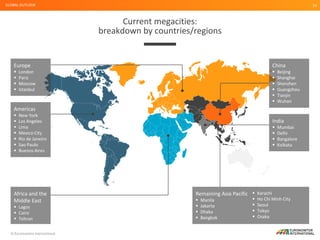
Current megacities:
breakdown by countries/regions
GLOBAL OUTLOOK
Americas
▪ New York
▪ Los Angeles
▪ Lima
▪ Mexico City
▪ Rio de Janeiro
▪ Sao Paulo
▪ Buenos Aires
Africa and the
Middle East
▪ Lagos
▪ Cairo
▪ Tehran
Europe
▪ London
▪ Paris
▪ Moscow
▪ Istanbul
Remaining Asia Pacific
▪ Manila
▪ Jakarta
▪ Dhaka
▪ Bangkok
▪ Karachi
▪ Ho Chi Minh City
▪ Seoul
▪ Tokyo
▪ Osaka
China
▪ Beijing
▪ Shanghai
▪ Shenzhen
▪ Guangzhou
▪ Tianjin
▪ Wuhan
India
▪ Mumbai
▪ Delhi
▪ Bangalore
▪ Kolkata
© Euromonitor International
11
Demographics: developed cities lag in
population growth
GLOBAL OUTLOOK
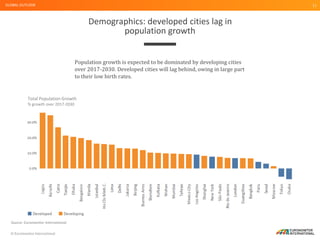
Population growth is expected to be dominated by developing cities
over 2017-2030. Developed cities will lag behind, owing in large part
to their low birth rates.
Source: Euromonitor International
Total Population Growth
% growth over 2017-2030
© Euromonitor International
12
Economy: developing megacities
playing catch up
GLOBAL OUTLOOK
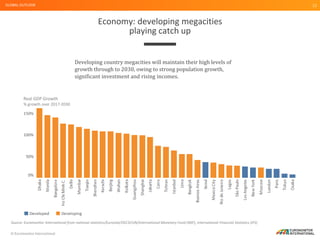
Developing country megacities will maintain their high levels of
growth through to 2030, owing to strong population growth,
significant investment and rising incomes.
Source: Euromonitor International from national statistics/Eurostat/OECD/UN/International Monetary Fund (IMF), International Financial Statistics (IFS)
Real GDP Growth
% growth over 2017-2030
© Euromonitor International
13
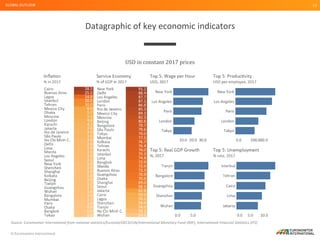
Datagraphic of key economic indicators
GLOBAL OUTLOOK
USD in constant 2017 prices
Source: Euromonitor International from national statistics/Eurostat/OECD/UN/International Monetary Fund (IMF), International Financial Statistics (IFS)
© Euromonitor International
14
The future megacities
© Euromonitor International
15
The future megacities
THE FUTURE MEGACITIES
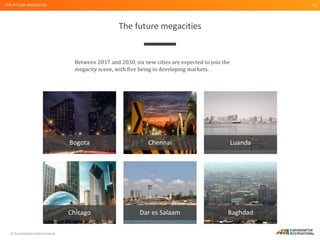
Between 2017 and 2030, six new cities are expected to join the
megacity scene, with five being in developing markets.
Bogota Chennai Luanda
Chicago Dar es Salaam Baghdad
© Euromonitor International
16
A snapshot of the future megacities
THE FUTURE MEGACITIES
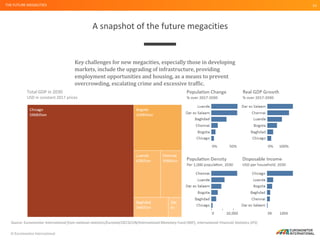
Key challenges for new megacities, especially those in developing
markets, include the upgrading of infrastructure, providing
employment opportunities and housing, as a means to prevent
overcrowding, escalating crime and excessive traffic.
Source: Euromonitor International from national statistics/Eurostat/OECD/UN/International Monetary Fund (IMF), International Financial Statistics (IFS)
Total GDP in 2030
USD in constant 2017 prices
Megacities by Region 2030
Asia-Pacific Americas
Middle East and Africa Europe
Megacities by
Development 2030
Emerging Developed
25
30
35
40
Jakarta Tokyo Karachi Manila Cairo
Five Largest Megacitiesby
Population 2030
0
5
10
China India US Japan Brazil
Top Five Countries by
MegacityCount 2030
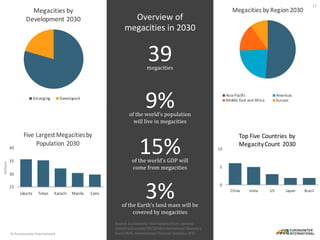
39megacities
9%of the world’s population
will live in megacities
15%of the world’s GDP will
come from megacities
3%of the Earth’s land mass will be
covered by megacities
Overview of
megacities in 2030
© Euromonitor International
17
Source: Euromonitor International from national
statistics/Eurostat/OECD/UN/International Monetary
Fund (IMF), International Financial Statistics (IFS)
Millions
© Euromonitor International
18
Key trends
© Euromonitor International
19
Key trends
KEY TRENDS
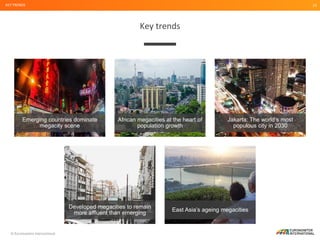
Emerging countries dominate
megacity scene
African megacities at the heart of
population growth
Jakarta: The world’s most
populous city in 2030
Developed megacities to remain
more affluent than emerging
East Asia’s ageing megacities
© Euromonitor International
20
Poor emerging countries dominate
megacity scene
KEY TRENDS
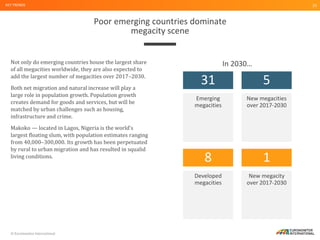
Not only do emerging countries house the largest share
of all megacities worldwide, they are also expected to
add the largest number of megacities over 2017–2030.
Both net migration and natural increase will play a
large role in population growth. Population growth
creates demand for goods and services, but will be
matched by urban challenges such as housing,
infrastructure and crime.
Makoko — located in Lagos, Nigeria is the world’s
largest floating slum, with population estimates ranging
from 40,000–300,000. Its growth has been perpetuated
by rural to urban migration and has resulted in squalid
living conditions.
31
Emerging
megacities
5
New megacities
over 2017-2030
8
Developed
megacities
1
New megacity
over 2017-2030
In 2030…
© Euromonitor International
21
African megacities at the heart of
population growth
KEY TRENDS
Urbanisation is taking hold in Africa, as people seek a life
in urban conurbations. In Nigeria — the largest country
by population in Africa — the urban share is expected to
jump by nine percentage points over 2017–2030.
Urbanisation will continue feeding megacities growth.
Luanda and Dar es Salaam — two of the new megacities
in Africa — will be the fastest growing cities by population
in the region over 2017–2030.
Challenges regarding housing, public services and
sanitation, among other things, will require attention in
Africa’s megacities, as overcrowding will take its toll.
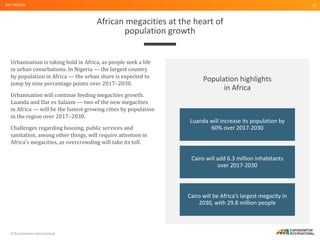
Population highlights
in Africa
Luanda will increase its population by
60% over 2017-2030
Cairo will add 6.3 million inhabitants
over 2017-2030
Cairo will be Africa’s largest megacity in
2030, with 29.8 million people
© Euromonitor International
22
Jakarta to be crowned most
populous city in 2030
KEY TRENDS
In 2030, Jakarta is expected to overtake Tokyo to become
the most populous city in the world. Population decline in
Tokyo (the city is expected to lose two million inhabitants
over 2017–2030), coupled with large growth in Jakarta
(adding 4.1 million people) will make it the largest city in
the world, with a total population of 35.6 million.
This marks a new era in urban history, as Jakarta becomes
the first emerging city to hold the title of world’s largest
megacity. Previously, New York held top spot, until it was
overtaken by Tokyo in the 1950s.
Challenges will arise in Jakarta, with traffic being a major
one. According to TomTom’s congestion index, it was the
third worst city for traffic in 2018.
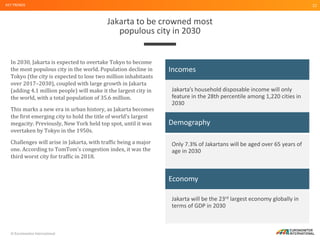
Incomes
Jakarta’s household disposable income will only
feature in the 28th percentile among 1,220 cities in
2030
Demography
Only 7.3% of Jakartans will be aged over 65 years of
age in 2030
Economy
Jakarta will be the 23rd largest economy globally in
terms of GDP in 2030
© Euromonitor International
23
Developed megacities to remain more
affluent than emerging
KEY TRENDS
It is no surprise that economic, income and expenditure
growth have all been dominated by developing cities
over the last decade. In spite of such growth, in 2030,
developed megacities will be more affluent than
emerging counterparts. For instance, based on
household disposable income, Seoul (USD53,000)
— the least affluent developed megacity, will still be
richer than Shanghai (USD50,600)— the richest
emerging megacity.
Developed megacities are still the key consumer
markets of the future. Cities such as Dar es Salaam and
Luanda have a long way to go before being considered
for large-scale retail or commercial investment.
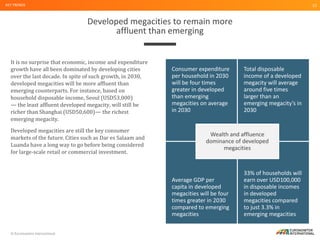
Consumer expenditure
per household in 2030
will be four times
greater in developed
than emerging
megacities on average
in 2030
Total disposable
income of a developed
megacity will average
around five times
larger than an
emerging megacity’s in
2030
Average GDP per
capita in developed
megacities will be four
times greater in 2030
compared to emerging
megacities
33% of households will
earn over USD100,000
in disposable incomes
in developed
megacities compared
to just 3.3% in
emerging megacities
Wealth and affluence
dominance of developed
megacities
© Euromonitor International
24
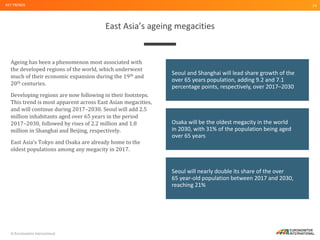
East Asia’s ageing megacities
KEY TRENDS
Ageing has been a phenomenon most associated with
the developed regions of the world, which underwent
much of their economic expansion during the 19th and
20th centuries.
Developing regions are now following in their footsteps.
This trend is most apparent across East Asian megacities,
and will continue during 2017–2030. Seoul will add 2.5
million inhabitants aged over 65 years in the period
2017–2030, followed by rises of 2.2 million and 1.8
million in Shanghai and Beijing, respectively.
East Asia’s Tokyo and Osaka are already home to the
oldest populations among any megacity in 2017.
Seoul and Shanghai will lead share growth of the
over 65 years population, adding 9.2 and 7.1
percentage points, respectively, over 2017–2030
Osaka will be the oldest megacity in the world
in 2030, with 31% of the population being aged
over 65 years
Seoul will nearly double its share of the over
65 year-old population between 2017 and 2030,
reaching 21%
© Euromonitor International
25
Conclusion
© Euromonitor International
26
Conclusion
CONCLUSION
Megacities are urban consumer markets that can
concentrate immense business potential. Indeed, some
of the world’s megacities are so large that they hold
disproportionate national economic dominance albeit
within a relatively small geographic space; for example,
Bangkok generated over half of Thailand’s GDP in 2017
despite only accounting for 1.5% of total national land
area. As consumer markets, megacities make ideal
settings for businesses to form entry or expansionary
strategies; but they should be treated as individual
consumer markets.
The importance of megacities in national affairs will
continue to rise, with megacities potentially becoming
future megalopolises capable of holding 50 or even 100
million people. To pave the way for sustainable growth,
megacities will need to simultaneously overcome the
stereotypical hurdles associated with urban growth:
traffic congestion, income inequality, air pollution, crime,
affordability and slum generation. Developing megacities
will need to ensure good access to public amenities, clean
water supply, electricity, education and jobs if they are
to avoid the abovementioned pitfalls cities so often fall
prey to. Chinese megacities have grown remarkably well
with standards of living being almost akin to developed
megacities, but the real question lays with less affluent
developing countries. Africa will spearhead growth as the
world’s final continent will embark on the urbanisation
journey, but with weak governance and corruption, some
of the continent’s newly emerging megacities may face
immense economic, social and environmental hardships.
Thank you
Fransua Vytautas Razvadauskas, Senior City Analyst
Tel: +370 5 243 1577
fransua.razvadauskas@euromonitor.com

Megacities: Developing Country Domination

  • 1.
    Megacities: Developing Country Domination FransuaVytautas Razvadauskas, Senior City Analyst
  • 2.
    © Euromonitor International 2 ©Euromonitor International 2 This PowerPoint presentation includes proprietary information from Euromonitor International and cannot be used or stored with the intent of republishing, reprinting, repurposing or redistributing in any form without explicit consent from Euromonitor International. For usage requests and permission, please contact us http://www.euromonitor.com/locations. 2 © Euromonitor International© Euromonitor International 2
  • 3.
    OVERVIEW © Euromonitor International 3 Introduction GlobalOutlook The Future Megacities Key Trends Conclusion
  • 4.
  • 5.
    © Euromonitor International 5 Introduction INTRODUCTION Thetrend of global urbanisation is in full swing, with the last 100 years seeing remarkable change in attitudes to city life. In the past, urban living was an infrequent occurrence; for instance, in 1900 only 15% of the globe’s population resided in cities. Nonetheless, changing consumer lifestyles and livelihoods have led to a stark rise in this figure and 2008 marked a historic milestone which saw over half of the world’s population living in urbanised conurbations. The trend sees no end — at least in the medium term — as current projections suggest 60% of the world’s population to be urban by 2030. Megacities are significant for businesses since they concentrate wealth, income and business opportunities. The adverse externalities they create through excessive pollution or traffic congestion, concurrently fosters urban challenges and opportunities which necessitate innovative solutions to maintain economic appeal. Understanding the economic and demographic composition of megacities, as well as the direction of expected changes can help businesses implement the appropriate business models to achieve future success. The purpose of the white paper is to offer an overview of the current economic and demographic state of the world’s megacities. The report answers a range of questions: which megacities feature the most affluent economic indicators? which megacities are forecast to lead economic growth? Furthermore, the report examines and pinpoints the key future trends that are set to characterise megacity consumer markets over 2017–2030, touching upon key topics such as ageing and consumer affluence.
  • 6.
    © Euromonitor International 6 ©Euromonitor International 6 Why are they significant?What is a megacity? An urbanised conurbation housing 10 or more million inhabitants. They are often the primary nodes for investment in a country and feature the most affluent households. Some of the first megacities popped up in the developed world, with New York being the first, in the 1950s, but was soon overtaken by the fast rising Tokyo. Megacities offer wealth, social diversity, economic growth and innovation. They attract the ambitious in search of jobs, business ventures and education. At the same time, megacities present numerous challenges to urban planners, as they can suffer from overcrowding, traffic congestion, air pollution and high income inequality. © Euromonitor International 6
  • 7.
    © Euromonitor International 7 Keyfindings INTRODUCTION Developing cities dominate the megacity scene In 2017, 26 of the 33 megacities were in developing countries. Developing countries will dominate the megacity scene over 2017–2030, adding five of the six new megacities in the period. Asia Pacific has the largest number of megacities In 2017, Asia Pacific accounted for the largest number of megacities, with 19 of the 33 (58%). China and India are the regional and global leaders, with six and four megacities each in 2017, respectively. Jakarta: The globe’s most populous city in 2030 Jakarta is due to overtake Tokyo in 2030 to become the largest city in terms of population size. Rapid population growth in Jakarta, coupled with depopulation in Tokyo, will make the Indonesian capital the largest by population size in 2030, with 35.6 million. African megacities to lead population surge African megacities will lead population growth, reflecting its position as the last major continent to undergo urbanisation. It will account for the largest absolute rise in megacities over 2017–2030, adding Dar es Salaam and Luanda to the region’s current megacities of Cairo and Lagos. Developed megacities maintain economic lead In spite of the surging populations and economic progress in emerging countries, developed megacities will still maintain their economic and consumer affluence advantage in 2030. For instance, disposable income per household will still be greater in all developed megacities in 2030 than in emerging megacities. East Asia’s ageing megacities Ageing is expected to have an impact on many key megacities in East Asia over 2017–2030. Growth in the share of over 65 year-olds will be particularly apparent in Seoul, and Chinese megacities such as Beijing and Shanghai.
  • 8.
    © Euromonitor International 8 Risingneed for smart city initiatives In light of rising populations, the demands placed upon city assets and resources (waste management, public transport, energy, etc.) will be stretched. Smart city initiatives are needed in fast growing developing cities to help manage the effects population growth brings. Business opportunities in ageing East Asia Population ageing will feature in Asia Pacific countries, with China being a major market. One key growth industry among the older Chinese population is travel, with domestic and international tours specific tailored to the elderly rising in popularity. Harnessing growth of African megacities The African continent is rapidly urbanizing, and the middle class that is emerging will be an important component of future consumption growth. Challenges related to overcrowding, congestion and air pollution will need to be addressed to prevent counterproductive effects. © Euromonitor International 8 Areas of opportunity
  • 9.
  • 10.
    © Euromonitor International 10 Currentmegacities: breakdown by countries/regions GLOBAL OUTLOOK Americas ▪ New York ▪ Los Angeles ▪ Lima ▪ Mexico City ▪ Rio de Janeiro ▪ Sao Paulo ▪ Buenos Aires Africa and the Middle East ▪ Lagos ▪ Cairo ▪ Tehran Europe ▪ London ▪ Paris ▪ Moscow ▪ Istanbul Remaining Asia Pacific ▪ Manila ▪ Jakarta ▪ Dhaka ▪ Bangkok ▪ Karachi ▪ Ho Chi Minh City ▪ Seoul ▪ Tokyo ▪ Osaka China ▪ Beijing ▪ Shanghai ▪ Shenzhen ▪ Guangzhou ▪ Tianjin ▪ Wuhan India ▪ Mumbai ▪ Delhi ▪ Bangalore ▪ Kolkata
  • 11.
    © Euromonitor International 11 Demographics:developed cities lag in population growth GLOBAL OUTLOOK Population growth is expected to be dominated by developing cities over 2017-2030. Developed cities will lag behind, owing in large part to their low birth rates. Source: Euromonitor International Total Population Growth % growth over 2017-2030
  • 12.
    © Euromonitor International 12 Economy:developing megacities playing catch up GLOBAL OUTLOOK Developing country megacities will maintain their high levels of growth through to 2030, owing to strong population growth, significant investment and rising incomes. Source: Euromonitor International from national statistics/Eurostat/OECD/UN/International Monetary Fund (IMF), International Financial Statistics (IFS) Real GDP Growth % growth over 2017-2030
  • 13.
    © Euromonitor International 13 Datagraphicof key economic indicators GLOBAL OUTLOOK USD in constant 2017 prices Source: Euromonitor International from national statistics/Eurostat/OECD/UN/International Monetary Fund (IMF), International Financial Statistics (IFS)
  • 14.
  • 15.
    © Euromonitor International 15 Thefuture megacities THE FUTURE MEGACITIES Between 2017 and 2030, six new cities are expected to join the megacity scene, with five being in developing markets. Bogota Chennai Luanda Chicago Dar es Salaam Baghdad
  • 16.
    © Euromonitor International 16 Asnapshot of the future megacities THE FUTURE MEGACITIES Key challenges for new megacities, especially those in developing markets, include the upgrading of infrastructure, providing employment opportunities and housing, as a means to prevent overcrowding, escalating crime and excessive traffic. Source: Euromonitor International from national statistics/Eurostat/OECD/UN/International Monetary Fund (IMF), International Financial Statistics (IFS) Total GDP in 2030 USD in constant 2017 prices
  • 17.
    Megacities by Region2030 Asia-Pacific Americas Middle East and Africa Europe Megacities by Development 2030 Emerging Developed 25 30 35 40 Jakarta Tokyo Karachi Manila Cairo Five Largest Megacitiesby Population 2030 0 5 10 China India US Japan Brazil Top Five Countries by MegacityCount 2030 39megacities 9%of the world’s population will live in megacities 15%of the world’s GDP will come from megacities 3%of the Earth’s land mass will be covered by megacities Overview of megacities in 2030 © Euromonitor International 17 Source: Euromonitor International from national statistics/Eurostat/OECD/UN/International Monetary Fund (IMF), International Financial Statistics (IFS) Millions
  • 18.
  • 19.
    © Euromonitor International 19 Keytrends KEY TRENDS Emerging countries dominate megacity scene African megacities at the heart of population growth Jakarta: The world’s most populous city in 2030 Developed megacities to remain more affluent than emerging East Asia’s ageing megacities
  • 20.
    © Euromonitor International 20 Pooremerging countries dominate megacity scene KEY TRENDS Not only do emerging countries house the largest share of all megacities worldwide, they are also expected to add the largest number of megacities over 2017–2030. Both net migration and natural increase will play a large role in population growth. Population growth creates demand for goods and services, but will be matched by urban challenges such as housing, infrastructure and crime. Makoko — located in Lagos, Nigeria is the world’s largest floating slum, with population estimates ranging from 40,000–300,000. Its growth has been perpetuated by rural to urban migration and has resulted in squalid living conditions. 31 Emerging megacities 5 New megacities over 2017-2030 8 Developed megacities 1 New megacity over 2017-2030 In 2030…
  • 21.
    © Euromonitor International 21 Africanmegacities at the heart of population growth KEY TRENDS Urbanisation is taking hold in Africa, as people seek a life in urban conurbations. In Nigeria — the largest country by population in Africa — the urban share is expected to jump by nine percentage points over 2017–2030. Urbanisation will continue feeding megacities growth. Luanda and Dar es Salaam — two of the new megacities in Africa — will be the fastest growing cities by population in the region over 2017–2030. Challenges regarding housing, public services and sanitation, among other things, will require attention in Africa’s megacities, as overcrowding will take its toll. Population highlights in Africa Luanda will increase its population by 60% over 2017-2030 Cairo will add 6.3 million inhabitants over 2017-2030 Cairo will be Africa’s largest megacity in 2030, with 29.8 million people
  • 22.
    © Euromonitor International 22 Jakartato be crowned most populous city in 2030 KEY TRENDS In 2030, Jakarta is expected to overtake Tokyo to become the most populous city in the world. Population decline in Tokyo (the city is expected to lose two million inhabitants over 2017–2030), coupled with large growth in Jakarta (adding 4.1 million people) will make it the largest city in the world, with a total population of 35.6 million. This marks a new era in urban history, as Jakarta becomes the first emerging city to hold the title of world’s largest megacity. Previously, New York held top spot, until it was overtaken by Tokyo in the 1950s. Challenges will arise in Jakarta, with traffic being a major one. According to TomTom’s congestion index, it was the third worst city for traffic in 2018. Incomes Jakarta’s household disposable income will only feature in the 28th percentile among 1,220 cities in 2030 Demography Only 7.3% of Jakartans will be aged over 65 years of age in 2030 Economy Jakarta will be the 23rd largest economy globally in terms of GDP in 2030
  • 23.
    © Euromonitor International 23 Developedmegacities to remain more affluent than emerging KEY TRENDS It is no surprise that economic, income and expenditure growth have all been dominated by developing cities over the last decade. In spite of such growth, in 2030, developed megacities will be more affluent than emerging counterparts. For instance, based on household disposable income, Seoul (USD53,000) — the least affluent developed megacity, will still be richer than Shanghai (USD50,600)— the richest emerging megacity. Developed megacities are still the key consumer markets of the future. Cities such as Dar es Salaam and Luanda have a long way to go before being considered for large-scale retail or commercial investment. Consumer expenditure per household in 2030 will be four times greater in developed than emerging megacities on average in 2030 Total disposable income of a developed megacity will average around five times larger than an emerging megacity’s in 2030 Average GDP per capita in developed megacities will be four times greater in 2030 compared to emerging megacities 33% of households will earn over USD100,000 in disposable incomes in developed megacities compared to just 3.3% in emerging megacities Wealth and affluence dominance of developed megacities
  • 24.
    © Euromonitor International 24 EastAsia’s ageing megacities KEY TRENDS Ageing has been a phenomenon most associated with the developed regions of the world, which underwent much of their economic expansion during the 19th and 20th centuries. Developing regions are now following in their footsteps. This trend is most apparent across East Asian megacities, and will continue during 2017–2030. Seoul will add 2.5 million inhabitants aged over 65 years in the period 2017–2030, followed by rises of 2.2 million and 1.8 million in Shanghai and Beijing, respectively. East Asia’s Tokyo and Osaka are already home to the oldest populations among any megacity in 2017. Seoul and Shanghai will lead share growth of the over 65 years population, adding 9.2 and 7.1 percentage points, respectively, over 2017–2030 Osaka will be the oldest megacity in the world in 2030, with 31% of the population being aged over 65 years Seoul will nearly double its share of the over 65 year-old population between 2017 and 2030, reaching 21%
  • 25.
  • 26.
    © Euromonitor International 26 Conclusion CONCLUSION Megacitiesare urban consumer markets that can concentrate immense business potential. Indeed, some of the world’s megacities are so large that they hold disproportionate national economic dominance albeit within a relatively small geographic space; for example, Bangkok generated over half of Thailand’s GDP in 2017 despite only accounting for 1.5% of total national land area. As consumer markets, megacities make ideal settings for businesses to form entry or expansionary strategies; but they should be treated as individual consumer markets. The importance of megacities in national affairs will continue to rise, with megacities potentially becoming future megalopolises capable of holding 50 or even 100 million people. To pave the way for sustainable growth, megacities will need to simultaneously overcome the stereotypical hurdles associated with urban growth: traffic congestion, income inequality, air pollution, crime, affordability and slum generation. Developing megacities will need to ensure good access to public amenities, clean water supply, electricity, education and jobs if they are to avoid the abovementioned pitfalls cities so often fall prey to. Chinese megacities have grown remarkably well with standards of living being almost akin to developed megacities, but the real question lays with less affluent developing countries. Africa will spearhead growth as the world’s final continent will embark on the urbanisation journey, but with weak governance and corruption, some of the continent’s newly emerging megacities may face immense economic, social and environmental hardships.
  • 27.
    Thank you Fransua VytautasRazvadauskas, Senior City Analyst Tel: +370 5 243 1577 fransua.razvadauskas@euromonitor.com