Competitiveness and Urban Mobility
A Case from India
Dr. Amit Kapoor
Honorary Chairman, Institute for Competitiveness, India
INDIA CITIES ON GLOBAL BENCHMARK
Tokyo (68)Shanghai (55.2)Los Angeles (61.5)
New York (71.4)
London (70.4)
Hong Kong (69.3)
Paris(69.3)
Zurich (66.8)
Chicago (65.9)
Singapore (70)
Delhi (46.7)
Kolkata (37.8)
Chennai (38.1)
Bangalore (44.6)
Mumbai (46.6)
Ahmedabad (41.9)
Source:- Economist Intelligence Unit and Institute for Competitiveness Analysis
Hyderabad (39.4)
Institute for Competitiveness, India Presented by: Dr. Amit Kapoor
 Competitiveness is the productivity with which a region utilizes its human, capital, and natural resources
 Productivity determines wages and the standard of living – Productivity growth determines sustainable economic growth
 It is not what industries a nation competes in that matters for prosperity, but how productively it competes in those industries
 Productivity in an economy depends on a combination of domestic and foreign firms
 Innovation in products and processes is necessary to drive productivity growth
 Only productive businesses can create wealth and jobs States compete to offer the most productive environment for business
 The public and private sectors play different but interrelated roles in creating a productive economy
Leading to the prosperity of the region
ENHANCING THE PROSPERITY OF URBAN INDIA via COMPETITIVENESS
Institute for Competitiveness, India Presented by: Dr. Amit Kapoor
INFLUENCES ON COMPETITIVENESS
WORLD ECONOMY
BROAD ECONOMIC AREAS
GROUP OF NEIGHBOURING NATIONS
NATIONS
STATES, PROVINCES
METROPOLITAN AREAS, RURAL AREAS
Multiple Geographic Levels
[Our Focus]
Source:- Institute for Strategy and Competitiveness
Institute for Competitiveness, India Presented by: Dr. Amit Kapoor
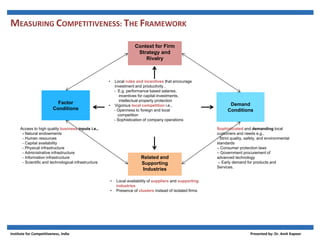
MEASURING COMPETITIVENESS: THE FRAMEWORK
Context for Firm
Strategy and
Rivalry
Related and
Supporting
Industries
Demand
Conditions
• Local rules and incentives that encourage
investment and productivity .
- E.g. performance based salaries,
incentives for capital investments,
intellectual property protection
• Vigorous local competition i.e.,
- Openness to foreign and local
competition
- Sophistication of company operations
• Local availability of suppliers and supporting
industries
• Presence of clusters instead of isolated firms
Sophisticated and demanding local
customers and needs e.g.,
- Strict quality, safety, and environmental
standards
– Consumer protection laws
– Government procurement of
advanced technology
– Early demand for products and
Services.
Access to high quality business inputs i.e.,
- Natural endowments
- Human resources
- Capital availability
- Physical infrastructure
- Administrative infrastructure
- Information infrastructure
- Scientific and technological infrastructure
Factor
Conditions
Institute for Competitiveness, India Presented by: Dr. Amit Kapoor
DRIVERS OF COMPETITIVENESS
Quality of overall business
environment
Concentration of resources
and urban growth
Policy Coordination among
Multiple Levels of
Geography/Government
Institute for Competitiveness, India Presented by: Dr. Amit Kapoor
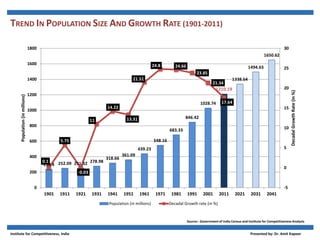
TREND IN POPULATION SIZE AND GROWTH RATE (1901-2011)
238.4 252.09 251.32 278.98
318.66
361.09
439.23
548.16
683.33
846.42
1028.74
1210.19
1338.64
1494.63
1650.62
0.1
5.75
-0.03
11
14.22
13.31
21.51
24.8 24.66
23.85
21.34
17.64
-5
0
5
10
15
20
25
30
0
200
400
600
800
1000
1200
1400
1600
1800
1901 1911 1921 1931 1941 1951 1961 1971 1981 1991 2001 2011 2021 2031 2041
DecadalGrowthRate(in%)
Population(inmillions)
Population (in millions) Decadal Growth rate (in %)
Source:- Government of India Census and Institute for Competitiveness Analysis
Institute for Competitiveness, India Presented by: Dr. Amit Kapoor
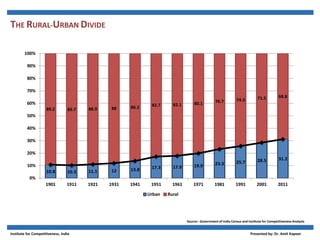
THE RURAL-URBAN DIVIDE
10.8 10.3 11.1 12 13.8 17.3 17.9 19.9 23.3 25.7 28.5 31.2
89.2 89.7 88.9 88 86.2 82.7 82.1 80.1 76.7 74.3 71.5 68.8
0%
10%
20%
30%
40%
50%
60%
70%
80%
90%
100%
1901 1911 1921 1931 1941 1951 1961 1971 1981 1991 2001 2011
Urban Rural
Source:- Government of India Census and Institute for Competitiveness Analysis
Institute for Competitiveness, India Presented by: Dr. Amit Kapoor
URBAN INDIA OF 1951
10 - 30 million
5 - 10 million
1 - 5 million
0.1 – 1 million
Cities Size Class By Population
Source:- India Urban Conference 2011: Evidence & Experience - IIHS
Institute for Competitiveness, India Presented by: Dr. Amit Kapoor
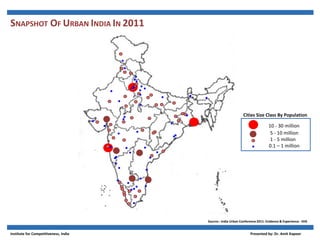
SNAPSHOT OF URBAN INDIA IN 2011
10 - 30 million
5 - 10 million
1 - 5 million
0.1 – 1 million
Cities Size Class By Population
Source:- India Urban Conference 2011: Evidence & Experience - IIHS
Institute for Competitiveness, India Presented by: Dr. Amit Kapoor
URBAN INDIA OF 2031
10 - 30 million
5 - 10 million
1 - 5 million
0.1 – 1 million
Cities Size Class By Population
Source:- India Urban Conference 2011: Evidence & Experience - IIHS
Institute for Competitiveness, India Presented by: Dr. Amit Kapoor
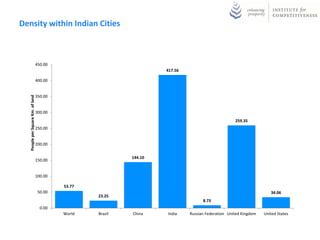
Density within Indian Cities
53.77
23.25
144.10
417.56
8.73
259.35
34.06
0.00
50.00
100.00
150.00
200.00
250.00
300.00
350.00
400.00
450.00
World Brazil China India Russian Federation United Kingdom United States
PeopleperSquareKm.ofland
Most and the Least Dense Cities of India
26903
24252
20925
18480
11297
393
384
339
310
159
1 10 100 1000 10000 100000
Chennai
Kolkata
Mumbai
	Hyderabad
Delhi
Nashik
Vishakhapatnam
Rajkot
Raipur
Shimla
Density of People per square Km of Area
Most and the Least Dense Cities of India
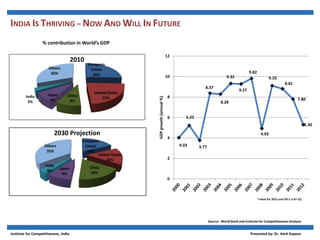
INDIA IS THRIVING – NOW AND WILL IN FUTURE
% contribution in World’s GDP
European
Union
18%
United States
16%
China
18%
Japan
9%
India
4%
Others
35%
2030 Projection
European
Union
26%
United States
23%
China
9%
Japan
9%
India
3%
Others
30%
2010
4.03
5.22
3.77
8.37
8.28
9.32
9.27
9.82
4.93
9.10
8.81
7.80
5.30
0
2
4
6
8
10
12
GDPgrowth(annual%)
*value for 2012 and 2011 is for Q1
Source:- World Bank and Institute for Competitiveness Analysis
Institute for Competitiveness, India Presented by: Dr. Amit Kapoor
Urban Population as a percentage of Total Population
17.3
18
19.9
23.3
25.7
27.8
31.2
0
5
10
15
20
25
30
35
1951 1961 1971 1981 1991 2001 2011
PercentageofUrbanPopulation(%)
Urban Population as a percentage of Total Population
Source :MOSPI, Institute for Competitiveness Analysis
FACTOR CONDITIONS (From State Competitiveness Report)
AP
AR
AS
BR
CG
DL
GA
GJ
HR
HPJK
JH
KA
KL
MP
MH
MN ML MZ
NL
OD
PB
RJ
SK
TN
TR
UP
UK
WB
y = 22.879e0.2343x
R² = 0.3619
0
200000
400000
600000
800000
1000000
1200000
1400000
1600000
50 52 54 56 58 60 62 64 66
GSDPatcurrentpricesinRs.Crorein2012-13
Factor Conditions Score
Source :CEA, Institute for Competitiveness Analysis
SUB PILLARS OF FACTOR CONDITIONS - PHYSICAL CONDITIONS
AP
AR
AS
CG
DL
GA
GJ
HR
HP
JK
KA
KL
MP
MH
MNML
MZ
NL
OD PB
RJ
SK
TN
UP
UK
WB
y = 13.908x2 - 716.11x + 2523.6
R² = 0.7141
-5000
0
5000
10000
15000
20000
25000
30000
35000
40000
50 55 60 65 70 75 80 85
TotalInstalledCapacotyinMWason28.2.2014
Physical Conditions Score
Source :MORTH, Institute for Competitiveness Analysis
SURFACE ROADS AND COMPETITIVENESS
AP
AR
AS
BR
CG
DL
GA
GJHR
HP
JK
JH
KA
KL
MP
MH
MN
ML
MZ
NL
OD
PB
RJ
SK
TN
TR
UP
UK
WB
y = 98.06ln(x) - 329.88
R² = 0.2145
0
10
20
30
40
50
60
70
80
90
100
50.00 52.00 54.00 56.00 58.00 60.00 62.00 64.00 66.00 68.00 70.00
Ratioofsurfacedtototalroads,2012
Microeconomic Competititveness Scores
Source MOR, Institute for Competitiveness Analysis
RAILWAYS AND COMPETITIVENESS
AP
AR
AS
BR
CG
DL
GA
GJ
HR
HPJK
JH
KA
KL
MP
MH
MNML MZNL
OD
PB
RJ
SK
TN
TR
UP
UK
WB
y = 188.12x - 8495.8
R² = 0.1643
0
1000
2000
3000
4000
5000
6000
7000
8000
9000
10000
50.00 52.00 54.00 56.00 58.00 60.00 62.00 64.00 66.00 68.00 70.00
StatewiseRouteKmofRailwayLines(inKm)
Microeconomic Competititveness Scores
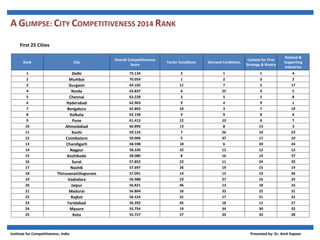
A GLIMPSE: CITY COMPETITIVENESS 2014 RANK
First 25 Cities
Institute for Competitiveness, India Presented by: Dr. Amit Kapoor
Rank City
Overall Competitiveness
Score
Factor Conditions Demand Conditions
Context for Firm
Strategy  Rivalry
Related 
Supporting
Industries
1 Delhi 73.134 2 1 1 4
2 Mumbai 70.059 1 2 3 2
3 Gurgaon 64.102 11 7 2 17
4 Noida 63.837 6 25 4 5
5 Chennai 63.228 3 5 5 8
6 Hyderabad 62.903 9 4 9 1
7 Bengaluru 62.803 10 3 7 19
8 Kolkata 62.158 4 9 8 6
9 Pune 61.413 12 10 6 7
10 Ahmedabad 60.890 13 8 13 3
11 Kochi 59.123 7 26 10 23
12 Coimbatore 59.006 5 37 17 10
13 Chandigarh 58.598 18 6 20 24
14 Nagpur 58.330 32 12 12 13
15 Kozhikode 58.080 8 16 14 37
16 Surat 57.852 22 11 24 20
17 Nashik 57.697 26 19 15 14
18 Thiruvananthapuram 57.091 14 15 19 36
19 Vadodara 56.988 23 27 16 25
20 Jaipur 56.821 46 13 18 16
21 Madurai 56.804 16 32 22 31
22 Rajkot 56.524 31 17 21 22
23 Faridabad 56.392 45 18 11 27
24 Mysore 55.754 19 34 30 32
25 Kota 55.727 27 20 33 28
A GLIMPSE: CITY COMPETITIVENESS 2014 RANK
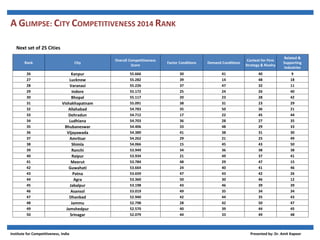
Next set of 25 Cities
Institute for Competitiveness, India Presented by: Dr. Amit Kapoor
Rank City
Overall Competitiveness
Score
Factor Conditions Demand Conditions
Context for Firm
Strategy  Rivalry
Related 
Supporting
Industries
26 Kanpur 55.666 30 41 40 9
27 Lucknow 55.282 39 14 48 18
28 Varanasi 55.226 37 47 32 11
29 Indore 55.172 25 24 26 40
30 Bhopal 55.117 20 23 28 42
31 Vishakhapatnam 55.091 38 31 23 29
32 Allahabad 54.783 35 50 36 21
33 Dehradun 54.712 17 22 45 44
34 Ludhiana 54.703 36 28 27 35
35 Bhubaneswar 54.406 33 48 29 33
36 Vijayawada 54.389 41 38 31 30
37 Amritsar 54.262 29 21 25 49
38 Shimla 54.066 15 45 43 50
39 Ranchi 53.949 34 36 38 38
40 Raipur 53.934 21 49 37 41
41 Meerut 53.784 48 29 47 15
42 Guwahati 53.664 24 40 41 46
43 Patna 53.659 47 43 42 26
44 Agra 53.360 50 30 46 12
45 Jabalpur 53.198 43 46 39 39
46 Asansol 53.019 49 35 34 34
47 Dhanbad 52.940 42 44 35 43
48 Jammu 52.798 28 42 50 47
49 Jamshedpur 52.570 40 39 44 45
50 Srinagar 52.079 44 33 49 48
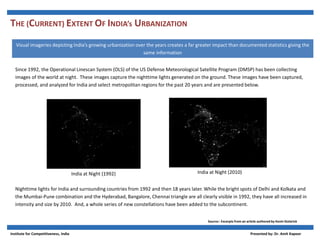
THE (CURRENT) EXTENT OF INDIA’s URBANIZATION
Visual imageries depicting India’s growing urbanization over the years creates a far greater impact than documented statistics giving the
same information
Source:- Excerpts from an article authored by Kevin Stolarick
Institute for Competitiveness, India Presented by: Dr. Amit Kapoor
Since 1992, the Operational Linescan System (OLS) of the US Defense Meteorological Satellite Program (DMSP) has been collecting
images of the world at night. These images capture the nighttime lights generated on the ground. These images have been captured,
processed, and analyzed for India and select metropolitan regions for the past 20 years and are presented below.
India at Night (1992) India at Night (2010)
Nighttime lights for India and surrounding countries from 1992 and then 18 years later. While the bright spots of Delhi and Kolkata and
the Mumbai-Pune combination and the Hyderabad, Bangalore, Chennai triangle are all clearly visible in 1992, they have all increased in
intensity and size by 2010. And, a whole series of new constellations have been added to the subcontinent.
THE (CURRENT) EXTENT OF INDIA’s URBANIZATION
Institute for Competitiveness, India Presented by: Dr. Amit Kapoor
DELHI
Increased urbanization of selected cities
MUMBAI-PUNE
Source:- Excerpts from an article authored by Kevin Stolarick
THE (CURRENT) EXTENT OF INDIA’s URBANIZATION
Institute for Competitiveness, India Presented by: Dr. Amit Kapoor
KOLKATA
Increased urbanization of selected cities
HYDERABAD
Source:- Excerpts from an article authored by Kevin Stolarick
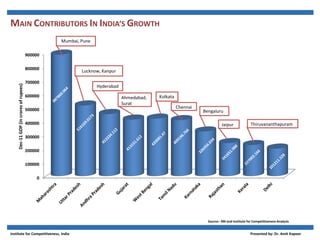
MAIN CONTRIBUTORS IN INDIA’S GROWTH
Source:- RBI and Institute for Competitiveness Analysis
0
100000
200000
300000
400000
500000
600000
700000
800000
900000
Dec-11GDP(incroresofrupees)
Mumbai, Pune
Lucknow, Kanpur
Hyderabad
Ahmedabad,
Surat
Kolkata
Chennai
Bengaluru
Jaipur Thiruvananthapuram
Institute for Competitiveness, India Presented by: Dr. Amit Kapoor
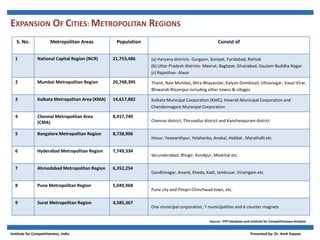
EXPANSION OF CITIES: METROPOLITAN REGIONS
Source:- PPP Database and Institute for Competitiveness Analysis
S. No. Metropolitan Areas Population Consist of
1 National Capital Region (NCR) 21,753,486 (a) Haryana districts- Gurgaon, Sonipat, Faridabad, Rohtak
(b) Uttar Pradesh districts- Meerut, Baghpat, Ghaziabad, Gautam Buddha Nagar
(c) Rajasthan- Alwar
2 Mumbai Metropolitan Region 20,748,395 Thane, Navi Mumbai, Mira-Bhayandar, Kalyan-Dombivali, Ulhasnagar, Vasai-Virar,
Bhiwandi-Nizampur including other towns  villages
3 Kolkata Metropolitan Area (KMA) 14,617,882 Kolkata Municipal Corporation (KMC), Howrah Municipal Corporation and
Chandannagore Municipal Corporation
4 Chennai Metropolitan Area
(CMA)
8,917,749
Chennai district, Thiruvallur district and Kancheepuram district
5 Bangalore Metropolitan Region 8,728,906
Hosur, Yeswanthpur, Yelahanka, Anekal, Hebbal , Marathalli etc.
6 Hyderabad Metropolitan Region 7,749,334
Secunderabad, Bhogir, Kondpur, Medchal etc.
7 Ahmedabad Metropolitan Region 6,352,254
Gandhinagar, Anand, Kheda, Kadi, Jambusar, Viramgam etc.
8 Pune Metropolitan Region 5,049,968
Pune city and Pimpri-Chinchwad town, etc.
9 Surat Metropolitan Region 4,585,367
One municipal corporation, 7 municipalities and 6 counter magnets
Institute for Competitiveness, India Presented by: Dr. Amit Kapoor
CHALLENGES OF URBANISATION
Source:- PPP Database and Institute for Competitiveness Analysis
 Concentration of urban population in one or few cities
 Leading to massive growth of slum followed by misery, poverty, unemployment, exploitation, inequalities, degradation in the
quality of urban life
 It is a result of rural push and not of urban pull
 Most of the cities using capital intensive technologies can not generate employment for the distress rural poor
 It is degenerating social and economic inequalities
 Crisis in urban infra-structural services
 Migration of poor from rural to urban areas
 These lead to mega cities that are subject to extreme filthy slum and very cruel mega city denying shelter. Drinking water,
electricity, sanitation to the extreme poor and rural migrants
 Lack a modern planning framework
Institute for Competitiveness, India Presented by: Dr. Amit Kapoor
URBAN INFRASTRUCTURE: TRANSPORTATION IN INDIAN CITIES
 Chaotic situation in most cities except the mega cities where the number of commuters is so high that the transportation seems weak
 Challenges:
- Vast gaps between demand and supply
- Poor infrastructure such as insufficient routes and roads
- Increase in private vehicles which leads to congestion and also slows down the speed of other vehicles such as buses etc. to 10-12 km
- Leads to environmental pollution
- Absence of comprehensive parking facilities in the city
3414
6110
4652
942 956
5771
278.59
205.38
154.02
152.71
99.9
138.66
0
50
100
150
200
250
300
0
1000
2000
3000
4000
5000
6000
7000
Chennai Bengaluru Mumbai Ahmedabad Kolkata Delhi
Inkm/Bus/Day
InNumber
Total Fleet Held Vehicle Productivity (km/Bus/Day)
Operations of Road Transportation in Major Cities: 2010-11
Source:- Road Transport and highways Ministry, 2010-11 and Institute for Competitiveness Analysis
Institute for Competitiveness, India Presented by: Dr. Amit Kapoor
OTHER MODES OF TRANSPORTATION
• The other major mode of transportation in cities is Railways
• Though it is dominant for the inter city transportation only in cities
• Also has a different face in every region such as in
- Delhi – Metro Rapid Transit System (MRTS) is main lifeline but Local Rails are also present
- Kolkata – The Underground Metro, The Local Rails and the tram, all are widely used by commuters
- Mumbai – Local Trains however, metro will be operational after short period, as reported by authorities
- Bengaluru – The introduction of Metro in the city has change the travelling experience of the commuters
55019
9518
244235
78582
791158
903465
18865
United Kingdom
United States
Japan
Germany
China
India
South Africa
In million passenger - km
Passengers carried by railways (million passenger-km)
Source:- World Bank and Institute for Competitiveness Analysis
Institute for Competitiveness, India Presented by: Dr. Amit Kapoor
DRIVERS FOR MOBILITY SOLUTIONS IN INDIA
 Technology drivers: Technological innovations in the Indian automotive and transportation industry over the past decade
have enabled up gradation, right from the design and planning stage to the product development stage, and have also played a
critical role in improving the overall performance of the product and integrated modes of transportation.
 Cultural  behavioral drivers: With rising urbanization and changing urban mobility needs, future mobility solutions
would require vehicles that are small, maneuverable, energy efficient and connected. Further, with increasing congestion in
cities, rising parking woes and rise in number of nuclear families, vehicles are becoming more compact.
 Structural drivers: The basic structural drivers is the rise in the disposable income with people and an aspirational middle
class which wants more choices for modes of commuting. Economic growth and increased penetration in Tier II and Tier III
markets drive the luxury vehicle segment because of which it has been predicted that by 2020, it will increase growth to 4-5%
from 1% y/y presently.
Institute for Competitiveness, India Presented by: Dr. Amit Kapoor
Source:- Institute for Competitiveness Analysis
OTHER MODES OF TRANSPORTATION
• The other major mode of transportation in cities is Railways
• Though it is dominant for the inter city transportation only in cities
• Also has a different face in every region such as in
- Delhi – Metro Rapid Transit System (MRTS) is main lifeline but Local Rails are also present
- Kolkata – The Underground Metro, The Local Rails and the tram, all are widely used by commuters
- Mumbai – Local Trains however, metro will be operational after short period, as reported by authorities
- Bengaluru – The introduction of Metro in the city has change the travelling experience of the commuters
55019
9518
244235
78582
791158
903465
18865
United Kingdom
United States
Japan
Germany
China
India
South Africa
In million passenger - km
Passengers carried by railways (million passenger-km)
Source:- World Bank and Institute for Competitiveness Analysis
Institute for Competitiveness, India Presented by: Dr. Amit Kapoor
Urban Mobility Index81.90
81.20
78.50
77.60
77.50
77.30
76.30
76.30
76.20
76.20
74.70
74.60
74.50
72.30
71.80
71.70
71.60
71.60
71.50
71.30
70.70
70.20
70.20
69.90
68.70
68.50
68.50
67.80
67.30
67.30
67.20
65.80
65.70
65.30
64.90
64.80
63.70
63.50
62.00
61.20
60.40
60.30
60.10
59.70
58.50
58.00
57.90
57.70
56.90
56.40
55.20
55.10
54.90
54.70
53.70
53.30
53.10
53.00
51.30
51.00
50.00
49.80
48.60
48.40
47.70
46.20
0.00
10.00
20.00
30.00
40.00
50.00
60.00
70.00
80.00
90.00
HongKong
Amsterdam
London
Stockholm
Gothenburg
Singapore
Wien(Vienna)
Paris
Munich
Boston
Shanghai
Zurich
Berlin
Barcelona
Madrid
Wuhan
NewYork
Guangzhou
Seoul
Cambridge(UK)
Washington,D.C.
Osaka
Istanbul
Frankfurt
Tokyo
Shenzhen
Toronto
Prague
Philadelphia
Brussels
Beijing
Milan
(MexicoCity)
BuenosAires
Tianjin
Ankara
Mumbai
Chicago
Lisbon
Lahore
Kolkata(Calcutta)
Dhaka
Moscow
SãoPaulo
Delhi
Dubai
Rome
Lagos
SaintPetersburg
Hyderabad
LosAngeles
Dallas
Kinshasa
Miami
Baghdad
Athens
KualaLumpur
Houston
Bangalore
Karachi
Chennai(Madras)
KrungThep(Bangkok)
Jakarta
Manila
Tehran
Atlanta
Urban Mobility Index for Cities*
Source :
http://www.adlittle.com/downloads/tx_adlreports/2014_ADL_UITP_Future_of_Urban_Mobility_2_0_Full_study.pdf
Using 19 criteria Arthur D. Little assessed the mobility maturity and performance of 84 cities worldwide. The
mobility score per city ranges from 0 to 100 index points; the maximum of 100 points is defined by the best
performance of any city in the sample for each criteria.
SMART CITIES IN INDIA
 India plans to develop 100 new “Smart Cities” and the budget has
already been allocated to initiate the plan
 Idea is to develop cities as satellite towns of larger cities and by
modernizing existing mid-sized cities
 To attract foreign investors, Foreign Direct investment (FDI) in terms of
minimum built up area and capital conditions have been substantially
reduced
 It is being anticipated that many industrial and commercial centers
along the significant corridors would be recreated as “Smart Cities”
 Being smart and well equipped with technology will convert the urban
Indian centers into self-sustainable habitats with minimal pollution
levels, maximum recycling, optimized energy supplies and efficient
urban mobility.
 The cities can be a game changer and can take the country one step
closer to the growth process
Institute for Competitiveness, India Presented by: Dr. Amit Kapoor
“An urban settlement that uses the power of technology to bring efficiency in its existing set of resources (like mobility, governance,
energy, buildings etc.) by improving and using them productively. Also, equipping the core systems of the settlement with new
advanced technologies and ideas.”
Source: Centre of Regional Science, Vienna UT, October 2007
Source:- https://www.opendemocracy.net/openindia/mathew-idiculla/crafting-“smart-cities”-india’s-new-urban-vision
Will be a eastern freight corridor and
will leverage the inland Waterway
System being developed along National
Waterway - 1
Plans are to construct 3 ‘smart cities’ on the
corridor with the help of Japan International
Cooperation Agency (JICA)
Delhi-Mumbai
Industrial Corridor
(1500km long)
Aimed to generate an
investment of over USD 50
billion and expected to create
2.5 million jobs Chennai-Bangalore
Industrial Corridor
(560 km long)
Mumbai
Bengaluru
Industrial Corridor
Amritsar-Delhi-Kolkata
Industrial Corridor
Spread across six states, seeks to
create seven cities. Focus is to
develop it as the ‘Global
Manufacturing and Trading Hub’
Institute for Competitiveness, India Presented by: Dr. Amit Kapoor
SMART CITIES IN INDIA: PROPOSED PROJECTS on industrial corridors
India has also got into an agreement with
Singapore to use its expertise in building 100
smart cities and in urban planning
THE CITIES OF FUTURE
 Present cities seems stressed on multiple accounts that is, overpopulation, sketchy resources, exorbitantly high cost of living index,
formal governance etc.
 So the cities of future would primarily be an itsy-bitsy variation of current cities
 Current cities have built in so many contra forces that they are now leviathan white elephants. However it is being suggested that
city of future would be fragmentisation of population clusters
 Every employee shall serve many firms
 Geography and power would no longer correlate
 21st century man is absolutely asocial
 Technology will keep on pouring and will make one city advanced and other obsolete
 Therefore, cities needs to see their future and then address the stresses bothering them and should not depend on the vacuous
pronouncements of politicians
Institute for Competitiveness, India Presented by: Dr. Amit Kapoor
ENHANCING CITY COMPETITIVENESS
Focus on
1. Public-Private Partnerships
- Increases the ease of business, fetches innovative ideas, provide potential for financing
- One of the successful model is the Delhi Noida Bridge
2. Dealing with Urbanization
3. Urban Poverty
4. Transparency and Civic Engagement
5. Other Common Areas
- Understand the city challenges  search their solutions, improve internal  external environment
- Some Tier-2  3 cities like Guwahati, Bhopal, Faridabad, Coimbatore are urbanizing at a fast pace
- Leads to vulnerable conditions, create issues with respect to sanitation, water, health , education etc.
- Government programmes: Swarna Jayanti Shahari Raozgar Yojana (SJSRY), JNNURM, Rajiv Awas Yojana
- Engage major stakeholders in most of the development activities
- A tool for the betterment of the democracy and thus the city
- Includes basic amenities, infrastructure, facilities etc. required for a decent standard of living
Institute for Competitiveness, India Presented by: Dr. Amit Kapoor
Need for Better Mobility
Economic Growth
Increase in Industrial Activities
Increase in personal income
Increase in consumption
Economic and Environmental
Impacts
Emissions
Congestions
Collisions
Noise, etc.
Transport Services
Facilitate movement
of goods and services Improve
access to work, education, etc.
Transport Impacts
Increase in Trip Rates
Motorization
Urban Expansion
Source : http://www.wbcsdpublications.org/cd_files/datas/business-solutions/mobility/pdf/MobilityForDevelopment-
FullReport.pdf
Changing context of Urban Mobility
Source: http://www.ey.com/Publication/vwLUAssets/Urban_mobility_blueprint_-
_executive_summary/$FILE/Urban_mobility_blueprint-executive_summary.pdf
http://www.wbcsdpublications.org/cd_files/datas/business-solutions/mobility/pdf/MobilityForDevelopment-
FullReport.pdf
Some Facts :
• Passenger travel distance to double by 2050 — over 70 trillion kms per year*
• Per capita commuting delay to double by 2050 to over 100 hours per year*
• Over 37 cities–majority in Asia and Latin America – to have over 10 million
inhabitants by 2025*
• Over 70% of global population to live in urban areas by 2050, up from 51% in
2010*
Aims for the Future of Mobility:
The aim should be to ‘meet the societies’ desire to move freely, have access,
trade and establish relationships without sacrificing other essential human or
ecological values, today or in the future’.
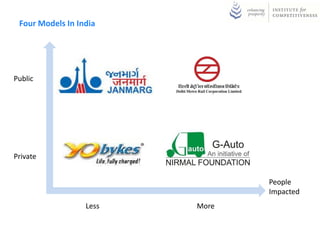
Four Models In India
Public
Private
People
Impacted
Less More
DMRC : A case for Integrated Urban Transportation Planning
Points about Integrated Mobility of DMRC:
• Integrated with Feeder Bus Service: 23 Routes 170 Buses, 1,20,000 passengers a day.
• Integrated with Bus: Integration at Bus terminals at Kashmiri Gate, Anand Vihar, etc.
Integrated with BRT: At Moolchand and Lajpath Nagar
• Integrated with Railways: At Old Delhi, New Delhi and Anand Vihar Metro stations
• Integrated with Rapid Metro Gurgaon: At a station Sikendarpur in Gurgaon
• Integrated with Airways: Airport Express Line connects the Main metro with IGI
• Parking Facility at 92 stations
• Integrated Ticketing with Smart card usage across various Services.
• Integration with Taxi/ Auto/ Grameen Stands.
• Bicycle Rental Scheme at Vishvavidyalaya Station.
• All the factors help Delhi Metro Rail corporation to be a preferred choice for urban
mobility for citizens with more than 2.0 Million people commuting on the same daily.
Source : http://urbanmobilityindia.in/Upload/Conference/dd516689-6f90-4372-9299-32737381d847.pdf
http://timesofindia.indiatimes.com/city/delhi/Highest-Delhi-Metro-ridership-at-27-1-lakh/articleshow/39703553.cms
Development of Smart cities :
Financing Urban Transportation:
• What can be built with 1000 Crores INR:
• Underground Metro : 2.5Km
• Elevated Metro: 5 Km
• Monorail : 6.7 Km
• BRT: 67 Km
The Smart City Solution:
According to ITDP (Institute for Transportation and Development Policy) for every
million urban residents for a smart city, it is required that there is atleast:
• 25-35 km of rapid transit
• 200-500 city buses
• 80 km walking  cycling infrastructure
Source : http://urbanmobilityindia.in/Upload/Conference/dd516689-6f90-4372-9299-32737381d847.pdf
http://timesofindia.indiatimes.com/city/delhi/Highest-Delhi-Metro-ridership-at-27-1-lakh/articleshow/39703553.cms
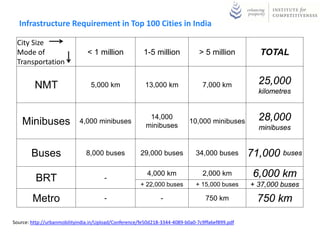
Infrastructure Requirement in Top 100 Cities in India
Source: http://urbanmobilityindia.in/Upload/Conference/fe50d218-3344-4089-b0a0-7c9ffa6ef899.pdf
City Size
Mode of
Transportation
 1 million 1-5 million  5 million TOTAL
NMT 5,000 km 13,000 km 7,000 km 25,000
kilometres
Minibuses 4,000 minibuses
14,000
minibuses
10,000 minibuses 28,000
minibuses
Buses 8,000 buses 29,000 buses 34,000 buses 71,000 buses
BRT -
4,000 km 2,000 km 6,000 km
+ 22,000 buses + 15,000 buses + 37,000 buses
Metro - - 750 km 750 km
Infrastructure Cost in Rs. For Top 100 cities
Source : http://urbanmobilityindia.in/Upload/Conference/fe50d218-3344-4089-b0a0-7c9ffa6ef899.pdf
City Size INFRASTRUCTURE COST (Crore Rupees)
Mode of
Transportation  1 million 1-5 million  5 million TOTAL
NMT 15,000 39,000 21,000 1,00,000
Minibuses 3,000 11,000 8,000 22,000
Buses 10,000 35,000 41,000 86,000
BRT - 1,03,000 65,000 1,68,000
Metro - - 2,04,000 2,04,000
Business Models Emerging and for the future
• Will be driven by services rather than means of transportation or Products in
the past.
• These will include:
• Car Pooling,
• Car sharing,
• Multimodal transportation
• Change in Technology- with adaptive cruising, emergency braking, ‘smart
cars’. Much more integrated and more door to door within Cities.
• In 5-10 years time should also be aligned with the smart cities program of the
union government- where services can be offered by OEM’s. Example like a
car company takes ownership of Taxi within a smart city.
• But in the present time one has to be careful especially with the recent issue
of Uber in India. That of a lady travelling in a Cab. Now Uber does now own
the cab is it really Uber’s responsibility for Safety of Women?
THE CITIES OF FUTURE
 Present cities seems stressed on multiple accounts that is, overpopulation, sketchy resources, exorbitantly high cost of living index,
formal governance etc.
 So the cities of future would primarily be an itsy-bitsy variation of current cities
 Current cities have built in so many contra forces that they are now leviathan white elephants. However it is being suggested that
city of future would be fragmentisation of population clusters
 Every employee shall serve many firms
 Geography and power would no longer correlate
 21st century man is absolutely asocial
 Technology will keep on pouring and will make one city advanced and other obsolete
 Therefore, cities needs to see their future and then address the stresses bothering them and should not depend on the vacuous
pronouncements of politicians
Institute for Competitiveness, India Presented by: Dr. Amit Kapoor
KEYS FOR SUCCESSFUL CITIES
Vision
Entrepreneurship
SpecializationSocial cohesion
Governance
ambition for future + desire
+ shared value system
shaping people and not
merely “shaping
knowledge”
understand every city’s unique
characteristics
Creative city planning which,
addresses social issues
Include principles such as,
participation, coherency,
competitiveness, subsidiarity,
sustainability
Institute for Competitiveness, India Presented by: Dr. Amit Kapoor
GOVERNANCE
Movement of power
Center
State
Urban Local Government
Therefore,
 Clear boundaries between Metropolitan governance body and municipal corporation
 Need to make institutional arrangements
 Empower Local bodies
 Create well defined model for governance structure
 Focus should be on managing the change wherein expectations of all stakeholders is taken into consideration
provide quality services in adequate
quantities to the residents
A ‘GOOD’ City = sound political and governance system
are responsive towards the requirements of the
businesses
City Mayor
City Management Service Delivery Agencies
Institute for Competitiveness, India Presented by: Dr. Amit Kapoor
UNTANGLING THE LINKAGES BETWEEN CITY, COMPETITIVENESS  ECONOMIC GROWTH
 More advanced economies are more urbanized economies
 Cities tend to be the only place where companies and individuals find opportunities for successful economic activity
 Rise of cities is seen as an inevitable part of development but also as a policy challenge
 Avoid a political schism between metropolitan and rural regions
 Cities have a different role to play in advanced economies
 From the competitiveness perspective, the policy imperative is crucial for cities as well as for rural regions
 Cities and the rural regions around them should cooperate closely
The case with Mumbai
 Tried to manage the growth by creating artificial boundaries
 The approach failed and made living conditions worse
 Different policy approach is required that focuses on better public services and land use inside the city
 Competitiveness-oriented policy approach can be used that changes the economic fundamentals of where people live and work
Institute for Competitiveness, India Presented by: Dr. Amit Kapoor
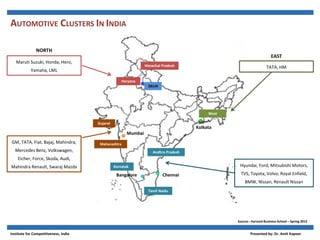
AUTOMOTIVE CLUSTERS IN INDIA
Himachal Pradesh
DELHI
Haryana
West
Bengal
Kolkata
Gujarat
Maharashtra
Mumbai
Karnatak
a
Bangalore
Andhra Pradesh
Tamil Naidu
Chennai
Maruti Suzuki, Honda, Hero,
Yamaha, LML
NORTH
GM, TATA, Fiat, Bajaj, Mahindra,
Mercedes Benz, Volkswagen,
Eicher, Force, Skoda, Audi,
Mahindra Renault, Swaraj Mazda
TATA, HM
EAST
Hyundai, Ford, Mitsubishi Motors,
TVS, Toyota, Volvo, Royal Enfield,
BMW, Nissan, Renault Nissan
Source:- Harvard Business School – Spring 2012
Institute for Competitiveness, India Presented by: Dr. Amit Kapoor
Automotive Clusters in India
Punjab
Uttar Pradesh
Haryana
Madhya Pradesh
Bihar
Rajasthan
Maharashtra
Gujarat
Jammu and Kashmir
Uttarakhand
Andhra Pradesh
Tamil Nadu
Karnataka
Odisha
West Bengal
Kerala
Chhattisgarh
Jharkhand
Himachal Pradesh
Arunachal Pradesh
Assam
Manipur
Mizoram
Meghalaya
Nagaland
Sikkim
Delhi
Goa
ChinaPakistan
Arabian Sea
Bay of Bengal
Indian Ocean
Sri Lanka
Nepal
Tripura
Kolkata
Jamshedpur
Cluster
Gujarat and
Maharashtra
Cluster
Chennai-
Bengaluru Hosur
Cluster
Delhi Gurgaon
Faridabad Cluster
Source: Institute for Competitiveness Analysis
Delhi is a cluster
for the light
vehicle
manufacturing
while the eastern
part is
dominated by
Tata which is
known for heavy
vehicle
manufacturing.
Maharashtra and
Gujarat are still
the hotspots of
manufacturing of
light and heavy
motor vehicles In
India. Chennai is
known for
manufacturing
of light and
heavy vehicles.
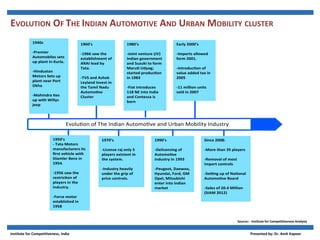
EVOLUTION OF THE INDIAN AUTOMOTIVE AND URBAN MOBILITY CLUSTER
Source:- Institute for Competitiveness Analysis
Institute for Competitiveness, India Presented by: Dr. Amit Kapoor
IT’s Role for the cluster:
Increasing Complexity
IT Services Continuum
Role of IT
Just plain
ticketing
solutions
Complete IT
Blueprint of the
City enabling smart
mobility solutions
GPS Mapping for obtaining
real time location of trains/
buses
How would the Urban Mobility Industry Serve Various Categories of Consumers
• Already have access to various modes.
• Preference to Personalization (Luxury cars
etc).
• Some do prefer green modes of urban
mobility (bikes, etc) which are both green
and make one healthy.
• Rising Income levels and aspirations.
• Most likely to use MRTS and other other
urban mobility platforms for going to work.
• Usage of cars and other owned private
vehicles limited.
• Likely to benefit from implementation of
various urban mobility projects.
• Information asymmetry is largely reducing
due to rising internet penetration.
• Often have limited access due to economics of
access.
• Economics and information often determines
the distance and choice of commuting.
• Mostly stay close to workplace and often go
walking to work.
• Do not have the capacity to purchase most
mobility assets (scooters, motorbikes or cars)
however some do have a cycle for commuting.
• Likely to use old public modes (Buses) or
privatized very cheap modes of travel like shared
autos when they travel.
Rich (42,800 people with more than 1
Crore Income in 2013, GOI)
Middle Class (Roughly 13% or 160
Million according to NCAER 2011)
Poor (68.72%) at less than $2 Dollar a
day (World Bank 2010)
Urban Mobility Industry
CLASSES URBAN MOBILITY CHOICES
Support
Activities
Marketing
 Sales
(e.g. Sales Force,
Promotion,
Advertising,
Proposal Writing,
Web site)
Inbound
Logistics
(e.g. Incoming
Material
Storage, Data
Collection,
Service,
Customer
Access)
Operations
(e.g. Assembly,
Component
Fabrication,
Branch
Operations)
Outbound
Logistics
(e.g. Order
Processing,
Warehousing,
Report
Preparation)
After-Sales
Service
(e.g. Installation,
Customer
Support,
Complaint
Resolution,
Repair)
M
a
r
g
i
n
Primary Activities
Firm Infrastructure
(e.g. Financing, Planning, Investor Relations)
Procurement
(e.g. Components, Machinery, Advertising, Services)`
Technology Development
(e.g. Product Design, Testing, Process Design, Material Research, Market Research)
Human Resource Management
(e.g. Recruiting, Training, Compensation System)
Value
What
buyers are
willing to
pay
• Separate local value chains • Integrated global value chain
• Geographic scope of competition is determined by the ability to leverage activities in the value chain across borders Industries differ greatly in the
scope of competition
Global
Regional
(e.g., Scandinavia, Western
Europe)
Local / State National
Global versus Local
THE END
Institute for Competitiveness, India Presented by: Dr. Amit Kapoor

Competitiveness_and_urban_mobility

  • 1.
    Competitiveness and UrbanMobility A Case from India Dr. Amit Kapoor Honorary Chairman, Institute for Competitiveness, India
  • 2.
    INDIA CITIES ONGLOBAL BENCHMARK Tokyo (68)Shanghai (55.2)Los Angeles (61.5) New York (71.4) London (70.4) Hong Kong (69.3) Paris(69.3) Zurich (66.8) Chicago (65.9) Singapore (70) Delhi (46.7) Kolkata (37.8) Chennai (38.1) Bangalore (44.6) Mumbai (46.6) Ahmedabad (41.9) Source:- Economist Intelligence Unit and Institute for Competitiveness Analysis Hyderabad (39.4) Institute for Competitiveness, India Presented by: Dr. Amit Kapoor
  • 3.
     Competitiveness isthe productivity with which a region utilizes its human, capital, and natural resources  Productivity determines wages and the standard of living – Productivity growth determines sustainable economic growth  It is not what industries a nation competes in that matters for prosperity, but how productively it competes in those industries  Productivity in an economy depends on a combination of domestic and foreign firms  Innovation in products and processes is necessary to drive productivity growth  Only productive businesses can create wealth and jobs States compete to offer the most productive environment for business  The public and private sectors play different but interrelated roles in creating a productive economy Leading to the prosperity of the region ENHANCING THE PROSPERITY OF URBAN INDIA via COMPETITIVENESS Institute for Competitiveness, India Presented by: Dr. Amit Kapoor
  • 4.
    INFLUENCES ON COMPETITIVENESS WORLDECONOMY BROAD ECONOMIC AREAS GROUP OF NEIGHBOURING NATIONS NATIONS STATES, PROVINCES METROPOLITAN AREAS, RURAL AREAS Multiple Geographic Levels [Our Focus] Source:- Institute for Strategy and Competitiveness Institute for Competitiveness, India Presented by: Dr. Amit Kapoor
  • 5.
    MEASURING COMPETITIVENESS: THEFRAMEWORK Context for Firm Strategy and Rivalry Related and Supporting Industries Demand Conditions • Local rules and incentives that encourage investment and productivity . - E.g. performance based salaries, incentives for capital investments, intellectual property protection • Vigorous local competition i.e., - Openness to foreign and local competition - Sophistication of company operations • Local availability of suppliers and supporting industries • Presence of clusters instead of isolated firms Sophisticated and demanding local customers and needs e.g., - Strict quality, safety, and environmental standards – Consumer protection laws – Government procurement of advanced technology – Early demand for products and Services. Access to high quality business inputs i.e., - Natural endowments - Human resources - Capital availability - Physical infrastructure - Administrative infrastructure - Information infrastructure - Scientific and technological infrastructure Factor Conditions Institute for Competitiveness, India Presented by: Dr. Amit Kapoor
  • 6.
    DRIVERS OF COMPETITIVENESS Qualityof overall business environment Concentration of resources and urban growth Policy Coordination among Multiple Levels of Geography/Government Institute for Competitiveness, India Presented by: Dr. Amit Kapoor
  • 7.
    TREND IN POPULATIONSIZE AND GROWTH RATE (1901-2011) 238.4 252.09 251.32 278.98 318.66 361.09 439.23 548.16 683.33 846.42 1028.74 1210.19 1338.64 1494.63 1650.62 0.1 5.75 -0.03 11 14.22 13.31 21.51 24.8 24.66 23.85 21.34 17.64 -5 0 5 10 15 20 25 30 0 200 400 600 800 1000 1200 1400 1600 1800 1901 1911 1921 1931 1941 1951 1961 1971 1981 1991 2001 2011 2021 2031 2041 DecadalGrowthRate(in%) Population(inmillions) Population (in millions) Decadal Growth rate (in %) Source:- Government of India Census and Institute for Competitiveness Analysis Institute for Competitiveness, India Presented by: Dr. Amit Kapoor
  • 8.
    THE RURAL-URBAN DIVIDE 10.810.3 11.1 12 13.8 17.3 17.9 19.9 23.3 25.7 28.5 31.2 89.2 89.7 88.9 88 86.2 82.7 82.1 80.1 76.7 74.3 71.5 68.8 0% 10% 20% 30% 40% 50% 60% 70% 80% 90% 100% 1901 1911 1921 1931 1941 1951 1961 1971 1981 1991 2001 2011 Urban Rural Source:- Government of India Census and Institute for Competitiveness Analysis Institute for Competitiveness, India Presented by: Dr. Amit Kapoor
  • 9.
    URBAN INDIA OF1951 10 - 30 million 5 - 10 million 1 - 5 million 0.1 – 1 million Cities Size Class By Population Source:- India Urban Conference 2011: Evidence & Experience - IIHS Institute for Competitiveness, India Presented by: Dr. Amit Kapoor
  • 10.
    SNAPSHOT OF URBANINDIA IN 2011 10 - 30 million 5 - 10 million 1 - 5 million 0.1 – 1 million Cities Size Class By Population Source:- India Urban Conference 2011: Evidence & Experience - IIHS Institute for Competitiveness, India Presented by: Dr. Amit Kapoor
  • 11.
    URBAN INDIA OF2031 10 - 30 million 5 - 10 million 1 - 5 million 0.1 – 1 million Cities Size Class By Population Source:- India Urban Conference 2011: Evidence & Experience - IIHS Institute for Competitiveness, India Presented by: Dr. Amit Kapoor
  • 12.
    Density within IndianCities 53.77 23.25 144.10 417.56 8.73 259.35 34.06 0.00 50.00 100.00 150.00 200.00 250.00 300.00 350.00 400.00 450.00 World Brazil China India Russian Federation United Kingdom United States PeopleperSquareKm.ofland
  • 13.
    Most and theLeast Dense Cities of India 26903 24252 20925 18480 11297 393 384 339 310 159 1 10 100 1000 10000 100000 Chennai Kolkata Mumbai Hyderabad Delhi Nashik Vishakhapatnam Rajkot Raipur Shimla Density of People per square Km of Area Most and the Least Dense Cities of India
  • 14.
    INDIA IS THRIVING– NOW AND WILL IN FUTURE % contribution in World’s GDP European Union 18% United States 16% China 18% Japan 9% India 4% Others 35% 2030 Projection European Union 26% United States 23% China 9% Japan 9% India 3% Others 30% 2010 4.03 5.22 3.77 8.37 8.28 9.32 9.27 9.82 4.93 9.10 8.81 7.80 5.30 0 2 4 6 8 10 12 GDPgrowth(annual%) *value for 2012 and 2011 is for Q1 Source:- World Bank and Institute for Competitiveness Analysis Institute for Competitiveness, India Presented by: Dr. Amit Kapoor
  • 15.
    Urban Population asa percentage of Total Population 17.3 18 19.9 23.3 25.7 27.8 31.2 0 5 10 15 20 25 30 35 1951 1961 1971 1981 1991 2001 2011 PercentageofUrbanPopulation(%) Urban Population as a percentage of Total Population
  • 16.
    Source :MOSPI, Institutefor Competitiveness Analysis FACTOR CONDITIONS (From State Competitiveness Report) AP AR AS BR CG DL GA GJ HR HPJK JH KA KL MP MH MN ML MZ NL OD PB RJ SK TN TR UP UK WB y = 22.879e0.2343x R² = 0.3619 0 200000 400000 600000 800000 1000000 1200000 1400000 1600000 50 52 54 56 58 60 62 64 66 GSDPatcurrentpricesinRs.Crorein2012-13 Factor Conditions Score
  • 17.
    Source :CEA, Institutefor Competitiveness Analysis SUB PILLARS OF FACTOR CONDITIONS - PHYSICAL CONDITIONS AP AR AS CG DL GA GJ HR HP JK KA KL MP MH MNML MZ NL OD PB RJ SK TN UP UK WB y = 13.908x2 - 716.11x + 2523.6 R² = 0.7141 -5000 0 5000 10000 15000 20000 25000 30000 35000 40000 50 55 60 65 70 75 80 85 TotalInstalledCapacotyinMWason28.2.2014 Physical Conditions Score
  • 18.
    Source :MORTH, Institutefor Competitiveness Analysis SURFACE ROADS AND COMPETITIVENESS AP AR AS BR CG DL GA GJHR HP JK JH KA KL MP MH MN ML MZ NL OD PB RJ SK TN TR UP UK WB y = 98.06ln(x) - 329.88 R² = 0.2145 0 10 20 30 40 50 60 70 80 90 100 50.00 52.00 54.00 56.00 58.00 60.00 62.00 64.00 66.00 68.00 70.00 Ratioofsurfacedtototalroads,2012 Microeconomic Competititveness Scores
  • 19.
    Source MOR, Institutefor Competitiveness Analysis RAILWAYS AND COMPETITIVENESS AP AR AS BR CG DL GA GJ HR HPJK JH KA KL MP MH MNML MZNL OD PB RJ SK TN TR UP UK WB y = 188.12x - 8495.8 R² = 0.1643 0 1000 2000 3000 4000 5000 6000 7000 8000 9000 10000 50.00 52.00 54.00 56.00 58.00 60.00 62.00 64.00 66.00 68.00 70.00 StatewiseRouteKmofRailwayLines(inKm) Microeconomic Competititveness Scores
  • 20.
    A GLIMPSE: CITYCOMPETITIVENESS 2014 RANK First 25 Cities Institute for Competitiveness, India Presented by: Dr. Amit Kapoor Rank City Overall Competitiveness Score Factor Conditions Demand Conditions Context for Firm Strategy Rivalry Related Supporting Industries 1 Delhi 73.134 2 1 1 4 2 Mumbai 70.059 1 2 3 2 3 Gurgaon 64.102 11 7 2 17 4 Noida 63.837 6 25 4 5 5 Chennai 63.228 3 5 5 8 6 Hyderabad 62.903 9 4 9 1 7 Bengaluru 62.803 10 3 7 19 8 Kolkata 62.158 4 9 8 6 9 Pune 61.413 12 10 6 7 10 Ahmedabad 60.890 13 8 13 3 11 Kochi 59.123 7 26 10 23 12 Coimbatore 59.006 5 37 17 10 13 Chandigarh 58.598 18 6 20 24 14 Nagpur 58.330 32 12 12 13 15 Kozhikode 58.080 8 16 14 37 16 Surat 57.852 22 11 24 20 17 Nashik 57.697 26 19 15 14 18 Thiruvananthapuram 57.091 14 15 19 36 19 Vadodara 56.988 23 27 16 25 20 Jaipur 56.821 46 13 18 16 21 Madurai 56.804 16 32 22 31 22 Rajkot 56.524 31 17 21 22 23 Faridabad 56.392 45 18 11 27 24 Mysore 55.754 19 34 30 32 25 Kota 55.727 27 20 33 28
  • 21.
    A GLIMPSE: CITYCOMPETITIVENESS 2014 RANK Next set of 25 Cities Institute for Competitiveness, India Presented by: Dr. Amit Kapoor Rank City Overall Competitiveness Score Factor Conditions Demand Conditions Context for Firm Strategy Rivalry Related Supporting Industries 26 Kanpur 55.666 30 41 40 9 27 Lucknow 55.282 39 14 48 18 28 Varanasi 55.226 37 47 32 11 29 Indore 55.172 25 24 26 40 30 Bhopal 55.117 20 23 28 42 31 Vishakhapatnam 55.091 38 31 23 29 32 Allahabad 54.783 35 50 36 21 33 Dehradun 54.712 17 22 45 44 34 Ludhiana 54.703 36 28 27 35 35 Bhubaneswar 54.406 33 48 29 33 36 Vijayawada 54.389 41 38 31 30 37 Amritsar 54.262 29 21 25 49 38 Shimla 54.066 15 45 43 50 39 Ranchi 53.949 34 36 38 38 40 Raipur 53.934 21 49 37 41 41 Meerut 53.784 48 29 47 15 42 Guwahati 53.664 24 40 41 46 43 Patna 53.659 47 43 42 26 44 Agra 53.360 50 30 46 12 45 Jabalpur 53.198 43 46 39 39 46 Asansol 53.019 49 35 34 34 47 Dhanbad 52.940 42 44 35 43 48 Jammu 52.798 28 42 50 47 49 Jamshedpur 52.570 40 39 44 45 50 Srinagar 52.079 44 33 49 48
  • 22.
    THE (CURRENT) EXTENTOF INDIA’s URBANIZATION Visual imageries depicting India’s growing urbanization over the years creates a far greater impact than documented statistics giving the same information Source:- Excerpts from an article authored by Kevin Stolarick Institute for Competitiveness, India Presented by: Dr. Amit Kapoor Since 1992, the Operational Linescan System (OLS) of the US Defense Meteorological Satellite Program (DMSP) has been collecting images of the world at night. These images capture the nighttime lights generated on the ground. These images have been captured, processed, and analyzed for India and select metropolitan regions for the past 20 years and are presented below. India at Night (1992) India at Night (2010) Nighttime lights for India and surrounding countries from 1992 and then 18 years later. While the bright spots of Delhi and Kolkata and the Mumbai-Pune combination and the Hyderabad, Bangalore, Chennai triangle are all clearly visible in 1992, they have all increased in intensity and size by 2010. And, a whole series of new constellations have been added to the subcontinent.
  • 23.
    THE (CURRENT) EXTENTOF INDIA’s URBANIZATION Institute for Competitiveness, India Presented by: Dr. Amit Kapoor DELHI Increased urbanization of selected cities MUMBAI-PUNE Source:- Excerpts from an article authored by Kevin Stolarick
  • 24.
    THE (CURRENT) EXTENTOF INDIA’s URBANIZATION Institute for Competitiveness, India Presented by: Dr. Amit Kapoor KOLKATA Increased urbanization of selected cities HYDERABAD Source:- Excerpts from an article authored by Kevin Stolarick
  • 25.
    MAIN CONTRIBUTORS ININDIA’S GROWTH Source:- RBI and Institute for Competitiveness Analysis 0 100000 200000 300000 400000 500000 600000 700000 800000 900000 Dec-11GDP(incroresofrupees) Mumbai, Pune Lucknow, Kanpur Hyderabad Ahmedabad, Surat Kolkata Chennai Bengaluru Jaipur Thiruvananthapuram Institute for Competitiveness, India Presented by: Dr. Amit Kapoor
  • 26.
    EXPANSION OF CITIES:METROPOLITAN REGIONS Source:- PPP Database and Institute for Competitiveness Analysis S. No. Metropolitan Areas Population Consist of 1 National Capital Region (NCR) 21,753,486 (a) Haryana districts- Gurgaon, Sonipat, Faridabad, Rohtak (b) Uttar Pradesh districts- Meerut, Baghpat, Ghaziabad, Gautam Buddha Nagar (c) Rajasthan- Alwar 2 Mumbai Metropolitan Region 20,748,395 Thane, Navi Mumbai, Mira-Bhayandar, Kalyan-Dombivali, Ulhasnagar, Vasai-Virar, Bhiwandi-Nizampur including other towns villages 3 Kolkata Metropolitan Area (KMA) 14,617,882 Kolkata Municipal Corporation (KMC), Howrah Municipal Corporation and Chandannagore Municipal Corporation 4 Chennai Metropolitan Area (CMA) 8,917,749 Chennai district, Thiruvallur district and Kancheepuram district 5 Bangalore Metropolitan Region 8,728,906 Hosur, Yeswanthpur, Yelahanka, Anekal, Hebbal , Marathalli etc. 6 Hyderabad Metropolitan Region 7,749,334 Secunderabad, Bhogir, Kondpur, Medchal etc. 7 Ahmedabad Metropolitan Region 6,352,254 Gandhinagar, Anand, Kheda, Kadi, Jambusar, Viramgam etc. 8 Pune Metropolitan Region 5,049,968 Pune city and Pimpri-Chinchwad town, etc. 9 Surat Metropolitan Region 4,585,367 One municipal corporation, 7 municipalities and 6 counter magnets Institute for Competitiveness, India Presented by: Dr. Amit Kapoor
  • 27.
    CHALLENGES OF URBANISATION Source:-PPP Database and Institute for Competitiveness Analysis  Concentration of urban population in one or few cities  Leading to massive growth of slum followed by misery, poverty, unemployment, exploitation, inequalities, degradation in the quality of urban life  It is a result of rural push and not of urban pull  Most of the cities using capital intensive technologies can not generate employment for the distress rural poor  It is degenerating social and economic inequalities  Crisis in urban infra-structural services  Migration of poor from rural to urban areas  These lead to mega cities that are subject to extreme filthy slum and very cruel mega city denying shelter. Drinking water, electricity, sanitation to the extreme poor and rural migrants  Lack a modern planning framework Institute for Competitiveness, India Presented by: Dr. Amit Kapoor
  • 28.
    URBAN INFRASTRUCTURE: TRANSPORTATIONIN INDIAN CITIES  Chaotic situation in most cities except the mega cities where the number of commuters is so high that the transportation seems weak  Challenges: - Vast gaps between demand and supply - Poor infrastructure such as insufficient routes and roads - Increase in private vehicles which leads to congestion and also slows down the speed of other vehicles such as buses etc. to 10-12 km - Leads to environmental pollution - Absence of comprehensive parking facilities in the city 3414 6110 4652 942 956 5771 278.59 205.38 154.02 152.71 99.9 138.66 0 50 100 150 200 250 300 0 1000 2000 3000 4000 5000 6000 7000 Chennai Bengaluru Mumbai Ahmedabad Kolkata Delhi Inkm/Bus/Day InNumber Total Fleet Held Vehicle Productivity (km/Bus/Day) Operations of Road Transportation in Major Cities: 2010-11 Source:- Road Transport and highways Ministry, 2010-11 and Institute for Competitiveness Analysis Institute for Competitiveness, India Presented by: Dr. Amit Kapoor
  • 29.
    OTHER MODES OFTRANSPORTATION • The other major mode of transportation in cities is Railways • Though it is dominant for the inter city transportation only in cities • Also has a different face in every region such as in - Delhi – Metro Rapid Transit System (MRTS) is main lifeline but Local Rails are also present - Kolkata – The Underground Metro, The Local Rails and the tram, all are widely used by commuters - Mumbai – Local Trains however, metro will be operational after short period, as reported by authorities - Bengaluru – The introduction of Metro in the city has change the travelling experience of the commuters 55019 9518 244235 78582 791158 903465 18865 United Kingdom United States Japan Germany China India South Africa In million passenger - km Passengers carried by railways (million passenger-km) Source:- World Bank and Institute for Competitiveness Analysis Institute for Competitiveness, India Presented by: Dr. Amit Kapoor
  • 30.
    DRIVERS FOR MOBILITYSOLUTIONS IN INDIA  Technology drivers: Technological innovations in the Indian automotive and transportation industry over the past decade have enabled up gradation, right from the design and planning stage to the product development stage, and have also played a critical role in improving the overall performance of the product and integrated modes of transportation.  Cultural behavioral drivers: With rising urbanization and changing urban mobility needs, future mobility solutions would require vehicles that are small, maneuverable, energy efficient and connected. Further, with increasing congestion in cities, rising parking woes and rise in number of nuclear families, vehicles are becoming more compact.  Structural drivers: The basic structural drivers is the rise in the disposable income with people and an aspirational middle class which wants more choices for modes of commuting. Economic growth and increased penetration in Tier II and Tier III markets drive the luxury vehicle segment because of which it has been predicted that by 2020, it will increase growth to 4-5% from 1% y/y presently. Institute for Competitiveness, India Presented by: Dr. Amit Kapoor Source:- Institute for Competitiveness Analysis
  • 31.
    OTHER MODES OFTRANSPORTATION • The other major mode of transportation in cities is Railways • Though it is dominant for the inter city transportation only in cities • Also has a different face in every region such as in - Delhi – Metro Rapid Transit System (MRTS) is main lifeline but Local Rails are also present - Kolkata – The Underground Metro, The Local Rails and the tram, all are widely used by commuters - Mumbai – Local Trains however, metro will be operational after short period, as reported by authorities - Bengaluru – The introduction of Metro in the city has change the travelling experience of the commuters 55019 9518 244235 78582 791158 903465 18865 United Kingdom United States Japan Germany China India South Africa In million passenger - km Passengers carried by railways (million passenger-km) Source:- World Bank and Institute for Competitiveness Analysis Institute for Competitiveness, India Presented by: Dr. Amit Kapoor
  • 32.
    Urban Mobility Index81.90 81.20 78.50 77.60 77.50 77.30 76.30 76.30 76.20 76.20 74.70 74.60 74.50 72.30 71.80 71.70 71.60 71.60 71.50 71.30 70.70 70.20 70.20 69.90 68.70 68.50 68.50 67.80 67.30 67.30 67.20 65.80 65.70 65.30 64.90 64.80 63.70 63.50 62.00 61.20 60.40 60.30 60.10 59.70 58.50 58.00 57.90 57.70 56.90 56.40 55.20 55.10 54.90 54.70 53.70 53.30 53.10 53.00 51.30 51.00 50.00 49.80 48.60 48.40 47.70 46.20 0.00 10.00 20.00 30.00 40.00 50.00 60.00 70.00 80.00 90.00 HongKong Amsterdam London Stockholm Gothenburg Singapore Wien(Vienna) Paris Munich Boston Shanghai Zurich Berlin Barcelona Madrid Wuhan NewYork Guangzhou Seoul Cambridge(UK) Washington,D.C. Osaka Istanbul Frankfurt Tokyo Shenzhen Toronto Prague Philadelphia Brussels Beijing Milan (MexicoCity) BuenosAires Tianjin Ankara Mumbai Chicago Lisbon Lahore Kolkata(Calcutta) Dhaka Moscow SãoPaulo Delhi Dubai Rome Lagos SaintPetersburg Hyderabad LosAngeles Dallas Kinshasa Miami Baghdad Athens KualaLumpur Houston Bangalore Karachi Chennai(Madras) KrungThep(Bangkok) Jakarta Manila Tehran Atlanta UrbanMobility Index for Cities* Source : http://www.adlittle.com/downloads/tx_adlreports/2014_ADL_UITP_Future_of_Urban_Mobility_2_0_Full_study.pdf Using 19 criteria Arthur D. Little assessed the mobility maturity and performance of 84 cities worldwide. The mobility score per city ranges from 0 to 100 index points; the maximum of 100 points is defined by the best performance of any city in the sample for each criteria.
  • 33.
    SMART CITIES ININDIA  India plans to develop 100 new “Smart Cities” and the budget has already been allocated to initiate the plan  Idea is to develop cities as satellite towns of larger cities and by modernizing existing mid-sized cities  To attract foreign investors, Foreign Direct investment (FDI) in terms of minimum built up area and capital conditions have been substantially reduced  It is being anticipated that many industrial and commercial centers along the significant corridors would be recreated as “Smart Cities”  Being smart and well equipped with technology will convert the urban Indian centers into self-sustainable habitats with minimal pollution levels, maximum recycling, optimized energy supplies and efficient urban mobility.  The cities can be a game changer and can take the country one step closer to the growth process Institute for Competitiveness, India Presented by: Dr. Amit Kapoor “An urban settlement that uses the power of technology to bring efficiency in its existing set of resources (like mobility, governance, energy, buildings etc.) by improving and using them productively. Also, equipping the core systems of the settlement with new advanced technologies and ideas.” Source: Centre of Regional Science, Vienna UT, October 2007
  • 34.
    Source:- https://www.opendemocracy.net/openindia/mathew-idiculla/crafting-“smart-cities”-india’s-new-urban-vision Will bea eastern freight corridor and will leverage the inland Waterway System being developed along National Waterway - 1 Plans are to construct 3 ‘smart cities’ on the corridor with the help of Japan International Cooperation Agency (JICA) Delhi-Mumbai Industrial Corridor (1500km long) Aimed to generate an investment of over USD 50 billion and expected to create 2.5 million jobs Chennai-Bangalore Industrial Corridor (560 km long) Mumbai Bengaluru Industrial Corridor Amritsar-Delhi-Kolkata Industrial Corridor Spread across six states, seeks to create seven cities. Focus is to develop it as the ‘Global Manufacturing and Trading Hub’ Institute for Competitiveness, India Presented by: Dr. Amit Kapoor SMART CITIES IN INDIA: PROPOSED PROJECTS on industrial corridors India has also got into an agreement with Singapore to use its expertise in building 100 smart cities and in urban planning
  • 35.
    THE CITIES OFFUTURE  Present cities seems stressed on multiple accounts that is, overpopulation, sketchy resources, exorbitantly high cost of living index, formal governance etc.  So the cities of future would primarily be an itsy-bitsy variation of current cities  Current cities have built in so many contra forces that they are now leviathan white elephants. However it is being suggested that city of future would be fragmentisation of population clusters  Every employee shall serve many firms  Geography and power would no longer correlate  21st century man is absolutely asocial  Technology will keep on pouring and will make one city advanced and other obsolete  Therefore, cities needs to see their future and then address the stresses bothering them and should not depend on the vacuous pronouncements of politicians Institute for Competitiveness, India Presented by: Dr. Amit Kapoor
  • 36.
    ENHANCING CITY COMPETITIVENESS Focuson 1. Public-Private Partnerships - Increases the ease of business, fetches innovative ideas, provide potential for financing - One of the successful model is the Delhi Noida Bridge 2. Dealing with Urbanization 3. Urban Poverty 4. Transparency and Civic Engagement 5. Other Common Areas - Understand the city challenges search their solutions, improve internal external environment - Some Tier-2 3 cities like Guwahati, Bhopal, Faridabad, Coimbatore are urbanizing at a fast pace - Leads to vulnerable conditions, create issues with respect to sanitation, water, health , education etc. - Government programmes: Swarna Jayanti Shahari Raozgar Yojana (SJSRY), JNNURM, Rajiv Awas Yojana - Engage major stakeholders in most of the development activities - A tool for the betterment of the democracy and thus the city - Includes basic amenities, infrastructure, facilities etc. required for a decent standard of living Institute for Competitiveness, India Presented by: Dr. Amit Kapoor
  • 37.
    Need for BetterMobility Economic Growth Increase in Industrial Activities Increase in personal income Increase in consumption Economic and Environmental Impacts Emissions Congestions Collisions Noise, etc. Transport Services Facilitate movement of goods and services Improve access to work, education, etc. Transport Impacts Increase in Trip Rates Motorization Urban Expansion Source : http://www.wbcsdpublications.org/cd_files/datas/business-solutions/mobility/pdf/MobilityForDevelopment- FullReport.pdf
  • 38.
    Changing context ofUrban Mobility Source: http://www.ey.com/Publication/vwLUAssets/Urban_mobility_blueprint_- _executive_summary/$FILE/Urban_mobility_blueprint-executive_summary.pdf http://www.wbcsdpublications.org/cd_files/datas/business-solutions/mobility/pdf/MobilityForDevelopment- FullReport.pdf Some Facts : • Passenger travel distance to double by 2050 — over 70 trillion kms per year* • Per capita commuting delay to double by 2050 to over 100 hours per year* • Over 37 cities–majority in Asia and Latin America – to have over 10 million inhabitants by 2025* • Over 70% of global population to live in urban areas by 2050, up from 51% in 2010* Aims for the Future of Mobility: The aim should be to ‘meet the societies’ desire to move freely, have access, trade and establish relationships without sacrificing other essential human or ecological values, today or in the future’.
  • 39.
    Four Models InIndia Public Private People Impacted Less More
  • 40.
    DMRC : Acase for Integrated Urban Transportation Planning Points about Integrated Mobility of DMRC: • Integrated with Feeder Bus Service: 23 Routes 170 Buses, 1,20,000 passengers a day. • Integrated with Bus: Integration at Bus terminals at Kashmiri Gate, Anand Vihar, etc. Integrated with BRT: At Moolchand and Lajpath Nagar • Integrated with Railways: At Old Delhi, New Delhi and Anand Vihar Metro stations • Integrated with Rapid Metro Gurgaon: At a station Sikendarpur in Gurgaon • Integrated with Airways: Airport Express Line connects the Main metro with IGI • Parking Facility at 92 stations • Integrated Ticketing with Smart card usage across various Services. • Integration with Taxi/ Auto/ Grameen Stands. • Bicycle Rental Scheme at Vishvavidyalaya Station. • All the factors help Delhi Metro Rail corporation to be a preferred choice for urban mobility for citizens with more than 2.0 Million people commuting on the same daily. Source : http://urbanmobilityindia.in/Upload/Conference/dd516689-6f90-4372-9299-32737381d847.pdf http://timesofindia.indiatimes.com/city/delhi/Highest-Delhi-Metro-ridership-at-27-1-lakh/articleshow/39703553.cms
  • 41.
    Development of Smartcities : Financing Urban Transportation: • What can be built with 1000 Crores INR: • Underground Metro : 2.5Km • Elevated Metro: 5 Km • Monorail : 6.7 Km • BRT: 67 Km The Smart City Solution: According to ITDP (Institute for Transportation and Development Policy) for every million urban residents for a smart city, it is required that there is atleast: • 25-35 km of rapid transit • 200-500 city buses • 80 km walking cycling infrastructure Source : http://urbanmobilityindia.in/Upload/Conference/dd516689-6f90-4372-9299-32737381d847.pdf http://timesofindia.indiatimes.com/city/delhi/Highest-Delhi-Metro-ridership-at-27-1-lakh/articleshow/39703553.cms
  • 42.
    Infrastructure Requirement inTop 100 Cities in India Source: http://urbanmobilityindia.in/Upload/Conference/fe50d218-3344-4089-b0a0-7c9ffa6ef899.pdf City Size Mode of Transportation 1 million 1-5 million 5 million TOTAL NMT 5,000 km 13,000 km 7,000 km 25,000 kilometres Minibuses 4,000 minibuses 14,000 minibuses 10,000 minibuses 28,000 minibuses Buses 8,000 buses 29,000 buses 34,000 buses 71,000 buses BRT - 4,000 km 2,000 km 6,000 km + 22,000 buses + 15,000 buses + 37,000 buses Metro - - 750 km 750 km
  • 43.
    Infrastructure Cost inRs. For Top 100 cities Source : http://urbanmobilityindia.in/Upload/Conference/fe50d218-3344-4089-b0a0-7c9ffa6ef899.pdf City Size INFRASTRUCTURE COST (Crore Rupees) Mode of Transportation 1 million 1-5 million 5 million TOTAL NMT 15,000 39,000 21,000 1,00,000 Minibuses 3,000 11,000 8,000 22,000 Buses 10,000 35,000 41,000 86,000 BRT - 1,03,000 65,000 1,68,000 Metro - - 2,04,000 2,04,000
  • 44.
    Business Models Emergingand for the future • Will be driven by services rather than means of transportation or Products in the past. • These will include: • Car Pooling, • Car sharing, • Multimodal transportation • Change in Technology- with adaptive cruising, emergency braking, ‘smart cars’. Much more integrated and more door to door within Cities. • In 5-10 years time should also be aligned with the smart cities program of the union government- where services can be offered by OEM’s. Example like a car company takes ownership of Taxi within a smart city. • But in the present time one has to be careful especially with the recent issue of Uber in India. That of a lady travelling in a Cab. Now Uber does now own the cab is it really Uber’s responsibility for Safety of Women?
  • 45.
    THE CITIES OFFUTURE  Present cities seems stressed on multiple accounts that is, overpopulation, sketchy resources, exorbitantly high cost of living index, formal governance etc.  So the cities of future would primarily be an itsy-bitsy variation of current cities  Current cities have built in so many contra forces that they are now leviathan white elephants. However it is being suggested that city of future would be fragmentisation of population clusters  Every employee shall serve many firms  Geography and power would no longer correlate  21st century man is absolutely asocial  Technology will keep on pouring and will make one city advanced and other obsolete  Therefore, cities needs to see their future and then address the stresses bothering them and should not depend on the vacuous pronouncements of politicians Institute for Competitiveness, India Presented by: Dr. Amit Kapoor
  • 46.
    KEYS FOR SUCCESSFULCITIES Vision Entrepreneurship SpecializationSocial cohesion Governance ambition for future + desire + shared value system shaping people and not merely “shaping knowledge” understand every city’s unique characteristics Creative city planning which, addresses social issues Include principles such as, participation, coherency, competitiveness, subsidiarity, sustainability Institute for Competitiveness, India Presented by: Dr. Amit Kapoor
  • 47.
    GOVERNANCE Movement of power Center State UrbanLocal Government Therefore,  Clear boundaries between Metropolitan governance body and municipal corporation  Need to make institutional arrangements  Empower Local bodies  Create well defined model for governance structure  Focus should be on managing the change wherein expectations of all stakeholders is taken into consideration provide quality services in adequate quantities to the residents A ‘GOOD’ City = sound political and governance system are responsive towards the requirements of the businesses City Mayor City Management Service Delivery Agencies Institute for Competitiveness, India Presented by: Dr. Amit Kapoor
  • 48.
    UNTANGLING THE LINKAGESBETWEEN CITY, COMPETITIVENESS ECONOMIC GROWTH  More advanced economies are more urbanized economies  Cities tend to be the only place where companies and individuals find opportunities for successful economic activity  Rise of cities is seen as an inevitable part of development but also as a policy challenge  Avoid a political schism between metropolitan and rural regions  Cities have a different role to play in advanced economies  From the competitiveness perspective, the policy imperative is crucial for cities as well as for rural regions  Cities and the rural regions around them should cooperate closely The case with Mumbai  Tried to manage the growth by creating artificial boundaries  The approach failed and made living conditions worse  Different policy approach is required that focuses on better public services and land use inside the city  Competitiveness-oriented policy approach can be used that changes the economic fundamentals of where people live and work Institute for Competitiveness, India Presented by: Dr. Amit Kapoor
  • 49.
    AUTOMOTIVE CLUSTERS ININDIA Himachal Pradesh DELHI Haryana West Bengal Kolkata Gujarat Maharashtra Mumbai Karnatak a Bangalore Andhra Pradesh Tamil Naidu Chennai Maruti Suzuki, Honda, Hero, Yamaha, LML NORTH GM, TATA, Fiat, Bajaj, Mahindra, Mercedes Benz, Volkswagen, Eicher, Force, Skoda, Audi, Mahindra Renault, Swaraj Mazda TATA, HM EAST Hyundai, Ford, Mitsubishi Motors, TVS, Toyota, Volvo, Royal Enfield, BMW, Nissan, Renault Nissan Source:- Harvard Business School – Spring 2012 Institute for Competitiveness, India Presented by: Dr. Amit Kapoor
  • 50.
    Automotive Clusters inIndia Punjab Uttar Pradesh Haryana Madhya Pradesh Bihar Rajasthan Maharashtra Gujarat Jammu and Kashmir Uttarakhand Andhra Pradesh Tamil Nadu Karnataka Odisha West Bengal Kerala Chhattisgarh Jharkhand Himachal Pradesh Arunachal Pradesh Assam Manipur Mizoram Meghalaya Nagaland Sikkim Delhi Goa ChinaPakistan Arabian Sea Bay of Bengal Indian Ocean Sri Lanka Nepal Tripura Kolkata Jamshedpur Cluster Gujarat and Maharashtra Cluster Chennai- Bengaluru Hosur Cluster Delhi Gurgaon Faridabad Cluster Source: Institute for Competitiveness Analysis Delhi is a cluster for the light vehicle manufacturing while the eastern part is dominated by Tata which is known for heavy vehicle manufacturing. Maharashtra and Gujarat are still the hotspots of manufacturing of light and heavy motor vehicles In India. Chennai is known for manufacturing of light and heavy vehicles.
  • 51.
    EVOLUTION OF THEINDIAN AUTOMOTIVE AND URBAN MOBILITY CLUSTER Source:- Institute for Competitiveness Analysis Institute for Competitiveness, India Presented by: Dr. Amit Kapoor
  • 52.
    IT’s Role forthe cluster: Increasing Complexity IT Services Continuum Role of IT Just plain ticketing solutions Complete IT Blueprint of the City enabling smart mobility solutions GPS Mapping for obtaining real time location of trains/ buses
  • 53.
    How would theUrban Mobility Industry Serve Various Categories of Consumers • Already have access to various modes. • Preference to Personalization (Luxury cars etc). • Some do prefer green modes of urban mobility (bikes, etc) which are both green and make one healthy. • Rising Income levels and aspirations. • Most likely to use MRTS and other other urban mobility platforms for going to work. • Usage of cars and other owned private vehicles limited. • Likely to benefit from implementation of various urban mobility projects. • Information asymmetry is largely reducing due to rising internet penetration. • Often have limited access due to economics of access. • Economics and information often determines the distance and choice of commuting. • Mostly stay close to workplace and often go walking to work. • Do not have the capacity to purchase most mobility assets (scooters, motorbikes or cars) however some do have a cycle for commuting. • Likely to use old public modes (Buses) or privatized very cheap modes of travel like shared autos when they travel. Rich (42,800 people with more than 1 Crore Income in 2013, GOI) Middle Class (Roughly 13% or 160 Million according to NCAER 2011) Poor (68.72%) at less than $2 Dollar a day (World Bank 2010) Urban Mobility Industry CLASSES URBAN MOBILITY CHOICES
  • 54.
    Support Activities Marketing Sales (e.g. SalesForce, Promotion, Advertising, Proposal Writing, Web site) Inbound Logistics (e.g. Incoming Material Storage, Data Collection, Service, Customer Access) Operations (e.g. Assembly, Component Fabrication, Branch Operations) Outbound Logistics (e.g. Order Processing, Warehousing, Report Preparation) After-Sales Service (e.g. Installation, Customer Support, Complaint Resolution, Repair) M a r g i n Primary Activities Firm Infrastructure (e.g. Financing, Planning, Investor Relations) Procurement (e.g. Components, Machinery, Advertising, Services)` Technology Development (e.g. Product Design, Testing, Process Design, Material Research, Market Research) Human Resource Management (e.g. Recruiting, Training, Compensation System) Value What buyers are willing to pay • Separate local value chains • Integrated global value chain • Geographic scope of competition is determined by the ability to leverage activities in the value chain across borders Industries differ greatly in the scope of competition Global Regional (e.g., Scandinavia, Western Europe) Local / State National Global versus Local
  • 55.
    THE END Institute forCompetitiveness, India Presented by: Dr. Amit Kapoor