Meet your
amazing brain!!!
Benjamin Leiva
Javier Moraga
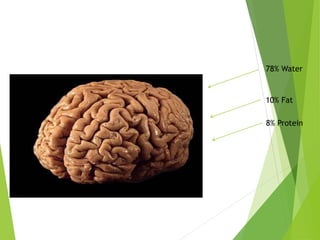
78% Water
10% Fat
8% Protein
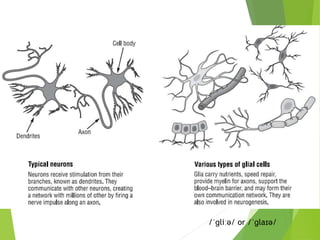
/ˈɡliːə/ or /ˈɡlaɪə/
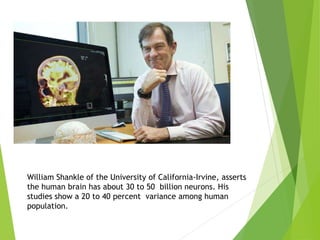
William Shankle of the University of California-Irvine, asserts
the human brain has about 30 to 50 billion neurons. His
studies show a 20 to 40 percent variance among human
population.
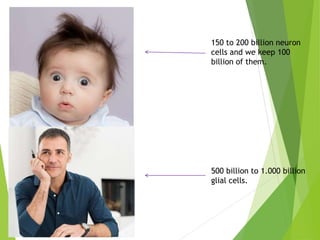
150 to 200 billion neuron
cells and we keep 100
billion of them.
500 billion to 1.000 billion
glial cells.
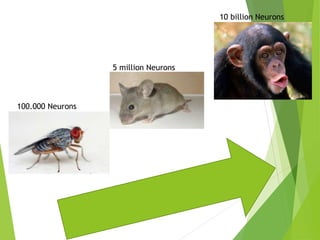
100.000 Neurons
5 million Neurons
10 billion Neurons
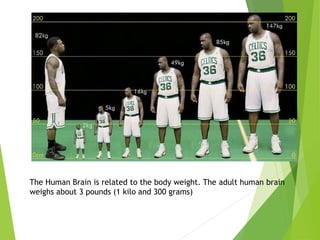
The Human Brain is related to the body weight. The adult human brain
weighs about 3 pounds (1 kilo and 300 grams)
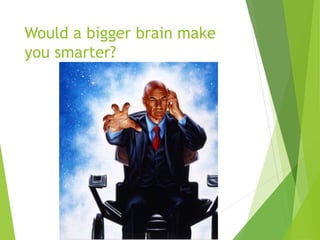
Would a bigger brain make
you smarter?
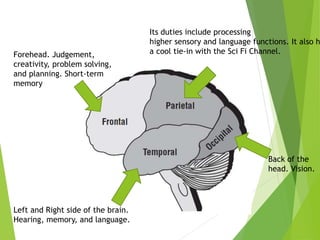
Back of the
head. Vision.
Left and Right side of the brain.
Hearing, memory, and language.
Forehead. Judgement,
creativity, problem solving,
and planning. Short-term
memory
Its duties include processing
higher sensory and language functions. It also h
a cool tie-in with the Sci Fi Channel.
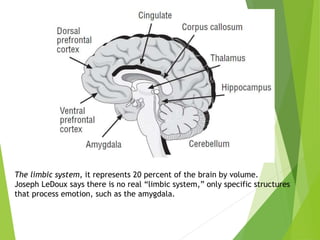
The limbic system, it represents 20 percent of the brain by volume.
Joseph LeDoux says there is no real “limbic system,” only specific structures
that process emotion, such as the amygdala.
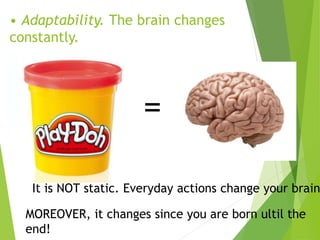
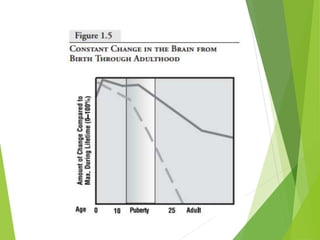
• Adaptability. The brain changes
constantly.
=
It is NOT static. Everyday actions change your brain
MOREOVER, it changes since you are born ultil the
end!
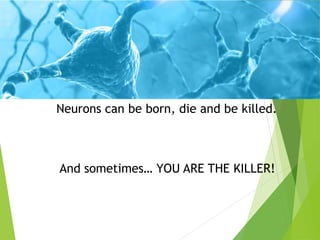
Neurons can be born, die and be killed.
And sometimes… YOU ARE THE KILLER!
Integration: How the Brain
structures compete and
cooperate.
Brain cells are “connected” to other
brain cells by physical structures such as
axons, which are extensions sent out by
neurons. Bloodstream creates a common
network, circulating brain chemicals
known as neurotransmitters (e.g.,
serotonin, dopamine, and acetylchoine)
and hormones known as
neuromodulators (e.g., ortisol and
adrenaline).
Integration: How the Brain
structures compete and
cooperate.
Information is also communicated through
the immune system and “messenger
molecules” known as peptides.
The two sides of the brain, the left and right
cerebral hemispheres, are connected by
bundles of nerve fibers.
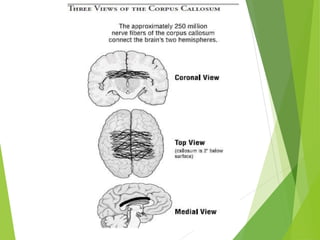
The corpus callosum is the largest
connective pathways, with about 250 million
nerve fibres.
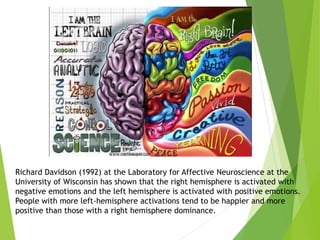
Richard Davidson (1992) at the Laboratory for Affective Neuroscience at the
University of Wisconsin has shown that the right hemisphere is activated with
negative emotions and the left hemisphere is activated with positive emotions.
People with more left-hemisphere activations tend to be happier and more
positive than those with a right hemisphere dominance.
Integration: How the Brain
structures compete and
cooperate
“Competition within the brain” sounds a
little like malfunction to be corrected.
The competition concept is simple:
whatever is first, whatever activities are
more frequent, and whatever actions are
more coherent will “win” the
competition for network wiring and
signal the brain to allocate space and
resources to that set of behaviours.
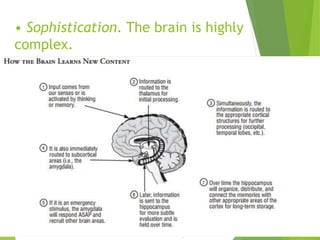
• Sophistication. The brain is highly
complex.
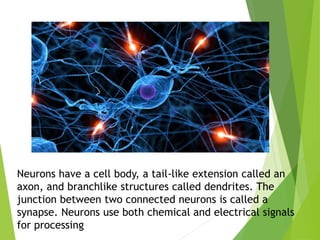
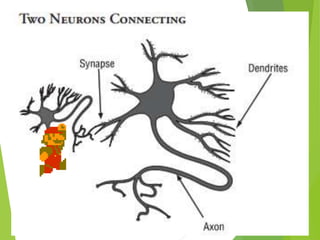
Neurons have a cell body, a tail-like extension called an
axon, and branchlike structures called dendrites. The
junction between two connected neurons is called a
synapse. Neurons use both chemical and electrical signals
for processing
 Modification of existing connections : Connections
are re-programed.
 Elimination of synapses : Synapses eliminated
through experience.
 Growth of new connections : LEARNING.
https://www.learner.org/courses
/neuroscience/common_includes
/si_flowplayer.html?pid=2448

Meet your amazing brain

  • 1.
  • 2.
  • 3.
  • 4.
    William Shankle ofthe University of California-Irvine, asserts the human brain has about 30 to 50 billion neurons. His studies show a 20 to 40 percent variance among human population.
  • 5.
    150 to 200billion neuron cells and we keep 100 billion of them. 500 billion to 1.000 billion glial cells.
  • 6.
    100.000 Neurons 5 millionNeurons 10 billion Neurons
  • 7.
    The Human Brainis related to the body weight. The adult human brain weighs about 3 pounds (1 kilo and 300 grams)
  • 8.
    Would a biggerbrain make you smarter?
  • 10.
    Back of the head.Vision. Left and Right side of the brain. Hearing, memory, and language. Forehead. Judgement, creativity, problem solving, and planning. Short-term memory Its duties include processing higher sensory and language functions. It also h a cool tie-in with the Sci Fi Channel.
  • 11.
    The limbic system,it represents 20 percent of the brain by volume. Joseph LeDoux says there is no real “limbic system,” only specific structures that process emotion, such as the amygdala.
  • 12.
    • Adaptability. Thebrain changes constantly. = It is NOT static. Everyday actions change your brain MOREOVER, it changes since you are born ultil the end!
  • 14.
    Neurons can beborn, die and be killed. And sometimes… YOU ARE THE KILLER!
  • 16.
    Integration: How theBrain structures compete and cooperate. Brain cells are “connected” to other brain cells by physical structures such as axons, which are extensions sent out by neurons. Bloodstream creates a common network, circulating brain chemicals known as neurotransmitters (e.g., serotonin, dopamine, and acetylchoine) and hormones known as neuromodulators (e.g., ortisol and adrenaline).
  • 17.
    Integration: How theBrain structures compete and cooperate. Information is also communicated through the immune system and “messenger molecules” known as peptides. The two sides of the brain, the left and right cerebral hemispheres, are connected by bundles of nerve fibers. The corpus callosum is the largest connective pathways, with about 250 million nerve fibres.
  • 19.
    Richard Davidson (1992)at the Laboratory for Affective Neuroscience at the University of Wisconsin has shown that the right hemisphere is activated with negative emotions and the left hemisphere is activated with positive emotions. People with more left-hemisphere activations tend to be happier and more positive than those with a right hemisphere dominance.
  • 20.
    Integration: How theBrain structures compete and cooperate “Competition within the brain” sounds a little like malfunction to be corrected. The competition concept is simple: whatever is first, whatever activities are more frequent, and whatever actions are more coherent will “win” the competition for network wiring and signal the brain to allocate space and resources to that set of behaviours.
  • 21.
    • Sophistication. Thebrain is highly complex.
  • 22.
    Neurons have acell body, a tail-like extension called an axon, and branchlike structures called dendrites. The junction between two connected neurons is called a synapse. Neurons use both chemical and electrical signals for processing
  • 24.
     Modification ofexisting connections : Connections are re-programed.  Elimination of synapses : Synapses eliminated through experience.  Growth of new connections : LEARNING.
  • 25.