Prepared by : Mahmoud Mohamed Ali
Department : Electrical Maintenance
Email : Mahmoud.Mohamed@Siemens.com
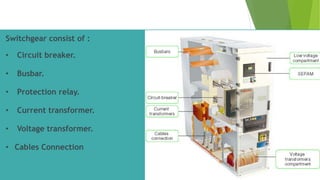
Switchgear consist of :
• Circuit breaker.
• Busbar.
• Protection relay.
• Current transformer.
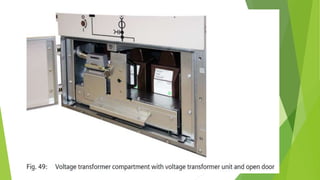
• Voltage transformer.
• Cables Connection
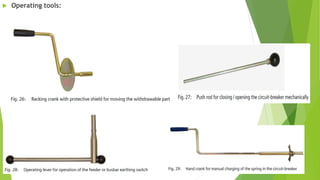
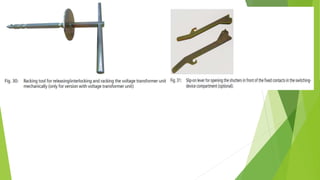
 Operating tools:
Current transformer :
APPLICATION:
 Current transformers (CT,s) are instrument transformers that are used to supply a reduced value of
current to protective relays , meters and other instruments.
 CT,s provide isolation from the high voltage primary , permit grounding of the secondary windings for
safety , and step down the magnitude of the measured current to a value that can be safely handled
by the instruments
RATIO:
 The most common CT secondary full load current is 1A or 5A.
 CT ratio are expressed as a ratio of rated primary current to the rated
secondary current .
 Example
a 1000/1 A CT will produce 1A of secondary current when 1000 A flows through
the primary .
As the primary current changes the secondary current will vary accordingly.
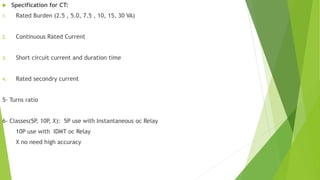
 Specification for CT:
1. Rated Burden (2.5 , 5.0, 7.5 , 10, 15, 30 VA)
2. Continuous Rated Current
3. Short circuit current and duration time
4. Rated secondry current
5- Turns ratio
6- Classes(5P, 10P, X): 5P use with Instantaneous oc Relay
- 10P use with IDMT oc Relay
- X no need high accuracy
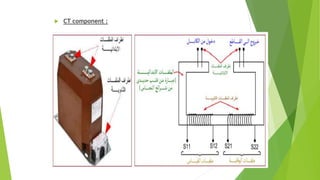
 CT component :
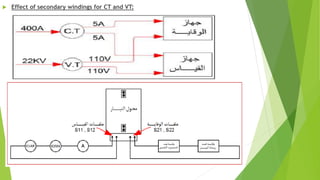
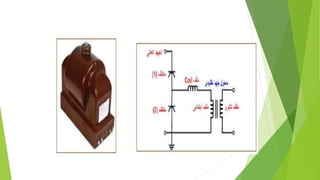
 Effect of secondary windings for CT and VT:
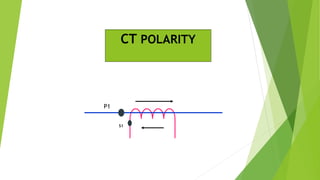
CT POLARITY
P1
S1
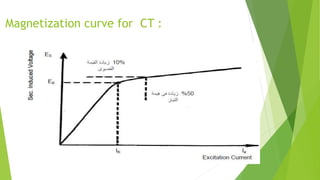
Magnetization curve for CT :
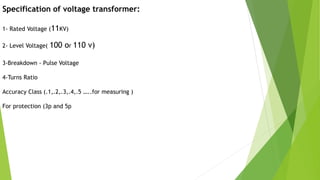
Specification of voltage transformer:
1- Rated Voltage (11KV)
2- Level Voltage( 100 or 110 v)
3-Breakdown - Pulse Voltage
4-Turns Ratio
Accuracy Class (.1,.2,.3,.4,.5 …..for measuring )
For protection (3p and 5p
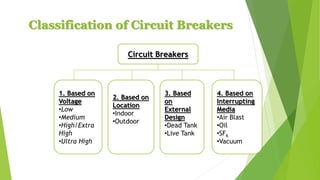
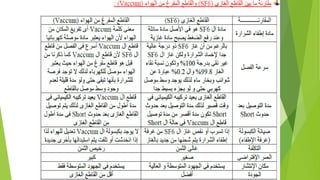
Classification of Circuit Breakers
Circuit Breakers
1. Based on
Voltage
•Low
•Medium
•High/Extra
High
•Ultra High
3. Based
on
External
Design
•Dead Tank
•Live Tank
4. Based on
Interrupting
Media
•Air Blast
•Oil
•SF6
•Vacuum
2. Based on
Location
•Indoor
•Outdoor
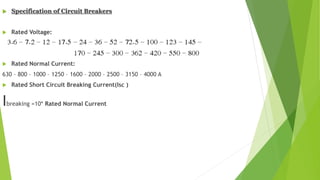
 Specification of Circuit Breakers
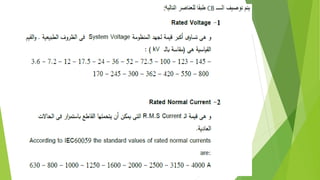
 Rated Voltage:
 Rated Normal Current:
630 – 800 – 1000 – 1250 – 1600 – 2000 – 2500 – 3150 – 4000 A
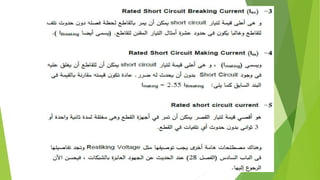
 Rated Short Circuit Breaking Current(Isc )
Ibreaking =10* Rated Normal Current
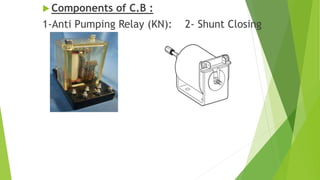
 Components of C.B :
1-Anti Pumping Relay (KN): 2- Shunt Closing
(YF):
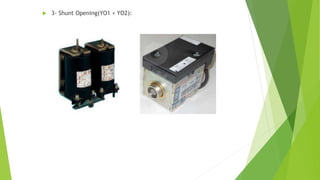
 3- Shunt Opening(YO1 + YO2):
 General inspection on C.B
1- Ensure of the upper and down contacts for good
connection
2- Ensure of the opening and closing mechanical for
circuit breaker
3- inspection of Charging Limit Switch
4- easy in entire and outage the C.B
5-the heater in the cell is work
6- Ensure of the earthing
 General inspection on C.B
1- Ensure of the upper and down contacts for good
connection
2- Ensure of the opening and closing mechanical for
circuit breaker
3- inspection of Charging Limit Switch
4- easy in entire and outage the C.B
5-the heater in the cell is work
6- Ensure of the earthing
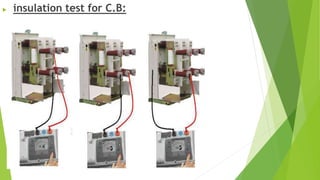
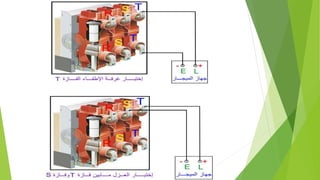
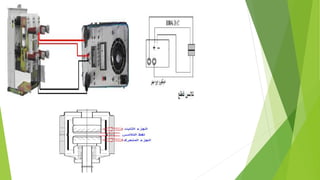
 insulation test for C.B:
 Contact Resistance for C.B
 Use Micrometer device:
 Measure each phase resistance only
 Connection points Resistance for C.B at voltage (11
kv) is 12 - 60 μΩ
 For (33kv) is (25-100) μΩ
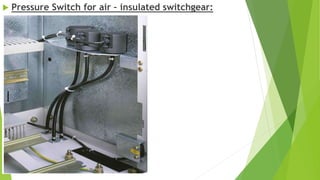
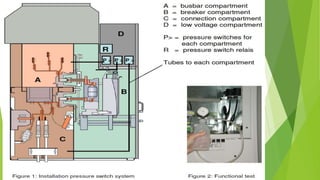
 Pressure Switch for air – insulated switchgear:
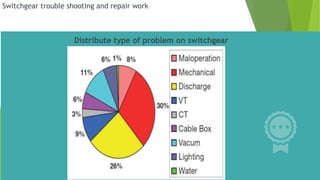
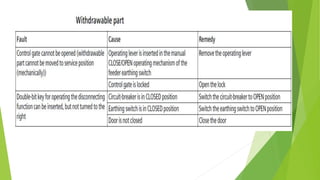
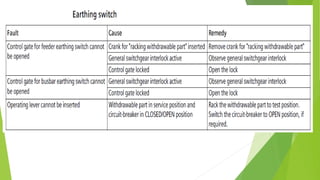
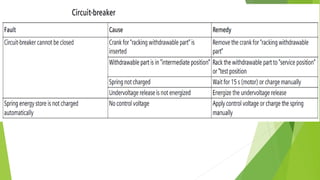
Distribute type of problem on switchgear
Switchgear trouble shooting and repair work
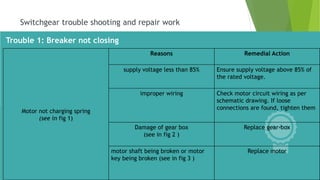
Trouble 1: Breaker not closing
Switchgear trouble shooting and repair work
Motor not charging spring
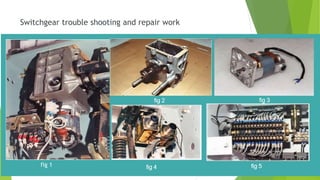
(see in fig 1)
Reasons Remedial Action
supply voltage less than 85% Ensure supply voltage above 85% of
the rated voltage.
improper wiring Check motor circuit wiring as per
schematic drawing. If loose
connections are found, tighten them
Damage of gear box
(see in fig 2 )
Replace gear-box
motor shaft being broken or motor
key being broken (see in fig 3 )
Replace motor
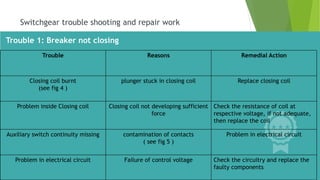
Trouble 1: Breaker not closing
Switchgear trouble shooting and repair work
Trouble Reasons Remedial Action
Closing coil burnt
(see fig 4 )
plunger stuck in closing coil Replace closing coil
Problem inside Closing coil Closing coil not developing sufficient
force
Check the resistance of coil at
respective voltage, if not adequate,
then replace the coil
Auxiliary switch continuity missing contamination of contacts
( see fig 5 )
Problem in electrical circuit
Problem in electrical circuit Failure of control voltage Check the circuitry and replace the
faulty components
fig 1
Switchgear trouble shooting and repair work
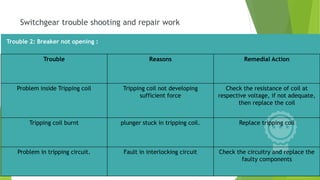
Trouble 2: Breaker not opening :
Switchgear trouble shooting and repair work
Trouble Reasons Remedial Action
Problem inside Tripping coil Tripping coil not developing
sufficient force
Check the resistance of coil at
respective voltage, if not adequate,
then replace the coil
Tripping coil burnt plunger stuck in tripping coil. Replace tripping coil
Problem in tripping circuit. Fault in interlocking circuit Check the circuitry and replace the
faulty components
Switchgear trouble shooting and repair work
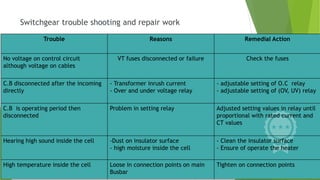
Trouble Reasons Remedial Action
No voltage on control circuit
although voltage on cables
VT fuses disconnected or failure Check the fuses
C.B disconnected after the incoming
directly
- Transformer inrush current
- Over and under voltage relay
- adjustable setting of O.C relay
- adjustable setting of (OV, UV) relay
C.B is operating period then
disconnected
Problem in setting relay Adjusted setting values in relay until
proportional with rated current and
CT values
Hearing high sound inside the cell -Dust on insulator surface
- high moisture inside the cell
- Clean the insulator surface
- Ensure of operate the heater
High temperature inside the cell Loose in connection points on main
Busbar
Tighten on connection points
Meduim Voltage Switchgear.pptx

Meduim Voltage Switchgear.pptx

  • 1.
    Prepared by :Mahmoud Mohamed Ali Department : Electrical Maintenance Email : Mahmoud.Mohamed@Siemens.com
  • 3.
    Switchgear consist of: • Circuit breaker. • Busbar. • Protection relay. • Current transformer. • Voltage transformer. • Cables Connection
  • 6.
  • 8.
    Current transformer : APPLICATION: Current transformers (CT,s) are instrument transformers that are used to supply a reduced value of current to protective relays , meters and other instruments.  CT,s provide isolation from the high voltage primary , permit grounding of the secondary windings for safety , and step down the magnitude of the measured current to a value that can be safely handled by the instruments
  • 9.
    RATIO:  The mostcommon CT secondary full load current is 1A or 5A.  CT ratio are expressed as a ratio of rated primary current to the rated secondary current .  Example a 1000/1 A CT will produce 1A of secondary current when 1000 A flows through the primary . As the primary current changes the secondary current will vary accordingly.
  • 10.
     Specification forCT: 1. Rated Burden (2.5 , 5.0, 7.5 , 10, 15, 30 VA) 2. Continuous Rated Current 3. Short circuit current and duration time 4. Rated secondry current 5- Turns ratio 6- Classes(5P, 10P, X): 5P use with Instantaneous oc Relay - 10P use with IDMT oc Relay - X no need high accuracy
  • 11.
  • 12.
     Effect ofsecondary windings for CT and VT:
  • 13.
  • 14.
  • 15.
    Specification of voltagetransformer: 1- Rated Voltage (11KV) 2- Level Voltage( 100 or 110 v) 3-Breakdown - Pulse Voltage 4-Turns Ratio Accuracy Class (.1,.2,.3,.4,.5 …..for measuring ) For protection (3p and 5p
  • 18.
    Classification of CircuitBreakers Circuit Breakers 1. Based on Voltage •Low •Medium •High/Extra High •Ultra High 3. Based on External Design •Dead Tank •Live Tank 4. Based on Interrupting Media •Air Blast •Oil •SF6 •Vacuum 2. Based on Location •Indoor •Outdoor
  • 19.
     Specification ofCircuit Breakers  Rated Voltage:  Rated Normal Current: 630 – 800 – 1000 – 1250 – 1600 – 2000 – 2500 – 3150 – 4000 A  Rated Short Circuit Breaking Current(Isc ) Ibreaking =10* Rated Normal Current
  • 23.
     Components ofC.B : 1-Anti Pumping Relay (KN): 2- Shunt Closing (YF):
  • 24.
     3- ShuntOpening(YO1 + YO2):
  • 25.
     General inspectionon C.B 1- Ensure of the upper and down contacts for good connection 2- Ensure of the opening and closing mechanical for circuit breaker 3- inspection of Charging Limit Switch 4- easy in entire and outage the C.B 5-the heater in the cell is work 6- Ensure of the earthing
  • 26.
     General inspectionon C.B 1- Ensure of the upper and down contacts for good connection 2- Ensure of the opening and closing mechanical for circuit breaker 3- inspection of Charging Limit Switch 4- easy in entire and outage the C.B 5-the heater in the cell is work 6- Ensure of the earthing
  • 27.
  • 29.
     Contact Resistancefor C.B  Use Micrometer device:  Measure each phase resistance only  Connection points Resistance for C.B at voltage (11 kv) is 12 - 60 μΩ  For (33kv) is (25-100) μΩ
  • 31.
     Pressure Switchfor air – insulated switchgear:
  • 33.
    Distribute type ofproblem on switchgear Switchgear trouble shooting and repair work
  • 34.
    Trouble 1: Breakernot closing Switchgear trouble shooting and repair work Motor not charging spring (see in fig 1) Reasons Remedial Action supply voltage less than 85% Ensure supply voltage above 85% of the rated voltage. improper wiring Check motor circuit wiring as per schematic drawing. If loose connections are found, tighten them Damage of gear box (see in fig 2 ) Replace gear-box motor shaft being broken or motor key being broken (see in fig 3 ) Replace motor
  • 35.
    Trouble 1: Breakernot closing Switchgear trouble shooting and repair work Trouble Reasons Remedial Action Closing coil burnt (see fig 4 ) plunger stuck in closing coil Replace closing coil Problem inside Closing coil Closing coil not developing sufficient force Check the resistance of coil at respective voltage, if not adequate, then replace the coil Auxiliary switch continuity missing contamination of contacts ( see fig 5 ) Problem in electrical circuit Problem in electrical circuit Failure of control voltage Check the circuitry and replace the faulty components
  • 36.
    fig 1 Switchgear troubleshooting and repair work
  • 37.
    Trouble 2: Breakernot opening : Switchgear trouble shooting and repair work Trouble Reasons Remedial Action Problem inside Tripping coil Tripping coil not developing sufficient force Check the resistance of coil at respective voltage, if not adequate, then replace the coil Tripping coil burnt plunger stuck in tripping coil. Replace tripping coil Problem in tripping circuit. Fault in interlocking circuit Check the circuitry and replace the faulty components
  • 38.
    Switchgear trouble shootingand repair work Trouble Reasons Remedial Action No voltage on control circuit although voltage on cables VT fuses disconnected or failure Check the fuses C.B disconnected after the incoming directly - Transformer inrush current - Over and under voltage relay - adjustable setting of O.C relay - adjustable setting of (OV, UV) relay C.B is operating period then disconnected Problem in setting relay Adjusted setting values in relay until proportional with rated current and CT values Hearing high sound inside the cell -Dust on insulator surface - high moisture inside the cell - Clean the insulator surface - Ensure of operate the heater High temperature inside the cell Loose in connection points on main Busbar Tighten on connection points