How to Build a Corporate Style Guide
January 13, 2015
Laurie Buckeye, Senior Technical Writer, Neuromodulation
Lisa Stammer, Senior Technical Editor, Cardiovascular
Agenda
• Who needs a style guide?
• Phase I (Commonalities)
• Phase II (Differences)
• Phase III (Release)
• Maintenance
• Challenges
• Lessons learned
• How to build a corporate style guide
2
Why do companies need a
style guide?
• Reduce ambiguity and improve clarity to optimize
English content for a global audience and for
translations
• Enable automation of content quality checks (in
English and for translations)
• Improve consistency across the company
• Create a common roadmap for customers
3
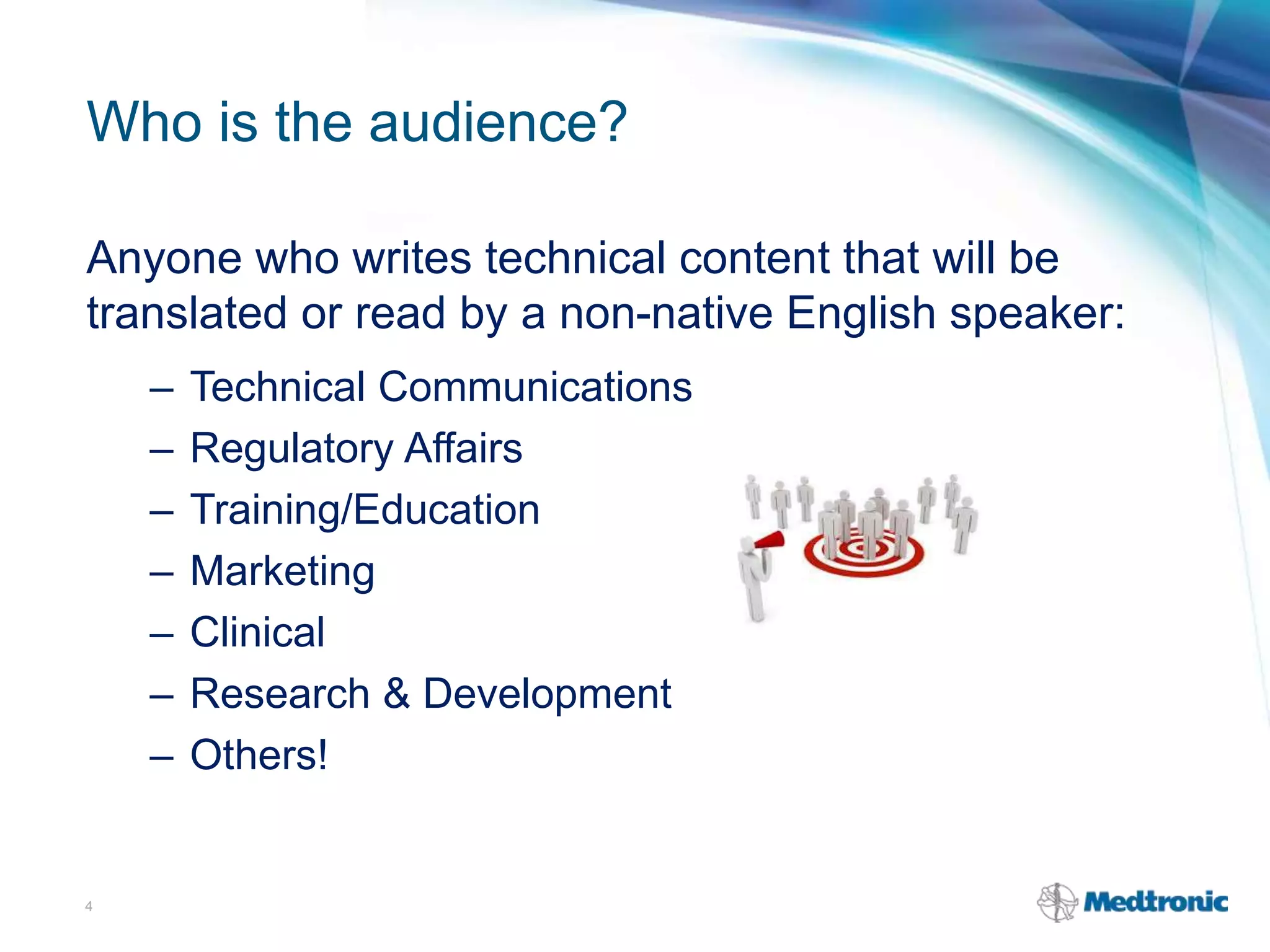
Who is the audience?
Anyone who writes technical content that will be
translated or read by a non-native English speaker:
– Technical Communications
– Regulatory Affairs
– Training/Education
– Marketing
– Clinical
– Research & Development
– Others!
4
Phase I – Find commonalities
• Team leader sent a short survey to the
representatives from the different divisions,
asking for copies of their style guides, and for
answers to a few questions about how the guides
are used and maintained.
• The existing style guides were posted to a
shared site so all team members had access.
• The team began meeting monthly to analyze the
style guides.
5
Phase I –
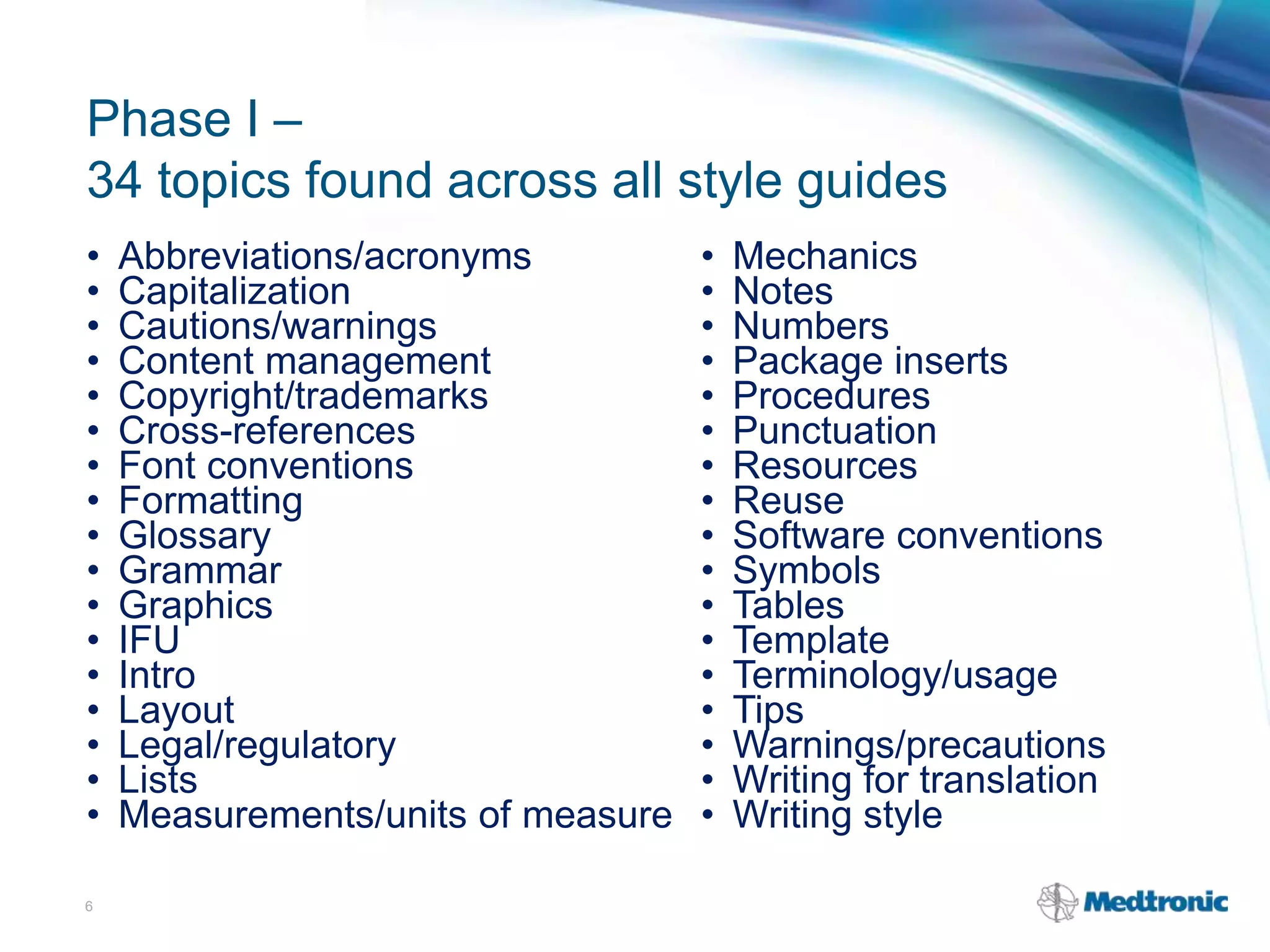
34 topics found across all style guides
• Abbreviations/acronyms
• Capitalization
• Cautions/warnings
• Content management
• Copyright/trademarks
• Cross-references
• Font conventions
• Formatting
• Glossary
• Grammar
• Graphics
• IFU
• Intro
• Layout
• Legal/regulatory
• Lists
• Measurements/units of measure
6
• Mechanics
• Notes
• Numbers
• Package inserts
• Procedures
• Punctuation
• Resources
• Reuse
• Software conventions
• Symbols
• Tables
• Template
• Terminology/usage
• Tips
• Warnings/precautions
• Writing for translation
• Writing style
Phase I –
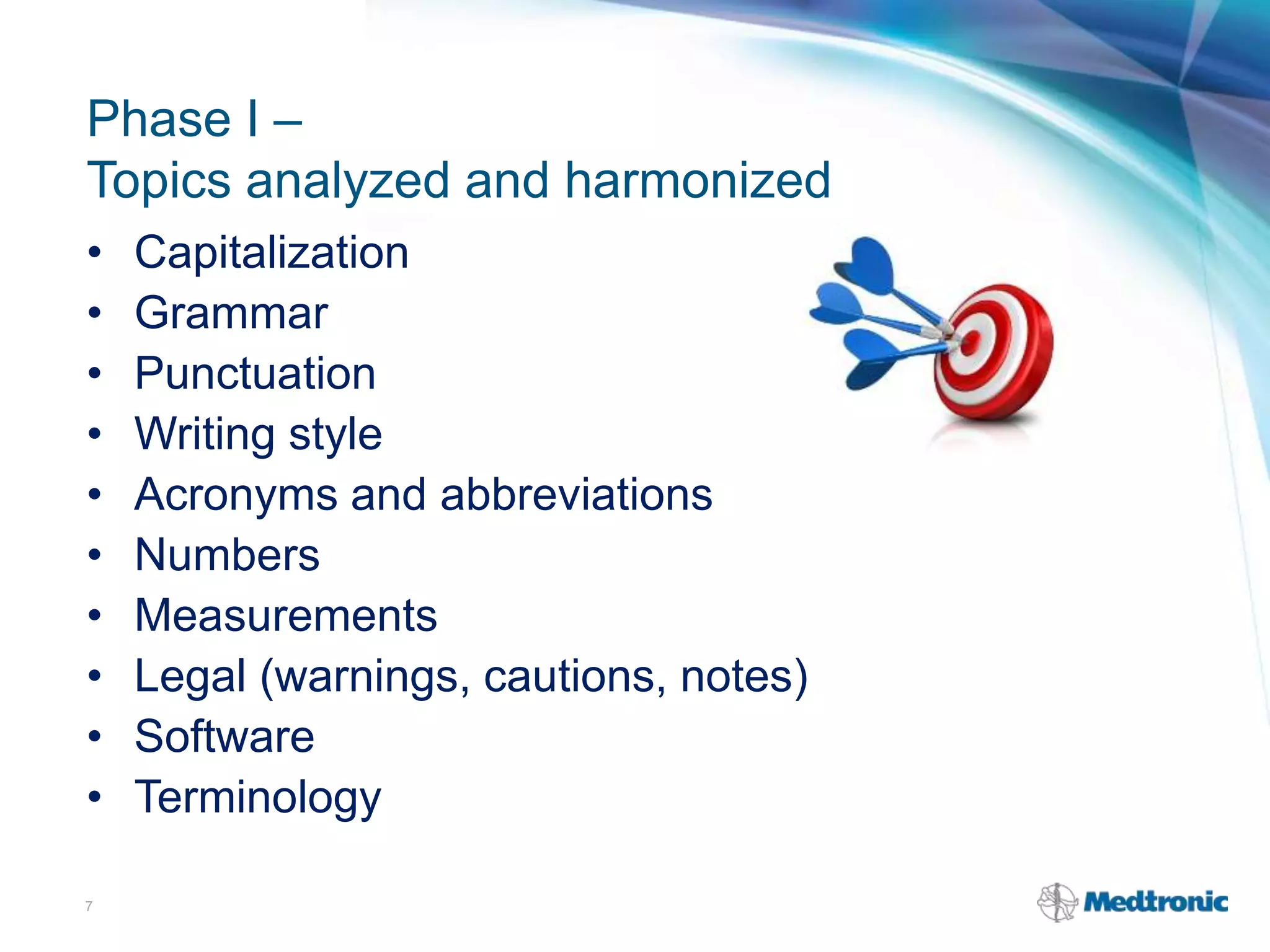
Topics analyzed and harmonized
• Capitalization
• Grammar
• Punctuation
• Writing style
• Acronyms and abbreviations
• Numbers
• Measurements
• Legal (warnings, cautions, notes)
• Software
• Terminology
7
Our guide does NOT include:
• English language terminology management
• Reading level guidelines
– Patient-facing literature vs. clinician-facing
publications
– Multiple, conflicting sources available for
assessment
• Style conventions for software strings
• Visual design
• Branding
8
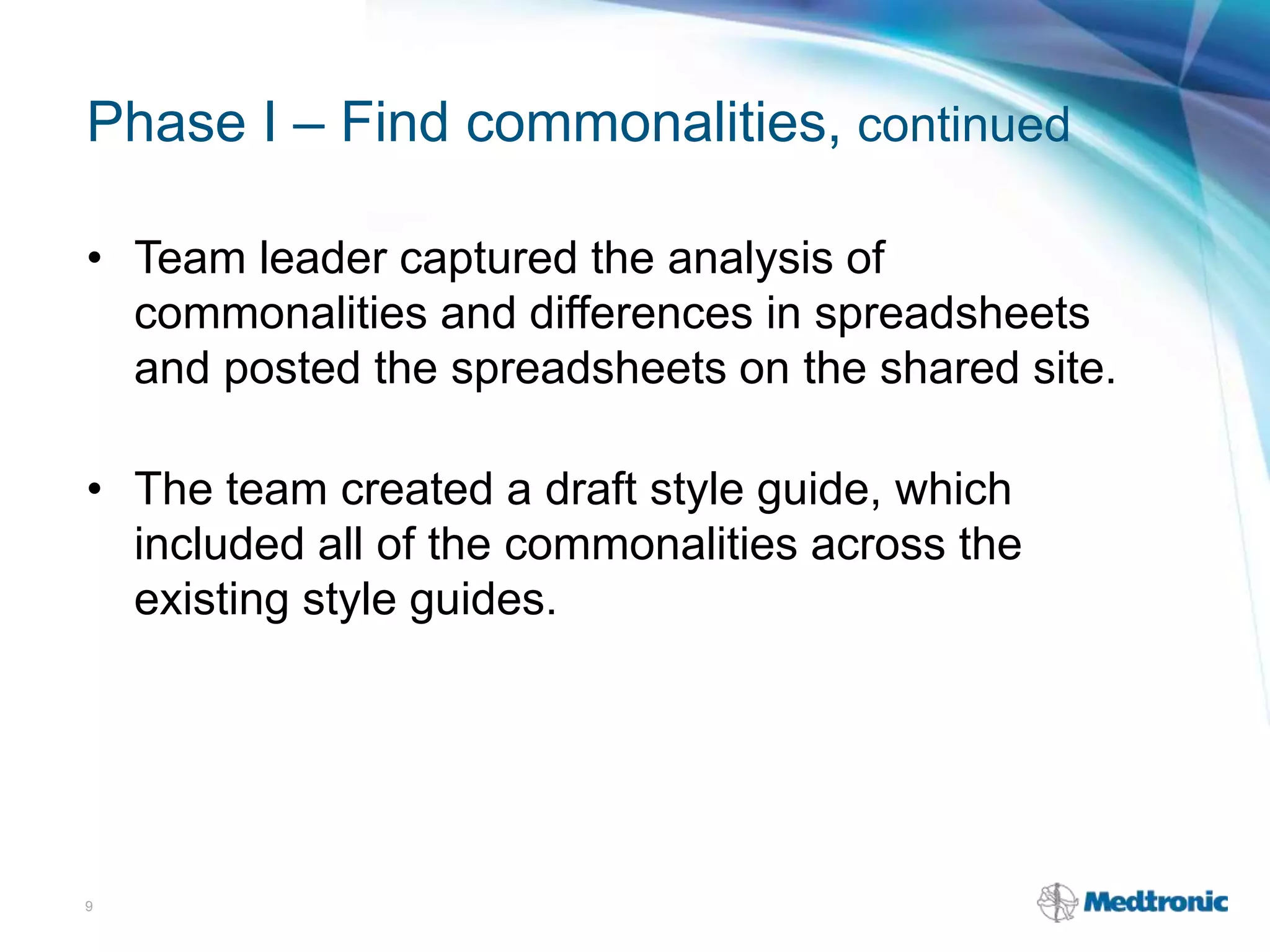
Phase I – Find commonalities, continued
• Team leader captured the analysis of
commonalities and differences in spreadsheets
and posted the spreadsheets on the shared site.
• The team created a draft style guide, which
included all of the commonalities across the
existing style guides.
9
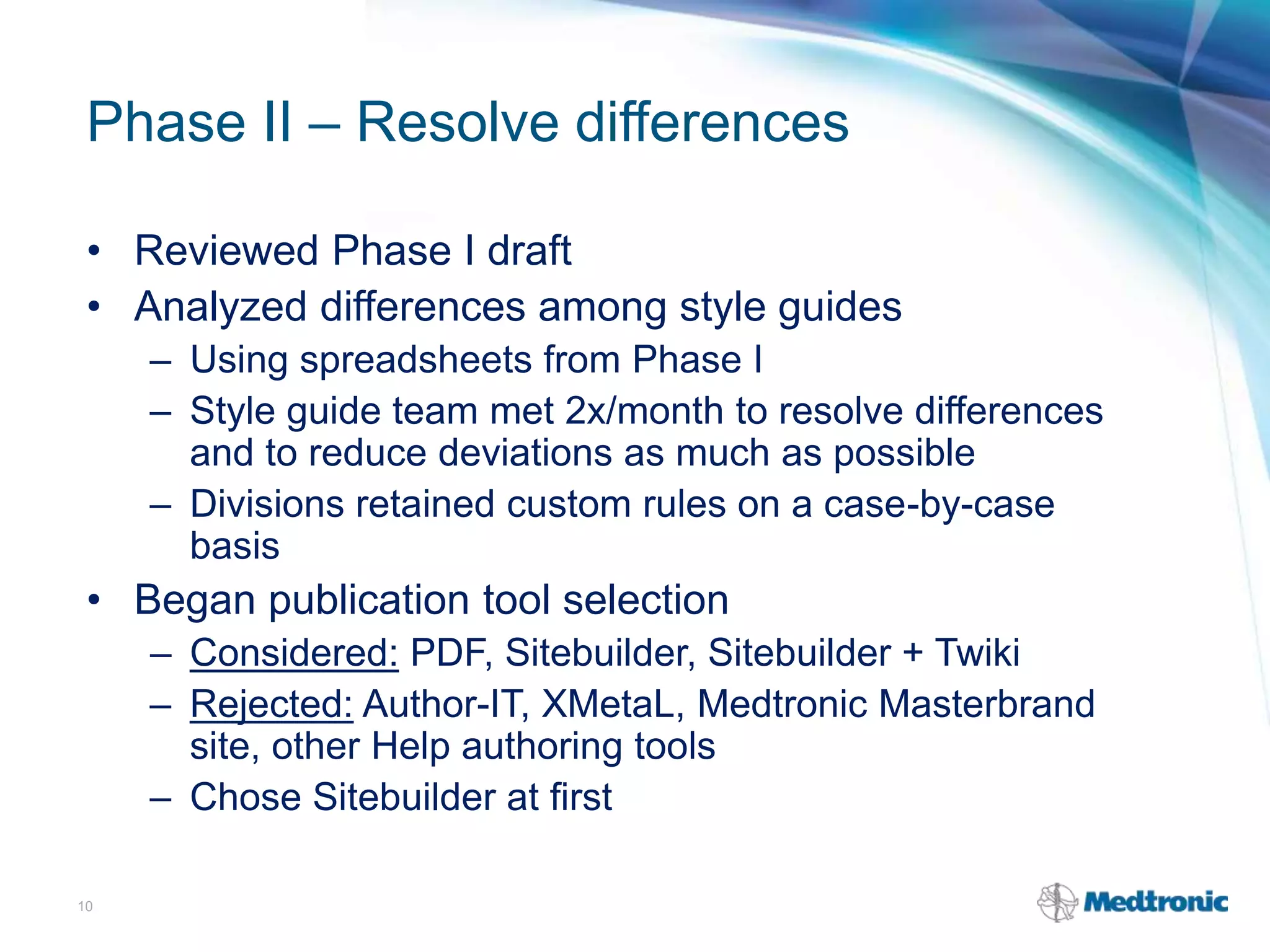
Phase II – Resolve differences
• Reviewed Phase I draft
• Analyzed differences among style guides
– Using spreadsheets from Phase I
– Style guide team met 2x/month to resolve differences
and to reduce deviations as much as possible
– Divisions retained custom rules on a case-by-case
basis
• Began publication tool selection
– Considered: PDF, Sitebuilder, Sitebuilder + Twiki
– Rejected: Author-IT, XMetaL, Medtronic Masterbrand
site, other Help authoring tools
– Chose Sitebuilder at first
10
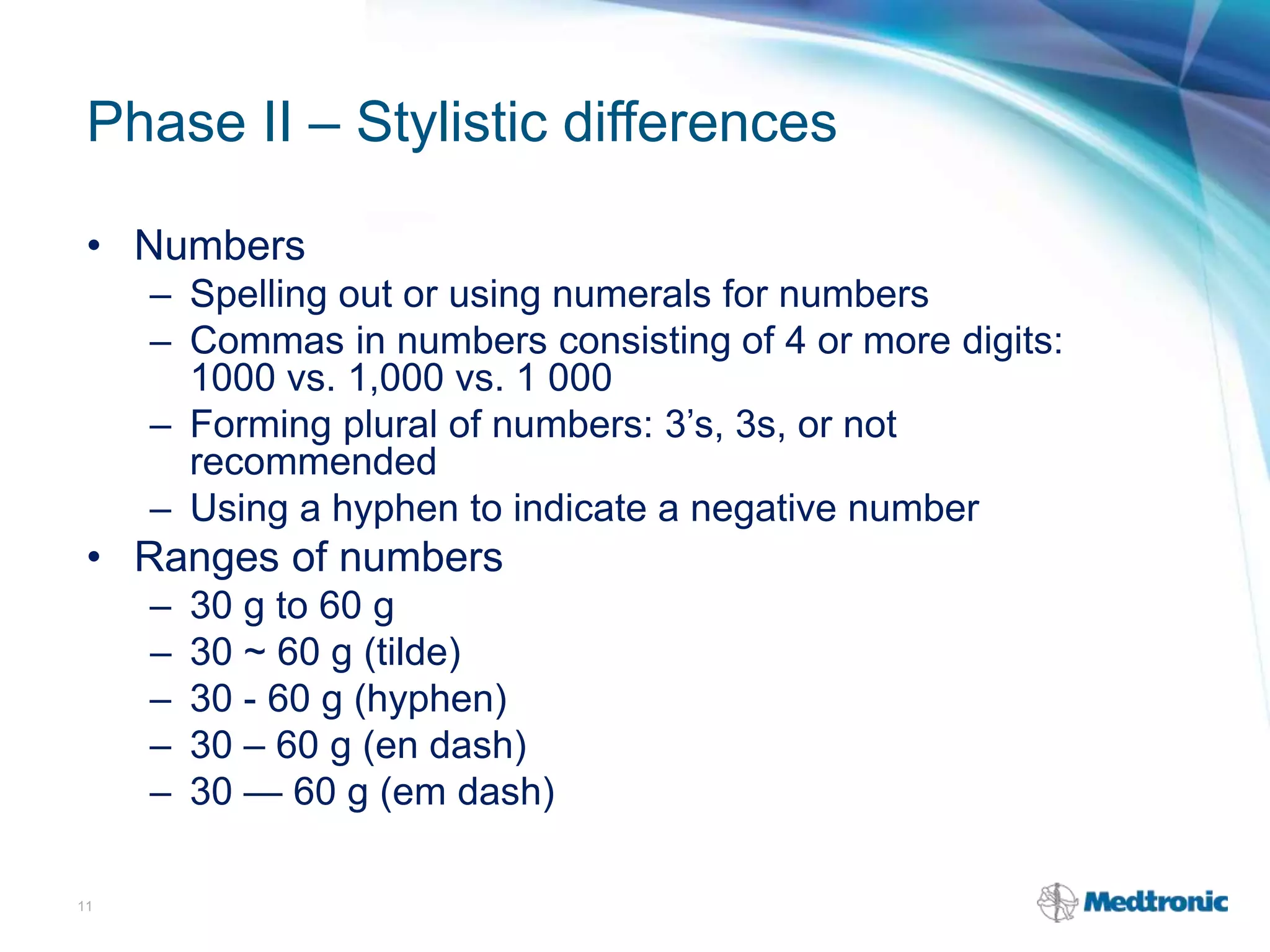
Phase II – Stylistic differences
• Numbers
– Spelling out or using numerals for numbers
– Commas in numbers consisting of 4 or more digits:
1000 vs. 1,000 vs. 1 000
– Forming plural of numbers: 3’s, 3s, or not
recommended
– Using a hyphen to indicate a negative number
• Ranges of numbers
– 30 g to 60 g
– 30 ~ 60 g (tilde)
– 30 - 60 g (hyphen)
– 30 – 60 g (en dash)
– 30 — 60 g (em dash)
11
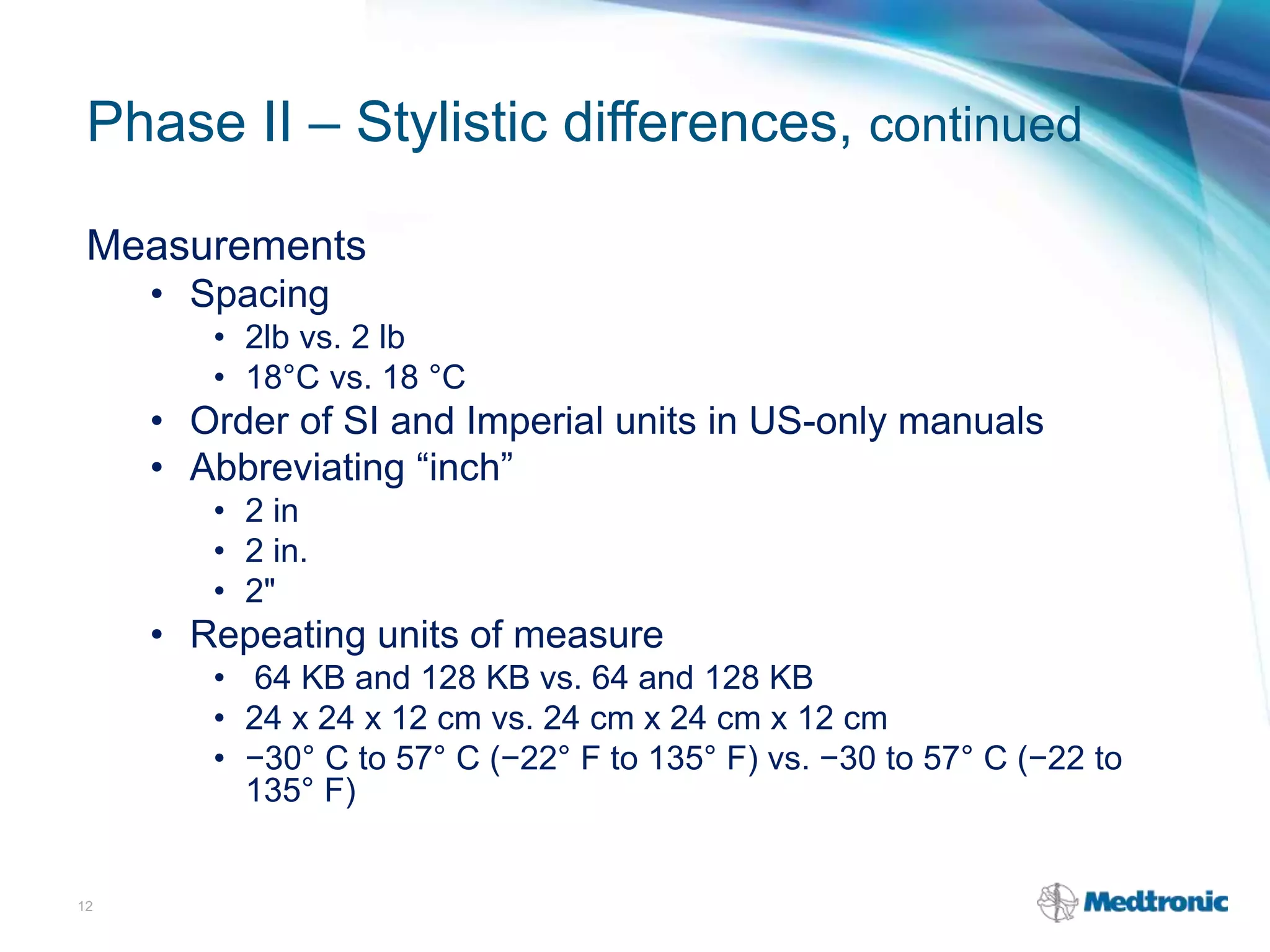
Phase II – Stylistic differences, continued
Measurements
• Spacing
• 2lb vs. 2 lb
• 18°C vs. 18 °C
• Order of SI and Imperial units in US-only manuals
• Abbreviating “inch”
• 2 in
• 2 in.
• 2"
• Repeating units of measure
• 64 KB and 128 KB vs. 64 and 128 KB
• 24 x 24 x 12 cm vs. 24 cm x 24 cm x 12 cm
• −30° C to 57° C (−22° F to 135° F) vs. −30 to 57° C (−22 to
135° F)
12
Phase II – Stylistic differences, continued
• Telephone numbers
– (800) 123-4567
– 800.123.4567
– 1-800-123-4567
– +1-800-123-4567
– (800) 123 4567
– +1 800 123 4567
• Capitalization of first word in bulleted lists
• Plurals—using “(s)” construction to indicate an
item that may be plural or singular
13
Phase III – Final steps
• Create online style guide using MediaWiki
• Complete user acceptance testing
• Develop and deliver training to tech comm
groups throughout company
• Communicate upcoming release of the style
guide to stakeholders and potential users
14
Style guide maintenance
• Each division will decide how to enforce use of
the style guide.
• Writers will negotiate potential changes with
individual project teams.
• The style guide team will continue in a governing
role, meeting regularly to discuss needed
changes and additions.
• A subteam will coordinate style guide rules with
for translation and editing tools.
15
Challenges
• Resource availability
– Work is not a high priority
– Lower priority delays completion
– Project depends on each team member’s input
• Tool selection needs
– Low cost
– Minimal training requirements
– Easy upkeep
– In-house availability
– PDF export capability
• Implementation
– Management support and enforcement
– Effective publication/distribution
16
Lessons learned?
• Longer face-to-face meetings increased
commitment and productivity.
• The team leader remained consistent and
dedicated to the goal.
• Collecting and tracking documents on a shared
site (such as Sitebuilder) helped with team
communication and continuity.
• Ongoing management support across the
company helped push the team forward.
17
How to build a corporate style guide
 Analyze multiple existing style guides for
similarities and differences (about 1 year)
 Resolve differences (about 3 years)
 Create final draft in Word
 Put final content into a Wiki (switch from a Sitebuilder
wiki to MediaWiki just before release)
 Perform user testing and incorporate feedback
 Finalize release and implementation/training plan
 Deliver training to all tech comm divisions
 Release the Medtronic Global English Style Guide!
18

Medtronic style guide presentation- Jan 2015

  • 1.
    How to Builda Corporate Style Guide January 13, 2015 Laurie Buckeye, Senior Technical Writer, Neuromodulation Lisa Stammer, Senior Technical Editor, Cardiovascular
  • 2.
    Agenda • Who needsa style guide? • Phase I (Commonalities) • Phase II (Differences) • Phase III (Release) • Maintenance • Challenges • Lessons learned • How to build a corporate style guide 2
  • 3.
    Why do companiesneed a style guide? • Reduce ambiguity and improve clarity to optimize English content for a global audience and for translations • Enable automation of content quality checks (in English and for translations) • Improve consistency across the company • Create a common roadmap for customers 3
  • 4.
    Who is theaudience? Anyone who writes technical content that will be translated or read by a non-native English speaker: – Technical Communications – Regulatory Affairs – Training/Education – Marketing – Clinical – Research & Development – Others! 4
  • 5.
    Phase I –Find commonalities • Team leader sent a short survey to the representatives from the different divisions, asking for copies of their style guides, and for answers to a few questions about how the guides are used and maintained. • The existing style guides were posted to a shared site so all team members had access. • The team began meeting monthly to analyze the style guides. 5
  • 6.
    Phase I – 34topics found across all style guides • Abbreviations/acronyms • Capitalization • Cautions/warnings • Content management • Copyright/trademarks • Cross-references • Font conventions • Formatting • Glossary • Grammar • Graphics • IFU • Intro • Layout • Legal/regulatory • Lists • Measurements/units of measure 6 • Mechanics • Notes • Numbers • Package inserts • Procedures • Punctuation • Resources • Reuse • Software conventions • Symbols • Tables • Template • Terminology/usage • Tips • Warnings/precautions • Writing for translation • Writing style
  • 7.
    Phase I – Topicsanalyzed and harmonized • Capitalization • Grammar • Punctuation • Writing style • Acronyms and abbreviations • Numbers • Measurements • Legal (warnings, cautions, notes) • Software • Terminology 7
  • 8.
    Our guide doesNOT include: • English language terminology management • Reading level guidelines – Patient-facing literature vs. clinician-facing publications – Multiple, conflicting sources available for assessment • Style conventions for software strings • Visual design • Branding 8
  • 9.
    Phase I –Find commonalities, continued • Team leader captured the analysis of commonalities and differences in spreadsheets and posted the spreadsheets on the shared site. • The team created a draft style guide, which included all of the commonalities across the existing style guides. 9
  • 10.
    Phase II –Resolve differences • Reviewed Phase I draft • Analyzed differences among style guides – Using spreadsheets from Phase I – Style guide team met 2x/month to resolve differences and to reduce deviations as much as possible – Divisions retained custom rules on a case-by-case basis • Began publication tool selection – Considered: PDF, Sitebuilder, Sitebuilder + Twiki – Rejected: Author-IT, XMetaL, Medtronic Masterbrand site, other Help authoring tools – Chose Sitebuilder at first 10
  • 11.
    Phase II –Stylistic differences • Numbers – Spelling out or using numerals for numbers – Commas in numbers consisting of 4 or more digits: 1000 vs. 1,000 vs. 1 000 – Forming plural of numbers: 3’s, 3s, or not recommended – Using a hyphen to indicate a negative number • Ranges of numbers – 30 g to 60 g – 30 ~ 60 g (tilde) – 30 - 60 g (hyphen) – 30 – 60 g (en dash) – 30 — 60 g (em dash) 11
  • 12.
    Phase II –Stylistic differences, continued Measurements • Spacing • 2lb vs. 2 lb • 18°C vs. 18 °C • Order of SI and Imperial units in US-only manuals • Abbreviating “inch” • 2 in • 2 in. • 2" • Repeating units of measure • 64 KB and 128 KB vs. 64 and 128 KB • 24 x 24 x 12 cm vs. 24 cm x 24 cm x 12 cm • −30° C to 57° C (−22° F to 135° F) vs. −30 to 57° C (−22 to 135° F) 12
  • 13.
    Phase II –Stylistic differences, continued • Telephone numbers – (800) 123-4567 – 800.123.4567 – 1-800-123-4567 – +1-800-123-4567 – (800) 123 4567 – +1 800 123 4567 • Capitalization of first word in bulleted lists • Plurals—using “(s)” construction to indicate an item that may be plural or singular 13
  • 14.
    Phase III –Final steps • Create online style guide using MediaWiki • Complete user acceptance testing • Develop and deliver training to tech comm groups throughout company • Communicate upcoming release of the style guide to stakeholders and potential users 14
  • 15.
    Style guide maintenance •Each division will decide how to enforce use of the style guide. • Writers will negotiate potential changes with individual project teams. • The style guide team will continue in a governing role, meeting regularly to discuss needed changes and additions. • A subteam will coordinate style guide rules with for translation and editing tools. 15
  • 16.
    Challenges • Resource availability –Work is not a high priority – Lower priority delays completion – Project depends on each team member’s input • Tool selection needs – Low cost – Minimal training requirements – Easy upkeep – In-house availability – PDF export capability • Implementation – Management support and enforcement – Effective publication/distribution 16
  • 17.
    Lessons learned? • Longerface-to-face meetings increased commitment and productivity. • The team leader remained consistent and dedicated to the goal. • Collecting and tracking documents on a shared site (such as Sitebuilder) helped with team communication and continuity. • Ongoing management support across the company helped push the team forward. 17
  • 18.
    How to builda corporate style guide  Analyze multiple existing style guides for similarities and differences (about 1 year)  Resolve differences (about 3 years)  Create final draft in Word  Put final content into a Wiki (switch from a Sitebuilder wiki to MediaWiki just before release)  Perform user testing and incorporate feedback  Finalize release and implementation/training plan  Deliver training to all tech comm divisions  Release the Medtronic Global English Style Guide! 18