How To Prepare The Style
Guide For Your Transla8ons
What translators should know about you to deliver the best text quality
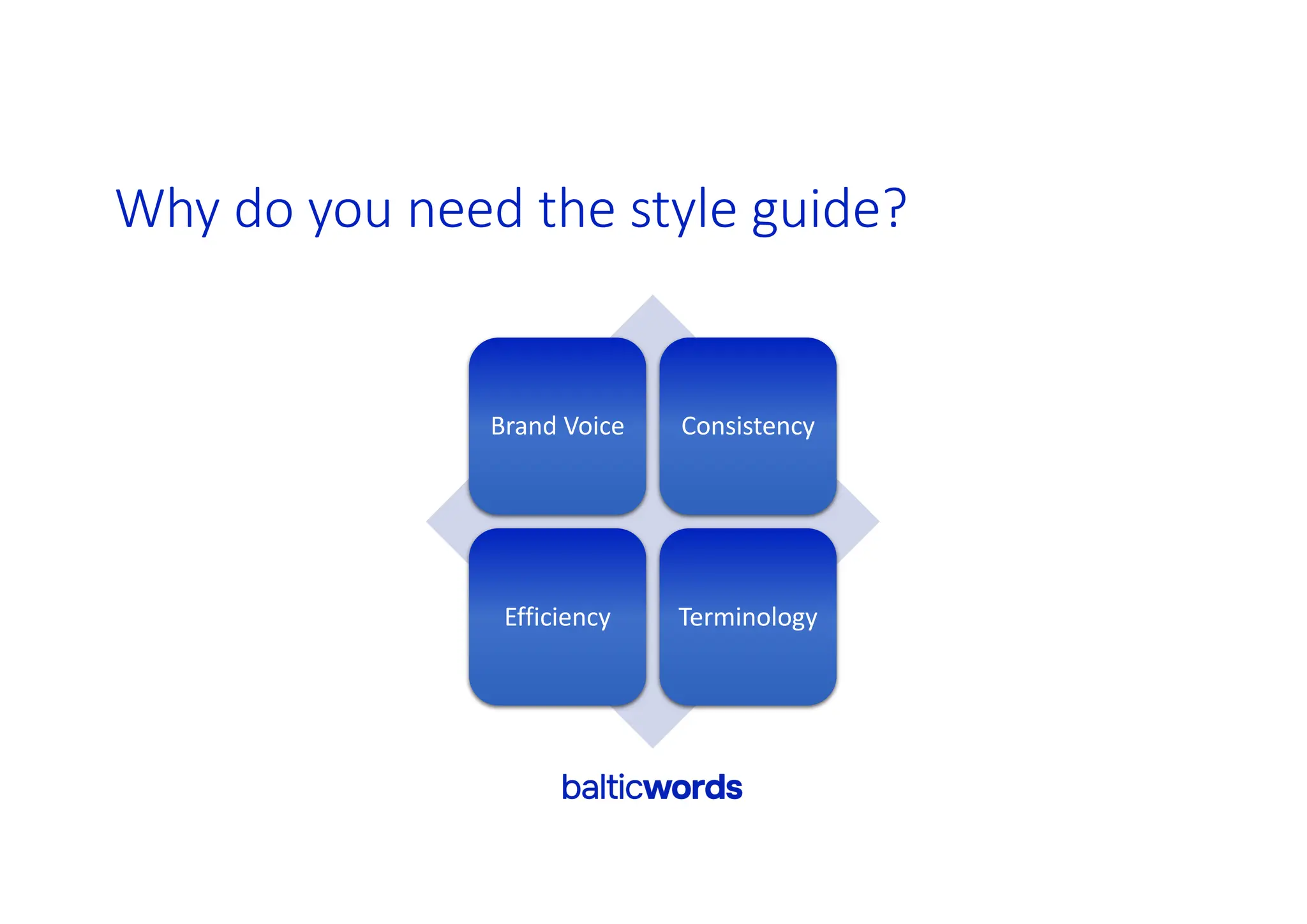
Why do you need the style guide?
Brand Voice Consistency
Efficiency Terminology
Just answer the questions on
next slides, and you’ll have the
draft of your styleguide
What are you selling?
Transla'on is a part of your copywri'ng and content marke'ng plan.
Linguists should understand the basic things about your product:
1. What kind of product/service do you have? Communicate the
nature of your product/service, including business model
(b2b/b2c), deployment (SaaS/on-premises), and pricing model
(freemium, etc.).
2. What do you sell at the value level? For example, Apple doesn’t sell
phones or computers. It sells infrastructure, convenience, and
status. Transla'on is not just about the literal transla'on of words
but also about effec'vely conveying the value proposi'on.
Who is your audience?
• Your marketing department holds valuable information about your
target audience, making it beneficial to include these insights in the
style guide.
• For translators, it is also essential to understand your audience's
technical background knowledge regarding your product/service.
• For example, you are selling corporate software. The level of
familiarity with terms would differ for CTO and line managers. If
translators know that, they would consider the different levels of
detail.
What is the goal of your texts?
Examples of Sales/Marketing text goals:
• Promote the product
• Script for direct sales
• Raise product awareness
• Educate the audience
• Remind people about your company
• Remarketing
What is the goal of your texts?
Examples of Product UI goals:
• Enhance usability
• Expand customer base through multilingual support
• Create a positive user experience with clear and concise menus
and buttons
Examples of Instructional text (HC) goals:
• Help customers use the product and solve problems
• Provide excellent tech support to increase customer satisfaction
Expert, friend, or assistant?
When it comes to our rela'onship with the reader, it's important to
determine our role.
• Are we posi'oned as experts or specialists, providing authorita've
informa'on and guidance?
• Or do we adopt a friend and assistant role, offering support,
relatability, and a personal touch?
Understanding our role helps shape our content’s tone, style, and
messaging, ensuring we connect effec'vely with our readers and fulfill
their expecta'ons.
How do you refer to the reader?
Here are some examples of formal and informal addressing
English:
• Formal: "Would you please provide your feedback?"
• Informal: "Can you give me your opinion?"
Spanish:
• Formal: "¿Podría usted dar su opinión?"
• Informal: "¿Puedes darme tu opinión?"
French:
• Formal: "Pourriez-vous donner votre avis?"
• Informal: "Peux-tu me donner ton avis?"
What to avoid?
• Some companies choose to avoid phrases that may potentially violate
national advertising laws or make unreasonable promises.
• Similarly, they may opt not to mention competitive brands to prevent
potential conflicts or misrepresentation.
• While every company's approach may vary, being aware of these
examples helps ensure legal compliance, ethical considerations, and
responsible communication in our content.
• Ensure that your translators are aware of these considerations and
approaches.
How do you spell your brand names?
Pay attention to the correct spelling of our brands, including
capitalization, spacing, and other specific details.
For example, iPhone is not Iphone, and macOS is not Mac Os.
By prioritizing our brands' correct spelling and formatting, we reinforce
brand identity and maintain a professional appearance.
Punctua>on guidelines: consistency is key
Non-breaking Spaces: Define where non-breaking spaces
should be used to prevent word or line breaks in specific
contexts.
N-dash or M-dash: Specify whether to use an N-dash (–) or an
M-dash (—) for par'cular purposes, such as indica'ng ranges
or adding emphasis.
Ellipsis: Determine how the ellipsis (...) should be represented,
either as a single symbol (…) or as three separate dots (...).
Quota'on Marks: Establish the preferred style for quota'on
marks, whether it is double quota'on marks (“ ”) or angled
quota'on marks (« »).
Ready to unlock the poten'al of your transla'ons with a comprehensive
style guide? Let bal'cwords be your guide on this journey. Start crea'ng
your personalized style guide today and empower your transla'ons with
consistency, clarity, and impact.
Get in touch with us now!
✉ hello@bal'cwords.lv
bal'cwords on Facebook
bal'cwords on linkedin
Thank you!

Balticwords slides How To Prepare The Style Guide For Your Translations.pdf

  • 1.
    How To PrepareThe Style Guide For Your Transla8ons What translators should know about you to deliver the best text quality
  • 2.
    Why do youneed the style guide? Brand Voice Consistency Efficiency Terminology
  • 3.
    Just answer thequestions on next slides, and you’ll have the draft of your styleguide
  • 4.
    What are youselling? Transla'on is a part of your copywri'ng and content marke'ng plan. Linguists should understand the basic things about your product: 1. What kind of product/service do you have? Communicate the nature of your product/service, including business model (b2b/b2c), deployment (SaaS/on-premises), and pricing model (freemium, etc.). 2. What do you sell at the value level? For example, Apple doesn’t sell phones or computers. It sells infrastructure, convenience, and status. Transla'on is not just about the literal transla'on of words but also about effec'vely conveying the value proposi'on.
  • 5.
    Who is youraudience? • Your marketing department holds valuable information about your target audience, making it beneficial to include these insights in the style guide. • For translators, it is also essential to understand your audience's technical background knowledge regarding your product/service. • For example, you are selling corporate software. The level of familiarity with terms would differ for CTO and line managers. If translators know that, they would consider the different levels of detail.
  • 6.
    What is thegoal of your texts? Examples of Sales/Marketing text goals: • Promote the product • Script for direct sales • Raise product awareness • Educate the audience • Remind people about your company • Remarketing
  • 7.
    What is thegoal of your texts? Examples of Product UI goals: • Enhance usability • Expand customer base through multilingual support • Create a positive user experience with clear and concise menus and buttons Examples of Instructional text (HC) goals: • Help customers use the product and solve problems • Provide excellent tech support to increase customer satisfaction
  • 8.
    Expert, friend, orassistant? When it comes to our rela'onship with the reader, it's important to determine our role. • Are we posi'oned as experts or specialists, providing authorita've informa'on and guidance? • Or do we adopt a friend and assistant role, offering support, relatability, and a personal touch? Understanding our role helps shape our content’s tone, style, and messaging, ensuring we connect effec'vely with our readers and fulfill their expecta'ons.
  • 9.
    How do yourefer to the reader? Here are some examples of formal and informal addressing English: • Formal: "Would you please provide your feedback?" • Informal: "Can you give me your opinion?" Spanish: • Formal: "¿Podría usted dar su opinión?" • Informal: "¿Puedes darme tu opinión?" French: • Formal: "Pourriez-vous donner votre avis?" • Informal: "Peux-tu me donner ton avis?"
  • 10.
    What to avoid? •Some companies choose to avoid phrases that may potentially violate national advertising laws or make unreasonable promises. • Similarly, they may opt not to mention competitive brands to prevent potential conflicts or misrepresentation. • While every company's approach may vary, being aware of these examples helps ensure legal compliance, ethical considerations, and responsible communication in our content. • Ensure that your translators are aware of these considerations and approaches.
  • 11.
    How do youspell your brand names? Pay attention to the correct spelling of our brands, including capitalization, spacing, and other specific details. For example, iPhone is not Iphone, and macOS is not Mac Os. By prioritizing our brands' correct spelling and formatting, we reinforce brand identity and maintain a professional appearance.
  • 12.
    Punctua>on guidelines: consistencyis key Non-breaking Spaces: Define where non-breaking spaces should be used to prevent word or line breaks in specific contexts. N-dash or M-dash: Specify whether to use an N-dash (–) or an M-dash (—) for par'cular purposes, such as indica'ng ranges or adding emphasis. Ellipsis: Determine how the ellipsis (...) should be represented, either as a single symbol (…) or as three separate dots (...). Quota'on Marks: Establish the preferred style for quota'on marks, whether it is double quota'on marks (“ ”) or angled quota'on marks (« »).
  • 13.
    Ready to unlockthe poten'al of your transla'ons with a comprehensive style guide? Let bal'cwords be your guide on this journey. Start crea'ng your personalized style guide today and empower your transla'ons with consistency, clarity, and impact. Get in touch with us now! ✉ hello@bal'cwords.lv bal'cwords on Facebook bal'cwords on linkedin
  • 14.