Plain language
training
KATE WILHELM
Goals for today
I’m hoping to give you:
•Better understanding of what plain language is
•Renewed focus on thinking from the customer’s perspective especially
on structuring information
•Renewed commitment to testing and continuous improvement
•At least one new tip or skill or reminder per person
What are your goals for today?
2
What is plain language?
An approach to communication that helps readers:
•Find what they need
•Understand what they read on the first try
•Use it to fulfill their needs and obligations
3
Plain language helps us:
•Make it easier for customers to understand and use information
•Save time, effort and money
•Reduce errors
•Improve our accountability to both government and public
4
The importance of plain
language
“The single biggest problem in communication is the illusion that it has
taken place. “
~ George Bernard Shaw
5
Plain language is not new
“Every word that is unnecessary only pours over the side of a brimming
mind.”
~ Cicero (106 BC to 43 BC)
“Simplicity is the ultimate sophistication.”
~ Leonardo da Vinci (1400’s)
But perhaps harder than ever…
6
Nobody wants to have to read at the top of their
ability for everyday actions and requirements like
taking medicine or paying bills.
7
How to create plain language
1. Know your audience
2. Know your content
3. Make an outline
4. Respect your reader
5. Write good sentences
6. Break up the text
7. Layout and design
8. Test with target audience
9. Revise
8
Know your audience
• Who are they?
• What do they already know?
• What did they do most recently?
• How will they use this information?
• What’s on their mind?
• What mistakes have they made in the past in similar situations?
• Why do they call us? What questions do they have?
• What do they care about?
• What’s going to motivate them?
9
Know your content
• Why are we communicating?
• What’s the most important information?
• What’s less important but still worth knowing?
• What doesn’t matter to the reader and can be cut?
10
Make an outline
• Determine appropriate information structure
• Start where your audience is (or last was)
• Strongest positions are first and last
• Identify groups, categories or themes of information
11
Make an outline, cont’d.
5 Ways to organize:
• LATCH: Location, Alphabet, Time, Category, Hierarchy, OR, some
examples:
• From general to specific (inverse pyramid) (C)
• From specific to general (pyramid) (C)
• From positive to negative (C)
• Step by step (T)
• From most important to least important (H)
12
General guidelines for organizing
information
•Think about their need to know, not our need to tell
•Start with what we told them last
•Avoid jargon or unfamiliar terminology
•Stick to the task – focus on what the customer needs to DO
•Share information ‘just in time’ – tell people things when it makes sense, not
before (or after)
13
Respect your reader
•Imagine someone you know who has the same or less knowledge than the
target audience
•Write with your reader’s perspective in mind
•Use headings (4-8 words long)
•Use passive voice sparingly
•Chunk information
14
Chunking information
15
Respect your reader, cont’d.
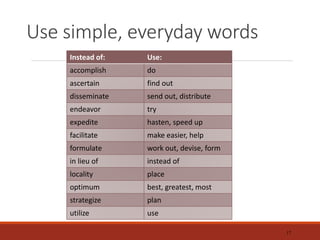
•Use simple, concrete, everyday words (e.g. use instead of utilize)
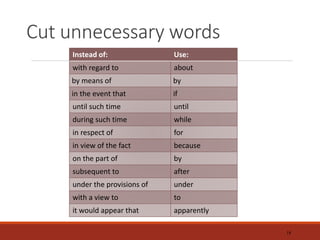
•Cut unnecessary words
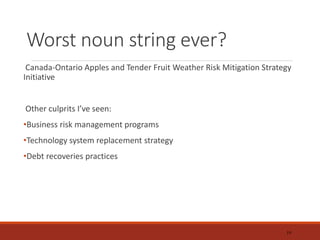
•Avoid noun strings
•Use contractions
•It’s ok to end sentences with prepositions when it makes sense
•It’s ok to start sentence with and, so or but sometimes
16
Use simple, everyday words
17
Instead of: Use:
accomplish do
ascertain find out
disseminate send out, distribute
endeavor try
expedite hasten, speed up
facilitate make easier, help
formulate work out, devise, form
in lieu of instead of
locality place
optimum best, greatest, most
strategize plan
utilize use
Cut unnecessary words
18
Instead of: Use:
with regard to about
by means of by
in the event that if
until such time until
during such time while
in respect of for
in view of the fact because
on the part of by
subsequent to after
under the provisions of under
with a view to to
it would appear that apparently
Worst noun string ever?
Canada-Ontario Apples and Tender Fruit Weather Risk Mitigation Strategy
Initiative
Other culprits I’ve seen:
•Business risk management programs
•Technology system replacement strategy
•Debt recoveries practices
19
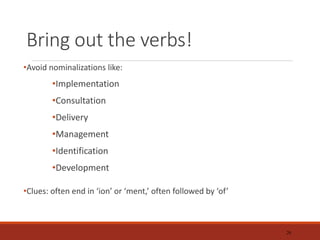
Bring out the verbs!
•Avoid nominalizations like:
•Implementation
•Consultation
•Delivery
•Management
•Identification
•Development
•Clues: often end in ‘ion’ or ‘ment,’ often followed by ‘of’
20
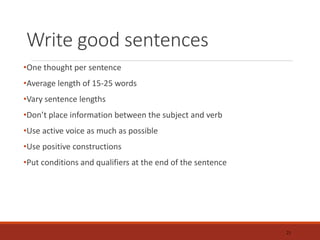
Write good sentences
•One thought per sentence
•Average length of 15-25 words
•Vary sentence lengths
•Don’t place information between the subject and verb
•Use active voice as much as possible
•Use positive constructions
•Put conditions and qualifiers at the end of the sentence
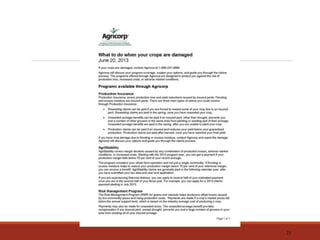
21
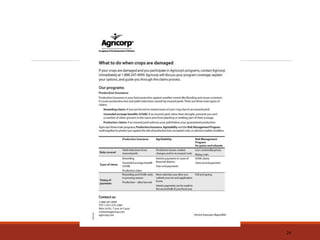
Break up the text
•Use headings and subheads (>6 words)
•Use tables, graphs and charts
•If phrases are repeating a lot, could signal opportunity for a visual
•Tables work esp. well for comparisons
22
23
24
Layout and design
•White space: More is MORE!
•Proximity
•Alignment
•Repetition
•Contrast
•Typefaces and readability
25
Proximity
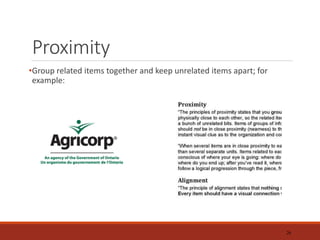
•Group related items together and keep unrelated items apart; for
example:
26
Alignment
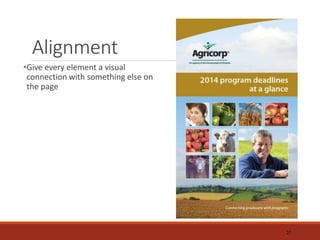
•Give every element a visual
connection with something else on
the page
27
Repetition
•Repeat some aspect of the design throughout the entire piece
28
Contrast
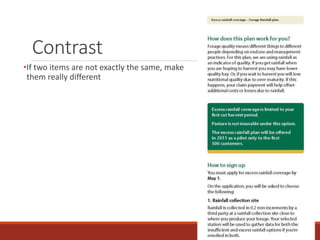
•If two items are not exactly the same, make
them really different
29
Test with target audience
•Moves away from emotions, opinions and biases; lends objectivity
•Not always possible to work directly with audience
•Often can start with internal staff who are also in target group
•Or focus on measuring actual effectiveness and improving with each cycle
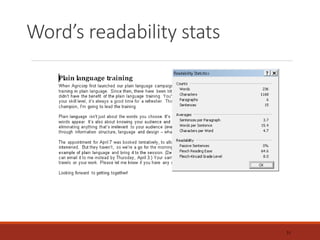
•At least use MS Word metrics
30
Word’s readability stats
31
Revise
•At the very least, peer edit
•Plain language is iterative
•Evaluation feeds continuous improvement
32
So… what now?
Homework: opportunity for 1:1 feedback
Online resources:
I’ll send a list
Pay attention to all materials you come across and spend time understanding
what works and what doesn’t.
33
How did we do today?
•Your hopes
•My hopes
34

Plain language training-presentation

  • 1.
  • 2.
    Goals for today I’mhoping to give you: •Better understanding of what plain language is •Renewed focus on thinking from the customer’s perspective especially on structuring information •Renewed commitment to testing and continuous improvement •At least one new tip or skill or reminder per person What are your goals for today? 2
  • 3.
    What is plainlanguage? An approach to communication that helps readers: •Find what they need •Understand what they read on the first try •Use it to fulfill their needs and obligations 3
  • 4.
    Plain language helpsus: •Make it easier for customers to understand and use information •Save time, effort and money •Reduce errors •Improve our accountability to both government and public 4
  • 5.
    The importance ofplain language “The single biggest problem in communication is the illusion that it has taken place. “ ~ George Bernard Shaw 5
  • 6.
    Plain language isnot new “Every word that is unnecessary only pours over the side of a brimming mind.” ~ Cicero (106 BC to 43 BC) “Simplicity is the ultimate sophistication.” ~ Leonardo da Vinci (1400’s) But perhaps harder than ever… 6
  • 7.
    Nobody wants tohave to read at the top of their ability for everyday actions and requirements like taking medicine or paying bills. 7
  • 8.
    How to createplain language 1. Know your audience 2. Know your content 3. Make an outline 4. Respect your reader 5. Write good sentences 6. Break up the text 7. Layout and design 8. Test with target audience 9. Revise 8
  • 9.
    Know your audience •Who are they? • What do they already know? • What did they do most recently? • How will they use this information? • What’s on their mind? • What mistakes have they made in the past in similar situations? • Why do they call us? What questions do they have? • What do they care about? • What’s going to motivate them? 9
  • 10.
    Know your content •Why are we communicating? • What’s the most important information? • What’s less important but still worth knowing? • What doesn’t matter to the reader and can be cut? 10
  • 11.
    Make an outline •Determine appropriate information structure • Start where your audience is (or last was) • Strongest positions are first and last • Identify groups, categories or themes of information 11
  • 12.
    Make an outline,cont’d. 5 Ways to organize: • LATCH: Location, Alphabet, Time, Category, Hierarchy, OR, some examples: • From general to specific (inverse pyramid) (C) • From specific to general (pyramid) (C) • From positive to negative (C) • Step by step (T) • From most important to least important (H) 12
  • 13.
    General guidelines fororganizing information •Think about their need to know, not our need to tell •Start with what we told them last •Avoid jargon or unfamiliar terminology •Stick to the task – focus on what the customer needs to DO •Share information ‘just in time’ – tell people things when it makes sense, not before (or after) 13
  • 14.
    Respect your reader •Imaginesomeone you know who has the same or less knowledge than the target audience •Write with your reader’s perspective in mind •Use headings (4-8 words long) •Use passive voice sparingly •Chunk information 14
  • 15.
  • 16.
    Respect your reader,cont’d. •Use simple, concrete, everyday words (e.g. use instead of utilize) •Cut unnecessary words •Avoid noun strings •Use contractions •It’s ok to end sentences with prepositions when it makes sense •It’s ok to start sentence with and, so or but sometimes 16
  • 17.
    Use simple, everydaywords 17 Instead of: Use: accomplish do ascertain find out disseminate send out, distribute endeavor try expedite hasten, speed up facilitate make easier, help formulate work out, devise, form in lieu of instead of locality place optimum best, greatest, most strategize plan utilize use
  • 18.
    Cut unnecessary words 18 Insteadof: Use: with regard to about by means of by in the event that if until such time until during such time while in respect of for in view of the fact because on the part of by subsequent to after under the provisions of under with a view to to it would appear that apparently
  • 19.
    Worst noun stringever? Canada-Ontario Apples and Tender Fruit Weather Risk Mitigation Strategy Initiative Other culprits I’ve seen: •Business risk management programs •Technology system replacement strategy •Debt recoveries practices 19
  • 20.
    Bring out theverbs! •Avoid nominalizations like: •Implementation •Consultation •Delivery •Management •Identification •Development •Clues: often end in ‘ion’ or ‘ment,’ often followed by ‘of’ 20
  • 21.
    Write good sentences •Onethought per sentence •Average length of 15-25 words •Vary sentence lengths •Don’t place information between the subject and verb •Use active voice as much as possible •Use positive constructions •Put conditions and qualifiers at the end of the sentence 21
  • 22.
    Break up thetext •Use headings and subheads (>6 words) •Use tables, graphs and charts •If phrases are repeating a lot, could signal opportunity for a visual •Tables work esp. well for comparisons 22
  • 23.
  • 24.
  • 25.
    Layout and design •Whitespace: More is MORE! •Proximity •Alignment •Repetition •Contrast •Typefaces and readability 25
  • 26.
    Proximity •Group related itemstogether and keep unrelated items apart; for example: 26
  • 27.
    Alignment •Give every elementa visual connection with something else on the page 27
  • 28.
    Repetition •Repeat some aspectof the design throughout the entire piece 28
  • 29.
    Contrast •If two itemsare not exactly the same, make them really different 29
  • 30.
    Test with targetaudience •Moves away from emotions, opinions and biases; lends objectivity •Not always possible to work directly with audience •Often can start with internal staff who are also in target group •Or focus on measuring actual effectiveness and improving with each cycle •At least use MS Word metrics 30
  • 31.
  • 32.
    Revise •At the veryleast, peer edit •Plain language is iterative •Evaluation feeds continuous improvement 32
  • 33.
    So… what now? Homework:opportunity for 1:1 feedback Online resources: I’ll send a list Pay attention to all materials you come across and spend time understanding what works and what doesn’t. 33
  • 34.
    How did wedo today? •Your hopes •My hopes 34

Editor's Notes

  • #2 Welcome to plain language training.
  • #9 Look how far down the process the writing is. Step 5 out of 8. Clear writing depends on clear thinking, so the first four steps are all about getting your thoughts in order. It’s been my experience that most times I encounter unclear writing, there is unclear thinking behind it. Often, our content questions end up influencing the policy by identifying ambiguities and gaps.
  • #13 Alphabetical organization is very common but only really works well when the reader knows the terms they’re looking for and is in a context or working on a task where they will be looking for those terms.
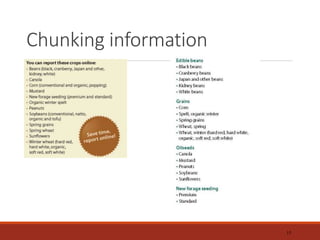
  • #15 Chunk information: break your content down into manageable pieces. So if you have a whole process to describe, you could break it down into sub-processes. For example, when we developed the information structure for Agricorp.com in 2010, we came up with the following categories for task-related information on participating in programs: Sign up/renew Update account Pay premium Report info Make a claim Appeal decision Cancel coverage
  • #16 On a smaller scale, here is an example of chunking information. Here is a list that appeared in a brochure about reporting acreage. I expect the reader to go through the list with their own crop in mind to see if it’s on the list of crops they can report online. So they’re looking for a specific crop. So we organized the list alphabetically, which is a great start. But it’s a pretty long list. So maybe we can break it up. So I took a stab at developing categories for the crops. Grains and oilseeds were pretty easy. But I had to ask a subject matter expert how to categorize the beans. New forage seeding doesn’t strictly fit into the structure, but I think it works for the forage producer wondering if they can report online.
  • #18 We’re not writing for critical acclaim. We’re writing to help our customers understand what they need to do. In fields like creative writing and poetry, writers are trying to find novel and surprising word combinations, but in our job, we make use of the familiar. That said, strive for freshness. In our government context, that means simple, conversational writing. That’s what surprises customers these days. Utilize does have its uses (ha!)… it means to fully use to its utmost. But it’s not often actually used that way. Most times you can just replace it with use. There are lists all over the place of recommended substitutions.
  • #20 Noun strings are groups of three or more nouns, where most of the nouns act like adjectives. The problem is that it’s not clear how they relate to each other. We’re used to seeing nouns stand on their own, so when we encounter one in a sentence, we tend to stop there. But then the nouns continue and it takes a lot of mental energy to sort out their relationships. Clearly we have a our work cut out for us. To break up a noun string, it’s best to work backwards, starting with the last noun and working your way to the first one. Often times you’ll discover a verb that’s been turned into a noun in there too (which I’ll get to later). What would be a clearer way to talk about business risk management programs?
  • #21 Verbs are where it’s at. They create energy in a sentence. So use them as much as you can. I’ve often seen advice for writers that says to use adjectives and adverbs sparingly (and I support that advice wholeheartedly) but don’t be restrained with your verbs. For some reason, in the corporate world, however, verbs seem to be feared. Perhaps they’re too declarative, I don’t know. But I didn’t have to search far to find a whole bunch of examples – more than I could fit on a slide – of nominalizations. Where good verbs are made into energy-sucking nouns. Here are a few examples from. The easiest way to avoid nominalizations is to watch for words that end in ‘ion’ or that are followed by ‘of.’ More often than not you can just remove the suffix, replace it with ‘ing’ and remove the word ‘of.’ So for a phrase like, “delivery of new programs” you could just say “delivering new programs.”
  • #22 Re: sentence length: you would be safe with a max of 20 words. Positive constructions: instead of “If you don’t get your application in by the deadline, you won’t be eligible for a payment.” You could say “You must submit your application by the deadline to be eligible for a payment.” That kind of thing…
  • #23 Tables are good for comparisons but they’re not always the best solution. Try different approaches before you settle on one.
  • #26 from The Non-Designer’s Design Book: Design and Typograhic Principles for the Visual Novice By Robin Williams (1994) Typefaces affect readability… In general, sans serif fonts are better for reading on screens and serif fonts are better for body text in print. Sans serif fonts are better for headings. We have a brand standard of using the same font on screen and in print. Different typefaces can be used to create contrast… but use sparingly: Less is more
  • #27 When several items are grouped closely together they appear as one visual unit rather than several separate units.
  • #30 Contrast helps create interest so it’s more likely to be read and it helps organize information. Contrast must never confuse the reader by making something a focus that is not the real focus of the piece. Often times colour and weight are used to create contrast. You see it a lot with headings…
  • #32 Word’s readability stats are a good first check. You want the Flesch Reading ease to be high and the Flesch-Kincaid Grade Level to be low. We need to aim for a grade 8 reading level. You could argue we could get away with a higher grade level for our employee communications, but nobody ever complained about something being too easy to read. And nobody wants to have to struggle at the height of their abilities to understand their pension or vacation details. So Word’s readability stats are a good check but there is a limit to them.
  • #34 Recommended reading Finally, prepare to work hard… There’s a famous quote that I’ve seen attributed to various people in various forms, but I suspect it was Blaise Pascal who said in a letter in 1657: “I have only made this letter longer because I have not had the time to make it shorter.“