Dietetics and Nutrition in the Mediterranean   By Dr. Alberto Fatticcioni
Eating in our time has gotten complicated. This is because people know supermarkets and food brands, but they don’t know what real food is.  The secret to eating well isn’t in biochemistry, it isn’t in food labels or in doctors’ advice. The secret to eating well is in the knowledge of food. We need to understand all the different aspects of food to create a food culture.  In food culture there are only three protagonists: the farmer who produces food with his work. The cook, who creates taste with his art. The innate necessity/pleasure to eat of all of us .
Without food humans can’t survive, without good food humans can’t thrive. Nowadays there is a revival of food culture.  This food culture makes food quality and food production quality a basis for a new concept of well-being. This new food philosophy is a way of life, where food is the core of this way of thinking. This food consciousness connects food to agriculture, gastronomy, health, business, ecology, society, politics, history, science, religion, cooking and pleasure.
Cooking is the art of happiness. Its ultimate aim is to give us an honest pleasure to recover the meaning of the world.
Diet and nutrition Diet  is the amount of food consumed by a person, it is what someone eats.  Nutrition  is the science which studies the relation between diet and health.
What is the Mediterranean diet? The  Mediterranean diet   is a modern nutritional recommendation  inspired by the traditional dietary patterns of the poor coastal regions of  southern Italy  (cucina povera),  Crete , and  coastal Greece  in the 1960s, discovered by researchers from the Rockefeller University.  The common Italian definition for some of these dietary patterns is  “Cucina povera” . “Cucina povera” has been around for thousands of years in Italy, and it’s a sort of rural subsistence diet.
Mediterranean Sea
 
Mediterranean diet rules The Mediterranean diet is principally a  plant based diet .  Everyday  the “mediterranean way” consists of:  vegetables (at least 300-400 g a day)  fruit (at least 4 pieces or 400 g a day) legumes and pulses grains, pasta and/or bread (mostly wholemeal and unrefined)  olive oil and nuts an abundant use of  herbs and spices water (more than 2 liters per day) wine during meals ( maximum 2 glasses per day )
Mediterranean diet rules In the Mediterranean diet the most important source of animal food is fish. The Mediterranean is a sea which is rich in fish, and to do things the “mediterranean way” we need to eat seafood  frequently : seafood (fish, shellfish, mollusc), recommended 4-6 times a week, at least twice weekly
Mediterranean diet rules The intake of dairy produce is low to moderate and usually in the form of goat’s and sheep’s cheese or yoghurt.  yoghurt, recommended 2 - 4 times per week cheese, recommended 1 - 4 times per week milk, recommended 1 - 2 times per week eggs, recommended 1 - 4 eggs per week (maximum 1 a day)
Mediterranean diet rules The Mediterranean diet consists in a low intake of sweets, poultry and red meat, these types of foods are a sort of  “special occasion food”.  Processed food and junk food are forbidden.  poultry, recommended 1 - 2 times per week red meat, recommended 0 - 1 time a week  sweets, recommended 0 - 1 time per week  no junk food
Mediterranean diet rules In synthesis, the principal aspects of this diet include  high olive oil consumption ,  high consumption of legumes ,  high consumption of unrefined cereals ,  high consumption of fruit ,  high consumption of vegetables ,  moderate consumption of dairy products  (mostly as cheese and yoghurt),  moderate to high consumption of fish ,  low consumption of meat and meat products  and  moderate wine consumption .
Is the Mediterranean diet the official diet in the Mediterranean area? Despite its name, the “Mediterranean diet” is not the official diet in the Mediterranean area, but its nutrition patterns are similar in all the Mediterranean nations. In Northern Italy or France, for instance, lard and butter are commonly used in cooking, and olive oil is reserved for dressing salads and cooked vegetables. In North Africa wine is traditionally avoided by Muslims. In both North Africa and the Levant, along with olive oil, sheep's tail fat and rendered butter are traditional staple fats.
Mediterranean diet rules Unconventional rules:  Eat food, mostly plants (roots, stalks, flowers) especially leaves. Eat foods with different colors. Avoid food products with the terms “low fat” or “fat free” in their names, prefer whole food. Eat foods made from ingredients that you can picture in their raw state or growing in nature, when you eat, think about where your meal comes from. When you go to the supermarket choose food that is in season. Buy food that is organic. Buy your food at the farmers’ market.
Mediterranean diet rules … unconventional rules:  Eating animals without legs (fish) is better than eating what stands on two legs (poultry), which is better than eating what stands on four legs (cows, pigs and other mammals) Eating animals that have themselves eaten well Eat well-grown food from healthy soil Eat wild food when you can Eat sweet foods as you find them in nature Eat food not supplements Eat when you are hungry, not when you are bored Eat slowly
Mediterranean diet rules … unconventional rules:  Breakfast like a king, lunch like a prince, dinner like a pauper Limit your snacks to unprocessed plant foods Try not to eat alone Plant a vegetable garden if you have the space, a window box if you don’t Eat fresh food, food which is no longer fresh can not sufficiently nourish people who want to live a long life  Quality in food, not quantity
The health effects of the Mediterranean diet  Nobody knows for sure what the ideal diet is, but there are good reasons to believe that the  Mediterranean diet may come closer to it than any other realistic diet.  Thanks to fruit it is high in fiber, vitamins, minerals, antioxidants and phytochemicals Thanks to olive oil and nuts it is low in saturated fats and high in monosaturates Thanks to whole grains and legumes it is high in complex carbohydrates with a low glycemic index Thanks to seafood and greens it is high in omega-3 fatty acid
The health effects of the Mediterranean diet  Food is more than the sum of its nutrients, and diet is more than the sum of different foods.  In the Mediterranean Diet the synergic effect of food influences our health. The analysis of single   nutrients does not take into consideration the important interactions between the components of   a diet and, more importantly, because people do not eat isolated   nutrients but foods.
The health effects of the Mediterranean diet  A meta-analysis published in the British Medical Journal (September 12, 2008) showed that following the  Mediterranean diet strictly reduced the risk of dying from cancer and cardiovascular disease as well as the risk of developing Parkinson's and Alzheimer's disease . The findings report a 9%, and 6% reduction in overall cardiovascular, and cancer mortality respectively. Additionally a 13% reduction in the incidence of Parkinson's and Alzheimer's diseases is to be expected provided strict adherence to the diet is observed.
The health effects of the Mediterranean diet  These findings seem to be clinically relevant for public health, in particular for encouraging a Mediterranean-like dietary pattern for primary prevention of major chronic diseases.
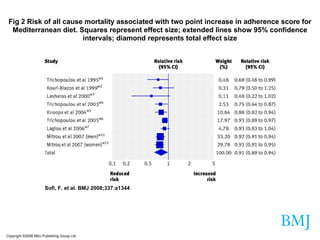
Copyright ©2008 BMJ Publishing Group Ltd. Sofi, F. et al. BMJ 2008;337:a1344 Fig 2 Risk of all cause mortality associated with two point increase in adherence score for Mediterranean diet. Squares represent effect size; extended lines show 95% confidence intervals; diamond represents total effect size
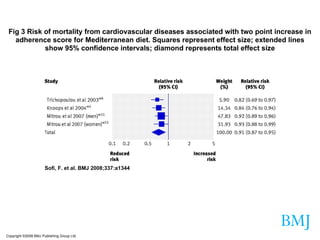
Copyright ©2008 BMJ Publishing Group Ltd. Sofi, F. et al. BMJ 2008;337:a1344 Fig 3 Risk of mortality from cardiovascular diseases associated with two point increase in adherence score for Mediterranean diet. Squares represent effect size; extended lines show 95% confidence intervals; diamond represents total effect size
Copyright ©2008 BMJ Publishing Group Ltd. Sofi, F. et al. BMJ 2008;337:a1344 Fig 4 Risk of occurrence of or mortality from cancer associated with two point increase in adherence score for Mediterranean diet. Squares represent effect size; extended lines show 95% confidence intervals; diamond represents total effect size
Copyright ©2008 BMJ Publishing Group Ltd. Sofi, F. et al. BMJ 2008;337:a1344 Fig 5 Risk of Parkinson's disease and Alzheimer's disease associated with two point increase in adherence score for Mediterranean diet. Squares represent effect size; extended lines show 95% confidence intervals; diamond represents total effect size
Top 10 Foods contributing to Energy Intake in the U.S population  Rank Food % of total energy 1 Regular soft drinks 7.1 2 Cake, sweet rolls, doughnuts, pastries 3.6 3 Hamburgers, cheeseburgers, meat loaf 3.1 4 Pizza 3.1 5 Potato chips, corn chips, popcorn 2.9 6 Rice 2.7 7 Rolls, buns, English muffins, bagels 2.7 8 Cheese or cheese spread 2.6 9 Beer 2.6 10 French fries, fried potatoes 2.2
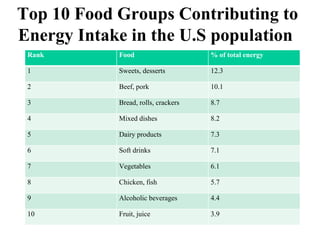
Top 10 Food Groups Contributing to Energy Intake in the U.S population  Rank Food % of total energy 1 Sweets, desserts 12.3 2 Beef, pork 10.1 3 Bread, rolls, crackers 8.7 4 Mixed dishes 8.2 5 Dairy products 7.3 6 Soft drinks 7.1 7 Vegetables 6.1 8 Chicken, fish 5.7 9 Alcoholic beverages 4.4 10 Fruit, juice 3.9
For the most part, these foods contain far more calories than can be justified by their nutritional values. In part, this is because they’re largely made from corn, in the form of extracted protein or oil; or refined wheat-white flour all processed to the point where they’re nutritionally worthless or even damaging.  The USA is a victim of the industrialization of eating...

Lesson one 02/02/2010

  • 1.
    Dietetics and Nutritionin the Mediterranean By Dr. Alberto Fatticcioni
  • 2.
    Eating in ourtime has gotten complicated. This is because people know supermarkets and food brands, but they don’t know what real food is. The secret to eating well isn’t in biochemistry, it isn’t in food labels or in doctors’ advice. The secret to eating well is in the knowledge of food. We need to understand all the different aspects of food to create a food culture. In food culture there are only three protagonists: the farmer who produces food with his work. The cook, who creates taste with his art. The innate necessity/pleasure to eat of all of us .
  • 3.
    Without food humanscan’t survive, without good food humans can’t thrive. Nowadays there is a revival of food culture. This food culture makes food quality and food production quality a basis for a new concept of well-being. This new food philosophy is a way of life, where food is the core of this way of thinking. This food consciousness connects food to agriculture, gastronomy, health, business, ecology, society, politics, history, science, religion, cooking and pleasure.
  • 4.
    Cooking is theart of happiness. Its ultimate aim is to give us an honest pleasure to recover the meaning of the world.
  • 5.
    Diet and nutritionDiet is the amount of food consumed by a person, it is what someone eats. Nutrition is the science which studies the relation between diet and health.
  • 6.
    What is theMediterranean diet? The Mediterranean diet is a modern nutritional recommendation inspired by the traditional dietary patterns of the poor coastal regions of southern Italy (cucina povera), Crete , and coastal Greece in the 1960s, discovered by researchers from the Rockefeller University. The common Italian definition for some of these dietary patterns is “Cucina povera” . “Cucina povera” has been around for thousands of years in Italy, and it’s a sort of rural subsistence diet.
  • 7.
  • 8.
  • 9.
    Mediterranean diet rulesThe Mediterranean diet is principally a plant based diet . Everyday the “mediterranean way” consists of: vegetables (at least 300-400 g a day) fruit (at least 4 pieces or 400 g a day) legumes and pulses grains, pasta and/or bread (mostly wholemeal and unrefined) olive oil and nuts an abundant use of herbs and spices water (more than 2 liters per day) wine during meals ( maximum 2 glasses per day )
  • 10.
    Mediterranean diet rulesIn the Mediterranean diet the most important source of animal food is fish. The Mediterranean is a sea which is rich in fish, and to do things the “mediterranean way” we need to eat seafood frequently : seafood (fish, shellfish, mollusc), recommended 4-6 times a week, at least twice weekly
  • 11.
    Mediterranean diet rulesThe intake of dairy produce is low to moderate and usually in the form of goat’s and sheep’s cheese or yoghurt. yoghurt, recommended 2 - 4 times per week cheese, recommended 1 - 4 times per week milk, recommended 1 - 2 times per week eggs, recommended 1 - 4 eggs per week (maximum 1 a day)
  • 12.
    Mediterranean diet rulesThe Mediterranean diet consists in a low intake of sweets, poultry and red meat, these types of foods are a sort of “special occasion food”. Processed food and junk food are forbidden. poultry, recommended 1 - 2 times per week red meat, recommended 0 - 1 time a week sweets, recommended 0 - 1 time per week no junk food
  • 13.
    Mediterranean diet rulesIn synthesis, the principal aspects of this diet include high olive oil consumption , high consumption of legumes , high consumption of unrefined cereals , high consumption of fruit , high consumption of vegetables , moderate consumption of dairy products (mostly as cheese and yoghurt), moderate to high consumption of fish , low consumption of meat and meat products and moderate wine consumption .
  • 14.
    Is the Mediterraneandiet the official diet in the Mediterranean area? Despite its name, the “Mediterranean diet” is not the official diet in the Mediterranean area, but its nutrition patterns are similar in all the Mediterranean nations. In Northern Italy or France, for instance, lard and butter are commonly used in cooking, and olive oil is reserved for dressing salads and cooked vegetables. In North Africa wine is traditionally avoided by Muslims. In both North Africa and the Levant, along with olive oil, sheep's tail fat and rendered butter are traditional staple fats.
  • 15.
    Mediterranean diet rulesUnconventional rules: Eat food, mostly plants (roots, stalks, flowers) especially leaves. Eat foods with different colors. Avoid food products with the terms “low fat” or “fat free” in their names, prefer whole food. Eat foods made from ingredients that you can picture in their raw state or growing in nature, when you eat, think about where your meal comes from. When you go to the supermarket choose food that is in season. Buy food that is organic. Buy your food at the farmers’ market.
  • 16.
    Mediterranean diet rules… unconventional rules: Eating animals without legs (fish) is better than eating what stands on two legs (poultry), which is better than eating what stands on four legs (cows, pigs and other mammals) Eating animals that have themselves eaten well Eat well-grown food from healthy soil Eat wild food when you can Eat sweet foods as you find them in nature Eat food not supplements Eat when you are hungry, not when you are bored Eat slowly
  • 17.
    Mediterranean diet rules… unconventional rules: Breakfast like a king, lunch like a prince, dinner like a pauper Limit your snacks to unprocessed plant foods Try not to eat alone Plant a vegetable garden if you have the space, a window box if you don’t Eat fresh food, food which is no longer fresh can not sufficiently nourish people who want to live a long life Quality in food, not quantity
  • 18.
    The health effectsof the Mediterranean diet Nobody knows for sure what the ideal diet is, but there are good reasons to believe that the Mediterranean diet may come closer to it than any other realistic diet. Thanks to fruit it is high in fiber, vitamins, minerals, antioxidants and phytochemicals Thanks to olive oil and nuts it is low in saturated fats and high in monosaturates Thanks to whole grains and legumes it is high in complex carbohydrates with a low glycemic index Thanks to seafood and greens it is high in omega-3 fatty acid
  • 19.
    The health effectsof the Mediterranean diet Food is more than the sum of its nutrients, and diet is more than the sum of different foods. In the Mediterranean Diet the synergic effect of food influences our health. The analysis of single nutrients does not take into consideration the important interactions between the components of a diet and, more importantly, because people do not eat isolated nutrients but foods.
  • 20.
    The health effectsof the Mediterranean diet A meta-analysis published in the British Medical Journal (September 12, 2008) showed that following the Mediterranean diet strictly reduced the risk of dying from cancer and cardiovascular disease as well as the risk of developing Parkinson's and Alzheimer's disease . The findings report a 9%, and 6% reduction in overall cardiovascular, and cancer mortality respectively. Additionally a 13% reduction in the incidence of Parkinson's and Alzheimer's diseases is to be expected provided strict adherence to the diet is observed.
  • 21.
    The health effectsof the Mediterranean diet These findings seem to be clinically relevant for public health, in particular for encouraging a Mediterranean-like dietary pattern for primary prevention of major chronic diseases.
  • 22.
    Copyright ©2008 BMJPublishing Group Ltd. Sofi, F. et al. BMJ 2008;337:a1344 Fig 2 Risk of all cause mortality associated with two point increase in adherence score for Mediterranean diet. Squares represent effect size; extended lines show 95% confidence intervals; diamond represents total effect size
  • 23.
    Copyright ©2008 BMJPublishing Group Ltd. Sofi, F. et al. BMJ 2008;337:a1344 Fig 3 Risk of mortality from cardiovascular diseases associated with two point increase in adherence score for Mediterranean diet. Squares represent effect size; extended lines show 95% confidence intervals; diamond represents total effect size
  • 24.
    Copyright ©2008 BMJPublishing Group Ltd. Sofi, F. et al. BMJ 2008;337:a1344 Fig 4 Risk of occurrence of or mortality from cancer associated with two point increase in adherence score for Mediterranean diet. Squares represent effect size; extended lines show 95% confidence intervals; diamond represents total effect size
  • 25.
    Copyright ©2008 BMJPublishing Group Ltd. Sofi, F. et al. BMJ 2008;337:a1344 Fig 5 Risk of Parkinson's disease and Alzheimer's disease associated with two point increase in adherence score for Mediterranean diet. Squares represent effect size; extended lines show 95% confidence intervals; diamond represents total effect size
  • 26.
    Top 10 Foodscontributing to Energy Intake in the U.S population Rank Food % of total energy 1 Regular soft drinks 7.1 2 Cake, sweet rolls, doughnuts, pastries 3.6 3 Hamburgers, cheeseburgers, meat loaf 3.1 4 Pizza 3.1 5 Potato chips, corn chips, popcorn 2.9 6 Rice 2.7 7 Rolls, buns, English muffins, bagels 2.7 8 Cheese or cheese spread 2.6 9 Beer 2.6 10 French fries, fried potatoes 2.2
  • 27.
    Top 10 FoodGroups Contributing to Energy Intake in the U.S population Rank Food % of total energy 1 Sweets, desserts 12.3 2 Beef, pork 10.1 3 Bread, rolls, crackers 8.7 4 Mixed dishes 8.2 5 Dairy products 7.3 6 Soft drinks 7.1 7 Vegetables 6.1 8 Chicken, fish 5.7 9 Alcoholic beverages 4.4 10 Fruit, juice 3.9
  • 28.
    For the mostpart, these foods contain far more calories than can be justified by their nutritional values. In part, this is because they’re largely made from corn, in the form of extracted protein or oil; or refined wheat-white flour all processed to the point where they’re nutritionally worthless or even damaging. The USA is a victim of the industrialization of eating...