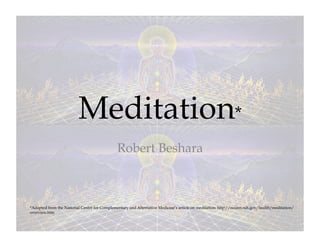
Meditation*
                                              Robert Beshara


*Adapted from the National Center for Complementary and Alternative Medicine’s article on meditation: http://nccam.nih.gov/health/meditation/
overview.htm
What is meditation?

•  Meditation is a mind-body practice. The term
   meditation refers to a group of techniques,
   such as mantra meditation, relaxation
   response, mindfulness meditation, and Zen
   Buddhist meditation. Most meditative
   techniques started in Eastern religious or
   spiritual traditions. These techniques have
   been used by many different cultures
   throughout the world for thousands of years.
   Today, many people use meditation outside
   of its traditional religious or cultural settings,
   for health and well-being.
Why meditate?
•  A 2007 national Government survey that asked
   about CAM [Complimentary and Alternative
   Medicine] use in a sample of 23,393 U.S. adults
   found that 9.4 percent of respondents
   (representing more than 20 million people) had
   used meditation in the past 12 months—compared
   with 7.6 percent of respondents (representing
   more than 15 million people) in a similar survey
   conducted in 2002. The 2007 survey also asked
   about CAM use in a sample of 9,417 children;
   1 percent (representing 725,000 children) had used
   meditation in the past 12 months.
People use meditation for various health
                  problems, such as:
•    Anxiety
•    Pain
•    Depression
•    Stress
•    Insomnia
•    Physical or emotional symptoms that may be
     associated with chronic illnesses (such as heart
     disease, HIV/AIDS, and cancer) and their treatment.

•  Meditation is also used for overall wellness (e.g.
   improving attention related abilities such as alerting,
   focusing, and prioritizing).
When to meditate?**

•  Four good times of day to meditate: first thing in the morning,
   whenever you’re stressed, on your lunch hour, and at the end of
   your workday. Worst time to meditate: right before bedtime.
   Meditation is about falling more fully awake and not falling
   asleep, so there should be at least a 1-hour gap between
   meditation and sleep.

•  It is important to practice regularly because it’s like working
   out: the more you do it, the more you’ll get out from it.

•  The general guideline is to practice twice a day for 20 minutes
   during each session, but that may be hard for a lot of people
   to do, but some meditation is more beneficial than no
   meditation at all.

**http://www.psychologytoday.com/blog/minding-the-body/201203/four-good-times-day-meditate-and-one-avoid
Where to meditate?

•  A quiet location would be ideal, with as
   few distractions as possible, especially if
   you are a beginner. But ultimately, one
   should be able to meditate anywhere and
   all the time. That’s when meditation
   transcends being a state of mind into
   being a way of living & experiencing the
   world.
Who can meditate?

•  Almost everyone can & should meditate,
   with the exception of people who have
   certain psychiatric problems. Also,
   individuals with existing mental or
   physical health conditions should speak
   with their health care providers prior to
   starting a meditative practice and make
   their meditation instructor aware of their
   condition.
How to meditate?

•  Be in a comfortable posture, whether sitting, lying
   down, standing, walking, or in other positions.
•  Focus attention, whether on a mantra (a
   specifically chosen word or set of words), an
   object, the sensations of the breath, or the
   dominant content of consciousness.
•  Have an open attitude… letting distractions come
   and go naturally without judging them. In that
   way, as a meditator, you are an observer of
   thoughts and emotions without identifying with
   them.
Two examples of meditation practices that
           are well-researched:

•  Mindfulness meditation is an essential component of Buddhism. In
   one common form of mindfulness meditation, the meditator is
   taught to bring attention to the sensation of the flow of the breath in
   and out of the body. The meditator learns to focus attention on what
   is being experienced, without reacting to or judging it. This is seen
   as helping the meditator learn to experience thoughts and emotions
   in normal daily life with greater balance and acceptance.

•  The TM technique is derived from Hindu traditions. It uses a
   mantra (a word, sound, or phrase repeated silently) to prevent
   distracting thoughts from entering the mind. The goal of TM is to
   achieve a state of relaxed awareness.

•  But the key thing is that you should experiment with different
   meditation techniques until you find the one that works best for you
   or the ones that work best for you.
How does meditation work?

•  By affecting the autonomic (involuntary) nervous
   system, which regulates many organs and muscles,
   controlling functions such as heartbeat, sweating,
   breathing, and digestion. It is thought that some types
   of meditation might work by reducing activity in the
   sympathetic nervous system (that helps mobilize the
   body for action and which produces the “fight-or-
   flight response” that we experience when we are
   under stress, increasing the heart rate and breathing
   rate & restricting the flow of blood) and increasing
   activity in the parasympathetic nervous system,
   which causes the heart rate and breathing rate to slow
   down improving blood flow and the flow of digestive
   juices increases.
Positive effects of meditation:

•  Significant changes in brain functions
•  Improvement in the mind’s ability to pay
   attention, which is involved in performing
   everyday tasks and regulating mood
What’s the difference between concentration,
            meditation, and contemplation?***

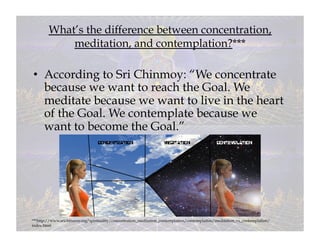
•  According to Sri Chinmoy: “We concentrate
   because we want to reach the Goal. We
   meditate because we want to live in the heart
   of the Goal. We contemplate because we
   want to become the Goal.”


***http://www.srichinmoy.org/spirituality/concentration_meditation_contemplation/contemplation/meditation_vs_contemplation/
index.html
Famous meditators:****

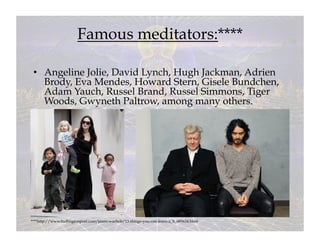
 •  Angeline Jolie, David Lynch, Hugh Jackman, Adrien
    Brody, Eva Mendes, Howard Stern, Gisele Bundchen,
    Adam Yauch, Russel Brand, Russel Simmons, Tiger
    Woods, Gwyneth Paltrow, among many others.


****http://www.huffingtonpost.com/jason-wachob/13-things-you-can-learn-a_b_685634.html
Shall we meditate?

Meditation

  • 1.
    Meditation* Robert Beshara *Adapted from the National Center for Complementary and Alternative Medicine’s article on meditation: http://nccam.nih.gov/health/meditation/ overview.htm
  • 2.
    What is meditation? • Meditation is a mind-body practice. The term meditation refers to a group of techniques, such as mantra meditation, relaxation response, mindfulness meditation, and Zen Buddhist meditation. Most meditative techniques started in Eastern religious or spiritual traditions. These techniques have been used by many different cultures throughout the world for thousands of years. Today, many people use meditation outside of its traditional religious or cultural settings, for health and well-being.
  • 3.
    Why meditate? •  A2007 national Government survey that asked about CAM [Complimentary and Alternative Medicine] use in a sample of 23,393 U.S. adults found that 9.4 percent of respondents (representing more than 20 million people) had used meditation in the past 12 months—compared with 7.6 percent of respondents (representing more than 15 million people) in a similar survey conducted in 2002. The 2007 survey also asked about CAM use in a sample of 9,417 children; 1 percent (representing 725,000 children) had used meditation in the past 12 months.
  • 4.
    People use meditationfor various health problems, such as: •  Anxiety •  Pain •  Depression •  Stress •  Insomnia •  Physical or emotional symptoms that may be associated with chronic illnesses (such as heart disease, HIV/AIDS, and cancer) and their treatment. •  Meditation is also used for overall wellness (e.g. improving attention related abilities such as alerting, focusing, and prioritizing).
  • 5.
    When to meditate?** • Four good times of day to meditate: first thing in the morning, whenever you’re stressed, on your lunch hour, and at the end of your workday. Worst time to meditate: right before bedtime. Meditation is about falling more fully awake and not falling asleep, so there should be at least a 1-hour gap between meditation and sleep. •  It is important to practice regularly because it’s like working out: the more you do it, the more you’ll get out from it. •  The general guideline is to practice twice a day for 20 minutes during each session, but that may be hard for a lot of people to do, but some meditation is more beneficial than no meditation at all. **http://www.psychologytoday.com/blog/minding-the-body/201203/four-good-times-day-meditate-and-one-avoid
  • 6.
    Where to meditate? • A quiet location would be ideal, with as few distractions as possible, especially if you are a beginner. But ultimately, one should be able to meditate anywhere and all the time. That’s when meditation transcends being a state of mind into being a way of living & experiencing the world.
  • 7.
    Who can meditate? • Almost everyone can & should meditate, with the exception of people who have certain psychiatric problems. Also, individuals with existing mental or physical health conditions should speak with their health care providers prior to starting a meditative practice and make their meditation instructor aware of their condition.
  • 8.
    How to meditate? • Be in a comfortable posture, whether sitting, lying down, standing, walking, or in other positions. •  Focus attention, whether on a mantra (a specifically chosen word or set of words), an object, the sensations of the breath, or the dominant content of consciousness. •  Have an open attitude… letting distractions come and go naturally without judging them. In that way, as a meditator, you are an observer of thoughts and emotions without identifying with them.
  • 9.
    Two examples ofmeditation practices that are well-researched: •  Mindfulness meditation is an essential component of Buddhism. In one common form of mindfulness meditation, the meditator is taught to bring attention to the sensation of the flow of the breath in and out of the body. The meditator learns to focus attention on what is being experienced, without reacting to or judging it. This is seen as helping the meditator learn to experience thoughts and emotions in normal daily life with greater balance and acceptance. •  The TM technique is derived from Hindu traditions. It uses a mantra (a word, sound, or phrase repeated silently) to prevent distracting thoughts from entering the mind. The goal of TM is to achieve a state of relaxed awareness. •  But the key thing is that you should experiment with different meditation techniques until you find the one that works best for you or the ones that work best for you.
  • 10.
    How does meditationwork? •  By affecting the autonomic (involuntary) nervous system, which regulates many organs and muscles, controlling functions such as heartbeat, sweating, breathing, and digestion. It is thought that some types of meditation might work by reducing activity in the sympathetic nervous system (that helps mobilize the body for action and which produces the “fight-or- flight response” that we experience when we are under stress, increasing the heart rate and breathing rate & restricting the flow of blood) and increasing activity in the parasympathetic nervous system, which causes the heart rate and breathing rate to slow down improving blood flow and the flow of digestive juices increases.
  • 11.
    Positive effects ofmeditation: •  Significant changes in brain functions •  Improvement in the mind’s ability to pay attention, which is involved in performing everyday tasks and regulating mood
  • 12.
    What’s the differencebetween concentration, meditation, and contemplation?*** •  According to Sri Chinmoy: “We concentrate because we want to reach the Goal. We meditate because we want to live in the heart of the Goal. We contemplate because we want to become the Goal.” ***http://www.srichinmoy.org/spirituality/concentration_meditation_contemplation/contemplation/meditation_vs_contemplation/ index.html
  • 13.
    Famous meditators:**** • Angeline Jolie, David Lynch, Hugh Jackman, Adrien Brody, Eva Mendes, Howard Stern, Gisele Bundchen, Adam Yauch, Russel Brand, Russel Simmons, Tiger Woods, Gwyneth Paltrow, among many others. ****http://www.huffingtonpost.com/jason-wachob/13-things-you-can-learn-a_b_685634.html
  • 14.