How Medicare Part D helps
you get them (legally) and
pay for them.
Drugs.
What is Part D?

Formularies & Tiers


How does it work?

Deductible Phase

Initial Coverage

Coverage Gap

Catastrophic Coverage


Is it worth it?


Your Medicare team
3

4


5

6

7

8

9


10


11
Table of Contents
© Senior Benefits Insurance Services | 2021
Prescription Drug Plans

(PDPs)
Let’s review the four parts of Medicare:
3
What is Part D?
Part A
Hospital Insurance
Part B
Medical Insurance
Part D
Prescription Drug Plans
Part C
Medicare Advantage
Government-runPrivateinsurancecompany
Medicare Part D is a way for you to cover one
of the biggest gaps left by Original Medicare:
Prescription Drugs.
Part D Prescription Drug Plans are offered
and administered by private insurance
companies.
Classifying medications
Formularies and Tiers
The private insurance companies who
administer these drug plans establish their
own formularies and drug tiers.
Formulary

The list of medications your plan covers. 

Drugs on the formulary are covered.
Drugs not on the formulary are not
covered.

Each drug is put into one of several tiers
within the formulary.
Tiers

Medications within the formulary are
put into different tiers. Copay or
coinsurance amounts generally increase
as you move up to higher tiers. 

Tier 1 - Preferred Generics

Tier 2 - Non-Preferred Generics

Tier 3 - Preferred Brands

Tier 4 - Non-Preferred Brands

Tier 5 - Specialty
4
How does it work?
Surprisingly, the best way to explain
Part D coverage is with a donut.
The next few pages will go into more detail
about each phase of prescription drug coverage.
Deductible Phase

Begins Jan. 1st
Coverage Gap

(Donut Hole)
Coverage Ends

Dec. 31st
Initial Coverage

Begins once

deductible is met
Catastrophic 

Coverage
5
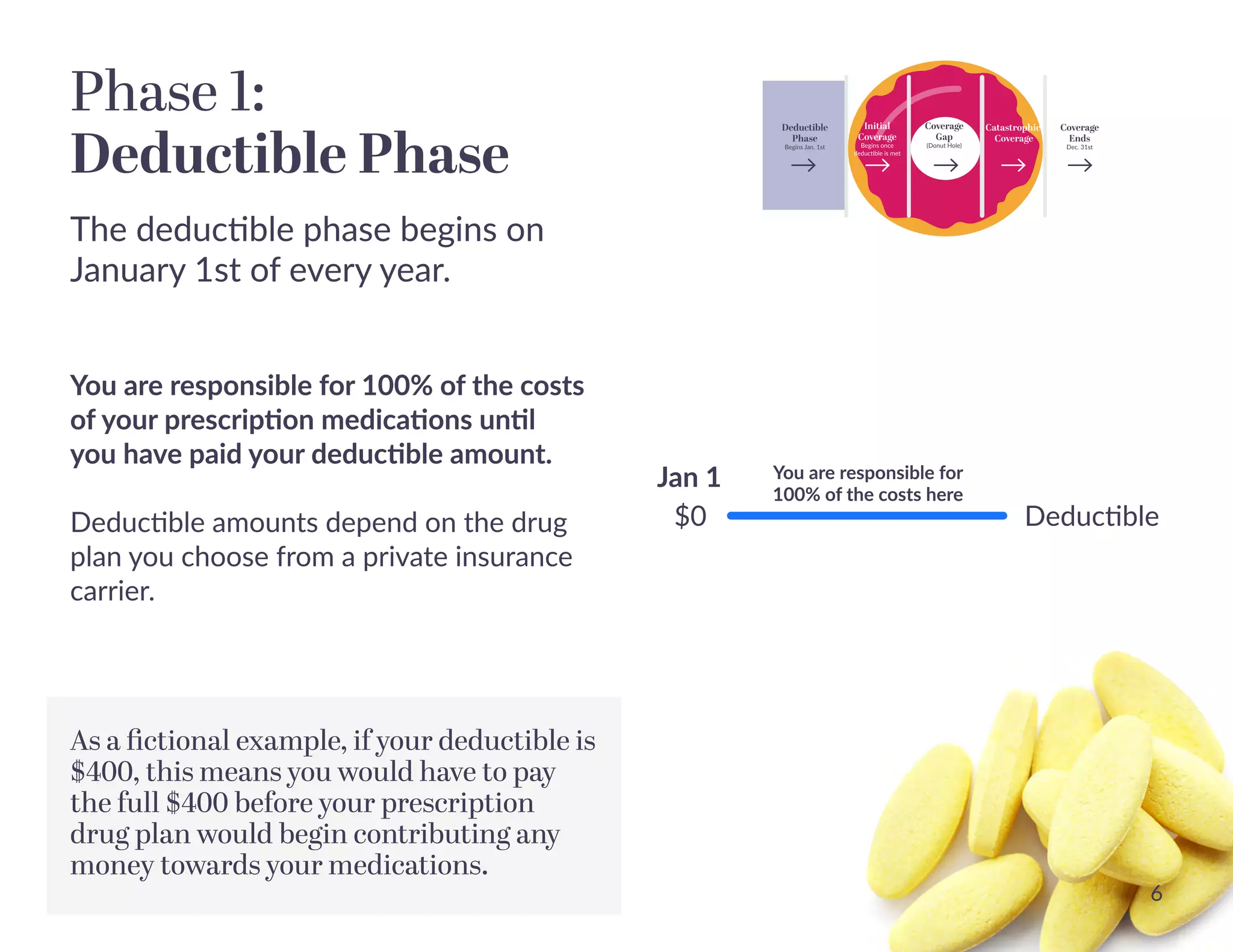
Phase 1:

Deductible Phase
The deductible phase begins on
January 1st of every year.
You are responsible for 100% of the costs
of your prescription medications until
you have paid your deductible amount.


Deductible amounts depend on the drug
plan you choose from a private insurance
carrier.
As a fictional example, if your deductible is
$400, this means you would have to pay
the full $400 before your prescription
drug plan would begin contributing any
money towards your medications.
Deductible
Phase

Begins Jan. 1st
Coverage
Gap

(Donut Hole)
Coverage
Ends

Dec. 31st
Initial
Coverage

Begins once

deductible is met
Catastrophic 

Coverage
Jan 1
$0 Deductible
You are responsible for
100% of the costs here
6
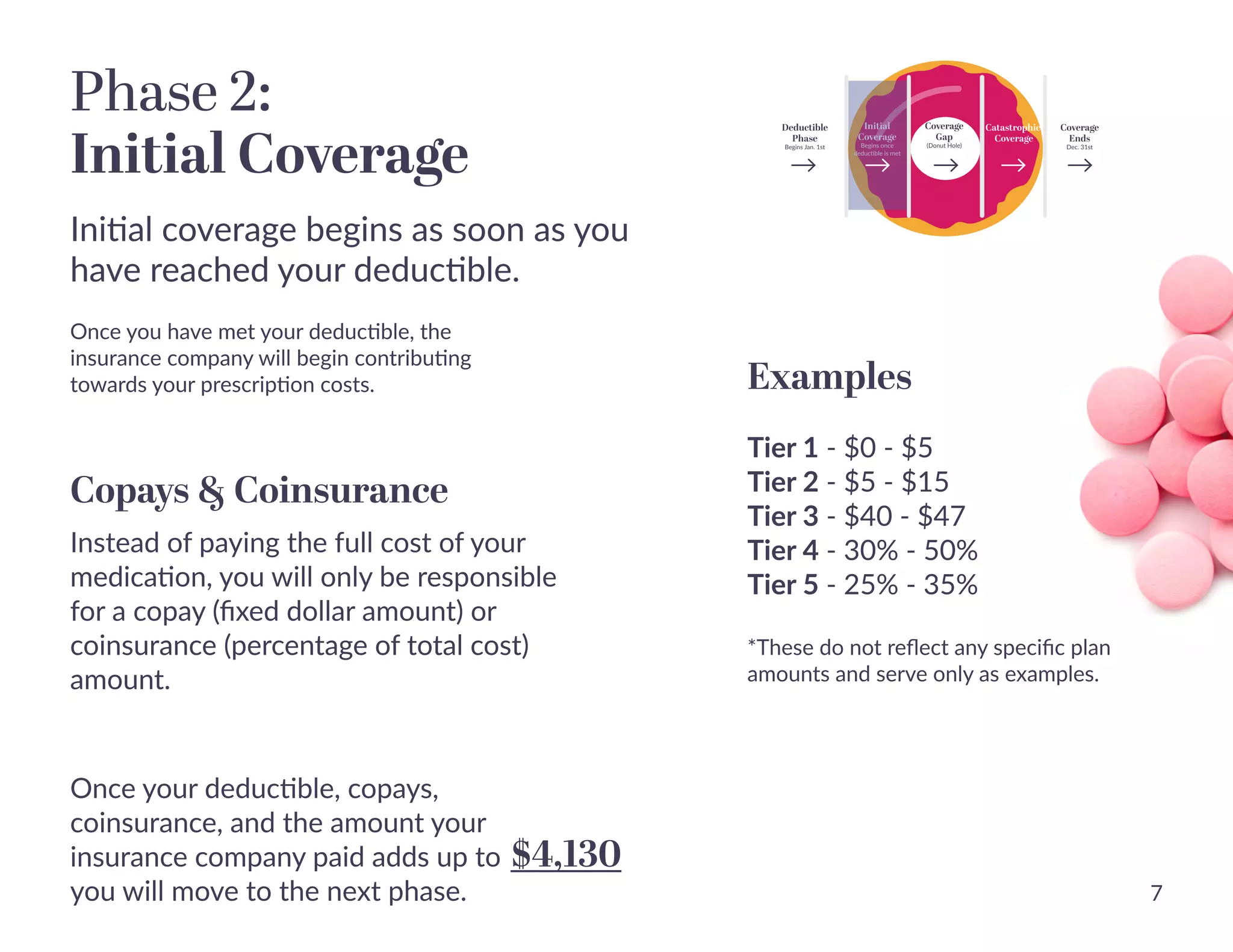
Phase 2:

Initial Coverage
Initial coverage begins as soon as you
have reached your deductible.
Copays & Coinsurance

Instead of paying the full cost of your
medication, you will only be responsible
for a copay (fixed dollar amount) or
coinsurance (percentage of total cost)
amount.
Once your deductible, copays,
coinsurance, and the amount your
insurance company paid adds up to
you will move to the next phase.
$4,130
Examples


Tier 1 - $0 - $5

Tier 2 - $5 - $15

Tier 3 - $40 - $47

Tier 4 - 30% - 50%

Tier 5 - 25% - 35%


*These do not reflect any specific plan
amounts and serve only as examples.
Once you have met your deductible, the
insurance company will begin contributing
towards your prescription costs.
Deductible
Phase

Begins Jan. 1st
Coverage
Gap

(Donut Hole)
Coverage
Ends

Dec. 31st
Initial
Coverage

Begins once

deductible is met
Catastrophic 

Coverage
7
Phase 3:

Coverage Gap
The notorious “Donut Hole”
Once your deductible, copays, coinsurance
and the amount your insurance company paid
adds up to $4,130, you will find yourself in

the Coverage Gap. 


Everything changes here and costs 

can get quite high, quite quickly.
You get out of the Donut Hole once the
following items add up to $6,550:

• Your deductible

• All you’ve paid in copays

• All you’ve paid in coinsurance

• Drug manufacturer discounted
amounts


Note: The amount your insurance
company has paid towards medications
does not go toward this $6,550 figure.

This means that it is more than just the
difference between $6,550 and the
$4,130 level from the Initial Coverage
phase.
While in the Coverage Gap, you
are responsible for 25% of the
medication’s contracted rate
with the pharmacy.
Deductible
Phase

Begins Jan. 1st
Coverage
Gap

(Donut Hole)
Coverage
Ends

Dec. 31st
Initial
Coverage

Begins once

deductible is met
Catastrophic 

Coverage
25%
How to get out of the
Donut Hole
8
As an example, if your drug costs $100 per
month through the pharmacy, you would
be responsible for paying $25 per month.
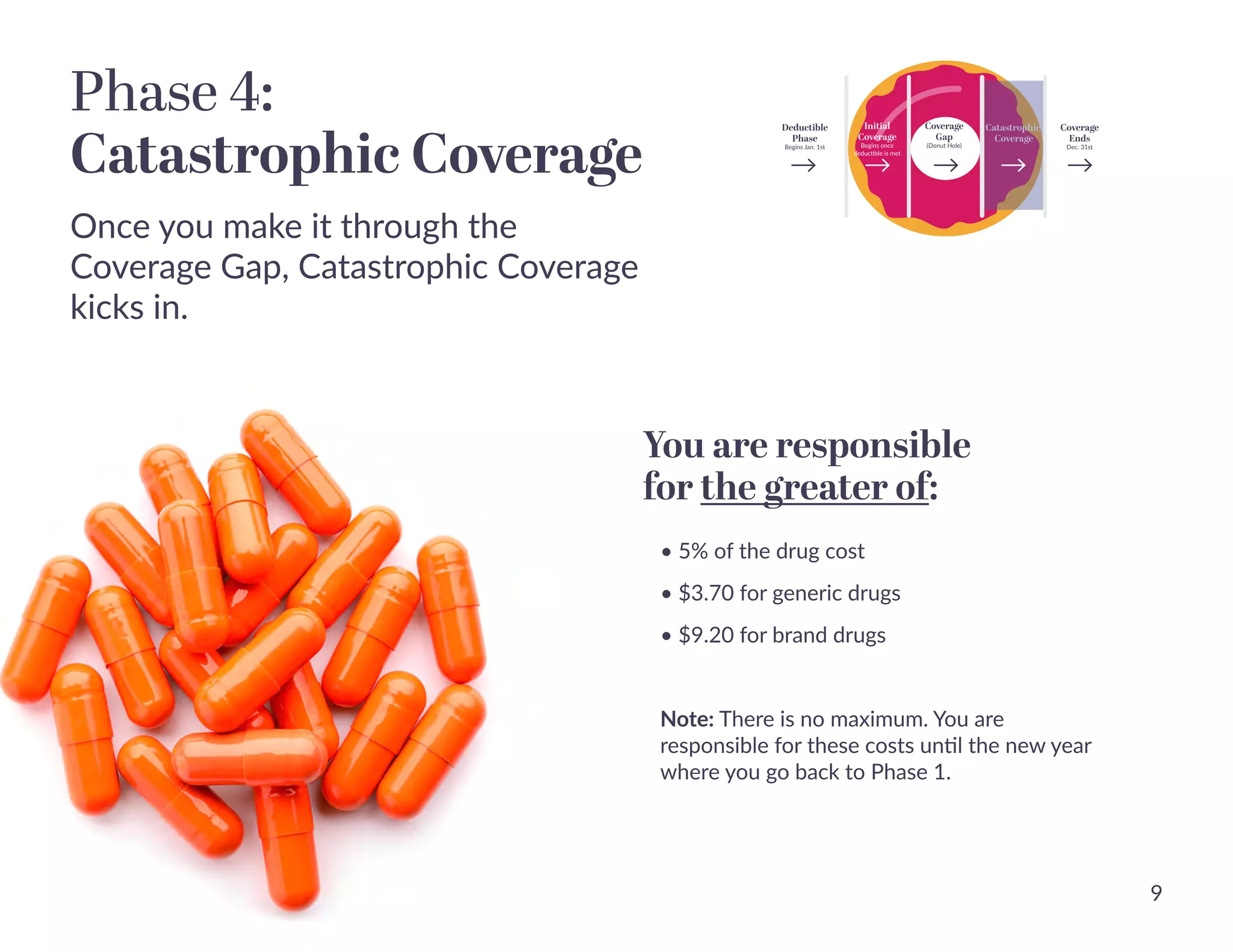
Phase 4:

Catastrophic Coverage
Once you make it through the
Coverage Gap, Catastrophic Coverage
kicks in.
Deductible
Phase

Begins Jan. 1st
Coverage
Gap

(Donut Hole)
Coverage
Ends

Dec. 31st
Initial
Coverage

Begins once

deductible is met
Catastrophic 

Coverage
• 5% of the drug cost

• $3.70 for generic drugs

• $9.20 for brand drugs


Note: There is no maximum. You are
responsible for these costs until the new year
where you go back to Phase 1.
You are responsible
for the greater of:
9
Is it worth it?
Yes.
You’re healthy. 

You exercise.

You eat organic foods.

You don’t use prescription drugs.


Should you even consider a drug plan?
Life comes at you fast, and unfortunately, you aren’t always in
control. There is a penalty if you decide to purchase a prescription
drug plan outside your initial enrollment window. 


Should you decide you want a drug plan later, you may only get a
plan during the Annual Enrollment Period (AEP) that runs from
October 15th - December 7th.  


This means that should you eventually need expensive
medications, you would be responsible for 100% of the costs for
those medications until AEP when you could enroll in a drug plan.
And, your Part D premiums will be higher for the rest of your life.
10
Your team of Medicare experts
You can take advantage of our
expertise at no cost to you. 

Ever.
Call us to turn worry and concern into peace and
calm when it comes to your Medicare decisions.
801-523-6081
srbenco.com
11

Medicare Part D Explained

  • 1.
    How Medicare PartD helps you get them (legally) and pay for them. Drugs.
  • 2.
    What is PartD? Formularies & Tiers How does it work? Deductible Phase Initial Coverage Coverage Gap Catastrophic Coverage Is it worth it? Your Medicare team 3 4 5 6 7 8 9 10 11 Table of Contents © Senior Benefits Insurance Services | 2021
  • 3.
    Prescription Drug Plans
 (PDPs) Let’sreview the four parts of Medicare: 3 What is Part D? Part A Hospital Insurance Part B Medical Insurance Part D Prescription Drug Plans Part C Medicare Advantage Government-runPrivateinsurancecompany Medicare Part D is a way for you to cover one of the biggest gaps left by Original Medicare: Prescription Drugs. Part D Prescription Drug Plans are offered and administered by private insurance companies.
  • 4.
    Classifying medications Formularies andTiers The private insurance companies who administer these drug plans establish their own formularies and drug tiers. Formulary The list of medications your plan covers. Drugs on the formulary are covered. Drugs not on the formulary are not covered. Each drug is put into one of several tiers within the formulary. Tiers Medications within the formulary are put into different tiers. Copay or coinsurance amounts generally increase as you move up to higher tiers. Tier 1 - Preferred Generics Tier 2 - Non-Preferred Generics Tier 3 - Preferred Brands Tier 4 - Non-Preferred Brands Tier 5 - Specialty 4
  • 5.
    How does itwork? Surprisingly, the best way to explain Part D coverage is with a donut. The next few pages will go into more detail about each phase of prescription drug coverage. Deductible Phase
 Begins Jan. 1st Coverage Gap
 (Donut Hole) Coverage Ends
 Dec. 31st Initial Coverage
 Begins once
 deductible is met Catastrophic 
 Coverage 5
  • 6.
    Phase 1:
 Deductible Phase Thedeductible phase begins on January 1st of every year. You are responsible for 100% of the costs of your prescription medications until you have paid your deductible amount. Deductible amounts depend on the drug plan you choose from a private insurance carrier. As a fictional example, if your deductible is $400, this means you would have to pay the full $400 before your prescription drug plan would begin contributing any money towards your medications. Deductible Phase
 Begins Jan. 1st Coverage Gap
 (Donut Hole) Coverage Ends
 Dec. 31st Initial Coverage
 Begins once
 deductible is met Catastrophic 
 Coverage Jan 1 $0 Deductible You are responsible for 100% of the costs here 6
  • 7.
    Phase 2:
 Initial Coverage Initialcoverage begins as soon as you have reached your deductible. Copays & Coinsurance Instead of paying the full cost of your medication, you will only be responsible for a copay (fixed dollar amount) or coinsurance (percentage of total cost) amount. Once your deductible, copays, coinsurance, and the amount your insurance company paid adds up to you will move to the next phase. $4,130 Examples Tier 1 - $0 - $5 Tier 2 - $5 - $15 Tier 3 - $40 - $47 Tier 4 - 30% - 50% Tier 5 - 25% - 35% *These do not reflect any specific plan amounts and serve only as examples. Once you have met your deductible, the insurance company will begin contributing towards your prescription costs. Deductible Phase
 Begins Jan. 1st Coverage Gap
 (Donut Hole) Coverage Ends
 Dec. 31st Initial Coverage
 Begins once
 deductible is met Catastrophic 
 Coverage 7
  • 8.
    Phase 3:
 Coverage Gap Thenotorious “Donut Hole” Once your deductible, copays, coinsurance and the amount your insurance company paid adds up to $4,130, you will find yourself in
 the Coverage Gap. 

 Everything changes here and costs 
 can get quite high, quite quickly. You get out of the Donut Hole once the following items add up to $6,550: • Your deductible • All you’ve paid in copays • All you’ve paid in coinsurance • Drug manufacturer discounted amounts Note: The amount your insurance company has paid towards medications does not go toward this $6,550 figure. This means that it is more than just the difference between $6,550 and the $4,130 level from the Initial Coverage phase. While in the Coverage Gap, you are responsible for 25% of the medication’s contracted rate with the pharmacy. Deductible Phase
 Begins Jan. 1st Coverage Gap
 (Donut Hole) Coverage Ends
 Dec. 31st Initial Coverage
 Begins once
 deductible is met Catastrophic 
 Coverage 25% How to get out of the Donut Hole 8 As an example, if your drug costs $100 per month through the pharmacy, you would be responsible for paying $25 per month.
  • 9.
    Phase 4:
 Catastrophic Coverage Onceyou make it through the Coverage Gap, Catastrophic Coverage kicks in. Deductible Phase
 Begins Jan. 1st Coverage Gap
 (Donut Hole) Coverage Ends
 Dec. 31st Initial Coverage
 Begins once
 deductible is met Catastrophic 
 Coverage • 5% of the drug cost • $3.70 for generic drugs • $9.20 for brand drugs Note: There is no maximum. You are responsible for these costs until the new year where you go back to Phase 1. You are responsible for the greater of: 9
  • 10.
    Is it worthit? Yes. You’re healthy. 
 You exercise.
 You eat organic foods.
 You don’t use prescription drugs. 
 Should you even consider a drug plan? Life comes at you fast, and unfortunately, you aren’t always in control. There is a penalty if you decide to purchase a prescription drug plan outside your initial enrollment window. Should you decide you want a drug plan later, you may only get a plan during the Annual Enrollment Period (AEP) that runs from October 15th - December 7th. This means that should you eventually need expensive medications, you would be responsible for 100% of the costs for those medications until AEP when you could enroll in a drug plan. And, your Part D premiums will be higher for the rest of your life. 10
  • 11.
    Your team ofMedicare experts You can take advantage of our expertise at no cost to you. Ever. Call us to turn worry and concern into peace and calm when it comes to your Medicare decisions. 801-523-6081 srbenco.com 11