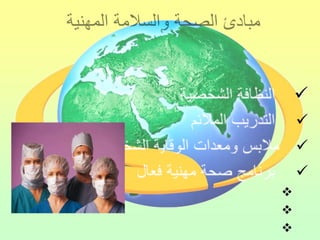



The Handling techniques and segregation
  of the Health Care (medical wastes )
   inside the medical institutions and
           Healthcare Facility.
HAZARDOUS MEDICAL WASTE
      Classification
Who are in risk from
    healthcare waste???

                                   
 Doctors and Nurses.
 Patients.                        
 Health care providers and        
   treatment employees.
 Environment and public health.   
 Dentists and dental workers.     
 blood bank technologists.        
 Laboratory technologists.        
 housekeeping personnel.          
How does exposure
    occur?

 Most common:     needle     
    sticks.
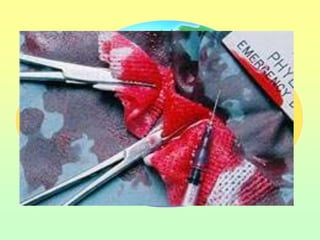
 Cuts from other             
    contaminated sharps
    (scalpels, broken glass
    , etc.).

 Contact of mucous           
    membranes (for
example,    the
eye, nose, mouth) or
    broken (cut or abraded)
    skin with contaminated
    blood.
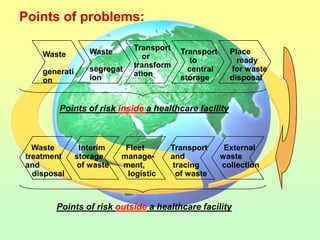
Points of problems:

                  Waste      Transport   Transport     Place
    Waste                      or           to           ready
                  segregat   transform     central     for waste
    generati                 ation
    on            ion                    storage       disposal


        Points of risk inside a healthcare facility


  Waste         Interim    Fleet      Transport       External
treatment      storage    manage-     and            waste
and            of waste   ment,       tracing        collection
  disposal                 logistic    of waste


       Points of risk outside a healthcare facility
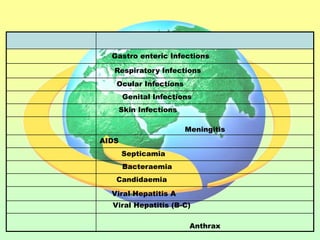
Gastro enteric Infections

   Respiratory Infections
   Ocular Infections
       Genital Infections
       Skin Infections

                         Meningitis
AIDS
       Septicamia
       Bacteraemia
   Candidaemia
  Viral Hepatitis A
  Viral Hepatitis (B-C)

                          Anthrax

        
        
-       
    
    
    
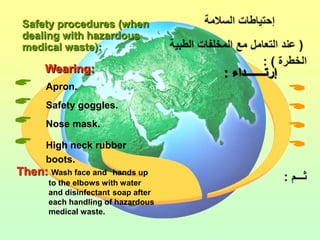
Safety procedures (when
 dealing with hazardous
 medical waste):

     Wearing:
     Apron.
                                    
     Safety goggles.
                                    
     Nose mask.
                                    
     High neck rubber              
      boots.
Then: Wash face and    hands up
      to the elbows with water
      and disinfectant soap after
      each handling of hazardous
      medical waste.
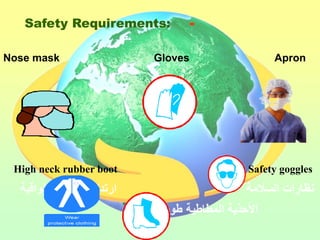
Safety Requirements:       -

Nose mask                Gloves        Apron


 High neck rubber boot            Safety goggles
Principals of dealing with the
Hazards medical wastes Inside
 the health Care Institutions
INFECTED MEDICAL
HAZARDOUS WASTE


-

    
    
    
    

-

    -


    -




















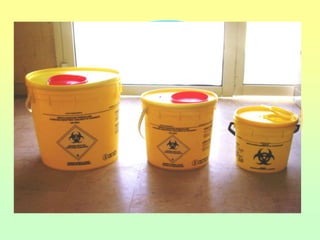
SHARP MEDICAL
HAZARDOUS WASTE















    
    
    


Procedures for treatment of Infected
   and Sharp MEDICAL WASTE







    
-   
    
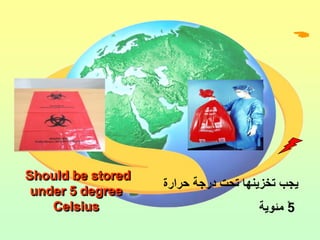
Human Body Tissues and
    Parts Waste:
-
    
    
    
    
    










Should be stored
 under 5 degree
    Celsius







Pharmaceutical Waste
    ( Medicine ) :


























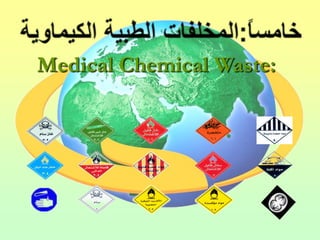
Medical Chemical Waste:
-
    
    
    
    
    
-

    

    

    





-

    


    


    








             

(recovery)   
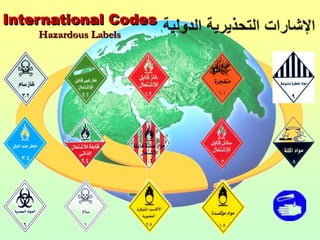
International Codes
    Hazardous Labels
Toxic Genes & Cells Material
          Waste:
-


    -
-
                                   
                                   
                                   


Potassium permanganate, Sulfuric acid
                                     
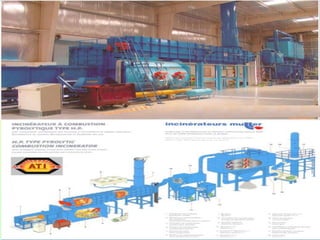
Treatment The Chemical
     medical waste
-
    

    
    

    
    
Compressed Gas Package



        
-
    -

    -
Radioactive Medical waste










                       


 It is not under the
company response

    



Back up )


            •

Medical waste management