
MEDICAL MALPRACTICES
IN INDIA
…negligence or wrong intention
Hey, do you know
what is medical
malpractice??
Lets’
Know
WHAT IS MEDICAL MALPRACTICE…?
A definition by Wikipedia says…
 Medical malpractice is professional
negligence by act or omission by a health care
provider in which the treatment provided falls
below the accepted standard of practice in the
medical community and causes injury or death to
the patient, with most cases involving medical
error.
RELATIONSHIP BETWEEN A DOCTOR AND A
PATIENT :
 The practice of medicine has long been seen as a
noble one.
 The doctor is looked upon as healer, guardian of
our well-being, and someone we trust with our
lives.
 People trust medical practitioners, believing that
they are equipped with the knowledge and skills
to safeguard their health.
WHAT IS INDIAN SCENARIO…?
 In India, medical malpractice is not a mistake or
negligence but a wrong intention of making
money.
 Doctors are deliberately misleading and
exploiting patients by prescribing expensive tests
and operations, which are not needed in the first
place.
 It is a faith that doctors play upon.
CASES ON MEDICAL
NEGLIGENCE/MALPRACTICE
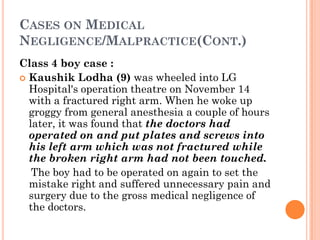
Medical Nightmare :
One such victim of alleged medical
malpractice was retired Army officer
Major Pankaj Rai who lost his wife Seema
to what he called a botched kidney
transplantation operation.
"It's not as if people can't live with dialysis.
They called us from the hospital to tell us
that a donor was available. We had her
admitted to the hospital on the doctors' advice.
We were amazed that a day prior to surgery
the doctors said we could transplant her
pancreas as well. Have you heard of such a
thing? They kept saying there's no risk.
But Seema said she wasn't prepared for this,“
Rai told.
Retd. Major Pankaj Rai
CASES ON MEDICAL
NEGLIGENCE/MALPRACTICE(CONT.)
Class 4 boy case :
 Kaushik Lodha (9) was wheeled into LG
Hospital's operation theatre on November 14
with a fractured right arm. When he woke up
groggy from general anesthesia a couple of hours
later, it was found that the doctors had
operated on and put plates and screws into
his left arm which was not fractured while
the broken right arm had not been touched.
The boy had to be operated on again to set the
mistake right and suffered unnecessary pain and
surgery due to the gross medical negligence of
the doctors.
OTHER ISSUES ( BASIN TEST ):
 Even when the situation is not as serious as to
require hospitalization, in regular treatment too,
patients are often advised to have blood, urine and
other tests done. Doctors ask pathology lab owners for
a percentage, of about 40 to 50 per cent, in return for
referring patients to their lab. This naturally results
in the cost of the tests being raised for the lab to be
able to make a profit.
 Also, Doctors often prescribe more tests than are
required. In fact, one such test is called a “basin test”,
and involves the blood sample being thrown into the
basin, with reports being given as normal, because
the doctor knows that there is nothing really wrong
with the patient.
OTHER ISSUES ( OVERPRICED DRUGS ):
 Strip of 10 tablets of Amaryl costs around Rs
125/-, and a strip of 10 tablets of the salt
„glimeperide‟ costs Rs 2/-. Both are essentially the
same thing. We pay approximately Rs 123/- more
for the brand name.
 The common cold is one of the most prevalent
illnesses. The salt name of the medicine used to
tackle the common cold is cetrizine. Now, the
manufacturing, packaging, transportation costs
of this generic medicine, including a decent
margin, is Rs. 1.20 paisa for 10 tablets.
But the branded version of the same medicine,
for example Cetzine, costs over Rs 35/- for 10
tabs.
OTHER ISSUES :
 The Medical Council of India says, “The large
gaps in health care accessibility in rural parts of
the country, the need for enhanced clinical
competence and limited opportunities for post-
graduate training are our major concerns.”
 Medicines prescribed by doctors are not always
within the budget of the average person.
 Some corrupt practices, patients being
overcharged, and prescribed treatment and
surgery they did not need.
 Children dying of diseases such as pneumonia
and diarrhea, diseases that are easily curable if
treated with the right medicine.
WHY ALL THIS IS HAPPENING ?
 At least 6-8% of India's GDP should be allotted to
public healthcare. But it is less than 2% of our
GDP.
 Healthcare is not a priority.
 For the vast majority of India‟s poor and lower
middle class, medical insurance is unviable.
 Less Govt. Medical Institutes and privatization.
 Practice of capitation fees in private colleges
demanding more than 5 million in cash.
 This is a sizeable amount which many doctors are
under pressure to recover as quickly as possible
when they qualify and begin practicing.
WHY DO PATIENTS GET DRUGS AT HIGH
PRICES ?
We know that the actual cost of most of the drugs is
very low. But, these are not available to patients at
low rates because :
 There is no regulation on prices of drugs by the
Government. Thus the pharmaceutical companies fix
very high MRP on drugs and reap huge profits.
 Doctors prescribe medicines by the brand name of a
particular drug company which encourage them with
incentives.
 This creates monopoly and enables the drug company
to put a very high MRP, despite the same drug being
produced by many companies. Generally consumers
are also not aware.
MCI…( WHICH CAN CURB IT!)
 The Medical Council of India (MCI) is a statutory
body regulating medical colleges, affiliation, new
colleges, and doctors registration.
 It protect and promote the health and safety of
the public by ensuring proper standards in the
practice of medicine.
 It has the power to cancel any doctor‟s license in
case of misconduct.
WHAT CAN BE DONE ?
 Generic medicines is the answer.
Governments, corporate hospitals, Rogi Kalyan
Samitis, NGOs etc can provide medicines and
health consumables at an affordable cost and
improve medicine accessibility.
 Poor people living in isolation are weak, but
together they are very strong. For e.g.
Under a scheme where the farmers pay Rs 10 per
month, which the govt. matches with Rs 30 per
year, farmers get the best medical care. While the
so-called rack rate for a heart operation is Rs
1,40,000, many hospital does it for Rs 60,000 for
patients under the scheme.
WHAT CAN BE DONE ? ( CONT.)
 If the government can be convinced that there
are 750 million Indians who are spending Rs 150
per month just to talk on their cell phones, and if
Rs 10 can be collected from each of them, we can
have the most robust health insurance scheme.
 Also the solution is to have more government
hospitals, because at the moment the number of
government hospitals is not enough to serve the
population, and people have to either wait long
hours or come away untreated.
INDIAN LAWS AND REGULATIONS
RELATED TO HEALTH
 If you are a victim then where you can go and
what you can do to seek help…
 Indian Penal Code, 1860 sections 52, 80, 81, 83,
88, 90, 91, 92 304-A, 337 and 338 contain the law
of medical malpractices in India.
 You can easily file a case in your local Consumer
Disputes Redressal Commission ( or Consumer
Court ) and can appeal for justice and
compensation.
CONTENT PICKED FROM :
 Satyamev Jayate Episode 04: Does Healthcare
Need Healing?
 Wikipedia
 www.medindia.net
 www.mciindia.org
 Google BlogSpot
 Cases from : The Times of India
IBN Live
Thank You
Created By :
SAURABH GOEL
111438

Medical malpractices

  • 1.
  • 2.
    Hey, do youknow what is medical malpractice?? Lets’ Know
  • 3.
    WHAT IS MEDICALMALPRACTICE…? A definition by Wikipedia says…  Medical malpractice is professional negligence by act or omission by a health care provider in which the treatment provided falls below the accepted standard of practice in the medical community and causes injury or death to the patient, with most cases involving medical error.
  • 4.
    RELATIONSHIP BETWEEN ADOCTOR AND A PATIENT :  The practice of medicine has long been seen as a noble one.  The doctor is looked upon as healer, guardian of our well-being, and someone we trust with our lives.  People trust medical practitioners, believing that they are equipped with the knowledge and skills to safeguard their health.
  • 5.
    WHAT IS INDIANSCENARIO…?  In India, medical malpractice is not a mistake or negligence but a wrong intention of making money.  Doctors are deliberately misleading and exploiting patients by prescribing expensive tests and operations, which are not needed in the first place.  It is a faith that doctors play upon.
  • 6.
    CASES ON MEDICAL NEGLIGENCE/MALPRACTICE MedicalNightmare : One such victim of alleged medical malpractice was retired Army officer Major Pankaj Rai who lost his wife Seema to what he called a botched kidney transplantation operation. "It's not as if people can't live with dialysis. They called us from the hospital to tell us that a donor was available. We had her admitted to the hospital on the doctors' advice. We were amazed that a day prior to surgery the doctors said we could transplant her pancreas as well. Have you heard of such a thing? They kept saying there's no risk. But Seema said she wasn't prepared for this,“ Rai told. Retd. Major Pankaj Rai
  • 7.
    CASES ON MEDICAL NEGLIGENCE/MALPRACTICE(CONT.) Class4 boy case :  Kaushik Lodha (9) was wheeled into LG Hospital's operation theatre on November 14 with a fractured right arm. When he woke up groggy from general anesthesia a couple of hours later, it was found that the doctors had operated on and put plates and screws into his left arm which was not fractured while the broken right arm had not been touched. The boy had to be operated on again to set the mistake right and suffered unnecessary pain and surgery due to the gross medical negligence of the doctors.
  • 8.
    OTHER ISSUES (BASIN TEST ):  Even when the situation is not as serious as to require hospitalization, in regular treatment too, patients are often advised to have blood, urine and other tests done. Doctors ask pathology lab owners for a percentage, of about 40 to 50 per cent, in return for referring patients to their lab. This naturally results in the cost of the tests being raised for the lab to be able to make a profit.  Also, Doctors often prescribe more tests than are required. In fact, one such test is called a “basin test”, and involves the blood sample being thrown into the basin, with reports being given as normal, because the doctor knows that there is nothing really wrong with the patient.
  • 9.
    OTHER ISSUES (OVERPRICED DRUGS ):  Strip of 10 tablets of Amaryl costs around Rs 125/-, and a strip of 10 tablets of the salt „glimeperide‟ costs Rs 2/-. Both are essentially the same thing. We pay approximately Rs 123/- more for the brand name.  The common cold is one of the most prevalent illnesses. The salt name of the medicine used to tackle the common cold is cetrizine. Now, the manufacturing, packaging, transportation costs of this generic medicine, including a decent margin, is Rs. 1.20 paisa for 10 tablets. But the branded version of the same medicine, for example Cetzine, costs over Rs 35/- for 10 tabs.
  • 10.
    OTHER ISSUES : The Medical Council of India says, “The large gaps in health care accessibility in rural parts of the country, the need for enhanced clinical competence and limited opportunities for post- graduate training are our major concerns.”  Medicines prescribed by doctors are not always within the budget of the average person.  Some corrupt practices, patients being overcharged, and prescribed treatment and surgery they did not need.  Children dying of diseases such as pneumonia and diarrhea, diseases that are easily curable if treated with the right medicine.
  • 11.
    WHY ALL THISIS HAPPENING ?  At least 6-8% of India's GDP should be allotted to public healthcare. But it is less than 2% of our GDP.  Healthcare is not a priority.  For the vast majority of India‟s poor and lower middle class, medical insurance is unviable.  Less Govt. Medical Institutes and privatization.  Practice of capitation fees in private colleges demanding more than 5 million in cash.  This is a sizeable amount which many doctors are under pressure to recover as quickly as possible when they qualify and begin practicing.
  • 12.
    WHY DO PATIENTSGET DRUGS AT HIGH PRICES ? We know that the actual cost of most of the drugs is very low. But, these are not available to patients at low rates because :  There is no regulation on prices of drugs by the Government. Thus the pharmaceutical companies fix very high MRP on drugs and reap huge profits.  Doctors prescribe medicines by the brand name of a particular drug company which encourage them with incentives.  This creates monopoly and enables the drug company to put a very high MRP, despite the same drug being produced by many companies. Generally consumers are also not aware.
  • 13.
    MCI…( WHICH CANCURB IT!)  The Medical Council of India (MCI) is a statutory body regulating medical colleges, affiliation, new colleges, and doctors registration.  It protect and promote the health and safety of the public by ensuring proper standards in the practice of medicine.  It has the power to cancel any doctor‟s license in case of misconduct.
  • 14.
    WHAT CAN BEDONE ?  Generic medicines is the answer. Governments, corporate hospitals, Rogi Kalyan Samitis, NGOs etc can provide medicines and health consumables at an affordable cost and improve medicine accessibility.  Poor people living in isolation are weak, but together they are very strong. For e.g. Under a scheme where the farmers pay Rs 10 per month, which the govt. matches with Rs 30 per year, farmers get the best medical care. While the so-called rack rate for a heart operation is Rs 1,40,000, many hospital does it for Rs 60,000 for patients under the scheme.
  • 15.
    WHAT CAN BEDONE ? ( CONT.)  If the government can be convinced that there are 750 million Indians who are spending Rs 150 per month just to talk on their cell phones, and if Rs 10 can be collected from each of them, we can have the most robust health insurance scheme.  Also the solution is to have more government hospitals, because at the moment the number of government hospitals is not enough to serve the population, and people have to either wait long hours or come away untreated.
  • 16.
    INDIAN LAWS ANDREGULATIONS RELATED TO HEALTH  If you are a victim then where you can go and what you can do to seek help…  Indian Penal Code, 1860 sections 52, 80, 81, 83, 88, 90, 91, 92 304-A, 337 and 338 contain the law of medical malpractices in India.  You can easily file a case in your local Consumer Disputes Redressal Commission ( or Consumer Court ) and can appeal for justice and compensation.
  • 17.
    CONTENT PICKED FROM:  Satyamev Jayate Episode 04: Does Healthcare Need Healing?  Wikipedia  www.medindia.net  www.mciindia.org  Google BlogSpot  Cases from : The Times of India IBN Live
  • 18.
    Thank You Created By: SAURABH GOEL 111438