SURGICAL ETHICS
Prof. Md. Mazibar Rahman
FCPS, FRCS, FACS, FICS
,
Fellow in urology (Australia)
Professor of Surgery
Popular Medical College Hospital
Ethics – Defined
• The word ethics is derived from the Greek word -
“ethos” which means “ character “.
• To put it formally ethics is the branch of
philosophy that defines what is good for the
individual and for society and establishes the nature
of obligations, or duties, that people owe themselves
and one another.
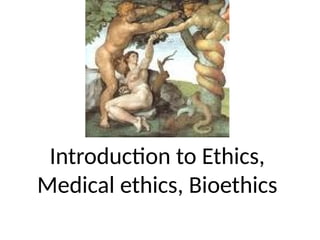
Introduction to Ethics,
Medical ethics, Bioethics
ETHICS / MORAL
• The oldest scientific and philosophical discipline
• ? Demarcation: science / subject
ethics moral
(gr. ethos = custom, (lat. mos = character,
practice) nature)
- Ethics – discipline about moral or philosophy on
moral
- Moral – system of norms or rules, written or not,
about human behavior
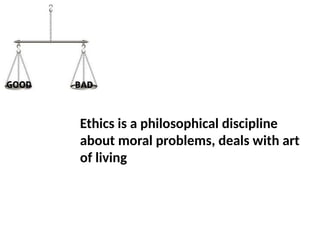
Ethics is a philosophical discipline
about moral problems, deals with art
of living
What is Ethics?
• The formal study of:
–What is right and wrong.
–The study of the bases or principles for
deciding right and wrong.
–The analyses of the processes by which we
decide what is right and wrong.
Ethics is not:
• Merely obeying the law
• Compliance
Although in many instances laws are
statements of considered ethical
positions and most of the time obeying
the law is an element of ethical
behavior.
Relation between moral and other regulative
norms
- Moral norm – specific individual system of personal
values with validity of genesis, development and
adoption
• Other regulative norms (close to moral):
- Of primitive society
- Of customs
- Of religion
- Of law
• Religious vs. Moral norms:
- religious norms are characterized by concept
“sanctity”
(moral ones by term “good”)
- religious norms are more absolute, without
conditions and inevitable that moral ones
- when broke religious norm, a man committed sin
(when violated moral norm, a man felt he
committed mistake against his dignity)
Traditional arrangements of the
field of ethics:
• Meta-ethics (nature of right or good, nature
and justification of ethical issues)
• Normative ethics ( standards, principles)
• Applied ethics (actual application of ethical
principles to particular situation)
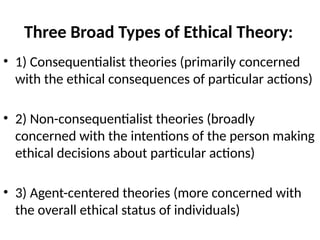
Three Broad Types of Ethical Theory:
• 1) Consequentialist theories (primarily concerned
with the ethical consequences of particular actions)
• 2) Non-consequentialist theories (broadly
concerned with the intentions of the person making
ethical decisions about particular actions)
• 3) Agent-centered theories (more concerned with
the overall ethical status of individuals)
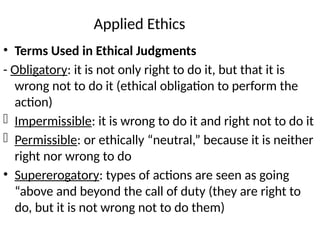
Applied Ethics
• Terms Used in Ethical Judgments
- Obligatory: it is not only right to do it, but that it is
wrong not to do it (ethical obligation to perform the
action)
- Impermissible: it is wrong to do it and right not to do it
- Permissible: or ethically “neutral,” because it is neither
right nor wrong to do
• Supererogatory: types of actions are seen as going
“above and beyond the call of duty (they are right to
do, but it is not wrong not to do them)
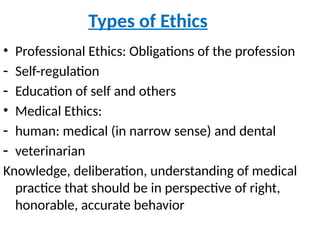
Types of Ethics
• Professional Ethics: Obligations of the profession
- Self-regulation
- Education of self and others
• Medical Ethics:
- human: medical (in narrow sense) and dental
- veterinarian
Knowledge, deliberation, understanding of medical
practice that should be in perspective of right,
honorable, accurate behavior
Medical Ethics
• a field of applied ethics, the study of moral
values and judgments as they apply to
medicine. As a scholarly discipline, medical
ethics encompasses its practical application in
clinical settings as well as work on its history,
philosophy, theology, sociology, and
anthropology.
Based on definition of “Medical Ethics” http://en.wikipedia.org/wiki/Medical_ethics
Why study medical ethics?
• “As long as the physician is a knowledgeable and skilful
clinician, ethics doesn’t matter.”
• “Ethics is learned in the family, not in medical school.”
• “Medical ethics is learned by observing how senior
physicians act, not from books or lectures.”
• “Ethics is important, but our curriculum is already too
crowded and there is no room for ethics teaching.”
Why study medical ethics?
• ethics is and always has been an essential
component of medical practice
• some ethical principles are basic to the physician-
patient relationship, but application in specific
situations is often problematic due to disagreement
about what is the right way to act)
• study of ethics prepares medical students to
recognize difficult situations and to deal with them
in a rational and principled manner
Bioethics
• Medical ethics closely related to bioethics
(biomedical ethics), but not identical
- medical ethics focuses primarily on issues arising out
of the practice of medicine
- bioethics: very broad subject, concerned with the
moral issues raised by developments in the
biological sciences
- bioethics does not require the acceptance of certain
traditional values that are fundamental to medical
ethics
Bioethics
• Branch of applied ethics that studies the
philosophical, social, and legal issues arising in
medicine and the life sciences
• It is chiefly concerned with human life and
well-being, though it sometimes also treats
ethical questions relating to the nonhuman
biological environment
As Practical Ethics, Medical Ethics
focuses on:
The process of deciding what is the most
appropriate (right) course of action in a
particular situation:
• given these facts
• given my skills and abilities
• operating with finite knowledge
• in real time
• and then effecting that course of action.
Ethical Problems
• Problems caused by fact of having to choose
between goods or things to which we owe an
obligation
• Bad rankings of goods
• Failure to grasp facts
–Ignorance
–Incompetence
–Willful blindness
• Bad factual analysis
–Often caused by personal or institutional
distortion
Organizational Problems
• General organizational culture
• Ego and narcissism
• Overly punitive responses
• Lack of a culture of responsibility
• Failure to acknowledge information distortion
• Bad communication flows
• High transaction costs for doing the “right”
thing
Process of making ethical decisions
• Awareness—Is there a moral issue here?
–What is its nature? How important?
• What are the facts?
• What are the issues?
• What rules or values apply here?
• To whom or what do I owe a duty?
• How should they be applied?
• Who needs to decide and act? Who ought to?
• To what am I obligated because of role/position?
• What are the consequences?
• What are the options?!
Duties to whom or what?
• Individuals
– Patients
– Patients’ families/guardians
– Colleagues
– Co-workers
– Self
• Groups
– Profession
– Society
– The weak
• Ideas/Principles
– The Law
– Truth
– Justice
– Individual value
Duties—Sources
• Legal Obligations
–Health insurance
–Emergency treatment
–Reporting duties
• Institutional Obligations
–Practices of hospital
• Professional norms and obligations
–Inhere with being a physician
Framework for ethical decision-making
IN PRACTICE
1. Determine whether the issue at hand is an ethical
one.
2. Consult authoritative sources to see how
physicians generally deal with such issues.
3. Consider alternative solutions.
4. Discuss your proposed solution with those whom it
will affect.
5. Make your decision and act on it.
6. Evaluate your decision and be prepared to act
differently in future.
Factors in ethical decision-making in
health-care
1. Ethical theories
2. Ethical principles
3. Ethical rules
ETHICAL MAXIM (principles)
General guidelines that site what is forbidden,
desirable or permissible (often base for rules)
1. Respecting autonomy
2. Doing no harm (nonmaleficence)
3. Benefiting others (beneficence)
4. Being just (justice)
- Being faithful (fidelity)
ETHICAL RULES (codes)
Manners developed by professional organizations
Structure of codes:
1. regulative
2. protective (for public opinion)
3. specific (regarding membership)
4. obligated
Surgical Ethics
Ethics is an essential discipline in the practice of
surgery.
•Represents your best understanding of moral
responsibility.
•Evolves as reasoned reflection on clinical experience.
•Role of the Surgeon is to act as the patient’s fiduciary
(person to whom property or power is entrusted for)
Introduction (1)
• Ethics and surgical intervention must go hand in
hand.
• Both surgeons and some attempted murderers use
knives to accomplish their goals. What is the
difference?
• Why people are willing to risk allowing surgeons
whom they may not have even met to cut them, at
times in potentially lethal ways?
Introduction (2)
• If someone deliberately cuts another person, draws blood,
causes pain, leaves scars and disrupts everyday activity
then the likely result will be a criminal charge. If the person
dies as a result, the charge could be manslaughter or even
murder.
• The difference between the criminal and the surgeon is that
the surgeon causes harm only incidentally.
• The surgeon’s intent is to cure or manage illness and any
bodily invasion that occurs only does so with the
permission of the patient.
Questions (1)
• Patients consent to surgery because they trust their
surgeons.
1. What should such consent entail in practice
2. What should surgeons do when patients
need help but are unable or unwilling to agree
to it?
 When patients do consent to treatment, surgeons
exert enormous power over them, the power not just
to cure but to injure, disable and kill.
1. How should such power be regulated to
reinforce the trust of patients and to ensure that
surgeons practice to an acceptable professional
standard?
2. Are there circumstances in which it is
acceptable to sacrifice the trust of individual patients
in the public interest through revealing information
that was communicated in what patients believed to
be conditions of strict privacy?
Questions (1) Contd
Questions (2)
• These questions about what constitutes good
professional practice concern ethics rather than
surgical technique.
• Surgeons may be expert in the management of
specific diseases but may have little understanding
of how much and what sort of information is
required for patients to give valid consent to
treatment.
• Surgeons can understand the delicate techniques
associated with specific types of procedures without
necessarily knowing when these should be
administered to patients who are unable to consent at
all.
• Surgeons can recognize their own mistakes and
those of colleagues without knowing how much
should be said about them to others.
Questions (2) Contd
Questions (3)
• Traditional surgical training offers little help in
the resolution of such ethical dilemmas.
• Aim: To provide guidance which is morally
coherent, widely endorsed and legally
justifiable.
AUTONOMY
• What makes us unique as animals is our
autonomy, our ability to formulate both
goals and beliefs about how these should be
achieved.
• Humans can attempt to plan their lives on
the basis of reason and choice in ways which
other animals cannot.
AUTONOMY
• When we talk of the particular type of
respect which it is appropriate to show to
humans, the focus should primarily be on
our autonomy rather than our particular
physical characteristics.
• Respect for human dignity is respect for
human autonomy.
AUTONOMY
• Surgeons have a duty of care towards their
human patients which goes beyond just
protecting their life and health. Their
additional duty of care is to respect the
autonomy of their patients, their ability to
make choices about their treatments and to
evaluate potential outcomes in light of
other life plans.
AUTONOMY
• Patients have the right to exercise choice
over their surgical care.
• To the degree that patients have a right to
make choices about proposed surgical
treatment, it then follows that they should
be allowed to refuse treatments that they
do not want, even when surgeons think that
they are wrong.
Autonomy
Respect the autonomy of patients & their ability to
make choices about their treatments.
It recognizes rights of patients to self-determination.
So patients have right to make choices over their
surgical care.
Respect for autonomy is the basis for informed
consent and advance directives.
Information
Explanation of the patient’s disease
Explanation of untreated natural history
Recommendation of most appropriate surgery
Discussion of risks and benefits
Anticipated outcome – prognosis
Treatment alternatives
Consent – principles
Venue – calm & quite place
Consent form – Pt’s language
Time – take own decision
Principal person – Surgeon
Entry – case record
For agreement to count as consent to treatment, patients need to
be given appropriate and accurate information about:
• Their condition and the reasons why it warrants surgery
• What type of surgery is proposed and how it might correct
their condition
• What the proposed surgery entails in practice
• The anticipated prognosis of the proposed surgery
• The expected side-effects of the proposed surgery
• The unexpected hazards of the proposed surgery
• Any alternative and potentially successful treatments for
their condition other than the proposed surgery, along with
similar information about these
• The consequences of no treatment at all.
INFORMED CONSENT
• A quiet venue for discussion should be found.
• Written material in the patient’s preferred language
should be provided to supplement verbal
communication.
• Patients should be given time and help to evaluate
their own understanding and to come to their own
decision.
• The person obtaining the consent should ideally be
the surgeon who will carry out the treatment.
INFORMED CONSENT
• Good communication skills go hand in hand with
properly obtaining informed consent for surgery.
• Attention must be paid to:
1. Whether or not the patient has understood
what has been stated
2. Avoiding overly technical language in
descriptions and explanations
3. The provision of translators for patients whose
first language is not English
4. Asking patients if they have further questions.
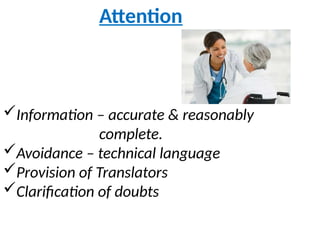
Attention
Information – accurate & reasonably
complete.
Avoidance – technical language
Provision of Translators
Clarification of doubts
INFORMED CONSENT
• In law, intentionally to touch another person
without their consent is a battery.
• Negligence is the second legal action which might
be brought against a surgeon for not obtaining
appropriate consent to treatment.
• If the patient agrees to proceed, no other treatment
should ordinarily be administered without further
explicit consent.
INFORMED CONSENT
• The duty of surgeons to respect the autonomy of
patients translates into the specific responsibility to
obtain informed consent to treatment.
• For consent to be valid, patients must:
1. Be competent to give it – to be able to
understand, remember, deliberate about and
believe whatever information is provided to them
about treatment choices.
2. Not be forced into decisions which reflect the
preferences of others rather than themselves.
3. Be given sufficient information for these
choices to be based on an accurate understanding
of reasons for and against proceeding with specific
treatments.
• For consent to be valid, patients must:
INFORMED CONSENT
Practical Difficulties
Refusal or waiver by patient
Temporary Unconsciousness patients
Children less than 18 yrs are minors and are
legally incompetent.
Incompetence – other kind
End of Life – Issues
In unusual circumstances (close to death) that no
evidence shows that a specific treatment desired by
the patient will provide any benefit from any
perspective, the physician need not provide such
treatment.
If there are no treatment options i.e. the pt is brain
dead and the family insists on treatment – if there is
nothing that the physician can do; treatment must
stop.
Noted in case sheet along with senior clinician’s
agreement
Confidentiality
The principle of confidentiality is that the
information a patient reveals to a surgeon is private
and has limits on how and when it can be disclosed to
a third party.
The patient (and the person treating the patient)
have right to dignity.
Breaking confidentiality
- If the patient is threat to self or others
- Other team members – improving treatment options
- Public interest
- Court order
Research
Surgeons have a subsidiary responsibility to
improve operative techniques through research,
to assure their patients that the care proposed
is best.
The administration of such regulation is
through research ethics committees, and
surgeons should not participate in research that
has not been approved by such bodies.
Good Standards
To optimize success in protecting life and health to
an acceptable standard, surgeons must only offer
specialized treatment in which they have been
properly trained.
To do so will entail sustained further education
throughout a surgeon’s career in the wake of new
surgical procedures.
To do otherwise would be to place the interest of
the surgeon above that of their patient, an imbalance
that is never morally or professionally acceptable.
Some Ethical Issues
In OR
Some Ethical Issues in The OR
I. Exposure of body.
II. Dress.
III. People gathering and traffic.
IV. Noise.
V. Comments and behavior.
VI. Honesty.
VII. Consent.
I. Exposure of body
Exposure of body
• Parts of body should not be exposed to
others ( governed by religion )
–men : from umbilicus to knees.
–ladies : all body.
• Exceptions are allowed when necessary
according to a definite need.
• Exposure of some body parts is often
necessary, depending on procedure.
Exposure of body - Examples
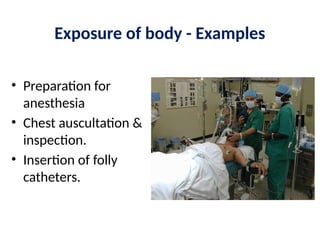
• Preparation for
anesthesia
• Chest auscultation &
inspection.
• Insertion of folly
catheters.
Exposure of body - Examples
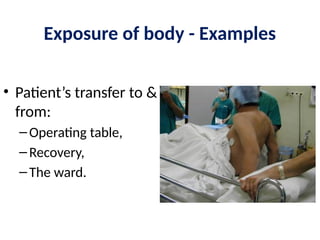
• Patient’s transfer to &
from:
–Operating table,
–Recovery,
–The ward.
Exposure of body - Examples
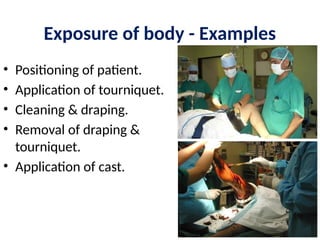
• Positioning of patient.
• Application of tourniquet.
• Cleaning & draping.
• Removal of draping &
tourniquet.
• Application of cast.
Exposure of body
Whenever exposure is necessary,
it should be :
• Limited to parts needed only.
• In the presence of limited number of people.
• For the shortest period of time.
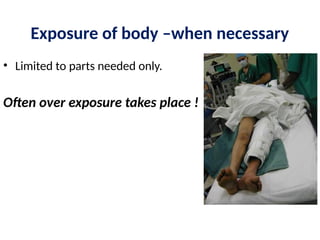
Exposure of body –when necessary
• Limited to parts needed only.
Often over exposure takes place !
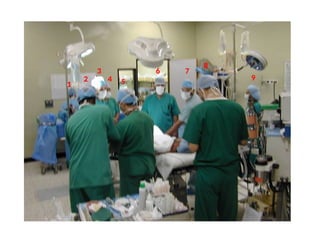
Exposure of body - when necessary
• In the presence of limited number of
people.
Often too many people around
(Drs. / Nurses / Technicians / Students/ workers)
Often unnecessary
1
2
3
4 5
6 7
8
9
Exposure of body - when necessary
• For the shortest period of time.
• Not to call in the cleaners early (to save time).
Do we really apply this ?
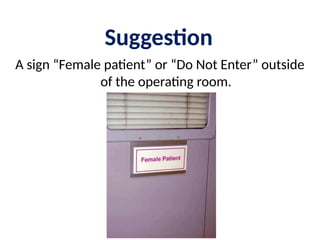
A sign “Female patient” or “Do Not Enter” outside
of the operating room.
Suggestion
II. Dress
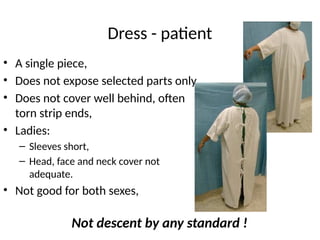
Dress - patient
• A single piece,
• Does not expose selected parts only,
• Does not cover well behind, often
torn strip ends,
• Ladies:
– Sleeves short,
– Head, face and neck cover not
adequate.
• Not good for both sexes,
Not descent by any standard !
Dress - patient
• Underwear  by some policies should be
removed
( even if operation is at neck ! ).
• Problems with patient’s underwear :
–uncleanliness / metal parts / nylon ?
• Solution:
–ensure and allow clean underwear.
–Provide proper disposable underwear .
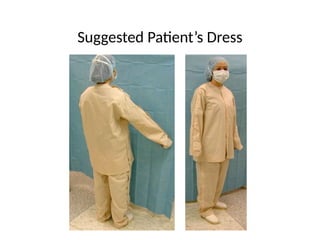
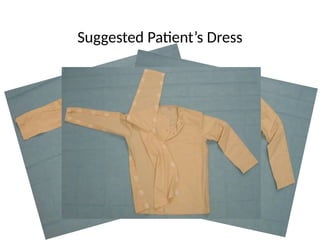
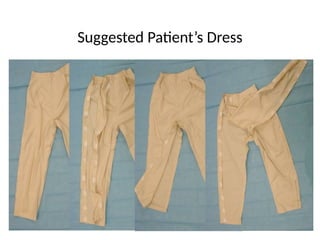
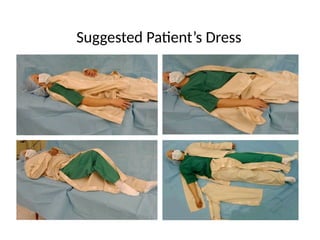
Suggested Patient’s Dress
Criteria
• Should provide adequate cover according
to local standards (religion).
• Should provide adequate local (selective)
exposure.
• Should allow quick & practical wide
exposure in emergency situations.
• Should look descent.
Suggested Patient’s Dress
Dress - staff
• Lady staff  Drs., nurses, students.
• Does not meet required standards
regarding :
–Design,
–Width & length,
–Areas covered ( head & body) ,
–Practicality.
( ask our lady colleagues ! )
New Staff’s Dress
Suggested and designed by our lady colleagues
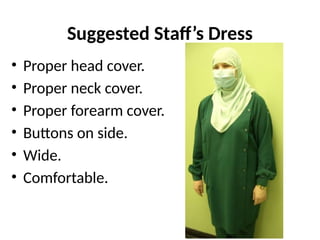
Suggested Staff’s Dress
• Proper head cover.
• Proper neck cover.
• Proper forearm cover.
• Buttons on side.
• Wide.
• Comfortable.
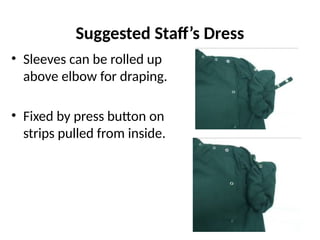
Suggested Staff’s Dress
• Sleeves can be rolled up
above elbow for draping.
• Fixed by press button on
strips pulled from inside.
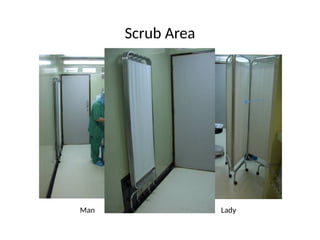
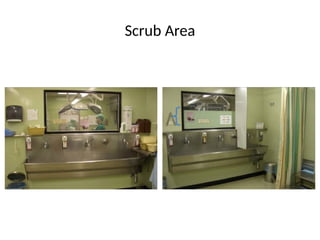
Lady Surgeons Scrub Area
Scrub Area
Man Lady
Scrub Area
III. People’s gathering & traffic
People’s gathering and traffic
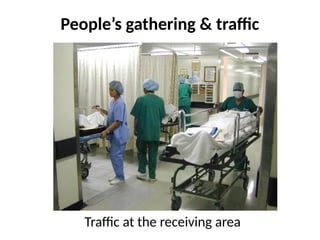
• Often too many people in the corridors, receiving
area & OR  causes inconvenience to patients &
staff.
• Problem related to :
- behavior of staff & students.
- limited space.
(Both should be discussed & improved)
People’s gathering & traffic
Traffic at the receiving area
IV. Noise
Noise
• Patients coming to OR are worried 
need privacy, silence & reassurance.
• Noise should be kept to minimum.
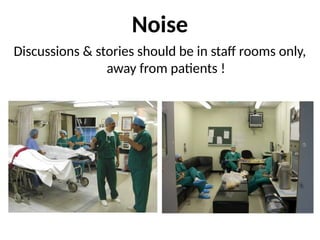
Noise
Discussions & stories should be in staff rooms only,
away from patients !
V. Comments & Behavior
Comments & Behavior
• Jokes & laughing:
–Loudly,
–In front of patients,
–In a language not known to them !
–Before anesthesia,
–During procedure with local/spinal
anesthesia.
Comments & Behavior
• Comments & remarks on patient’s:
–Disease,
–Body shape or weight,
–Behavior …etc.
That would not be said if patient is
awake
Comments & Behavior
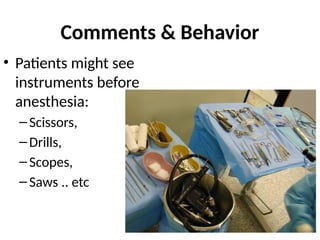
• Patients might see
instruments before
anesthesia:
–Scissors,
–Drills,
–Scopes,
–Saws .. etc
Comments & Behavior
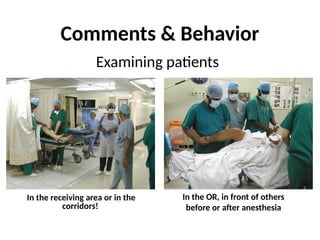
Examining patients
In the OR, in front of others
before or after anesthesia
In the receiving area or in the
corridors!
VI. Honesty
Honesty
• Patients often ask who performed surgery
• The answer should be honest & concentrate
on :
–Concept of team work.
–Quality is assured.
–Supervised by the consultant / senior staff.
–Teaching / training does not reduce
standards.
Honesty
Tell the truth !
• What went wrong.
• Complications.
• Unexpected incidence.
• Preserve Patients’ dignity during all phases of
transportation.
• Patients should not be exposed unnecessarily
regarding:
–The area exposed,
–The duration of exposure,
–The number of people present during exposure.
• Patient examination if needed  should be
inside the operating room only, with privacy
& limited exposure.
Conclusions & Suggestions
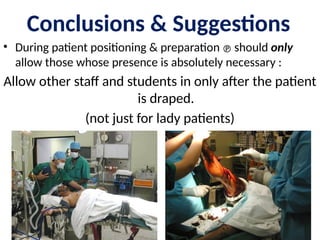
• During patient positioning & preparation  should only
allow those whose presence is absolutely necessary :
Allow other staff and students in only after the patient
is draped.
(not just for lady patients)
Conclusions & Suggestions
CONCLUSION
• The two general duties of surgical care are to
protect life and health and to respect autonomy,
both to an acceptable professional standard.
• The specific duties of surgeons are shown to follow
from these: acceptable practice concerning
informed consent, confidentiality, decisions not to
provide, or to omit, life-sustaining care, surgical
research and the maintenance of good
professional standards.
•The final duty of surgical care is to exercise all of these
general and specific responsibilities with fairness and justice,
and without arbitrary prejudice.
•The conduct of ethical surgery illustrates good citizenship:
protecting the vulnerable and respecting human dignity and
equality.
•To the extent that the practice of individual surgeons is a
reflection of such sustained conduct, they deserve the civil
respect which they often receive.
•To the extent that it is not, they should not practice the
honorable profession of surgery.
CONCLUSION
SURGICAL ETHICS - lecture for PMC students.pptx

SURGICAL ETHICS - lecture for PMC students.pptx

  • 1.
    SURGICAL ETHICS Prof. Md.Mazibar Rahman FCPS, FRCS, FACS, FICS , Fellow in urology (Australia) Professor of Surgery Popular Medical College Hospital
  • 2.
    Ethics – Defined •The word ethics is derived from the Greek word - “ethos” which means “ character “. • To put it formally ethics is the branch of philosophy that defines what is good for the individual and for society and establishes the nature of obligations, or duties, that people owe themselves and one another.
  • 3.
  • 4.
    ETHICS / MORAL •The oldest scientific and philosophical discipline • ? Demarcation: science / subject ethics moral (gr. ethos = custom, (lat. mos = character, practice) nature) - Ethics – discipline about moral or philosophy on moral - Moral – system of norms or rules, written or not, about human behavior
  • 5.
    Ethics is aphilosophical discipline about moral problems, deals with art of living
  • 7.
    What is Ethics? •The formal study of: –What is right and wrong. –The study of the bases or principles for deciding right and wrong. –The analyses of the processes by which we decide what is right and wrong.
  • 9.
    Ethics is not: •Merely obeying the law • Compliance Although in many instances laws are statements of considered ethical positions and most of the time obeying the law is an element of ethical behavior.
  • 10.
    Relation between moraland other regulative norms - Moral norm – specific individual system of personal values with validity of genesis, development and adoption • Other regulative norms (close to moral): - Of primitive society - Of customs - Of religion - Of law
  • 11.
    • Religious vs.Moral norms: - religious norms are characterized by concept “sanctity” (moral ones by term “good”) - religious norms are more absolute, without conditions and inevitable that moral ones - when broke religious norm, a man committed sin (when violated moral norm, a man felt he committed mistake against his dignity)
  • 12.
    Traditional arrangements ofthe field of ethics: • Meta-ethics (nature of right or good, nature and justification of ethical issues) • Normative ethics ( standards, principles) • Applied ethics (actual application of ethical principles to particular situation)
  • 14.
    Three Broad Typesof Ethical Theory: • 1) Consequentialist theories (primarily concerned with the ethical consequences of particular actions) • 2) Non-consequentialist theories (broadly concerned with the intentions of the person making ethical decisions about particular actions) • 3) Agent-centered theories (more concerned with the overall ethical status of individuals)
  • 15.
    Applied Ethics • TermsUsed in Ethical Judgments - Obligatory: it is not only right to do it, but that it is wrong not to do it (ethical obligation to perform the action) - Impermissible: it is wrong to do it and right not to do it - Permissible: or ethically “neutral,” because it is neither right nor wrong to do • Supererogatory: types of actions are seen as going “above and beyond the call of duty (they are right to do, but it is not wrong not to do them)
  • 16.
    Types of Ethics •Professional Ethics: Obligations of the profession - Self-regulation - Education of self and others • Medical Ethics: - human: medical (in narrow sense) and dental - veterinarian Knowledge, deliberation, understanding of medical practice that should be in perspective of right, honorable, accurate behavior
  • 17.
    Medical Ethics • afield of applied ethics, the study of moral values and judgments as they apply to medicine. As a scholarly discipline, medical ethics encompasses its practical application in clinical settings as well as work on its history, philosophy, theology, sociology, and anthropology. Based on definition of “Medical Ethics” http://en.wikipedia.org/wiki/Medical_ethics
  • 18.
    Why study medicalethics? • “As long as the physician is a knowledgeable and skilful clinician, ethics doesn’t matter.” • “Ethics is learned in the family, not in medical school.” • “Medical ethics is learned by observing how senior physicians act, not from books or lectures.” • “Ethics is important, but our curriculum is already too crowded and there is no room for ethics teaching.”
  • 19.
    Why study medicalethics? • ethics is and always has been an essential component of medical practice • some ethical principles are basic to the physician- patient relationship, but application in specific situations is often problematic due to disagreement about what is the right way to act) • study of ethics prepares medical students to recognize difficult situations and to deal with them in a rational and principled manner
  • 20.
    Bioethics • Medical ethicsclosely related to bioethics (biomedical ethics), but not identical - medical ethics focuses primarily on issues arising out of the practice of medicine - bioethics: very broad subject, concerned with the moral issues raised by developments in the biological sciences - bioethics does not require the acceptance of certain traditional values that are fundamental to medical ethics
  • 22.
    Bioethics • Branch ofapplied ethics that studies the philosophical, social, and legal issues arising in medicine and the life sciences • It is chiefly concerned with human life and well-being, though it sometimes also treats ethical questions relating to the nonhuman biological environment
  • 25.
    As Practical Ethics,Medical Ethics focuses on: The process of deciding what is the most appropriate (right) course of action in a particular situation: • given these facts • given my skills and abilities • operating with finite knowledge • in real time • and then effecting that course of action.
  • 26.
    Ethical Problems • Problemscaused by fact of having to choose between goods or things to which we owe an obligation • Bad rankings of goods • Failure to grasp facts –Ignorance –Incompetence –Willful blindness • Bad factual analysis –Often caused by personal or institutional distortion
  • 27.
    Organizational Problems • Generalorganizational culture • Ego and narcissism • Overly punitive responses • Lack of a culture of responsibility • Failure to acknowledge information distortion • Bad communication flows • High transaction costs for doing the “right” thing
  • 28.
    Process of makingethical decisions • Awareness—Is there a moral issue here? –What is its nature? How important? • What are the facts? • What are the issues? • What rules or values apply here? • To whom or what do I owe a duty? • How should they be applied? • Who needs to decide and act? Who ought to? • To what am I obligated because of role/position? • What are the consequences? • What are the options?!
  • 29.
    Duties to whomor what? • Individuals – Patients – Patients’ families/guardians – Colleagues – Co-workers – Self • Groups – Profession – Society – The weak • Ideas/Principles – The Law – Truth – Justice – Individual value
  • 30.
    Duties—Sources • Legal Obligations –Healthinsurance –Emergency treatment –Reporting duties • Institutional Obligations –Practices of hospital • Professional norms and obligations –Inhere with being a physician
  • 31.
    Framework for ethicaldecision-making IN PRACTICE 1. Determine whether the issue at hand is an ethical one. 2. Consult authoritative sources to see how physicians generally deal with such issues. 3. Consider alternative solutions. 4. Discuss your proposed solution with those whom it will affect. 5. Make your decision and act on it. 6. Evaluate your decision and be prepared to act differently in future.
  • 32.
    Factors in ethicaldecision-making in health-care 1. Ethical theories 2. Ethical principles 3. Ethical rules
  • 33.
    ETHICAL MAXIM (principles) Generalguidelines that site what is forbidden, desirable or permissible (often base for rules) 1. Respecting autonomy 2. Doing no harm (nonmaleficence) 3. Benefiting others (beneficence) 4. Being just (justice) - Being faithful (fidelity)
  • 34.
    ETHICAL RULES (codes) Mannersdeveloped by professional organizations Structure of codes: 1. regulative 2. protective (for public opinion) 3. specific (regarding membership) 4. obligated
  • 36.
    Surgical Ethics Ethics isan essential discipline in the practice of surgery. •Represents your best understanding of moral responsibility. •Evolves as reasoned reflection on clinical experience. •Role of the Surgeon is to act as the patient’s fiduciary (person to whom property or power is entrusted for)
  • 38.
    Introduction (1) • Ethicsand surgical intervention must go hand in hand. • Both surgeons and some attempted murderers use knives to accomplish their goals. What is the difference? • Why people are willing to risk allowing surgeons whom they may not have even met to cut them, at times in potentially lethal ways?
  • 39.
    Introduction (2) • Ifsomeone deliberately cuts another person, draws blood, causes pain, leaves scars and disrupts everyday activity then the likely result will be a criminal charge. If the person dies as a result, the charge could be manslaughter or even murder. • The difference between the criminal and the surgeon is that the surgeon causes harm only incidentally. • The surgeon’s intent is to cure or manage illness and any bodily invasion that occurs only does so with the permission of the patient.
  • 40.
    Questions (1) • Patientsconsent to surgery because they trust their surgeons. 1. What should such consent entail in practice 2. What should surgeons do when patients need help but are unable or unwilling to agree to it?
  • 41.
     When patientsdo consent to treatment, surgeons exert enormous power over them, the power not just to cure but to injure, disable and kill. 1. How should such power be regulated to reinforce the trust of patients and to ensure that surgeons practice to an acceptable professional standard? 2. Are there circumstances in which it is acceptable to sacrifice the trust of individual patients in the public interest through revealing information that was communicated in what patients believed to be conditions of strict privacy? Questions (1) Contd
  • 42.
    Questions (2) • Thesequestions about what constitutes good professional practice concern ethics rather than surgical technique. • Surgeons may be expert in the management of specific diseases but may have little understanding of how much and what sort of information is required for patients to give valid consent to treatment.
  • 43.
    • Surgeons canunderstand the delicate techniques associated with specific types of procedures without necessarily knowing when these should be administered to patients who are unable to consent at all. • Surgeons can recognize their own mistakes and those of colleagues without knowing how much should be said about them to others. Questions (2) Contd
  • 44.
    Questions (3) • Traditionalsurgical training offers little help in the resolution of such ethical dilemmas. • Aim: To provide guidance which is morally coherent, widely endorsed and legally justifiable.
  • 45.
    AUTONOMY • What makesus unique as animals is our autonomy, our ability to formulate both goals and beliefs about how these should be achieved. • Humans can attempt to plan their lives on the basis of reason and choice in ways which other animals cannot.
  • 46.
    AUTONOMY • When wetalk of the particular type of respect which it is appropriate to show to humans, the focus should primarily be on our autonomy rather than our particular physical characteristics. • Respect for human dignity is respect for human autonomy.
  • 47.
    AUTONOMY • Surgeons havea duty of care towards their human patients which goes beyond just protecting their life and health. Their additional duty of care is to respect the autonomy of their patients, their ability to make choices about their treatments and to evaluate potential outcomes in light of other life plans.
  • 48.
    AUTONOMY • Patients havethe right to exercise choice over their surgical care. • To the degree that patients have a right to make choices about proposed surgical treatment, it then follows that they should be allowed to refuse treatments that they do not want, even when surgeons think that they are wrong.
  • 49.
    Autonomy Respect the autonomyof patients & their ability to make choices about their treatments. It recognizes rights of patients to self-determination. So patients have right to make choices over their surgical care. Respect for autonomy is the basis for informed consent and advance directives.
  • 50.
    Information Explanation of thepatient’s disease Explanation of untreated natural history Recommendation of most appropriate surgery Discussion of risks and benefits Anticipated outcome – prognosis Treatment alternatives
  • 51.
    Consent – principles Venue– calm & quite place Consent form – Pt’s language Time – take own decision Principal person – Surgeon Entry – case record
  • 52.
    For agreement tocount as consent to treatment, patients need to be given appropriate and accurate information about: • Their condition and the reasons why it warrants surgery • What type of surgery is proposed and how it might correct their condition • What the proposed surgery entails in practice • The anticipated prognosis of the proposed surgery • The expected side-effects of the proposed surgery • The unexpected hazards of the proposed surgery • Any alternative and potentially successful treatments for their condition other than the proposed surgery, along with similar information about these • The consequences of no treatment at all.
  • 53.
    INFORMED CONSENT • Aquiet venue for discussion should be found. • Written material in the patient’s preferred language should be provided to supplement verbal communication. • Patients should be given time and help to evaluate their own understanding and to come to their own decision. • The person obtaining the consent should ideally be the surgeon who will carry out the treatment.
  • 54.
    INFORMED CONSENT • Goodcommunication skills go hand in hand with properly obtaining informed consent for surgery. • Attention must be paid to: 1. Whether or not the patient has understood what has been stated 2. Avoiding overly technical language in descriptions and explanations 3. The provision of translators for patients whose first language is not English 4. Asking patients if they have further questions.
  • 55.
    Attention Information – accurate& reasonably complete. Avoidance – technical language Provision of Translators Clarification of doubts
  • 56.
    INFORMED CONSENT • Inlaw, intentionally to touch another person without their consent is a battery. • Negligence is the second legal action which might be brought against a surgeon for not obtaining appropriate consent to treatment. • If the patient agrees to proceed, no other treatment should ordinarily be administered without further explicit consent.
  • 57.
    INFORMED CONSENT • Theduty of surgeons to respect the autonomy of patients translates into the specific responsibility to obtain informed consent to treatment. • For consent to be valid, patients must: 1. Be competent to give it – to be able to understand, remember, deliberate about and believe whatever information is provided to them about treatment choices.
  • 58.
    2. Not beforced into decisions which reflect the preferences of others rather than themselves. 3. Be given sufficient information for these choices to be based on an accurate understanding of reasons for and against proceeding with specific treatments. • For consent to be valid, patients must: INFORMED CONSENT
  • 59.
    Practical Difficulties Refusal orwaiver by patient Temporary Unconsciousness patients Children less than 18 yrs are minors and are legally incompetent. Incompetence – other kind
  • 60.
    End of Life– Issues In unusual circumstances (close to death) that no evidence shows that a specific treatment desired by the patient will provide any benefit from any perspective, the physician need not provide such treatment. If there are no treatment options i.e. the pt is brain dead and the family insists on treatment – if there is nothing that the physician can do; treatment must stop. Noted in case sheet along with senior clinician’s agreement
  • 61.
    Confidentiality The principle ofconfidentiality is that the information a patient reveals to a surgeon is private and has limits on how and when it can be disclosed to a third party. The patient (and the person treating the patient) have right to dignity. Breaking confidentiality - If the patient is threat to self or others - Other team members – improving treatment options - Public interest - Court order
  • 62.
    Research Surgeons have asubsidiary responsibility to improve operative techniques through research, to assure their patients that the care proposed is best. The administration of such regulation is through research ethics committees, and surgeons should not participate in research that has not been approved by such bodies.
  • 63.
    Good Standards To optimizesuccess in protecting life and health to an acceptable standard, surgeons must only offer specialized treatment in which they have been properly trained. To do so will entail sustained further education throughout a surgeon’s career in the wake of new surgical procedures. To do otherwise would be to place the interest of the surgeon above that of their patient, an imbalance that is never morally or professionally acceptable.
  • 64.
  • 65.
    Some Ethical Issuesin The OR I. Exposure of body. II. Dress. III. People gathering and traffic. IV. Noise. V. Comments and behavior. VI. Honesty. VII. Consent.
  • 66.
  • 67.
    Exposure of body •Parts of body should not be exposed to others ( governed by religion ) –men : from umbilicus to knees. –ladies : all body. • Exceptions are allowed when necessary according to a definite need. • Exposure of some body parts is often necessary, depending on procedure.
  • 68.
    Exposure of body- Examples • Preparation for anesthesia • Chest auscultation & inspection. • Insertion of folly catheters.
  • 69.
    Exposure of body- Examples • Patient’s transfer to & from: –Operating table, –Recovery, –The ward.
  • 70.
    Exposure of body- Examples • Positioning of patient. • Application of tourniquet. • Cleaning & draping. • Removal of draping & tourniquet. • Application of cast.
  • 71.
    Exposure of body Wheneverexposure is necessary, it should be : • Limited to parts needed only. • In the presence of limited number of people. • For the shortest period of time.
  • 72.
    Exposure of body–when necessary • Limited to parts needed only. Often over exposure takes place !
  • 73.
    Exposure of body- when necessary • In the presence of limited number of people. Often too many people around (Drs. / Nurses / Technicians / Students/ workers) Often unnecessary
  • 74.
  • 75.
    Exposure of body- when necessary • For the shortest period of time. • Not to call in the cleaners early (to save time). Do we really apply this ?
  • 76.
    A sign “Femalepatient” or “Do Not Enter” outside of the operating room. Suggestion
  • 77.
  • 78.
    Dress - patient •A single piece, • Does not expose selected parts only, • Does not cover well behind, often torn strip ends, • Ladies: – Sleeves short, – Head, face and neck cover not adequate. • Not good for both sexes, Not descent by any standard !
  • 79.
    Dress - patient •Underwear  by some policies should be removed ( even if operation is at neck ! ). • Problems with patient’s underwear : –uncleanliness / metal parts / nylon ? • Solution: –ensure and allow clean underwear. –Provide proper disposable underwear .
  • 80.
  • 81.
    Suggested Patient’s Dress Criteria •Should provide adequate cover according to local standards (religion). • Should provide adequate local (selective) exposure. • Should allow quick & practical wide exposure in emergency situations. • Should look descent.
  • 82.
  • 83.
  • 84.
  • 85.
  • 86.
    Dress - staff •Lady staff  Drs., nurses, students. • Does not meet required standards regarding : –Design, –Width & length, –Areas covered ( head & body) , –Practicality. ( ask our lady colleagues ! )
  • 87.
    New Staff’s Dress Suggestedand designed by our lady colleagues
  • 88.
    Suggested Staff’s Dress •Proper head cover. • Proper neck cover. • Proper forearm cover. • Buttons on side. • Wide. • Comfortable.
  • 89.
    Suggested Staff’s Dress •Sleeves can be rolled up above elbow for draping. • Fixed by press button on strips pulled from inside.
  • 90.
  • 91.
  • 92.
  • 93.
  • 94.
    People’s gathering andtraffic • Often too many people in the corridors, receiving area & OR  causes inconvenience to patients & staff. • Problem related to : - behavior of staff & students. - limited space. (Both should be discussed & improved)
  • 95.
    People’s gathering &traffic Traffic at the receiving area
  • 96.
  • 97.
    Noise • Patients comingto OR are worried  need privacy, silence & reassurance. • Noise should be kept to minimum.
  • 98.
    Noise Discussions & storiesshould be in staff rooms only, away from patients !
  • 99.
    V. Comments &Behavior
  • 100.
    Comments & Behavior •Jokes & laughing: –Loudly, –In front of patients, –In a language not known to them ! –Before anesthesia, –During procedure with local/spinal anesthesia.
  • 101.
    Comments & Behavior •Comments & remarks on patient’s: –Disease, –Body shape or weight, –Behavior …etc. That would not be said if patient is awake
  • 102.
    Comments & Behavior •Patients might see instruments before anesthesia: –Scissors, –Drills, –Scopes, –Saws .. etc
  • 103.
    Comments & Behavior Examiningpatients In the OR, in front of others before or after anesthesia In the receiving area or in the corridors!
  • 104.
  • 105.
    Honesty • Patients oftenask who performed surgery • The answer should be honest & concentrate on : –Concept of team work. –Quality is assured. –Supervised by the consultant / senior staff. –Teaching / training does not reduce standards.
  • 106.
    Honesty Tell the truth! • What went wrong. • Complications. • Unexpected incidence.
  • 107.
    • Preserve Patients’dignity during all phases of transportation. • Patients should not be exposed unnecessarily regarding: –The area exposed, –The duration of exposure, –The number of people present during exposure. • Patient examination if needed  should be inside the operating room only, with privacy & limited exposure. Conclusions & Suggestions
  • 108.
    • During patientpositioning & preparation  should only allow those whose presence is absolutely necessary : Allow other staff and students in only after the patient is draped. (not just for lady patients) Conclusions & Suggestions
  • 109.
    CONCLUSION • The twogeneral duties of surgical care are to protect life and health and to respect autonomy, both to an acceptable professional standard. • The specific duties of surgeons are shown to follow from these: acceptable practice concerning informed consent, confidentiality, decisions not to provide, or to omit, life-sustaining care, surgical research and the maintenance of good professional standards.
  • 110.
    •The final dutyof surgical care is to exercise all of these general and specific responsibilities with fairness and justice, and without arbitrary prejudice. •The conduct of ethical surgery illustrates good citizenship: protecting the vulnerable and respecting human dignity and equality. •To the extent that the practice of individual surgeons is a reflection of such sustained conduct, they deserve the civil respect which they often receive. •To the extent that it is not, they should not practice the honorable profession of surgery. CONCLUSION