Linguistic AnalysisLinguistic Analysis
ofof
Media TextMedia Text
English for Journalists
Prepared by Maria Ahmad
Objectives of the session
After this session students will be able to:
1.Understand the basic concepts of Grammar in English, which they need
to analyse the language used in English print Media.
2.Describe different rhetorical features used in media texts
3.Analyze English different genres of journalistic writing from different
English newspapers and from different beats for the use of English
Language
Prepared by Maria Ahmad
Overview of the session
1. Discussion on the framework for Text
Analysis
2. Revision of all the grammatical terms and
concepts, which students need for the
linguistic analysis of the text
3. Discussion over the concept of Rhetorical
devices and rhetorical functions in a text
Prepared by Maria Ahmad
Framework for Text
Analysis
Read the Text and Note down the
following Features
1. Headline
2.Introduction or Stand-first
3.Genre of journalistic writing
3. Elaboration (What, When, Where,
Who, Why)
4. Quotes, pictorial, graphic or
statistical support
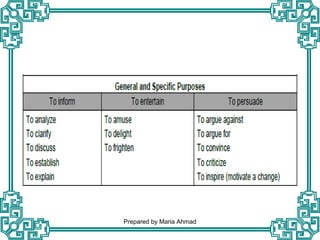
5. Bias (political, personal,
organizational, racial, ethical, religious)
5. Summarise the main points of the
text in your own world
6. Identify the tone of the text.
7. State the purpose of the article
Explain your choice of purpose by
quoting words, phrases from the
text to support your choice.
To entertain
To inform
To persuade
To examine/explore an issue
To describe/report
To instruct
8. Linguistic Analysis of the Text
Prepared by Maria Ahmad
NEWS HEADLINES
&
STAND FIRSTS
 A headline is artful phrasing that informs
and entices in just a few words.
 Stand First is a short summary of a
newspaper story or an article that appears
between the headline and the start of the
story or article
Prepared by Maria Ahmad
Examples
Wills in a wedding snub to the stars
PRINCE William and Kate Middleton are to snub celebs
hoping for invites to their wedding
Get cabin crew job, blow up B.A. plane
A BRITISH Airways worker was given secret orders from a
terror chief urging him to get a cabin crew job so he could blow
up a US-bound jet, a court heard yesterday.
Prepared by Maria Ahmad
Genres in Print Media
1. Books
2. Broadsheets
3. Handbills
4. News books
5. Journals & Magazine
6. Intelligencers
7. Pamphlets
8. Newspapers
Prepared by Maria Ahmad
Genres in Newspapers
1. Hard news stories
2. Columns
3. Features
4. Editorial Page
5. Comics
6. Advertisements
7. Cutlines
8. Letter to the editors
9. Headlines
Prepared by Maria Ahmad
Main Features of Newspaper writing
genres
Hard news stories
1.Inverted pyramid structure;
5 Ws and H (Who, What,
When, Where, Why and How)
in lead, other details in
descending order of
importance
2.Adheres to accepted
grammatical conventions
3.Written by reporters
4.Objective, facts-only
reporting
5.Purpose is to inform
Columns
1. Personal writing style
2. Uses accepted grammatical
conventions except where
columnists would find the
message more effective
otherwise
3. Written by columnists, either
newspaper staff or
syndicated; usually identified
with photograph
4. Purpose is to advise,
entertain, analyse, interpret
or commentPrepared by Maria Ahmad
Main Features of Newspaper writing
genres
Editorial page
1.Written in essay form
2.Adheres to accepted
grammatical conventions
3. Written by editorial page staff
4. Presents the opinions of the
newspaper’s editorial board
5. Purpose is to persuade,
comment and provoke thought
Features
1. Personal writing style
2. Adheres to accepted
grammatical conventions
3. Written by reporters
4. Reporting of facts, with
interpretations often included;
result of extensive research;
longer than hard news story
5. Purpose is to inform and
explain
Prepared by Maria Ahmad
Main Features of Newspaper writing
genres
Comics
1.Very brief, often dialogue only
2. Not necessarily grammatically
correct; slang often appears
3. Written by cartoonists from
newspapers or syndicates
4. Purpose is to entertain and
comment, sometimes on
political issues
Advertisements
1. Brief, descriptive
2. Not necessarily grammatically
correct
3. Written by professional
services or ad staff
4. Purpose is to persuade and
inform about services and
products
Prepared by Maria Ahmad
Main Features of Newspaper writing
genres
Cutlines
1.Brief; maximum a few
sentences
2.Not necessarily grammatically
correct
3.Written by copy editors
4.Contain facts related to
photos/illustrations or
accompanying stories
5. Purpose is to inform
Letters to the editor
1. Letter; essay form
2. Should be grammatically
correct
3. Written by newspaper readers
4. Reader’s opinion expressed
5. Purpose is to provide forum for
readers’ comments
Prepared by Maria Ahmad
Main Features of Newspaper writing
genres
 Headlines
1.Brief; descriptive
2.Not complete sentences
3.Written by copy editors
4.Purpose to attract reader and inform
Prepared by Maria Ahmad
ELABORATION
 Read the given news and elaborate the information given:
 Iraq crisis: 'At least 50 killed' in wave of terrorist attacks across Baghdad
 At least 50 people have been killed and many wounded in a wave of bomb
attacks on Baghdad bearing the hallmarks of Isis. The Islamist group, which
controls several major cities and towns surrounding the Iraqi capital, has
claimed responsibility for the most deadly attack in the Dawlai district.
 Two car bombs exploded simultaneously in a shopping area, killing between 14
and 16 civilians and wounding more than 30 others, according to varying
reports. Also on Thursday, a suicide bomber rammed a car laden with
explosives into a police checkpoint in the eastern suburb of Talibiyah at
2.30pm, killing at least 12 people, a police officer said. Seven policemen and
five civilians were among those killed, he added, and at least 28 other people
were wounded. An hour later, five mortar rounds hit the Shia district of al-
Shaoula, killing another five and wounding 21 others.
Prepared by Maria Ahmad
 Read the news and answer the following
questions.
1.What was happened?
2.When did it happen?
3.Where did it happen?
4.Who was responsible for this happening?
5.Why did it happen?
Prepared by Maria Ahmad
Supporting comments,
propositions and opinions
1. Quotes
2. Statistical data
3. Pictorial depictions
Prepared by Maria Ahmad
Britain's migrating birds are
declining in number
Prepared by Maria Ahmad
Facts, opinions and
biases
Prepared by Maria Ahmad
Fact
1. Fact is a testable proposition
2. It represents things which actually exist or
which have happened in the past; they can
be verified as true or false
ex. Wahaj is wearing a hat.
Prepared by Maria Ahmad
Opinion
 An opinion is an interpretation, value
judgment, or belief that cannot be proved or
disproved. An opinion is created.
 Ex. Wahaj is wearing an awkward hat
Prepared by Maria Ahmad
Fact Vs. Opinion
Prepared by Maria Ahmad
Bias
 A bias is when you are partial to something
over something else. When people do not
look at both sides of a question, they are
considered biased.
 Example: Say you like Coke over Pepsi. If you
were somewhere, and wanted a soda and they only
had Pepsi and you decided to drink water instead
you would be showing your bias towards Coke.
Prepared by Maria Ahmad
An opinion can often be identified
because the sentence contains biased
words. Biased words express
opinions, value judgments, and
interpretations. Often they are full
of emotion.
awful
amazing
bad
beautiful
best
better
disgusting
exciting
favorite
frightful
fun
good
great
handsom
e
horrible
miserable
more
most
smart
stupid
terrible
unbelieva
ble
ugly
very
Prepared by Maria Ahmad
Sometimes an author will use words that
qualify an idea. A qualifier may
express an absolute, unwavering
opinion using words like always or
never. Other times a qualifier
expresses opinion in the form of a
command as in must or should.
all
always
appear
believe
could
likely
may
might
must
it is
believed
never
often
only
ought to
has/have
to
possibly
possible
probably
seem
every
should
sometime
s
think
usually
Prepared by Maria Ahmad
Identify Facts and
Opinions
 1 Alexander III, more commonly known as
Alexander the Great, was one of the
greatest military leaders in world history. 2
He was born in Pella, Macedonia. 3 The
exact date of his birth was probably July 20
or 26, 356 B.C. 4 Shortly before his 33rd
birthday, Alexander the Great died. 5 The
cause of his death remains unknown.
Prepared by Maria Ahmad
Biases in Media text
Media is not always completely honest and objective
about their depiction of important issues. Certain
issues are made to look a certain way to benefit a
certain group and influence public opinion.
In media there are many factors that make it bias.
These factors are related to:
Ethnicity
Race
Social class
Religion and sect
Political views
Prepared by Maria Ahmad
Types of Biases in Media
1. Bias through selection and omission
2. Bias through placement
3. Bias by Headline
4. Bias by Word Choice and Tone
5. Bias by Photo, Captions and Camera angles
6. Bias through use of names and titles
7. Bias through statistics and crowd counts
8. Bias by source control
Prepared by Maria Ahmad
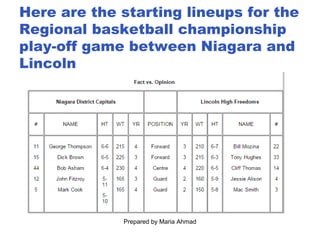
Here are the starting lineups for the
Regional basketball championship
play-off game between Niagara and
Lincoln
Prepared by Maria Ahmad
Below are some statements about the game at Lincoln. Some
are facts - statements that can be proven true. Others are
opinions - statements that cannot be proven true.
Can you determine which are facts and which are opinions?
Look carefully at the statements and the starting lineups.
Write an "F" in front of those statements that are facts. Write
an "O" in front of those that are opinion.
___ 1. Bill Mozina is the tallest player in the game.
___ 2. Niagara's players are experienced.
___ 3. Forwards for the Capitals will be Crich, Tieche and
Cuthbert.
___ 4. The Freedoms are the greatest!
___ 5. The forwards on both teams are taller than the
guards.
___ 6. Lincoln should have more fans than Niagara.
___ 7. Player against player, the Freedoms have the edge.Prepared by Maria Ahmad
Task 1
Prepared by Maria Ahmad
Identifying Tone of the
TextTone is the author’s attitude toward the topic.
 The author’s attitude is expressed through the words and details he
or she selects. To determine the author’s tone, you must notice how
these words and details are used within the writing.
 The objective tone: is matter-of-fact and neutral. It does not show
any feelings for or against a topic; therefore, it is unbiased or neutral.
Often objective tone uses higher level words and avoids pronouns
such as I and you, creating a formal tone.
 A subjective tone: uses words that describe feelings, judgments, or
opinions. The details are likely to include experiences, senses,
feelings, and thoughts, so it is personal, biased, emotional, and often
informal.
  Prepared by Maria Ahmad
The following statements each express different attitudes
about a shabby apartment. Six different tones are used:
optimistic, bitter, tolerant, sentimental, humorous, and
objective.
 1. This place may be shabby, but since both of my children were born while
we lived here, it has a special place in my heart.
 The tone is sentimental. “It has a special place in my heart,” expresses
tender emotions.
 2. This isn’t the greatest apartment in the world, but it’s not really that bad.
 The tone is tolerant. The words “not really that bad” show that the
writer accepts the situation while recognizing that it could be better.
 3. If only there were some decent jobs out there, I wouldn’t be reduced to
living in this miserable dump.
 The tone is bitter. The writer resents a situation that forces him or her
to live in a “miserable dump.”Prepared by Maria Ahmad
 4. This place does need some repairs, but I’m sure the landlord will
be making improvements sometime soon.
 The tone is optimistic. The writer is expecting the apartment to
be improved soon.
 5. When we move away, we’re planning to release three hundred
cockroaches and tow mice, so we can leave the place exactly as we
found it.
The tone is humorous. The writer claims to be planning a comic
revenge on the landlord by returning the apartment to the
terrible condition it was in when the tenants moved in.
 6. This is the apartment we live in. It provides shelter.
 The tone is objective. The writer does not express feelings
about the apartment. He simply states facts
Prepared by Maria Ahmad
Identifying Purpose of
The text
 An author writes to share a main idea about a topic. An
author’s main idea is directly related to the author’s purpose.
One of the three following purposes will drive a main idea: to
inform, to entertain, and to persuade.
Prepared by Maria Ahmad
 To find out the author’s purpose, the reader must
consider the main idea, thought pattern, and tone. For
example:
 Topic Sentence: Spanking must be avoided as a way to discipline due to
its long-term negative effects on the child.
 Consider what the author is going to write about spanking.
  Is the author going to discuss the disadvantages of spanking?
  Is the author going to argue against spanking as a means of discipline?
  Is the author going to make fun of those who use spanking as a means of
discipline?
 The tone words „must and „negative indicate the author s point of view is‟ ‟ ‟
against spanking. The phrase “long-term effects” indicates that the details will
be organized as a list of effects.
 We can conclude that the author is going to argue against spanking as a
means of discipline.
Prepared by Maria Ahmad
Practice Activities
Prepared by Maria Ahmad
Linguistic Analysis of the
Media Text
1. Analysis at Word and phrase level
2. Analysis at Sentence Level
3. Analysis at paragraph Level
4. Analysis for words choice
Prepared by Maria Ahmad
Analysis at word and phrase level
1. Use of Verb & Verb Phrase
a)Tense b) Aspect c)Voice d)Mood
2. Use of Noun Phrase
3. Use of Adjectives
4. Use of Numerals
5. Use of Foreign Words
6. Use of Idioms and proverbs
Prepared by Maria Ahmad
Analysis at Sentence Level
1. Sentence Types Used
a)Declarative
b)Interrogative
c)Imperatives
d)Exclamatory
2. Sentence Structures
a)Simple Sentences
b)Complex Sentence
c)Compound Sentence
d)Compound-Complex Sentence
3. Deviation from Grammatical rules
Prepared by Maria Ahmad
Analysis at Paragraph Level
 1. Use of Rhetorical Patterns in Text
(Compare/contrast, Cause/effect,
Problem/solution, Fact/opinion, Theory/evidence)
 2. Intertextuality
 3. Use of Rhetorical Devices in Text (Alliteration,
Simile, Analogy, Metaphor, Irony etc.)
Prepared by Maria Ahmad
Analysing the Text for Word Choice
1. Quote 10 words from the text, which
are unfamiliar to you. Look for their
meaning and usage from dictionary
and write.
2. Quote 10 collocations from the text.
Prepared by Maria Ahmad
Analysis at Word Level
Prepared by Maria Ahmad
Main Parts Of Speech
1. Nouns
2. Articles
3. Adjective
4. Pronouns
5. Verbs
6. Adverbs
7. Preposition
8. Conjunctions
9. interjections
Prepared by Maria Ahmad
Parts of speech table
part of speech function or "job" example words example sentences
Verb action or state
)to) be, have, do, like,
work, sing, can, must
EnglishClub is a web site.
I am learning English
Noun thing or person
pen, dog, work, music,
town, , teacher, John
This is my dog.
He lives in my house.
Adjective describes a noun
a/an, the, 90, some, good,
big, red, well, interesting
My like eating big, red apple
Adverb describes a verb, adjective
or adverb
quickly, silently, well,
badly, very, really
I eat quickly. When he is very
hungry, he eats really quickly.
Pronoun replaces a noun I, you, he, she, some …is Indian. She is dark.
Preposition links a noun to another
word
to, at, after, on, but
We went to school on
Monday.
Conjunction joins clauses or sentences
or words
and, but, when
I like reading news and
articles, but I do not read
reviews.
Interjection
short exclamation,
sometimes inserted into a
sentence
oh!, ouch!, hi!, well
Ouch! That hurts! Hi! How
are you? Well, I don't know.
Prepared by Maria Ahmad
Noun
 A noun is a word used to name something: a person/animal,
 a place, a thing, or an idea. For example, all of the following are nouns.
 Ex.
 Lara, Adil, Linda, Mahrukh
 Japan, Venezuela, Atlanta, Kroger, the Gap
 pencil, store, music, air
 biology, theory of Relativity, Pythagorean theory
 Noun can be:
 1. Singular or Plural
 2. Countable or Uncountable
 3. Common or Proper
 4. Abstract or Concrete
 5. Collective
Prepared by Maria Ahmad
Verbs
 Verbs tell what action a subject is
performing
1.Can show physical action (marched, mailed)
2.Can show mental action or ownership
(thought, has)
3.Can show an occurrence (became)
4.Can show a state of being (was)
Prepared by Maria Ahmad
Verb or verb phrases in a sentence
Changes to indicate:
1. Either the subject of the verb is singular or plural
2. Either the subject of the verb is doing an action or
receiving the action (Voice)
3. The person of the pronoun which is acting as its
subject
4. The time of action and patterns of action (Tense
and Aspect)
5. Modality ( likelihood, ability, permission, and
obligation)
Prepared by Maria Ahmad
Classification of Verbs
1. Action Verbs
2. Helping Verbs
3. Linking Verbs
4. Verbals
Prepared by Maria Ahmad
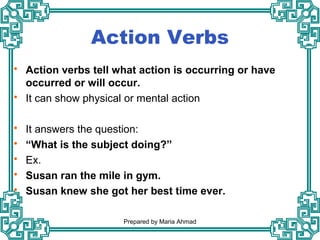
Action Verbs
 Action verbs tell what action is occurring or have
occurred or will occur.
 It can show physical or mental action
 It answers the question:
 “What is the subject doing?”
 Ex.
 Susan ran the mile in gym.
 Susan knew she got her best time ever.
Prepared by Maria Ahmad
Helping Verbs
 Helping verbs have no meaning by themselves and work
with a main verb to help you understand when and how
action is taking place.
 There could be up to three helping verbs in a sentence.
Ex.
1. Ali will run the mile in gym.
2. Other migrant birds that spend winter in Africa, such as
cuckoos and spotted flycatchers, are being found in the
UK.
Prepared by Maria Ahmad
Common Helping Verbs
Prepared by Maria Ahmad
Linking Verbs
 Linking verbs do not show an action or do anything, they
show a relationship. It links the subject of the sentence with
a noun or an adjective in the predicate
 Ex.
 1. Monday Mornings are usually very busy.
 subject Links adjective
 2. He is an intelligent boy
Prepared by Maria Ahmad
Two Types of Linking
verbs
 To “be” Linking Verbs
 Is, am, are, was, were,
be, being, been
 Sensory Linking Verbs
 Look, smell, sound,
taste, feel, appear,
become, seem, grow,
remain, stay
Prepared by Maria Ahmad
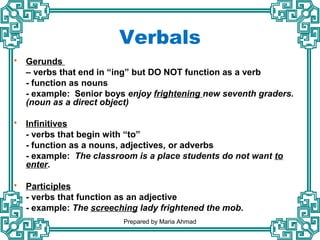
 Gerunds
– verbs that end in “ing” but DO NOT function as a verb
- function as nouns
- example: Senior boys enjoy frightening new seventh graders.
(noun as a direct object)
 Infinitives
- verbs that begin with “to”
- function as a nouns, adjectives, or adverbs
- example: The classroom is a place students do not want to
enter.
 Participles
- verbs that function as an adjective
- example: The screeching lady frightened the mob.
Verbals
Prepared by Maria Ahmad
Identify the verbals in the given sentences
1. The plan accepted by the mayor involved a tax cut.
2. Pat expected the paper airplane to fly.
3. Feeling dizzy, Hamid stopped and took a break.
4. The weight of the sack made it difficult to carry.
5. My uncle from Michigan enjoys swimming.
6. The squeaking wheel alerted the mechanic to a potential problem.
7. Getting up early in the morning is sometimes a challenge.
8. We bought a new wrench to fix the leaky valve.
9. The forgotten treasure lay at the bottom of the sea for three
hundred years.
10. Fascinated, Salman stood and admired the mural for several
hours.
Prepared by Maria Ahmad
Identifying Action Verbs and Linking Verbs. In the following
sentences, underline each verb. Then write "A" for action or
"L" for linking. Example:
 1. Joe cooked dinner for the family. _____
 2. The boy seemed restless after the long program. ______
 3. The popcorn smells good. _____
 4. We stayed quiet for an hour after dinner. _____
 5. The pizza tastes good. _____
 6. Eve was CR of her graduating class. _____
 7. The boys appear calm again after all the excitement. _____
 8. I play the piano an hour every day. _____
 9. The audience grew quiet. _____
 10. The boys feel tired after their long hike. _____
Prepared by Maria Ahmad
Phrases and Clauses
 Phrases and clauses are groups of related
words that serve as building blocks of
sentences on a larger scale than parts of
speech.
 A clause contains both a subject and a verb
whereas a phrase does not. errors.
Prepared by Maria Ahmad
Phrases
 a phrase is a group of closely related words. This group of
words makes some sense together, although it does not
express a complete thought.
 A phrase is a fragment, or part of a complete thought.
 Ex.
1. Our friends have bought a house in the village.
2. Those houses are very expensive.
3. Our closest friends have just bought a new house in the village.
Prepared by Maria Ahmad
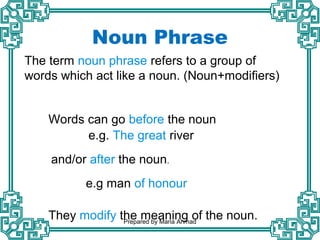
The term noun phrase refers to a group of
words which act like a noun. (Noun+modifiers)
Words can go before the noun
e.g. The great river
e.g man of honour
and/or after the noun.
They modify the meaning of the noun.
Noun Phrase
Prepared by Maria Ahmad
Verb Phrase
 Verb phrase carries information about mood, tense, modality,
aspect, and voice
 The verb phrase has two functional parts,
 the auxiliary, a grammatical structure carrying information about
mood, tense, modality, and voice
 the main verb, a structure giving information about the action or
state of the subject
Prepared by Maria Ahmad
Underline the verb phrase in each sentence. Include
main verbs and helping verbs
 1. The colonists would build a home as quickly as possible.
 2. Wood from nearby forests was used for their homes.
 3. In later years, some houses were made of brick.
 4. Poor settlers could make their furniture from the many trees of the
forest.
 5. Wealthy families could order fancy furniture from England.
 6. The colonists may have brought some tools and household items
with them. 7. They did eat some new foods, such as corn.
 8. Most colonists would wear rough, homemade clothing called
homespun.
 9. Adults and children did like games and contests.
 10. Sometimes, they might fly a kite.
Prepared by Maria Ahmad
Writing Using Verb Phrases Use at least
three of the following verb phrases in a
story.
Prepared by Maria Ahmad
Prepositional Phrase
 a prepositional phrase will begin with a preposition and end with a
noun, pronoun,gerund, or clause, the "object" of the preposition. It
basically act as an adjective or as an adverb in a sentence.
 Common patterns for a prepositional phrase:
 PREPOSITION + NOUN, PRONOUN, GERUND, OR CLAUSE
 PREPOSITION + MODIFIER(S) + NOUN, PRONOUN, GERUND, OR
CLAUSE
 Ex.
 From my grandmother
 Under the warm blanket
 In the weedy, overgrown garden
 Along the busy, six-lane highway
 Without excessively worrying
Prepared by Maria Ahmad
Directions: Circle all the prepositional phrases in the
following sentences
 1. After the movie the group of teenagers went to McDonalds for a
burger.
 2. Without sugar the blueberries were too sour for the dinner guests.
 3. Sally worked from midnight to noon on her science project.
 4. He ate three boxes of popcorn with butter during the movie.
 5. Janet took her lunch with her to the seminar..
Prepared by Maria Ahmad
Appositive Phrase
 A noun phrase that renames the noun it
follows. Also known as a parenthetical phrase
 Example:
 Brad Ruff, the grammar guru, empowers teachers.
Appositive phrase?
- the grammar guru
Prepared by Maria Ahmad
Clauses
• A clause is a group of words with a
 subject and a verb.
1. since she laughs at the bad jock
2. I despise individuals of low character
3. when the graduates go marching in
4. because he smiled at him.
5. Rabit runs
Prepared by Maria Ahmad
Types of Clauses
There are two types of clauses:
independent and dependent.
1.An independent clause, or main clause, is a
subject/verb combination that makes a complete
sentence.
2.A dependent clause cannot stand alone, and must
be attached to an independent clause.
Prepared by Maria Ahmad
A Complete Sentences
1. Subject
2. Predicate
3. Punctuation
4. A complete thought
Ex. The College is upgrading to university.
Two major parts of a sentence
Prepared by Maria Ahmad
Subjects
A subject may be
1. A single noun Ex. College is upgrading
2. A noun phrase Ex. The language center will improve your English
3. A pronoun Ex. It is open from Monday to Friday.
4. Two or more nouns, noun phrases or pronouns Ex. Ali, Salman
and I will do this tomorrow.
5. A gerund (verb + -ing) Ex. Online learning is a good option.
6. An infinitive (To + verb) Ex. To err is human
7. .
Prepared by Maria Ahmad
Sample News
Prepared by Maria Ahmad
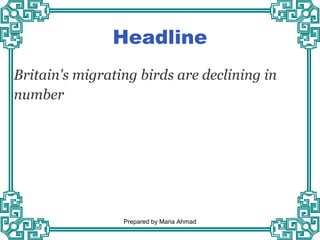
Headline
Britain's migrating birds are declining in
number
Prepared by Maria Ahmad
Introduction or Stand-first
Fewer birds, including nightingales and
cuckoos, are migrating between Europe
and Africa due to combined factors of
habitat loss, hunting and climate change
Prepared by Maria Ahmad
Good Luck with your
analysis assignment!!!
Prepared by Maria Ahmad

Media text analysis

  • 1.
    Linguistic AnalysisLinguistic Analysis ofof MediaTextMedia Text English for Journalists Prepared by Maria Ahmad
  • 2.
    Objectives of thesession After this session students will be able to: 1.Understand the basic concepts of Grammar in English, which they need to analyse the language used in English print Media. 2.Describe different rhetorical features used in media texts 3.Analyze English different genres of journalistic writing from different English newspapers and from different beats for the use of English Language Prepared by Maria Ahmad
  • 3.
    Overview of thesession 1. Discussion on the framework for Text Analysis 2. Revision of all the grammatical terms and concepts, which students need for the linguistic analysis of the text 3. Discussion over the concept of Rhetorical devices and rhetorical functions in a text Prepared by Maria Ahmad
  • 4.
    Framework for Text Analysis Readthe Text and Note down the following Features 1. Headline 2.Introduction or Stand-first 3.Genre of journalistic writing 3. Elaboration (What, When, Where, Who, Why) 4. Quotes, pictorial, graphic or statistical support 5. Bias (political, personal, organizational, racial, ethical, religious) 5. Summarise the main points of the text in your own world 6. Identify the tone of the text. 7. State the purpose of the article Explain your choice of purpose by quoting words, phrases from the text to support your choice. To entertain To inform To persuade To examine/explore an issue To describe/report To instruct 8. Linguistic Analysis of the Text Prepared by Maria Ahmad
  • 5.
    NEWS HEADLINES & STAND FIRSTS A headline is artful phrasing that informs and entices in just a few words.  Stand First is a short summary of a newspaper story or an article that appears between the headline and the start of the story or article Prepared by Maria Ahmad
  • 6.
    Examples Wills in awedding snub to the stars PRINCE William and Kate Middleton are to snub celebs hoping for invites to their wedding Get cabin crew job, blow up B.A. plane A BRITISH Airways worker was given secret orders from a terror chief urging him to get a cabin crew job so he could blow up a US-bound jet, a court heard yesterday. Prepared by Maria Ahmad
  • 7.
    Genres in PrintMedia 1. Books 2. Broadsheets 3. Handbills 4. News books 5. Journals & Magazine 6. Intelligencers 7. Pamphlets 8. Newspapers Prepared by Maria Ahmad
  • 8.
    Genres in Newspapers 1.Hard news stories 2. Columns 3. Features 4. Editorial Page 5. Comics 6. Advertisements 7. Cutlines 8. Letter to the editors 9. Headlines Prepared by Maria Ahmad
  • 9.
    Main Features ofNewspaper writing genres Hard news stories 1.Inverted pyramid structure; 5 Ws and H (Who, What, When, Where, Why and How) in lead, other details in descending order of importance 2.Adheres to accepted grammatical conventions 3.Written by reporters 4.Objective, facts-only reporting 5.Purpose is to inform Columns 1. Personal writing style 2. Uses accepted grammatical conventions except where columnists would find the message more effective otherwise 3. Written by columnists, either newspaper staff or syndicated; usually identified with photograph 4. Purpose is to advise, entertain, analyse, interpret or commentPrepared by Maria Ahmad
  • 10.
    Main Features ofNewspaper writing genres Editorial page 1.Written in essay form 2.Adheres to accepted grammatical conventions 3. Written by editorial page staff 4. Presents the opinions of the newspaper’s editorial board 5. Purpose is to persuade, comment and provoke thought Features 1. Personal writing style 2. Adheres to accepted grammatical conventions 3. Written by reporters 4. Reporting of facts, with interpretations often included; result of extensive research; longer than hard news story 5. Purpose is to inform and explain Prepared by Maria Ahmad
  • 11.
    Main Features ofNewspaper writing genres Comics 1.Very brief, often dialogue only 2. Not necessarily grammatically correct; slang often appears 3. Written by cartoonists from newspapers or syndicates 4. Purpose is to entertain and comment, sometimes on political issues Advertisements 1. Brief, descriptive 2. Not necessarily grammatically correct 3. Written by professional services or ad staff 4. Purpose is to persuade and inform about services and products Prepared by Maria Ahmad
  • 12.
    Main Features ofNewspaper writing genres Cutlines 1.Brief; maximum a few sentences 2.Not necessarily grammatically correct 3.Written by copy editors 4.Contain facts related to photos/illustrations or accompanying stories 5. Purpose is to inform Letters to the editor 1. Letter; essay form 2. Should be grammatically correct 3. Written by newspaper readers 4. Reader’s opinion expressed 5. Purpose is to provide forum for readers’ comments Prepared by Maria Ahmad
  • 13.
    Main Features ofNewspaper writing genres  Headlines 1.Brief; descriptive 2.Not complete sentences 3.Written by copy editors 4.Purpose to attract reader and inform Prepared by Maria Ahmad
  • 14.
    ELABORATION  Read thegiven news and elaborate the information given:  Iraq crisis: 'At least 50 killed' in wave of terrorist attacks across Baghdad  At least 50 people have been killed and many wounded in a wave of bomb attacks on Baghdad bearing the hallmarks of Isis. The Islamist group, which controls several major cities and towns surrounding the Iraqi capital, has claimed responsibility for the most deadly attack in the Dawlai district.  Two car bombs exploded simultaneously in a shopping area, killing between 14 and 16 civilians and wounding more than 30 others, according to varying reports. Also on Thursday, a suicide bomber rammed a car laden with explosives into a police checkpoint in the eastern suburb of Talibiyah at 2.30pm, killing at least 12 people, a police officer said. Seven policemen and five civilians were among those killed, he added, and at least 28 other people were wounded. An hour later, five mortar rounds hit the Shia district of al- Shaoula, killing another five and wounding 21 others. Prepared by Maria Ahmad
  • 15.
     Read thenews and answer the following questions. 1.What was happened? 2.When did it happen? 3.Where did it happen? 4.Who was responsible for this happening? 5.Why did it happen? Prepared by Maria Ahmad
  • 16.
    Supporting comments, propositions andopinions 1. Quotes 2. Statistical data 3. Pictorial depictions Prepared by Maria Ahmad
  • 17.
    Britain's migrating birdsare declining in number Prepared by Maria Ahmad
  • 18.
  • 19.
    Fact 1. Fact isa testable proposition 2. It represents things which actually exist or which have happened in the past; they can be verified as true or false ex. Wahaj is wearing a hat. Prepared by Maria Ahmad
  • 20.
    Opinion  An opinionis an interpretation, value judgment, or belief that cannot be proved or disproved. An opinion is created.  Ex. Wahaj is wearing an awkward hat Prepared by Maria Ahmad
  • 21.
  • 22.
    Bias  A biasis when you are partial to something over something else. When people do not look at both sides of a question, they are considered biased.  Example: Say you like Coke over Pepsi. If you were somewhere, and wanted a soda and they only had Pepsi and you decided to drink water instead you would be showing your bias towards Coke. Prepared by Maria Ahmad
  • 23.
    An opinion canoften be identified because the sentence contains biased words. Biased words express opinions, value judgments, and interpretations. Often they are full of emotion. awful amazing bad beautiful best better disgusting exciting favorite frightful fun good great handsom e horrible miserable more most smart stupid terrible unbelieva ble ugly very Prepared by Maria Ahmad
  • 24.
    Sometimes an authorwill use words that qualify an idea. A qualifier may express an absolute, unwavering opinion using words like always or never. Other times a qualifier expresses opinion in the form of a command as in must or should. all always appear believe could likely may might must it is believed never often only ought to has/have to possibly possible probably seem every should sometime s think usually Prepared by Maria Ahmad
  • 25.
    Identify Facts and Opinions 1 Alexander III, more commonly known as Alexander the Great, was one of the greatest military leaders in world history. 2 He was born in Pella, Macedonia. 3 The exact date of his birth was probably July 20 or 26, 356 B.C. 4 Shortly before his 33rd birthday, Alexander the Great died. 5 The cause of his death remains unknown. Prepared by Maria Ahmad
  • 26.
    Biases in Mediatext Media is not always completely honest and objective about their depiction of important issues. Certain issues are made to look a certain way to benefit a certain group and influence public opinion. In media there are many factors that make it bias. These factors are related to: Ethnicity Race Social class Religion and sect Political views Prepared by Maria Ahmad
  • 27.
    Types of Biasesin Media 1. Bias through selection and omission 2. Bias through placement 3. Bias by Headline 4. Bias by Word Choice and Tone 5. Bias by Photo, Captions and Camera angles 6. Bias through use of names and titles 7. Bias through statistics and crowd counts 8. Bias by source control Prepared by Maria Ahmad
  • 28.
    Here are thestarting lineups for the Regional basketball championship play-off game between Niagara and Lincoln Prepared by Maria Ahmad
  • 29.
    Below are somestatements about the game at Lincoln. Some are facts - statements that can be proven true. Others are opinions - statements that cannot be proven true. Can you determine which are facts and which are opinions? Look carefully at the statements and the starting lineups. Write an "F" in front of those statements that are facts. Write an "O" in front of those that are opinion. ___ 1. Bill Mozina is the tallest player in the game. ___ 2. Niagara's players are experienced. ___ 3. Forwards for the Capitals will be Crich, Tieche and Cuthbert. ___ 4. The Freedoms are the greatest! ___ 5. The forwards on both teams are taller than the guards. ___ 6. Lincoln should have more fans than Niagara. ___ 7. Player against player, the Freedoms have the edge.Prepared by Maria Ahmad
  • 30.
    Task 1 Prepared byMaria Ahmad
  • 31.
    Identifying Tone ofthe TextTone is the author’s attitude toward the topic.  The author’s attitude is expressed through the words and details he or she selects. To determine the author’s tone, you must notice how these words and details are used within the writing.  The objective tone: is matter-of-fact and neutral. It does not show any feelings for or against a topic; therefore, it is unbiased or neutral. Often objective tone uses higher level words and avoids pronouns such as I and you, creating a formal tone.  A subjective tone: uses words that describe feelings, judgments, or opinions. The details are likely to include experiences, senses, feelings, and thoughts, so it is personal, biased, emotional, and often informal.   Prepared by Maria Ahmad
  • 32.
    The following statementseach express different attitudes about a shabby apartment. Six different tones are used: optimistic, bitter, tolerant, sentimental, humorous, and objective.  1. This place may be shabby, but since both of my children were born while we lived here, it has a special place in my heart.  The tone is sentimental. “It has a special place in my heart,” expresses tender emotions.  2. This isn’t the greatest apartment in the world, but it’s not really that bad.  The tone is tolerant. The words “not really that bad” show that the writer accepts the situation while recognizing that it could be better.  3. If only there were some decent jobs out there, I wouldn’t be reduced to living in this miserable dump.  The tone is bitter. The writer resents a situation that forces him or her to live in a “miserable dump.”Prepared by Maria Ahmad
  • 33.
     4. Thisplace does need some repairs, but I’m sure the landlord will be making improvements sometime soon.  The tone is optimistic. The writer is expecting the apartment to be improved soon.  5. When we move away, we’re planning to release three hundred cockroaches and tow mice, so we can leave the place exactly as we found it. The tone is humorous. The writer claims to be planning a comic revenge on the landlord by returning the apartment to the terrible condition it was in when the tenants moved in.  6. This is the apartment we live in. It provides shelter.  The tone is objective. The writer does not express feelings about the apartment. He simply states facts Prepared by Maria Ahmad
  • 34.
    Identifying Purpose of Thetext  An author writes to share a main idea about a topic. An author’s main idea is directly related to the author’s purpose. One of the three following purposes will drive a main idea: to inform, to entertain, and to persuade. Prepared by Maria Ahmad
  • 35.
  • 36.
     To findout the author’s purpose, the reader must consider the main idea, thought pattern, and tone. For example:  Topic Sentence: Spanking must be avoided as a way to discipline due to its long-term negative effects on the child.  Consider what the author is going to write about spanking.   Is the author going to discuss the disadvantages of spanking?   Is the author going to argue against spanking as a means of discipline?   Is the author going to make fun of those who use spanking as a means of discipline?  The tone words „must and „negative indicate the author s point of view is‟ ‟ ‟ against spanking. The phrase “long-term effects” indicates that the details will be organized as a list of effects.  We can conclude that the author is going to argue against spanking as a means of discipline. Prepared by Maria Ahmad
  • 37.
  • 38.
    Linguistic Analysis ofthe Media Text 1. Analysis at Word and phrase level 2. Analysis at Sentence Level 3. Analysis at paragraph Level 4. Analysis for words choice Prepared by Maria Ahmad
  • 39.
    Analysis at wordand phrase level 1. Use of Verb & Verb Phrase a)Tense b) Aspect c)Voice d)Mood 2. Use of Noun Phrase 3. Use of Adjectives 4. Use of Numerals 5. Use of Foreign Words 6. Use of Idioms and proverbs Prepared by Maria Ahmad
  • 40.
    Analysis at SentenceLevel 1. Sentence Types Used a)Declarative b)Interrogative c)Imperatives d)Exclamatory 2. Sentence Structures a)Simple Sentences b)Complex Sentence c)Compound Sentence d)Compound-Complex Sentence 3. Deviation from Grammatical rules Prepared by Maria Ahmad
  • 41.
    Analysis at ParagraphLevel  1. Use of Rhetorical Patterns in Text (Compare/contrast, Cause/effect, Problem/solution, Fact/opinion, Theory/evidence)  2. Intertextuality  3. Use of Rhetorical Devices in Text (Alliteration, Simile, Analogy, Metaphor, Irony etc.) Prepared by Maria Ahmad
  • 42.
    Analysing the Textfor Word Choice 1. Quote 10 words from the text, which are unfamiliar to you. Look for their meaning and usage from dictionary and write. 2. Quote 10 collocations from the text. Prepared by Maria Ahmad
  • 43.
    Analysis at WordLevel Prepared by Maria Ahmad
  • 44.
    Main Parts OfSpeech 1. Nouns 2. Articles 3. Adjective 4. Pronouns 5. Verbs 6. Adverbs 7. Preposition 8. Conjunctions 9. interjections Prepared by Maria Ahmad
  • 45.
    Parts of speechtable part of speech function or "job" example words example sentences Verb action or state )to) be, have, do, like, work, sing, can, must EnglishClub is a web site. I am learning English Noun thing or person pen, dog, work, music, town, , teacher, John This is my dog. He lives in my house. Adjective describes a noun a/an, the, 90, some, good, big, red, well, interesting My like eating big, red apple Adverb describes a verb, adjective or adverb quickly, silently, well, badly, very, really I eat quickly. When he is very hungry, he eats really quickly. Pronoun replaces a noun I, you, he, she, some …is Indian. She is dark. Preposition links a noun to another word to, at, after, on, but We went to school on Monday. Conjunction joins clauses or sentences or words and, but, when I like reading news and articles, but I do not read reviews. Interjection short exclamation, sometimes inserted into a sentence oh!, ouch!, hi!, well Ouch! That hurts! Hi! How are you? Well, I don't know. Prepared by Maria Ahmad
  • 46.
    Noun  A nounis a word used to name something: a person/animal,  a place, a thing, or an idea. For example, all of the following are nouns.  Ex.  Lara, Adil, Linda, Mahrukh  Japan, Venezuela, Atlanta, Kroger, the Gap  pencil, store, music, air  biology, theory of Relativity, Pythagorean theory  Noun can be:  1. Singular or Plural  2. Countable or Uncountable  3. Common or Proper  4. Abstract or Concrete  5. Collective Prepared by Maria Ahmad
  • 47.
    Verbs  Verbs tellwhat action a subject is performing 1.Can show physical action (marched, mailed) 2.Can show mental action or ownership (thought, has) 3.Can show an occurrence (became) 4.Can show a state of being (was) Prepared by Maria Ahmad
  • 48.
    Verb or verbphrases in a sentence Changes to indicate: 1. Either the subject of the verb is singular or plural 2. Either the subject of the verb is doing an action or receiving the action (Voice) 3. The person of the pronoun which is acting as its subject 4. The time of action and patterns of action (Tense and Aspect) 5. Modality ( likelihood, ability, permission, and obligation) Prepared by Maria Ahmad
  • 49.
    Classification of Verbs 1.Action Verbs 2. Helping Verbs 3. Linking Verbs 4. Verbals Prepared by Maria Ahmad
  • 50.
    Action Verbs  Actionverbs tell what action is occurring or have occurred or will occur.  It can show physical or mental action  It answers the question:  “What is the subject doing?”  Ex.  Susan ran the mile in gym.  Susan knew she got her best time ever. Prepared by Maria Ahmad
  • 51.
    Helping Verbs  Helpingverbs have no meaning by themselves and work with a main verb to help you understand when and how action is taking place.  There could be up to three helping verbs in a sentence. Ex. 1. Ali will run the mile in gym. 2. Other migrant birds that spend winter in Africa, such as cuckoos and spotted flycatchers, are being found in the UK. Prepared by Maria Ahmad
  • 52.
  • 53.
    Linking Verbs  Linkingverbs do not show an action or do anything, they show a relationship. It links the subject of the sentence with a noun or an adjective in the predicate  Ex.  1. Monday Mornings are usually very busy.  subject Links adjective  2. He is an intelligent boy Prepared by Maria Ahmad
  • 54.
    Two Types ofLinking verbs  To “be” Linking Verbs  Is, am, are, was, were, be, being, been  Sensory Linking Verbs  Look, smell, sound, taste, feel, appear, become, seem, grow, remain, stay Prepared by Maria Ahmad
  • 55.
     Gerunds – verbsthat end in “ing” but DO NOT function as a verb - function as nouns - example: Senior boys enjoy frightening new seventh graders. (noun as a direct object)  Infinitives - verbs that begin with “to” - function as a nouns, adjectives, or adverbs - example: The classroom is a place students do not want to enter.  Participles - verbs that function as an adjective - example: The screeching lady frightened the mob. Verbals Prepared by Maria Ahmad
  • 56.
    Identify the verbalsin the given sentences 1. The plan accepted by the mayor involved a tax cut. 2. Pat expected the paper airplane to fly. 3. Feeling dizzy, Hamid stopped and took a break. 4. The weight of the sack made it difficult to carry. 5. My uncle from Michigan enjoys swimming. 6. The squeaking wheel alerted the mechanic to a potential problem. 7. Getting up early in the morning is sometimes a challenge. 8. We bought a new wrench to fix the leaky valve. 9. The forgotten treasure lay at the bottom of the sea for three hundred years. 10. Fascinated, Salman stood and admired the mural for several hours. Prepared by Maria Ahmad
  • 57.
    Identifying Action Verbsand Linking Verbs. In the following sentences, underline each verb. Then write "A" for action or "L" for linking. Example:  1. Joe cooked dinner for the family. _____  2. The boy seemed restless after the long program. ______  3. The popcorn smells good. _____  4. We stayed quiet for an hour after dinner. _____  5. The pizza tastes good. _____  6. Eve was CR of her graduating class. _____  7. The boys appear calm again after all the excitement. _____  8. I play the piano an hour every day. _____  9. The audience grew quiet. _____  10. The boys feel tired after their long hike. _____ Prepared by Maria Ahmad
  • 58.
    Phrases and Clauses Phrases and clauses are groups of related words that serve as building blocks of sentences on a larger scale than parts of speech.  A clause contains both a subject and a verb whereas a phrase does not. errors. Prepared by Maria Ahmad
  • 59.
    Phrases  a phraseis a group of closely related words. This group of words makes some sense together, although it does not express a complete thought.  A phrase is a fragment, or part of a complete thought.  Ex. 1. Our friends have bought a house in the village. 2. Those houses are very expensive. 3. Our closest friends have just bought a new house in the village. Prepared by Maria Ahmad
  • 60.
    The term nounphrase refers to a group of words which act like a noun. (Noun+modifiers) Words can go before the noun e.g. The great river e.g man of honour and/or after the noun. They modify the meaning of the noun. Noun Phrase Prepared by Maria Ahmad
  • 61.
    Verb Phrase  Verbphrase carries information about mood, tense, modality, aspect, and voice  The verb phrase has two functional parts,  the auxiliary, a grammatical structure carrying information about mood, tense, modality, and voice  the main verb, a structure giving information about the action or state of the subject Prepared by Maria Ahmad
  • 62.
    Underline the verbphrase in each sentence. Include main verbs and helping verbs  1. The colonists would build a home as quickly as possible.  2. Wood from nearby forests was used for their homes.  3. In later years, some houses were made of brick.  4. Poor settlers could make their furniture from the many trees of the forest.  5. Wealthy families could order fancy furniture from England.  6. The colonists may have brought some tools and household items with them. 7. They did eat some new foods, such as corn.  8. Most colonists would wear rough, homemade clothing called homespun.  9. Adults and children did like games and contests.  10. Sometimes, they might fly a kite. Prepared by Maria Ahmad
  • 63.
    Writing Using VerbPhrases Use at least three of the following verb phrases in a story. Prepared by Maria Ahmad
  • 64.
    Prepositional Phrase  aprepositional phrase will begin with a preposition and end with a noun, pronoun,gerund, or clause, the "object" of the preposition. It basically act as an adjective or as an adverb in a sentence.  Common patterns for a prepositional phrase:  PREPOSITION + NOUN, PRONOUN, GERUND, OR CLAUSE  PREPOSITION + MODIFIER(S) + NOUN, PRONOUN, GERUND, OR CLAUSE  Ex.  From my grandmother  Under the warm blanket  In the weedy, overgrown garden  Along the busy, six-lane highway  Without excessively worrying Prepared by Maria Ahmad
  • 65.
    Directions: Circle allthe prepositional phrases in the following sentences  1. After the movie the group of teenagers went to McDonalds for a burger.  2. Without sugar the blueberries were too sour for the dinner guests.  3. Sally worked from midnight to noon on her science project.  4. He ate three boxes of popcorn with butter during the movie.  5. Janet took her lunch with her to the seminar.. Prepared by Maria Ahmad
  • 66.
    Appositive Phrase  Anoun phrase that renames the noun it follows. Also known as a parenthetical phrase  Example:  Brad Ruff, the grammar guru, empowers teachers. Appositive phrase? - the grammar guru Prepared by Maria Ahmad
  • 67.
    Clauses • A clauseis a group of words with a  subject and a verb. 1. since she laughs at the bad jock 2. I despise individuals of low character 3. when the graduates go marching in 4. because he smiled at him. 5. Rabit runs Prepared by Maria Ahmad
  • 68.
    Types of Clauses Thereare two types of clauses: independent and dependent. 1.An independent clause, or main clause, is a subject/verb combination that makes a complete sentence. 2.A dependent clause cannot stand alone, and must be attached to an independent clause. Prepared by Maria Ahmad
  • 69.
    A Complete Sentences 1.Subject 2. Predicate 3. Punctuation 4. A complete thought Ex. The College is upgrading to university. Two major parts of a sentence Prepared by Maria Ahmad
  • 70.
    Subjects A subject maybe 1. A single noun Ex. College is upgrading 2. A noun phrase Ex. The language center will improve your English 3. A pronoun Ex. It is open from Monday to Friday. 4. Two or more nouns, noun phrases or pronouns Ex. Ali, Salman and I will do this tomorrow. 5. A gerund (verb + -ing) Ex. Online learning is a good option. 6. An infinitive (To + verb) Ex. To err is human 7. . Prepared by Maria Ahmad
  • 71.
  • 72.
    Headline Britain's migrating birdsare declining in number Prepared by Maria Ahmad
  • 73.
    Introduction or Stand-first Fewerbirds, including nightingales and cuckoos, are migrating between Europe and Africa due to combined factors of habitat loss, hunting and climate change Prepared by Maria Ahmad
  • 74.
    Good Luck withyour analysis assignment!!! Prepared by Maria Ahmad