Memory Improvement
• Mnemonics (VIBGYOR, 4M, POSDC)
• Mind mapping/ Information Wheel/ Page
map / Concept web
• Loci (imagine a building)
• Number and letter peg system (rhymes)
• Stories
• Remembering names and faces (caricature)
• Chunking
Advanced Learning Methods
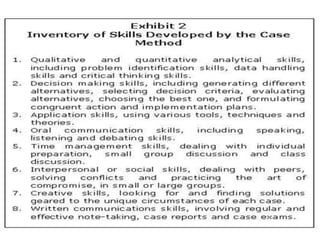
1.Case Study method
2.Role-play method
3.Simulation method
CASE STUDY METHOD
• Case studies ( or Learning by Doing ) :
This method was first developed in the 1880s by
Christopher Landgdell at Harward Law School to
help students to learn for themselves by
independent thinking.
CASE STUDY METHOD
The ‘case’ is a set of data (real or fictional),
written or oral miniature description and
summary of such data that present issues
and problems calling for given cases to
analyze, they are asked to identify the
problem and to recommend tentative
solutions for it.
Role play method
• Developed by Moreno, a Venetian psychiatrist.
• It is “a method of human interaction which
involves realistic behaviour in the imaginary
situations.”
• It’s experience demonstrates the gap between
‘thinking’, and ‘doing’. The idea of role-playing
involves “action, doing and practice.”
Simulation method
• It is “duplication of organizational
situation in a learning environment”.
• It is a mock-up of a real thing. This
technique is used for developing
technical interpersonal skills.
@MCEME-Lorry Driving/ rifle shooting
Simulation Contd..
PROCEDURE:
• Essential characteristics of a real-life organization or activity are
abstracted and presented as a case-not to be studied and analyzed
as in the usual case-study method but to be experienced by the
trainee as a realistic, life-like circumstance.
• Trainees are asked to assume various roles in the circumstance and
to solve the problem facing them. They are asked to be
themselves, not to act.
• A simulation often involves a telescopic or compressing of time
events; a single hour may be equated with a month or a quarter of
a year in real life, and many events are experienced in a relatively
brief period of time.
• Trainees are required to make decision that have a real effect in the
simulation and about which they receive rapid feedback.
• The simulation is followed by a critique of what went on during the
exercise.
How to analyze a Case
•Pl. wait and watch a
small Video on it.
•Record the notes from it.
• https://www.youtube.com/watch?v=eEYb2VRsWQU

Memory Improve Methods_ Case Study method

  • 1.
    Memory Improvement • Mnemonics(VIBGYOR, 4M, POSDC) • Mind mapping/ Information Wheel/ Page map / Concept web • Loci (imagine a building) • Number and letter peg system (rhymes) • Stories • Remembering names and faces (caricature) • Chunking
  • 2.
    Advanced Learning Methods 1.CaseStudy method 2.Role-play method 3.Simulation method
  • 3.
    CASE STUDY METHOD •Case studies ( or Learning by Doing ) : This method was first developed in the 1880s by Christopher Landgdell at Harward Law School to help students to learn for themselves by independent thinking.
  • 4.
    CASE STUDY METHOD The‘case’ is a set of data (real or fictional), written or oral miniature description and summary of such data that present issues and problems calling for given cases to analyze, they are asked to identify the problem and to recommend tentative solutions for it.
  • 6.
    Role play method •Developed by Moreno, a Venetian psychiatrist. • It is “a method of human interaction which involves realistic behaviour in the imaginary situations.” • It’s experience demonstrates the gap between ‘thinking’, and ‘doing’. The idea of role-playing involves “action, doing and practice.”
  • 7.
    Simulation method • Itis “duplication of organizational situation in a learning environment”. • It is a mock-up of a real thing. This technique is used for developing technical interpersonal skills. @MCEME-Lorry Driving/ rifle shooting
  • 8.
    Simulation Contd.. PROCEDURE: • Essentialcharacteristics of a real-life organization or activity are abstracted and presented as a case-not to be studied and analyzed as in the usual case-study method but to be experienced by the trainee as a realistic, life-like circumstance. • Trainees are asked to assume various roles in the circumstance and to solve the problem facing them. They are asked to be themselves, not to act. • A simulation often involves a telescopic or compressing of time events; a single hour may be equated with a month or a quarter of a year in real life, and many events are experienced in a relatively brief period of time. • Trainees are required to make decision that have a real effect in the simulation and about which they receive rapid feedback. • The simulation is followed by a critique of what went on during the exercise.
  • 9.
    How to analyzea Case •Pl. wait and watch a small Video on it. •Record the notes from it. • https://www.youtube.com/watch?v=eEYb2VRsWQU