Evaluation Question 1

     BY LIAT SHAMASH
Synaesthesia

 Andrew Goodwin in 1992 from ‘dancing in the distraction factory: music
    television and popular culture’ states that listeners and composers ‘see’
    or imagine images when music is heard.
    The concept is called Synaesthesia.


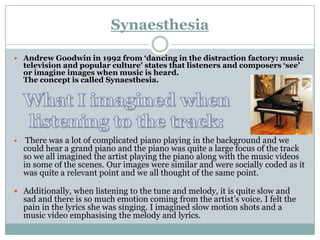
    There was a lot of complicated piano playing in the background and we
    could hear a grand piano and the piano was quite a large focus of the track
    so we all imagined the artist playing the piano along with the music videos
    in some of the scenes. Our images were similar and were socially coded as it
    was quite a relevant point and we all thought of the same point.

 Additionally, when listening to the tune and melody, it is quite slow and
    sad and there is so much emotion coming from the artist’s voice. I felt the
    pain in the lyrics she was singing. I imagined slow motion shots and a
    music video emphasising the melody and lyrics.
More of my thoughts when listening to the song...

 Furthermore, when focusing on the lyrics, I realised they were very detailed
  and told a story. The female artist is singing to this boy, it seemed like a love
  story and I imagined a very personal, natural and realistic music video. All the
  shots I imagined would have to be in places which were personal to the couple’s
  relationship maybe places they had been. I imagined scenes with the couple
  together and the girl telling the boy ‘you can tell them all that its over’ this
  would be the start of the break up scene ‘stand there and look into my eyes and
  tell me that all we had were lies’ I felt her pain and could imagine the girl
  singing to the boy wanting him to tell her he lied to make her leave.
  She says ‘I’ll stay if you prefer’ or she would leave ‘without a word’ I imagined
  the song would be a journey to tell the audience her story of what happened
  and the next part of her journey would be her leaving.
  We all had very similar ideas and they were socially coded as we all imagined
  she would be walking somewhere or getting a train or bus (probably running
  away)

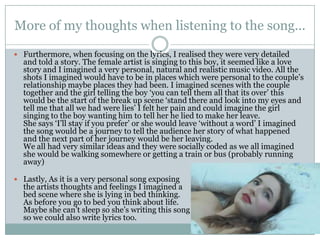
 Lastly, As it is a very personal song exposing
  the artists thoughts and feelings I imagined a
  bed scene where she is lying in bed thinking.
  As before you go to bed you think about life.
  Maybe she can’t sleep so she’s writing this song
  so we could also write lyrics too.
Mode of address

 Through the Digi-Pack, Website and music video I wanted to bring
  focus to the artist and the artist’s unique style and original songs.
 We also did not want to give everything away and explain to the
  audience. We wanted them to think for themselves and make their
  own judgements so it becomes more personal.
 From the post production research some of the
  storylines our audience thought of where:
  -girl leaving town after a break-up
  - girl singing her sorrows
  -girl wanting to commit suicide
  - girl leaving abusive relationship
  -lonely girl running away as boy did not show up
  <- all these are relevant and they all create their own personal
  judgements and it is along the storyline we created
 We wanted to invite the viewer into the music video and to conclude
  with them having questions like ‘what happened’ ‘What will happen
  to the girl’ ‘What will she do’ so we are inviting them to make
  their own verdicts.
Preferred reading

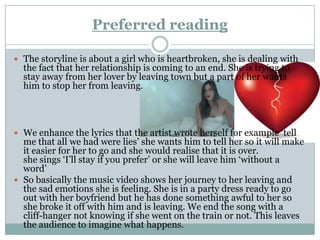
 The storyline is about a girl who is heartbroken, she is dealing with
  the fact that her relationship is coming to an end. She is trying to
  stay away from her lover by leaving town but a part of her wants
  him to stop her from leaving.


 We enhance the lyrics that the artist wrote herself for example ‘tell
  me that all we had were lies’ she wants him to tell her so it will make
  it easier for her to go and she would realise that it is over.
  she sings ‘I’ll stay if you prefer’ or she will leave him ‘without a
  word’
 So basically the music video shows her journey to her leaving and
  the sad emotions she is feeling. She is in a party dress ready to go
  out with her boyfriend but he has done something awful to her so
  she broke it off with him and is leaving. We end the song with a
  cliff-hanger not knowing if she went on the train or not. This leaves
  the audience to imagine what happens.
Type of Signs

 Symbolic: The significant symbol shows what’s being implied
  or represented
  e.g. red octagon could be the symbolic meaning to ‘stop’

  -Using a white bedroom and white dress and contrasting it with Red lipstick to
  highlight innocence and purity. Additionally some people might think of everything
  white as being in heaven and being an angel so her being in that room could
  symbolise how she is dead as she is heartbroken without her lover.
   -A symbolic location we used was the train station which highlights her journey.
  The girl does not get on a train straight away and we show her waiting around which
  shows how she is thinking. She is unsure is she should get on the train and run away
  from her problems.

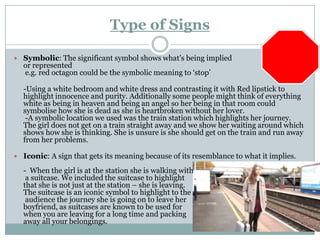
 Iconic: A sign that gets its meaning because of its resemblance to what it implies.

  - When the girl is at the station she is walking with
   a suitcase. We included the suitcase to highlight
  that she is not just at the station – she is leaving.
  The suitcase is an iconic symbol to highlight to the
   audience the journey she is going on to leave her
  boyfriend, as suitcases are known to be used for
  when you are leaving for a long time and packing
  away all your belongings.
Semiology

 Semiology is the deconstruction of the significance of images and words, the
  meaning of images and the relations the audience brings to the symbol. Ferdinand
  de Saussure describes Semiology as the science of signs in his ‘course on general
  linguistics’ (1916)
 Roland Barthes examines the Semiology of the image in ‘Mythologies’ 1973. He
  breaks down the myth into three sections like Saussure does.
  -The signifier – the associations
  -The signified – the meaning behind association
  -The sign – the signifier and the signified are intertwined in the shape you see
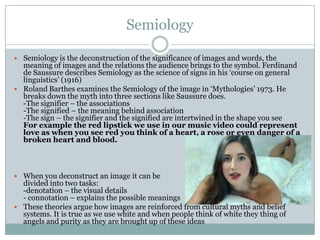
  For example the red lipstick we use in our music video could represent
  love as when you see red you think of a heart, a rose or even danger of a
  broken heart and blood.


 When you deconstruct an image it can be
  divided into two tasks:
  -denotation – the visual details
  - connotation – explains the possible meanings
 These theories argue how images are reinforced from cultural myths and belief
  systems. It is true as we use white and when people think of white they thing of
  angels and purity as they are brought up of these ideas
Interpellation

 Interpellation is an idea introduced by Louis Althusser.
  Interpellation explains the method in which ideas get into our
  heads and how effective it is on our lives. It’s so effective that
  our cultural information and ideas have such a hold on us that
  we believe they are our own. Interpellation is a development
  stage in which we come across our culture’s values and
  assume that they are true.
 We intended to interpellate our audience
   by making a broad narrative that the
  audience can create their own
  interpretation to what really is
  happening and going on. Therefore the
  ideas they create relate to their cultural
  ideas and values. Our music video is
  generally a love story and the audience
  interpellate the meaning of
   what happens in their own way.
Hegemony

 Hegemony is the leadership, control and authority
 Hegemony is when the values and beliefs of most powerful people in
  society dominate and influence the less powerful

 For the music video, digi-pac and website we could have created
  something like Rihanna and Beyonce where they clearly show the
  development of the relationship and the details of what happened.
  Beyonce and Rihanna are very powerful artists and have a
  big influence on audiences and other artists. However we
  did not want to make something so obvious and include lots
  of other characters. We were going against the idea that the
  values and beliefs of powerful people in society dominate
  the less powerful by going against the powerful people in
  society’s ideas. We did this by creating a very personal music video
  focusing on the music and the artist telling her story and how she
  felt. So the level of hegemony used in the meaning of our music
  video is very low.
Continuing Hegemony...

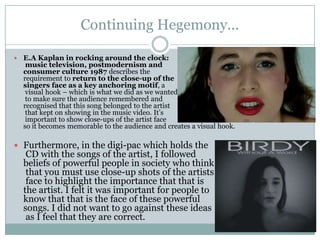
   E.A Kaplan in rocking around the clock:
     music television, postmodernism and
    consumer culture 1987 describes the
    requirement to return to the close-up of the
    singers face as a key anchoring motif, a
     visual hook – which is what we did as we wanted
     to make sure the audience remembered and
    recognised that this song belonged to the artist
     that kept on showing in the music video. It’s
     important to show close-ups of the artist face
    so it becomes memorable to the audience and creates a visual hook.

 Furthermore, in the digi-pac which holds the
     CD with the songs of the artist, I followed
    beliefs of powerful people in society who think
     that you must use close-up shots of the artists
     face to highlight the importance that that is
    the artist. I felt it was important for people to
    know that that is the face of these powerful
    songs. I did not want to go against these ideas
     as I feel that they are correct.
Looking at Laura Mulvey...

 ‘Visual pleasures and narrative cinema’ screen vol.16. no.3 1975 Laura
  Mulvey describes the concept of Scopophilia whereby films use images
  of women for the satisfaction of men. When a women stares at
  the camera it invites the male to ‘look’ at her. Therefore this
  objectifies women as sexual objects which are popular in music
  videos. These scopophilic hooks are used to offer a visual addiction to
  keep watching which creates an argument concerning sexism.


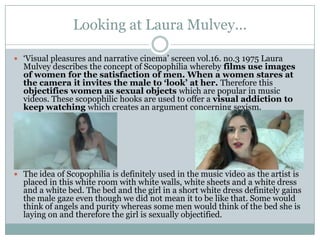
 The idea of Scopophilia is definitely used in the music video as the artist is
  placed in this white room with white walls, white sheets and a white dress
  and a white bed. The bed and the girl in a short white dress definitely gains
  the male gaze even though we did not mean it to be like that. Some would
  think of angels and purity whereas some men would think of the bed she is
  laying on and therefore the girl is sexually objectified.
Scopophilia

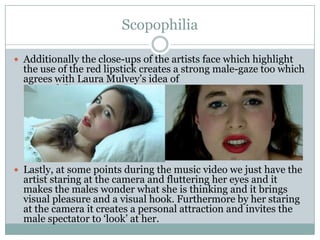
 Additionally the close-ups of the artists face which highlight
  the use of the red lipstick creates a strong male-gaze too which
  agrees with Laura Mulvey’s idea of
  Scopophilia.


 Lastly, at some points during the music video we just have the
  artist staring at the camera and fluttering her eyes and it
  makes the males wonder what she is thinking and it brings
  visual pleasure and a visual hook. Furthermore by her staring
  at the camera it creates a personal attraction and invites the
  male spectator to ‘look’ at her.
Pastiche

 We make reference to intertextuality by using pastiche in the music video.
  Pastiche is a piece of work that imitates the work of a previous artist. The
  music video reflects features of another genre for example our music video
  includes the genre of romance and mystery.
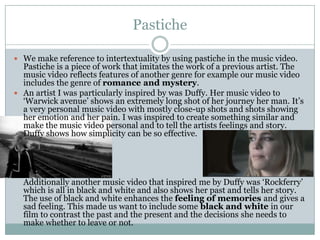
 An artist I was particularly inspired by was Duffy. Her music video to
  ‘Warwick avenue’ shows an extremely long shot of her journey her man. It’s
  a very personal music video with mostly close-up shots and shots showing
  her emotion and her pain. I was inspired to create something similar and
  make the music video personal and to tell the artists feelings and story.
  Duffy shows how simplicity can be so effective.


  Additionally another music video that inspired me by Duffy was ‘Rockferry’
  which is all in black and white and also shows her past and tells her story.
  The use of black and white enhances the feeling of memories and gives a
  sad feeling. This made us want to include some black and white in our
  film to contrast the past and the present and the decisions she needs to
  make whether to leave or not.
Elements of a music video – Andrew Goodwin
 Typical elements of a music video Andrew Goodwin has pinpointed:
  -personal imagery arising from the individual memories associated with the song
  -images associated with the song itself which may be conveyed through metaphors
  -images of musician
  -visual signifiers arising from national popular iconography
  -popular cultural signs associated with rock music which often link with a
  mythologized ‘America’

 elements we have included that Andrew Goodwin has pointed out are:
  - using the artist in the music video and many close-ups and images of the artist
  - making the music video broad and about love so audience can create their own
  associations and feelings and meanings towards the song.
  -we include images associated with the song and lyrics to tell the story of the lyrics.
  Birdy claims she’ll ‘leave without a word’ This is why we show her at a train station
  on her way to leave her boyfriend. We use a suitcase to highlight that she would be
  leaving for good.
  - We included shots of Birdy playing the piano and
  performing the song we felt it was important to not just
   have narrative but to also highlight that the song is
  sung by the artist performing it.
Typical of a music video...

 I include that I think are typical of a music video:
  -I felt lip synching was important and for the artist to stare into the camera
  as if singing to the audience so the audience receive a more personal
  experience and relate to the song more as they see her pain and emotion.
  -close-ups of artists face
  -Mise en scene having appropriate and relatable locations and clothing
  that suits the artist and props that are relevant and that enhance the lyrics.
  -making sure cuts fit in time with the music and that it is appropriate. E.g.
  slow music – longer shots but cut in time with piano chords.
  -a range of cuts between different types of shots
 I include that created ourselves:
  -the contrast of having both colour and black and white together in one
  music video. I have seen many music videos using black and white such as
  Duffy and Beyonce however I have not seen music videos using both colour
  and black and white. I feel that it really suits our artist and helps show her
  past and the pain she’s going through and also her present and what she is
  going to do about it.
  -using a white room, white dress and white bed to highlight purity and
  contrast with red lipstick to highlight her broken heart. Hidden meanings
  that we have put into the music video.
Montage – Sergei Einstein

 Quick cutting between shots that is seen within music
 videos is resulting from the film form – Montage which
 was inspired by Sergei Eisenstein who created silent
 films showing propaganda.

 Even though we choose a slow song
 there are still many shots and fast cuts
 within the music video to show
 continuity and make the music video
 flow. We do this to include a range of
 shots, close-up, medium close-up and
 even long shots. This gives the
 audience a better understanding of
 the setting of the music video.
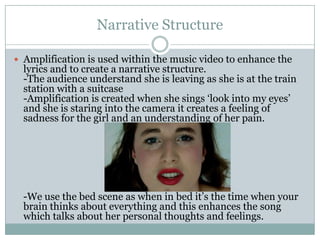
Narrative Structure

 Amplification is used within the music video to enhance the
  lyrics and to create a narrative structure.
  -The audience understand she is leaving as she is at the train
  station with a suitcase
  -Amplification is created when she sings ‘look into my eyes’
  and she is staring into the camera it creates a feeling of
  sadness for the girl and an understanding of her pain.


  -We use the bed scene as when in bed it’s the time when your
  brain thinks about everything and this enhances the song
  which talks about her personal thoughts and feelings.
Richard Dyer

 In ‘heavenly bodies: film stars and society 1987’ Richard dyer contributes to the
  definition of the star system by saying that it’s a major generator of the
  mainstream film industry
 Andrew Goodwin claims that the purpose of the music video for the music
  industry is to advertise and sell a CD as well as maintain image of artist.

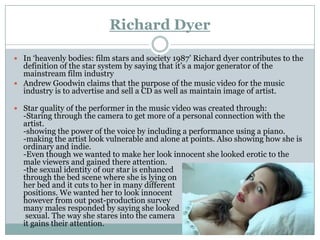
 Star quality of the performer in the music video was created through:
  -Staring through the camera to get more of a personal connection with the
  artist.
  -showing the power of the voice by including a performance using a piano.
  -making the artist look vulnerable and alone at points. Also showing how she is
  ordinary and indie.
  -Even though we wanted to make her look innocent she looked erotic to the
  male viewers and gained there attention.
  -the sexual identity of our star is enhanced
  through the bed scene where she is lying on
  her bed and it cuts to her in many different
  positions. We wanted her to look innocent
  however from out post-production survey
  many males responded by saying she looked
   sexual. The way she stares into the camera
  it gains their attention.
‘WE MEDIA’

 By using a range of websites such as YouTube, Facebook, twitter
  and blogger. By using a large range of websites, the music video gets
  distributed widely and a bigger audience will see it

 Websites such as Facebook allows you to
  ‘share’ and ‘retweet’ the music video which
  then gets sent to their friends who send to
  their friends who send to their friends.

 ‘We Media’ was thought of by David Gauntlet
  who created the idea of ‘web2.0’

 Furthermore the website which is online would be a part of we
  media as people will send around the link to the website.
  Additionally within the website there are links to other websites
  such as YouTube, Facebook, twitter, MySpace and sound cloud.
  These links create a larger audience within the artist’s fans.

Media evaluation question 1

  • 1.
    Evaluation Question 1 BY LIAT SHAMASH
  • 2.
    Synaesthesia  Andrew Goodwinin 1992 from ‘dancing in the distraction factory: music television and popular culture’ states that listeners and composers ‘see’ or imagine images when music is heard. The concept is called Synaesthesia.  There was a lot of complicated piano playing in the background and we could hear a grand piano and the piano was quite a large focus of the track so we all imagined the artist playing the piano along with the music videos in some of the scenes. Our images were similar and were socially coded as it was quite a relevant point and we all thought of the same point.  Additionally, when listening to the tune and melody, it is quite slow and sad and there is so much emotion coming from the artist’s voice. I felt the pain in the lyrics she was singing. I imagined slow motion shots and a music video emphasising the melody and lyrics.
  • 3.
    More of mythoughts when listening to the song...  Furthermore, when focusing on the lyrics, I realised they were very detailed and told a story. The female artist is singing to this boy, it seemed like a love story and I imagined a very personal, natural and realistic music video. All the shots I imagined would have to be in places which were personal to the couple’s relationship maybe places they had been. I imagined scenes with the couple together and the girl telling the boy ‘you can tell them all that its over’ this would be the start of the break up scene ‘stand there and look into my eyes and tell me that all we had were lies’ I felt her pain and could imagine the girl singing to the boy wanting him to tell her he lied to make her leave. She says ‘I’ll stay if you prefer’ or she would leave ‘without a word’ I imagined the song would be a journey to tell the audience her story of what happened and the next part of her journey would be her leaving. We all had very similar ideas and they were socially coded as we all imagined she would be walking somewhere or getting a train or bus (probably running away)  Lastly, As it is a very personal song exposing the artists thoughts and feelings I imagined a bed scene where she is lying in bed thinking. As before you go to bed you think about life. Maybe she can’t sleep so she’s writing this song so we could also write lyrics too.
  • 4.
    Mode of address Through the Digi-Pack, Website and music video I wanted to bring focus to the artist and the artist’s unique style and original songs.  We also did not want to give everything away and explain to the audience. We wanted them to think for themselves and make their own judgements so it becomes more personal.  From the post production research some of the storylines our audience thought of where: -girl leaving town after a break-up - girl singing her sorrows -girl wanting to commit suicide - girl leaving abusive relationship -lonely girl running away as boy did not show up <- all these are relevant and they all create their own personal judgements and it is along the storyline we created  We wanted to invite the viewer into the music video and to conclude with them having questions like ‘what happened’ ‘What will happen to the girl’ ‘What will she do’ so we are inviting them to make their own verdicts.
  • 5.
    Preferred reading  Thestoryline is about a girl who is heartbroken, she is dealing with the fact that her relationship is coming to an end. She is trying to stay away from her lover by leaving town but a part of her wants him to stop her from leaving.  We enhance the lyrics that the artist wrote herself for example ‘tell me that all we had were lies’ she wants him to tell her so it will make it easier for her to go and she would realise that it is over. she sings ‘I’ll stay if you prefer’ or she will leave him ‘without a word’  So basically the music video shows her journey to her leaving and the sad emotions she is feeling. She is in a party dress ready to go out with her boyfriend but he has done something awful to her so she broke it off with him and is leaving. We end the song with a cliff-hanger not knowing if she went on the train or not. This leaves the audience to imagine what happens.
  • 6.
    Type of Signs Symbolic: The significant symbol shows what’s being implied or represented e.g. red octagon could be the symbolic meaning to ‘stop’ -Using a white bedroom and white dress and contrasting it with Red lipstick to highlight innocence and purity. Additionally some people might think of everything white as being in heaven and being an angel so her being in that room could symbolise how she is dead as she is heartbroken without her lover. -A symbolic location we used was the train station which highlights her journey. The girl does not get on a train straight away and we show her waiting around which shows how she is thinking. She is unsure is she should get on the train and run away from her problems.  Iconic: A sign that gets its meaning because of its resemblance to what it implies. - When the girl is at the station she is walking with a suitcase. We included the suitcase to highlight that she is not just at the station – she is leaving. The suitcase is an iconic symbol to highlight to the audience the journey she is going on to leave her boyfriend, as suitcases are known to be used for when you are leaving for a long time and packing away all your belongings.
  • 7.
    Semiology  Semiology isthe deconstruction of the significance of images and words, the meaning of images and the relations the audience brings to the symbol. Ferdinand de Saussure describes Semiology as the science of signs in his ‘course on general linguistics’ (1916)  Roland Barthes examines the Semiology of the image in ‘Mythologies’ 1973. He breaks down the myth into three sections like Saussure does. -The signifier – the associations -The signified – the meaning behind association -The sign – the signifier and the signified are intertwined in the shape you see For example the red lipstick we use in our music video could represent love as when you see red you think of a heart, a rose or even danger of a broken heart and blood.  When you deconstruct an image it can be divided into two tasks: -denotation – the visual details - connotation – explains the possible meanings  These theories argue how images are reinforced from cultural myths and belief systems. It is true as we use white and when people think of white they thing of angels and purity as they are brought up of these ideas
  • 8.
    Interpellation  Interpellation isan idea introduced by Louis Althusser. Interpellation explains the method in which ideas get into our heads and how effective it is on our lives. It’s so effective that our cultural information and ideas have such a hold on us that we believe they are our own. Interpellation is a development stage in which we come across our culture’s values and assume that they are true.  We intended to interpellate our audience by making a broad narrative that the audience can create their own interpretation to what really is happening and going on. Therefore the ideas they create relate to their cultural ideas and values. Our music video is generally a love story and the audience interpellate the meaning of what happens in their own way.
  • 9.
    Hegemony  Hegemony isthe leadership, control and authority  Hegemony is when the values and beliefs of most powerful people in society dominate and influence the less powerful  For the music video, digi-pac and website we could have created something like Rihanna and Beyonce where they clearly show the development of the relationship and the details of what happened. Beyonce and Rihanna are very powerful artists and have a big influence on audiences and other artists. However we did not want to make something so obvious and include lots of other characters. We were going against the idea that the values and beliefs of powerful people in society dominate the less powerful by going against the powerful people in society’s ideas. We did this by creating a very personal music video focusing on the music and the artist telling her story and how she felt. So the level of hegemony used in the meaning of our music video is very low.
  • 10.
    Continuing Hegemony...  E.A Kaplan in rocking around the clock: music television, postmodernism and consumer culture 1987 describes the requirement to return to the close-up of the singers face as a key anchoring motif, a visual hook – which is what we did as we wanted to make sure the audience remembered and recognised that this song belonged to the artist that kept on showing in the music video. It’s important to show close-ups of the artist face so it becomes memorable to the audience and creates a visual hook.  Furthermore, in the digi-pac which holds the CD with the songs of the artist, I followed beliefs of powerful people in society who think that you must use close-up shots of the artists face to highlight the importance that that is the artist. I felt it was important for people to know that that is the face of these powerful songs. I did not want to go against these ideas as I feel that they are correct.
  • 11.
    Looking at LauraMulvey...  ‘Visual pleasures and narrative cinema’ screen vol.16. no.3 1975 Laura Mulvey describes the concept of Scopophilia whereby films use images of women for the satisfaction of men. When a women stares at the camera it invites the male to ‘look’ at her. Therefore this objectifies women as sexual objects which are popular in music videos. These scopophilic hooks are used to offer a visual addiction to keep watching which creates an argument concerning sexism.  The idea of Scopophilia is definitely used in the music video as the artist is placed in this white room with white walls, white sheets and a white dress and a white bed. The bed and the girl in a short white dress definitely gains the male gaze even though we did not mean it to be like that. Some would think of angels and purity whereas some men would think of the bed she is laying on and therefore the girl is sexually objectified.
  • 12.
    Scopophilia  Additionally theclose-ups of the artists face which highlight the use of the red lipstick creates a strong male-gaze too which agrees with Laura Mulvey’s idea of Scopophilia.  Lastly, at some points during the music video we just have the artist staring at the camera and fluttering her eyes and it makes the males wonder what she is thinking and it brings visual pleasure and a visual hook. Furthermore by her staring at the camera it creates a personal attraction and invites the male spectator to ‘look’ at her.
  • 13.
    Pastiche  We makereference to intertextuality by using pastiche in the music video. Pastiche is a piece of work that imitates the work of a previous artist. The music video reflects features of another genre for example our music video includes the genre of romance and mystery.  An artist I was particularly inspired by was Duffy. Her music video to ‘Warwick avenue’ shows an extremely long shot of her journey her man. It’s a very personal music video with mostly close-up shots and shots showing her emotion and her pain. I was inspired to create something similar and make the music video personal and to tell the artists feelings and story. Duffy shows how simplicity can be so effective. Additionally another music video that inspired me by Duffy was ‘Rockferry’ which is all in black and white and also shows her past and tells her story. The use of black and white enhances the feeling of memories and gives a sad feeling. This made us want to include some black and white in our film to contrast the past and the present and the decisions she needs to make whether to leave or not.
  • 14.
    Elements of amusic video – Andrew Goodwin  Typical elements of a music video Andrew Goodwin has pinpointed: -personal imagery arising from the individual memories associated with the song -images associated with the song itself which may be conveyed through metaphors -images of musician -visual signifiers arising from national popular iconography -popular cultural signs associated with rock music which often link with a mythologized ‘America’  elements we have included that Andrew Goodwin has pointed out are: - using the artist in the music video and many close-ups and images of the artist - making the music video broad and about love so audience can create their own associations and feelings and meanings towards the song. -we include images associated with the song and lyrics to tell the story of the lyrics. Birdy claims she’ll ‘leave without a word’ This is why we show her at a train station on her way to leave her boyfriend. We use a suitcase to highlight that she would be leaving for good. - We included shots of Birdy playing the piano and performing the song we felt it was important to not just have narrative but to also highlight that the song is sung by the artist performing it.
  • 15.
    Typical of amusic video...  I include that I think are typical of a music video: -I felt lip synching was important and for the artist to stare into the camera as if singing to the audience so the audience receive a more personal experience and relate to the song more as they see her pain and emotion. -close-ups of artists face -Mise en scene having appropriate and relatable locations and clothing that suits the artist and props that are relevant and that enhance the lyrics. -making sure cuts fit in time with the music and that it is appropriate. E.g. slow music – longer shots but cut in time with piano chords. -a range of cuts between different types of shots  I include that created ourselves: -the contrast of having both colour and black and white together in one music video. I have seen many music videos using black and white such as Duffy and Beyonce however I have not seen music videos using both colour and black and white. I feel that it really suits our artist and helps show her past and the pain she’s going through and also her present and what she is going to do about it. -using a white room, white dress and white bed to highlight purity and contrast with red lipstick to highlight her broken heart. Hidden meanings that we have put into the music video.
  • 16.
    Montage – SergeiEinstein  Quick cutting between shots that is seen within music videos is resulting from the film form – Montage which was inspired by Sergei Eisenstein who created silent films showing propaganda.  Even though we choose a slow song there are still many shots and fast cuts within the music video to show continuity and make the music video flow. We do this to include a range of shots, close-up, medium close-up and even long shots. This gives the audience a better understanding of the setting of the music video.
  • 17.
    Narrative Structure  Amplificationis used within the music video to enhance the lyrics and to create a narrative structure. -The audience understand she is leaving as she is at the train station with a suitcase -Amplification is created when she sings ‘look into my eyes’ and she is staring into the camera it creates a feeling of sadness for the girl and an understanding of her pain. -We use the bed scene as when in bed it’s the time when your brain thinks about everything and this enhances the song which talks about her personal thoughts and feelings.
  • 18.
    Richard Dyer  In‘heavenly bodies: film stars and society 1987’ Richard dyer contributes to the definition of the star system by saying that it’s a major generator of the mainstream film industry  Andrew Goodwin claims that the purpose of the music video for the music industry is to advertise and sell a CD as well as maintain image of artist.  Star quality of the performer in the music video was created through: -Staring through the camera to get more of a personal connection with the artist. -showing the power of the voice by including a performance using a piano. -making the artist look vulnerable and alone at points. Also showing how she is ordinary and indie. -Even though we wanted to make her look innocent she looked erotic to the male viewers and gained there attention. -the sexual identity of our star is enhanced through the bed scene where she is lying on her bed and it cuts to her in many different positions. We wanted her to look innocent however from out post-production survey many males responded by saying she looked sexual. The way she stares into the camera it gains their attention.
  • 19.
    ‘WE MEDIA’  Byusing a range of websites such as YouTube, Facebook, twitter and blogger. By using a large range of websites, the music video gets distributed widely and a bigger audience will see it  Websites such as Facebook allows you to ‘share’ and ‘retweet’ the music video which then gets sent to their friends who send to their friends who send to their friends.  ‘We Media’ was thought of by David Gauntlet who created the idea of ‘web2.0’  Furthermore the website which is online would be a part of we media as people will send around the link to the website. Additionally within the website there are links to other websites such as YouTube, Facebook, twitter, MySpace and sound cloud. These links create a larger audience within the artist’s fans.