Music Video Analysis
(SIMILAR PRODUCT RESEARCH)
Wolf Alice – Moaning Lisa Smile
 Wolf Alice is a British band whose music falls into the genre of indie rock
(the same as Pulp’s broad music genre). Wolf Alice’s ‘Moaning Lisa Smile’
follows the conventions of a narrative music video (placing it in Andrew
Goodwin’s narrative music video category) because it presents a chain of
events in a cause- effect relationship occurring in time (Bordwell and
Thompson). Because it’s classed as a narrative video, it fits into many
narrative theories.
 An example of a theory which this video fits to is Vladimir Propp’s theory
that there’s a limited number of character types that share a function and
when an audience reads a media text, it deploys its knowledge of these
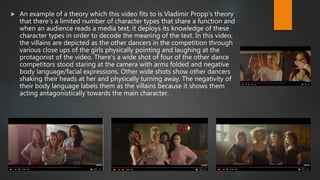
character types in order to decode the meaning of the text. In this video,
the villains are depicted as the other dancers in the competition through
various close ups of the girls physically pointing and laughing at the
protagonist of the video. There’s a wide shot of four of the other dance
competitors stood staring at the camera with arms folded and negative
body language/facial expressions. Other wide shots show other dancers
shaking their heads at her and physically turning away. The negativity of
their body language labels them as the villains because it shows them
acting antagonistically towards the main character.
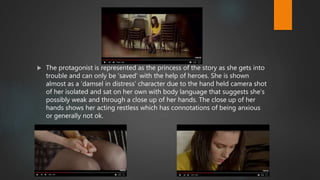
 The protagonist is represented as the princess of the story as she gets into
trouble and can only be ‘saved’ with the help of heroes. She is shown
almost as a ‘damsel in distress’ character due to the hand held camera shot
of her isolated and sat on her own with body language that suggests she’s
possibly weak and through a close up of her hands. The close up of her
hands shows her acting restless which has connotations of being anxious
or generally not ok.
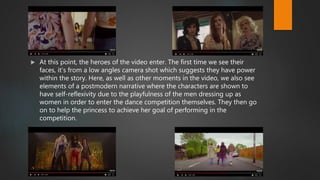
 At this point, the heroes of the video enter. The first time we see their
faces, it’s from a low angles camera shot which suggests they have power
within the story. Here, as well as other moments in the video, we also see
elements of a postmodern narrative where the characters are shown to
have self-reflexivity due to the playfulness of the men dressing up as
women in order to enter the dance competition themselves. They then go
on to help the princess to achieve her goal of performing in the
competition.
 The video also fits to Tsetan Todorov’s theory on the structure of a music
video (1969). The video begins with the equilibrium of the protagonist
practising for the dance competition on her own, shown through various
close ups. This then leads to a disruption of equilibrium when she enters
the venue and the villains of the story act negatively towards her shown
through wide shots of negative body language aimed at the protagonist.
This then leads to a hand held camera shot of the protagonist sat alone
with close ups to allude to her anxiety and upset at the situation which
could be seen as recognition of the disruption. The heroes enter here and
the low angle shot of them labels them as holding power which they then
use to attempt to repair the damage caused. This leads to them competing
in the dance competition with her which satisfies her goal and creates new
equilibrium.
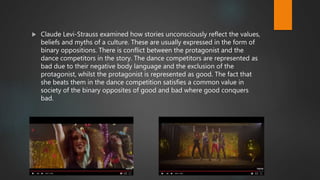
 Claude Levi-Strauss examined how stories unconsciously reflect the values,
beliefs and myths of a culture. These are usually expressed in the form of
binary oppositions. There is conflict between the protagonist and the
dance competitors in the story. The dance competitors are represented as
bad due to their negative body language and the exclusion of the
protagonist, whilst the protagonist is represented as good. The fact that
she beats them in the dance competition satisfies a common value in
society of the binary opposites of good and bad where good conquers
bad.
 Overall, this music video satisfies a number of narrative theories and
presents ‘a way of organising spatial and temporal events into a cause-
effect chain of events with a beginning, middle and end that embodies a
judgement about the nature of events’ (Edward Branigan- 1992).
The Human League – Mirror Man
 The Human League is a British band whose music falls under the genre of
art pop (one of the sub-genres of Pulp’s music). The band was created in
1977, a year before the creation of Pulp and so dealt with many of the
same social and political contexts of the time. The music video for ‘Mirror
Man’ applies to many of the music video features described by Andrew
Goodwin in his book: ‘Dancing in the Distraction Factory.’
“There’s a relationship between lyrics
and visuals”
 Goodwin outlines 6 features of a music video with one being a relationship
between lyrics and visuals. The lyrics depict a protagonist who is looking
for ‘a change of mind, another start, a brand new day.’ This idea of change
is reflected in the visuals where we go from a black and white establishing
shot of the protagonist sat down and with quite closed off non-verbal
communication, to a slightly low angled wide shot of the protagonist in
colour with an open stance which suggests he’s gained power.
“Close ups of the artist/s”
 The demands of a record label will include the need for lots of close ups of
the artist and the artist may develop motifs which recur across their work
(a visual style). This can be evidenced in this video where there are lots of
close ups of the band members, particularly close ups of the video
protagonist. By doing this, not only does it familiarise the audience with
the band members and allow for effective lip syncing, it also allows the
audience to view the non-verbal communication of the characters in the
video which will drive the narrative and convey appropriate meaning.
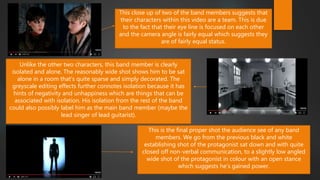
This close up of two of the band members suggests that
their characters within this video are a team. This is due
to the fact that their eye line is focused on each other
and the camera angle is fairly equal which suggests they
are of fairly equal status.
Unlike the other two characters, this band member is clearly
isolated and alone. The reasonably wide shot shows him to be sat
alone in a room that’s quite sparse and simply decorated. The
greyscale editing effects further connotes isolation because it has
hints of negativity and unhappiness which are things that can be
associated with isolation. His isolation from the rest of the band
could also possibly label him as the main band member (maybe the
lead singer of lead guitarist).
This is the final proper shot the audience see of any band
members. We go from the previous black and white
establishing shot of the protagonist sat down and with quite
closed off non-verbal communication, to a slightly low angled
wide shot of the protagonist in colour with an open stance
which suggests he’s gained power.
“There’s frequently reference to notion
of looking (mirror etc.)”
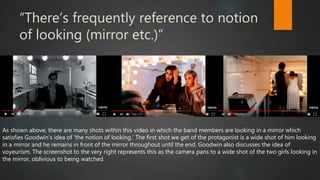
As shown above, there are many shots within this video in which the band members are looking in a mirror which
satisfies Goodwin’s idea of ‘the notion of looking.’ The first shot we get of the protagonist is a wide shot of him looking
in a mirror and he remains in front of the mirror throughout until the end. Goodwin also discusses the idea of
voyeurism. The screenshot to the very right represents this as the camera pans to a wide shot of the two girls looking in
the mirror, oblivious to being watched.
 Overall, this music video satisfies a number of the key features of a music
video which Andre Goodwin highlighted in his book ‘Dancing in the
Distraction Factory.’
Foster the People – Coming of Age
 Foster the People is an American band whose music falls into the genre of
indie pop/rock (the same as Pulp’s broad music genre). The editing of this
video creates an almost vintage colour effect and the clothing is quite
retro which is reminiscent of the era of Britpop. The music video applies to
many of the ways a music video can be analysed described by Andrew
Goodwin in his book: ‘Dancing in the Distraction Factory.’
Thought Beats - Seeing the Sound
 This idea can be split into three steps:
 Step 1 – this looks at the music itself and it’s structure, for example, chorus and
verse structure. This song can easily be split into this kind of structure as it
presents a simple verse, chorus alternation which is synonymous with most
other songs.
 Step 2– this regards the ‘voice’ of the song. Roland Barthes’ theory of ‘the
Grain of Voice’ can relate to this as he sees the singing voice as an expressive
expressive instrument which can form an identifiable sound for the music. In
this case, the lead singer has a particular singing technique that is evident
across the rest of the band’s songs. The use of close up shots of performance
allows the singer’s identifiable voice to become related to a face and will make
the band more memorable to the audience.
 Step 3 – this looks at the artist’s mode of address. Songs can be seen as stories
and the artist as the storyteller, making the video a communication device: the
artist is telling a story and the audience is listening. This music video satisfies
this idea as it presents features of a narrative music video style as well as
performance. This video follows the classic narrative structure of romance
where the guy gets the girl. Tom Ryall (1978) theorised that genres become
recognisable through repeated use of genetic codes and conventions.
Therefore, by using the narrative outline of a romance (as evidenced through
wide shots of couples sat together and close up shots of the guy’s face as he
tries to get the girl so the audience can see his non verbal communication and
identify his sadness at not having the girl), this video will automatically become
familiar to the audience which will make it possibly more relatable and likeable.
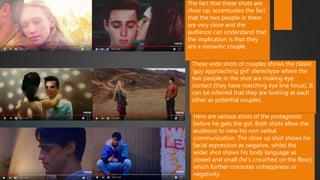
The fact that these shots are
close up, accentuates the fact
that the two people in them
are very close and the
audience can understand that
the implication is that they
are a romantic couple.
These wide shots of couples shows the classic
‘guy approaching girl’ stereotype where the
two people in the shot are making eye
contact (they have matching eye line focus). It
can be inferred that they are looking at each
other as potential couples.
Here are various shots of the protagonist
before he gets the girl. Both shots allow the
audience to view his non verbal
communication. The close up shot shows his
facial expression as negative, whilst the
wider shot shows his body language as
closed and small (he’s crouched on the floor)
which further connotes unhappiness or
negativity.
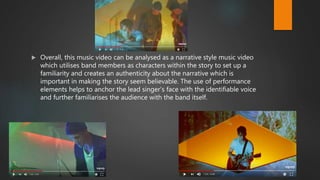
 Overall, this music video can be analysed as a narrative style music video
which utilises band members as characters within the story to set up a
familiarity and creates an authenticity about the narrative which is
important in making the story seem believable. The use of performance
elements helps to anchor the lead singer’s face with the identifiable voice
and further familiarises the audience with the band itself.

Music Video Analysis

  • 1.
  • 2.
    Wolf Alice –Moaning Lisa Smile  Wolf Alice is a British band whose music falls into the genre of indie rock (the same as Pulp’s broad music genre). Wolf Alice’s ‘Moaning Lisa Smile’ follows the conventions of a narrative music video (placing it in Andrew Goodwin’s narrative music video category) because it presents a chain of events in a cause- effect relationship occurring in time (Bordwell and Thompson). Because it’s classed as a narrative video, it fits into many narrative theories.
  • 3.
     An exampleof a theory which this video fits to is Vladimir Propp’s theory that there’s a limited number of character types that share a function and when an audience reads a media text, it deploys its knowledge of these character types in order to decode the meaning of the text. In this video, the villains are depicted as the other dancers in the competition through various close ups of the girls physically pointing and laughing at the protagonist of the video. There’s a wide shot of four of the other dance competitors stood staring at the camera with arms folded and negative body language/facial expressions. Other wide shots show other dancers shaking their heads at her and physically turning away. The negativity of their body language labels them as the villains because it shows them acting antagonistically towards the main character.
  • 4.
     The protagonistis represented as the princess of the story as she gets into trouble and can only be ‘saved’ with the help of heroes. She is shown almost as a ‘damsel in distress’ character due to the hand held camera shot of her isolated and sat on her own with body language that suggests she’s possibly weak and through a close up of her hands. The close up of her hands shows her acting restless which has connotations of being anxious or generally not ok.
  • 5.
     At thispoint, the heroes of the video enter. The first time we see their faces, it’s from a low angles camera shot which suggests they have power within the story. Here, as well as other moments in the video, we also see elements of a postmodern narrative where the characters are shown to have self-reflexivity due to the playfulness of the men dressing up as women in order to enter the dance competition themselves. They then go on to help the princess to achieve her goal of performing in the competition.
  • 6.
     The videoalso fits to Tsetan Todorov’s theory on the structure of a music video (1969). The video begins with the equilibrium of the protagonist practising for the dance competition on her own, shown through various close ups. This then leads to a disruption of equilibrium when she enters the venue and the villains of the story act negatively towards her shown through wide shots of negative body language aimed at the protagonist. This then leads to a hand held camera shot of the protagonist sat alone with close ups to allude to her anxiety and upset at the situation which could be seen as recognition of the disruption. The heroes enter here and the low angle shot of them labels them as holding power which they then use to attempt to repair the damage caused. This leads to them competing in the dance competition with her which satisfies her goal and creates new equilibrium.
  • 7.
     Claude Levi-Straussexamined how stories unconsciously reflect the values, beliefs and myths of a culture. These are usually expressed in the form of binary oppositions. There is conflict between the protagonist and the dance competitors in the story. The dance competitors are represented as bad due to their negative body language and the exclusion of the protagonist, whilst the protagonist is represented as good. The fact that she beats them in the dance competition satisfies a common value in society of the binary opposites of good and bad where good conquers bad.
  • 8.
     Overall, thismusic video satisfies a number of narrative theories and presents ‘a way of organising spatial and temporal events into a cause- effect chain of events with a beginning, middle and end that embodies a judgement about the nature of events’ (Edward Branigan- 1992).
  • 9.
    The Human League– Mirror Man  The Human League is a British band whose music falls under the genre of art pop (one of the sub-genres of Pulp’s music). The band was created in 1977, a year before the creation of Pulp and so dealt with many of the same social and political contexts of the time. The music video for ‘Mirror Man’ applies to many of the music video features described by Andrew Goodwin in his book: ‘Dancing in the Distraction Factory.’
  • 10.
    “There’s a relationshipbetween lyrics and visuals”  Goodwin outlines 6 features of a music video with one being a relationship between lyrics and visuals. The lyrics depict a protagonist who is looking for ‘a change of mind, another start, a brand new day.’ This idea of change is reflected in the visuals where we go from a black and white establishing shot of the protagonist sat down and with quite closed off non-verbal communication, to a slightly low angled wide shot of the protagonist in colour with an open stance which suggests he’s gained power.
  • 11.
    “Close ups ofthe artist/s”  The demands of a record label will include the need for lots of close ups of the artist and the artist may develop motifs which recur across their work (a visual style). This can be evidenced in this video where there are lots of close ups of the band members, particularly close ups of the video protagonist. By doing this, not only does it familiarise the audience with the band members and allow for effective lip syncing, it also allows the audience to view the non-verbal communication of the characters in the video which will drive the narrative and convey appropriate meaning.
  • 12.
    This close upof two of the band members suggests that their characters within this video are a team. This is due to the fact that their eye line is focused on each other and the camera angle is fairly equal which suggests they are of fairly equal status. Unlike the other two characters, this band member is clearly isolated and alone. The reasonably wide shot shows him to be sat alone in a room that’s quite sparse and simply decorated. The greyscale editing effects further connotes isolation because it has hints of negativity and unhappiness which are things that can be associated with isolation. His isolation from the rest of the band could also possibly label him as the main band member (maybe the lead singer of lead guitarist). This is the final proper shot the audience see of any band members. We go from the previous black and white establishing shot of the protagonist sat down and with quite closed off non-verbal communication, to a slightly low angled wide shot of the protagonist in colour with an open stance which suggests he’s gained power.
  • 13.
    “There’s frequently referenceto notion of looking (mirror etc.)” As shown above, there are many shots within this video in which the band members are looking in a mirror which satisfies Goodwin’s idea of ‘the notion of looking.’ The first shot we get of the protagonist is a wide shot of him looking in a mirror and he remains in front of the mirror throughout until the end. Goodwin also discusses the idea of voyeurism. The screenshot to the very right represents this as the camera pans to a wide shot of the two girls looking in the mirror, oblivious to being watched.
  • 14.
     Overall, thismusic video satisfies a number of the key features of a music video which Andre Goodwin highlighted in his book ‘Dancing in the Distraction Factory.’
  • 15.
    Foster the People– Coming of Age  Foster the People is an American band whose music falls into the genre of indie pop/rock (the same as Pulp’s broad music genre). The editing of this video creates an almost vintage colour effect and the clothing is quite retro which is reminiscent of the era of Britpop. The music video applies to many of the ways a music video can be analysed described by Andrew Goodwin in his book: ‘Dancing in the Distraction Factory.’
  • 16.
    Thought Beats -Seeing the Sound  This idea can be split into three steps:  Step 1 – this looks at the music itself and it’s structure, for example, chorus and verse structure. This song can easily be split into this kind of structure as it presents a simple verse, chorus alternation which is synonymous with most other songs.  Step 2– this regards the ‘voice’ of the song. Roland Barthes’ theory of ‘the Grain of Voice’ can relate to this as he sees the singing voice as an expressive expressive instrument which can form an identifiable sound for the music. In this case, the lead singer has a particular singing technique that is evident across the rest of the band’s songs. The use of close up shots of performance allows the singer’s identifiable voice to become related to a face and will make the band more memorable to the audience.
  • 17.
     Step 3– this looks at the artist’s mode of address. Songs can be seen as stories and the artist as the storyteller, making the video a communication device: the artist is telling a story and the audience is listening. This music video satisfies this idea as it presents features of a narrative music video style as well as performance. This video follows the classic narrative structure of romance where the guy gets the girl. Tom Ryall (1978) theorised that genres become recognisable through repeated use of genetic codes and conventions. Therefore, by using the narrative outline of a romance (as evidenced through wide shots of couples sat together and close up shots of the guy’s face as he tries to get the girl so the audience can see his non verbal communication and identify his sadness at not having the girl), this video will automatically become familiar to the audience which will make it possibly more relatable and likeable.
  • 18.
    The fact thatthese shots are close up, accentuates the fact that the two people in them are very close and the audience can understand that the implication is that they are a romantic couple. These wide shots of couples shows the classic ‘guy approaching girl’ stereotype where the two people in the shot are making eye contact (they have matching eye line focus). It can be inferred that they are looking at each other as potential couples. Here are various shots of the protagonist before he gets the girl. Both shots allow the audience to view his non verbal communication. The close up shot shows his facial expression as negative, whilst the wider shot shows his body language as closed and small (he’s crouched on the floor) which further connotes unhappiness or negativity.
  • 19.
     Overall, thismusic video can be analysed as a narrative style music video which utilises band members as characters within the story to set up a familiarity and creates an authenticity about the narrative which is important in making the story seem believable. The use of performance elements helps to anchor the lead singer’s face with the identifiable voice and further familiarises the audience with the band itself.