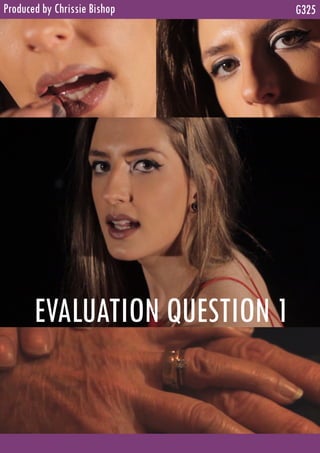
Produced by Chrissie Bishop G325
EVALUATION QUESTION 1
In what ways does your media product use, develop or
challenge forms and conventions of real media products?
MUSIC VIDEO
Lana Del Rey generally has
her own genre. With indie rock
artists, an audience would typ-
ically expect to see a live per-
formance
music
video, whilst
for a pop
artist, you
can expect
to see a lot
of bright,
vibrant
colours with
typical story lines such as love
or hatred. However, Lana chal-
lenges this and somehow man-
ages to blend both together,
by using both performance
and narrative. For example,
in ‘Born To Die’ the audience
follow a story line of Lana and
her boyfriend on a road trip
and at a hotel, although it is
an unhealthy relationship. The
video then cuts to a car acci-
dent where the Lana’s blood-
ied corpse is being carried
by the boyfriend, with some
performance shots added in,
and ends where the music vid-
eo started in a cyclical struc-
ture. I think this is an extremely
effective style of video as she
highlights an issue through nar-
rative and therefore wanted
to use conventions of Lana’s
videos within my own.
I wanted to create a sense
of sympathy and love for the
character and portray a high
level of emotion through the
narrative which is similar to
Lana’s typical videos. The
circulate narrative of my music
video highlights the life of the
female performer who ap-
pears to have low self esteem
as she believes the love of
her live will no longer love her
when she grows old. The end
scene ties the video together
as we see an older lady in a
modern day
household
dancing with
the male who
is now older
too, portray-
ing that their
love was ever-
lasting; which
answers the
rhetorical question which is the
main lyric within the song. The
indexical signs of memorablia
such as photos of the couple,
a teddy bear, jewellery and
tickets that the woman had
collected throughout their re-
lationship, which informs
the audience that their
love did grow as the
music video gradually
goes on. This relates to
Andrew Goodwin’s the-
ory of the six elements
that all music videos
have; one of which being that
all visuals illustrate the lyrics:
“Will you still love me when I’m
no longer young and beauti-
ful?”.
In terms of representation, I
wanted to create the running
themes of love and nostalgia
within my music video. To do
so, I had to focus heavily on
Saussure’s theory of signs. The
mise-en-scene element was
quite important as I had to
ensure my music video was
slightly based around the late
1920’s, especially as the song
I chose for my music video is
from The Great Gatsby (2013)
soundtrack, although I want-
ed to put a modern twist on it.
Firstly, the iconic signs of their
costume; I dressed my model
in red and black dresses as
well as a black jumpsuit. I also
tied her hair back in a high
bun as well as leaving it down.
Costume will work as a signifier
informing the audience of the
time period. Moreover, in order
to further the theme of love
and nostalgia, I got the fe-
male to wear a deep pink/red
lipstick with a clear explication
of this through the close ups of
the application. Symbolically,
it is purely red lipstick however
the connotations of the colour
red would create an indexical
sign of love and lust which au-
dience’s would notice based
upon their own cultural refer-
ence points.
Another iconic
sign was the
violin, which is
a typical in-
strument used
in The Great
Gatsby’s era
so the use of this musical instru-
ment links it all together.
During the editing process, I
decided to edit some footage
by putting on soft and somber
effects in order for the video to
look old. I used photogrpahs to
suggest the idea of memories
and looking back on the past.
These images and memories
leave the audience hang-
ing as they’re unaware as to
whether the man leaves her or
stays - however the answer is
revealed at the end.
Goodwin also stated that
within a music video, the music
and visuals must intertwine
one another. Whilst filming, in
order for the visuals to fit with
the music. During the editing
process, I slowed some clips of
footage down by about 20%
which made the video look
very smooth and fitted with the
pace of the music perfectly.
Slow motion
used in the
same way
can also be
seen in many
of Lana’s
other music
videos to al-
low an audi-
ence to look
more closely
at certain
shots that the director deemed
to be the most effective.
Another element of Goodwin’s
theory I choose to utilise is
the idea that due to the high
demands of the music industry,
there is often a strong need or
demand for lots of close ups.
Within the industry, close ups
tend to be used to sexualise
popular females such as Rihan-
na, Jessie J and Ellie Goulding.
I have used many close ups in
a similar way in order to make
audience believe that the
model is ‘young and beauti-
ful’ which is what the song is
about. However, I have also
challenged this by using some
close ups to highlight certain
signs that I want the audience
to notice more such as the
phots, the ring and the violin.
The close ups also will allow
audience’s to identify with
the actors which will create a
greater emotional response
when the narrative becomes
clear. Audience would be
able to feel like they have a
gained a personal relationship
with them as stated within the
Uses and Gratifications theory.
This mirrors the effect integral
to the music video ‘Why’ by
Annie Lennox which was my
main inspiration. Similarly, my
video conforms to Laura Mul-
vey’s theory of the Male Gaze
as well as the virgin/whore
dichotomy where the model in
this instance would be seen as
‘the whore’.
My vid-
eo con-
forms
to the
conven-
tions of
a circu-
lar nar-
rative
in the
sense
that the
audience is exposed to seeing
the older lady in the modern
day at the beginning, it then
goes back to the older era to
show the younger version of
herself performing and then
back to the older lady, this
time with her male partner.
My music video also demon-
strates a restrictive narrative
as at the beginning, the au-
dience would be unaware of
why there is a shot of an older
lady until the end answering
the enigma posed as part of
Barthes hermeneutic code. I
also intended for my video to
show elements of an episodic
narrative as the action does
not necessarily happen in one
big chunk and through the
editing, I decided to cut foot-
age and go back to certain
shots. For example, when she is
singing which cuts to the violin
playing, or when she’s looking
back at old memories.
ALBUM ADVERT
My first ancillary task was the
album madvert and once
again I have used several
conventions that feature in ad-
vertisements. I was inspired by
existing products and aimed to
recreate these typical ele-
ments. These include having
the name at the top of the
page and having reputable
magazines and newspapers
giving good reviews, which
would entice the audience to
buy the album. I chose pro-
fessional fonts and the images
matched up with my overall
theme and house style which
were the colours of black,
white, gold and a deep purple
which all represent the artist
well.
DIGIPAK
The second ancillary task was
my digipak. I replicated the
house style and fonts that I
used in my postere to the digi-
pak in order for the audience
to become familiar with it and
recognise it more. The digipak
consists of a front cover, inside
cover, CD and back cover.
I follows this design and fea-
tured a special message for
fans on the inside cover as well
as my track listing on the back.
I also put a barcode on the
back in order for the digipak to
look authentic.
Overall, I think all my print and
moving image work either use
or challenge the conventions
of real life media texts which
all work collaboratively in order
to make them look as realistic
as possible.
“I put a
modern twist
on it”

Evalq1

  • 1.
    Produced by ChrissieBishop G325 EVALUATION QUESTION 1
  • 2.
    In what waysdoes your media product use, develop or challenge forms and conventions of real media products? MUSIC VIDEO Lana Del Rey generally has her own genre. With indie rock artists, an audience would typ- ically expect to see a live per- formance music video, whilst for a pop artist, you can expect to see a lot of bright, vibrant colours with typical story lines such as love or hatred. However, Lana chal- lenges this and somehow man- ages to blend both together, by using both performance and narrative. For example, in ‘Born To Die’ the audience follow a story line of Lana and her boyfriend on a road trip and at a hotel, although it is an unhealthy relationship. The video then cuts to a car acci- dent where the Lana’s blood- ied corpse is being carried by the boyfriend, with some performance shots added in, and ends where the music vid- eo started in a cyclical struc- ture. I think this is an extremely effective style of video as she highlights an issue through nar- rative and therefore wanted to use conventions of Lana’s videos within my own. I wanted to create a sense of sympathy and love for the character and portray a high level of emotion through the narrative which is similar to Lana’s typical videos. The circulate narrative of my music video highlights the life of the female performer who ap- pears to have low self esteem as she believes the love of her live will no longer love her when she grows old. The end scene ties the video together as we see an older lady in a modern day household dancing with the male who is now older too, portray- ing that their love was ever- lasting; which answers the rhetorical question which is the main lyric within the song. The indexical signs of memorablia such as photos of the couple, a teddy bear, jewellery and tickets that the woman had collected throughout their re- lationship, which informs the audience that their love did grow as the music video gradually goes on. This relates to Andrew Goodwin’s the- ory of the six elements that all music videos have; one of which being that all visuals illustrate the lyrics: “Will you still love me when I’m no longer young and beauti- ful?”. In terms of representation, I wanted to create the running themes of love and nostalgia within my music video. To do so, I had to focus heavily on Saussure’s theory of signs. The mise-en-scene element was quite important as I had to ensure my music video was slightly based around the late 1920’s, especially as the song I chose for my music video is from The Great Gatsby (2013) soundtrack, although I want- ed to put a modern twist on it. Firstly, the iconic signs of their costume; I dressed my model in red and black dresses as well as a black jumpsuit. I also tied her hair back in a high bun as well as leaving it down. Costume will work as a signifier informing the audience of the time period. Moreover, in order to further the theme of love and nostalgia, I got the fe- male to wear a deep pink/red lipstick with a clear explication of this through the close ups of the application. Symbolically, it is purely red lipstick however the connotations of the colour red would create an indexical sign of love and lust which au- dience’s would notice based upon their own cultural refer- ence points. Another iconic sign was the violin, which is a typical in- strument used in The Great Gatsby’s era so the use of this musical instru- ment links it all together. During the editing process, I decided to edit some footage by putting on soft and somber effects in order for the video to look old. I used photogrpahs to suggest the idea of memories and looking back on the past. These images and memories leave the audience hang- ing as they’re unaware as to whether the man leaves her or stays - however the answer is revealed at the end. Goodwin also stated that within a music video, the music and visuals must intertwine one another. Whilst filming, in order for the visuals to fit with the music. During the editing process, I slowed some clips of footage down by about 20% which made the video look very smooth and fitted with the pace of the music perfectly. Slow motion used in the same way can also be seen in many of Lana’s other music videos to al- low an audi- ence to look more closely at certain shots that the director deemed to be the most effective. Another element of Goodwin’s theory I choose to utilise is the idea that due to the high demands of the music industry, there is often a strong need or demand for lots of close ups. Within the industry, close ups tend to be used to sexualise popular females such as Rihan- na, Jessie J and Ellie Goulding. I have used many close ups in a similar way in order to make audience believe that the model is ‘young and beauti- ful’ which is what the song is about. However, I have also challenged this by using some close ups to highlight certain signs that I want the audience to notice more such as the phots, the ring and the violin. The close ups also will allow audience’s to identify with the actors which will create a greater emotional response when the narrative becomes clear. Audience would be able to feel like they have a gained a personal relationship with them as stated within the Uses and Gratifications theory. This mirrors the effect integral to the music video ‘Why’ by Annie Lennox which was my main inspiration. Similarly, my video conforms to Laura Mul- vey’s theory of the Male Gaze as well as the virgin/whore dichotomy where the model in this instance would be seen as ‘the whore’. My vid- eo con- forms to the conven- tions of a circu- lar nar- rative in the sense that the audience is exposed to seeing the older lady in the modern day at the beginning, it then goes back to the older era to show the younger version of herself performing and then back to the older lady, this time with her male partner. My music video also demon- strates a restrictive narrative as at the beginning, the au- dience would be unaware of why there is a shot of an older lady until the end answering the enigma posed as part of Barthes hermeneutic code. I also intended for my video to show elements of an episodic narrative as the action does not necessarily happen in one big chunk and through the editing, I decided to cut foot- age and go back to certain shots. For example, when she is singing which cuts to the violin playing, or when she’s looking back at old memories. ALBUM ADVERT My first ancillary task was the album madvert and once again I have used several conventions that feature in ad- vertisements. I was inspired by existing products and aimed to recreate these typical ele- ments. These include having the name at the top of the page and having reputable magazines and newspapers giving good reviews, which would entice the audience to buy the album. I chose pro- fessional fonts and the images matched up with my overall theme and house style which were the colours of black, white, gold and a deep purple which all represent the artist well. DIGIPAK The second ancillary task was my digipak. I replicated the house style and fonts that I used in my postere to the digi- pak in order for the audience to become familiar with it and recognise it more. The digipak consists of a front cover, inside cover, CD and back cover. I follows this design and fea- tured a special message for fans on the inside cover as well as my track listing on the back. I also put a barcode on the back in order for the digipak to look authentic. Overall, I think all my print and moving image work either use or challenge the conventions of real life media texts which all work collaboratively in order to make them look as realistic as possible. “I put a modern twist on it”