JUSTICE
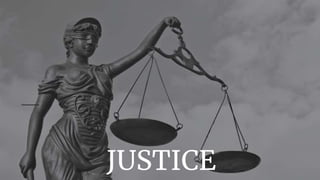
JUSTICE
Etymologically, justice comes from the Latin word ‘jus’ to mean
‘right’.
Justice means fairness, desert (from what is deserved) and
entitlement. It can also mean as fair, equitable, and appropriate
treatment.
The term Justice has been more specific according to the
Philosophers that was referred to as ‘rightness in people’s
interactions and interrelations’.
FORMAL PRINCIPLE OF JUSTICE
According to Aristotle, Justice refers to ‘equals must be
treated equally and unequals must be treated unequally’.
This is a formal principle of Justice because it identifies no
particular respects in which equals ought to be treated
equally and thus provide no criteria for determining
whether two or more individuals are in fact equal
(Beauchamp and Childress, 2001).
MATERIAL PRINCIPLE OF JUSTICE
Principles that specify the relevant characteristics
for equal treatment are called ‘material’ because
they identify the substantive properties for
distribution:
1. To each person an equal share. [example: all
members of the society are given equal
services such as the free immunization to all
children below seven years old]
2. To each person according to need. [example:
Covid 19 vaccines are free for everyone]
MATERIAL PRINCIPLE OF JUSTICE
Principles that specify the relevant characteristics
for equal treatment are called ‘material’ because
they identify the substantive properties for
distribution:
3. To each person according to contribution.
[example: only people who are members of
the Philippine Health can avail of its medical
services and privileged]
4. To each person according to free-market
exchanges. [example: In a certain product, there
is a right value]
MATERIAL PRINCIPLE OF JUSTICE
Principles that specify the relevant characteristics for
equal treatment are called ‘material’ because they
identify the substantive properties for distribution:
5. To each person according to merit. [Example:
Philippine Charity Sweepstakes service of proving free
health care assistance only to those who meets the
required criteria and that is having no financial capacity
to provide it for themselves and to their family]
6. To each person according to effort. [example: this
refers to the patient’s efforts to comply or not to comply
with the medical advice. A diabetic client has the choice
to comply or not to comply with his medication and diet
regimen]
TYPES OF JUSTICE
1. DISTRIBUTIVE JUSTICE - It refers to fair,
equitable, and appropriate distribution or
responsibilities or share or rights and roles,
resources and privileges
2. CRIMINAL JUSTICE - Refers to the
infliction of punishment or penalty
proportionate to the crime committed. In
other words, no exemption in the merited
penalty.
3. RECTIFICATORY JUSTICE - Refers to just
compensation for transactional problems
such as breaches of contract and practice
based on civil law. Rectify the person
who did not observe hi/her word of honor.
THE PARADIGM APPROACH TO JUSTICE
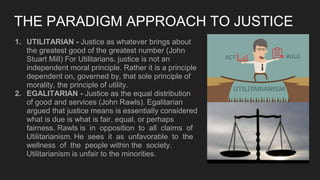
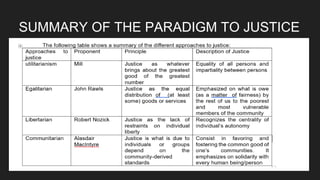
1. UTILITARIAN - Justice as whatever brings about
the greatest good of the greatest number (John
Stuart Mill) For Utilitarians. justice is not an
independent moral principle. Rather it is a principle
dependent on, governed by, that sole principle of
morality, the principle of utility.
2. EGALITARIAN - Justice as the equal distribution
of good and services (John Rawls). Egalitarian
argued that justice means is essentially considered
what is due is what is fair, equal, or perhaps
fairness. Rawls is in opposition to all claims of
Utilitarianism. He sees it as unfavorable to the
wellness of the people within the society.
Utilitarianism is unfair to the minorities.
THE PARADIGM APPROACH TO JUSTICE
3. LIBERTARIAN - Justice as the lack of restraints on individual
liberty (Robert Nozick). Nozick believed that individual have
rights, such as right to liberty, life, property and others, which
those individual are entitled to enjoy and to exercise so long as it
does not interfere into the rights of others.
4. COMMUNITARIAN- Justice is what is due to individuals or
groups depend on the community-derived standards (Alasdair
MacIntyre). It derives justice from as many as different conceptions
of the good as there are diverse moral and cultural communities.
Communitarian then placed the community as the core of a value
system than prioritizing an individual as libertarian proposed.
SUMMARY OF THE PARADIGM TO JUSTICE
Ethics Week 11-Justice.pptx

Ethics Week 11-Justice.pptx

  • 1.
  • 2.
    JUSTICE Etymologically, justice comesfrom the Latin word ‘jus’ to mean ‘right’. Justice means fairness, desert (from what is deserved) and entitlement. It can also mean as fair, equitable, and appropriate treatment. The term Justice has been more specific according to the Philosophers that was referred to as ‘rightness in people’s interactions and interrelations’.
  • 3.
    FORMAL PRINCIPLE OFJUSTICE According to Aristotle, Justice refers to ‘equals must be treated equally and unequals must be treated unequally’. This is a formal principle of Justice because it identifies no particular respects in which equals ought to be treated equally and thus provide no criteria for determining whether two or more individuals are in fact equal (Beauchamp and Childress, 2001).
  • 4.
    MATERIAL PRINCIPLE OFJUSTICE Principles that specify the relevant characteristics for equal treatment are called ‘material’ because they identify the substantive properties for distribution: 1. To each person an equal share. [example: all members of the society are given equal services such as the free immunization to all children below seven years old] 2. To each person according to need. [example: Covid 19 vaccines are free for everyone]
  • 5.
    MATERIAL PRINCIPLE OFJUSTICE Principles that specify the relevant characteristics for equal treatment are called ‘material’ because they identify the substantive properties for distribution: 3. To each person according to contribution. [example: only people who are members of the Philippine Health can avail of its medical services and privileged] 4. To each person according to free-market exchanges. [example: In a certain product, there is a right value]
  • 6.
    MATERIAL PRINCIPLE OFJUSTICE Principles that specify the relevant characteristics for equal treatment are called ‘material’ because they identify the substantive properties for distribution: 5. To each person according to merit. [Example: Philippine Charity Sweepstakes service of proving free health care assistance only to those who meets the required criteria and that is having no financial capacity to provide it for themselves and to their family] 6. To each person according to effort. [example: this refers to the patient’s efforts to comply or not to comply with the medical advice. A diabetic client has the choice to comply or not to comply with his medication and diet regimen]
  • 7.
    TYPES OF JUSTICE 1.DISTRIBUTIVE JUSTICE - It refers to fair, equitable, and appropriate distribution or responsibilities or share or rights and roles, resources and privileges 2. CRIMINAL JUSTICE - Refers to the infliction of punishment or penalty proportionate to the crime committed. In other words, no exemption in the merited penalty. 3. RECTIFICATORY JUSTICE - Refers to just compensation for transactional problems such as breaches of contract and practice based on civil law. Rectify the person who did not observe hi/her word of honor.
  • 8.
    THE PARADIGM APPROACHTO JUSTICE 1. UTILITARIAN - Justice as whatever brings about the greatest good of the greatest number (John Stuart Mill) For Utilitarians. justice is not an independent moral principle. Rather it is a principle dependent on, governed by, that sole principle of morality, the principle of utility. 2. EGALITARIAN - Justice as the equal distribution of good and services (John Rawls). Egalitarian argued that justice means is essentially considered what is due is what is fair, equal, or perhaps fairness. Rawls is in opposition to all claims of Utilitarianism. He sees it as unfavorable to the wellness of the people within the society. Utilitarianism is unfair to the minorities.
  • 9.
    THE PARADIGM APPROACHTO JUSTICE 3. LIBERTARIAN - Justice as the lack of restraints on individual liberty (Robert Nozick). Nozick believed that individual have rights, such as right to liberty, life, property and others, which those individual are entitled to enjoy and to exercise so long as it does not interfere into the rights of others. 4. COMMUNITARIAN- Justice is what is due to individuals or groups depend on the community-derived standards (Alasdair MacIntyre). It derives justice from as many as different conceptions of the good as there are diverse moral and cultural communities. Communitarian then placed the community as the core of a value system than prioritizing an individual as libertarian proposed.
  • 10.
    SUMMARY OF THEPARADIGM TO JUSTICE