Media Audiences
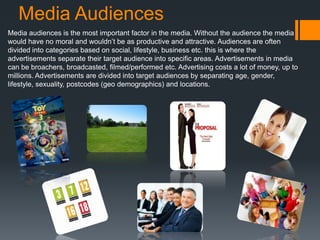
Media audiences is the most important factor in the media. Without the audience the media
would have no moral and wouldn’t be as productive and attractive. Audiences are often
divided into categories based on social, lifestyle, business etc. this is where the
advertisements separate their target audience into specific areas. Advertisements in media
can be broachers, broadcasted, filmed/performed etc. Advertising costs a lot of money, up to
millions. Advertisements are divided into target audiences by separating age, gender,
lifestyle, sexuality, postcodes (geo demographics) and locations.
Age
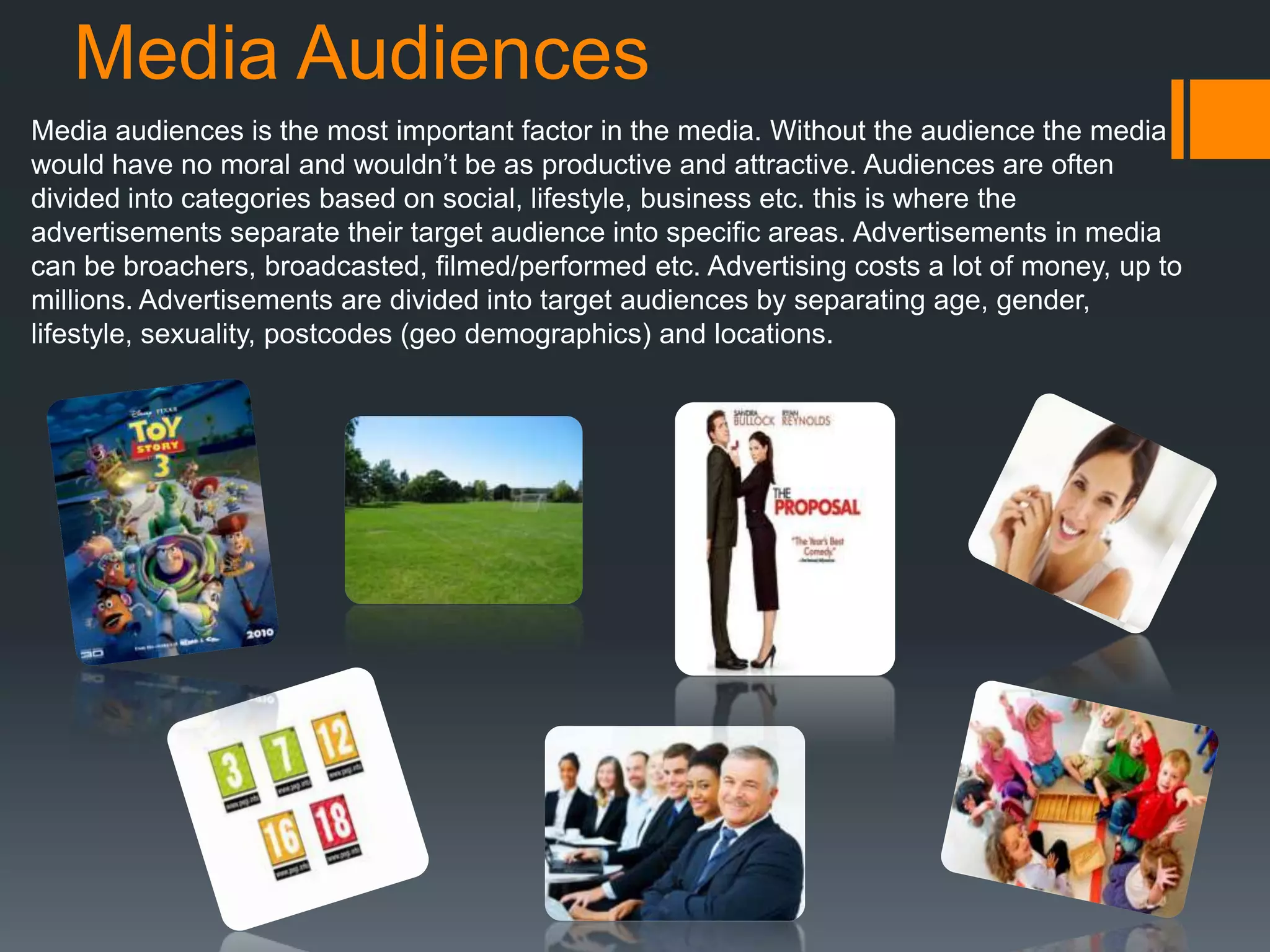
 In advertising, age is a modal target that is controlled when publishing. It
ranges from ‘U’ = suitable for everyone to ‘18’ = only above this adult age.
There are 6 main codes for age restrictions on movies, games, adverts, and
other public promotion products. These are the following;
 U = suitable for All
 PG = Parental guidance
 12 = 12 years +
 12A = 12 adult
 15 = 15 years +
 18 = 18+ (adult)
The cinema industry categorizes audiences in
many different ways but often relies on an age-
related scheme which closely follows the film
certification categories (U, PG,12, 15, 18):
•Children (5-11 years old)
•Family groups
•Teenagers / young couples / students
•Adults
Gender
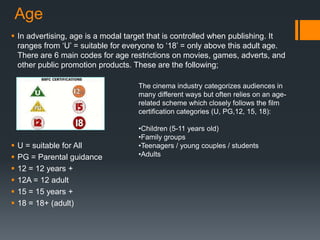
 Gender is another modal target audience that is controlled when
publishing and advertising. Different products vary for different
genders. For example ‘Rimmel London’ is a woman eyeliner product
which is clearly and purposefully aimed at females. Where as an
example of a men's advert would be ‘Calvin Klein’ boxers. This is
how advertising markets separate the gender equality when
advertising. This process is segmented the same way in films.
Covers will have specific colours, characters, text which would
attract the precise audience target group.
Locations
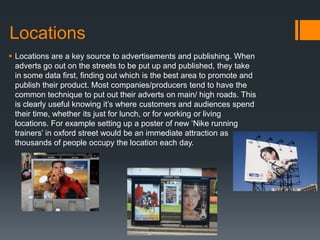
 Locations are a key source to advertisements and publishing. When
adverts go out on the streets to be put up and published, they take
in some data first, finding out which is the best area to promote and
publish their product. Most companies/producers tend to have the
common technique to put out their adverts on main/ high roads. This
is clearly useful knowing it’s where customers and audiences spend
their time, whether its just for lunch, or for working or living
locations. For example setting up a poster of new ‘Nike running
trainers’ in oxford street would be an immediate attraction as
thousands of people occupy the location each day.
Lifestyle
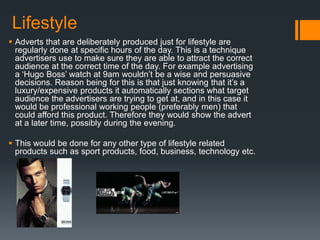
 Adverts that are deliberately produced just for lifestyle are
regularly done at specific hours of the day. This is a technique
advertisers use to make sure they are able to attract the correct
audience at the correct time of the day. For example advertising
a ‘Hugo Boss’ watch at 9am wouldn’t be a wise and persuasive
decisions. Reason being for this is that just knowing that it’s a
luxury/expensive products it automatically sections what target
audience the advertisers are trying to get at, and in this case it
would be professional working people (preferably men) that
could afford this product. Therefore they would show the advert
at a later time, possibly during the evening.
 This would be done for any other type of lifestyle related
products such as sport products, food, business, technology etc.
Target Audience (Female)
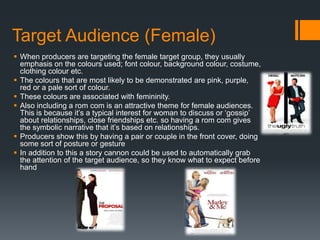
 When producers are targeting the female target group, they usually
emphasis on the colours used; font colour, background colour, costume,
clothing colour etc.
 The colours that are most likely to be demonstrated are pink, purple,
red or a pale sort of colour.
 These colours are associated with femininity.
 Also including a rom com is an attractive theme for female audiences.
This is because it’s a typical interest for woman to discuss or ‘gossip’
about relationships, close friendships etc. so having a rom com gives
the symbolic narrative that it’s based on relationships.
 Producers show this by having a pair or couple in the front cover, doing
some sort of posture or gesture
 In addition to this a story cannon could be used to automatically grab
the attention of the target audience, so they know what to expect before
hand
Target Audience – Young children
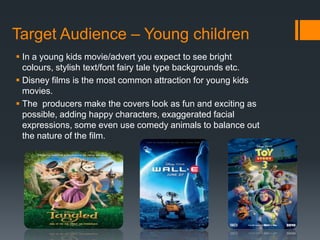
 In a young kids movie/advert you expect to see bright
colours, stylish text/font fairy tale type backgrounds etc.
 Disney films is the most common attraction for young kids
movies.
 The producers make the covers look as fun and exciting as
possible, adding happy characters, exaggerated facial
expressions, some even use comedy animals to balance out
the nature of the film.
Target Audience – (Males)
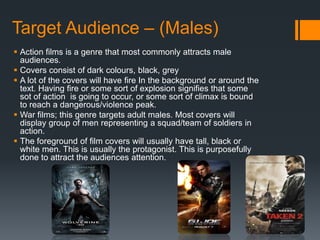
 Action films is a genre that most commonly attracts male
audiences.
 Covers consist of dark colours, black, grey
 A lot of the covers will have fire In the background or around the
text. Having fire or some sort of explosion signifies that some
sot of action is going to occur, or some sort of climax is bound
to reach a dangerous/violence peak.
 War films; this genre targets adult males. Most covers will
display group of men representing a squad/team of soldiers in
action.
 The foreground of film covers will usually have tall, black or
white men. This is usually the protagonist. This is purposefully
done to attract the audiences attention.
Test screening, film screening,
screener
 Test screening – this is a preview screening of a movie or television
show before its a general release in order to gauge audience
reaction (Wikipedia). Preview audiences are selected from a sample
of the population, and are usually asked to complete a
questionnaire or provide feedback in some type.
 Film screening – this is the displaying of a motion picture or film,
generally referring to a special showing as part of a film’s production
and release cycle. To show the film to best advantage, special
screenings may take place in plush, low seat-count theatres with
very high quality
 Focus group screening are formal test screenings of a film with very
detailed documentation of audience responses. Target audience
members answer survey questionnaires and are usually
interviewed, sometimes on video (Wikipedia)

Media audience

  • 1.
    Media Audiences Media audiencesis the most important factor in the media. Without the audience the media would have no moral and wouldn’t be as productive and attractive. Audiences are often divided into categories based on social, lifestyle, business etc. this is where the advertisements separate their target audience into specific areas. Advertisements in media can be broachers, broadcasted, filmed/performed etc. Advertising costs a lot of money, up to millions. Advertisements are divided into target audiences by separating age, gender, lifestyle, sexuality, postcodes (geo demographics) and locations.
  • 2.
    Age  In advertising,age is a modal target that is controlled when publishing. It ranges from ‘U’ = suitable for everyone to ‘18’ = only above this adult age. There are 6 main codes for age restrictions on movies, games, adverts, and other public promotion products. These are the following;  U = suitable for All  PG = Parental guidance  12 = 12 years +  12A = 12 adult  15 = 15 years +  18 = 18+ (adult) The cinema industry categorizes audiences in many different ways but often relies on an age- related scheme which closely follows the film certification categories (U, PG,12, 15, 18): •Children (5-11 years old) •Family groups •Teenagers / young couples / students •Adults
  • 3.
    Gender  Gender isanother modal target audience that is controlled when publishing and advertising. Different products vary for different genders. For example ‘Rimmel London’ is a woman eyeliner product which is clearly and purposefully aimed at females. Where as an example of a men's advert would be ‘Calvin Klein’ boxers. This is how advertising markets separate the gender equality when advertising. This process is segmented the same way in films. Covers will have specific colours, characters, text which would attract the precise audience target group.
  • 4.
    Locations  Locations area key source to advertisements and publishing. When adverts go out on the streets to be put up and published, they take in some data first, finding out which is the best area to promote and publish their product. Most companies/producers tend to have the common technique to put out their adverts on main/ high roads. This is clearly useful knowing it’s where customers and audiences spend their time, whether its just for lunch, or for working or living locations. For example setting up a poster of new ‘Nike running trainers’ in oxford street would be an immediate attraction as thousands of people occupy the location each day.
  • 5.
    Lifestyle  Adverts thatare deliberately produced just for lifestyle are regularly done at specific hours of the day. This is a technique advertisers use to make sure they are able to attract the correct audience at the correct time of the day. For example advertising a ‘Hugo Boss’ watch at 9am wouldn’t be a wise and persuasive decisions. Reason being for this is that just knowing that it’s a luxury/expensive products it automatically sections what target audience the advertisers are trying to get at, and in this case it would be professional working people (preferably men) that could afford this product. Therefore they would show the advert at a later time, possibly during the evening.  This would be done for any other type of lifestyle related products such as sport products, food, business, technology etc.
  • 6.
    Target Audience (Female) When producers are targeting the female target group, they usually emphasis on the colours used; font colour, background colour, costume, clothing colour etc.  The colours that are most likely to be demonstrated are pink, purple, red or a pale sort of colour.  These colours are associated with femininity.  Also including a rom com is an attractive theme for female audiences. This is because it’s a typical interest for woman to discuss or ‘gossip’ about relationships, close friendships etc. so having a rom com gives the symbolic narrative that it’s based on relationships.  Producers show this by having a pair or couple in the front cover, doing some sort of posture or gesture  In addition to this a story cannon could be used to automatically grab the attention of the target audience, so they know what to expect before hand
  • 7.
    Target Audience –Young children  In a young kids movie/advert you expect to see bright colours, stylish text/font fairy tale type backgrounds etc.  Disney films is the most common attraction for young kids movies.  The producers make the covers look as fun and exciting as possible, adding happy characters, exaggerated facial expressions, some even use comedy animals to balance out the nature of the film.
  • 8.
    Target Audience –(Males)  Action films is a genre that most commonly attracts male audiences.  Covers consist of dark colours, black, grey  A lot of the covers will have fire In the background or around the text. Having fire or some sort of explosion signifies that some sot of action is going to occur, or some sort of climax is bound to reach a dangerous/violence peak.  War films; this genre targets adult males. Most covers will display group of men representing a squad/team of soldiers in action.  The foreground of film covers will usually have tall, black or white men. This is usually the protagonist. This is purposefully done to attract the audiences attention.
  • 9.
    Test screening, filmscreening, screener  Test screening – this is a preview screening of a movie or television show before its a general release in order to gauge audience reaction (Wikipedia). Preview audiences are selected from a sample of the population, and are usually asked to complete a questionnaire or provide feedback in some type.  Film screening – this is the displaying of a motion picture or film, generally referring to a special showing as part of a film’s production and release cycle. To show the film to best advantage, special screenings may take place in plush, low seat-count theatres with very high quality  Focus group screening are formal test screenings of a film with very detailed documentation of audience responses. Target audience members answer survey questionnaires and are usually interviewed, sometimes on video (Wikipedia)