Distance Education and the Internet TECH4101 Dr. Alaa Sadik Instructional & Learning Technologies Department www.alaasadik.net [email_address]
Lecture Four Media and Technologies Used in Distance Education:  Advantages and limitations Distance Education and the Internet TECH4101 Includes suggestions for class presentations
Broadcasting radio and television Telephone and audio-conferencing   Media and Technologies Used in Distance Education
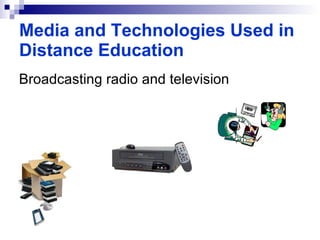
Broadcasting radio and television Media and Technologies Used in Distance Education
Advantages of broadcasting radio and television The broadcast element includes components which are unique to the medium and which provide experiences not easily gained by other means. Broadcasting reaches audiences that other forms of education do not reach. Broadcasting Radio and Television
Advantages of broadcasting radio and television Radio is extremely flexible, has a dramatic effect and can stimulate the imagination of learners. With the development in communications satellites, television can reach a long distance and use extra numbers of channels, with their potential for two-way signal carriage.  Broadcasting Radio and Television
Disadvantages of broadcasting radio and television Broadcasting does not have many of the features available in printed materials, such as learner control and self pace. Although broadcasting is considered as a powerful tool for bringing the real world into the classroom, programmes often lack strategies for involving learners. Broadcasting Radio and Television
Disadvantages of broadcasting radio and television It is difficult for students to talk, practise skills or understand difficult points unless teachers integrate broadcasting with other learning activities. Instruction goes in one direction, from the tutor to the audience and the medium does not support transfer of information in the opposite direction. Broadcasting Radio and Television
Disadvantages of broadcasting radio and television Certain types of experiences cannot be transmitted by broadcasting, such as face-to-face contacts and abstract ideas that need interaction and deep explanation, like mathematical concepts. The costs of production, equipment and transmission per hour are very high in comparison with other media. Broadcasting Radio and Television
Disadvantages of broadcasting radio and television Students resist technology that have to be used according to a rigid pre-set schedule . Broadcasting Radio and Television
As a result of the limitations of radio and television, many solutions were suggested  to give the learner more control and to facilitate interaction between the teacher and students . These solutions include using audio-cassettes, video-cassettes and two-way interactive radio/television. Broadcasting Radio and Television
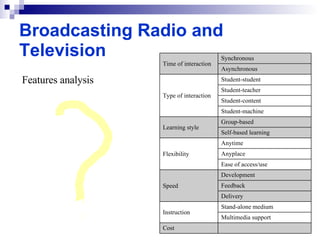
Broadcasting Radio and Television Features analysis Cost Multimedia support Stand-alone medium Instruction Delivery Feedback Development Speed Ease of access/use Anyplace Anytime Flexibility Self-based learning Group-based Learning style Student-machine Student-content Student-teacher Student-student Type of interaction Asynchronous Synchronous Time of interaction
Telephone and audio-conferencing Media and Technologies Used in Distance Education
The use of the telephone in distance education was  a result of the limitations of broadcasting  as one-way medium.  The main reason for using the telephone medium is  to establish a direct connection  between the teacher and students at a distance.   Telephone and audio-conferencing
Forms of telephone use in DE One-to-one telephone tutoring (teacher-to-student): To provide students with human support. Small-group audio-conferencing (students-to-students): To link students together for helpful dialogue and to socialize the learning process. Telephone and audio-conferencing
Advantages of telephone and audio-conferencing The telephone can overcome many contact problems between students and tutors, whether in one-to-one links or in small group conferencing.   Students can gain learning experiences by interaction with the tutor, receiving feedback or asking for immediate support.   Telephone and audio-conferencing
Advantages of telephone and audio-conferencing Using additional equipment, voice message can be stored for distance students to access at any time/anywhere.   Using fax, the tutor can send course materials, homework and feedback, and students can submit their assignments or send their questions for more explanation . Telephone and audio-conferencing
Advantages of telephone and audio-conferencing Telephone conferencing enables distance students to interact directly with the tutor or experts, exchanging experiences or ask questions . Telephone can be used for tasks which involve cooperation, problem-solving, generating ideas and exchanging opinions. Telephone and audio-conferencing
Disadvantages of telephone and audio-conferencing Telephone tutorials do not allow full interaction between teacher and students. Prepared materials have to be delivered by print or audio-tapes to the learners in advance. Conference calls require special equipment known as a conference amplifier or conference bridge. Telephone and audio-conferencing
Disadvantages of telephone and audio-conferencing Most science courses are heavily dependent upon visual representation, particularly these that contain graphs, formulae and diagrams. These subjects need additional visual media besides the telephone. Individual calls are costly in time and money for the tutor and students.  Telephone and audio-conferencing
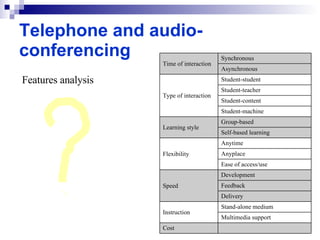
Telephone and audio-conferencing Features analysis Cost Multimedia support Stand-alone medium Instruction Delivery Feedback Development Speed Ease of access/use Anyplace Anytime Flexibility Self-based learning Group-based Learning style Student-machine Student-content Student-teacher Student-student Type of interaction Asynchronous Synchronous Time of interaction
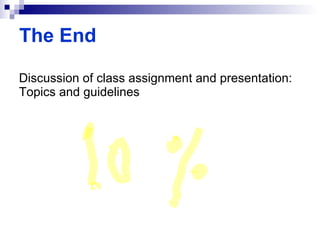
Discussion of class assignment and presentation: Topics and guidelines The End
Write an assignment and present it to your classmates to describe the technical and pedagogical features of a DE technology. In this assignment you should: Define the technology Define objectives of using the technology in DE Specify features/advantages and limitations of the technology. Discuss how this technology are used to deliver and support learning. Discuss concerns raised by researchers and distance students/tutors about this technology.  Provide some case studies/examples. Follow these guidelines:  Cover page contains assignment title, your name & ID,1500 words length (exl ref & cover), 12pt font size, Arial font, 2 cm margins each side The End

Media and Technologies Used in DE I

  • 1.
    Distance Education andthe Internet TECH4101 Dr. Alaa Sadik Instructional & Learning Technologies Department www.alaasadik.net [email_address]
  • 2.
    Lecture Four Mediaand Technologies Used in Distance Education: Advantages and limitations Distance Education and the Internet TECH4101 Includes suggestions for class presentations
  • 3.
    Broadcasting radio andtelevision Telephone and audio-conferencing Media and Technologies Used in Distance Education
  • 4.
    Broadcasting radio andtelevision Media and Technologies Used in Distance Education
  • 5.
    Advantages of broadcastingradio and television The broadcast element includes components which are unique to the medium and which provide experiences not easily gained by other means. Broadcasting reaches audiences that other forms of education do not reach. Broadcasting Radio and Television
  • 6.
    Advantages of broadcastingradio and television Radio is extremely flexible, has a dramatic effect and can stimulate the imagination of learners. With the development in communications satellites, television can reach a long distance and use extra numbers of channels, with their potential for two-way signal carriage. Broadcasting Radio and Television
  • 7.
    Disadvantages of broadcastingradio and television Broadcasting does not have many of the features available in printed materials, such as learner control and self pace. Although broadcasting is considered as a powerful tool for bringing the real world into the classroom, programmes often lack strategies for involving learners. Broadcasting Radio and Television
  • 8.
    Disadvantages of broadcastingradio and television It is difficult for students to talk, practise skills or understand difficult points unless teachers integrate broadcasting with other learning activities. Instruction goes in one direction, from the tutor to the audience and the medium does not support transfer of information in the opposite direction. Broadcasting Radio and Television
  • 9.
    Disadvantages of broadcastingradio and television Certain types of experiences cannot be transmitted by broadcasting, such as face-to-face contacts and abstract ideas that need interaction and deep explanation, like mathematical concepts. The costs of production, equipment and transmission per hour are very high in comparison with other media. Broadcasting Radio and Television
  • 10.
    Disadvantages of broadcastingradio and television Students resist technology that have to be used according to a rigid pre-set schedule . Broadcasting Radio and Television
  • 11.
    As a resultof the limitations of radio and television, many solutions were suggested to give the learner more control and to facilitate interaction between the teacher and students . These solutions include using audio-cassettes, video-cassettes and two-way interactive radio/television. Broadcasting Radio and Television
  • 12.
    Broadcasting Radio andTelevision Features analysis Cost Multimedia support Stand-alone medium Instruction Delivery Feedback Development Speed Ease of access/use Anyplace Anytime Flexibility Self-based learning Group-based Learning style Student-machine Student-content Student-teacher Student-student Type of interaction Asynchronous Synchronous Time of interaction
  • 13.
    Telephone and audio-conferencingMedia and Technologies Used in Distance Education
  • 14.
    The use ofthe telephone in distance education was a result of the limitations of broadcasting as one-way medium. The main reason for using the telephone medium is to establish a direct connection between the teacher and students at a distance. Telephone and audio-conferencing
  • 15.
    Forms of telephoneuse in DE One-to-one telephone tutoring (teacher-to-student): To provide students with human support. Small-group audio-conferencing (students-to-students): To link students together for helpful dialogue and to socialize the learning process. Telephone and audio-conferencing
  • 16.
    Advantages of telephoneand audio-conferencing The telephone can overcome many contact problems between students and tutors, whether in one-to-one links or in small group conferencing. Students can gain learning experiences by interaction with the tutor, receiving feedback or asking for immediate support. Telephone and audio-conferencing
  • 17.
    Advantages of telephoneand audio-conferencing Using additional equipment, voice message can be stored for distance students to access at any time/anywhere. Using fax, the tutor can send course materials, homework and feedback, and students can submit their assignments or send their questions for more explanation . Telephone and audio-conferencing
  • 18.
    Advantages of telephoneand audio-conferencing Telephone conferencing enables distance students to interact directly with the tutor or experts, exchanging experiences or ask questions . Telephone can be used for tasks which involve cooperation, problem-solving, generating ideas and exchanging opinions. Telephone and audio-conferencing
  • 19.
    Disadvantages of telephoneand audio-conferencing Telephone tutorials do not allow full interaction between teacher and students. Prepared materials have to be delivered by print or audio-tapes to the learners in advance. Conference calls require special equipment known as a conference amplifier or conference bridge. Telephone and audio-conferencing
  • 20.
    Disadvantages of telephoneand audio-conferencing Most science courses are heavily dependent upon visual representation, particularly these that contain graphs, formulae and diagrams. These subjects need additional visual media besides the telephone. Individual calls are costly in time and money for the tutor and students. Telephone and audio-conferencing
  • 21.
    Telephone and audio-conferencingFeatures analysis Cost Multimedia support Stand-alone medium Instruction Delivery Feedback Development Speed Ease of access/use Anyplace Anytime Flexibility Self-based learning Group-based Learning style Student-machine Student-content Student-teacher Student-student Type of interaction Asynchronous Synchronous Time of interaction
  • 22.
    Discussion of classassignment and presentation: Topics and guidelines The End
  • 23.
    Write an assignmentand present it to your classmates to describe the technical and pedagogical features of a DE technology. In this assignment you should: Define the technology Define objectives of using the technology in DE Specify features/advantages and limitations of the technology. Discuss how this technology are used to deliver and support learning. Discuss concerns raised by researchers and distance students/tutors about this technology. Provide some case studies/examples. Follow these guidelines: Cover page contains assignment title, your name & ID,1500 words length (exl ref & cover), 12pt font size, Arial font, 2 cm margins each side The End