Distance Education

                     Zoaib Mirza
                 Promote Education
              www.promoteeducation.com

Zoaib Mirza           Promote Education   1
Topic of Discussions
•   What is Distance Education?
•   Levels of Distance Education
•   Why Distance Education?
•   Components of a Working Distance Education
    System
•   A Student at the Center of the System
•   Five Generations of Distance Education
•   Technologies and Media
•   Design and Development of Web-Based
    Courses

Zoaib Mirza          Promote Education           2
What is Distance Education?
• Distance education is planned learning that
  normally occurs in a different place from
  teaching, requiring special course design and
  instruction techniques, communication through
  various technologies, and special organizational
  and administrative arrangement
• Distance education is the study of:
     – Learning and teaching
     – Learning that is planned and not accidental
     – Learning that is normally in a different place from
       teaching
     – Communication through various technologies

Zoaib Mirza               Promote Education                  3
Levels of Distance Education
• Single Mode Institutes
     – Distance education is the sole activity of the single mode
       institution
     – All faculty and staff of the institution are exclusively devoted to
       distance education
     – Example Athabasca (http://www.athabascau.ca) is Canada
       leading singe mode distance-education university
• Dual Mode Institutes
     – On campus and online
     – Sets up a special unit alongside the recourses dedicated to
       conventional teaching
     – Example: public agencies, voluntary organizations and
       businesses that are not primarily educational institutions
          • U.S National Part Services (http://www.telnps.net)
          • Pennsylvania State University (http://www.worldcampus.psu.edu)

Zoaib Mirza                     Promote Education                            4
Levels of Distance Education
• Individual Teachers
     – Conventional institutions distrusting their teaching by
       distance education methods do so without a especial
       unit
     – Lead individual teachers design and delver their own
       courses
     – No special unit
• Virtual Universities and Consortia
     – The term “virtual” is used very loosely and applied at
       times to all three types of organizations
          • National Technological University (http://www.ntu.edu) ,
            consortium of 50 universties
Zoaib Mirza                    Promote Education                       5
Why Distance Education?
• Increasing access to learning and training opportunities
• Providing opportunities for updating skills
• Improving the cost effectiveness of education resources
• Supporting the quality of exiting educational structures
• Enhancing the capacity of the education system
• Balancing inequalities between age groups
• Delivering educational campaign to specific target
  audience
• Providing emergency training for key target groups
• Expanding the capacity for education in new subject
  areas

Zoaib Mirza             Promote Education                    6
Why Distance Education?
• Offering combination of education with
  work and family life
• Adding an international dimension to the
  educational experience


Zoaib Mirza       Promote Education          7
Components of a Working Distance
      Education System
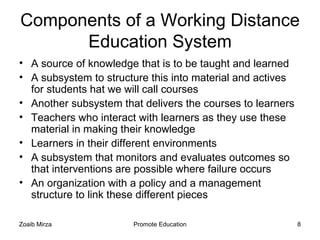
• A source of knowledge that is to be taught and learned
• A subsystem to structure this into material and actives
  for students hat we will call courses
• Another subsystem that delivers the courses to learners
• Teachers who interact with learners as they use these
  material in making their knowledge
• Learners in their different environments
• A subsystem that monitors and evaluates outcomes so
  that interventions are possible where failure occurs
• An organization with a policy and a management
  structure to link these different pieces

Zoaib Mirza            Promote Education                    8
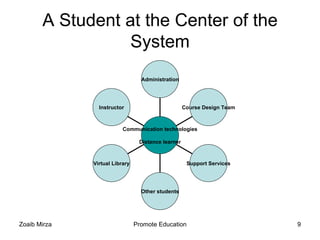
A Student at the Center of the
                  System
                                  Administration


                Instructor                          Course Design Team


                          Communication technologies

                                 Distance learner


              Virtual Library                        Support Services


                                  Other students


Zoaib Mirza                     Promote Education                        9
Five Generations of Distance
                Education
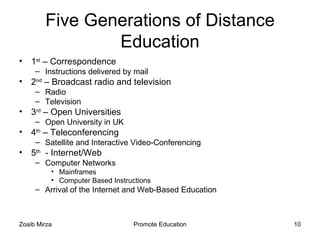
•   1st – Correspondence
     – Instructions delivered by mail
•   2nd – Broadcast radio and television
     – Radio
     – Television
•   3rd – Open Universities
     – Open University in UK
•   4th – Teleconferencing
     – Satellite and Interactive Video-Conferencing
•   5th - Internet/Web
     – Computer Networks
          • Mainframes
          • Computer Based Instructions
     – Arrival of the Internet and Web-Based Education


Zoaib Mirza                      Promote Education       10
Technologies and Media
•   Print
•   Audio and Video Media
•   Radio and Television
•   Teleconferencing
•   Computer and Web-based learning


Zoaib Mirza           Promote Education   11
Design and Development of Web-
          Based Courses
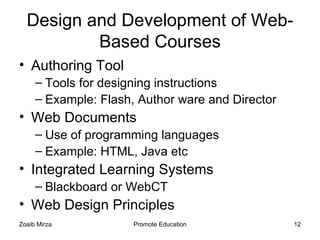
• Authoring Tool
     – Tools for designing instructions
     – Example: Flash, Author ware and Director
• Web Documents
     – Use of programming languages
     – Example: HTML, Java etc
• Integrated Learning Systems
     – Blackboard or WebCT
• Web Design Principles
Zoaib Mirza           Promote Education           12
Design and Development of Web-
          Based Courses
• Lets view an example
     – http://oll.depaul.edu


Zoaib Mirza             Promote Education   13
Bibliography and Reference
• Distance Education – A System View, 2nd
  edition by Micheal Moore and Grey
  Kearsley
• http://en.wikipedia.org/wiki/Distance_education


Zoaib Mirza       Promote Education        14

Promote Education Distance Education

  • 1.
    Distance Education Zoaib Mirza Promote Education www.promoteeducation.com Zoaib Mirza Promote Education 1
  • 2.
    Topic of Discussions • What is Distance Education? • Levels of Distance Education • Why Distance Education? • Components of a Working Distance Education System • A Student at the Center of the System • Five Generations of Distance Education • Technologies and Media • Design and Development of Web-Based Courses Zoaib Mirza Promote Education 2
  • 3.
    What is DistanceEducation? • Distance education is planned learning that normally occurs in a different place from teaching, requiring special course design and instruction techniques, communication through various technologies, and special organizational and administrative arrangement • Distance education is the study of: – Learning and teaching – Learning that is planned and not accidental – Learning that is normally in a different place from teaching – Communication through various technologies Zoaib Mirza Promote Education 3
  • 4.
    Levels of DistanceEducation • Single Mode Institutes – Distance education is the sole activity of the single mode institution – All faculty and staff of the institution are exclusively devoted to distance education – Example Athabasca (http://www.athabascau.ca) is Canada leading singe mode distance-education university • Dual Mode Institutes – On campus and online – Sets up a special unit alongside the recourses dedicated to conventional teaching – Example: public agencies, voluntary organizations and businesses that are not primarily educational institutions • U.S National Part Services (http://www.telnps.net) • Pennsylvania State University (http://www.worldcampus.psu.edu) Zoaib Mirza Promote Education 4
  • 5.
    Levels of DistanceEducation • Individual Teachers – Conventional institutions distrusting their teaching by distance education methods do so without a especial unit – Lead individual teachers design and delver their own courses – No special unit • Virtual Universities and Consortia – The term “virtual” is used very loosely and applied at times to all three types of organizations • National Technological University (http://www.ntu.edu) , consortium of 50 universties Zoaib Mirza Promote Education 5
  • 6.
    Why Distance Education? •Increasing access to learning and training opportunities • Providing opportunities for updating skills • Improving the cost effectiveness of education resources • Supporting the quality of exiting educational structures • Enhancing the capacity of the education system • Balancing inequalities between age groups • Delivering educational campaign to specific target audience • Providing emergency training for key target groups • Expanding the capacity for education in new subject areas Zoaib Mirza Promote Education 6
  • 7.
    Why Distance Education? •Offering combination of education with work and family life • Adding an international dimension to the educational experience Zoaib Mirza Promote Education 7
  • 8.
    Components of aWorking Distance Education System • A source of knowledge that is to be taught and learned • A subsystem to structure this into material and actives for students hat we will call courses • Another subsystem that delivers the courses to learners • Teachers who interact with learners as they use these material in making their knowledge • Learners in their different environments • A subsystem that monitors and evaluates outcomes so that interventions are possible where failure occurs • An organization with a policy and a management structure to link these different pieces Zoaib Mirza Promote Education 8
  • 9.
    A Student atthe Center of the System Administration Instructor Course Design Team Communication technologies Distance learner Virtual Library Support Services Other students Zoaib Mirza Promote Education 9
  • 10.
    Five Generations ofDistance Education • 1st – Correspondence – Instructions delivered by mail • 2nd – Broadcast radio and television – Radio – Television • 3rd – Open Universities – Open University in UK • 4th – Teleconferencing – Satellite and Interactive Video-Conferencing • 5th - Internet/Web – Computer Networks • Mainframes • Computer Based Instructions – Arrival of the Internet and Web-Based Education Zoaib Mirza Promote Education 10
  • 11.
    Technologies and Media • Print • Audio and Video Media • Radio and Television • Teleconferencing • Computer and Web-based learning Zoaib Mirza Promote Education 11
  • 12.
    Design and Developmentof Web- Based Courses • Authoring Tool – Tools for designing instructions – Example: Flash, Author ware and Director • Web Documents – Use of programming languages – Example: HTML, Java etc • Integrated Learning Systems – Blackboard or WebCT • Web Design Principles Zoaib Mirza Promote Education 12
  • 13.
    Design and Developmentof Web- Based Courses • Lets view an example – http://oll.depaul.edu Zoaib Mirza Promote Education 13
  • 14.
    Bibliography and Reference •Distance Education – A System View, 2nd edition by Micheal Moore and Grey Kearsley • http://en.wikipedia.org/wiki/Distance_education Zoaib Mirza Promote Education 14