Intro: What is Mechanics?
1
What is Mechanics?
2
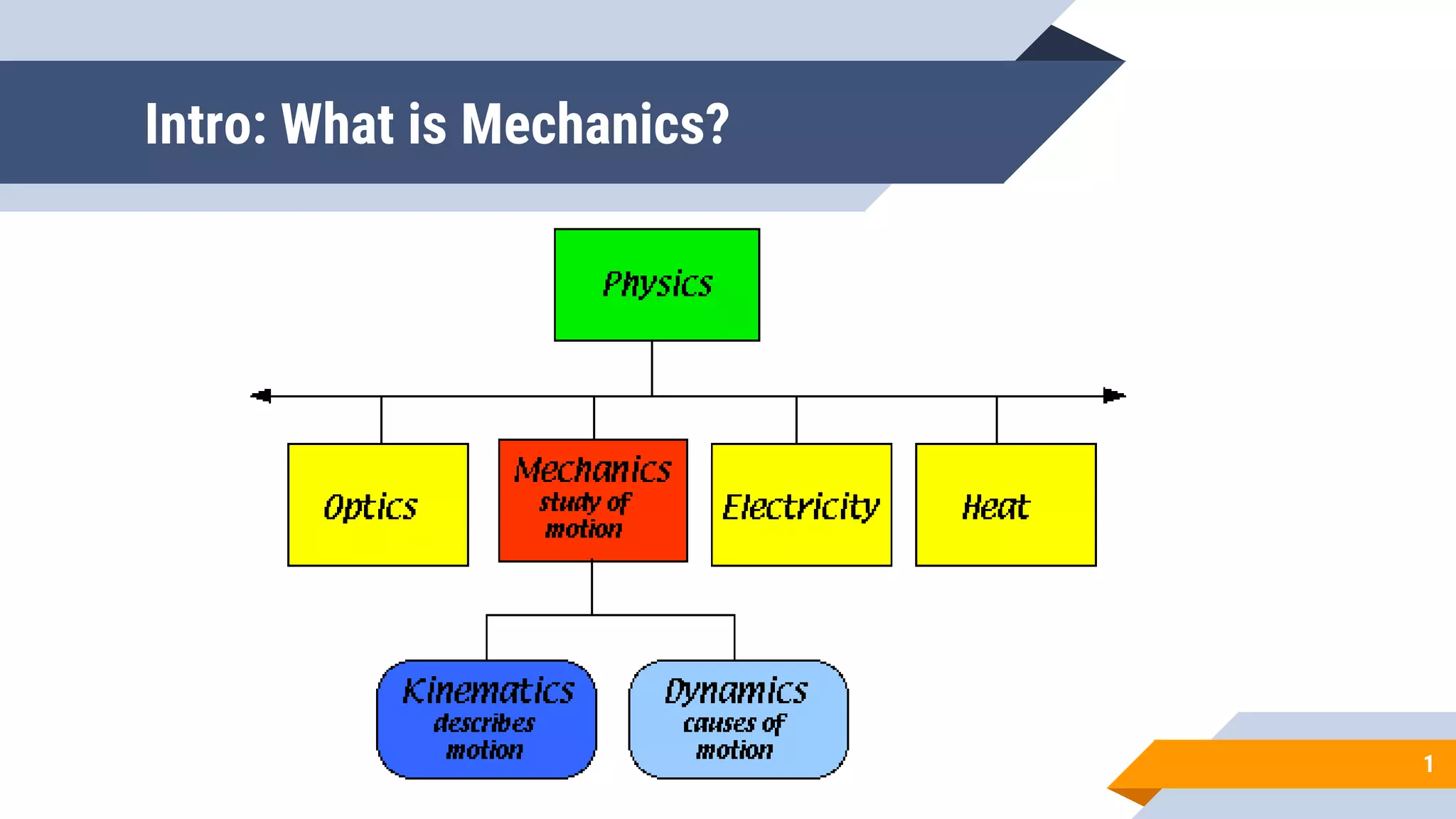
▰ Mechanics is the branch of Physics dealing with the
study of motion
▰ Motion is a fundamental idea in all of science.
▰ Mechanics can be divided into 2 areas:
1. Kinematics, dealing with describing motions
2. Dynamics, dealing with the causes of motion
CHAPTER
UNITS AND PROBLEM SOLVING
3
1
CHAPTER OBJECTIVE
▰ Distinguish standard unit and system units
▰ Describe the SI and specify the references for the three main base quantities of
this system
▰ Use common metric prefixes and nonstandard metric units
▰ Explain conversion factor relationships and apply them in converting units
within a system
▰ Determine the number of significant figures
▰ Establish a problem-solving procedure and apply it to typical problems
4
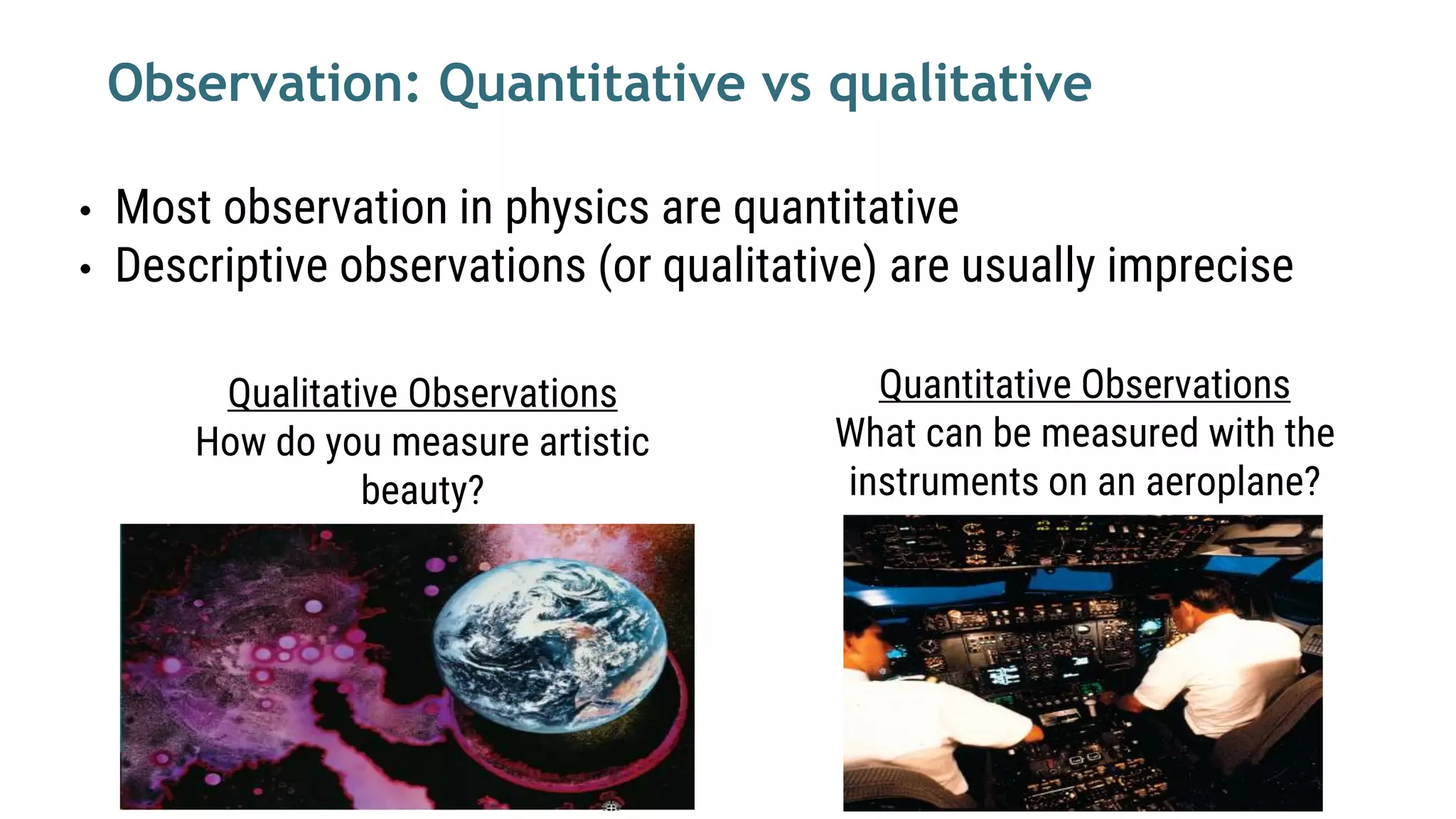
Quantitative Observations
What can be measured with the
instruments on an aeroplane?
Qualitative Observations
How do you measure artistic
beauty?
Observation: Quantitative vs qualitative
• Most observation in physics are quantitative
• Descriptive observations (or qualitative) are usually imprecise
▰ To be quantitative in Physics requires measurements
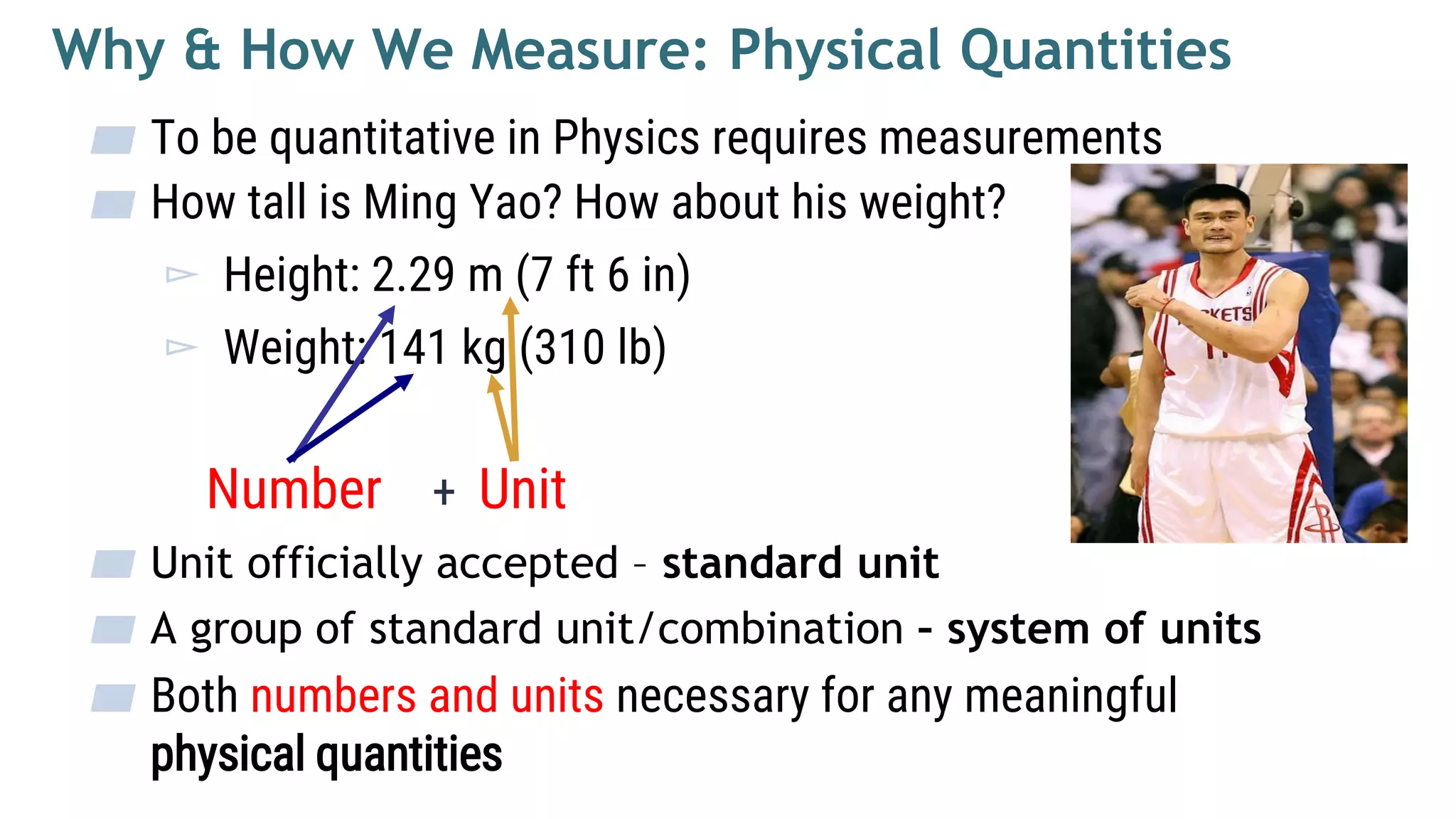
▰ How tall is Ming Yao? How about his weight?
▻ Height: 2.29 m (7 ft 6 in)
▻ Weight: 141 kg (310 lb)
Number + Unit
▰ Unit officially accepted – standard unit
▰ A group of standard unit/combination – system of units
▰ Both numbers and units necessary for any meaningful
physical quantities
Why & How We Measure: Physical Quantities
Are classified into two types:
1. Base quantities
2. Derived quantities
Physical Quantities
Base quantity
is like the brick – the
basic building block of
a house
Derived quantity is like
the house that was
build up from a collection
of bricks (basic quantity)
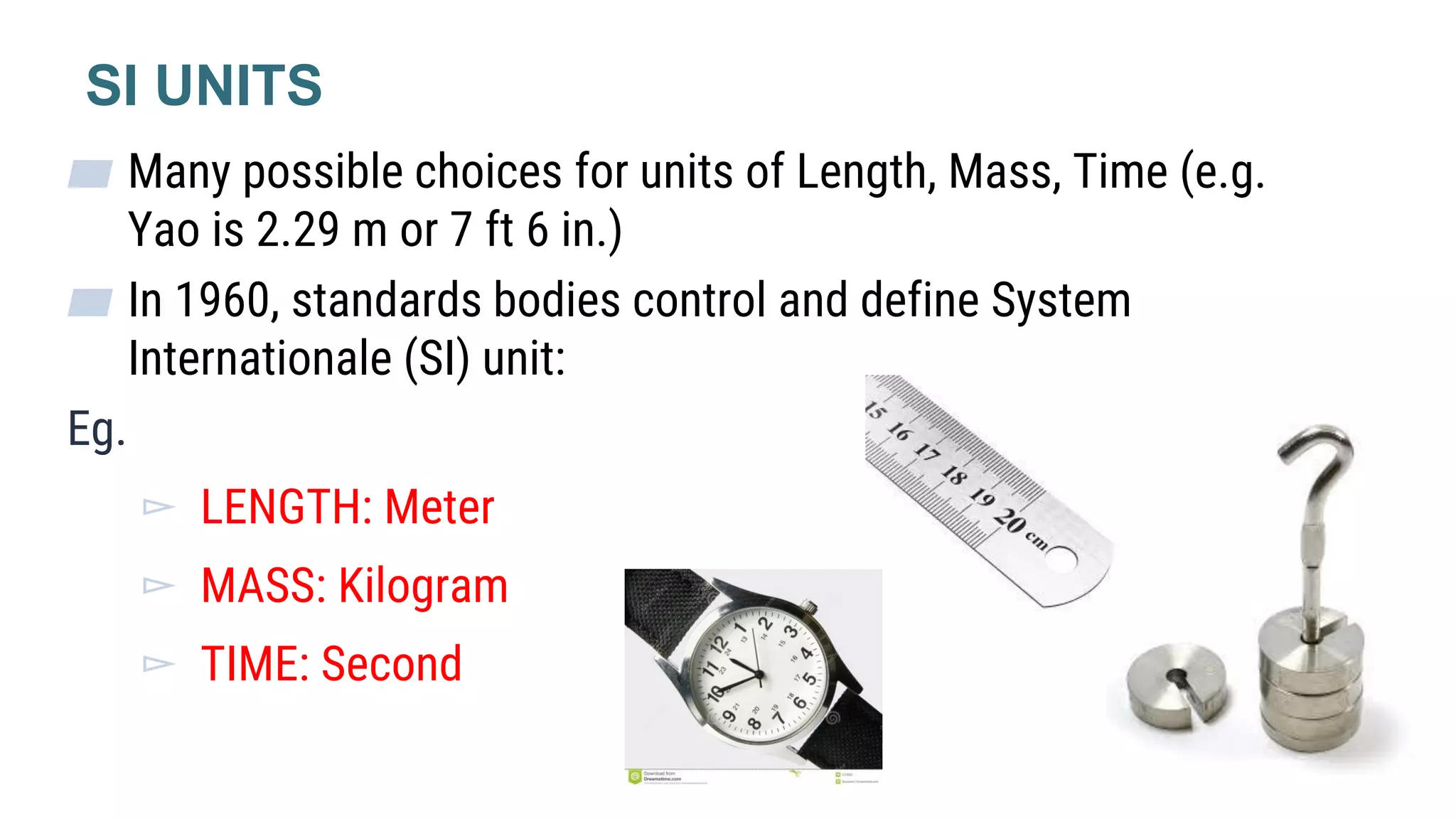
▰ Many possible choices for units of Length, Mass, Time (e.g.
Yao is 2.29 m or 7 ft 6 in.)
▰ In 1960, standards bodies control and define System
Internationale (SI) unit:
Eg.
▻ LENGTH: Meter
▻ MASS: Kilogram
▻ TIME: Second
SI UNITS
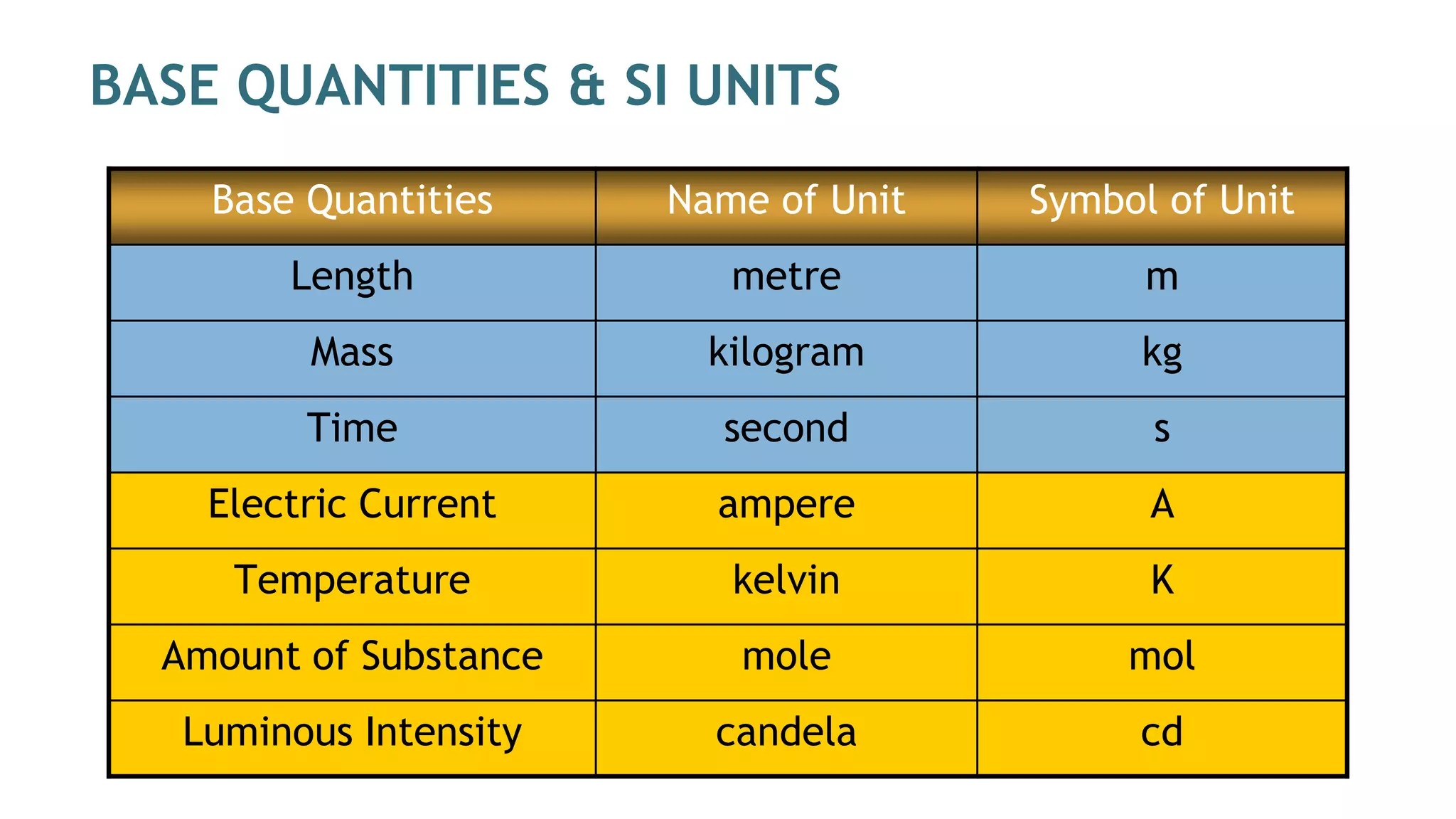
BASE QUANTITIES & SI UNITS
Base Quantities Name of Unit Symbol of Unit
Length metre m
Mass kilogram kg
Time second s
Electric Current ampere A
Temperature kelvin K
Amount of Substance mole mol
Luminous Intensity candela cd
SI Length Unit: Meter
▰ Length describe the quantity of space such width, height or
distance
▰ Symbol  [L]
▰ Current Definition of 1 Meter: the distance traveled by light
in vacuum during a time of 1/299,792,458 second.
▰ 1 Meter = about 3.28 ft
▰ 1 km = 1000 m, 1 cm = 1/100 m, 1 mm = 1/1000 m
SI Time Unit: Second
▰ Time describes the flow of the universe from the past through
the present into the future. In physics, usually mean a quantity
of time in seconds, such as 35s.
▰ Symbol  [T]
▰ The solar clock was originally used to define the second.
▰ 1 Second is defined in terms of an “atomic clock”– time taken
for 9,192,631,770 oscillations of the light emitted by a
cesium-133 atom.
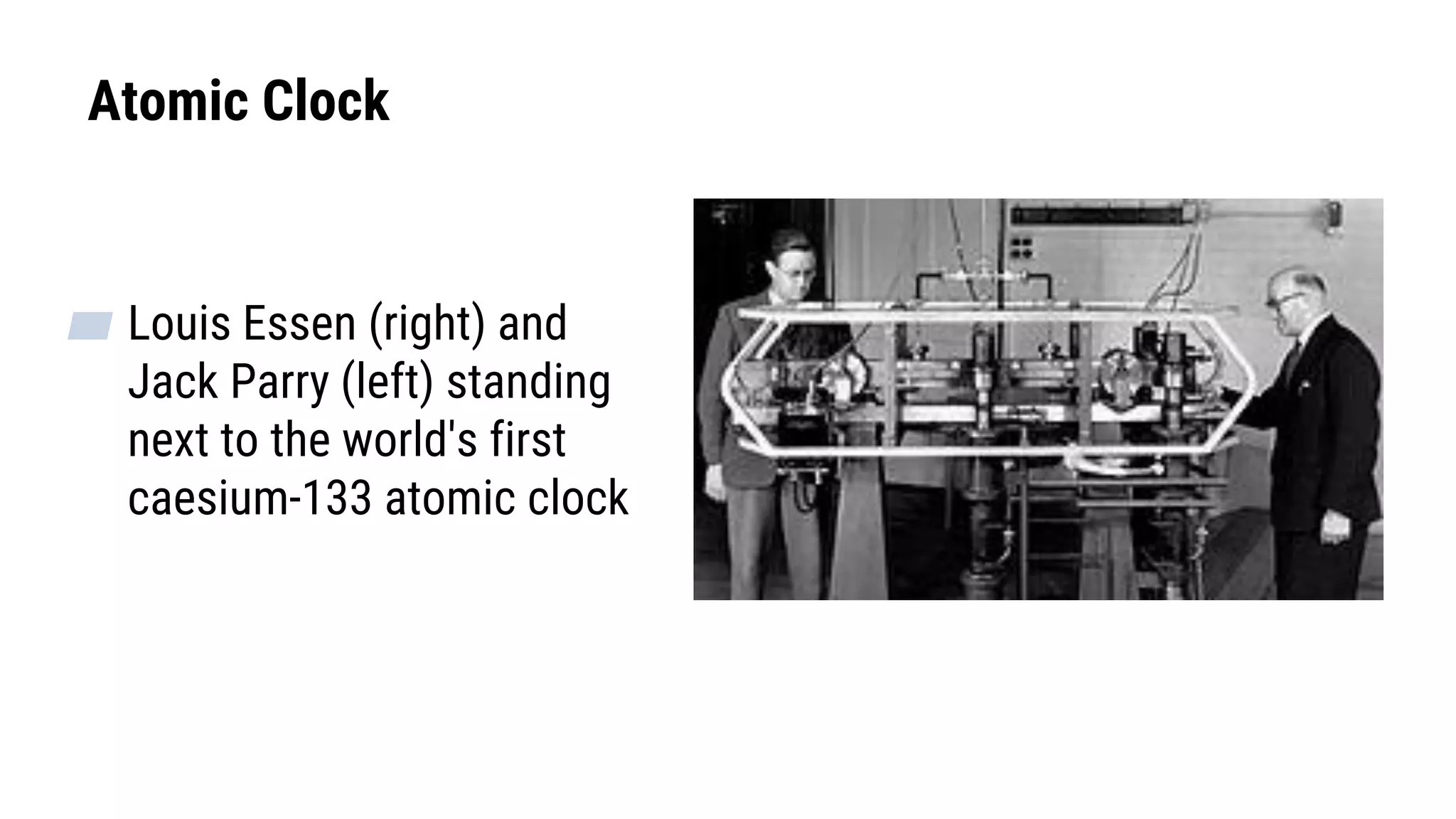
Atomic Clock
▰ Louis Essen (right) and
Jack Parry (left) standing
next to the world's first
caesium-133 atomic clock
SI Mass Unit: Kilogram
▰ Mass describes the quantity of matter
▰ Symbol  [M]
▰ 1 Kilogram – the mass of a specific platinum-
iridium alloy kept at International Bureau of
Weights and Measures near Paris. Copies are
kept in many other countries.
▰ Yao Ming is 141 kg, equivalent to weight of 141
pieces of the alloy cylinder.
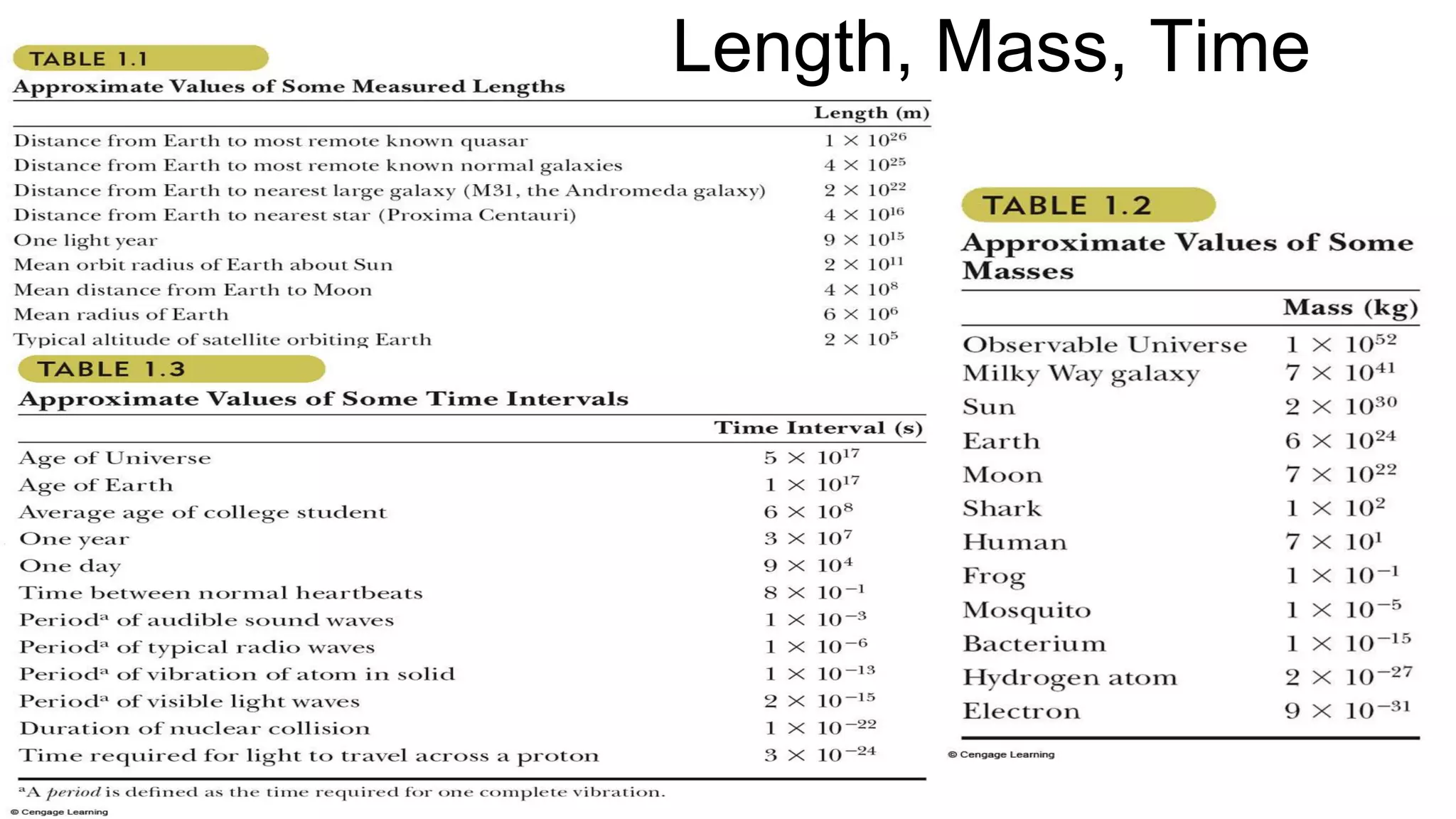
Length, Mass, Time
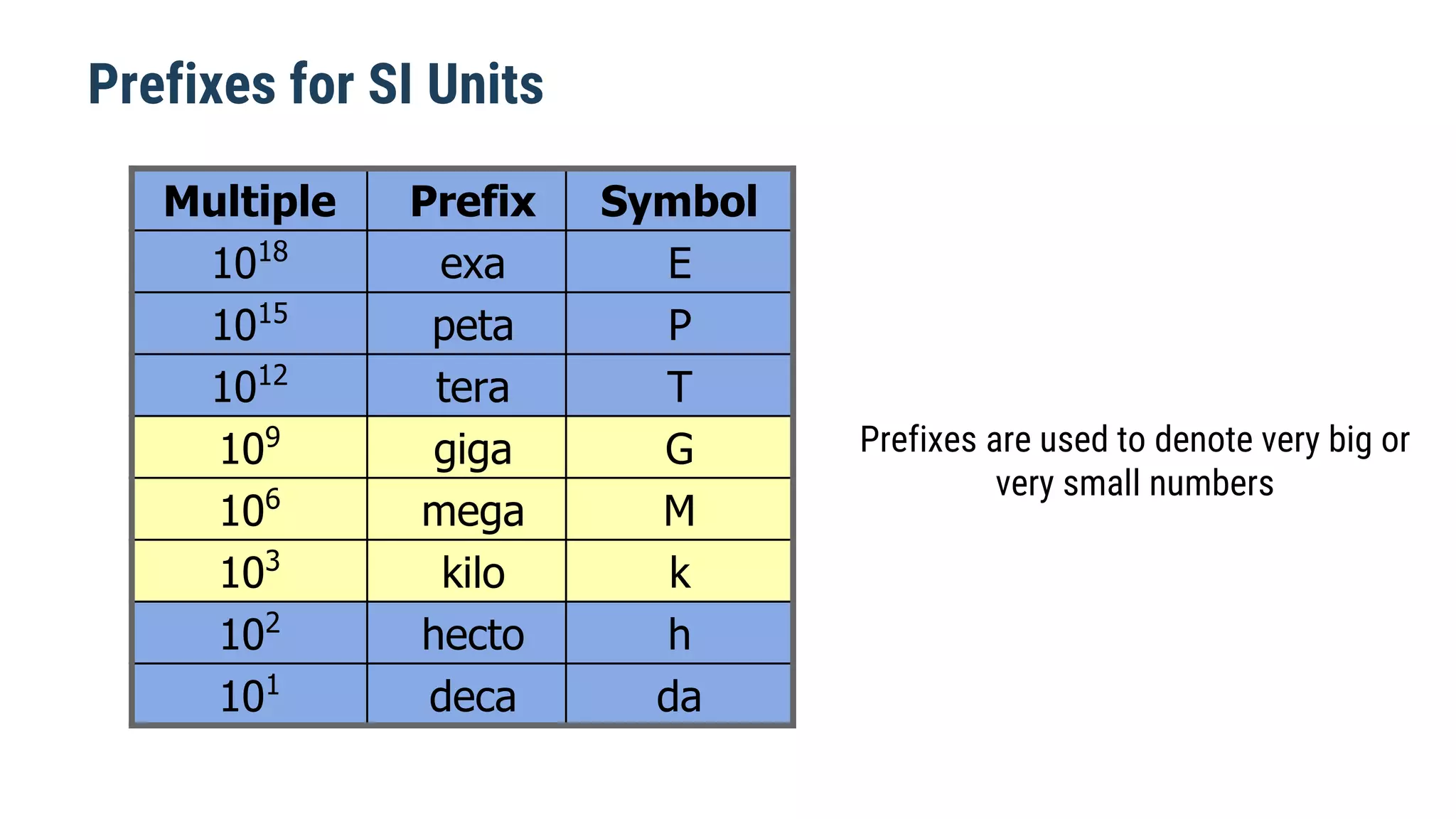
Prefixes for SI Units
Multiple Prefix Symbol
1018
exa E
1015
peta P
1012
tera T
109
giga G
106
mega M
103
kilo k
102
hecto h
101
deca da
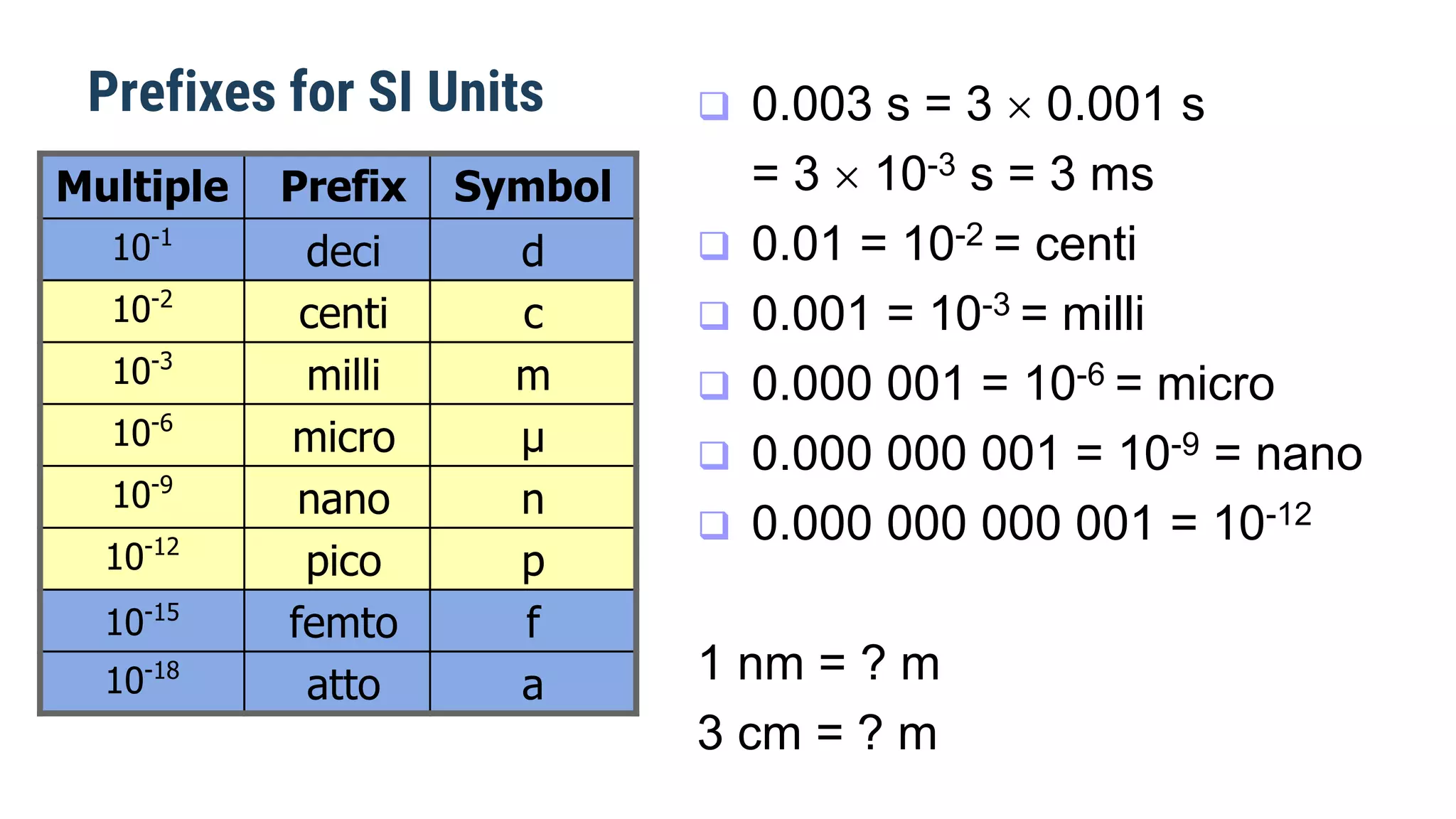
Prefixes are used to denote very big or
very small numbers
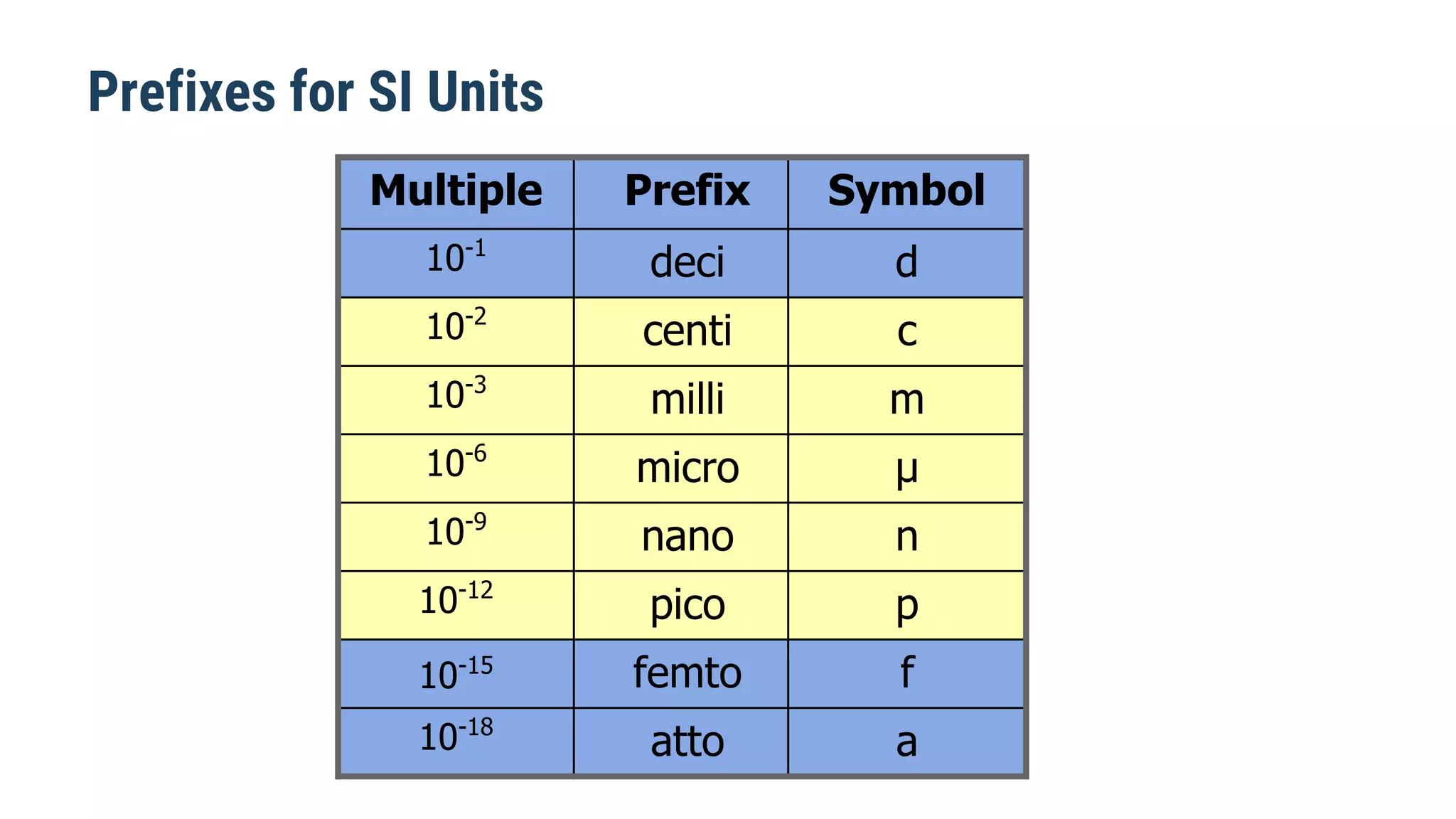
Multiple Prefix Symbol
10-1
deci d
10-2
centi c
10-3
milli m
10-6
micro µ
10-9
nano n
10-12
pico p
10-15
femto f
10-18
atto a
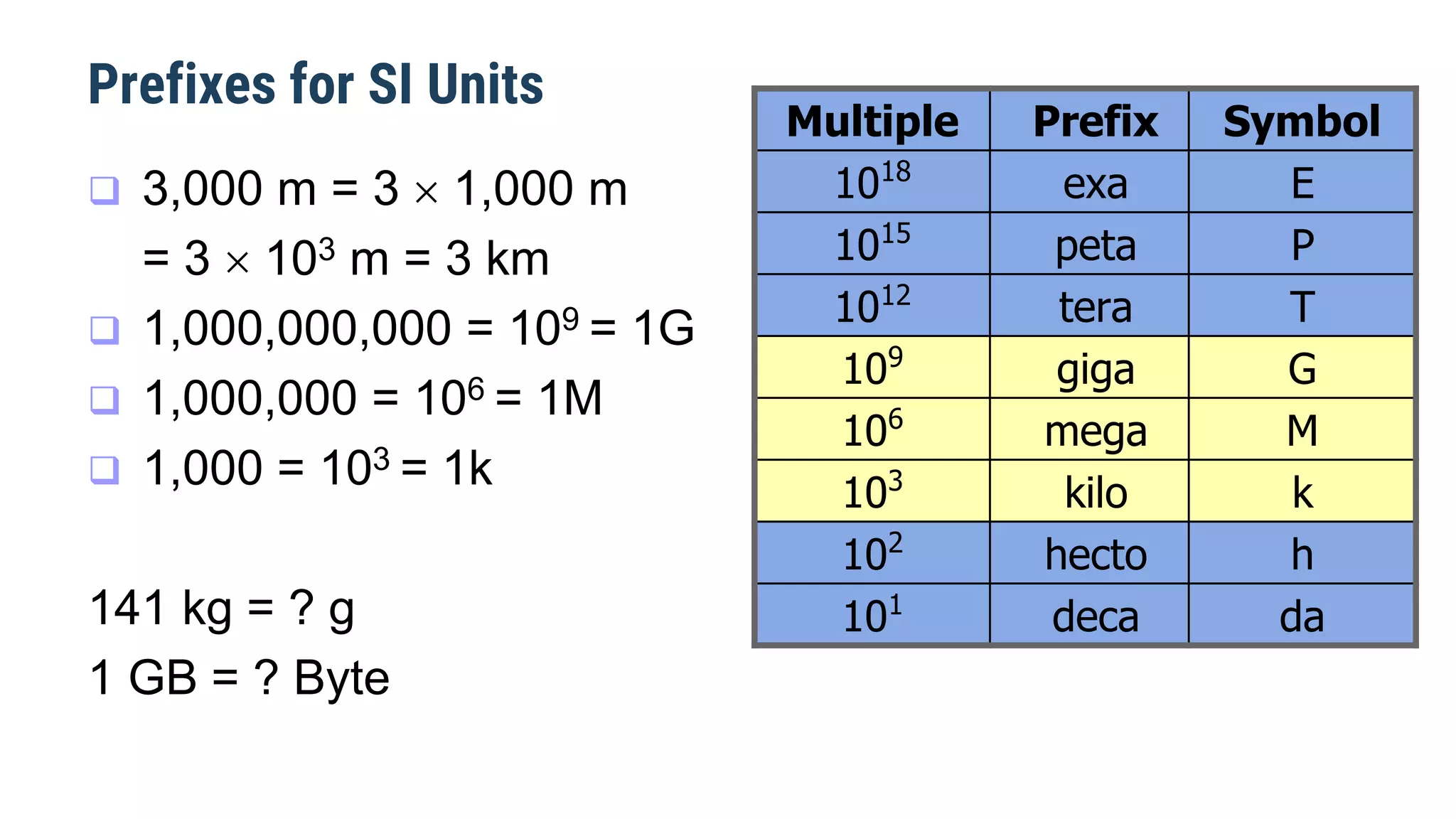
Prefixes for SI Units
Multiple Prefix Symbol
1018
exa E
1015
peta P
1012
tera T
109
giga G
106
mega M
103
kilo k
102
hecto h
101
deca da
 3,000 m = 3  1,000 m
= 3  103 m = 3 km
 1,000,000,000 = 109 = 1G
 1,000,000 = 106 = 1M
 1,000 = 103 = 1k
141 kg = ? g
1 GB = ? Byte
Multiple Prefix Symbol
10-1
deci d
10-2
centi c
10-3
milli m
10-6
micro µ
10-9
nano n
10-12
pico p
10-15
femto f
10-18
atto a
Prefixes for SI Units  0.003 s = 3  0.001 s
= 3  10-3 s = 3 ms
 0.01 = 10-2 = centi
 0.001 = 10-3 = milli
 0.000 001 = 10-6 = micro
 0.000 000 001 = 10-9 = nano
 0.000 000 000 001 = 10-12
1 nm = ? m
3 cm = ? m
Derived Quantities and Units
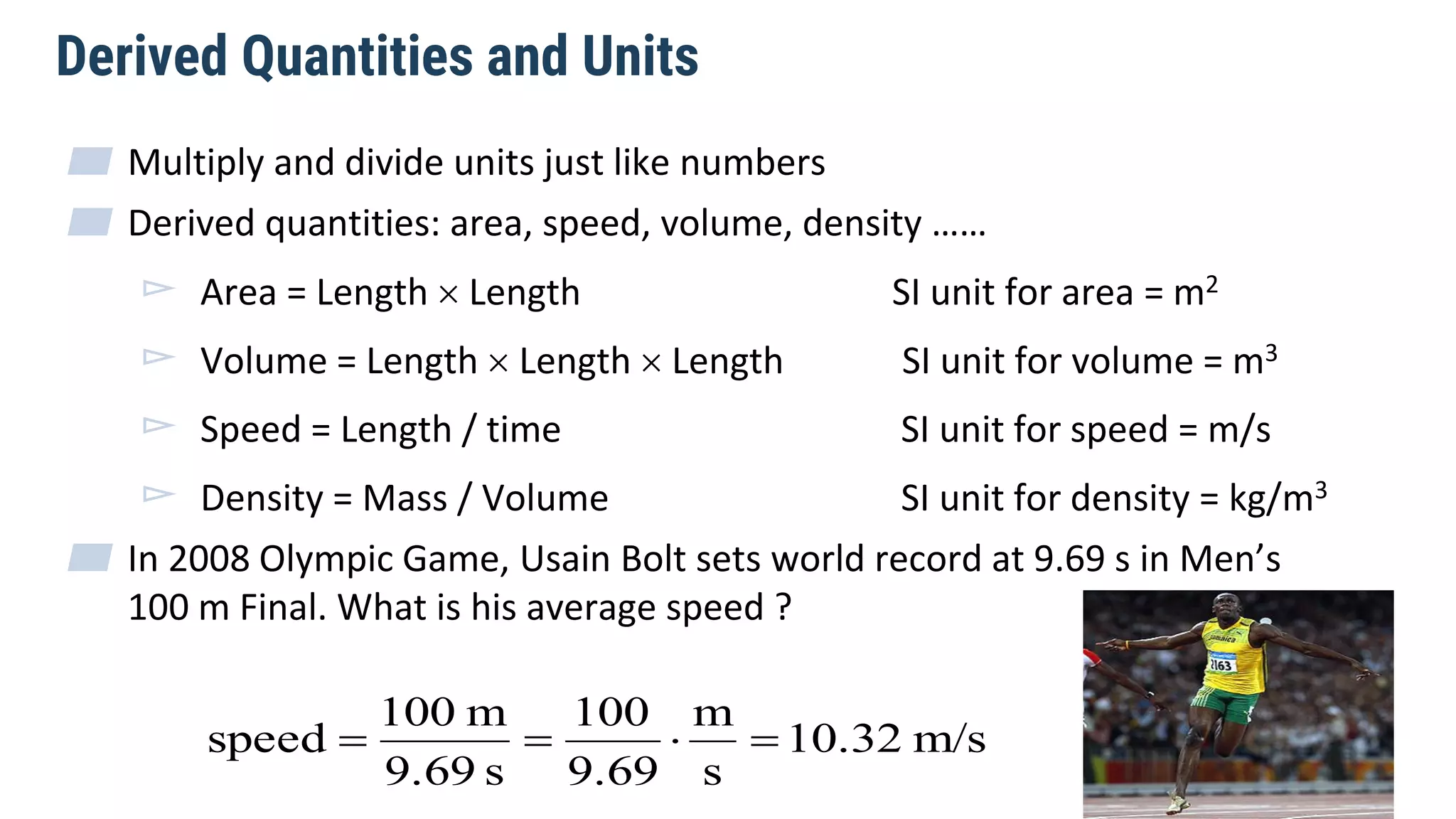
▰ Multiply and divide units just like numbers
▰ Derived quantities: area, speed, volume, density ……
▻ Area = Length  Length SI unit for area = m2
▻ Volume = Length  Length  Length SI unit for volume = m3
▻ Speed = Length / time SI unit for speed = m/s
▻ Density = Mass / Volume SI unit for density = kg/m3
▰ In 2008 Olympic Game, Usain Bolt sets world record at 9.69 s in Men’s
100 m Final. What is his average speed ?
m/s10.32
s
m
9.69
100
s9.69
m100
speed 
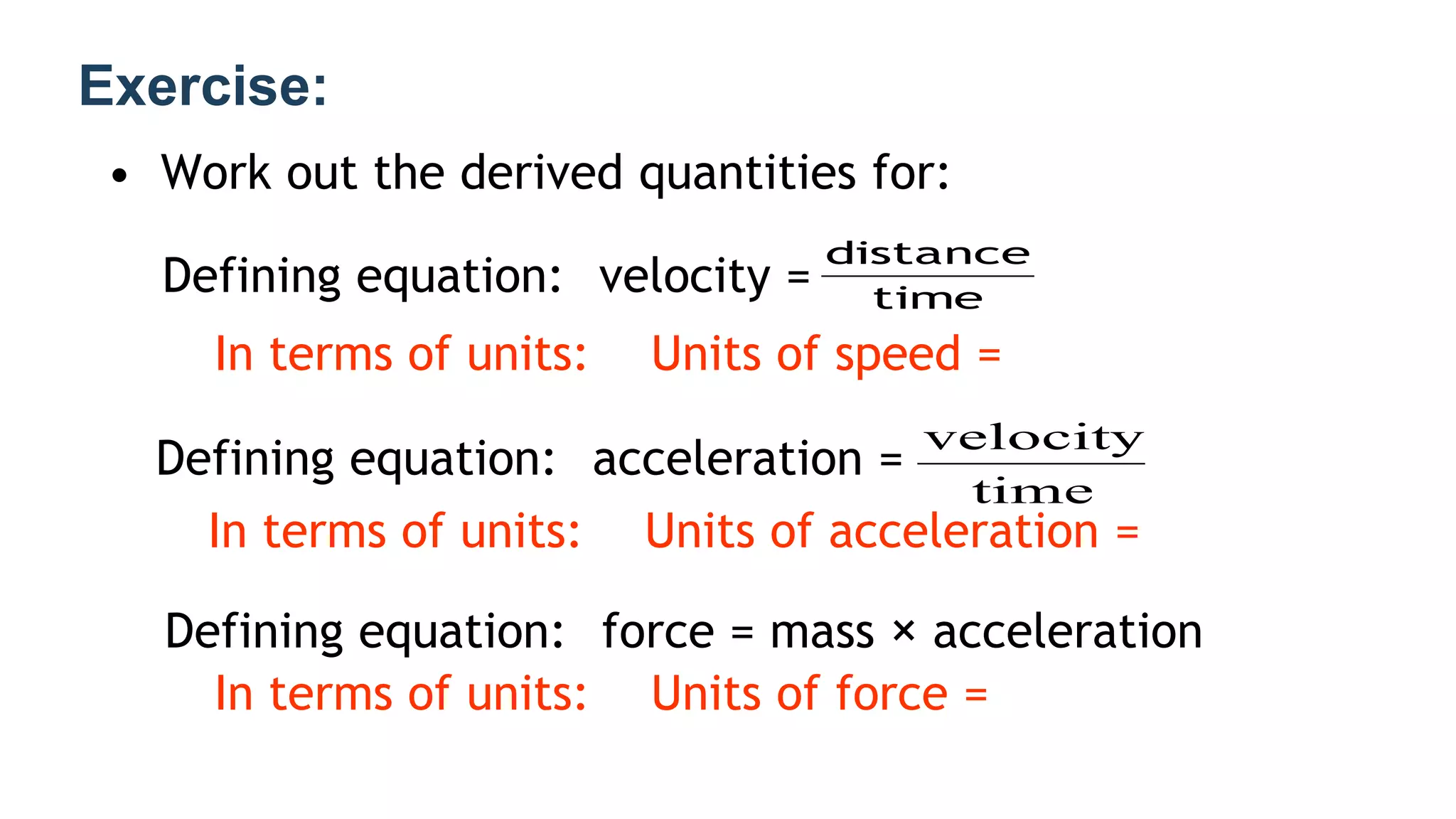
Exercise:
• Work out the derived quantities for:
Defining equation: velocity =
In terms of units: Units of speed =
Defining equation: acceleration =
In terms of units: Units of acceleration =
Defining equation: force = mass × acceleration
In terms of units: Units of force =
time
distance
time
velocity
21
THANKS!
Any questions?
You can find /Whatsapp me

Mechanics Chapter 1 units, base & derived quantities

  • 1.
    Intro: What isMechanics? 1
  • 2.
    What is Mechanics? 2 ▰Mechanics is the branch of Physics dealing with the study of motion ▰ Motion is a fundamental idea in all of science. ▰ Mechanics can be divided into 2 areas: 1. Kinematics, dealing with describing motions 2. Dynamics, dealing with the causes of motion
  • 3.
  • 4.
    CHAPTER OBJECTIVE ▰ Distinguishstandard unit and system units ▰ Describe the SI and specify the references for the three main base quantities of this system ▰ Use common metric prefixes and nonstandard metric units ▰ Explain conversion factor relationships and apply them in converting units within a system ▰ Determine the number of significant figures ▰ Establish a problem-solving procedure and apply it to typical problems 4
  • 5.
    Quantitative Observations What canbe measured with the instruments on an aeroplane? Qualitative Observations How do you measure artistic beauty? Observation: Quantitative vs qualitative • Most observation in physics are quantitative • Descriptive observations (or qualitative) are usually imprecise
  • 6.
    ▰ To bequantitative in Physics requires measurements ▰ How tall is Ming Yao? How about his weight? ▻ Height: 2.29 m (7 ft 6 in) ▻ Weight: 141 kg (310 lb) Number + Unit ▰ Unit officially accepted – standard unit ▰ A group of standard unit/combination – system of units ▰ Both numbers and units necessary for any meaningful physical quantities Why & How We Measure: Physical Quantities
  • 7.
    Are classified intotwo types: 1. Base quantities 2. Derived quantities Physical Quantities Base quantity is like the brick – the basic building block of a house Derived quantity is like the house that was build up from a collection of bricks (basic quantity)
  • 8.
    ▰ Many possiblechoices for units of Length, Mass, Time (e.g. Yao is 2.29 m or 7 ft 6 in.) ▰ In 1960, standards bodies control and define System Internationale (SI) unit: Eg. ▻ LENGTH: Meter ▻ MASS: Kilogram ▻ TIME: Second SI UNITS
  • 9.
    BASE QUANTITIES &SI UNITS Base Quantities Name of Unit Symbol of Unit Length metre m Mass kilogram kg Time second s Electric Current ampere A Temperature kelvin K Amount of Substance mole mol Luminous Intensity candela cd
  • 10.
    SI Length Unit:Meter ▰ Length describe the quantity of space such width, height or distance ▰ Symbol  [L] ▰ Current Definition of 1 Meter: the distance traveled by light in vacuum during a time of 1/299,792,458 second. ▰ 1 Meter = about 3.28 ft ▰ 1 km = 1000 m, 1 cm = 1/100 m, 1 mm = 1/1000 m
  • 11.
    SI Time Unit:Second ▰ Time describes the flow of the universe from the past through the present into the future. In physics, usually mean a quantity of time in seconds, such as 35s. ▰ Symbol  [T] ▰ The solar clock was originally used to define the second. ▰ 1 Second is defined in terms of an “atomic clock”– time taken for 9,192,631,770 oscillations of the light emitted by a cesium-133 atom.
  • 12.
    Atomic Clock ▰ LouisEssen (right) and Jack Parry (left) standing next to the world's first caesium-133 atomic clock
  • 13.
    SI Mass Unit:Kilogram ▰ Mass describes the quantity of matter ▰ Symbol  [M] ▰ 1 Kilogram – the mass of a specific platinum- iridium alloy kept at International Bureau of Weights and Measures near Paris. Copies are kept in many other countries. ▰ Yao Ming is 141 kg, equivalent to weight of 141 pieces of the alloy cylinder.
  • 14.
  • 15.
    Prefixes for SIUnits Multiple Prefix Symbol 1018 exa E 1015 peta P 1012 tera T 109 giga G 106 mega M 103 kilo k 102 hecto h 101 deca da Prefixes are used to denote very big or very small numbers
  • 16.
    Multiple Prefix Symbol 10-1 decid 10-2 centi c 10-3 milli m 10-6 micro µ 10-9 nano n 10-12 pico p 10-15 femto f 10-18 atto a Prefixes for SI Units
  • 17.
    Prefixes for SIUnits Multiple Prefix Symbol 1018 exa E 1015 peta P 1012 tera T 109 giga G 106 mega M 103 kilo k 102 hecto h 101 deca da  3,000 m = 3  1,000 m = 3  103 m = 3 km  1,000,000,000 = 109 = 1G  1,000,000 = 106 = 1M  1,000 = 103 = 1k 141 kg = ? g 1 GB = ? Byte
  • 18.
    Multiple Prefix Symbol 10-1 decid 10-2 centi c 10-3 milli m 10-6 micro µ 10-9 nano n 10-12 pico p 10-15 femto f 10-18 atto a Prefixes for SI Units  0.003 s = 3  0.001 s = 3  10-3 s = 3 ms  0.01 = 10-2 = centi  0.001 = 10-3 = milli  0.000 001 = 10-6 = micro  0.000 000 001 = 10-9 = nano  0.000 000 000 001 = 10-12 1 nm = ? m 3 cm = ? m
  • 19.
    Derived Quantities andUnits ▰ Multiply and divide units just like numbers ▰ Derived quantities: area, speed, volume, density …… ▻ Area = Length  Length SI unit for area = m2 ▻ Volume = Length  Length  Length SI unit for volume = m3 ▻ Speed = Length / time SI unit for speed = m/s ▻ Density = Mass / Volume SI unit for density = kg/m3 ▰ In 2008 Olympic Game, Usain Bolt sets world record at 9.69 s in Men’s 100 m Final. What is his average speed ? m/s10.32 s m 9.69 100 s9.69 m100 speed 
  • 20.
    Exercise: • Work outthe derived quantities for: Defining equation: velocity = In terms of units: Units of speed = Defining equation: acceleration = In terms of units: Units of acceleration = Defining equation: force = mass × acceleration In terms of units: Units of force = time distance time velocity
  • 21.