02
Mechanical ventilation-2
The basics
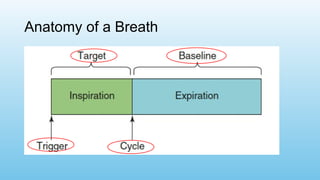
Anatomy of a Breath
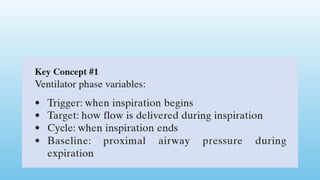
• Each breath can be broken into 4 components, known as
phase variables.
• These variables determine when the inspiration
begins(trigger) ,
how flow is delivered during inspiration(target), when
inspiration ends(cycle), and proximal airway pressure during
expiration(baseline)
Anatomy of a Breath
Trigger
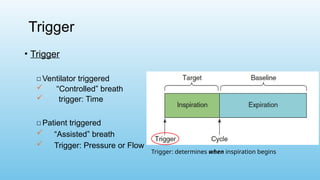
• Trigger
□Ventilator triggered
 “Controlled” breath
 trigger: Time
□Patient triggered
 “Assisted” breath
 Trigger: Pressure or Flow
Trigger: determines when inspiration begins
Time trigger
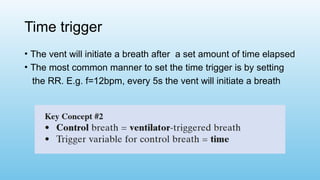
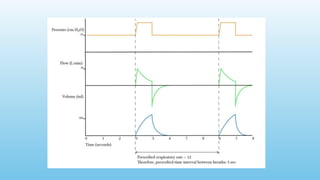
• The vent will initiate a breath after a set amount of time elapsed
• The most common manner to set the time trigger is by setting
the RR. E.g. f=12bpm, every 5s the vent will initiate a breath
Patient trigger: pressure trigger
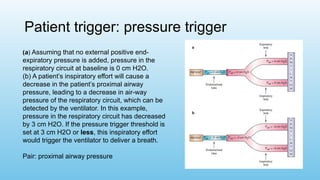
(a) Assuming that no external positive end-
expiratory pressure is added, pressure in the
respiratory circuit at baseline is 0 cm H2O.
(b) A patient’s inspiratory effort will cause a
decrease in the patient’s proximal airway
pressure, leading to a decrease in air-way
pressure of the respiratory circuit, which can be
detected by the ventilator. In this example,
pressure in the respiratory circuit has decreased
by 3 cm H2O. If the pressure trigger threshold is
set at 3 cm H2O or less, this inspiratory effort
would trigger the ventilator to deliver a breath.
Pair: proximal airway pressure
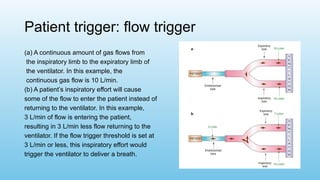
Patient trigger: flow trigger
(a) A continuous amount of gas flows from
the inspiratory limb to the expiratory limb of
the ventilator. In this example, the
continuous gas flow is 10 L/min.
(b) A patient’s inspiratory effort will cause
some of the flow to enter the patient instead of
returning to the ventilator. In this example,
3 L/min of flow is entering the patient,
resulting in 3 L/min less flow returning to the
ventilator. If the flow trigger threshold is set at
3 L/min or less, this inspiratory effort would
trigger the ventilator to deliver a breath.
• When a breath is initiated by a pressure or flow trigger, that
breath is classified as a patient-triggered, or assist, breath. The
difference between pressure and flow triggers in modern ven-
tilators is clinically insignificant.
A patient can trigger the ventilator only during the expiratory
(baseline) phase. Patient respiratory efforts during inspiration
after a breath has been initiated will not trigger another breath.
Assist-Control
• A patient trigger (assist) + a ventilator trigger (control) =assist-
control (A/C).
• With this hybrid trigger, both a control respiratory rate (time
trigger) and either a pressure or flow trigger are set.
• If an amount of time as set by the time trigger has elapsed
without a patient-triggered breath, the ventilator will initiate a
“control” breath.However, if the patient triggers the ventilator,
prior to elapsing of the time trigger, the ventilator will initiate
an “assist” breath and the time trigger clock will reset.
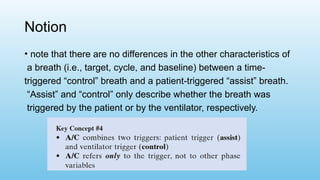
Notion
• note that there are no differences in the other characteristics of
a breath (i.e., target, cycle, and baseline) between a time-
triggered “control” breath and a patient-triggered “assist” breath.
“Assist” and “control” only describe whether the breath was
triggered by the patient or by the ventilator, respectively.
Difference in different trigger
• Time triggering which guarantees a minute volume and
decreased work of breathing but which is less comfortable
• Pressure triggering which gives the patient more control over
the initiation of a breath, but which can also be uncomfortable
• Flow triggering which is the most comfortable but which can be
over-sensitive, leading to dyssynchrony
• Of these, time pressure and flow triggers are the most common.
• Flow triggering is favoured as the best choice for spontaneously
breathing patients(low evidence)
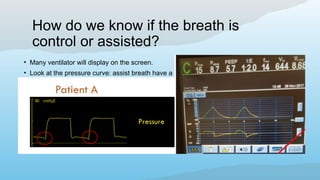
How do we know if the breath is
control or assisted?
• Many ventilator will display on the screen.
• Look at the pressure curve: assist breath have a negative deflection right before inspiration
Quiz(A/C)
• 1.Suppose the intrinsic breathing pattern of the patient is regular,
If the time trigger is set that the control rate is 10 bpm, and the
rate of patient inspiratory efforts is 20 bpm, then the breaths will
Be__? A: All assit B: All control C: Part assit, part control
2. If we increase the control rate from 10 to 15, the answer is _?
3. If we increase the control rate from 10 to 25, the answer is _?
4. For patients with irregular breathing patterns where the time
between patient inspiratory efforts varies, there can be a
combination of assist and control
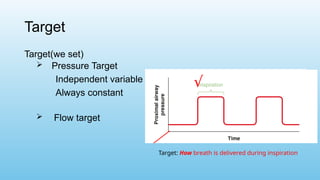
Target
Target
Target(we set)
 Pressure Target
Independent variable
Always constant
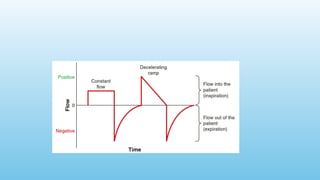
 Flow target
Target: How breath is delivered during inspiration
√
notion
• Volume is not a target, because it does not clarify how the flow
is to be delivered—whether it is delivered over a short period
(high flow rate) or over a long period( low flow rate)
• But volume delivered per unit time, which is the definition of
flow,
is target variable.
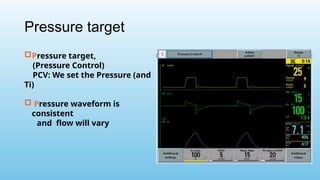
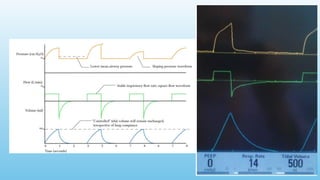
Pressure target
Pressure target,
(Pressure Control)
PCV: We set the Pressure (and
Ti)
 Pressure waveform is
consistent
and flow will vary
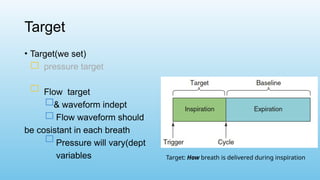
Target
• Target(we set)
pressure target
Flow target
& waveform indept
Flow waveform should
be cosistant in each breath
Pressure will vary(dept
variables Target: How breath is delivered during inspiration
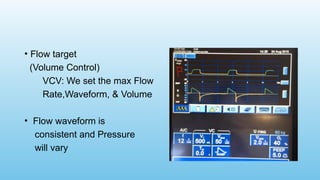
• Flow target
(Volume Control)
VCV: We set the max Flow
Rate,Waveform, & Volume
• Flow waveform is
consistent and Pressure
will vary
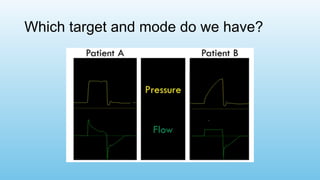
Which target and mode do we have?
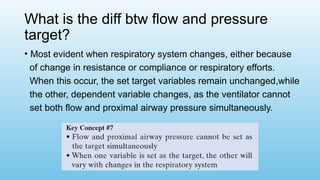
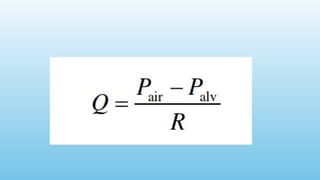
What is the diff btw flow and pressure
target?
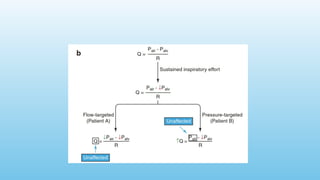
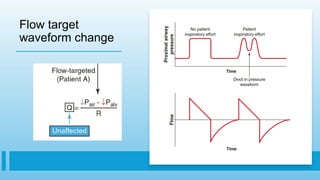
• Most evident when respiratory system changes, either because
of change in resistance or compliance or respiratory efforts.
When this occur, the set target variables remain unchanged,while
the other, dependent variable changes, as the ventilator cannot
set both flow and proximal airway pressure simultaneously.
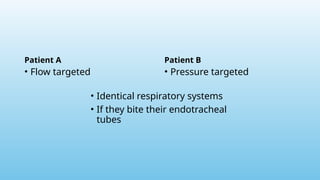
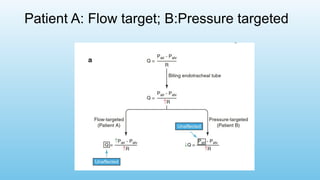
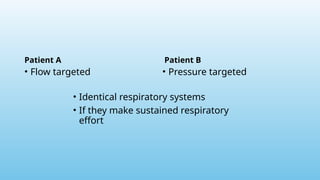
Patient A
• Flow targeted
Patient B
• Pressure targeted
• Identical respiratory systems
• If they bite their endotracheal
tubes
Patient A: Flow target; B:Pressure targeted
Patient A
• Flow targeted
Patient B
• Pressure targeted
• Identical respiratory systems
• If they make sustained respiratory
effort
Flow target
waveform change
Question?
If the respiratory effort reach the trigger sensitivity, can the
ventilator initiate a breath?
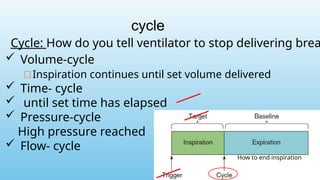
cycle
cycle
Cycle: How do you tell ventilator to stop delivering brea
How to end inspiration
 Volume-cycle
Inspiration continues until set volume delivered
 Time- cycle
 until set time has elapsed
 Pressure-cycle
High pressure reached
 Flow- cycle
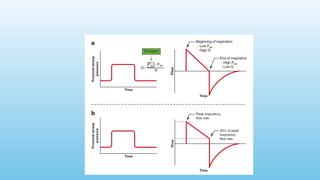
Cycle
• Flow cycle
terminates breath until flow reaches certain percentage of
peak inspiratory flow
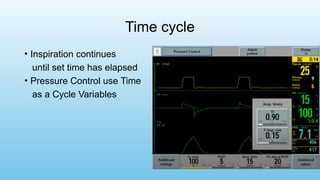
Time cycle
• Inspiration continues
until set time has elapsed
• Pressure Control use Time
as a Cycle Variables
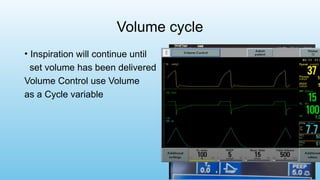
Volume cycle
• Inspiration will continue until
set volume has been delivered
Volume Control use Volume
as a Cycle variable
Cycle
• Flow cycle
terminates breath until flow reaches certain percentage of
peak inspiratory flow
Pressure Support use Flow as cycle vairiable
Baseline phase
44
Baseline Pressure
• Airway pressure during inspiration
• Zero baseline pressure is equal to atmospheric pressure
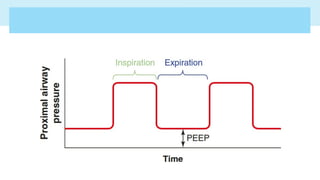
• PEEP: resistance applied during exhalation preventing
complete exhalation
• Applications of PEEP:
• Increases FRC
• Increases mean airway pressure
• Improves lung recruitment
• Improves oxygenation
45
Expiration: Baseline Variable
• Defined by how baseline or end expiratory pressure (EEP)
relates to atmospheric pressure
• PEEP Positive or supra- atmospheric EEP
• NEEP Negative or sub-atmospheric EEP
• ZEEP Zero EEP equals sub-atmospheric pressure
O92

mechanical ventilation help you understand the basics2.pptx

  • 1.
  • 2.
    Anatomy of aBreath • Each breath can be broken into 4 components, known as phase variables. • These variables determine when the inspiration begins(trigger) , how flow is delivered during inspiration(target), when inspiration ends(cycle), and proximal airway pressure during expiration(baseline)
  • 3.
  • 4.
    Trigger • Trigger □Ventilator triggered “Controlled” breath  trigger: Time □Patient triggered  “Assisted” breath  Trigger: Pressure or Flow Trigger: determines when inspiration begins
  • 6.
    Time trigger • Thevent will initiate a breath after a set amount of time elapsed • The most common manner to set the time trigger is by setting the RR. E.g. f=12bpm, every 5s the vent will initiate a breath
  • 8.
    Patient trigger: pressuretrigger (a) Assuming that no external positive end- expiratory pressure is added, pressure in the respiratory circuit at baseline is 0 cm H2O. (b) A patient’s inspiratory effort will cause a decrease in the patient’s proximal airway pressure, leading to a decrease in air-way pressure of the respiratory circuit, which can be detected by the ventilator. In this example, pressure in the respiratory circuit has decreased by 3 cm H2O. If the pressure trigger threshold is set at 3 cm H2O or less, this inspiratory effort would trigger the ventilator to deliver a breath. Pair: proximal airway pressure
  • 9.
    Patient trigger: flowtrigger (a) A continuous amount of gas flows from the inspiratory limb to the expiratory limb of the ventilator. In this example, the continuous gas flow is 10 L/min. (b) A patient’s inspiratory effort will cause some of the flow to enter the patient instead of returning to the ventilator. In this example, 3 L/min of flow is entering the patient, resulting in 3 L/min less flow returning to the ventilator. If the flow trigger threshold is set at 3 L/min or less, this inspiratory effort would trigger the ventilator to deliver a breath.
  • 10.
    • When abreath is initiated by a pressure or flow trigger, that breath is classified as a patient-triggered, or assist, breath. The difference between pressure and flow triggers in modern ven- tilators is clinically insignificant. A patient can trigger the ventilator only during the expiratory (baseline) phase. Patient respiratory efforts during inspiration after a breath has been initiated will not trigger another breath.
  • 11.
    Assist-Control • A patienttrigger (assist) + a ventilator trigger (control) =assist- control (A/C). • With this hybrid trigger, both a control respiratory rate (time trigger) and either a pressure or flow trigger are set. • If an amount of time as set by the time trigger has elapsed without a patient-triggered breath, the ventilator will initiate a “control” breath.However, if the patient triggers the ventilator, prior to elapsing of the time trigger, the ventilator will initiate an “assist” breath and the time trigger clock will reset.
  • 13.
    Notion • note thatthere are no differences in the other characteristics of a breath (i.e., target, cycle, and baseline) between a time- triggered “control” breath and a patient-triggered “assist” breath. “Assist” and “control” only describe whether the breath was triggered by the patient or by the ventilator, respectively.
  • 14.
    Difference in differenttrigger • Time triggering which guarantees a minute volume and decreased work of breathing but which is less comfortable • Pressure triggering which gives the patient more control over the initiation of a breath, but which can also be uncomfortable • Flow triggering which is the most comfortable but which can be over-sensitive, leading to dyssynchrony • Of these, time pressure and flow triggers are the most common. • Flow triggering is favoured as the best choice for spontaneously breathing patients(low evidence)
  • 15.
    How do weknow if the breath is control or assisted? • Many ventilator will display on the screen. • Look at the pressure curve: assist breath have a negative deflection right before inspiration
  • 16.
    Quiz(A/C) • 1.Suppose theintrinsic breathing pattern of the patient is regular, If the time trigger is set that the control rate is 10 bpm, and the rate of patient inspiratory efforts is 20 bpm, then the breaths will Be__? A: All assit B: All control C: Part assit, part control 2. If we increase the control rate from 10 to 15, the answer is _? 3. If we increase the control rate from 10 to 25, the answer is _? 4. For patients with irregular breathing patterns where the time between patient inspiratory efforts varies, there can be a combination of assist and control
  • 17.
  • 18.
    Target Target(we set)  PressureTarget Independent variable Always constant  Flow target Target: How breath is delivered during inspiration √
  • 19.
    notion • Volume isnot a target, because it does not clarify how the flow is to be delivered—whether it is delivered over a short period (high flow rate) or over a long period( low flow rate) • But volume delivered per unit time, which is the definition of flow, is target variable.
  • 21.
    Pressure target Pressure target, (PressureControl) PCV: We set the Pressure (and Ti)  Pressure waveform is consistent and flow will vary
  • 22.
    Target • Target(we set) pressuretarget Flow target & waveform indept Flow waveform should be cosistant in each breath Pressure will vary(dept variables Target: How breath is delivered during inspiration
  • 24.
    • Flow target (VolumeControl) VCV: We set the max Flow Rate,Waveform, & Volume • Flow waveform is consistent and Pressure will vary
  • 26.
    Which target andmode do we have?
  • 27.
    What is thediff btw flow and pressure target? • Most evident when respiratory system changes, either because of change in resistance or compliance or respiratory efforts. When this occur, the set target variables remain unchanged,while the other, dependent variable changes, as the ventilator cannot set both flow and proximal airway pressure simultaneously.
  • 29.
    Patient A • Flowtargeted Patient B • Pressure targeted • Identical respiratory systems • If they bite their endotracheal tubes
  • 30.
    Patient A: Flowtarget; B:Pressure targeted
  • 31.
    Patient A • Flowtargeted Patient B • Pressure targeted • Identical respiratory systems • If they make sustained respiratory effort
  • 33.
  • 34.
    Question? If the respiratoryeffort reach the trigger sensitivity, can the ventilator initiate a breath?
  • 35.
  • 36.
    cycle Cycle: How doyou tell ventilator to stop delivering brea How to end inspiration  Volume-cycle Inspiration continues until set volume delivered  Time- cycle  until set time has elapsed  Pressure-cycle High pressure reached  Flow- cycle
  • 37.
    Cycle • Flow cycle terminatesbreath until flow reaches certain percentage of peak inspiratory flow
  • 38.
    Time cycle • Inspirationcontinues until set time has elapsed • Pressure Control use Time as a Cycle Variables
  • 39.
    Volume cycle • Inspirationwill continue until set volume has been delivered Volume Control use Volume as a Cycle variable
  • 40.
    Cycle • Flow cycle terminatesbreath until flow reaches certain percentage of peak inspiratory flow Pressure Support use Flow as cycle vairiable
  • 42.
  • 43.
    44 Baseline Pressure • Airwaypressure during inspiration • Zero baseline pressure is equal to atmospheric pressure • PEEP: resistance applied during exhalation preventing complete exhalation • Applications of PEEP: • Increases FRC • Increases mean airway pressure • Improves lung recruitment • Improves oxygenation
  • 44.
    45 Expiration: Baseline Variable •Defined by how baseline or end expiratory pressure (EEP) relates to atmospheric pressure • PEEP Positive or supra- atmospheric EEP • NEEP Negative or sub-atmospheric EEP • ZEEP Zero EEP equals sub-atmospheric pressure
  • 45.