
Measuring other conditions in
oral epidemiology
PDS 372
Lecture outline
•
•
•
•

Malocclusion
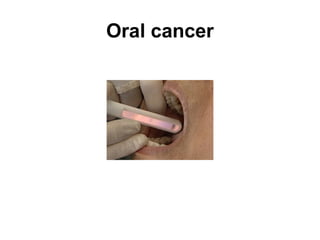
Oral cancer
Cleft lip and palate
Oral health and quality of life
Learning objectives
• At the end of this lecture, the student will:
– Learn about different methods of measuring
other dental conditions in oral epidemiology
– Learn about how to measure these conditions
in a public health perspective
– Understand the concept behind quality of life
Malocclusion
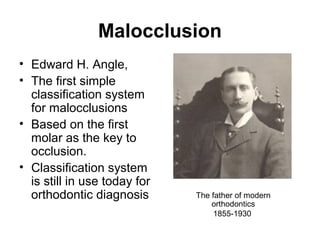
• Edward H. Angle,
• The first simple
classification system
for malocclusions
• Based on the first
molar as the key to
occlusion.
• Classification system
is still in use today for
orthodontic diagnosis

The father of modern
orthodontics
1855-1930
Malocclusion
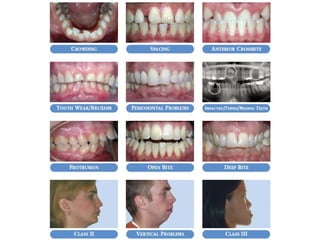
• Difficult to measure
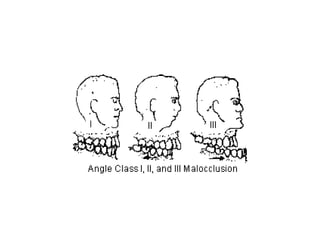
• Angle’s classification is a nominal scale
• The malalignment index assess rotation and
tooth displacement
• Occlusal Feature index records crowding,
cuspal interdigitation and vertical and horizontal
overbite
• The Handicapping Labio-Lingual Deviations
(HLD), assesses treatment needs
Malocclusion
• Occlusal index:
–
–
–
–
–
–
–
–
–

Dental age
Molar relation
Overbite
Overjet
Posterior crossbite
Posterior overbite
Tooth displacement
Midline relations
Missing permanent maxillary incisors
What is IOTN?
• The Index of Orthodontic Treatment Need
(IOTN)
• It combines both functional and aesthetic
measures
• Used to assess the need and eligibility of
children under 18 years of age for orthodontic
treatment
• IOTN is an objective and reliable way for
specialists to select those children who will
benefit most from treatment and is a fair way to
prioritise limited resources
IOTN
• The Dental Health Component (DHC) has 5
Grades
– Grade 1 is almost perfection
– Grade 2 is for minor irregularities
– Grade 3 is for greater irregularities which normally do
not need treatment for health reasons
– Grade 4 is for more severe degrees of irregularity and
these do require treatment for health reasons
– Grade 5 is for severe dental health problems
IOTN
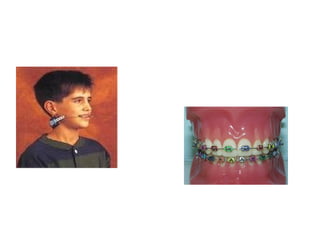
• The Aesthetic Component (AC)
Malocclusion
• Peer Assessment Index (PAR)
– Dental anomalies in a single score

• Index of Complexity, Outcome and
Need (ICON)
– Correlate well w pt perception of esthetics,
function, speech and need for Tx.

• FDI attempt to unify indices: failed
• Attention towards aesthetic vs. function
• Dental Aesthetic Index (DAI)
Malocclusion
• WHO in the pathfinder survey suggests using
DAI criteria in the following conditions:
–
–
–
–
–
–
–

Missing teeth
Anterior crowding
Anterior spacing
Diasteimas
Largest irregularities in front teeth
Overjet and overbite (anterior)
Molar relation
Oral cancer
• The occurrence is expressed as a
proportion or rates
• The age-adjusted rate of years of life lost
from oral cancer
• Five-year survival rates
– A 5-year survival rate of 67%

• Cancer data maintained in registries
Oral cancer
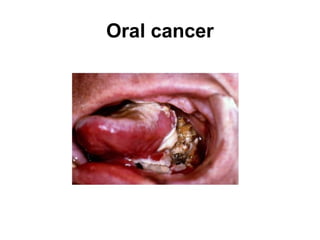
Oral cancer
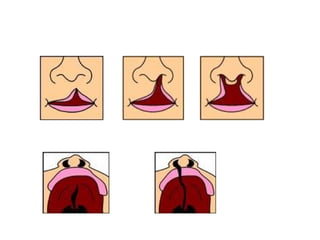
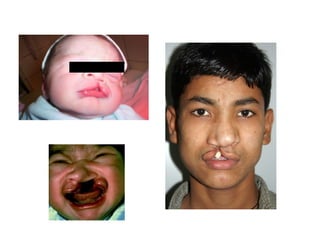
Cleft lip and palate
• The occurrence is expressed as a
proportion or rates
• 1 infant in 700 births
• Congenital abnormality
• Supposed to be recorded on birth
certificates
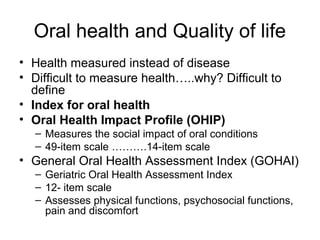
Oral health and Quality of life
• Health measured instead of disease
• Difficult to measure health…..why? Difficult to
define
• Index for oral health
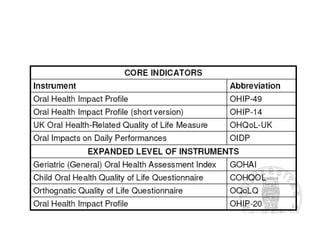
• Oral Health Impact Profile (OHIP)
– Measures the social impact of oral conditions
– 49-item scale ……….14-item scale

• General Oral Health Assessment Index (GOHAI)
– Geriatric Oral Health Assessment Index
– 12- item scale
– Assesses physical functions, psychosocial functions,
pain and discomfort
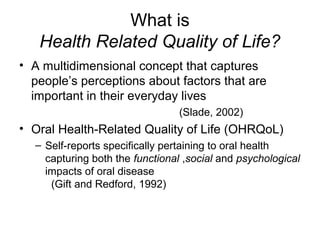
What is
Health Related Quality of Life?
• A multidimensional concept that captures
people’s perceptions about factors that are
important in their everyday lives
(Slade, 2002)

• Oral Health-Related Quality of Life (OHRQoL)
– Self-reports specifically pertaining to oral health
capturing both the functional ,social and psychological
impacts of oral disease
(Gift and Redford, 1992)
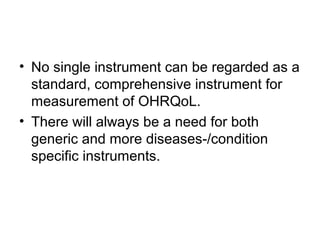
• No single instrument can be regarded as a
standard, comprehensive instrument for
measurement of OHRQoL.
• There will always be a need for both
generic and more diseases-/condition
specific instruments.
Other conditions
Oral cancer, distribution
• Life and death matter
• Age adjusted oral cancer mortality rate
among men has decreased.
• Female rates are low, but showed slight
further reduction
• Oral cancer: lip, tongue, buccal mucosa,
floor of mouth, salivary glands, and
pharynx.
• But not throat cancer.
• Squamus cell carcinoma of the tongue,
mucosa, lip: 80% of oral cancers
• Bet. 88~04: No. of new oral cancers
dropped
• Mortality also dropped, in absolute no anf
and in proportionate
• Oral caner is related to older age
• Mortality is related to low SES
• The standard measure for the severity is
the 5-y-survival rate: % of people still alive
after 5 y after diagnosis
• 5SR is decreased with increased
consumptions of the alcohol and social
deprivation
• Survival in higher if diagnosis made when
cancer is confined, nor spread
Oral cancer, risk factors
• %SR is 4 times when tumors diagnosed at
earlier stages, before metastasis.
• Tobacco use, heavy alcohol and poor diet
is responsible for 90% of all cancers.
• Risk for oral cancer from tobacco is equal
for men and women.
• Risk decrease after quitting
• Risk is more for pharyngeal cancer and
less for lip cancer
• Etio for submucus fibrosis: betel
• SMF and nodular luekoplakia has a hi
transformation rate
• Genetic role in oral caner is strong
• Other risk factors:
– Ill fitting dentures
– Long-term sun exposure
– Chronic inflammations: lichen planus
– leukoplakia
• Survival rate of oral cancer is low:
– Delay by patients seeking attention
– Delay in diagnosis by professionals

• Leukoplakia, erythroplakia are
precancerous
• Hi rate of second primary cancers in
patients of oral cancer
Other soft tissue lesions
• Precancerous lesion:
– Morphologically altered tissue in which cancer
is more likely to occur than its apparently
normal counterpart

• Leukoplakia:
– White patch that cannot be characterized
clinically or by pathological examination as
anything else
• Eruthroplakia:
– Bright red or velvety plaque that cannot be
characterized clinically or pathologically as
being due any thing else

• Papillary hyperplasia is related to ill fitting
dentures
• Little is known (distribution, prevelence,
risk factors) about the pemphigus,
pemphigoid, lichen planus, candidacies
and herpes infections.

Measuring other Conditions

  • 1.
    Measuring other conditionsin oral epidemiology PDS 372
  • 2.
    Lecture outline • • • • Malocclusion Oral cancer Cleftlip and palate Oral health and quality of life
  • 3.
    Learning objectives • Atthe end of this lecture, the student will: – Learn about different methods of measuring other dental conditions in oral epidemiology – Learn about how to measure these conditions in a public health perspective – Understand the concept behind quality of life
  • 4.
    Malocclusion • Edward H.Angle, • The first simple classification system for malocclusions • Based on the first molar as the key to occlusion. • Classification system is still in use today for orthodontic diagnosis The father of modern orthodontics 1855-1930
  • 5.
    Malocclusion • Difficult tomeasure • Angle’s classification is a nominal scale • The malalignment index assess rotation and tooth displacement • Occlusal Feature index records crowding, cuspal interdigitation and vertical and horizontal overbite • The Handicapping Labio-Lingual Deviations (HLD), assesses treatment needs
  • 6.
    Malocclusion • Occlusal index: – – – – – – – – – Dentalage Molar relation Overbite Overjet Posterior crossbite Posterior overbite Tooth displacement Midline relations Missing permanent maxillary incisors
  • 10.
    What is IOTN? •The Index of Orthodontic Treatment Need (IOTN) • It combines both functional and aesthetic measures • Used to assess the need and eligibility of children under 18 years of age for orthodontic treatment • IOTN is an objective and reliable way for specialists to select those children who will benefit most from treatment and is a fair way to prioritise limited resources
  • 11.
    IOTN • The DentalHealth Component (DHC) has 5 Grades – Grade 1 is almost perfection – Grade 2 is for minor irregularities – Grade 3 is for greater irregularities which normally do not need treatment for health reasons – Grade 4 is for more severe degrees of irregularity and these do require treatment for health reasons – Grade 5 is for severe dental health problems
  • 12.
    IOTN • The AestheticComponent (AC)
  • 13.
    Malocclusion • Peer AssessmentIndex (PAR) – Dental anomalies in a single score • Index of Complexity, Outcome and Need (ICON) – Correlate well w pt perception of esthetics, function, speech and need for Tx. • FDI attempt to unify indices: failed • Attention towards aesthetic vs. function • Dental Aesthetic Index (DAI)
  • 14.
    Malocclusion • WHO inthe pathfinder survey suggests using DAI criteria in the following conditions: – – – – – – – Missing teeth Anterior crowding Anterior spacing Diasteimas Largest irregularities in front teeth Overjet and overbite (anterior) Molar relation
  • 15.
    Oral cancer • Theoccurrence is expressed as a proportion or rates • The age-adjusted rate of years of life lost from oral cancer • Five-year survival rates – A 5-year survival rate of 67% • Cancer data maintained in registries
  • 16.
  • 18.
  • 19.
    Cleft lip andpalate • The occurrence is expressed as a proportion or rates • 1 infant in 700 births • Congenital abnormality • Supposed to be recorded on birth certificates
  • 22.
    Oral health andQuality of life • Health measured instead of disease • Difficult to measure health…..why? Difficult to define • Index for oral health • Oral Health Impact Profile (OHIP) – Measures the social impact of oral conditions – 49-item scale ……….14-item scale • General Oral Health Assessment Index (GOHAI) – Geriatric Oral Health Assessment Index – 12- item scale – Assesses physical functions, psychosocial functions, pain and discomfort
  • 23.
    What is Health RelatedQuality of Life? • A multidimensional concept that captures people’s perceptions about factors that are important in their everyday lives (Slade, 2002) • Oral Health-Related Quality of Life (OHRQoL) – Self-reports specifically pertaining to oral health capturing both the functional ,social and psychological impacts of oral disease (Gift and Redford, 1992)
  • 25.
    • No singleinstrument can be regarded as a standard, comprehensive instrument for measurement of OHRQoL. • There will always be a need for both generic and more diseases-/condition specific instruments.
  • 26.
  • 27.
    Oral cancer, distribution •Life and death matter • Age adjusted oral cancer mortality rate among men has decreased. • Female rates are low, but showed slight further reduction • Oral cancer: lip, tongue, buccal mucosa, floor of mouth, salivary glands, and pharynx. • But not throat cancer.
  • 28.
    • Squamus cellcarcinoma of the tongue, mucosa, lip: 80% of oral cancers • Bet. 88~04: No. of new oral cancers dropped • Mortality also dropped, in absolute no anf and in proportionate • Oral caner is related to older age • Mortality is related to low SES
  • 29.
    • The standardmeasure for the severity is the 5-y-survival rate: % of people still alive after 5 y after diagnosis • 5SR is decreased with increased consumptions of the alcohol and social deprivation • Survival in higher if diagnosis made when cancer is confined, nor spread
  • 30.
    Oral cancer, riskfactors • %SR is 4 times when tumors diagnosed at earlier stages, before metastasis. • Tobacco use, heavy alcohol and poor diet is responsible for 90% of all cancers. • Risk for oral cancer from tobacco is equal for men and women. • Risk decrease after quitting • Risk is more for pharyngeal cancer and less for lip cancer
  • 31.
    • Etio forsubmucus fibrosis: betel • SMF and nodular luekoplakia has a hi transformation rate • Genetic role in oral caner is strong • Other risk factors: – Ill fitting dentures – Long-term sun exposure – Chronic inflammations: lichen planus – leukoplakia
  • 32.
    • Survival rateof oral cancer is low: – Delay by patients seeking attention – Delay in diagnosis by professionals • Leukoplakia, erythroplakia are precancerous • Hi rate of second primary cancers in patients of oral cancer
  • 33.
    Other soft tissuelesions • Precancerous lesion: – Morphologically altered tissue in which cancer is more likely to occur than its apparently normal counterpart • Leukoplakia: – White patch that cannot be characterized clinically or by pathological examination as anything else
  • 34.
    • Eruthroplakia: – Brightred or velvety plaque that cannot be characterized clinically or pathologically as being due any thing else • Papillary hyperplasia is related to ill fitting dentures • Little is known (distribution, prevelence, risk factors) about the pemphigus, pemphigoid, lichen planus, candidacies and herpes infections.