2012 Clinical Congress
Presenter Disclosure Slide
American College of Surgeons♦ Division of Education


Amalia Cochran, MD, FACS

         Nothing To Disclose
DEPARTMENT OF SURGERY


Barriers to Advancement in Academic
               Surgery:
Views of Senior Residents and Early
            Career Faculty
       Amalia Cochran, MD, FACS
           William B. Elder, MA
        Marie Crandall, MD, FACS
        Karen Brasel, MD, FACS
           Tricia Hauschild, MD
       Leigh Neumayer, MD, FACS
DEPARTMENT OF SURGERY


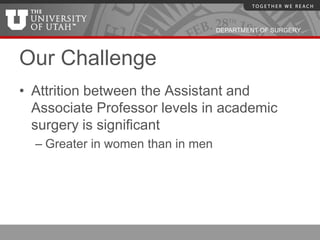
Our Challenge
• Attrition between the Assistant and
  Associate Professor levels in academic
  surgery is significant
  – Greater in women than in men
DEPARTMENT OF SURGERY


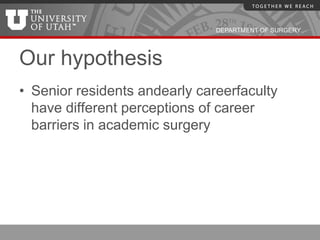
Our hypothesis
• Senior residents andearly careerfaculty
  have different perceptions of career
  barriers in academic surgery
DEPARTMENT OF SURGERY


Our methods
• Web-based administration of modified
  Career Barriers Inventory
  – IRB approved or exempted at 8 AMCs
DEPARTMENT OF SURGERY


Our sample selection
• Sites selected to maximize geographic
  and institutional diversity
• Site PI established email contact with
  local participants
• Cohort 1: 4th and 5th year GS residents
• Cohort 2: Early career tenure-track
  faculty, invited in 2:1 male: female ratio
DEPARTMENT OF SURGERY


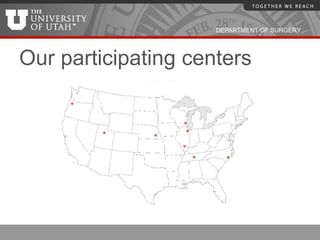
Our participating centers
DEPARTMENT OF SURGERY


Our participants
• 154 respondents (51% response rate)
  – 85 residents (44 female, 41 male)
     • 74% response rate
  – 69 faculty (26 female, 43 male)
     • 37% response rate
• Percentages indicate “Strongly Agree” or
  “Agree” on Likert Scale
DEPARTMENT OF SURGERY


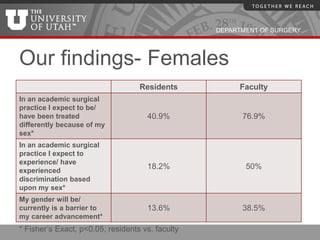
Our findings- Females
                                   Residents           Faculty
In an academic surgical
practice I expect to be/
have been treated                    40.9%              76.9%
differently because of my
sex*
In an academic surgical
practice I expect to
experience/ have
experienced
                                     18.2%               50%
discrimination based
upon my sex*
My gender will be/
currently is a barrier to            13.6%              38.5%
my career advancement*
* Fisher’s Exact, p<0.05, residents vs. faculty
DEPARTMENT OF SURGERY


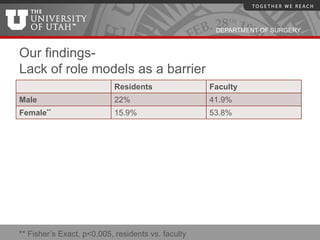
Our findings-
Lack of role models as a barrier
                           Residents                Faculty
Male                       22%                      41.9%
Female**                   15.9%                    53.8%


** Fisher’s Exact, p<0.005, residents vs. faculty
DEPARTMENT OF SURGERY


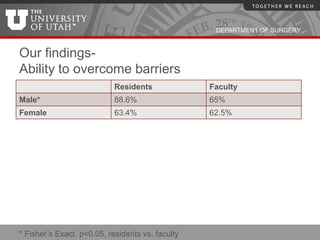
Our findings-
Ability to overcome barriers
                            Residents             Faculty
Male*                       88.6%                 65%
Female                      63.4%                 62.5%


* Fisher’s Exact, p<0.05, residents vs. faculty
DEPARTMENT OF SURGERY


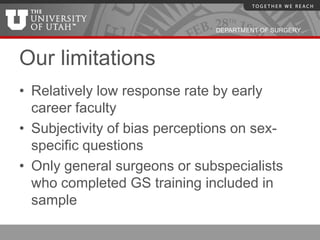
Our limitations
• Relatively low response rate by early
  career faculty
• Subjectivity of bias perceptions on sex-
  specific questions
• Only general surgeons or subspecialists
  who completed GS training included in
  sample
DEPARTMENT OF SURGERY


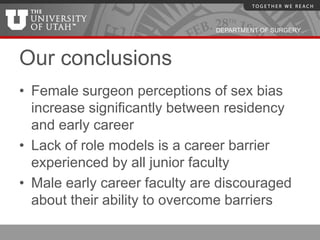
Our conclusions
• Female surgeon perceptions of sex bias
  increase significantly between residency
  and early career
• Lack of role models is a career barrier
  experienced by all junior faculty
• Male early career faculty are discouraged
  about their ability to overcome barriers
DEPARTMENT OF SURGERY


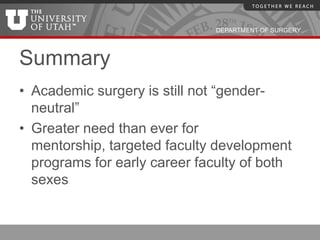
Summary
• Academic surgery is still not “gender-
  neutral”
• Greater need than ever for
  mentorship, targeted faculty development
  programs for early career faculty of both
  sexes
DEPARTMENT OF SURGERY


Our appreciation
• WAGES collaborators
  – PJ Schenarts (ECU)
  – Rachel Danczyk and Susan Orloff (OHSU)
  – Hilary Sanfey (SIU)
  – Wendy Grant (U Nebraska)
  – Colleen Brophy and Kevin Sexton
    (Vanderbilt)

Cochran ACS Presentation

  • 1.
    2012 Clinical Congress PresenterDisclosure Slide American College of Surgeons♦ Division of Education Amalia Cochran, MD, FACS Nothing To Disclose
  • 2.
    DEPARTMENT OF SURGERY Barriersto Advancement in Academic Surgery: Views of Senior Residents and Early Career Faculty Amalia Cochran, MD, FACS William B. Elder, MA Marie Crandall, MD, FACS Karen Brasel, MD, FACS Tricia Hauschild, MD Leigh Neumayer, MD, FACS
  • 3.
    DEPARTMENT OF SURGERY OurChallenge • Attrition between the Assistant and Associate Professor levels in academic surgery is significant – Greater in women than in men
  • 4.
    DEPARTMENT OF SURGERY Ourhypothesis • Senior residents andearly careerfaculty have different perceptions of career barriers in academic surgery
  • 5.
    DEPARTMENT OF SURGERY Ourmethods • Web-based administration of modified Career Barriers Inventory – IRB approved or exempted at 8 AMCs
  • 6.
    DEPARTMENT OF SURGERY Oursample selection • Sites selected to maximize geographic and institutional diversity • Site PI established email contact with local participants • Cohort 1: 4th and 5th year GS residents • Cohort 2: Early career tenure-track faculty, invited in 2:1 male: female ratio
  • 7.
    DEPARTMENT OF SURGERY Ourparticipating centers
  • 8.
    DEPARTMENT OF SURGERY Ourparticipants • 154 respondents (51% response rate) – 85 residents (44 female, 41 male) • 74% response rate – 69 faculty (26 female, 43 male) • 37% response rate • Percentages indicate “Strongly Agree” or “Agree” on Likert Scale
  • 9.
    DEPARTMENT OF SURGERY Ourfindings- Females Residents Faculty In an academic surgical practice I expect to be/ have been treated 40.9% 76.9% differently because of my sex* In an academic surgical practice I expect to experience/ have experienced 18.2% 50% discrimination based upon my sex* My gender will be/ currently is a barrier to 13.6% 38.5% my career advancement* * Fisher’s Exact, p<0.05, residents vs. faculty
  • 10.
    DEPARTMENT OF SURGERY Ourfindings- Lack of role models as a barrier Residents Faculty Male 22% 41.9% Female** 15.9% 53.8% ** Fisher’s Exact, p<0.005, residents vs. faculty
  • 11.
    DEPARTMENT OF SURGERY Ourfindings- Ability to overcome barriers Residents Faculty Male* 88.6% 65% Female 63.4% 62.5% * Fisher’s Exact, p<0.05, residents vs. faculty
  • 12.
    DEPARTMENT OF SURGERY Ourlimitations • Relatively low response rate by early career faculty • Subjectivity of bias perceptions on sex- specific questions • Only general surgeons or subspecialists who completed GS training included in sample
  • 13.
    DEPARTMENT OF SURGERY Ourconclusions • Female surgeon perceptions of sex bias increase significantly between residency and early career • Lack of role models is a career barrier experienced by all junior faculty • Male early career faculty are discouraged about their ability to overcome barriers
  • 14.
    DEPARTMENT OF SURGERY Summary •Academic surgery is still not “gender- neutral” • Greater need than ever for mentorship, targeted faculty development programs for early career faculty of both sexes
  • 15.
    DEPARTMENT OF SURGERY Ourappreciation • WAGES collaborators – PJ Schenarts (ECU) – Rachel Danczyk and Susan Orloff (OHSU) – Hilary Sanfey (SIU) – Wendy Grant (U Nebraska) – Colleen Brophy and Kevin Sexton (Vanderbilt)