By-
Pankaj Kumar
Department of Management Studies
Pondicherry University
Objectives
 The maintenance Process
 Measuring internet marketing effectiveness
 Measuring the flow effect
 Responsibilities in web site maintenance
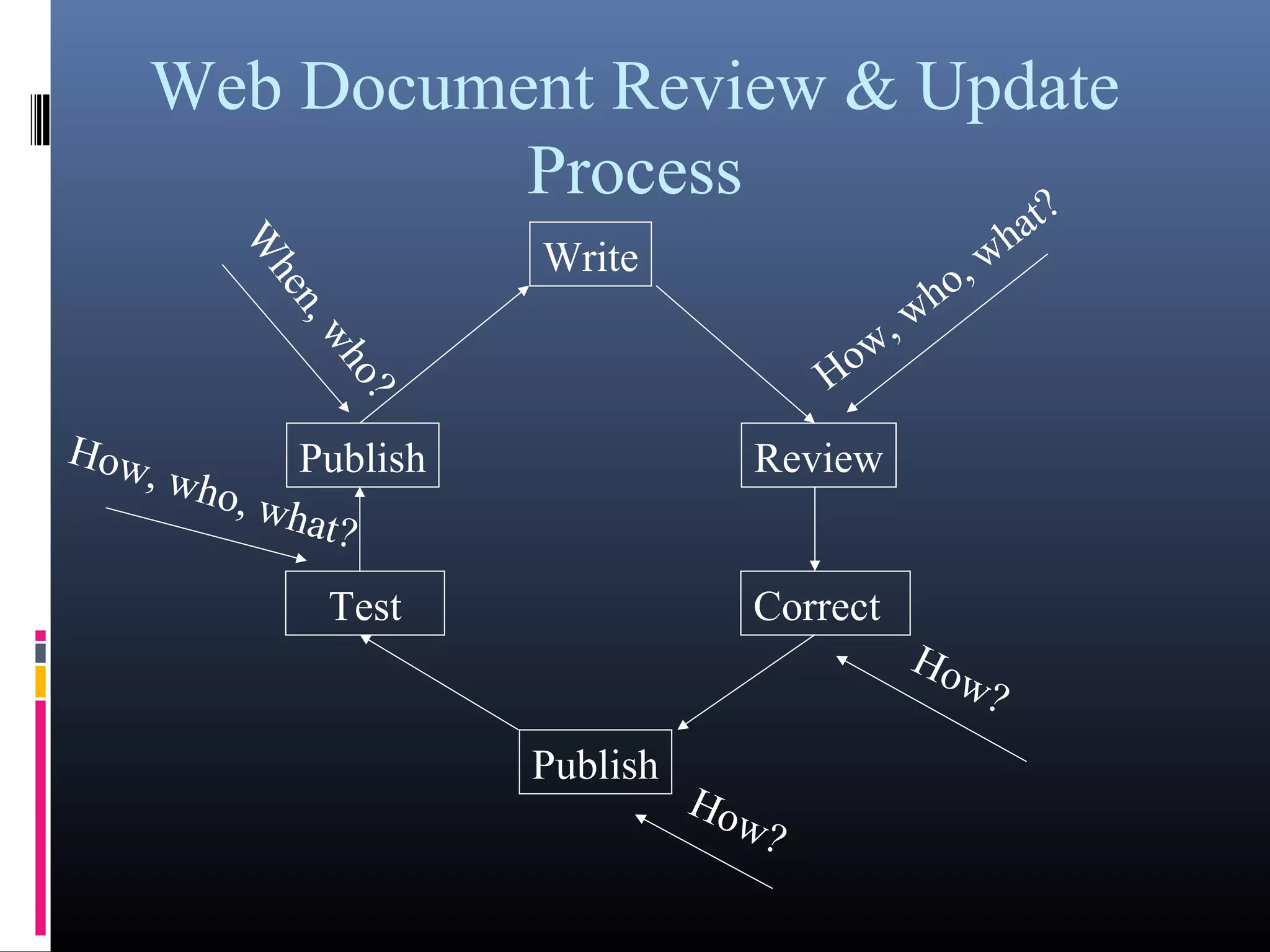
Web Document Review & Update
Process
Write
Publish Review
Test Correct
Publish
W
hen,who?
How, who, what?
How?
How?
How, who, what?
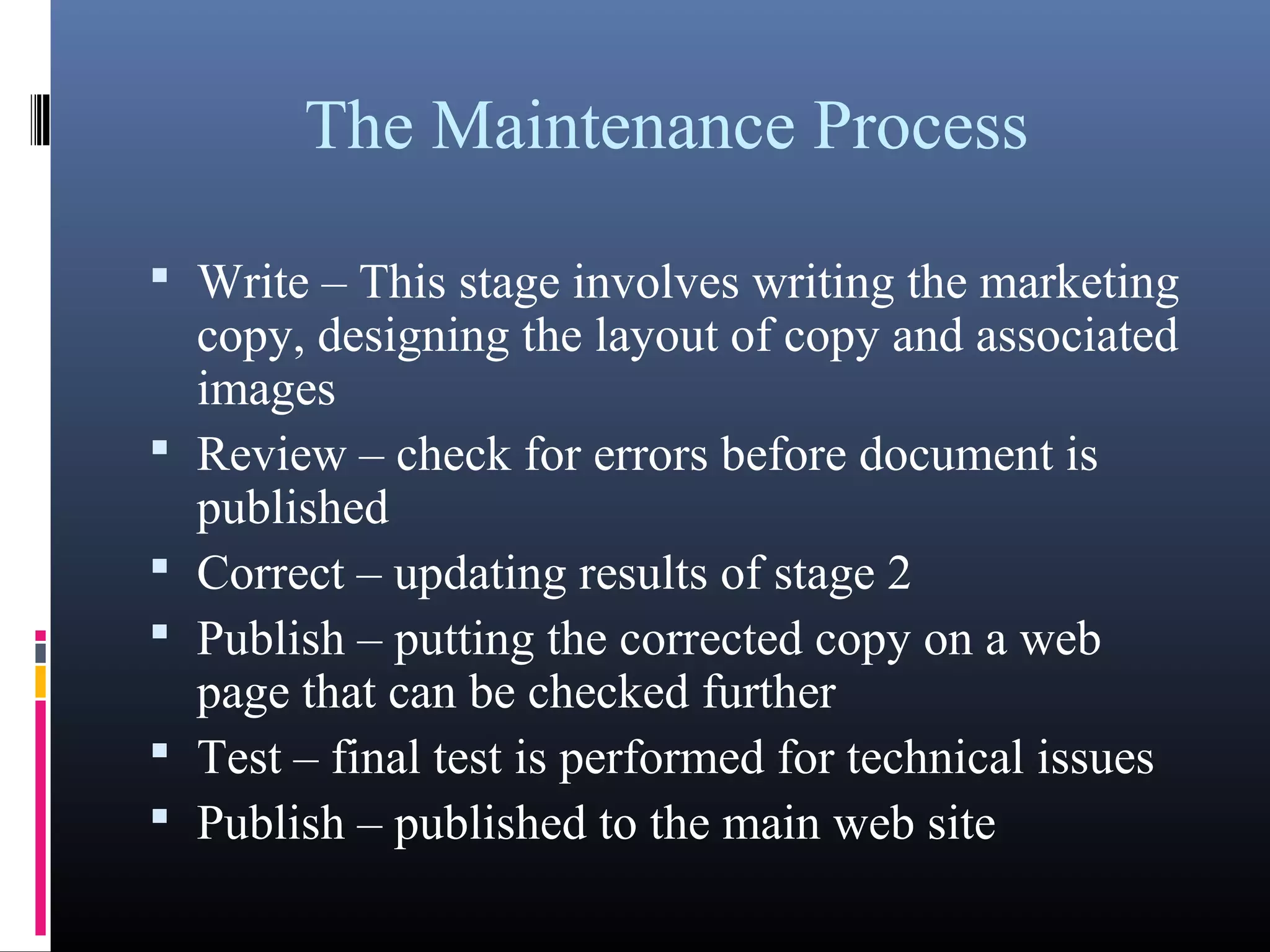
The Maintenance Process
 Write – This stage involves writing the marketing
copy, designing the layout of copy and associated
images
 Review – check for errors before document is
published
 Correct – updating results of stage 2
 Publish – putting the corrected copy on a web
page that can be checked further
 Test – final test is performed for technical issues
 Publish – published to the main web site
Updating Material
 Within two days of a factual error being
identified
 A new ‘news’ item is added at least once a
month
 When product information has been static for
two months
Responsibilities in Web Site
Maintenance
The questions to ask are:
 Who owns the process?
 Who owns the content?
 Who owns the format?
 Who owns the technology?
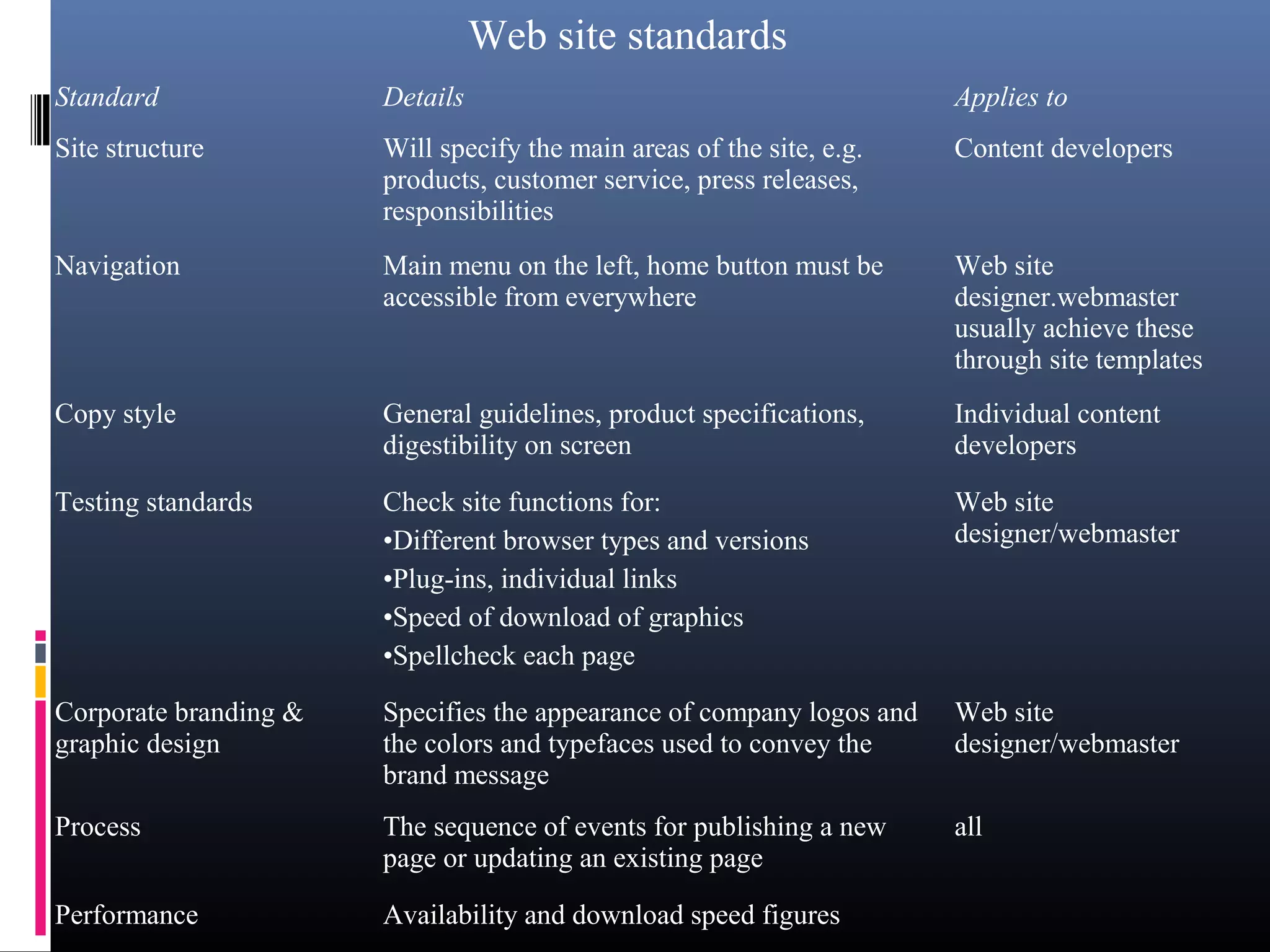
Standard Details Applies to
Site structure Will specify the main areas of the site, e.g.
products, customer service, press releases,
responsibilities
Content developers
Navigation Main menu on the left, home button must be
accessible from everywhere
Web site
designer.webmaster
usually achieve these
through site templates
Copy style General guidelines, product specifications,
digestibility on screen
Individual content
developers
Testing standards Check site functions for:
•Different browser types and versions
•Plug-ins, individual links
•Speed of download of graphics
•Spellcheck each page
Web site
designer/webmaster
Corporate branding &
graphic design
Specifies the appearance of company logos and
the colors and typefaces used to convey the
brand message
Web site
designer/webmaster
Process The sequence of events for publishing a new
page or updating an existing page
all
Performance Availability and download speed figures
Web site standards
Measuring Internet Marketing
Effectiveness
 Are corporate objectives identified in the Internet
marketing strategy being met?
 Are marketing objectives defined in the internet
marketing strategy and plan achieved?
 Are marketing communications objectives
identified in the internet marketing plan achieved?
How effective are the different promotional
techniques used to attract visitors to a site?
Creating a Measurement Process
 Highlighting the need for metrics
 Identifying metrics (SMART)
 Specific
 Measurable
 Actionable
 Relevant
 Timely
 Introducing techniques to collect metrics and
summarize results
 Reviewing the metrics
 Acting on the results
Which Measures to Use
 Level 1: Business effectiveness measures
 Level 2: Marketing effectiveness measures
 Level 3: Internet marketing effectiveness
Level 1: Business Effectiveness
Measures
 Direct online contribution to revenue
 Indirect online contribution to revenue
 Profitability of web site
 Return on investment (ROI)
 Operational cost reductions
Level 2: Marketing Effectiveness
Measures
 Customer acquisition or new leads generated by the web
site
 Sales generated directly and indirectly by the web site
 Impact on market penetration and demand
 Customer satisfaction and retention rates of clients who
use the internet, compared with those who do not
 Incremental or cross-sales achieved through the Internet
 Impact of Internet on customer satisfaction, loyalty and
brand
Level 2 – Internet sales
 Internet sales as proportion of all sales made
by company compared with sales by all
companies operating in the market
 Internet sales as a proportion of all internet
sales for company
Level 2 – Marketing costs
 Reduction in cost of promotional material
 Cost of acquiring a new customer
 Cost of developing/supporting an existing
customer relationship through time
 Also some less tangible elements such as
corporate image and brand enhancement
 Building long-term client relationships and
reducing ‘churn’ of customers
Level 3: Internet Marketing
Effectiveness
 Capture – how effective are we in attracting
customers to site using online and offline promotion
methods
 Content – how well are customers supported with
information and ease of use through the content and
design of the site
 Customer orientation – does the content suit its target
audience
 Community and interactivity – how well are the
customers’ needs as an individual met by providing
community facilities and establishing an interactive
dialogue
Level 3 - Further Elements
 Awareness efficiency – target web-users/all web-
users
 Locatability/attractability efficiency – number of
individual visits/number of seekers
 Contact efficiency – number of active
visitors/number of visits
 Conversion efficiency – number of
purchases/number of active visits
 Retention efficiency – number of
repurchases/number of purchases
Online Measurement Methods
 Online web metric and server log files
 Hits and page impressions (views)
 Site visits (user sessions)
 Web site auditors
Log File Information
 Page impressions for different parts of the site
 Page impressions broken down by different time
intervals
 Page impression by domain
 Page impression by browser type
 Referring sites
 Exit pages
 Document trails
 Average length of visit
Tools for Measuring Web Site
Performance
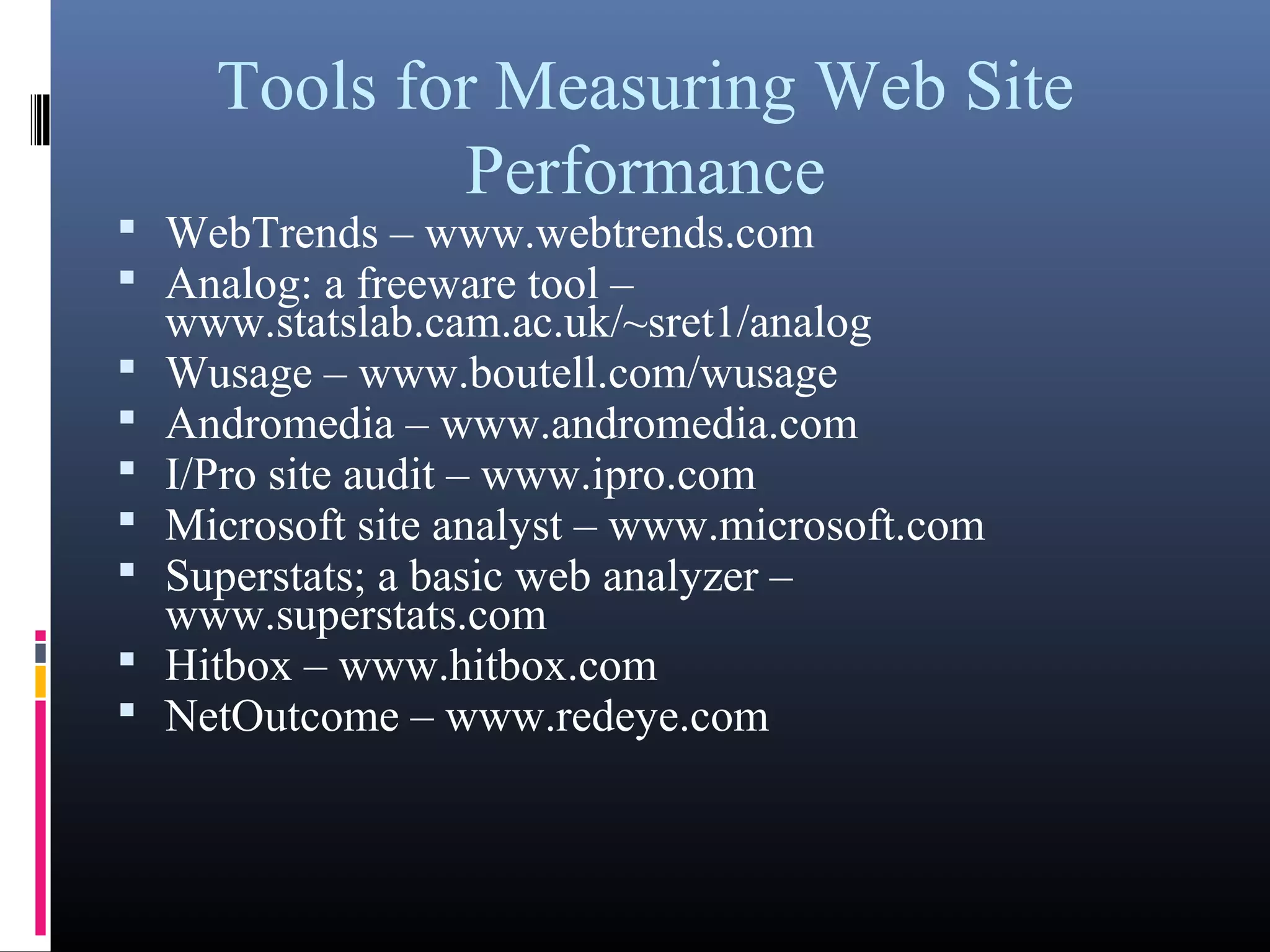
 WebTrends – www.webtrends.com
 Analog: a freeware tool –
www.statslab.cam.ac.uk/~sret1/analog
 Wusage – www.boutell.com/wusage
 Andromedia – www.andromedia.com
 I/Pro site audit – www.ipro.com
 Microsoft site analyst – www.microsoft.com
 Superstats; a basic web analyzer –
www.superstats.com
 Hitbox – www.hitbox.com
 NetOutcome – www.redeye.com
Measuring Individual Behavior
 Registration
 A suitable incentive – most customers will give
information if they will receive something in return
 A tacit agreement to enter into a medium to long term
agreement with customer that he or she will enter the
site again
 Trust on the part of the customer, which will be based
on his or her perception of a company’s brand and
credibility
 Cookies
 Click-tracking
Offline Methods of Metric Collection
Measure Measured through
Enquiries or leads Number of online e-mails
Phone calls mentioning web site
Faxed enquiries mentioning web site
Sales Online sales or sales in which customers state they found
out about the product on the web site
Conversion rate Can be calculated separately for customers who are
registered online and those who are not
Retention rates Is the ‘churn’ of customers using the web site lower?
Customer
satisfaction
Focus groups, questionnaires and interviews
Mystery shoppers
Brand enhancement Focus groups, surveys
Evaluation of Promotional Methods
 Unaware
 Aware
 Attitude
 Preference
 Intention
 Trial
 Repeat
Communication Effects
 How well does the page catch the reader’s
attention?
 How well does the page lead the reader to go
further?
 How effective is the particular appeal?
 How well does the page suggest follow
through or call to action?
Customer Loyalty, Satisfaction and
Brand Impact
 Online questionnaires
 Online focus groups
Thank You

Measuring Internet marketing effectiveness

  • 1.
    By- Pankaj Kumar Department ofManagement Studies Pondicherry University
  • 2.
    Objectives  The maintenanceProcess  Measuring internet marketing effectiveness  Measuring the flow effect  Responsibilities in web site maintenance
  • 3.
    Web Document Review& Update Process Write Publish Review Test Correct Publish W hen,who? How, who, what? How? How? How, who, what?
  • 4.
    The Maintenance Process Write – This stage involves writing the marketing copy, designing the layout of copy and associated images  Review – check for errors before document is published  Correct – updating results of stage 2  Publish – putting the corrected copy on a web page that can be checked further  Test – final test is performed for technical issues  Publish – published to the main web site
  • 5.
    Updating Material  Withintwo days of a factual error being identified  A new ‘news’ item is added at least once a month  When product information has been static for two months
  • 6.
    Responsibilities in WebSite Maintenance The questions to ask are:  Who owns the process?  Who owns the content?  Who owns the format?  Who owns the technology?
  • 7.
    Standard Details Appliesto Site structure Will specify the main areas of the site, e.g. products, customer service, press releases, responsibilities Content developers Navigation Main menu on the left, home button must be accessible from everywhere Web site designer.webmaster usually achieve these through site templates Copy style General guidelines, product specifications, digestibility on screen Individual content developers Testing standards Check site functions for: •Different browser types and versions •Plug-ins, individual links •Speed of download of graphics •Spellcheck each page Web site designer/webmaster Corporate branding & graphic design Specifies the appearance of company logos and the colors and typefaces used to convey the brand message Web site designer/webmaster Process The sequence of events for publishing a new page or updating an existing page all Performance Availability and download speed figures Web site standards
  • 8.
    Measuring Internet Marketing Effectiveness Are corporate objectives identified in the Internet marketing strategy being met?  Are marketing objectives defined in the internet marketing strategy and plan achieved?  Are marketing communications objectives identified in the internet marketing plan achieved? How effective are the different promotional techniques used to attract visitors to a site?
  • 9.
    Creating a MeasurementProcess  Highlighting the need for metrics  Identifying metrics (SMART)  Specific  Measurable  Actionable  Relevant  Timely  Introducing techniques to collect metrics and summarize results  Reviewing the metrics  Acting on the results
  • 10.
    Which Measures toUse  Level 1: Business effectiveness measures  Level 2: Marketing effectiveness measures  Level 3: Internet marketing effectiveness
  • 11.
    Level 1: BusinessEffectiveness Measures  Direct online contribution to revenue  Indirect online contribution to revenue  Profitability of web site  Return on investment (ROI)  Operational cost reductions
  • 12.
    Level 2: MarketingEffectiveness Measures  Customer acquisition or new leads generated by the web site  Sales generated directly and indirectly by the web site  Impact on market penetration and demand  Customer satisfaction and retention rates of clients who use the internet, compared with those who do not  Incremental or cross-sales achieved through the Internet  Impact of Internet on customer satisfaction, loyalty and brand
  • 13.
    Level 2 –Internet sales  Internet sales as proportion of all sales made by company compared with sales by all companies operating in the market  Internet sales as a proportion of all internet sales for company
  • 14.
    Level 2 –Marketing costs  Reduction in cost of promotional material  Cost of acquiring a new customer  Cost of developing/supporting an existing customer relationship through time  Also some less tangible elements such as corporate image and brand enhancement  Building long-term client relationships and reducing ‘churn’ of customers
  • 15.
    Level 3: InternetMarketing Effectiveness  Capture – how effective are we in attracting customers to site using online and offline promotion methods  Content – how well are customers supported with information and ease of use through the content and design of the site  Customer orientation – does the content suit its target audience  Community and interactivity – how well are the customers’ needs as an individual met by providing community facilities and establishing an interactive dialogue
  • 16.
    Level 3 -Further Elements  Awareness efficiency – target web-users/all web- users  Locatability/attractability efficiency – number of individual visits/number of seekers  Contact efficiency – number of active visitors/number of visits  Conversion efficiency – number of purchases/number of active visits  Retention efficiency – number of repurchases/number of purchases
  • 17.
    Online Measurement Methods Online web metric and server log files  Hits and page impressions (views)  Site visits (user sessions)  Web site auditors
  • 18.
    Log File Information Page impressions for different parts of the site  Page impressions broken down by different time intervals  Page impression by domain  Page impression by browser type  Referring sites  Exit pages  Document trails  Average length of visit
  • 19.
    Tools for MeasuringWeb Site Performance  WebTrends – www.webtrends.com  Analog: a freeware tool – www.statslab.cam.ac.uk/~sret1/analog  Wusage – www.boutell.com/wusage  Andromedia – www.andromedia.com  I/Pro site audit – www.ipro.com  Microsoft site analyst – www.microsoft.com  Superstats; a basic web analyzer – www.superstats.com  Hitbox – www.hitbox.com  NetOutcome – www.redeye.com
  • 20.
    Measuring Individual Behavior Registration  A suitable incentive – most customers will give information if they will receive something in return  A tacit agreement to enter into a medium to long term agreement with customer that he or she will enter the site again  Trust on the part of the customer, which will be based on his or her perception of a company’s brand and credibility  Cookies  Click-tracking
  • 21.
    Offline Methods ofMetric Collection Measure Measured through Enquiries or leads Number of online e-mails Phone calls mentioning web site Faxed enquiries mentioning web site Sales Online sales or sales in which customers state they found out about the product on the web site Conversion rate Can be calculated separately for customers who are registered online and those who are not Retention rates Is the ‘churn’ of customers using the web site lower? Customer satisfaction Focus groups, questionnaires and interviews Mystery shoppers Brand enhancement Focus groups, surveys
  • 22.
    Evaluation of PromotionalMethods  Unaware  Aware  Attitude  Preference  Intention  Trial  Repeat
  • 23.
    Communication Effects  Howwell does the page catch the reader’s attention?  How well does the page lead the reader to go further?  How effective is the particular appeal?  How well does the page suggest follow through or call to action?
  • 24.
    Customer Loyalty, Satisfactionand Brand Impact  Online questionnaires  Online focus groups
  • 25.