How to measure ‘soft’ outcomes
to demonstrate ‘hard’ impact
   Gail Dervish, WCVA Economic
   Inactivity Initiatives Manager/ Morgan
   Armstrong WCVA ILM Development
   & Support Manager
Definitions & Delivery

 Soft Outcomes
 Soft Indicators
 Distance Travelled

 Based on ESF funded WCVA ILM Scheme
Soft Outcomes
 Outcomes from training, support or guidance interventions,
   which cannot be measured directly or tangibly
 They may include achievements relating to:
 • Interpersonal skills such as social skills and coping with
   authority
 • Organisational skills such as personal organisation and the
   ability to order and prioritise
 • Analytical skills such as the ability to exercise judgement,
   managing time or problem solving
 • Personal skills such as insight, motivation, confidence,
   reliability and health awareness
Soft Indicators
 There is interplay between indicators and outcomes –
 • Indicators are the means by which we can measure whether
   the outcomes have been achieved
 • The term soft indicators can be used when referring to the
   achievements that indicate acquisition or progress towards
   an outcome
 A project, for example, will need to explore whether an
   individual’s motivation has increased over the length of
   the scheme –
 • This is a subjective judgement but indicators such as
   improved levels of attendance, improved time keeping and
   improved communication skills, can suggest strongly that
   motivation has increased
Distance Travelled
 •   The progress that a participant makes towards employability
     or harder outcomes as a result of the scheme intervention
 •   The acquisition of certain soft outcomes may seem
     insignificant, but for certain individuals the leap forward in
     achieving these outcomes is immense
 •   A consideration of distance travelled is very important in
     contextualising participants’ achievements
 •   Indicators (or measurements) of soft outcomes can be used
     as tools for measuring distance travelled towards labour
     market participation
Importance of Measuring Soft Skills &
Distance Travelled

  • Should be an intrinsic element of any scheme
    evaluation & be considered good practice
  • Accrues benefits to the scheme and participant
  • Improves the process of working with participants
    & service delivery
  • Provides an important context for client needs &
    successes
Importance of Measuring Soft Skills &
Distance Travelled (General)

  • Hard outcomes (jobs, qualifications, etc.) do not
    show the success of the scheme as a whole
  • They are incomplete as an indicator of a
    participant’s increased employability
  • Participants facing multiple barriers may be a long
    way from acquiring a job or qualification
  • Soft outcomes for such participants is a critical
    indicator of success
Importance of Measuring Soft Skills &
Distance Travelled (Participant Level)

  • Employers are interested in soft skills, valuing
    personal attributes & attitudes
  • Participants will be at an advantage if they are able
    to evidence such skills & attributes gained during
    the scheme
  • Staff will be able to demonstrate to participants that
    they have pre-existing skills & attributes that they
    did not know existed
Importance of Measuring Soft Skills &
Distance Travelled (Participant Level)

  • Working with participants to record & monitor
    distance travelled can give them a sense of
    ownership over their own personal development
  • If participants are made aware of the distance they
    have travelled, this boosts confidence & motivation
  • Participants will understand that the recognition &
    development of soft skills is part of their
    integration into the labour market
Types of Soft Skills & Examples of
Indicators – Key Work Skills


  •   Improved team working, problem solving,
      numeracy, ICT
  •   Increased language & communication
  •   Completion of work placements
  •   Lower rates of sickness related absence
Types of Soft Skills & Examples of
Indicators – Attitudinal Skills
  •   Increased levels of motivation
  •   Increased levels of confidence
  •   Recognition of prior skills
  •   Increased feelings of responsibility
  •   Increased levels of self-esteem
  •   Higher personal & career aspirations
Types of Soft Skills & Examples of
Indicators – Personal Skills
  •   Improved personal appearance &
      presentation
  •   Improved levels of attendance
  •   Improved timekeeping
  •   Improved personal hygiene
  •   Better health & fitness
  •   Greater levels of concentration &
      engagement
Types of Soft Skills & Examples of
Indicators – Practical Skills
  •   Ability to complete forms
  •   Ability to write a CV
  •   Ability to understand & follow instructions
  •   Improved ability to manage money
  •   Improved awareness of rights &
      responsibilities
How do we do it?

 There are numerous & varied methods of
  measuring soft outcomes.
 On the ILM scheme one tool we use is a soft
  skills questionnaire of up to 77 questions

    Have a go!
Baseline Assessment
 Baseline assessment is crucial in order to establish a starting
   point from which a participant may start to demonstrate
   progress in soft skill outcomes. This can normally be done
   during the initial assessment phase when client needs are
   established, barriers to employability identified & targets set

 It is important to ensure that methods used for collecting &
    recording information on soft outcomes & distance travelled
    are rigorous & targeted to the client group. Selecting &
    implementing a range of methods to collect data is more
    likely to capture a full picture of individual progress
Collection & Recording Methods

  Action-planning:
  This is carried out at initial assessment & periodically
    reviewed to gauge whether objectives have been met. The
    plan can include personal goals, priorities & reflections on
    progress
  Reviews:
  Improvements over time can be noted on a regular formal &
    informal basis. This system is reliant on sound judgement
    from the client & staff member. It will not provide an
    absolute or formal measure on distance travelled
Collection & Recording Methods

  Daily diary or personal journal –
  Clients can be encouraged to write about progress towards soft
     outcomes. Issues of confidentiality should be considered

  In-depth reflection –
  This could include weekly, work placement & end of course
     evaluations. Questionnaires are also an important tool for
     this purpose. This would allow the participant to consider
     & review their progress. It could provide valuable portfolio
     evidence & is easily compared against baseline data
Collection & Recording Methods

  Recorded observations -
  It is important to have comprehensive documentation systems
      that will allow for the recording of anecdotal evidence of
      progress & outcomes. This method requires a good level of
      observer skill, lack of observer bias & an approach that does
      not influence participant behaviour during the process
  Portfolio compilation –
  This would include evidence of tasks completed successfully
      or progress towards them. An evidence based portfolio
      would be a concrete output that could be presented to an
      employer
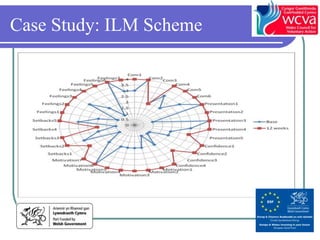
Case Study: ILM Scheme
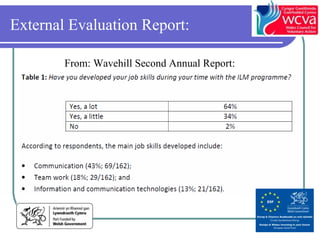
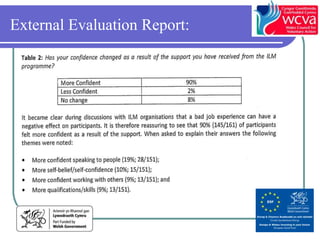
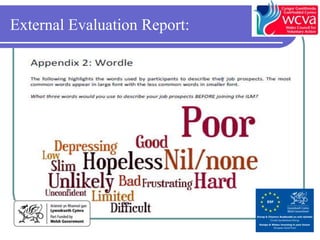
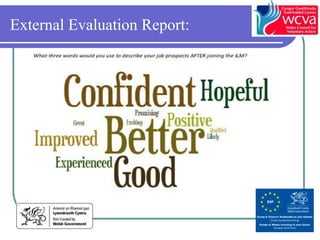
External Evaluation Report:

        From: Wavehill Second Annual Report:
External Evaluation Report:
Soft Outcomes: Further details
    Outcomes Star. Developed by Triangle Consulting for use by homelessness
     organisations. Take a look at http://www.outcomesstar.org.uk/

    WEFO’s own: A practical guide to measuring soft outcomes and distance
     travelled

    The Institute for Employment Studies have produced ‘A guide to measuring soft
     outcomes and distance travelled’ Http://www.esf.gov.uk/_docs/distance1.pdf

    Many other systems out there: Catching Confidence tool, SOUL Record, Spirit
     Level etc.

    Want to share thoughts? ilm@wcva.org.uk

Measure soft outcomes to demonstrate hard impacts

  • 1.
    How to measure‘soft’ outcomes to demonstrate ‘hard’ impact Gail Dervish, WCVA Economic Inactivity Initiatives Manager/ Morgan Armstrong WCVA ILM Development & Support Manager
  • 2.
    Definitions & Delivery Soft Outcomes Soft Indicators Distance Travelled Based on ESF funded WCVA ILM Scheme
  • 3.
    Soft Outcomes Outcomesfrom training, support or guidance interventions, which cannot be measured directly or tangibly They may include achievements relating to: • Interpersonal skills such as social skills and coping with authority • Organisational skills such as personal organisation and the ability to order and prioritise • Analytical skills such as the ability to exercise judgement, managing time or problem solving • Personal skills such as insight, motivation, confidence, reliability and health awareness
  • 4.
    Soft Indicators Thereis interplay between indicators and outcomes – • Indicators are the means by which we can measure whether the outcomes have been achieved • The term soft indicators can be used when referring to the achievements that indicate acquisition or progress towards an outcome A project, for example, will need to explore whether an individual’s motivation has increased over the length of the scheme – • This is a subjective judgement but indicators such as improved levels of attendance, improved time keeping and improved communication skills, can suggest strongly that motivation has increased
  • 5.
    Distance Travelled • The progress that a participant makes towards employability or harder outcomes as a result of the scheme intervention • The acquisition of certain soft outcomes may seem insignificant, but for certain individuals the leap forward in achieving these outcomes is immense • A consideration of distance travelled is very important in contextualising participants’ achievements • Indicators (or measurements) of soft outcomes can be used as tools for measuring distance travelled towards labour market participation
  • 6.
    Importance of MeasuringSoft Skills & Distance Travelled • Should be an intrinsic element of any scheme evaluation & be considered good practice • Accrues benefits to the scheme and participant • Improves the process of working with participants & service delivery • Provides an important context for client needs & successes
  • 7.
    Importance of MeasuringSoft Skills & Distance Travelled (General) • Hard outcomes (jobs, qualifications, etc.) do not show the success of the scheme as a whole • They are incomplete as an indicator of a participant’s increased employability • Participants facing multiple barriers may be a long way from acquiring a job or qualification • Soft outcomes for such participants is a critical indicator of success
  • 8.
    Importance of MeasuringSoft Skills & Distance Travelled (Participant Level) • Employers are interested in soft skills, valuing personal attributes & attitudes • Participants will be at an advantage if they are able to evidence such skills & attributes gained during the scheme • Staff will be able to demonstrate to participants that they have pre-existing skills & attributes that they did not know existed
  • 9.
    Importance of MeasuringSoft Skills & Distance Travelled (Participant Level) • Working with participants to record & monitor distance travelled can give them a sense of ownership over their own personal development • If participants are made aware of the distance they have travelled, this boosts confidence & motivation • Participants will understand that the recognition & development of soft skills is part of their integration into the labour market
  • 10.
    Types of SoftSkills & Examples of Indicators – Key Work Skills • Improved team working, problem solving, numeracy, ICT • Increased language & communication • Completion of work placements • Lower rates of sickness related absence
  • 11.
    Types of SoftSkills & Examples of Indicators – Attitudinal Skills • Increased levels of motivation • Increased levels of confidence • Recognition of prior skills • Increased feelings of responsibility • Increased levels of self-esteem • Higher personal & career aspirations
  • 12.
    Types of SoftSkills & Examples of Indicators – Personal Skills • Improved personal appearance & presentation • Improved levels of attendance • Improved timekeeping • Improved personal hygiene • Better health & fitness • Greater levels of concentration & engagement
  • 13.
    Types of SoftSkills & Examples of Indicators – Practical Skills • Ability to complete forms • Ability to write a CV • Ability to understand & follow instructions • Improved ability to manage money • Improved awareness of rights & responsibilities
  • 14.
    How do wedo it? There are numerous & varied methods of measuring soft outcomes. On the ILM scheme one tool we use is a soft skills questionnaire of up to 77 questions  Have a go!
  • 15.
    Baseline Assessment Baselineassessment is crucial in order to establish a starting point from which a participant may start to demonstrate progress in soft skill outcomes. This can normally be done during the initial assessment phase when client needs are established, barriers to employability identified & targets set It is important to ensure that methods used for collecting & recording information on soft outcomes & distance travelled are rigorous & targeted to the client group. Selecting & implementing a range of methods to collect data is more likely to capture a full picture of individual progress
  • 16.
    Collection & RecordingMethods Action-planning: This is carried out at initial assessment & periodically reviewed to gauge whether objectives have been met. The plan can include personal goals, priorities & reflections on progress Reviews: Improvements over time can be noted on a regular formal & informal basis. This system is reliant on sound judgement from the client & staff member. It will not provide an absolute or formal measure on distance travelled
  • 17.
    Collection & RecordingMethods Daily diary or personal journal – Clients can be encouraged to write about progress towards soft outcomes. Issues of confidentiality should be considered In-depth reflection – This could include weekly, work placement & end of course evaluations. Questionnaires are also an important tool for this purpose. This would allow the participant to consider & review their progress. It could provide valuable portfolio evidence & is easily compared against baseline data
  • 18.
    Collection & RecordingMethods Recorded observations - It is important to have comprehensive documentation systems that will allow for the recording of anecdotal evidence of progress & outcomes. This method requires a good level of observer skill, lack of observer bias & an approach that does not influence participant behaviour during the process Portfolio compilation – This would include evidence of tasks completed successfully or progress towards them. An evidence based portfolio would be a concrete output that could be presented to an employer
  • 19.
  • 20.
    External Evaluation Report: From: Wavehill Second Annual Report:
  • 21.
  • 22.
  • 23.
  • 24.
    Soft Outcomes: Furtherdetails  Outcomes Star. Developed by Triangle Consulting for use by homelessness organisations. Take a look at http://www.outcomesstar.org.uk/  WEFO’s own: A practical guide to measuring soft outcomes and distance travelled  The Institute for Employment Studies have produced ‘A guide to measuring soft outcomes and distance travelled’ Http://www.esf.gov.uk/_docs/distance1.pdf  Many other systems out there: Catching Confidence tool, SOUL Record, Spirit Level etc.  Want to share thoughts? ilm@wcva.org.uk