Configuring Electronic Health Records
Meaningful Use and
Implementation
Lecture a
This material (Comp 11 Unit 7) was developed by Oregon Health & Science University, funded by the
Department of Health and Human Services, Office of the National Coordinator for Health Information
Technology under Award Number 90WT00001.
This work is licensed under the Creative Commons Attribution-NonCommercial-ShareAlike 4.0 International
License. To view a copy of this license, visit http://creativecommons.org/licenses/by-nc-sa/4.0/.
Meaningful Use and Implementation
Learning Objectives
• Describe the implementation of meaningful
use (MU) of electronic health records in
the context of the Health Information
Technology for Economic and Clinical
Health (HITECH) Act (Lecture a)
• Demonstrate examples of MU using the
VistA Electronic Health Record (EHR)
system (Lecture b)
2
Meaningful Use and HITECH
• Health Information Technology for Economic
and Clinical Health (HITECH) Act of the
American Recovery and Reinvestment Act
(ARRA)
– Provides financial incentives for “meaningful
use”(MU) of HIT and electronic health record
(EHR) adoption by physicians and hospitals
– Direct grants administered by federal agencies
– More details in Component 1, Unit 10
3
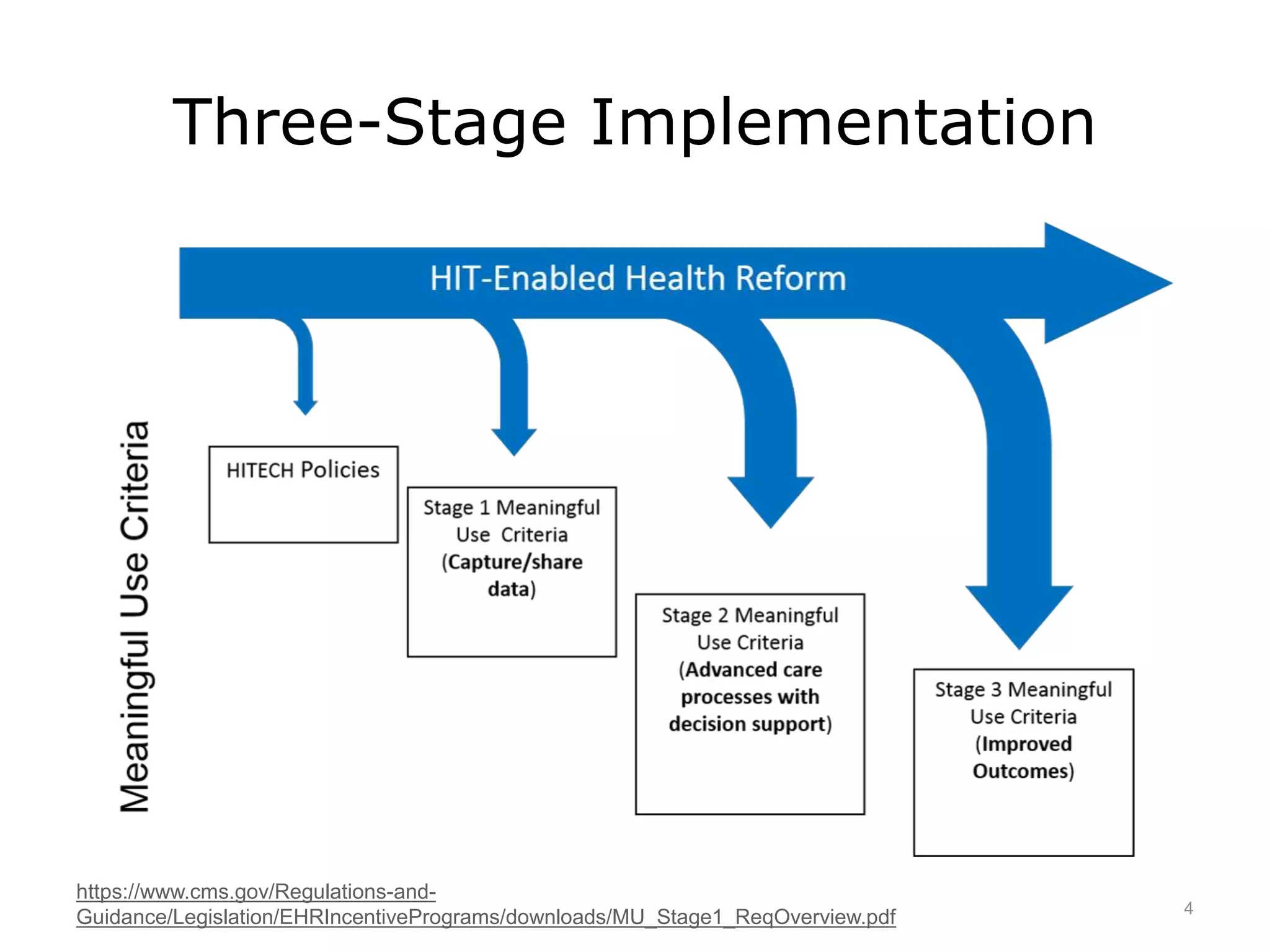
Three-Stage Implementation
https://www.cms.gov/Regulations-and-
Guidance/Legislation/EHRIncentivePrograms/downloads/MU_Stage1_ReqOverview.pdf 4
Incentive Implementation:
Increased Reimbursements - 1
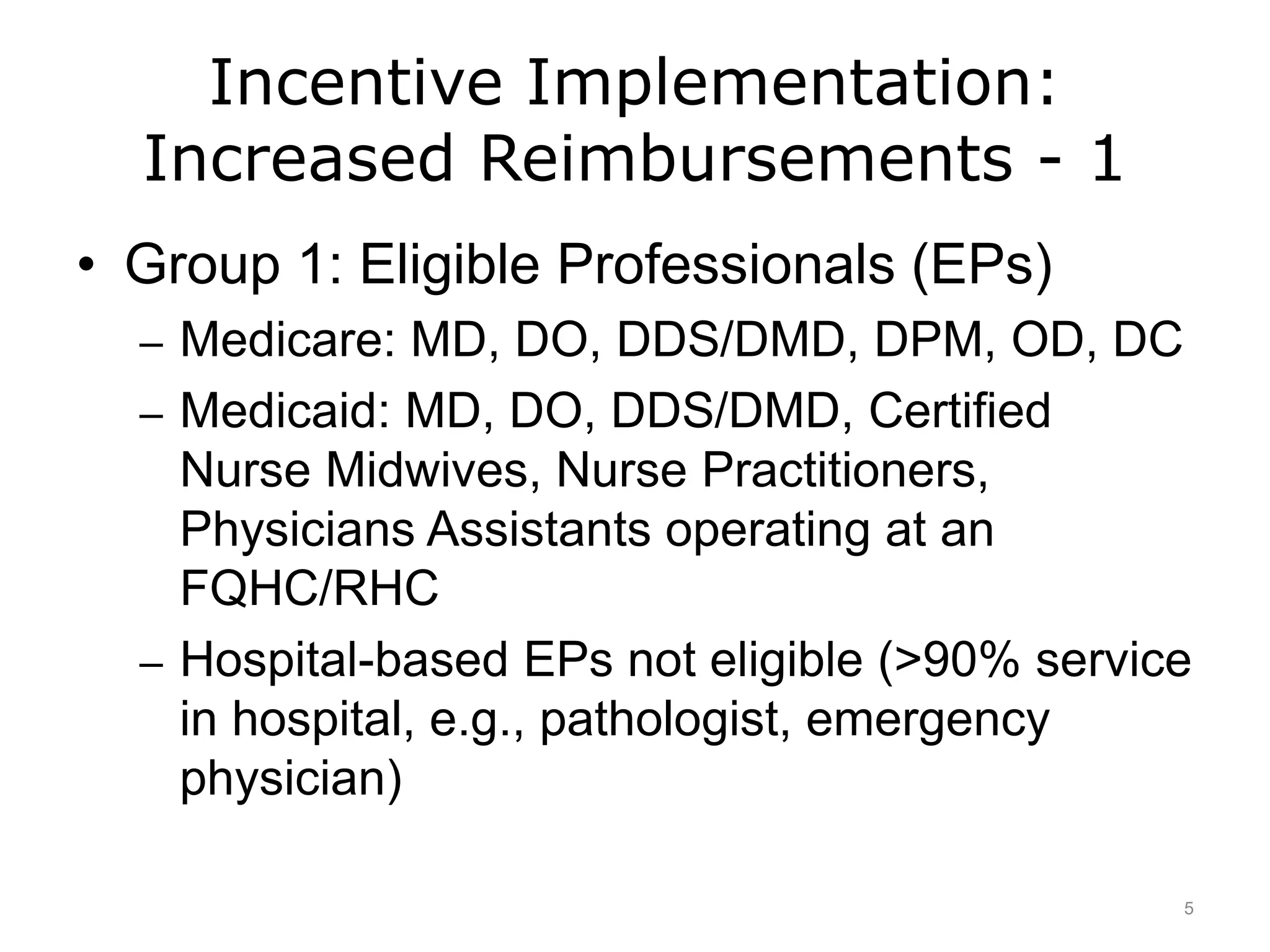
• Group 1: Eligible Professionals (EPs)
– Medicare: MD, DO, DDS/DMD, DPM, OD, DC
– Medicaid: MD, DO, DDS/DMD, Certified
Nurse Midwives, Nurse Practitioners,
Physicians Assistants operating at an
FQHC/RHC
– Hospital-based EPs not eligible (>90% service
in hospital, e.g., pathologist, emergency
physician)
5
Incentive Implementation:
Increased Reimbursements - 2
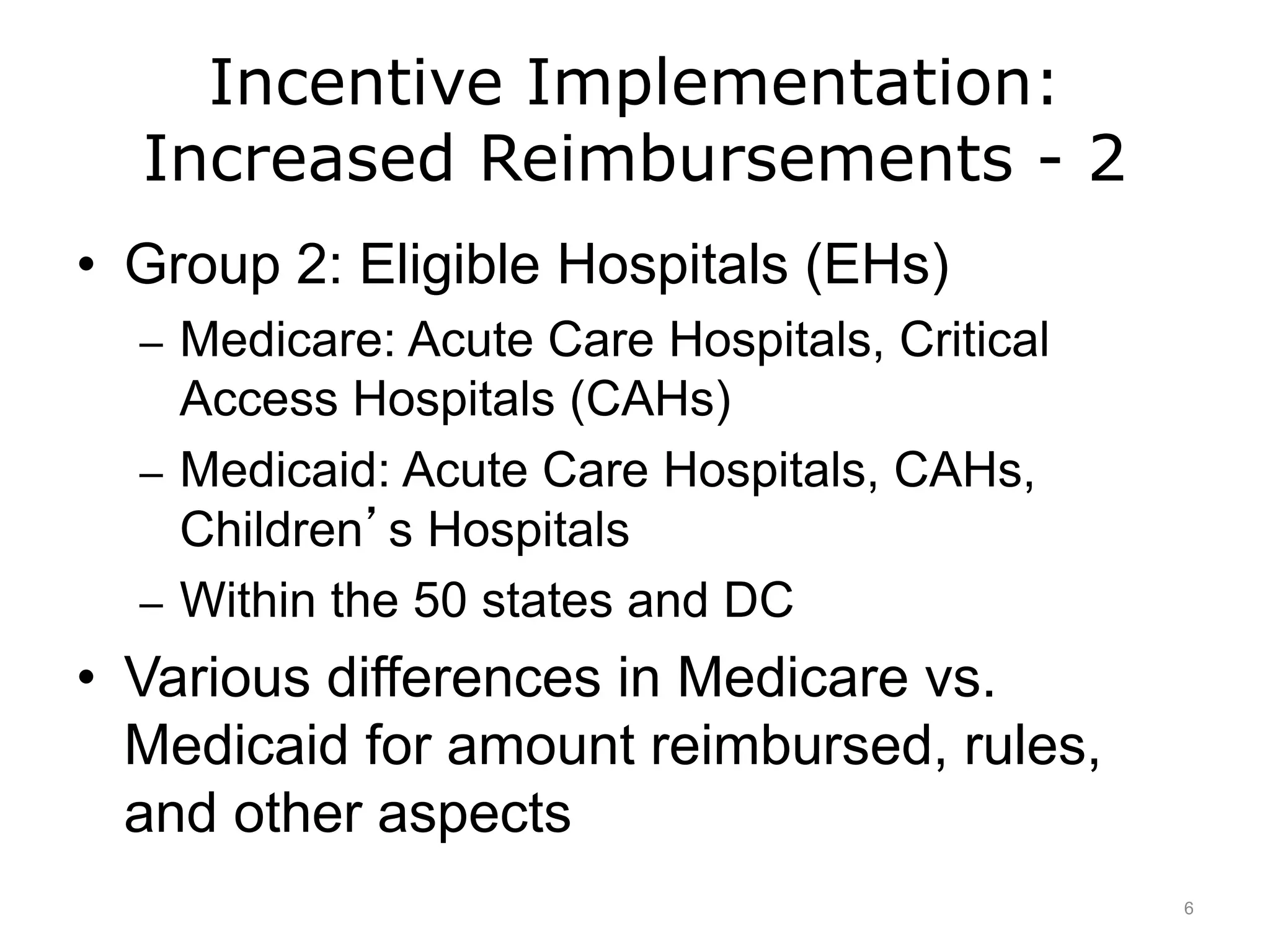
• Group 2: Eligible Hospitals (EHs)
– Medicare: Acute Care Hospitals, Critical
Access Hospitals (CAHs)
– Medicaid: Acute Care Hospitals, CAHs,
Children’s Hospitals
– Within the 50 states and DC
• Various differences in Medicare vs.
Medicaid for amount reimbursed, rules,
and other aspects
6
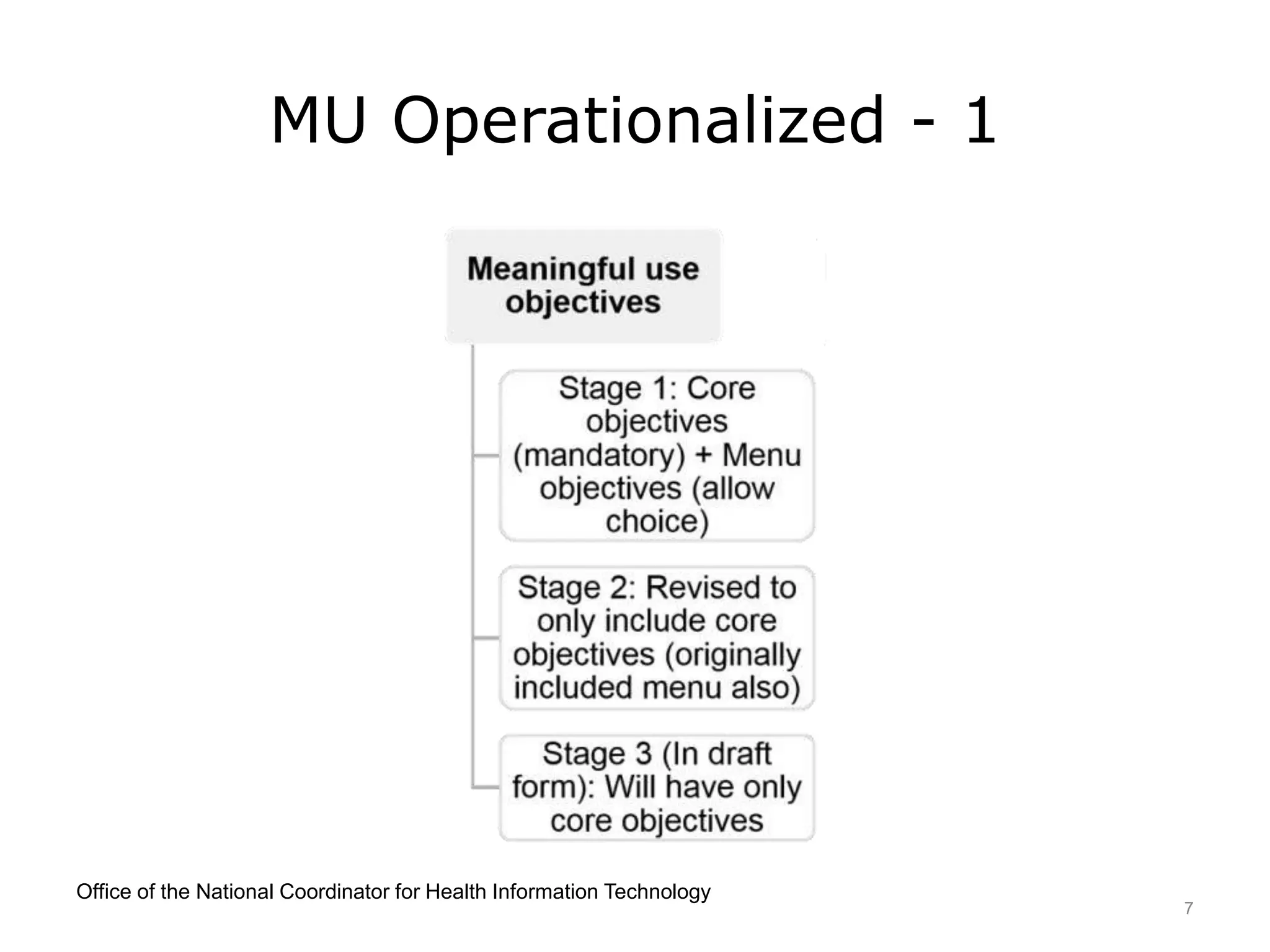
MU Operationalized - 1
Office of the National Coordinator for Health Information Technology
7
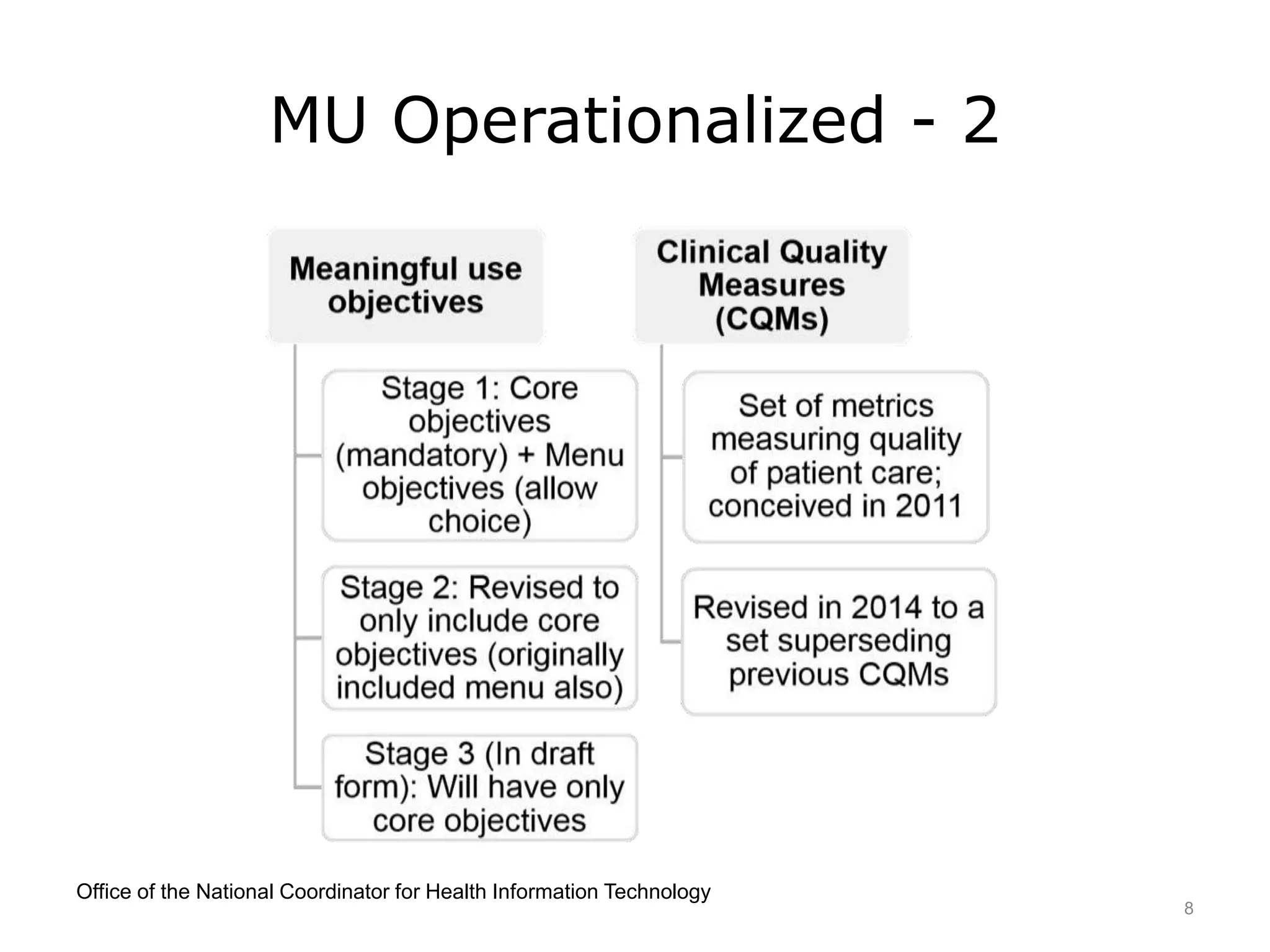
MU Operationalized - 2
Office of the National Coordinator for Health Information Technology
8
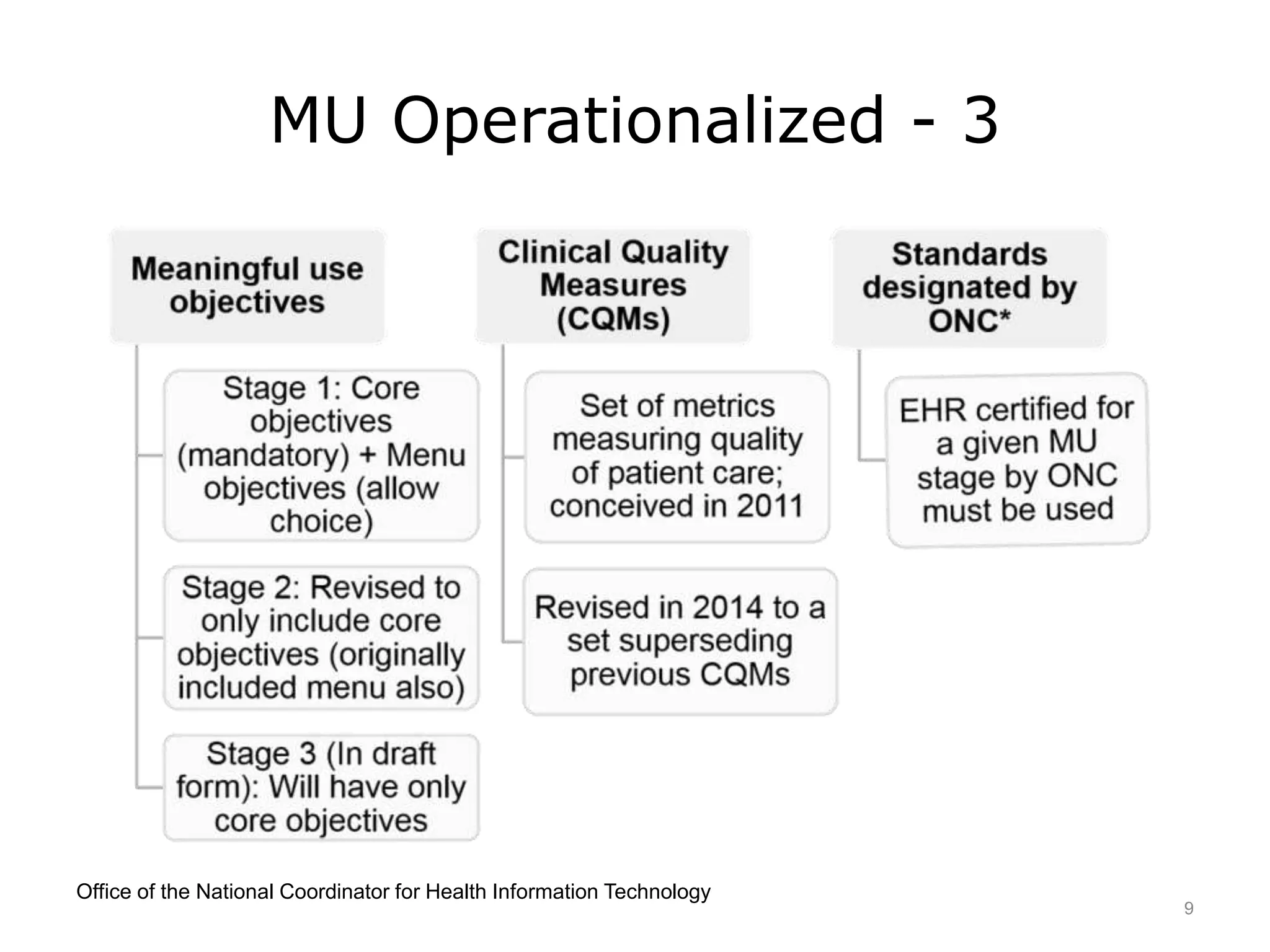
MU Operationalized - 3
Office of the National Coordinator for Health Information Technology
9
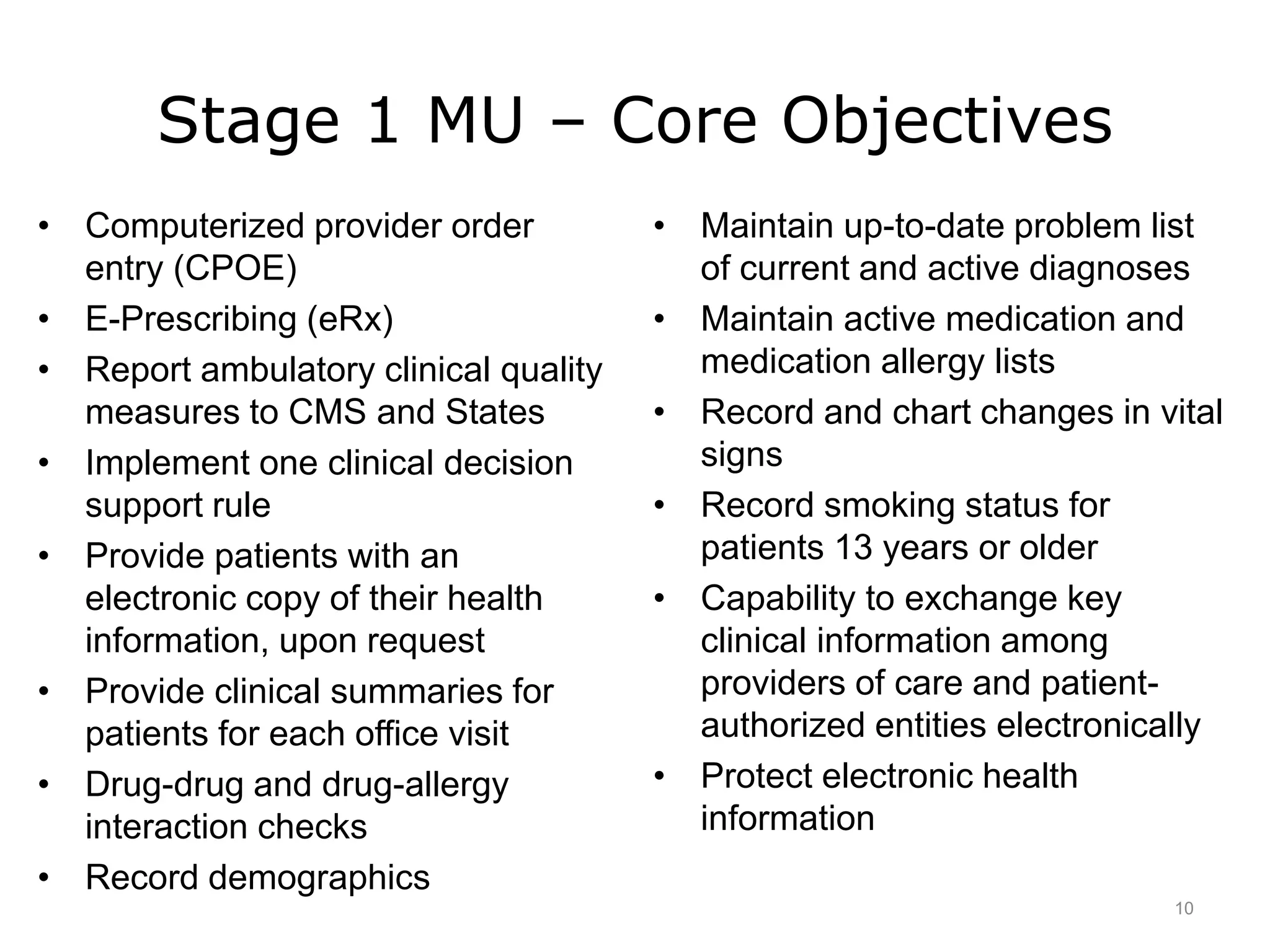
Stage 1 MU – Core Objectives
• Computerized provider order
entry (CPOE)
• E-Prescribing (eRx)
• Report ambulatory clinical quality
measures to CMS and States
• Implement one clinical decision
support rule
• Provide patients with an
electronic copy of their health
information, upon request
• Provide clinical summaries for
patients for each office visit
• Drug-drug and drug-allergy
interaction checks
• Record demographics
• Maintain up-to-date problem list
of current and active diagnoses
• Maintain active medication and
medication allergy lists
• Record and chart changes in vital
signs
• Record smoking status for
patients 13 years or older
• Capability to exchange key
clinical information among
providers of care and patient-
authorized entities electronically
• Protect electronic health
information
10
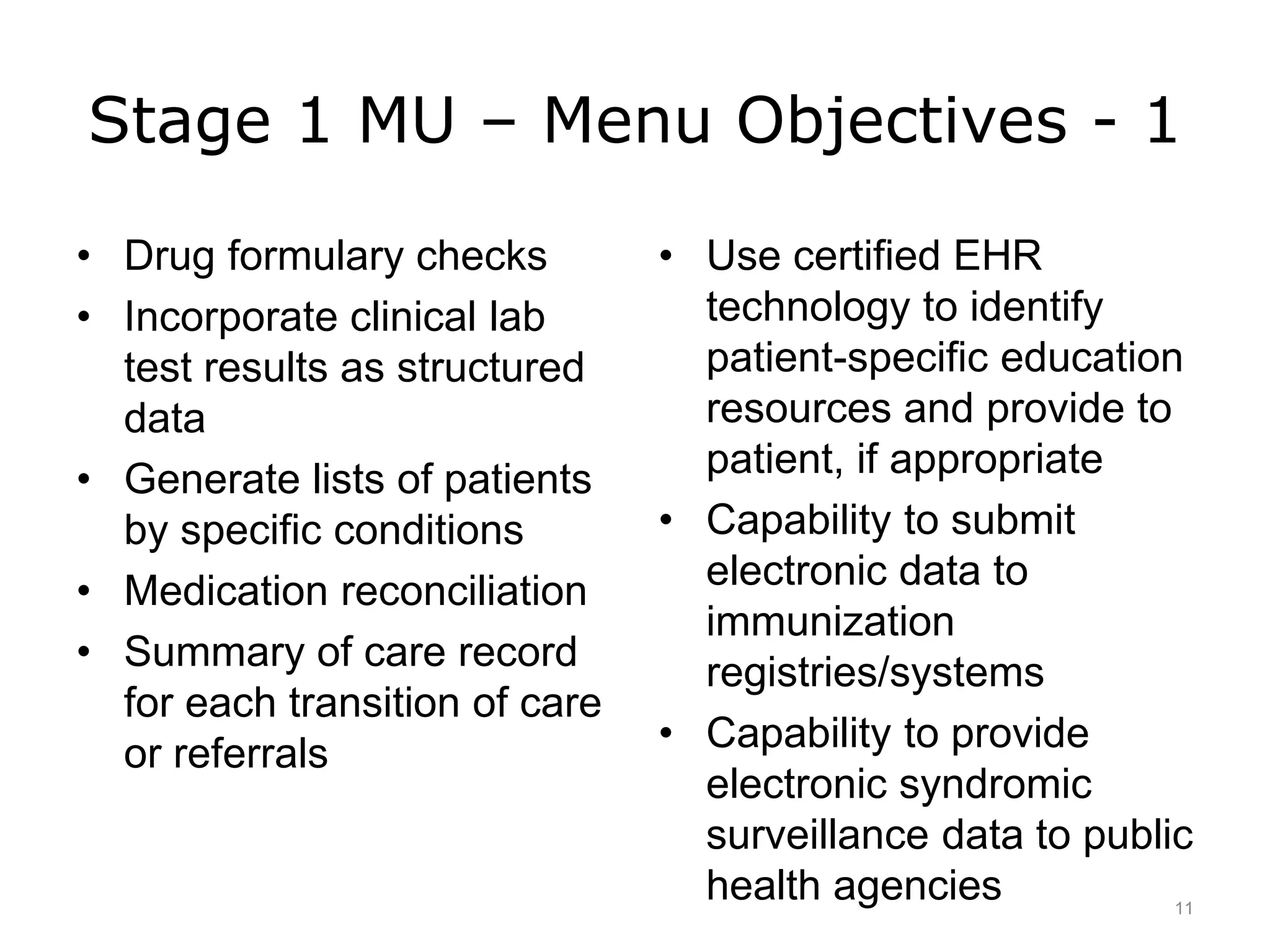
Stage 1 MU – Menu Objectives - 1
• Drug formulary checks
• Incorporate clinical lab
test results as structured
data
• Generate lists of patients
by specific conditions
• Medication reconciliation
• Summary of care record
for each transition of care
or referrals
• Use certified EHR
technology to identify
patient-specific education
resources and provide to
patient, if appropriate
• Capability to submit
electronic data to
immunization
registries/systems
• Capability to provide
electronic syndromic
surveillance data to public
health agencies 11
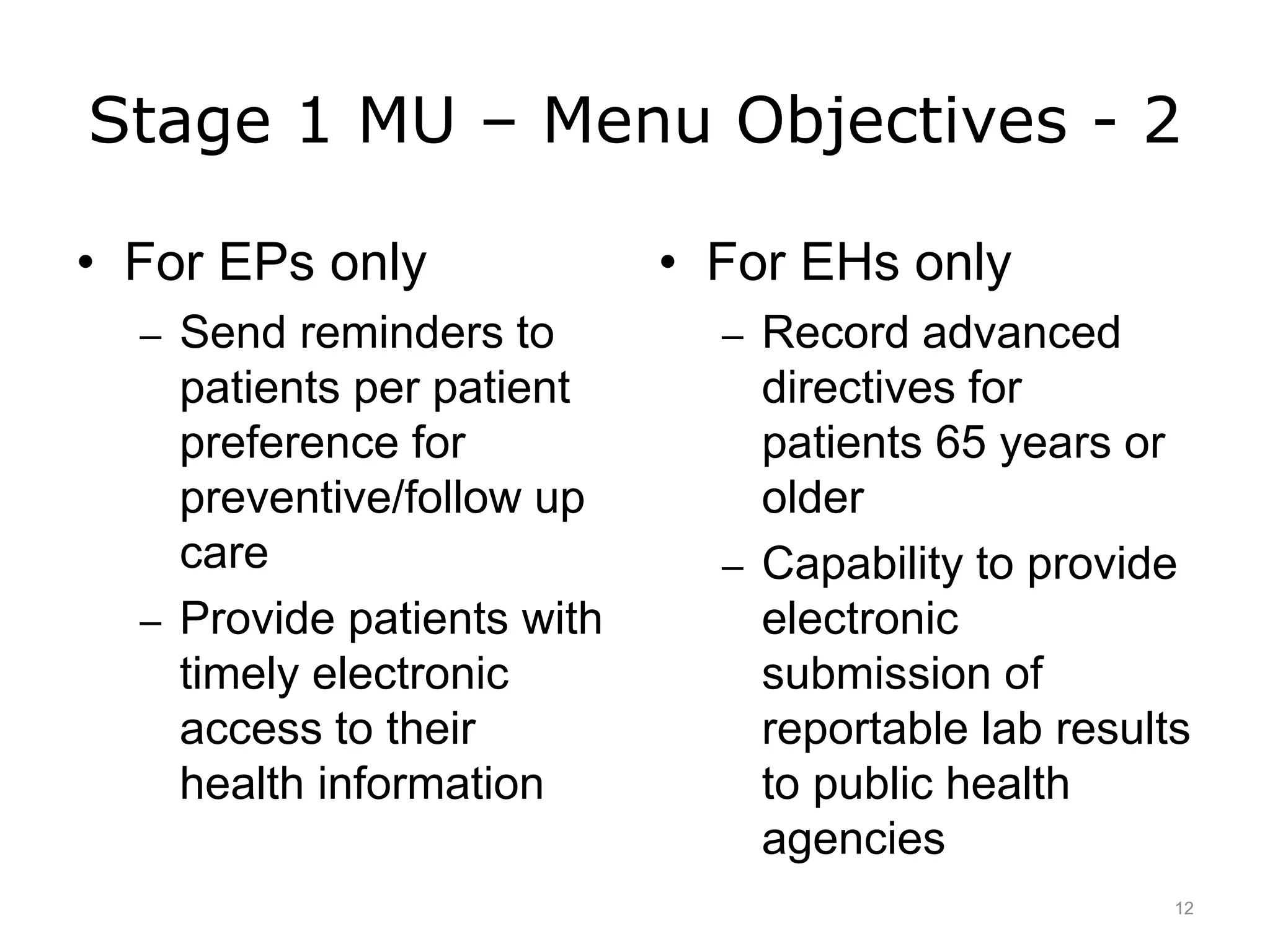
Stage 1 MU – Menu Objectives - 2
• For EPs only
– Send reminders to
patients per patient
preference for
preventive/follow up
care
– Provide patients with
timely electronic
access to their
health information
• For EHs only
– Record advanced
directives for
patients 65 years or
older
– Capability to provide
electronic
submission of
reportable lab results
to public health
agencies
12
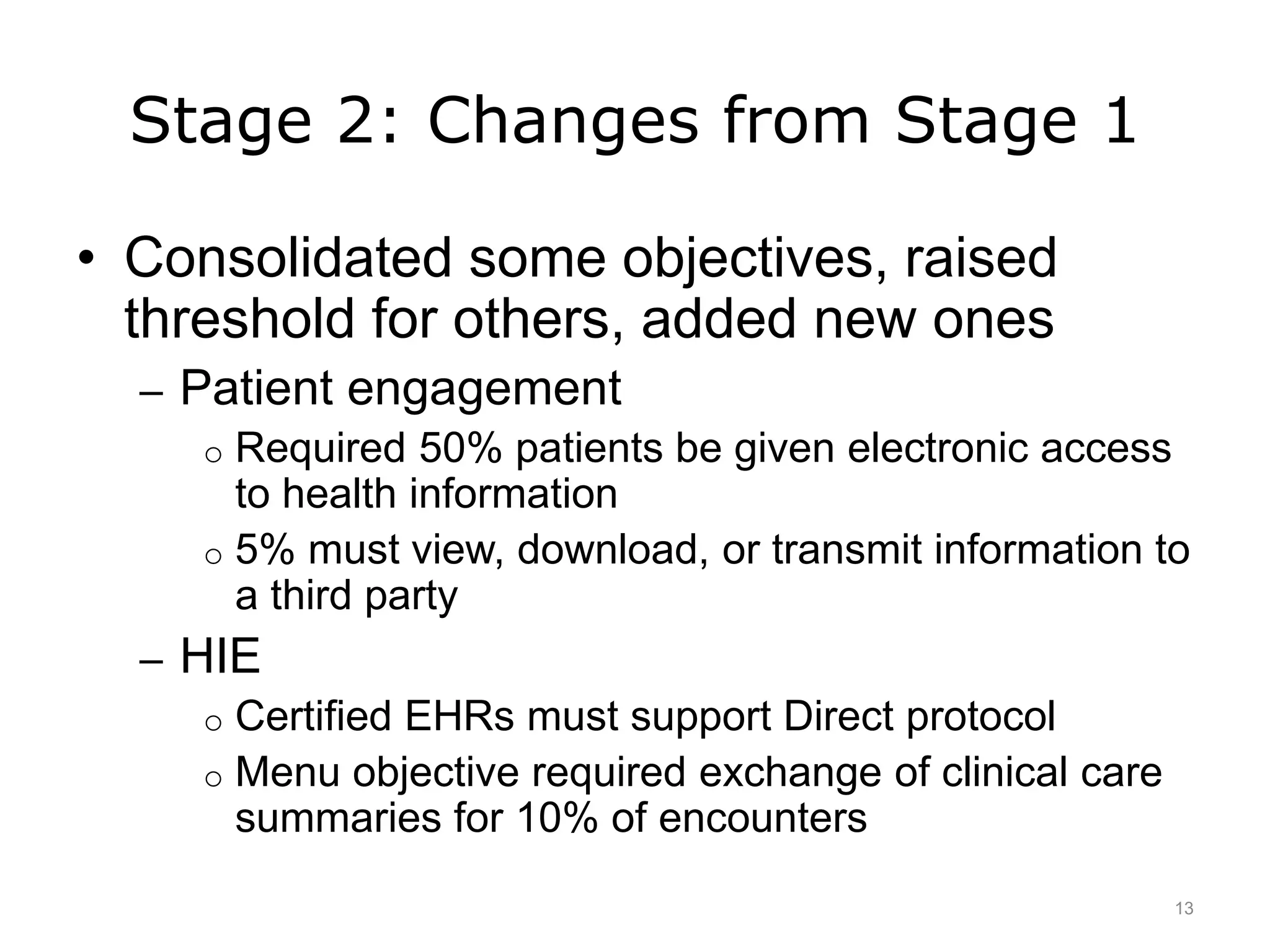
Stage 2: Changes from Stage 1
• Consolidated some objectives, raised
threshold for others, added new ones
– Patient engagement
o Required 50% patients be given electronic access
to health information
o 5% must view, download, or transmit information to
a third party
– HIE
o Certified EHRs must support Direct protocol
o Menu objective required exchange of clinical care
summaries for 10% of encounters
13
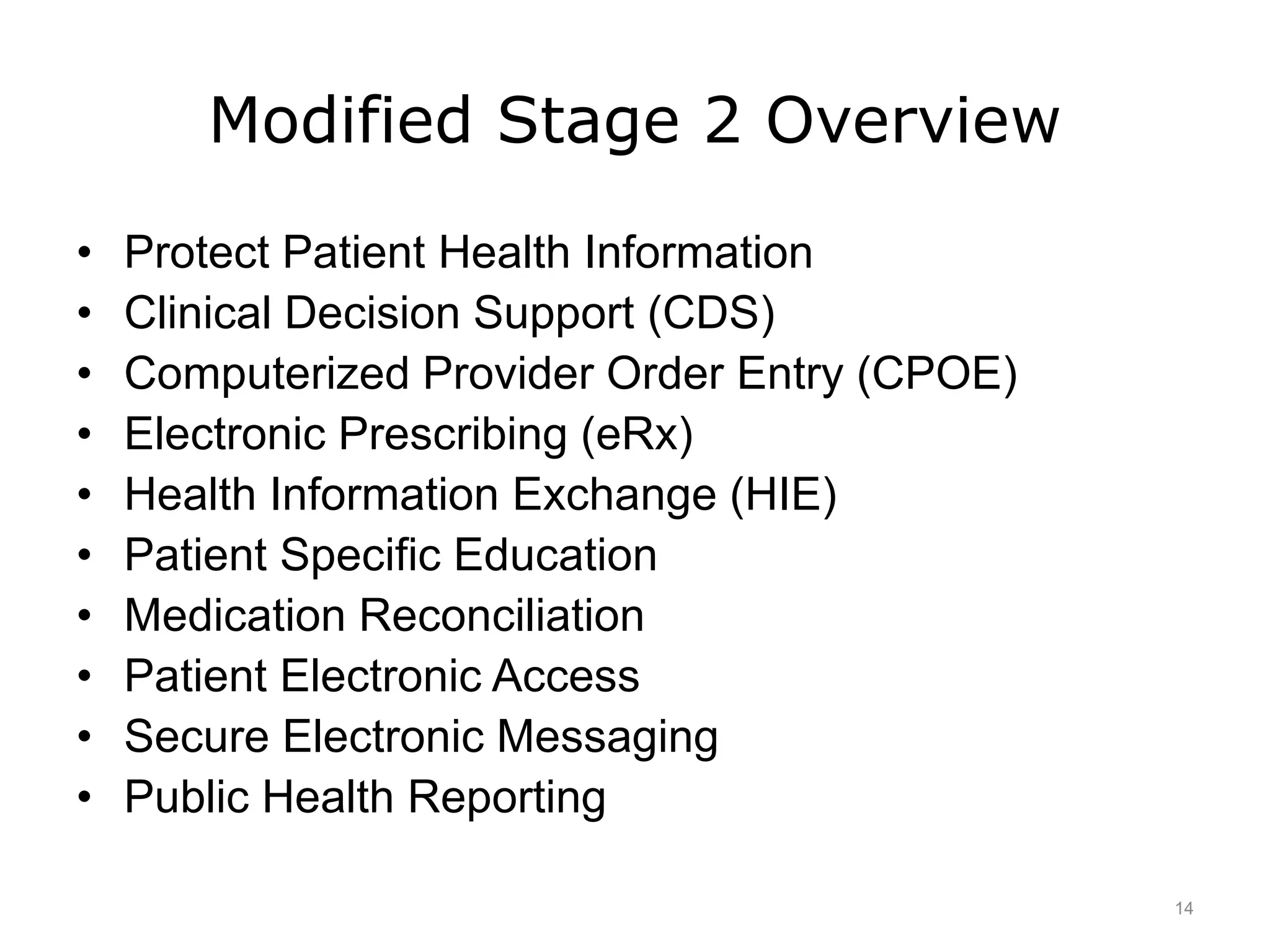
Modified Stage 2 Overview
• Protect Patient Health Information
• Clinical Decision Support (CDS)
• Computerized Provider Order Entry (CPOE)
• Electronic Prescribing (eRx)
• Health Information Exchange (HIE)
• Patient Specific Education
• Medication Reconciliation
• Patient Electronic Access
• Secure Electronic Messaging
• Public Health Reporting
14
Meaningful Use and Implementation
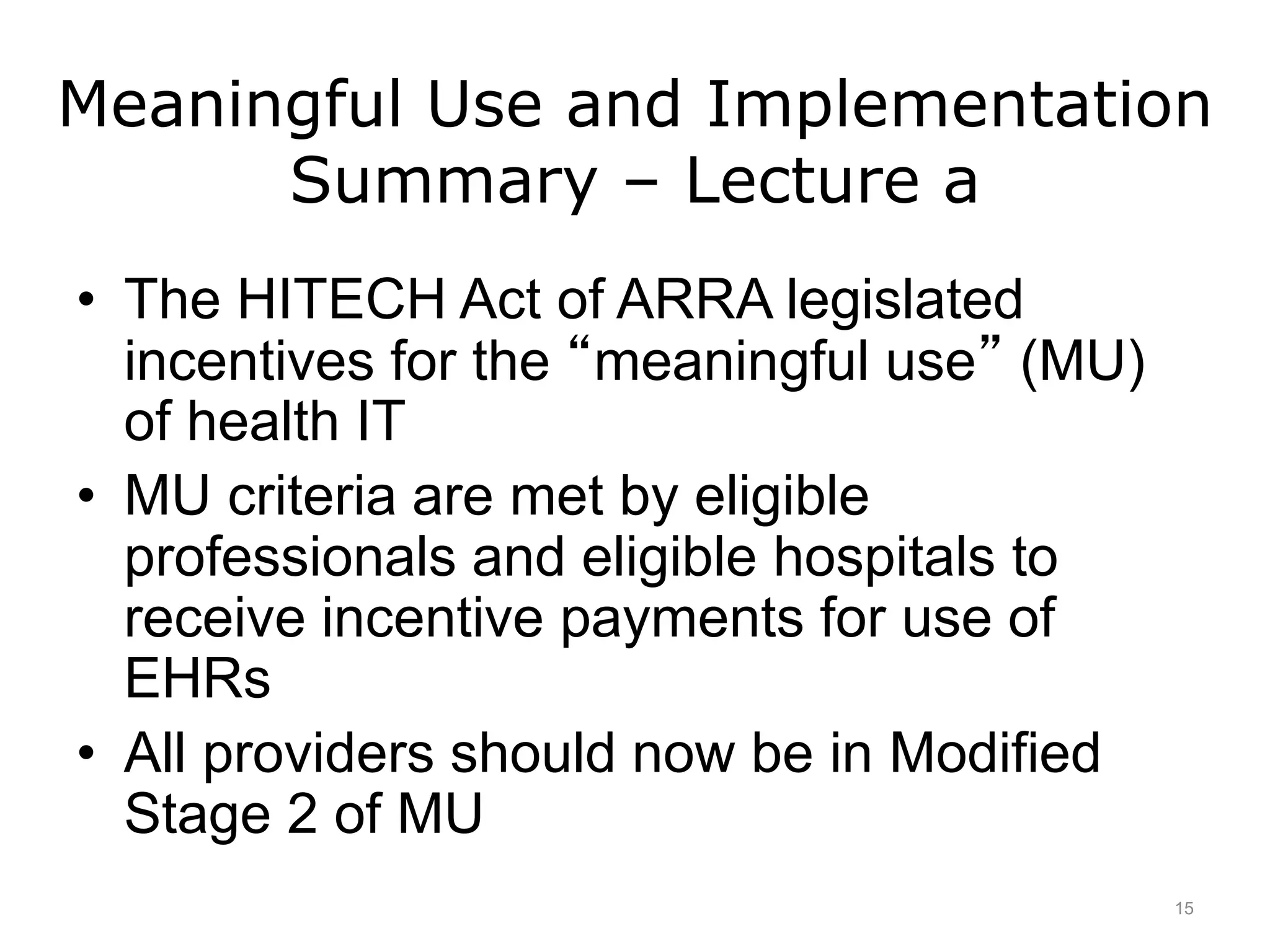
Summary – Lecture a
• The HITECH Act of ARRA legislated
incentives for the “meaningful use” (MU)
of health IT
• MU criteria are met by eligible
professionals and eligible hospitals to
receive incentive payments for use of
EHRs
• All providers should now be in Modified
Stage 2 of MU
15
Meaningful Use and Implementation
References – 1 – Lecture a
References
Blumenthal, D., & Tavenner, M. (2010). The “meaningful use” regulation for electronic
health records. New England Journal of Medicine, 363, 501-504.
Metzger, J and Rhoads, J (2012). Summary of Key Provisions in Final Rule for Stage 2
HITECH Meaningful Use. Falls Church, VA, Computer Sciences Corp.
O'Neill, T (2015). Primer: EHR Stage 3 Meaningful Use Requirements. Washington, DC,
American Action Forum. http://americanactionforum.org/uploads/files/research/2015-
10-
20_Primer_Stage_3_Meaningful_Use_Final_Rule_%28CH_edits%29_ej_mg_sh_....p
df
Trotter, F., & Uhlman, D. (2011). Getting to Meaningful Use and Beyond. Sebastopol, CA:
O'Reilly Media.
16
Meaningful Use and Implementation
References – 2 – Lecture a
Charts, Tables, Figures
2.1 Figure: Overview: What is Meaningful Use?, Missouri Health Information Technology
Assistance Center. Stage 1 rules set in 2010 (Blumenthal, 2010); Stage 2 rules likely
to be announced in 2012 (Drazen, 2011).
17
Configuring Electronic Health Records
Meaningful Use and Implementation
Lecture a
This material was developed by Oregon
Health & Science University, funded by the
Department of Health and Human Services,
Office of the National Coordinator for Health
Information Technology under Award
Number 90WT0001.
18

Meaningful Use and Implementation

  • 1.
    Configuring Electronic HealthRecords Meaningful Use and Implementation Lecture a This material (Comp 11 Unit 7) was developed by Oregon Health & Science University, funded by the Department of Health and Human Services, Office of the National Coordinator for Health Information Technology under Award Number 90WT00001. This work is licensed under the Creative Commons Attribution-NonCommercial-ShareAlike 4.0 International License. To view a copy of this license, visit http://creativecommons.org/licenses/by-nc-sa/4.0/.
  • 2.
    Meaningful Use andImplementation Learning Objectives • Describe the implementation of meaningful use (MU) of electronic health records in the context of the Health Information Technology for Economic and Clinical Health (HITECH) Act (Lecture a) • Demonstrate examples of MU using the VistA Electronic Health Record (EHR) system (Lecture b) 2
  • 3.
    Meaningful Use andHITECH • Health Information Technology for Economic and Clinical Health (HITECH) Act of the American Recovery and Reinvestment Act (ARRA) – Provides financial incentives for “meaningful use”(MU) of HIT and electronic health record (EHR) adoption by physicians and hospitals – Direct grants administered by federal agencies – More details in Component 1, Unit 10 3
  • 4.
  • 5.
    Incentive Implementation: Increased Reimbursements- 1 • Group 1: Eligible Professionals (EPs) – Medicare: MD, DO, DDS/DMD, DPM, OD, DC – Medicaid: MD, DO, DDS/DMD, Certified Nurse Midwives, Nurse Practitioners, Physicians Assistants operating at an FQHC/RHC – Hospital-based EPs not eligible (>90% service in hospital, e.g., pathologist, emergency physician) 5
  • 6.
    Incentive Implementation: Increased Reimbursements- 2 • Group 2: Eligible Hospitals (EHs) – Medicare: Acute Care Hospitals, Critical Access Hospitals (CAHs) – Medicaid: Acute Care Hospitals, CAHs, Children’s Hospitals – Within the 50 states and DC • Various differences in Medicare vs. Medicaid for amount reimbursed, rules, and other aspects 6
  • 7.
    MU Operationalized -1 Office of the National Coordinator for Health Information Technology 7
  • 8.
    MU Operationalized -2 Office of the National Coordinator for Health Information Technology 8
  • 9.
    MU Operationalized -3 Office of the National Coordinator for Health Information Technology 9
  • 10.
    Stage 1 MU– Core Objectives • Computerized provider order entry (CPOE) • E-Prescribing (eRx) • Report ambulatory clinical quality measures to CMS and States • Implement one clinical decision support rule • Provide patients with an electronic copy of their health information, upon request • Provide clinical summaries for patients for each office visit • Drug-drug and drug-allergy interaction checks • Record demographics • Maintain up-to-date problem list of current and active diagnoses • Maintain active medication and medication allergy lists • Record and chart changes in vital signs • Record smoking status for patients 13 years or older • Capability to exchange key clinical information among providers of care and patient- authorized entities electronically • Protect electronic health information 10
  • 11.
    Stage 1 MU– Menu Objectives - 1 • Drug formulary checks • Incorporate clinical lab test results as structured data • Generate lists of patients by specific conditions • Medication reconciliation • Summary of care record for each transition of care or referrals • Use certified EHR technology to identify patient-specific education resources and provide to patient, if appropriate • Capability to submit electronic data to immunization registries/systems • Capability to provide electronic syndromic surveillance data to public health agencies 11
  • 12.
    Stage 1 MU– Menu Objectives - 2 • For EPs only – Send reminders to patients per patient preference for preventive/follow up care – Provide patients with timely electronic access to their health information • For EHs only – Record advanced directives for patients 65 years or older – Capability to provide electronic submission of reportable lab results to public health agencies 12
  • 13.
    Stage 2: Changesfrom Stage 1 • Consolidated some objectives, raised threshold for others, added new ones – Patient engagement o Required 50% patients be given electronic access to health information o 5% must view, download, or transmit information to a third party – HIE o Certified EHRs must support Direct protocol o Menu objective required exchange of clinical care summaries for 10% of encounters 13
  • 14.
    Modified Stage 2Overview • Protect Patient Health Information • Clinical Decision Support (CDS) • Computerized Provider Order Entry (CPOE) • Electronic Prescribing (eRx) • Health Information Exchange (HIE) • Patient Specific Education • Medication Reconciliation • Patient Electronic Access • Secure Electronic Messaging • Public Health Reporting 14
  • 15.
    Meaningful Use andImplementation Summary – Lecture a • The HITECH Act of ARRA legislated incentives for the “meaningful use” (MU) of health IT • MU criteria are met by eligible professionals and eligible hospitals to receive incentive payments for use of EHRs • All providers should now be in Modified Stage 2 of MU 15
  • 16.
    Meaningful Use andImplementation References – 1 – Lecture a References Blumenthal, D., & Tavenner, M. (2010). The “meaningful use” regulation for electronic health records. New England Journal of Medicine, 363, 501-504. Metzger, J and Rhoads, J (2012). Summary of Key Provisions in Final Rule for Stage 2 HITECH Meaningful Use. Falls Church, VA, Computer Sciences Corp. O'Neill, T (2015). Primer: EHR Stage 3 Meaningful Use Requirements. Washington, DC, American Action Forum. http://americanactionforum.org/uploads/files/research/2015- 10- 20_Primer_Stage_3_Meaningful_Use_Final_Rule_%28CH_edits%29_ej_mg_sh_....p df Trotter, F., & Uhlman, D. (2011). Getting to Meaningful Use and Beyond. Sebastopol, CA: O'Reilly Media. 16
  • 17.
    Meaningful Use andImplementation References – 2 – Lecture a Charts, Tables, Figures 2.1 Figure: Overview: What is Meaningful Use?, Missouri Health Information Technology Assistance Center. Stage 1 rules set in 2010 (Blumenthal, 2010); Stage 2 rules likely to be announced in 2012 (Drazen, 2011). 17
  • 18.
    Configuring Electronic HealthRecords Meaningful Use and Implementation Lecture a This material was developed by Oregon Health & Science University, funded by the Department of Health and Human Services, Office of the National Coordinator for Health Information Technology under Award Number 90WT0001. 18

Editor's Notes

  • #2 Welcome to Configuring Electronic Health Records, Meaningful Use and Implementation. This is lecture a.
  • #3 The learning objectives for this unit, Meaningful Use and Implementation, are to: Describe the implementation of meaningful use, or MU, of electronic health records in the context of the Health Information Technology for Economic and Clinical Health, or HITECH, Act And demonstrate examples of MU using the VistA Electronic Health Record, or EHR, system
  • #4 This lecture describes the eligibility, criteria, and objectives for achieving meaningful use. With the American Recovery and Reinvestment Act, or ARRA, also known as the economic stimulus bill, the United States entered a new era for health information technology. The portions of ARRA addressing health information technology are known as the Health Information Technology for Economic and Clinical Health, or HITECH, Act. HITECH provides incentives for electronic health record, or EHR, adoption by physicians and hospitals, for which it will fund up to $27 billion dollars. HITECH also provides direct grants administered by federal agencies, up to $2 billion dollars, to develop the infrastructure to support the program. The financial incentives are specifically tied to a concept called “meaningful use” of health information technology. More details about HITECH and the meaningful use program are provided in Component 1, Unit 10.
  • #5 The overall plan for implementing meaningful use was that it would be done in three stages, all as part of health IT-enabled health care reform. Stage 1 would focus on the capturing and sharing of data, and we’ll see that from the criteria. Stage 2 would focus on advanced care processes with decision support, while the goal of Stage 3 will be to focus on improved outcomes. The details of Stage 3 have not yet been finalized.
  • #6 Those who achieve meaningful use will receive the incentive funding through increased reimbursement from Medicare or Medicaid, the government-funded health care payment systems in the U.S. The rules differ slightly whether funding is obtained through Medicare or Medicaid, but they have the same general concept. One group that will receive funding is eligible professionals, or EPs. Several different types of professionals are eligible under Medicare or Medicaid. Physicians, osteopaths, and dentists will qualify under both. Podiatrists, optometrists, and chiropractors will be eligible under Medicare. Certified nurse midwives, nurse practitioners, and physician assistants who work at certain types of health centers - that is, federally qualified health centers - will be eligible under Medicaid. One of the initial controversies concerned hospital-based eligible professionals, in particular physicians who work in hospitals. Under the original legislation, they were not eligible, although the hospitals that they worked for were eligible. However, additional legislation was passed that changed the definition of hospital-based eligible professionals, so that more physicians who work in hospitals could become eligible. Now, a hospital-based professional who provides greater than 90 percent of his or her service in the hospital, such as a pathologist or emergency physician, is not eligible, but those who work less time in the hospital are.
  • #7 Hospitals eligible under Medicare and Medicaid include acute care hospitals and critical access hospitals. Also eligible under Medicaid are children's hospitals. Eligible hospitals, or EHs need to be within the 50 states of the U.S. or the District of Columbia. The upcoming slides will show that there are various differences, depending on whether incentive funding is obtained under Medicare or Medicaid.
  • #8 This slide gives an overview of how the meaningful use program has been operationalized, with the warning that there will be a great deal of detail included here and in the following slides. It's most important, though, to keep one’s eye on the big picture. In the meaningful use program, recall that there are eligible professionals, eligible hospitals, and critical access hospitals, and that they need to meet three requirements to receive reimbursement funds: One requirement is meeting the meaningful use objectives in the various stages. In the original Stages 1 and 2, each had two sets of objectives. The first set of objectives were the core objectives. All of the core objectives had to be met. For the second set of objectives, users could choose a required number from a larger menu of options. Recently, Stage 2 has been modified to have only core objectives. In addition, the draft criteria for Stage 3 have been released. In this new set up, those seeking remuneration via the meaningful use program must meet all of the objectives; there are no choices.
  • #9 In addition to meeting the meaningful use objectives, there are clinical quality measures, or CQMs, that had to be met as part of the three requirements. In the 2011 release of the original CQMs, there was one set of CQMs for eligible hospitals and another for eligible providers. These were superseded in 2014 by expanded sets of clinical quality measures. No matter what stage an EP or EH was in, starting in 2014, all those seeking remuneration through the meaningful use program needed to meet the new clinical quality measures.
  • #10 The third requirement for qualifying to receive meaningful use reimbursement funds was meeting standards designated by the office of the national coordinator for health information technology, or ONC, via certified electronic health records.
  • #11 This slide shows the original core objectives for Stage 1 of meaningful use. They are: Computerized provider order entry, or CPOE E-Prescribing, or eRx Report ambulatory clinical quality measures to the Centers for Medicare and Medicaid Services, or CMS, and the states Implement one clinical decision support rule Provide patients with an electronic copy of their health information, upon request Provide clinical summaries for patients for each office visit Drug-drug and drug-allergy interaction checks Record demographics Maintain up-to-date problem list of current and active diagnoses Maintain active medication and medication allergy lists Record and chart changes in vital signs Record smoking status for patients 13 years or older Capability to exchange key clinical information among providers of care and patient-authorized entities electronically And protect electronic health information Early meaningful use program participants had to achieve each of these objectives during Stage 1 to get their first payments under the HITECH Act.
  • #12 This slide lists the menu objectives for Stage 1 that are common to both eligible professionals and eligible hospitals. They are: Drug formulary checks Incorporate clinical lab test results as structured data Generate lists of patients by specific conditions Medication reconciliation Summary of care record for each transition of care or referrals Use certified EHR technology to identify patient-specific education resources and provide to patient, if appropriate Capability to submit electronic data to immunization registries/systems And, capability to provide electronic syndromic surveillance data to public health agencies
  • #13 This slide lists a couple of objectives that are specific to eligible professionals and another couple that are specific to eligible hospitals. For EPs only, the list includes: Send reminders to patients per patient preference for preventive and/or follow up care And provide patients with timely electronic access to their health information For EHs only, the list includes: Record advanced directives for patients 65 years or older And, have the capability to provide electronic submission of reportable lab results to public health agencies
  • #14 Moving on to Stage 2, there were changes from Stage 1. Some objectives were consolidated, some objective thresholds were raised, and seven objectives were added around patient engagement and health information exchange. One of the new core objectives required that 50% of patients or their authorized representative be given access to health information and, of those, 5% had to view, download, or transmit health information to a third party. For health information exchange, the certification process now required supporting the Direct protocol of point-to-point secure transmission of information and a new menu objective required the exchange of clinical care summaries for 10 percent of all patient encounters.
  • #15 Modified Stage 2 consolidates many of the meaningful use criteria from Stages 1 and 2. The major categories are listed on this slide. Protect Patient health information - Protect electronic health information created or maintained by the Certified Electronic Health Record Technology, or CEHRT, through the implementation of appropriate technical capabilities Clinical decision support - Use clinical decision support to improve performance on high priority health conditions Computerized Provider Order Entry, or CPOE - Use computerized provider order entry for medication, laboratory, and radiology orders directly entered by any licensed health care professional who can enter orders into the medical record per state, local, and professional guidelines Electronic Prescribing, or eRx - EPs generate and transmit permissible prescriptions electronically. EHs generate and transmit permissible discharge prescriptions electronically Health Information Exchange, or HIE - The EP or EH that transitions their patient to another setting of care, or provider of care or refers their patient to another provider of care, provides a summary care record for each transition of care or referral Patient Specific Education - Use clinically relevant information from CEHRT to identify patient specific education resources and provide those resources to the patient Medication Reconciliation - The EP or EH that receives a patient from another setting of care or provider of care, or believes an encounter is relevant, performs medication reconciliation Patient Electronic Access - EPs provide patients the ability to view online, download, and transmit their health information within 4 business days of the information being available to the EP. EHs provide patients the ability to view online, download, and transmit their health information within 36 hours of hospital discharge. Secure Electronic Messaging - EPs use secure electronic messaging to communicate with patients on relevant health information And Public Health Reporting - The EP or EH is in active engagement with a public health agency to submit electronic public health data from CEHRT, except where prohibited, and in accordance with applicable law and practice
  • #16 This concludes lecture a of Meaningful Use and Implementation. In summary, this lecture described the meaningful use program of the HITECH Act. This program provides financial incentives for the meaningful use of health information technology, where the criteria for use must be met by eligible professionals and eligible hospitals. All providers should now be in Modified Stage 2 of the program.
  • #17 References slide. No audio.
  • #18 References slide. No audio.
  • #19 No audio.