Studio 12
GraphViz, Prezi, ManyEyes
Introduction to the Digital Liberal Arts
MDST 3703 / 7703
Fall 2010
Business
• Last formal studio
– Next week Thanksgiving
– Last studio will be an open session
• Talk to me if you think you need help
Review
• Effective visualization requires visual literacy
• Graphesis helps us understand visual literacy
• The visual as cultural
• The visual as irreducible—as important as the
data and content
Overview
Today we explore some practical tools to
develop visualizations
We look at three tools for creating visualizations
• GraphViz
• Prezi
• ManyEyes
GraphViz
• Free tool from AT&T to create “graphs”
– http://www.graphviz.org/
– Good PC and Mac versions
• Graph = nodes + links
– In math, these are “edges” and “vertices”
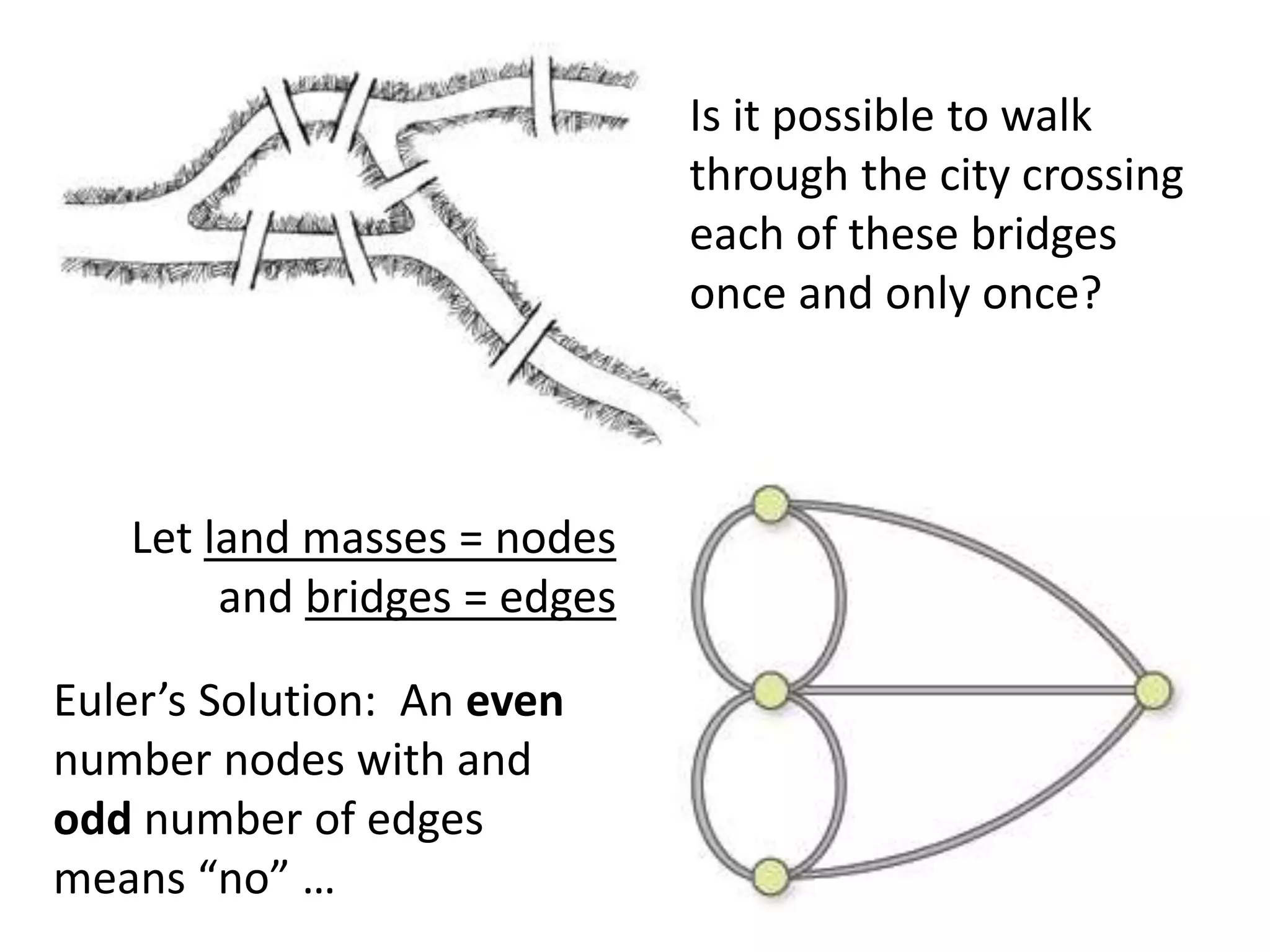
– Used by Euler to solve the “seven bridges of
Konigsburg” problem
• GraphViz uses a simple language called DOT
– Give it a graph expressed in DOT and it will generate
a nice picture using an algorithm
Is it possible to walk
through the city crossing
each of these bridges
once and only once?
Euler’s Solution: An even
number nodes with and
odd number of edges
means “no” …
Let land masses = nodes
and bridges = edges
Graphs can represent almost anything
• Social networks
• Causal chains of events (e.g. evolution)
• Texts, e.g. basic structure and narrative
structure
• Arguments
• The Internet
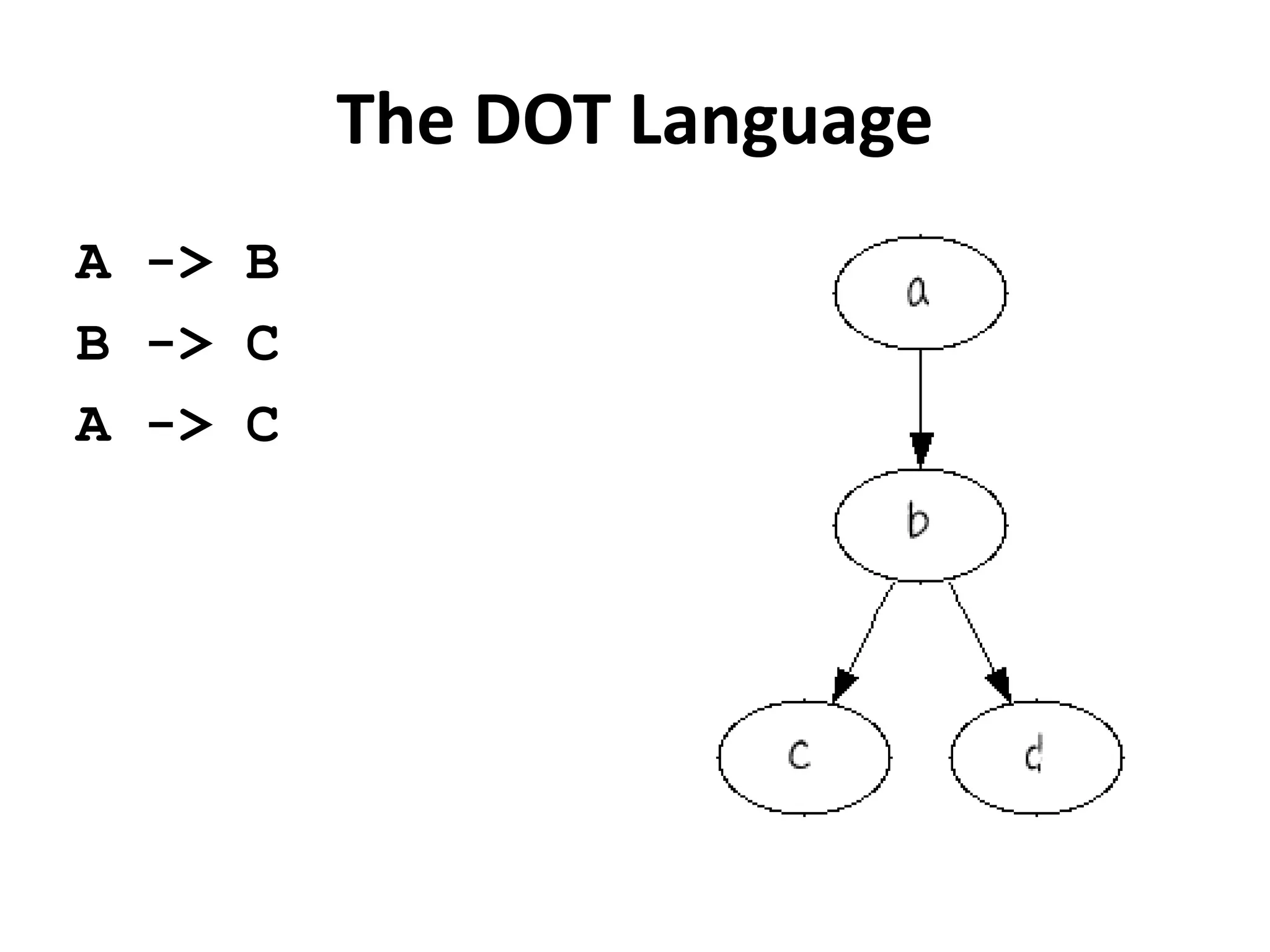
The DOT Language
A -> B
B -> C
A -> C
The DOT Language
A [label='foo']
B [label='bar']
C [label='baz']
D [label='boo']
A -> B
B -> C
B -> D
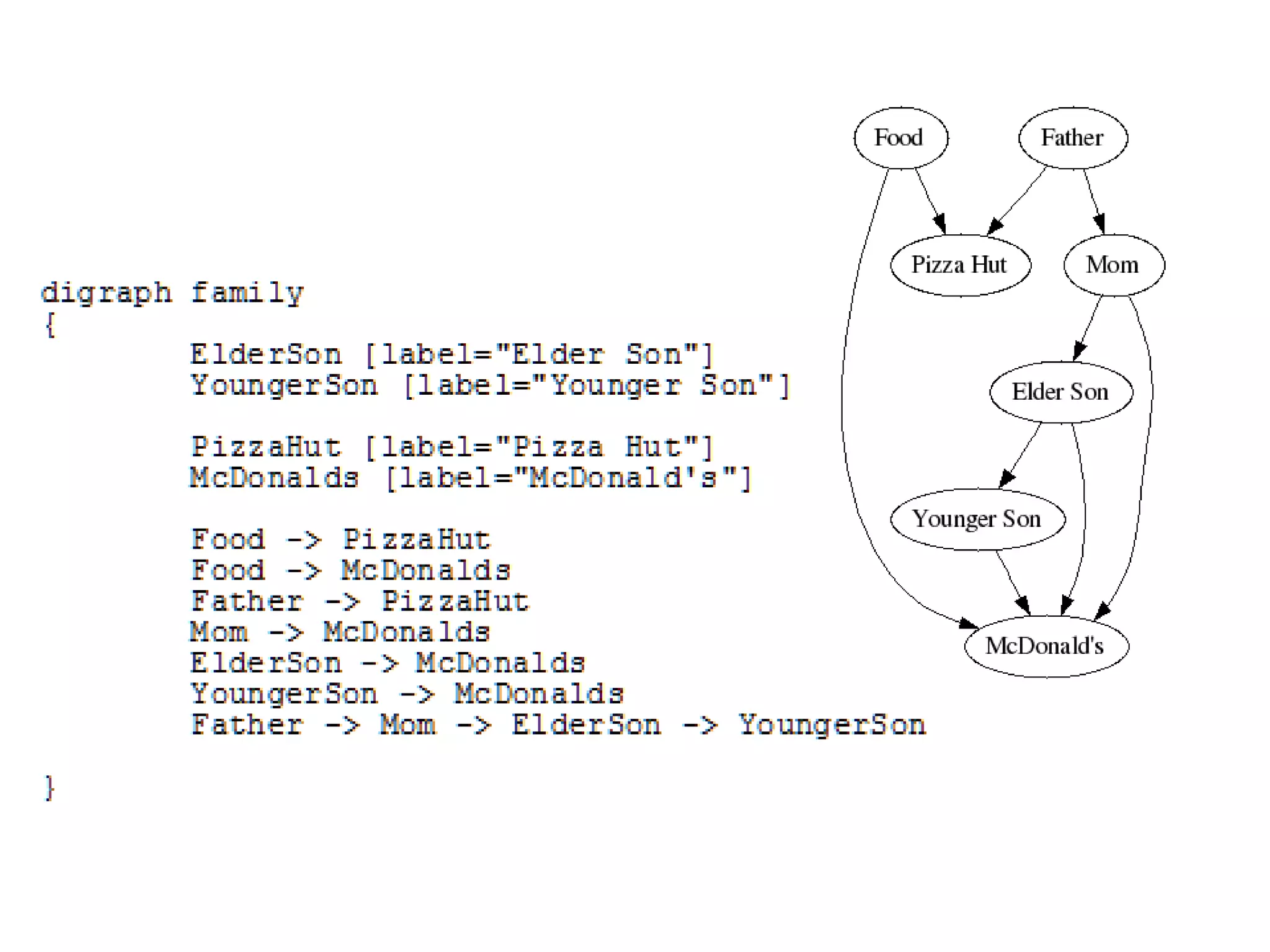
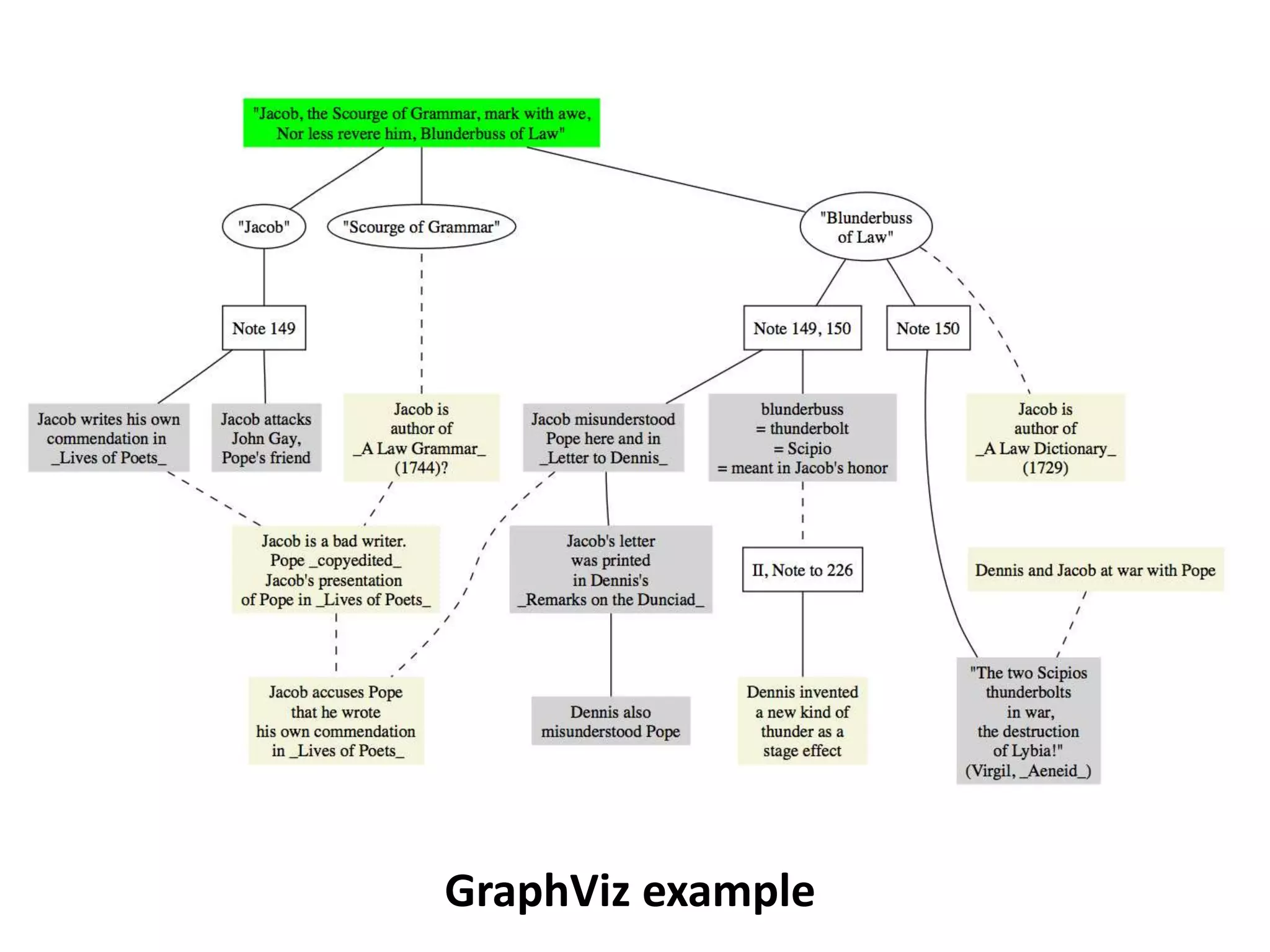
GraphViz example
The DOT language--Nodes
A [label=""Jacob, the Scourge of Grammar, mark
with awe,nNor less revere him, Blunderbuss of
Law"" style="filled" color="green"]
A1 [label=""Jacob"" group="A" shape="ellipse"]
A2 [label=""Blunderbussnof Law"" group="A"
shape="ellipse"]
A3 [label=""Scourge of Grammar"" group="A"
shape="ellipse"]
B [label="Note 149" shape="record"]
C [label="Note 149, 150" shape="record"]
D [shape="record" label="Note 150"]
E [shape="record" label="II, Note to 226"]
The DOT language--Edges
A -- {A1;A2;A3}
A1 -- B
A2 -- {C;D}
A2 -- I04 [style="dashed"]
B -- {B1;B2}
B1 -- B3 [style="dashed"]
I01 -- B3 [style="dashed"]
B3 -- I03 [style="dashed"]
I01 -- A3 [style="dashed"]
C -- {I02;I08}
I02 -- I03 [style="dashed"]
I02 -- I06
I06 -- I07
I05 -- I10 [style="dashed"]
I08 -- E [style="dashed"]
E -- I09
D -- I10
Try it …
• Go to http://ashitani.jp/gv/#
– Start typing in the box on the left …
• To create your own, use one of these:
Mac http://www.pixelglow.com/graphviz/
Win http://wingraphviz.sourceforge.net/wingraphviz/
• Use it to create graphs and then save them as
images
• Nice tutorial here …
http://www.linux.com/archive/feed/49655?theme=print
Prezi
• Creates presentations based on graphs
• Allows you to throw down ideas and then
connect them
– Not the PowerPoint sequence of implied order
– PPT: worst of both worlds – both linear and non-
narrative
• Then you “play” them based on the edges you
provide
Prezi How-to
• Demo video
http://www.youtube.com/watch?v=pxhqD0hNx4Q
• Go to prezi.com and create an account
– http://prezi.com
• Create a presentation
– We’ll do one collaboratively …
Prezi’s Devices
• Nodes can be texts or images or URLs
• Nodes can by groups by frames
• Nodes can be connected by paths
• Narrative flow is accomplished through
movement and zooming in and out
ManyEyes
• IBM site that lets you create visualizations
with data sets
– Textual or tabular (i.e. CSV, exported Excel)
• A place to find and create data
• Tons of very cool visualizations
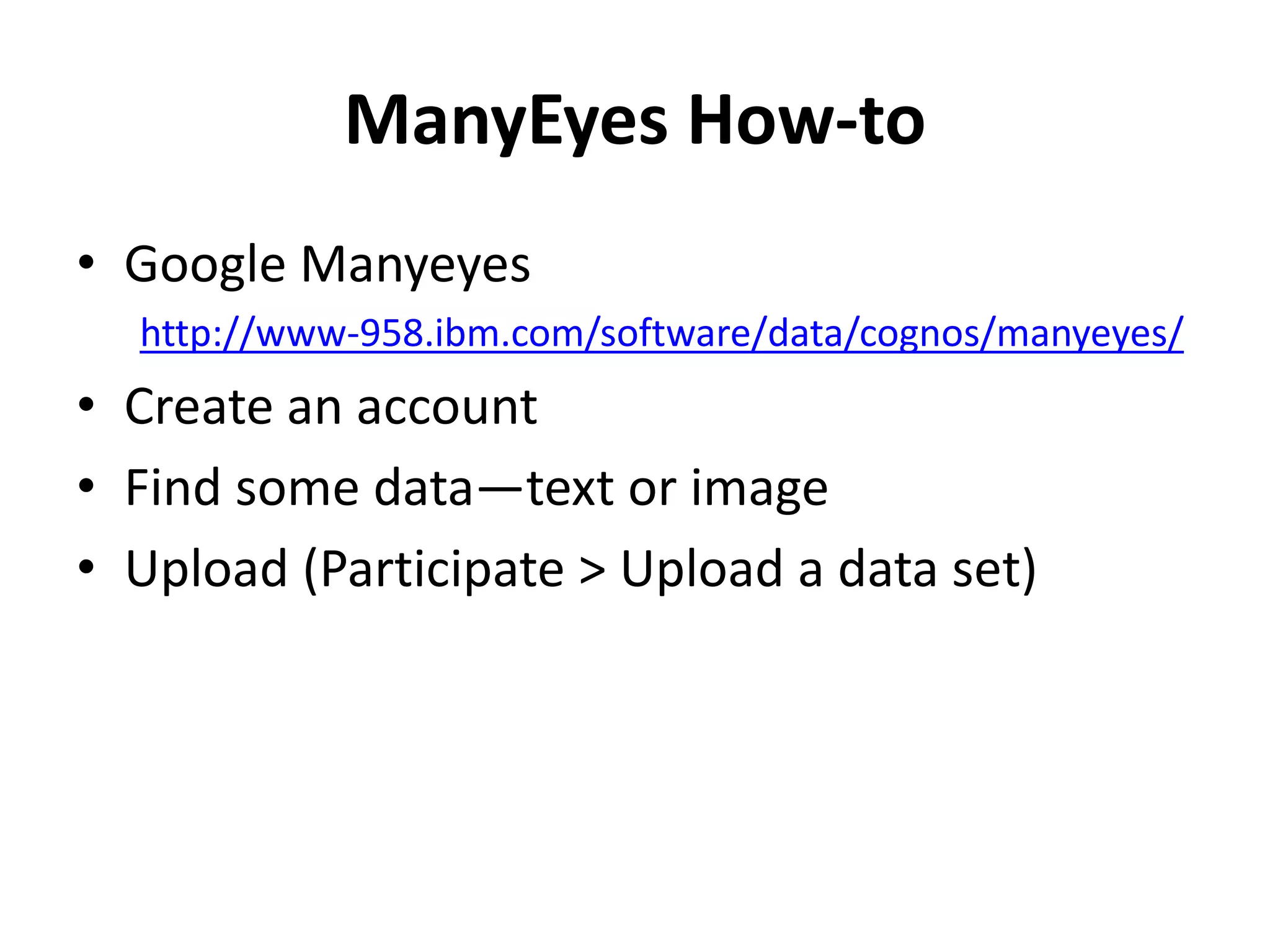
ManyEyes How-to
• Google Manyeyes
http://www-958.ibm.com/software/data/cognos/manyeyes/
• Create an account
• Find some data—text or image
• Upload (Participate > Upload a data set)
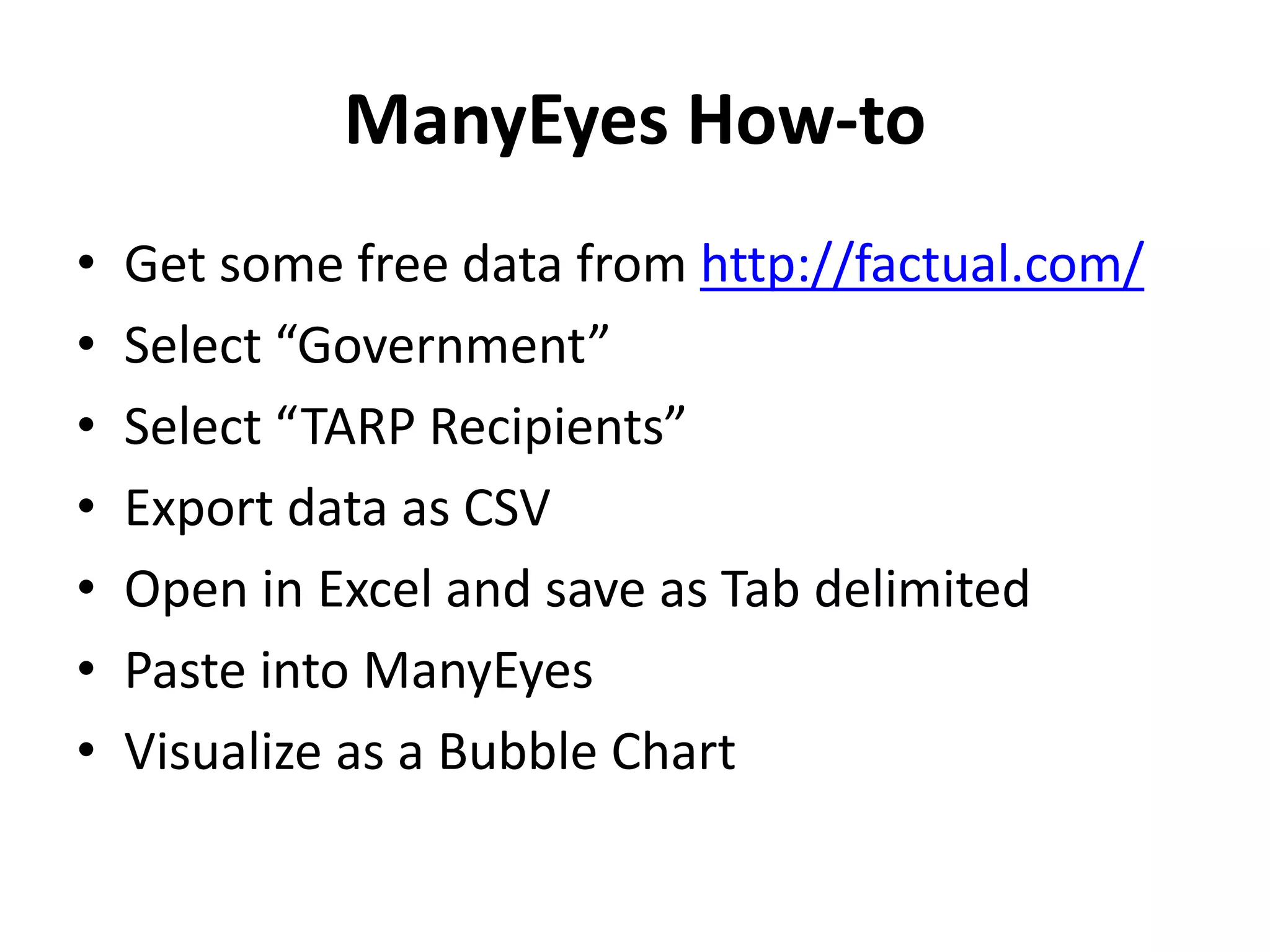
ManyEyes How-to
• Get some free data from http://factual.com/
• Select “Government”
• Select “TARP Recipients”
• Export data as CSV
• Open in Excel and save as Tab delimited
• Paste into ManyEyes
• Visualize as a Bubble Chart

MDST 3703 F10 Studio 12

  • 1.
    Studio 12 GraphViz, Prezi,ManyEyes Introduction to the Digital Liberal Arts MDST 3703 / 7703 Fall 2010
  • 2.
    Business • Last formalstudio – Next week Thanksgiving – Last studio will be an open session • Talk to me if you think you need help
  • 3.
    Review • Effective visualizationrequires visual literacy • Graphesis helps us understand visual literacy • The visual as cultural • The visual as irreducible—as important as the data and content
  • 4.
    Overview Today we exploresome practical tools to develop visualizations We look at three tools for creating visualizations • GraphViz • Prezi • ManyEyes
  • 5.
    GraphViz • Free toolfrom AT&T to create “graphs” – http://www.graphviz.org/ – Good PC and Mac versions • Graph = nodes + links – In math, these are “edges” and “vertices” – Used by Euler to solve the “seven bridges of Konigsburg” problem • GraphViz uses a simple language called DOT – Give it a graph expressed in DOT and it will generate a nice picture using an algorithm
  • 6.
    Is it possibleto walk through the city crossing each of these bridges once and only once? Euler’s Solution: An even number nodes with and odd number of edges means “no” … Let land masses = nodes and bridges = edges
  • 7.
    Graphs can representalmost anything • Social networks • Causal chains of events (e.g. evolution) • Texts, e.g. basic structure and narrative structure • Arguments • The Internet
  • 8.
    The DOT Language A-> B B -> C A -> C
  • 9.
    The DOT Language A[label='foo'] B [label='bar'] C [label='baz'] D [label='boo'] A -> B B -> C B -> D
  • 11.
  • 12.
    The DOT language--Nodes A[label=""Jacob, the Scourge of Grammar, mark with awe,nNor less revere him, Blunderbuss of Law"" style="filled" color="green"] A1 [label=""Jacob"" group="A" shape="ellipse"] A2 [label=""Blunderbussnof Law"" group="A" shape="ellipse"] A3 [label=""Scourge of Grammar"" group="A" shape="ellipse"] B [label="Note 149" shape="record"] C [label="Note 149, 150" shape="record"] D [shape="record" label="Note 150"] E [shape="record" label="II, Note to 226"]
  • 13.
    The DOT language--Edges A-- {A1;A2;A3} A1 -- B A2 -- {C;D} A2 -- I04 [style="dashed"] B -- {B1;B2} B1 -- B3 [style="dashed"] I01 -- B3 [style="dashed"] B3 -- I03 [style="dashed"] I01 -- A3 [style="dashed"] C -- {I02;I08} I02 -- I03 [style="dashed"] I02 -- I06 I06 -- I07 I05 -- I10 [style="dashed"] I08 -- E [style="dashed"] E -- I09 D -- I10
  • 14.
    Try it … •Go to http://ashitani.jp/gv/# – Start typing in the box on the left … • To create your own, use one of these: Mac http://www.pixelglow.com/graphviz/ Win http://wingraphviz.sourceforge.net/wingraphviz/ • Use it to create graphs and then save them as images • Nice tutorial here … http://www.linux.com/archive/feed/49655?theme=print
  • 15.
    Prezi • Creates presentationsbased on graphs • Allows you to throw down ideas and then connect them – Not the PowerPoint sequence of implied order – PPT: worst of both worlds – both linear and non- narrative • Then you “play” them based on the edges you provide
  • 16.
    Prezi How-to • Demovideo http://www.youtube.com/watch?v=pxhqD0hNx4Q • Go to prezi.com and create an account – http://prezi.com • Create a presentation – We’ll do one collaboratively …
  • 17.
    Prezi’s Devices • Nodescan be texts or images or URLs • Nodes can by groups by frames • Nodes can be connected by paths • Narrative flow is accomplished through movement and zooming in and out
  • 18.
    ManyEyes • IBM sitethat lets you create visualizations with data sets – Textual or tabular (i.e. CSV, exported Excel) • A place to find and create data • Tons of very cool visualizations
  • 19.
    ManyEyes How-to • GoogleManyeyes http://www-958.ibm.com/software/data/cognos/manyeyes/ • Create an account • Find some data—text or image • Upload (Participate > Upload a data set)
  • 20.
    ManyEyes How-to • Getsome free data from http://factual.com/ • Select “Government” • Select “TARP Recipients” • Export data as CSV • Open in Excel and save as Tab delimited • Paste into ManyEyes • Visualize as a Bubble Chart

Editor's Notes

  • #7 How does graphesis play into this?