Module 4   Expressions and Flow Control
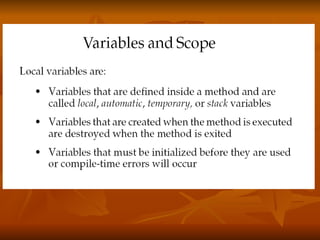
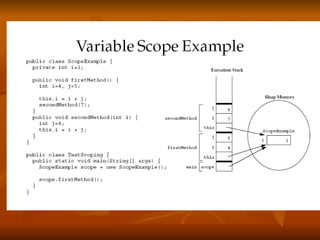
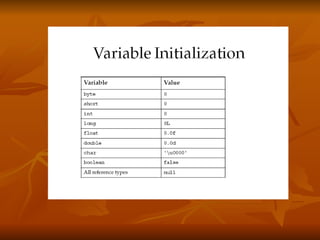
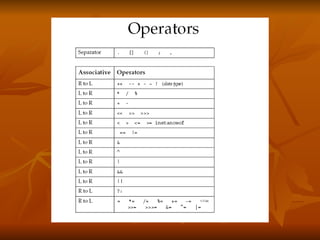
  Objectives   •  Distinguish between instance and local variables •  Describe how instance variables are initialized  •  Identify and correct a possible reference before  assignment compiler error  •  Recognize, describe, and use Java software operators •  Distinguish between legal and illegal assignments of  primitive types
  Objectives •  Identify boolean expressions and their requirements  in control constructs. •  Recognize assignment compatibility and required casts  in fundamental types. •  Use if, switch, for, while, and do constructions  and the labeled forms of break and continue as flow  control structures in a program   


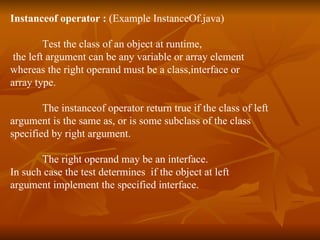
Instanceof operator :  (Example  InstanceOf.java ) Test the class of an object at runtime, the left argument can be any variable or array element  whereas the right operand must be a class,interface or  array type. The instanceof operator return true if the class of left  argument is the same as, or is some subclass of the class  specified by right argument.  The right operand may be an interface.  In such case the test determines  if the object at left  argument implement the specified interface.


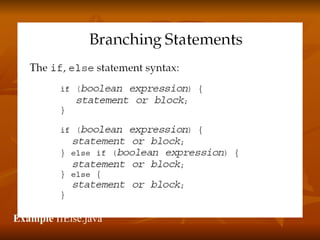
Example  IfElse.java
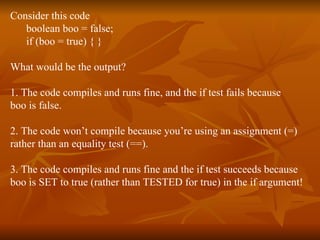
Consider this code boolean boo = false; if (boo = true) { } What would be the output? 1. The code compiles and runs fine, and the if test fails because boo is false. 2. The code won’t compile because you’re using an assignment (=) rather than an equality test (==). 3. The code compiles and runs fine and the if test succeeds because boo is SET to true (rather than TESTED for true) in the if argument!
 
 
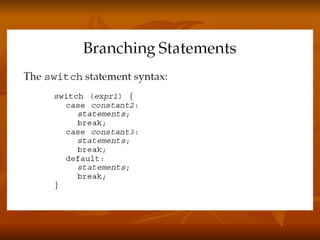
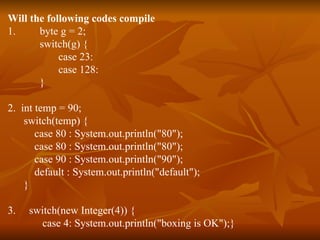
Will the following codes compile 1.  byte g = 2; switch(g) { case 23: case 128: } 2.  int temp = 90; switch(temp) { case 80 : System.out.println("80"); case 80 : System.out.println("80"); case 90 : System.out.println("90"); default : System.out.println("default"); } 3.  switch(new Integer(4)) { case 4: System.out.println("boxing is OK");}
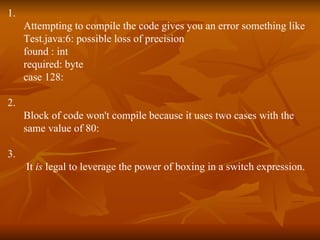
1. Attempting to compile the code gives you an error something like Test.java:6: possible loss of precision found : int required: byte case 128: 2. Block of code won't compile because it uses two cases with the  same value of 80: 3. It  is  legal to leverage the power of boxing in a switch expression.
 
Enhanced for Loop Instead of having  three  components, the enhanced for has  two .  Looping through an array The basic (old) way int [] a = {1,2,3,4}; for(int x = 0; x < a.length; x++) // basic for loop System.out.print(a[x]); Enhanced for for(int n : a) // enhanced for loop System.out.print(n);
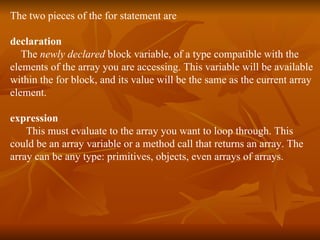
The two pieces of the for statement are declaration  The  newly declared  block variable, of a type compatible with the elements of the array you are accessing. This variable will be available  within the for block, and its value will be the same as the current array  element. expression  This must evaluate to the array you want to loop through. This could be an array variable or a method call that returns an array. The  array can be any type: primitives, objects, even arrays of arrays.


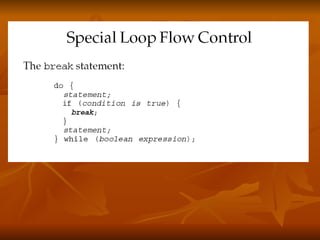
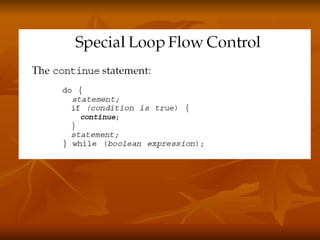
Example class Continue { public static void main(String args[]) { for(int i=0; i<10; i++) { System.out.print(i + &quot; &quot;); if (i%2 == 0) continue; System.out.println(&quot;&quot;); } } }
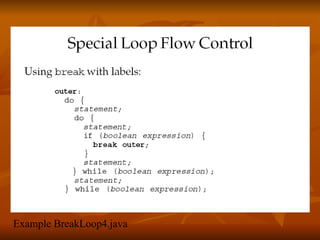
Example BreakLoop4.java
Example class Break { public static void main(String args[]) { boolean t = true; first: { second: { third: { System.out.println(&quot;Before the break.&quot;); if(t) break second; // break out of second block System.out.println(&quot;This won't execute&quot;); } System.out.println(&quot;This won't execute&quot;); } System.out.println(&quot;This is after second block.&quot;); } } }
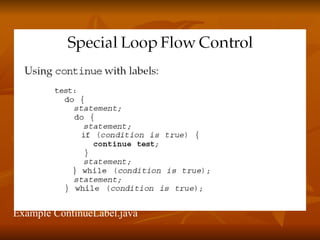
Example ContinueLabel.java

Md04 flow control

  • 1.
    Module4 Expressions and Flow Control
  • 2.
    Objectives • Distinguish between instance and local variables • Describe how instance variables are initialized • Identify and correct a possible reference before assignment compiler error • Recognize, describe, and use Java software operators • Distinguish between legal and illegal assignments of primitive types
  • 3.
    Objectives• Identify boolean expressions and their requirements in control constructs. • Recognize assignment compatibility and required casts in fundamental types. • Use if, switch, for, while, and do constructions and the labeled forms of break and continue as flow control structures in a program  
  • 4.
  • 5.
  • 6.
  • 7.
  • 8.
  • 9.
  • 10.
  • 11.
  • 12.
  • 13.
    Instanceof operator : (Example InstanceOf.java ) Test the class of an object at runtime, the left argument can be any variable or array element whereas the right operand must be a class,interface or array type. The instanceof operator return true if the class of left argument is the same as, or is some subclass of the class specified by right argument. The right operand may be an interface. In such case the test determines if the object at left argument implement the specified interface.
  • 14.
  • 15.
  • 16.
  • 17.
  • 18.
    Consider this codeboolean boo = false; if (boo = true) { } What would be the output? 1. The code compiles and runs fine, and the if test fails because boo is false. 2. The code won’t compile because you’re using an assignment (=) rather than an equality test (==). 3. The code compiles and runs fine and the if test succeeds because boo is SET to true (rather than TESTED for true) in the if argument!
  • 19.
  • 20.
  • 21.
    Will the followingcodes compile 1. byte g = 2; switch(g) { case 23: case 128: } 2. int temp = 90; switch(temp) { case 80 : System.out.println(&quot;80&quot;); case 80 : System.out.println(&quot;80&quot;); case 90 : System.out.println(&quot;90&quot;); default : System.out.println(&quot;default&quot;); } 3. switch(new Integer(4)) { case 4: System.out.println(&quot;boxing is OK&quot;);}
  • 22.
    1. Attempting tocompile the code gives you an error something like Test.java:6: possible loss of precision found : int required: byte case 128: 2. Block of code won't compile because it uses two cases with the same value of 80: 3. It is legal to leverage the power of boxing in a switch expression.
  • 23.
  • 24.
    Enhanced for LoopInstead of having three components, the enhanced for has two . Looping through an array The basic (old) way int [] a = {1,2,3,4}; for(int x = 0; x < a.length; x++) // basic for loop System.out.print(a[x]); Enhanced for for(int n : a) // enhanced for loop System.out.print(n);
  • 25.
    The two piecesof the for statement are declaration The newly declared block variable, of a type compatible with the elements of the array you are accessing. This variable will be available within the for block, and its value will be the same as the current array element. expression This must evaluate to the array you want to loop through. This could be an array variable or a method call that returns an array. The array can be any type: primitives, objects, even arrays of arrays.
  • 26.
  • 27.
  • 28.
  • 29.
  • 30.
  • 31.
    Example class Continue{ public static void main(String args[]) { for(int i=0; i<10; i++) { System.out.print(i + &quot; &quot;); if (i%2 == 0) continue; System.out.println(&quot;&quot;); } } }
  • 32.
  • 33.
    Example class Break{ public static void main(String args[]) { boolean t = true; first: { second: { third: { System.out.println(&quot;Before the break.&quot;); if(t) break second; // break out of second block System.out.println(&quot;This won't execute&quot;); } System.out.println(&quot;This won't execute&quot;); } System.out.println(&quot;This is after second block.&quot;); } } }
  • 34.